L ' A C C E S A L ' E S P A C ECISEAUXARTICULEES TELESCOPIQUESMATS TRACTEES
I S O 9 0 01
PINGUELY HAULOTTE • LA PERONNIERE - BP 9 - 42152 L'HORME • Tél. +33 (0) 4 77 29 24 24 • Fax SAV +33 (0) 4 77 31 28 11
email haulotte@haulotte.com • Web www.haulotte.com
REPAIR MANUAL
SELF-PROPELLED SCISSOR PLATFORM
242 031 8680 - E 05.05 GB
Distribué par / Distributed by/ Distribuito da
Haulotte France
Tél / Phone +33 (0)4 72 88 05 70
Fax / Fax +33 (0)4 72 88 01 43
Centre Mondial Pièces de Rechange
Spare Parts International Centre
Tél / Phone +33 (0)4 77 29 24 51
Fax / Fax +33 (0)4 77 29 98 88
Haulotte Hubarbeitsbühnen
Tél / Phone + 49 76 33 806 920
Fax / Fax + 49 76 33 806 82 18
Haulotte Portugal
Tél / Phone + 351 21 955 98 10
Fax / Fax + 351 21 995 98 19
Haulotte UK
Tél / Phone + 44 (0) 1952 292753
Fax / Fax² + 44 (0) 1952 292758
Haulotte U.S. Inc.
Main tool free 1-877-HAULOTTE
Service tool free 1-877-HAULOT-S
Haulotte Asia
Tél / Phone + 65 6536 3989
Fax / Fax + 65 6536 3969
Haulotte Netherlands BV
Tél / Phone + 31 162 670 707
Fax / Fax + 31 162 670 710
Haulotte Australia PTY Ltd
Tél / Phone + 61 3 9706 6787
Fax / Fax + 61 3 9706 6797
Haulotte Italia
Tél / Phone + 39 05 17 80 813
Fax / Fax + 39 05 16 05 33 28
Haulotte Do Brazil
Tél / Phone + 55 11 3026 9177
Fax / Fax + 55 3026 9178
Haulotte Scandinavia AB u.b.
Tél / Phone + 46 31 744 32 90
Fax / Fax + 46 31 744 32 99
Haulotte Iberica - Madrid
Tél / Phone + 34 91 656 97 77
Fax / Fax + 34 91 656 97 81
Haulotte Iberica - Sevilla
Tél / Phone + 34 95 493 44 75
Fax / Fax + 34 95 463 69 44
Repair manual 1
1
Caution!
GENERAL
This manual gives the information required for you to perform servicing and repair
operations on certain pieces of equipment yourself.
However, we would like to bring your attention to the importance of:
• respecting the safety instructions concerning the machine itself, its use and
its environment,
• use within the limits of its performance,
• correct servicing to ensure long service life.
During and after the guarantee period, our After-Sales service is available to
perform any servicing operations you may require.
In this case, contact our local agency or our Plant After-Sales service, specifying
the exact type of machine and its serial number.
To order consumables or spare parts, use the "Instructions for use and
maintenace" manual and the "Spare parts" catalogue to order original parts, the
only guarantee of interchangability and perfect operation.
REMINDER:We would like to remind you that our machines comply with the
clauses of the "Machines Directive", 89/392/CEE, dated June 14th
1989, modified by directives 91/368/CEE, dated June 21st 1991, 93/
44/CEE, dated June 14th 1993, 93/68/CEE (98/37/CE) dated July
22nd 1993 and 89/336 CEE, dated May 3rd 1989; to directive 2000/
14/CE and directive EMC/89/336/CE.
The technical data in this
manual is not binding and we
reserve the right to make
improvements or
modifications without altering
this manual.
1 Repair manual
2
Repair Manual
i
SUMMARY
GENERAL.................................................................................................................... 1
1 - GENERAL RECOMMENDATIONS - SAFETY ............................................................ 5
1.1 - GENERAL WARNING ................................................................................................. 5
1.2 - GENERAL SAFETY RECOMMENDATIONS .............................................................. 6
1.3 - RESIDUAL RISKS....................................................................................................... 7
1.4 - VERIFICATIONS ......................................................................................................... 8
1.5 - REPAIRS AND ADJUSTMENTS................................................................................. 9
1.6 - VERIFICATIONS BEFORE RESTARTING WORK..................................................... 9
1.7 - BEAUFORT SCALE .................................................................................................... 9
2 - SPECIFICATION........................................................................................................ 11
2.1 - TECHNICAL CHARACTERISTICS ........................................................................... 12
2.2 - SIZE........................................................................................................................... 13
2.3 - TIGHTENING TORQUE ............................................................................................ 14
2.4 - PRESSURE TABLES (IN BARS) .............................................................................. 15
2.5 - ADJUSTEMENT TIMES TABLE................................................................................ 15
3 - WIRING DIAGRAM.................................................................................................... 17
3.1 - WIRING DIAGRAM E 591A (PRESSURE SWITCH VERSION) ............................... 18
3.2 - WIRING DIAGRAM E591A : WEIGHING CARD VERSION...................................... 20
4 - ELECTRIC COMPONENTS’ DESCRIPTION ............................................................ 23
4.1 - CHASSIS CONTROL POST...................................................................................... 23
4.2 - PLATFORM CONTROL POST EQUIPMENT ........................................................... 24
4.3 - SOLENOID VALVES ................................................................................................. 24
Repair Manual
ii
4.4 - END OF TRAVEL SWITCHES CHART .....................................................................25
4.5 - SERIAL CARD ...........................................................................................................25
4.6 - MDI.............................................................................................................................26
4.7 - USING THE ON-BOARD CHARGER ........................................................................27
4.8 - CHOPPER .................................................................................................................28
5 - HYDRAULIC DIAGRAM.............................................................................................29
5.1 - HYDRAULIC DIAGRAM FOR OPTIMUM 6 AND 8 (B16288B) MODEL....................29
5.2 - HYDRAULIC INSTALLATION DIAGRAM A14681D ..................................................30
6 - DESCRIPTION OF THE HYDRAULIC CIRCUIT........................................................33
6.1 - HYDRAULIC BLOCK’S COMPONENTS ...................................................................33
6.2 - MK4 HYDRAULIC BLOCK SPECIFICATIONS..........................................................35
6.3 - HYDRAULIC FUNCTIONING ....................................................................................39
7 - MAINTENANCE..........................................................................................................45
7.1 - GENERAL RECOMMENDATIONS............................................................................45
7.2 - MAINTENANCE DEVICE...........................................................................................45
7.3 - ELECTRICITY SUPPLY.............................................................................................46
7.4 - MAINTENANCE PLAN...............................................................................................46
7.5 - OPERATIONS............................................................................................................48
7.6 - PRESENCE OF LABELS...........................................................................................49
7.7 - PRESENCE OF MANUALS .......................................................................................49
8 - PREVENTIVE MAINTENANCE SHEETS ..................................................................51
9 - OPERATING INCIDENTS ..........................................................................................61
9.1 - TABLE OF INCIDENTS .............................................................................................61
9.2 - FAILURE DETECTION FLOW CHARTS ...................................................................67
Repair Manual
iii
10 - CORRECTIVE MAINTENANCE PROCEDURES .................................................... 105
Repair Manual
iv
Repair manual 3
5
Caution!
1 - GENERAL RECOMMENDATIONS - SAFETY
1.1 - GENERAL WARNING
1.1.1 - Manual
This manual aims to help maintenance personnel service and repair the machine.
It cannot, however, replace the basic training required by any person working on
the site equipment.
The site manager must inform operators of the recommendations in the
instruction manual. He is also responsible for application of current "user
regulations" in the country of use.
Before operating on the machine, it is essential to be familiar with all the
recommendations in this manual and the user manual to ensure personnel and
equipment safety.
1.1.2 - Labels
Potential dangers and recommendations for the machine are indicated on labels
and plates. Read the instructions on them.
All labels conform to the following colour code:
• Red indicates a potentially fatal danger.
• Orange indicates a danger that may cause serious injury.
• Yellow indicates a danger that may cause material damage or slight injury.
Maintenance pesrsonnel must ensure that these labels and plates are in good
conditions and keep them legible. Spare labels and plates can be supplied by the
manufacturer on request.
1.1.3 - Safety
Ensure that any person entrusted with the machine is take the safety measures
implied by its use.
Avoid any working mode that may affect safety. Any use that does not comply with
the recommendations may generate risks and damage to people and equipment.
After intervention, maintenance personnel must check that the operator manual
is present. This must be kept by the user throughout the machine’s service life,
even if it is loaned, rented or sold.
Ensure that all the plates or labels related to safety and danger are complete and
legible.
To attract the reader’s
attention, instructions are
indicated by this
standardised sign.
3 Repair manual
6
Caution!
1.2 - GENERAL SAFETY RECOMMENDATIONS
1.2.1 - Operators
Operators must be aged 18 or over and hold an operating permit issued by the
employer after verification of medical aptitude and the practical platform operation
test.
Only trained operators may
use Haulotte self-propelled
platforms.
There must be at least two operators present, so that one of them can:
• intervene rapidly if necessary,
• take over the controls in the case of accident or breakdown,
• monitor and prevent machines or people from circulating around the plat-
form,
• guide the platform operator if necessary.
1.2.2 - Environment
Never use the machine:
• On soft, unstable or cluttered floors.
• On a floor with a tilt greater than the allowed limit.
• With a windspeed above the permitted level. In case of outdoor use, check
that windspeed is lower or equal to the permitted level using an anemome-
ter.
• Near electric lines (find out about minimum distances according to current).
In temperatures of less than -15°C (in particular, in cold rooms); consult our
service department if work is required in conditions below -15°C.
• In an explosive atmosphere.
• In an incorrectly ventilated area, as exhaust fumes are toxic.
• During storms (risk of being struck by lightning).
• At night if the machine is not equipped with an optional light.
• In the presence of intense electromagnetic fields (radar, mobile and high
current).
DO NOT DRIVE ON THE PUBLIC HIGHWAY.
1.2.3 - Using the machine
It is important to ensure that in normal use, i.e. platform operation, the platform
station selection key remains in the the platform position to enable control of the
machine from the platform. If a problem occurs on the platform, a person present
and trained in emergency/standby manoeuvres can help by putting the key in the
ground control position.
Never use the machine with:
• a load greater than the nominal load,
• more people than the authorised number,
• lateral force in the platform greater than the level permitted,
• wind speed higher than the permitted level.
Repair manual 3
7
Caution!
To avoid all risk of serious fall, operators must respect the following instructions:
• Hold the hand rails firmly when climbing onto or operating the platform.
• Wipe any traces of oil or grease off the steps, floor and hand rails.
• Wear protective clothing suited to working conditions and current local legis-
lation, in particular when working in hazardous areas.
• Do not disable the safety system end of stroke contactors.
• Avoid contact with fixed or mobile obstacles.
• Do not increase working height by using ladders or other accessories.
• Never use the hand rails as a means of access for getting onto and off the
platform (use the steps provided on the machine).
• Never climb on the hand rails when the platform is raised.
• Never drive the platform at high speed in narrow or cluttered areas.
• Never use the machine without installing the platform protective bar or clo-
sing the safety barrier.
• Never climb on the covers.
Never use the platform as a
crane, goods lift or elevator.
Never use the platform or tow
or haul.
To avoid risks of tipping over, operators must respect the following instructions:
• Do not disable the safety system end of stroke contactors.
• Avoid moving the steering control levers in the opposite direction, without
stopping in the "O" position (to stop during a travel manoeuvre, move the
manipulator lever gradually).
• Respect maximum load and maximum number of people authorised on the
platform.
• Distribute the load evenly and place in the centre of the platform if possible.
• Check that the floor resists the pressure and load per wheel.
• Avoid contact with fixed or mobile obstacles.
• Do not drive the platform at high speed in narrow or cluttered areas.
• Do not drive the platform in reverse (inadequate visibility).
• Do not use the machine if the platform is cluttered.
• Do not use the machine with equipment or objects hanging from the hand
rails.
• Do not use the machine with elements that may increase the wind load (e.g.
panels).
• Do not perform machine maintenance operations when the machine is
raised without setting up the required safety means (gantry crane, crane).
• Make daily checks and monitor proper operation during periods of use.
• Preserve the machine from any uncontrolled operation when it is not in ser-
vice.
NB: Do not tow the platform (it is not designed to be towed and must be
transported on a trailer).
1.3 - RESIDUAL RISKS
1.3.1 - Risks of jolting - tipping over
The risks of jolting or tipping over are high in the following situations:
- sudden action on the control levers,
- platform overload,
- uneven floor (pay attention to thaw periods in winter),
- gusts of wind,
- contact with obstacles on the ground or in the air,
- working on quays, pavements, etc.
Allow sufficient stopping distances:
- 3 metres at high speed,
- 1 metre at low speed.
3 Repair manual
8
Caution!
1.3.2 - Electric risks
If the machihe has a 220 V
plug, with max. 16A, the
extension must be connected
to a mains socket protected
by a 30mA differential circuit
breaker.
Electric risks are high in the following situations:
- contact with a live line,
- use during stormy weather.
1.3.3 - Risks of explosion or burning
The risks of explosion or burning are high in the following situations:
- work in an explosive or inflammable atmosphere,
- filling the fuel tank near a naked flame,
- contact with the hot parts of the motor,
- use of a machine with hydraulic leaks.
1.3.4 - Risks of collision
- Risks of crushing people present in the machine’s movement area (travel
or when manoeuvring the equipment).
- The operator must assess any overhead risks before use.
1.4 - VERIFICATIONS
Comply with current national legislation in the country of use.
In FRANCE: Order dated June 9th 1993 + circular DRT 93-22 dated September
1993, specifying:
1.4.1 - Regular checks
The devices must be regularly inspected every 6 months to detect any defect
liable to cause an accident.
These inspections are to be carried out by an organisation or person specially
appointed by the site manager and under his responsibility (company personnel
or otherwise) Articles R 233-5 and R 233-11 of the Labour Code.
The result of these inspections is recorded in a safety register updated by the site
manager and constantly available to the Works Inspector and the company’s
safety committee, if any, and the list of specially appointed personnel (Article R
233-5 of the Labour Code).
NB: This register can be obtained from professional organisations and
for some, from the OPPBTP or private prevention organisations.
The appointed people must be experienced in the field of risk prevention (Article
R 233-11 of decree no. 93-41).
It is forbidden to allow anyone to perform any checks during machine operation
(Article R 233-11 of the Labour Code).
1.4.2 - Examination of device suitability
The manager of the site on which the equipment is used must ensure that the
machine is suitable, i.e. appropriate to the work to be carried out safely and that
it is used in accordance with the instruction manual. Moreover, the French order,
dated June 9th 1993, refers to problems asosciated with rental, examination of
the condition, verifications before starting work after repair, and conditions of
static test coefficient 1.25 and dynamic test coefficient 1.1. All responsible users
should find out about and respect the requirements of this decree.
1.4.3 - Condition
Detect any deterioration liable to cause dangerous situations (safety devices,
load limiters, tilt detector, cylinder leaks, deformation, weld condition, tightness of
bolts, hoses and electric connections, tyre condition, excessive mechanical play).
Repair manual 3
9
NB: In the case of rental, responsible users of the rented machine must
examine the condition and check suitability. They must check with
the rental company that the general regular checks and checks be-
fore starting work have been performed.
1.5 - REPAIRS AND ADJUSTMENTS
Major repairs, interventions or adjustments on the safety systems or elements
(concerning mechanical, hydraulic and electric systems) must be carried out by
PINGUELY-HAULOTTE personnel or personnel working on behalf of
PINGUELY-HAULOTTE, who will only use original spare parts.
Any modification outside PINGUELY-HAULOTTE’s control is unauthorised.
The manufacturer is not responsible if original spare parts are not used or if the
work specified above is not performed by PINGUELY-HAULOTTE approved
personnel.
1.6 - VERIFICATIONS BEFORE RESTARTING WORK
To be performed after:
• major dismantling-reassembly operations,
• repair of the machine’s essential devices,
• any accident caused by failure of an essential device.
A suitability examination, examination of the condition, static test and dynamic
test must all be carried out (see coefficient paragraph 1.4.2, page 8).
1.7 - BEAUFORT SCALE
The Beaufort Scale of wind force is accepted internationally and is used when
communicating weather conditions. It consists of number 0 - 17, each
representing a certain strength or velocity of wind at 10m (33 ft) above ground
level in the open.
Description of Wind Specifications for use on land MPH m/s
0 Calm Calm; smoke rises vertically. 0-1 0-0.2
1 Light Air Direction of wind shown by smoke. 1-5 0.3-1.5
2 Light Breeze Wind felt on face; leaves rustle; ordinary vanes moved by
wind.
6-11 1.6-3.3
3 Gentle Breeze Leaves and small twigs in constant motion; wind extends
light flag.
12-19 3.4-5.4
4 Moderate Breeze Raises dust and loose paper; small Branches are moved. 20-28 5.5-7.9
5 Fresh Breeze Small trees in leaf begin to sway; crested wavelets form
on inland waterways.
29-38 8.0-10.7
6 Strong Breeze Large branches in motion; whistling heard in telephone
wires; umbrellas used with difficulty.
39-49 10.8-
13.8
7 Near Gale Whole trees in motion; inconvenience felt when walking
against wind.
50-61 13.9-
17.1
8 Gale Breaks twigs off trees; generally impedes progress. 62-74 17.2-
20.7
9 Strong Gale Slight structural damage occurs (chimney pots and slates
removed).
75-88 20.8-
24.4
3 Repair manual
10
Repair manual 3
11
2 - SPECIFICATION
Self-propelled platforms, models Optimum 6 and 8, are designed for any
overhead work within the limits of their characteristics (see paragraph 2.1,
page 12) and within the respect of all safety instructions specific to the equipment
and places of use.
The main operating station is on the platform.
The operating station from the chassis is a standby or emergency station.
REMINDER:For any information, intervention of spare part requests, please spe-
cify the machine type and serial number.
3 Repair manual
12
2.1 - TECHNICAL CHARACTERISTICS
Description Optimum 6 Optimum 8
Load
270 kg including
2 people
(Inside use)
115 kg including
1 people
(outside use)
230 kg including 2 people
(Inside use)
Manual lateral force 40 daN 20 daN 40 daN
Maximum wind speed 0 Km/h 45 Km/h 0 Km/h
Floor height 4.5 m 5.8 m
Working height 6.3 m 7.6 m
Folded length with steps 1.88 m
Overall width 0.76 m
Folded height (safety barrier) 1.90 m 1.99 m
Folded height (platform) 0.79 m 0.87 m
Wheelbase 1.38 m
Floor clearance 80 mm
Floor clearance with Pot Hole in use 14 mm
Platform dimension 1.73 m x 0.68 m
Extension dimension 0.92 m
Extension capacity 115 Kg
Travel speed with machine folded 0/4.5 km/h
Travel speed with machine lifted 0/0.6 km/h
Internal turning radius 0,4 m 0,4 m
External turning radius 1,8 m
Maximum slope in travel 25%
Maximum tilt allowed 2°
Hydraulic tank 20 l
Total mass 1335 Kg 1420 Kg
Maximum load on one wheel 605 daN 750 daN
Maximum floor pressure 14,9 daN/cm2 17,8 daN/cm2
Number of drive wheels 2 2
Number of steering wheels 2 2
Tyres Non-marking - Solid rubber
Wheel diameter 317 mm
Free wheel YES
Movements proportional control
Batteries 24 V - 180 Amp/h C5
General hydraulic pressure
Travel
Steering
230 bars
230 bars
100 bars
Lifting 110 bars 130 bars
Lifting time 20 s 23 s
Lowering time 35 s 32 s
CE standards YES
Repair manual 3
13
2.2 - SIZE
2.2.1 - Optimum 6 size
2.2.2 - Optimum 8 size
1839
1380
90
785
1900
760
700
1839
760
700
875
1990
90
1380
3 Repair manual
14
2.3 - TIGHTENING TORQUE
2.3.1 - Tightening torque for large thread screws
2.3.2 - Tightening torque for fine thread screws
2.3.3 - Recommended torques
Nominal diameter
Tightening torque in N.M
8.8 10.9 12.9
M 6*1 9 to 11 13 to 14 15 to 17
M 7*1 15 to 19 21 to 24 26 to 28
M 8*1.25 22 to 27 31 to 34 37 to 41
M 10*1.5 43 to 45 61 to 67 73 to 81
M 12*1.75 75 to 94 110 to 120 130 to 140
M 14*2 120 to 150 170 to 190 200 to 220
M 16*2 190 to 230 260 to 290 320 to 350
M 18*2.5 260 to 320 360 to 400 440 to 480
M 20*2.5 370 to 450 520 to 570 620 to 680
M 22*2.5 500 to 620 700 to 770 840 to 930
M 24.3*3 630 to 790 890 to 990 1070 to 1180
M 27*3 930 to 1150 1300 to 1400 1560 to 1730
M 30*3.5 1260 to 1570 1770 to 1960 2200 to 2350
Nominal diameter
Tightening torque in N.M
8.8 10.9 12.9
M 8*1 24 to 29 33 to 37 40 to 44
M 10*1.25 46 to 57 64 to 71 77 to 85
M 12*1.25 83 to 100 120 to 130 140 to 150
M 14*1.5 130 to 160 180 to 200 220 to 240
M 16*1.5 200 to 250 280 to 310 340 to 370
M 18*1.5 290 to 360 410 to 450 490 to 540
M 20*1.5 410 to 510 570 to 630 690 to 760
M 22*1.5 550 to 680 780 to 870 920 to 1000
M 24*1.5 690 to 860 970 to 1070 1160 to 1290
M 27*2 1000 to 1300 1400 to 1560 1690 to 1880
M 30*2 1400 to 1700 1960 to 2180 2350 to 2610
Component Tightening torques in N.M
Brakes 90 N.m
Hydraulic motors 90 N.m
Wheels 250 N.m
Repair manual 3
15
2.4 - PRESSURE TABLES (IN BARS)
Margin: +/-10%. The lifting pressure is adjusted according to the actual load.
2.5 - ADJUSTEMENT TIMES TABLE
Machine Useful load Useful load + 10% Main pressure
Steering
pressure
Optimum 6
Outdoor use: 115 Kg
Indoor use: 270 Kg
Outdoor use: 132 Kg
Indoor use: 292 Kg
230 bars 100 bars
Optimum 8
Outdoor use: forbidden
Indoor use: 230 Kg
Outdoor use: forbidden
Indoor use: 253 Kg
230 bars 100 bars
Movement
Movement duration
Optimum 6 Optimum 8
Travel - Slow speed 16 s +/-2s for 10m
Travel - High speed 8s +/- 2s for 10m
Travel - Micro speed 87 s +/- 19s for 10m
Steering - right and left 5 to 6 s
Raising 21s +/-3s 23s +/- 3s
Lowering 37s +/- 5s 29s +/- 5s
3 Repair manual
16
Repair manual 3
17
3 - WIRING DIAGRAM
3 Repair manual
18
3.1 - WIRING DIAGRAM E 591A (PRESSURE SWITCH VERSION)
123456789101112131415161718192021
A
B
C
D
E
F
G
H
I
J
K
L
M
01
VISAMODIFICATIONINDDATE
COMPACT8-8W-10N-10-12&OPTIMUM6-8
PINGUELY-HAULOTTE
LaPØronnire
BP9
42152L’HORME
DATEDECREATION
DATEDEVERIFICATION
DESSINEPAR
VERIFIEPAR
LaurentDIFLORIO
FrØdØricDENEZE
12-09-2003
12-09-2003
3
NBRETOTALDEFOLIOS
TEL:0477292424
E591
SCHEMAPRES
a12-09-2003VoyPesageLDF
B+
VMNP
B-
Devers
Lift
Lower
Overload
Main Contactor
GV
Klaxon
Homme mort
Hors neutre
Consigne
Direction
Bottom
Hight
10 meters cut C12
indicateur
SM1
Lift
Lower > SQ1
Forward
Reverse
HS
Right Steering
Left Steering
LS-HS
Lower
Lower C12
TONSA1
3031323323
MDI
3629242527383726132
C4
21
B12B1A9B5B13
1210987162019183175
C2B-
B4B2
17
11
C1B+
42
4
(1)
(2)
(4)
(3)(7)(5)(6)
10A
300A
10A
rch
110V-220V
U
16
U2
U1
PT1
U1
10A
RCH
A7A6
9
13
Mvt
21653
HS
640
Free
Tilt
MontØe
Descente
Surcharge
Bas
Haut
Coupure 10m C12
Libre
Contacteur
MontØe
MAV
MAR
GV
GV
Descente > SQ1
Gauche
Droite
PV-GV
Descente
Descente C12
indicator
Horn
HS
Cursor
Deadman
Null position
Steering
34
PF/CH
Overload Light
Emergency Stop
Alarm
Alarme
AU
Voyant Surcharge
Pothole
(8)
(9)
Option phare de travail
Working light option
Option feu Øclats
Flashing light option
BUZZER
416
1011514136
2
62
79 28
100
60
59
32
101
9
9
36
11
100
9
106
5
96
11
8
1
11
35
100
44
3
11
58
34
34
9
15
100
9
10
10
1
1
11
3
4
1
6
38
11
11
11
45
12
29
22
14
43
43
100
1111
11
11
34
36
61
7
9
19
20
7779
23
24
30
46
7
25
50
42
7
77
38
47
6
49
48
59 100
9
100
59
21
36
100
100
18
11
11
37
39
35
51
40
41
52
33
11
6
6
6
58
58
26
27
9
9
100
101
9
9
100
3
3
54
54
9
9 9
44
31
8
8
99
9
FU3
SQ6
SB2
GB1
YV2a
FU1
YV1
HL5
FU2
HL4
HL2
SA4
FU4
HL3
YV2bYV8
HA1
HL6
SQ3
YV7YV3YV5b
SB1
SQ1
SQ10
YV6
SQ5
YV4
HL1
YV5a
SQ4
YV9
SB3
HM
M1
P1
KA1
SA3
SB1a
SA2
GD
(01-9)
SB1
(01-2)
KA1
(01-12)
(01-3)
(01-11)
(01-8)
Repair manual 3
19
3.1.1 - Electric components : pressure switch version
Component Description
FU1 Power fuse
FU2 Chopper output protective fuse
FU3 Controls protective fuset
FU4 Working light protective fuse
GB1 Battery
HA1 Buzzer
HL1 Situation light indicator
HL2 Flashing light
HL3 Working light
HL4 Lifting light indicator
HL5 Machine travel light indicator
HL6 Weighing light indicator
M1 Motorpump unit
PT1 M.D.I display
RCH Battery charger relay
SA1 Control post selection
SA2 Movement selection
SA3 Platform travel / lifting selection
SA4 Working light switch
SB1 Battery cut-off / Emergency stop (chassis)
SB2 Emergency stop (platform)
SB3 Buzzer control
SM1 Manipulator
SP1 Pressure switch
SQ1 Low position contactor
SQ10 Tilt sensor
SQ3 Top position contactor
SQ4 Travel interruption switch
SQ5/SQ6 Pothole system out
U Battery charger
U1 Electronic chopper
U2 Serial card
YV Electrovalve
3 Repair manual
20
3.2 - WIRING DIAGRAM E591A : WEIGHING CARD VERSION
123456789101112131415161718192021
A
B
C
D
E
F
G
H
I
J
K
L
M
01
VISAMODIFICATIONINDDATE
COMPACT8-8W-10N-10-12&OPTIMUM6-8
PINGUELY-HAULOTTE
LaPØronnire
BP9
42152L’HORME
DATEDECREATION
DATEDEVERIFICATION
DESSINEPAR
VERIFIEPAR
LaurentDIFLORIO
FrØdØricDENEZE
12-09-2003
12-09-2003
3
NBRETOTALDEFOLIOS
TEL:0477292424
E591
SCHEMAEUR
a12-09-2003VoyPesageLDF
B+
VMNP
B-
Devers
Lift
Lower
Overload
Main Contactor
GV
Klaxon
Homme mort
Hors neutre
Consigne
Direction
Bottom
Hight
10 meters cut C12
indicateur
SM1
Lift
Lower > SQ1
Forward
Reverse
HS
Right Steering
Left Steering
LS-HS
Lower
Lower C12
TONSA1
3031323323
MDI
3629242527383726132
C4
21
B12B1A9B5B13
1210987162019183175
C2B-
B4B2
17
11
C1B+
42
4
(1)
(2)
(4)
(3)(7)(5)(6)
10A
300A
10A
rch
220V-110V
U
16
U2
U1
PT1
U1
10A
RCH
A7A6
111095
413
141
16
36
Mvt
21653
HS
640
Free
Tilt
MontØe
Descente
Surcharge
Bas
Haut
Coupure 10m C12
Libre
Contacteur
MontØe
MAV
MAR
GV
GV
Descente > SQ1
Gauche
Droite
PV-GV
Descente
Descente C12
indicator
Horn
HS
Cursor
Deadman
Null position
Steering
34
PF/CH
Weighing Light
Emergency Stop
Alarm
Alarme
AU
Voyant Pesage
J15.3
J11.1
J11.3
J9.2J9.3
CARTEPESAGE
J4.1
J4.2
Pothole
J4.4
J4.3
J4.6
J4.5
J10.3
(8)
(9)
WEIGHINGCARDU3
Option phare de travail
Working light option
Option feu Øclats
Flashing light option
BUZZER
7
31
7
8
911
58
34
11
9
7
9
100
15
100
9
11
34
9
106
8
11
3
9
1
9
6
6
11
6
36
11
11
45
12
11
7
29
10
22
14
43
9
18
101
386
34
100
61
7
54
7
19
20
77
23
24
30
46
36
25
11
50
42
384
100
43
7
6
1
38
47
6
49
48
59
5
10059
9
11
100
21
59
100
100
100 100
18
11
60
11
11
8
11
38
37
39
35
51
40
41
52
35
58
33
10
62 58
26
26
9
27
9
381
382
9
100
101
9
44
4
100
2 3
1
18
54
26
100
9
6
387
388
9 9
31
28
28
386
11
32
44
9
9
387
9
G
YV8
FU2
YV1YV2aYV2bYV3
FU4
YV9YV4
A1
G1
SB1a
SQ6
SQ5
SQ4
HL6
HA1
(01-8)
(01-11)
KA1
(01-2)
KA1
(01-3)
(01-12)
SQ1
SQ3
HL1
12
SQ7
SQ8
GB1
M1
FU1
SB1
(01-9)
FU3
SA4
HL2HL3
SB2
SB3HL4
HL5
SA2
SQ10
YV7YV6YV5bYV5a
SA3
GD
HM
SB1
Repair manual 3
21
3.2.1 - Electric components : weighing card version
Component Description
A1 Weighing angle sensor
FU1 Power fuse 300A
FU2 Chopper output protective fuse
FU3 Controls protective fuse
FU4 Working light protective fuse
G1 Pressure sensor
GB1 Battery
HA1 Buzzer
HL1 Situation light indicator
HL2 Flashing light
HL3 Working light
HL4 Lifting light indicator
HL5 Machine travel light indicator
HL6 Weighing light indicator
M1 Motorpump unit
PT1 M.D.I display
RCH Battery charger relay
SA1 Control post selection
SA2 Movement selection
SA3 Platform travel / lifting selection
SA4 Working light switch
SB1 Battery cut-off / Emergency stop (chassis)
SB2 Emergency stop (platform)
SB3 Buzzer control
SM1 Manipulator
SQ1 Low position contactor
SQ10 Tilt sensor
SQ3 Top position contactor
SQ4 Travel interruption switch
SQ5/SQ6 Pothole system out
U Battery charger
U1 Electronic chopper
U2 Serial card
U3 Weighing card
YV Electrovalve
3 Repair manual
22
Repair manual 3
23
4 - ELECTRIC COMPONENTS’ DESCRIPTION
4.1 - CHASSIS CONTROL POST
4.1.1 - Switches (E591a - Pressure switch version)
• SB1 • Main switch including battery-cut-off function
• SA1 • Key contactor : selection of the command either on the top console with the possibility to take off the key,
or on the turntable console with no need to maintain the command.
• SA2 • Command switch driving the platform up or down. 14 Up, 15 Down
• PT1 • Multifunction indicator (hour recorder, unloading indicator and numeric indicator of codes statements)
• U1 • Chopper
• RCH • Battery charger relay
SA1 PT1 SA2SB1
U1
• SQ1 • Low position switch : wire 28 ; 1 = low position of the platform ; 0 = high position of the platform.
• SQ3 • Low position switch; wire 29, gets on position 0 at the end of lifting and cuts the lifting command.
• SQ4 • Position switch to stop traveling at a platform height of 8 meters from the floor: wire 31
• SQ5 & SQ6 • Position switch to control the extension of potholes. The wire 31 of this circuit must be closed
before SQ1 gets on 0 ; otherwise it prevents lifting and traveling. Lowering is the only solution left.
• SQ10 • Slope : wire 12 ; 1 at rest ; 0 = tilt
• SP1 • Pressure switch wires 28
SQ4 SQ1 SQ3 SQ5 SQ6
SP1SQ10 TILT SENSOR TEST MODE =0
3 Repair manual
24
4.1.2 - Fuses and motors
4.2 - PLATFORM CONTROL POST EQUIPMENT
4.3 - SOLENOID VALVES
• FU2 10A • Command fuse : protection of solenoid valves and horn.
• FU3 10A • Command fuse to feed the command circuit. It protects the whole command circuit.
• FU4 10A : • Fuse protecting the feeding of the optional circuit of working head lights or flashing lights.
• FU1 250A • Power protection fuse.
• M1: . • Pump motor 24V 3000W
• U2 • The serial card allows compiling the different elements of the console in order to get a digital transmission
signal.
• SM1 • Joystick
• SA3 • Switch selecting either lifting or slow & high travel speed.
• SB2 • Upside console emergency push button
• HA1 • Buzzer
• HL1 • Light visualising alarm codes (Flashing codes)
• HL4 • Light visualising travel motion position : slow or high travel speed of SA3
• HL5 • Light visualising lifting position of SA3
• HL6 • Weighing light indicator
• YV1 • Solenoid valve selecting travel or up & down operations. At rest it controls travel, working it drives lifting
wire 18.
• YV2A • Solenoid valve that controls the forward gear wire 19
• YV2B • Solenoid valve that controls backward gear wire 20
• YV3 • Solenoid valve that controls high or low travel speed. At rest : low speed, working : high speed wire 21
• YV4 • Solenoid valve that controls high or low travel speed ; at rest : low speed, working : high speed ; wire 22
• YV5A • Solenoid valve that controls steering right
• YV5B • Solenoid valve that controls left steering
• YV6 • Solenoid valve that controls the potholes’ spreading out movement only when SQ1 is on 1.
• YV7 • Solenoid valve that pilots the low cylinder lowering; wire 26.
• YV9 • Solenoid valve : principal descent : ON when SQ1 is = 0 wire 50.
SM1
SA3
SB2
HA1
HL5
HL1 U2
HL4
HL6
Repair manual 3
25
4.4 - END OF TRAVEL SWITCHES CHART
4.5 - SERIAL CARD
Switch
Movement to
perform
Recommended adjustment
CheckOptimum 6 Optimum 8
End of travel -
lifting (SQ3)
• Lifting 4.33 m
+/-15 cm
5.80 m
+/-15 cm
• Lifting movement cut-off in
high position
Pothole end of
travel
(SQ5 & SQ6)
• Lifting - - • Potholes’ extension when
the plateform is raised at
1.5 m
• Microspeed activation
• Disconnect YV6
• Lifting
- - • Lifting movement impossible
above 1.5 m
• Travel movement impossible
above 1.5 m
SQ1 - Fin de
course
réarmement
dévers
• Lifting
above 1.5m and
lowering
1.75 m
+/- 10cm
1.75 m
+/- 10cm
• Check that the lowering
movement is properly
performed ; the movement
must be interrupted at 1.5 m.
A B C
A7 – Wire 51
A9 – Wire 39 Accelerator
A6 – Wire 52 potentiometer
B1 wire 40 : Left steering switch
B12 wire 41 : Right steering switch
B13 wire 38 : Except neutral
B5 wire 37 : Dead man switch
B2 wire 35 : Travel selection
B4 wire 34 : Movement selection
B8 wire 36 : Horn
C1 : battery +
C2 : battery –
C4 : battery signal
6 7 9 8 1 2 4 5 12 13
3
2
1
4
C
A B
3 Repair manual
26
4.5.1 - Serial card initialization
• Emergency stop not pressed.
• Put the key on OFF (stop).
• Shunt the serial card (J1) with the help of a crimp.
• Put the key on ON (start), and operate as follows, slowly:
- 1.Advance high speed
Return to neutral position
Release the joystick
- 2.Backward movement high speed
Return to neutral position
Release the joystick
- 3.Climbing
Return to neutral position
Release the joystick
- 4.Going down
Return to neutral position
Release the joystick
When these operations have been done, release the shunt.
• Wait 5 seconds.
• Put the key in position OFF.
• Test the platform.
4.6 - MDI
The state of charge of the batteries is displayed through a series of 5 LED’S.
• 4 yellow LEDs (4 LEDs lit = batteries charged).
• 1 red LED (signals that the battery unit is discharged).
Hour meter
A liquid crystal alphanumerical display unit situated at the centre of the charge
indicator dial informs the user about the number of hours performed.
Alarms
The same display unit used for the hour meter also plays the part of a state of
alarm indicator providing a code corresponding to the type of alarm reported. The
red LED flashes in order to attract the user’s attention.
Software version
On switching off the key, the eeprom version is displayed on the dial for a few
seconds (EPXXX where XXX represents the version). The English key symbol
also appears during this phase.
Repair manual 3
27
Caution!
Caution!
4.7 - USING THE ON-BOARD CHARGER
Set the chassis’ emergency
stop button on the ’OFF’
position before recharging.
4.7.1 - Characteristics
Traction batteries must be charged with the charger provided. DO NOT
OVERCHARGE THEM
• Charger: 24V - 30A
• Power supply: 220V single phase - 50 Hz
• Operating voltage: 24V
• Charging time: approximately 11 hours for batteries discharged by 70% to
80%
In cold weather, the charging
time increases.
4.7.2 - Starting the charge
Photo 1 Charging is started automatically when the charger is connected to the mains.
The charger is equipped with a light indicator:
• the indicator shows the current state of charge.
4.7.3 - Maintenance charging
If the charger remains connected to the mains for more than 48 hours, it starts a
charge cycle after the end of the previous charge in order to compensate for self-
discharge.
4.7.4 - Charge interruption
Charging is stopped by disconnecting the charger from the mains. If the machine
has to be moved during a charge cycle, the charger must be disconnected. This
may reduce battery life. After movement, reconnect the charger.
4.7.5 - Precautions of use
• Avoid recharging batteries if the electrolyte temperature is higher than 40°C.
Leave to cool.
• Keep the top of the batteries dry and clean. Incorrect connection or corrosion
may lead to serious power loss.
• If new batteries are used, re-charge them 3 to 5 times after 3 or 4 hours’ use.
• The charger has been configured in the plant with the cable provided. If the
cable needs replacing, contact PINGUELY-HAULOTTE for authorisation.
State Description
RED on Machine charging
YELLON on 80% charged
GREEN on Machine charging complete
3 Repair manual
28
4.8 - CHOPPER
4.8.1 - Terminal-wire connections chart
Terminal Wire Terminal Wire Terminal Wire
1 Not in use 15 Not in use 29 39 Top position end of
travel input (SQ3)
2 58 Input - 16 50 Lifting solenoid
valve output YV9
30 45 MDI signal
3 26 Lowering control YV7
solenoid valve
17 27 Not in use 31 46 MDI signal
4 9 Input + 18 25 Pothole com-
mand solenoid
valve YV6
32 47 MDI signal
5 16 Output SB1control 19 24 Left steering so-
lenoid valve con-
trol ouput
YV5b
33 48 MDI signal
6 22 Output
YV4 HS control
20 23 Right steering
solenoid valve
control ouput
YV5a
34 11 Top control panel
validation
7 21 Output
YV3 HS control
21 43 Series signal
input
35 Not in use
8 20 Output
YV 2 b Reverse gear
control
22 12 Not in use 36 31 + Batterie
9 19 Output
YV2a Forward gear
control
23 49 MDI signal 37 14 Chassis lifting con-
trol
10 18 Output supplying
YV1 : travel move-
ment selection
24 33 Pothole end of
travel input (SQ5
and SQ6)
38 15 Chassis lowering
input
11 54 Input – indicator light
Default indicator
25 29 Low position end
of travel input
(SQ1)
39 Not in use
12 44 Horn control 26 28 Overload pres-
sure switch input
(SP1)
40 61 Not in use
13 9 Input + 27 12 Tilt indicator
signal
41 Not in use
14 Not in use 28 Not in use 42 42 SB1control output
Repair manual 3
29
5 - HYDRAULIC DIAGRAM
5.1 - HYDRAULIC DIAGRAM FOR OPTIMUM 6 AND 8 (B16288B) MODEL
5.1.1 - Components
4
3 2
1
6
7
55
20 L
RESERVOIR - TANK
YV 1
YV 4
YV 3
YV 2 a YV 2 b
YV 6
YV 9
YV 5a YV 5b
YV
7
DIRECTION
STEERING
LEVAG
E
-LIFTIN
G
POTHOLES
ESSIEU AVANT
FRONT AXLE
FREIN ESSIEU ARRIERE
REAR AXLE BRAKE
A1 3/8" B1 1/4" D1 1/4" D2 1/4"B4 1/4" B2 1/4" B3 1/4" C1 3/8"A2 3/8" A3 3/8" A4 3/8" FR 1/4"
B
1/2" BSPP 1/2" BSPP 1/2" BSPP 1/2" BSPP
7/16 -20 UNF"
7/16 -20 UNF"
B A
1/4"
1/4" 3/8"
1/4" 1/4"
1/4"
o
8
0
/6
0
c
o
u
rs
e
8
4
6
o 40/20 course 114o 32/20 course 85
230 bar
110 bar
o1.2mm
Pressionseloncharge
Pressureaccprdongtoload
MX
1/4"
T 1/2" P 3/8"
3/4"
3/4"
3/4" 3/4"3/8"
1/2"
3/8"
M
5.53000 W
24 V
Part Marker Qty Comments
2420703820 – Motor pump unit 3KW 24V 1 1
2427010430 – Oil filter 3/4 BSPP 2 1
2420212090 - MK4 distribution block 3 1
2431202110 – Hydraulic motor 162cm3 4 2
118C149380 - Cylinder SP.5090-5093 5 2
118C170040 – Lifting cylinder 6 1
3Repairmanual
30
5.2-HYDRAULICINSTALLATIONDIAGRAMA14681D
VERIN
POTHOLE
DROIT
RIGHT ANTI-TIPPING
OVER DEVICE
CYLINDER
RIGHT FRONT
MOTOR
MOTEUR AVANT
DROIT
LEFT FRONT
MOTOR
MOTEUR AVANT
GAUCHE
VERIN DE
DIRECTION
STEERING
CYLINDER
VERIN
POTHOLE
GAUCHE
LEFT ANTI-TIPPING
OVER DEVICE
CYLINDER
VERIN DE LEVAGE
LIFT CYLINDER
PUMP
POMPE
LEFT BACK
BRAKE
FREIN ARRIERE
GAUCHE
FILTRE
FILTER
RIGHT BACK
BRAKE
FREIN ARRIERE
DROIT
RESERVOIR 22L
22L TANK
8
7/16-20 UNF
S6
S16
S16
S16
S10
S10
S10S10
S10
S10
S10
S10
S181/2"
3/8"
S18
S18
3/4"
3/4"
3/4"
3/4"
1/2"BSPP
1/2"BSPP
S10
S10
1/2"BSPP
1/2"BSPP
40
S6
S6
1/4"
1/4"
1/4"
1/4"
1/4"
1/4"
1/4"
1/4"
1/4"
1/2"
3/8"
3/8"
3/8"
3/8"
3/8"
3/8"
S6S6S6
S6
7/16-20 UNF
1/4"
Robinet défreinage
manuel/
Brake releasevalve (manual)
Limiteur pression levage
Lift pressure limiter
Robinet mise en roue libre
Brake release valve
Limiteur de pression direction
Steering pressure limiter
Limiteur de pression generale
Main pressure limiter
636
S10
S6
S6
3/8"
A14681d
Repair manual 3
31
5.2.1 - Components listed in diagram A14681d
A14681d - Parts Marker Qty Comments
2369117210 – Union piece M.JIC 37 1 1
2369117190 - Union piece M.JIC 37 2 1
2369110160 - Union piece M.JIC37 (16)M 3/4 BSPP 3 1
2369110170 - Union piece M.JIC37 (16)M 1/2 BSPP 4 1
2369117370 - Union piece JIC 37 BS 5 4
2369117360 - Union piece M JIC37 6 9
2369117120 - Union piece M.JIC 37 7 6
2369111440 - Union piece male JIC37( 6)M.7/16-20 UNF 8 2
2369109100 - Union piece TC M.JIC 37 (10) 9 2
2369132200 – Adjustable bend M.JIC37 10 2
2369132090 - Bend 7 90° 11 7
2369135180 – Bend 37 90° 12 1
2369147000 – Equal T piece JIC 37 13 1
2441604150 – Minimess tap 1/4' G 14 1
2369073050 - Hose S5241 Lg 290 D-C90 15 1
2369073040 - Hose S5028 Lg 1130 D-D 16 1
2369073030 - Hose S5028 Lg 420 D-D 17 1
2369073310 - Hose S5415 Lg 2050 D-C135 18 1
2369070890 - Hose SP.1756 1,750m 19 1
2369071650 - Hose SP. 5250 2,050m 20 1
2369073000 - Hose S5250 Lg 2000 D-C90 21 2
2369072890 - Hose S5250 Lg1850 22 1
2369058550 - Hose S1756 LG 1m 23 1
2369073080 - Hose S1756 Lg 2350 D-D 24 1
2369073300 - Hose S5250 Lg 2400 D-C90 25 1
2369071160 - Hose S1707 2,19m 26 2
2369073020 - Hose S1707 Lg 1660 D-D 27 2
2369070260 - Hose S1707 Lg 1550 D-D 28 1
2369072380 - Hose S1707 1.47m 29 1
2369072530 - Hose Lg 860 D-C90 30 1
2369071800 - Hose SP. 5238 0,530m 31 1
2301231750 - Screw H M8X80/22 CL8.8 ZB 32 1
2421608490 – Protective plate GD2-D 33 1
2389003250 - Collar 216/16 PP 34 2
2349221500 - Nut M8 CL8ZB 35 1
2389002540 - Collar 36 1
118D160570 - Washer Ø36/27 ep=2 37 2
118D160560 - Washer Ø23,5/17 ep=2 38 1
2421903390 – Flexible plastic spiral 900952-12 39 1 0,31m
2421903430 - Flexible plastic spiral 40 2 2 m
3 Repair manual
32
Repair manual 3
33
6 - DESCRIPTION OF THE HYDRAULIC CIRCUIT
6.1 - HYDRAULIC BLOCK’S COMPONENTS
Marker Part Description
1 YV3 244 050 7620 Parallel serial coupling Low speed / High speed travel
2 YV4 244 050 7610 Parallel serial coupling Low speed / High speed travel
3 YV2 244 050 8580 Solenoid valve selecting direction of travel
4 YV6 244 050 8590 Pothole control solenoid valve
5 YV1 244 050 7590 Travel/ lifting selection solenoid valve
6 FRT 242 220 4980 Priority valve
7 RV2 242 120 3240 Main pressure regulating valve
8 RV3 242 120 3510 Lifting pressure regulating valve
9 YV 244 050 8570 Steering solenoid valve
10 RV1 242 120 3520 Steering pressure regulating valve
11 FD1 242 040 2610 Travel flow divider
12 CB2 242 220 5310 Balancing valve
13 CB1 242 220 5310 Balancing valve
1 2 3 4 5 6 7 8 9
3 Repair manual
34
Block’s output
Marker Part Description
15 FR Rear brakes power supply output
16 YV3 244 050 8560 Lifting solenoid valve
17 NV1 242 180 8630 Brake release discharge valve
18 NV2 242 180 8630 Balancing valves by-pass valve
14 242 160 9590 Hand pump
23 30 24 26 28 37
32
31
34
35 25 33 29 36
Marker Part - description Marker Part - description
23 A1 - Front left travel motors power supply output 31 MX - Minimess tap output – port gauge
24 B1 - Pothole re-entry block output 32 D1 - Steering cylinder power supply output
25 B4 - Pothole re-entry block output 33 B3 - Pothole spreading out device
26 B2 - Potholes spreading out device 34 A2 - Front left travel motors power supply
output
28 C1 - YV9 lifting power supply output 35 A3 - Front right travel motors power supply
output
29 T - Block output for returning to the tank through
the hydraulic filter
36 P Block input taken on the block’s output
30 A4 - Front right travel motors output 37 D2 Steering cylinder power supply output
Repair manual 3
35
6.2 - MK4 HYDRAULIC BLOCK SPECIFICATIONS
Haulotte reference
Maximum pressure: 240 bar
Haulotte reference: 242 021 2090
Flow: 18 l/minute
3 Repair manual
36
RIGHTSIDEVIEWREARVIEW
2 tapped holes M 8
Depth: 13
Repair manual 3
37
FRONTVIEW
3 Repair manual
38
Repair manual 3
39
6.2.1 - List of components (Page 5 of 5 in S5625)
6.3 - HYDRAULIC FUNCTIONING
6.3.1 - Operating equation
• Steering
- Right =YV5 A
- Left =YV5 B
• Lifting
- YV1 + YV6 (When < SQ1)
• Descent
- > SQ1 =YV9 + YV 7 + YV 8( if C12) +YV6
- < SQ1 =YV 7 + YV 8( if C12)
• Travel motion
- Slow speed frontward gear: YV2A
- Slow speed backward gear: YV2B
- High speed frontward gear: YV2A + YV3 + YV 4
- High speed backward gear: YV2B + YV3 + YV 4
Marker Description Haulotte reference
1 Priority valve 242 220 4980
2 Main pressure regulating valve 242 120 3240
3 Lifting pressure regulating valve 242 120 3510
4 Steering pressure regulating valve 242 120 3520
5 Screw-in cartridge electrovalve 244 050 7590
6 Screw-in cartridge electrovalve 244 050 8580
7 Screw-in cartridge electrovalve 244 050 7610
8 Screw-in cartridge electrovalve 244 050 7620
9 Screw-in cartridge electrovalve 244 050 8590
10 Screw-in cartridge electrovalve 244 050 8560
11 Screw-in cartridge electrovalve 244 050 8570
12 Flow divider 242 040 2610
13 Balancing valve 242 190 5310
14 Hand pump 242 160 9590
15 Spray nozzle (Orifice plug) 242 070 3510
16 Block 242 021 2100
17 Plug 242 020 9890
18 Safety valve 242 180 8630
3 Repair manual
40
6.3.2 - Solenoid valves’ functioning
Common hydraulic diagram for compact and optimum machines
6.3.3 - Direction of travel and anti-rolling selection
Front axle Brake Steering Lifting
rear axle
Balancing valve +
one-way valve
Forward or reverse gear
selection solenoid valve
Repair manual 3
41
6.3.4 - Speed selection
6.3.4.1 -Fonctioning of balancing valves
The solenoid valve in use is that placed on the return position ; its main role
consists in keeping an equilibrium in the travel circuit pressures and ensuring a
constant speed preventing the machine from rolling when on ramps. In the
following diagram we shall consider that the machine is in forward gear.
YV1 - Travel / movement selection solenoid valve
Forward gear slow speed
(travel motor in parallel)
Forward gear high speed
(travel motor in series)
Reverse gear slow speed
(travel motor in parallel)
Reverse gear high speed
(travel motor in series)
Oil circulates through
the one-way valve
Towards T return
Oil circulation
is stopped on the valve
Accumulation of pressure
on both control pipes allows
opening the balancing valve.
Towards P supply
3 Repair manual
42
6.3.4.2 -Rear wheels’ brake release power supply
6.3.4.3 -Potholes’ functioning
When using the lifting command, hydraulic oil circulation is supervised through
the following solenoid valves :
• YV1 (in operation position)
Travel/lifting selection. In the lifting position the oil is directed towards the lowering
solenoid valve as indicated in the diagram above, by passed during lifting and on
the two pothole cylinders chambers. The oil present in the small chambers is sent
back to the tank through the YV6 solenoid valve. This solenoid valve will be
powered as long as the machine is under the SQ1 switch.
• YV6: Pothole control solenoid valve.
Pressure being present in the
Potholes’s supply
travel pressure pipe feeds the
brake release device.
Lifting
power supply
Repair manual 3
43
Lowering
Potholes’ re-entry
on starting a travel
movement under
SQ1
3 Repair manual
44
6.3.5 - Steering funtioning
In the hydraulic block input, the oil first passes through a priority valve. The latter
powers steering through a priority flow.
It is necessary that YV1 be at rest (Travel selection)
The choice of YV5A or B depends on the direction requested for steering.
Right or left cylinder power supply output
according to the direction requested.
Priority flow
Priority valve
Pump output flow
Motor pump
run by the
chopper
Non priority flow
Filter on
return
Hydraulic tank: 27 l / 7 gallon
Repair manual 3
45
Caution!
7 - MAINTENANCE
7.1 - GENERAL RECOMMENDATIONS
Do not use the machine as a
welding ground.
Do not weld without
disconnecting the (+) and (-)
battery terminals.
Do not start other vehicles
with the batteries connected.
Servicing operations described in this manual are given for normal conditions of
use.
In difficult conditions: extreme temperatures, high hygrometry, polluted
atmosphere, high altitude, etc., certain operations must be carried out more
frequently and specific precautions must be taken: consult the PINGUELY
HAULOTTE After-Sales Service for information.
Only authorised and competent personnel may operate on the machine and must
comply with the safety instructions related to Personnel and Environment
protection.
Regularly check that the safety systems work properly:
1°) Tilt: buzzer + stop (travel and lifting disabled).
2°) Platform overload - load.
7.2 - MAINTENANCE DEVICE
The maintenance stand enables the operator to work under the machine in total
safety.
Operating instructions:
(Photo 2, page 45)
These operations are to be carried out on both sides of the platform.
Photo 2
Putting the maintenance stand into place:
• Position the platform on a firm, horizontal floor.
• Ensure that the two emergency stop buttons are "ON".
• Turn the chassis ignition key to the "Chassis" position.
• Push the chassis lifting switch up to raise the platform.
• Unscrew and turn the maintenance stand and allow to hang vertically.
• Push the lifting switch down to lower the platform gradually until the mainte-
nance stand comes up against the two fixing points (top and bottom).
Removing the maintenance stand:
• Push the chassis lifting switch up and gradually raise the platform until the
maintenance stand is free.
• Turn the maintenance stand until it comes into its storage position and screw
back into place.
• Push the chassis lifting switch down and lower the platform completely.
3 Repair manual
46
7.3 - ELECTRICITY SUPPLY
Photo 3
Operating instructions:
Cutting off the electricity supply:
Press the chassis emergency stop (Photo 3, page 46).
Starting the electricity supply:
Reset the emergency stop.
7.4 - MAINTENANCE PLAN
The plan (overleaf) indicates frequency, servicing points (device) and the
consumables to be used.
• The reference in the symbol indicates the servicing point according to the
frequency.
• The symbol represents the consumable to be used (or the operation to be
performed).
7.4.1 - Consumables
7.4.1.1 -’Intense cold’ hydraulic oil conditions of use
This oil is meant for working at low temperature.
Caution!
The ambient temperature must not exceed 15°C. In the opposite case, use
Consumable Specification Symbol
Lubrifiers used by
Pinguely-Haulotte
ELF TOTAL
Hydraulic oil
Organic hydraulic oil
(option)
’Intense cold’ hydraulic
oil
AFNOR 48602
ISO VG 46
BIO ISO 46
ISO 6743-4
BP
SHF ZS 46
SHELL TELLUS 32
HYDRELF
DS 46
EQUIVIS
ZS 46
Lithium grease
SHELL ALVANIA EP
(LF) 3
Exchange or specific
operation
Repair manual 3
47
1 000
10
50
250
500
10
50
250
500
1 000
3 000
14
13
1
2
6 54 43
7
17
17
12
19
15 16
18
119 10 8
19
3
3 000
7.4.2 - Maintenance diagram
3 Repair manual
48
7.5 - OPERATIONS
7.5.1 - Summary table
IMPORTANT: If "ORGANIC" OR "EXTREME COLD" OIL IS USED,
FREQUENCIES IN THE TABLE BELOW ARE REDUCED BY HALF.
FREQUENCY OPERATIONS REF
Every day or before
each start of
operation
• Check presence and legibility:
- of CE manual,
- of danger warning stickers,
- of instruction stickers.
• Check presence of screws etc.
• Check levels of:
- hydraulic oil (see paragraph 8, sheet P001 )
- battery electrolyte.
• Check the condition of:
- wheel solid tyres,
- battery charge on the discharge indicator,
- wear of the hydraulic hoses,
- hydraulic connections (no leaks),
- electric cables and wiring harnesses (no corrosion or
stripped areas),
- wear of scissor arm slides and pads.
• Check proper operation of the tilt detector.
1
2
3
4
5
6
Every 50 hours
• Only the first 50 hours
- change the hydraulic filter (see paragraph 8, sheet P002 ).
• Check the tightness:
- of screws etc. in general,
- front motor fixing screws (9 daNm),
- rear brake fixing screws (9 daNm),
- front wheel nuts (25 daNm),
- rear wheel nuts (25 daNm).
• Check:
- the condition of electric cables (change if corroded),
- density of battery electrolyte,
- no battery electrolyte leaks.
7
8
9
10
11
12
Every 250 hours
• Check:
- the connection of the battery charger,
- no cylinder leaks.
• Grease:
- wheel pivot pins (see paragraph 8, sheet P003 ),
- friction parts of the scissor arm slides (see paragraph 8,
sheet P004 ).
• Change the hydraulic oil filter.
• Clean the motor-pump unit ventilation hole.
13
14
15
16
Every 500 hours • Oil change: organic hydraulic oil tank (option) 17
Every 1000 hours or
every year
• Empty:
- the hydraulic oil tank,
- the hydraulic circuit.
• Clean the motor-pump unit carbon.
• Adjust the pressure limiters.
• Check ring wear.
17
18
Every 3000 hours or
every 4 years
• Replace:
- hydraulic circuit hoses,
- batteries. 19
Repair manual 3
49
REMINDER:All these frequencies must be reduced if working in difficult condi-
tions (consult After-Sales if necessary).
7.6 - PRESENCE OF LABELS
It is important to check that the labels and plates warning personnel of the various
dangers associated with using the machine are in good condition.
The labels providing operators with information on machine use and maintenance
must also be checked.
An illegible label may lead to incorrect or dangerous use of the machine.
Operating instructions:
Check the presence of the labels:
Check that all the labels described in the operator’s manual are legible and in the
correct place. Replace if necessary (spare parts can be supplied on request, if
necessary).
7.7 - PRESENCE OF MANUALS
It is important to ensure that the manuals supplied with the machine are in good
condition and stored in the document holder provided on the platform.
An illegible manual may lead to incorrect or dangerous use of the machine.
Operating instructions:
Check presence of manuals:
Check that all the manuals are legible, complete and stored in the document
holder provided on the platform. Replace if necessary (extra copies can be
supplied on request by the manufacturer).
3 Repair manual
50
Repair manual 3
51
8 - PREVENTIVE MAINTENANCE SHEETS
List of preventive maintenance sheets:
Sheet no. Description
P001 Checking - filling the hydraulic oil tank
P002 Replacing the hydraulic filter cartridge
P003 Greasing the steering wheel pivots
P004 Greasing the slides
3 Repair manual
52
PREVENTIVE MAINTENANCE SHEET
Caution !
Ensure that oil temperature
is not too high.
MAX MIN
1 - Preliminary operations
• Put the machine in the low position and maintenance configuration (see
§ 7.2, page 49).
NOTA : Do not use the maintenance stands, leave the platform in the low po-
sition.
• Cut off the electric power supply (see § 7.3, page 50).
2 - Checking the hydraulic oil tank level
• Ensure that the oil level in the tank is sufficient.
• Top up if necessary.
NOTA : Only use the oil recommended by the manufacturer.
• Put the machine back into operational configuration.
CHECKING THE HYDRAULIC OIL TANK LEVELSHEET P001
Sheet 1/1
OIL LEVEL
PREVENTIVE MAINTENANCE SHEET
Caution !
Ensure that oil temperature
is not too high.
Compact
Optimum
1 - Preliminary operations
•Put the machine in the maintenance configuration (see § 7.2, page 49).
•Cut off the electric power supply (see § 7.3, page 50).
2 - Replacing the hydraulic filter cartridge
•Unscrew the body and remove the hydrualic filter cartridge.
•Screw a new cartridge into place.
•Put the machine back into the operational configuration.
REPLACING THE HYDRAULIC FILTER CARTRIDGESHEET P002
Sheet 1/1
PREVENTIVE MAINTENANCE SHEET
Compact, optimum, previous
design
Compact, optimum, current
design
1 - Greasing the steering wheel pivots
•Cut off the electric power supply (see § 7.3, page 52).
•Grease the pivots.
NOTA : Only use the grease recommended by the manufacturer.
•Put the machine back into the operational configuration
.
Star 22J / Star 8
GREASING THE STEERING WHEEL PIVOTSSHEET P003
Sheet 1/1
PREVENTIVE MAINTENANCE SHEET
1 - Preliminary operations
•Put the machine in the maintenance configuration (see § 7.2, page 51).
•Cut off the electric power supply (see § 7.3, page 52).
2 - Greasing the slides
•Grease the slides using a spatula.
NOTA : Only use the grease recommended by the manufacturer.
•Put the machine back into the operational configuration.
GREASING THE SLIDESSHEET P004
Sheet 1/1
PREVENTIVE MAINTENANCE SHEET
Repair manual 3
61
Caution!
9 - OPERATING INCIDENTS
9.1 - TABLE OF INCIDENTS
Before anything else, check that:
• the batteries are charged; the green light indicators should be on.
• the two "palm button" emergency stops on the chassis control box and on
the platform control box are unlocked.
• the oil level in the tank is OK.
Bubbles + pressure + heat =
unacceptable situation.
Risk of explosion
NB: Cavitation (emulsified oil) may cause incorrect operation of hydraulic
components. It takes approximately 4 hours for oil that has been
emulsified under the effects of cavitation to get back to its normal
condition.
9.1.1 - General operation
ANOMALY CHECK PROBABLE CAUSE SOLUTION
No movement
• Defective batteries
• Oil level low
• Defective fuses
• Defective chassis emergency stop
• Defective platform emergency stop
• Defective wiring harness
• Defective motorpump set
• Defective printed circuit
• Defective control unit
SHEET DP007
Hydraulic pump noisy
• Insufficient oil in the tank
• Defective pump
SHEET DP009
Pothole system does
not extend when the
platform is raised
• Defective speed variator
• Defective wiring harness
• Defective electrovalve YV6 coil
• Defective electrovalve YV6
• Defective pothole cylinders
SHEET DP013
No movement from the
platform control station
• Defective key switch SA1
• Defective electric wiring harness
• Defective speed variator
• Defective manipulator
• Defective printer circuit U2
SHEET DP014
Hydraulic pump
cavitation
(Vacuum in the pump
due to insufficient oil).
The hydraulic oil
becomes cloudy
and white (with
bubbles)
• Oil viscosity too high • Empty the circuit and
refill with the recom-
mended oil.
3 Repair manual
62
9.1.2 - Platform lifting system
ANOMALY CHECK PROBABLE CAUSE SOLUTION
Overheating of the
hydraulic circuit
• Oil viscosity too high
• Insufficient hydraulic oil in the tank
• Empty the circuit and
replace with the re-
commended oil. Top
up with oil as neces-
sary.
The system works
irregularly
• The hydraulic oil is not at optimum
operating temperature
• Make some move-
ments without load to
enable the oil to heat
up
ANOMALY CHECK PROBABLE CAUSE SOLUTION
No up or down
movement from the
platform control
• Defective wiring harness
• Defective printed circuit U2
• Defective manipulator
• Defective platform emergency stop
button
• Defective speed variator
SHEET DP001
No up or down
movement from the
chassis control
• Defective key switch
• Defective wire no. 10
• Defective switch SA2
• Defective speed variator
SHEET DP002
No up movement from
the chassis or platform
controls
• Hydraulic leak
• Defective wiring harness
• Defective electrovalve YV1 coil
• Defective lifting cylinder
• Defective electrovalve YV1
• Defective or badly adjusted limiter
• Defective tilt detector
• Defective speed variator
• Defective end of stroke contactor
SHEET DP003
No down movement
from the platform or
chassis controls
• Defective wiring harness
• Badly adjusted or defective pressure
contact SP1
• Defective electrovalve YV7 coil
• Defective electrovalve YV7
• Defective speed variator
SHEET DP004
The platform (above
1.5m) comes down
slowly by platform or
chassis controls
• Defective electrovalve YV9 coil
• Defective electrovalve YV9
• Defective electric wiring harness
• Defective speed variator
SHEET DP061
The platform moves up
and down with a jerky
movement
• Insufficient oil in the hydraulic circuit • Top up with oil as ne-
cessary
Repair manual 3
63
9.1.3 - Travel system
9.1.4 - Steering system
ANOMALY CHECK PROBABLE CAUSE SOLUTION
No travel movement in
either direction,
FORWARD or
BACKWARD
• No movement available
• Defective pothole cylinder
• Defective wiring harness
• Defective pothole end of stroke con-
tactor
• Defective brake
• Defective motor
SHEET DP062
No travel in one
direction, FORWARD
or BACKWARD
• Defective speed variator
• Defective wiring harness
• Defective YV2a or YV2b coil
SHEET DP010
High speed
unavailable below
1.5m
• Defective electrovalve YV3 or YV4
coil
• Defective electrovalve YV3 or YV4
• Defective wiring harness
• Defective printed circuit U2
• Defective speed selector switch SA3
SHEET DP011
Only micro-speed is
available below 1.5m
• Defective speed variator
• Defective electric wiring harness
• Defective contactor SQ1
SHEET DP012
The machine goes into
runaway downhill
• Balancing valve incorrectly set or not
working properly
• Replace the balan-
cing valve.
ANOMALY CHECK PROBABLE CAUSE SOLUTION
No steering
• Hydraulic leak
• No lifting
• Defective printed circuit U2
• Defective electrovalve YV5a or YV5b
coil
• Defective electrovalve YV5
• Defective wiring harness
• Defective manipulator
• Defective steering cylinder
• Defective steering pressure limiter
SHEET DP008
3 Repair manual
64
9.1.5 - List of MDI codes
Alarm
code
Number
of
flashes
(MDI)
Message Description Solution
AL01 3 EVP NOT OK • Defective coil or
YV7/YV9 coil’s supply.
• Look for failure on the lifting
cylinders’ lowering coil(s).
AL06 6 SERIAL
ERROR #1
• Incorrect or lack of
reception of serial card’s
signal to chopper.
• Look for failure on:
- the platform console’s serial
card;
- the bundle;
- the connections between the
platform’s console and the
chopper.
• Other possible reason: incorrect
cabling on the MDI line or the
MDI display.
AL13 6 EEPROM KO • Fault in the chop-
per’s EEPROM.
• Replace the chopper.
AL32 3 VMN NOT OK • Low VMN at rest or
inconsistent with the
applied VMN at work.
• Check the chopper’s isolation
between B- and P terminals.
• If the value is below 65 KOhms,
replace the chopper.
• Otherwise replace the motor.
AL37 4 CONTACTOR
CLOSED
• SB1’s contact stuck. • Check SB1.
AL38 4 CONTACTOR
OPEN
• SB1’s auxiliary con-
tact faulty.
• Check SB1.
AL49 5 I=O EVER • Null current on
movement request.
• Replace the chopper.
AL53 5 STBY I HIGH • High current at rest. • Replace the chopper.
AL60 3 CAPACITOR
CHARGE
• Capacitors do not
charge on starting the
machine.
• Replace the chopper.
AL62 9 TH.
PROTECTION
• Chopper’s thermal
protection: temperature
over 75°C/167F
• Replace the chopper.
AL66 8 BATTERY
LOW
• Batteries dischar-
ged.
• Check:
- the batteries
- the charger
- the electric circuit’s supply.
AL73 1 POWER
FAILURE
• Short circuit on an
electrovalve’s coil or the
horn or SB1’s coil.
• Check:
- the electrovalves’ various
coils,
- the horn;
- SB1 contactor’s coil.
AL74 4 DRIVER
SHORTED
• SB1 conctactor’s dri-
ver faulty or in short cir-
cuit.
• Defective SB1 or chopper.
AL75 4 CONTACTOR
DRIVER
• SB1 conctactor’s dri-
ver malfunctioning or will
not close.
• Defective SB1 or chopper.
Repair manual 3
65
AL78 2 VACC NOT OK • Manipulator at rest. • Check the joystick’s output vol-
tage using the console’s
TESTER mode.
• In the case of an incorrect pro-
graming, adjust the values
calibrating the serial card.
• Otherwise replace the chopper.
AL79 2 INCORRECT
START
• Incorrect starting
sequence.
• Check the joystick’s output data
using the console’s TESTER
mode, then replace either the
joystick or the chopper,
according to the tests’ results.
AL80 2 FORW+BACK • Backward and
forward movements re-
quested simultaneously.
• Check the joystick’s output data
using the console’s TESTER
mode, then replace either the
joystick or the chopper,
according to the tests’ results.
AL90 4 DRIVER 1 KO • YV6 coil in short cir-
cuit.
• Check YV6 electrovalve’s coil
and its connections.
AL93 0 WRONGINPUT
CONF.
• The platform conso-
le’s ENABLE starting
switch is closed while a
movement is requested
from the chassis control
panel.
• Replace the chassis control
panel’s lift switch.
AL94 6 MICRO
CONTROL KO
• The Siemens calcu-
lator does not respond
correctly.
• Replace the chopper.
AL97 5 CURR.
PROTECTION
• Current out of con-
trol.
• Replace the chopper.
AL98 0 • The hour shown on
the MDI and the chopper
differ.
• Wait for 6 minutes after putting
into service.
• If the problem remains, connect
the console instead of the MDI.
• In this configuration, if the ma-
chine functions again, MDI fault.
• If the machine still does not
function, defective bundle or
chopper.
AL99 6 CHECK UP
NEEDED
• The ’Check up’ func-
tion has been activated.
• Deactivate the ’CHECK UP
ENABLE’ function using the
console.
Alarm
code
Number
of
flashes
(MDI)
Message Description Solution
3 Repair manual
66
NB: If no situation and red and green (last) light indicators are on,
SPEED VARIATOR is INOPERATIVE.
Alarm 01:- if all the green light indicators are on = speed variator ino-
perative
- Check YV7 connector
- Disconnect the plug on electrovalve YV7
- Take YV1 coil for testing
- The fault disappears = replace coil / the fault does not
disappear
- Disconnect the plug connecting with the chassis wiring
harness
- Check the pin of wire 26 for incorrect connection
- Tests
Alarm 98 :- when replacing the speed variator or MDI, this code may
appear when restarting the machine. In this case, leave
the machine live for approximately 1/4 hour, to allow the
speed variator to re-establish communication with the
M.D.I.
Repair manual 3
67
9.2 - FAILURE DETECTION FLOW CHARTS
3 Repair manual
68
FAILURE DETECTION FLOW CHART
SHEET DP001
NO UP AND DOWN MOVEMENT
FROM THE PLATFORM CONTROL
No up and down movement from the
platform control
The
LEDs come
on
Place the movement selector
switch (SA3) in the position (HS)
then in the up position.
Check that light indicators HL4 (up)
and HL5 (HS) come on
NO
YES
END
Open the platform
control panel and-
check for 24V
between terminals (7)
and (4)
24V
between (7)
and (4)
NO
YES
Repair cabling or
replace switch SA3
Open the platform control
panel and activate
the «fail-safe» and tilt the
manipulator
Presence
of setpoint at C4
output of printed
circuit U2
YES
NO
Renovate cabling
between terminal C4
and output (5) of the
control panel or change
the control panel link
wiring harness
Check the presence of a set-
point value on input A9 of
printed circuit U2 and the
presence of 24V on input B5
and B13 of printed circuit U2
A9 setpoint
value and 24V on
B5 and B13
YES
NO
Replace printed
circuit U2
Replace the
manipulator
Continuity
between coils (1) and (2)
of the platform
control panel
YES
NO
Change the
control panel link
wiring harness Renovate cabling or
change PB SB2
END
END
END
END
END
See SHEET
C004
See SHEET
C013
Sheet 1/2
NO
NO
Replace speed
variator U1
END
FAILURE DETECTION FLOW CHART
SHEET DP001
NO UP AND DOWN MOVEMENT
FROM THE PLATFORM CONTROL
Sheet 2/2
FAILURE DETECTION FLOW CHART
SHEET DP002
NO UP AND DOWN MOVEMENT FROM THE
CHASSIS CONTROL
No up and down movement
from the chassis control
24V present
Place the key switch in the «chassis
control» position and check for
24V on its terminal connected to
wire no. 10
Replace the
switch
See SHEET
C005
Check for voltage on switch SA2 -
wire no. 10
24V
present
Replace wire no. 10
Check operation of switch SA2.
Change SA2 up/down
NO
YES
NO
YES
END
END
NO
YES
24V at
terminals 37 or 38 of
the speed variator
Replace switch SA2 See SHEET
C003
END
Replace speed
variator U1
See SHEET
C005
END
Sheet 1/2
FAILURE DETECTION FLOW CHART
SHEET DP002
NO UP AND DOWN MOVEMENT FROM THE
CHASSIS CONTROL
Sheet 2/2
FAILURE DETECTION FLOW CHART
SHEET DP003 NO UP MOVEMENT FROM THE
CHASSIS OR PLATFORM CONTROL
No up movement from the chassis or
platform control
Check supply of the electrovalve
YV1 coil:
- disconnect the coil connector and
measure supply voltage
NO
YES
END
A
24V coil supply
Check electrical continuity of
the wiring harness betwen coil
YV1 and the speed variator
Check continuity of
coil YV1
NO
YES
Continuity
correct
NO
YES
Continuity
correct
Replace the
wiring harness
Replace the
coil
See SHEET
C007
END
Connect a pressure gauge to the hy-
draulic block’s minimess pressure tap
Activate the up movement and note
pressure
Check the speed variator’s
«safety» inputs:
- Tilt «SQ10» (input 27)
- High position contactor
«SQ3» (input 29)
- Potholes «SQ5» SQ6» (input
24) associated with position
switch «SQ1» (input 25)
B
Check that there are no hydraulic leaks
NO
YES
No leaks
END
Repair the
hydraulic links
Sheet 1/4
FAILURE DETECTION FLOW CHART
SHEET DP003 NO UP MOVEMENT FROM THE
CHASSIS OR PLATFORM CONTROL
A
Replace the lifting
hydraulic cylinder(s)
NO
YES
Pressure
= 165 bars
(or 150 bars: compact 12)
= 2393 psi
(or 2175 psi : compact 3347E
NO
YES
Zero
pressure
END
Adjust or
replace the
limiter
See SHEET
C002 or
SHEET
C012
END
Replace
electrovalve
YV1
See
SHEET
C030
END
SeeSHEET
C001
Sheet 2/4
FAILURE DETECTION FLOW CHART
SHEET DP003 NO UP MOVEMENT FROM THE
CHASSIS OR PLATFORM CONTROL
B
NO
YES
Input(27)
at +24V
Replace the
connector or the
tilt detector
See
SHEET
C006
END
NO
YES
Input (29)
at +24V
Check operation of the end of stroke
contactor SQ3:
- Check supply, connection
- Check operation
- Check setting
END
NO
YES
Input
(25) at +24V
(below 1.5m
or 4ft92in)
Replace the speed
variator U1
See SHEET
C003
NO
YES
Input
(24) at +24V
Check operation of end of stroke
contactors SQ1, SQ5 and SQ6:
- Check supply, connection
- Check operation
- Check setting
END
Adjust or replace the
defective detector or its
wiring
See SHEET
C018
Check operation of tilt detector SQ10 :
- Check supply, connection
- Check operation
- Check the setting
Sheet 3/4
FAILURE DETECTION FLOW CHART
SHEET DP003 NO UP MOVEMENT FROM THE
CHASSIS OR PLATFORM CONTROL
Sheet 4/4
FAILURE DETECTION FLOW CHART
SHEET DP004
NO DOWN MOVEMENT FROM THE
PLATFORM OR CHASSIS CONTROL
No down movement from the chassis or
platform controls
Load correct
Check the allowed load on the
platform
Adjust or replace pressure
contact SP1
See SHEET C033
NO
YES
END
Reduce load
Disconnect the wiring harness from
pressure contact SP1 (on up cylinder)
24V
present
NO
YES
END
Check for 24V on one of the two
wiring harness terminals
Replace wiring harness
Place a shunt between the two
terminals of the wiring harness
The platform
comes down
YES
Check for 24V on input 26 of
the speed variator
24V
present
YES
NO
NO Replace the wiring
harness
A
END
END
Sheet 1/2
FAILURE DETECTION FLOW CHART
SHEET DP004
NO DOWN MOVEMENT FROM THE
PLATFORM OR CHASSIS CONTROL
Check supply to electrovalve YV7:
disconnect the coil’s electric connector
and measure supply voltage
24V
coil supply
NO
YES
Check continuity of the coil of
electrovalveYV7
Check electric continuity of the
wiring harness between the electro-
valve and speed variator
Continuity
correct
NO
YES
Replace wi-
ring harness
ENDCoil continuity
correct
NO
YES
Replace the
coil
See
SHEET
C007
A
END
Replace the
speed variator
See Fiche
C003
Replace
electrovanne
YV7
See
SHEET
C030
END
Sheet 2/2
FAILURE DETECTION FLOW CHART
SHEET DP007
NO MOVEMENT
No movement
Charge
OK
Check battery charge
NO
YES
END
B
Top up with oil See SHEET
P001
Recharge or replace
defective batteries
Check the oil level in the
hydraulic tank
Level
OK
NO
YES
Check the state of fuses
FU1, FU2, FU3 and FU4
Fuses
OK
NO
YES
Replace defective
fuses
END
END
Request a platform lifting
movement and check motor-
pump operation (audible)
The motor
pump set
works
NO
YES
Maintain the activated lifting control and
check for setpoint voltage between
terminals B+ and VMNP of the speed
variator
Voltage
present
NO
YES
AC
Sheet 1/4
FAILURE DETECTION FLOW CHART
SHEET DP007
NO MOVEMENT
A
Check electric continuity of chassis
emergency stop contacts SB1
Continuity
OK
NO
YES
END
Replace the chassis
emergency stop
See SHEET
C031
Check for 24V at key switch (SA1)
input on the chassis control panel
24V
present
NO
YES
Check electric continuity of plat-
form emergency stop contacts
(SB2)
Place the chassis control panel key
switch (SA1) in the «chassis»
position and check for 24V
between terminals (13) and (2); (4)
and (2); (34) and (2) of the speed
variator U1
24V
present
NO
YES
Continuity
OK
NO
YES
Replace the wiring harness
between the platform control
panel and the chassis
END
END
Replace the platform
emergency stop
See
SHEET
C004
Repair electric cabling between
key switch SA1 on the chassis
control panel and the speed va-
riator U1
END
C
Sheet 2/4
FAILURE DETECTION FLOW CHART
SHEET DP007
NO MOVEMENT
B
Check electric continuity of the
motor pump set connection to
the speed variator
Continuity
OK
NO
YES
Restore the electric connection
between the motor pump set and
the speed variator
END
END
Replace the motor
pump set
See SHEE
T C019
Sheet 3/4
FAILURE DETECTION FLOW CHART
SHEET DP007
NO MOVEMENT
C
Check cabling of the
electrovalve supply line (line 7 at
fuse FU2 output)
Cabling
OK
NO
YES
Replace cabling
END
END
Replace speed
variator U1
See SHEE
T C003
Sheet 4/4
FAILURE DETECTION FLOW CHART
SHEET DP008
NO STEERING
No steering
24V
present
- Disconnect electrovalve YV5 electric
connectors
- Activate steering and check for 24V on
connector YV5a (left) or YV5b (right)
Replace the
defective coil
See SHEET
C007
NO
YES
END
Make a steering movement (right and left)
and check for 24V on input B1 or B12 of
printed circuit U2 of the platform control
panel
Check continuity of coils
YV5a or YV5b
Continuity
OK
NO
YES
24V
present
NO
YES
END
Check for absence of hydraulic leaks
Absence of
leaks
NO
YES
Repair hydraulic
connectors
Make a lifting movement
Lifting
movement
occurs
NO
YES
SHEET DP007
END
24V
present on
outputs 3 or 6 of the
manipulator NO
YES
Replace the
manipulator
See SHEE
T C013
See SHEET
C004
Replace printed
circuit U2 Repair cabling between the
manipulator and the circuit
imprimé U2
A
END
END
Sheet 1/2
FAILURE DETECTION FLOW CHART
SHEET DP008
NO STEERING
Connect a pressure gauge to the minimess tapping on the hydraulic block
Activate steering and note the pressure value (value disappears after 5s)
Pressure
= 150 bars or
2175 psi
NO
YES
Replace the steering
cylinder
END
See SHEET
C023
A
Zero pressure NO
YES
Replace
electrovalveYV5
See SHEE
T C030
See SHEET
C012
Adjust or replace the steering
pressure limiter
END
END
Sheet 2/2
FAILURE DETECTION FLOW CHART
SHEET DP009
NOISY HYDRAULIC PUMP
The hydraulic pump
makes a noise
Oil level
is OK
Check the oil level in the circuit
NO
YES
END
Top up with oil See SHEET
P001
Incorrect operation of the hydraulic
pump; replace the pump
See SHEET
C032
Sheet 1/2
FAILURE DETECTION FLOW CHART
SHEET DP009
NOISY HYDRAULIC PUMP
Sheet 2/2
FAILURE DETECTION FLOW CHART
SHEET DP010
NO TRAVEL IN JUST ONE DIRECTION
No travel in just one travel direction
24V present
Disconnect the connector YV2a (F)
or YV2b (B) concerned by the fault
Check for 24V between outputs:
- (8) and (34) for FORWARD
- (9) and (34) for BACKWARD
NO
YES
Request the defective travel
movement and check for 24V at the
connector’s terminals
Invert coils YV2a and YV2b
The fault is still on
the same travel
direction
END
Replace the
speed variator
See SHEET
C003
NO
YES
END
Voltage present
YES
NO
Replace the wiring harness
between the electrovalve
and the speed variator
Replace
electrovalve YV2
See SHEE
T C008
END
END
Replace coil YV2a or
YV2b corresponding to
the defective travel
direction
See SHEET
C007
Sheet 1/2
FAILURE DETECTION FLOW CHART
SHEET DP010
NO TRAVEL IN JUST ONE DIRECTION
FORWARD or BACKWARD
Sheet 2/2
FAILURE DETECTION FLOW CHART
SHEET DP011
HIGH SPEED UNAVAILBLE
BELOW 1.5M OR 4FT92IN
High speed unavailable below 1.5m
or 4ft 92 in
24V present
Check for 24V between terminals (7)
and (34) of the speed variator U1
NO
YES
Disconnect the connector of electrovalve
YV3. Request a high speed travel
movement and check for 24V on the
disconnected wiring harness connector
END
Check electric continuity of the coil of
electrovalve YV3
Replace the coil of
electrovalve YV3
See SHE
ET C007
24V present
NO
YES
Replace the wiring harness
between electrovalve YV3 and
speed variator U1
NO
Check electric
continuity of the coil of
electrovalve YV4
NO
YES
YES
END
Disconnect the connector of
electrovalve YV4.
Request a high speed travel
movement and check for 24V on
the disconnected wiring harness
connector
C
Continuity
OK
B
END
24V present
Continuity OK
Check for 24V between
terminals (6) and (34) of
speed variator U1
Replace the wiring harness
between electrovalve YV3
and speed variator U1
24V present
YES
NO
B
YES
Replace the coil of
electrovalve YV4
See SHEET
C007
NO
END
Sheet 1/2
FAILURE DETECTION FLOW CHART
SHEET DP011
HIGH SPEED UNAVAILBLE
BELOW 1.5M OR 4FT92IN
B
24V present
NO
YES
Check for 24V on input B2 of
printed circuit U2 of the platform
control
END
Repair cabling between the
speed selector switch SA3 and
printed circuit U2 of the
platform control or replace the
speed selector switch SA3
(see SHEET C004 )
END
Replace printed
circuit U2
See SHEET
C004
C
Replace
electrovalve YV4
See SHEET
C007
The fault
persists
NO
YES
Replace
electrovalve YV3
See SHEET
C007
END
END
Sheet 2/2
FAILURE DETECTION FLOW CHART
SHEET DP012
ONLY MICRO-SPEED IS AVAILABLE BELOW 1.5M
OR 4FT92IN
Adjust or replace the
end of stroke contac-
tor SQ1 (1.5m or
4ft92in)
See SHEET
C018
Only micro-speed is available below
1.5m or 4ft92in
The platform
stops its descent
at 1.5m or
4ft92in
Raise the platform above 1.5m or 4ft92in
Check electric continuity of the
wiring harness between the end of
stroke contactor SP1 (1.5m or
4ft92in) and speed variator U1
NO
YES
Lower the platform below 1.5m or
4ft92in. Check that the lowering
movement stops (normal procedure
with lowering restarted after
releasing the manipulator for 3s)
END
YES
END
Continuity
OK
NO Replace the wiring
harness
END
Replace the speed
variator U1
See SHEET
C003
Sheet 1/2
FAILURE DETECTION FLOW CHART
SHEET DP012
ONLY MICRO-SPEED IS AVAILABLE BELOW 1.5M
OR 4FT92IN
Sheet 2/2
FAILURE DETECTION FLOW CHART
SHEET DP013
THE POTHOLE SYSTEM IS NOT EXTENDED WHEN
THE PLATFORM IS LIFTED
The pothole system is not extended
when the platform is lifted
Voltage
present on output
18 of the speed
variator
Replace the wiring
harness (ref 25)
NO
YES
- Disconnect the electric connector
of electrovalve YV6
- Check 24V supply to the
electrovalve
24V present
Check coil continuity
Replacer the coil of
electrovalve YV6
See SHEET
C007
YES
Replace the
variator
See SHEET
C003
Continuity
OK
Electrovalve
works properly
NO
YES
NO Replace
electrovalve YV6
See SHEET
C030
Check
electrovalve
operation
YES
A
END
END
END
END
Sheet 1/2
FAILURE DETECTION FLOW CHART
SHEET DP013
THE POTHOLE SYSTEM IS NOT EXTENDED WHEN
THE PLATFORM IS LIFTED
A
END
Check operation of the
pothole system cylinder(s)
Replace defective
cylinder(s)
See SHEET
C024
Cylinder(s) work
properly
NO
YES
END
Sheet 2/2
FAILURE DETECTION FLOW CHART
SHEET DP014
NO MOVEMENT FROM THE PLATFORM CONTROL PANEL
Replace speed
variator U2
See SHEE
T C003
No movement from the platform control
panel
24V present
Check for 24V on wires 9 and 11 of
the platform control panel
NO
YES
Place the key switch SA1 in the
«platform» position and check for
24V at terminals 9 and 11 of SA1
END
END
Replace the electric wiring harness
between the platform control panel
and the chassis
END
Replace the key
switch SA1
See
SHEET
C004
24V present
NO
YES
Check for 24V between terminals
C1B+ and C2B- of printed circuit U2
24V present
NO
Replace the electric wiring harness
between the platform control panel
and the chassis
24V present
NO
YES
YES
Check for 24V between terminals 34
and 2 of the speed variator
END
Request a travel or lifting
movement from the platform and
measure voltage at the
manipulator’s output terminals:
• 9: -10V
• 11: +10V
• 10: between -10V and +10V
• 5: 24V
• 14 or 1: 24V
A
Sheet 1/4
FAILURE DETECTION FLOW CHART
SHEET DP014
NO MOVEMENT FROM THE PLATFORM CONTROL PANEL
A
Voltage
OK
NO
YES
Replace the
manipulator
See SHEET
C013
END
Check voltage on the inputs of
printed circuit U2:
• A6: -10V
• A7: +10V
• A9: between -10V and +10V
• B5 and B13: 24V
Voltage
OK
NO
YES
Check for setpoint voltage
between terminals 2 and 21 of the
speed variator U1
Repair cabling between the
manipulator SM1 and printed
circuit U2
END
Presence of a
setpoint voltage
NO
YES
Replace printed
circuit U2
See SHEET
C004
END
Check for variable setpoint
voltage between terminals C2B-
and C4 of printed circuit U2
B
Sheet 2/4
FAILURE DETECTION FLOW CHART
SHEET DP014
NO MOVEMENT FROM THE PLATFORM CONTROL PANEL
B
Setpoint voltage
present
Replace speed
variator U1
See SHEE
T C003
Replace the wiring harness
between the platform control
panel and the speed variator
END
END
NO
YES
Sheet 3/4
FAILURE DETECTION FLOW CHART
SHEET DP014
NO MOVEMENT FROM THE PLATFORM CONTROL PANEL
Sheet 4/4
FAILURE DETECTION FLOW CHART
SHEET DP061 PLATFORM (ABOVE 1.5M OR 4FT92IN) DESCENT
IS SLOW
FROM THE PLATFORM OR CHASSIS CONTROL
Platform (above 1.5m or 4ft92in) descent is slow
from the platform or chassis controls
END
Change
electrovalve YV9
See SHEET
C030
Check for 24V at the terminals of the coil
supply connector of electrovalve YV9
A
24V
present
NO
YES
Check electrovalve YV9 coil
continuity
Continuity
correct
NO
YES
END
Change electrovalve
YV9 coil
See SHEET
C007
Sheet 1/2
FAILURE DETECTION FLOW CHART
SHEET DP061 PLATFORM (ABOVE 1.5M OR 4FT92IN) DESCENT
IS SLOW
FROM THE PLATFORM OR CHASSIS CONTROL
A
Check for 24V absence on input (25)
of the speed variator
24V
absent
NO
YES
Check electric continuity of the wiring
harness between electrovalve YV9
and the speed variator
Continuity
correct
NO
YES
END
Replace the speed
variator
See SHEET
C003
Replace the wiring
harness
END
Check absence of short-circuit in the
wiring harness between pressure
contact SP1 and speed variator U1
Absence of
short-circuit
NO
YES
Replace the electric
wiring harness
See SHEET
C003
Replace the
speed variator
END
END
Sheet 2/2
FAILURE DETECTION FLOW CHART
SHEET DP062
NO TRAVEL MOVEMENT IN BOTH DIRECTIONS
FORWARD AND BACKWARD
No travel movement in either forward or
backward direction
Load
correct
Check platform load
NO
YES
END
A
Make a lifting movement
from the chassis
The
platform
rises
NO
YES
Make a lifting movement from
the platform lifting control
panel
The
platform
rises
NO
YES
Make a lowering move-
ment from the platform
Reduce load
No movement is
available
No movement is available from the
platform
The
platform goes
down
NO
YES
See SHEET DP014
Lower the platform below
1.5m or 4ft92in
See SHEET
DP007
See SHEET
DP014
Sheet 1/4
FAILURE DETECTION FLOW CHART
SHEET DP062
NO TRAVEL MOVEMENT IN BOTH DIRECTIONS
FORWARD AND BACKWARD
A
Request a travel movement
The
travel movement
operates
NO
YES
Raise the platform above
1.5m or 4ft92in and check that
the
Pothole sys-
tem extends
NO
YES
Check for 24V on input 24 of
the speed variator
24V
present
NO
YES
See SHEET DP013
Check electric continuity of the wiring
harness between the pothole end of stoke
contactor (SQ5 and SQ6) and the variator.
Replace the
variator U1
See SHEE
T C003
END
Continuity
correct
NO
YES
Adjust or replace the defective pothole
end of stroke contactor (SQ5 or SQ6)
See SHEET
C018
END
Replace the defective wiring
harness
END
Disconnect the two coils a and b of
electrovalve YV2
Request a travel movement and check for
24V
B
Sheet 2/4
FAILURE DETECTION FLOW CHART
SHEET DP062
NO TRAVEL MOVEMENT IN BOTH DIRECTIONS
FORWARD AND BACKWARD
B
24V
present
YES
Close valve NV1 of the
hydraulic block and release
the brakes manually
Request a travel movement
The
travel movement
occurs
NO
YES
Replace the
defective brake
See SHE
ET C011
END
Replace the
defective motor
See SHE
ET C014
END
Sheet 3/4
FAILURE DETECTION FLOW CHART
SHEET DP062
NO TRAVEL MOVEMENT IN BOTH DIRECTIONS
FORWARD AND BACKWARD
Sheet 4/4
Repair manual
1053
10 - CORRECTIVE MAINTENANCE PROCEDURES
List of corrective maintenance sheets:
Sheet no. Description
SHEET C001 Replacing a lifting cylinder
SHEET C002 Adjusting a hydraulic block pressure limiter
SHEET C003 Replacing a speed variator
SHEET C004 Replacing a component on the platform control station
SHEET C005 Replacing a component on the chassis control station
SHEET C006 Replacing the tilt detector
SHEET C007 Replacing a coil
SHEET C008 Replacing the travel eletrovalve
SHEET C009 Replacing the hydraulic filter
SHEET C010 Replacing a hose
SHEET C011 Replacing a vacuum brake
SHEET C013 Replacing a manipulator
SHEET C014 Replacing a hydraulic travel motor
SHEET C015 Replacing the buzzer
SHEET C016 Replacing the distribution block
SHEET C017 Replacing the remote control system
SHEET C018 Replacing the end of stroke sensor
SHEET C019 Replacing the motor pump set
SHEET C020 Replacing a hydraulic block valve
SHEET C021 Replacing a wheel
SHEET C022 Replacing the brake release pull
SHEET C023 Replacing the steering cylinder
SHEET C024 Replacing a pothole cylinder
SHEET C025 Replacing the platform extension
SHEET C026 Replacing the platform
SHEET C027 Replacing the scissors (and pads)
SHEET C028 Replacing a scissor ring or axle
SHEET C029 Replacing the balancing valves
SHEET C030 Replacing a cartridge electrovalve
SHEET C031 Replacing the chassis emergency stop button
SHEET C032 Replacing the hydraulic pump
SHEET C033 Replacing and adjusting the pressure switch
Repair manual
1063
CORRECTIVE MAINTENANCE SHEET
Caution!
Ensure that oil temperature
is not too high.
1 2
Fig. 1
1 - Preliminary operations
• Put the machine in the maintenance configuration (see § 7.2, page 51).
• Cut off the electric power supply (see § 7.3, page 52).
2 - Removing the cylinder
• Remove the cylinder remote control, if any (see SHEET C017).
• Mark and disconnect the cylinder pressure switch’s electric connections.
• Mark and disconnect the cylinder’s hydraulic hoses.
• Fit caps to the hoses.
• Put the cylinder into slings.
• Remove the two cylinder axle stop bolts (1), on the rod and body side.
• Remove the two axles (2) (also see figure 1) and remove the cylinder.
3 - Replacing the cylinder
• Put the new cylinder into place using slings.
• Put back the cylinder axle on the cylinder body side and secure using the
axle stop bolt.
NB: Fit so that the screw is above the axle and the nut underneath (see
figure 2).
• Reconnect the cylinder’s hydraulic hoses according to the marks made
when dismantling.
• Reconect the pressure switches electric connections, according to the
marks made when dismantling.
• Reconnect the cylinder’s remote control, if any (see SHEET C017).
• Put the machine back into the operational configuration.
• Perform several lifting cycles to purge the hydraulic circuit.
• Check the oil level in the hydraulic oil tank.
VIS
VIS
ECROU
ECROU
Fig. 2
Screw
Screw
Nut
Nut
REPLACING A LIFTING CYLINDER
SHEET C001 Sheet 1/1
CORRECTIVE MAINTENANCE SHEET
Sheet 1/2
Caution!
Ensure that oil temperature
is not too high.
Compact
Optimum
31
2
2
31
ADJUSTING A HYDRAULIC BLOCK
PRESSURE LIMITER
SHEET C002
1 - Adjusting the general pressure limiter (1)
• Put the machine in the low position.
• Cut off the electric power supply (see § 7.3, page 52).
• Unscrew the cap of the hydraulic pressure tap marked «MX» on the hydraulic
block and connect a pressure gauge with sufficient range to measure overall
pressure.
• Restore the electric power suply (see § 7.3, page 52).
• Bring the machine against a wall to block the travel movement.
• Request a travel movement and measure overall pressure on the pressure
gauge.
• Adjust the hexagonal hollow head screw on the overall pressure limiter (1) so
that movements are disabled at the pressure indicated in the table below.
• Put the machine in the maintenance configuration (see § 7.2, page 51).
• Cut off the electric power supply (see § 7.3, page 52).
• Unscrew the pressure gauge and put the cap back on the hydraulic pressure
tap.
• Put the machine back in the operational configuration.
• Make several travel movements to check that the machine works properly.
2 - Adjusting the steering pressure limiter (2)
• Put the machine in the low configuration.
• Cut off the electric power supply (see § 7.3, page 52).
• Unscrew the cap of the hydraulic pressure tap marked «MX» on the hydraulic
block and connect a pressure gauge with sufficient range to measure the
steering pressure.
• Restore the electric power supply (see § 7.3, page 52).
• Activate the steering command as far as possible to the right or left.
• Maintain the steering command and measure the steering pressure on the
pressure gauge.
NB: Steering is disabled after a certain period when at the maximum in one
direction, and only the other direction is possible and can re-authorise
steering in the initial direction. The steering pressure measurement time
is therefore limited.
• If necessary, adjust the hexagonal hollow head screw on the steering pres-
sure limiter (2) to disable movement at the pressure indicated in the table
below.
• Put the machine in the maintenance configuration (see § 7.2, page 51).
• Cut off the electric power supply (see § 7.3, page 52).
• Unscrew the pressure gauge and put the cap back on the hydraulic pressure
tap.
• Put the machine back in the operational configuration.
• Make several steering movements to check that the machine works properly.
CORRECTIVE MAINTENANCE SHEET
Sheet 2/2
3 - Adjusting the lifting pressure limiter (3)
• Put the platform in the low configuration.
• Unscrew the lifting pressure limiter adjusting screw (3).
• Place a load corresponding to nominal load + 10% in the platform (see table
below).
• Lift the platform and tighten the pressure limiter adjustment screw until move-
ments are disabled for this load.
• Place a load corresponding to nominal load in the platform (see table below).
• Check that the lifting movement is not disabled for this load.
• Put the machine back into the operational configuration.
4 - Load and pressure table
(tolerance: + or - 10%)
Nominal load
Nominal load
+10%
Overall
hydraulic
pressure
Steering
pressure
H8SN
2032E
outdoor use:
120kg / 265 lb
indoor use:
350kg / 770 lb
outdoor use:
132kg / 290 lb
indoor use:
385kg / 850 lb
200 bars
3335 PSI
150 bars
2175 PSI
H8SW
2247E
outdoor use:
120kg / 265 lb
indoor use:
450kg / 990 lb
outdoor use:
132kg / 290 lb
indoor use:
495kg / 1090 lb
200 bars
3335 PSI
150 bars
2175 PSI
H10N
2632E
indoor use only:
230 kg / 500 lb
indoor use only:
253 kg / 520 lb
220 bars
3190 PSI
150 bars
2175 PSI
H10S
2747E
outdoor use:
120kg / 265 lb
indoor use:
450kg / 990 lb
outdoor use:
132kg / 290 lb
indoor use:
495kg / 1090 lb
220 bars
3190 PSI
150 bars
2175 PSI
H12SN
3347E
outdoor use:
120kg / 265 lb
indoor use:
300kg / 660 lb
outdoor use:
132kg / 290 lb
indoor use:
330kg / 730 lb
240 bars
3480 PSI
150 bars
2175 PSI
Optimum 6
1530E
outdoor use:
115kg / 254 lb
indoor use:
270kg / 595 lb
outdoor use:
126.5kg / 280 lb
indoor use:
297kg / 655 lb
230 bars
3335 PSI
100 bars
1450 PSI
Optimum 8
1930E
indoor use only:
230kg / 500 lb
indoor use only:
253kg / 520 lb
230 bars
3335 PSI
100 bars
1450 PSI
ADJUSTING A HYDRAULIC BLOCK PRESSURE LIMITER
SHEET C002
CORRECTIVE MAINTENANCE SHEET
Sheet 1/2
Compact
Optimum
Compact
1
REPLACING THE SPEED VARIATOR
SHEET C003
1 - Preliminary operations
•Put the machine in the low position.
•Cut off the electric power supply (see § 7.3, page 52).
•Disconnect the + and - terminals of the batteries to isolate the electric circuit.
2 - Removing the speed variator
•Disconnect the speed variator’s electric connections.
•Remove the speed variator (1).
3 - Replacing the speed variator
•Put the speed variator back into place and secure with the fixing screws.
•Reconnect the speed variator’s electric connections.
•Reconnect the + and - terminals of the batteries.
•Put the machine back in the operational configuration.
Optimum
1
CORRECTIVE MAINTENANCE SHEET
Sheet 2/2
Star 22 J / Star 8
HA12IP / HA33JE - HA15IP / HA43JE
1
1
1
SHEET C003
REPLACING THE SPEED VARIATOR
STAR 6 - STAR 13
CORRECTIVE MAINTENANCE SHEET
Caution!
Do not use the machine
during maintenance
operations.
Compact - Optimum
Star 8 - HM10P (star 10)
1
1
1 - Preliminary operations
• Cut off the electric power supply (see § 7.3, page 50).
2 - Removing a component from the platform control panel
• Remove the closing plate (1) by unscrewing the four fixing screws.
• Mark and disconnect the electric connections of the component to be
replaced.
• Remove the component.
3 - Replacing a component on the platform control panel
• Put a new component and seal into place on the front of the platform con-
trol panel.
NB: If it is a lever switch, adjust the position of the fixing nut and counter
nut so that the switch lever joint axle is on the same level as the seal,
to ensure tightness.
• Reconnect the electric connections according to the marks made when
dismantling.
• Fix the closing plate with the four fixing screws.
• Perform the function corresponding to the replaced component to check
that it works properly.
REPLACING A COMPONENT ON THE
PLATFORM CONTROL PANEL
SHEET C004 Sheet 1/1
CORRECTIVE MAINTENANCE SHEET
Caution!
Do not use the machine
during maintenance
operations.
Compact
Optimum
1
1
2
1 - Preliminary operations
• Put the machine in the maintenance configuration (see § 7.2, page 51).
• Cut off the electric power supply (see § 7.3, page 52).
2 - Removing a component from the chassis control panel (1)
• Remove the protective plate (2) from the chassis control panel.
• Mark and disconnect the electric connections of the component requiring
replacement.
• Remove the component.
3 - Replacing a component in the chassis control panel
• Put the new component and seal on the front of the chassis control panel.
NB: If it is a lever switch, adjust the position of the fixing nut and counter
nut so that the switch lever joint axle is on the same level as the seal,
to ensure tightness.
• Reconnect the electric connections according to the marks made when
dismantling.
• Put back the chassis control panel protective plate.
4 - Test
• Put the machine back into the operational configuration.
• Perform the function corresponding to the replaced component to check
that it works properly.
REPLACING A COMPONENT ON THE
CHASSIS CONTROL PANEL
SHEET C005 Sheet 1/1
CORRECTIVE MAINTENANCE SHEET
Caution!
Do not use the machine du-
ring maintenance operations.
1 - Preliminary operations
• Place the platform on a flat, level floor with no slope.
• Put the machine in the maintenance configuration (see § 7.2, page 51).
• Cut off the electric power supply (see § 7.3, page 52).
2 - Removing the tilt detector
• Mark and disconnect the tilt detector’s electric connections
• Remove the tilt detector by unscrewing the three fixing bolts.
3 - Replacing the tilt detector
• Put a new tilt detector into place and secure with the three fixing bolts.
• Reconnect the electric connections, according to the marks made when
dismantling.
• Place a spirit level on the top of the tilt detector and adjust the fixing
screws to align the tilt detector.
NB: A spirit level is built into certain tilt detectors.
• Put the machine back into the operational configuration.
4 - Operating test of the tilt detector
• Lift the platform to a height of 2m.
• Tilt the tilt detector (see photo) and check that a signal is given (the signal
should be audible from the platform).
REPLACING THE TILT DETECTOR
SHEET C006 Sheet 1/1
CORRECTIVE MAINTENANCE SHEET
Compact
4
1
5
2 3 5
1 - Preliminary operations
• Put the machine in the maintenance configuration (see § 7.2, page 51).
• Cut off the electric power supply (see § 7.3, page 52).
2 - Removing a coil
• Unscrew the two fixing screws (1) from the fixing lug and take out the
hydraulic block.
• Disconnect the relevant coil’s electric connector (2).
• Unscrew the nut (3) or (4) and remove the coil (5).
3 - Replacing a coil
• Put a new coil (5) into place and secure with the nut (3) or (4).
• Reconnect the electric connector (2) on the coil.
• Put the hydraulic block back into place and secure with the screws (1)
equipped with new flat and toothed washers.
• Put the machine back into the operational configuration.
Check that the coil works properly by performing the movement corresponding to
the replaced coil.
Optimum
1
54
2 3 5
REPLACING A COIL
SHEET C007 Sheet 1/1
CORRECTIVE MAINTENANCE SHEET
Caution!
Ensure that oil temperature
is not too high.
Compact
Optimum
2
1
1
2
1 - Preliminary operations
• Put the machine in the maintenance configuration (see § 7.2, page 51).
• Cut off the electric power supply (see § 7.3, page 52).
2 - Removing the travel electrovalve
• Unscrew the two screws (1) on the fixing lug and take out the hydraulic
block.
• Mark and disconnect the coil’s electric connections.
• Remove the coils of the electrovalve (2) and remove it.
3 - Replacing the travel electrovalve
• Put a new electrovalve equipped with its seal into place.
• Reconnect the electric connections on the coils.
• Put back the hydraulic block and secure using the screws (1) equipped
with new flat and toothed washers.
• Put the machine back into the operational configuration.
• Make several travel movements to check that it works properly.
REPLACING THE TRAVEL ELECTROVALVE
SHEET C008 Sheet 1/1
CORRECTIVE MAINTENANCE SHEET
Caution!
Ensure that oil temperature
is not too high.
Compact
Optimum
1
2
1
2
1 - Preliminary operations
• Put the machine in the maintenance configuration (see § 7.2, page 51).
• Cut off the electric power supply (see § 7.3, page 52).
2 - Removing the hydraulic filter
• Disconnect the two hydraulic filter hoses.
• Fit caps on the hoses.
• Unscrew the fixing screws (1) and remove the hydraulic filter.
• Remove the two hydraulic filter connections (2).
3 - Replacing the hydraulic filter
• Put the two connections (2) on a new hydraulic filter.
• Put the equipped hydraulic filter into place, respecting the oil flow direc-
tion; secure with the fixing screws.
• Reconnect the hydraulic hoses.
• Put the machine back into the operational configuration.
• Perform several lifting cycles to purge the hydraulic circuit.
REPLACING THE HYDRAULIC FILTER
SHEET C009 Sheet 1/1
CORRECTIVE MAINTENANCE SHEET
Caution!
Ensure that oil temperature
is not too high.
1 - Preliminary operations
• Put the machine in the maintenance configuration (see corresponding
paragraph).
• Cut off the electric power supply (see corresponding paragraph).
2 - Removing a hose
• Disconnect the hose from the equipment it connects.
NB: Unscrew the hose slowly to allow residual hydraulic pressure to
dissipate.
• Fit caps to the equipment holes to protect them.
3 - Replacing a hose
• Reconnect a new hydraulic hose.
• Put the machine back into the operational configuration.
• Make several movements using the replaced hose to purge the hydraulic
circuit.
• Check the oil level in the hydraulic oil tank.
REPLACING A HOSE
SHEET C010 Sheet 1/1
CORRECTIVE MAINTENANCE SHEET
C010 Sheet 2/2
CORRECTIVE MAINTENANCE SHEET
Caution!
Ensure that oil temperature
is not too high.
1 - Preliminary operations
• Put the machine in the low configuration.
• Cut off the electric power supply (see § 7.3, page 52).
• Raise the machine using a jack or hoist.
2 - Removing a vacuum brake (see figure 1)
• Remove the pin (3) and nut (4) fixing the wheel and remove the wheel (1).
• Place a wedge under the vacuum brake.
• Disconnect the vacuum brake’s hose.
• Fit a cap to the hose.
• Remove the vacuum brake (2) by removing its fixing bolts (5) (6) (7).
3 - Replacing a vacuum brake
• Put the new vacuum brake (2) into place.
• Secure the vacuum brake using the fixing bolts equipped with new elastic
washers (5).
• Reconnect the hydraulic hose.
• Put the wheel (1) into place and secure using the fixing nut and pin.
• Put the machine back into the operational configuration.
• Perform several brake/release operations to purge the hydraulic circuit.
• Check the oil level in the hydraulic oil tank.
2
6
75 1
4
3
Fig. 1
REPLACING A VACUUM BRAKE
SHEET C011 Sheet 1/1
Wheel nut tightening torque :
25 N/m
To fix the pin, the slot must
be in front of an hole : at this
time we can screw until
30 N/m.
CORRECTIVE MAINTENANCE SHEET
Caution!
Do not use the machine du-
ring maintenance opera-
tions.
12
1 - Preliminary operations
• Put the machine in the maintenance configuration (see § 7.2, page 51).
• Cut off the electric power supply (see § 7.3, page 52).
2 - Removing the manipulator (2)
• Remove the closing plate (1) by removing the four fixing screws.
• Mark and disconnect the manipulator’s electric connections.
• Remove the manipulator by removing its fixing screws.
3 - Replacing the manipulator
• Fix a manipulator, equipped with new seals, to the platform control panel.
• Reconnect the electric connections, according to the marks made when
dismantling.
• Put the closing plate back into place and secure with the four fixing
screws.
• Put the machine back into the operational configuration.
• Make several up and down movements from the plaform to check that the
manipulator works properly.
REPLACING THE MANIPULATOR
SHEET C013 Sheet 1/1
CORRECTIVE MAINTENANCE SHEET
Caution!
Ensure that oil temperature
is not too high.
1 - Preliminary operations
• Put the machine in the low configuration (see § 7.2, page 51).
• Cut off the electric power supply (see § 7.3, page 52).
• Raise the machine using a jack or hoist.
2 - Removing a hydraulic travel motor (see figure 1)
• Remove the pin (2) and nut (1) fixing the wheel and remove the wheel (7).
• Mark and disconnect the two hydraulic motor hoses.
• Fit caps to the hoses.
• Place a wedge under the hydraulic motor.
• Remove the hydraulic motor (4) by removing its four fixing bolts (3) (5) (6).
3 - Replacing a hydraulic travel motor
• Put a new hydraulic motor into place.
• Secure the hydraulic motor using the four fixing bolts, equipped with new
elastic washers.
• Reconnect the hydraulic hoses according to the marks made when dis-
mantling.
• Put the wheel back and secure with the fixing nut and pin.
• Put the machine back into the operational configuration.
• Make several travel movements to purge the hydraulic circuit.
• Check the oil level in the hydraulic oil tank.
Fig. 1
1
2
34
5
6
7
REPLACING A HYDRAULIC TRAVEL MOTOR
SHEET C014 Sheet 1/1
Wheel nut tightening torque : 25 N/m / 18 lbf.ft
To fix the pin, the slot must be in front of an hole : at this time we can
screw until 30 N/m / 22 lbf.ft
.
CORRECTIVE MAINTENANCE SHEET
Caution!
Do not use the machine
during maintenance
operations.
Compact
Optimum
1
1
1 - Preliminary operations
• Cut off the electric power supply (see § 7.3, page 52).
2 - Remove the buzzer
• Mark and disconnect the buzzer’s electric connections (1).
• Remove the buzzer by unscrewing the fixing bolt.
3 - Replacing the buzzer
• Put the new buzzer into place and secure with the fixing bolt.
• Reconnect the electric conections according to the marks made when dis-
mantling.
4 - Test
• Put the machine back into the operational configuration.
• Check that the buzzer gives a signal below 1.5 metres (or 4ft92in) during
lowering.
REPLACING THE BUZZER
SHEET C015 Sheet 1/1
CORRECTIVE MAINTENANCE SHEET
Caution!
Ensure that oil temperature
is not too high.
Compact
Optimum
1
2
1
2
1 - Preliminary operations
• Put the machine in the maintenance configuration (see § 7.2, page 51).
• Cut off the electric power supply (see § 7.3, page 52).
2 - Removing the distribution block
• Remove the fixing lug (1) securing the distribution block to the chassis,
and take out the distribution block (2) to access its components.
• Mark and disconnect the distribution block’s electric connections.
• Mark and disconnect the distribution block’s hydraulic hoses.
NB: Unscrew the hoses slowly to allow the residual hydraulic pressure to
dissipate.
• Fit caps to the hoses.
• Remove the distribution block.
2 - Replacing the distribution block
• Put the new distribution block into place.
• Reconnect the hydraulic hoses according to the marks made when dis-
mantling.
• Reconnect the distribution block’s electric connections, according to the
marks made when dismantling.
• Secure the distribution block to the chassis using the fixing lug, screws
and washers.
• Put the machine back into the operational configuration.
• Perform several lifting, steering and travel cycles to purge the hydraulic
circuit.
• Check the oil level in the hydraulic oil tank.
REPLACING THE DISTRIBUTION BLOCK
SHEET C016 Sheet 1/1
CORRECTIVE MAINTENANCE SHEET
Sheet 1/2
Compact
4
2 3
REPLACING THE REMOTE CONTROL
SHEET C017
1 - Preliminary operations
• Put the machine in the maintenance configuration (see § 7.2, page 51).
• Cut off the electric power supply (see § 7.3, page 52).
2 - Removing the remote control
• Remove the protective plate (4) of the chassis control station (for Compact
machines).
• Release the manual control cable (2) of the covered distributing valve on the
lifting cylinder.
• Unscrew the plate sheath stop (3) supporting the cable.
• Mark the cable route in the scissor ducts and remove the cable from the
ducts.
• Unscrew the blocking nut of the emergency pull (1) and remove the pull and
cable assembly.
3 - Replacing the remote control
• Put the remote control cable back into place in the scissor ducts, according to
the route marked when dismantling.
• Put the emergency pull (1) in place on the chassis and secure with the bloc-
king nut.
• Screw the sheath stop onto the cable support plate (3) at the distributing
valve level.
• Secure the cable to the distributing valve manual control.
• Put the chassis control panel protective plate (4) back into place (for Com-
pact machines).
• Put the machine back into the operational configuration.
• Raise the platform to a height of 2m (or 6ft56in) and activate the emergency
pull to check that it works properly.
Compact Optimum
1 1
CORRECTIVE MAINTENANCE SHEET
Sheet 2/2
CORRECTIVE MAINTENANCE SHEET
Caution!
Do not use the machine
during maintenance
operations.
1 23
1 - Preliminary operations
• Put the machine in the maintenance configuration (see § 7.2, page 51).
• Cut off the electric power supply (see § 7.3, page 52).
2 - Removing an end of stroke contactor
• Mark the position of the end of stroke contactor (1) and its lever (2).
• Remove the end of stroke contactor.
• Open the end of stroke contactor, mark and disconnect the electric connec-
tions.
3 - Replacing an end of stroke contactor
• Open the new end of stroke contactor, reconnect the electric connections and
close the end of stroke contactor.
• Move the end of stroke contactor’s lever (2) back to the position marked when
dismantling.
• Put the end of stroke contactor into place in the position marked when dis-
mantling and secure with bolts (3) without tightening.
4 - Test
• Put the machine into the operational configuration.
• Perform the movement, using the contactor concerned (see table) and check
that it works properly.
• Adjust the contactor position if necessary and tighten the fixing bolts.
CONTACTOR
MOVEMENT TO
BE MADE
CHECK
Lifting end of stroke
(SQ3)
Lifting
Lifting disabled in the high posi-
tion
Pothole end of stroke
(SQ5 and SQ6)
Lifting
• Extension of the potholes
when the platform reaches
1.5m.
• Microspeed present
• Disconnect YV6
• Lifting
• Lifting impossible beyond
1.5m
• Travel impossible beyond
1.5m
Tilt reset end of
stroke (SQ1)
Lifting beyond
1.5m and lowering
Check that the lowering move-
ment is correct with an interrup-
tion at 1.5m.
8m end of stroke
switch (SQ4)
(H12SN only)
Lifting beyond 8m
Travel impossible (microspeed
disabled)
REPLACING AN END OF STROKE CONTACTOR
SHEET C018 Sheet 1/1
CORRECTIVE MAINTENANCE SHEET
Sheet 1/2
Caution!
Ensure that oil temperature
is not too high.
13 2
4
3
REPLACING THE MOTOR PUMP SET
SHEET C019
1 - Preliminary operations
• Put the machine in the maintenance configuration (see § 7.2, page 51).
• Cut off the electric power supply (see § 7.3, page 52).
NB: Lift the platform using a gantry crane or fork-lift truck
2 - Removing the motor pump set
• Remove the upper inspection flap (for Compact machines).
• Mark and disconnect the motor’s electric connections (1).
• Mark and disconnect the hydraulic pump’s hoses (3).
• Fit caps to the hoses.
• Remove the fixing collars (2) from the motor pump set and remove the motor
pump set.
• Remove the hydraulic pump’s suction and backflow flanges (4).
3 - Replacing the motor pump set
• Put the suction and backflow flanges equipped with new seals on a motor
pump set.
• Put the motor pump set into place and secure with the collars.
• Reconnect the hydraulic hoses to the pump according to the marks made
when dismantling.
• Reconnect the electric connections to the motor according to the marks made
when dismantling.
• Close the inspection flap (for Compact machines).
• Put the machine back into the operational configuration.
• Perform several lifting cycles to purge the hydraulic circuit.
• Check the oil level in the hydraulic oil tank.
CORRECTIVE MAINTENANCE SHEET
Sheet 2/2
CORRECTIVE MAINTENANCE SHEET
Sheet 1/2
Caution!
Ensure that oil temperature
is not too high.
Compact
Optimum
4
13
2
3
4 2
1
REPLACING A HYDRAULIC BLOCK VALVE
SHEET C020
1 - Preliminary operations
• Put the machine in the maintenance configuration (see § 7.2, page 51).
• Cut off the electric power supply (see § 7.3, page 52).
2 - Removing a valve from the hydraulic block
• Unscrew the fixing screws (3) and take out the hydraulic block (4) if neces-
sary to make access easier.
• Open the valve concerned.
• Unscrew the base (2) of the valve (1) and remove from the hydraulic block.
• Fit a cap to the hydraulic block hole to protect it.
3 - Replacing a valve in the hydraulic block
• Screw a new valve onto the hydraulic block.
• Put the valve back into its initial state.
• Fix the hydraulic block on with the fixing screws (3).
• Put the machine back into the operational configuration.
• Make several travel movements to purge the hydraulic circuit.
CORRECTIVE MAINTENANCE SHEET
Sheet 2/2
CORRECTIVE MAINTENANCE SHEET
Sheet 1/2
REPLACING A WHEEL
SHEET C021
1 - Preliminary operations
• Put the machine in the low configuration.
• Cut off the electric power supply (see § 7.3, page 52).
• Raise the machine using a jack or hoist.
2 - Removing a wheel
• Remove the pin (1) and fixing nut (2) from the wheel and remove the wheel
(3).
3 - Replacing a wheel
• Replace the key (4) if necessary.
• Put a new wheel into place and secure with the fixing nut and pin.
• Put the machine back into the operational configuration.
4
3
2
1
Wheel nut tightening torque : 25 N/m / 18 lbf.ft
To fix the pin, the slot must be in front of an hole : at this time
we can screw until 30 N/m / 22 lbf.ft.
CORRECTIVE MAINTENANCE SHEET
Sheet 2/2
CORRECTIVE MAINTENANCE SHEET
Sheet 1/2
Caution!
Ensure that oil temperature
is not too high.
Compact
Optimum
1
1
REPLACING THE BRAKE RELEASE HAND PUMP
SHEET C022
1 - Preliminary operations
• Put the machine in the maintenance configuration (see § 7.2, page 51).
• Cut off the electric power supply (see § 7.3, page 52).
• Check that the brake release valve NV1 is open.
2 - Removing the brake release hand pump
• Unscrew the brake release hand pump (1) and take it out of the hydraulic
block.
• Put a cap on the hydraulic block hole to protect it.
3 - Replacing the manual brake hand pump
• Screw a new brake release hand pump into place.
• Put the machine back in the operational configuration.
• Apply and release the brakes manually several times to purge the hydraulic
circuit.
CORRECTIVE MAINTENANCE SHEET
Sheet 2/2
CORRECTIVE MAINTENANCE SHEET
Sheet 1/2
Caution!
Ensure that oil temperature
is not too high.
1
3 42
REPLACING THE STEERING CYLINDER
SHEET C023
1 - Preliminary operations
• Put the machine in the low configuration.
• Cut off the electric power supply (see § 7.3, page 52).
• Raise the machine with a jack or hoist.
2 - Removing the steering cylinder
• Mark and disconnect the two steering cylinder hoses (1).
NB: Unscrew the hose slowly to allow residual hydraulic pressure to
dissipate.
• Fit caps to the hoses.
• Put the cylinder into slings.
• Remove the screws (3) and blocking yokes (4) then remove the steering
cylinder’s two axles (2).
• Remove the steering cylinder.
3 - Replacing the steering cylinder
• Put a new steering cylinder into place.
• Replace the axles and blocking yokes and secure with screws equipped with
new toothed washers.
• Reconnect the hydraulic hoses according to the marks made when dismant-
ling.
• Put the machine back into the operational configuration.
• Make several steering movements to purge the hydraulic circuit.
• Check the oil level in the hydraulic oil tank.
CORRECTIVE MAINTENANCE SHEET
Sheet 2/2
CORRECTIVE MAINTENANCE SHEET
Sheet 1/2
Caution!
Ensure that oil temperature
is not too high.
6 7 5 1 2
3 4
REPLACING A POTHOLE CYLINDER
SHEET C024
1 - Preliminary operations
• Put the machine into the maintenance configuration (see § 7.2, page 51).
• Cut off the electric power supply (see § 7.3, page 52).
2 - Removing a pothole cylinder
• Mark and disconnect the two hoses (2) of the pothole cylinder (1). Fit caps to
the hoses.
• Remove the special screw (5), washer (6) and nut (7) from the lower axle.
• Remove the pin (3) and washer (4) from the cylinder’s upper joint and remove
the pothole cylinder.
3 - Replacing a pothole cylinder
• Put a new pothole cylinder into place on the upper axle.
• Put the washer into place and secure a new pin.
• Fix the pothole cylinder rod yoke with the special screw, washer and a new
nut.
• Reconnect the hydraulic hoses according to the marks made when dismant-
ling.
• Put the machine back into the operational configuration.
• Perform several up/down movements from the plaform above 1.5 meters (or
4ft92in) and travel movements with the platform lowered to purge the hydrau-
lic circuit.
• Check that the pothole protective system extends and retracts correctly.
NOTA : If counterweights are fitted with the potholes, check that their position
remains correct before replacing the cylinder.
CORRECTIVE MAINTENANCE SHEET
Sheet 2/2
CORRECTIVE MAINTENANCE SHEET
Sheet 1/2
Compact
Optimum
12
37
12
37
REPLACING A PLATFORM EXTENSION
SHEET C025
1 - Preliminary operations
• Put the machine in the low position.
• Cut off the electric power supply (see § 7.3, page 52).
2 - Removing the platform extension
• Remove the electric plug and its support, if any, from the platform.
• Remove the control panel (1) and the platform wiring harness (2).
• Put the platform extension (3) into slings.
• Remove the locking pedal (4) and support (5) assembly.
• Remove the two roller and roller axle assemblies at the back of the extension
by unscrewing the fixing screws (6).
• Remove the two safety brackets (7).
• Remove the platform extension.
3 - Replacing the platform extension
• Put the platform extension into place.
• Secure the two safety brackets.
• Put the locking pedal and support assembly, the two rollers and their axles
back into place and secure with screws equipped with new toothed washers.
• Install the electric plug support.
• Put the platform control panel back into place and reconnect the platform
wiring harness.
• Grease the friction parts of the slides.
NB: Only use the grease recommended by the manufacturer.
• Put the machine back into the operational configuration.
• Check that the platform extension can be extended and retracted easily.
Compact Optimum
•
65
4
65
4
CORRECTIVE MAINTENANCE SHEET
Sheet 2/2
CORRECTIVE MAINTENANCE SHEET
Sheet 1/2
1
2
3
REPLACING THE PLATFORM
SHEET C026
1 - Preliminary operations
• Put the machine in the low position.
• Cut off the electric power supply (see § 7.3, page 52).
2 - Removing the platform
• Disconnect the wiring harness (1) from the platform control panel.
• Remove the control panel and remove the wiring harnesses from the plat-
form.
• Remove the electric plug and its support, if any, from the platform.
• Put the platform into slings.
• Remove the axle stop bolts from the four platform axles (two fixed axles (2)
and two moving axles (3)) and remove the four axles.
• Remove the platform.
• Remove the four pads and check their condition, remove the adjustment wed-
ges if necessary.
3 - Replacing the platform
• Put the four pads into place (fixed and moving) on the platform.
• Put the plaform on the scissors.
• Put the four fixed and moving platform axles into place and secure with the
axle stop bolts.
NB: Fit the bolts so that the screw is on the outside of the platform and the
nut on the inside (see diagram).
• Remount the electric plug, if applicable, on the platform.
• Put back the platform control panel.
• Grease the slides using a spatula
NB: Only use the grease recommended by the manufacturer.
• Put the machine back into the operational configuration.
• Perform several lifting cycles to check that the machine works properly.
Screw
Nut
Nut
Nut
Nut
Nut
Screw
Screw
Screw
Screw
Screw
Screw
Screw
Screw
Screw
Screw
Screw
Screw
Screw
Screw
Screw
Screw
Screw
Screw
Screw
Screw
Nut
Nut
Nut
Nut
Nut
Nut
Nut
Nut
Nut
Nut
Nut
Nut
Nut
Nut
Nut
CORRECTIVE MAINTENANCE SHEET
Sheet 2/2
CORRECTIVE MAINTENANCE SHEET
Sheet 1/2
1 2
3 45
8
REPLACING THE SCISSORS
SHEET C027
1 - Preliminary operations
• Put the machine in the low position.
• Cut off the electric power supply (see § 7.3, page 52).
2 - Remove the scissors
• Remove the platform (see SHEET C025 ).
• Remove the lifting cylinder(s) (see SHEET C001 ).
• Mark and remove the hydraulic hoses and electric wiring harness routed
along the scissors.
• Fit caps on the hoses and hydraulic equipment.
• Put the scissors into slings.
• Remove the two axle stop bolts (8) on the two fixed chassis axles.
• Remove the two fixed chassis axles using the threaded holes.
• Remove the scissors and pads.
3 - Dismantling the scissors
• Carefully mark the equipment’s assembly.
• Remove the cable passage ducts (1):
- counterbore the eight rivets (2) at both ends of the duct and remove the
straps,
- remove the duct,
- remove the upper duct stop bracket.
• Put each element into slings and remove, one after the other, removing the
elastic rings (3) and washers (4) from the articulation axles (5).
NB: Remove the scissor elements starting from the top.
4 - Reassembling the scissors
• Reassemble according to the dismantling procedure in reverse order, respec-
ting the marks made when dismantling.
5 - Replacing the scissors
• Check the condition of the pads and replace if necessary.
• Put the scissors into slings and into place on the chassis.
• Check that the axial clearance between the chassis and the lower arm (6)
does not exceed 1mm; otherwise, adjust the clearance using the adjustment
wedges (7) provided (see figure 2).
• Put the two fixed chassis axles into place and secure using the two axle stop
bolts.
NB: Fit the bolts so that the screw is on the top of the axle and the nut is un-
derneath (see figure 1).
• Replace the hydraulic hoses and electric wiring harness routed along the
scissors, according to the marks made when dismantling.
• Replace the lifting cylinder(s) (see SHEET C001 ).
• Replace the platform (see SHEET C025 ).
• Put the machine back into the operational configuration.
• Grease the slides using lead-free grease.
CORRECTIVE MAINTENANCE SHEET
Sheet 2/2
NB: Only use the grease recommended by the manufacturer.
• Perform several lifting cycles to check that the machine works properly.
Screw
Nut
Nut
Nut
Nut
Nut
Screw
Screw
Screw
Screw
Screw
Screw
Screw
Screw
Screw
Screw
Screw
Screw
Screw
Screw
Screw
Screw
Screw
Screw
Screw
Screw
Nut
Nut
Nut
Nut
Nut
Nut
Nut
Nut
Nut
Nut
Nut
Nut
Nut
Nut
Nut
Fig. 1
Fig. 2
7 6
Sheet C027
REPLACING THE SCISSORS
CORRECTIVE MAINTENANCE SHEET
Sheet 1/2
1 2
REPLACING A SCISSOR RING OR AXLE
SHEET C028
1 - Preliminary operations
• Put the machine in the low position.
• Cut off the electric power supply (see § 7.3, page 52).
2 - Removing a scissor axle (1) or ring (2)
• Remove the platform (see SHEET C026 ).
• Remove the elastic ring and washer from the scissor axle in question.
• Remove the axle stop bolt.
• Take out the scissor axle.
• Take out the two scissor rings.
3 - Replacing a scissor axle or ring
• Put new scissor rings into place.
• Put the scissor axle into place and secure using the axle stop bolt.
NB: Fit the axle stop bolts so that the screw is above the axle and the nut
underneath when the platform is in the high position (see figure below)
• Put the washer and elastic ring back into place.
• Put the platform back (see SHEET C026 ).
• Put the machine back into the operational configuration.
• Make several lifting movements and check that the scissors work properly.
Screw
Nut
Nut
Nut
Nut
Nut
Screw
Screw
Screw
Screw
Screw
Screw
Screw
Screw
Screw
Screw
Screw
Screw
Screw
Screw
Screw
Screw
Screw
Screw
Screw
Screw
Nut
Nut
Nut
Nut
Nut
Nut
Nut
Nut
Nut
Nut
Nut
Nut
Nut
Nut
Nut
Fig. 1
CORRECTIVE MAINTENANCE SHEET
Sheet 2/2
CORRECTIVE MAINTENANCE SHEET
Caution!
Ensure that oil temperature
is not too high.
Compact
Optimum
Caution!
The balancing valves are
safety elements.
They are calibrated in the
plant and must not be re-
adjusted.
1 2
1 2
1 - Preliminary operations
• Put the machine in the low position.
• Cut off the electric power supply (see § 7.3, page 52).
2 - Removing the balancing valves
• Disconnect the hydraulic brake hoses (2) and close the holes on the
pipework and hydraulic block.
• Unscrew the two screws (1) of the fixing lug and take out the hydraulic
block.
• Remove the balancing valves (3) by unscrewing them.
3 - Replacing the balancing valves
• Screw the new balancing valves (whose characteristics correspond to the
machine in question) into the hydraulic block.
• Put the hydraulic block back into place and secure using the screws (1)
equipped with new flat and toothed washers.
• Reconnect the hydraulic brake hose onto the block.
• Make several travel movements to purge the circuit.
• Position the machine on a 40% slope and check that the machine does
not go into runaway during a travel movement.
3
REPLACING THE BALANCING VALVESSHEET C029
Sheet 1/1
CORRECTIVE MAINTENANCE SHEET
Caution!
Ensure that oil temperature
is not too high.
Compact
Optimum
12
12
1 - Preliminary operations
• Put the machine in the maintenance configuration (see § 7.2, page 51).
• Cut off the electric power supply (see § 7.3, page 52).
2 - Removing a cartridge electrovalve
• Remove the coil(s) (2) of the electrovalve (see SHEET C007 ).
• Unscrew the electrovalve (1) with the Allen key and remove from the
hydraulic block.
3 - Replacing a cartridge electrovalve
• Screw a new electrovalve, equipped with its seal, into the hydraulic block.
• Put the coil(s) back into place on the electrovalve and put the hydraulic
block back into place (see SHEET C007 ).
• Put the machine back into the operational configuration.
• Perform several movements using the replaced electrovalve to check that
it works properly.
REPLACING A CARTRIDGE ELECTROVALVESHEET C030
Sheet 1/1
CORRECTIVE MAINTENANCE SHEET
Caution!
Do not use the machine
during maintenance
operations.
Compact
Optimum
Compact
1 2
1 - Preliminary operations
• Put the machine in the maintenance configuration (see § 7.2, page 51).
• Disconnect the + and - terminals of the batteries to isolate the electric cir-
cuit.
2 - Remove the emergency stop button
• Mark and disconnect the emergency stop button’s electric connections
(1).
• Remove the emergency stop button (2).
3 - Replacing the emergency stop button
• Put a new emergency stop button into place.
• Reconnect the electric connections according to the marks made when
dismantling.
4 - Test
• Put the machine back into the operational configuration.
• Check that the emergency stop button works properly.
Optimum
12
REPLACING THE CHASSIS EMERGENCY STOP BUTTONSHEET C031
Sheet 1/1
CORRECTIVE MAINTENANCE SHEET
Sheet 1/2
Caution!
Ensure that oil temperature
is not too high.
REPLACING THE HYDRAULIC PUMP
SHEET C032
1 - Preliminary operations
• Put the machine in the maintenance configuration (see § 7.2, page 51).
• Cut off the electric power supply (see § 7.3, page 52).
2 - Removing the hydraulic pump
• Remove the motorpump set (see SHEET C019 ).
• Remove the screws securing the pump to the motor and remove the pump.
3 - Replacing the hydraulic pump
• Put a new pump equipped with seal onto the electric motor and secure with
the fixing screws.
• Remount the motor pump set (see SHEET C019 ).
• Put the machine back into the operational configuration.
• Perform several lifting cycles to purge the hydraulic circuit.
• Check the oil level in the hydraulic oil tank.
CORRECTIVE MAINTENANCE SHEET
Sheet 2/2
2
CORRECTIVE MAINTENANCE SHEET
Caution!
Ensure that oil temperature
is not too high.
1
2 3
1 - Preliminary operations
• Put the machine in the maintenance configuration (see § 7.2, page 51).
• Cut off the electric power supply (see § 7.3, page 52).
• Check low pressure with the emergency control.
2 - Removing the pressure switch
• Disconnect the lifting electric connector (1) from the lifting cylinder’s pres-
sure switch.
• Disconnect the pressure switch’s hydraulic hose (2).
• Fit a cap to the hose.
• Unscrew and remove the pressure switch fixing screws.
3 - Replacing the pressure switch
• Screw a new pressure switch, equipped with its seal, into place.
• Reconnect the pressure switch’s hydraulic hose.
• Reconnect the pressure switch’s electric connector.
• Put the machine back into the operational configuration.
4 - Adjusting the pressure switch
• Place a load corresponding to «movement disabling load» in the platform
(see table below), raise the platform until the small rod of the lifting cylin-
der is disengaged and adjust the pressure switch screw (3) located on the
lifting cylinder so that the movements are disabled for this given load.
• Check that the machine works properly in all positions with a load slightly
less than nominal load on the platform.
(tolerance: + or - 10%)
Machine Nominal load
Load setting for disabling
movements
H8SN
2032E
outdoor use: 120kg / 265 lb
indoor use: 350kg / 770 lb
outdoor use: 120kg / 265 lb
indoor use: 350kg / 770 lb
H8SW
2247E
outdoor use: 120kg / 265 lb
indoor use: 450kg / 990 lb
outdoor use: 120kg / 265 lb
indoor use: 450kg / 990 lb
H10N
2632E
indoor use only: 230 kg / 500 lb indoor use only: 230 kg / 500 lb
H10S
2747E
outdoor use: 120kg / 265 lb
indoor use: 450kg / 990 lb
outdoor use: 120kg / 265 lb
indoor use: 450kg / 990 lb
H12SN
3347E
outdoor use: 120kg / 265 lb
indoor use: 300kg / 660 lb
outdoor use: 120kg / 265 lb
indoor use: 300kg / 660 lb
Optimum 6
1530E
outdoor use: 115kg / 254 lb
indoor use: 270kg / 595 lb
outdoor use: 115kg / 254 lb
indoor use: 270kg / 595 lb
Optimum 8
1930E
indoor use: 230kg / 500 lb indoor use: 230kg / 500 lb
REPLACING AND ADJUSTING A PRESSURE SWITCH
SHEET C033 Sheet 1/1

Haulotte 1930e

  • 1.
    L ' AC C E S A L ' E S P A C ECISEAUXARTICULEES TELESCOPIQUESMATS TRACTEES I S O 9 0 01 PINGUELY HAULOTTE • LA PERONNIERE - BP 9 - 42152 L'HORME • Tél. +33 (0) 4 77 29 24 24 • Fax SAV +33 (0) 4 77 31 28 11 email haulotte@haulotte.com • Web www.haulotte.com REPAIR MANUAL SELF-PROPELLED SCISSOR PLATFORM 242 031 8680 - E 05.05 GB
  • 3.
    Distribué par /Distributed by/ Distribuito da Haulotte France Tél / Phone +33 (0)4 72 88 05 70 Fax / Fax +33 (0)4 72 88 01 43 Centre Mondial Pièces de Rechange Spare Parts International Centre Tél / Phone +33 (0)4 77 29 24 51 Fax / Fax +33 (0)4 77 29 98 88 Haulotte Hubarbeitsbühnen Tél / Phone + 49 76 33 806 920 Fax / Fax + 49 76 33 806 82 18 Haulotte Portugal Tél / Phone + 351 21 955 98 10 Fax / Fax + 351 21 995 98 19 Haulotte UK Tél / Phone + 44 (0) 1952 292753 Fax / Fax² + 44 (0) 1952 292758 Haulotte U.S. Inc. Main tool free 1-877-HAULOTTE Service tool free 1-877-HAULOT-S Haulotte Asia Tél / Phone + 65 6536 3989 Fax / Fax + 65 6536 3969 Haulotte Netherlands BV Tél / Phone + 31 162 670 707 Fax / Fax + 31 162 670 710 Haulotte Australia PTY Ltd Tél / Phone + 61 3 9706 6787 Fax / Fax + 61 3 9706 6797 Haulotte Italia Tél / Phone + 39 05 17 80 813 Fax / Fax + 39 05 16 05 33 28 Haulotte Do Brazil Tél / Phone + 55 11 3026 9177 Fax / Fax + 55 3026 9178 Haulotte Scandinavia AB u.b. Tél / Phone + 46 31 744 32 90 Fax / Fax + 46 31 744 32 99 Haulotte Iberica - Madrid Tél / Phone + 34 91 656 97 77 Fax / Fax + 34 91 656 97 81 Haulotte Iberica - Sevilla Tél / Phone + 34 95 493 44 75 Fax / Fax + 34 95 463 69 44
  • 5.
    Repair manual 1 1 Caution! GENERAL Thismanual gives the information required for you to perform servicing and repair operations on certain pieces of equipment yourself. However, we would like to bring your attention to the importance of: • respecting the safety instructions concerning the machine itself, its use and its environment, • use within the limits of its performance, • correct servicing to ensure long service life. During and after the guarantee period, our After-Sales service is available to perform any servicing operations you may require. In this case, contact our local agency or our Plant After-Sales service, specifying the exact type of machine and its serial number. To order consumables or spare parts, use the "Instructions for use and maintenace" manual and the "Spare parts" catalogue to order original parts, the only guarantee of interchangability and perfect operation. REMINDER:We would like to remind you that our machines comply with the clauses of the "Machines Directive", 89/392/CEE, dated June 14th 1989, modified by directives 91/368/CEE, dated June 21st 1991, 93/ 44/CEE, dated June 14th 1993, 93/68/CEE (98/37/CE) dated July 22nd 1993 and 89/336 CEE, dated May 3rd 1989; to directive 2000/ 14/CE and directive EMC/89/336/CE. The technical data in this manual is not binding and we reserve the right to make improvements or modifications without altering this manual.
  • 6.
  • 7.
    Repair Manual i SUMMARY GENERAL.................................................................................................................... 1 1- GENERAL RECOMMENDATIONS - SAFETY ............................................................ 5 1.1 - GENERAL WARNING ................................................................................................. 5 1.2 - GENERAL SAFETY RECOMMENDATIONS .............................................................. 6 1.3 - RESIDUAL RISKS....................................................................................................... 7 1.4 - VERIFICATIONS ......................................................................................................... 8 1.5 - REPAIRS AND ADJUSTMENTS................................................................................. 9 1.6 - VERIFICATIONS BEFORE RESTARTING WORK..................................................... 9 1.7 - BEAUFORT SCALE .................................................................................................... 9 2 - SPECIFICATION........................................................................................................ 11 2.1 - TECHNICAL CHARACTERISTICS ........................................................................... 12 2.2 - SIZE........................................................................................................................... 13 2.3 - TIGHTENING TORQUE ............................................................................................ 14 2.4 - PRESSURE TABLES (IN BARS) .............................................................................. 15 2.5 - ADJUSTEMENT TIMES TABLE................................................................................ 15 3 - WIRING DIAGRAM.................................................................................................... 17 3.1 - WIRING DIAGRAM E 591A (PRESSURE SWITCH VERSION) ............................... 18 3.2 - WIRING DIAGRAM E591A : WEIGHING CARD VERSION...................................... 20 4 - ELECTRIC COMPONENTS’ DESCRIPTION ............................................................ 23 4.1 - CHASSIS CONTROL POST...................................................................................... 23 4.2 - PLATFORM CONTROL POST EQUIPMENT ........................................................... 24 4.3 - SOLENOID VALVES ................................................................................................. 24
  • 8.
    Repair Manual ii 4.4 -END OF TRAVEL SWITCHES CHART .....................................................................25 4.5 - SERIAL CARD ...........................................................................................................25 4.6 - MDI.............................................................................................................................26 4.7 - USING THE ON-BOARD CHARGER ........................................................................27 4.8 - CHOPPER .................................................................................................................28 5 - HYDRAULIC DIAGRAM.............................................................................................29 5.1 - HYDRAULIC DIAGRAM FOR OPTIMUM 6 AND 8 (B16288B) MODEL....................29 5.2 - HYDRAULIC INSTALLATION DIAGRAM A14681D ..................................................30 6 - DESCRIPTION OF THE HYDRAULIC CIRCUIT........................................................33 6.1 - HYDRAULIC BLOCK’S COMPONENTS ...................................................................33 6.2 - MK4 HYDRAULIC BLOCK SPECIFICATIONS..........................................................35 6.3 - HYDRAULIC FUNCTIONING ....................................................................................39 7 - MAINTENANCE..........................................................................................................45 7.1 - GENERAL RECOMMENDATIONS............................................................................45 7.2 - MAINTENANCE DEVICE...........................................................................................45 7.3 - ELECTRICITY SUPPLY.............................................................................................46 7.4 - MAINTENANCE PLAN...............................................................................................46 7.5 - OPERATIONS............................................................................................................48 7.6 - PRESENCE OF LABELS...........................................................................................49 7.7 - PRESENCE OF MANUALS .......................................................................................49 8 - PREVENTIVE MAINTENANCE SHEETS ..................................................................51 9 - OPERATING INCIDENTS ..........................................................................................61 9.1 - TABLE OF INCIDENTS .............................................................................................61 9.2 - FAILURE DETECTION FLOW CHARTS ...................................................................67
  • 9.
    Repair Manual iii 10 -CORRECTIVE MAINTENANCE PROCEDURES .................................................... 105
  • 10.
  • 11.
    Repair manual 3 5 Caution! 1- GENERAL RECOMMENDATIONS - SAFETY 1.1 - GENERAL WARNING 1.1.1 - Manual This manual aims to help maintenance personnel service and repair the machine. It cannot, however, replace the basic training required by any person working on the site equipment. The site manager must inform operators of the recommendations in the instruction manual. He is also responsible for application of current "user regulations" in the country of use. Before operating on the machine, it is essential to be familiar with all the recommendations in this manual and the user manual to ensure personnel and equipment safety. 1.1.2 - Labels Potential dangers and recommendations for the machine are indicated on labels and plates. Read the instructions on them. All labels conform to the following colour code: • Red indicates a potentially fatal danger. • Orange indicates a danger that may cause serious injury. • Yellow indicates a danger that may cause material damage or slight injury. Maintenance pesrsonnel must ensure that these labels and plates are in good conditions and keep them legible. Spare labels and plates can be supplied by the manufacturer on request. 1.1.3 - Safety Ensure that any person entrusted with the machine is take the safety measures implied by its use. Avoid any working mode that may affect safety. Any use that does not comply with the recommendations may generate risks and damage to people and equipment. After intervention, maintenance personnel must check that the operator manual is present. This must be kept by the user throughout the machine’s service life, even if it is loaned, rented or sold. Ensure that all the plates or labels related to safety and danger are complete and legible. To attract the reader’s attention, instructions are indicated by this standardised sign.
  • 12.
    3 Repair manual 6 Caution! 1.2- GENERAL SAFETY RECOMMENDATIONS 1.2.1 - Operators Operators must be aged 18 or over and hold an operating permit issued by the employer after verification of medical aptitude and the practical platform operation test. Only trained operators may use Haulotte self-propelled platforms. There must be at least two operators present, so that one of them can: • intervene rapidly if necessary, • take over the controls in the case of accident or breakdown, • monitor and prevent machines or people from circulating around the plat- form, • guide the platform operator if necessary. 1.2.2 - Environment Never use the machine: • On soft, unstable or cluttered floors. • On a floor with a tilt greater than the allowed limit. • With a windspeed above the permitted level. In case of outdoor use, check that windspeed is lower or equal to the permitted level using an anemome- ter. • Near electric lines (find out about minimum distances according to current). In temperatures of less than -15°C (in particular, in cold rooms); consult our service department if work is required in conditions below -15°C. • In an explosive atmosphere. • In an incorrectly ventilated area, as exhaust fumes are toxic. • During storms (risk of being struck by lightning). • At night if the machine is not equipped with an optional light. • In the presence of intense electromagnetic fields (radar, mobile and high current). DO NOT DRIVE ON THE PUBLIC HIGHWAY. 1.2.3 - Using the machine It is important to ensure that in normal use, i.e. platform operation, the platform station selection key remains in the the platform position to enable control of the machine from the platform. If a problem occurs on the platform, a person present and trained in emergency/standby manoeuvres can help by putting the key in the ground control position. Never use the machine with: • a load greater than the nominal load, • more people than the authorised number, • lateral force in the platform greater than the level permitted, • wind speed higher than the permitted level.
  • 13.
    Repair manual 3 7 Caution! Toavoid all risk of serious fall, operators must respect the following instructions: • Hold the hand rails firmly when climbing onto or operating the platform. • Wipe any traces of oil or grease off the steps, floor and hand rails. • Wear protective clothing suited to working conditions and current local legis- lation, in particular when working in hazardous areas. • Do not disable the safety system end of stroke contactors. • Avoid contact with fixed or mobile obstacles. • Do not increase working height by using ladders or other accessories. • Never use the hand rails as a means of access for getting onto and off the platform (use the steps provided on the machine). • Never climb on the hand rails when the platform is raised. • Never drive the platform at high speed in narrow or cluttered areas. • Never use the machine without installing the platform protective bar or clo- sing the safety barrier. • Never climb on the covers. Never use the platform as a crane, goods lift or elevator. Never use the platform or tow or haul. To avoid risks of tipping over, operators must respect the following instructions: • Do not disable the safety system end of stroke contactors. • Avoid moving the steering control levers in the opposite direction, without stopping in the "O" position (to stop during a travel manoeuvre, move the manipulator lever gradually). • Respect maximum load and maximum number of people authorised on the platform. • Distribute the load evenly and place in the centre of the platform if possible. • Check that the floor resists the pressure and load per wheel. • Avoid contact with fixed or mobile obstacles. • Do not drive the platform at high speed in narrow or cluttered areas. • Do not drive the platform in reverse (inadequate visibility). • Do not use the machine if the platform is cluttered. • Do not use the machine with equipment or objects hanging from the hand rails. • Do not use the machine with elements that may increase the wind load (e.g. panels). • Do not perform machine maintenance operations when the machine is raised without setting up the required safety means (gantry crane, crane). • Make daily checks and monitor proper operation during periods of use. • Preserve the machine from any uncontrolled operation when it is not in ser- vice. NB: Do not tow the platform (it is not designed to be towed and must be transported on a trailer). 1.3 - RESIDUAL RISKS 1.3.1 - Risks of jolting - tipping over The risks of jolting or tipping over are high in the following situations: - sudden action on the control levers, - platform overload, - uneven floor (pay attention to thaw periods in winter), - gusts of wind, - contact with obstacles on the ground or in the air, - working on quays, pavements, etc. Allow sufficient stopping distances: - 3 metres at high speed, - 1 metre at low speed.
  • 14.
    3 Repair manual 8 Caution! 1.3.2- Electric risks If the machihe has a 220 V plug, with max. 16A, the extension must be connected to a mains socket protected by a 30mA differential circuit breaker. Electric risks are high in the following situations: - contact with a live line, - use during stormy weather. 1.3.3 - Risks of explosion or burning The risks of explosion or burning are high in the following situations: - work in an explosive or inflammable atmosphere, - filling the fuel tank near a naked flame, - contact with the hot parts of the motor, - use of a machine with hydraulic leaks. 1.3.4 - Risks of collision - Risks of crushing people present in the machine’s movement area (travel or when manoeuvring the equipment). - The operator must assess any overhead risks before use. 1.4 - VERIFICATIONS Comply with current national legislation in the country of use. In FRANCE: Order dated June 9th 1993 + circular DRT 93-22 dated September 1993, specifying: 1.4.1 - Regular checks The devices must be regularly inspected every 6 months to detect any defect liable to cause an accident. These inspections are to be carried out by an organisation or person specially appointed by the site manager and under his responsibility (company personnel or otherwise) Articles R 233-5 and R 233-11 of the Labour Code. The result of these inspections is recorded in a safety register updated by the site manager and constantly available to the Works Inspector and the company’s safety committee, if any, and the list of specially appointed personnel (Article R 233-5 of the Labour Code). NB: This register can be obtained from professional organisations and for some, from the OPPBTP or private prevention organisations. The appointed people must be experienced in the field of risk prevention (Article R 233-11 of decree no. 93-41). It is forbidden to allow anyone to perform any checks during machine operation (Article R 233-11 of the Labour Code). 1.4.2 - Examination of device suitability The manager of the site on which the equipment is used must ensure that the machine is suitable, i.e. appropriate to the work to be carried out safely and that it is used in accordance with the instruction manual. Moreover, the French order, dated June 9th 1993, refers to problems asosciated with rental, examination of the condition, verifications before starting work after repair, and conditions of static test coefficient 1.25 and dynamic test coefficient 1.1. All responsible users should find out about and respect the requirements of this decree. 1.4.3 - Condition Detect any deterioration liable to cause dangerous situations (safety devices, load limiters, tilt detector, cylinder leaks, deformation, weld condition, tightness of bolts, hoses and electric connections, tyre condition, excessive mechanical play).
  • 15.
    Repair manual 3 9 NB:In the case of rental, responsible users of the rented machine must examine the condition and check suitability. They must check with the rental company that the general regular checks and checks be- fore starting work have been performed. 1.5 - REPAIRS AND ADJUSTMENTS Major repairs, interventions or adjustments on the safety systems or elements (concerning mechanical, hydraulic and electric systems) must be carried out by PINGUELY-HAULOTTE personnel or personnel working on behalf of PINGUELY-HAULOTTE, who will only use original spare parts. Any modification outside PINGUELY-HAULOTTE’s control is unauthorised. The manufacturer is not responsible if original spare parts are not used or if the work specified above is not performed by PINGUELY-HAULOTTE approved personnel. 1.6 - VERIFICATIONS BEFORE RESTARTING WORK To be performed after: • major dismantling-reassembly operations, • repair of the machine’s essential devices, • any accident caused by failure of an essential device. A suitability examination, examination of the condition, static test and dynamic test must all be carried out (see coefficient paragraph 1.4.2, page 8). 1.7 - BEAUFORT SCALE The Beaufort Scale of wind force is accepted internationally and is used when communicating weather conditions. It consists of number 0 - 17, each representing a certain strength or velocity of wind at 10m (33 ft) above ground level in the open. Description of Wind Specifications for use on land MPH m/s 0 Calm Calm; smoke rises vertically. 0-1 0-0.2 1 Light Air Direction of wind shown by smoke. 1-5 0.3-1.5 2 Light Breeze Wind felt on face; leaves rustle; ordinary vanes moved by wind. 6-11 1.6-3.3 3 Gentle Breeze Leaves and small twigs in constant motion; wind extends light flag. 12-19 3.4-5.4 4 Moderate Breeze Raises dust and loose paper; small Branches are moved. 20-28 5.5-7.9 5 Fresh Breeze Small trees in leaf begin to sway; crested wavelets form on inland waterways. 29-38 8.0-10.7 6 Strong Breeze Large branches in motion; whistling heard in telephone wires; umbrellas used with difficulty. 39-49 10.8- 13.8 7 Near Gale Whole trees in motion; inconvenience felt when walking against wind. 50-61 13.9- 17.1 8 Gale Breaks twigs off trees; generally impedes progress. 62-74 17.2- 20.7 9 Strong Gale Slight structural damage occurs (chimney pots and slates removed). 75-88 20.8- 24.4
  • 16.
  • 17.
    Repair manual 3 11 2- SPECIFICATION Self-propelled platforms, models Optimum 6 and 8, are designed for any overhead work within the limits of their characteristics (see paragraph 2.1, page 12) and within the respect of all safety instructions specific to the equipment and places of use. The main operating station is on the platform. The operating station from the chassis is a standby or emergency station. REMINDER:For any information, intervention of spare part requests, please spe- cify the machine type and serial number.
  • 18.
    3 Repair manual 12 2.1- TECHNICAL CHARACTERISTICS Description Optimum 6 Optimum 8 Load 270 kg including 2 people (Inside use) 115 kg including 1 people (outside use) 230 kg including 2 people (Inside use) Manual lateral force 40 daN 20 daN 40 daN Maximum wind speed 0 Km/h 45 Km/h 0 Km/h Floor height 4.5 m 5.8 m Working height 6.3 m 7.6 m Folded length with steps 1.88 m Overall width 0.76 m Folded height (safety barrier) 1.90 m 1.99 m Folded height (platform) 0.79 m 0.87 m Wheelbase 1.38 m Floor clearance 80 mm Floor clearance with Pot Hole in use 14 mm Platform dimension 1.73 m x 0.68 m Extension dimension 0.92 m Extension capacity 115 Kg Travel speed with machine folded 0/4.5 km/h Travel speed with machine lifted 0/0.6 km/h Internal turning radius 0,4 m 0,4 m External turning radius 1,8 m Maximum slope in travel 25% Maximum tilt allowed 2° Hydraulic tank 20 l Total mass 1335 Kg 1420 Kg Maximum load on one wheel 605 daN 750 daN Maximum floor pressure 14,9 daN/cm2 17,8 daN/cm2 Number of drive wheels 2 2 Number of steering wheels 2 2 Tyres Non-marking - Solid rubber Wheel diameter 317 mm Free wheel YES Movements proportional control Batteries 24 V - 180 Amp/h C5 General hydraulic pressure Travel Steering 230 bars 230 bars 100 bars Lifting 110 bars 130 bars Lifting time 20 s 23 s Lowering time 35 s 32 s CE standards YES
  • 19.
    Repair manual 3 13 2.2- SIZE 2.2.1 - Optimum 6 size 2.2.2 - Optimum 8 size 1839 1380 90 785 1900 760 700 1839 760 700 875 1990 90 1380
  • 20.
    3 Repair manual 14 2.3- TIGHTENING TORQUE 2.3.1 - Tightening torque for large thread screws 2.3.2 - Tightening torque for fine thread screws 2.3.3 - Recommended torques Nominal diameter Tightening torque in N.M 8.8 10.9 12.9 M 6*1 9 to 11 13 to 14 15 to 17 M 7*1 15 to 19 21 to 24 26 to 28 M 8*1.25 22 to 27 31 to 34 37 to 41 M 10*1.5 43 to 45 61 to 67 73 to 81 M 12*1.75 75 to 94 110 to 120 130 to 140 M 14*2 120 to 150 170 to 190 200 to 220 M 16*2 190 to 230 260 to 290 320 to 350 M 18*2.5 260 to 320 360 to 400 440 to 480 M 20*2.5 370 to 450 520 to 570 620 to 680 M 22*2.5 500 to 620 700 to 770 840 to 930 M 24.3*3 630 to 790 890 to 990 1070 to 1180 M 27*3 930 to 1150 1300 to 1400 1560 to 1730 M 30*3.5 1260 to 1570 1770 to 1960 2200 to 2350 Nominal diameter Tightening torque in N.M 8.8 10.9 12.9 M 8*1 24 to 29 33 to 37 40 to 44 M 10*1.25 46 to 57 64 to 71 77 to 85 M 12*1.25 83 to 100 120 to 130 140 to 150 M 14*1.5 130 to 160 180 to 200 220 to 240 M 16*1.5 200 to 250 280 to 310 340 to 370 M 18*1.5 290 to 360 410 to 450 490 to 540 M 20*1.5 410 to 510 570 to 630 690 to 760 M 22*1.5 550 to 680 780 to 870 920 to 1000 M 24*1.5 690 to 860 970 to 1070 1160 to 1290 M 27*2 1000 to 1300 1400 to 1560 1690 to 1880 M 30*2 1400 to 1700 1960 to 2180 2350 to 2610 Component Tightening torques in N.M Brakes 90 N.m Hydraulic motors 90 N.m Wheels 250 N.m
  • 21.
    Repair manual 3 15 2.4- PRESSURE TABLES (IN BARS) Margin: +/-10%. The lifting pressure is adjusted according to the actual load. 2.5 - ADJUSTEMENT TIMES TABLE Machine Useful load Useful load + 10% Main pressure Steering pressure Optimum 6 Outdoor use: 115 Kg Indoor use: 270 Kg Outdoor use: 132 Kg Indoor use: 292 Kg 230 bars 100 bars Optimum 8 Outdoor use: forbidden Indoor use: 230 Kg Outdoor use: forbidden Indoor use: 253 Kg 230 bars 100 bars Movement Movement duration Optimum 6 Optimum 8 Travel - Slow speed 16 s +/-2s for 10m Travel - High speed 8s +/- 2s for 10m Travel - Micro speed 87 s +/- 19s for 10m Steering - right and left 5 to 6 s Raising 21s +/-3s 23s +/- 3s Lowering 37s +/- 5s 29s +/- 5s
  • 22.
  • 23.
    Repair manual 3 17 3- WIRING DIAGRAM
  • 24.
    3 Repair manual 18 3.1- WIRING DIAGRAM E 591A (PRESSURE SWITCH VERSION) 123456789101112131415161718192021 A B C D E F G H I J K L M 01 VISAMODIFICATIONINDDATE COMPACT8-8W-10N-10-12&OPTIMUM6-8 PINGUELY-HAULOTTE LaPØronnire BP9 42152L’HORME DATEDECREATION DATEDEVERIFICATION DESSINEPAR VERIFIEPAR LaurentDIFLORIO FrØdØricDENEZE 12-09-2003 12-09-2003 3 NBRETOTALDEFOLIOS TEL:0477292424 E591 SCHEMAPRES a12-09-2003VoyPesageLDF B+ VMNP B- Devers Lift Lower Overload Main Contactor GV Klaxon Homme mort Hors neutre Consigne Direction Bottom Hight 10 meters cut C12 indicateur SM1 Lift Lower > SQ1 Forward Reverse HS Right Steering Left Steering LS-HS Lower Lower C12 TONSA1 3031323323 MDI 3629242527383726132 C4 21 B12B1A9B5B13 1210987162019183175 C2B- B4B2 17 11 C1B+ 42 4 (1) (2) (4) (3)(7)(5)(6) 10A 300A 10A rch 110V-220V U 16 U2 U1 PT1 U1 10A RCH A7A6 9 13 Mvt 21653 HS 640 Free Tilt MontØe Descente Surcharge Bas Haut Coupure 10m C12 Libre Contacteur MontØe MAV MAR GV GV Descente > SQ1 Gauche Droite PV-GV Descente Descente C12 indicator Horn HS Cursor Deadman Null position Steering 34 PF/CH Overload Light Emergency Stop Alarm Alarme AU Voyant Surcharge Pothole (8) (9) Option phare de travail Working light option Option feu Øclats Flashing light option BUZZER 416 1011514136 2 62 79 28 100 60 59 32 101 9 9 36 11 100 9 106 5 96 11 8 1 11 35 100 44 3 11 58 34 34 9 15 100 9 10 10 1 1 11 3 4 1 6 38 11 11 11 45 12 29 22 14 43 43 100 1111 11 11 34 36 61 7 9 19 20 7779 23 24 30 46 7 25 50 42 7 77 38 47 6 49 48 59 100 9 100 59 21 36 100 100 18 11 11 37 39 35 51 40 41 52 33 11 6 6 6 58 58 26 27 9 9 100 101 9 9 100 3 3 54 54 9 9 9 44 31 8 8 99 9 FU3 SQ6 SB2 GB1 YV2a FU1 YV1 HL5 FU2 HL4 HL2 SA4 FU4 HL3 YV2bYV8 HA1 HL6 SQ3 YV7YV3YV5b SB1 SQ1 SQ10 YV6 SQ5 YV4 HL1 YV5a SQ4 YV9 SB3 HM M1 P1 KA1 SA3 SB1a SA2 GD (01-9) SB1 (01-2) KA1 (01-12) (01-3) (01-11) (01-8)
  • 25.
    Repair manual 3 19 3.1.1- Electric components : pressure switch version Component Description FU1 Power fuse FU2 Chopper output protective fuse FU3 Controls protective fuset FU4 Working light protective fuse GB1 Battery HA1 Buzzer HL1 Situation light indicator HL2 Flashing light HL3 Working light HL4 Lifting light indicator HL5 Machine travel light indicator HL6 Weighing light indicator M1 Motorpump unit PT1 M.D.I display RCH Battery charger relay SA1 Control post selection SA2 Movement selection SA3 Platform travel / lifting selection SA4 Working light switch SB1 Battery cut-off / Emergency stop (chassis) SB2 Emergency stop (platform) SB3 Buzzer control SM1 Manipulator SP1 Pressure switch SQ1 Low position contactor SQ10 Tilt sensor SQ3 Top position contactor SQ4 Travel interruption switch SQ5/SQ6 Pothole system out U Battery charger U1 Electronic chopper U2 Serial card YV Electrovalve
  • 26.
    3 Repair manual 20 3.2- WIRING DIAGRAM E591A : WEIGHING CARD VERSION 123456789101112131415161718192021 A B C D E F G H I J K L M 01 VISAMODIFICATIONINDDATE COMPACT8-8W-10N-10-12&OPTIMUM6-8 PINGUELY-HAULOTTE LaPØronnire BP9 42152L’HORME DATEDECREATION DATEDEVERIFICATION DESSINEPAR VERIFIEPAR LaurentDIFLORIO FrØdØricDENEZE 12-09-2003 12-09-2003 3 NBRETOTALDEFOLIOS TEL:0477292424 E591 SCHEMAEUR a12-09-2003VoyPesageLDF B+ VMNP B- Devers Lift Lower Overload Main Contactor GV Klaxon Homme mort Hors neutre Consigne Direction Bottom Hight 10 meters cut C12 indicateur SM1 Lift Lower > SQ1 Forward Reverse HS Right Steering Left Steering LS-HS Lower Lower C12 TONSA1 3031323323 MDI 3629242527383726132 C4 21 B12B1A9B5B13 1210987162019183175 C2B- B4B2 17 11 C1B+ 42 4 (1) (2) (4) (3)(7)(5)(6) 10A 300A 10A rch 220V-110V U 16 U2 U1 PT1 U1 10A RCH A7A6 111095 413 141 16 36 Mvt 21653 HS 640 Free Tilt MontØe Descente Surcharge Bas Haut Coupure 10m C12 Libre Contacteur MontØe MAV MAR GV GV Descente > SQ1 Gauche Droite PV-GV Descente Descente C12 indicator Horn HS Cursor Deadman Null position Steering 34 PF/CH Weighing Light Emergency Stop Alarm Alarme AU Voyant Pesage J15.3 J11.1 J11.3 J9.2J9.3 CARTEPESAGE J4.1 J4.2 Pothole J4.4 J4.3 J4.6 J4.5 J10.3 (8) (9) WEIGHINGCARDU3 Option phare de travail Working light option Option feu Øclats Flashing light option BUZZER 7 31 7 8 911 58 34 11 9 7 9 100 15 100 9 11 34 9 106 8 11 3 9 1 9 6 6 11 6 36 11 11 45 12 11 7 29 10 22 14 43 9 18 101 386 34 100 61 7 54 7 19 20 77 23 24 30 46 36 25 11 50 42 384 100 43 7 6 1 38 47 6 49 48 59 5 10059 9 11 100 21 59 100 100 100 100 18 11 60 11 11 8 11 38 37 39 35 51 40 41 52 35 58 33 10 62 58 26 26 9 27 9 381 382 9 100 101 9 44 4 100 2 3 1 18 54 26 100 9 6 387 388 9 9 31 28 28 386 11 32 44 9 9 387 9 G YV8 FU2 YV1YV2aYV2bYV3 FU4 YV9YV4 A1 G1 SB1a SQ6 SQ5 SQ4 HL6 HA1 (01-8) (01-11) KA1 (01-2) KA1 (01-3) (01-12) SQ1 SQ3 HL1 12 SQ7 SQ8 GB1 M1 FU1 SB1 (01-9) FU3 SA4 HL2HL3 SB2 SB3HL4 HL5 SA2 SQ10 YV7YV6YV5bYV5a SA3 GD HM SB1
  • 27.
    Repair manual 3 21 3.2.1- Electric components : weighing card version Component Description A1 Weighing angle sensor FU1 Power fuse 300A FU2 Chopper output protective fuse FU3 Controls protective fuse FU4 Working light protective fuse G1 Pressure sensor GB1 Battery HA1 Buzzer HL1 Situation light indicator HL2 Flashing light HL3 Working light HL4 Lifting light indicator HL5 Machine travel light indicator HL6 Weighing light indicator M1 Motorpump unit PT1 M.D.I display RCH Battery charger relay SA1 Control post selection SA2 Movement selection SA3 Platform travel / lifting selection SA4 Working light switch SB1 Battery cut-off / Emergency stop (chassis) SB2 Emergency stop (platform) SB3 Buzzer control SM1 Manipulator SQ1 Low position contactor SQ10 Tilt sensor SQ3 Top position contactor SQ4 Travel interruption switch SQ5/SQ6 Pothole system out U Battery charger U1 Electronic chopper U2 Serial card U3 Weighing card YV Electrovalve
  • 28.
  • 29.
    Repair manual 3 23 4- ELECTRIC COMPONENTS’ DESCRIPTION 4.1 - CHASSIS CONTROL POST 4.1.1 - Switches (E591a - Pressure switch version) • SB1 • Main switch including battery-cut-off function • SA1 • Key contactor : selection of the command either on the top console with the possibility to take off the key, or on the turntable console with no need to maintain the command. • SA2 • Command switch driving the platform up or down. 14 Up, 15 Down • PT1 • Multifunction indicator (hour recorder, unloading indicator and numeric indicator of codes statements) • U1 • Chopper • RCH • Battery charger relay SA1 PT1 SA2SB1 U1 • SQ1 • Low position switch : wire 28 ; 1 = low position of the platform ; 0 = high position of the platform. • SQ3 • Low position switch; wire 29, gets on position 0 at the end of lifting and cuts the lifting command. • SQ4 • Position switch to stop traveling at a platform height of 8 meters from the floor: wire 31 • SQ5 & SQ6 • Position switch to control the extension of potholes. The wire 31 of this circuit must be closed before SQ1 gets on 0 ; otherwise it prevents lifting and traveling. Lowering is the only solution left. • SQ10 • Slope : wire 12 ; 1 at rest ; 0 = tilt • SP1 • Pressure switch wires 28 SQ4 SQ1 SQ3 SQ5 SQ6 SP1SQ10 TILT SENSOR TEST MODE =0
  • 30.
    3 Repair manual 24 4.1.2- Fuses and motors 4.2 - PLATFORM CONTROL POST EQUIPMENT 4.3 - SOLENOID VALVES • FU2 10A • Command fuse : protection of solenoid valves and horn. • FU3 10A • Command fuse to feed the command circuit. It protects the whole command circuit. • FU4 10A : • Fuse protecting the feeding of the optional circuit of working head lights or flashing lights. • FU1 250A • Power protection fuse. • M1: . • Pump motor 24V 3000W • U2 • The serial card allows compiling the different elements of the console in order to get a digital transmission signal. • SM1 • Joystick • SA3 • Switch selecting either lifting or slow & high travel speed. • SB2 • Upside console emergency push button • HA1 • Buzzer • HL1 • Light visualising alarm codes (Flashing codes) • HL4 • Light visualising travel motion position : slow or high travel speed of SA3 • HL5 • Light visualising lifting position of SA3 • HL6 • Weighing light indicator • YV1 • Solenoid valve selecting travel or up & down operations. At rest it controls travel, working it drives lifting wire 18. • YV2A • Solenoid valve that controls the forward gear wire 19 • YV2B • Solenoid valve that controls backward gear wire 20 • YV3 • Solenoid valve that controls high or low travel speed. At rest : low speed, working : high speed wire 21 • YV4 • Solenoid valve that controls high or low travel speed ; at rest : low speed, working : high speed ; wire 22 • YV5A • Solenoid valve that controls steering right • YV5B • Solenoid valve that controls left steering • YV6 • Solenoid valve that controls the potholes’ spreading out movement only when SQ1 is on 1. • YV7 • Solenoid valve that pilots the low cylinder lowering; wire 26. • YV9 • Solenoid valve : principal descent : ON when SQ1 is = 0 wire 50. SM1 SA3 SB2 HA1 HL5 HL1 U2 HL4 HL6
  • 31.
    Repair manual 3 25 4.4- END OF TRAVEL SWITCHES CHART 4.5 - SERIAL CARD Switch Movement to perform Recommended adjustment CheckOptimum 6 Optimum 8 End of travel - lifting (SQ3) • Lifting 4.33 m +/-15 cm 5.80 m +/-15 cm • Lifting movement cut-off in high position Pothole end of travel (SQ5 & SQ6) • Lifting - - • Potholes’ extension when the plateform is raised at 1.5 m • Microspeed activation • Disconnect YV6 • Lifting - - • Lifting movement impossible above 1.5 m • Travel movement impossible above 1.5 m SQ1 - Fin de course réarmement dévers • Lifting above 1.5m and lowering 1.75 m +/- 10cm 1.75 m +/- 10cm • Check that the lowering movement is properly performed ; the movement must be interrupted at 1.5 m. A B C A7 – Wire 51 A9 – Wire 39 Accelerator A6 – Wire 52 potentiometer B1 wire 40 : Left steering switch B12 wire 41 : Right steering switch B13 wire 38 : Except neutral B5 wire 37 : Dead man switch B2 wire 35 : Travel selection B4 wire 34 : Movement selection B8 wire 36 : Horn C1 : battery + C2 : battery – C4 : battery signal 6 7 9 8 1 2 4 5 12 13 3 2 1 4 C A B
  • 32.
    3 Repair manual 26 4.5.1- Serial card initialization • Emergency stop not pressed. • Put the key on OFF (stop). • Shunt the serial card (J1) with the help of a crimp. • Put the key on ON (start), and operate as follows, slowly: - 1.Advance high speed Return to neutral position Release the joystick - 2.Backward movement high speed Return to neutral position Release the joystick - 3.Climbing Return to neutral position Release the joystick - 4.Going down Return to neutral position Release the joystick When these operations have been done, release the shunt. • Wait 5 seconds. • Put the key in position OFF. • Test the platform. 4.6 - MDI The state of charge of the batteries is displayed through a series of 5 LED’S. • 4 yellow LEDs (4 LEDs lit = batteries charged). • 1 red LED (signals that the battery unit is discharged). Hour meter A liquid crystal alphanumerical display unit situated at the centre of the charge indicator dial informs the user about the number of hours performed. Alarms The same display unit used for the hour meter also plays the part of a state of alarm indicator providing a code corresponding to the type of alarm reported. The red LED flashes in order to attract the user’s attention. Software version On switching off the key, the eeprom version is displayed on the dial for a few seconds (EPXXX where XXX represents the version). The English key symbol also appears during this phase.
  • 33.
    Repair manual 3 27 Caution! Caution! 4.7- USING THE ON-BOARD CHARGER Set the chassis’ emergency stop button on the ’OFF’ position before recharging. 4.7.1 - Characteristics Traction batteries must be charged with the charger provided. DO NOT OVERCHARGE THEM • Charger: 24V - 30A • Power supply: 220V single phase - 50 Hz • Operating voltage: 24V • Charging time: approximately 11 hours for batteries discharged by 70% to 80% In cold weather, the charging time increases. 4.7.2 - Starting the charge Photo 1 Charging is started automatically when the charger is connected to the mains. The charger is equipped with a light indicator: • the indicator shows the current state of charge. 4.7.3 - Maintenance charging If the charger remains connected to the mains for more than 48 hours, it starts a charge cycle after the end of the previous charge in order to compensate for self- discharge. 4.7.4 - Charge interruption Charging is stopped by disconnecting the charger from the mains. If the machine has to be moved during a charge cycle, the charger must be disconnected. This may reduce battery life. After movement, reconnect the charger. 4.7.5 - Precautions of use • Avoid recharging batteries if the electrolyte temperature is higher than 40°C. Leave to cool. • Keep the top of the batteries dry and clean. Incorrect connection or corrosion may lead to serious power loss. • If new batteries are used, re-charge them 3 to 5 times after 3 or 4 hours’ use. • The charger has been configured in the plant with the cable provided. If the cable needs replacing, contact PINGUELY-HAULOTTE for authorisation. State Description RED on Machine charging YELLON on 80% charged GREEN on Machine charging complete
  • 34.
    3 Repair manual 28 4.8- CHOPPER 4.8.1 - Terminal-wire connections chart Terminal Wire Terminal Wire Terminal Wire 1 Not in use 15 Not in use 29 39 Top position end of travel input (SQ3) 2 58 Input - 16 50 Lifting solenoid valve output YV9 30 45 MDI signal 3 26 Lowering control YV7 solenoid valve 17 27 Not in use 31 46 MDI signal 4 9 Input + 18 25 Pothole com- mand solenoid valve YV6 32 47 MDI signal 5 16 Output SB1control 19 24 Left steering so- lenoid valve con- trol ouput YV5b 33 48 MDI signal 6 22 Output YV4 HS control 20 23 Right steering solenoid valve control ouput YV5a 34 11 Top control panel validation 7 21 Output YV3 HS control 21 43 Series signal input 35 Not in use 8 20 Output YV 2 b Reverse gear control 22 12 Not in use 36 31 + Batterie 9 19 Output YV2a Forward gear control 23 49 MDI signal 37 14 Chassis lifting con- trol 10 18 Output supplying YV1 : travel move- ment selection 24 33 Pothole end of travel input (SQ5 and SQ6) 38 15 Chassis lowering input 11 54 Input – indicator light Default indicator 25 29 Low position end of travel input (SQ1) 39 Not in use 12 44 Horn control 26 28 Overload pres- sure switch input (SP1) 40 61 Not in use 13 9 Input + 27 12 Tilt indicator signal 41 Not in use 14 Not in use 28 Not in use 42 42 SB1control output
  • 35.
    Repair manual 3 29 5- HYDRAULIC DIAGRAM 5.1 - HYDRAULIC DIAGRAM FOR OPTIMUM 6 AND 8 (B16288B) MODEL 5.1.1 - Components 4 3 2 1 6 7 55 20 L RESERVOIR - TANK YV 1 YV 4 YV 3 YV 2 a YV 2 b YV 6 YV 9 YV 5a YV 5b YV 7 DIRECTION STEERING LEVAG E -LIFTIN G POTHOLES ESSIEU AVANT FRONT AXLE FREIN ESSIEU ARRIERE REAR AXLE BRAKE A1 3/8" B1 1/4" D1 1/4" D2 1/4"B4 1/4" B2 1/4" B3 1/4" C1 3/8"A2 3/8" A3 3/8" A4 3/8" FR 1/4" B 1/2" BSPP 1/2" BSPP 1/2" BSPP 1/2" BSPP 7/16 -20 UNF" 7/16 -20 UNF" B A 1/4" 1/4" 3/8" 1/4" 1/4" 1/4" o 8 0 /6 0 c o u rs e 8 4 6 o 40/20 course 114o 32/20 course 85 230 bar 110 bar o1.2mm Pressionseloncharge Pressureaccprdongtoload MX 1/4" T 1/2" P 3/8" 3/4" 3/4" 3/4" 3/4"3/8" 1/2" 3/8" M 5.53000 W 24 V Part Marker Qty Comments 2420703820 – Motor pump unit 3KW 24V 1 1 2427010430 – Oil filter 3/4 BSPP 2 1 2420212090 - MK4 distribution block 3 1 2431202110 – Hydraulic motor 162cm3 4 2 118C149380 - Cylinder SP.5090-5093 5 2 118C170040 – Lifting cylinder 6 1
  • 36.
    3Repairmanual 30 5.2-HYDRAULICINSTALLATIONDIAGRAMA14681D VERIN POTHOLE DROIT RIGHT ANTI-TIPPING OVER DEVICE CYLINDER RIGHTFRONT MOTOR MOTEUR AVANT DROIT LEFT FRONT MOTOR MOTEUR AVANT GAUCHE VERIN DE DIRECTION STEERING CYLINDER VERIN POTHOLE GAUCHE LEFT ANTI-TIPPING OVER DEVICE CYLINDER VERIN DE LEVAGE LIFT CYLINDER PUMP POMPE LEFT BACK BRAKE FREIN ARRIERE GAUCHE FILTRE FILTER RIGHT BACK BRAKE FREIN ARRIERE DROIT RESERVOIR 22L 22L TANK 8 7/16-20 UNF S6 S16 S16 S16 S10 S10 S10S10 S10 S10 S10 S10 S181/2" 3/8" S18 S18 3/4" 3/4" 3/4" 3/4" 1/2"BSPP 1/2"BSPP S10 S10 1/2"BSPP 1/2"BSPP 40 S6 S6 1/4" 1/4" 1/4" 1/4" 1/4" 1/4" 1/4" 1/4" 1/4" 1/2" 3/8" 3/8" 3/8" 3/8" 3/8" 3/8" S6S6S6 S6 7/16-20 UNF 1/4" Robinet défreinage manuel/ Brake releasevalve (manual) Limiteur pression levage Lift pressure limiter Robinet mise en roue libre Brake release valve Limiteur de pression direction Steering pressure limiter Limiteur de pression generale Main pressure limiter 636 S10 S6 S6 3/8" A14681d
  • 37.
    Repair manual 3 31 5.2.1- Components listed in diagram A14681d A14681d - Parts Marker Qty Comments 2369117210 – Union piece M.JIC 37 1 1 2369117190 - Union piece M.JIC 37 2 1 2369110160 - Union piece M.JIC37 (16)M 3/4 BSPP 3 1 2369110170 - Union piece M.JIC37 (16)M 1/2 BSPP 4 1 2369117370 - Union piece JIC 37 BS 5 4 2369117360 - Union piece M JIC37 6 9 2369117120 - Union piece M.JIC 37 7 6 2369111440 - Union piece male JIC37( 6)M.7/16-20 UNF 8 2 2369109100 - Union piece TC M.JIC 37 (10) 9 2 2369132200 – Adjustable bend M.JIC37 10 2 2369132090 - Bend 7 90° 11 7 2369135180 – Bend 37 90° 12 1 2369147000 – Equal T piece JIC 37 13 1 2441604150 – Minimess tap 1/4' G 14 1 2369073050 - Hose S5241 Lg 290 D-C90 15 1 2369073040 - Hose S5028 Lg 1130 D-D 16 1 2369073030 - Hose S5028 Lg 420 D-D 17 1 2369073310 - Hose S5415 Lg 2050 D-C135 18 1 2369070890 - Hose SP.1756 1,750m 19 1 2369071650 - Hose SP. 5250 2,050m 20 1 2369073000 - Hose S5250 Lg 2000 D-C90 21 2 2369072890 - Hose S5250 Lg1850 22 1 2369058550 - Hose S1756 LG 1m 23 1 2369073080 - Hose S1756 Lg 2350 D-D 24 1 2369073300 - Hose S5250 Lg 2400 D-C90 25 1 2369071160 - Hose S1707 2,19m 26 2 2369073020 - Hose S1707 Lg 1660 D-D 27 2 2369070260 - Hose S1707 Lg 1550 D-D 28 1 2369072380 - Hose S1707 1.47m 29 1 2369072530 - Hose Lg 860 D-C90 30 1 2369071800 - Hose SP. 5238 0,530m 31 1 2301231750 - Screw H M8X80/22 CL8.8 ZB 32 1 2421608490 – Protective plate GD2-D 33 1 2389003250 - Collar 216/16 PP 34 2 2349221500 - Nut M8 CL8ZB 35 1 2389002540 - Collar 36 1 118D160570 - Washer Ø36/27 ep=2 37 2 118D160560 - Washer Ø23,5/17 ep=2 38 1 2421903390 – Flexible plastic spiral 900952-12 39 1 0,31m 2421903430 - Flexible plastic spiral 40 2 2 m
  • 38.
  • 39.
    Repair manual 3 33 6- DESCRIPTION OF THE HYDRAULIC CIRCUIT 6.1 - HYDRAULIC BLOCK’S COMPONENTS Marker Part Description 1 YV3 244 050 7620 Parallel serial coupling Low speed / High speed travel 2 YV4 244 050 7610 Parallel serial coupling Low speed / High speed travel 3 YV2 244 050 8580 Solenoid valve selecting direction of travel 4 YV6 244 050 8590 Pothole control solenoid valve 5 YV1 244 050 7590 Travel/ lifting selection solenoid valve 6 FRT 242 220 4980 Priority valve 7 RV2 242 120 3240 Main pressure regulating valve 8 RV3 242 120 3510 Lifting pressure regulating valve 9 YV 244 050 8570 Steering solenoid valve 10 RV1 242 120 3520 Steering pressure regulating valve 11 FD1 242 040 2610 Travel flow divider 12 CB2 242 220 5310 Balancing valve 13 CB1 242 220 5310 Balancing valve 1 2 3 4 5 6 7 8 9
  • 40.
    3 Repair manual 34 Block’soutput Marker Part Description 15 FR Rear brakes power supply output 16 YV3 244 050 8560 Lifting solenoid valve 17 NV1 242 180 8630 Brake release discharge valve 18 NV2 242 180 8630 Balancing valves by-pass valve 14 242 160 9590 Hand pump 23 30 24 26 28 37 32 31 34 35 25 33 29 36 Marker Part - description Marker Part - description 23 A1 - Front left travel motors power supply output 31 MX - Minimess tap output – port gauge 24 B1 - Pothole re-entry block output 32 D1 - Steering cylinder power supply output 25 B4 - Pothole re-entry block output 33 B3 - Pothole spreading out device 26 B2 - Potholes spreading out device 34 A2 - Front left travel motors power supply output 28 C1 - YV9 lifting power supply output 35 A3 - Front right travel motors power supply output 29 T - Block output for returning to the tank through the hydraulic filter 36 P Block input taken on the block’s output 30 A4 - Front right travel motors output 37 D2 Steering cylinder power supply output
  • 41.
    Repair manual 3 35 6.2- MK4 HYDRAULIC BLOCK SPECIFICATIONS Haulotte reference Maximum pressure: 240 bar Haulotte reference: 242 021 2090 Flow: 18 l/minute
  • 42.
  • 43.
  • 44.
  • 45.
    Repair manual 3 39 6.2.1- List of components (Page 5 of 5 in S5625) 6.3 - HYDRAULIC FUNCTIONING 6.3.1 - Operating equation • Steering - Right =YV5 A - Left =YV5 B • Lifting - YV1 + YV6 (When < SQ1) • Descent - > SQ1 =YV9 + YV 7 + YV 8( if C12) +YV6 - < SQ1 =YV 7 + YV 8( if C12) • Travel motion - Slow speed frontward gear: YV2A - Slow speed backward gear: YV2B - High speed frontward gear: YV2A + YV3 + YV 4 - High speed backward gear: YV2B + YV3 + YV 4 Marker Description Haulotte reference 1 Priority valve 242 220 4980 2 Main pressure regulating valve 242 120 3240 3 Lifting pressure regulating valve 242 120 3510 4 Steering pressure regulating valve 242 120 3520 5 Screw-in cartridge electrovalve 244 050 7590 6 Screw-in cartridge electrovalve 244 050 8580 7 Screw-in cartridge electrovalve 244 050 7610 8 Screw-in cartridge electrovalve 244 050 7620 9 Screw-in cartridge electrovalve 244 050 8590 10 Screw-in cartridge electrovalve 244 050 8560 11 Screw-in cartridge electrovalve 244 050 8570 12 Flow divider 242 040 2610 13 Balancing valve 242 190 5310 14 Hand pump 242 160 9590 15 Spray nozzle (Orifice plug) 242 070 3510 16 Block 242 021 2100 17 Plug 242 020 9890 18 Safety valve 242 180 8630
  • 46.
    3 Repair manual 40 6.3.2- Solenoid valves’ functioning Common hydraulic diagram for compact and optimum machines 6.3.3 - Direction of travel and anti-rolling selection Front axle Brake Steering Lifting rear axle Balancing valve + one-way valve Forward or reverse gear selection solenoid valve
  • 47.
    Repair manual 3 41 6.3.4- Speed selection 6.3.4.1 -Fonctioning of balancing valves The solenoid valve in use is that placed on the return position ; its main role consists in keeping an equilibrium in the travel circuit pressures and ensuring a constant speed preventing the machine from rolling when on ramps. In the following diagram we shall consider that the machine is in forward gear. YV1 - Travel / movement selection solenoid valve Forward gear slow speed (travel motor in parallel) Forward gear high speed (travel motor in series) Reverse gear slow speed (travel motor in parallel) Reverse gear high speed (travel motor in series) Oil circulates through the one-way valve Towards T return Oil circulation is stopped on the valve Accumulation of pressure on both control pipes allows opening the balancing valve. Towards P supply
  • 48.
    3 Repair manual 42 6.3.4.2-Rear wheels’ brake release power supply 6.3.4.3 -Potholes’ functioning When using the lifting command, hydraulic oil circulation is supervised through the following solenoid valves : • YV1 (in operation position) Travel/lifting selection. In the lifting position the oil is directed towards the lowering solenoid valve as indicated in the diagram above, by passed during lifting and on the two pothole cylinders chambers. The oil present in the small chambers is sent back to the tank through the YV6 solenoid valve. This solenoid valve will be powered as long as the machine is under the SQ1 switch. • YV6: Pothole control solenoid valve. Pressure being present in the Potholes’s supply travel pressure pipe feeds the brake release device. Lifting power supply
  • 49.
    Repair manual 3 43 Lowering Potholes’re-entry on starting a travel movement under SQ1
  • 50.
    3 Repair manual 44 6.3.5- Steering funtioning In the hydraulic block input, the oil first passes through a priority valve. The latter powers steering through a priority flow. It is necessary that YV1 be at rest (Travel selection) The choice of YV5A or B depends on the direction requested for steering. Right or left cylinder power supply output according to the direction requested. Priority flow Priority valve Pump output flow Motor pump run by the chopper Non priority flow Filter on return Hydraulic tank: 27 l / 7 gallon
  • 51.
    Repair manual 3 45 Caution! 7- MAINTENANCE 7.1 - GENERAL RECOMMENDATIONS Do not use the machine as a welding ground. Do not weld without disconnecting the (+) and (-) battery terminals. Do not start other vehicles with the batteries connected. Servicing operations described in this manual are given for normal conditions of use. In difficult conditions: extreme temperatures, high hygrometry, polluted atmosphere, high altitude, etc., certain operations must be carried out more frequently and specific precautions must be taken: consult the PINGUELY HAULOTTE After-Sales Service for information. Only authorised and competent personnel may operate on the machine and must comply with the safety instructions related to Personnel and Environment protection. Regularly check that the safety systems work properly: 1°) Tilt: buzzer + stop (travel and lifting disabled). 2°) Platform overload - load. 7.2 - MAINTENANCE DEVICE The maintenance stand enables the operator to work under the machine in total safety. Operating instructions: (Photo 2, page 45) These operations are to be carried out on both sides of the platform. Photo 2 Putting the maintenance stand into place: • Position the platform on a firm, horizontal floor. • Ensure that the two emergency stop buttons are "ON". • Turn the chassis ignition key to the "Chassis" position. • Push the chassis lifting switch up to raise the platform. • Unscrew and turn the maintenance stand and allow to hang vertically. • Push the lifting switch down to lower the platform gradually until the mainte- nance stand comes up against the two fixing points (top and bottom). Removing the maintenance stand: • Push the chassis lifting switch up and gradually raise the platform until the maintenance stand is free. • Turn the maintenance stand until it comes into its storage position and screw back into place. • Push the chassis lifting switch down and lower the platform completely.
  • 52.
    3 Repair manual 46 7.3- ELECTRICITY SUPPLY Photo 3 Operating instructions: Cutting off the electricity supply: Press the chassis emergency stop (Photo 3, page 46). Starting the electricity supply: Reset the emergency stop. 7.4 - MAINTENANCE PLAN The plan (overleaf) indicates frequency, servicing points (device) and the consumables to be used. • The reference in the symbol indicates the servicing point according to the frequency. • The symbol represents the consumable to be used (or the operation to be performed). 7.4.1 - Consumables 7.4.1.1 -’Intense cold’ hydraulic oil conditions of use This oil is meant for working at low temperature. Caution! The ambient temperature must not exceed 15°C. In the opposite case, use Consumable Specification Symbol Lubrifiers used by Pinguely-Haulotte ELF TOTAL Hydraulic oil Organic hydraulic oil (option) ’Intense cold’ hydraulic oil AFNOR 48602 ISO VG 46 BIO ISO 46 ISO 6743-4 BP SHF ZS 46 SHELL TELLUS 32 HYDRELF DS 46 EQUIVIS ZS 46 Lithium grease SHELL ALVANIA EP (LF) 3 Exchange or specific operation
  • 53.
    Repair manual 3 47 1000 10 50 250 500 10 50 250 500 1 000 3 000 14 13 1 2 6 54 43 7 17 17 12 19 15 16 18 119 10 8 19 3 3 000 7.4.2 - Maintenance diagram
  • 54.
    3 Repair manual 48 7.5- OPERATIONS 7.5.1 - Summary table IMPORTANT: If "ORGANIC" OR "EXTREME COLD" OIL IS USED, FREQUENCIES IN THE TABLE BELOW ARE REDUCED BY HALF. FREQUENCY OPERATIONS REF Every day or before each start of operation • Check presence and legibility: - of CE manual, - of danger warning stickers, - of instruction stickers. • Check presence of screws etc. • Check levels of: - hydraulic oil (see paragraph 8, sheet P001 ) - battery electrolyte. • Check the condition of: - wheel solid tyres, - battery charge on the discharge indicator, - wear of the hydraulic hoses, - hydraulic connections (no leaks), - electric cables and wiring harnesses (no corrosion or stripped areas), - wear of scissor arm slides and pads. • Check proper operation of the tilt detector. 1 2 3 4 5 6 Every 50 hours • Only the first 50 hours - change the hydraulic filter (see paragraph 8, sheet P002 ). • Check the tightness: - of screws etc. in general, - front motor fixing screws (9 daNm), - rear brake fixing screws (9 daNm), - front wheel nuts (25 daNm), - rear wheel nuts (25 daNm). • Check: - the condition of electric cables (change if corroded), - density of battery electrolyte, - no battery electrolyte leaks. 7 8 9 10 11 12 Every 250 hours • Check: - the connection of the battery charger, - no cylinder leaks. • Grease: - wheel pivot pins (see paragraph 8, sheet P003 ), - friction parts of the scissor arm slides (see paragraph 8, sheet P004 ). • Change the hydraulic oil filter. • Clean the motor-pump unit ventilation hole. 13 14 15 16 Every 500 hours • Oil change: organic hydraulic oil tank (option) 17 Every 1000 hours or every year • Empty: - the hydraulic oil tank, - the hydraulic circuit. • Clean the motor-pump unit carbon. • Adjust the pressure limiters. • Check ring wear. 17 18 Every 3000 hours or every 4 years • Replace: - hydraulic circuit hoses, - batteries. 19
  • 55.
    Repair manual 3 49 REMINDER:Allthese frequencies must be reduced if working in difficult condi- tions (consult After-Sales if necessary). 7.6 - PRESENCE OF LABELS It is important to check that the labels and plates warning personnel of the various dangers associated with using the machine are in good condition. The labels providing operators with information on machine use and maintenance must also be checked. An illegible label may lead to incorrect or dangerous use of the machine. Operating instructions: Check the presence of the labels: Check that all the labels described in the operator’s manual are legible and in the correct place. Replace if necessary (spare parts can be supplied on request, if necessary). 7.7 - PRESENCE OF MANUALS It is important to ensure that the manuals supplied with the machine are in good condition and stored in the document holder provided on the platform. An illegible manual may lead to incorrect or dangerous use of the machine. Operating instructions: Check presence of manuals: Check that all the manuals are legible, complete and stored in the document holder provided on the platform. Replace if necessary (extra copies can be supplied on request by the manufacturer).
  • 56.
  • 57.
    Repair manual 3 51 8- PREVENTIVE MAINTENANCE SHEETS List of preventive maintenance sheets: Sheet no. Description P001 Checking - filling the hydraulic oil tank P002 Replacing the hydraulic filter cartridge P003 Greasing the steering wheel pivots P004 Greasing the slides
  • 58.
  • 59.
    PREVENTIVE MAINTENANCE SHEET Caution! Ensure that oil temperature is not too high. MAX MIN 1 - Preliminary operations • Put the machine in the low position and maintenance configuration (see § 7.2, page 49). NOTA : Do not use the maintenance stands, leave the platform in the low po- sition. • Cut off the electric power supply (see § 7.3, page 50). 2 - Checking the hydraulic oil tank level • Ensure that the oil level in the tank is sufficient. • Top up if necessary. NOTA : Only use the oil recommended by the manufacturer. • Put the machine back into operational configuration. CHECKING THE HYDRAULIC OIL TANK LEVELSHEET P001 Sheet 1/1 OIL LEVEL
  • 60.
  • 61.
    PREVENTIVE MAINTENANCE SHEET Caution! Ensure that oil temperature is not too high. Compact Optimum 1 - Preliminary operations •Put the machine in the maintenance configuration (see § 7.2, page 49). •Cut off the electric power supply (see § 7.3, page 50). 2 - Replacing the hydraulic filter cartridge •Unscrew the body and remove the hydrualic filter cartridge. •Screw a new cartridge into place. •Put the machine back into the operational configuration. REPLACING THE HYDRAULIC FILTER CARTRIDGESHEET P002 Sheet 1/1
  • 62.
  • 63.
    PREVENTIVE MAINTENANCE SHEET Compact,optimum, previous design Compact, optimum, current design 1 - Greasing the steering wheel pivots •Cut off the electric power supply (see § 7.3, page 52). •Grease the pivots. NOTA : Only use the grease recommended by the manufacturer. •Put the machine back into the operational configuration . Star 22J / Star 8 GREASING THE STEERING WHEEL PIVOTSSHEET P003 Sheet 1/1
  • 64.
  • 65.
    PREVENTIVE MAINTENANCE SHEET 1- Preliminary operations •Put the machine in the maintenance configuration (see § 7.2, page 51). •Cut off the electric power supply (see § 7.3, page 52). 2 - Greasing the slides •Grease the slides using a spatula. NOTA : Only use the grease recommended by the manufacturer. •Put the machine back into the operational configuration. GREASING THE SLIDESSHEET P004 Sheet 1/1
  • 66.
  • 67.
    Repair manual 3 61 Caution! 9- OPERATING INCIDENTS 9.1 - TABLE OF INCIDENTS Before anything else, check that: • the batteries are charged; the green light indicators should be on. • the two "palm button" emergency stops on the chassis control box and on the platform control box are unlocked. • the oil level in the tank is OK. Bubbles + pressure + heat = unacceptable situation. Risk of explosion NB: Cavitation (emulsified oil) may cause incorrect operation of hydraulic components. It takes approximately 4 hours for oil that has been emulsified under the effects of cavitation to get back to its normal condition. 9.1.1 - General operation ANOMALY CHECK PROBABLE CAUSE SOLUTION No movement • Defective batteries • Oil level low • Defective fuses • Defective chassis emergency stop • Defective platform emergency stop • Defective wiring harness • Defective motorpump set • Defective printed circuit • Defective control unit SHEET DP007 Hydraulic pump noisy • Insufficient oil in the tank • Defective pump SHEET DP009 Pothole system does not extend when the platform is raised • Defective speed variator • Defective wiring harness • Defective electrovalve YV6 coil • Defective electrovalve YV6 • Defective pothole cylinders SHEET DP013 No movement from the platform control station • Defective key switch SA1 • Defective electric wiring harness • Defective speed variator • Defective manipulator • Defective printer circuit U2 SHEET DP014 Hydraulic pump cavitation (Vacuum in the pump due to insufficient oil). The hydraulic oil becomes cloudy and white (with bubbles) • Oil viscosity too high • Empty the circuit and refill with the recom- mended oil.
  • 68.
    3 Repair manual 62 9.1.2- Platform lifting system ANOMALY CHECK PROBABLE CAUSE SOLUTION Overheating of the hydraulic circuit • Oil viscosity too high • Insufficient hydraulic oil in the tank • Empty the circuit and replace with the re- commended oil. Top up with oil as neces- sary. The system works irregularly • The hydraulic oil is not at optimum operating temperature • Make some move- ments without load to enable the oil to heat up ANOMALY CHECK PROBABLE CAUSE SOLUTION No up or down movement from the platform control • Defective wiring harness • Defective printed circuit U2 • Defective manipulator • Defective platform emergency stop button • Defective speed variator SHEET DP001 No up or down movement from the chassis control • Defective key switch • Defective wire no. 10 • Defective switch SA2 • Defective speed variator SHEET DP002 No up movement from the chassis or platform controls • Hydraulic leak • Defective wiring harness • Defective electrovalve YV1 coil • Defective lifting cylinder • Defective electrovalve YV1 • Defective or badly adjusted limiter • Defective tilt detector • Defective speed variator • Defective end of stroke contactor SHEET DP003 No down movement from the platform or chassis controls • Defective wiring harness • Badly adjusted or defective pressure contact SP1 • Defective electrovalve YV7 coil • Defective electrovalve YV7 • Defective speed variator SHEET DP004 The platform (above 1.5m) comes down slowly by platform or chassis controls • Defective electrovalve YV9 coil • Defective electrovalve YV9 • Defective electric wiring harness • Defective speed variator SHEET DP061 The platform moves up and down with a jerky movement • Insufficient oil in the hydraulic circuit • Top up with oil as ne- cessary
  • 69.
    Repair manual 3 63 9.1.3- Travel system 9.1.4 - Steering system ANOMALY CHECK PROBABLE CAUSE SOLUTION No travel movement in either direction, FORWARD or BACKWARD • No movement available • Defective pothole cylinder • Defective wiring harness • Defective pothole end of stroke con- tactor • Defective brake • Defective motor SHEET DP062 No travel in one direction, FORWARD or BACKWARD • Defective speed variator • Defective wiring harness • Defective YV2a or YV2b coil SHEET DP010 High speed unavailable below 1.5m • Defective electrovalve YV3 or YV4 coil • Defective electrovalve YV3 or YV4 • Defective wiring harness • Defective printed circuit U2 • Defective speed selector switch SA3 SHEET DP011 Only micro-speed is available below 1.5m • Defective speed variator • Defective electric wiring harness • Defective contactor SQ1 SHEET DP012 The machine goes into runaway downhill • Balancing valve incorrectly set or not working properly • Replace the balan- cing valve. ANOMALY CHECK PROBABLE CAUSE SOLUTION No steering • Hydraulic leak • No lifting • Defective printed circuit U2 • Defective electrovalve YV5a or YV5b coil • Defective electrovalve YV5 • Defective wiring harness • Defective manipulator • Defective steering cylinder • Defective steering pressure limiter SHEET DP008
  • 70.
    3 Repair manual 64 9.1.5- List of MDI codes Alarm code Number of flashes (MDI) Message Description Solution AL01 3 EVP NOT OK • Defective coil or YV7/YV9 coil’s supply. • Look for failure on the lifting cylinders’ lowering coil(s). AL06 6 SERIAL ERROR #1 • Incorrect or lack of reception of serial card’s signal to chopper. • Look for failure on: - the platform console’s serial card; - the bundle; - the connections between the platform’s console and the chopper. • Other possible reason: incorrect cabling on the MDI line or the MDI display. AL13 6 EEPROM KO • Fault in the chop- per’s EEPROM. • Replace the chopper. AL32 3 VMN NOT OK • Low VMN at rest or inconsistent with the applied VMN at work. • Check the chopper’s isolation between B- and P terminals. • If the value is below 65 KOhms, replace the chopper. • Otherwise replace the motor. AL37 4 CONTACTOR CLOSED • SB1’s contact stuck. • Check SB1. AL38 4 CONTACTOR OPEN • SB1’s auxiliary con- tact faulty. • Check SB1. AL49 5 I=O EVER • Null current on movement request. • Replace the chopper. AL53 5 STBY I HIGH • High current at rest. • Replace the chopper. AL60 3 CAPACITOR CHARGE • Capacitors do not charge on starting the machine. • Replace the chopper. AL62 9 TH. PROTECTION • Chopper’s thermal protection: temperature over 75°C/167F • Replace the chopper. AL66 8 BATTERY LOW • Batteries dischar- ged. • Check: - the batteries - the charger - the electric circuit’s supply. AL73 1 POWER FAILURE • Short circuit on an electrovalve’s coil or the horn or SB1’s coil. • Check: - the electrovalves’ various coils, - the horn; - SB1 contactor’s coil. AL74 4 DRIVER SHORTED • SB1 conctactor’s dri- ver faulty or in short cir- cuit. • Defective SB1 or chopper. AL75 4 CONTACTOR DRIVER • SB1 conctactor’s dri- ver malfunctioning or will not close. • Defective SB1 or chopper.
  • 71.
    Repair manual 3 65 AL782 VACC NOT OK • Manipulator at rest. • Check the joystick’s output vol- tage using the console’s TESTER mode. • In the case of an incorrect pro- graming, adjust the values calibrating the serial card. • Otherwise replace the chopper. AL79 2 INCORRECT START • Incorrect starting sequence. • Check the joystick’s output data using the console’s TESTER mode, then replace either the joystick or the chopper, according to the tests’ results. AL80 2 FORW+BACK • Backward and forward movements re- quested simultaneously. • Check the joystick’s output data using the console’s TESTER mode, then replace either the joystick or the chopper, according to the tests’ results. AL90 4 DRIVER 1 KO • YV6 coil in short cir- cuit. • Check YV6 electrovalve’s coil and its connections. AL93 0 WRONGINPUT CONF. • The platform conso- le’s ENABLE starting switch is closed while a movement is requested from the chassis control panel. • Replace the chassis control panel’s lift switch. AL94 6 MICRO CONTROL KO • The Siemens calcu- lator does not respond correctly. • Replace the chopper. AL97 5 CURR. PROTECTION • Current out of con- trol. • Replace the chopper. AL98 0 • The hour shown on the MDI and the chopper differ. • Wait for 6 minutes after putting into service. • If the problem remains, connect the console instead of the MDI. • In this configuration, if the ma- chine functions again, MDI fault. • If the machine still does not function, defective bundle or chopper. AL99 6 CHECK UP NEEDED • The ’Check up’ func- tion has been activated. • Deactivate the ’CHECK UP ENABLE’ function using the console. Alarm code Number of flashes (MDI) Message Description Solution
  • 72.
    3 Repair manual 66 NB:If no situation and red and green (last) light indicators are on, SPEED VARIATOR is INOPERATIVE. Alarm 01:- if all the green light indicators are on = speed variator ino- perative - Check YV7 connector - Disconnect the plug on electrovalve YV7 - Take YV1 coil for testing - The fault disappears = replace coil / the fault does not disappear - Disconnect the plug connecting with the chassis wiring harness - Check the pin of wire 26 for incorrect connection - Tests Alarm 98 :- when replacing the speed variator or MDI, this code may appear when restarting the machine. In this case, leave the machine live for approximately 1/4 hour, to allow the speed variator to re-establish communication with the M.D.I.
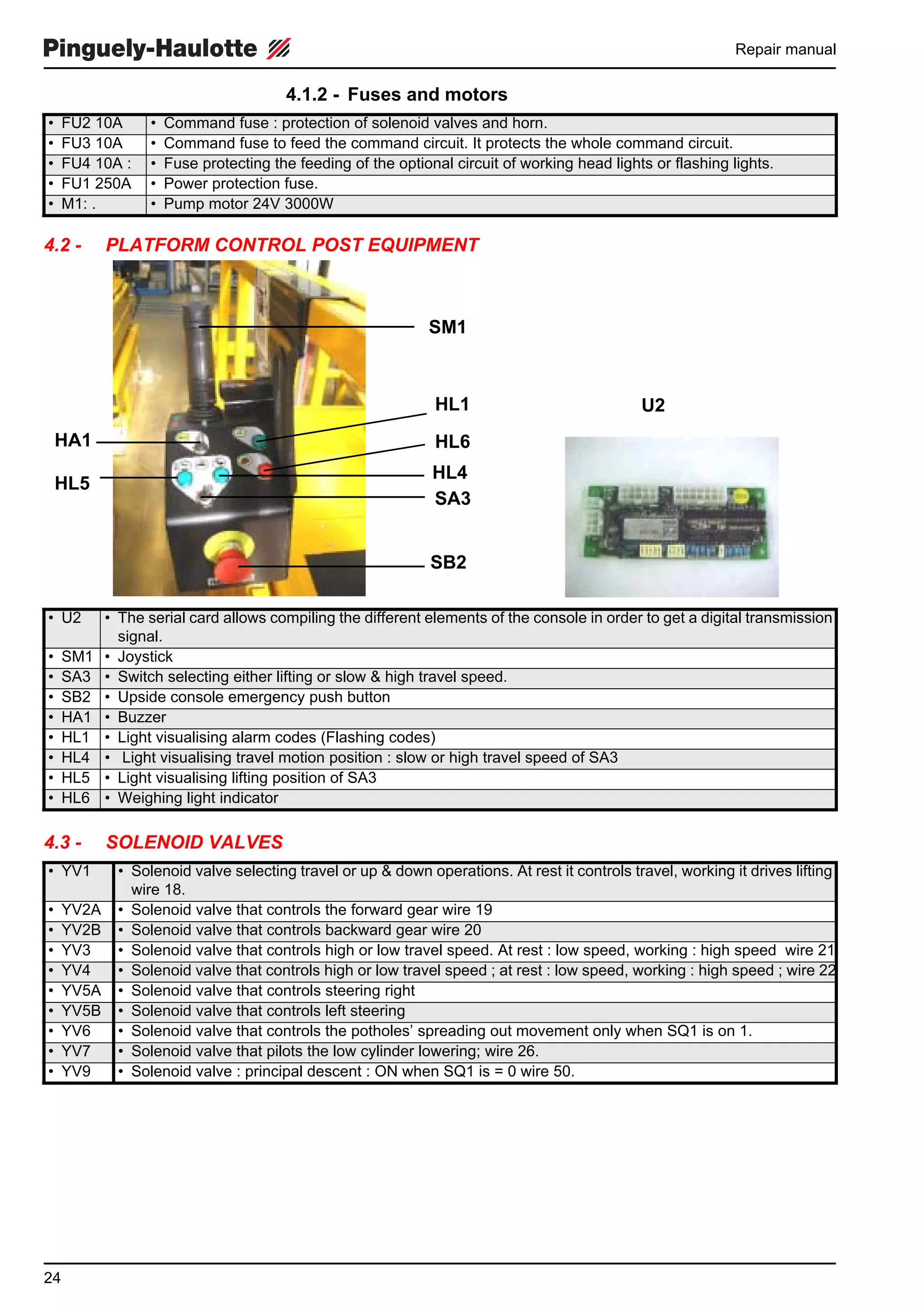
  • 73.
    Repair manual 3 67 9.2- FAILURE DETECTION FLOW CHARTS
  • 74.
  • 75.
    FAILURE DETECTION FLOWCHART SHEET DP001 NO UP AND DOWN MOVEMENT FROM THE PLATFORM CONTROL No up and down movement from the platform control The LEDs come on Place the movement selector switch (SA3) in the position (HS) then in the up position. Check that light indicators HL4 (up) and HL5 (HS) come on NO YES END Open the platform control panel and- check for 24V between terminals (7) and (4) 24V between (7) and (4) NO YES Repair cabling or replace switch SA3 Open the platform control panel and activate the «fail-safe» and tilt the manipulator Presence of setpoint at C4 output of printed circuit U2 YES NO Renovate cabling between terminal C4 and output (5) of the control panel or change the control panel link wiring harness Check the presence of a set- point value on input A9 of printed circuit U2 and the presence of 24V on input B5 and B13 of printed circuit U2 A9 setpoint value and 24V on B5 and B13 YES NO Replace printed circuit U2 Replace the manipulator Continuity between coils (1) and (2) of the platform control panel YES NO Change the control panel link wiring harness Renovate cabling or change PB SB2 END END END END END See SHEET C004 See SHEET C013 Sheet 1/2 NO NO Replace speed variator U1 END
  • 76.
    FAILURE DETECTION FLOWCHART SHEET DP001 NO UP AND DOWN MOVEMENT FROM THE PLATFORM CONTROL Sheet 2/2
  • 77.
    FAILURE DETECTION FLOWCHART SHEET DP002 NO UP AND DOWN MOVEMENT FROM THE CHASSIS CONTROL No up and down movement from the chassis control 24V present Place the key switch in the «chassis control» position and check for 24V on its terminal connected to wire no. 10 Replace the switch See SHEET C005 Check for voltage on switch SA2 - wire no. 10 24V present Replace wire no. 10 Check operation of switch SA2. Change SA2 up/down NO YES NO YES END END NO YES 24V at terminals 37 or 38 of the speed variator Replace switch SA2 See SHEET C003 END Replace speed variator U1 See SHEET C005 END Sheet 1/2
  • 78.
    FAILURE DETECTION FLOWCHART SHEET DP002 NO UP AND DOWN MOVEMENT FROM THE CHASSIS CONTROL Sheet 2/2
  • 79.
    FAILURE DETECTION FLOWCHART SHEET DP003 NO UP MOVEMENT FROM THE CHASSIS OR PLATFORM CONTROL No up movement from the chassis or platform control Check supply of the electrovalve YV1 coil: - disconnect the coil connector and measure supply voltage NO YES END A 24V coil supply Check electrical continuity of the wiring harness betwen coil YV1 and the speed variator Check continuity of coil YV1 NO YES Continuity correct NO YES Continuity correct Replace the wiring harness Replace the coil See SHEET C007 END Connect a pressure gauge to the hy- draulic block’s minimess pressure tap Activate the up movement and note pressure Check the speed variator’s «safety» inputs: - Tilt «SQ10» (input 27) - High position contactor «SQ3» (input 29) - Potholes «SQ5» SQ6» (input 24) associated with position switch «SQ1» (input 25) B Check that there are no hydraulic leaks NO YES No leaks END Repair the hydraulic links Sheet 1/4
  • 80.
    FAILURE DETECTION FLOWCHART SHEET DP003 NO UP MOVEMENT FROM THE CHASSIS OR PLATFORM CONTROL A Replace the lifting hydraulic cylinder(s) NO YES Pressure = 165 bars (or 150 bars: compact 12) = 2393 psi (or 2175 psi : compact 3347E NO YES Zero pressure END Adjust or replace the limiter See SHEET C002 or SHEET C012 END Replace electrovalve YV1 See SHEET C030 END SeeSHEET C001 Sheet 2/4
  • 81.
    FAILURE DETECTION FLOWCHART SHEET DP003 NO UP MOVEMENT FROM THE CHASSIS OR PLATFORM CONTROL B NO YES Input(27) at +24V Replace the connector or the tilt detector See SHEET C006 END NO YES Input (29) at +24V Check operation of the end of stroke contactor SQ3: - Check supply, connection - Check operation - Check setting END NO YES Input (25) at +24V (below 1.5m or 4ft92in) Replace the speed variator U1 See SHEET C003 NO YES Input (24) at +24V Check operation of end of stroke contactors SQ1, SQ5 and SQ6: - Check supply, connection - Check operation - Check setting END Adjust or replace the defective detector or its wiring See SHEET C018 Check operation of tilt detector SQ10 : - Check supply, connection - Check operation - Check the setting Sheet 3/4
  • 82.
    FAILURE DETECTION FLOWCHART SHEET DP003 NO UP MOVEMENT FROM THE CHASSIS OR PLATFORM CONTROL Sheet 4/4
  • 83.
    FAILURE DETECTION FLOWCHART SHEET DP004 NO DOWN MOVEMENT FROM THE PLATFORM OR CHASSIS CONTROL No down movement from the chassis or platform controls Load correct Check the allowed load on the platform Adjust or replace pressure contact SP1 See SHEET C033 NO YES END Reduce load Disconnect the wiring harness from pressure contact SP1 (on up cylinder) 24V present NO YES END Check for 24V on one of the two wiring harness terminals Replace wiring harness Place a shunt between the two terminals of the wiring harness The platform comes down YES Check for 24V on input 26 of the speed variator 24V present YES NO NO Replace the wiring harness A END END Sheet 1/2
  • 84.
    FAILURE DETECTION FLOWCHART SHEET DP004 NO DOWN MOVEMENT FROM THE PLATFORM OR CHASSIS CONTROL Check supply to electrovalve YV7: disconnect the coil’s electric connector and measure supply voltage 24V coil supply NO YES Check continuity of the coil of electrovalveYV7 Check electric continuity of the wiring harness between the electro- valve and speed variator Continuity correct NO YES Replace wi- ring harness ENDCoil continuity correct NO YES Replace the coil See SHEET C007 A END Replace the speed variator See Fiche C003 Replace electrovanne YV7 See SHEET C030 END Sheet 2/2
  • 85.
    FAILURE DETECTION FLOWCHART SHEET DP007 NO MOVEMENT No movement Charge OK Check battery charge NO YES END B Top up with oil See SHEET P001 Recharge or replace defective batteries Check the oil level in the hydraulic tank Level OK NO YES Check the state of fuses FU1, FU2, FU3 and FU4 Fuses OK NO YES Replace defective fuses END END Request a platform lifting movement and check motor- pump operation (audible) The motor pump set works NO YES Maintain the activated lifting control and check for setpoint voltage between terminals B+ and VMNP of the speed variator Voltage present NO YES AC Sheet 1/4
  • 86.
    FAILURE DETECTION FLOWCHART SHEET DP007 NO MOVEMENT A Check electric continuity of chassis emergency stop contacts SB1 Continuity OK NO YES END Replace the chassis emergency stop See SHEET C031 Check for 24V at key switch (SA1) input on the chassis control panel 24V present NO YES Check electric continuity of plat- form emergency stop contacts (SB2) Place the chassis control panel key switch (SA1) in the «chassis» position and check for 24V between terminals (13) and (2); (4) and (2); (34) and (2) of the speed variator U1 24V present NO YES Continuity OK NO YES Replace the wiring harness between the platform control panel and the chassis END END Replace the platform emergency stop See SHEET C004 Repair electric cabling between key switch SA1 on the chassis control panel and the speed va- riator U1 END C Sheet 2/4
  • 87.
    FAILURE DETECTION FLOWCHART SHEET DP007 NO MOVEMENT B Check electric continuity of the motor pump set connection to the speed variator Continuity OK NO YES Restore the electric connection between the motor pump set and the speed variator END END Replace the motor pump set See SHEE T C019 Sheet 3/4
  • 88.
    FAILURE DETECTION FLOWCHART SHEET DP007 NO MOVEMENT C Check cabling of the electrovalve supply line (line 7 at fuse FU2 output) Cabling OK NO YES Replace cabling END END Replace speed variator U1 See SHEE T C003 Sheet 4/4
  • 89.
    FAILURE DETECTION FLOWCHART SHEET DP008 NO STEERING No steering 24V present - Disconnect electrovalve YV5 electric connectors - Activate steering and check for 24V on connector YV5a (left) or YV5b (right) Replace the defective coil See SHEET C007 NO YES END Make a steering movement (right and left) and check for 24V on input B1 or B12 of printed circuit U2 of the platform control panel Check continuity of coils YV5a or YV5b Continuity OK NO YES 24V present NO YES END Check for absence of hydraulic leaks Absence of leaks NO YES Repair hydraulic connectors Make a lifting movement Lifting movement occurs NO YES SHEET DP007 END 24V present on outputs 3 or 6 of the manipulator NO YES Replace the manipulator See SHEE T C013 See SHEET C004 Replace printed circuit U2 Repair cabling between the manipulator and the circuit imprimé U2 A END END Sheet 1/2
  • 90.
    FAILURE DETECTION FLOWCHART SHEET DP008 NO STEERING Connect a pressure gauge to the minimess tapping on the hydraulic block Activate steering and note the pressure value (value disappears after 5s) Pressure = 150 bars or 2175 psi NO YES Replace the steering cylinder END See SHEET C023 A Zero pressure NO YES Replace electrovalveYV5 See SHEE T C030 See SHEET C012 Adjust or replace the steering pressure limiter END END Sheet 2/2
  • 91.
    FAILURE DETECTION FLOWCHART SHEET DP009 NOISY HYDRAULIC PUMP The hydraulic pump makes a noise Oil level is OK Check the oil level in the circuit NO YES END Top up with oil See SHEET P001 Incorrect operation of the hydraulic pump; replace the pump See SHEET C032 Sheet 1/2
  • 92.
    FAILURE DETECTION FLOWCHART SHEET DP009 NOISY HYDRAULIC PUMP Sheet 2/2
  • 93.
    FAILURE DETECTION FLOWCHART SHEET DP010 NO TRAVEL IN JUST ONE DIRECTION No travel in just one travel direction 24V present Disconnect the connector YV2a (F) or YV2b (B) concerned by the fault Check for 24V between outputs: - (8) and (34) for FORWARD - (9) and (34) for BACKWARD NO YES Request the defective travel movement and check for 24V at the connector’s terminals Invert coils YV2a and YV2b The fault is still on the same travel direction END Replace the speed variator See SHEET C003 NO YES END Voltage present YES NO Replace the wiring harness between the electrovalve and the speed variator Replace electrovalve YV2 See SHEE T C008 END END Replace coil YV2a or YV2b corresponding to the defective travel direction See SHEET C007 Sheet 1/2
  • 94.
    FAILURE DETECTION FLOWCHART SHEET DP010 NO TRAVEL IN JUST ONE DIRECTION FORWARD or BACKWARD Sheet 2/2
  • 95.
    FAILURE DETECTION FLOWCHART SHEET DP011 HIGH SPEED UNAVAILBLE BELOW 1.5M OR 4FT92IN High speed unavailable below 1.5m or 4ft 92 in 24V present Check for 24V between terminals (7) and (34) of the speed variator U1 NO YES Disconnect the connector of electrovalve YV3. Request a high speed travel movement and check for 24V on the disconnected wiring harness connector END Check electric continuity of the coil of electrovalve YV3 Replace the coil of electrovalve YV3 See SHE ET C007 24V present NO YES Replace the wiring harness between electrovalve YV3 and speed variator U1 NO Check electric continuity of the coil of electrovalve YV4 NO YES YES END Disconnect the connector of electrovalve YV4. Request a high speed travel movement and check for 24V on the disconnected wiring harness connector C Continuity OK B END 24V present Continuity OK Check for 24V between terminals (6) and (34) of speed variator U1 Replace the wiring harness between electrovalve YV3 and speed variator U1 24V present YES NO B YES Replace the coil of electrovalve YV4 See SHEET C007 NO END Sheet 1/2
  • 96.
    FAILURE DETECTION FLOWCHART SHEET DP011 HIGH SPEED UNAVAILBLE BELOW 1.5M OR 4FT92IN B 24V present NO YES Check for 24V on input B2 of printed circuit U2 of the platform control END Repair cabling between the speed selector switch SA3 and printed circuit U2 of the platform control or replace the speed selector switch SA3 (see SHEET C004 ) END Replace printed circuit U2 See SHEET C004 C Replace electrovalve YV4 See SHEET C007 The fault persists NO YES Replace electrovalve YV3 See SHEET C007 END END Sheet 2/2
  • 97.
    FAILURE DETECTION FLOWCHART SHEET DP012 ONLY MICRO-SPEED IS AVAILABLE BELOW 1.5M OR 4FT92IN Adjust or replace the end of stroke contac- tor SQ1 (1.5m or 4ft92in) See SHEET C018 Only micro-speed is available below 1.5m or 4ft92in The platform stops its descent at 1.5m or 4ft92in Raise the platform above 1.5m or 4ft92in Check electric continuity of the wiring harness between the end of stroke contactor SP1 (1.5m or 4ft92in) and speed variator U1 NO YES Lower the platform below 1.5m or 4ft92in. Check that the lowering movement stops (normal procedure with lowering restarted after releasing the manipulator for 3s) END YES END Continuity OK NO Replace the wiring harness END Replace the speed variator U1 See SHEET C003 Sheet 1/2
  • 98.
    FAILURE DETECTION FLOWCHART SHEET DP012 ONLY MICRO-SPEED IS AVAILABLE BELOW 1.5M OR 4FT92IN Sheet 2/2
  • 99.
    FAILURE DETECTION FLOWCHART SHEET DP013 THE POTHOLE SYSTEM IS NOT EXTENDED WHEN THE PLATFORM IS LIFTED The pothole system is not extended when the platform is lifted Voltage present on output 18 of the speed variator Replace the wiring harness (ref 25) NO YES - Disconnect the electric connector of electrovalve YV6 - Check 24V supply to the electrovalve 24V present Check coil continuity Replacer the coil of electrovalve YV6 See SHEET C007 YES Replace the variator See SHEET C003 Continuity OK Electrovalve works properly NO YES NO Replace electrovalve YV6 See SHEET C030 Check electrovalve operation YES A END END END END Sheet 1/2
  • 100.
    FAILURE DETECTION FLOWCHART SHEET DP013 THE POTHOLE SYSTEM IS NOT EXTENDED WHEN THE PLATFORM IS LIFTED A END Check operation of the pothole system cylinder(s) Replace defective cylinder(s) See SHEET C024 Cylinder(s) work properly NO YES END Sheet 2/2
  • 101.
    FAILURE DETECTION FLOWCHART SHEET DP014 NO MOVEMENT FROM THE PLATFORM CONTROL PANEL Replace speed variator U2 See SHEE T C003 No movement from the platform control panel 24V present Check for 24V on wires 9 and 11 of the platform control panel NO YES Place the key switch SA1 in the «platform» position and check for 24V at terminals 9 and 11 of SA1 END END Replace the electric wiring harness between the platform control panel and the chassis END Replace the key switch SA1 See SHEET C004 24V present NO YES Check for 24V between terminals C1B+ and C2B- of printed circuit U2 24V present NO Replace the electric wiring harness between the platform control panel and the chassis 24V present NO YES YES Check for 24V between terminals 34 and 2 of the speed variator END Request a travel or lifting movement from the platform and measure voltage at the manipulator’s output terminals: • 9: -10V • 11: +10V • 10: between -10V and +10V • 5: 24V • 14 or 1: 24V A Sheet 1/4
  • 102.
    FAILURE DETECTION FLOWCHART SHEET DP014 NO MOVEMENT FROM THE PLATFORM CONTROL PANEL A Voltage OK NO YES Replace the manipulator See SHEET C013 END Check voltage on the inputs of printed circuit U2: • A6: -10V • A7: +10V • A9: between -10V and +10V • B5 and B13: 24V Voltage OK NO YES Check for setpoint voltage between terminals 2 and 21 of the speed variator U1 Repair cabling between the manipulator SM1 and printed circuit U2 END Presence of a setpoint voltage NO YES Replace printed circuit U2 See SHEET C004 END Check for variable setpoint voltage between terminals C2B- and C4 of printed circuit U2 B Sheet 2/4
  • 103.
    FAILURE DETECTION FLOWCHART SHEET DP014 NO MOVEMENT FROM THE PLATFORM CONTROL PANEL B Setpoint voltage present Replace speed variator U1 See SHEE T C003 Replace the wiring harness between the platform control panel and the speed variator END END NO YES Sheet 3/4
  • 104.
    FAILURE DETECTION FLOWCHART SHEET DP014 NO MOVEMENT FROM THE PLATFORM CONTROL PANEL Sheet 4/4
  • 105.
    FAILURE DETECTION FLOWCHART SHEET DP061 PLATFORM (ABOVE 1.5M OR 4FT92IN) DESCENT IS SLOW FROM THE PLATFORM OR CHASSIS CONTROL Platform (above 1.5m or 4ft92in) descent is slow from the platform or chassis controls END Change electrovalve YV9 See SHEET C030 Check for 24V at the terminals of the coil supply connector of electrovalve YV9 A 24V present NO YES Check electrovalve YV9 coil continuity Continuity correct NO YES END Change electrovalve YV9 coil See SHEET C007 Sheet 1/2
  • 106.
    FAILURE DETECTION FLOWCHART SHEET DP061 PLATFORM (ABOVE 1.5M OR 4FT92IN) DESCENT IS SLOW FROM THE PLATFORM OR CHASSIS CONTROL A Check for 24V absence on input (25) of the speed variator 24V absent NO YES Check electric continuity of the wiring harness between electrovalve YV9 and the speed variator Continuity correct NO YES END Replace the speed variator See SHEET C003 Replace the wiring harness END Check absence of short-circuit in the wiring harness between pressure contact SP1 and speed variator U1 Absence of short-circuit NO YES Replace the electric wiring harness See SHEET C003 Replace the speed variator END END Sheet 2/2
  • 107.
    FAILURE DETECTION FLOWCHART SHEET DP062 NO TRAVEL MOVEMENT IN BOTH DIRECTIONS FORWARD AND BACKWARD No travel movement in either forward or backward direction Load correct Check platform load NO YES END A Make a lifting movement from the chassis The platform rises NO YES Make a lifting movement from the platform lifting control panel The platform rises NO YES Make a lowering move- ment from the platform Reduce load No movement is available No movement is available from the platform The platform goes down NO YES See SHEET DP014 Lower the platform below 1.5m or 4ft92in See SHEET DP007 See SHEET DP014 Sheet 1/4
  • 108.
    FAILURE DETECTION FLOWCHART SHEET DP062 NO TRAVEL MOVEMENT IN BOTH DIRECTIONS FORWARD AND BACKWARD A Request a travel movement The travel movement operates NO YES Raise the platform above 1.5m or 4ft92in and check that the Pothole sys- tem extends NO YES Check for 24V on input 24 of the speed variator 24V present NO YES See SHEET DP013 Check electric continuity of the wiring harness between the pothole end of stoke contactor (SQ5 and SQ6) and the variator. Replace the variator U1 See SHEE T C003 END Continuity correct NO YES Adjust or replace the defective pothole end of stroke contactor (SQ5 or SQ6) See SHEET C018 END Replace the defective wiring harness END Disconnect the two coils a and b of electrovalve YV2 Request a travel movement and check for 24V B Sheet 2/4
  • 109.
    FAILURE DETECTION FLOWCHART SHEET DP062 NO TRAVEL MOVEMENT IN BOTH DIRECTIONS FORWARD AND BACKWARD B 24V present YES Close valve NV1 of the hydraulic block and release the brakes manually Request a travel movement The travel movement occurs NO YES Replace the defective brake See SHE ET C011 END Replace the defective motor See SHE ET C014 END Sheet 3/4
  • 110.
    FAILURE DETECTION FLOWCHART SHEET DP062 NO TRAVEL MOVEMENT IN BOTH DIRECTIONS FORWARD AND BACKWARD Sheet 4/4
  • 111.
    Repair manual 1053 10 -CORRECTIVE MAINTENANCE PROCEDURES List of corrective maintenance sheets: Sheet no. Description SHEET C001 Replacing a lifting cylinder SHEET C002 Adjusting a hydraulic block pressure limiter SHEET C003 Replacing a speed variator SHEET C004 Replacing a component on the platform control station SHEET C005 Replacing a component on the chassis control station SHEET C006 Replacing the tilt detector SHEET C007 Replacing a coil SHEET C008 Replacing the travel eletrovalve SHEET C009 Replacing the hydraulic filter SHEET C010 Replacing a hose SHEET C011 Replacing a vacuum brake SHEET C013 Replacing a manipulator SHEET C014 Replacing a hydraulic travel motor SHEET C015 Replacing the buzzer SHEET C016 Replacing the distribution block SHEET C017 Replacing the remote control system SHEET C018 Replacing the end of stroke sensor SHEET C019 Replacing the motor pump set SHEET C020 Replacing a hydraulic block valve SHEET C021 Replacing a wheel SHEET C022 Replacing the brake release pull SHEET C023 Replacing the steering cylinder SHEET C024 Replacing a pothole cylinder SHEET C025 Replacing the platform extension SHEET C026 Replacing the platform SHEET C027 Replacing the scissors (and pads) SHEET C028 Replacing a scissor ring or axle SHEET C029 Replacing the balancing valves SHEET C030 Replacing a cartridge electrovalve SHEET C031 Replacing the chassis emergency stop button SHEET C032 Replacing the hydraulic pump SHEET C033 Replacing and adjusting the pressure switch
  • 112.
  • 113.
    CORRECTIVE MAINTENANCE SHEET Caution! Ensurethat oil temperature is not too high. 1 2 Fig. 1 1 - Preliminary operations • Put the machine in the maintenance configuration (see § 7.2, page 51). • Cut off the electric power supply (see § 7.3, page 52). 2 - Removing the cylinder • Remove the cylinder remote control, if any (see SHEET C017). • Mark and disconnect the cylinder pressure switch’s electric connections. • Mark and disconnect the cylinder’s hydraulic hoses. • Fit caps to the hoses. • Put the cylinder into slings. • Remove the two cylinder axle stop bolts (1), on the rod and body side. • Remove the two axles (2) (also see figure 1) and remove the cylinder. 3 - Replacing the cylinder • Put the new cylinder into place using slings. • Put back the cylinder axle on the cylinder body side and secure using the axle stop bolt. NB: Fit so that the screw is above the axle and the nut underneath (see figure 2). • Reconnect the cylinder’s hydraulic hoses according to the marks made when dismantling. • Reconect the pressure switches electric connections, according to the marks made when dismantling. • Reconnect the cylinder’s remote control, if any (see SHEET C017). • Put the machine back into the operational configuration. • Perform several lifting cycles to purge the hydraulic circuit. • Check the oil level in the hydraulic oil tank. VIS VIS ECROU ECROU Fig. 2 Screw Screw Nut Nut REPLACING A LIFTING CYLINDER SHEET C001 Sheet 1/1
  • 114.
  • 115.
    CORRECTIVE MAINTENANCE SHEET Sheet1/2 Caution! Ensure that oil temperature is not too high. Compact Optimum 31 2 2 31 ADJUSTING A HYDRAULIC BLOCK PRESSURE LIMITER SHEET C002 1 - Adjusting the general pressure limiter (1) • Put the machine in the low position. • Cut off the electric power supply (see § 7.3, page 52). • Unscrew the cap of the hydraulic pressure tap marked «MX» on the hydraulic block and connect a pressure gauge with sufficient range to measure overall pressure. • Restore the electric power suply (see § 7.3, page 52). • Bring the machine against a wall to block the travel movement. • Request a travel movement and measure overall pressure on the pressure gauge. • Adjust the hexagonal hollow head screw on the overall pressure limiter (1) so that movements are disabled at the pressure indicated in the table below. • Put the machine in the maintenance configuration (see § 7.2, page 51). • Cut off the electric power supply (see § 7.3, page 52). • Unscrew the pressure gauge and put the cap back on the hydraulic pressure tap. • Put the machine back in the operational configuration. • Make several travel movements to check that the machine works properly. 2 - Adjusting the steering pressure limiter (2) • Put the machine in the low configuration. • Cut off the electric power supply (see § 7.3, page 52). • Unscrew the cap of the hydraulic pressure tap marked «MX» on the hydraulic block and connect a pressure gauge with sufficient range to measure the steering pressure. • Restore the electric power supply (see § 7.3, page 52). • Activate the steering command as far as possible to the right or left. • Maintain the steering command and measure the steering pressure on the pressure gauge. NB: Steering is disabled after a certain period when at the maximum in one direction, and only the other direction is possible and can re-authorise steering in the initial direction. The steering pressure measurement time is therefore limited. • If necessary, adjust the hexagonal hollow head screw on the steering pres- sure limiter (2) to disable movement at the pressure indicated in the table below. • Put the machine in the maintenance configuration (see § 7.2, page 51). • Cut off the electric power supply (see § 7.3, page 52). • Unscrew the pressure gauge and put the cap back on the hydraulic pressure tap. • Put the machine back in the operational configuration. • Make several steering movements to check that the machine works properly.
  • 116.
    CORRECTIVE MAINTENANCE SHEET Sheet2/2 3 - Adjusting the lifting pressure limiter (3) • Put the platform in the low configuration. • Unscrew the lifting pressure limiter adjusting screw (3). • Place a load corresponding to nominal load + 10% in the platform (see table below). • Lift the platform and tighten the pressure limiter adjustment screw until move- ments are disabled for this load. • Place a load corresponding to nominal load in the platform (see table below). • Check that the lifting movement is not disabled for this load. • Put the machine back into the operational configuration. 4 - Load and pressure table (tolerance: + or - 10%) Nominal load Nominal load +10% Overall hydraulic pressure Steering pressure H8SN 2032E outdoor use: 120kg / 265 lb indoor use: 350kg / 770 lb outdoor use: 132kg / 290 lb indoor use: 385kg / 850 lb 200 bars 3335 PSI 150 bars 2175 PSI H8SW 2247E outdoor use: 120kg / 265 lb indoor use: 450kg / 990 lb outdoor use: 132kg / 290 lb indoor use: 495kg / 1090 lb 200 bars 3335 PSI 150 bars 2175 PSI H10N 2632E indoor use only: 230 kg / 500 lb indoor use only: 253 kg / 520 lb 220 bars 3190 PSI 150 bars 2175 PSI H10S 2747E outdoor use: 120kg / 265 lb indoor use: 450kg / 990 lb outdoor use: 132kg / 290 lb indoor use: 495kg / 1090 lb 220 bars 3190 PSI 150 bars 2175 PSI H12SN 3347E outdoor use: 120kg / 265 lb indoor use: 300kg / 660 lb outdoor use: 132kg / 290 lb indoor use: 330kg / 730 lb 240 bars 3480 PSI 150 bars 2175 PSI Optimum 6 1530E outdoor use: 115kg / 254 lb indoor use: 270kg / 595 lb outdoor use: 126.5kg / 280 lb indoor use: 297kg / 655 lb 230 bars 3335 PSI 100 bars 1450 PSI Optimum 8 1930E indoor use only: 230kg / 500 lb indoor use only: 253kg / 520 lb 230 bars 3335 PSI 100 bars 1450 PSI ADJUSTING A HYDRAULIC BLOCK PRESSURE LIMITER SHEET C002
  • 117.
    CORRECTIVE MAINTENANCE SHEET Sheet1/2 Compact Optimum Compact 1 REPLACING THE SPEED VARIATOR SHEET C003 1 - Preliminary operations •Put the machine in the low position. •Cut off the electric power supply (see § 7.3, page 52). •Disconnect the + and - terminals of the batteries to isolate the electric circuit. 2 - Removing the speed variator •Disconnect the speed variator’s electric connections. •Remove the speed variator (1). 3 - Replacing the speed variator •Put the speed variator back into place and secure with the fixing screws. •Reconnect the speed variator’s electric connections. •Reconnect the + and - terminals of the batteries. •Put the machine back in the operational configuration. Optimum 1
  • 118.
    CORRECTIVE MAINTENANCE SHEET Sheet2/2 Star 22 J / Star 8 HA12IP / HA33JE - HA15IP / HA43JE 1 1 1 SHEET C003 REPLACING THE SPEED VARIATOR STAR 6 - STAR 13
  • 119.
    CORRECTIVE MAINTENANCE SHEET Caution! Donot use the machine during maintenance operations. Compact - Optimum Star 8 - HM10P (star 10) 1 1 1 - Preliminary operations • Cut off the electric power supply (see § 7.3, page 50). 2 - Removing a component from the platform control panel • Remove the closing plate (1) by unscrewing the four fixing screws. • Mark and disconnect the electric connections of the component to be replaced. • Remove the component. 3 - Replacing a component on the platform control panel • Put a new component and seal into place on the front of the platform con- trol panel. NB: If it is a lever switch, adjust the position of the fixing nut and counter nut so that the switch lever joint axle is on the same level as the seal, to ensure tightness. • Reconnect the electric connections according to the marks made when dismantling. • Fix the closing plate with the four fixing screws. • Perform the function corresponding to the replaced component to check that it works properly. REPLACING A COMPONENT ON THE PLATFORM CONTROL PANEL SHEET C004 Sheet 1/1
  • 120.
  • 121.
    CORRECTIVE MAINTENANCE SHEET Caution! Donot use the machine during maintenance operations. Compact Optimum 1 1 2 1 - Preliminary operations • Put the machine in the maintenance configuration (see § 7.2, page 51). • Cut off the electric power supply (see § 7.3, page 52). 2 - Removing a component from the chassis control panel (1) • Remove the protective plate (2) from the chassis control panel. • Mark and disconnect the electric connections of the component requiring replacement. • Remove the component. 3 - Replacing a component in the chassis control panel • Put the new component and seal on the front of the chassis control panel. NB: If it is a lever switch, adjust the position of the fixing nut and counter nut so that the switch lever joint axle is on the same level as the seal, to ensure tightness. • Reconnect the electric connections according to the marks made when dismantling. • Put back the chassis control panel protective plate. 4 - Test • Put the machine back into the operational configuration. • Perform the function corresponding to the replaced component to check that it works properly. REPLACING A COMPONENT ON THE CHASSIS CONTROL PANEL SHEET C005 Sheet 1/1
  • 122.
  • 123.
    CORRECTIVE MAINTENANCE SHEET Caution! Donot use the machine du- ring maintenance operations. 1 - Preliminary operations • Place the platform on a flat, level floor with no slope. • Put the machine in the maintenance configuration (see § 7.2, page 51). • Cut off the electric power supply (see § 7.3, page 52). 2 - Removing the tilt detector • Mark and disconnect the tilt detector’s electric connections • Remove the tilt detector by unscrewing the three fixing bolts. 3 - Replacing the tilt detector • Put a new tilt detector into place and secure with the three fixing bolts. • Reconnect the electric connections, according to the marks made when dismantling. • Place a spirit level on the top of the tilt detector and adjust the fixing screws to align the tilt detector. NB: A spirit level is built into certain tilt detectors. • Put the machine back into the operational configuration. 4 - Operating test of the tilt detector • Lift the platform to a height of 2m. • Tilt the tilt detector (see photo) and check that a signal is given (the signal should be audible from the platform). REPLACING THE TILT DETECTOR SHEET C006 Sheet 1/1
  • 124.
  • 125.
    CORRECTIVE MAINTENANCE SHEET Compact 4 1 5 23 5 1 - Preliminary operations • Put the machine in the maintenance configuration (see § 7.2, page 51). • Cut off the electric power supply (see § 7.3, page 52). 2 - Removing a coil • Unscrew the two fixing screws (1) from the fixing lug and take out the hydraulic block. • Disconnect the relevant coil’s electric connector (2). • Unscrew the nut (3) or (4) and remove the coil (5). 3 - Replacing a coil • Put a new coil (5) into place and secure with the nut (3) or (4). • Reconnect the electric connector (2) on the coil. • Put the hydraulic block back into place and secure with the screws (1) equipped with new flat and toothed washers. • Put the machine back into the operational configuration. Check that the coil works properly by performing the movement corresponding to the replaced coil. Optimum 1 54 2 3 5 REPLACING A COIL SHEET C007 Sheet 1/1
  • 126.
  • 127.
    CORRECTIVE MAINTENANCE SHEET Caution! Ensurethat oil temperature is not too high. Compact Optimum 2 1 1 2 1 - Preliminary operations • Put the machine in the maintenance configuration (see § 7.2, page 51). • Cut off the electric power supply (see § 7.3, page 52). 2 - Removing the travel electrovalve • Unscrew the two screws (1) on the fixing lug and take out the hydraulic block. • Mark and disconnect the coil’s electric connections. • Remove the coils of the electrovalve (2) and remove it. 3 - Replacing the travel electrovalve • Put a new electrovalve equipped with its seal into place. • Reconnect the electric connections on the coils. • Put back the hydraulic block and secure using the screws (1) equipped with new flat and toothed washers. • Put the machine back into the operational configuration. • Make several travel movements to check that it works properly. REPLACING THE TRAVEL ELECTROVALVE SHEET C008 Sheet 1/1
  • 128.
  • 129.
    CORRECTIVE MAINTENANCE SHEET Caution! Ensurethat oil temperature is not too high. Compact Optimum 1 2 1 2 1 - Preliminary operations • Put the machine in the maintenance configuration (see § 7.2, page 51). • Cut off the electric power supply (see § 7.3, page 52). 2 - Removing the hydraulic filter • Disconnect the two hydraulic filter hoses. • Fit caps on the hoses. • Unscrew the fixing screws (1) and remove the hydraulic filter. • Remove the two hydraulic filter connections (2). 3 - Replacing the hydraulic filter • Put the two connections (2) on a new hydraulic filter. • Put the equipped hydraulic filter into place, respecting the oil flow direc- tion; secure with the fixing screws. • Reconnect the hydraulic hoses. • Put the machine back into the operational configuration. • Perform several lifting cycles to purge the hydraulic circuit. REPLACING THE HYDRAULIC FILTER SHEET C009 Sheet 1/1
  • 130.
  • 131.
    CORRECTIVE MAINTENANCE SHEET Caution! Ensurethat oil temperature is not too high. 1 - Preliminary operations • Put the machine in the maintenance configuration (see corresponding paragraph). • Cut off the electric power supply (see corresponding paragraph). 2 - Removing a hose • Disconnect the hose from the equipment it connects. NB: Unscrew the hose slowly to allow residual hydraulic pressure to dissipate. • Fit caps to the equipment holes to protect them. 3 - Replacing a hose • Reconnect a new hydraulic hose. • Put the machine back into the operational configuration. • Make several movements using the replaced hose to purge the hydraulic circuit. • Check the oil level in the hydraulic oil tank. REPLACING A HOSE SHEET C010 Sheet 1/1
  • 132.
  • 133.
    CORRECTIVE MAINTENANCE SHEET Caution! Ensurethat oil temperature is not too high. 1 - Preliminary operations • Put the machine in the low configuration. • Cut off the electric power supply (see § 7.3, page 52). • Raise the machine using a jack or hoist. 2 - Removing a vacuum brake (see figure 1) • Remove the pin (3) and nut (4) fixing the wheel and remove the wheel (1). • Place a wedge under the vacuum brake. • Disconnect the vacuum brake’s hose. • Fit a cap to the hose. • Remove the vacuum brake (2) by removing its fixing bolts (5) (6) (7). 3 - Replacing a vacuum brake • Put the new vacuum brake (2) into place. • Secure the vacuum brake using the fixing bolts equipped with new elastic washers (5). • Reconnect the hydraulic hose. • Put the wheel (1) into place and secure using the fixing nut and pin. • Put the machine back into the operational configuration. • Perform several brake/release operations to purge the hydraulic circuit. • Check the oil level in the hydraulic oil tank. 2 6 75 1 4 3 Fig. 1 REPLACING A VACUUM BRAKE SHEET C011 Sheet 1/1 Wheel nut tightening torque : 25 N/m To fix the pin, the slot must be in front of an hole : at this time we can screw until 30 N/m.
  • 134.
  • 135.
    CORRECTIVE MAINTENANCE SHEET Caution! Donot use the machine du- ring maintenance opera- tions. 12 1 - Preliminary operations • Put the machine in the maintenance configuration (see § 7.2, page 51). • Cut off the electric power supply (see § 7.3, page 52). 2 - Removing the manipulator (2) • Remove the closing plate (1) by removing the four fixing screws. • Mark and disconnect the manipulator’s electric connections. • Remove the manipulator by removing its fixing screws. 3 - Replacing the manipulator • Fix a manipulator, equipped with new seals, to the platform control panel. • Reconnect the electric connections, according to the marks made when dismantling. • Put the closing plate back into place and secure with the four fixing screws. • Put the machine back into the operational configuration. • Make several up and down movements from the plaform to check that the manipulator works properly. REPLACING THE MANIPULATOR SHEET C013 Sheet 1/1
  • 136.
  • 137.
    CORRECTIVE MAINTENANCE SHEET Caution! Ensurethat oil temperature is not too high. 1 - Preliminary operations • Put the machine in the low configuration (see § 7.2, page 51). • Cut off the electric power supply (see § 7.3, page 52). • Raise the machine using a jack or hoist. 2 - Removing a hydraulic travel motor (see figure 1) • Remove the pin (2) and nut (1) fixing the wheel and remove the wheel (7). • Mark and disconnect the two hydraulic motor hoses. • Fit caps to the hoses. • Place a wedge under the hydraulic motor. • Remove the hydraulic motor (4) by removing its four fixing bolts (3) (5) (6). 3 - Replacing a hydraulic travel motor • Put a new hydraulic motor into place. • Secure the hydraulic motor using the four fixing bolts, equipped with new elastic washers. • Reconnect the hydraulic hoses according to the marks made when dis- mantling. • Put the wheel back and secure with the fixing nut and pin. • Put the machine back into the operational configuration. • Make several travel movements to purge the hydraulic circuit. • Check the oil level in the hydraulic oil tank. Fig. 1 1 2 34 5 6 7 REPLACING A HYDRAULIC TRAVEL MOTOR SHEET C014 Sheet 1/1 Wheel nut tightening torque : 25 N/m / 18 lbf.ft To fix the pin, the slot must be in front of an hole : at this time we can screw until 30 N/m / 22 lbf.ft .
  • 138.
  • 139.
    CORRECTIVE MAINTENANCE SHEET Caution! Donot use the machine during maintenance operations. Compact Optimum 1 1 1 - Preliminary operations • Cut off the electric power supply (see § 7.3, page 52). 2 - Remove the buzzer • Mark and disconnect the buzzer’s electric connections (1). • Remove the buzzer by unscrewing the fixing bolt. 3 - Replacing the buzzer • Put the new buzzer into place and secure with the fixing bolt. • Reconnect the electric conections according to the marks made when dis- mantling. 4 - Test • Put the machine back into the operational configuration. • Check that the buzzer gives a signal below 1.5 metres (or 4ft92in) during lowering. REPLACING THE BUZZER SHEET C015 Sheet 1/1
  • 140.
  • 141.
    CORRECTIVE MAINTENANCE SHEET Caution! Ensurethat oil temperature is not too high. Compact Optimum 1 2 1 2 1 - Preliminary operations • Put the machine in the maintenance configuration (see § 7.2, page 51). • Cut off the electric power supply (see § 7.3, page 52). 2 - Removing the distribution block • Remove the fixing lug (1) securing the distribution block to the chassis, and take out the distribution block (2) to access its components. • Mark and disconnect the distribution block’s electric connections. • Mark and disconnect the distribution block’s hydraulic hoses. NB: Unscrew the hoses slowly to allow the residual hydraulic pressure to dissipate. • Fit caps to the hoses. • Remove the distribution block. 2 - Replacing the distribution block • Put the new distribution block into place. • Reconnect the hydraulic hoses according to the marks made when dis- mantling. • Reconnect the distribution block’s electric connections, according to the marks made when dismantling. • Secure the distribution block to the chassis using the fixing lug, screws and washers. • Put the machine back into the operational configuration. • Perform several lifting, steering and travel cycles to purge the hydraulic circuit. • Check the oil level in the hydraulic oil tank. REPLACING THE DISTRIBUTION BLOCK SHEET C016 Sheet 1/1
  • 142.
  • 143.
    CORRECTIVE MAINTENANCE SHEET Sheet1/2 Compact 4 2 3 REPLACING THE REMOTE CONTROL SHEET C017 1 - Preliminary operations • Put the machine in the maintenance configuration (see § 7.2, page 51). • Cut off the electric power supply (see § 7.3, page 52). 2 - Removing the remote control • Remove the protective plate (4) of the chassis control station (for Compact machines). • Release the manual control cable (2) of the covered distributing valve on the lifting cylinder. • Unscrew the plate sheath stop (3) supporting the cable. • Mark the cable route in the scissor ducts and remove the cable from the ducts. • Unscrew the blocking nut of the emergency pull (1) and remove the pull and cable assembly. 3 - Replacing the remote control • Put the remote control cable back into place in the scissor ducts, according to the route marked when dismantling. • Put the emergency pull (1) in place on the chassis and secure with the bloc- king nut. • Screw the sheath stop onto the cable support plate (3) at the distributing valve level. • Secure the cable to the distributing valve manual control. • Put the chassis control panel protective plate (4) back into place (for Com- pact machines). • Put the machine back into the operational configuration. • Raise the platform to a height of 2m (or 6ft56in) and activate the emergency pull to check that it works properly. Compact Optimum 1 1
  • 144.
  • 145.
    CORRECTIVE MAINTENANCE SHEET Caution! Donot use the machine during maintenance operations. 1 23 1 - Preliminary operations • Put the machine in the maintenance configuration (see § 7.2, page 51). • Cut off the electric power supply (see § 7.3, page 52). 2 - Removing an end of stroke contactor • Mark the position of the end of stroke contactor (1) and its lever (2). • Remove the end of stroke contactor. • Open the end of stroke contactor, mark and disconnect the electric connec- tions. 3 - Replacing an end of stroke contactor • Open the new end of stroke contactor, reconnect the electric connections and close the end of stroke contactor. • Move the end of stroke contactor’s lever (2) back to the position marked when dismantling. • Put the end of stroke contactor into place in the position marked when dis- mantling and secure with bolts (3) without tightening. 4 - Test • Put the machine into the operational configuration. • Perform the movement, using the contactor concerned (see table) and check that it works properly. • Adjust the contactor position if necessary and tighten the fixing bolts. CONTACTOR MOVEMENT TO BE MADE CHECK Lifting end of stroke (SQ3) Lifting Lifting disabled in the high posi- tion Pothole end of stroke (SQ5 and SQ6) Lifting • Extension of the potholes when the platform reaches 1.5m. • Microspeed present • Disconnect YV6 • Lifting • Lifting impossible beyond 1.5m • Travel impossible beyond 1.5m Tilt reset end of stroke (SQ1) Lifting beyond 1.5m and lowering Check that the lowering move- ment is correct with an interrup- tion at 1.5m. 8m end of stroke switch (SQ4) (H12SN only) Lifting beyond 8m Travel impossible (microspeed disabled) REPLACING AN END OF STROKE CONTACTOR SHEET C018 Sheet 1/1
  • 146.
  • 147.
    CORRECTIVE MAINTENANCE SHEET Sheet1/2 Caution! Ensure that oil temperature is not too high. 13 2 4 3 REPLACING THE MOTOR PUMP SET SHEET C019 1 - Preliminary operations • Put the machine in the maintenance configuration (see § 7.2, page 51). • Cut off the electric power supply (see § 7.3, page 52). NB: Lift the platform using a gantry crane or fork-lift truck 2 - Removing the motor pump set • Remove the upper inspection flap (for Compact machines). • Mark and disconnect the motor’s electric connections (1). • Mark and disconnect the hydraulic pump’s hoses (3). • Fit caps to the hoses. • Remove the fixing collars (2) from the motor pump set and remove the motor pump set. • Remove the hydraulic pump’s suction and backflow flanges (4). 3 - Replacing the motor pump set • Put the suction and backflow flanges equipped with new seals on a motor pump set. • Put the motor pump set into place and secure with the collars. • Reconnect the hydraulic hoses to the pump according to the marks made when dismantling. • Reconnect the electric connections to the motor according to the marks made when dismantling. • Close the inspection flap (for Compact machines). • Put the machine back into the operational configuration. • Perform several lifting cycles to purge the hydraulic circuit. • Check the oil level in the hydraulic oil tank.
  • 148.
  • 149.
    CORRECTIVE MAINTENANCE SHEET Sheet1/2 Caution! Ensure that oil temperature is not too high. Compact Optimum 4 13 2 3 4 2 1 REPLACING A HYDRAULIC BLOCK VALVE SHEET C020 1 - Preliminary operations • Put the machine in the maintenance configuration (see § 7.2, page 51). • Cut off the electric power supply (see § 7.3, page 52). 2 - Removing a valve from the hydraulic block • Unscrew the fixing screws (3) and take out the hydraulic block (4) if neces- sary to make access easier. • Open the valve concerned. • Unscrew the base (2) of the valve (1) and remove from the hydraulic block. • Fit a cap to the hydraulic block hole to protect it. 3 - Replacing a valve in the hydraulic block • Screw a new valve onto the hydraulic block. • Put the valve back into its initial state. • Fix the hydraulic block on with the fixing screws (3). • Put the machine back into the operational configuration. • Make several travel movements to purge the hydraulic circuit.
  • 150.
  • 151.
    CORRECTIVE MAINTENANCE SHEET Sheet1/2 REPLACING A WHEEL SHEET C021 1 - Preliminary operations • Put the machine in the low configuration. • Cut off the electric power supply (see § 7.3, page 52). • Raise the machine using a jack or hoist. 2 - Removing a wheel • Remove the pin (1) and fixing nut (2) from the wheel and remove the wheel (3). 3 - Replacing a wheel • Replace the key (4) if necessary. • Put a new wheel into place and secure with the fixing nut and pin. • Put the machine back into the operational configuration. 4 3 2 1 Wheel nut tightening torque : 25 N/m / 18 lbf.ft To fix the pin, the slot must be in front of an hole : at this time we can screw until 30 N/m / 22 lbf.ft.
  • 152.
  • 153.
    CORRECTIVE MAINTENANCE SHEET Sheet1/2 Caution! Ensure that oil temperature is not too high. Compact Optimum 1 1 REPLACING THE BRAKE RELEASE HAND PUMP SHEET C022 1 - Preliminary operations • Put the machine in the maintenance configuration (see § 7.2, page 51). • Cut off the electric power supply (see § 7.3, page 52). • Check that the brake release valve NV1 is open. 2 - Removing the brake release hand pump • Unscrew the brake release hand pump (1) and take it out of the hydraulic block. • Put a cap on the hydraulic block hole to protect it. 3 - Replacing the manual brake hand pump • Screw a new brake release hand pump into place. • Put the machine back in the operational configuration. • Apply and release the brakes manually several times to purge the hydraulic circuit.
  • 154.
  • 155.
    CORRECTIVE MAINTENANCE SHEET Sheet1/2 Caution! Ensure that oil temperature is not too high. 1 3 42 REPLACING THE STEERING CYLINDER SHEET C023 1 - Preliminary operations • Put the machine in the low configuration. • Cut off the electric power supply (see § 7.3, page 52). • Raise the machine with a jack or hoist. 2 - Removing the steering cylinder • Mark and disconnect the two steering cylinder hoses (1). NB: Unscrew the hose slowly to allow residual hydraulic pressure to dissipate. • Fit caps to the hoses. • Put the cylinder into slings. • Remove the screws (3) and blocking yokes (4) then remove the steering cylinder’s two axles (2). • Remove the steering cylinder. 3 - Replacing the steering cylinder • Put a new steering cylinder into place. • Replace the axles and blocking yokes and secure with screws equipped with new toothed washers. • Reconnect the hydraulic hoses according to the marks made when dismant- ling. • Put the machine back into the operational configuration. • Make several steering movements to purge the hydraulic circuit. • Check the oil level in the hydraulic oil tank.
  • 156.
  • 157.
    CORRECTIVE MAINTENANCE SHEET Sheet1/2 Caution! Ensure that oil temperature is not too high. 6 7 5 1 2 3 4 REPLACING A POTHOLE CYLINDER SHEET C024 1 - Preliminary operations • Put the machine into the maintenance configuration (see § 7.2, page 51). • Cut off the electric power supply (see § 7.3, page 52). 2 - Removing a pothole cylinder • Mark and disconnect the two hoses (2) of the pothole cylinder (1). Fit caps to the hoses. • Remove the special screw (5), washer (6) and nut (7) from the lower axle. • Remove the pin (3) and washer (4) from the cylinder’s upper joint and remove the pothole cylinder. 3 - Replacing a pothole cylinder • Put a new pothole cylinder into place on the upper axle. • Put the washer into place and secure a new pin. • Fix the pothole cylinder rod yoke with the special screw, washer and a new nut. • Reconnect the hydraulic hoses according to the marks made when dismant- ling. • Put the machine back into the operational configuration. • Perform several up/down movements from the plaform above 1.5 meters (or 4ft92in) and travel movements with the platform lowered to purge the hydrau- lic circuit. • Check that the pothole protective system extends and retracts correctly. NOTA : If counterweights are fitted with the potholes, check that their position remains correct before replacing the cylinder.
  • 158.
  • 159.
    CORRECTIVE MAINTENANCE SHEET Sheet1/2 Compact Optimum 12 37 12 37 REPLACING A PLATFORM EXTENSION SHEET C025 1 - Preliminary operations • Put the machine in the low position. • Cut off the electric power supply (see § 7.3, page 52). 2 - Removing the platform extension • Remove the electric plug and its support, if any, from the platform. • Remove the control panel (1) and the platform wiring harness (2). • Put the platform extension (3) into slings. • Remove the locking pedal (4) and support (5) assembly. • Remove the two roller and roller axle assemblies at the back of the extension by unscrewing the fixing screws (6). • Remove the two safety brackets (7). • Remove the platform extension. 3 - Replacing the platform extension • Put the platform extension into place. • Secure the two safety brackets. • Put the locking pedal and support assembly, the two rollers and their axles back into place and secure with screws equipped with new toothed washers. • Install the electric plug support. • Put the platform control panel back into place and reconnect the platform wiring harness. • Grease the friction parts of the slides. NB: Only use the grease recommended by the manufacturer. • Put the machine back into the operational configuration. • Check that the platform extension can be extended and retracted easily. Compact Optimum • 65 4 65 4
  • 160.
  • 161.
    CORRECTIVE MAINTENANCE SHEET Sheet1/2 1 2 3 REPLACING THE PLATFORM SHEET C026 1 - Preliminary operations • Put the machine in the low position. • Cut off the electric power supply (see § 7.3, page 52). 2 - Removing the platform • Disconnect the wiring harness (1) from the platform control panel. • Remove the control panel and remove the wiring harnesses from the plat- form. • Remove the electric plug and its support, if any, from the platform. • Put the platform into slings. • Remove the axle stop bolts from the four platform axles (two fixed axles (2) and two moving axles (3)) and remove the four axles. • Remove the platform. • Remove the four pads and check their condition, remove the adjustment wed- ges if necessary. 3 - Replacing the platform • Put the four pads into place (fixed and moving) on the platform. • Put the plaform on the scissors. • Put the four fixed and moving platform axles into place and secure with the axle stop bolts. NB: Fit the bolts so that the screw is on the outside of the platform and the nut on the inside (see diagram). • Remount the electric plug, if applicable, on the platform. • Put back the platform control panel. • Grease the slides using a spatula NB: Only use the grease recommended by the manufacturer. • Put the machine back into the operational configuration. • Perform several lifting cycles to check that the machine works properly. Screw Nut Nut Nut Nut Nut Screw Screw Screw Screw Screw Screw Screw Screw Screw Screw Screw Screw Screw Screw Screw Screw Screw Screw Screw Screw Nut Nut Nut Nut Nut Nut Nut Nut Nut Nut Nut Nut Nut Nut Nut
  • 162.
  • 163.
    CORRECTIVE MAINTENANCE SHEET Sheet1/2 1 2 3 45 8 REPLACING THE SCISSORS SHEET C027 1 - Preliminary operations • Put the machine in the low position. • Cut off the electric power supply (see § 7.3, page 52). 2 - Remove the scissors • Remove the platform (see SHEET C025 ). • Remove the lifting cylinder(s) (see SHEET C001 ). • Mark and remove the hydraulic hoses and electric wiring harness routed along the scissors. • Fit caps on the hoses and hydraulic equipment. • Put the scissors into slings. • Remove the two axle stop bolts (8) on the two fixed chassis axles. • Remove the two fixed chassis axles using the threaded holes. • Remove the scissors and pads. 3 - Dismantling the scissors • Carefully mark the equipment’s assembly. • Remove the cable passage ducts (1): - counterbore the eight rivets (2) at both ends of the duct and remove the straps, - remove the duct, - remove the upper duct stop bracket. • Put each element into slings and remove, one after the other, removing the elastic rings (3) and washers (4) from the articulation axles (5). NB: Remove the scissor elements starting from the top. 4 - Reassembling the scissors • Reassemble according to the dismantling procedure in reverse order, respec- ting the marks made when dismantling. 5 - Replacing the scissors • Check the condition of the pads and replace if necessary. • Put the scissors into slings and into place on the chassis. • Check that the axial clearance between the chassis and the lower arm (6) does not exceed 1mm; otherwise, adjust the clearance using the adjustment wedges (7) provided (see figure 2). • Put the two fixed chassis axles into place and secure using the two axle stop bolts. NB: Fit the bolts so that the screw is on the top of the axle and the nut is un- derneath (see figure 1). • Replace the hydraulic hoses and electric wiring harness routed along the scissors, according to the marks made when dismantling. • Replace the lifting cylinder(s) (see SHEET C001 ). • Replace the platform (see SHEET C025 ). • Put the machine back into the operational configuration. • Grease the slides using lead-free grease.
  • 164.
    CORRECTIVE MAINTENANCE SHEET Sheet2/2 NB: Only use the grease recommended by the manufacturer. • Perform several lifting cycles to check that the machine works properly. Screw Nut Nut Nut Nut Nut Screw Screw Screw Screw Screw Screw Screw Screw Screw Screw Screw Screw Screw Screw Screw Screw Screw Screw Screw Screw Nut Nut Nut Nut Nut Nut Nut Nut Nut Nut Nut Nut Nut Nut Nut Fig. 1 Fig. 2 7 6 Sheet C027 REPLACING THE SCISSORS
  • 165.
    CORRECTIVE MAINTENANCE SHEET Sheet1/2 1 2 REPLACING A SCISSOR RING OR AXLE SHEET C028 1 - Preliminary operations • Put the machine in the low position. • Cut off the electric power supply (see § 7.3, page 52). 2 - Removing a scissor axle (1) or ring (2) • Remove the platform (see SHEET C026 ). • Remove the elastic ring and washer from the scissor axle in question. • Remove the axle stop bolt. • Take out the scissor axle. • Take out the two scissor rings. 3 - Replacing a scissor axle or ring • Put new scissor rings into place. • Put the scissor axle into place and secure using the axle stop bolt. NB: Fit the axle stop bolts so that the screw is above the axle and the nut underneath when the platform is in the high position (see figure below) • Put the washer and elastic ring back into place. • Put the platform back (see SHEET C026 ). • Put the machine back into the operational configuration. • Make several lifting movements and check that the scissors work properly. Screw Nut Nut Nut Nut Nut Screw Screw Screw Screw Screw Screw Screw Screw Screw Screw Screw Screw Screw Screw Screw Screw Screw Screw Screw Screw Nut Nut Nut Nut Nut Nut Nut Nut Nut Nut Nut Nut Nut Nut Nut Fig. 1
  • 166.
  • 167.
    CORRECTIVE MAINTENANCE SHEET Caution! Ensurethat oil temperature is not too high. Compact Optimum Caution! The balancing valves are safety elements. They are calibrated in the plant and must not be re- adjusted. 1 2 1 2 1 - Preliminary operations • Put the machine in the low position. • Cut off the electric power supply (see § 7.3, page 52). 2 - Removing the balancing valves • Disconnect the hydraulic brake hoses (2) and close the holes on the pipework and hydraulic block. • Unscrew the two screws (1) of the fixing lug and take out the hydraulic block. • Remove the balancing valves (3) by unscrewing them. 3 - Replacing the balancing valves • Screw the new balancing valves (whose characteristics correspond to the machine in question) into the hydraulic block. • Put the hydraulic block back into place and secure using the screws (1) equipped with new flat and toothed washers. • Reconnect the hydraulic brake hose onto the block. • Make several travel movements to purge the circuit. • Position the machine on a 40% slope and check that the machine does not go into runaway during a travel movement. 3 REPLACING THE BALANCING VALVESSHEET C029 Sheet 1/1
  • 168.
  • 169.
    CORRECTIVE MAINTENANCE SHEET Caution! Ensurethat oil temperature is not too high. Compact Optimum 12 12 1 - Preliminary operations • Put the machine in the maintenance configuration (see § 7.2, page 51). • Cut off the electric power supply (see § 7.3, page 52). 2 - Removing a cartridge electrovalve • Remove the coil(s) (2) of the electrovalve (see SHEET C007 ). • Unscrew the electrovalve (1) with the Allen key and remove from the hydraulic block. 3 - Replacing a cartridge electrovalve • Screw a new electrovalve, equipped with its seal, into the hydraulic block. • Put the coil(s) back into place on the electrovalve and put the hydraulic block back into place (see SHEET C007 ). • Put the machine back into the operational configuration. • Perform several movements using the replaced electrovalve to check that it works properly. REPLACING A CARTRIDGE ELECTROVALVESHEET C030 Sheet 1/1
  • 170.
  • 171.
    CORRECTIVE MAINTENANCE SHEET Caution! Donot use the machine during maintenance operations. Compact Optimum Compact 1 2 1 - Preliminary operations • Put the machine in the maintenance configuration (see § 7.2, page 51). • Disconnect the + and - terminals of the batteries to isolate the electric cir- cuit. 2 - Remove the emergency stop button • Mark and disconnect the emergency stop button’s electric connections (1). • Remove the emergency stop button (2). 3 - Replacing the emergency stop button • Put a new emergency stop button into place. • Reconnect the electric connections according to the marks made when dismantling. 4 - Test • Put the machine back into the operational configuration. • Check that the emergency stop button works properly. Optimum 12 REPLACING THE CHASSIS EMERGENCY STOP BUTTONSHEET C031 Sheet 1/1
  • 172.
  • 173.
    CORRECTIVE MAINTENANCE SHEET Sheet1/2 Caution! Ensure that oil temperature is not too high. REPLACING THE HYDRAULIC PUMP SHEET C032 1 - Preliminary operations • Put the machine in the maintenance configuration (see § 7.2, page 51). • Cut off the electric power supply (see § 7.3, page 52). 2 - Removing the hydraulic pump • Remove the motorpump set (see SHEET C019 ). • Remove the screws securing the pump to the motor and remove the pump. 3 - Replacing the hydraulic pump • Put a new pump equipped with seal onto the electric motor and secure with the fixing screws. • Remount the motor pump set (see SHEET C019 ). • Put the machine back into the operational configuration. • Perform several lifting cycles to purge the hydraulic circuit. • Check the oil level in the hydraulic oil tank.
  • 174.
  • 175.
    2 CORRECTIVE MAINTENANCE SHEET Caution! Ensurethat oil temperature is not too high. 1 2 3 1 - Preliminary operations • Put the machine in the maintenance configuration (see § 7.2, page 51). • Cut off the electric power supply (see § 7.3, page 52). • Check low pressure with the emergency control. 2 - Removing the pressure switch • Disconnect the lifting electric connector (1) from the lifting cylinder’s pres- sure switch. • Disconnect the pressure switch’s hydraulic hose (2). • Fit a cap to the hose. • Unscrew and remove the pressure switch fixing screws. 3 - Replacing the pressure switch • Screw a new pressure switch, equipped with its seal, into place. • Reconnect the pressure switch’s hydraulic hose. • Reconnect the pressure switch’s electric connector. • Put the machine back into the operational configuration. 4 - Adjusting the pressure switch • Place a load corresponding to «movement disabling load» in the platform (see table below), raise the platform until the small rod of the lifting cylin- der is disengaged and adjust the pressure switch screw (3) located on the lifting cylinder so that the movements are disabled for this given load. • Check that the machine works properly in all positions with a load slightly less than nominal load on the platform. (tolerance: + or - 10%) Machine Nominal load Load setting for disabling movements H8SN 2032E outdoor use: 120kg / 265 lb indoor use: 350kg / 770 lb outdoor use: 120kg / 265 lb indoor use: 350kg / 770 lb H8SW 2247E outdoor use: 120kg / 265 lb indoor use: 450kg / 990 lb outdoor use: 120kg / 265 lb indoor use: 450kg / 990 lb H10N 2632E indoor use only: 230 kg / 500 lb indoor use only: 230 kg / 500 lb H10S 2747E outdoor use: 120kg / 265 lb indoor use: 450kg / 990 lb outdoor use: 120kg / 265 lb indoor use: 450kg / 990 lb H12SN 3347E outdoor use: 120kg / 265 lb indoor use: 300kg / 660 lb outdoor use: 120kg / 265 lb indoor use: 300kg / 660 lb Optimum 6 1530E outdoor use: 115kg / 254 lb indoor use: 270kg / 595 lb outdoor use: 115kg / 254 lb indoor use: 270kg / 595 lb Optimum 8 1930E indoor use: 230kg / 500 lb indoor use: 230kg / 500 lb REPLACING AND ADJUSTING A PRESSURE SWITCH SHEET C033 Sheet 1/1