Whether your business is growing now or you’re planning for the future, the computing
power of your data center is an important consideration. Upgrading your hardware could
enable you to take advantage of new processor technologies, updated architectures, and
increased storage.
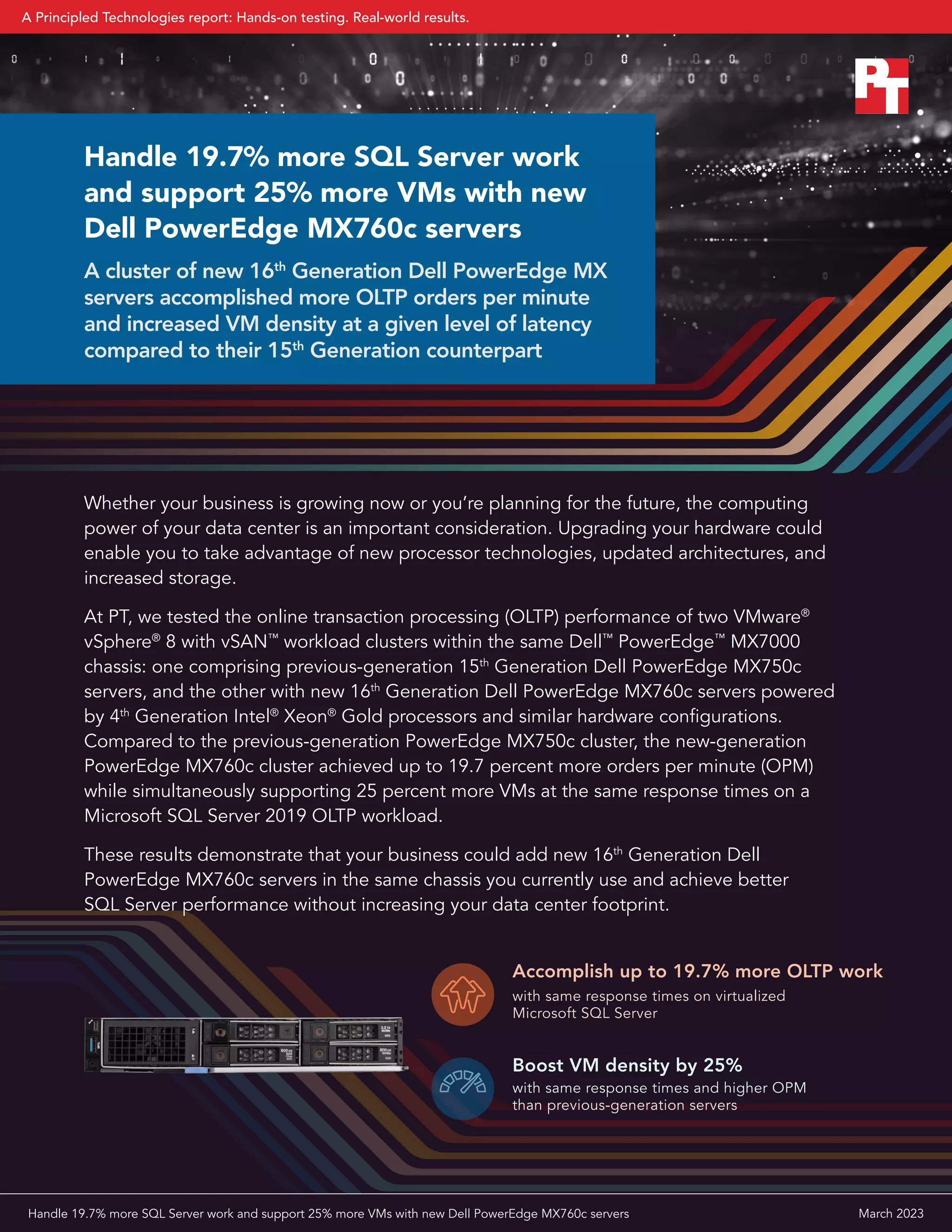
At PT, we tested the online transaction processing (OLTP) performance of two VMware®
vSphere®
8 with vSAN™
workload clusters within the same Dell™
PowerEdge™
MX7000
chassis: one comprising previous-generation 15th
Generation Dell PowerEdge MX750c
servers, and the other with new 16th
Generation Dell PowerEdge MX760c servers powered
by 4th
Generation Intel®
Xeon®
Gold processors and similar hardware configurations.
Compared to the previous-generation PowerEdge MX750c cluster, the new-generation
PowerEdge MX760c cluster achieved up to 19.7 percent more orders per minute (OPM)
while simultaneously supporting 25 percent more VMs at the same response times on a
Microsoft SQL Server 2019 OLTP workload.
These results demonstrate that your business could add new 16th
Generation Dell
PowerEdge MX760c servers in the same chassis you currently use and achieve better
SQL Server performance without increasing your data center footprint.
Handle 19.7% more SQL Server work
and support 25% more VMs with new
Dell PowerEdge MX760c servers
A cluster of new 16th
Generation Dell PowerEdge MX
servers accomplished more OLTP orders per minute
and increased VM density at a given level of latency
compared to their 15th
Generation counterpart
Boost VM density by 25%
with same response times and higher OPM
than previous-generation servers
Accomplish up to 19.7% more OLTP work
with same response times on virtualized
Microsoft SQL Server
Handle 19.7% more SQL Server work and support 25% more VMs with new Dell PowerEdge MX760c servers March 2023
A Principled Technologies report: Hands-on testing. Real-world results.
A greater OLTP
transaction rate from
new-generation servers
OLTP databases play a key role in retail transactions,
inventory tracking, customer relationship
management, and other business operations. As
demand on these databases increases, critical
applications can slow down, especially if hardware
is not up to the task. Therefore, selecting a solution
that can support a higher rate of transactions is a
prudent choice.
We used the DVD Store 3 benchmark to measure
the Microsoft SQL Server OLTP performance with
virtualized SQL Server 2019 of two vSAN clusters:
• A cluster of three 16th
Generation Dell
PowerEdge MX760c servers, each with 32-
core 4th
Generation Intel Xeon Gold 6430
processors, 512 GB of DDR5 RAM, and four
3.2TB NVMe®
SSDs
• A cluster of three 15th
generation Dell
PowerEdge MX750c servers, each with 32-
core 3rd
Generation Intel Xeon Gold 6338
processors, 512 GB of DDR4 RAM, and four
3.2TB NVMe SSDs
We configured the servers in a manner typical of the
time of their release. Therefore, the new-generation
servers include higher-performing processors, DDR5
memory, and PCIe®
5 drives (though we tested with
PCIe 4 drives). Dell states that the PowerEdge MX760c
supports up to two 4th
Generation Intel Xeon Scalable
processors with up to 56 cores per socket; high-speed
and dense memory capacity, optimized for two DIMMs
per channel; up to 32 DDR5 DIMMs at 4,800 MT/s;
and up to eight E3.S PCIe 5 NVMe drives.3
We found that the new-generation cluster not only
delivered more orders per minute per VM with lower
response times, but it could also support greater
VM density, increasing the total OPM with similar
response times.
For complete details on the systems and our testing,
see the science behind this report.
About new Dell PowerEdge MX760c
compute sleds
According to Dell, the new PowerEdge
MX760c server is a “2-socket, single-width
sled with scalable and dense compute for
AI inferencing, database, Big Data analytics,
virtualization, and containerization.”1
To learn more, visit https://www.
dell.com/en-us/dt/servers/modular-
infrastructure/poweredge-mx/.
What about managing power?
In a November 2022 study, we used Dell
OpenManage Enterprise Power Manager
to monitor and manage a group of eight
PowerEdge servers.2
Our testing found that
compared to a manual process using iDRAC,
using Power Manager to collect power data
took 70 percent less time and 33 percent fewer
steps. Applying a power cap to servers with
Power Manager took 82 percent less time and
70 percent fewer steps than with the manual
approach. For efficiency-minded businesses
seeking to make the most of their data centers,
simplifying power management can also be a
compelling strategy.
To learn more, see the report:
https://facts.pt/3a2yDEn.
Handle 19.7% more SQL Server work and support 25% more VMs with new Dell PowerEdge MX760c servers March 2023 | 2
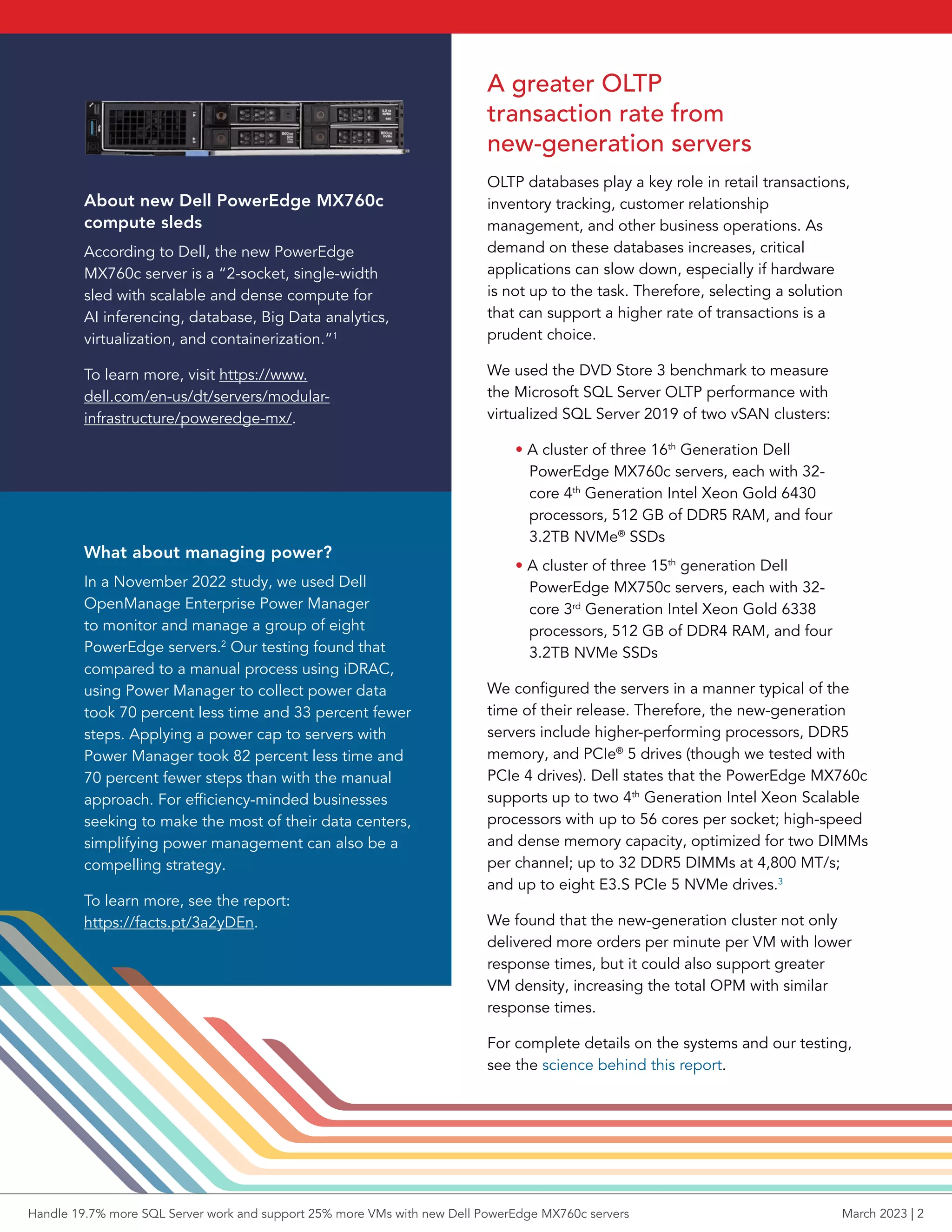
Figure 1: Total orders per minute the two clusters achieved with 24 VMs. Higher OPM and lower latency are better.
Source: Principled Technologies.
10.6% more orders per minute with an equal number of VMs (24)
373,831 OPM (avg. latency: 100 ms)
Dell PowerEdge MX760c vSAN cluster
24 VMs
Dell PowerEdge MX750c vSAN cluster 337,977 OPM (avg. latency: 112 ms)
24 VMs
Results of our hands-on testing
During the first phase of testing, we ran eight VMs on each server in our three-node workload clusters, for a total
of 24 VMs per cluster. As Figure 1 shows, the new-generation servers delivered 373,831 OPM, an improvement
of 10.6 percent over the previous-generation cluster’s 337,977 OPM. While achieving this higher level of
performance, the new-generation cluster also delivered average latency 10.7 percent lower than that of the
previous-generation server.
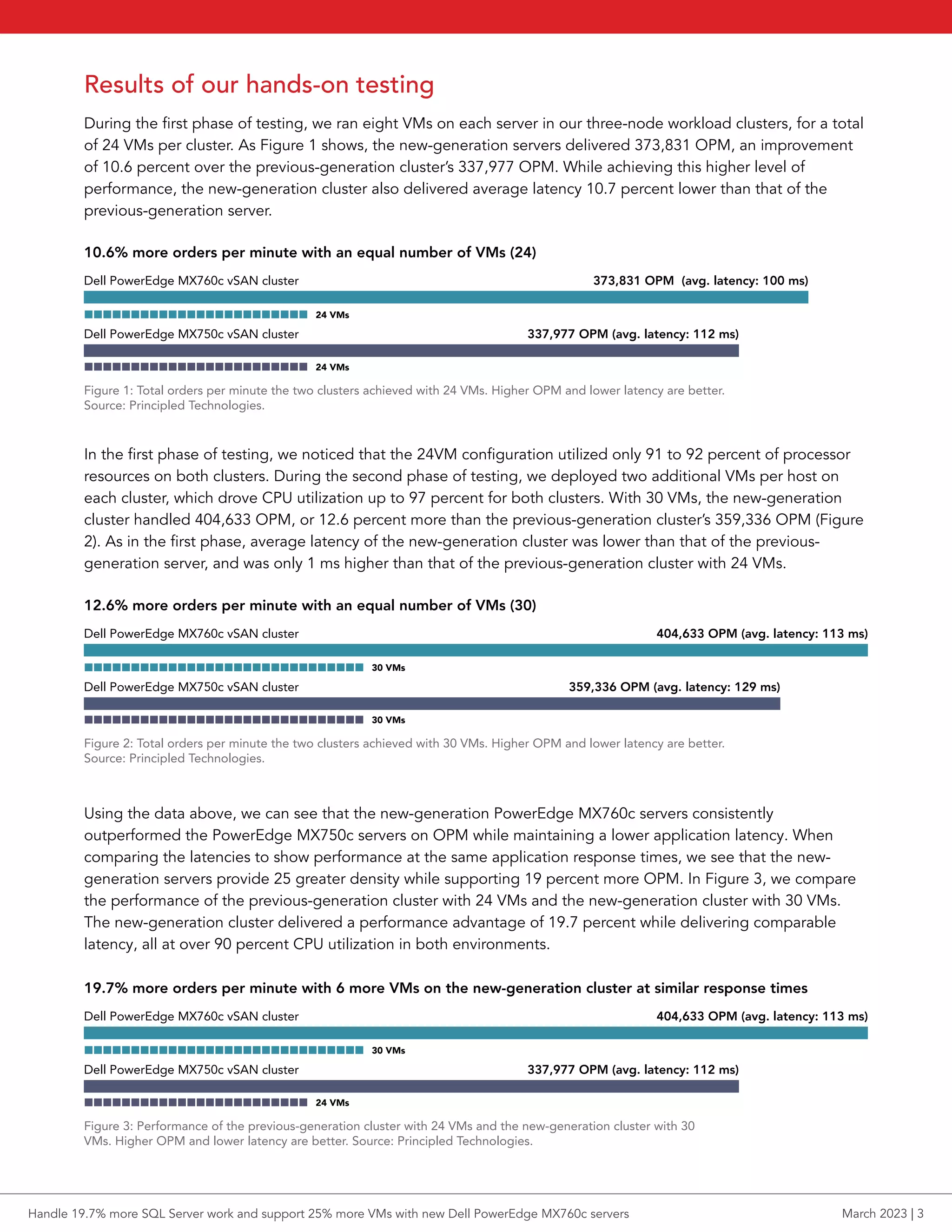
In the first phase of testing, we noticed that the 24VM configuration utilized only 91 to 92 percent of processor
resources on both clusters. During the second phase of testing, we deployed two additional VMs per host on
each cluster, which drove CPU utilization up to 97 percent for both clusters. With 30 VMs, the new-generation
cluster handled 404,633 OPM, or 12.6 percent more than the previous-generation cluster’s 359,336 OPM (Figure
2). As in the first phase, average latency of the new-generation cluster was lower than that of the previous-
generation server, and was only 1 ms higher than that of the previous-generation cluster with 24 VMs.
Figure 2: Total orders per minute the two clusters achieved with 30 VMs. Higher OPM and lower latency are better.
Source: Principled Technologies.
12.6% more orders per minute with an equal number of VMs (30)
404,633 OPM (avg. latency: 113 ms)
Dell PowerEdge MX760c vSAN cluster
30 VMs
Dell PowerEdge MX750c vSAN cluster 359,336 OPM (avg. latency: 129 ms)
30 VMs
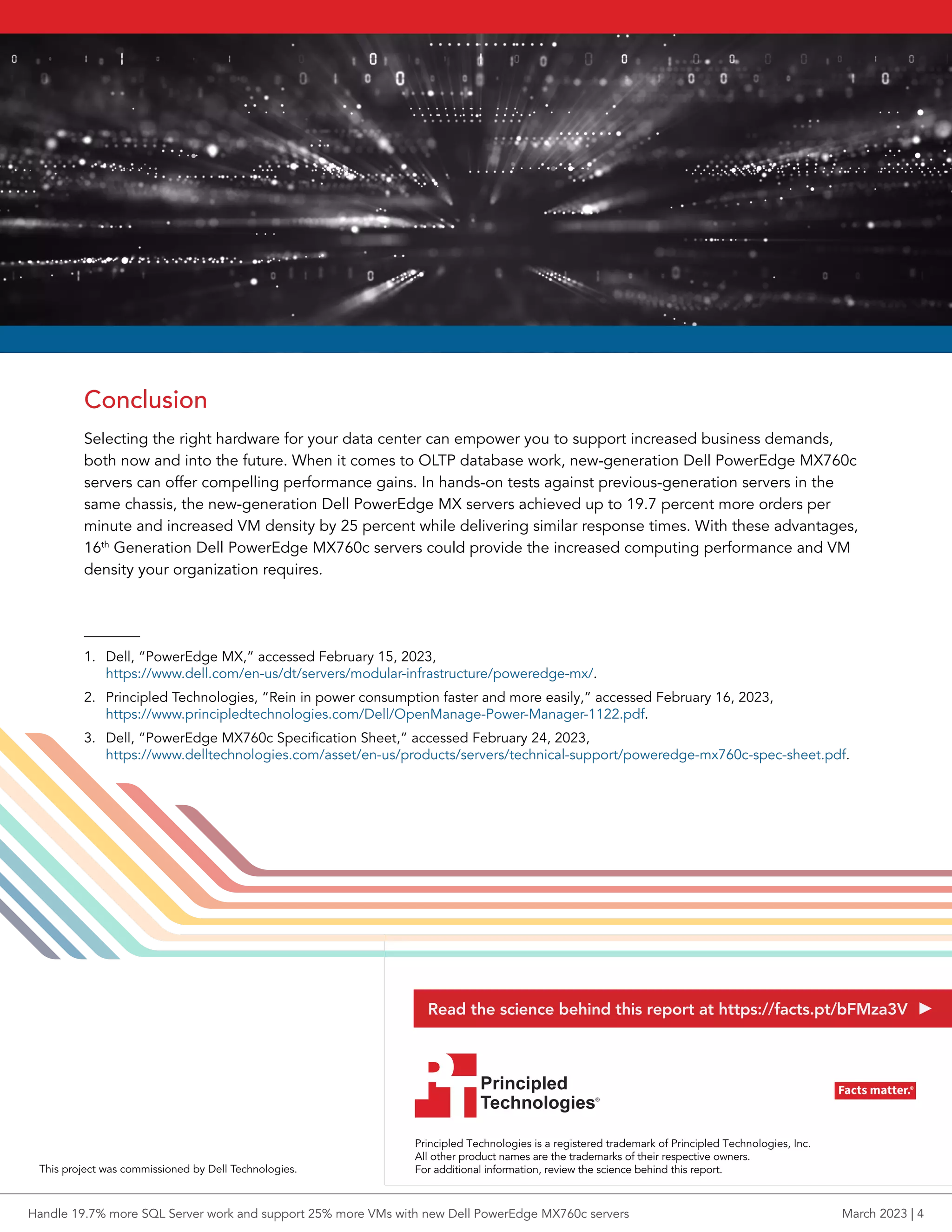
Figure 3: Performance of the previous-generation cluster with 24 VMs and the new-generation cluster with 30
VMs. Higher OPM and lower latency are better. Source: Principled Technologies.
19.7% more orders per minute with 6 more VMs on the new-generation cluster at similar response times
404,633 OPM (avg. latency: 113 ms)
Dell PowerEdge MX760c vSAN cluster
30 VMs
Dell PowerEdge MX750c vSAN cluster 337,977 OPM (avg. latency: 112 ms)
24 VMs
Using the data above, we can see that the new-generation PowerEdge MX760c servers consistently
outperformed the PowerEdge MX750c servers on OPM while maintaining a lower application latency. When
comparing the latencies to show performance at the same application response times, we see that the new-
generation servers provide 25 greater density while supporting 19 percent more OPM. In Figure 3, we compare
the performance of the previous-generation cluster with 24 VMs and the new-generation cluster with 30 VMs.
The new-generation cluster delivered a performance advantage of 19.7 percent while delivering comparable
latency, all at over 90 percent CPU utilization in both environments.
Handle 19.7% more SQL Server work and support 25% more VMs with new Dell PowerEdge MX760c servers March 2023 | 3
Conclusion
Selecting the right hardware for your data center can empower you to support increased business demands,
both now and into the future. When it comes to OLTP database work, new-generation Dell PowerEdge MX760c
servers can offer compelling performance gains. In hands-on tests against previous-generation servers in the
same chassis, the new-generation Dell PowerEdge MX servers achieved up to 19.7 percent more orders per
minute and increased VM density by 25 percent while delivering similar response times. With these advantages,
16th
Generation Dell PowerEdge MX760c servers could provide the increased computing performance and VM
density your organization requires.
1. Dell, “PowerEdge MX,” accessed February 15, 2023,
https://www.dell.com/en-us/dt/servers/modular-infrastructure/poweredge-mx/.
2. Principled Technologies, “Rein in power consumption faster and more easily,” accessed February 16, 2023,
https://www.principledtechnologies.com/Dell/OpenManage-Power-Manager-1122.pdf.
3. Dell, “PowerEdge MX760c Specification Sheet,” accessed February 24, 2023,
https://www.delltechnologies.com/asset/en-us/products/servers/technical-support/poweredge-mx760c-spec-sheet.pdf.
Principled Technologies is a registered trademark of Principled Technologies, Inc.
All other product names are the trademarks of their respective owners.
For additional information, review the science behind this report.
Principled
Technologies®
Facts matter.®
Principled
Technologies®
Facts matter.®
This project was commissioned by Dell Technologies.
Read the science behind this report at https://facts.pt/bFMza3V
Handle 19.7% more SQL Server work and support 25% more VMs with new Dell PowerEdge MX760c servers March 2023 | 4

Handle 19.7% more SQL Server work and support 25% more VMs with new Dell PowerEdge MX760c servers

  • 1.
    Whether your businessis growing now or you’re planning for the future, the computing power of your data center is an important consideration. Upgrading your hardware could enable you to take advantage of new processor technologies, updated architectures, and increased storage. At PT, we tested the online transaction processing (OLTP) performance of two VMware® vSphere® 8 with vSAN™ workload clusters within the same Dell™ PowerEdge™ MX7000 chassis: one comprising previous-generation 15th Generation Dell PowerEdge MX750c servers, and the other with new 16th Generation Dell PowerEdge MX760c servers powered by 4th Generation Intel® Xeon® Gold processors and similar hardware configurations. Compared to the previous-generation PowerEdge MX750c cluster, the new-generation PowerEdge MX760c cluster achieved up to 19.7 percent more orders per minute (OPM) while simultaneously supporting 25 percent more VMs at the same response times on a Microsoft SQL Server 2019 OLTP workload. These results demonstrate that your business could add new 16th Generation Dell PowerEdge MX760c servers in the same chassis you currently use and achieve better SQL Server performance without increasing your data center footprint. Handle 19.7% more SQL Server work and support 25% more VMs with new Dell PowerEdge MX760c servers A cluster of new 16th Generation Dell PowerEdge MX servers accomplished more OLTP orders per minute and increased VM density at a given level of latency compared to their 15th Generation counterpart Boost VM density by 25% with same response times and higher OPM than previous-generation servers Accomplish up to 19.7% more OLTP work with same response times on virtualized Microsoft SQL Server Handle 19.7% more SQL Server work and support 25% more VMs with new Dell PowerEdge MX760c servers March 2023 A Principled Technologies report: Hands-on testing. Real-world results.
  • 2.
    A greater OLTP transactionrate from new-generation servers OLTP databases play a key role in retail transactions, inventory tracking, customer relationship management, and other business operations. As demand on these databases increases, critical applications can slow down, especially if hardware is not up to the task. Therefore, selecting a solution that can support a higher rate of transactions is a prudent choice. We used the DVD Store 3 benchmark to measure the Microsoft SQL Server OLTP performance with virtualized SQL Server 2019 of two vSAN clusters: • A cluster of three 16th Generation Dell PowerEdge MX760c servers, each with 32- core 4th Generation Intel Xeon Gold 6430 processors, 512 GB of DDR5 RAM, and four 3.2TB NVMe® SSDs • A cluster of three 15th generation Dell PowerEdge MX750c servers, each with 32- core 3rd Generation Intel Xeon Gold 6338 processors, 512 GB of DDR4 RAM, and four 3.2TB NVMe SSDs We configured the servers in a manner typical of the time of their release. Therefore, the new-generation servers include higher-performing processors, DDR5 memory, and PCIe® 5 drives (though we tested with PCIe 4 drives). Dell states that the PowerEdge MX760c supports up to two 4th Generation Intel Xeon Scalable processors with up to 56 cores per socket; high-speed and dense memory capacity, optimized for two DIMMs per channel; up to 32 DDR5 DIMMs at 4,800 MT/s; and up to eight E3.S PCIe 5 NVMe drives.3 We found that the new-generation cluster not only delivered more orders per minute per VM with lower response times, but it could also support greater VM density, increasing the total OPM with similar response times. For complete details on the systems and our testing, see the science behind this report. About new Dell PowerEdge MX760c compute sleds According to Dell, the new PowerEdge MX760c server is a “2-socket, single-width sled with scalable and dense compute for AI inferencing, database, Big Data analytics, virtualization, and containerization.”1 To learn more, visit https://www. dell.com/en-us/dt/servers/modular- infrastructure/poweredge-mx/. What about managing power? In a November 2022 study, we used Dell OpenManage Enterprise Power Manager to monitor and manage a group of eight PowerEdge servers.2 Our testing found that compared to a manual process using iDRAC, using Power Manager to collect power data took 70 percent less time and 33 percent fewer steps. Applying a power cap to servers with Power Manager took 82 percent less time and 70 percent fewer steps than with the manual approach. For efficiency-minded businesses seeking to make the most of their data centers, simplifying power management can also be a compelling strategy. To learn more, see the report: https://facts.pt/3a2yDEn. Handle 19.7% more SQL Server work and support 25% more VMs with new Dell PowerEdge MX760c servers March 2023 | 2
  • 3.
    Figure 1: Totalorders per minute the two clusters achieved with 24 VMs. Higher OPM and lower latency are better. Source: Principled Technologies. 10.6% more orders per minute with an equal number of VMs (24) 373,831 OPM (avg. latency: 100 ms) Dell PowerEdge MX760c vSAN cluster 24 VMs Dell PowerEdge MX750c vSAN cluster 337,977 OPM (avg. latency: 112 ms) 24 VMs Results of our hands-on testing During the first phase of testing, we ran eight VMs on each server in our three-node workload clusters, for a total of 24 VMs per cluster. As Figure 1 shows, the new-generation servers delivered 373,831 OPM, an improvement of 10.6 percent over the previous-generation cluster’s 337,977 OPM. While achieving this higher level of performance, the new-generation cluster also delivered average latency 10.7 percent lower than that of the previous-generation server. In the first phase of testing, we noticed that the 24VM configuration utilized only 91 to 92 percent of processor resources on both clusters. During the second phase of testing, we deployed two additional VMs per host on each cluster, which drove CPU utilization up to 97 percent for both clusters. With 30 VMs, the new-generation cluster handled 404,633 OPM, or 12.6 percent more than the previous-generation cluster’s 359,336 OPM (Figure 2). As in the first phase, average latency of the new-generation cluster was lower than that of the previous- generation server, and was only 1 ms higher than that of the previous-generation cluster with 24 VMs. Figure 2: Total orders per minute the two clusters achieved with 30 VMs. Higher OPM and lower latency are better. Source: Principled Technologies. 12.6% more orders per minute with an equal number of VMs (30) 404,633 OPM (avg. latency: 113 ms) Dell PowerEdge MX760c vSAN cluster 30 VMs Dell PowerEdge MX750c vSAN cluster 359,336 OPM (avg. latency: 129 ms) 30 VMs Figure 3: Performance of the previous-generation cluster with 24 VMs and the new-generation cluster with 30 VMs. Higher OPM and lower latency are better. Source: Principled Technologies. 19.7% more orders per minute with 6 more VMs on the new-generation cluster at similar response times 404,633 OPM (avg. latency: 113 ms) Dell PowerEdge MX760c vSAN cluster 30 VMs Dell PowerEdge MX750c vSAN cluster 337,977 OPM (avg. latency: 112 ms) 24 VMs Using the data above, we can see that the new-generation PowerEdge MX760c servers consistently outperformed the PowerEdge MX750c servers on OPM while maintaining a lower application latency. When comparing the latencies to show performance at the same application response times, we see that the new- generation servers provide 25 greater density while supporting 19 percent more OPM. In Figure 3, we compare the performance of the previous-generation cluster with 24 VMs and the new-generation cluster with 30 VMs. The new-generation cluster delivered a performance advantage of 19.7 percent while delivering comparable latency, all at over 90 percent CPU utilization in both environments. Handle 19.7% more SQL Server work and support 25% more VMs with new Dell PowerEdge MX760c servers March 2023 | 3
  • 4.
    Conclusion Selecting the righthardware for your data center can empower you to support increased business demands, both now and into the future. When it comes to OLTP database work, new-generation Dell PowerEdge MX760c servers can offer compelling performance gains. In hands-on tests against previous-generation servers in the same chassis, the new-generation Dell PowerEdge MX servers achieved up to 19.7 percent more orders per minute and increased VM density by 25 percent while delivering similar response times. With these advantages, 16th Generation Dell PowerEdge MX760c servers could provide the increased computing performance and VM density your organization requires. 1. Dell, “PowerEdge MX,” accessed February 15, 2023, https://www.dell.com/en-us/dt/servers/modular-infrastructure/poweredge-mx/. 2. Principled Technologies, “Rein in power consumption faster and more easily,” accessed February 16, 2023, https://www.principledtechnologies.com/Dell/OpenManage-Power-Manager-1122.pdf. 3. Dell, “PowerEdge MX760c Specification Sheet,” accessed February 24, 2023, https://www.delltechnologies.com/asset/en-us/products/servers/technical-support/poweredge-mx760c-spec-sheet.pdf. Principled Technologies is a registered trademark of Principled Technologies, Inc. All other product names are the trademarks of their respective owners. For additional information, review the science behind this report. Principled Technologies® Facts matter.® Principled Technologies® Facts matter.® This project was commissioned by Dell Technologies. Read the science behind this report at https://facts.pt/bFMza3V Handle 19.7% more SQL Server work and support 25% more VMs with new Dell PowerEdge MX760c servers March 2023 | 4