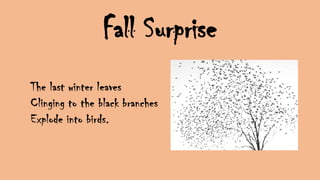
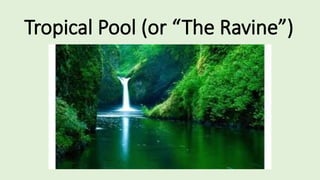
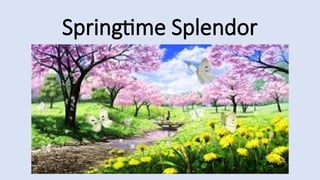
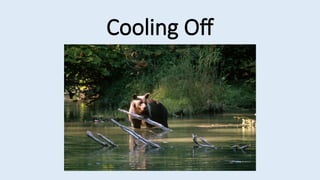
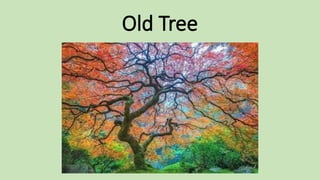
This presentation contains the definition of a haiku, and an explanation of a "twisted" haiku. It has example slides, instructions for students, and pictures for students to use in their assignments.
What is aHaiku?
• A Haiku doesn’t rhyme
• A haiku must “paint a mental image in the reader’s
mind”
• This is the challenge of a Haiku – to put the poem’s
meaning/image into the reader’s mind in ONLY
seventeen syllables and three lines of poetry!
2.
Directions: Choose onepicture that inspires you, and write
3 Haikus about it. Use the following steps:
1. Draft a list of words and phrases that go with your picture
• Use all 5 of the senses
• Consider the emotions the setting might evoke
• Think of what you might do or experience in the picture’s setting
2. Write 3 Haikus based on your picture (the title of your page
should be the title of the picture you choose)
3. At least one of your Haikus needs to have a “twist”
4. Choose a font size and style that you feel matches your Haikus
and decide how best to place them on a document.
3.
5. Make aslide out of your Haiku with a twist and turn it in to the Google
Classroom for a class slide show
6. Your slide should include the picture you used (or a similar picture).
You can choose your own title for the slide (see the sample slides
below…)
7. You do not have to include your name on your slide if you don’t want
to
8. Print off your document with the three Haikus and turn it in to the
inbox
4.
Frozen Lake
From acrossthe lake,
Past the black winter trees,
Faint sounds of a flute.
- Richard Wright