Big Data in Cloud
堵俊平
Apache Hadoop Committer
Staff Engineer, VMware
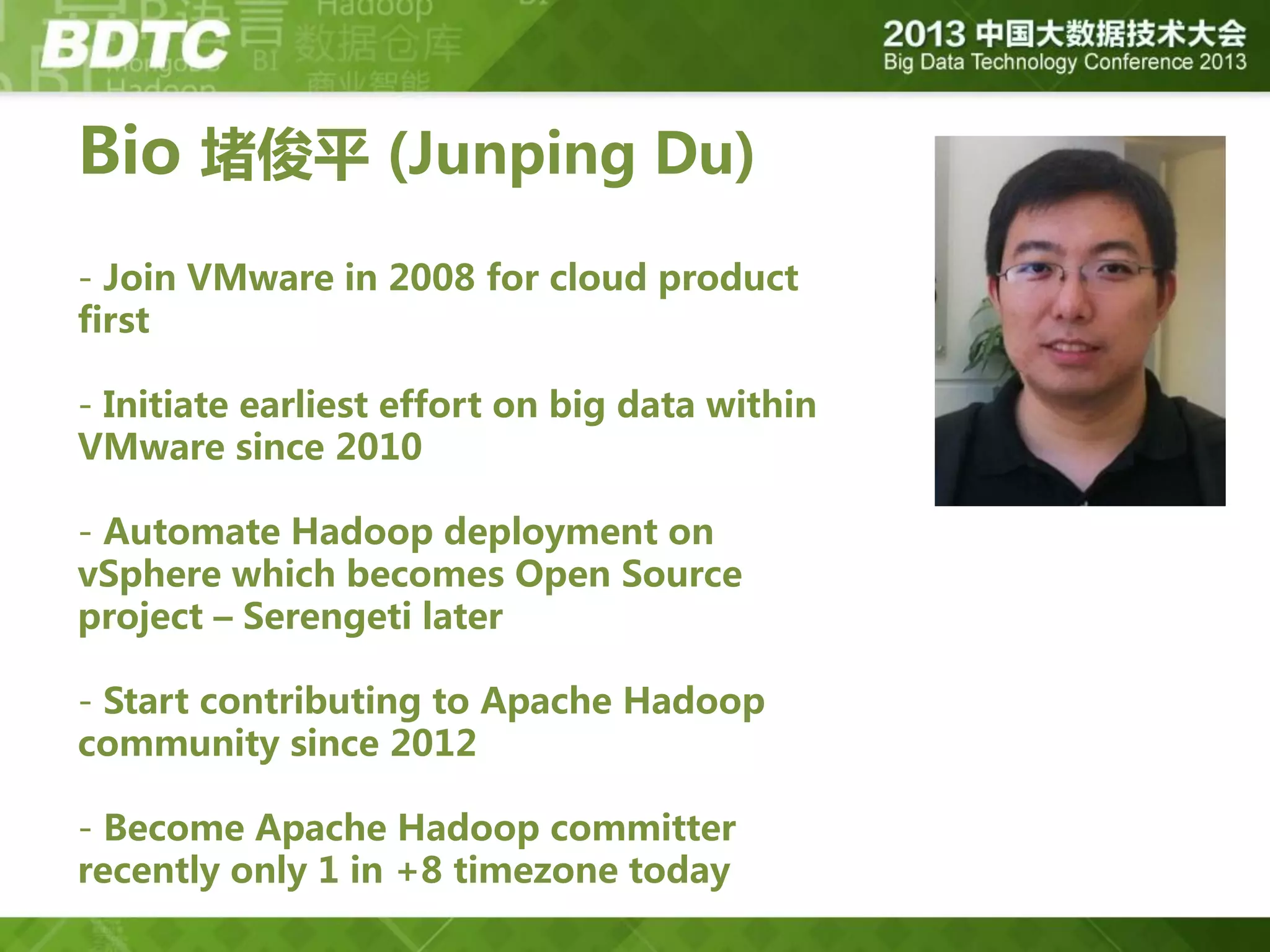
Bio 堵俊平 (Junping Du)
- Join VMware in 2008 for cloud product
first
- Initiate earliest effort on big data within
VMware since 2010
- Automate Hadoop deployment on
vSphere which becomes Open Source
project – Serengeti later
- Start contributing to Apache Hadoop
community since 2012
- Become Apache Hadoop committer
recently only 1 in +8 timezone today
Agenda
- Virtualization, SDDC and Cloud
- Trends from my observation in Big
Data
- YARN: resource hub for Big Data
Applications
- YARN in the Cloud
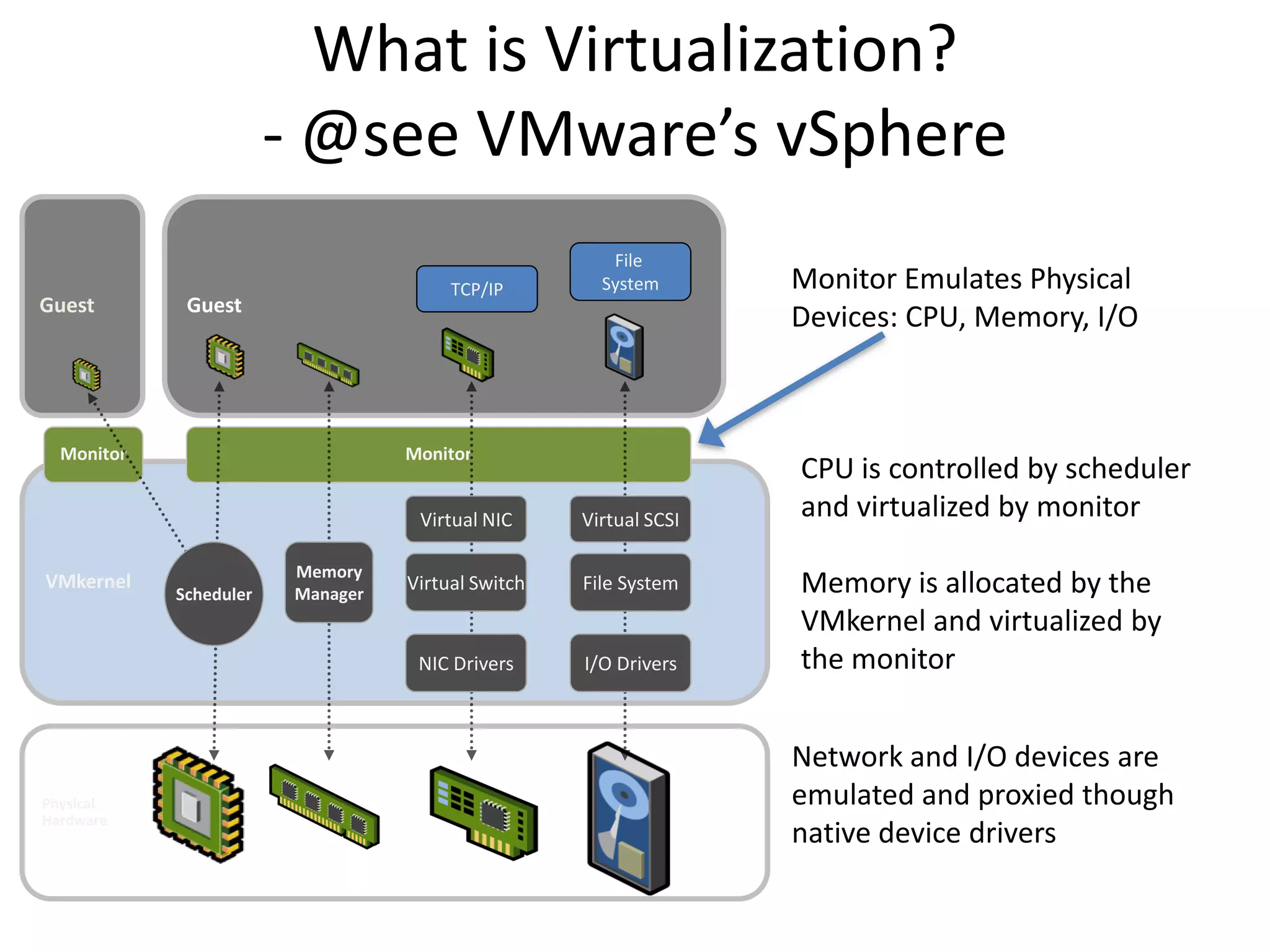
What is Virtualization?
- @see VMware’s vSphere
Guest

TCP/IP

Guest

Monitor

File
System

Monitor

Virtual NIC

Physical
Hardware

Scheduler

Memory
Manager

Virtual Switch

File System

NIC Drivers

VMkernel

Virtual SCSI

I/O Drivers

Monitor Emulates Physical
Devices: CPU, Memory, I/O

CPU is controlled by scheduler
and virtualized by monitor

Memory is allocated by the
VMkernel and virtualized by
the monitor
Network and I/O devices are
emulated and proxied though
native device drivers
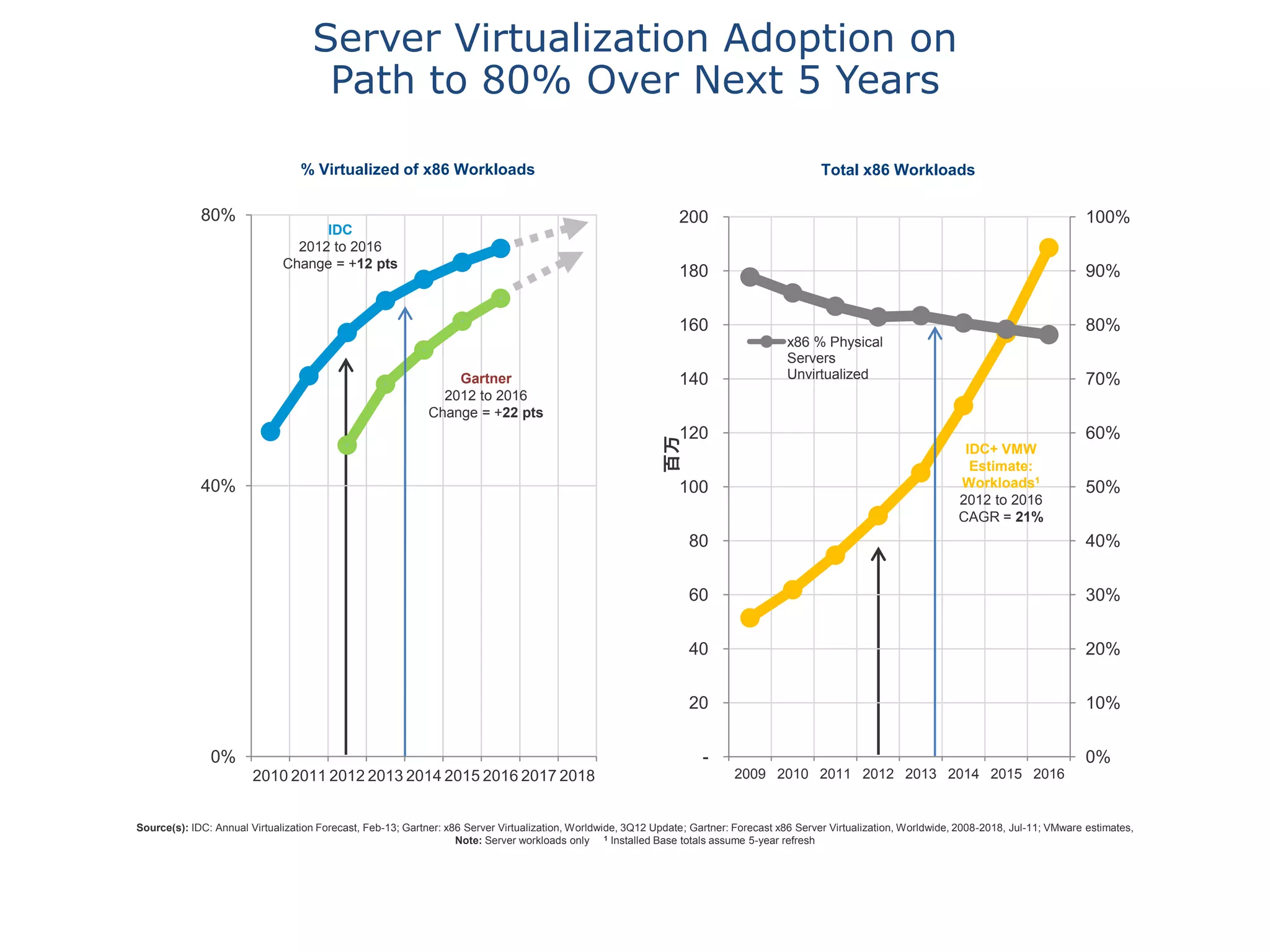
Server Virtualization Adoption on
Path to 80% Over Next 5 Years
% Virtualized of x86 Workloads

80%

Total x86 Workloads

200

100%

180

IDC
2012 to 2016
Change = +12 pts

90%

160
Gartner
2012 to 2016
Change = +22 pts

140

80%
x86 % Physical
Servers
Unvirtualized

70%

百万

120

40%

100

60%
IDC+ VMW
Estimate:
Workloads1
2012 to 2016
CAGR = 21%

50%

80
60

30%

40

20%

20
0%

40%

10%

2010 2011 2012 2013 2014 2015 2016 2017 2018

0%
2009 2010 2011 2012 2013 2014 2015 2016

Source(s): IDC: Annual Virtualization Forecast, Feb-13; Gartner: x86 Server Virtualization, Worldwide, 3Q12 Update; Gartner: Forecast x86 Server Virtualization, Worldwide, 2008-2018, Jul-11; VMware estimates,
Note: Server workloads only 1 Installed Base totals assume 5-year refresh
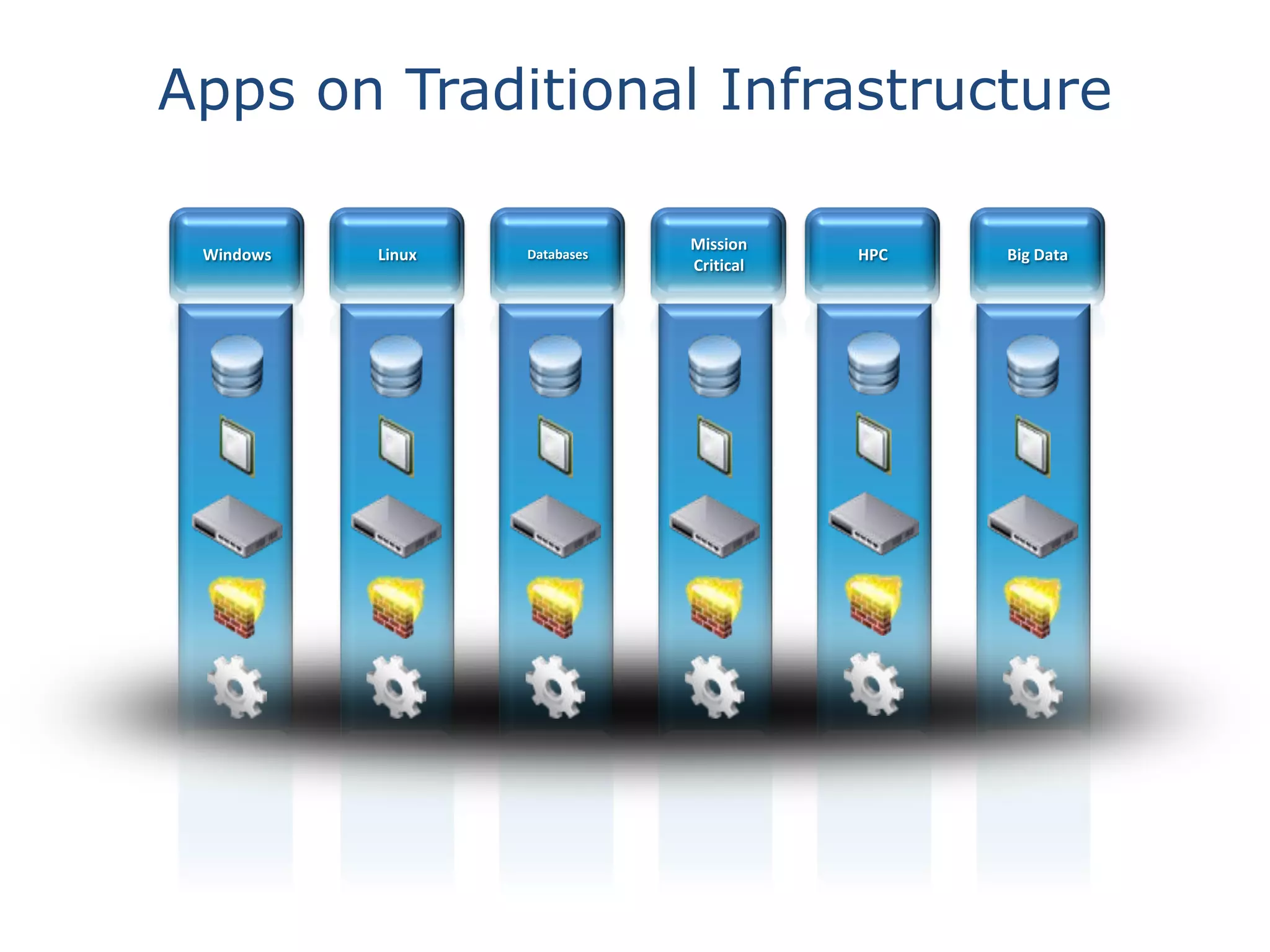
Apps on Traditional Infrastructure
Windows

Linux

Databases

Mission
Critical

HPC

Big Data
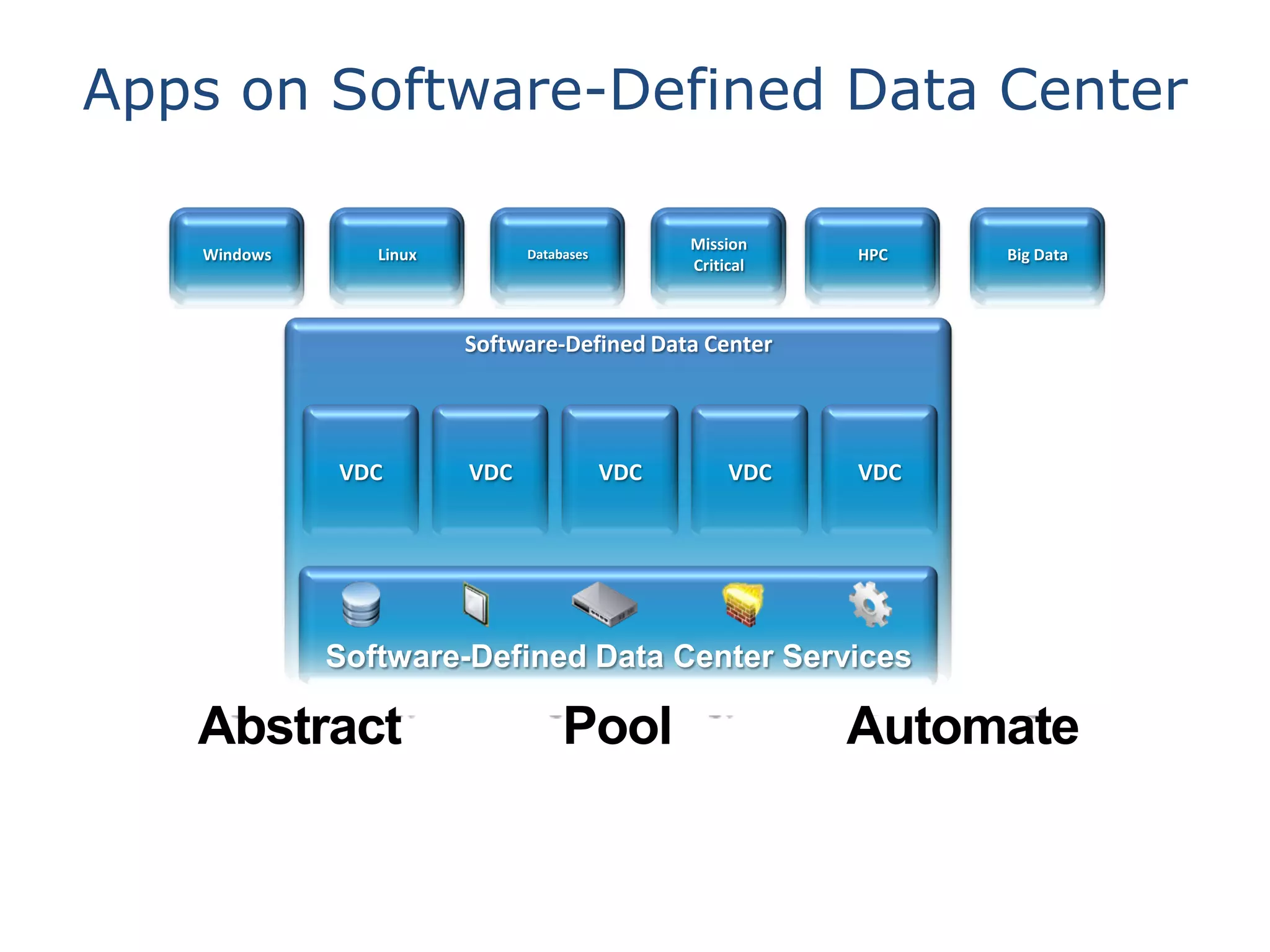
Apps on Software-Defined Data Center
Windows

Linux

Mission
Critical

Databases

HPC

Big Data

Software-Defined Data Center

VDC

VDC

VDC

VDC

VDC

Software-Defined Data Center Services

Abstract

Pool

Automate
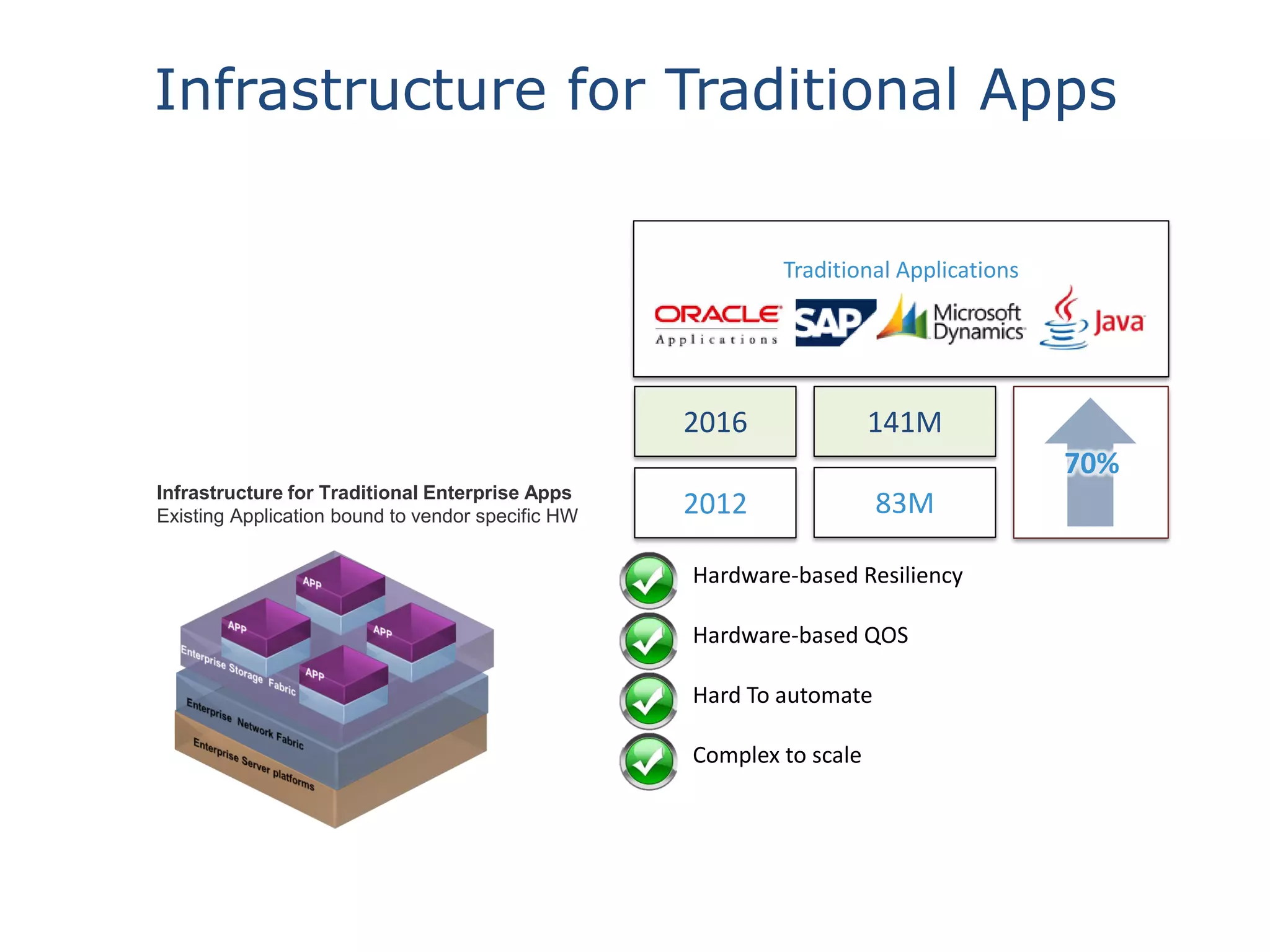
Infrastructure for Traditional Apps
Traditional Applications

2016

141M
70%

Infrastructure for Traditional Enterprise Apps
Existing Application bound to vendor specific HW

2012

83M

Hardware-based Resiliency
Hardware-based QOS
Hard To automate
Complex to scale
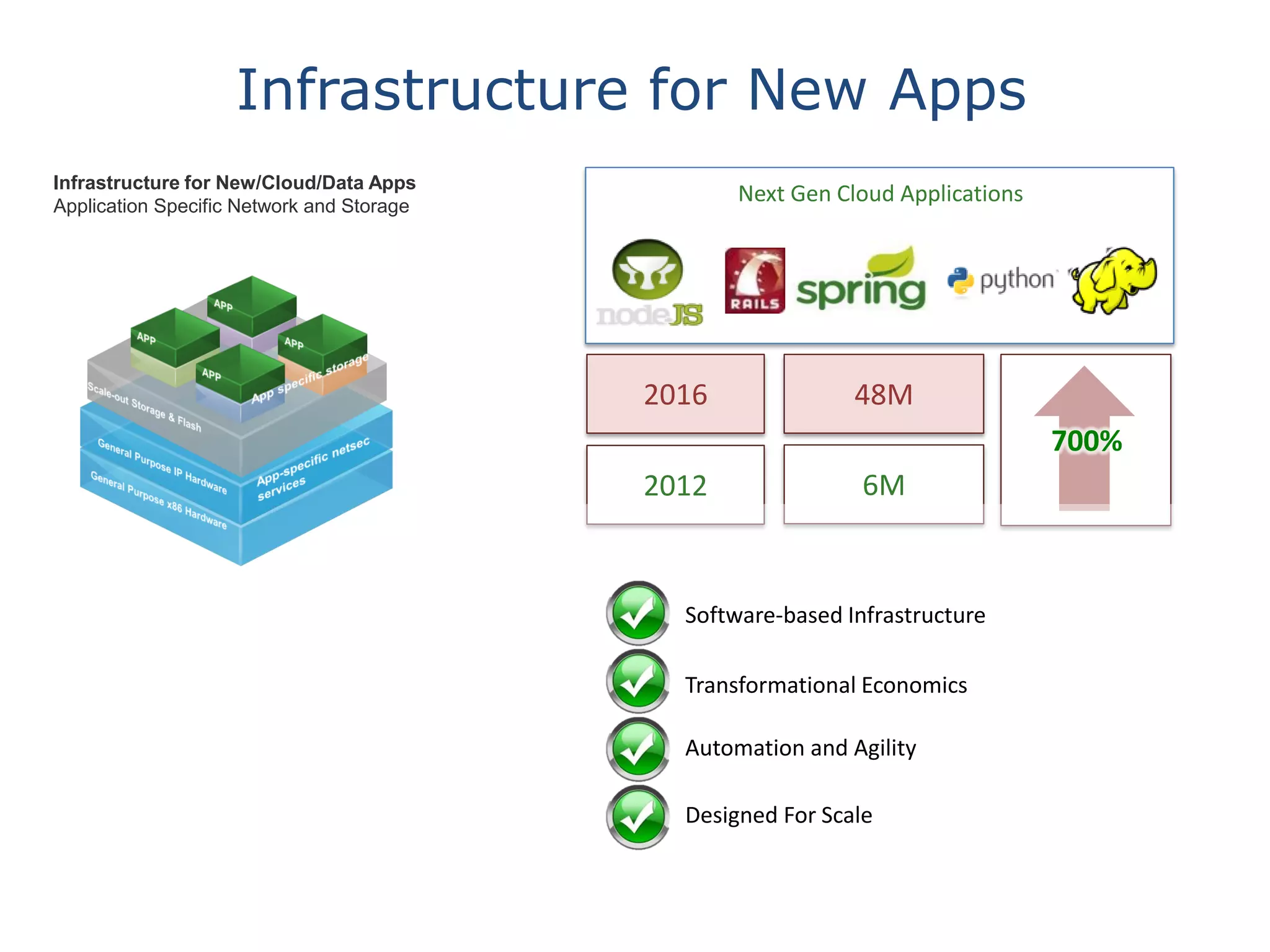
Infrastructure for New Apps
Infrastructure for New/Cloud/Data Apps
Application Specific Network and Storage

Next Gen Cloud Applications

2016

48M

700%
2012

6M

Software-based Infrastructure
Transformational Economics
Automation and Agility
Designed For Scale
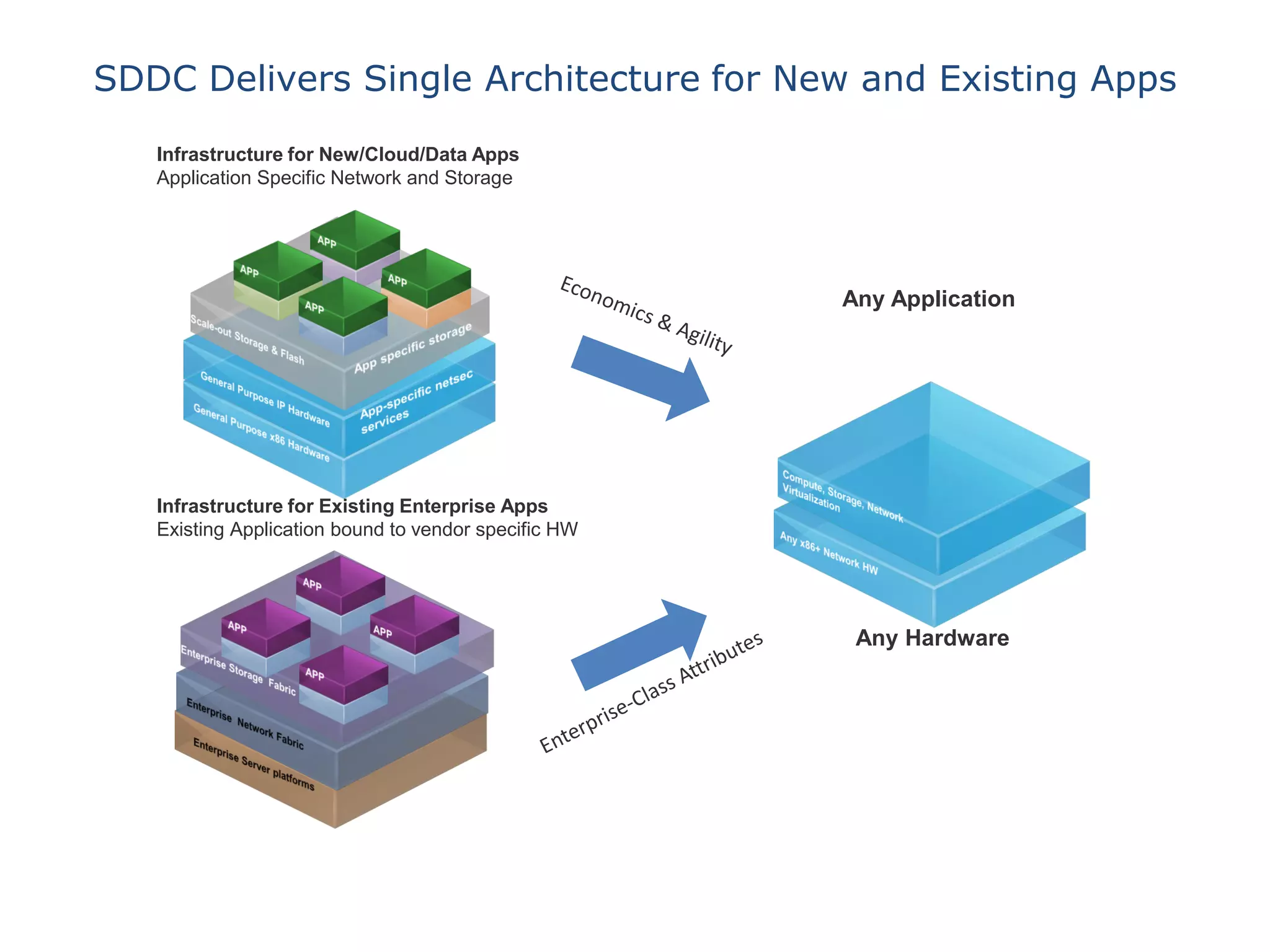
SDDC Delivers Single Architecture for New and Existing Apps
Infrastructure for New/Cloud/Data Apps
Application Specific Network and Storage

Any Application

Infrastructure for Existing Enterprise Apps
Existing Application bound to vendor specific HW

Any Hardware
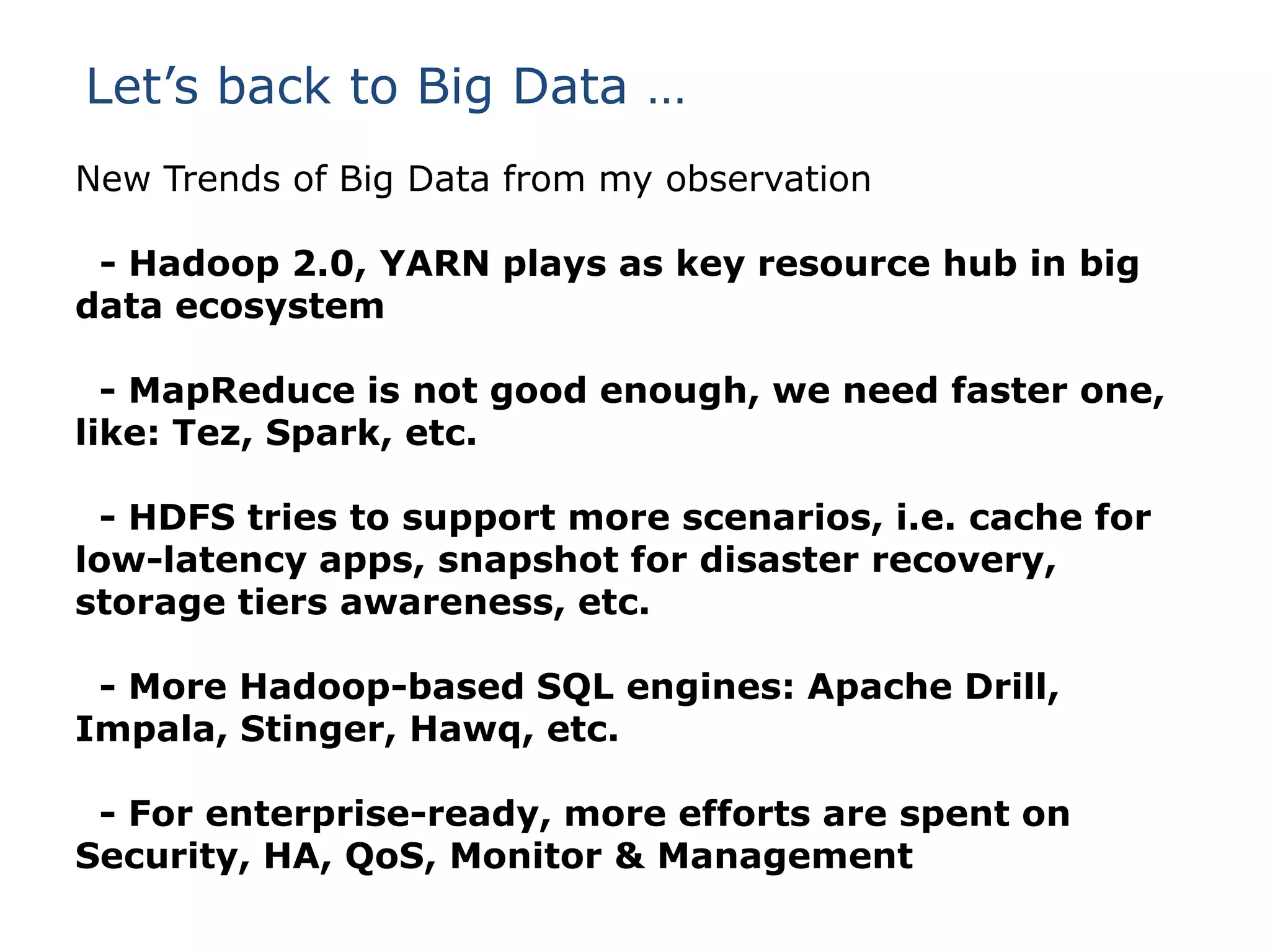
Let’s back to Big Data …
New Trends of Big Data from my observation
- Hadoop 2.0, YARN plays as key resource hub in big
data ecosystem
- MapReduce is not good enough, we need faster one,
like: Tez, Spark, etc.
- HDFS tries to support more scenarios, i.e. cache for
low-latency apps, snapshot for disaster recovery,
storage tiers awareness, etc.
- More Hadoop-based SQL engines: Apache Drill,
Impala, Stinger, Hawq, etc.
- For enterprise-ready, more efforts are spent on
Security, HA, QoS, Monitor & Management
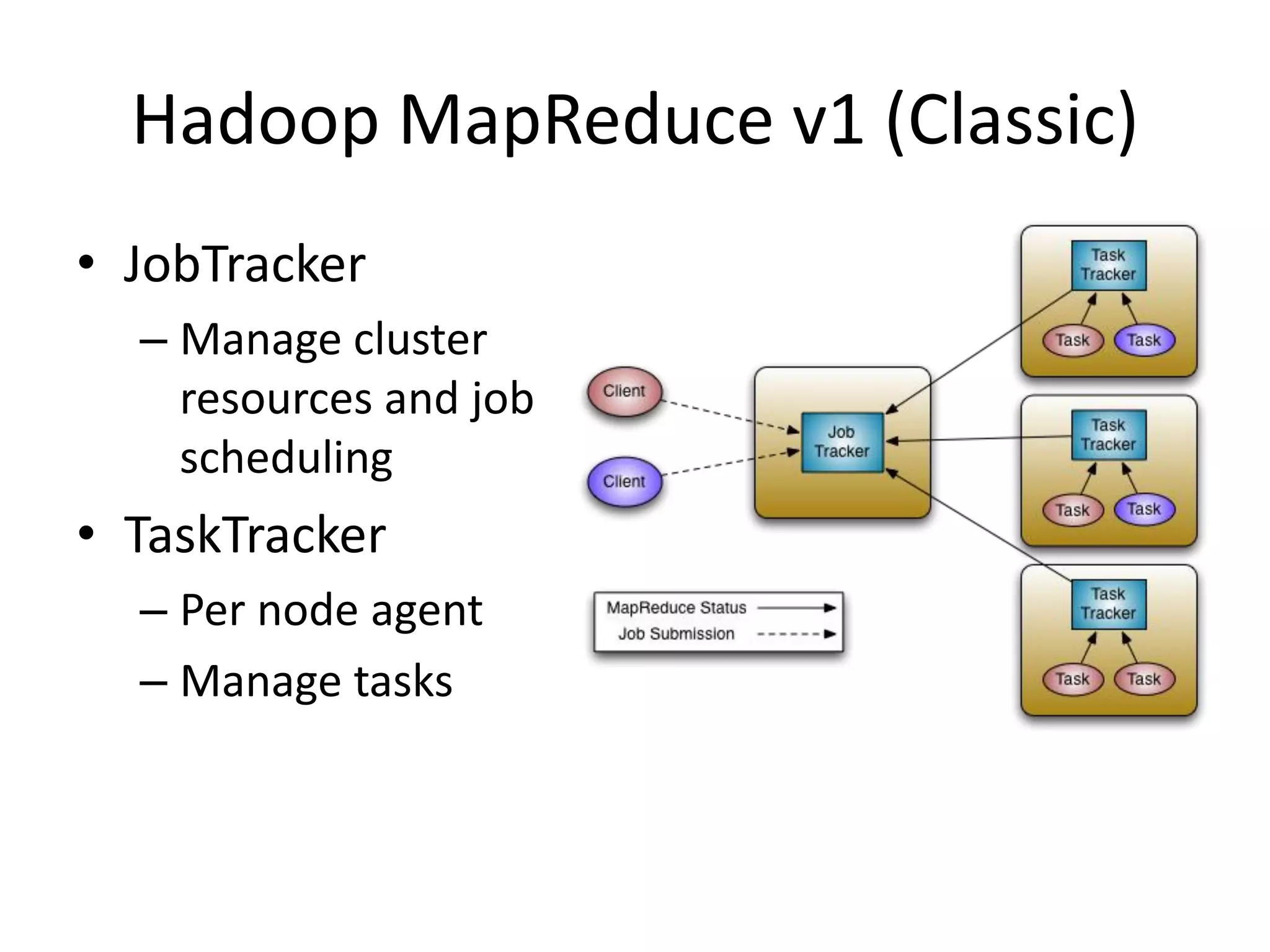
Hadoop MapReduce v1 (Classic)
• JobTracker
– Manage cluster
resources and job
scheduling

• TaskTracker
– Per node agent
– Manage tasks
MapReduce v1 Limitations
• Scalability
– Manage cluster resources and job scheduling

• SPOF (Single Point Of Failure)
• JobTracker failure cause all queued and running job
failure
– Restart is very tricky due to complex state

• Hard partition of resources into map and reduce
slots
– Low resource utilization

• Lacks support for alternate paradigms
• Lack of wire-compatible protocols
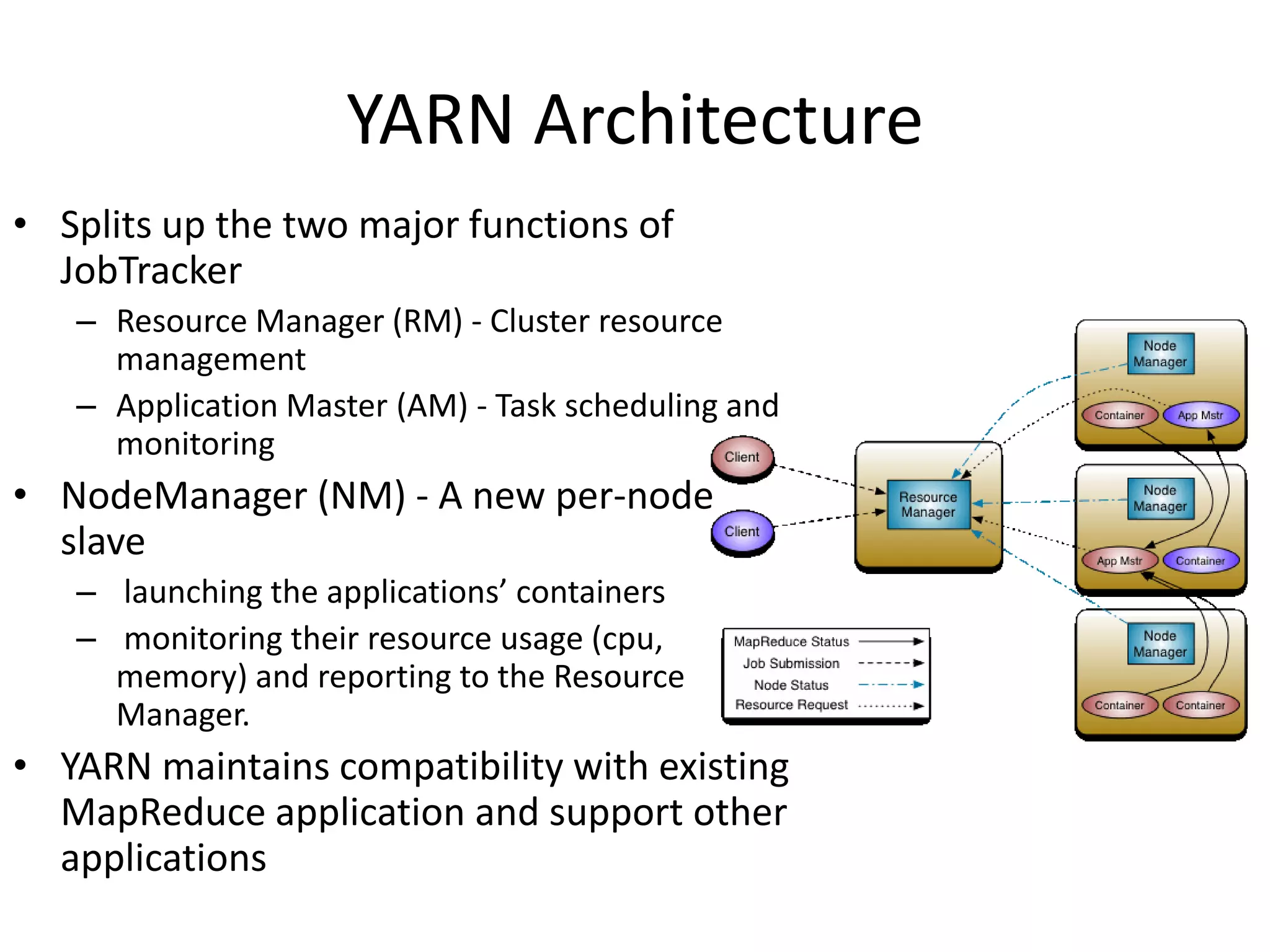
YARN Architecture
• Splits up the two major functions of
JobTracker
– Resource Manager (RM) - Cluster resource
management
– Application Master (AM) - Task scheduling and
monitoring

• NodeManager (NM) - A new per-node
slave
– launching the applications’ containers
– monitoring their resource usage (cpu,
memory) and reporting to the Resource
Manager.

• YARN maintains compatibility with existing
MapReduce application and support other
applications
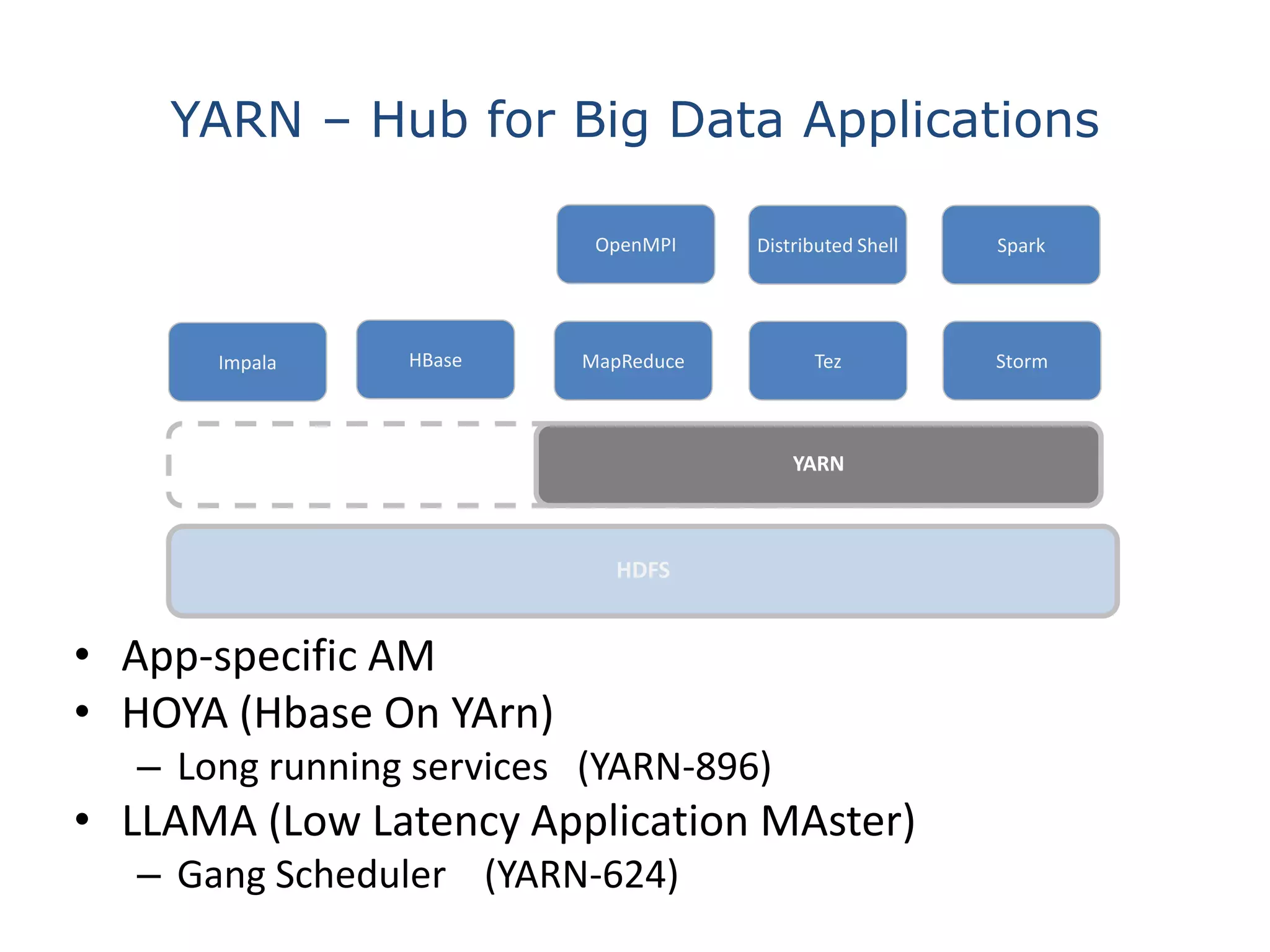
YARN – Hub for Big Data Applications
OpenMPI

Impala

HBase

Distributed Shell

Spark

MapReduce

Tez

Storm

YARN

HDFS

• App-specific AM
• HOYA (Hbase On YArn)
– Long running services (YARN-896)

• LLAMA (Low Latency Application MAster)
– Gang Scheduler (YARN-624)
YARN and Cloud
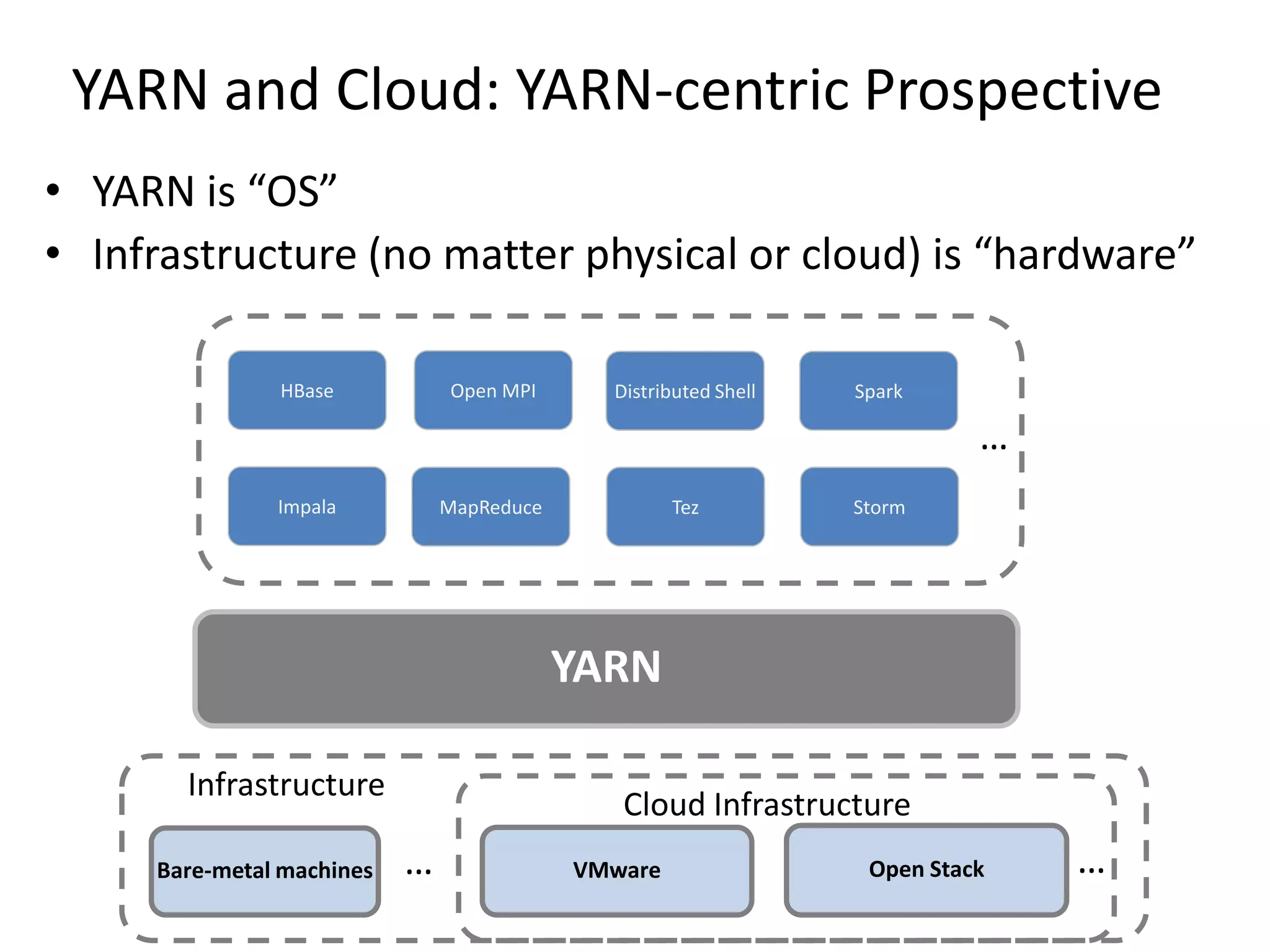
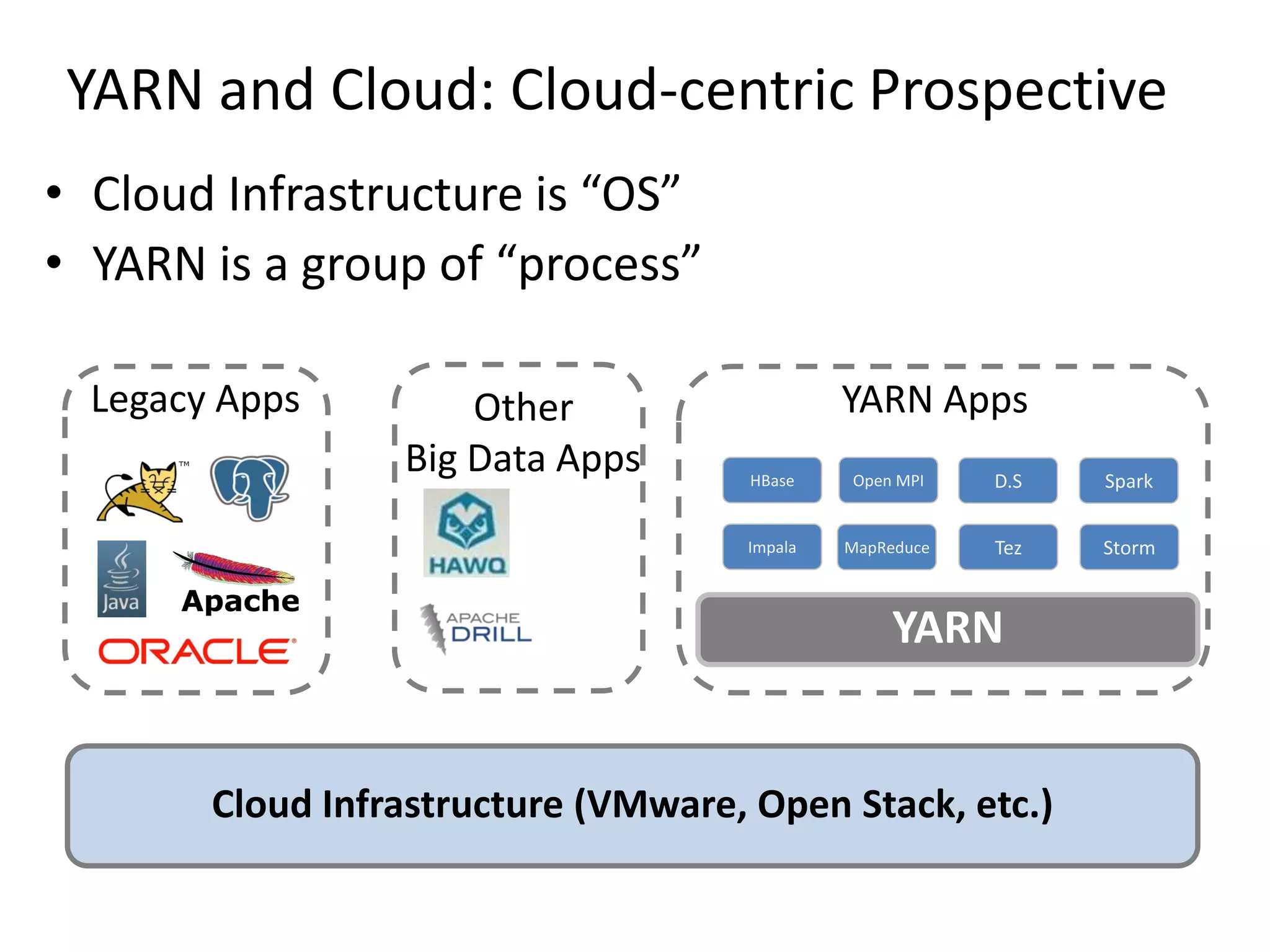
• Two different prospective:
– YARN-centric prospective
• YARN is the key platform to apps
• YARN is independent of infrastructure, running on top of
Cloud shows YARN’s generality

– Cloud-centric prospective
• YARN is an umbrella kind of applications
• Supporting YARN shows Cloud’s generality
YARN and Cloud: YARN-centric Prospective
• YARN is “OS”
Big Data Apps
• Infrastructure (no matter physical or cloud) is “hardware”
HBase

Open MPI

Distributed Shell

Spark

…
Impala

MapReduce

Tez

Storm

YARN
Infrastructure
Bare-metal machines

Cloud Infrastructure

…

VMware

Open Stack

…
YARN and Cloud: Cloud-centric Prospective
• Cloud Infrastructure is “OS”
• YARN is a group of “process”
Legacy Apps

Other
Big Data Apps

YARN Apps
Open MPI

D.S

Spark

Impala

…

HBase

MapReduce

Tez

Storm

…

YARN

Cloud Infrastructure (VMware, Open Stack, etc.)
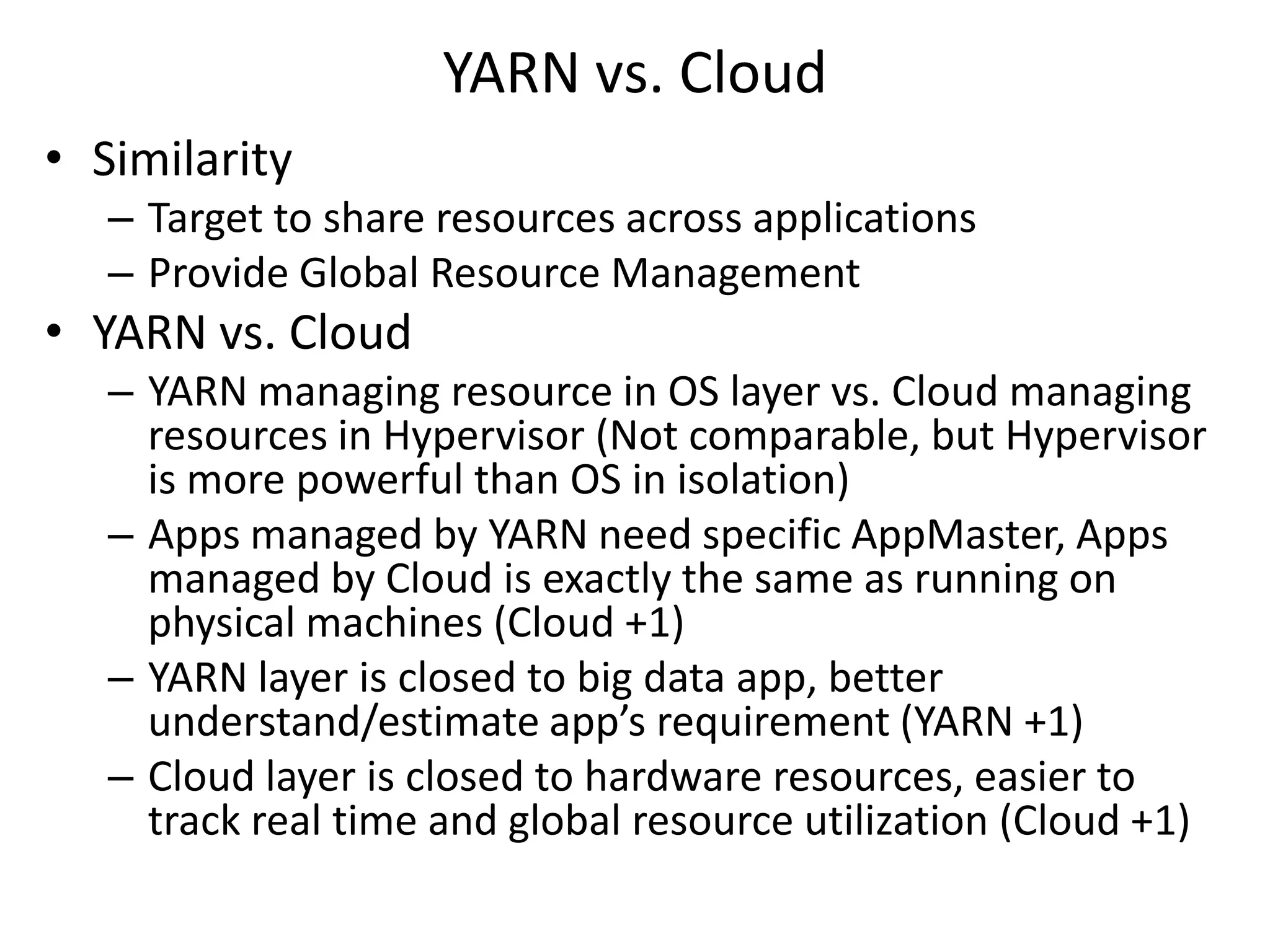
YARN vs. Cloud
• Similarity
– Target to share resources across applications
– Provide Global Resource Management

• YARN vs. Cloud
– YARN managing resource in OS layer vs. Cloud managing
resources in Hypervisor (Not comparable, but Hypervisor
is more powerful than OS in isolation)
– Apps managed by YARN need specific AppMaster, Apps
managed by Cloud is exactly the same as running on
physical machines (Cloud +1)
– YARN layer is closed to big data app, better
understand/estimate app’s requirement (YARN +1)
– Cloud layer is closed to hardware resources, easier to
track real time and global resource utilization (Cloud +1)
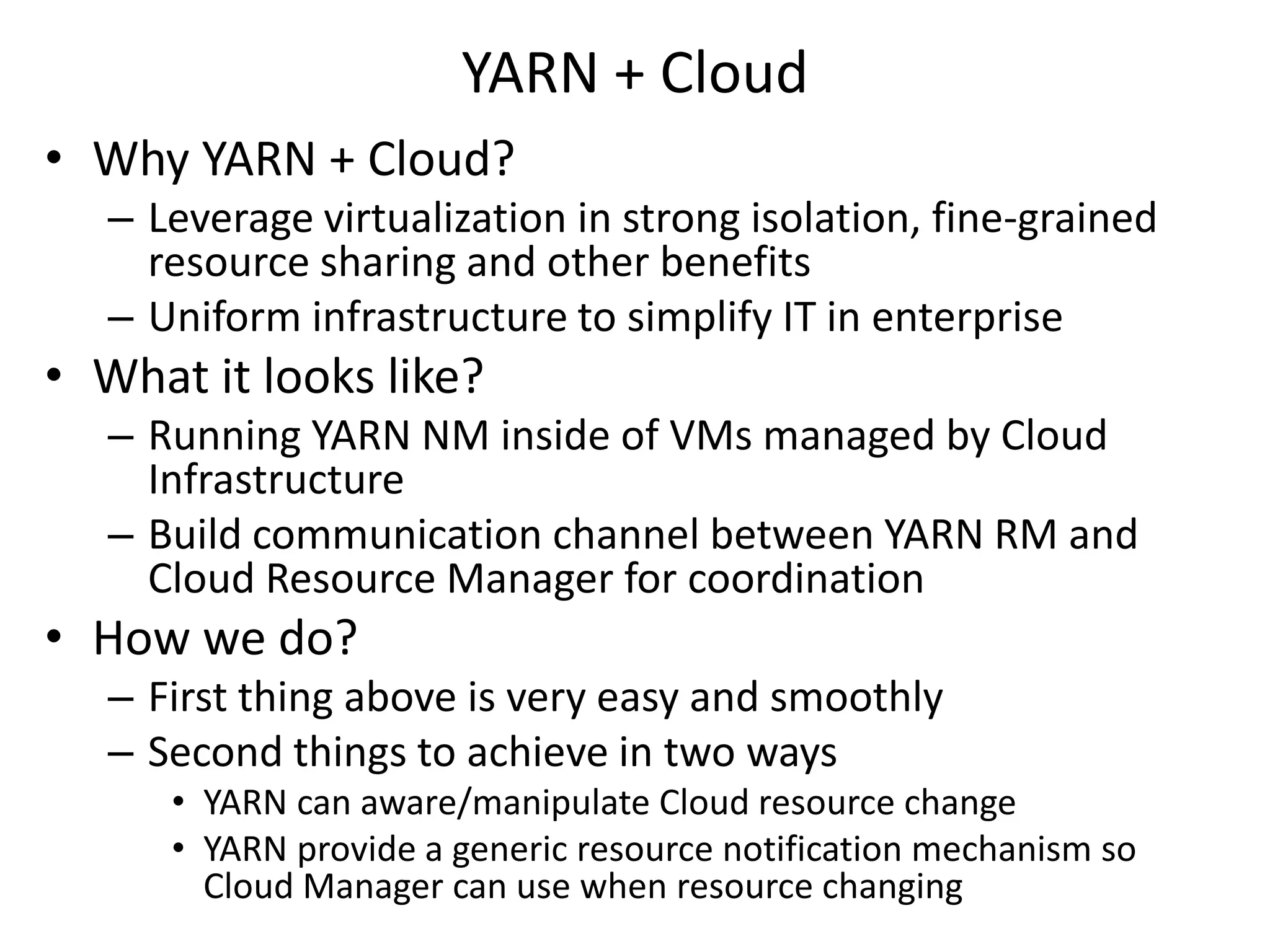
YARN + Cloud
• Why YARN + Cloud?
– Leverage virtualization in strong isolation, fine-grained
resource sharing and other benefits
– Uniform infrastructure to simplify IT in enterprise

• What it looks like?
– Running YARN NM inside of VMs managed by Cloud
Infrastructure
– Build communication channel between YARN RM and
Cloud Resource Manager for coordination

• How we do?
– First thing above is very easy and smoothly
– Second things to achieve in two ways
• YARN can aware/manipulate Cloud resource change
• YARN provide a generic resource notification mechanism so
Cloud Manager can use when resource changing
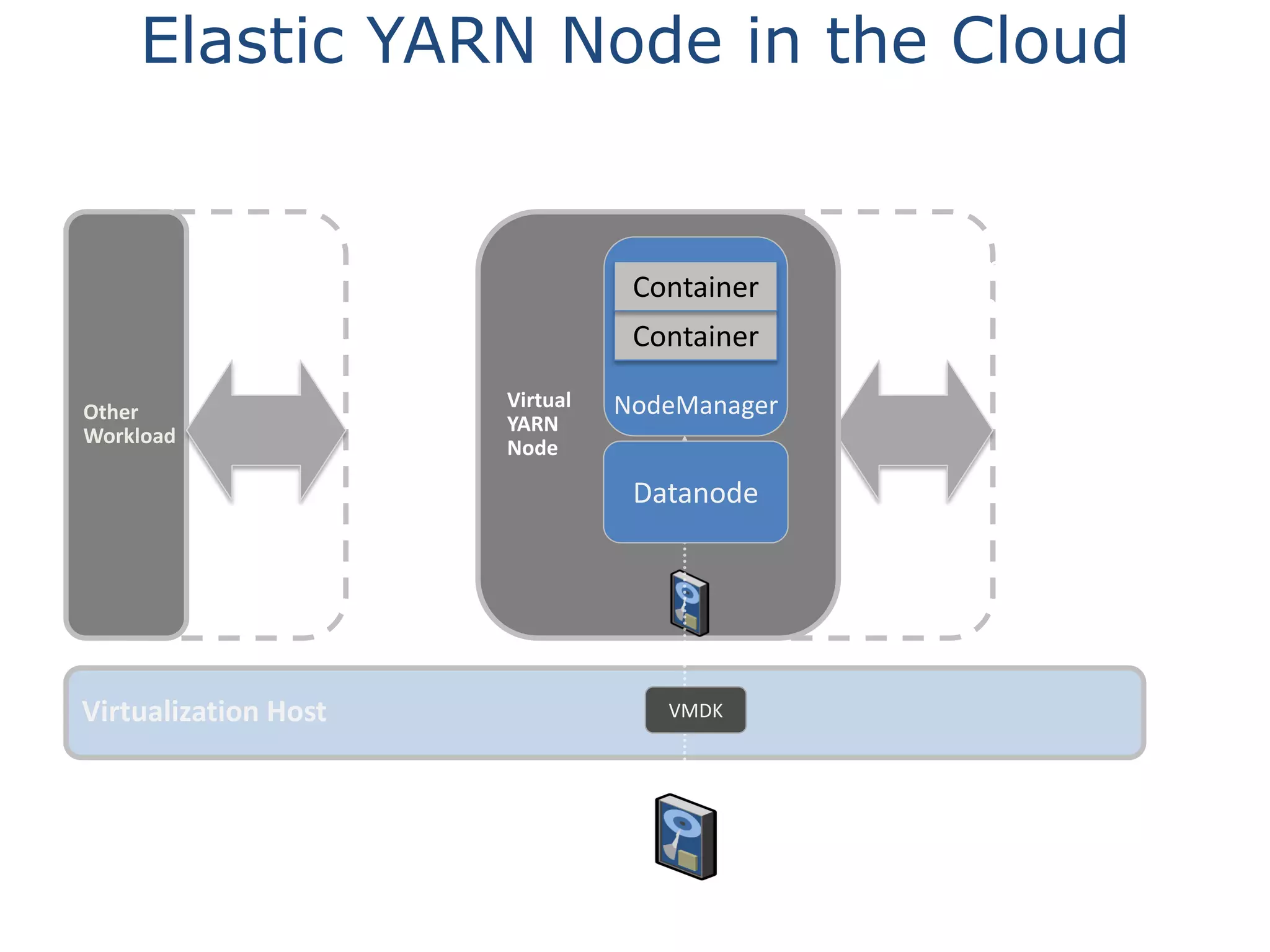
Elastic YARN Node in the Cloud

Container

Add/Remove
Resources?

Container
Other
Workload

Virtual
YARN
Node

NodeManager

Datanode

Virtualization Host

Grow/Shrink resource of a VM

VMDK

Grow/Shrink
by tens of GB in
memory?
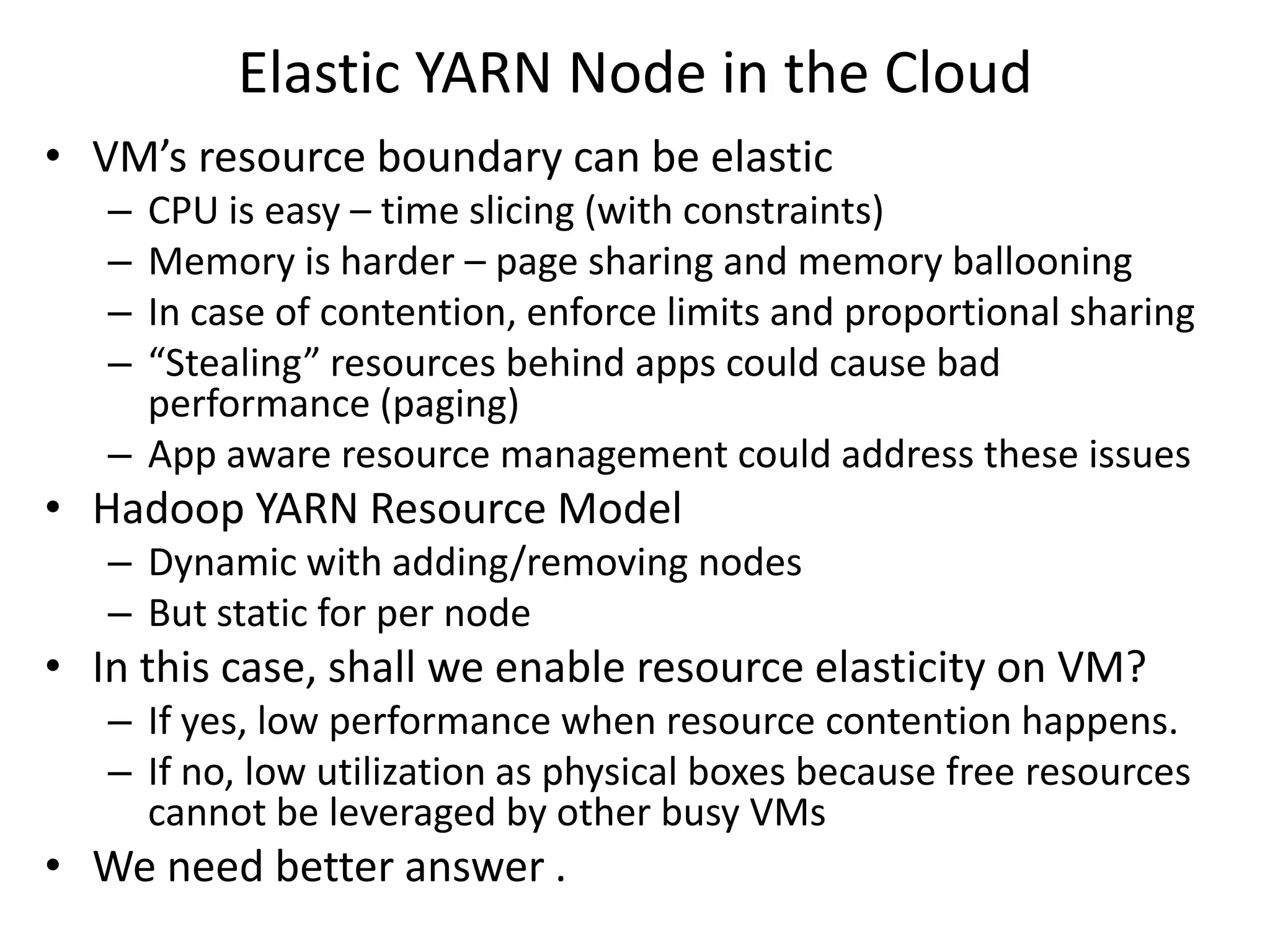
Elastic YARN Node in the Cloud
• VM’s resource boundary can be elastic
–
–
–
–

CPU is easy – time slicing (with constraints)
Memory is harder – page sharing and memory ballooning
In case of contention, enforce limits and proportional sharing
“Stealing” resources behind apps could cause bad
performance (paging)
– App aware resource management could address these issues

• Hadoop YARN Resource Model
– Dynamic with adding/removing nodes
– But static for per node

• In this case, shall we enable resource elasticity on VM?
– If yes, low performance when resource contention happens.
– If no, low utilization as physical boxes because free resources
cannot be leveraged by other busy VMs

• We need better answer .
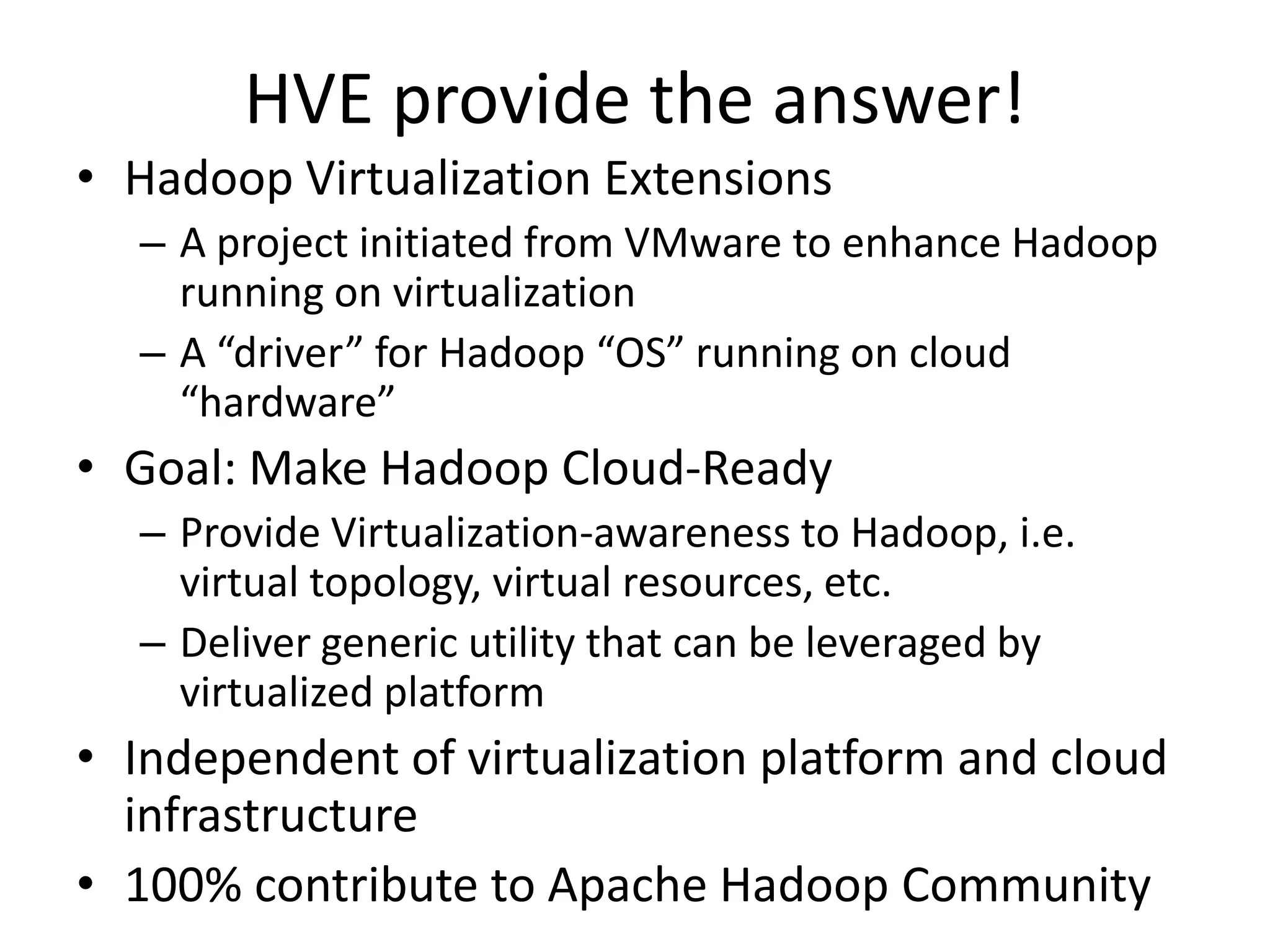
HVE provide the answer!
• Hadoop Virtualization Extensions
– A project initiated from VMware to enhance Hadoop
running on virtualization
– A “driver” for Hadoop “OS” running on cloud
“hardware”

• Goal: Make Hadoop Cloud-Ready
– Provide Virtualization-awareness to Hadoop, i.e.
virtual topology, virtual resources, etc.
– Deliver generic utility that can be leveraged by
virtualized platform

• Independent of virtualization platform and cloud
infrastructure
• 100% contribute to Apache Hadoop Community
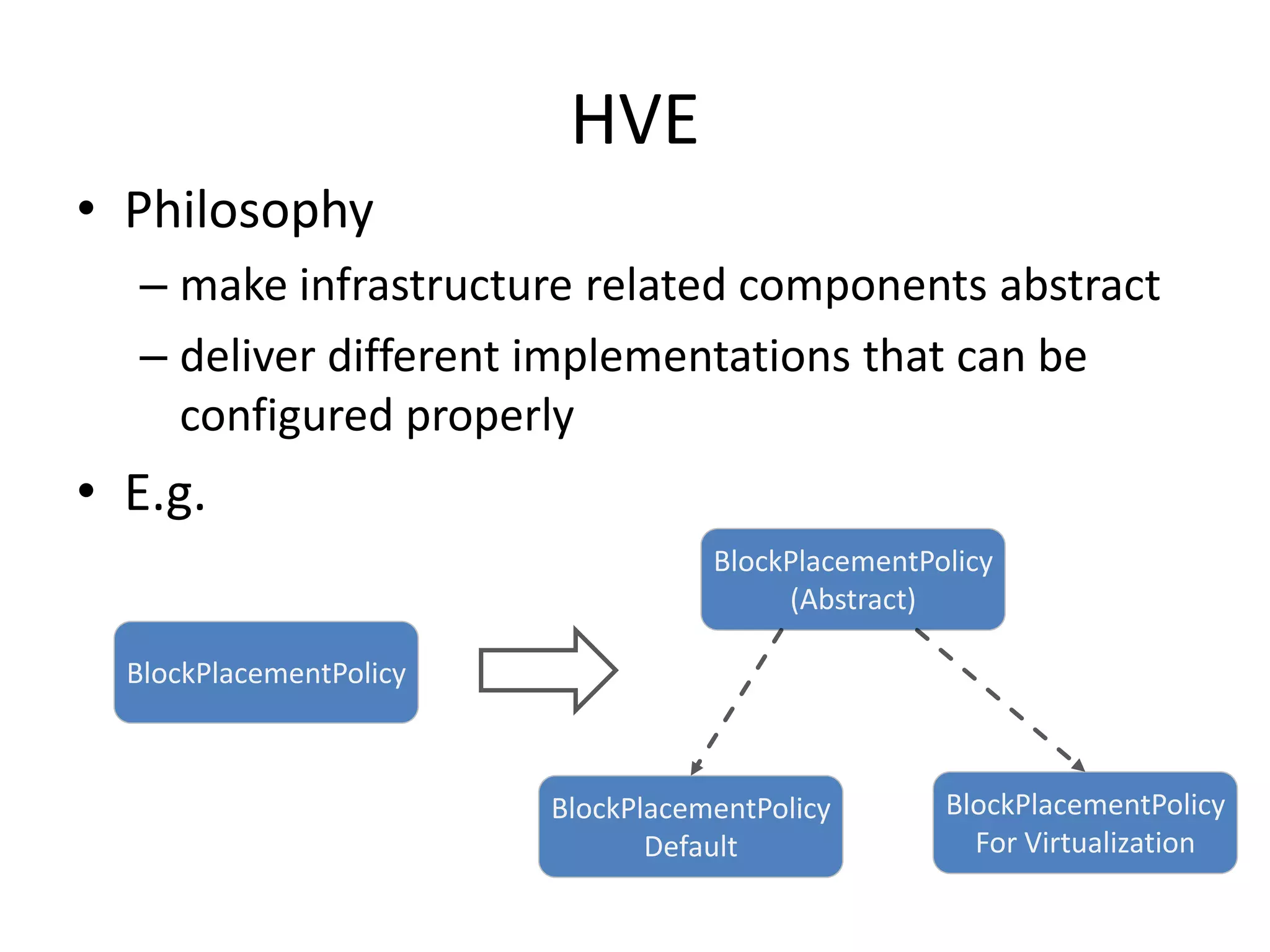
HVE
• Philosophy
– make infrastructure related components abstract
– deliver different implementations that can be
configured properly

• E.g.
BlockPlacementPolicy
(Abstract)
BlockPlacementPolicy

BlockPlacementPolicy
Default

BlockPlacementPolicy
For Virtualization
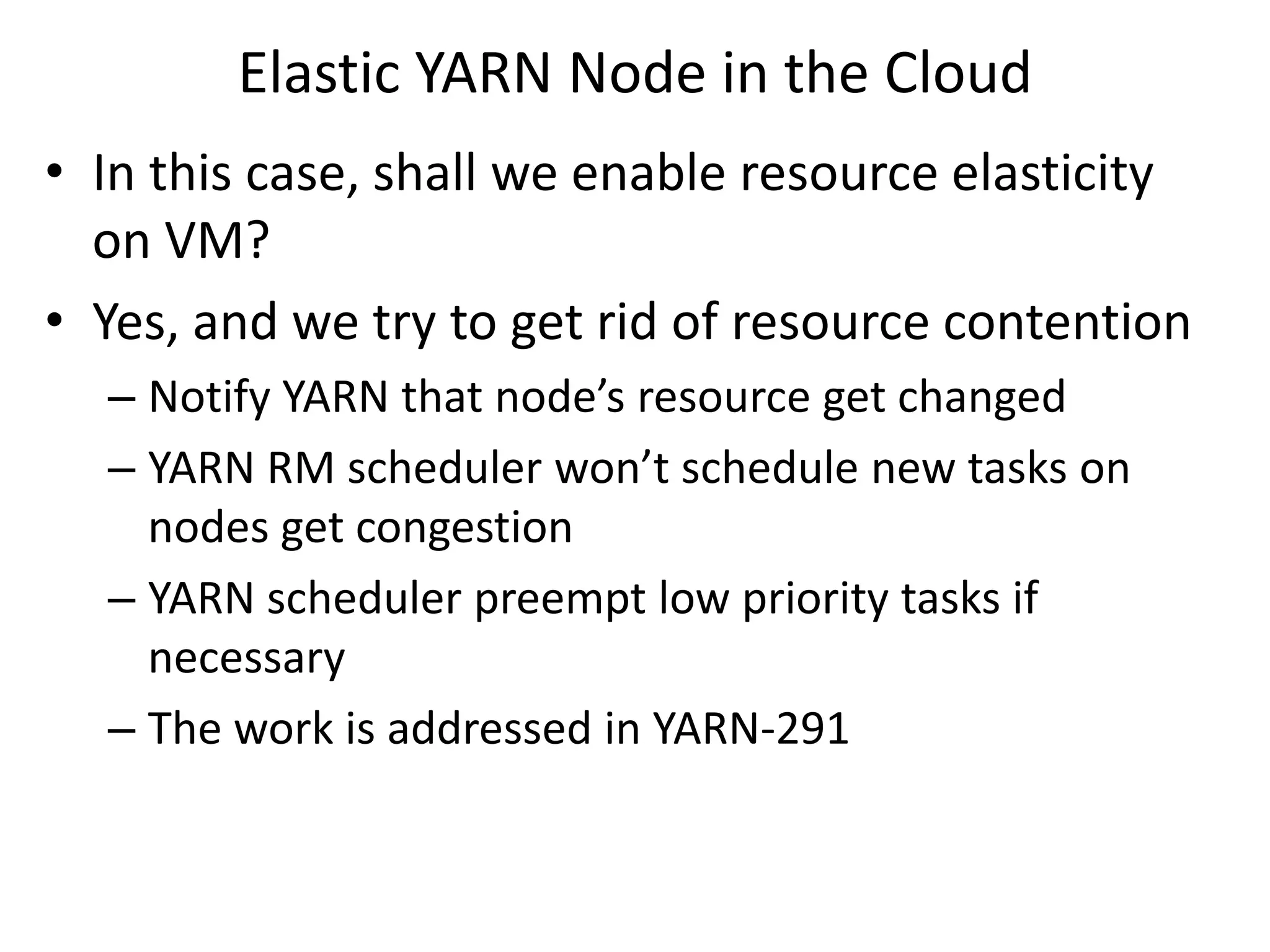
Elastic YARN Node in the Cloud
• In this case, shall we enable resource elasticity
on VM?
• Yes, and we try to get rid of resource contention
– Notify YARN that node’s resource get changed
– YARN RM scheduler won’t schedule new tasks on
nodes get congestion
– YARN scheduler preempt low priority tasks if
necessary
– The work is addressed in YARN-291
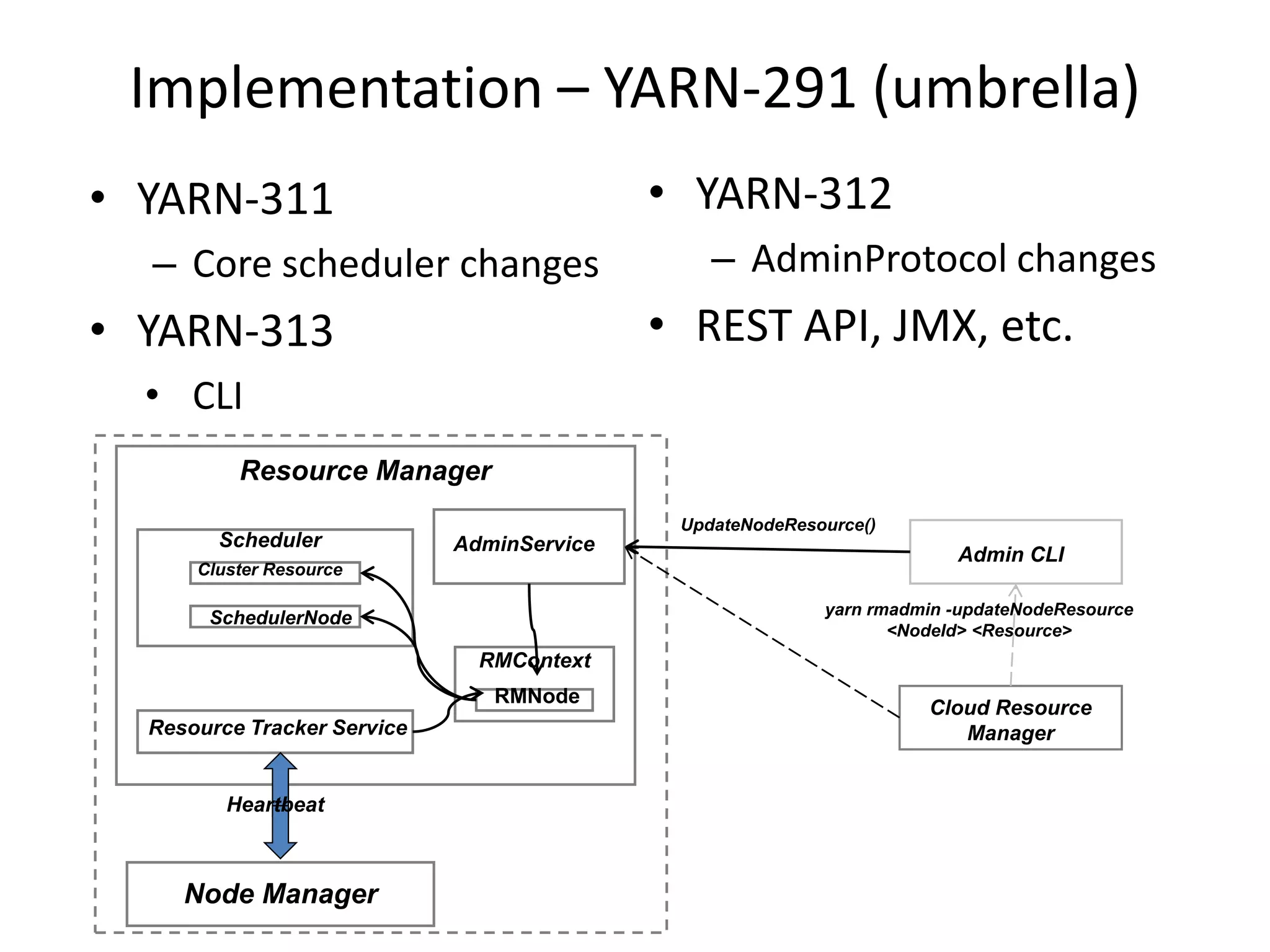
Implementation – YARN-291 (umbrella)
• YARN-312

• YARN-311
– Core scheduler changes

– AdminProtocol changes

• REST API, JMX, etc.

• YARN-313
• CLI
Resource Manager
Scheduler

UpdateNodeResource()

AdminService

Cluster Resource

Admin CLI
yarn rmadmin -updateNodeResource
<NodeId> <Resource>

SchedulerNode

RMContext
RMNode
Resource Tracker Service

Heartbeat

Node Manager

Cloud Resource
Manager
Welcome contribution to Apache Hadoop!
• Hadoop is the key platform
– For architecting Big Data
– Contribute a bit can change the world!

• Open source project is a great platform
– For people to share great ideas, works from different
organizations
– Community is a great work place

• Companies and persons get credit
– From work and resources they are putting
– Also easy to build a ecosystem and show expertise

• So many challenges in Big Data, like building Babel
– Open source is the common language to make sure we can
work together
Key messages in today’s talk
• SDDC and Cloud are the future for architecting
enterprise IT
• New trends in big data: YARN plays as a “OS” for
big data apps
• In VMware, we tries to support any “OS”, include
“YARN”
• HVE plays as “driver” to enable Hadoop on
virtualization/cloud
• Contribute to Apache Hadoop
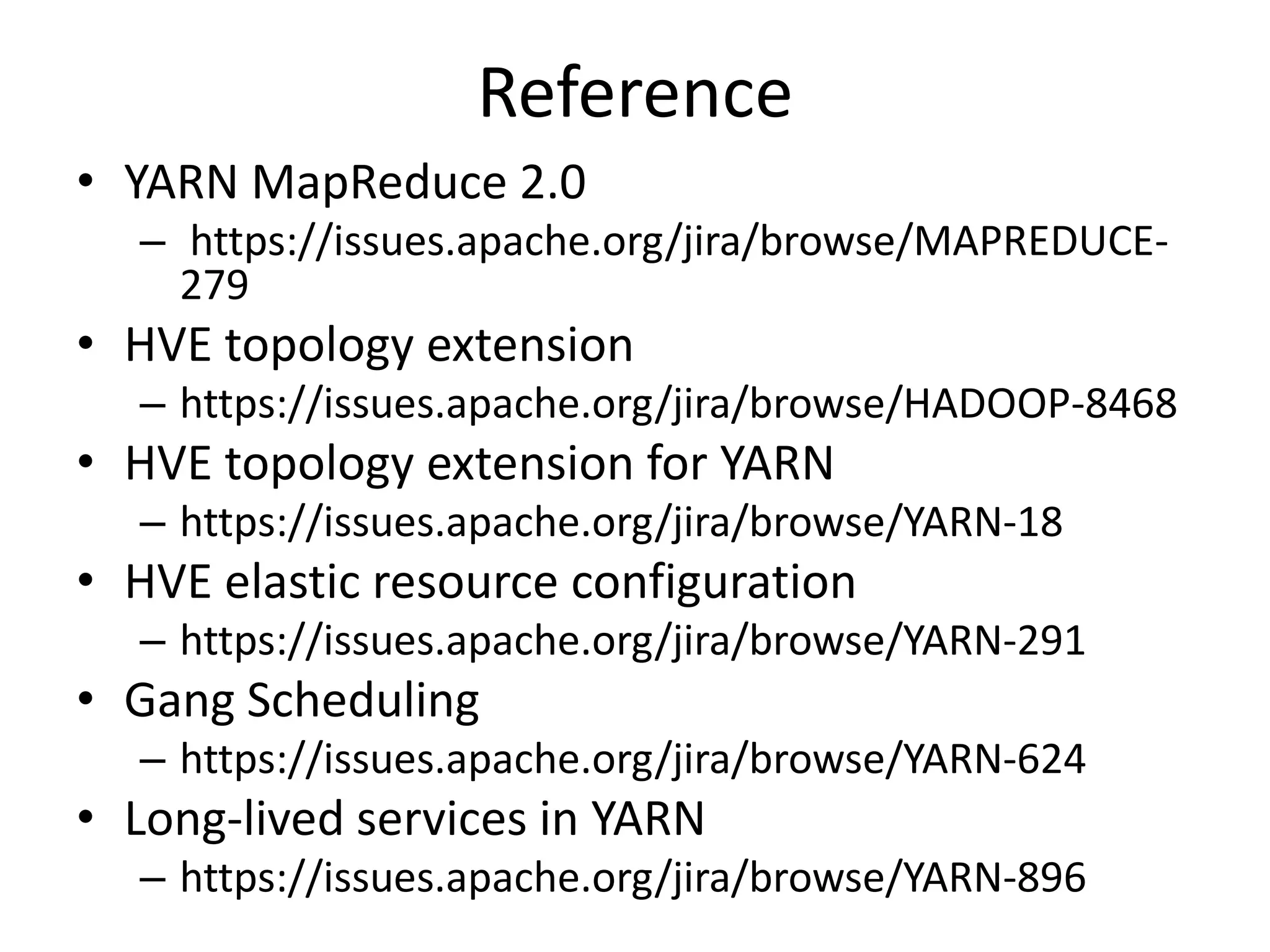
Reference
• YARN MapReduce 2.0
– https://issues.apache.org/jira/browse/MAPREDUCE279

• HVE topology extension
– https://issues.apache.org/jira/browse/HADOOP-8468

• HVE topology extension for YARN
– https://issues.apache.org/jira/browse/YARN-18

• HVE elastic resource configuration
– https://issues.apache.org/jira/browse/YARN-291

• Gang Scheduling
– https://issues.apache.org/jira/browse/YARN-624

• Long-lived services in YARN
– https://issues.apache.org/jira/browse/YARN-896
堵俊平:Hadoop virtualization extensions

堵俊平:Hadoop virtualization extensions

  • 1.
    Big Data inCloud 堵俊平 Apache Hadoop Committer Staff Engineer, VMware
  • 2.
    Bio 堵俊平 (JunpingDu) - Join VMware in 2008 for cloud product first - Initiate earliest effort on big data within VMware since 2010 - Automate Hadoop deployment on vSphere which becomes Open Source project – Serengeti later - Start contributing to Apache Hadoop community since 2012 - Become Apache Hadoop committer recently only 1 in +8 timezone today
  • 3.
    Agenda - Virtualization, SDDCand Cloud - Trends from my observation in Big Data - YARN: resource hub for Big Data Applications - YARN in the Cloud
  • 4.
    What is Virtualization? -@see VMware’s vSphere Guest TCP/IP Guest Monitor File System Monitor Virtual NIC Physical Hardware Scheduler Memory Manager Virtual Switch File System NIC Drivers VMkernel Virtual SCSI I/O Drivers Monitor Emulates Physical Devices: CPU, Memory, I/O CPU is controlled by scheduler and virtualized by monitor Memory is allocated by the VMkernel and virtualized by the monitor Network and I/O devices are emulated and proxied though native device drivers
  • 5.
    Server Virtualization Adoptionon Path to 80% Over Next 5 Years % Virtualized of x86 Workloads 80% Total x86 Workloads 200 100% 180 IDC 2012 to 2016 Change = +12 pts 90% 160 Gartner 2012 to 2016 Change = +22 pts 140 80% x86 % Physical Servers Unvirtualized 70% 百万 120 40% 100 60% IDC+ VMW Estimate: Workloads1 2012 to 2016 CAGR = 21% 50% 80 60 30% 40 20% 20 0% 40% 10% 2010 2011 2012 2013 2014 2015 2016 2017 2018 0% 2009 2010 2011 2012 2013 2014 2015 2016 Source(s): IDC: Annual Virtualization Forecast, Feb-13; Gartner: x86 Server Virtualization, Worldwide, 3Q12 Update; Gartner: Forecast x86 Server Virtualization, Worldwide, 2008-2018, Jul-11; VMware estimates, Note: Server workloads only 1 Installed Base totals assume 5-year refresh
  • 6.
    Apps on TraditionalInfrastructure Windows Linux Databases Mission Critical HPC Big Data
  • 7.
    Apps on Software-DefinedData Center Windows Linux Mission Critical Databases HPC Big Data Software-Defined Data Center VDC VDC VDC VDC VDC Software-Defined Data Center Services Abstract Pool Automate
  • 8.
    Infrastructure for TraditionalApps Traditional Applications 2016 141M 70% Infrastructure for Traditional Enterprise Apps Existing Application bound to vendor specific HW 2012 83M Hardware-based Resiliency Hardware-based QOS Hard To automate Complex to scale
  • 9.
    Infrastructure for NewApps Infrastructure for New/Cloud/Data Apps Application Specific Network and Storage Next Gen Cloud Applications 2016 48M 700% 2012 6M Software-based Infrastructure Transformational Economics Automation and Agility Designed For Scale
  • 10.
    SDDC Delivers SingleArchitecture for New and Existing Apps Infrastructure for New/Cloud/Data Apps Application Specific Network and Storage Any Application Infrastructure for Existing Enterprise Apps Existing Application bound to vendor specific HW Any Hardware
  • 11.
    Let’s back toBig Data … New Trends of Big Data from my observation - Hadoop 2.0, YARN plays as key resource hub in big data ecosystem - MapReduce is not good enough, we need faster one, like: Tez, Spark, etc. - HDFS tries to support more scenarios, i.e. cache for low-latency apps, snapshot for disaster recovery, storage tiers awareness, etc. - More Hadoop-based SQL engines: Apache Drill, Impala, Stinger, Hawq, etc. - For enterprise-ready, more efforts are spent on Security, HA, QoS, Monitor & Management
  • 12.
    Hadoop MapReduce v1(Classic) • JobTracker – Manage cluster resources and job scheduling • TaskTracker – Per node agent – Manage tasks
  • 13.
    MapReduce v1 Limitations •Scalability – Manage cluster resources and job scheduling • SPOF (Single Point Of Failure) • JobTracker failure cause all queued and running job failure – Restart is very tricky due to complex state • Hard partition of resources into map and reduce slots – Low resource utilization • Lacks support for alternate paradigms • Lack of wire-compatible protocols
  • 14.
    YARN Architecture • Splitsup the two major functions of JobTracker – Resource Manager (RM) - Cluster resource management – Application Master (AM) - Task scheduling and monitoring • NodeManager (NM) - A new per-node slave – launching the applications’ containers – monitoring their resource usage (cpu, memory) and reporting to the Resource Manager. • YARN maintains compatibility with existing MapReduce application and support other applications
  • 15.
    YARN – Hubfor Big Data Applications OpenMPI Impala HBase Distributed Shell Spark MapReduce Tez Storm YARN HDFS • App-specific AM • HOYA (Hbase On YArn) – Long running services (YARN-896) • LLAMA (Low Latency Application MAster) – Gang Scheduler (YARN-624)
  • 16.
    YARN and Cloud •Two different prospective: – YARN-centric prospective • YARN is the key platform to apps • YARN is independent of infrastructure, running on top of Cloud shows YARN’s generality – Cloud-centric prospective • YARN is an umbrella kind of applications • Supporting YARN shows Cloud’s generality
  • 17.
    YARN and Cloud:YARN-centric Prospective • YARN is “OS” Big Data Apps • Infrastructure (no matter physical or cloud) is “hardware” HBase Open MPI Distributed Shell Spark … Impala MapReduce Tez Storm YARN Infrastructure Bare-metal machines Cloud Infrastructure … VMware Open Stack …
  • 18.
    YARN and Cloud:Cloud-centric Prospective • Cloud Infrastructure is “OS” • YARN is a group of “process” Legacy Apps Other Big Data Apps YARN Apps Open MPI D.S Spark Impala … HBase MapReduce Tez Storm … YARN Cloud Infrastructure (VMware, Open Stack, etc.)
  • 19.
    YARN vs. Cloud •Similarity – Target to share resources across applications – Provide Global Resource Management • YARN vs. Cloud – YARN managing resource in OS layer vs. Cloud managing resources in Hypervisor (Not comparable, but Hypervisor is more powerful than OS in isolation) – Apps managed by YARN need specific AppMaster, Apps managed by Cloud is exactly the same as running on physical machines (Cloud +1) – YARN layer is closed to big data app, better understand/estimate app’s requirement (YARN +1) – Cloud layer is closed to hardware resources, easier to track real time and global resource utilization (Cloud +1)
  • 20.
    YARN + Cloud •Why YARN + Cloud? – Leverage virtualization in strong isolation, fine-grained resource sharing and other benefits – Uniform infrastructure to simplify IT in enterprise • What it looks like? – Running YARN NM inside of VMs managed by Cloud Infrastructure – Build communication channel between YARN RM and Cloud Resource Manager for coordination • How we do? – First thing above is very easy and smoothly – Second things to achieve in two ways • YARN can aware/manipulate Cloud resource change • YARN provide a generic resource notification mechanism so Cloud Manager can use when resource changing
  • 21.
    Elastic YARN Nodein the Cloud Container Add/Remove Resources? Container Other Workload Virtual YARN Node NodeManager Datanode Virtualization Host Grow/Shrink resource of a VM VMDK Grow/Shrink by tens of GB in memory?
  • 22.
    Elastic YARN Nodein the Cloud • VM’s resource boundary can be elastic – – – – CPU is easy – time slicing (with constraints) Memory is harder – page sharing and memory ballooning In case of contention, enforce limits and proportional sharing “Stealing” resources behind apps could cause bad performance (paging) – App aware resource management could address these issues • Hadoop YARN Resource Model – Dynamic with adding/removing nodes – But static for per node • In this case, shall we enable resource elasticity on VM? – If yes, low performance when resource contention happens. – If no, low utilization as physical boxes because free resources cannot be leveraged by other busy VMs • We need better answer .
  • 23.
    HVE provide theanswer! • Hadoop Virtualization Extensions – A project initiated from VMware to enhance Hadoop running on virtualization – A “driver” for Hadoop “OS” running on cloud “hardware” • Goal: Make Hadoop Cloud-Ready – Provide Virtualization-awareness to Hadoop, i.e. virtual topology, virtual resources, etc. – Deliver generic utility that can be leveraged by virtualized platform • Independent of virtualization platform and cloud infrastructure • 100% contribute to Apache Hadoop Community
  • 24.
    HVE • Philosophy – makeinfrastructure related components abstract – deliver different implementations that can be configured properly • E.g. BlockPlacementPolicy (Abstract) BlockPlacementPolicy BlockPlacementPolicy Default BlockPlacementPolicy For Virtualization
  • 25.
    Elastic YARN Nodein the Cloud • In this case, shall we enable resource elasticity on VM? • Yes, and we try to get rid of resource contention – Notify YARN that node’s resource get changed – YARN RM scheduler won’t schedule new tasks on nodes get congestion – YARN scheduler preempt low priority tasks if necessary – The work is addressed in YARN-291
  • 26.
    Implementation – YARN-291(umbrella) • YARN-312 • YARN-311 – Core scheduler changes – AdminProtocol changes • REST API, JMX, etc. • YARN-313 • CLI Resource Manager Scheduler UpdateNodeResource() AdminService Cluster Resource Admin CLI yarn rmadmin -updateNodeResource <NodeId> <Resource> SchedulerNode RMContext RMNode Resource Tracker Service Heartbeat Node Manager Cloud Resource Manager
  • 27.
    Welcome contribution toApache Hadoop! • Hadoop is the key platform – For architecting Big Data – Contribute a bit can change the world! • Open source project is a great platform – For people to share great ideas, works from different organizations – Community is a great work place • Companies and persons get credit – From work and resources they are putting – Also easy to build a ecosystem and show expertise • So many challenges in Big Data, like building Babel – Open source is the common language to make sure we can work together
  • 28.
    Key messages intoday’s talk • SDDC and Cloud are the future for architecting enterprise IT • New trends in big data: YARN plays as a “OS” for big data apps • In VMware, we tries to support any “OS”, include “YARN” • HVE plays as “driver” to enable Hadoop on virtualization/cloud • Contribute to Apache Hadoop
  • 29.
    Reference • YARN MapReduce2.0 – https://issues.apache.org/jira/browse/MAPREDUCE279 • HVE topology extension – https://issues.apache.org/jira/browse/HADOOP-8468 • HVE topology extension for YARN – https://issues.apache.org/jira/browse/YARN-18 • HVE elastic resource configuration – https://issues.apache.org/jira/browse/YARN-291 • Gang Scheduling – https://issues.apache.org/jira/browse/YARN-624 • Long-lived services in YARN – https://issues.apache.org/jira/browse/YARN-896