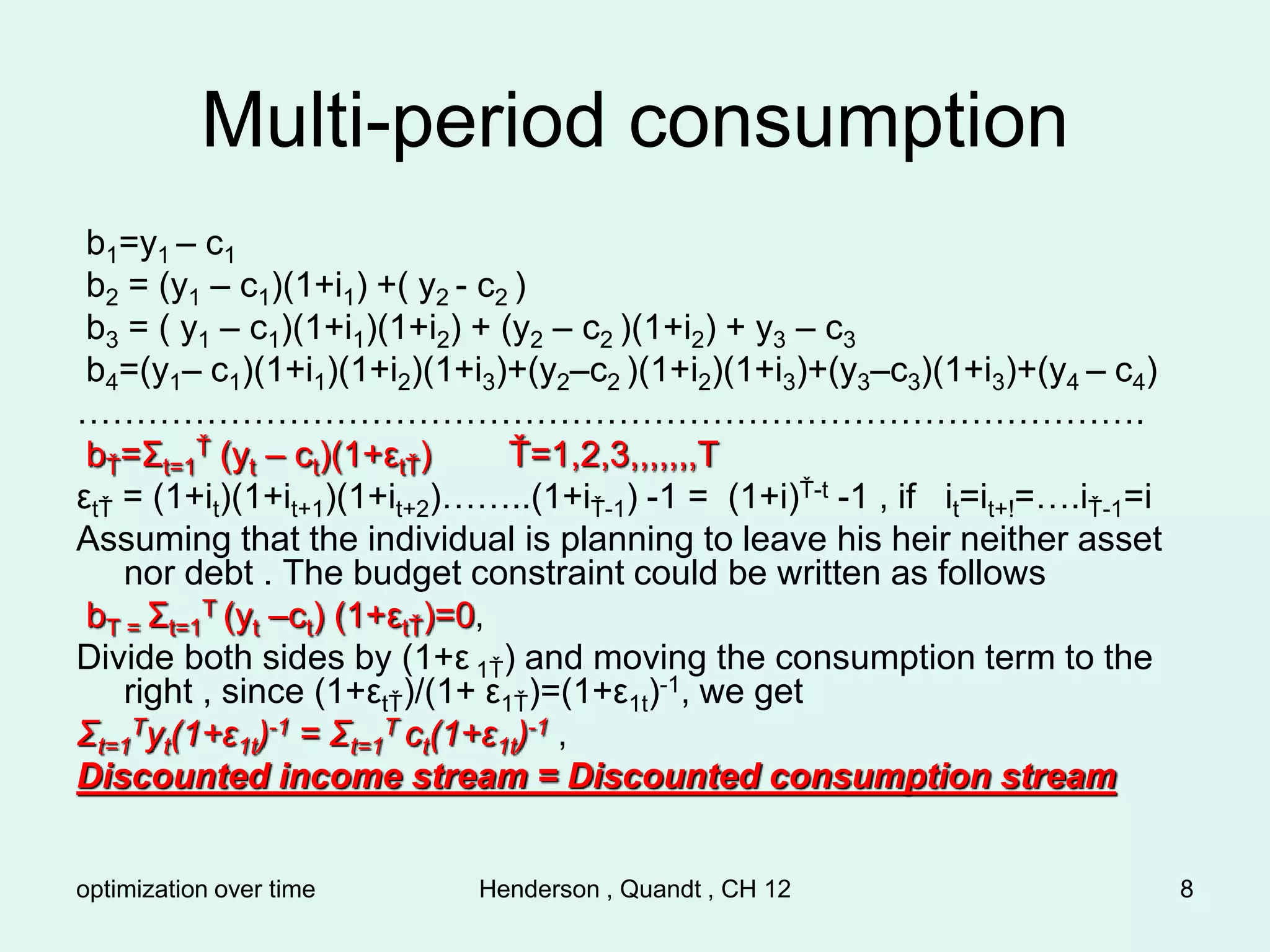
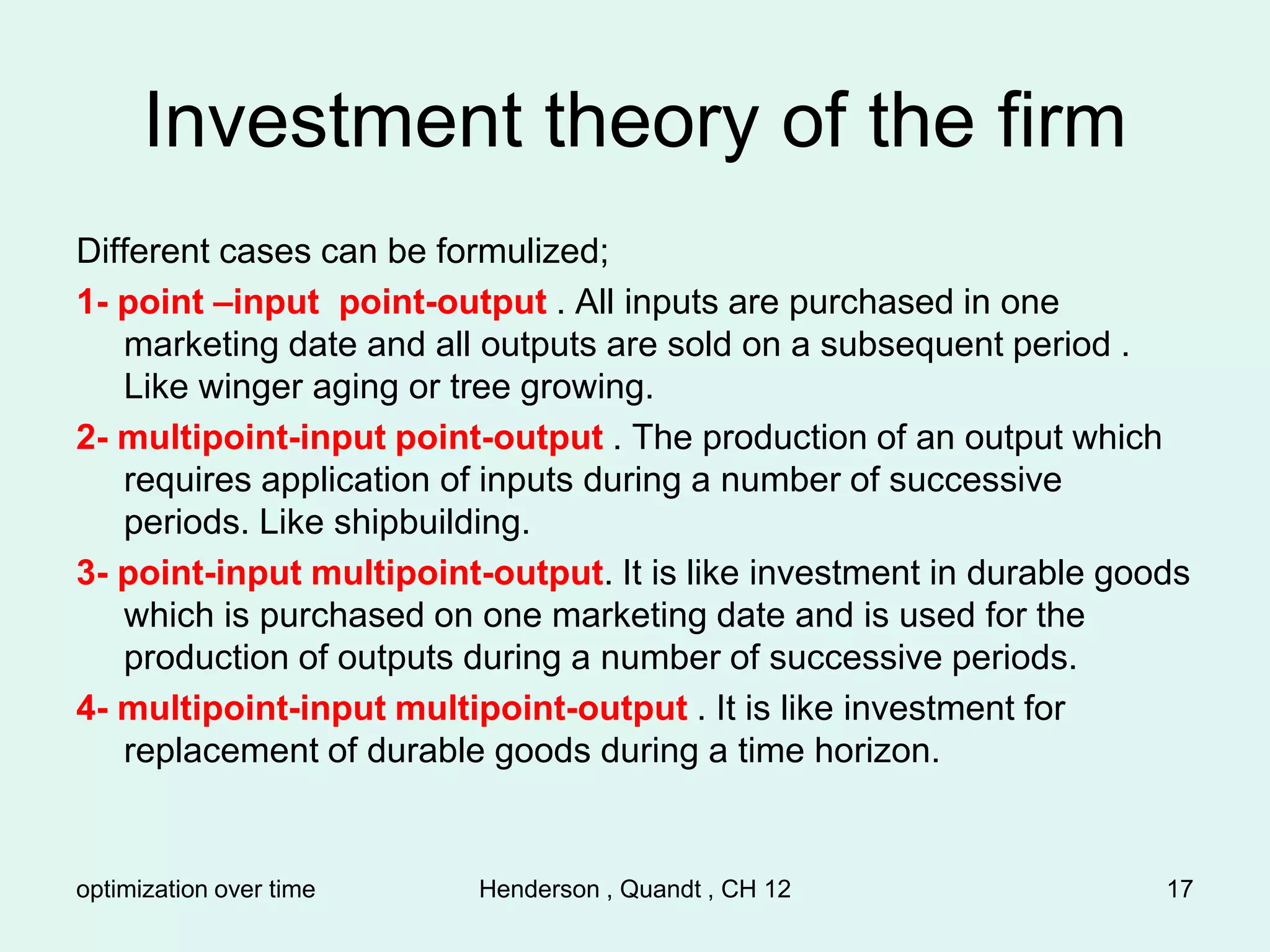
1) The document introduces multi-period optimization, where consumers maximize utility over multiple time periods rather than just one. Consumers can borrow and lend between periods.
2) Basic assumptions include the availability of one-period bonds for borrowing and lending, with interest rate i. Consumers maximize a multi-period utility function subject to their intertemporal budget constraint.
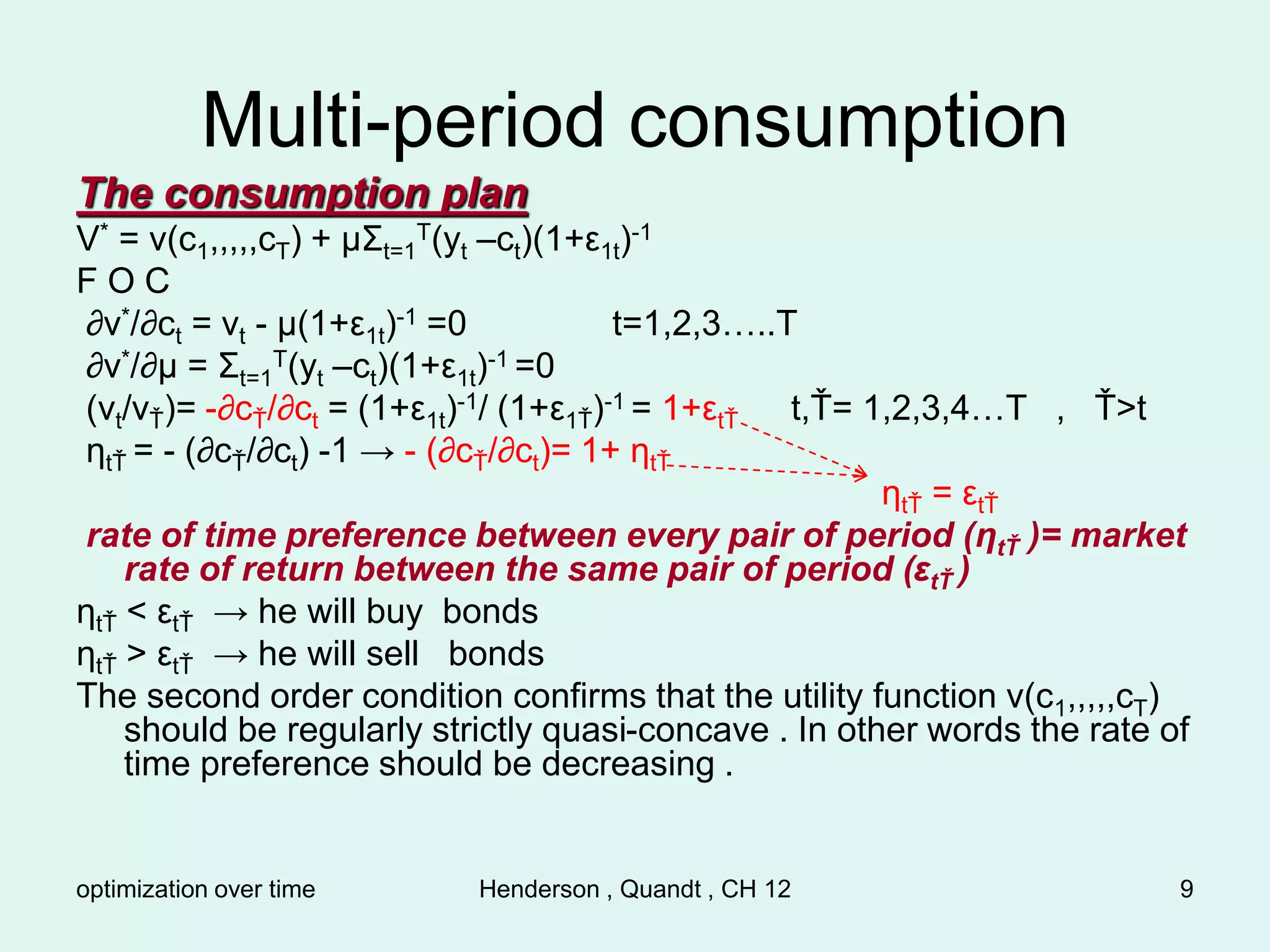
3) The consumer's rate of time preference η between any two periods should equal the market interest rate ε between those periods for an optimal consumption plan. If η is less than ε, the consumer will borrow, and vice versa if η is greater than ε.
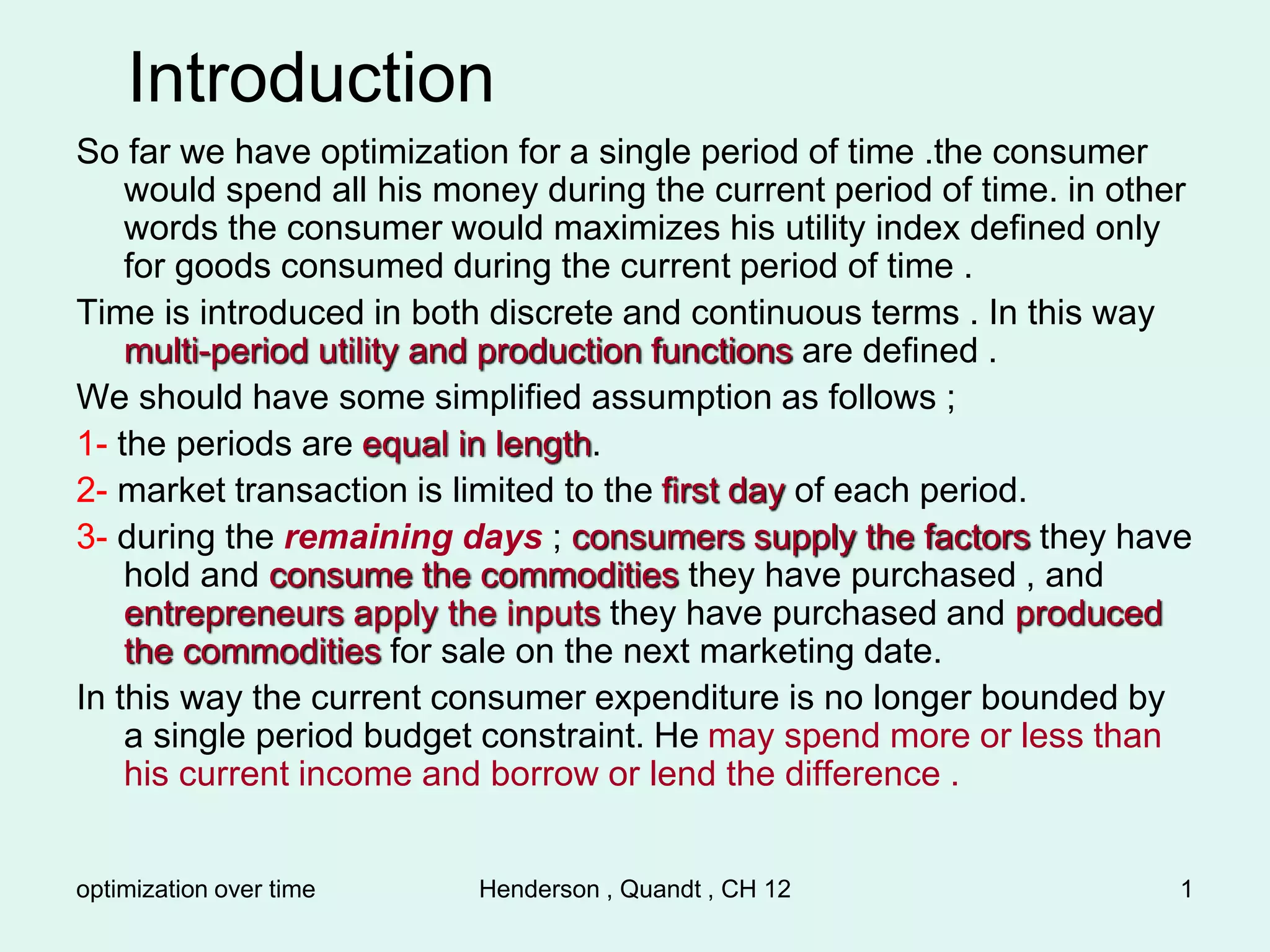
![optimization over time Henderson , Quandt , CH 12 3
Basic concepts
Market rate of interest.
Suppose that a consumer receives bt on the tth marketing date and
continues to reinvest both principal and the interest until the Ť
marketing date.
t=0→→→→→t=t→→→→→→t=Ť→→→→t=T
bt= value of consumer’s investment in the beginning of tth marketing
date.
b t+bt it =bt (1+it) = value of consumer’s investment in the beginning of
( t+1) marketing date
bt (1+it) +[ bt (1+it) ] it+1 = bt(1+it)(1+it+1)= value of investment in the
beginning of (t+2) marketing date.
bt(1+it)(1+it+1)……(1+iŤ-1)= value of investment in the beginning of the Ť
marketing date.
J= bt(1+it)(1+it+1)……(1+iŤ-1) – bt = total return on investment .
εtŤ=(J/bt)=(dJ/dbt)= [ (1+it)(1+it+1)……(1+iŤ-1) – 1 ] = average rate of
return= marginal rate of return.
εtt = 1 -1 =0 , εtt+1 = ( 1 + it ) -1= it
If it = it+1 = it+2 = it+3 =….. =iŤ-1 = i , then εtŤ = (1+ i)Ť-t – 1 ;
as it is seen the level of interest rates and not the order of their
sequence affects the rate of return](https://image.slidesharecdn.com/hqch12optimizationovertime-230226160121-4944a946/75/H-Q-CH-12-Optimization-over-time-ppt-3-2048.jpg)
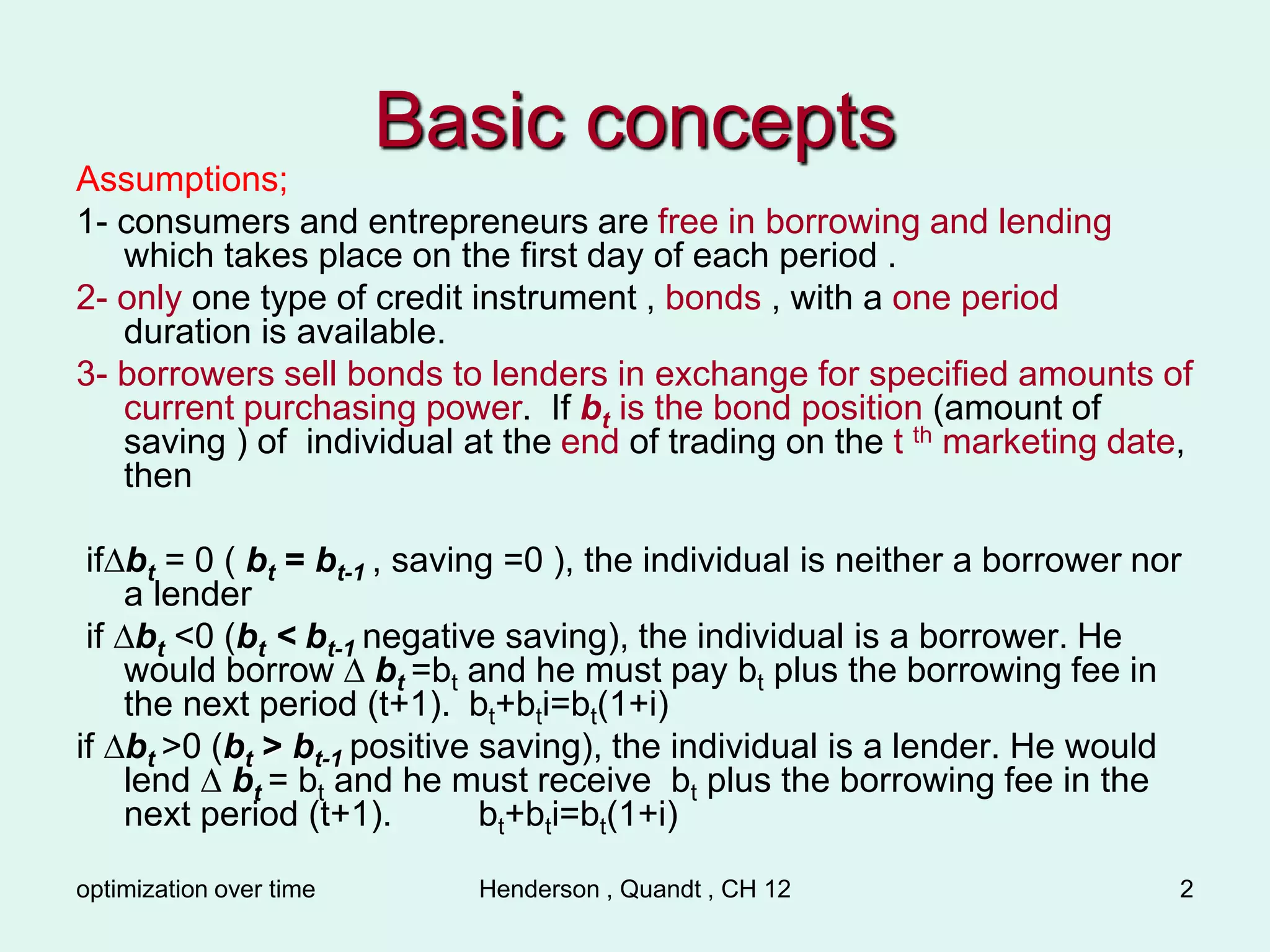
![optimization over time Henderson , Quandt , CH 12 4
Basic concepts
Discount rate and present value
Rational consumer will not consider one dollar payable on the current
marketing date equivalent to one dollar payable on some future
marketing date. Because , consumption at present time has more
utility than consumption in future. Delaying consumption will lower
the utility (assuming constant price and no inflation) .
Discount rate payable on the tth ( t=1→→→t=t ) marketing date
(beginning from t=1) is equal to ;
[ (1+i1)(1+i2)…….(1+it-1) ] -1 = ( 1+ ε1t)-1
Investing one dollar in first marketing date (t=1) will result in ( 1+ ε1t)
dollars in the tth marketing date. in other words ( 1+ ε1t)-1 dollars in
the tth marketing date worth one dollar on the first marketing date
In the same way the present value of the income stream (y1,y2,y3,,,yŤ)
would be equal to Y= y1+[y2/(1+ε12)]+[y3/(1+ε13)]+….+[yŤ/(1+ε1Ť)]
If all the interest rates are positive then denominator will increase and
the discounted values would decrease .](https://image.slidesharecdn.com/hqch12optimizationovertime-230226160121-4944a946/75/H-Q-CH-12-Optimization-over-time-ppt-4-2048.jpg)
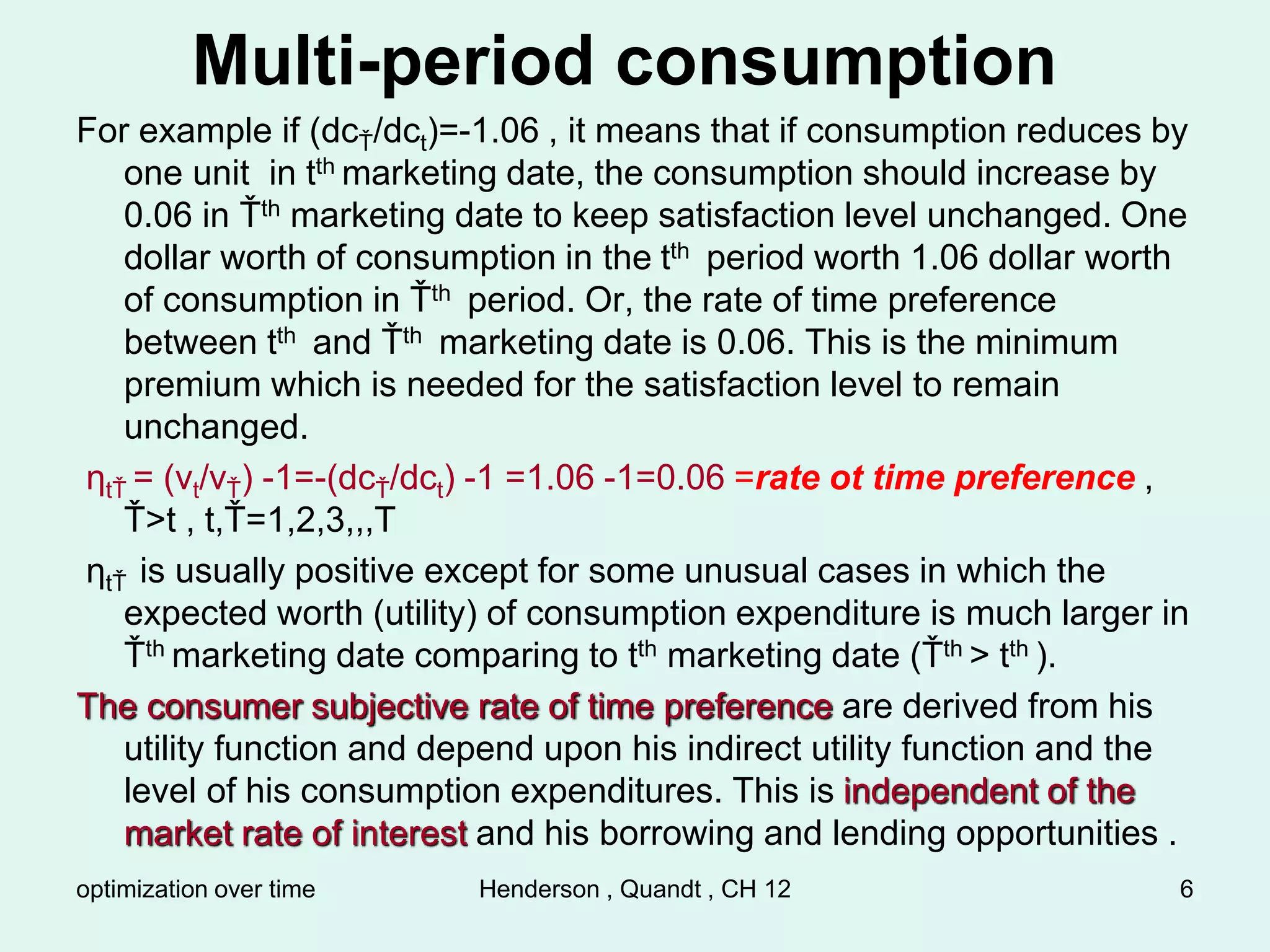
![optimization over time Henderson , Quandt , CH 12 5
Multi-period consumption
Multi-period utility function
U=U(q11,,,qn1 , q12,,,,qn2 , q13,,,,,qn3 ,,,,,, q1T,,,,,qnT)
qjt= quantity of qj consumed during the tth period .
Actual and expected commodity prices are fixed in values and
remained unchanged.
Ct= Σj=1
n pjtqjt = consumer total expenditure for commodities consumed
on the tth marketing date. t = 1,2,3,4,,,T.
Redefine the utility function as follows ;
V=V(c1, c2 , c3 ,,,,cT) indirect utility function
dv= [∂v/∂cŤ]dcŤ + [∂v/∂ct]dct= vŤdcŤ + vtdct =0 (indifference locus )
(vt/vŤ)=-(dcŤ/dct) = the rate of return at which consumption expenditure
on the Ť th marketing date must be increased to compensate for a
reduction of consumption expenditure on the tth marketing date to
leave the consumer satisfaction level unchanged during the time
horizon. This is called time substitution rate](https://image.slidesharecdn.com/hqch12optimizationovertime-230226160121-4944a946/75/H-Q-CH-12-Optimization-over-time-ppt-5-2048.jpg)
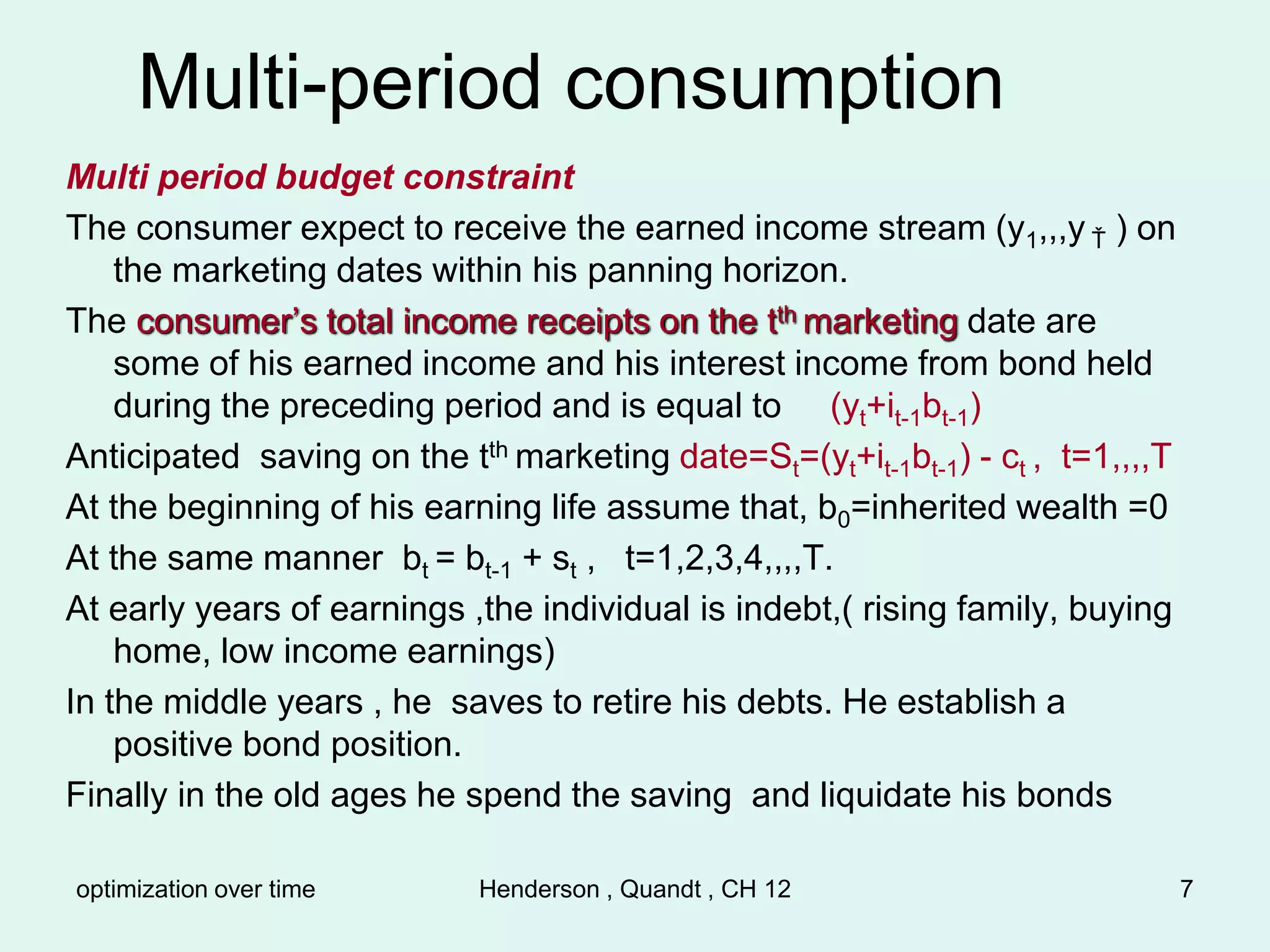
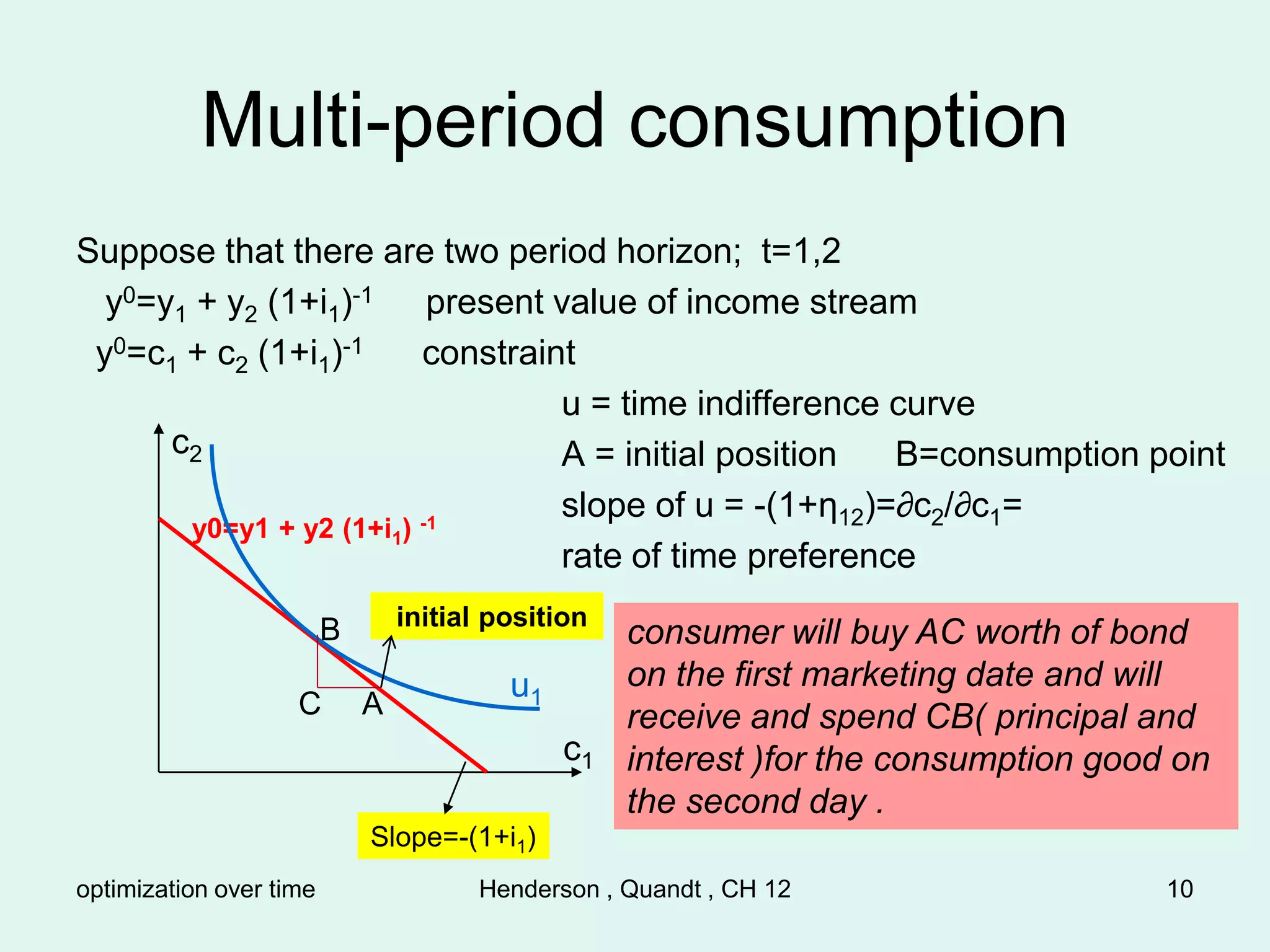
![optimization over time Henderson , Quandt , CH 12 11
Multi-period consumption
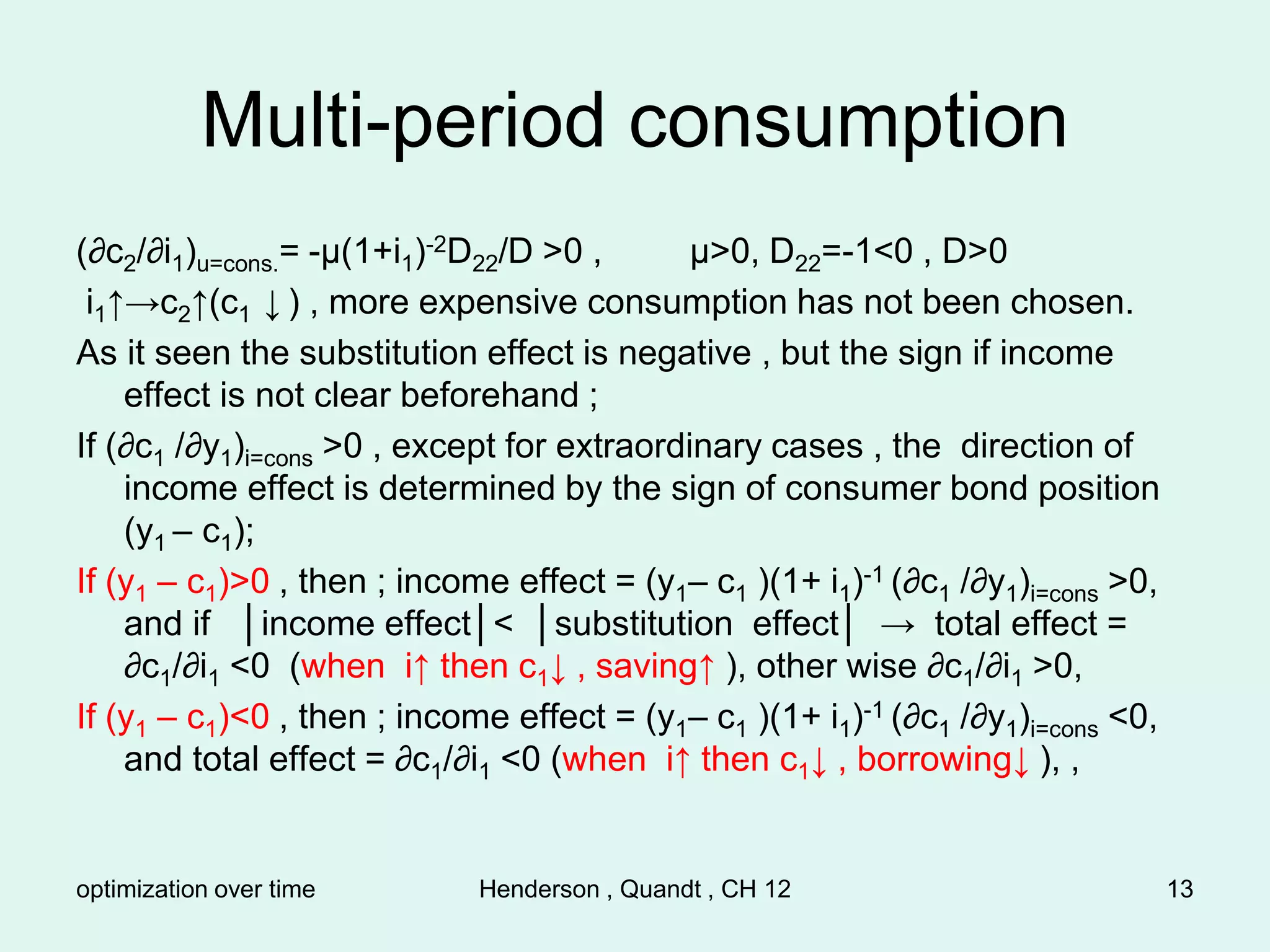
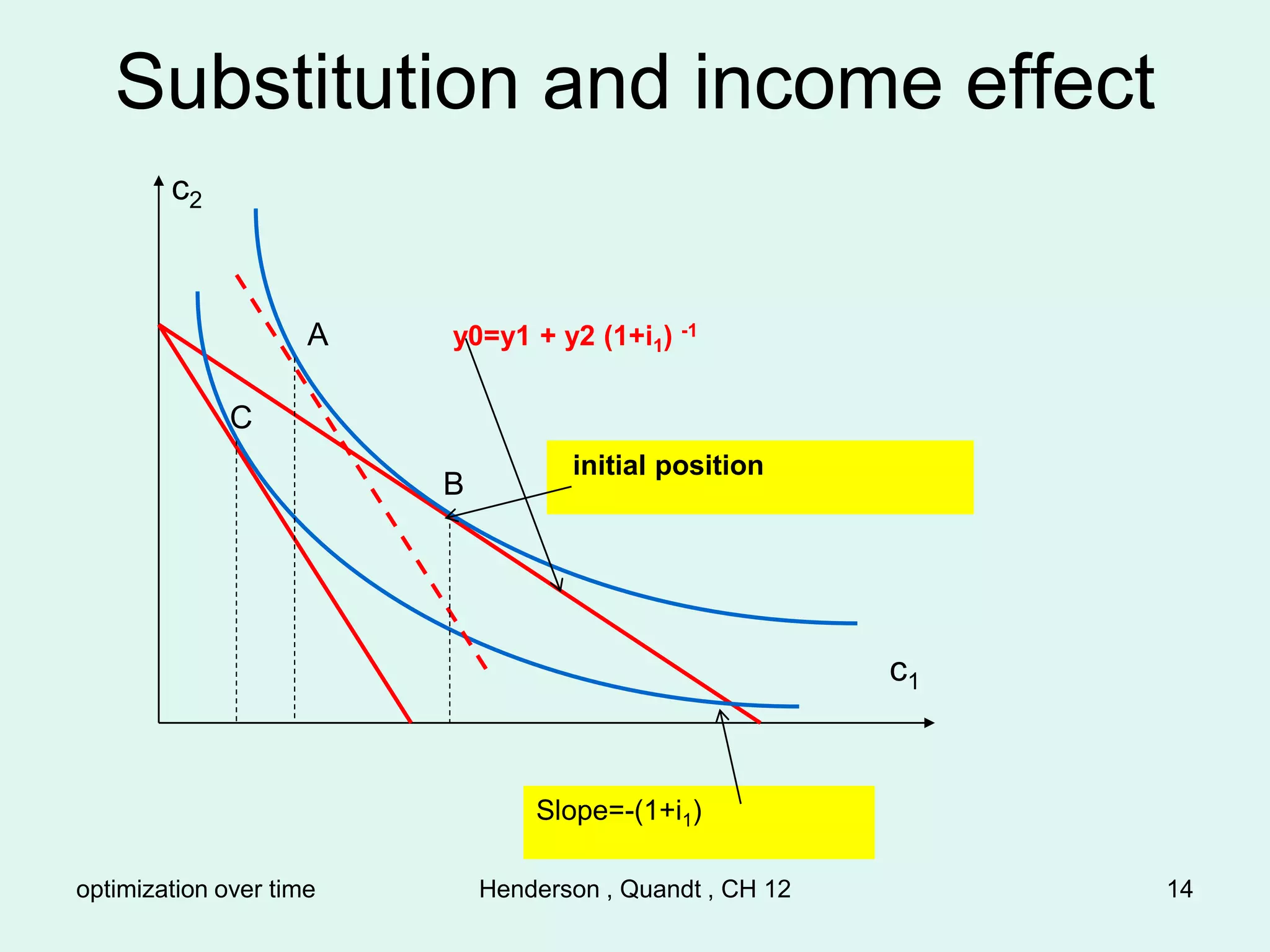
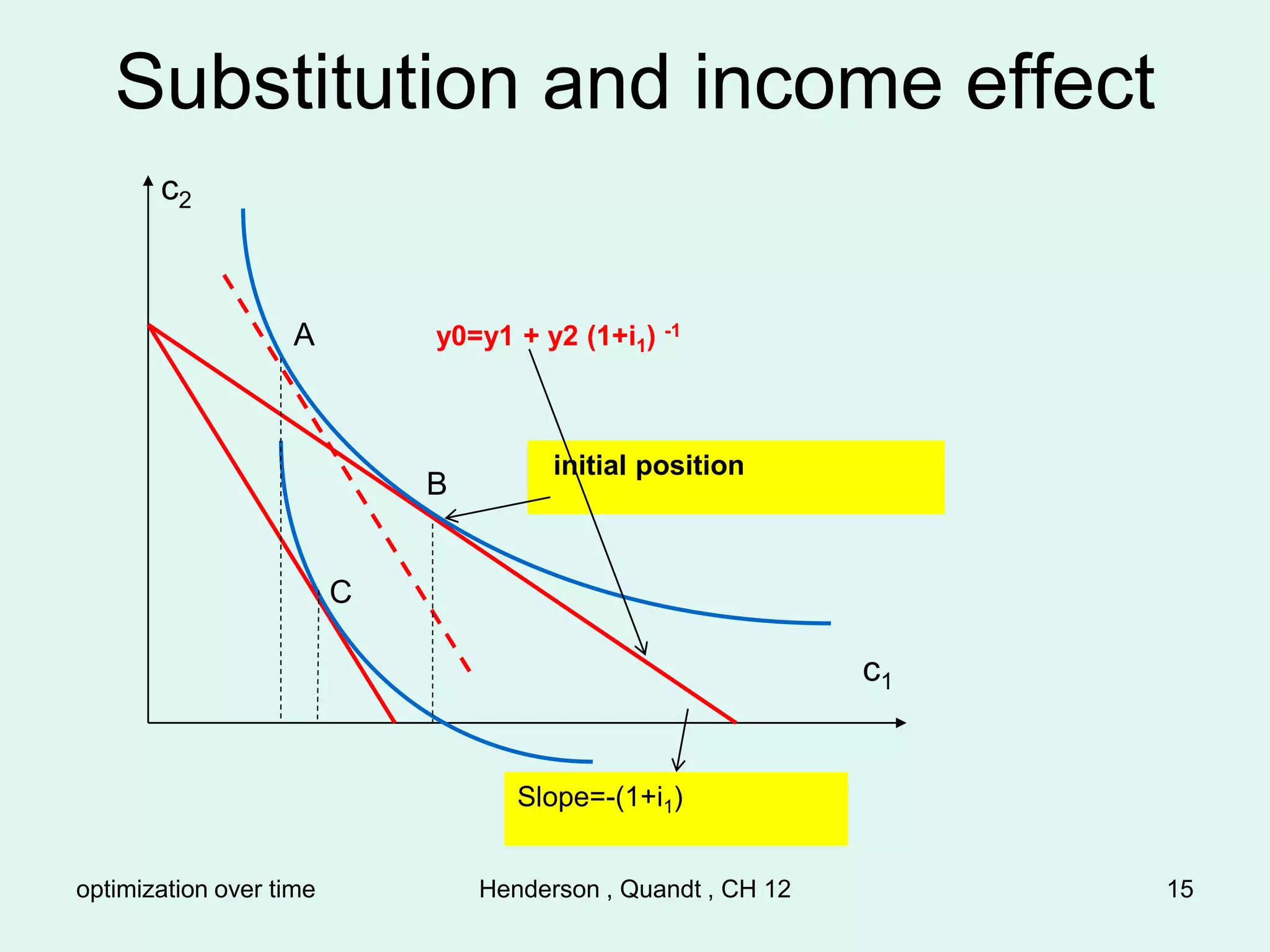
Substitution and Income effect
V* = v(c1,c2) + µ[(y1 – c1) +(y2 – c2)(11+i1)-1]
F .O .C.
∂v*/∂c1 = v1 - µ = 0
∂v*/∂c2 = v2 - µ(1+i1)-1=0
∂v*/∂µ = (y1 – c1) +(y2 – c2)(11+i1)-1 = 0
Differentiate totally from the first order condition
v11 v12 -1 dc1 0
v21 v22 -(1+i1)-1 dc2 = - µ (1+i1)-2 di
-1 -(1+i1)-1 0 dµ -dy1 – (1+i1)-1dy2+(y2-c2)(1+i1)-2di1
Using Cramer’s rule ;
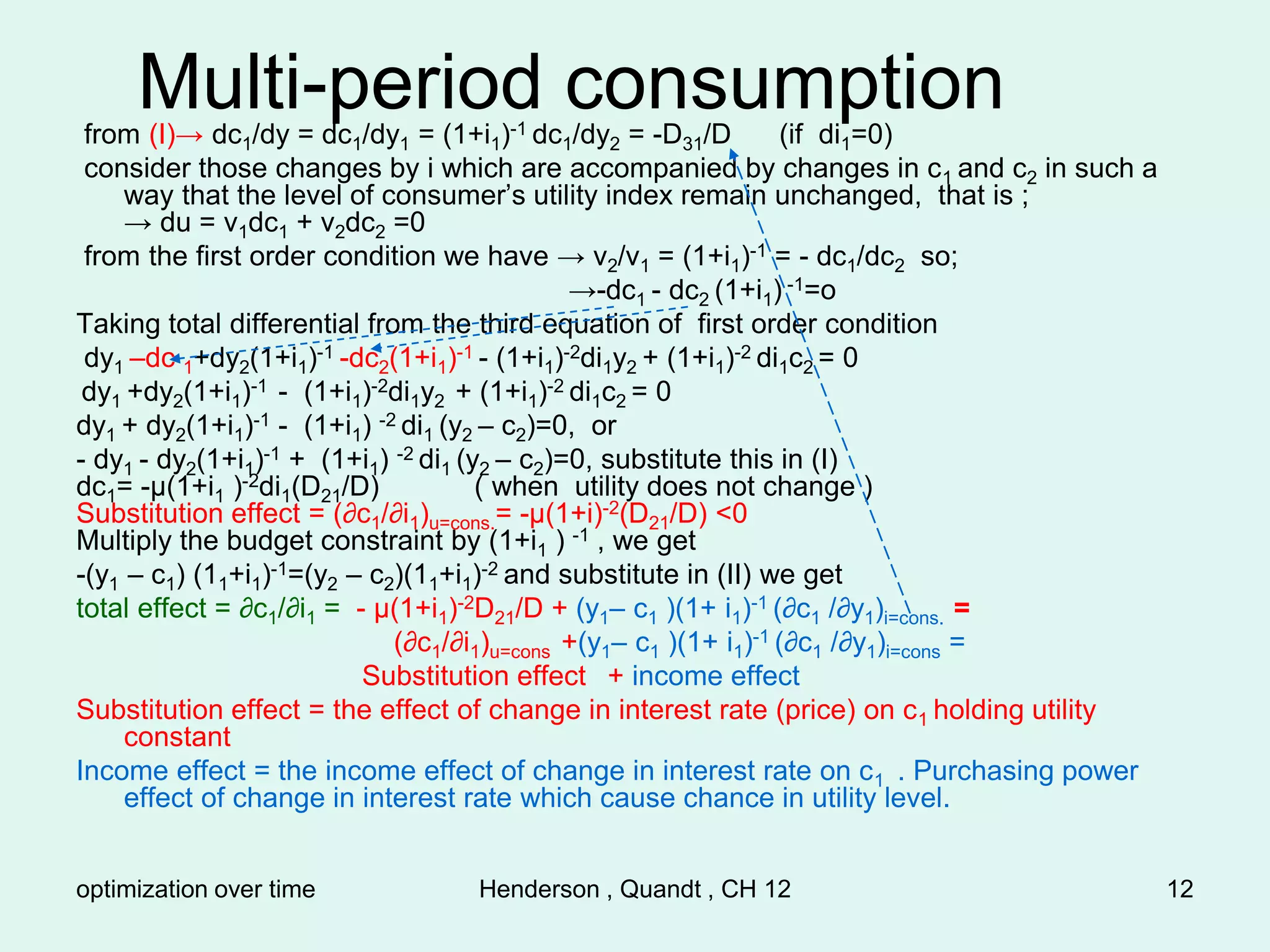
dc1=(0)(D11/D)-µ(1+i)-2di1(D21/D)+[-dy1–(1+i1)-1dy2+(y2-c2)(1+i1)-2di1]D31/D (I)
Where Dij is the cofactor of element in ith row and jth column
If di1≠0 , and dy1 = dy2 = =0 , then ;
∂c1/∂i1 = total effect = -µ(1+i1)-2D21/D + (y2 – c2 )(1+ i1)-2D31/D (II)
Y = y1 +y2(1+i1)-1 , present value of the consumer’s earned income .
An increase in y1 by one or y2 by (1+i1) would increase Y by one . So;](https://image.slidesharecdn.com/hqch12optimizationovertime-230226160121-4944a946/75/H-Q-CH-12-Optimization-over-time-ppt-11-2048.jpg)
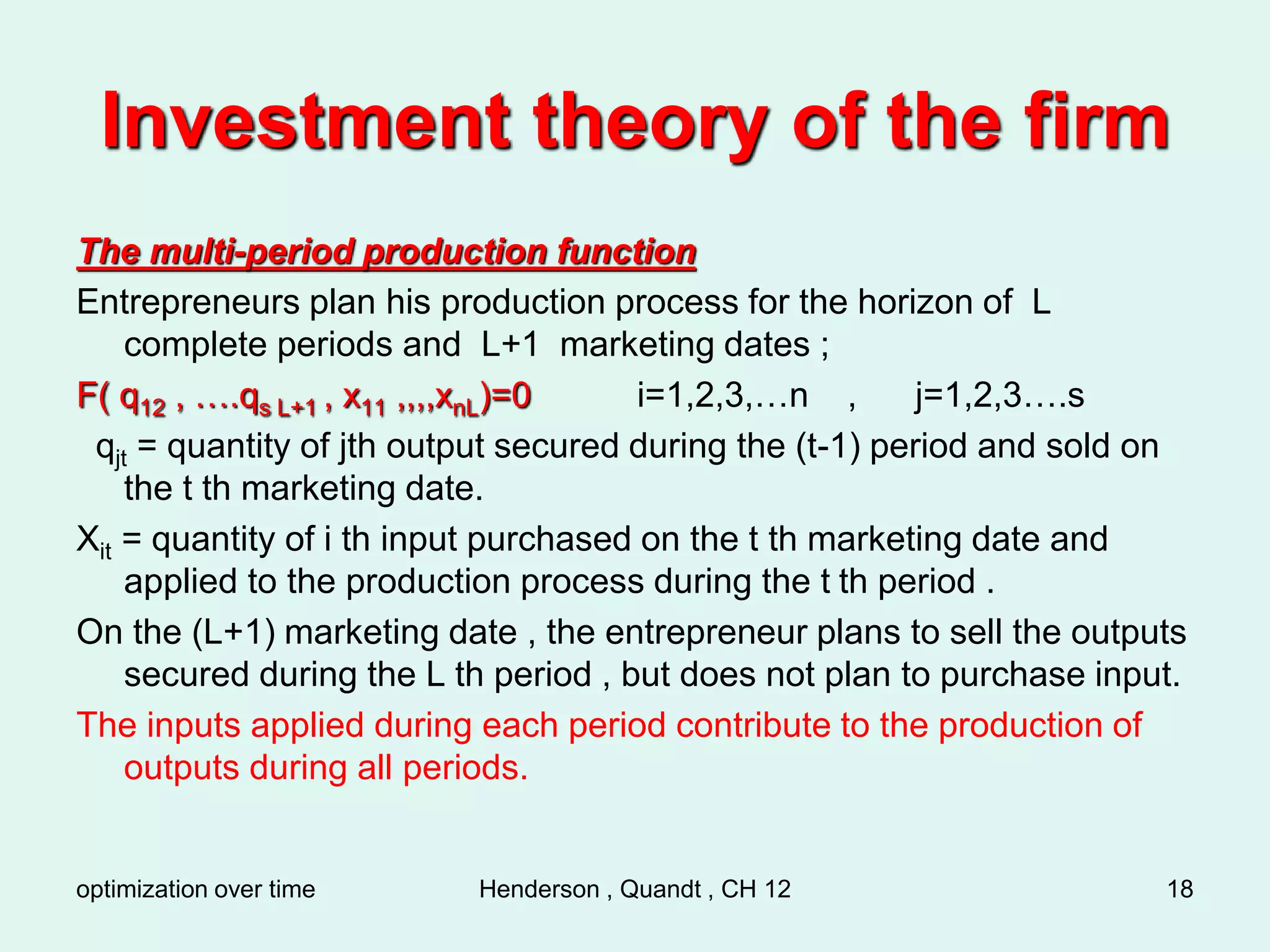
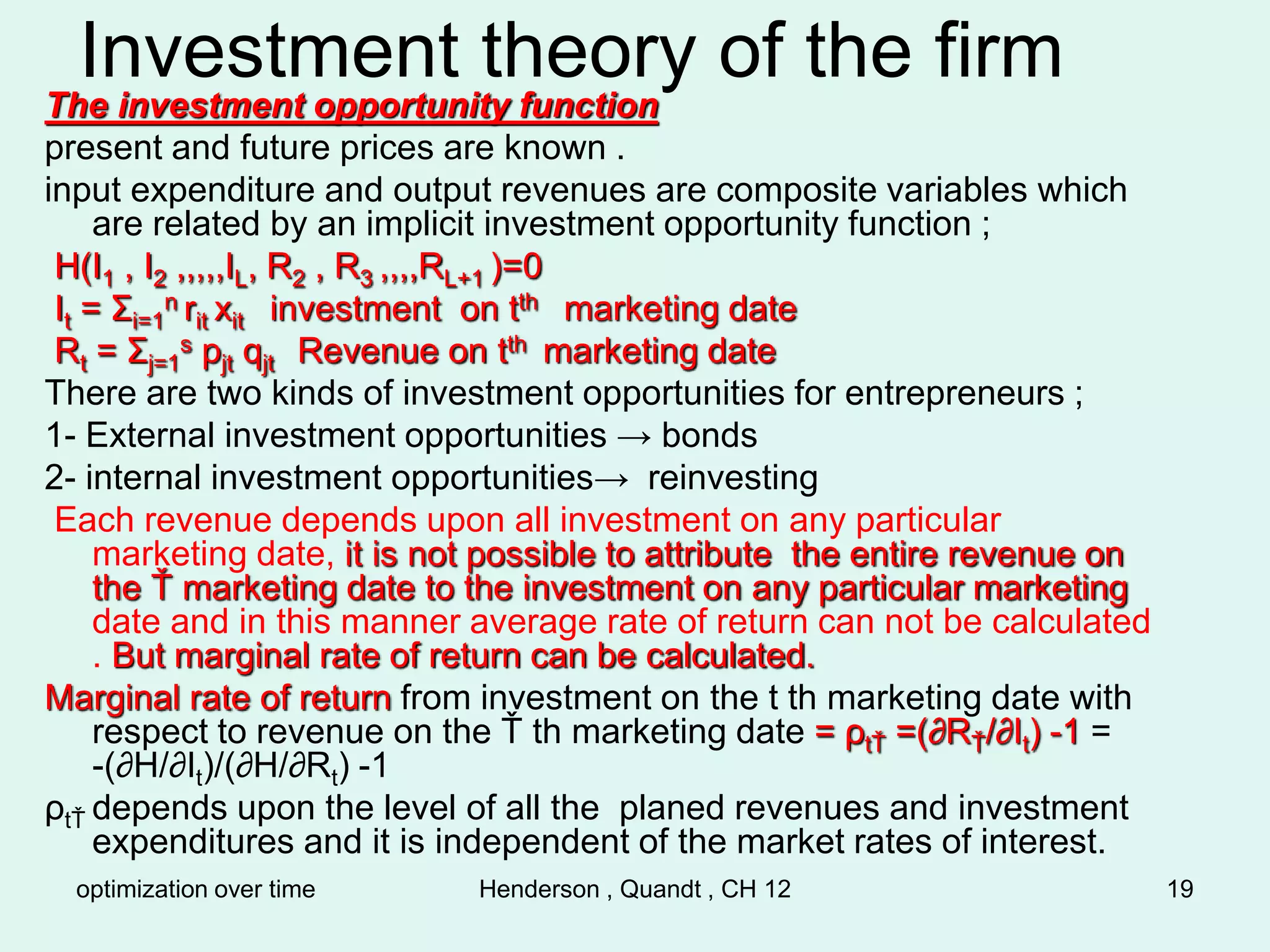
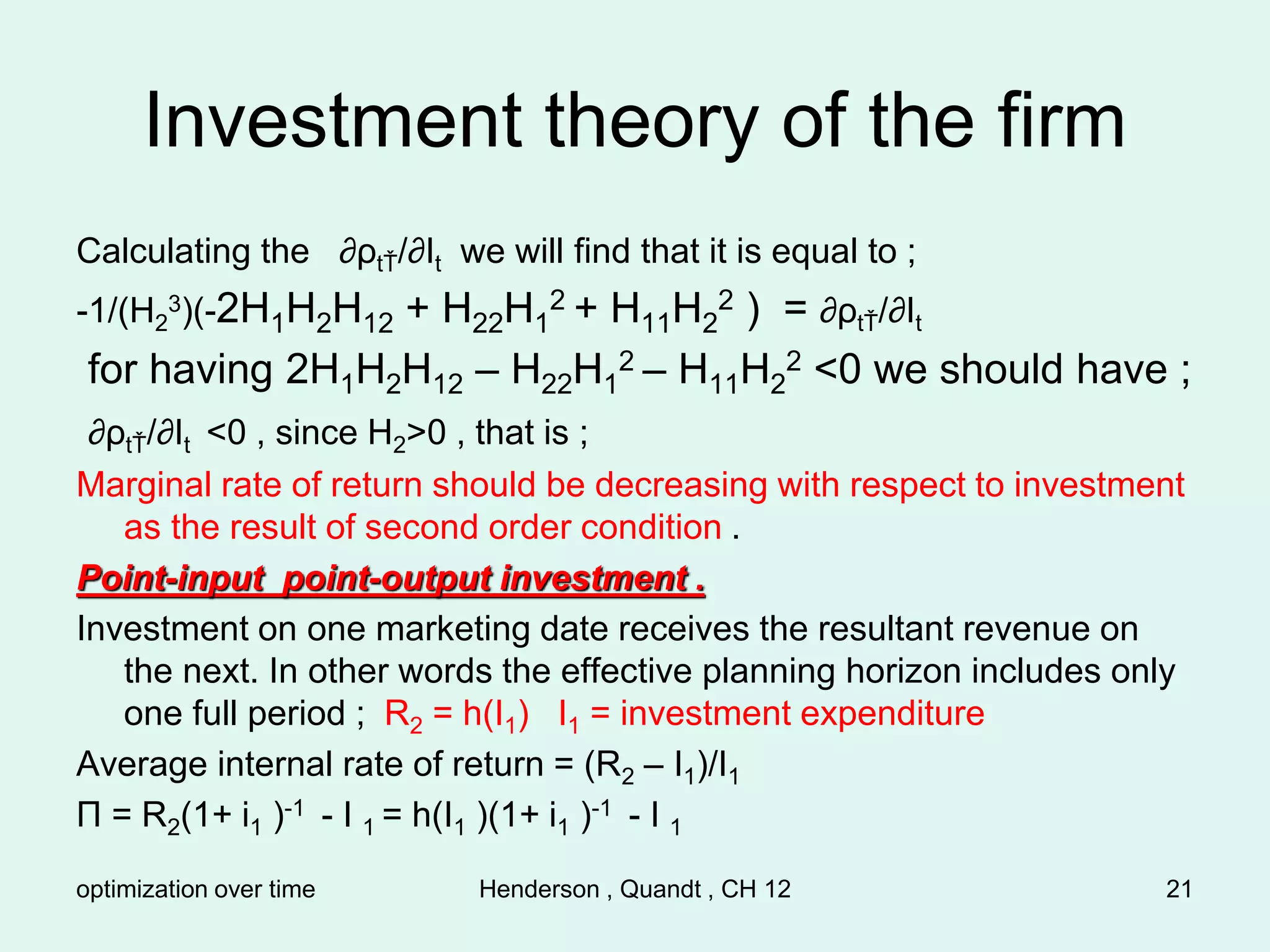
![optimization over time Henderson , Quandt , CH 12 20
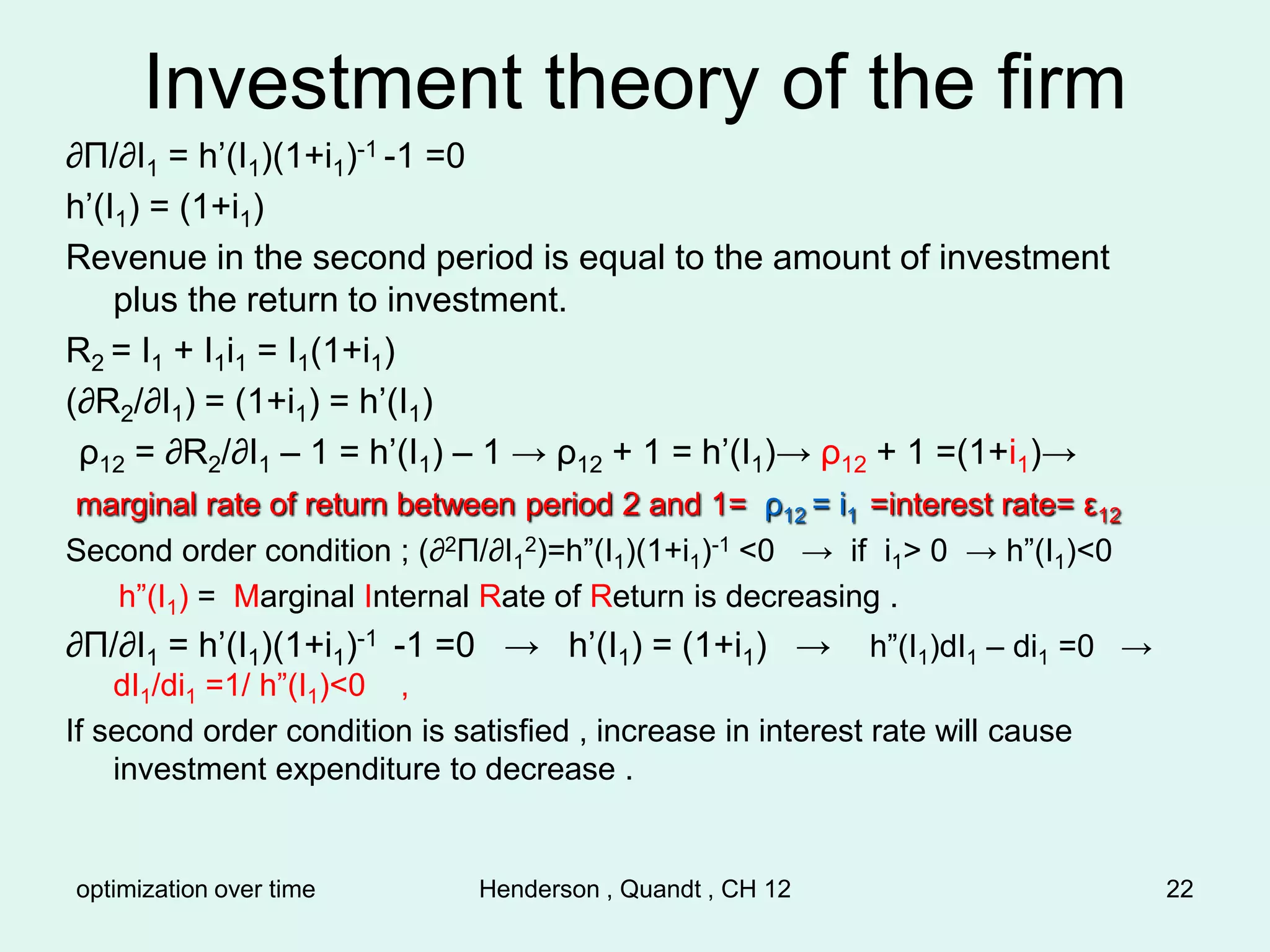
Investment theory of the firm
The investment plan
Max Π* = Σt=2
L+1 Rt(1+ ε1t)-1 - Σt=1
L It(1+ ε1t)-1 +µH(I1, ,,,,,RL+1)
∂Π*/∂RŤ = (1 + ε1Ť)-1 + µ ∂H/∂RŤ = 0 Ť =2,3,4,,,,,L+1
∂Π*/∂It = - (1 + ε1t)-1 + µ ∂H/∂It = 0 t=1,2,3……L
∂Π*/∂µ = H(I1, ,,,,,RL+1) = 0
(∂H/∂It )/(∂H/∂RŤ )=[(1+i1)….(1+it-1)-1+1]-1 / [(1+i1)….(1+iŤ-1)-1+1]-1 =
1/ [(1+it)….(1+iŤ-1)-1+1]-1= [(1+it)….(1+iŤ-1)] = - (1+ εtŤ)
(∂H/∂It )/(∂H/∂RŤ)=-(1+ρtŤ)=-(1+ εtŤ) →ρtŤ=εtŤ optimum level of investment
Marginal internal rate of return (internal investment )=ρtŤ = εtŤ = market rate of
return (external investment )
t=1,2,3..L , Ť= 2,3,4,,,,L+1
ρtŤ < εtŤ , entrepreneur buy bonds , contract investment
ρtŤ > εtŤ , entrepreneur sell bonds , expand investment
S . O. C.
H11 H12 H1 H11 H12 H13 H1
H21 H22 H2 < 0 → 2H1H2H12 – H22H1
2 – H11H2
2 <0 H21 H22 H23 H2 > 0
H1 H2 0 H31 H32 H33 H3
H1 H2 H3 0](https://image.slidesharecdn.com/hqch12optimizationovertime-230226160121-4944a946/75/H-Q-CH-12-Optimization-over-time-ppt-20-2048.jpg)
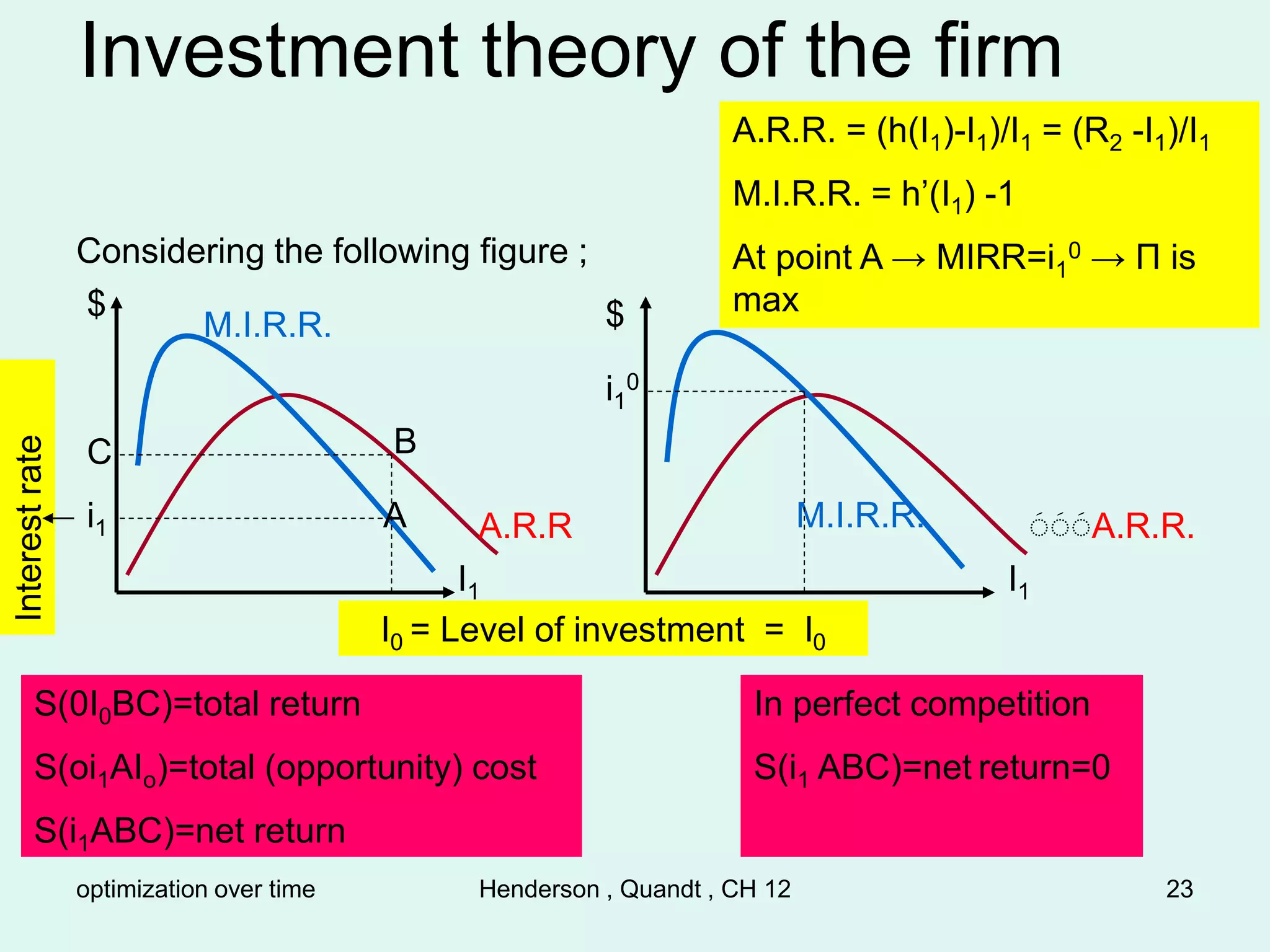
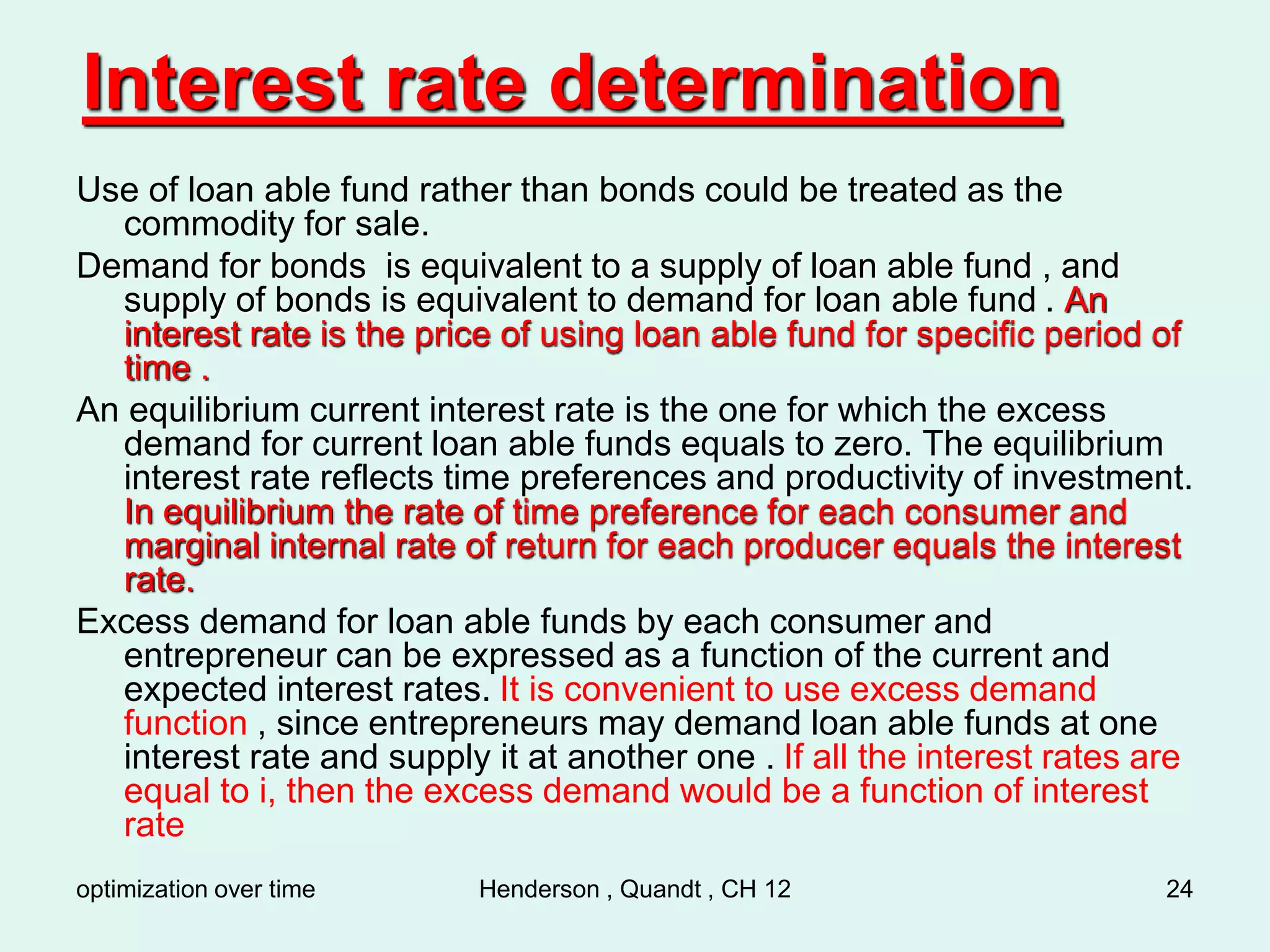
![optimization over time Henderson , Quandt , CH 12 25
Investment theory and the role
of the firm .
Interest rate theory is characterized by the fact that time elapse between the
application of inputs and the attainment of the resultant output.
Continuous compounding and discounting.
We should note that time is continuous and transaction may take place at any
point in time.
If Wt is the interest of one dollar investment at the end of t years period ;
$1 at t=0→t=1[W1=(1+i)] →t=2 [W2= (1+i)2 ]→t=3 [W3=(1+i)3 ]→…t=t [Wt=(1+i)t ]
Wt = (1+ i) t
,, if interest rate compound once a year.
Wt = (1+ i/2) 2t
,, if interest rate compound twice a year , one half of i would
compound every six months .(1/2 of a year )
Wt = (1+ i/n)nt
,, if interest rate compound n times a year , 1/n of i would
compound every 1/n of a month.
Z=(1+i/n)nt ,→ Ln Z = nt Ln (1+i/n) → Ln Z =[Ln(1+i/n)] / (1/nt)
if n → ∞(continuous time)→Lim Ln Zn→∞ = 0/0
Using Hopital rule → Lim Ln Zn→∞ =(i)(t) → Lim Z n→∞ = eit
So the present value of u dollars payable at time t is equal to ue-it](https://image.slidesharecdn.com/hqch12optimizationovertime-230226160121-4944a946/75/H-Q-CH-12-Optimization-over-time-ppt-25-2048.jpg)
![optimization over time Henderson , Quandt , CH 12 26
Investment theory and the role
of the firm .
Point and flow variables
Transaction may take place at any point in time and their values may
be the function of the time at which they occur.
R(T) =revenue (dollar value) , realized at time t =T
R(T)e-iT = present value of the revenue at time T
d[R(T)e-iT ]/dT = [R’(T) –iR(T)]e-iT = marginal discounted revenue with
respect to time.
We should note that inputs , outputs , costs, and revenues may be
realized as flow variables over time . Flow variables may occur at
constant rate over time or their rate may be a function of the time .
R=R(t) = rate of flow of income at instant t measured in dollars per
year.
R=R(T) denotes point value at time T .](https://image.slidesharecdn.com/hqch12optimizationovertime-230226160121-4944a946/75/H-Q-CH-12-Optimization-over-time-ppt-26-2048.jpg)
![optimization over time Henderson , Quandt , CH 12 27
Investment theory and the role
of the firm .
R0T = ∫0
T R(T)e-it dt = present value of revenue stream R(T) from
t=0 to t=T
dR0T/dT = R(T) e-iT , marginal revenue of an income stream with
respect to time
Consider a income stream R(t) from t=0 to t=T , and a point value at T
with equal present value , RT e-iT = ∫0
TR(t)e-it dt , then ;
RT= ∫0
TR(t)e-i(T-t) dt , as it is seen a flow variable , R(t) , could be
converted into an equivalent point variable , R(T).
Consider a constant income flow , α , with present value equal to that of
a point value T , RT e-iT = ∫0
T αe-it dt = α ∫0
T e-it dt = α δ in which δ
equal to δ= [(1-e-iT)/i ] = ∫0
T e-it dt = present value of one dollar
income stream for T years .
Finding α from the RT e-iT = ∫0
T αe-it dt , and substituting from
[(1-e-iT)/i ] = ∫0
T e-it dt , we will find α = [i / (e-iT -1)] RT ,, which
provides a mean for converting a point value into an equivalent
constant flow.](https://image.slidesharecdn.com/hqch12optimizationovertime-230226160121-4944a946/75/H-Q-CH-12-Optimization-over-time-ppt-27-2048.jpg)
![optimization over time Henderson , Quandt , CH 12 28
Investment theory and the role
of the firm .
Point –input Point-output
All inputs are applied at one point in time and all outputs are sold at a later
point in time. Winger aging .
I0 = cost for buying cask of grape juice . Frgmantation and aging is costless .
The only other cost is interest paid for I0
R(T) = sales value of winger at point T . T is the aging period .
Profit max→Π = R(T)e-iT – I0 , dΠ/dT = [R’(T)– i R(T)]e-it=0 (I)→ [R’(T)/R(T)] = i
[R’(T)/R(T)]= Proportionate rate of return with respect to time= i =
proportionate marginal rate of return with respect to time
S. O. C.→ d2Π/dT2 = [R”(T)-2iR’(T)+i2R’(T)]e-iT<0
Substituting from FOC →[ R”(T)R(T)–[R’(T)]2 ] / [R(T)]2 <0 →d[R’(T)/R(T)]/dT <0
Solving the first order equation we will get T=T0
If investment period = T0 , marginal earning from winger aging = earning from
investing R(T) in bond market.
If investment period < T0 , marginal earning from winger aging > earning from
investing R(T) in bond market.
If investment period > T0 , marginal earning from winger aging < earning from
investing R(T) in bond market.](https://image.slidesharecdn.com/hqch12optimizationovertime-230226160121-4944a946/75/H-Q-CH-12-Optimization-over-time-ppt-28-2048.jpg)
![optimization over time Henderson , Quandt , CH 12 29
Investment theory and the role
of the firm .
Totally differentiate the first order condition we get;
R”(T)dT – iR’(T)dT – R(T)di =0
dT/di = R(T) / [R”(T) – i R’(T)] < 0 [R”(T) – i R’(T)] < 0
if i goes up it will force the entrepreneur to shorten his aging period
Continuous-Input Point-Output
Example ; tree growing , ship building .
Seedling cost = I0 (initial fixed cost )
Cultivation cost = G(t) per year , (variable cost during the investment
period)
Selling price of the tree at time t=T R=R(T)
Π=R(T)e-it – I0 - ∫0
TG(t)e-itdt =present value of profit
dΠ/dT = [R’(T) – iR(T) – G(T)]e-iT = 0
[R’(T) – G(T)] / R(T) = i →
proportionate rate of return net of cultivation cost=interest rate](https://image.slidesharecdn.com/hqch12optimizationovertime-230226160121-4944a946/75/H-Q-CH-12-Optimization-over-time-ppt-29-2048.jpg)
![optimization over time Henderson , Quandt , CH 12 30
Investment theory and the role
of the firm .
Point-Input Continuous-Output
Investment in durable equipment which yields a revenue stream over
time . (swing machinery)
Suppose that the equipment yields revenue at a constant rate of R
dollars per year during its life.
I0 = I(T) = investment cost T =life time of machine .
Π = ∫0
T Re-itdt – I(T)
dΠ/dT = Re-iT – I’(T) = 0 → Re-iT = I’(T)
Present value of additional revenue from increased durability =
marginal cost of durability
S. O. C. → d2Π/dT2 = -iRe-iT – I”(T) < 0 → S.O.C. is satisfied if the
marginal cost of durability is increasing over time → I”(T)>0
Differentiating the first order condition →dT/di =[TRe-iT]/ [-iRe-iT-I”(T)] <0
if interest rate goes up (i↑)→ life time of machine should shorten (T)↓.](https://image.slidesharecdn.com/hqch12optimizationovertime-230226160121-4944a946/75/H-Q-CH-12-Optimization-over-time-ppt-30-2048.jpg)
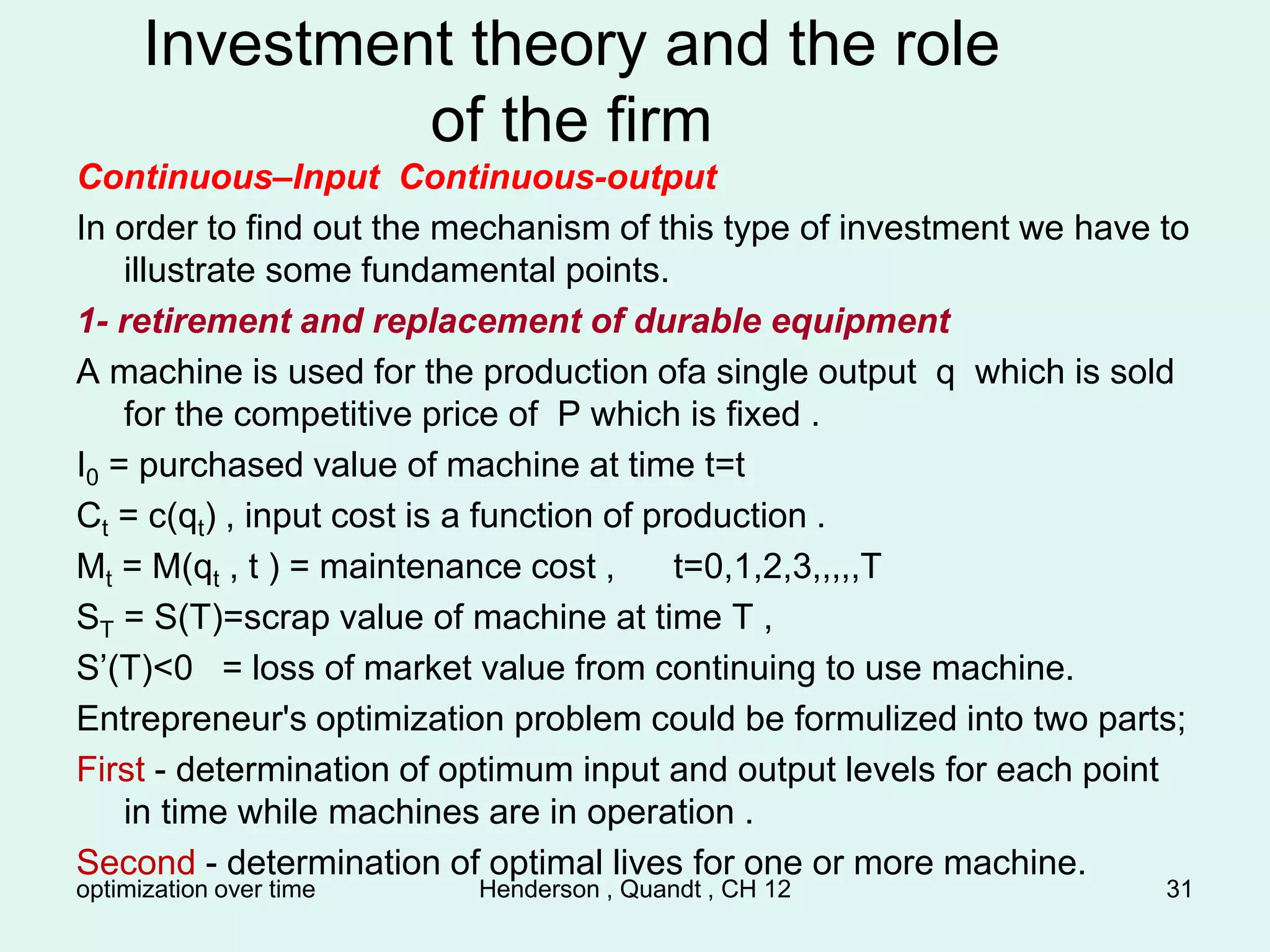
![optimization over time Henderson , Quandt , CH 12 33
Investment theory and the role
of the firm
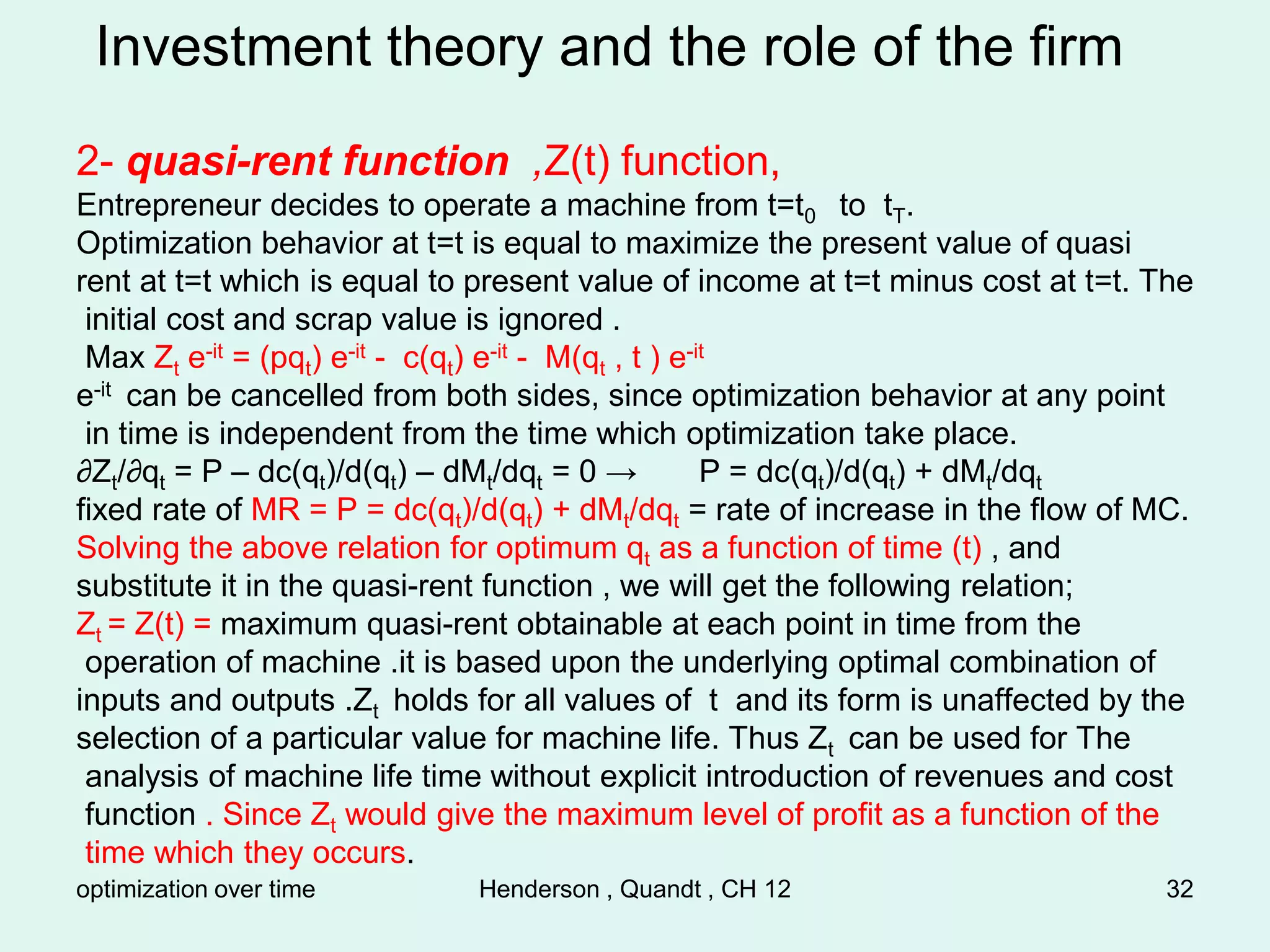
Retirement of a single machine
Max Π1 = [ ∫0
T Z(t)e-iT dt ] – I0 + S(T)e-iT , T= life time of machine ,
Π1 = present value of the profit stream for the first machine
dΠ1/dT = [ Z(T) – i S(T) + S’(T) ] e-iT = 0
Z(T) – i S(T) + S’(T) =0 → Z(T) + S’(T) = i S(T) F.O.C.
Z(T)= marginal quasi rent
S’(T) <0 , depreciation flow or marginal loss of scrap value
i S(T)= interest from investing the scrap value ,
S.O.C. ; d[ Z(T) – i S(T) + S’(T) ]/dT <0
d[ Z(T) + S’(T) ]/dT < d [i S(T) ]/dT S’(T)<0
Quasi-rent less depreciation flow decrease more rapidly than the
alternative bond-market return.](https://image.slidesharecdn.com/hqch12optimizationovertime-230226160121-4944a946/75/H-Q-CH-12-Optimization-over-time-ppt-33-2048.jpg)
![optimization over time Henderson , Quandt , CH 12 34
Investment theory and the role of the firm
Replacement of a chain of machine (Continuous-Input Continuous-Output)
Infinite horizon , infinite chain of machine succeeding each other. Quasi-rent
function , initial cost, planned life of the machine and scrap value are the
same for each machine except for the dates of obtaining them. Πi = present
value from the operation of ith machine.
Π1=∫0
T Z(t)e-it dt – I0 + S(T)e-iT
Π2=∫T
2T Z(t-T)e-it dt – I0e-iT + S(T)e –i2T = Π1e-iT
Π3=∫2T
3T Z(t-2T)e-it dt – I0e-i2T + S(T)e-i3T =Π1e-i2T
……………………………………………………..
Πk=Π1e-i(k-1)T = [∫0
T Z(t)e-it dt – I0 + S(T)e-iT ]e-i(k-1)T
Π= Σk=1
∞ Πk = total profit from the chain of the machine
Π = Σk=1
∞ Πk = Π1(1 + e-iT + e-i2T +…. +e-i(k-1)T) , k →∞ Π = Π1[1/(1-e-iT)]
dΠ/dT = {[Z(T)–iS(T)+S’(T)]e-iT(1-e-iT)-ie-iT[ ∫0
T Z(t)e-it dt–I0 + S(T)e-iT]}/(1-e-iT)2
Multiplying the both sides by e-iT(1-e-iT) and rearranging the terms ,
Z(T) + S’(T) = (1/δ ) [∫0
T [Z(t)e-it dt – I0 + S(T)] ,
δ=(1-e-iT)/i=∫0
Te-itdt = present value of one dollar income stream for T years.
∫0
T Z(t)e-it dt – I0 + S(T)= present value of the return of new machine
( with life time equal to T years )net of its investment cost plus the scrap value
of the old machine.](https://image.slidesharecdn.com/hqch12optimizationovertime-230226160121-4944a946/75/H-Q-CH-12-Optimization-over-time-ppt-34-2048.jpg)
![optimization over time Henderson , Quandt , CH 12 35
Investment theory and the role of the firm
Income stream per year fot T years present value of the investment
after T years.
one dollar δ
X [∫0
T Z(t)e-it dt – I0 + S(T)]
(1/δ ) [∫0
T Z(t)e-it dt – I0 + S(T)] = present value of the average return per
year of new machine net of its investment cost plus the scrap value of
the old machine.
[(Z(T) + S’(T)] = marginal rate of quasi-rent flow net of depreciation
machine is replaced when its marginal rate of quasi-rent flow net of
depreciation equals the present value of the average return per year of
new machine net of its investment cost plus the scrap value of the old
machine.
The first order condition in this case and one machine case are different in
the sense that;
In the one machine case , entrepreneur is looking for continuing to operate
the machine or investing its scrap value in the bond market. While in the
infinite number of machine case the entrepreneur is looking for operating
an existing machine or operating a new one .](https://image.slidesharecdn.com/hqch12optimizationovertime-230226160121-4944a946/75/H-Q-CH-12-Optimization-over-time-ppt-35-2048.jpg)
-t + λ(q0- Σt=1
nqt)
∂V/∂qt = [pt – c’(qt)](1+i)-t - λ =0
∂V/∂λ = q0 - Σt=1
n qt =0
[pt – c’(qt)](1+i)-t = λ , λ is the measure of scarcity
Present value of the difference between price and marginal cost for all
periods should be the same .
If pt = fixed , when time (t)↑ →(1+i)-t } ↓ → so we should have c’(qt)↓ →
qt ↓ , (if marginal cost is increasing as the result of second order
condition) .](https://image.slidesharecdn.com/hqch12optimizationovertime-230226160121-4944a946/75/H-Q-CH-12-Optimization-over-time-ppt-36-2048.jpg)
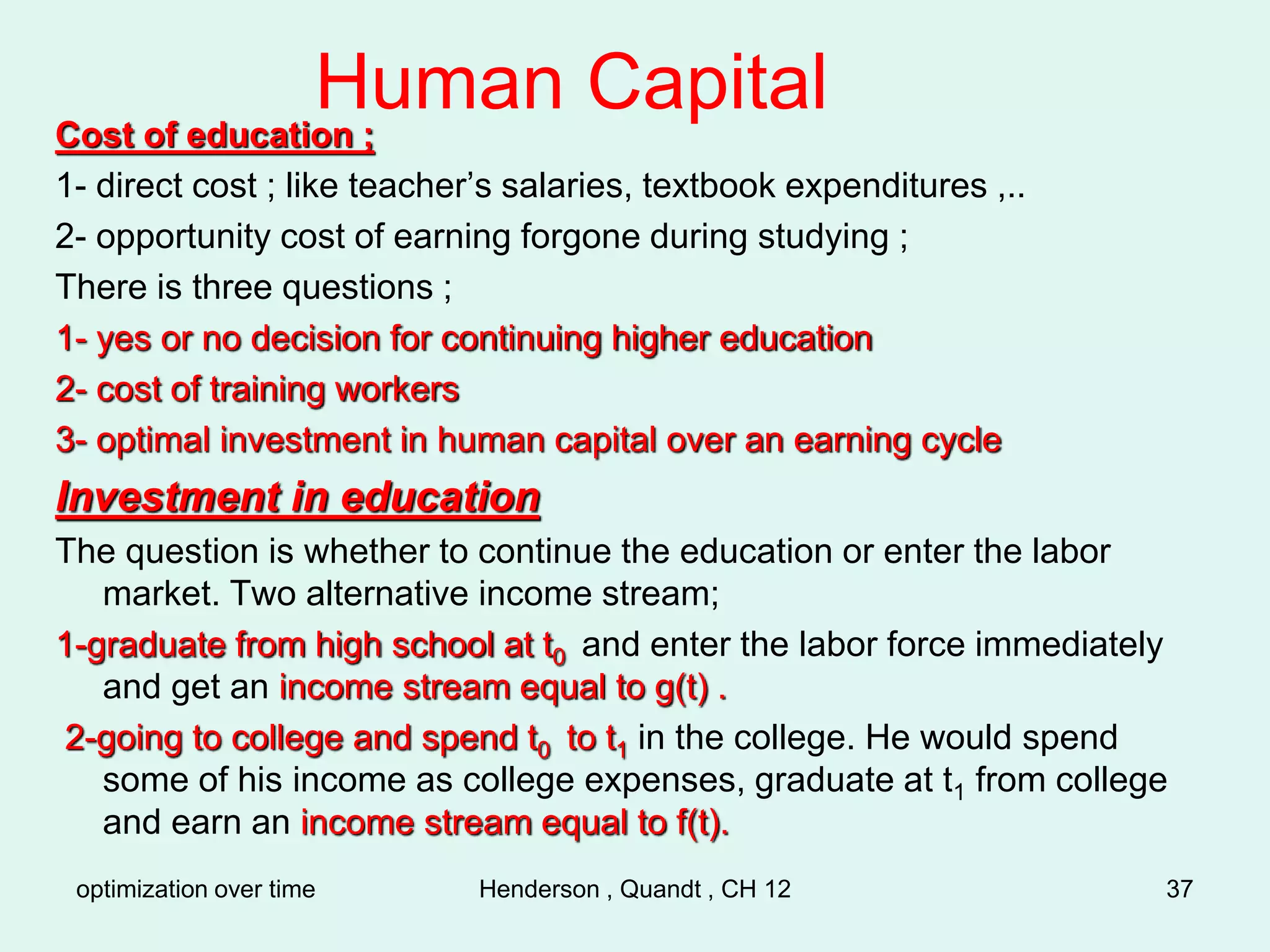
![optimization over time Henderson , Quandt , CH 12 38
Human Capital
We could see the above alternative income streams in following figure;
T = working life time period .
yt
t
g(t)
f(t)
t0 t1 Ť T
Investment cost for college education =∫0
Ť [g(t)-f(t)]dt=Sa+Sb=
opportunity cost forgone (b) + direct cost (a)
Return from investment = ∫Ť
T [ f(t) – g(t) ] dt
When present value of investment cost =present value of the return
from investment ,→ the equilibrium rate of return (r) will be found which
could equalize the cost and return from the investment .
a
b
negative
income
=
cost](https://image.slidesharecdn.com/hqch12optimizationovertime-230226160121-4944a946/75/H-Q-CH-12-Optimization-over-time-ppt-38-2048.jpg)
![optimization over time Henderson , Quandt , CH 12 39
Human Capital
If r* is the rate at which present value of net return is equal to present
value of investment cost, then ;
=∫0
Ť [g(t)-f(t)] e-r*t dt = ∫Ť
T[ f(t) – g(t) ] e-r*t dt → ∫0
T [g(t)-f(t)] e-r*t dt =0
g(t) and f(t) are function of rate of return of income after graduation (r* ).
If r* > i college education is desirable
If r* < i college education is not desirable
i=market interest rate ,
Investment in training
In a competitive market labor will be paid according to his value of
marginal product.
Suppose that the government requires that the firm should hires some
members of a disadvantaged group whose initial marginal product is
less than the current wage (w) , but should be paid the same current
wage rate.](https://image.slidesharecdn.com/hqch12optimizationovertime-230226160121-4944a946/75/H-Q-CH-12-Optimization-over-time-ppt-39-2048.jpg)
![optimization over time Henderson , Quandt , CH 12 40
Investment in training
For the disadvantaged group suppose that;
MP=f(t) , marginal product of labor is a function of time
VMPL = P MP = f(t) < w = the current wage rate If P=1→ VMPL = MP
Suppose the firm provides on job training program for this disadvantage
group till at time t=T , their marginal productivity would increase and
be equal to w , the current wage rate .
∫0
T[w-f(t)]e-it dt = Money paid to the disadvantage group in excess of
their marginal productivity till they productivity increase to w
cost of training = direct cost of training plus money paid to the
disadvantage group in excess of their marginal productivity. The
distribution of this cost depends upon the institutional setting . In a
competitive market the entire cost will be born by disadvantage
group, since in these markets the labor will be paid only by their
value of marginal product .](https://image.slidesharecdn.com/hqch12optimizationovertime-230226160121-4944a946/75/H-Q-CH-12-Optimization-over-time-ppt-40-2048.jpg)
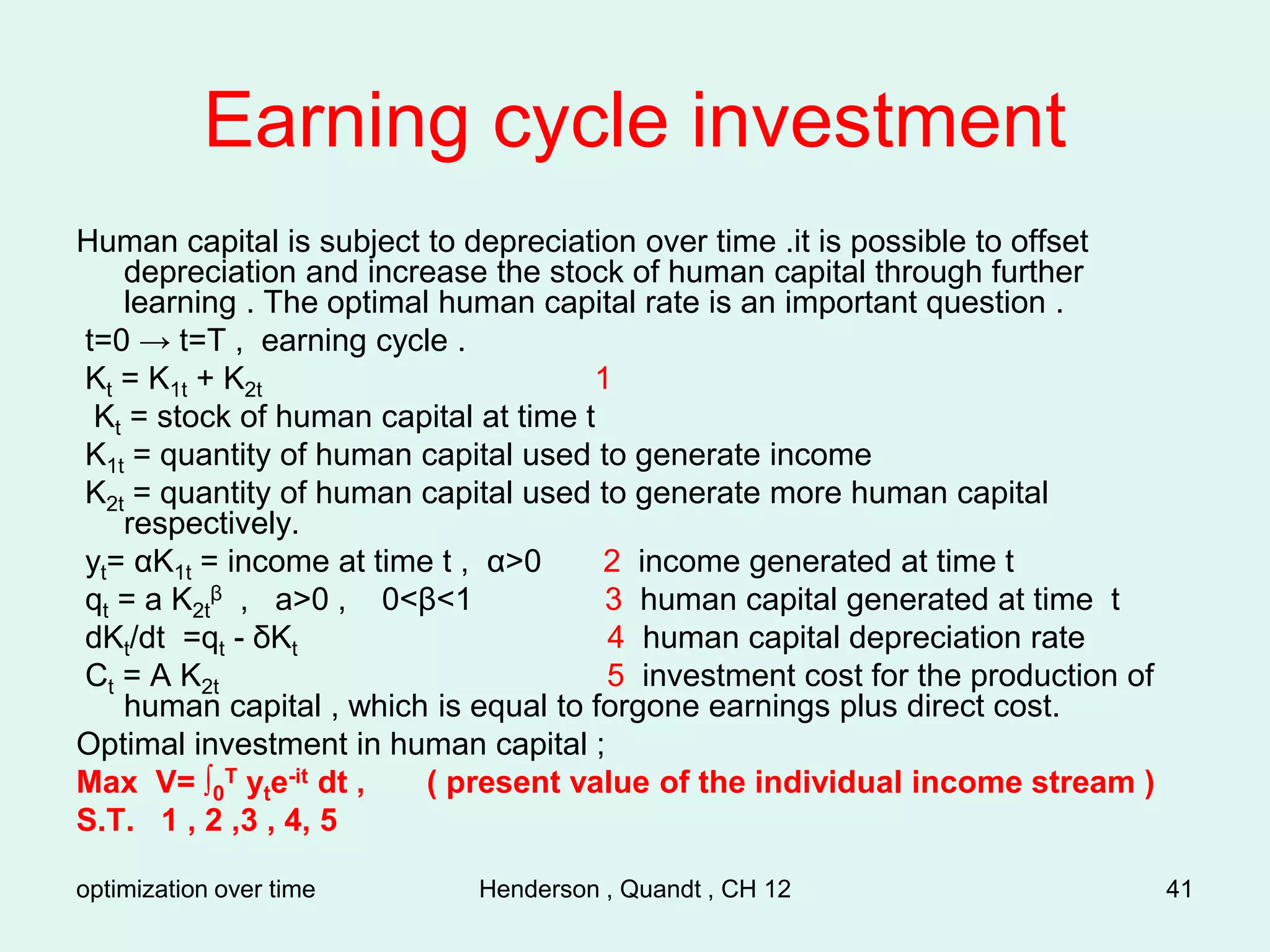
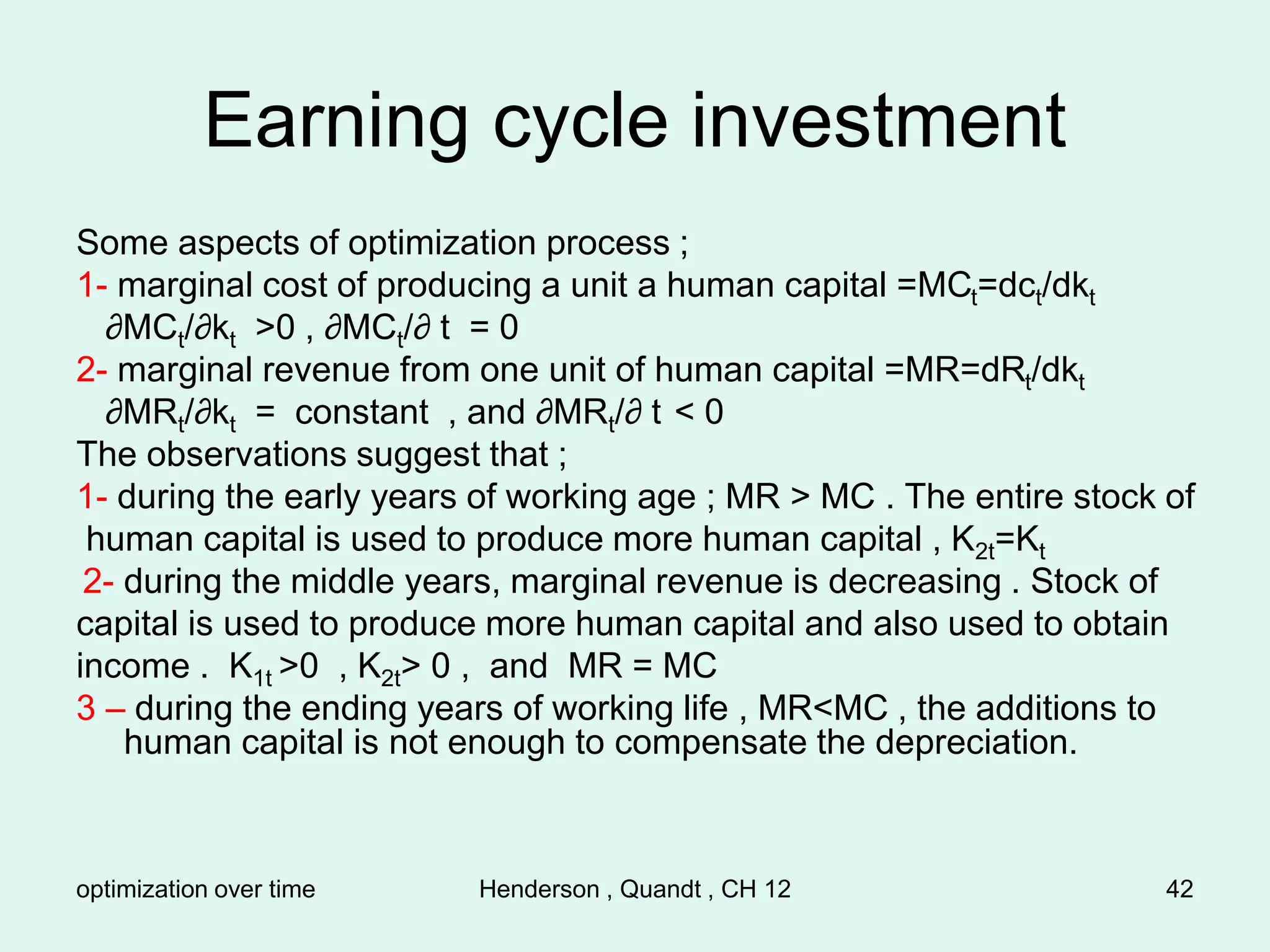
![optimization over time Henderson , Quandt , CH 12 43
Problems
12-1
Consider two alternative income streams ; y1 = 300 , and y2 =321 ,and
y1 =100 , and y2 =535 . For what rate of interest would the consumer
be indifferent between the two streams .
solution
300 + 321/(1+r) = 100 + 535/(1+r)
r = 0.07
12-2
A consumer consumption–utility function for a two period horizon is
U=c1c2
0.6 . His income stream is y1=1000 , y2=648 , and the market
rate of interest is 0.08. determine values for c1 and c2 that
maximizes his utility function . Is he a borrower or lender ?
Solution
Max U=c1c2
0.6
s.t. 1000 + 648/(1+0.08) = c1 + c2/(1+0.08)
L =c1c2
0.6 + λ [ 1000 + 648/(1+0.08) – c1 –c2 / (1+0.08) ]](https://image.slidesharecdn.com/hqch12optimizationovertime-230226160121-4944a946/75/H-Q-CH-12-Optimization-over-time-ppt-43-2048.jpg)
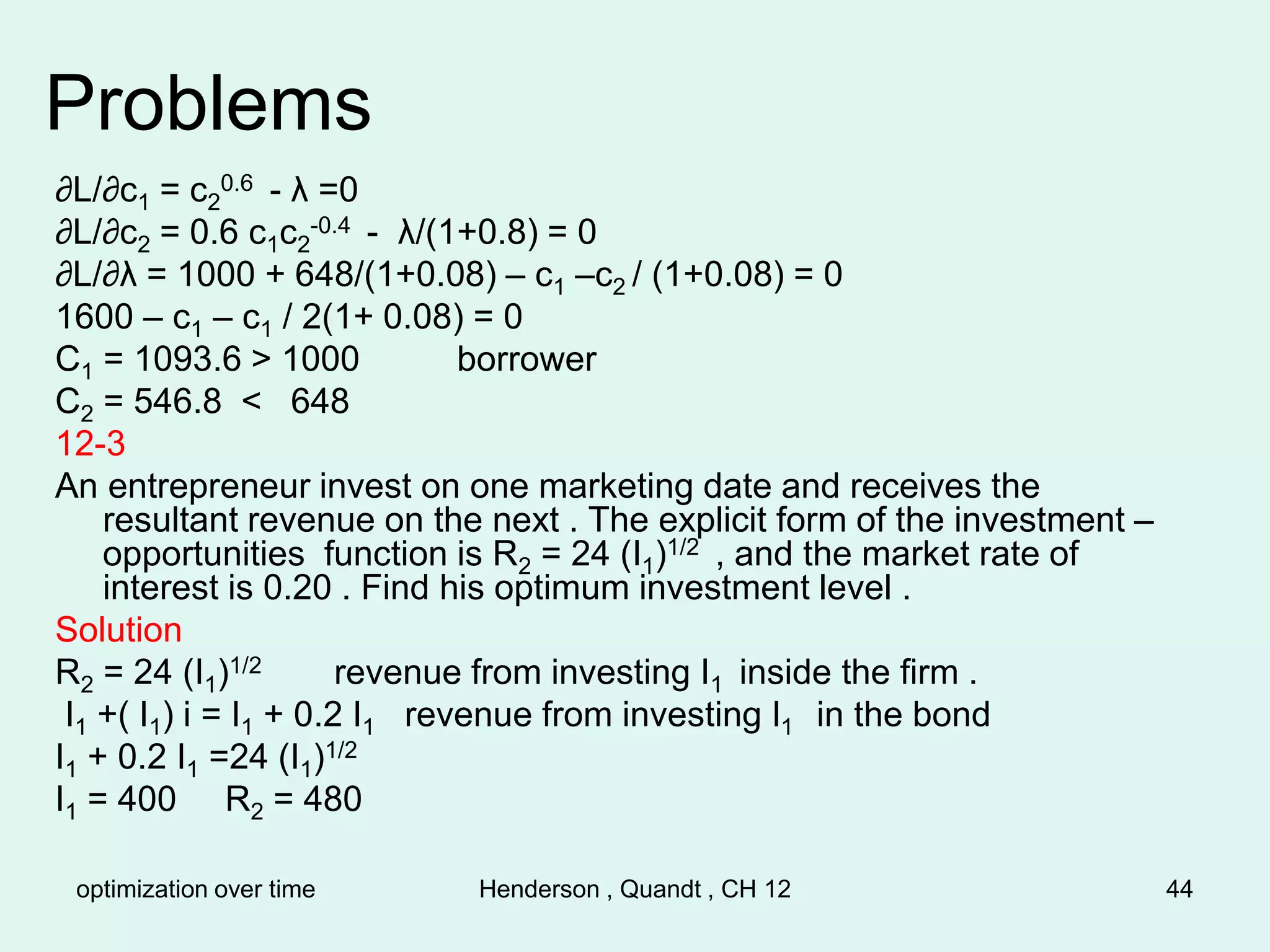
![optimization over time Henderson , Quandt , CH 12 45
Problems
12-4
Consider a bond market in which only the consumers borrow and lend. Assume
that all 150 consumers have the same two-period consumption –utility
function : U=c1c2 . Let each of the 100 consumers have the expected
income stream y1=10000 , y2=8400 , and let each of the remaining 50
consumers have the expected income stream y1= 8000 , y2 = 14000 . At
what rate of interest will the bond market be in equilibrium ?
Solution
The Lagrangian function for each consumer group is
V*= c1c2 +µ [ (y1 – c1 ) + (y2 – c2) (1+i)-1 ]
F. O. C.
∂V*/ ∂c1 = c2 - µ = 0
∂V*/ ∂c2 = c1 - µ (1+i)-1 = 0
∂V*/ ∂ µ = (y1 – c1 ) + (y2 – c2) (1+i)-1 = 0 , and solve for c1 ;
C1 = [ y1 + y2(1+i)-1 ] / 2 The consumer excess demand for bond is ;
y1 - c 1 = [y1 – y2(1+i)-1]/2 ,
Bond market equilibrium requires that aggregate excess demand by the two
groups of consumers equal zero ;
100[5000–4200(1+i)-1]+50[4000–7000(1+ i)-1]=700000–770000(1+i)-1=0→
i=0.10](https://image.slidesharecdn.com/hqch12optimizationovertime-230226160121-4944a946/75/H-Q-CH-12-Optimization-over-time-ppt-45-2048.jpg)
![optimization over time Henderson , Quandt , CH 12 46
Problems
12-5
An entrepreneur receives 100 dollars at t=5 , determine an equivalent
constant continuous income-stream from t=0 to t=5 if the interest
rate is 10 percent . Note that e0.5 = 1.64872 .
Solution
t=0→→→→→→t=5 . RT = 100
RT e-it = ∫0
t y e-it dt
y =[ i/(e-it - 1)]RT = 154.149
12-6
Consider an entrepreneur engaged in a point input point output vinegar
aging process .his initial cost is 20 , the sales value of the vinegar is
R(T)=100 T1/2 . And the rate of interest is 0.05 . How long is his
optimal investment period .](https://image.slidesharecdn.com/hqch12optimizationovertime-230226160121-4944a946/75/H-Q-CH-12-Optimization-over-time-ppt-46-2048.jpg)
![optimization over time Henderson , Quandt , CH 12 47
Problems
12-6 solution
Π=R(T) e-iT - Io = 100 T1/2 e-iT - 20
dΠ/dT = [ R’(T) – iR(T) ]e-iT = [50T-1/2 – (0.05)(100)T1/2 ] e-iT = 0
i= R’(T)/R(T)→→→0.05 = 50T-1/2 / 100 T1/2 →→→→T =10 .
12-7
An entrepreneur is engaged in a repeated point input point output
investment process . He invests Io dollars and receives a revenue of
R(T) dollars T years later . At T he will again invest Io dollars and
receive another revenue of of R(T) dollars at 2T . Assume that he
repeats this process indefinitely . Interest is compound continuously
at constant rate of i .
What is the present value of the entrepreneurs profit from such an
infinite chain ? Formulate his first order condition for profit
maximization . Compare this result with the first order condition for
the unrepeated case.](https://image.slidesharecdn.com/hqch12optimizationovertime-230226160121-4944a946/75/H-Q-CH-12-Optimization-over-time-ppt-47-2048.jpg)
![optimization over time Henderson , Quandt , CH 12 48
Problems
12-7 solution
Π1 = R(T) e-iT – I0 ; unrepeated case
Π2 = R(T) e-2iT - Ioe-iT = Π1 e-iT
Π3 = Π1 e-2iT
……………….
Πn = Π1 e-(n-1)iT
Π= Σi=1
∞ Πi =Π1(1+e-iT +e-2iT+e-3iT+...∞)=Π1/(1 - e-iT)=
[R(T) e-iT- I0 ]/(1 - e-iT)
dΠ/dT ={ (1 - e-iT)[R’(T) – iR(T)] e-iT - i e-iT [R(T) e-iT – Io ]} / (1 - e-iT)2 =0
(1 - e-iT)[R’(T) – iR(T)] =i [R(T) e-iT – Io]
∫o
T e-iT = (1 - e-iT)/ i = γ present value of one dollar income stream
[R’(T) – iR(T)] = 1/γ [R(T) e-iT – Io] F .O . C . Repeated case
[R’(T) – iR(T)] =marginal present value of profit (or net revenue) of increasing
the life of first casting (T) by one year .
[R(T) e-iT – Io] = net present revenue of profit from a new casting process after
T years .
1/γ [R(T) e-iT – Io]= net present revenue of profit from a new casting process for
the first year ( during the T years life of investment ).
Unrepeated case:
d(Π1 )/dT=d[R(T) e-iT – I0 )] / dT =0 → [R’(T) – iR(T)]=0 → R’(T) = iR(T)](https://image.slidesharecdn.com/hqch12optimizationovertime-230226160121-4944a946/75/H-Q-CH-12-Optimization-over-time-ppt-48-2048.jpg)
![optimization over time Henderson , Quandt , CH 12 49
Problems
12-8
an entrepreneur is engaged in tree growing . He purchases a seedling
for 4 dollars , incurs a cultivation cost flow at a rate G(t) = 0.4t
dollars per year during the life of a tree and sells the tree at t=T for
R(T) = 4+ 8T – T2 dollars . The market rate of interest is 20 percent.
Determine an optimal length for his cultivation period , T . Apply the
appropriate second order condition to verify that your solution is a
maximum .
12-8 solution
Π = R(T) e-iT - Io - ∫o
T G(t) e-it dt
dΠ/dT = [ R’(T) – iR(T) – G(T) ] e-iT = 0
[R’(T) – G(T) ] / R(T) = i
(-2T + 8 – 0.4T )/( 4+ 8T – T 2 ) = 0.20
T2 – 20T +36 =0 , T =2 , T=18 .
d2Π/dT2 <0 →→→T=2](https://image.slidesharecdn.com/hqch12optimizationovertime-230226160121-4944a946/75/H-Q-CH-12-Optimization-over-time-ppt-49-2048.jpg)
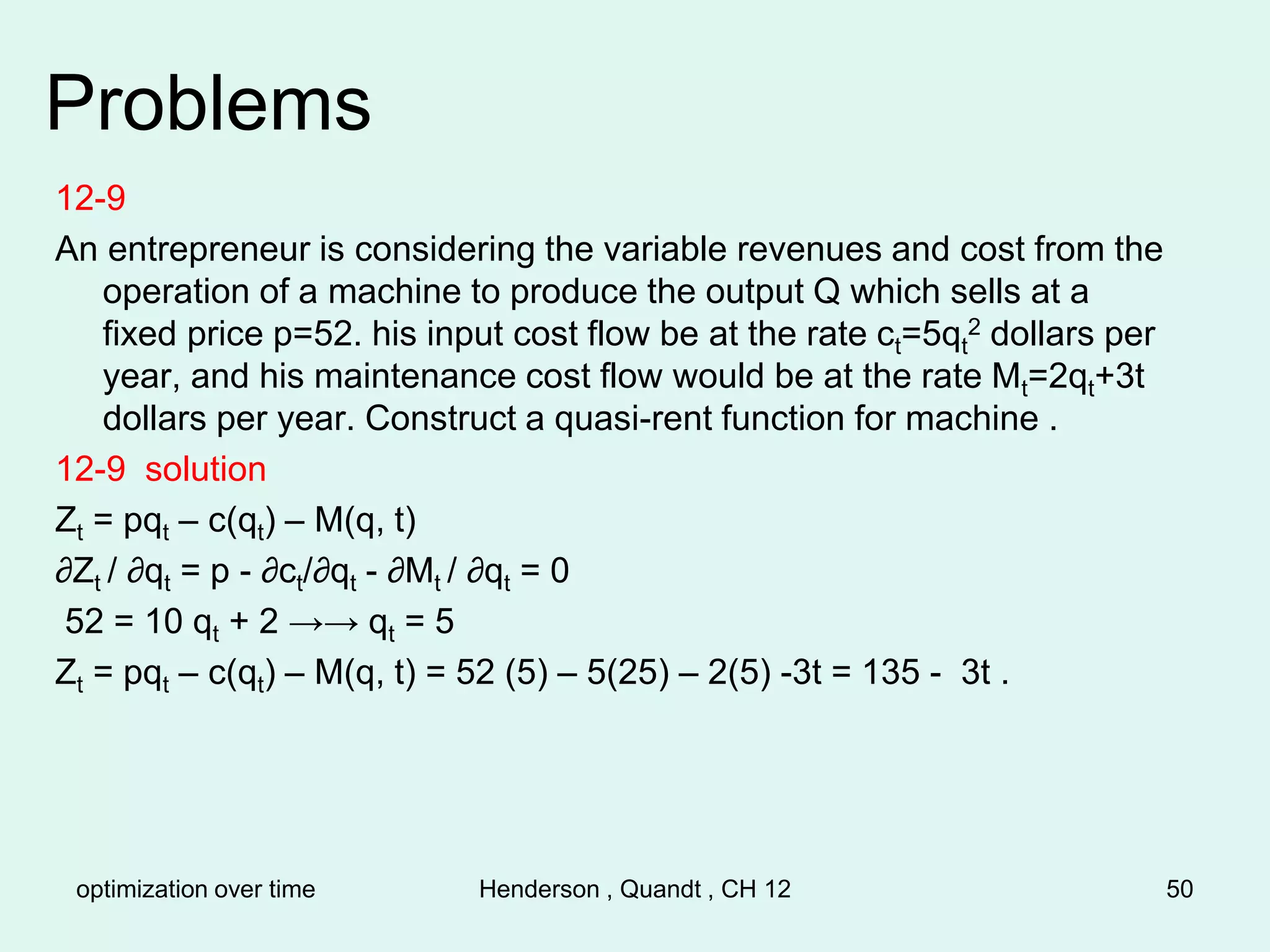
![optimization over time Henderson , Quandt , CH 12 51
Problems
12-10
An entrepreneur plans for a one-machine horizon. He purchases the
machine for 500 dollars . Its scrap value at time T is S(T)=500-40T.
The rate of interest is 0.05. The machine yields a quasi-rent flow at
the rate Zt = 85 – 4t dollars per year . When should the entrepreneur
retire this machine ?
12-10 solution
Π= ∫o
T Z(t) e-iT dt – I0 +S(T)e-iT
dΠ/dT = [Z(T) – iS(T) +S’(T)]e-iT = 0
Z(T) + S’(T) = iS(T)
85 – 4T -40 = 0.05(500 -40 T) , →→t=10
12-11
An entrepreneur with a two years horizon decides to extract 100 units
of output from an exhaustible resource . His extraction cost is
Ct=0.5qt
2 and the interest rate is 0.10 percent , and the constant
selling price for the output is 100 dollars . How much output should
he extract in each year ?](https://image.slidesharecdn.com/hqch12optimizationovertime-230226160121-4944a946/75/H-Q-CH-12-Optimization-over-time-ppt-51-2048.jpg)
![optimization over time Henderson , Quandt , CH 12 52
Problems
12-11 solution
Max Π= Σt=1
t=2 [ ptqt – c(qt) ] (1+i)-t + λ(q0 – Σt=1
t=2 qt)
dΠ/dqt = 0 →→→ [Pt - c’(qt) ] (1+i)-t = λ
[P1 - c’(q1 ) ] (1+i)-1 = λ
[P2 - c’(q2 ) ] (1+i)-2 = λ
[P1 - c’(q1 ) ] = [P2 - c’(q2 ) ] (1+i)-1
(100 –q1) = (100 – q2)(1.01)-1
q1+q2=100
q1 = 52.3 q2 = 47.7
THE END](https://image.slidesharecdn.com/hqch12optimizationovertime-230226160121-4944a946/75/H-Q-CH-12-Optimization-over-time-ppt-52-2048.jpg)