Leadership. Energy. Execution. 1
UNCLASSIFIED
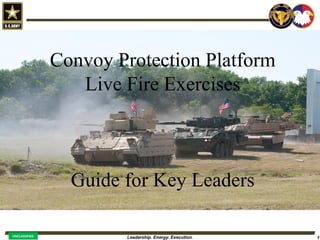
Convoy Protection Platform
Live Fire Exercises
Guide for Key Leaders
Leadership. Energy. Execution. 2
UNCLASSIFIED
Purpose of Mounted Gunnery
• In order for crews to take advantage of the various weapon system
capabilities at their disposal to quickly lay, engage, and destroy threat
targets, they must be proficient in the methods and techniques of
engagement execution. Mounted gunnery and its principles reinforce
training and grade the level of proficiency regarding said crew and
their engagement execution
• Qualify the crew and their platform
• Identify the level of proficiency and lethality of a crew
• Ensure every platform is a lethal and effective platform
• Establish battle and crew drills for a said platform
Leadership. Energy. Execution. 3
UNCLASSIFIED
Qualification Standard
• Distinguished Qualification
• 70 points per target on 9 of 10 engagements with 900 points out of a 1000 points and one
qualifying night engagement
• Superior Qualification
• 70 points per target on 8 of 10 engagements with 800 points out of a 1000 points and one
qualifying night engagement
• Qualified Qualification
• 70 points per target on 7 of 10 engagements with 700 points out of a 1000 points and one
qualifying night engagement
• Unqualified
• Less than 70 points per target on 4 or greater engagements or less than 700 points out of a
1000 points
• Any subsequent re-fire (failure to be first time go) can only be a Qualified
crew (not Distinguished or Superior and will be identified as Qualification 2)
Leadership. Energy. Execution. 4
UNCLASSIFIED
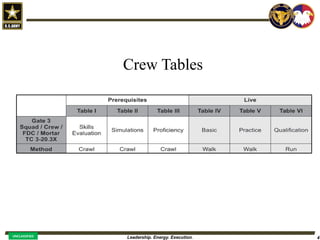
Crew Tables
Leadership. Energy. Execution. 5
UNCLASSIFIED
• Driving Licensure
• Driver & VC
• Night Vision Driving
• Driver and VC Familiarization and Licensure
• CBRN
• Donning
• Maintenance
• Inserts
• Vehicle Crew Evaluator Exportable Package
• Must train VCE’s T-9 or less
• Combat Lifesaver (CLS) Training
• Must train the appropriate amount of CLS prior to gunnery density and/or request medical
support
• Weapons Maintenance
• Documented
• AN-PAS/13 (Thermal)
• Employment
• Zeroing
• Ground Qualification
• Must be complete before Crew Qualification
Implied Gunnery Training Tasks
Leadership. Energy. Execution. 6
UNCLASSIFIED
Prerequisite Tables/Gates to Live Fire
• Can be completed in any order (this is the recommended order)
• All must be complete prior to going to Live Tables
• Must be complete within T-6 of live tables (T = months for the RC)
• Table I (Gunnery Skills Test)
• Gunnery Skills Test (GST) - TC 3-20.31-1
• Consists of critical tasks concerning the safety of the crew and essential to the operation of
the combat platform
• Ammo Identification
• Vehicle Identification
• Clear, disassemble, assemble, and perform a function check
• Load, attempt to fire, apply immediate action, and unload a pintle-mounted weapon
Leadership. Energy. Execution. 7
UNCLASSIFIED
Prerequisite Tables/Gates to Live Fire
• Table II (Simulations)
• Designed to evaluate the crew’s ability to engage stationary and moving
threat targets from a stationary and moving vehicle during day and limited
visibility in a simulated environment
• Live-fire prerequisite that must be completed prior any event using live
ammunition
• Allows crews to practice identifying threat targets and utilize the appropriate
Fire Commands; e.g. Elements of the Fire Command, Types of Fire
Commands, and Terms within the Fire Commands
Leadership. Energy. Execution. 8
UNCLASSIFIED
Prerequisite Tables/Gates to Live Fire
• Table III (Proficiency)
• A single vehicle course that is designed to evaluate the crew’s ability to
engage stationary and moving threat targets from a stationary and moving
vehicle during day and limited visibility in a simulated environment
• Platforms that do not have any laser-based TADSS for direct-fire training,
unit may conduct this course with blank ammunition or dry
• Failure to contact TADSS does not constitute a justification for executing
with blank fire or dry
• Will be built to the same task standards and range performance measures of
Live Tables
Leadership. Energy. Execution. 9
UNCLASSIFIED
Live Tables
• All prerequisite tables must be complete prior to any live fire event
• Are executed on standard Army ranges
• Are executed in sequence
• All platforms execute the tables
• Ammo resourcing varies from platform to platform and weapon system to
weapon system. Utilize the current STRAC for authorized ammunition
resources and allocation
Leadership. Energy. Execution. 10
UNCLASSIFIED
Live Tables
• Table IV (Basic)
• A single vehicle table used to prepare crews for the practice and
qualification tables
• The same tasks and range performance measures are utilized on successive
tables
• Designed to challenge by using demanding tasks, using full or scaled (3/4)
targets
• First table to utilize live ammunition
• Crews are evaluated to the same standard as subsequent Live Tables
• Not required for MMG Platforms (STRAC does not provide ammunition for
this Table for MMG Platforms)
Leadership. Energy. Execution. 11
UNCLASSIFIED
Live Tables
• Table V (Practice)
• A single vehicle table used to prepare crews for the qualification table
• The same tasks and range performance measures are utilized on successive
tables
• Designed to challenge by using demanding tasks, using full or scaled (3/4)
targets
• Second table to utilize live ammunition
• Crews are evaluated to the same standard as subsequent Live Tables
Leadership. Energy. Execution. 12
UNCLASSIFIED
Live Tables
• Table VI (Qualification)
• A single vehicle table used to qualify a crew and/or platform
• The same tasks and range performances measures are utilized
• Table VI must be fired with full-caliber ammunition against full-scale
targetry
• Qualification Table
• Crews are evaluated to the same standard as previous Live Tables
• Multiple-qualification criteria table
Leadership. Energy. Execution. 13
UNCLASSIFIED
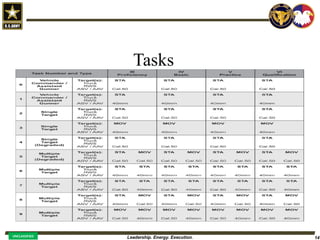
Tasks
• Required tasks (engagements) for each crew table III-VI
• Identifies who shoots each task and what targetry is called for; e.g. stationary or
moving, stationary and moving, stationary and stationary, or moving and
moving
• Tasks are sequentially numbered based off the given table; e.g. Task 0 of Table
III is Task or Engagement 30. The same Task on Table IV would be Task or
Engagement 40. Etc
• All tasks or engagements require an alternate target(s)
• Pintle-mounted machine guns will disregard the degraded portion of a said task
Leadership. Energy. Execution. 14
UNCLASSIFIED
Tasks
Leadership. Energy. Execution. 15
UNCLASSIFIED
Required Performance Measures
• Required performance measures (RPM) as seen below are incorporated into
the previous tasks/engagements
• These engagements will be conducted on all tables; e.g. III-VI
• These engagements will be conducted on all platforms:
• One defensive engagement, day and night
• One offensive engagement, day and night
• One short range engagement day or night
• One long-range engagement day or night
• One VC engagement day and night
• One chemical, biological, radiological, and nuclear (CBRN) engagement, day and night
• Call For Engagements Day and Night
Leadership. Energy. Execution. 16
UNCLASSIFIED
Kill Standards
• In order for a crew to achieve a target kill on any presented threat they must
achieve the target kill standard
• TC 3-20.31 Crew Training and Qualification Kill Standard
• To achieve a kill on a Troop Threat/Target
• M249, M240, M2HB, and M2A1 must hit a TROOP with at least one round
• MK19 must place one round within 5 meters of a TROOP
• M249, M240, M2HB, and M2A1 must hit a TRUCK with at least three rounds
• MK19 must place one round within 5 meters of a TRUCK
• Senior Gunners are authorized the following
• During tables III through VI, the tower must be prepared to serve as a notional wingman
for the firing crew. The tower may announce over the firing net when the kill standard is
achieved on any target, regardless if it falls automatically or not
• This is considered sensing a round or target
Leadership. Energy. Execution. 17
UNCLASSIFIED
Fire Commands
• Types of Fire Commands
• Initial
• Given upon initiation of an engagement
• Subsequent
• Senses or adjusts the firer on to the target or threat if the target or threat is not initially
defeated on the initial burst
• Supplemental
• Utilized during multiple target engagement
• Shifting the gunner from one target to the next
Leadership. Energy. Execution. 18
UNCLASSIFIED
Fire Commands
• Five Elements of Pintle-Mounted Machine Gun Fire Command
• Description (D)
• Truck, Troop, Sniper, Bunker, RPG Team, etc
• This acts as the alert element
• Direction/Elevation (D)
• 12 O’Clock (O’Clock Method), Quadrant, TRP, Traverse L/R, Roof/Ground, L/R
Side, L/R Front, L/R Rear, etc
• Range (R)
• Meters (Rounded up or down)
• 840 Meters = 800 Meters
• 1380 Meters = 1400 Meters
• 100 Meters = 100 Meters
Leadership. Energy. Execution. 19
UNCLASSIFIED
Fire Commands
• Elements of Pintle-Mounted Machine Gun Fire Command
• Execution
• Command of Execution
• Only the VC can give the command of execution
• The command of execution releases the control of the MMG to the
Gunner from the VC
• Commands of Execution (See Notes for Definitions)
• Fire
• Fire and Adjust
• On the Way
• Suppress
Leadership. Energy. Execution. 20
UNCLASSIFIED
Fire Commands
• Elements of Pintle-Mounted Machine Gun Fire Command
• Termination
• Every fire command must be terminated with Cease Fire after an
engagement and can only be done by the VC
• Cease Fire can be administratively given by any member of the crew for
a safety concern
• Friendly troops
• Neutral (Red Cross/Red Crescent/Etc)
• ROE
Leadership. Energy. Execution. 21
UNCLASSIFIED
Fire Commands
• Terms of a Fire Command
• Responses to a Fire Command
• The Crew must provide certain responses to a fire command such as the
following:
• If a VC says Truck (Description), 12 O’Clock (Direction), 200 Meters
(Range). The Gunner must say Identified 200 Meters prior to the VC
giving the command of execution
• The Gunner in the same situation may say Cannot Identify. The VC
would then give further information
• The Gunner in the same situation may say Cannot Engage (weapons
malfunction or harm to friendly or neutral if the Gunner did fire)
• The Gunner must give a response to a Command of Execution from the
VC. Their response is “On The Way” for every machine gun burst
• Sensing/Assessment
• To move a round or set of rounds on to target if the previous round or set of
rounds did not meet the kill standard crews will utilize the acronym DLOST
Leadership. Energy. Execution. 22
UNCLASSIFIED
Fire Commands
• Sensings/Assessment (Continued)
• DLOST
• Doubtful (Left or Right)
• Lost
• Over
• Short
• Target
• The VC will give objective sensings to move a Gunner on to target utilizing
objective terms like target form, clicks, meters, inches, etc
• Move it down one target form
• Move it up one target form
• Move it left one click
• Move right two inches of your barrel
• If ‘Fire’ was the Command of Execution the VC must say and decide whether a
Target has been hit standard
• If ‘Fire and Adjust was the Command of Execution the Gunner must say and
decide whether a Target has been hit to kill standard
Leadership. Energy. Execution. 23
UNCLASSIFIED
Common Crew Score Sheet
• Common Crew Score Sheet
• DA Form 8265
• Form is completed by the Vehicle Crew Evaluator (Primary Evaluator) on
every engagement
• The Primary Evaluator will input all header information, engagement
information, engagement modifiers, and task engagement points
• Crews are scored based on Exposure Time, Target Kill Time, Defilade Time
and the given Engagement Modifier. This then gives the Engagement Time
and the correlating Engagement Points (See note section for definitions)
• Crews are also scored based on their usage or Fire Commands
• Crews can receive penalties for incorrectly stated Fire Commands
Leadership. Energy. Execution. 24
UNCLASSIFIED
Common Crew Score Sheet
• Common Crew Score Sheet
• Crew Penalties are categorized in to the following categories
• Immediate disqualification (DQ). Extremely hazardous conduct
• Automatic zero. Disregard for announced actions, conditions, and
standards
• 30-point. Failure to adhere to basic safety/personnel protection precepts
• Five-point. Failure to perform fundamental leader/crew tasks
• Immediate DQ, Automatic Zero, and 30-Point failures are assessed on the
individual engagement
• Five-Point penalties are assessed at the end of the day or night phase in
which they occurred
• See note section for applicable penalties
Leadership. Energy. Execution. 25
UNCLASSIFIED
Common Crew Rollup
• Common Crew Rollup
• DA 8265-R
• Is a rollup of all 8265’s and engagements
• Is the final official qualification record
• The Primary Evaluator signs the form along with the VC
• Calculates all scores and penalties
• Provides additional comments; e.g. shot outside of the range, utilized 200
extra rounds to qualify Qualification 2, etc
Leadership. Energy. Execution. 26
UNCLASSIFIED
Range Operations
• Required Positions
• Senior Gunner
• OIC
• RSO
• Beachmaster
• Vehicle Crew Evaluators (VCEs)
• Ammo NCO
• Ammo Specialist
• Medical Support
Leadership. Energy. Execution. 27
UNCLASSIFIED
Range Operations
• Required Positions
• Senior Gunner
• A certified subject matter expert on direct fire weapons, weapon systems,
ammunition, maintenance of weapon systems, and training programs,
advises the commander through assessments, planning, development,
implementation, instruction, execution, evaluation, and reassessment through
all aspects of direct fire and combat readiness training
• Ensures all RPMs and Tasks are met
• Responsible for any operation/movement/action forward of the tower
regarding a crew
• Serves as the adjudication representative for the BN CDR (alibis are not
given to firers or crews unless there is a catastrophic failure that was no fault
of their own or could not be identified with -10 maintenance). The Senior
Gunner identifies if this was the case or not and makes a recommendation to
the CDR
• Responsible for the overall conduct, throughput, and execution of the range
due to his/her gunnery expertise and expertise
• Representative of the TF or BN CDR
Leadership. Energy. Execution. 28
UNCLASSIFIED
Range Operations
• Required Positions
• Senior Gunner (Continued)
• Organizes range-firing exercises
• Sets up range-firing exercises
• Coordinates target arrays
• Coordinates exposure times for targets
• Coordinates maneuver box verification
• Coordinates setup of all ranges to ensure they meet the standards in
this manual
• Prepares a surface danger area diagram and range overlay, if
required (in accordance with AR / DAPAM 385-63, Range Safety)
• Ensures proper conduct of range-firing exercises
• Confirms zero
• Conducts remedial training on site, as needed
• Ensures implementation of a standard VCE program
• Verifies all prerequisite tables are completed during T-6 through T-
week, and records are maintained through the training event
Leadership. Energy. Execution. 29
UNCLASSIFIED
Range Operations
• Required Positions
• OIC
• Ensuring the overall safe conduct of training and proper use of the
installation training complex
• Ensuring the range safety officer is physically present at the training site
• Ensuring adequate medical support is available
• Ensuring ammunition and explosives are properly handled, transported,
stored, and accounted for within the training complex from the time of
receipt to the time of expenditure or turn in
• Ensuring written log (DA Form 1594, Daily Staff Journal or Duty Officer’s
Log) is maintained of pertinent safety and control data
• Ensuring all ammunition malfunctions and accidents are reported to range
operations
• Briefing the range safety officer on the duties to be performed in support of
the training event. Clearly establishing the requirement for the range safety
officer to brief the officer-in-charge on the safety of the facility and unit, and
the readiness to commence live fire operations prior to the start of firing
• Implementing risk management in all phases of the training events
Leadership. Energy. Execution. 30
UNCLASSIFIED
Range Operations
• Required Positions
• Range Safety Officer
• Conducting a safety briefing before any day or night firing
• Enforcing all safety regulations
• Ensuring all ammunition is handled correctly
• Ensuring all misfires are handled as stated in DA Pam 385-63
• Ensuring accidents are investigated and reported promptly in
accordance with all regulations
• Ensuring weapons on live fire ranges are pointed toward the impact
area at all times
• Ensuring all weapons and weapon systems are clear upon completing
the day and night phase of training, as appropriate
• Ensuring personnel are clear of the danger area
• Ensuring barriers and guards are in place before the exercise is started
• Checking medics to make sure they have all required medical
equipment and Class VIII supplies and a properly marked vehicle or
ambulance for transporting casualties
Leadership. Energy. Execution. 31
UNCLASSIFIED
Range Operations
• Required Positions
• Beach Master
• Beach Master, minimum rank of staff sergeant or above, that is weapon
system qualified who—
• Controls all firing vehicle movement prior to movement forward of the
tower
• Receives the firing order from the Senior Gunner for the table’s phase.
• Briefs the firing order during the safety brief
• Verifies crews are in the correct firing order
• Verifies the firing crew’s pre-fire checklist has been completed and
turned into the ammo pad
• Ensures correct firing crew information is passed from the ammo
pad/ready line to the tower
Leadership. Energy. Execution. 32
UNCLASSIFIED
Range Operations
• Required Positions
• Ammo NCO
• All ammunition is delivered and properly stored at the training site
• Necessary paperwork and access rosters are on hand and properly filled
out
• The correct type and amount of ammunition is present at each training
site
• Each vehicle receives the proper number of rounds, by type
• The training site is properly policed of brass and packaging materials
• All ammunition is checked to make sure no restricted or suspended lots
are used in training, using TB 9-1300-385, Munitions Restricted or
Suspended, orhttps://mhp.redstone.army.mil/
Leadership. Energy. Execution. 33
UNCLASSIFIED
Range Operations
• Required Positions
• Medical Support
• Meeting the local requirements to qualify as medical support
• Having an aid bag
• Being familiar with local MEDEVAC reports and procedures.
• Having an ambulance or vehicle available that has been properly
marked as a medical vehicle and is dispatched
• Knowing how to get to the aid station or hospital (primary and alternate
route) and having rehearsed the route
• Maintaining 100-percent communications with the OIC and RSO on the
range on the firing frequency as well as the admin frequency (alternate)
• Having a strip map on hand to the closest military and civilian hospital,
ambulance exchange point (AXP), helipad, and/or MEDEVAC location.
• Is a licensed driver (not a primary driver of his vehicle)
• Understanding his duties relevant to local range SOP
Leadership. Energy. Execution. 34
UNCLASSIFIED
Range Operations
• Required Positions
• Vehicle Crew Evaluators (VCEs)
• Required for Tables II-VI
• VCE’s can be internal/organic to a Battalion Tables II-V
• VCE’s must be external/non-organic for Table VI
• Primary Evaluator
• A sergeant or above with experience serving as a vehicle
commander
• Weapon system qualified, within the last 12 months, AC, or within
the last training year (TY), for RC
• Certified or recertified no earlier than T-6 (AC) or T-9 (RC) and no
later than T-1 of evaluating the training event. Certification and
recertification procedures are discussed later in this chapter
• An experienced vehicle commander of the same platform type as
the firing crew is required
Leadership. Energy. Execution. 35
UNCLASSIFIED
Range Operations
• Required Positions
• Vehicle Crew Evaluators (VCEs)
• Primary Evaluator
• Primary evaluators are charged with upholding the standards
and intent of the evaluation process, its rules and requirements,
and provide an accurate assessment of the crew’s performance.
All members of the evaluation team are responsible for quality
control and quality assurance
• The primary evaluator is responsible for accurately determining
target score(s) and overall engagement score. They also are
required to assess any earned crew penalties as described within
this TC 3-20.31 Evaluators are not authorized to assess any
penalties that are not addressed in TC 3-20.31
Leadership. Energy. Execution. 36
UNCLASSIFIED
Range Operations
• Required Positions
• Vehicle Crew Evaluators (VCEs)
• Timing Controller
• Is a sergeant or above
• Must have some previous live fire experience as a gunner or vehicle
commander
• Is certified or recertified within T-6 to T-week of evaluating any live
fire exercise on conduct of fire, crew response, engagement
techniques, timing procedures, and safety aspects of the firing
vehicles
• Can be of any MOS provided all other requirements are met. The
standard evaluation process allows for unit flexibility when
assigning evaluators to this position
Leadership. Energy. Execution. 37
UNCLASSIFIED
Range Operations
• Required Positions
• Vehicle Crew Evaluators (VCEs)
• Timing Controller
• This evaluator’s primary responsibility is to accurately keep time of
firing occasion information. Accuracy of the timing information is
critical to effectively identifying the crew’s target engagement
times, score(s), and engagement qualification status
• The timing controller’s function is directly supported by the rest of
the VCE team
Leadership. Energy. Execution. 38
UNCLASSIFIED
Range Operations
• Required Positions
• Vehicle Crew Evaluators (VCEs)
• Audio/Optics/Thermal
• Is a Specialist or above
• Should have live fire experience. Must be trained by the unit Master
Gunner, designated NCOIC, or range operations personnel on
proper use and care of the equipment, adjustment of optics,
engagement scenarios, target locations, and recording techniques
• This evaluator does not have to certify through the VCEEP, but it is
highly encouraged
• Must have a working knowledge of fire commands and can clearly
identify the intended target the crew is actively engaging in a timely
manner to facilitate the AAR
• This evaluator’s primary responsibility is to orchestrate and
facilitate the video and audio recordings to support the evaluation,
retiming of engagements (if necessary), and the after action review
tape
Leadership. Energy. Execution. 39
UNCLASSIFIED
Range Operations
• Required Positions
• Vehicle Crew Evaluators (VCEs)
• RTO
• Is a Sergeant or above
• Should have previous live fire experience. Should have previous
tower experience, but can be trained during the individual and
practice tables. If experience is limited, he should not be used on the
qualification tables
• No certification is required. He must be briefed on the conduct of
the range by the unit Senior Gunner. He also must be provided with
a copy of the tactical script (radio traffic) that will be read or
digitally delivered to the firing crews over the firing frequency to
initiate their engagement
• Although only one RTO is required for the day and night phase,
units should consider separating the RTO details between the
administrative net and the firing net, each with their own respective
RTO
Leadership. Energy. Execution. 40
UNCLASSIFIED
Range Operations
• Required Positions
• Vehicle Crew Evaluators (VCEs)
• RTO
• The tower RTO’s primary responsibility is to control movement of
firing and non-firing vehicles on the range (forward the tower) in a
safe manner, and control the script or firing instructions to the crews
• This position may be provided by the firing unit and does not have
to be tasked for external support
Leadership. Energy. Execution. 41
UNCLASSIFIED
Questions

Gunnery Operations and Qualification Overview.PPTX

  • 1.
    Leadership. Energy. Execution.1 UNCLASSIFIED Convoy Protection Platform Live Fire Exercises Guide for Key Leaders
  • 2.
    Leadership. Energy. Execution.2 UNCLASSIFIED Purpose of Mounted Gunnery • In order for crews to take advantage of the various weapon system capabilities at their disposal to quickly lay, engage, and destroy threat targets, they must be proficient in the methods and techniques of engagement execution. Mounted gunnery and its principles reinforce training and grade the level of proficiency regarding said crew and their engagement execution • Qualify the crew and their platform • Identify the level of proficiency and lethality of a crew • Ensure every platform is a lethal and effective platform • Establish battle and crew drills for a said platform
  • 3.
    Leadership. Energy. Execution.3 UNCLASSIFIED Qualification Standard • Distinguished Qualification • 70 points per target on 9 of 10 engagements with 900 points out of a 1000 points and one qualifying night engagement • Superior Qualification • 70 points per target on 8 of 10 engagements with 800 points out of a 1000 points and one qualifying night engagement • Qualified Qualification • 70 points per target on 7 of 10 engagements with 700 points out of a 1000 points and one qualifying night engagement • Unqualified • Less than 70 points per target on 4 or greater engagements or less than 700 points out of a 1000 points • Any subsequent re-fire (failure to be first time go) can only be a Qualified crew (not Distinguished or Superior and will be identified as Qualification 2)
  • 4.
    Leadership. Energy. Execution.4 UNCLASSIFIED Crew Tables
  • 5.
    Leadership. Energy. Execution.5 UNCLASSIFIED • Driving Licensure • Driver & VC • Night Vision Driving • Driver and VC Familiarization and Licensure • CBRN • Donning • Maintenance • Inserts • Vehicle Crew Evaluator Exportable Package • Must train VCE’s T-9 or less • Combat Lifesaver (CLS) Training • Must train the appropriate amount of CLS prior to gunnery density and/or request medical support • Weapons Maintenance • Documented • AN-PAS/13 (Thermal) • Employment • Zeroing • Ground Qualification • Must be complete before Crew Qualification Implied Gunnery Training Tasks
  • 6.
    Leadership. Energy. Execution.6 UNCLASSIFIED Prerequisite Tables/Gates to Live Fire • Can be completed in any order (this is the recommended order) • All must be complete prior to going to Live Tables • Must be complete within T-6 of live tables (T = months for the RC) • Table I (Gunnery Skills Test) • Gunnery Skills Test (GST) - TC 3-20.31-1 • Consists of critical tasks concerning the safety of the crew and essential to the operation of the combat platform • Ammo Identification • Vehicle Identification • Clear, disassemble, assemble, and perform a function check • Load, attempt to fire, apply immediate action, and unload a pintle-mounted weapon
  • 7.
    Leadership. Energy. Execution.7 UNCLASSIFIED Prerequisite Tables/Gates to Live Fire • Table II (Simulations) • Designed to evaluate the crew’s ability to engage stationary and moving threat targets from a stationary and moving vehicle during day and limited visibility in a simulated environment • Live-fire prerequisite that must be completed prior any event using live ammunition • Allows crews to practice identifying threat targets and utilize the appropriate Fire Commands; e.g. Elements of the Fire Command, Types of Fire Commands, and Terms within the Fire Commands
  • 8.
    Leadership. Energy. Execution.8 UNCLASSIFIED Prerequisite Tables/Gates to Live Fire • Table III (Proficiency) • A single vehicle course that is designed to evaluate the crew’s ability to engage stationary and moving threat targets from a stationary and moving vehicle during day and limited visibility in a simulated environment • Platforms that do not have any laser-based TADSS for direct-fire training, unit may conduct this course with blank ammunition or dry • Failure to contact TADSS does not constitute a justification for executing with blank fire or dry • Will be built to the same task standards and range performance measures of Live Tables
  • 9.
    Leadership. Energy. Execution.9 UNCLASSIFIED Live Tables • All prerequisite tables must be complete prior to any live fire event • Are executed on standard Army ranges • Are executed in sequence • All platforms execute the tables • Ammo resourcing varies from platform to platform and weapon system to weapon system. Utilize the current STRAC for authorized ammunition resources and allocation
  • 10.
    Leadership. Energy. Execution.10 UNCLASSIFIED Live Tables • Table IV (Basic) • A single vehicle table used to prepare crews for the practice and qualification tables • The same tasks and range performance measures are utilized on successive tables • Designed to challenge by using demanding tasks, using full or scaled (3/4) targets • First table to utilize live ammunition • Crews are evaluated to the same standard as subsequent Live Tables • Not required for MMG Platforms (STRAC does not provide ammunition for this Table for MMG Platforms)
  • 11.
    Leadership. Energy. Execution.11 UNCLASSIFIED Live Tables • Table V (Practice) • A single vehicle table used to prepare crews for the qualification table • The same tasks and range performance measures are utilized on successive tables • Designed to challenge by using demanding tasks, using full or scaled (3/4) targets • Second table to utilize live ammunition • Crews are evaluated to the same standard as subsequent Live Tables
  • 12.
    Leadership. Energy. Execution.12 UNCLASSIFIED Live Tables • Table VI (Qualification) • A single vehicle table used to qualify a crew and/or platform • The same tasks and range performances measures are utilized • Table VI must be fired with full-caliber ammunition against full-scale targetry • Qualification Table • Crews are evaluated to the same standard as previous Live Tables • Multiple-qualification criteria table
  • 13.
    Leadership. Energy. Execution.13 UNCLASSIFIED Tasks • Required tasks (engagements) for each crew table III-VI • Identifies who shoots each task and what targetry is called for; e.g. stationary or moving, stationary and moving, stationary and stationary, or moving and moving • Tasks are sequentially numbered based off the given table; e.g. Task 0 of Table III is Task or Engagement 30. The same Task on Table IV would be Task or Engagement 40. Etc • All tasks or engagements require an alternate target(s) • Pintle-mounted machine guns will disregard the degraded portion of a said task
  • 14.
    Leadership. Energy. Execution.14 UNCLASSIFIED Tasks
  • 15.
    Leadership. Energy. Execution.15 UNCLASSIFIED Required Performance Measures • Required performance measures (RPM) as seen below are incorporated into the previous tasks/engagements • These engagements will be conducted on all tables; e.g. III-VI • These engagements will be conducted on all platforms: • One defensive engagement, day and night • One offensive engagement, day and night • One short range engagement day or night • One long-range engagement day or night • One VC engagement day and night • One chemical, biological, radiological, and nuclear (CBRN) engagement, day and night • Call For Engagements Day and Night
  • 16.
    Leadership. Energy. Execution.16 UNCLASSIFIED Kill Standards • In order for a crew to achieve a target kill on any presented threat they must achieve the target kill standard • TC 3-20.31 Crew Training and Qualification Kill Standard • To achieve a kill on a Troop Threat/Target • M249, M240, M2HB, and M2A1 must hit a TROOP with at least one round • MK19 must place one round within 5 meters of a TROOP • M249, M240, M2HB, and M2A1 must hit a TRUCK with at least three rounds • MK19 must place one round within 5 meters of a TRUCK • Senior Gunners are authorized the following • During tables III through VI, the tower must be prepared to serve as a notional wingman for the firing crew. The tower may announce over the firing net when the kill standard is achieved on any target, regardless if it falls automatically or not • This is considered sensing a round or target
  • 17.
    Leadership. Energy. Execution.17 UNCLASSIFIED Fire Commands • Types of Fire Commands • Initial • Given upon initiation of an engagement • Subsequent • Senses or adjusts the firer on to the target or threat if the target or threat is not initially defeated on the initial burst • Supplemental • Utilized during multiple target engagement • Shifting the gunner from one target to the next
  • 18.
    Leadership. Energy. Execution.18 UNCLASSIFIED Fire Commands • Five Elements of Pintle-Mounted Machine Gun Fire Command • Description (D) • Truck, Troop, Sniper, Bunker, RPG Team, etc • This acts as the alert element • Direction/Elevation (D) • 12 O’Clock (O’Clock Method), Quadrant, TRP, Traverse L/R, Roof/Ground, L/R Side, L/R Front, L/R Rear, etc • Range (R) • Meters (Rounded up or down) • 840 Meters = 800 Meters • 1380 Meters = 1400 Meters • 100 Meters = 100 Meters
  • 19.
    Leadership. Energy. Execution.19 UNCLASSIFIED Fire Commands • Elements of Pintle-Mounted Machine Gun Fire Command • Execution • Command of Execution • Only the VC can give the command of execution • The command of execution releases the control of the MMG to the Gunner from the VC • Commands of Execution (See Notes for Definitions) • Fire • Fire and Adjust • On the Way • Suppress
  • 20.
    Leadership. Energy. Execution.20 UNCLASSIFIED Fire Commands • Elements of Pintle-Mounted Machine Gun Fire Command • Termination • Every fire command must be terminated with Cease Fire after an engagement and can only be done by the VC • Cease Fire can be administratively given by any member of the crew for a safety concern • Friendly troops • Neutral (Red Cross/Red Crescent/Etc) • ROE
  • 21.
    Leadership. Energy. Execution.21 UNCLASSIFIED Fire Commands • Terms of a Fire Command • Responses to a Fire Command • The Crew must provide certain responses to a fire command such as the following: • If a VC says Truck (Description), 12 O’Clock (Direction), 200 Meters (Range). The Gunner must say Identified 200 Meters prior to the VC giving the command of execution • The Gunner in the same situation may say Cannot Identify. The VC would then give further information • The Gunner in the same situation may say Cannot Engage (weapons malfunction or harm to friendly or neutral if the Gunner did fire) • The Gunner must give a response to a Command of Execution from the VC. Their response is “On The Way” for every machine gun burst • Sensing/Assessment • To move a round or set of rounds on to target if the previous round or set of rounds did not meet the kill standard crews will utilize the acronym DLOST
  • 22.
    Leadership. Energy. Execution.22 UNCLASSIFIED Fire Commands • Sensings/Assessment (Continued) • DLOST • Doubtful (Left or Right) • Lost • Over • Short • Target • The VC will give objective sensings to move a Gunner on to target utilizing objective terms like target form, clicks, meters, inches, etc • Move it down one target form • Move it up one target form • Move it left one click • Move right two inches of your barrel • If ‘Fire’ was the Command of Execution the VC must say and decide whether a Target has been hit standard • If ‘Fire and Adjust was the Command of Execution the Gunner must say and decide whether a Target has been hit to kill standard
  • 23.
    Leadership. Energy. Execution.23 UNCLASSIFIED Common Crew Score Sheet • Common Crew Score Sheet • DA Form 8265 • Form is completed by the Vehicle Crew Evaluator (Primary Evaluator) on every engagement • The Primary Evaluator will input all header information, engagement information, engagement modifiers, and task engagement points • Crews are scored based on Exposure Time, Target Kill Time, Defilade Time and the given Engagement Modifier. This then gives the Engagement Time and the correlating Engagement Points (See note section for definitions) • Crews are also scored based on their usage or Fire Commands • Crews can receive penalties for incorrectly stated Fire Commands
  • 24.
    Leadership. Energy. Execution.24 UNCLASSIFIED Common Crew Score Sheet • Common Crew Score Sheet • Crew Penalties are categorized in to the following categories • Immediate disqualification (DQ). Extremely hazardous conduct • Automatic zero. Disregard for announced actions, conditions, and standards • 30-point. Failure to adhere to basic safety/personnel protection precepts • Five-point. Failure to perform fundamental leader/crew tasks • Immediate DQ, Automatic Zero, and 30-Point failures are assessed on the individual engagement • Five-Point penalties are assessed at the end of the day or night phase in which they occurred • See note section for applicable penalties
  • 25.
    Leadership. Energy. Execution.25 UNCLASSIFIED Common Crew Rollup • Common Crew Rollup • DA 8265-R • Is a rollup of all 8265’s and engagements • Is the final official qualification record • The Primary Evaluator signs the form along with the VC • Calculates all scores and penalties • Provides additional comments; e.g. shot outside of the range, utilized 200 extra rounds to qualify Qualification 2, etc
  • 26.
    Leadership. Energy. Execution.26 UNCLASSIFIED Range Operations • Required Positions • Senior Gunner • OIC • RSO • Beachmaster • Vehicle Crew Evaluators (VCEs) • Ammo NCO • Ammo Specialist • Medical Support
  • 27.
    Leadership. Energy. Execution.27 UNCLASSIFIED Range Operations • Required Positions • Senior Gunner • A certified subject matter expert on direct fire weapons, weapon systems, ammunition, maintenance of weapon systems, and training programs, advises the commander through assessments, planning, development, implementation, instruction, execution, evaluation, and reassessment through all aspects of direct fire and combat readiness training • Ensures all RPMs and Tasks are met • Responsible for any operation/movement/action forward of the tower regarding a crew • Serves as the adjudication representative for the BN CDR (alibis are not given to firers or crews unless there is a catastrophic failure that was no fault of their own or could not be identified with -10 maintenance). The Senior Gunner identifies if this was the case or not and makes a recommendation to the CDR • Responsible for the overall conduct, throughput, and execution of the range due to his/her gunnery expertise and expertise • Representative of the TF or BN CDR
  • 28.
    Leadership. Energy. Execution.28 UNCLASSIFIED Range Operations • Required Positions • Senior Gunner (Continued) • Organizes range-firing exercises • Sets up range-firing exercises • Coordinates target arrays • Coordinates exposure times for targets • Coordinates maneuver box verification • Coordinates setup of all ranges to ensure they meet the standards in this manual • Prepares a surface danger area diagram and range overlay, if required (in accordance with AR / DAPAM 385-63, Range Safety) • Ensures proper conduct of range-firing exercises • Confirms zero • Conducts remedial training on site, as needed • Ensures implementation of a standard VCE program • Verifies all prerequisite tables are completed during T-6 through T- week, and records are maintained through the training event
  • 29.
    Leadership. Energy. Execution.29 UNCLASSIFIED Range Operations • Required Positions • OIC • Ensuring the overall safe conduct of training and proper use of the installation training complex • Ensuring the range safety officer is physically present at the training site • Ensuring adequate medical support is available • Ensuring ammunition and explosives are properly handled, transported, stored, and accounted for within the training complex from the time of receipt to the time of expenditure or turn in • Ensuring written log (DA Form 1594, Daily Staff Journal or Duty Officer’s Log) is maintained of pertinent safety and control data • Ensuring all ammunition malfunctions and accidents are reported to range operations • Briefing the range safety officer on the duties to be performed in support of the training event. Clearly establishing the requirement for the range safety officer to brief the officer-in-charge on the safety of the facility and unit, and the readiness to commence live fire operations prior to the start of firing • Implementing risk management in all phases of the training events
  • 30.
    Leadership. Energy. Execution.30 UNCLASSIFIED Range Operations • Required Positions • Range Safety Officer • Conducting a safety briefing before any day or night firing • Enforcing all safety regulations • Ensuring all ammunition is handled correctly • Ensuring all misfires are handled as stated in DA Pam 385-63 • Ensuring accidents are investigated and reported promptly in accordance with all regulations • Ensuring weapons on live fire ranges are pointed toward the impact area at all times • Ensuring all weapons and weapon systems are clear upon completing the day and night phase of training, as appropriate • Ensuring personnel are clear of the danger area • Ensuring barriers and guards are in place before the exercise is started • Checking medics to make sure they have all required medical equipment and Class VIII supplies and a properly marked vehicle or ambulance for transporting casualties
  • 31.
    Leadership. Energy. Execution.31 UNCLASSIFIED Range Operations • Required Positions • Beach Master • Beach Master, minimum rank of staff sergeant or above, that is weapon system qualified who— • Controls all firing vehicle movement prior to movement forward of the tower • Receives the firing order from the Senior Gunner for the table’s phase. • Briefs the firing order during the safety brief • Verifies crews are in the correct firing order • Verifies the firing crew’s pre-fire checklist has been completed and turned into the ammo pad • Ensures correct firing crew information is passed from the ammo pad/ready line to the tower
  • 32.
    Leadership. Energy. Execution.32 UNCLASSIFIED Range Operations • Required Positions • Ammo NCO • All ammunition is delivered and properly stored at the training site • Necessary paperwork and access rosters are on hand and properly filled out • The correct type and amount of ammunition is present at each training site • Each vehicle receives the proper number of rounds, by type • The training site is properly policed of brass and packaging materials • All ammunition is checked to make sure no restricted or suspended lots are used in training, using TB 9-1300-385, Munitions Restricted or Suspended, orhttps://mhp.redstone.army.mil/
  • 33.
    Leadership. Energy. Execution.33 UNCLASSIFIED Range Operations • Required Positions • Medical Support • Meeting the local requirements to qualify as medical support • Having an aid bag • Being familiar with local MEDEVAC reports and procedures. • Having an ambulance or vehicle available that has been properly marked as a medical vehicle and is dispatched • Knowing how to get to the aid station or hospital (primary and alternate route) and having rehearsed the route • Maintaining 100-percent communications with the OIC and RSO on the range on the firing frequency as well as the admin frequency (alternate) • Having a strip map on hand to the closest military and civilian hospital, ambulance exchange point (AXP), helipad, and/or MEDEVAC location. • Is a licensed driver (not a primary driver of his vehicle) • Understanding his duties relevant to local range SOP
  • 34.
    Leadership. Energy. Execution.34 UNCLASSIFIED Range Operations • Required Positions • Vehicle Crew Evaluators (VCEs) • Required for Tables II-VI • VCE’s can be internal/organic to a Battalion Tables II-V • VCE’s must be external/non-organic for Table VI • Primary Evaluator • A sergeant or above with experience serving as a vehicle commander • Weapon system qualified, within the last 12 months, AC, or within the last training year (TY), for RC • Certified or recertified no earlier than T-6 (AC) or T-9 (RC) and no later than T-1 of evaluating the training event. Certification and recertification procedures are discussed later in this chapter • An experienced vehicle commander of the same platform type as the firing crew is required
  • 35.
    Leadership. Energy. Execution.35 UNCLASSIFIED Range Operations • Required Positions • Vehicle Crew Evaluators (VCEs) • Primary Evaluator • Primary evaluators are charged with upholding the standards and intent of the evaluation process, its rules and requirements, and provide an accurate assessment of the crew’s performance. All members of the evaluation team are responsible for quality control and quality assurance • The primary evaluator is responsible for accurately determining target score(s) and overall engagement score. They also are required to assess any earned crew penalties as described within this TC 3-20.31 Evaluators are not authorized to assess any penalties that are not addressed in TC 3-20.31
  • 36.
    Leadership. Energy. Execution.36 UNCLASSIFIED Range Operations • Required Positions • Vehicle Crew Evaluators (VCEs) • Timing Controller • Is a sergeant or above • Must have some previous live fire experience as a gunner or vehicle commander • Is certified or recertified within T-6 to T-week of evaluating any live fire exercise on conduct of fire, crew response, engagement techniques, timing procedures, and safety aspects of the firing vehicles • Can be of any MOS provided all other requirements are met. The standard evaluation process allows for unit flexibility when assigning evaluators to this position
  • 37.
    Leadership. Energy. Execution.37 UNCLASSIFIED Range Operations • Required Positions • Vehicle Crew Evaluators (VCEs) • Timing Controller • This evaluator’s primary responsibility is to accurately keep time of firing occasion information. Accuracy of the timing information is critical to effectively identifying the crew’s target engagement times, score(s), and engagement qualification status • The timing controller’s function is directly supported by the rest of the VCE team
  • 38.
    Leadership. Energy. Execution.38 UNCLASSIFIED Range Operations • Required Positions • Vehicle Crew Evaluators (VCEs) • Audio/Optics/Thermal • Is a Specialist or above • Should have live fire experience. Must be trained by the unit Master Gunner, designated NCOIC, or range operations personnel on proper use and care of the equipment, adjustment of optics, engagement scenarios, target locations, and recording techniques • This evaluator does not have to certify through the VCEEP, but it is highly encouraged • Must have a working knowledge of fire commands and can clearly identify the intended target the crew is actively engaging in a timely manner to facilitate the AAR • This evaluator’s primary responsibility is to orchestrate and facilitate the video and audio recordings to support the evaluation, retiming of engagements (if necessary), and the after action review tape
  • 39.
    Leadership. Energy. Execution.39 UNCLASSIFIED Range Operations • Required Positions • Vehicle Crew Evaluators (VCEs) • RTO • Is a Sergeant or above • Should have previous live fire experience. Should have previous tower experience, but can be trained during the individual and practice tables. If experience is limited, he should not be used on the qualification tables • No certification is required. He must be briefed on the conduct of the range by the unit Senior Gunner. He also must be provided with a copy of the tactical script (radio traffic) that will be read or digitally delivered to the firing crews over the firing frequency to initiate their engagement • Although only one RTO is required for the day and night phase, units should consider separating the RTO details between the administrative net and the firing net, each with their own respective RTO
  • 40.
    Leadership. Energy. Execution.40 UNCLASSIFIED Range Operations • Required Positions • Vehicle Crew Evaluators (VCEs) • RTO • The tower RTO’s primary responsibility is to control movement of firing and non-firing vehicles on the range (forward the tower) in a safe manner, and control the script or firing instructions to the crews • This position may be provided by the firing unit and does not have to be tasked for external support
  • 41.
    Leadership. Energy. Execution.41 UNCLASSIFIED Questions

Editor's Notes

  • #15 The Senior Gunner/Master Gunner will build Tables III-VI based off the targetry and limitations at a given installation. He/she will ensure all tasks and RPMs are met. There is no set shot sheet or standard shot sheet that covers Tables III-VI. The Senior Gunner/Master Gunner creates the scenario to meet tasks and RPMS.
  • #19 Fire means that the gunner can fire, but the VC will make adjustments Fire and Adjust means that the gunner can fire and make his/her own adjustments (typically given when the VC cannot see the target as well as the gunner, e.g. smoke, night, threat at the 6, etc.) On The Way is the command of execution if the VC is firing Suppress is given if a threat is thought to be destroyed, but requires reengagement. Typically if a crew engages and appears to destroy a vehicle, but dismounts get out
  • #23 Exposure Time: Each engagement whether one target or multiple targets is 50 seconds long Target Kill Time: Amount of time it took to kill a threat target. Defilade Time: Given time if the vehicle is in the defense. Engagement Modifier: The equivalent of a handicap in golf…It determines the difficulty of the said engagement.
  • #24 Immediate DQ: DQ-01 Crew fires outside the range fan, DQ-02 Crew member not in proper uniform, DQ-03, Firing into the berm from the defilade, DQ-04 Negligent discharge. Automatic Zero: AZ-02 Failure to button up or mask during CBRN engagement, AZ-04 Vehicle commander not firing their engagement 30-Point Penalty: 30-01 Firing or attempting to fire before the command of execution. If a crew accrues 3 30-point Penalties within a table they are DQ’d 5-Point Penalty: 05-01 Vehicle commander fails to announce element of fire command that is not provided by the fire control system, 05-02 Failure of vehicle commander to use required modifier terms, 05-03 Firer (gunner or vehicle commander) fails to identify the target prior to command of execution, 05-04 Gunner fails to announce range to target after announcing IDENTIFIED, 05-05 Vehicle commander or gunner fails to give sensing (as required), 05-06, Firing or attempting to fire before announcing ON THE WAY, and 05-07, and Incorrect crew response to a fire command.