OFALLINTERNATIONAL
MIGRANTSLIVEDINTHEGCC
10%
In2013
THEGLOBALLEVELANDGREATERTHAN
THEOECDLEVEL(1.02X).OUTWARD
FLOW
WAS
THEGLOBALLEVELANDJUST
BELOWTHEOECDRATE(0.86X).
2014FDIPERCAPITA
TOTHEGCC WAS 2.4x
2.9x
IN2013,THEGCCHAD
THEWORLD’SPOPULATION
BUTPRODUCED
OFITSENERGY,
ANDCONSUMED.
0.7%
9.6% 2.6%
GCCNETEXPORTSWERE$368BILLION
IN2014.NON-OIL
NETEXPORTSWERE
$368bn
GCCnetexportswere
-$288bn
EU28
CO2
EMISSIONS
GCC
PERCAPITAAREOVER4xTHE
WORLDLEVELANDOVER3x
LEVEL
THEGCCPOPULATIONGREWBY
BETWEEN2000-2015,EQUIVALENT
TOA76%INCREASE.
IN2050
ITISESTIMATEDTOREACH
22.8mil
75.6mil
32milTEUs
31%ofEUTOTALVOLUMES
OFPORTFREIGHTTRAFFICWASLOADEDOR
UNLOADEDINTHEGCCIN2013 WHICHIS
EQUIVALENTTO
AVERAGEGDPGROWTH
ACROSSGCCCOUNTRIESFROM2000-2015
WAS5.7%,COMPAREDTOANAVERAGE
GROWTHRATEAMONGSTTHEG7ECONOMIES
OF1.6%(OVER3.5X)
Urbanisation
Technology
Economic
Transition
Climate
Change and
Natural
Resources
Changing macroeconomic
outlook coupled with a
reliance on oil revenue could
lead to significant challenges
in the economic stability of
the region.
The Gulf has one of the fastest
growing populations in the world
as a result of natural growth and
influx of expatriates. This requires
a focus on skills development to
match anticipated workforce
requirements as well as the
provision of appropriate
infrastructure & social services.
The Gulf’s rapidly growing
population results in increased
pressure on housing,
infrastructure, public services
and transportation.
Gulf countries are some of the
highest carbon emitters per
capita globally. Meanwhile
climate change and reliance on
imports pose a risk to the
region if left unchecked.
Ubiquitous connectivity and
access to open data presents an
opportunity to enable more
efficient and responsive
infrastructure and public services.
Socio-
Demographic
Energy production and
consumption in the Gulf is
rapidly increasing. The
region is almost completely
reliant on fossil fuels.
Energy
Population
(in 000s)
2000-2030
GDP ($US)
+539k
+123bn
+408k
+12bn
+4373k
+167bn+2479k
+73bn
$
$
$
$
$
+1,103
+56bn $
+2564k
+62bn $
+560k
+10bn $
CONTACT:
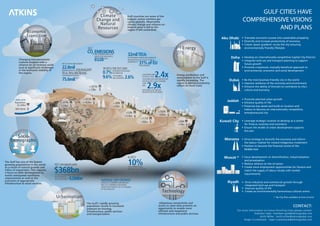
GULF CITIES HAVE
COMPREHENSIVE VISIONS
AND PLANS
* No City Plan available at time of print
For more information on Future Proofing Cities please contact:
Kathleen Gale : kathleen.gale@atkinsglobal.com
Keith Miller : keith.miller@atkinsglobal.com
Roger Cruickshank : roger.cruickshank@atkinsglobal.com
+10bn
+2615k
$
Translate economic success into sustainable prosperity
Diversify and increase productivity of economy
Create ‘green gradient’ across the city ensuring
environmentally friendly lifestyles
Abu Dhabi
Focus development on diversification, industrialisation
and privatisation
Reduce reliance on the oil sector
Create more employment opportunities for Omanis and
match the supply of labour locally with market
requirements.
Muscat *
Develop an internationally competitive Capital City Precinct
Integrate land use and transport planning to support
future growth
Promote a balanced, mutually beneficial approach to
environmental, economic and social development.
Doha
Be the most business friendly city in the world
Improve resilience of the economy and environment
Enhance the ability of Emiratis to contribute to city’s
culture and economy
Dubai
Promote planned urban growth
Enhance quality of life
Preserves key assets and build on location and
history to become an internationally competitive,
entrepreneurial city
Jeddah
Leverage strategic location to develop as a centre
for finance, business and commerce
Ensure the model of urban development supports
this aim
Kuwait City
Drive strategy to diversify the economy and reform
the labour market for inward indigenous investment
Position to become the financial centre of the
Middle East
Manama
Drive industrial and commercial growth through
integrated land use and transport
Improve quality of life
Create an environmentally harmonious cultural centre.
Riyadh
•
•
•
•
•
•
•
•
•
•
•
•
•
•
•
•
•
•
•
•
•
•
Centralised City Planning
Strategic planning & governance
Portfolio management
Stakeholder management
Reduces infrastructure programme
spend and timelines ($2bn / 24 months
on confidential Atkins project)
Combined Heat and Power Plants and
District Thermal Energy Schemes
Planning support, feasibility studies &
energy strategies
Design specifications
Tendering and award of ESCo contracts
Provides a more flexible energy strategy
resilient to climate change and demand
Knowledge Transfer and Upskilling
Development and delivery of
training programmes
Embedment of process
Implementation support
Achievement of professional body
accreditations across multiple
organisational departments
Sustainable BIM Methodology
R&D to Integrate BIM with Sustainability
in line with LEED V4 (BD+C) guidelines.
Improves decision making through
Real-Time Life-Cycle Assessment
Reduces Global Warming Potential
(GWP) by up to 40%
Distributed Energy Generation
Solar PV feasibility studies
Legal and financial advice on funding
Monitoring to inform business case creation
Delivers on carbon reduction targets
Improves supply resilience
Urban Regeneration
Regeneration of brownfield sites to create
new globally competitive city centres
Increases citizen quality of life & social
cohesion
Stimulates investment in infrastructure
Integrated Mass Transport Network
Dubai Metro – average daily ridership circa
450,000, public transport use increased from
6% to 14% from 2006 – 2014
BIM Lifecycle Management
Optimisation of asset
management decision-making
Reduces asset OPEX by up to 50%
Increases asset value & performance
FUTURE PROOFING CITIES
HELPING
GULF CITIES
FULFIL THEIR
AMBITIONS
Researching and identifying drivers
for change
Understanding global and regional
position and dependencies
Analysing drivers for change
Assessing plans for development
Identifying opportunities and risks
Identifying solutions
Understanding capacity to act
Appraising and shortlisting
opportunities
Prioritising solutions that maximise benefits
Assembling portfolio of solutions that address
multiple opportunities and risks
THE ATKINS FUTURE PROOFING APPROACH
CHANGING CONDITIONS CITY DIAGNOSTIC POTENTIAL SOLUTIONS PORTFOLIO OF SOLUTIONS

Gulf_static_infographic

  • 1.
    OFALLINTERNATIONAL MIGRANTSLIVEDINTHEGCC 10% In2013 THEGLOBALLEVELANDGREATERTHAN THEOECDLEVEL(1.02X).OUTWARD FLOW WAS THEGLOBALLEVELANDJUST BELOWTHEOECDRATE(0.86X). 2014FDIPERCAPITA TOTHEGCC WAS 2.4x 2.9x IN2013,THEGCCHAD THEWORLD’SPOPULATION BUTPRODUCED OFITSENERGY, ANDCONSUMED. 0.7% 9.6%2.6% GCCNETEXPORTSWERE$368BILLION IN2014.NON-OIL NETEXPORTSWERE $368bn GCCnetexportswere -$288bn EU28 CO2 EMISSIONS GCC PERCAPITAAREOVER4xTHE WORLDLEVELANDOVER3x LEVEL THEGCCPOPULATIONGREWBY BETWEEN2000-2015,EQUIVALENT TOA76%INCREASE. IN2050 ITISESTIMATEDTOREACH 22.8mil 75.6mil 32milTEUs 31%ofEUTOTALVOLUMES OFPORTFREIGHTTRAFFICWASLOADEDOR UNLOADEDINTHEGCCIN2013 WHICHIS EQUIVALENTTO AVERAGEGDPGROWTH ACROSSGCCCOUNTRIESFROM2000-2015 WAS5.7%,COMPAREDTOANAVERAGE GROWTHRATEAMONGSTTHEG7ECONOMIES OF1.6%(OVER3.5X) Urbanisation Technology Economic Transition Climate Change and Natural Resources Changing macroeconomic outlook coupled with a reliance on oil revenue could lead to significant challenges in the economic stability of the region. The Gulf has one of the fastest growing populations in the world as a result of natural growth and influx of expatriates. This requires a focus on skills development to match anticipated workforce requirements as well as the provision of appropriate infrastructure & social services. The Gulf’s rapidly growing population results in increased pressure on housing, infrastructure, public services and transportation. Gulf countries are some of the highest carbon emitters per capita globally. Meanwhile climate change and reliance on imports pose a risk to the region if left unchecked. Ubiquitous connectivity and access to open data presents an opportunity to enable more efficient and responsive infrastructure and public services. Socio- Demographic Energy production and consumption in the Gulf is rapidly increasing. The region is almost completely reliant on fossil fuels. Energy Population (in 000s) 2000-2030 GDP ($US) +539k +123bn +408k +12bn +4373k +167bn+2479k +73bn $ $ $ $ $ +1,103 +56bn $ +2564k +62bn $ +560k +10bn $ CONTACT: GULF CITIES HAVE COMPREHENSIVE VISIONS AND PLANS * No City Plan available at time of print For more information on Future Proofing Cities please contact: Kathleen Gale : kathleen.gale@atkinsglobal.com Keith Miller : keith.miller@atkinsglobal.com Roger Cruickshank : roger.cruickshank@atkinsglobal.com +10bn +2615k $ Translate economic success into sustainable prosperity Diversify and increase productivity of economy Create ‘green gradient’ across the city ensuring environmentally friendly lifestyles Abu Dhabi Focus development on diversification, industrialisation and privatisation Reduce reliance on the oil sector Create more employment opportunities for Omanis and match the supply of labour locally with market requirements. Muscat * Develop an internationally competitive Capital City Precinct Integrate land use and transport planning to support future growth Promote a balanced, mutually beneficial approach to environmental, economic and social development. Doha Be the most business friendly city in the world Improve resilience of the economy and environment Enhance the ability of Emiratis to contribute to city’s culture and economy Dubai Promote planned urban growth Enhance quality of life Preserves key assets and build on location and history to become an internationally competitive, entrepreneurial city Jeddah Leverage strategic location to develop as a centre for finance, business and commerce Ensure the model of urban development supports this aim Kuwait City Drive strategy to diversify the economy and reform the labour market for inward indigenous investment Position to become the financial centre of the Middle East Manama Drive industrial and commercial growth through integrated land use and transport Improve quality of life Create an environmentally harmonious cultural centre. Riyadh • • • • • • • • • • • • • • • • • • • • • •
  • 2.
    Centralised City Planning Strategicplanning & governance Portfolio management Stakeholder management Reduces infrastructure programme spend and timelines ($2bn / 24 months on confidential Atkins project) Combined Heat and Power Plants and District Thermal Energy Schemes Planning support, feasibility studies & energy strategies Design specifications Tendering and award of ESCo contracts Provides a more flexible energy strategy resilient to climate change and demand Knowledge Transfer and Upskilling Development and delivery of training programmes Embedment of process Implementation support Achievement of professional body accreditations across multiple organisational departments Sustainable BIM Methodology R&D to Integrate BIM with Sustainability in line with LEED V4 (BD+C) guidelines. Improves decision making through Real-Time Life-Cycle Assessment Reduces Global Warming Potential (GWP) by up to 40% Distributed Energy Generation Solar PV feasibility studies Legal and financial advice on funding Monitoring to inform business case creation Delivers on carbon reduction targets Improves supply resilience Urban Regeneration Regeneration of brownfield sites to create new globally competitive city centres Increases citizen quality of life & social cohesion Stimulates investment in infrastructure Integrated Mass Transport Network Dubai Metro – average daily ridership circa 450,000, public transport use increased from 6% to 14% from 2006 – 2014 BIM Lifecycle Management Optimisation of asset management decision-making Reduces asset OPEX by up to 50% Increases asset value & performance FUTURE PROOFING CITIES HELPING GULF CITIES FULFIL THEIR AMBITIONS Researching and identifying drivers for change Understanding global and regional position and dependencies Analysing drivers for change Assessing plans for development Identifying opportunities and risks Identifying solutions Understanding capacity to act Appraising and shortlisting opportunities Prioritising solutions that maximise benefits Assembling portfolio of solutions that address multiple opportunities and risks THE ATKINS FUTURE PROOFING APPROACH CHANGING CONDITIONS CITY DIAGNOSTIC POTENTIAL SOLUTIONS PORTFOLIO OF SOLUTIONS