How to Develop Scalable IoT Apps
with React Native
How to Develop Scalable IoT Apps with React Native
IoT applications are reshaping industries with connected devices that share data and improve
decision-making. Businesses are moving quickly to develop apps that connect hardware and
deliver real-time experiences. However, building IoT solutions that remain fast and reliable when
user numbers grow is a real challenge.
This is where React Native App Development Services in USA stand out. React Native offers
cross-platform support, rich integrations, and a fast development cycle, making it ideal for IoT
projects. It reduces the time needed to reach both Android and iOS users, while providing
performance close to native applications.
In this blog, you will learn how to build scalable IoT apps using React Native. We will cover
everything from the basics of IoT applications to best practices, tools, and security
considerations.
What is an IoT App and How It Works
An IoT app connects physical devices to the internet so they can send and receive data. These
devices may include sensors, wearables, smart appliances, and industrial machines.
Key components of an IoT ecosystem:
● Sensors and devices – Gather data from the environment.
● Connectivity – Transfer data using Wi-Fi, Bluetooth, Zigbee, or cellular networks.
● Data processing – Analyze and process information for meaningful actions.
● User interface – Display data and allow user interactions.
When a device records data, it sends the information to a server or cloud platform. The IoT app
processes the data and presents it to the user in real time. For example, a fitness tracker sends
health stats to a smartphone app where the user can track progress.
Also read: How USA Businesses Launch Apps Faster with React Native
Why Choose React Native for IoT App Development
React Native is an open-source framework from Meta that enables developers to create mobile
applications using JavaScript. It compiles to native components, giving high performance while
reducing the need for separate Android and iOS codebases.
Advantages for IoT app development:
● Cross-platform capability – Build for both Android and iOS using a single codebase.
● Faster development cycle – Developers can reuse components and speed up delivery.
● Strong community support – Thousands of ready-to-use libraries and plugins are
available.
● Native module integration – Easy integration with hardware APIs for IoT devices.
● Live updates – Immediate fixes and updates without full app store redeployment.
These features allow businesses to bring IoT products to market faster without compromising
quality.
Key Challenges in Building Scalable IoT Apps
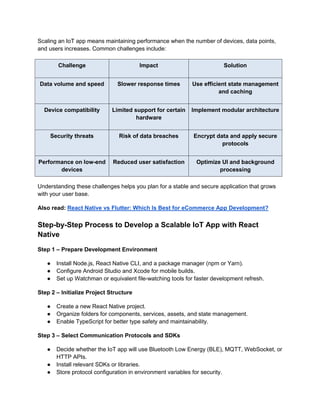
Scaling an IoT app means maintaining performance when the number of devices, data points,
and users increases. Common challenges include:
Challenge Impact Solution
Data volume and speed Slower response times Use efficient state management
and caching
Device compatibility Limited support for certain
hardware
Implement modular architecture
Security threats Risk of data breaches Encrypt data and apply secure
protocols
Performance on low-end
devices
Reduced user satisfaction Optimize UI and background
processing
Understanding these challenges helps you plan for a stable and secure application that grows
with your user base.
Also read: React Native vs Flutter: Which Is Best for eCommerce App Development?
Step-by-Step Process to Develop a Scalable IoT App with React
Native
Step 1 – Prepare Development Environment
● Install Node.js, React Native CLI, and a package manager (npm or Yarn).
● Configure Android Studio and Xcode for mobile builds.
● Set up Watchman or equivalent file-watching tools for faster development refresh.
Step 2 – Initialize Project Structure
● Create a new React Native project.
● Organize folders for components, services, assets, and state management.
● Enable TypeScript for better type safety and maintainability.
Step 3 – Select Communication Protocols and SDKs
● Decide whether the IoT app will use Bluetooth Low Energy (BLE), MQTT, WebSocket, or
HTTP APIs.
● Install relevant SDKs or libraries.
● Store protocol configuration in environment variables for security.
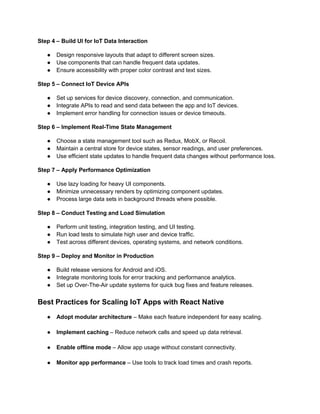
Step 4 – Build UI for IoT Data Interaction
● Design responsive layouts that adapt to different screen sizes.
● Use components that can handle frequent data updates.
● Ensure accessibility with proper color contrast and text sizes.
Step 5 – Connect IoT Device APIs
● Set up services for device discovery, connection, and communication.
● Integrate APIs to read and send data between the app and IoT devices.
● Implement error handling for connection issues or device timeouts.
Step 6 – Implement Real-Time State Management
● Choose a state management tool such as Redux, MobX, or Recoil.
● Maintain a central store for device states, sensor readings, and user preferences.
● Use efficient state updates to handle frequent data changes without performance loss.
Step 7 – Apply Performance Optimization
● Use lazy loading for heavy UI components.
● Minimize unnecessary renders by optimizing component updates.
● Process large data sets in background threads where possible.
Step 8 – Conduct Testing and Load Simulation
● Perform unit testing, integration testing, and UI testing.
● Run load tests to simulate high user and device traffic.
● Test across different devices, operating systems, and network conditions.
Step 9 – Deploy and Monitor in Production
● Build release versions for Android and iOS.
● Integrate monitoring tools for error tracking and performance analytics.
● Set up Over-The-Air update systems for quick bug fixes and feature releases.
Best Practices for Scaling IoT Apps with React Native
● Adopt modular architecture – Make each feature independent for easy scaling.
● Implement caching – Reduce network calls and speed up data retrieval.
● Enable offline mode – Allow app usage without constant connectivity.
● Monitor app performance – Use tools to track load times and crash reports.
● Plan for updates – Keep your codebase ready for future expansions.
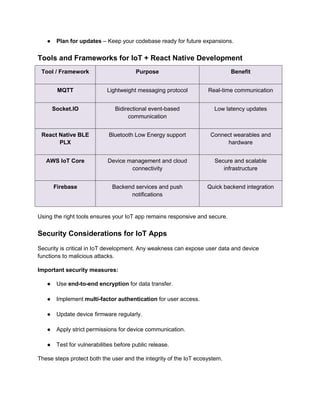
Tools and Frameworks for IoT + React Native Development
Tool / Framework Purpose Benefit
MQTT Lightweight messaging protocol Real-time communication
Socket.IO Bidirectional event-based
communication
Low latency updates
React Native BLE
PLX
Bluetooth Low Energy support Connect wearables and
hardware
AWS IoT Core Device management and cloud
connectivity
Secure and scalable
infrastructure
Firebase Backend services and push
notifications
Quick backend integration
Using the right tools ensures your IoT app remains responsive and secure.
Security Considerations for IoT Apps
Security is critical in IoT development. Any weakness can expose user data and device
functions to malicious attacks.
Important security measures:
● Use end-to-end encryption for data transfer.
● Implement multi-factor authentication for user access.
● Update device firmware regularly.
● Apply strict permissions for device communication.
● Test for vulnerabilities before public release.
These steps protect both the user and the integrity of the IoT ecosystem.
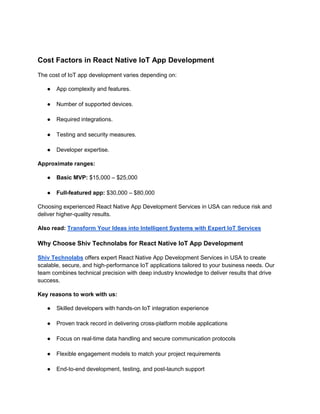
Cost Factors in React Native IoT App Development
The cost of IoT app development varies depending on:
● App complexity and features.
● Number of supported devices.
● Required integrations.
● Testing and security measures.
● Developer expertise.
Approximate ranges:
● Basic MVP: $15,000 – $25,000
● Full-featured app: $30,000 – $80,000
Choosing experienced React Native App Development Services in USA can reduce risk and
deliver higher-quality results.
Also read: Transform Your Ideas into Intelligent Systems with Expert IoT Services
Why Choose Shiv Technolabs for React Native IoT App Development
Shiv Technolabs offers expert React Native App Development Services in USA to create
scalable, secure, and high-performance IoT applications tailored to your business needs. Our
team combines technical precision with deep industry knowledge to deliver results that drive
success.
Key reasons to work with us:
● Skilled developers with hands-on IoT integration experience
● Proven track record in delivering cross-platform mobile applications
● Focus on real-time data handling and secure communication protocols
● Flexible engagement models to match your project requirements
● End-to-end development, testing, and post-launch support
Contact Us to discuss your IoT app requirements and provide tailored solutions that match your
vision.
Conclusion
Building scalable IoT applications with React Native demands structured planning, robust
architecture, and careful consideration of performance at scale. Effective state management,
secure data transmission, and modular design allow the application to adapt as the number of
connected devices and data streams increases. Selecting the right communication protocols,
applying performance monitoring, and conducting regular load testing are critical to sustaining
reliability. Continuous improvements, timely security updates, and efficient integration with IoT
hardware ensure the application remains stable, responsive, and ready for future growth.

Guide to Scalable IoT App Design with React Native

  • 1.
    How to DevelopScalable IoT Apps with React Native How to Develop Scalable IoT Apps with React Native IoT applications are reshaping industries with connected devices that share data and improve decision-making. Businesses are moving quickly to develop apps that connect hardware and deliver real-time experiences. However, building IoT solutions that remain fast and reliable when user numbers grow is a real challenge. This is where React Native App Development Services in USA stand out. React Native offers cross-platform support, rich integrations, and a fast development cycle, making it ideal for IoT projects. It reduces the time needed to reach both Android and iOS users, while providing performance close to native applications. In this blog, you will learn how to build scalable IoT apps using React Native. We will cover everything from the basics of IoT applications to best practices, tools, and security considerations.
  • 2.
    What is anIoT App and How It Works An IoT app connects physical devices to the internet so they can send and receive data. These devices may include sensors, wearables, smart appliances, and industrial machines. Key components of an IoT ecosystem: ● Sensors and devices – Gather data from the environment. ● Connectivity – Transfer data using Wi-Fi, Bluetooth, Zigbee, or cellular networks. ● Data processing – Analyze and process information for meaningful actions. ● User interface – Display data and allow user interactions. When a device records data, it sends the information to a server or cloud platform. The IoT app processes the data and presents it to the user in real time. For example, a fitness tracker sends health stats to a smartphone app where the user can track progress. Also read: How USA Businesses Launch Apps Faster with React Native Why Choose React Native for IoT App Development Why Choose React Native for IoT App Development
  • 3.
    React Native isan open-source framework from Meta that enables developers to create mobile applications using JavaScript. It compiles to native components, giving high performance while reducing the need for separate Android and iOS codebases. Advantages for IoT app development: ● Cross-platform capability – Build for both Android and iOS using a single codebase. ● Faster development cycle – Developers can reuse components and speed up delivery. ● Strong community support – Thousands of ready-to-use libraries and plugins are available. ● Native module integration – Easy integration with hardware APIs for IoT devices. ● Live updates – Immediate fixes and updates without full app store redeployment. These features allow businesses to bring IoT products to market faster without compromising quality. Key Challenges in Building Scalable IoT Apps Key Challenges in Building Scalable IoT Apps
  • 4.
    Scaling an IoTapp means maintaining performance when the number of devices, data points, and users increases. Common challenges include: Challenge Impact Solution Data volume and speed Slower response times Use efficient state management and caching Device compatibility Limited support for certain hardware Implement modular architecture Security threats Risk of data breaches Encrypt data and apply secure protocols Performance on low-end devices Reduced user satisfaction Optimize UI and background processing Understanding these challenges helps you plan for a stable and secure application that grows with your user base. Also read: React Native vs Flutter: Which Is Best for eCommerce App Development? Step-by-Step Process to Develop a Scalable IoT App with React Native Step 1 – Prepare Development Environment ● Install Node.js, React Native CLI, and a package manager (npm or Yarn). ● Configure Android Studio and Xcode for mobile builds. ● Set up Watchman or equivalent file-watching tools for faster development refresh. Step 2 – Initialize Project Structure ● Create a new React Native project. ● Organize folders for components, services, assets, and state management. ● Enable TypeScript for better type safety and maintainability. Step 3 – Select Communication Protocols and SDKs ● Decide whether the IoT app will use Bluetooth Low Energy (BLE), MQTT, WebSocket, or HTTP APIs. ● Install relevant SDKs or libraries. ● Store protocol configuration in environment variables for security.
  • 5.
    Step 4 –Build UI for IoT Data Interaction ● Design responsive layouts that adapt to different screen sizes. ● Use components that can handle frequent data updates. ● Ensure accessibility with proper color contrast and text sizes. Step 5 – Connect IoT Device APIs ● Set up services for device discovery, connection, and communication. ● Integrate APIs to read and send data between the app and IoT devices. ● Implement error handling for connection issues or device timeouts. Step 6 – Implement Real-Time State Management ● Choose a state management tool such as Redux, MobX, or Recoil. ● Maintain a central store for device states, sensor readings, and user preferences. ● Use efficient state updates to handle frequent data changes without performance loss. Step 7 – Apply Performance Optimization ● Use lazy loading for heavy UI components. ● Minimize unnecessary renders by optimizing component updates. ● Process large data sets in background threads where possible. Step 8 – Conduct Testing and Load Simulation ● Perform unit testing, integration testing, and UI testing. ● Run load tests to simulate high user and device traffic. ● Test across different devices, operating systems, and network conditions. Step 9 – Deploy and Monitor in Production ● Build release versions for Android and iOS. ● Integrate monitoring tools for error tracking and performance analytics. ● Set up Over-The-Air update systems for quick bug fixes and feature releases. Best Practices for Scaling IoT Apps with React Native ● Adopt modular architecture – Make each feature independent for easy scaling. ● Implement caching – Reduce network calls and speed up data retrieval. ● Enable offline mode – Allow app usage without constant connectivity. ● Monitor app performance – Use tools to track load times and crash reports.
  • 6.
    ● Plan forupdates – Keep your codebase ready for future expansions. Tools and Frameworks for IoT + React Native Development Tool / Framework Purpose Benefit MQTT Lightweight messaging protocol Real-time communication Socket.IO Bidirectional event-based communication Low latency updates React Native BLE PLX Bluetooth Low Energy support Connect wearables and hardware AWS IoT Core Device management and cloud connectivity Secure and scalable infrastructure Firebase Backend services and push notifications Quick backend integration Using the right tools ensures your IoT app remains responsive and secure. Security Considerations for IoT Apps Security is critical in IoT development. Any weakness can expose user data and device functions to malicious attacks. Important security measures: ● Use end-to-end encryption for data transfer. ● Implement multi-factor authentication for user access. ● Update device firmware regularly. ● Apply strict permissions for device communication. ● Test for vulnerabilities before public release. These steps protect both the user and the integrity of the IoT ecosystem.
  • 7.
    Cost Factors inReact Native IoT App Development The cost of IoT app development varies depending on: ● App complexity and features. ● Number of supported devices. ● Required integrations. ● Testing and security measures. ● Developer expertise. Approximate ranges: ● Basic MVP: $15,000 – $25,000 ● Full-featured app: $30,000 – $80,000 Choosing experienced React Native App Development Services in USA can reduce risk and deliver higher-quality results. Also read: Transform Your Ideas into Intelligent Systems with Expert IoT Services Why Choose Shiv Technolabs for React Native IoT App Development Shiv Technolabs offers expert React Native App Development Services in USA to create scalable, secure, and high-performance IoT applications tailored to your business needs. Our team combines technical precision with deep industry knowledge to deliver results that drive success. Key reasons to work with us: ● Skilled developers with hands-on IoT integration experience ● Proven track record in delivering cross-platform mobile applications ● Focus on real-time data handling and secure communication protocols ● Flexible engagement models to match your project requirements ● End-to-end development, testing, and post-launch support
  • 8.
    Contact Us todiscuss your IoT app requirements and provide tailored solutions that match your vision. Conclusion Building scalable IoT applications with React Native demands structured planning, robust architecture, and careful consideration of performance at scale. Effective state management, secure data transmission, and modular design allow the application to adapt as the number of connected devices and data streams increases. Selecting the right communication protocols, applying performance monitoring, and conducting regular load testing are critical to sustaining reliability. Continuous improvements, timely security updates, and efficient integration with IoT hardware ensure the application remains stable, responsive, and ready for future growth.