HOST COUNTRY
The Host Country
Brazil
111
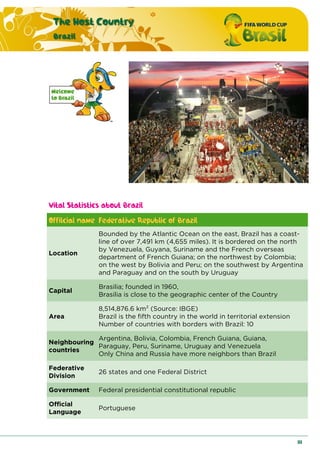
Vital Statistics about Brazil
Offilcial name Federative Republic of Brazil
Location
Bounded by the Atlantic Ocean on the east, Brazil has a coast-
line of over 7,491 km (4,655 miles). It is bordered on the north
by Venezuela, Guyana, Suriname and the French overseas
department of French Guiana; on the northwest by Colombia;
on the west by Bolivia and Peru; on the southwest by Argentina
and Paraguay and on the south by Uruguay
Capital
Brasilia; founded in 1960,
Brasilia is close to the geographic center of the Country
Area
8,514,876.6 km2 (Source: IBGE)
Brazil is the fifth country in the world in territorial extension
Number of countries with borders with Brazil: 10
Neighbouring
countries
Argentina, Bolivia, Colombia, French Guiana, Guiana,
Paraguay, Peru, Suriname, Uruguay and Venezuela
Only China and Russia have more neighbors than Brazil
Federative
Division
26 states and one Federal District
Government Federal presidential constitutional republic
Official
Language
Portuguese
The Host Country
Brazil
112 2014 FIFA WORLD CUP BRAZIL™ – MEDIA GUIDE
Population
201,032,714 (Source: IBGE - 2013);
Brazil is the fifth most populated country in the world
Most popu-
lated city
São Paulo
(10.886.518)
Age
distribution
<14 y.o., 26.6%; 15-59 y.o., 64.5%; >60 y.o., 10%
(Source: IBGE - 2010 - estimation)
Life
expectancy
75 years (total population); 71 years (men) and 78.3 years
(women) (Source: IBGE - 2013 - estimation)
Ethnical
groups
Caucasian, 47.7%; brown: 43.1%; black, 7.6%;
yellow and indigenous, 1.6% (Source: IBGE - 2010); Brazil has
the largest African-descendent population outside Africa
Religions
Catholic: 64.6%; Evangelist: 22.2%; Spiritualist: 2%;
Atheist: 8%; others: 3.2% (Source: IBGE – Censo 2010)
Time Zone Brazil Summer Time (BRST) – UTC -3 to UTC -5
Voltage 127 Volt / 60Hz and 220 Volt / 60Hz
Calling-code +55
Top-Level-
Domain
.br
Economic highlights
GDP
per capita
US$ 11,800
(Source: Central Bank of Brazil and IBGE - 2013)
Econ. active
population
101.1 Million
(Source: IBGE - PNAD - 2009)
Currency Real (symbol: R$)
World Eco-
nomy ranking
7th
(Source: Central Bank of Brazil)
Inflation 5.85% (Consumer price index – IPCA. Source: IBGE)
Exports
US$ 242.1 billion (Source – Ministry of Development, Industry and
External Commerce) – Brazil is the world’s main exporter
of ethanol, coffee, orange juice, tabacco, chicken and sugar
Imports
US$ 239.6 billion (Source – Ministry of Development, Industry
and External Commerce)
Commercial
Surplus
US$ 2.56 billion (Source – Ministry of Development, Industry and
External Commerce)
Hotlines
Fire 193
Police 190
Medical Emergency 192
The Host Country
Brazil
113
Photo: Divulgação Secom/Prefeitura de São Paulo
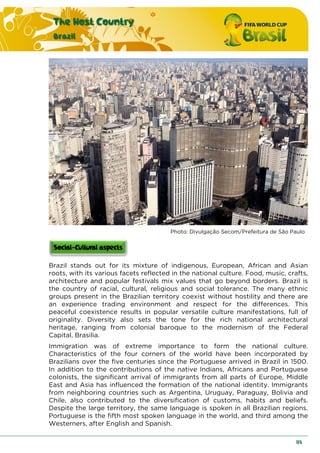
Brazil stands out for its mixture of indigenous, European, African and Asian
roots, with its various facets reflected in the national culture. Food, music, crafts,
architecture and popular festivals mix values that go beyond borders. Brazil is
the country of racial, cultural, religious and social tolerance. The many ethnic
groups present in the Brazilian territory coexist without hostility and there are
an experience trading environment and respect for the differences. This
peaceful coexistence results in popular versatile culture manifestations, full of
originality. Diversity also sets the tone for the rich national architectural
heritage, ranging from colonial baroque to the modernism of the Federal
Capital, Brasilia.
Immigration was of extreme importance to form the national culture.
Characteristics of the four corners of the world have been incorporated by
Brazilians over the five centuries since the Portuguese arrived in Brazil in 1500.
In addition to the contributions of the native Indians, Africans and Portuguese
colonists, the significant arrival of immigrants from all parts of Europe, Middle
East and Asia has influenced the formation of the national identity. Immigrants
from neighboring countries such as Argentina, Uruguay, Paraguay, Bolivia and
Chile, also contributed to the diversification of customs, habits and beliefs.
Despite the large territory, the same language is spoken in all Brazilian regions.
Portuguese is the fifth most spoken language in the world, and third among the
Westerners, after English and Spanish.
The Host Country
Brazil
114 2014 FIFA WORLD CUP BRAZIL™ – MEDIA GUIDE
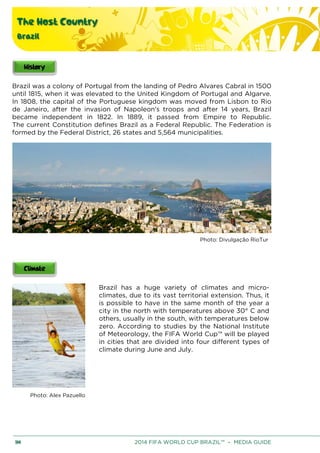
Brazil was a colony of Portugal from the landing of Pedro Alvares Cabral in 1500
until 1815, when it was elevated to the United Kingdom of Portugal and Algarve.
In 1808, the capital of the Portuguese kingdom was moved from Lisbon to Rio
de Janeiro, after the invasion of Napoleon's troops and after 14 years, Brazil
became independent in 1822. In 1889, it passed from Empire to Republic.
The current Constitution defines Brazil as a Federal Republic. The Federation is
formed by the Federal District, 26 states and 5,564 municipalities.
Photo: Divulgação RioTur
Brazil has a huge variety of climates and micro-
climates, due to its vast territorial extension. Thus, it
is possible to have in the same month of the year a
city in the north with temperatures above 30° C and
others, usually in the south, with temperatures below
zero. According to studies by the National Institute
of Meteorology, the FIFA World Cup™ will be played
in cities that are divided into four different types of
climate during June and July.
Photo: Alex Pazuello
The Host Country
Brazil
115
In the 1950s, Brazil was only beginning to leverage as a football world power.
Maracanã was built for the 1950 FIFA World Cup™, and for many years it was the
largest stadium in the world. At the championship final, about 200 000 people
watched Uruguay defeat Brazil (2-1), in what was called by the Uruguayans
“The Maracanazo” and considered the greatest tragedy in the history of
Brazilian soccer.
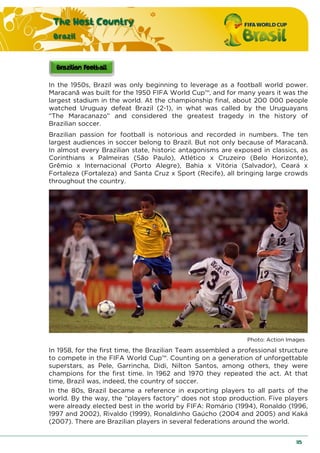
Brazilian passion for football is notorious and recorded in numbers. The ten
largest audiences in soccer belong to Brazil. But not only because of Maracanã.
In almost every Brazilian state, historic antagonisms are exposed in classics, as
Corinthians x Palmeiras (São Paulo), Atlético x Cruzeiro (Belo Horizonte),
Grêmio x Internacional (Porto Alegre), Bahia x Vitória (Salvador), Ceará x
Fortaleza (Fortaleza) and Santa Cruz x Sport (Recife), all bringing large crowds
throughout the country.
Photo: Action Images
In 1958, for the first time, the Brazilian Team assembled a professional structure
to compete in the FIFA World Cup™. Counting on a generation of unforgettable
superstars, as Pele, Garrincha, Didi, Nilton Santos, among others, they were
champions for the first time. In 1962 and 1970 they repeated the act. At that
time, Brazil was, indeed, the country of soccer.
In the 80s, Brazil became a reference in exporting players to all parts of the
world. By the way, the “players factory” does not stop production. Five players
were already elected best in the world by FIFA: Romário (1994), Ronaldo (1996,
1997 and 2002), Rivaldo (1999), Ronaldinho Gaúcho (2004 and 2005) and Kaká
(2007). There are Brazilian players in several federations around the world.
The Host Country
Brazil
116 2014 FIFA WORLD CUP BRAZIL™ – MEDIA GUIDE
In the beginning of the 90’s, a deep modernization was implemented in CBF
(Confederacao Brasileira de Futebol), making it self-sufficient and able to meet
the needs of the Brazilian Team in all categories. The result was a new cycle of
conquests, with three Cup finals and two FIFA World Cup™ titles (1994 and
2002).
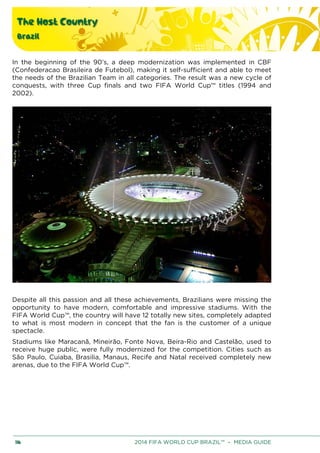
Despite all this passion and all these achievements, Brazilians were missing the
opportunity to have modern, comfortable and impressive stadiums. With the
FIFA World Cup™, the country will have 12 totally new sites, completely adapted
to what is most modern in concept that the fan is the customer of a unique
spectacle.
Stadiums like Maracanã, Mineirão, Fonte Nova, Beira-Rio and Castelão, used to
receive huge public, were fully modernized for the competition. Cities such as
São Paulo, Cuiaba, Brasilia, Manaus, Recife and Natal received completely new
arenas, due to the FIFA World Cup™.
The Host Country
Brazil
117
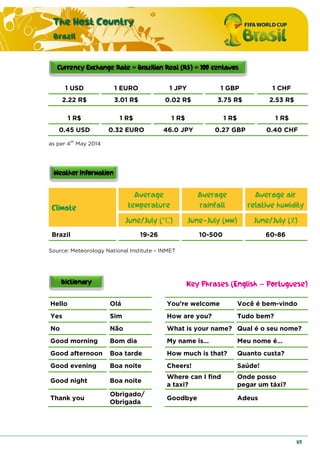
1 USD 1 EURO 1 JPY 1 GBP 1 CHF
2.22 R$ 3.01 R$ 0.02 R$ 3.75 R$ 2.53 R$
1 R$ 1 R$ 1 R$ 1 R$ 1 R$
0.45 USD 0.32 EURO 46.0 JPY 0.27 GBP 0.40 CHF
as per 4th
May 2014
Climate
Average
temperature
Average
rainfall
Average air
relative humidity
June/July ( ) June-July (mm) June/July (%)
Brazil 19-26 10-500 60-86
Source: Meteorology National Institute – INMET
Key Phrases (English – Portuguese)
Hello Olá You’re welcome Você é bem-vindo
Yes Sim How are you? Tudo bem?
No Não What is your name? Qual é o seu nome?
Good morning Bom dia My name is… Meu nome é…
Good afternoon Boa tarde How much is that? Quanto custa?
Good evening Boa noite Cheers! Saúde!
Good night Boa noite
Where can I find
a taxi?
Onde posso
pegar um táxi?
Thank you
Obrigado/
Obrigada
Goodbye Adeus
The Host Country
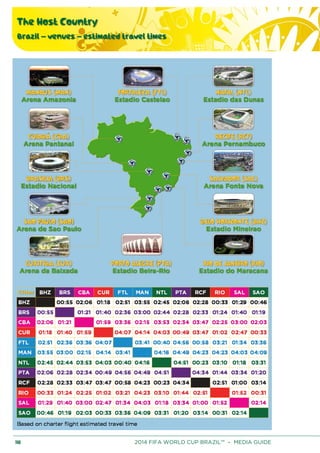
Brazil – venues – estimated travel times
118 2014 FIFA WORLD CUP BRAZIL™ – MEDIA GUIDE
HOST CITIES
Belo Horizonte
BHZ
Host Cities
Belo Horizonte
119
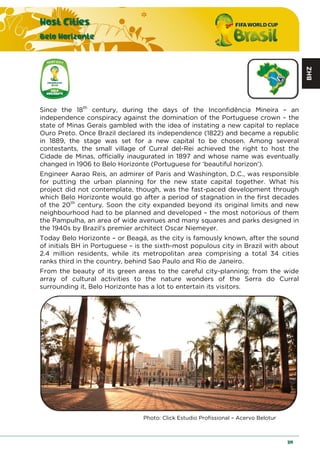
Since the 18th
century, during the days of the Inconfidência Mineira – an
independence conspiracy against the domination of the Portuguese crown – the
state of Minas Gerais gambled with the idea of instating a new capital to replace
Ouro Preto. Once Brazil declared its independence (1822) and became a republic
in 1889, the stage was set for a new capital to be chosen. Among several
contestants, the small village of Curral del-Rei achieved the right to host the
Cidade de Minas, officially inaugurated in 1897 and whose name was eventually
changed in 1906 to Belo Horizonte (Portuguese for ‘beautiful horizon').
Engineer Aarao Reis, an admirer of Paris and Washington, D.C., was responsible
for putting the urban planning for the new state capital together. What his
project did not contemplate, though, was the fast-paced development through
which Belo Horizonte would go after a period of stagnation in the first decades
of the 20th
century. Soon the city expanded beyond its original limits and new
neighbourhood had to be planned and developed – the most notorious of them
the Pampulha, an area of wide avenues and many squares and parks designed in
the 1940s by Brazil's premier architect Oscar Niemeyer.
Today Belo Horizonte – or Beagá, as the city is famously known, after the sound
of initials BH in Portuguese – is the sixth-most populous city in Brazil with about
2.4 million residents, while its metropolitan area comprising a total 34 cities
ranks third in the country, behind Sao Paulo and Rio de Janeiro.
From the beauty of its green areas to the careful city-planning; from the wide
array of cultural activities to the nature wonders of the Serra do Curral
surrounding it, Belo Horizonte has a lot to entertain its visitors.
Photo: Click Estudio Profissional – Acervo Belotur
Host Cities
Belo Horizonte
120 2014 FIFA WORLD CUP BRAZIL™ – MEDIA GUIDE
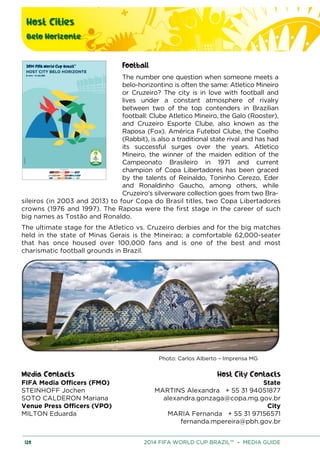
Football
The number one question when someone meets a
belo-horizontino is often the same: Atletico Mineiro
or Cruzeiro? The city is in love with football and
lives under a constant atmosphere of rivalry
between two of the top contenders in Brazilian
football: Clube Atletico Mineiro, the Galo (Rooster),
and Cruzeiro Esporte Clube, also known as the
Raposa (Fox). América Futebol Clube, the Coelho
(Rabbit), is also a traditional state rival and has had
its successful surges over the years. Atletico
Mineiro, the winner of the maiden edition of the
Campeonato Brasileiro in 1971 and current
champion of Copa Libertadores has been graced
by the talents of Reinaldo, Toninho Cerezo, Eder
and Ronaldinho Gaucho, among others, while
Cruzeiro's silverware collection goes from two Bra-
sileiros (in 2003 and 2013) to four Copa do Brasil titles, two Copa Libertadores
crowns (1976 and 1997). The Raposa were the first stage in the career of such
big names as Tostão and Ronaldo.
The ultimate stage for the Atletico vs. Cruzeiro derbies and for the big matches
held in the state of Minas Gerais is the Mineirao; a comfortable 62,000-seater
that has once housed over 100,000 fans and is one of the best and most
charismatic football grounds in Brazil.
Photo: Carlos Alberto – Imprensa MG
Media Contacts Host City Contacts
FIFA Media Officers (FMO) State
MARTINS Alexandra + 55 31 94051877
alexandra.gonzaga@copa.mg.gov.br
City
MARIA Fernanda + 55 31 97156571
fernanda.mpereira@pbh.gov.br
STEINHOFF Jochen
SOTO CALDERON Mariana
Venue Press Officers (VPO)
MILTON Eduarda
BHZ
Host Cities
Belo Horizonte
121
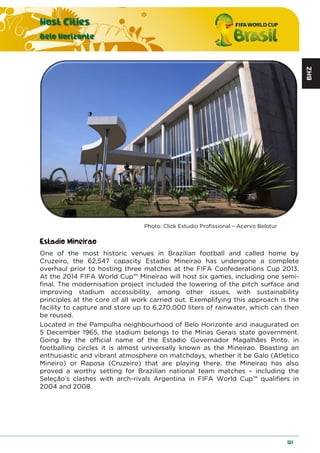
Photo: Click Estudio Profissional – Acervo Belotur
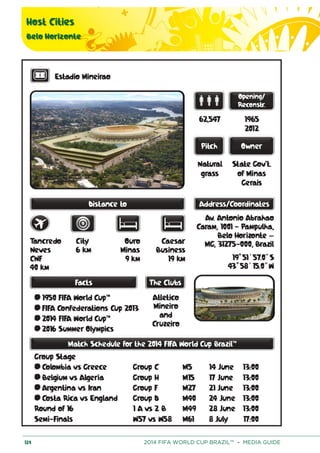
Estadio Mineirao
One of the most historic venues in Brazilian football and called home by
Cruzeiro, the 62,547 capacity Estadio Mineirao has undergone a complete
overhaul prior to hosting three matches at the FIFA Confederations Cup 2013.
At the 2014 FIFA World Cup™ Mineirao will host six games, including one semi-
final. The modernisation project included the lowering of the pitch surface and
improving stadium accessibility, among other issues, with sustainability
principles at the core of all work carried out. Exemplifying this approach is the
facility to capture and store up to 6,270,000 liters of rainwater, which can then
be reused.
Located in the Pampulha neighbourhood of Belo Horizonte and inaugurated on
5 December 1965, the stadium belongs to the Minas Gerais state government.
Going by the official name of the Estadio Governador Magalhães Pinto, in
footballing circles it is almost universally known as the Mineirao. Boasting an
enthusiastic and vibrant atmosphere on matchdays, whether it be Galo (Atletico
Mineiro) or Raposa (Cruzeiro) that are playing there, the Mineirao has also
proved a worthy setting for Brazilian national team matches – including the
Seleção’s clashes with arch-rivals Argentina in FIFA World Cup™ qualifiers in
2004 and 2008.
Host Cities
Belo Horizonte
122 2014 FIFA WORLD CUP BRAZIL™ – MEDIA GUIDE
BHZ
Host Cities
Belo Horizonte
123
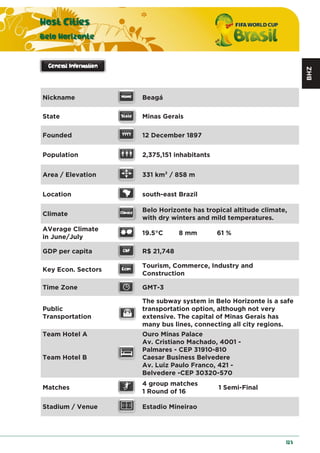
Nickname Beagá
State Minas Gerais
Founded 12 December 1897
Population 2,375,151 inhabitants
Area / Elevation 331 km2 / 858 m
Location south-east Brazil
Climate
Belo Horizonte has tropical altitude climate,
with dry winters and mild temperatures.
AVerage Climate
in June/July
19.5°C 8 mm 61 %
GDP per capita R$ 21,748
Key Econ. Sectors
Tourism, Commerce, Industry and
Construction
Time Zone GMT-3
Public
Transportation
The subway system in Belo Horizonte is a safe
transportation option, although not very
extensive. The capital of Minas Gerais has
many bus lines, connecting all city regions.
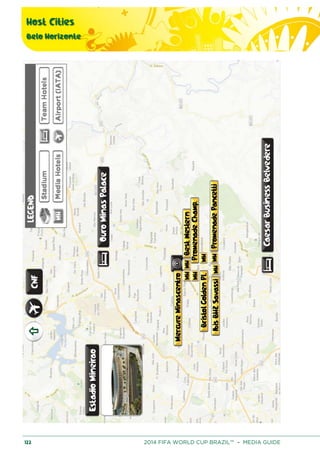
Team Hotel A
Team Hotel B
Ouro Minas Palace
Av. Cristiano Machado, 4001 -
Palmares - CEP 31910-810
Caesar Business Belvedere
Av. Luiz Paulo Franco, 421 -
Belvedere -CEP 30320-570
Matches
4 group matches
1 Round of 16
1 Semi-Final
Stadium / Venue Estadio Mineirao
Host Cities
Belo Horizonte
124 2014 FIFA WORLD CUP BRAZIL™ – MEDIA GUIDE
BHZ
Host Cities
Belo Horizonte
125
toStadium
from
Tancredo
NevesInt.
Confins
Pampulha
Estadio
Minerão
Caesar
Business
Ouro
Minas
Palace
Adagio
Minas-
centro
Bristol
Golden
Plaza
Best
Western
Sol
Ibis
Savassi
Promenad
Champ.
Promenad
Pancetti
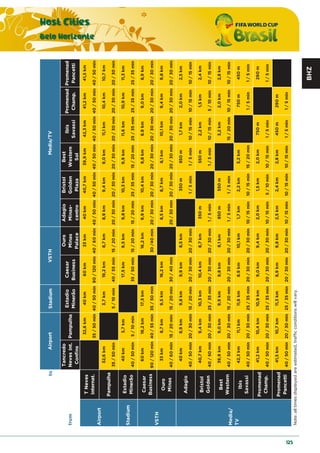
32,6km40km60km33km40km40,7km39,9km42,3km41,2km41,5km
35/50min40/50min90/120min40/60min40/50min40/50min40/50min40/50min40/50min40/50min
32,6km3,7km19,2km8,7km8,9km9,4km9,0km11,1km10,4km10,7km
35/50min5/10min40/55min15/20min20/30min20/30min20/30min20/30min20/30min20/30min
40km3,7km17,5km9,5km9,8km10,3km9,9km11,6km10,9km11,3km
40/50min5/10min35/50min15/20min15/20min25/35min15/20min25/35min25/35min25/35min
60km19,2km17,5km16,2km9,9km10,4km9,8km8.9km9,0km8,9km
90/120min40/55min35/50min30/40min20/30min20/30min20/30min20/30min20/30min20/30min
33km8,7km9,5km16,2km8,5km8,7km8,1km10,1km9,4km9,8km
40/60min15/20min15/20min30/40min20/30min20/30min20/30min20/30min20/30min20/30min
40km8,9km9,8km9,9km8,5km350m850m1,7km2,0km2,5km
40/50min20/30min15/20min20/30min20/30min1/5min1/5min10/15min10/15min10/15min
40,7km9,4km10,3km10,4km8,7km350m550m2,2km1,5km2,4km
40/50min20/30min25/35min20/30min20/30min1/5min1/5min10/15min5/10min10/15min
39,9km9,0km9,9km9,8km8,1km850m550m3,2km2,0km2,8km
40/50min20/30min15/20min20/30min20/30min1/5min1/5min15/20min10/15min10/15min
42,3km11,1km11,6km8.9km10,1km1,7km2,2km3,2km750m450m
40/50min20/30min25/35min20/30min20/30min10/15min10/15min15/20min1/5min1/5min
41,2km10,4km10,9km9,0km9,4km2,0km1,5km2,0km750m290m
40/50min20/30min25/35min20/30min20/30min10/15min5/10min10/15min1/5min1/5min
41,5km10,7km11,3km8,9km9,8km2,5km2,4km2,8km450m290m
40/50min20/30min25/35min20/30min20/30min10/15min10/15min10/15min1/5min1/5min
Note:alltimesdisplayedareestimated,trafficconditionswillvary.
Airport
TNeves
Internat.
Pampulha
Promenad
Champ.
Promenad
Pancetti
Media/
TV
Media/TV
Adagio
Bristol
Golden
Best
Western
Ibis
Savassi
Stadium
Estadio
Minerão
VSTH
Caesar
Business
Ouro
Minas
AirportVSTH
Host Cities
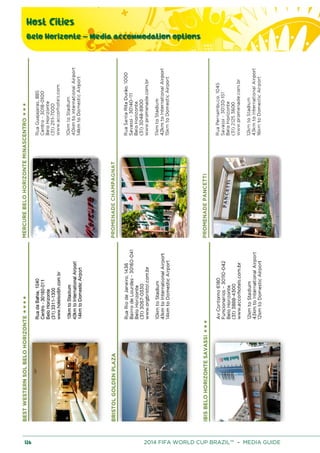
Belo Horizonte – Media accommodation options
126 2014 FIFA WORLD CUP BRAZIL™ – MEDIA GUIDE
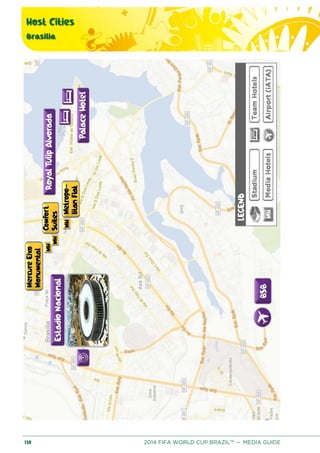
Brasilia
BRS
Host Cities
Brasilia
127
The city that will host seven games of the 2014 FIFA World Cup™ is the
accomplishment of the work of three of Brazil’s most important and memorable
men, who in the middle of the last century planned to transfer the capital of the
country from Rio de Janeiro to the centre lands of the territory: president
Juscelino Kubitschek and architects Lúcio Costa and Oscar Niemeyer.
Built from sketches, Brasilia is a tribute to modern architecture and its buildings,
churches and palaces are part of UNESCO World Cultural Heritage registry. But
the city’s importance goes far beyond the cultural aspects. Since 1960, Brasilia is
the centre of power in Brazil, uniting the three spheres of government –
Executive, Legislative and Judiciary.
Brasilia was planned to be a nice place to work and live. Localized in the the
heart of the country, it is a green city, embraced by the natural diversity of the
Cerrado. With 120 m2 of green area per inhabitant – almost four times what is
recommend by World Health Organization (WHO) - Brasilia has 50 million m2 of
grass covered lands, 4 million planted trees and one thousand rock-gardens
sharing space with planned apartment buildings, divided in the so called
superblocks. The large avenues and roads were built for fast displacement.
Still, the federal capital is also Brazil’s third gastronomic centre, with more than
3,5 thousand restaurants, bars and coffees serving dishes and drinks from the
traditional Brazilian cuisine.
One of the city's striking features is its wide avenues, which surround both its
public buildings and its two districts, one to the north and the other to the
south. These are divided into so-called superblocks, each of which contains
numerous buildings. The central part of this “cross” is the Praça dos Três
Poderes (Three Powers' Square). Here can be found the country's seats of
Executive and Legislative Power as well as the headquarters of the Supreme
Federal Court.
Photo: Pedro Ventura
Host Cities
Brasilia
128 2014 FIFA WORLD CUP BRAZIL™ – MEDIA GUIDE
Football
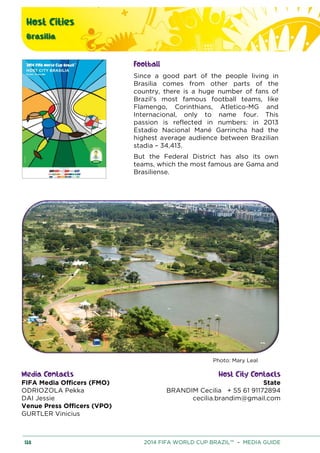
Since a good part of the people living in
Brasilia comes from other parts of the
country, there is a huge number of fans of
Brazil’s most famous football teams, like
Flamengo, Corinthians, Atletico-MG and
Internacional, only to name four. This
passion is reflected in numbers: in 2013
Estadio Nacional Mané Garrincha had the
highest average audience between Brazilian
stadia – 34,413.
But the Federal District has also its own
teams, which the most famous are Gama and
Brasiliense.
Photo: Mary Leal
Media Contacts Host City Contacts
FIFA Media Officers (FMO) State
BRANDIM Cecilia + 55 61 91172894
cecilia.brandim@gmail.com
ODRIOZOLA Pekka
DAI Jessie
Venue Press Officers (VPO)
GURTLER Vinicius
BRS
Host Cities
Brasilia
129
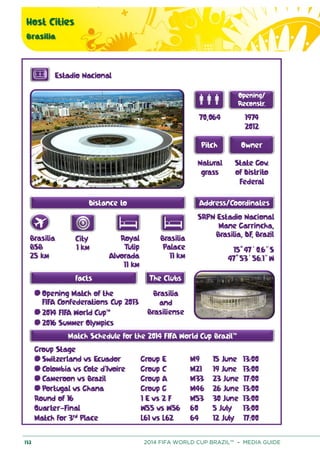
Estadio Nacional
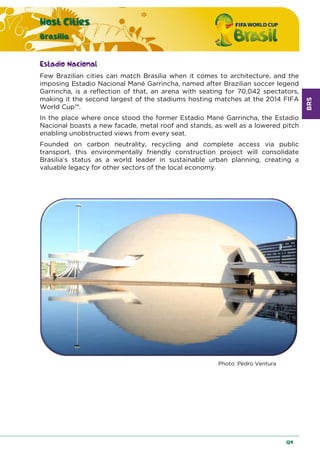
Few Brazilian cities can match Brasilia when it comes to architecture, and the
imposing Estadio Nacional Mané Garrincha, named after Brazilian soccer legend
Garrincha, is a reflection of that, an arena with seating for 70,042 spectators,
making it the second largest of the stadiums hosting matches at the 2014 FIFA
World Cup™.
In the place where once stood the former Estadio Mané Garrincha, the Estadio
Nacional boasts a new facade, metal roof and stands, as well as a lowered pitch
enabling unobstructed views from every seat.
Founded on carbon neutrality, recycling and complete access via public
transport, this environmentally friendly construction project will consolidate
Brasilia’s status as a world leader in sustainable urban planning, creating a
valuable legacy for other sectors of the local economy.
Photo: Pedro Ventura
Host Cities
Brasilia
130 2014 FIFA WORLD CUP BRAZIL™ – MEDIA GUIDE
BRS
Host Cities
Brasilia
131
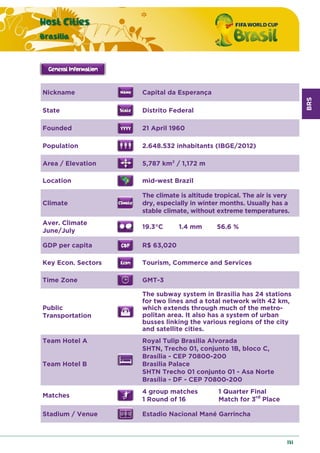
Nickname Capital da Esperança
State Distrito Federal
Founded 21 April 1960
Population 2.648.532 inhabitants (IBGE/2012)
Area / Elevation 5,787 km2 / 1,172 m
Location mid-west Brazil
Climate
The climate is altitude tropical. The air is very
dry, especially in winter months. Usually has a
stable climate, without extreme temperatures.
Aver. Climate
June/July
19.3°C 1.4 mm 56.6 %
GDP per capita R$ 63,020
Key Econ. Sectors Tourism, Commerce and Services
Time Zone GMT-3
Public
Transportation
The subway system in Brasilia has 24 stations
for two lines and a total network with 42 km,
which extends through much of the metro-
politan area. It also has a system of urban
busses linking the various regions of the city
and satellite cities.
Team Hotel A
Team Hotel B
Royal Tulip Brasilia Alvorada
SHTN, Trecho 01, conjunto 1B, bloco C,
Brasília - CEP 70800-200
Brasilia Palace
SHTN Trecho 01 conjunto 01 - Asa Norte
Brasília - DF - CEP 70800-200
Matches
4 group matches
1 Round of 16
1 Quarter Final
Match for 3rd
Place
Stadium / Venue Estadio Nacional Mané Garrincha
Host Cities
Brasilia
132 2014 FIFA WORLD CUP BRAZIL™ – MEDIA GUIDE
BRS
Host Cities
Brasilia
133
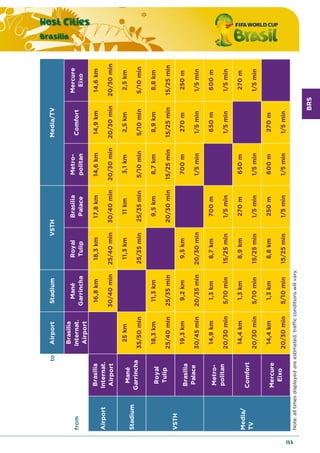
toAirportStadium
from
Brasilia
Internat.
Airport
Mané
Garrincha
Royal
Tulip
Brasilia
Palace
Metro-
politan
Comfort
Mercure
Eixo
16,8km18,3km17,8km14,6km14,9km14,6km
30/40min25/40min30/40min20/30min20/30min20/30min
25km11,3km11km3,1km2,5km2,5km
35/50min25/35min25/35min5/10min5/10min5/10min
18,3km11,3km9,5km8,7km8,9km8,8km
25/40min25/35min20/30min15/25min15/25min15/25min
19,3km9,2km9,5km700m270m250m
30/45min20/35min20/30min1/5min1/5min1/5min
14,9km1,3km8,7km700m650m600m
20/30min5/10min15/25min1/5min1/5min1/5min
14,4km1,3km8,9km270m650m270m
20/30min5/10min15/25min1/5min1/5min1/5min
14,4km1,3km8,8km250m600m270m
20/30min5/10min15/25min1/5min1/5min1/5min
Note:alltimesdisplayedareestimated,trafficconditionswillvary.
Mercure
Eixo
Media/TV
Media/
TV
VSTH
Royal
Tulip
Brasilia
Palace
Metro-
politan
Comfort
VSTH
Airport
Brasilia
Internat.
Airport
Stadium
Mané
Garrincha
Host Cities
Brasilia – Media accommodation options
134 2014 FIFA WORLD CUP BRAZIL™ – MEDIA GUIDE
Cuiaba
CBA
Host Cities
Cuiaba
135
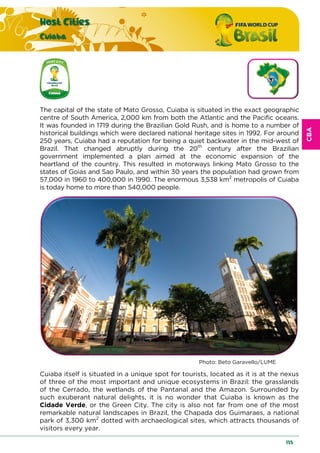
The capital of the state of Mato Grosso, Cuiaba is situated in the exact geographic
centre of South America, 2,000 km from both the Atlantic and the Pacific oceans.
It was founded in 1719 during the Brazilian Gold Rush, and is home to a number of
historical buildings which were declared national heritage sites in 1992. For around
250 years, Cuiaba had a reputation for being a quiet backwater in the mid-west of
Brazil. That changed abruptly during the 20th
century after the Brazilian
government implemented a plan aimed at the economic expansion of the
heartland of the country. This resulted in motorways linking Mato Grosso to the
states of Goias and Sao Paulo, and within 30 years the population had grown from
57,000 in 1960 to 400,000 in 1990. The enormous 3,538 km2
metropolis of Cuiaba
is today home to more than 540,000 people.
Photo: Beto Garavello/LUME
Cuiaba itself is situated in a unique spot for tourists, located as it is at the nexus
of three of the most important and unique ecosystems in Brazil: the grasslands
of the Cerrado, the wetlands of the Pantanal and the Amazon. Surrounded by
such exuberant natural delights, it is no wonder that Cuiaba is known as the
Cidade Verde, or the Green City. The city is also not far from one of the most
remarkable natural landscapes in Brazil, the Chapada dos Guimaraes, a national
park of 3,300 km2
dotted with archaeological sites, which attracts thousands of
visitors every year.
Host Cities
Cuiaba
136 2014 FIFA WORLD CUP BRAZIL™ – MEDIA GUIDE
Football
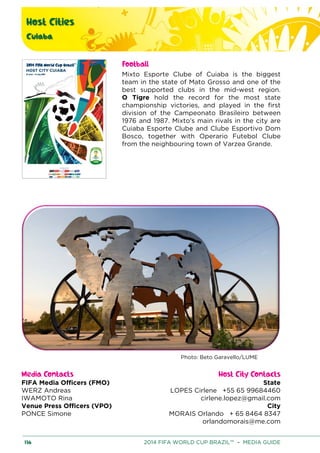
Mixto Esporte Clube of Cuiaba is the biggest
team in the state of Mato Grosso and one of the
best supported clubs in the mid-west region.
O Tigre hold the record for the most state
championship victories, and played in the first
division of the Campeonato Brasileiro between
1976 and 1987. Mixto’s main rivals in the city are
Cuiaba Esporte Clube and Clube Esportivo Dom
Bosco, together with Operario Futebol Clube
from the neighbouring town of Varzea Grande.
Photo: Beto Garavello/LUME
Media Contacts Host City Contacts
FIFA Media Officers (FMO) State
LOPES Cirlene +55 65 99684460
cirlene.lopez@gmail.com
City
MORAIS Orlando + 65 8464 8347
orlandomorais@me.com
WERZ Andreas
IWAMOTO Rina
Venue Press Officers (VPO)
PONCE Simone
CBA
Host Cities
Cuiaba
137
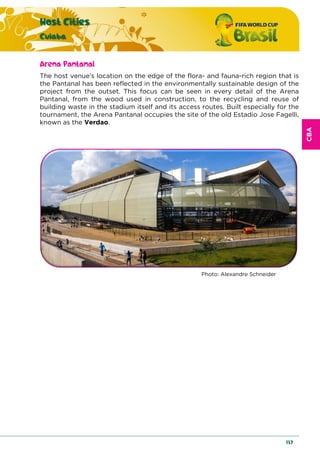
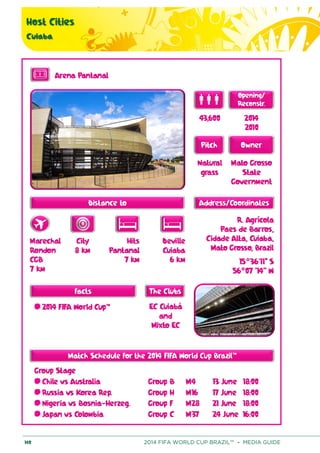
Arena Pantanal
The host venue’s location on the edge of the flora- and fauna-rich region that is
the Pantanal has been reflected in the environmentally sustainable design of the
project from the outset. This focus can be seen in every detail of the Arena
Pantanal, from the wood used in construction, to the recycling and reuse of
building waste in the stadium itself and its access routes. Built especially for the
tournament, the Arena Pantanal occupies the site of the old Estadio Jose Fagelli,
known as the Verdao.
Photo: Alexandre Schneider
Host Cities
Cuiaba
138 2014 FIFA WORLD CUP BRAZIL™ – MEDIA GUIDE
CBA
Host Cities
Cuiaba
139
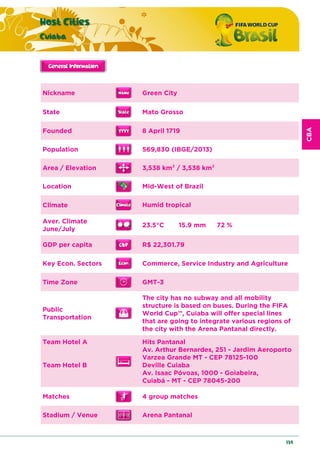
Nickname Green City
State Mato Grosso
Founded 8 April 1719
Population 569,830 (IBGE/2013)
Area / Elevation 3,538 km2 / 3,538 km2
Location Mid-West of Brazil
Climate Humid tropical
Aver. Climate
June/July
23.5°C 15.9 mm 72 %
GDP per capita R$ 22,301.79
Key Econ. Sectors Commerce, Service Industry and Agriculture
Time Zone GMT-3
Public
Transportation
The city has no subway and all mobility
structure is based on buses. During the FIFA
World Cup™, Cuiaba will offer special lines
that are going to integrate various regions of
the city with the Arena Pantanal directly.
Team Hotel A
Team Hotel B
Hits Pantanal
Av. Arthur Bernardes, 251 - Jardim Aeroporto
Varzea Grande MT - CEP 78125-100
Deville Cuiaba
Av. Isaac Póvoas, 1000 - Goiabeira,
Cuiabá - MT - CEP 78045-200
Matches 4 group matches
Stadium / Venue Arena Pantanal
Host Cities
Cuiaba
140 2014 FIFA WORLD CUP BRAZIL™ – MEDIA GUIDE
CBA
Host Cities
Cuiaba
141
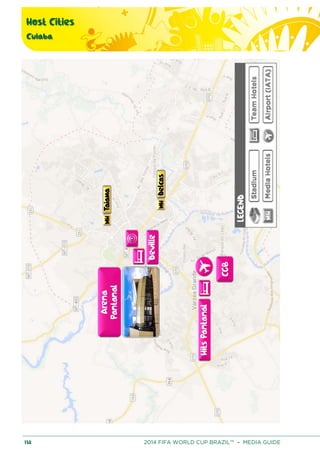
toAirportStadium
from
Cuiaba
Internat.
Airport
Arena
Pantanal
Hotel
Hits
Deville
Cuiaba
Hotel
Taiama
Hotel
Delcas
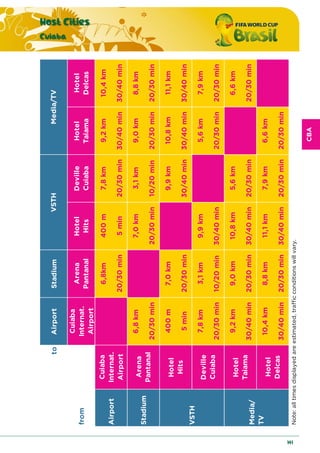
6,8km400m7,8km9,2km10,4km
20/30min5min20/30min30/40min30/40min
6,8km7,0km3,1km9,0km8,8km
20/30min20/30min10/20min20/30min20/30min
400m7,0km9,9km10,8km11,1km
5min20/30min30/40min30/40min30/40min
7,8km3,1km9,9km5,6km7,9km
20/30min10/20min30/40min20/30min20/30min
9,2km9,0km10,8km5,6km6,6km
30/40min20/30min30/40min20/30min20/30min
10,4km8,8km11,1km7,9km6,6km
30/40min20/30min30/40min20/30min20/30min
Note:alltimesdisplayedareestimated,trafficconditionswillvary.
Media/
TV
Hotel
Taiama
Hotel
Delcas
VSTHMedia/TV
Airport
Cuiaba
Internat.
Airport
Stadium
Arena
Pantanal
VSTH
Hotel
Hits
Deville
Cuiaba
Host Cities
Cuiaba – Media accommodation options
142 2014 FIFA WORLD CUP BRAZIL™ – MEDIA GUIDE
Curitiba
CUR
Host Cities
Curitiba
143
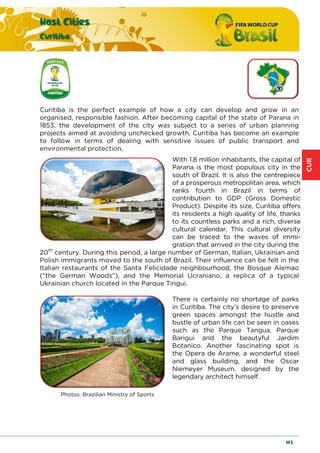
Curitiba is the perfect example of how a city can develop and grow in an
organised, responsible fashion. After becoming capital of the state of Parana in
1853, the development of the city was subject to a series of urban planning
projects aimed at avoiding unchecked growth. Curitiba has become an example
to follow in terms of dealing with sensitive issues of public transport and
environmental protection.
With 1.8 million inhabitants, the capital of
Parana is the most populous city in the
south of Brazil. It is also the centrepiece
of a prosperous metropolitan area, which
ranks fourth in Brazil in terms of
contribution to GDP (Gross Domestic
Product). Despite its size, Curitiba offers
its residents a high quality of life, thanks
to its countless parks and a rich, diverse
cultural calendar. This cultural diversity
can be traced to the waves of immi-
gration that arrived in the city during the
20th
century. During this period, a large number of German, Italian, Ukrainian and
Polish immigrants moved to the south of Brazil. Their influence can be felt in the
Italian restaurants of the Santa Felicidade neighbourhood, the Bosque Alemao
(“the German Woods”), and the Memorial Ucraniano, a replica of a typical
Ukrainian church located in the Parque Tingui.
There is certainly no shortage of parks
in Curitiba. The city’s desire to preserve
green spaces amongst the hustle and
bustle of urban life can be seen in oases
such as the Parque Tangua, Parque
Barigui and the beautyful Jardim
Botanico. Another fascinating spot is
the Opera de Arame, a wonderful steel
and glass building, and the Oscar
Niemeyer Museum, designed by the
legendary architect himself.
Photos: Brazilian Ministry of Sports
Host Cities
Curitiba
144 2014 FIFA WORLD CUP BRAZIL™ – MEDIA GUIDE
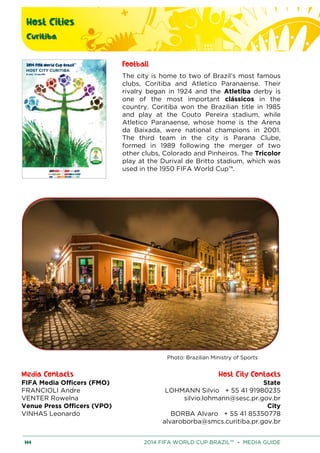
Football
The city is home to two of Brazil’s most famous
clubs, Coritiba and Atletico Paranaense. Their
rivalry began in 1924 and the Atletiba derby is
one of the most important clássicos in the
country. Coritiba won the Brazilian title in 1985
and play at the Couto Pereira stadium, while
Atletico Paranaense, whose home is the Arena
da Baixada, were national champions in 2001.
The third team in the city is Parana Clube,
formed in 1989 following the merger of two
other clubs, Colorado and Pinheiros. The Tricolor
play at the Durival de Britto stadium, which was
used in the 1950 FIFA World Cup™.
Photo: Brazilian Ministry of Sports
Media Contacts Host City Contacts
FIFA Media Officers (FMO) State
LOHMANN Silvio + 55 41 91980235
silvio.lohmann@sesc.pr.gov.br
City
BORBA Alvaro + 55 41 85350778
alvaroborba@smcs.curitiba.pr.gov.br
FRANCIOLI Andre
VENTER Rowelna
Venue Press Officers (VPO)
VINHAS Leonardo
CUR
Host Cities
Curitiba
145
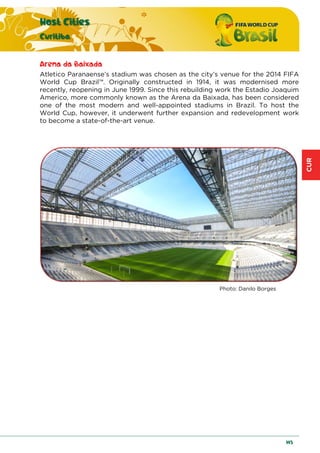
Arena da Baixada
Atletico Paranaense’s stadium was chosen as the city’s venue for the 2014 FIFA
World Cup Brazil™. Originally constructed in 1914, it was modernised more
recently, reopening in June 1999. Since this rebuilding work the Estadio Joaquim
Americo, more commonly known as the Arena da Baixada, has been considered
one of the most modern and well-appointed stadiums in Brazil. To host the
World Cup, however, it underwent further expansion and redevelopment work
to become a state-of-the-art venue.
Photo: Danilo Borges
Host Cities
Curitiba
146 2014 FIFA WORLD CUP BRAZIL™ – MEDIA GUIDE
CUR
Host Cities
Curitiba
147
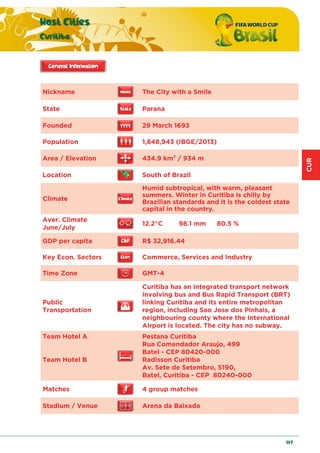
Nickname The City with a Smile
State Parana
Founded 29 March 1693
Population 1,848,943 (IBGE/2013)
Area / Elevation 434.9 km2 / 934 m
Location South of Brazil
Climate
Humid subtropical, with warm, pleasant
summers. Winter in Curitiba is chilly by
Brazilian standards and it is the coldest state
capital in the country.
Aver. Climate
June/July
12.2°C 98.1 mm 80.5 %
GDP per capita R$ 32,916.44
Key Econ. Sectors Commerce, Services and Industry
Time Zone GMT-4
Public
Transportation
Curitiba has an integrated transport network
involving bus and Bus Rapid Transport (BRT)
linking Curitiba and its entire metropolitan
region, including Sao Jose dos Pinhais, a
neighbouring county where the International
Airport is located. The city has no subway.
Team Hotel A
Team Hotel B
Pestana Curitiba
Rua Comendador Araujo, 499
Batel - CEP 80420-000
Radisson Curitiba
Av. Sete de Setembro, 5190,
Batel, Curitiba - CEP 80240-000
Matches 4 group matches
Stadium / Venue Arena da Baixada
Host Cities
Curitiba
148 2014 FIFA WORLD CUP BRAZIL™ – MEDIA GUIDE
CUR
Host Cities
Curitiba
149
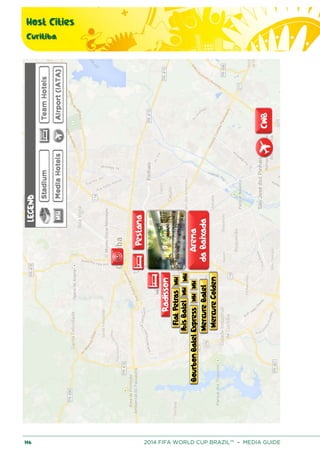
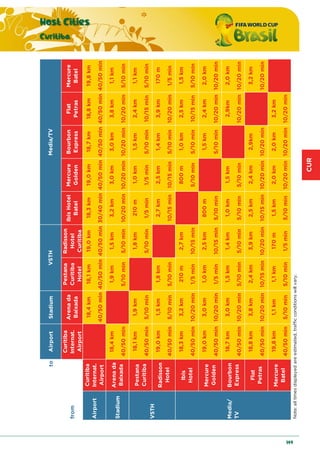
toAirportStadium
from
Curitiba
Internat.
Airport
Arenada
Baixada
Pestana
Curitiba
Hotel
Radisson
Hotel
Curitiba
IbisHotel
Batel
Mercure
Golden
Bourbon
Express
Flat
Petras
Mercure
Batel
18,4km18,1km19,0km18,3km19,0km18,7km18,8km19,8km
40/50min40/50min40/50min30/40min40/50min40/50min40/50min40/50min
18,4km1,9km1,5km3,2km3,0km3,0km3,8km1,1km
40/50min5/10min5/10min10/20min10/20min10/20min10/20min5/10min
18,1km1,9km1,8km210m1,0km1,5km2,4km1,1km
40/50min5/10min5/10min1/5min1/5min5/10min10/15min5/10min
19,0km1,5km1,8km2,7km2,5km1,4km3,9km170m
40/50min5/10min5/10min10/15min10/15min5/10min10/20min1/5min
18,3km3,2km210m2,7km800m1,0km2,5km1,5km
40/50min10/20min1/5min10/15min5/10min5/10min10/15min5/10min
19,0km3,0km1,0km2,5km800m1,5km2,4km2,0km
40/50min10/20min1/5min10/15min5/10min5/10min10/20min10/20min
18,7km3,0km1,5km1,4km1,0km1,5km2,9km2,0km
40/50min10/20min5/10min5/10min5/10min5/10min10/20min10/20min
18,8km3,8km2,4km3,9km2,5km2,4km2,9km3,2km
40/50min10/20min10/15min10/20min10/15min10/20min10/20min10/20min
19,8km1,1km1,1km170m1,5km2,0km2,0km3,2km
40/50min5/10min5/10min1/5min5/10min10/20min10/20min10/20min
Note:alltimesdisplayedareestimated,trafficconditionswillvary.
VSTHMedia/TV
Airport
Curitiba
Internat.
Airport
Stadium
Arenada
Baixada
Mercure
Batel
VSTH
Pestana
Curitiba
Radisson
Hotel
Media/
TV
Ibis
Hotel
Mercure
Golden
Bourbon
Express
Flat
Petras
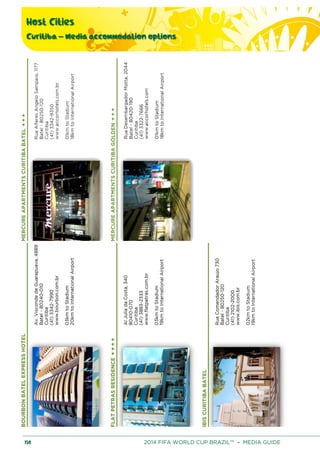
Host Cities
Curitiba – Media accommodation options
150 2014 FIFA WORLD CUP BRAZIL™ – MEDIA GUIDE
Fortaleza
FTL
Host Cities
Fortaleza
151
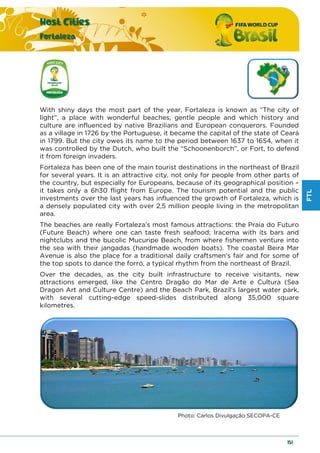
With shiny days the most part of the year, Fortaleza is known as “The city of
light”, a place with wonderful beaches, gentle people and which history and
culture are influenced by native Brazilians and European conquerors. Founded
as a village in 1726 by the Portuguese, it became the capital of the state of Ceará
in 1799. But the city owes its name to the period between 1637 to 1654, when it
was controlled by the Dutch, who built the “Schoonenborch”, or Fort, to defend
it from foreign invaders.
Fortaleza has been one of the main tourist destinations in the northeast of Brazil
for several years. It is an attractive city, not only for people from other parts of
the country, but especially for Europeans, because of its geographical position –
it takes only a 6h30 flight from Europe. The tourism potential and the public
investments over the last years has influenced the growth of Fortaleza, which is
a densely populated city with over 2,5 million people living in the metropolitan
area.
The beaches are really Fortaleza’s most famous attractions: the Praia do Futuro
(Future Beach) where one can taste fresh seafood; Iracema with its bars and
nightclubs and the bucolic Mucuripe Beach, from where fishermen venture into
the sea with their jangadas (handmade wooden boats). The coastal Beira Mar
Avenue is also the place for a traditional daily craftsmen's fair and for some of
the top spots to dance the forró, a typical rhythm from the northeast of Brazil.
Over the decades, as the city built infrastructure to receive visitants, new
attractions emerged, like the Centro Dragão do Mar de Arte e Cultura (Sea
Dragon Art and Culture Centre) and the Beach Park, Brazil's largest water park,
with several cutting-edge speed-slides distributed along 35,000 square
kilometres.
Photo: Carlos Divulgação SECOPA-CE
Host Cities
Fortaleza
152 2014 FIFA WORLD CUP BRAZIL™ – MEDIA GUIDE
Football
Two of the most popular clubs from the
northeast of Brazil come from Fortaleza: Ceará
Sporting Club and Fortaleza Esporte Clube. Both
teams have historically shared the attention of
the fans throughout the whole state of Ceará, as
well as the state titles.
The two sides have also played important roles
in national competitions: Ceará were the runner-
ups in the Copa do Brasil in 1994, when they lost
to Grêmio, and they reached the semi-finals in
2005, while Fortaleza finished runners-up twice
in the Taça Brasil (a predecessor to Campeonato
Brasileiro), in 1960 and 1968.
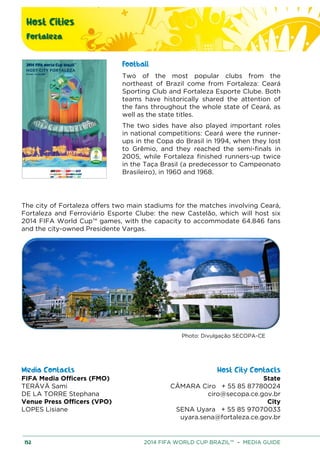
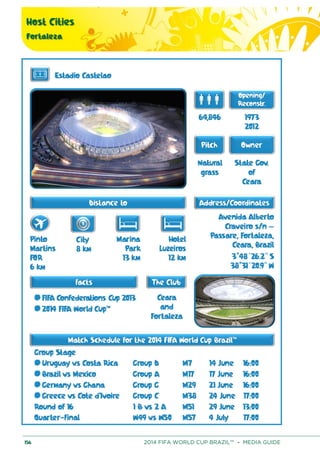
The city of Fortaleza offers two main stadiums for the matches involving Ceará,
Fortaleza and Ferroviário Esporte Clube: the new Castelão, which will host six
2014 FIFA World Cup™ games, with the capacity to accommodate 64.846 fans
and the city-owned Presidente Vargas.
Photo: Divulgação SECOPA-CE
Media Contacts Host City Contacts
FIFA Media Officers (FMO) State
CÂMARA Ciro + 55 85 87780024
ciro@secopa.ce.gov.br
City
SENA Uyara + 55 85 97070033
uyara.sena@fortaleza.ce.gov.br
TERÄVÄ Sami
DE LA TORRE Stephana
Venue Press Officers (VPO)
LOPES Lisiane
FTL
Host Cities
Fortaleza
153
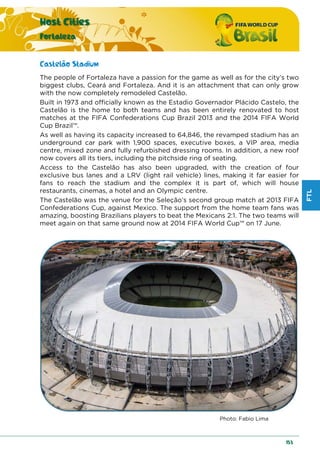
Castelão Stadium
The people of Fortaleza have a passion for the game as well as for the city’s two
biggest clubs, Ceará and Fortaleza. And it is an attachment that can only grow
with the now completely remodeled Castelão.
Built in 1973 and officially known as the Estadio Governador Plácido Castelo, the
Castelão is the home to both teams and has been entirely renovated to host
matches at the FIFA Confederations Cup Brazil 2013 and the 2014 FIFA World
Cup Brazil™.
As well as having its capacity increased to 64,846, the revamped stadium has an
underground car park with 1,900 spaces, executive boxes, a VIP area, media
centre, mixed zone and fully refurbished dressing rooms. In addition, a new roof
now covers all its tiers, including the pitchside ring of seating.
Access to the Castelão has also been upgraded, with the creation of four
exclusive bus lanes and a LRV (light rail vehicle) lines, making it far easier for
fans to reach the stadium and the complex it is part of, which will house
restaurants, cinemas, a hotel and an Olympic centre.
The Castelão was the venue for the Seleção’s second group match at 2013 FIFA
Confederations Cup, against Mexico. The support from the home team fans was
amazing, boosting Brazilians players to beat the Mexicans 2:1. The two teams will
meet again on that same ground now at 2014 FIFA World Cup™ on 17 June.
Photo: Fabio Lima
Host Cities
Fortaleza
154 2014 FIFA WORLD CUP BRAZIL™ – MEDIA GUIDE
FTL
Host Cities
Fortaleza
155
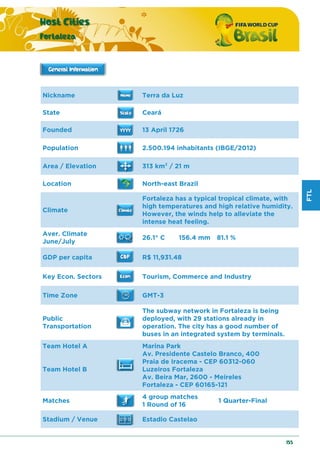
Nickname Terra da Luz
State Ceará
Founded 13 April 1726
Population 2.500.194 inhabitants (IBGE/2012)
Area / Elevation 313 km2 / 21 m
Location North-east Brazil
Climate
Fortaleza has a typical tropical climate, with
high temperatures and high relative humidity.
However, the winds help to alleviate the
intense heat feeling.
Aver. Climate
June/July
26.1° C 156.4 mm 81.1 %
GDP per capita R$ 11,931.48
Key Econ. Sectors Tourism, Commerce and Industry
Time Zone GMT-3
Public
Transportation
The subway network in Fortaleza is being
deployed, with 29 stations already in
operation. The city has a good number of
buses in an integrated system by terminals.
Team Hotel A
Team Hotel B
Marina Park
Av. Presidente Castelo Branco, 400
Praia de Iracema - CEP 60312-060
Luzeiros Fortaleza
Av. Beira Mar, 2600 - Meireles
Fortaleza - CEP 60165-121
Matches
4 group matches
1 Round of 16
1 Quarter-Final
Stadium / Venue Estadio Castelao
Host Cities
Fortaleza
156 2014 FIFA WORLD CUP BRAZIL™ – MEDIA GUIDE
FTL
Host Cities
Fortaleza
157
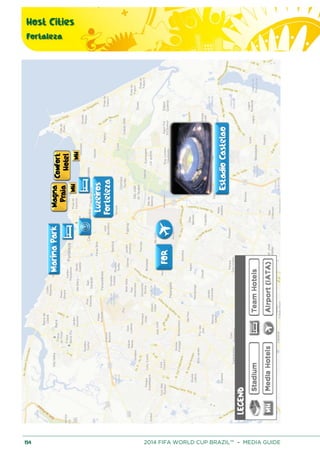
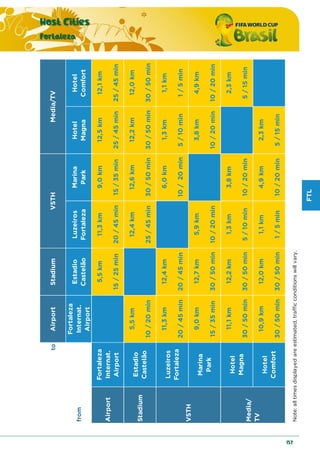
toAirportStadium
from
Fortaleza
Internat.
Airport
Estadio
Castelão
Luzeiros
Fortaleza
Marina
Park
Hotel
Magna
Hotel
Comfort
5,5km11,3km9,0km12,5km12,1km
15/25min20/45min15/35min25/45min25/45min
5,5km12,4km12,6km12,2km12,0km
10/20min25/45min30/50min30/50min30/50min
11,3km12,4km6,0km1,3km1,1km
20/45min20/45min10/20min5/10min1/5min
9,0km12,7km5,9km3,8km4,9km
15/35min30/50min10/20min10/20min10/20min
11,1km12,2km1,3km3,8km2,3km
30/50min30/50min5/10min10/20min5/15min
10,9km12,0km1,1km4,9km2,3km
30/50min30/50min1/5min10/20min5/15min
Note:alltimesdisplayedareestimated,trafficconditionswillvary.
Media/
TV
Hotel
Magna
Hotel
Comfort
VSTHMedia/TV
Airport
Fortaleza
Internat.
Airport
Stadium
Estadio
Castelão
VSTH
Luzeiros
Fortaleza
Marina
Park
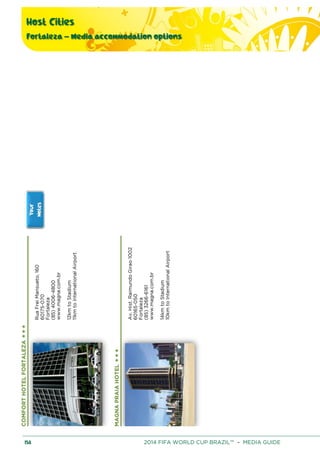
Host Cities
Fortaleza – Media accommodation options
158 2014 FIFA WORLD CUP BRAZIL™ – MEDIA GUIDE
Manaus
MAN
Host Cities
Manaus
159
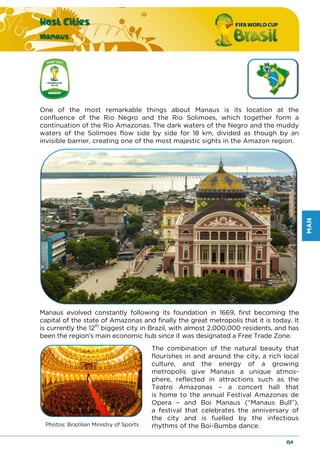
One of the most remarkable things about Manaus is its location at the
confluence of the Rio Negro and the Rio Solimoes, which together form a
continuation of the Rio Amazonas. The dark waters of the Negro and the muddy
waters of the Solimoes flow side by side for 18 km, divided as though by an
invisible barrier, creating one of the most majestic sights in the Amazon region.
Manaus evolved constantly following its foundation in 1669, first becoming the
capital of the state of Amazonas and finally the great metropolis that it is today. It
is currently the 12th
biggest city in Brazil, with almost 2,000,000 residents, and has
been the region’s main economic hub since it was designated a Free Trade Zone.
Photos: Brazilian Ministry of Sports
The combination of the natural beauty that
flourishes in and around the city, a rich local
culture, and the energy of a growing
metropolis give Manaus a unique atmos-
phere, reflected in attractions such as the
Teatro Amazonas – a concert hall that
is home to the annual Festival Amazonas de
Opera – and Boi Manaus (“Manaus Bull”),
a festival that celebrates the anniversary of
the city and is fuelled by the infectious
rhythms of the Boi-Bumba dance.
Host Cities
Manaus
160 2014 FIFA WORLD CUP BRAZIL™ – MEDIA GUIDE
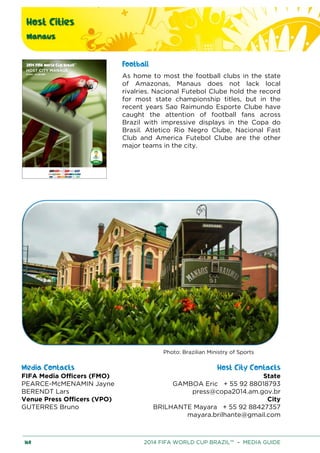
Football
As home to most the football clubs in the state
of Amazonas, Manaus does not lack local
rivalries. Nacional Futebol Clube hold the record
for most state championship titles, but in the
recent years Sao Raimundo Esporte Clube have
caught the attention of football fans across
Brazil with impressive displays in the Copa do
Brasil. Atletico Rio Negro Clube, Nacional Fast
Club and America Futebol Clube are the other
major teams in the city.
Photo: Brazilian Ministry of Sports
Media Contacts Host City Contacts
FIFA Media Officers (FMO) State
GAMBOA Eric + 55 92 88018793
press@copa2014.am.gov.br
City
BRILHANTE Mayara + 55 92 88427357
mayara.brilhante@gmail.com
PEARCE-McMENAMIN Jayne
BERENDT Lars
Venue Press Officers (VPO)
GUTERRES Bruno
MAN
Host Cities
Manaus
161
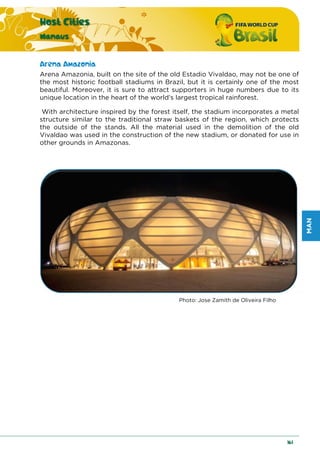
Arena Amazonia
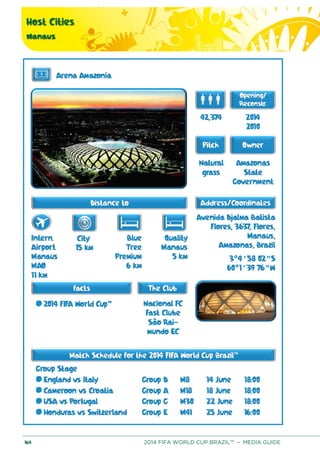
Arena Amazonia, built on the site of the old Estadio Vivaldao, may not be one of
the most historic football stadiums in Brazil, but it is certainly one of the most
beautiful. Moreover, it is sure to attract supporters in huge numbers due to its
unique location in the heart of the world’s largest tropical rainforest.
With architecture inspired by the forest itself, the stadium incorporates a metal
structure similar to the traditional straw baskets of the region, which protects
the outside of the stands. All the material used in the demolition of the old
Vivaldao was used in the construction of the new stadium, or donated for use in
other grounds in Amazonas.
Photo: Jose Zamith de Oliveira Filho
Host Cities
Manaus
162 2014 FIFA WORLD CUP BRAZIL™ – MEDIA GUIDE
MAN
Host Cities
Manaus
163
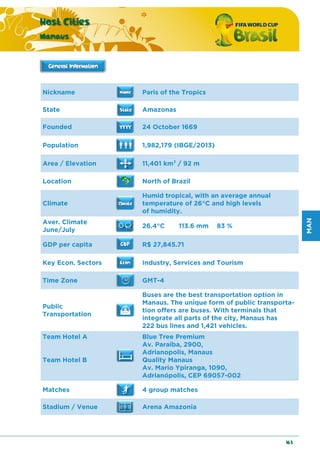
Nickname Paris of the Tropics
State Amazonas
Founded 24 October 1669
Population 1,982,179 (IBGE/2013)
Area / Elevation 11,401 km2 / 92 m
Location North of Brazil
Climate
Humid tropical, with an average annual
temperature of 26°C and high levels
of humidity.
Aver. Climate
June/July
26.4°C 113.6 mm 83 %
GDP per capita R$ 27,845.71
Key Econ. Sectors Industry, Services and Tourism
Time Zone GMT-4
Public
Transportation
Buses are the best transportation option in
Manaus. The unique form of public transporta-
tion offers are buses. With terminals that
integrate all parts of the city, Manaus has
222 bus lines and 1,421 vehicles.
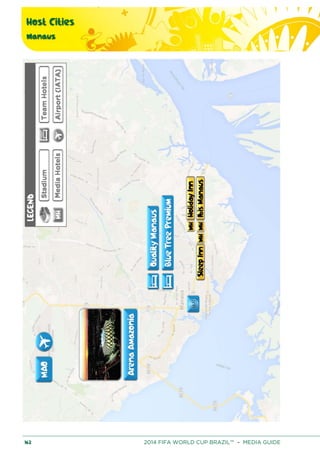
Team Hotel A
Team Hotel B
Blue Tree Premium
Av. Paraiba, 2900,
Adrianopolis, Manaus
Quality Manaus
Av. Mario Ypiranga, 1090,
Adrianópolis, CEP 69057-002
Matches 4 group matches
Stadium / Venue Arena Amazonia
Host Cities
Manaus
164 2014 FIFA WORLD CUP BRAZIL™ – MEDIA GUIDE
MAN
Host Cities
Manaus
165
toAirportStadium
from
Manaus
Internat.
Airport
Arena
Amazonia
BlueTree
Premium
Quality
Inn
Ibis
Manaus
Holiday
Inn
Sleep
Inn
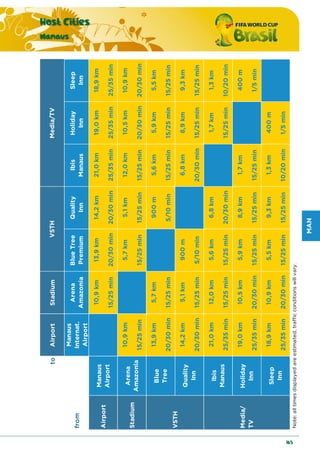
10,9km13,9km14,2km21,0km19,0km18,9km
15/25min20/30min20/30min25/35min25/35min25/35min
10,9km5,7km5,1km12,0km10,5km10,9km
15/25min15/25min15/25min15/25min20/30min20/30min
13,9km5,7km900m5,6km5,9km5,5km
20/30min15/25min5/10min15/25min15/25min15/25min
14,2km5,1km900m6,8km8,9km9,3km
20/30min15/25min5/10min20/30min15/25min15/25min
21,0km12,0km5,6km6,8km1,7km1,3km
25/35min15/25min15/25min20/30min15/25min10/20min
19,0km10,5km5,9km8,9km1,7km400m
25/35min20/30min15/25min15/25min15/25min1/5min
18,9km10,9km5,5km9,3km1,3km400m
25/35min20/30min15/25min15/25min10/20min1/5min
Note:alltimesdisplayedareestimated,trafficconditionswillvary.
Media/TV
Airport
Manaus
Airport
Stadium
Arena
Amazonia
Media/
TV
Ibis
Manaus
Holiday
Inn
Sleep
Inn
VSTH
VSTH
Blue
Tree
Quality
Inn
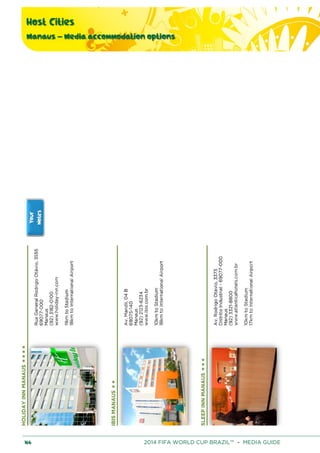
Host Cities
Manaus – Media accommodation options
166 2014 FIFA WORLD CUP BRAZIL™ – MEDIA GUIDE
Natal
NTL
Host Cities
Natal
167
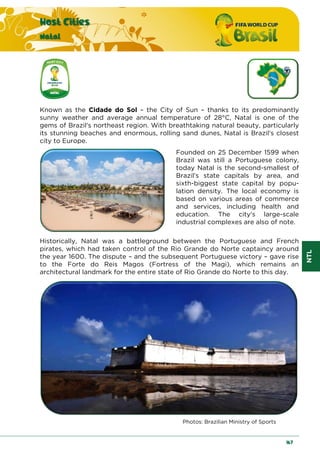
Known as the Cidade do Sol – the City of Sun – thanks to its predominantly
sunny weather and average annual temperature of 28°C, Natal is one of the
gems of Brazil's northeast region. With breathtaking natural beauty, particularly
its stunning beaches and enormous, rolling sand dunes, Natal is Brazil's closest
city to Europe.
Founded on 25 December 1599 when
Brazil was still a Portuguese colony,
today Natal is the second-smallest of
Brazil's state capitals by area, and
sixth-biggest state capital by popu-
lation density. The local economy is
based on various areas of commerce
and services, including health and
education. The city's large-scale
industrial complexes are also of note.
Historically, Natal was a battleground between the Portuguese and French
pirates, which had taken control of the Rio Grande do Norte captaincy around
the year 1600. The dispute – and the subsequent Portuguese victory – gave rise
to the Forte do Reis Magos (Fortress of the Magi), which remains an
architectural landmark for the entire state of Rio Grande do Norte to this day.
Photos: Brazilian Ministry of Sports
Host Cities
Natal
168 2014 FIFA WORLD CUP BRAZIL™ – MEDIA GUIDE
Football
The three main football clubs in the state of Rio
Grande do Norte are based in Natal: Alecrim,
ABC and America de Natal, with the latter two
accounting for 83 state titles between them.
Of the three, America de Natal have most
recently competed in the Campeonato Brasileiro,
playing their last Serie A game in 2007. ABC, for
their part, last graced the top flight in 1985.
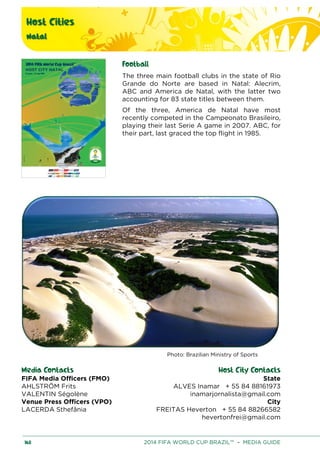
Photo: Brazilian Ministry of Sports
Media Contacts Host City Contacts
FIFA Media Officers (FMO) State
ALVES Inamar + 55 84 88161973
inamarjornalista@gmail.com
City
FREITAS Heverton + 55 84 88266582
hevertonfrei@gmail.com
AHLSTRÖM Frits
VALENTIN Ségolène
Venue Press Officers (VPO)
LACERDA Sthefânia
NTL
Host Cities
Natal
169
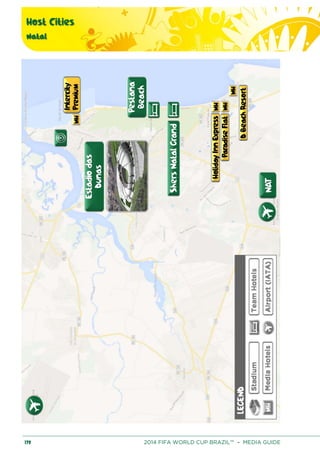
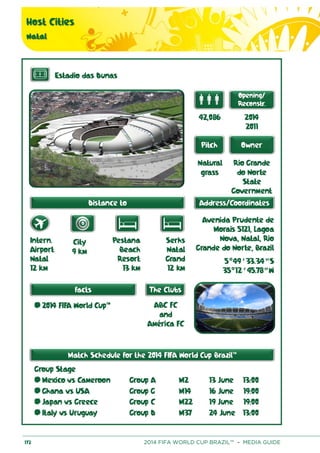
Estadio das Dunas
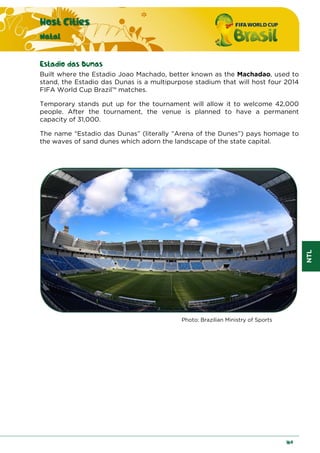
Built where the Estadio Joao Machado, better known as the Machadao, used to
stand, the Estadio das Dunas is a multipurpose stadium that will host four 2014
FIFA World Cup Brazil™ matches.
Temporary stands put up for the tournament will allow it to welcome 42,000
people. After the tournament, the venue is planned to have a permanent
capacity of 31,000.
The name “Estadio das Dunas” (literally “Arena of the Dunes”) pays homage to
the waves of sand dunes which adorn the landscape of the state capital.
Photo: Brazilian Ministry of Sports
Host Cities
Natal
170 2014 FIFA WORLD CUP BRAZIL™ – MEDIA GUIDE
NTL
Host Cities
Natal
171
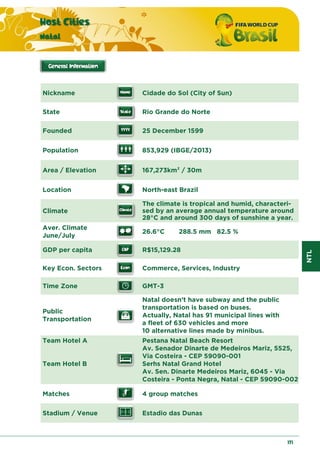
Nickname Cidade do Sol (City of Sun)
State Rio Grande do Norte
Founded 25 December 1599
Population 853,929 (IBGE/2013)
Area / Elevation 167,273km2 / 30m
Location North-east Brazil
Climate
The climate is tropical and humid, characteri-
sed by an average annual temperature around
28°C and around 300 days of sunshine a year.
Aver. Climate
June/July
26.6°C 288.5 mm 82.5 %
GDP per capita R$15,129.28
Key Econ. Sectors Commerce, Services, Industry
Time Zone GMT-3
Public
Transportation
Natal doesn’t have subway and the public
transportation is based on buses.
Actually, Natal has 91 municipal lines with
a fleet of 630 vehicles and more
10 alternative lines made by minibus.
Team Hotel A
Team Hotel B
Pestana Natal Beach Resort
Av. Senador Dinarte de Medeiros Mariz, 5525,
Via Costeira - CEP 59090-001
Serhs Natal Grand Hotel
Av. Sen. Dinarte Medeiros Mariz, 6045 - Via
Costeira - Ponta Negra, Natal - CEP 59090-002
Matches 4 group matches
Stadium / Venue Estadio das Dunas
Host Cities
Natal
172 2014 FIFA WORLD CUP BRAZIL™ – MEDIA GUIDE
NTL
Host Cities
Natal
173
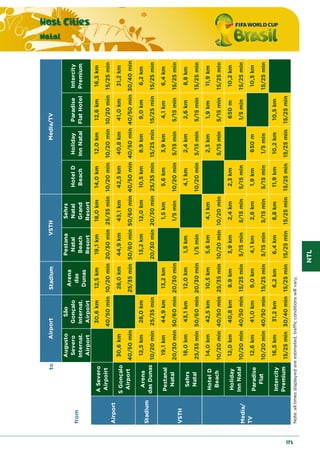
toStadium
from
Augusto
Severo
Internat.
Airport
São
Gonçalo
Internat.
Airpoirt
Arena
das
Dunas
Pestana
Natal
Beach
Resort
Sehrs
Natal
Grand
Resort
HotelD
Beach
Holiday
InnNatal
Paradise
FlatHotel
Intercity
Premium
30,6km12,5km19,1km18,0km14,0km12,0km12,6km16,5km
40/50min10/20min20/30min25/35min10/20min10/20min10/20min15/25min
30,6km28,0km44,9km43,1km42,5km40,8km41,0km31,2km
40/50min25/35min50/60min50/60min40/50min40/50min40/50min30/40min
12,5km28,0km13,2km12,0km10,5km8.9km9,0km6,2km
10/20min25/35min20/30min20/30min25/35min15/25min15/25min15/25min
19,1km44,9km13,2km1,5km5,6km3,9km4,1km6,4km
20/30min50/60min20/30min1/5min10/20min5/15min5/15min15/25min
18,0km43,1km12,0km1,5km4,1km2,4km2,6km8,8km
25/35min50/60min20/30min1/5min10/20min5/15min5/15min15/25min
14,0km42,5km10,5km5,6km4,1km2,3km1,9km11,9km
10/20min40/50min25/35min10/20min10/20min5/15min5/15min15/25min
12,0km40,8km8.9km3,9km2,4km2,3km650m10,2km
10/20min40/50min15/25min5/15min5/15min5/15min1/5min15/25min
12,6km41,0km9,0km4,1km2,6km1,9km650m10,5km
10/20min40/50min15/25min5/15min5/15min5/15min1/5min15/25min
16,5km31,2km6,2km6,4km8,8km11,9km10,2km10,5km
15/25min30/40min15/25min15/25min15/25min15/25min15/25min15/25min
Note:alltimesdisplayedareestimated,trafficconditionswillvary.
VSTH
Pestanal
Natal
Sehrs
Natal
VSTHMedia/TV
ASevero
Airpoirt
SGonçalo
Airport
Airport
Airport
Stadium
Arena
dasDunas
Media/
TV
HotelD
Beach
Holiday
InnNatal
Paradise
Flat
Intercity
Premium
Host Cities
Natal – Media accommodation options
174 2014 FIFA WORLD CUP BRAZIL™ – MEDIA GUIDE
Porto Alegre
PTA
Host Cities
Porto Alegre
175
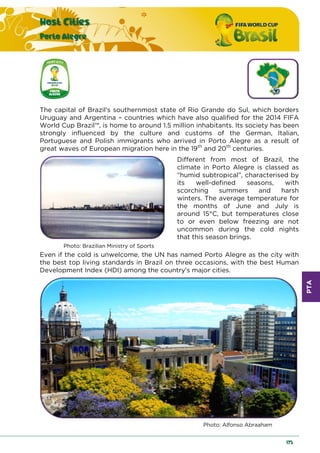
The capital of Brazil's southernmost state of Rio Grande do Sul, which borders
Uruguay and Argentina – countries which have also qualified for the 2014 FIFA
World Cup Brazil™, is home to around 1.5 million inhabitants. Its society has been
strongly influenced by the culture and customs of the German, Italian,
Portuguese and Polish immigrants who arrived in Porto Alegre as a result of
great waves of European migration here in the 19th
and 20th
centuries.
Different from most of Brazil, the
climate in Porto Alegre is classed as
“humid subtropical”, characterised by
its well-defined seasons, with
scorching summers and harsh
winters. The average temperature for
the months of June and July is
around 15°C, but temperatures close
to or even below freezing are not
uncommon during the cold nights
that this season brings.
Photo: Brazilian Ministry of Sports
Even if the cold is unwelcome, the UN has named Porto Alegre as the city with
the best top living standards in Brazil on three occasions, with the best Human
Development Index (HDI) among the country's major cities.
Photo: Alfonso Abraaham
Host Cities
Porto Alegre
176 2014 FIFA WORLD CUP BRAZIL™ – MEDIA GUIDE
Football
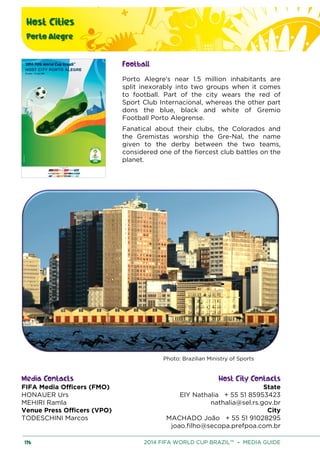
Porto Alegre's near 1.5 million inhabitants are
split inexorably into two groups when it comes
to football. Part of the city wears the red of
Sport Club Internacional, whereas the other part
dons the blue, black and white of Gremio
Football Porto Alegrense.
Fanatical about their clubs, the Colorados and
the Gremistas worship the Gre-Nal, the name
given to the derby between the two teams,
considered one of the fiercest club battles on the
planet.
Photo: Brazilian Ministry of Sports
Media Contacts Host City Contacts
FIFA Media Officers (FMO) State
ElY Nathalia + 55 51 85953423
nathalia@sel.rs.gov.br
City
MACHADO João + 55 51 91028295
joao.filho@secopa.prefpoa.com.br
HONAUER Urs
MEHIRI Ramla
Venue Press Officers (VPO)
TODESCHINI Marcos
PTA
Host Cities
Porto Alegre
177
Estadio Beira-Rio
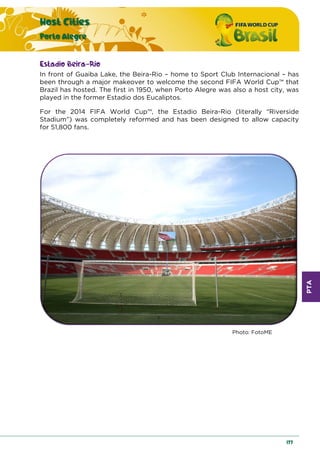
In front of Guaiba Lake, the Beira-Rio – home to Sport Club Internacional – has
been through a major makeover to welcome the second FIFA World Cup™ that
Brazil has hosted. The first in 1950, when Porto Alegre was also a host city, was
played in the former Estadio dos Eucaliptos.
For the 2014 FIFA World Cup™, the Estadio Beira-Rio (literally “Riverside
Stadium”) was completely reformed and has been designed to allow capacity
for 51,800 fans.
Photo: FotoME
Host Cities
Porto Alegre
178 2014 FIFA WORLD CUP BRAZIL™ – MEDIA GUIDE
PTA
Host Cities
Porto Alegre
179
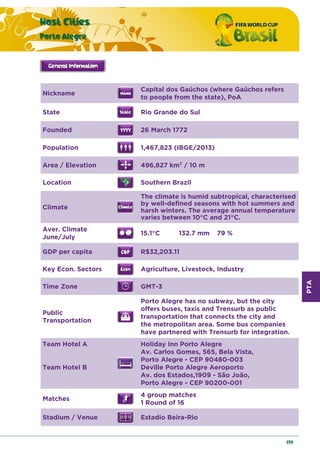
Nickname
Capital dos Gaúchos (where Gaúchos refers
to people from the state), PoA
State Rio Grande do Sul
Founded 26 March 1772
Population 1,467,823 (IBGE/2013)
Area / Elevation 496,827 km2 / 10 m
Location Southern Brazil
Climate
The climate is humid subtropical, characterised
by well-defined seasons with hot summers and
harsh winters. The average annual temperature
varies between 10°C and 21°C.
Aver. Climate
June/July
15.1°C 132.7 mm 79 %
GDP per capita R$32,203.11
Key Econ. Sectors Agriculture, Livestock, Industry
Time Zone GMT-3
Public
Transportation
Porto Alegre has no subway, but the city
offers buses, taxis and Trensurb as public
transportation that connects the city and
the metropolitan area. Some bus companies
have partnered with Trensurb for integration.
Team Hotel A
Team Hotel B
Holiday Inn Porto Alegre
Av. Carlos Gomes, 565, Bela Vista,
Porto Alegre - CEP 90480-003
Deville Porto Alegre Aeroporto
Av. dos Estados,1909 - São João,
Porto Alegre - CEP 90200-001
Matches
4 group matches
1 Round of 16
Stadium / Venue Estadio Beira-Rio
Host Cities
Porto Alegre
180 2014 FIFA WORLD CUP BRAZIL™ – MEDIA GUIDE
PTA
Host Cities
Porto Alegre
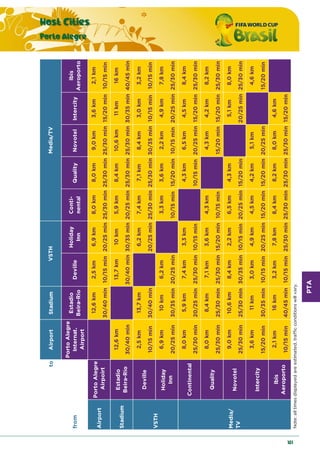
181
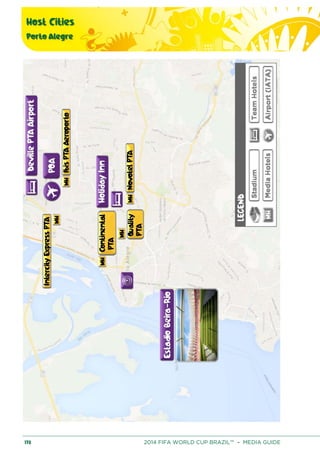
toAirportStadium
from
PortoAlegre
Internat.
Airport
Estadio
Beira-Rio
Deville
Holiday
Inn
Conti-
nental
QualityNovotelIntercity
Ibis
Aeroporto
12,6km2,5km6,9km8,0km8,0km9,0km3,6km2,1km
30/40min10/15min20/25min25/30min25/30min25/30min15/20min10/15min
12,6km13,7km10km5,9km8,4km10,6km11km16km
30/40min30/40min30/35min20/25min25/30min25/30min30/35min40/45min
2,5km13,7km6,2km7,4km7,1km8,4km3,0km3,2km
10/15min30/40min20/25min25/30min25/30min30/35min10/15min10/15min
6,9km10km6,2km3,3km3,6km2,2km4,9km7,8km
20/25min30/35min20/25min10/15min15/20min10/15min20/25min25/30min
8,0km5,9km7,4km3,3km4,3km6,5km4,5km8,4km
25/30min20/25min25/30min10/15min10/15min20/25min15/20min25/30min
8,0km8,4km7,1km3,6km4,3km4,3km4,2km8,2km
25/30min25/30min25/30min15/20min10/15min15/20min15/20min25/30min
9,0km10,6km8,4km2,2km6,5km4,3km5,1km8,0km
25/30min25/30min30/35min10/15min20/25min15/20min20/25min25/30min
3,6km11km3,0km4,9km4,5km4,2km5,1km4,6km
15/20min30/35min10/15min20/25min15/20min15/20min20/25min15/20min
2,1km16km3,2km7,8km8,4km8,2km8,0km4,6km
10/15min40/45min10/15min25/30min25/30min25/30min25/30min15/20min
Note:alltimesdisplayedareestimated,trafficconditionswillvary.
VSTHMedia/TV
Airport
PortoAlegre
Airpoirt
Stadium
Estadio
Beira-Rio
Ibis
Aeroporto
VSTH
Deville
Holiday
Inn
Media/
TV
Continental
Quality
Novotel
Intercity
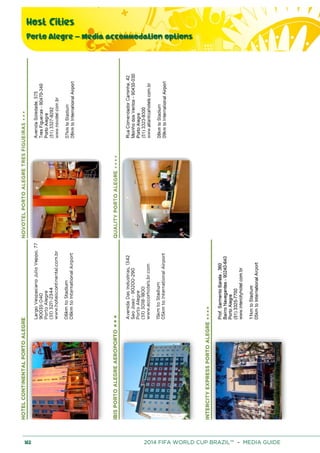
Host Cities
Porto Alegre – Media accommodation options
182 2014 FIFA WORLD CUP BRAZIL™ – MEDIA GUIDE
Recife
RCF
Host Cities
Recife
183
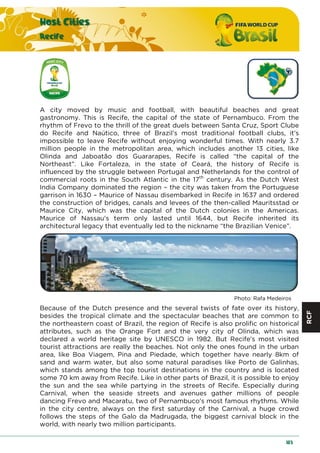
A city moved by music and football, with beautiful beaches and great
gastronomy. This is Recife, the capital of the state of Pernambuco. From the
rhythm of Frevo to the thrill of the great duels between Santa Cruz, Sport Clube
do Recife and Naútico, three of Brazil’s most traditional football clubs, it’s
impossible to leave Recife without enjoying wonderful times. With nearly 3.7
million people in the metropolitan area, which includes another 13 cities, like
Olinda and Jaboatão dos Guararapes, Recife is called “the capital of the
Northeast”. Like Fortaleza, in the state of Ceará, the history of Recife is
influenced by the struggle between Portugal and Netherlands for the control of
commercial roots in the South Atlantic in the 17th
century. As the Dutch West
India Company dominated the region – the city was taken from the Portuguese
garrison in 1630 – Maurice of Nassau disembarked in Recife in 1637 and ordered
the construction of bridges, canals and levees of the then-called Mauritsstad or
Maurice City, which was the capital of the Dutch colonies in the Americas.
Maurice of Nassau's term only lasted until 1644, but Recife inherited its
architectural legacy that eventually led to the nickname “the Brazilian Venice”.
Photo: Rafa Medeiros
Because of the Dutch presence and the several twists of fate over its history,
besides the tropical climate and the spectacular beaches that are common to
the northeastern coast of Brazil, the region of Recife is also prolific on historical
attributes, such as the Orange Fort and the very city of Olinda, which was
declared a world heritage site by UNESCO in 1982. But Recife’s most visited
tourist attractions are really the beaches. Not only the ones found in the urban
area, like Boa Viagem, Pina and Piedade, which together have nearly 8km of
sand and warm water, but also some natural paradises like Porto de Galinhas,
which stands among the top tourist destinations in the country and is located
some 70 km away from Recife. Like in other parts of Brazil, it is possible to enjoy
the sun and the sea while partying in the streets of Recife. Especially during
Carnival, when the seaside streets and avenues gather millions of people
dancing Frevo and Macaratu, two of Pernambuco’s most famous rhythms. While
in the city centre, always on the first saturday of the Carnival, a huge crowd
follows the steps of the Galo da Madrugada, the biggest carnival block in the
world, with nearly two million participants.
Host Cities
Recife
184 2014 FIFA WORLD CUP BRAZIL™ – MEDIA GUIDE
Football
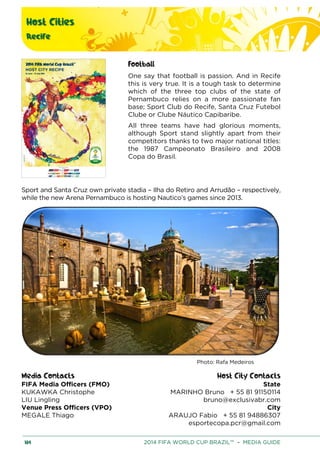
One say that football is passion. And in Recife
this is very true. It is a tough task to determine
which of the three top clubs of the state of
Pernambuco relies on a more passionate fan
base; Sport Club do Recife, Santa Cruz Futebol
Clube or Clube Náutico Capibaribe.
All three teams have had glorious moments,
although Sport stand slightly apart from their
competitors thanks to two major national titles:
the 1987 Campeonato Brasileiro and 2008
Copa do Brasil.
Sport and Santa Cruz own private stadia – Ilha do Retiro and Arrudão – respectively,
while the new Arena Pernambuco is hosting Nautico’s games since 2013.
Photo: Rafa Medeiros
Media Contacts Host City Contacts
FIFA Media Officers (FMO) State
MARINHO Bruno + 55 81 91150114
bruno@exclusivabr.com
City
ARAUJO Fabio + 55 81 94886307
esportecopa.pcr@gmail.com
KUKAWKA Christophe
LIU Lingling
Venue Press Officers (VPO)
MEGALE Thiago
RCF
Host Cities
Recife
185
Photo: Hugo Acioly
Arena Pernambuco
The Arena Pernambuco, which will be part of a complex also featuring
restaurants, shopping centres and cinemas, is located in São Lourenco da Mata
in Recife’s metropolitan zone, just 19km away from Guararapes International
Airport. The project is seen as an economic catalyst for the continued expansion
of Grande Recife, within an area which is considered to be economically
deprived. It is also estimated that the area will expand into a neighborhood
including nearly 5,000 homes. The Arena Pernambuco can receive 44,248
spectators.
Photo: Brazilian Ministry of Sports
Host Cities
Recife
186 2014 FIFA WORLD CUP BRAZIL™ – MEDIA GUIDE
RCF
Host Cities
Recife
187
Nickname Veneza Brasileira
State Pernambuco
Founded 12 March 1537
Population 1.537.704 inhabitants (IBGE/2012)
Area / Elevation 217 km2 / 4 m
Location North-east Brazil
Climate
Recife has tropical weather. In the winter
months, it usually rains a lot. Cold
temperatures are rare at any time.
Aver. Climate
June/July
24.7° C 490.1 mm 85.6 %
GDP per capita R$ 19,540
Key Econ. Sectors Tourism, Commerce and Industry
Time Zone GMT-3
Public
Transportation
The subway expansion in Recife is ongoing.
Current network has 29 stations and
is 39.5 km long. There are integrated
bus lines throughout the city.
Team Hotel A
Team Hotel B
Golden Tulip Recife Palace
Av. Boa Viagem, 1906 - Boa Viagem -
Recife - CEP 51021-000
Mar Hotel Recife
R. Barão de Souza Leão, 451 - Boa Viagem -
Recife - CEP 51030-300
Matches
4 group matches
1 Round of 16
Stadium / Venue Arena Pernambuco
Host Cities
Recife
188 2014 FIFA WORLD CUP BRAZIL™ – MEDIA GUIDE
RCF
Host Cities
Recife
189
toAirportStadium
from
Recife
Internat.
Airport
Arena
Pernam-
buco
Golden
Tulip
Mar
Hotel
Mercure
Navegantes
Blue
Tree
Towers
Vila
Rica
Park
Hotel
Mercure
Metropolis
30,9km3,9km4,3km3,8min7,4km3,6km4,0km9,0km
40/55min10/20min10/15min10/20min15/30min5/15min5/15min15/25min
30,9km24,0km22,0km23,1km27,0km21,9km21,6km17,7km
40/55min35/50min30/45min35/60min45/65min30/45min30/45min20/30min
5,8Km23km2,5km300m7,0km230m850m8,7km
10/25Min35/55min5/10min1/5min15/25min1/5min1/5min15/20min
5,0km22km1,8km1,9km6,0km1,8km550m9,3km
10/20min30/60min5/10min5/15min15/25min5/10min1/5min15/25min
4,8km22,9km260m1,4km4,7km1,5km2,1km7,6km
10/20min40/65min5min5/15min20/30min5/10min5/10min15/25min
6,7km24km6,0km5,5km4,5km6,7km6,6km14,7km
10/20min40/60min10/20min10/20min10/20min10/20min10/20min20/30min
3,6km21,9km230m1,8km1,5km6,7km600m9,8km
5/15min30/45min1/5min5/10min5/10min10/20min1/5min15/25min
4,0km21,6km850m550m2,1km6,6km600m9,3km
5/15min30/45min1/5min1/5min5/10min10/20min1/5min15/25min
9,0km17,7km8,7km9,3km7,6km14,7km9,8km9,3km
15/25min20/30min15/20min15/25min15/25min20/30min15/25min15/25min
Note:alltimesdisplayedareestimated,trafficconditionswillvary.
VSTHMedia/TV
Airport
Recife
Internat.
Airport
Stadium
Arena
Pernam-
buco
Mercure
Metrop.
VSTH
Golden
Tulip
Mar
Hotel
Media/
TV
Mercure
Navegantes
Blue
Tree
VilaRica
ParkHotel
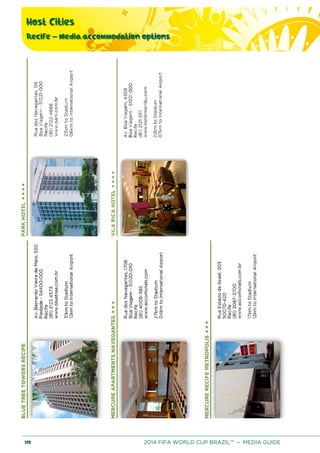
Host Cities
Recife – Media accommodation options
190 2014 FIFA WORLD CUP BRAZIL™ – MEDIA GUIDE
Rio de Janeiro
RIO
Host Cities
Rio de Janeiro
191
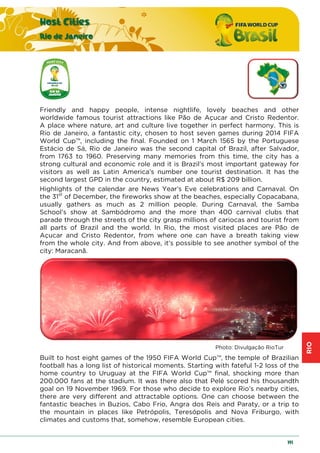
Friendly and happy people, intense nightlife, lovely beaches and other
worldwide famous tourist attractions like Pão de Açucar and Cristo Redentor.
A place where nature, art and culture live together in perfect harmony. This is
Rio de Janeiro, a fantastic city, chosen to host seven games during 2014 FIFA
World Cup™, including the final. Founded on 1 March 1565 by the Portuguese
Estácio de Sá, Rio de Janeiro was the second capital of Brazil, after Salvador,
from 1763 to 1960. Preserving many memories from this time, the city has a
strong cultural and economic role and it is Brazil’s most important gateway for
visitors as well as Latin America’s number one tourist destination. It has the
second largest GPD in the country, estimated at about R$ 209 billion.
Highlights of the calendar are News Year’s Eve celebrations and Carnaval. On
the 31st
of December, the fireworks show at the beaches, especially Copacabana,
usually gathers as much as 2 million people. During Carnaval, the Samba
School’s show at Sambódromo and the more than 400 carnival clubs that
parade through the streets of the city grasp millions of cariocas and tourist from
all parts of Brazil and the world. In Rio, the most visited places are Pão de
Açucar and Cristo Redentor, from where one can have a breath taking view
from the whole city. And from above, it’s possible to see another symbol of the
city: Maracanã.
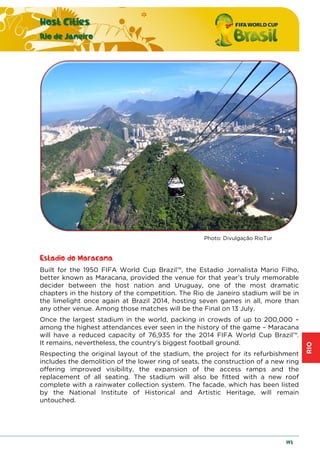
Photo: Divulgação RioTur
Built to host eight games of the 1950 FIFA World Cup™, the temple of Brazilian
football has a long list of historical moments. Starting with fateful 1-2 loss of the
home country to Uruguay at the FIFA World Cup™ final, shocking more than
200.000 fans at the stadium. It was there also that Pelé scored his thousandth
goal on 19 November 1969. For those who decide to explore Rio’s nearby cities,
there are very different and attractable options. One can choose between the
fantastic beaches in Buzios, Cabo Frio, Angra dos Reis and Paraty, or a trip to
the mountain in places like Petrópolis, Teresópolis and Nova Friburgo, with
climates and customs that, somehow, resemble European cities.
Host Cities
Rio de Janeiro
192 2014 FIFA WORLD CUP BRAZIL™ – MEDIA GUIDE
Football
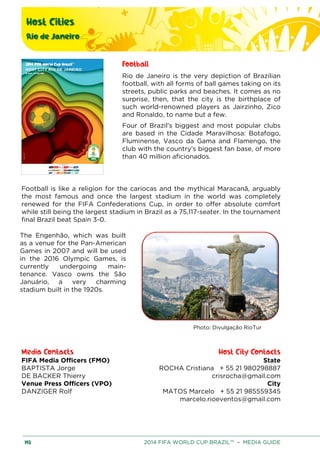
Rio de Janeiro is the very depiction of Brazilian
football, with all forms of ball games taking on its
streets, public parks and beaches. It comes as no
surprise, then, that the city is the birthplace of
such world-renowned players as Jairzinho, Zico
and Ronaldo, to name but a few.
Four of Brazil's biggest and most popular clubs
are based in the Cidade Maravilhosa: Botafogo,
Fluminense, Vasco da Gama and Flamengo, the
club with the country's biggest fan base, of more
than 40 million aficionados.
Football is like a religion for the cariocas and the mythical Maracanã, arguably
the most famous and once the largest stadium in the world was completely
renewed for the FIFA Confederations Cup, in order to offer absolute comfort
while still being the largest stadium in Brazil as a 75,117-seater. In the tournament
final Brazil beat Spain 3-0.
The Engenhão, which was built
as a venue for the Pan-American
Games in 2007 and will be used
in the 2016 Olympic Games, is
currently undergoing main-
tenance. Vasco owns the São
Januário, a very charming
stadium built in the 1920s.
Photo: Divulgação RioTur
Media Contacts Host City Contacts
FIFA Media Officers (FMO) State
ROCHA Cristiana + 55 21 980298887
crisrocha@gmail.com
City
MATOS Marcelo + 55 21 985559345
marcelo.rioeventos@gmail.com
BAPTISTA Jorge
DE BACKER Thierry
Venue Press Officers (VPO)
DANZIGER Rolf
RIO
Host Cities
Rio de Janeiro
193
Photo: Divulgação RioTur
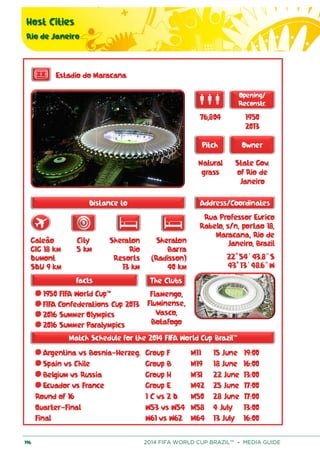
Estadio do Maracana
Built for the 1950 FIFA World Cup Brazil™, the Estadio Jornalista Mario Filho,
better known as Maracana, provided the venue for that year’s truly memorable
decider between the host nation and Uruguay, one of the most dramatic
chapters in the history of the competition. The Rio de Janeiro stadium will be in
the limelight once again at Brazil 2014, hosting seven games in all, more than
any other venue. Among those matches will be the Final on 13 July.
Once the largest stadium in the world, packing in crowds of up to 200,000 –
among the highest attendances ever seen in the history of the game – Maracana
will have a reduced capacity of 76,935 for the 2014 FIFA World Cup Brazil™.
It remains, nevertheless, the country’s biggest football ground.
Respecting the original layout of the stadium, the project for its refurbishment
includes the demolition of the lower ring of seats, the construction of a new ring
offering improved visibility, the expansion of the access ramps and the
replacement of all seating. The stadium will also be fitted with a new roof
complete with a rainwater collection system. The facade, which has been listed
by the National Institute of Historical and Artistic Heritage, will remain
untouched.
Host Cities
Rio de Janeiro
194 2014 FIFA WORLD CUP BRAZIL™ – MEDIA GUIDE
RIO
Host Cities
Rio de Janeiro
195
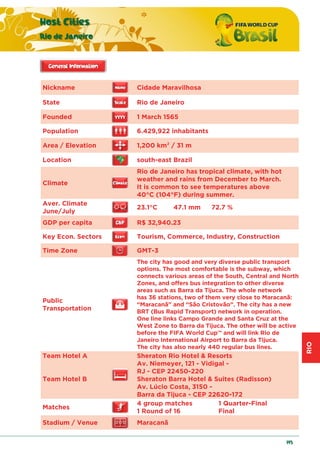
Nickname Cidade Maravilhosa
State Rio de Janeiro
Founded 1 March 1565
Population 6.429,922 inhabitants
Area / Elevation 1,200 km2 / 31 m
Location south-east Brazil
Climate
Rio de Janeiro has tropical climate, with hot
weather and rains from December to March.
It is common to see temperatures above
40°C (104°F) during summer.
Aver. Climate
June/July
23.1°C 47.1 mm 72.7 %
GDP per capita R$ 32,940.23
Key Econ. Sectors Tourism, Commerce, Industry, Construction
Time Zone GMT-3
Public
Transportation
The city has good and very diverse public transport
options. The most comfortable is the subway, which
connects various areas of the South, Central and North
Zones, and offers bus integration to other diverse
areas such as Barra da Tijuca. The whole network
has 36 stations, two of them very close to Maracanã:
“Maracanã” and “São Cristovão”. The city has a new
BRT (Bus Rapid Transport) network in operation.
One line links Campo Grande and Santa Cruz at the
West Zone to Barra da Tijuca. The other will be active
before the FIFA World Cup™ and will link Rio de
Janeiro International Airport to Barra da Tijuca.
The city has also nearly 440 regular bus lines.
Team Hotel A
Team Hotel B
Sheraton Rio Hotel & Resorts
Av. Niemeyer, 121 - Vidigal -
RJ - CEP 22450-220
Sheraton Barra Hotel & Suites (Radisson)
Av. Lúcio Costa, 3150 -
Barra da Tijuca - CEP 22620-172
Matches
4 group matches
1 Round of 16
1 Quarter-Final
Final
Stadium / Venue Maracanã
Host Cities
Rio de Janeiro
196 2014 FIFA WORLD CUP BRAZIL™ – MEDIA GUIDE
RIO
Host Cities
Rio de Janeiro
197
toStadium
from
Santos
Dumont
Rio
Internat.
Galeão
Maracanã
Sheraton
Barra
Sheraton
Rio
Rio´s
Nice
Hotel
Rio´s
Presidente
Hotel
California
Othon
Classic
Ibis
Copa-
cabana
19km8km40km15km8,7km3km10,5km8,9km
20/35min15/30min40/60min20/35min15/35min5/10min15/30min15/35min
19km16km34km27km16,6km16,5km23,3km24,2km
20/40min20/40min30/65min30/60min20/40min20/40min25/45min25/45min
9km18km40km13km6km5,3km12,6km12km
15/35min25/55min45/70min25/40min10/20min10/20min25/40min25/40min
38km37km32km12km24,7km25,5km18,3km19,4km
35/65min35/50min40/70min15/30min25/45min25/45min25/50min25/50min
17km23km15km13km13,8km14,5km6,8km8,2km
25/35min25/55min25/45min20/35min25/40min25/40min10/20min25/40min
8,7km16,6km6km24,7km13,8km9,4km10,0km8,8km
15/35min20/40min10/20min25/45min25/40min25/40min25/40min25/40min
3km16,5km5,3km25,5km14,5km9,4km10,3km9,2km
5/10min20/40min10/20min25/45min25/40min25/40min25/40min25/40min
10,5km23,3km12,6km18,3km6,8km10,0km10,3km1,2km
15/30min25/45min25/40min25/50min10/20min25/40min25/40min1/5min
8,9km24,2km12km19,4km8,2km8,8km9,2km1,2km
15/35min25/45min25/40min25/50min25/40min25/40min25/40min1/5min
Note:alltimesdisplayedareestimated,trafficconditionswillvary.
AirportVSTHMedia/TV
Airport
Santos
Dumont
Rio
Internat.
Galeão
Sheraton
Rio
StadiumMaracanã
VSTH
Sheraton
Barra
Ibis
Copacabana
Media/
TV
Rio´s
Nice
Hotel
Rio´s
Presidente
Hotel
California
Othon
Classic
Host Cities
Rio de Janeiro – Media accommodation options
198 2014 FIFA WORLD CUP BRAZIL™ – MEDIA GUIDE
Salvador
SAL
Host Cities
Salvador
199
When the Portuguese crown first decided to carry out the endeavour of
colonising Brazil, the first urban area to be settled in was Salvador, which was
established on 29 March 1549. This is one of the reasons why the coastal city in
the country's northeast was one of the main poles of slave trade in South
America. As a consequence, Salvador grew under deep influence of Portuguese,
Afro-descendents and indigenous alike: a situation that contributed to the
cultural richness that typifies the city today.
The presence of African elements is all
around in Salvador, from the circles of
capoeira (a combination of martial art
and dance brought to Brazil by African
slaves) at the Modelo Market to the
beat of the agogôs and atabaques
(percussion instruments) in the rites of
the Candomblé – a syncretic religion
conceived in Brazil. Such African
heritage has awarded Salvador with the
nickname Roma Negra (Black Rome).
Photo: Divulgação Secom/
Prefeitura de Salvador
Salvador's privileged topography is one of its most appealing attributes, with a
clear division between the Cidade Baixa and Cidade Alta (Low City and High
City), both of which are connected to each other by one of the city's most
important sights, the Elevador Lacerda. But the ultimate icon of the city is the
Pelourinho, which is its historical centre: its churches and colourful colonial
buildings have been a World Heritage Site by UNESCO in 1985.
Besides being a historical gem and
the birthplace of several of Brazil's
most significant artists, the capital of
the state of Bahia has also grown and
developed to become one of the
economic centres in the northeast
and the country's third-most
populous city, with roughly three
million residents.
Photo: Sergio Pedreira
Host Cities
Salvador
200 2014 FIFA WORLD CUP BRAZIL™ – MEDIA GUIDE
Football
It comes as a surprise to no-one after an edition
of the Campeonato Brasileiro when the figures
show that a team from Salvador – either Esporte
Clube Bahia or Esporte Clube Vitória – topped
the attendance average charts. The soteropo-
litanos are as mad about football as anyone else
in Brazil.
The two rivals comfortably dominate the football
scene within the state of Bahia, and have an
important national background as well: Bahia,
the Tricolor, won the Campeonato Brasileiro in
1988 and the Taca Brasil in 1959 (a predecessor
of the national championships), while Vitória
have collected three North-east Cup titles and
were runners-up in the Brasileiro in 1993. The Leão
are also famous for housing one of the best youth academies in the country,
having produced the likes of FIFA World Cup™ champions Bebeto and Dida.
One of the most fantastic moments for one to be in Salvador – only comparable
to the city's vivacious Carnival celebrations – is during a Ba-Vi, the famous derby
between the two rivals.
While Vitória owns the Barradão
and EC Bahia plays its home
matches at state-owned Pituaçu,
the ultimate stage for big matches
at the state of Bahia is the Fonte
Nova. The former stadium was
imploded and a brand new one
was built upon the same ground to
host the FIFA Confederations Cup
and the FIFA World Cup™.
Photo: Sergio Pedreira
Media Contacts Host City Contacts
FIFA Media Officers (FMO) State
AMARAL Maisa + 55 71 96724007
maisa.amaral@secopa.ba.gov.br
City
FARO Flávia + 55 71 99156459
flaviafaro@copa@gmail.com
DICKENS Les
KUNICK Anja
Venue Press Officers (VPO)
COUTINHO Caio
SAL
Host Cities
Salvador
201
Arena Fonte Nova
The first capital city in Brazil’s history, Salvador will welcome the 2014 FIFA
World Cup Brazil™ with a new and already tested, purpose-built stadium with a
capacity of more than 48,000.
Officially known as the Estadio Octavio Mangabeira, the Fonte Nova was
opened on 28 January 1951 and was the venue for many derbies between
Esporte Clube Bahia and Esporte Clube Vitória. It was closed in November 2007
and subsequently demolished three years later.
The stadium built in its place, the Arena Fonte Nova, is modelled on its
predecessor and is covered by a lightweight, metal roof. A public-private joint
venture, the complex will house a panoramic restaurant, museum of football, car
parks, shops, hotels and a concert hall.
Maintaining the proud tradition of the Fonte Nova, the new stadium will host
four group matches at the FIFA World Cup™, three of them featuring top-
seeded teams, as well as a Round-of-16 match and a quarter-final tie.
Photo: Divulgação Secom/Prefeitura de Salvador
Host Cities
Salvador
202 2014 FIFA WORLD CUP BRAZIL™ – MEDIA GUIDE
SAL
Host Cities
Salvador
203
Nickname Capital da Alegria
State Bahia
Founded 29 March 1549
Population 2.883.672 inhabitants
Area / Elevation 706 km2 / 65 m below sea level
Location North-east Brazil
Climate
Salvador has a tropical rainforest climate.
Temperatures are relatively constant
throughout the year, with hot and humid
climate. The winter months concentrate most
of the rain, which are rare in summer.
Aver. Climate
June/July
24.4°C 242.3 mm 84 %
GDP per capita R$ 14,411,73
Key Econ. Sectors Tourism, Commerce, and Industry
Time Zone GMT-3
Public
Transportation
The city has many bus routes connecting the
various regions, in addition to some special
buses for tourists, where you can experience
the beauty of the place. The subway in
Salvador is under construction.
Team Hotel A
Team Hotel B
Team Hotel C
Team Hotel D
Catussaba Suites Hotel
Alameda Praia de Tramandai, 260, Itapuã
Salvador - CEP 41600-460
Deville Salvador
Rua Passárgada, s/n, Salvador
CEP 41620-430
Grand Hotel Stella Maris
Praça de Stella Maris, 200
Stella Maris - CEP 41600-500
Novotel Hangar Aeroporto
Av. Luis Viana Filho, 13145, São Cristovão
Salvador - CEP 41500-300
Matches
4 group matches
1 Round of 16
1 Quarter-Final
Stadium / Venue Arena Fonte Nova
Host Cities
Salvador
204 2014 FIFA WORLD CUP BRAZIL™ – MEDIA GUIDE
SAL
Host Cities
Salvador
205
toAirportStadium
from
Salvador
Internat.
Airport
Arena
Fonte
Nova
Catussaba
Resort
Stella
Maris
Resort
Deville
Novotel
Hangar
Aeroporto
Web
Hotel
Salvador
Sol
Plaza
Sleep
Sol
Victoria
Marina
30,2km10,1km11,1km11,2km5,8km13,4km17,4km29,0km
40/75min15/25min15/25min15/25min5/15min25/35min30/40min50/60min
24km24,2km24,6km24,8km22,6km8,3km12,0km5,6km
35/60min35/55min35/60min35/60min25/35min15/25min15/25min10/15min
9,0km23,1km2,0km2,0km8,1km21,4km12,9km30,1km
10/20min35/55min5/15min5/15min10/20min25/35min15/25min30/45min
8,0km28,0km2,0km4,2km9,0km22,2km15,1km31,0km
10/20min40/70min5/15min5/10min15/25min30/40min20/30min30/45min
8,0km21,0km2,2km4,3km8,8km20,4km11,9km28,4km
10/20min30/50min5/15min10min15/25min30/40min20/30min30/45min
5,8km22,6km8,1km9,0km8,8km15,7km14,0km24,4km
5/15min25/35min10/20min15/25min15/25min20/30min20/30min30/40min
13,4km8,3km21,4km22,2km20,4km15,7km5,8km10,4km
25/35min15/25min25/35min30/40min30/40min20/30min15/20min15/25min
17,4km12,0km12,9km15,1km11,9km14,0km5,8km14,0km
30/40min15/25min15/25min20/30min20/30min20/30min15/20min20/30min
29,0km5,6km30,1km31,0km28,4km24,4km10,4km14,0km
50/60min10/15min30/45min30/45min30/45min30/40min15/25min20/30min
Note:alltimesdisplayedareestimated,trafficconditionswillvary.
Stadium
Arena
Fonte
Nova
VSTH
Media/
TV
Airport
Salvador
Internat.
Airport
Media/
TV
WebHotel
Salvador
SolPlaza
Sleep
SolVictoria
Marina
VSTH
Catussaba
Resort
Stella
Maris
Resort
Deville
Novotel
Aeroporto
Host Cities
Salvador – Media accommodation options
206 2014 FIFA WORLD CUP BRAZIL™ – MEDIA GUIDE
Sao Paulo
SAO
Host Cities
Sao Paulo
207
A Terra da Garoa – “The Land of Drizzle”, the affectionate nickname given to
Sao Paulo due to its changeable and rainy climate, is the city that will host the
2014 FIFA World Cup Brazil™ opening match on 12 June.
Photos: Brazilian Ministry of Sports
The city was founded in 1554,
attributed to groups of Jesuits
roaming the country on a mission
to catechise the indigenous
peoples who inhabited the
continent. As numerous settle-
ments were created, clusters began
to form, which today make up the
biggest city in South America. One
of the world's ten most-populous
cities, and with a population of over
11 million people, Sao Paulo's allure
is not confined to its status as the financial and commercial heart of Brazil.
Capital city of an eponymous state, Sao Paulo offers the chance to rub
shoulders with people from around 100 different ethnic backgrounds. This
mixture resulted in a cosmopolitan, culturally rich metropolis. Sao Paulo offers a
wide range of cultural programs to fit all budgets, and is known for its exquisite
gastronomic scene of over 12,000 restaurants.
Host Cities
Sao Paulo
208 2014 FIFA WORLD CUP BRAZIL™ – MEDIA GUIDE
Football
Replicating the economic might of the city, Sao
Paulo's football teams are among the top clubs
in Brazilian football in terms of investment.
This financial power, allied with tradition, are
reflected in the results on the pitch.
The “Iron Trio” – Corinthians, Palmeiras and Sao
Paulo – have clinched 18 national titles and won
the FIFA Club World Cup three times – 2005
(Sao Paulo), 2002 and 2012 (Corinthians).
Aside from the Arena de Sao
Paulo, which belongs to
Corinthians and will host the
opening match of the 2014
FIFA World Cup Brazil™, the
city is also home to the
Estadio do Morumbi, which
has room for 72,000 fans
and belongs to Sao Paulo
football club, as well as
Palmeiras' new stadium,
which should be opened
early in 2015 and has room
for 43,000 spectators.
Photo: Brazilian Ministry of Sports
Media Contacts Host City Contacts
FIFA Media Officers (FMO) State
MELO Camila + 55 11 972832257
cmelo@planejamento.sp.gov.br
City
CINTRA Andre + 55 11 98399950
andrecintras@uol.com.br
HAVIK Göran
HUSER Monika
Venue Press Officers (VPO)
FRAGA Fabiana
SAO
Host Cities
Sao Paulo
209
Arena de Sao Paulo
After years spent dreaming of the chance to build its own stadium, Corinthians –
or Sport Club Corinthians Paulista – will finally make thousands of fans' dreams
come true with the inauguration of the Arena de Sao Paulo, also known as the
Arena Corinthians.
Designed to hold over 65,000 fans during the FIFA World Cup™, the stadium is
located in the Itaquera region of Sao Paulo and its construction has been
heralded as a landmark in the development of the city's East Zone.
Photo: Brazilian Ministry of Sports
Host Cities
Sao Paulo
210 2014 FIFA WORLD CUP BRAZIL™ – MEDIA GUIDE
SAO
Host Cities
Sao Paulo
211
Nickname Terra da Garoa (Land of Drizzle)
State Sao Paulo
Founded 25 January 1554
Population 11,821,876 (IBGE/2013)
Area / Elevation 1,522,986 km2 / 760 m
Location South-east Brazil
Climate
The climate is highland tropical, and is
characterised by summer rain and an average
annual temperature between 19°C and 27°C.
Aver. Climate
June/July
20.6°C 74 mm 69.1 %
GDP per capita R$42,152.76
Key Econ. Sectors Tourism, Commerce, Services
Time Zone GMT-3
Public
Transportation
Brazil’s biggest city has a modern and exten-
sive transportation system that comprises
12 subway and train lines integrated with bus
lines. The city has also the largest taxi fleet
in the country.
Team Hotel A
Team Hotel B
Hotel Pullman São Paulo Ibirapuera
R. Joinville, 515 - Vila Mariana,
São Paulo - CEP 04008-011
Grande Mercure Parque do Ibirapuera
Rua Sena Madureira, 1355 Bl.1 -
Ibirapuera - CEP 04021-051
Matches 4 group matches
Round of 16
1 Semi-Final
Stadium / Venue Arena de Sao Paulo
Host Cities
Sao Paulo
212 2014 FIFA WORLD CUP BRAZIL™ – MEDIA GUIDE
SAO
Host Cities
Sao Paulo
213
toStadium
from
Guarulhos
Internat.
Airport
Congonhas
Airport
Viracopos
Airpoirt
Arena
Corin-
thians
Pullman
SãoPaulo
Ibirapuera
Grand
Mercure
HotelPq.
Ibirapuera
Comfort
Suites
Quality
Jardins
Mercure
SãoPaulo
Paulista
Mercure
SãoPaulo
Central
Towers
Tryp
Paulista
38,9km115km23,1km33,3km34,5km33,4km32,8km33,0km31,1km31,1km
60/70min90/100min50/60min50/60min50/60min50/60min50/60min50/60min50/60min50/60min
38,9km101km27,2km7,4km4,7km12,1km8,4km8,7km9,7km10,4km
60/70min90/100min40/50min15/25min10/20min20/30min20/30min20/30min20/30min20/30min
115km101km121km97,7km100km90,2km92,3km92,6km95,8km91,1km
80/90min80/90min110/120min75/85min75/85min70/80min70/80min70/80min75/85min70/80min
23,1km27,2km121km26,5km25,2km25,1km23,0km23,7km21,7km23,4km
30/40min40/50min110/120min,50/60min50/60min50/60min50/60min50/60min50/60min50/60min
33,3km7,4km97,7km26,5km2,8km5,3km2,8km2,7km4,0km4,4km
50/60min15/25min75/85min50/60min10/15min20/25min10/15min10/15min15/20min15/20min
34,5km4,7km100km25,2km2,8km7,2km4,6km4,7km4,7km6,4km
50/60min10/20min75/85min50/60min10/15min25/30min15/20min15/20min15/20min20/25min
33,4km12,1km90,2km25,1km5,3km7,2km3,7km3,7km5,5km2,7km
50/60min20/30min70/80min50/60min20/25min25/30min10/15min10/15min20/25min10/15min
32,8km8,4km92,3km23,0km2,8km4,6km3,7km900m2,1km1,7km
50/60min20/30min70/80min50/60min10/15min15/20min10/15min1/5min5/10min5/10min
33,0km8,7km92,6km23,7km2,7km4,7km3,7km900m1,7km1,7km
50/60min20/30min70/80min50/60min10/15min15/20min10/15min1/5min5/10min5/10min
31,1km9,7km95,8km21,7km4,0km4,7km5,5km2,1km1,7km3,0km
50/60min20/30min75/85min50/60min15/20min15/20min20/25min5/10min5/10min10/15min
31,1km10,4km91,1km23,4km4,4km6,4km2,7km1,7km1,7km3,0km
50/60min20/30min70/80min50/60min15/20min20/25min10/15min5/10min5/10min10/15min
Note:alltimesdisplayedareestimated,trafficconditionswillvary.
AirportVSTHMedia/TV
Airport
Guarulhos
Internat.
Congonhas
Airport
Viracopos
Airport
Stadium
Arena
Corinthians
VSTH
Pullman
Ibirapuera
Grand
Mercure
Media/
TV
Comfort
Suites
Quality
Jardins
Mercure
Paulista
MercureC.
Towers
Tryp
Paulista
Host Cities
Sao Paulo – Media accommodation options
214 2014 FIFA WORLD CUP BRAZIL™ – MEDIA GUIDE
PUBLISHING CREDITS
Publisher
FIFA
Fédération Internationale
de Football Association
FIFA-Strasse 20
P.O. Box
8044 Zurich
Switzerland
www.FIFA.com
Responsible for contents
FIFA, LOC
Layout, Infographics
Präsentations Consulting Dühmert
Im Wiesenring 12
63150 Heusenstamm
Germany
www.praesentations-consulting.com
Images
FIFA, LOC,
Andrew Boyers, Matthew Childs, Gabriel Rossi/STF,
Jamie McDonald, Dean Mouhtaropoulos, Lennart Preiss,
Manuel Queimadelos Alonso, Matt King, Marc Eich,
Charlie Crowhurst, Laurence Griffiths, Harry Engels,
Martin Rose, Adam Pretty, Vladimir Rys, Marc Serota,
Amin M. Jamali, Claudio Villa, Christof Koepsel, Francois Nel,
LatinContent/STR, Scott Heavey, Mike Hewitt, Alexandre Schneider,
Gonzalo Arroyo Moreno, Denis Doyle, Chung Sung-Jun,
Christian Petersen, Alex Pazuello, Divulgação RioTur,
Divulgação Secom/Prefeitura de Sao Paulo,
Action Images, Sergio Pedreira, Julio Avellar,
Divulgação Secom/Prefeitura de Salvador,
foto-net, Gallo Images, Getty Images
Maps and stadium pictures
LOC
Print and binding
DVZ Gráfica e Impressão digital
Av. Das Américas, 500 bloco 13C – sala 302,
Barra da Tijuca – Rio de Janeiro, RJ
CEP: 22640-100, Brazil
MATCH SCHEDULE
MATCH SCHEDULE
Brazil (BRA)
Croatia (CRO)
Mexico (MEX)
Cameroon (CMR)
Spain (ESP)
Netherlands (NED)
Chile (CHI)
Australia (AUS)
Colombia (COL)
Greece (GRE)
Côte d’Ivoire (CIV)
Japan (JPN)
Uruguay (URU)
Costa Rica (CRC)
England (ENG)
Italy (ITA)
Switzerland (SUI)
Ecuador (ECU)
France (FRA)
Honduras (HON)
Argentina (ARG)
Bosnia-Herzegovina (BIH)
Iran (IRN)
Nigeria (NGA)
Germany (GER)
Portugal (POR)
Ghana (GHA)
USA (USA)
Belgium (BEL)
Algeria (ALG)
Russia (RUS)
Korea Republic (KOR)
Group Matches Round of 16 Quarter-Finals Semi-Finals
3rd
Place
and Final
Belo Horizonte
Estadio Mineirao
Brasilia
Estadio Nacional
Cuiaba
Arena Pantanal
Curitiba
Arena da Baixada
Fortaleza
Estadio Castelao
Manaus
Arena Amazonia
Natal
Estadio das Dunas
Porto Alegre
Estadio Beira-Rio
Recife
Arena Pernambuco
Rio de Janeiro
Estadio do Maracana
Salvador
Arena Fonte Nova
Sao Paulo
Arena de Sao Paulo
Friday,
13June
Saturday,
14June
Thursday,
12June
Sunday,
15June
Monday,
16June
Tuesday,
17June
Wednesday,
18June
Thursday,
19June
Friday,
20June
Saturday,
21June
Sunday,
22June
Monday,
23June
Tuesday,
24June
Wednesday,
25June
Thursday,
26June
Friday,
27June
Saturday,
28June
Sunday,
29June
Monday,
30June
Tuesday,
1July
Wednesday,
2July
Thursday,
3July
Friday,
4July
Saturday,
5July
Sunday,
6July
Monday,
7July
Tuesday,
8July
Wednesday,
9July
Thursday,
10July
Friday,
11July
Saturday,
12July
Sunday,
13July
Subject to change
RESTDAYS
RESTDAY
RESTDAYS
RESTDAYS
*Note: Local kick-off times for Cuiaba and Manaus UTC -4, all other venues UTC -3
47 17:00
KOR
v.
BEL
1 17:00
BRA
v.
CRO
23 16:00
URU
v.
ENG
36 13:00
NED
v.
CHI
55 13:00
1F
v.
2E
62 17:00
W59
v.
W60
3 16:00
ESP
v.
NED
13 13:00
GER
v.
POR
25 16:00
SUI
v.
FRA
44 13:00
BIH
v.
IRN
56 17:00
1H
v.
2G
59 17:00
W51
v.
W52
11 19:00
ARG
v.
BIH
19 16:00
ESP
v.
CHI
31 13:00
BEL
v.
RUS
42 17:00
ECU
v.
FRA
50 17:00
1C
v.
2D
58 13:00
W53
v.
W54
64 16:00
W61
v.
W62
6 22:00
CIV
v.
JPN
24 13:00
ITA
v.
CRC
34 17:00
CRO
v.
MEX
45 13:00
USA
v.
GER
52 17:00
1D
v.
2C
20 13:00
AUS
v.
NED
32 16:00
KOR
v.
ALG
43 13:00
NGA
v.
ARG
54 17:00
1G
v.
2H
2 13:00
MEX
v.
CMR
14 19:00
GHA
v.
USA
22 19:00
JPN
v.
GRE
39 13:00
ITA
v.
URU
8 18:00
ENG
v.
ITA
18 18:00
CMR
v.
CRO
30 18:00
USA
v.
POR
41 16:00
HON
v.
SUI
7 16:00
URU
v.
CRC
17 16:00
BRA
v.
MEX
29 16:00
GER
v.
GHA
38 17:00
GRE
v.
CIV
51 13:00
1B
v.
2A
57 17:00
W49
v.
W50
12 16:00
IRN
v.
NGA
26 19:00
HON
v.
ECU
35 13:00
AUS
v.
ESP
48 17:00
ALG
v.
RUS
4 18:00
CHI
v.
AUS
28 18:00
NGA
v.
BIH
37 16:00
JPN
v.
COL
9 13:00
SUI
v.
ECU
21 13:00
COL
v.
CIV
33 17:00
CMR
v.
BRA
46 13:00
POR
v.
GHA
53 13:00
1E
v.
2F
60 13:00
W55
v.
W56
63 17:00
L61
v.
L62
5 13:00
COL
v.
GRE
15 13:00
BEL
v.
ALG
27 13:00
ARG
v.
IRN
40 13:00
CRC
v.
ENG
49 13:00
1A
v.
2B
61 17:00
W57
v.
W58
16 18:00
RUS
v.
KOR
10 16:00
FRA
v.
HON
FIRE
193
POLICE
190
MEDICAL EMERGENCY
192
HOTLINES
+55 21 2014 2111
MEDIA HOTLINE
Guia de Medios 2014b

Guia de Medios 2014b

  • 1.
  • 2.
    The Host Country Brazil 111 VitalStatistics about Brazil Offilcial name Federative Republic of Brazil Location Bounded by the Atlantic Ocean on the east, Brazil has a coast- line of over 7,491 km (4,655 miles). It is bordered on the north by Venezuela, Guyana, Suriname and the French overseas department of French Guiana; on the northwest by Colombia; on the west by Bolivia and Peru; on the southwest by Argentina and Paraguay and on the south by Uruguay Capital Brasilia; founded in 1960, Brasilia is close to the geographic center of the Country Area 8,514,876.6 km2 (Source: IBGE) Brazil is the fifth country in the world in territorial extension Number of countries with borders with Brazil: 10 Neighbouring countries Argentina, Bolivia, Colombia, French Guiana, Guiana, Paraguay, Peru, Suriname, Uruguay and Venezuela Only China and Russia have more neighbors than Brazil Federative Division 26 states and one Federal District Government Federal presidential constitutional republic Official Language Portuguese
  • 3.
    The Host Country Brazil 1122014 FIFA WORLD CUP BRAZIL™ – MEDIA GUIDE Population 201,032,714 (Source: IBGE - 2013); Brazil is the fifth most populated country in the world Most popu- lated city São Paulo (10.886.518) Age distribution <14 y.o., 26.6%; 15-59 y.o., 64.5%; >60 y.o., 10% (Source: IBGE - 2010 - estimation) Life expectancy 75 years (total population); 71 years (men) and 78.3 years (women) (Source: IBGE - 2013 - estimation) Ethnical groups Caucasian, 47.7%; brown: 43.1%; black, 7.6%; yellow and indigenous, 1.6% (Source: IBGE - 2010); Brazil has the largest African-descendent population outside Africa Religions Catholic: 64.6%; Evangelist: 22.2%; Spiritualist: 2%; Atheist: 8%; others: 3.2% (Source: IBGE – Censo 2010) Time Zone Brazil Summer Time (BRST) – UTC -3 to UTC -5 Voltage 127 Volt / 60Hz and 220 Volt / 60Hz Calling-code +55 Top-Level- Domain .br Economic highlights GDP per capita US$ 11,800 (Source: Central Bank of Brazil and IBGE - 2013) Econ. active population 101.1 Million (Source: IBGE - PNAD - 2009) Currency Real (symbol: R$) World Eco- nomy ranking 7th (Source: Central Bank of Brazil) Inflation 5.85% (Consumer price index – IPCA. Source: IBGE) Exports US$ 242.1 billion (Source – Ministry of Development, Industry and External Commerce) – Brazil is the world’s main exporter of ethanol, coffee, orange juice, tabacco, chicken and sugar Imports US$ 239.6 billion (Source – Ministry of Development, Industry and External Commerce) Commercial Surplus US$ 2.56 billion (Source – Ministry of Development, Industry and External Commerce) Hotlines Fire 193 Police 190 Medical Emergency 192
  • 4.
    The Host Country Brazil 113 Photo:Divulgação Secom/Prefeitura de São Paulo Brazil stands out for its mixture of indigenous, European, African and Asian roots, with its various facets reflected in the national culture. Food, music, crafts, architecture and popular festivals mix values that go beyond borders. Brazil is the country of racial, cultural, religious and social tolerance. The many ethnic groups present in the Brazilian territory coexist without hostility and there are an experience trading environment and respect for the differences. This peaceful coexistence results in popular versatile culture manifestations, full of originality. Diversity also sets the tone for the rich national architectural heritage, ranging from colonial baroque to the modernism of the Federal Capital, Brasilia. Immigration was of extreme importance to form the national culture. Characteristics of the four corners of the world have been incorporated by Brazilians over the five centuries since the Portuguese arrived in Brazil in 1500. In addition to the contributions of the native Indians, Africans and Portuguese colonists, the significant arrival of immigrants from all parts of Europe, Middle East and Asia has influenced the formation of the national identity. Immigrants from neighboring countries such as Argentina, Uruguay, Paraguay, Bolivia and Chile, also contributed to the diversification of customs, habits and beliefs. Despite the large territory, the same language is spoken in all Brazilian regions. Portuguese is the fifth most spoken language in the world, and third among the Westerners, after English and Spanish.
  • 5.
    The Host Country Brazil 1142014 FIFA WORLD CUP BRAZIL™ – MEDIA GUIDE Brazil was a colony of Portugal from the landing of Pedro Alvares Cabral in 1500 until 1815, when it was elevated to the United Kingdom of Portugal and Algarve. In 1808, the capital of the Portuguese kingdom was moved from Lisbon to Rio de Janeiro, after the invasion of Napoleon's troops and after 14 years, Brazil became independent in 1822. In 1889, it passed from Empire to Republic. The current Constitution defines Brazil as a Federal Republic. The Federation is formed by the Federal District, 26 states and 5,564 municipalities. Photo: Divulgação RioTur Brazil has a huge variety of climates and micro- climates, due to its vast territorial extension. Thus, it is possible to have in the same month of the year a city in the north with temperatures above 30° C and others, usually in the south, with temperatures below zero. According to studies by the National Institute of Meteorology, the FIFA World Cup™ will be played in cities that are divided into four different types of climate during June and July. Photo: Alex Pazuello
  • 6.
    The Host Country Brazil 115 Inthe 1950s, Brazil was only beginning to leverage as a football world power. Maracanã was built for the 1950 FIFA World Cup™, and for many years it was the largest stadium in the world. At the championship final, about 200 000 people watched Uruguay defeat Brazil (2-1), in what was called by the Uruguayans “The Maracanazo” and considered the greatest tragedy in the history of Brazilian soccer. Brazilian passion for football is notorious and recorded in numbers. The ten largest audiences in soccer belong to Brazil. But not only because of Maracanã. In almost every Brazilian state, historic antagonisms are exposed in classics, as Corinthians x Palmeiras (São Paulo), Atlético x Cruzeiro (Belo Horizonte), Grêmio x Internacional (Porto Alegre), Bahia x Vitória (Salvador), Ceará x Fortaleza (Fortaleza) and Santa Cruz x Sport (Recife), all bringing large crowds throughout the country. Photo: Action Images In 1958, for the first time, the Brazilian Team assembled a professional structure to compete in the FIFA World Cup™. Counting on a generation of unforgettable superstars, as Pele, Garrincha, Didi, Nilton Santos, among others, they were champions for the first time. In 1962 and 1970 they repeated the act. At that time, Brazil was, indeed, the country of soccer. In the 80s, Brazil became a reference in exporting players to all parts of the world. By the way, the “players factory” does not stop production. Five players were already elected best in the world by FIFA: Romário (1994), Ronaldo (1996, 1997 and 2002), Rivaldo (1999), Ronaldinho Gaúcho (2004 and 2005) and Kaká (2007). There are Brazilian players in several federations around the world.
  • 7.
    The Host Country Brazil 1162014 FIFA WORLD CUP BRAZIL™ – MEDIA GUIDE In the beginning of the 90’s, a deep modernization was implemented in CBF (Confederacao Brasileira de Futebol), making it self-sufficient and able to meet the needs of the Brazilian Team in all categories. The result was a new cycle of conquests, with three Cup finals and two FIFA World Cup™ titles (1994 and 2002). Despite all this passion and all these achievements, Brazilians were missing the opportunity to have modern, comfortable and impressive stadiums. With the FIFA World Cup™, the country will have 12 totally new sites, completely adapted to what is most modern in concept that the fan is the customer of a unique spectacle. Stadiums like Maracanã, Mineirão, Fonte Nova, Beira-Rio and Castelão, used to receive huge public, were fully modernized for the competition. Cities such as São Paulo, Cuiaba, Brasilia, Manaus, Recife and Natal received completely new arenas, due to the FIFA World Cup™.
  • 8.
    The Host Country Brazil 117 1USD 1 EURO 1 JPY 1 GBP 1 CHF 2.22 R$ 3.01 R$ 0.02 R$ 3.75 R$ 2.53 R$ 1 R$ 1 R$ 1 R$ 1 R$ 1 R$ 0.45 USD 0.32 EURO 46.0 JPY 0.27 GBP 0.40 CHF as per 4th May 2014 Climate Average temperature Average rainfall Average air relative humidity June/July ( ) June-July (mm) June/July (%) Brazil 19-26 10-500 60-86 Source: Meteorology National Institute – INMET Key Phrases (English – Portuguese) Hello Olá You’re welcome Você é bem-vindo Yes Sim How are you? Tudo bem? No Não What is your name? Qual é o seu nome? Good morning Bom dia My name is… Meu nome é… Good afternoon Boa tarde How much is that? Quanto custa? Good evening Boa noite Cheers! Saúde! Good night Boa noite Where can I find a taxi? Onde posso pegar um táxi? Thank you Obrigado/ Obrigada Goodbye Adeus
  • 9.
    The Host Country Brazil– venues – estimated travel times 118 2014 FIFA WORLD CUP BRAZIL™ – MEDIA GUIDE
  • 10.
  • 11.
  • 12.
    BHZ Host Cities Belo Horizonte 119 Sincethe 18th century, during the days of the Inconfidência Mineira – an independence conspiracy against the domination of the Portuguese crown – the state of Minas Gerais gambled with the idea of instating a new capital to replace Ouro Preto. Once Brazil declared its independence (1822) and became a republic in 1889, the stage was set for a new capital to be chosen. Among several contestants, the small village of Curral del-Rei achieved the right to host the Cidade de Minas, officially inaugurated in 1897 and whose name was eventually changed in 1906 to Belo Horizonte (Portuguese for ‘beautiful horizon'). Engineer Aarao Reis, an admirer of Paris and Washington, D.C., was responsible for putting the urban planning for the new state capital together. What his project did not contemplate, though, was the fast-paced development through which Belo Horizonte would go after a period of stagnation in the first decades of the 20th century. Soon the city expanded beyond its original limits and new neighbourhood had to be planned and developed – the most notorious of them the Pampulha, an area of wide avenues and many squares and parks designed in the 1940s by Brazil's premier architect Oscar Niemeyer. Today Belo Horizonte – or Beagá, as the city is famously known, after the sound of initials BH in Portuguese – is the sixth-most populous city in Brazil with about 2.4 million residents, while its metropolitan area comprising a total 34 cities ranks third in the country, behind Sao Paulo and Rio de Janeiro. From the beauty of its green areas to the careful city-planning; from the wide array of cultural activities to the nature wonders of the Serra do Curral surrounding it, Belo Horizonte has a lot to entertain its visitors. Photo: Click Estudio Profissional – Acervo Belotur
  • 13.
    Host Cities Belo Horizonte 1202014 FIFA WORLD CUP BRAZIL™ – MEDIA GUIDE Football The number one question when someone meets a belo-horizontino is often the same: Atletico Mineiro or Cruzeiro? The city is in love with football and lives under a constant atmosphere of rivalry between two of the top contenders in Brazilian football: Clube Atletico Mineiro, the Galo (Rooster), and Cruzeiro Esporte Clube, also known as the Raposa (Fox). América Futebol Clube, the Coelho (Rabbit), is also a traditional state rival and has had its successful surges over the years. Atletico Mineiro, the winner of the maiden edition of the Campeonato Brasileiro in 1971 and current champion of Copa Libertadores has been graced by the talents of Reinaldo, Toninho Cerezo, Eder and Ronaldinho Gaucho, among others, while Cruzeiro's silverware collection goes from two Bra- sileiros (in 2003 and 2013) to four Copa do Brasil titles, two Copa Libertadores crowns (1976 and 1997). The Raposa were the first stage in the career of such big names as Tostão and Ronaldo. The ultimate stage for the Atletico vs. Cruzeiro derbies and for the big matches held in the state of Minas Gerais is the Mineirao; a comfortable 62,000-seater that has once housed over 100,000 fans and is one of the best and most charismatic football grounds in Brazil. Photo: Carlos Alberto – Imprensa MG Media Contacts Host City Contacts FIFA Media Officers (FMO) State MARTINS Alexandra + 55 31 94051877 alexandra.gonzaga@copa.mg.gov.br City MARIA Fernanda + 55 31 97156571 fernanda.mpereira@pbh.gov.br STEINHOFF Jochen SOTO CALDERON Mariana Venue Press Officers (VPO) MILTON Eduarda
  • 14.
    BHZ Host Cities Belo Horizonte 121 Photo:Click Estudio Profissional – Acervo Belotur Estadio Mineirao One of the most historic venues in Brazilian football and called home by Cruzeiro, the 62,547 capacity Estadio Mineirao has undergone a complete overhaul prior to hosting three matches at the FIFA Confederations Cup 2013. At the 2014 FIFA World Cup™ Mineirao will host six games, including one semi- final. The modernisation project included the lowering of the pitch surface and improving stadium accessibility, among other issues, with sustainability principles at the core of all work carried out. Exemplifying this approach is the facility to capture and store up to 6,270,000 liters of rainwater, which can then be reused. Located in the Pampulha neighbourhood of Belo Horizonte and inaugurated on 5 December 1965, the stadium belongs to the Minas Gerais state government. Going by the official name of the Estadio Governador Magalhães Pinto, in footballing circles it is almost universally known as the Mineirao. Boasting an enthusiastic and vibrant atmosphere on matchdays, whether it be Galo (Atletico Mineiro) or Raposa (Cruzeiro) that are playing there, the Mineirao has also proved a worthy setting for Brazilian national team matches – including the Seleção’s clashes with arch-rivals Argentina in FIFA World Cup™ qualifiers in 2004 and 2008.
  • 15.
    Host Cities Belo Horizonte 1222014 FIFA WORLD CUP BRAZIL™ – MEDIA GUIDE
  • 16.
    BHZ Host Cities Belo Horizonte 123 NicknameBeagá State Minas Gerais Founded 12 December 1897 Population 2,375,151 inhabitants Area / Elevation 331 km2 / 858 m Location south-east Brazil Climate Belo Horizonte has tropical altitude climate, with dry winters and mild temperatures. AVerage Climate in June/July 19.5°C 8 mm 61 % GDP per capita R$ 21,748 Key Econ. Sectors Tourism, Commerce, Industry and Construction Time Zone GMT-3 Public Transportation The subway system in Belo Horizonte is a safe transportation option, although not very extensive. The capital of Minas Gerais has many bus lines, connecting all city regions. Team Hotel A Team Hotel B Ouro Minas Palace Av. Cristiano Machado, 4001 - Palmares - CEP 31910-810 Caesar Business Belvedere Av. Luiz Paulo Franco, 421 - Belvedere -CEP 30320-570 Matches 4 group matches 1 Round of 16 1 Semi-Final Stadium / Venue Estadio Mineirao
  • 17.
    Host Cities Belo Horizonte 1242014 FIFA WORLD CUP BRAZIL™ – MEDIA GUIDE
  • 18.
    BHZ Host Cities Belo Horizonte 125 toStadium from Tancredo NevesInt. Confins Pampulha Estadio Minerão Caesar Business Ouro Minas Palace Adagio Minas- centro Bristol Golden Plaza Best Western Sol Ibis Savassi Promenad Champ. Promenad Pancetti 32,6km40km60km33km40km40,7km39,9km42,3km41,2km41,5km 35/50min40/50min90/120min40/60min40/50min40/50min40/50min40/50min40/50min40/50min 32,6km3,7km19,2km8,7km8,9km9,4km9,0km11,1km10,4km10,7km 35/50min5/10min40/55min15/20min20/30min20/30min20/30min20/30min20/30min20/30min 40km3,7km17,5km9,5km9,8km10,3km9,9km11,6km10,9km11,3km 40/50min5/10min35/50min15/20min15/20min25/35min15/20min25/35min25/35min25/35min 60km19,2km17,5km16,2km9,9km10,4km9,8km8.9km9,0km8,9km 90/120min40/55min35/50min30/40min20/30min20/30min20/30min20/30min20/30min20/30min 33km8,7km9,5km16,2km8,5km8,7km8,1km10,1km9,4km9,8km 40/60min15/20min15/20min30/40min20/30min20/30min20/30min20/30min20/30min20/30min 40km8,9km9,8km9,9km8,5km350m850m1,7km2,0km2,5km 40/50min20/30min15/20min20/30min20/30min1/5min1/5min10/15min10/15min10/15min 40,7km9,4km10,3km10,4km8,7km350m550m2,2km1,5km2,4km 40/50min20/30min25/35min20/30min20/30min1/5min1/5min10/15min5/10min10/15min 39,9km9,0km9,9km9,8km8,1km850m550m3,2km2,0km2,8km 40/50min20/30min15/20min20/30min20/30min1/5min1/5min15/20min10/15min10/15min 42,3km11,1km11,6km8.9km10,1km1,7km2,2km3,2km750m450m 40/50min20/30min25/35min20/30min20/30min10/15min10/15min15/20min1/5min1/5min 41,2km10,4km10,9km9,0km9,4km2,0km1,5km2,0km750m290m 40/50min20/30min25/35min20/30min20/30min10/15min5/10min10/15min1/5min1/5min 41,5km10,7km11,3km8,9km9,8km2,5km2,4km2,8km450m290m 40/50min20/30min25/35min20/30min20/30min10/15min10/15min10/15min1/5min1/5min Note:alltimesdisplayedareestimated,trafficconditionswillvary. Airport TNeves Internat. Pampulha Promenad Champ. Promenad Pancetti Media/ TV Media/TV Adagio Bristol Golden Best Western Ibis Savassi Stadium Estadio Minerão VSTH Caesar Business Ouro Minas AirportVSTH
  • 19.
    Host Cities Belo Horizonte– Media accommodation options 126 2014 FIFA WORLD CUP BRAZIL™ – MEDIA GUIDE
  • 20.
  • 22.
    BRS Host Cities Brasilia 127 The citythat will host seven games of the 2014 FIFA World Cup™ is the accomplishment of the work of three of Brazil’s most important and memorable men, who in the middle of the last century planned to transfer the capital of the country from Rio de Janeiro to the centre lands of the territory: president Juscelino Kubitschek and architects Lúcio Costa and Oscar Niemeyer. Built from sketches, Brasilia is a tribute to modern architecture and its buildings, churches and palaces are part of UNESCO World Cultural Heritage registry. But the city’s importance goes far beyond the cultural aspects. Since 1960, Brasilia is the centre of power in Brazil, uniting the three spheres of government – Executive, Legislative and Judiciary. Brasilia was planned to be a nice place to work and live. Localized in the the heart of the country, it is a green city, embraced by the natural diversity of the Cerrado. With 120 m2 of green area per inhabitant – almost four times what is recommend by World Health Organization (WHO) - Brasilia has 50 million m2 of grass covered lands, 4 million planted trees and one thousand rock-gardens sharing space with planned apartment buildings, divided in the so called superblocks. The large avenues and roads were built for fast displacement. Still, the federal capital is also Brazil’s third gastronomic centre, with more than 3,5 thousand restaurants, bars and coffees serving dishes and drinks from the traditional Brazilian cuisine. One of the city's striking features is its wide avenues, which surround both its public buildings and its two districts, one to the north and the other to the south. These are divided into so-called superblocks, each of which contains numerous buildings. The central part of this “cross” is the Praça dos Três Poderes (Three Powers' Square). Here can be found the country's seats of Executive and Legislative Power as well as the headquarters of the Supreme Federal Court. Photo: Pedro Ventura
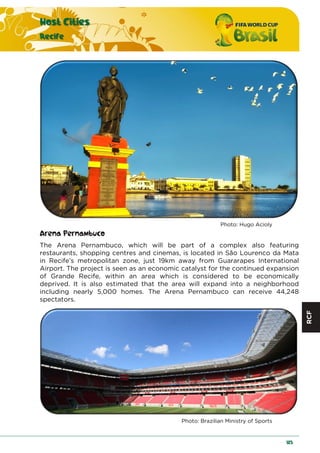
  • 23.
    Host Cities Brasilia 128 2014FIFA WORLD CUP BRAZIL™ – MEDIA GUIDE Football Since a good part of the people living in Brasilia comes from other parts of the country, there is a huge number of fans of Brazil’s most famous football teams, like Flamengo, Corinthians, Atletico-MG and Internacional, only to name four. This passion is reflected in numbers: in 2013 Estadio Nacional Mané Garrincha had the highest average audience between Brazilian stadia – 34,413. But the Federal District has also its own teams, which the most famous are Gama and Brasiliense. Photo: Mary Leal Media Contacts Host City Contacts FIFA Media Officers (FMO) State BRANDIM Cecilia + 55 61 91172894 cecilia.brandim@gmail.com ODRIOZOLA Pekka DAI Jessie Venue Press Officers (VPO) GURTLER Vinicius
  • 24.
    BRS Host Cities Brasilia 129 Estadio Nacional FewBrazilian cities can match Brasilia when it comes to architecture, and the imposing Estadio Nacional Mané Garrincha, named after Brazilian soccer legend Garrincha, is a reflection of that, an arena with seating for 70,042 spectators, making it the second largest of the stadiums hosting matches at the 2014 FIFA World Cup™. In the place where once stood the former Estadio Mané Garrincha, the Estadio Nacional boasts a new facade, metal roof and stands, as well as a lowered pitch enabling unobstructed views from every seat. Founded on carbon neutrality, recycling and complete access via public transport, this environmentally friendly construction project will consolidate Brasilia’s status as a world leader in sustainable urban planning, creating a valuable legacy for other sectors of the local economy. Photo: Pedro Ventura
  • 25.
    Host Cities Brasilia 130 2014FIFA WORLD CUP BRAZIL™ – MEDIA GUIDE
  • 26.
    BRS Host Cities Brasilia 131 Nickname Capitalda Esperança State Distrito Federal Founded 21 April 1960 Population 2.648.532 inhabitants (IBGE/2012) Area / Elevation 5,787 km2 / 1,172 m Location mid-west Brazil Climate The climate is altitude tropical. The air is very dry, especially in winter months. Usually has a stable climate, without extreme temperatures. Aver. Climate June/July 19.3°C 1.4 mm 56.6 % GDP per capita R$ 63,020 Key Econ. Sectors Tourism, Commerce and Services Time Zone GMT-3 Public Transportation The subway system in Brasilia has 24 stations for two lines and a total network with 42 km, which extends through much of the metro- politan area. It also has a system of urban busses linking the various regions of the city and satellite cities. Team Hotel A Team Hotel B Royal Tulip Brasilia Alvorada SHTN, Trecho 01, conjunto 1B, bloco C, Brasília - CEP 70800-200 Brasilia Palace SHTN Trecho 01 conjunto 01 - Asa Norte Brasília - DF - CEP 70800-200 Matches 4 group matches 1 Round of 16 1 Quarter Final Match for 3rd Place Stadium / Venue Estadio Nacional Mané Garrincha
  • 27.
    Host Cities Brasilia 132 2014FIFA WORLD CUP BRAZIL™ – MEDIA GUIDE
  • 28.
    BRS Host Cities Brasilia 133 toAirportStadium from Brasilia Internat. Airport Mané Garrincha Royal Tulip Brasilia Palace Metro- politan Comfort Mercure Eixo 16,8km18,3km17,8km14,6km14,9km14,6km 30/40min25/40min30/40min20/30min20/30min20/30min 25km11,3km11km3,1km2,5km2,5km 35/50min25/35min25/35min5/10min5/10min5/10min 18,3km11,3km9,5km8,7km8,9km8,8km 25/40min25/35min20/30min15/25min15/25min15/25min 19,3km9,2km9,5km700m270m250m 30/45min20/35min20/30min1/5min1/5min1/5min 14,9km1,3km8,7km700m650m600m 20/30min5/10min15/25min1/5min1/5min1/5min 14,4km1,3km8,9km270m650m270m 20/30min5/10min15/25min1/5min1/5min1/5min 14,4km1,3km8,8km250m600m270m 20/30min5/10min15/25min1/5min1/5min1/5min Note:alltimesdisplayedareestimated,trafficconditionswillvary. Mercure Eixo Media/TV Media/ TV VSTH Royal Tulip Brasilia Palace Metro- politan Comfort VSTH Airport Brasilia Internat. Airport Stadium Mané Garrincha
  • 29.
    Host Cities Brasilia –Media accommodation options 134 2014 FIFA WORLD CUP BRAZIL™ – MEDIA GUIDE
  • 30.
  • 32.
    CBA Host Cities Cuiaba 135 The capitalof the state of Mato Grosso, Cuiaba is situated in the exact geographic centre of South America, 2,000 km from both the Atlantic and the Pacific oceans. It was founded in 1719 during the Brazilian Gold Rush, and is home to a number of historical buildings which were declared national heritage sites in 1992. For around 250 years, Cuiaba had a reputation for being a quiet backwater in the mid-west of Brazil. That changed abruptly during the 20th century after the Brazilian government implemented a plan aimed at the economic expansion of the heartland of the country. This resulted in motorways linking Mato Grosso to the states of Goias and Sao Paulo, and within 30 years the population had grown from 57,000 in 1960 to 400,000 in 1990. The enormous 3,538 km2 metropolis of Cuiaba is today home to more than 540,000 people. Photo: Beto Garavello/LUME Cuiaba itself is situated in a unique spot for tourists, located as it is at the nexus of three of the most important and unique ecosystems in Brazil: the grasslands of the Cerrado, the wetlands of the Pantanal and the Amazon. Surrounded by such exuberant natural delights, it is no wonder that Cuiaba is known as the Cidade Verde, or the Green City. The city is also not far from one of the most remarkable natural landscapes in Brazil, the Chapada dos Guimaraes, a national park of 3,300 km2 dotted with archaeological sites, which attracts thousands of visitors every year.
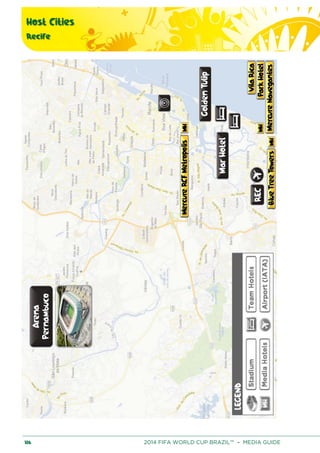
  • 33.
    Host Cities Cuiaba 136 2014FIFA WORLD CUP BRAZIL™ – MEDIA GUIDE Football Mixto Esporte Clube of Cuiaba is the biggest team in the state of Mato Grosso and one of the best supported clubs in the mid-west region. O Tigre hold the record for the most state championship victories, and played in the first division of the Campeonato Brasileiro between 1976 and 1987. Mixto’s main rivals in the city are Cuiaba Esporte Clube and Clube Esportivo Dom Bosco, together with Operario Futebol Clube from the neighbouring town of Varzea Grande. Photo: Beto Garavello/LUME Media Contacts Host City Contacts FIFA Media Officers (FMO) State LOPES Cirlene +55 65 99684460 cirlene.lopez@gmail.com City MORAIS Orlando + 65 8464 8347 orlandomorais@me.com WERZ Andreas IWAMOTO Rina Venue Press Officers (VPO) PONCE Simone
  • 34.
    CBA Host Cities Cuiaba 137 Arena Pantanal Thehost venue’s location on the edge of the flora- and fauna-rich region that is the Pantanal has been reflected in the environmentally sustainable design of the project from the outset. This focus can be seen in every detail of the Arena Pantanal, from the wood used in construction, to the recycling and reuse of building waste in the stadium itself and its access routes. Built especially for the tournament, the Arena Pantanal occupies the site of the old Estadio Jose Fagelli, known as the Verdao. Photo: Alexandre Schneider
  • 35.
    Host Cities Cuiaba 138 2014FIFA WORLD CUP BRAZIL™ – MEDIA GUIDE
  • 36.
    CBA Host Cities Cuiaba 139 Nickname GreenCity State Mato Grosso Founded 8 April 1719 Population 569,830 (IBGE/2013) Area / Elevation 3,538 km2 / 3,538 km2 Location Mid-West of Brazil Climate Humid tropical Aver. Climate June/July 23.5°C 15.9 mm 72 % GDP per capita R$ 22,301.79 Key Econ. Sectors Commerce, Service Industry and Agriculture Time Zone GMT-3 Public Transportation The city has no subway and all mobility structure is based on buses. During the FIFA World Cup™, Cuiaba will offer special lines that are going to integrate various regions of the city with the Arena Pantanal directly. Team Hotel A Team Hotel B Hits Pantanal Av. Arthur Bernardes, 251 - Jardim Aeroporto Varzea Grande MT - CEP 78125-100 Deville Cuiaba Av. Isaac Póvoas, 1000 - Goiabeira, Cuiabá - MT - CEP 78045-200 Matches 4 group matches Stadium / Venue Arena Pantanal
  • 37.
    Host Cities Cuiaba 140 2014FIFA WORLD CUP BRAZIL™ – MEDIA GUIDE
  • 38.
  • 39.
    Host Cities Cuiaba –Media accommodation options 142 2014 FIFA WORLD CUP BRAZIL™ – MEDIA GUIDE
  • 40.
  • 42.
    CUR Host Cities Curitiba 143 Curitiba isthe perfect example of how a city can develop and grow in an organised, responsible fashion. After becoming capital of the state of Parana in 1853, the development of the city was subject to a series of urban planning projects aimed at avoiding unchecked growth. Curitiba has become an example to follow in terms of dealing with sensitive issues of public transport and environmental protection. With 1.8 million inhabitants, the capital of Parana is the most populous city in the south of Brazil. It is also the centrepiece of a prosperous metropolitan area, which ranks fourth in Brazil in terms of contribution to GDP (Gross Domestic Product). Despite its size, Curitiba offers its residents a high quality of life, thanks to its countless parks and a rich, diverse cultural calendar. This cultural diversity can be traced to the waves of immi- gration that arrived in the city during the 20th century. During this period, a large number of German, Italian, Ukrainian and Polish immigrants moved to the south of Brazil. Their influence can be felt in the Italian restaurants of the Santa Felicidade neighbourhood, the Bosque Alemao (“the German Woods”), and the Memorial Ucraniano, a replica of a typical Ukrainian church located in the Parque Tingui. There is certainly no shortage of parks in Curitiba. The city’s desire to preserve green spaces amongst the hustle and bustle of urban life can be seen in oases such as the Parque Tangua, Parque Barigui and the beautyful Jardim Botanico. Another fascinating spot is the Opera de Arame, a wonderful steel and glass building, and the Oscar Niemeyer Museum, designed by the legendary architect himself. Photos: Brazilian Ministry of Sports
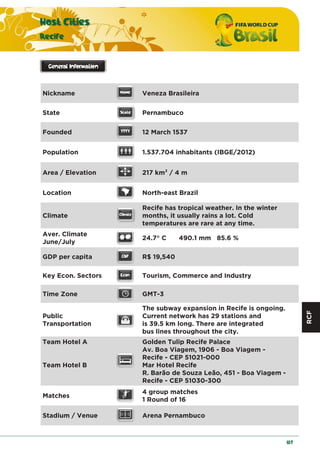
  • 43.
    Host Cities Curitiba 144 2014FIFA WORLD CUP BRAZIL™ – MEDIA GUIDE Football The city is home to two of Brazil’s most famous clubs, Coritiba and Atletico Paranaense. Their rivalry began in 1924 and the Atletiba derby is one of the most important clássicos in the country. Coritiba won the Brazilian title in 1985 and play at the Couto Pereira stadium, while Atletico Paranaense, whose home is the Arena da Baixada, were national champions in 2001. The third team in the city is Parana Clube, formed in 1989 following the merger of two other clubs, Colorado and Pinheiros. The Tricolor play at the Durival de Britto stadium, which was used in the 1950 FIFA World Cup™. Photo: Brazilian Ministry of Sports Media Contacts Host City Contacts FIFA Media Officers (FMO) State LOHMANN Silvio + 55 41 91980235 silvio.lohmann@sesc.pr.gov.br City BORBA Alvaro + 55 41 85350778 alvaroborba@smcs.curitiba.pr.gov.br FRANCIOLI Andre VENTER Rowelna Venue Press Officers (VPO) VINHAS Leonardo
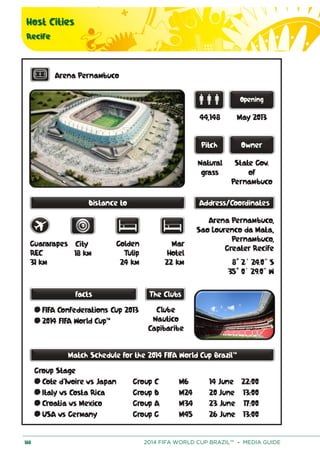
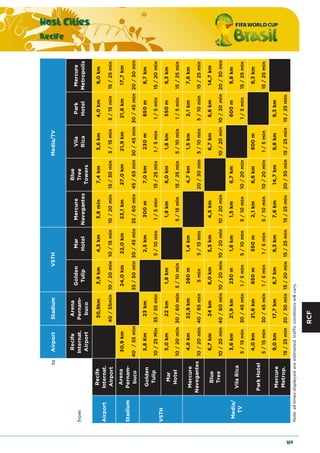
  • 44.
    CUR Host Cities Curitiba 145 Arena daBaixada Atletico Paranaense’s stadium was chosen as the city’s venue for the 2014 FIFA World Cup Brazil™. Originally constructed in 1914, it was modernised more recently, reopening in June 1999. Since this rebuilding work the Estadio Joaquim Americo, more commonly known as the Arena da Baixada, has been considered one of the most modern and well-appointed stadiums in Brazil. To host the World Cup, however, it underwent further expansion and redevelopment work to become a state-of-the-art venue. Photo: Danilo Borges
  • 45.
    Host Cities Curitiba 146 2014FIFA WORLD CUP BRAZIL™ – MEDIA GUIDE
  • 46.
    CUR Host Cities Curitiba 147 Nickname TheCity with a Smile State Parana Founded 29 March 1693 Population 1,848,943 (IBGE/2013) Area / Elevation 434.9 km2 / 934 m Location South of Brazil Climate Humid subtropical, with warm, pleasant summers. Winter in Curitiba is chilly by Brazilian standards and it is the coldest state capital in the country. Aver. Climate June/July 12.2°C 98.1 mm 80.5 % GDP per capita R$ 32,916.44 Key Econ. Sectors Commerce, Services and Industry Time Zone GMT-4 Public Transportation Curitiba has an integrated transport network involving bus and Bus Rapid Transport (BRT) linking Curitiba and its entire metropolitan region, including Sao Jose dos Pinhais, a neighbouring county where the International Airport is located. The city has no subway. Team Hotel A Team Hotel B Pestana Curitiba Rua Comendador Araujo, 499 Batel - CEP 80420-000 Radisson Curitiba Av. Sete de Setembro, 5190, Batel, Curitiba - CEP 80240-000 Matches 4 group matches Stadium / Venue Arena da Baixada
  • 47.
    Host Cities Curitiba 148 2014FIFA WORLD CUP BRAZIL™ – MEDIA GUIDE
  • 48.
    CUR Host Cities Curitiba 149 toAirportStadium from Curitiba Internat. Airport Arenada Baixada Pestana Curitiba Hotel Radisson Hotel Curitiba IbisHotel Batel Mercure Golden Bourbon Express Flat Petras Mercure Batel 18,4km18,1km19,0km18,3km19,0km18,7km18,8km19,8km 40/50min40/50min40/50min30/40min40/50min40/50min40/50min40/50min 18,4km1,9km1,5km3,2km3,0km3,0km3,8km1,1km 40/50min5/10min5/10min10/20min10/20min10/20min10/20min5/10min 18,1km1,9km1,8km210m1,0km1,5km2,4km1,1km 40/50min5/10min5/10min1/5min1/5min5/10min10/15min5/10min 19,0km1,5km1,8km2,7km2,5km1,4km3,9km170m 40/50min5/10min5/10min10/15min10/15min5/10min10/20min1/5min 18,3km3,2km210m2,7km800m1,0km2,5km1,5km 40/50min10/20min1/5min10/15min5/10min5/10min10/15min5/10min 19,0km3,0km1,0km2,5km800m1,5km2,4km2,0km 40/50min10/20min1/5min10/15min5/10min5/10min10/20min10/20min 18,7km3,0km1,5km1,4km1,0km1,5km2,9km2,0km 40/50min10/20min5/10min5/10min5/10min5/10min10/20min10/20min 18,8km3,8km2,4km3,9km2,5km2,4km2,9km3,2km 40/50min10/20min10/15min10/20min10/15min10/20min10/20min10/20min 19,8km1,1km1,1km170m1,5km2,0km2,0km3,2km 40/50min5/10min5/10min1/5min5/10min10/20min10/20min10/20min Note:alltimesdisplayedareestimated,trafficconditionswillvary. VSTHMedia/TV Airport Curitiba Internat. Airport Stadium Arenada Baixada Mercure Batel VSTH Pestana Curitiba Radisson Hotel Media/ TV Ibis Hotel Mercure Golden Bourbon Express Flat Petras
  • 49.
    Host Cities Curitiba –Media accommodation options 150 2014 FIFA WORLD CUP BRAZIL™ – MEDIA GUIDE
  • 50.
  • 52.
    FTL Host Cities Fortaleza 151 With shinydays the most part of the year, Fortaleza is known as “The city of light”, a place with wonderful beaches, gentle people and which history and culture are influenced by native Brazilians and European conquerors. Founded as a village in 1726 by the Portuguese, it became the capital of the state of Ceará in 1799. But the city owes its name to the period between 1637 to 1654, when it was controlled by the Dutch, who built the “Schoonenborch”, or Fort, to defend it from foreign invaders. Fortaleza has been one of the main tourist destinations in the northeast of Brazil for several years. It is an attractive city, not only for people from other parts of the country, but especially for Europeans, because of its geographical position – it takes only a 6h30 flight from Europe. The tourism potential and the public investments over the last years has influenced the growth of Fortaleza, which is a densely populated city with over 2,5 million people living in the metropolitan area. The beaches are really Fortaleza’s most famous attractions: the Praia do Futuro (Future Beach) where one can taste fresh seafood; Iracema with its bars and nightclubs and the bucolic Mucuripe Beach, from where fishermen venture into the sea with their jangadas (handmade wooden boats). The coastal Beira Mar Avenue is also the place for a traditional daily craftsmen's fair and for some of the top spots to dance the forró, a typical rhythm from the northeast of Brazil. Over the decades, as the city built infrastructure to receive visitants, new attractions emerged, like the Centro Dragão do Mar de Arte e Cultura (Sea Dragon Art and Culture Centre) and the Beach Park, Brazil's largest water park, with several cutting-edge speed-slides distributed along 35,000 square kilometres. Photo: Carlos Divulgação SECOPA-CE
  • 53.
    Host Cities Fortaleza 152 2014FIFA WORLD CUP BRAZIL™ – MEDIA GUIDE Football Two of the most popular clubs from the northeast of Brazil come from Fortaleza: Ceará Sporting Club and Fortaleza Esporte Clube. Both teams have historically shared the attention of the fans throughout the whole state of Ceará, as well as the state titles. The two sides have also played important roles in national competitions: Ceará were the runner- ups in the Copa do Brasil in 1994, when they lost to Grêmio, and they reached the semi-finals in 2005, while Fortaleza finished runners-up twice in the Taça Brasil (a predecessor to Campeonato Brasileiro), in 1960 and 1968. The city of Fortaleza offers two main stadiums for the matches involving Ceará, Fortaleza and Ferroviário Esporte Clube: the new Castelão, which will host six 2014 FIFA World Cup™ games, with the capacity to accommodate 64.846 fans and the city-owned Presidente Vargas. Photo: Divulgação SECOPA-CE Media Contacts Host City Contacts FIFA Media Officers (FMO) State CÂMARA Ciro + 55 85 87780024 ciro@secopa.ce.gov.br City SENA Uyara + 55 85 97070033 uyara.sena@fortaleza.ce.gov.br TERÄVÄ Sami DE LA TORRE Stephana Venue Press Officers (VPO) LOPES Lisiane
  • 54.
    FTL Host Cities Fortaleza 153 Castelão Stadium Thepeople of Fortaleza have a passion for the game as well as for the city’s two biggest clubs, Ceará and Fortaleza. And it is an attachment that can only grow with the now completely remodeled Castelão. Built in 1973 and officially known as the Estadio Governador Plácido Castelo, the Castelão is the home to both teams and has been entirely renovated to host matches at the FIFA Confederations Cup Brazil 2013 and the 2014 FIFA World Cup Brazil™. As well as having its capacity increased to 64,846, the revamped stadium has an underground car park with 1,900 spaces, executive boxes, a VIP area, media centre, mixed zone and fully refurbished dressing rooms. In addition, a new roof now covers all its tiers, including the pitchside ring of seating. Access to the Castelão has also been upgraded, with the creation of four exclusive bus lanes and a LRV (light rail vehicle) lines, making it far easier for fans to reach the stadium and the complex it is part of, which will house restaurants, cinemas, a hotel and an Olympic centre. The Castelão was the venue for the Seleção’s second group match at 2013 FIFA Confederations Cup, against Mexico. The support from the home team fans was amazing, boosting Brazilians players to beat the Mexicans 2:1. The two teams will meet again on that same ground now at 2014 FIFA World Cup™ on 17 June. Photo: Fabio Lima
  • 55.
    Host Cities Fortaleza 154 2014FIFA WORLD CUP BRAZIL™ – MEDIA GUIDE
  • 56.
    FTL Host Cities Fortaleza 155 Nickname Terrada Luz State Ceará Founded 13 April 1726 Population 2.500.194 inhabitants (IBGE/2012) Area / Elevation 313 km2 / 21 m Location North-east Brazil Climate Fortaleza has a typical tropical climate, with high temperatures and high relative humidity. However, the winds help to alleviate the intense heat feeling. Aver. Climate June/July 26.1° C 156.4 mm 81.1 % GDP per capita R$ 11,931.48 Key Econ. Sectors Tourism, Commerce and Industry Time Zone GMT-3 Public Transportation The subway network in Fortaleza is being deployed, with 29 stations already in operation. The city has a good number of buses in an integrated system by terminals. Team Hotel A Team Hotel B Marina Park Av. Presidente Castelo Branco, 400 Praia de Iracema - CEP 60312-060 Luzeiros Fortaleza Av. Beira Mar, 2600 - Meireles Fortaleza - CEP 60165-121 Matches 4 group matches 1 Round of 16 1 Quarter-Final Stadium / Venue Estadio Castelao
  • 57.
    Host Cities Fortaleza 156 2014FIFA WORLD CUP BRAZIL™ – MEDIA GUIDE
  • 58.
  • 59.
    Host Cities Fortaleza –Media accommodation options 158 2014 FIFA WORLD CUP BRAZIL™ – MEDIA GUIDE
  • 60.
  • 62.
    MAN Host Cities Manaus 159 One ofthe most remarkable things about Manaus is its location at the confluence of the Rio Negro and the Rio Solimoes, which together form a continuation of the Rio Amazonas. The dark waters of the Negro and the muddy waters of the Solimoes flow side by side for 18 km, divided as though by an invisible barrier, creating one of the most majestic sights in the Amazon region. Manaus evolved constantly following its foundation in 1669, first becoming the capital of the state of Amazonas and finally the great metropolis that it is today. It is currently the 12th biggest city in Brazil, with almost 2,000,000 residents, and has been the region’s main economic hub since it was designated a Free Trade Zone. Photos: Brazilian Ministry of Sports The combination of the natural beauty that flourishes in and around the city, a rich local culture, and the energy of a growing metropolis give Manaus a unique atmos- phere, reflected in attractions such as the Teatro Amazonas – a concert hall that is home to the annual Festival Amazonas de Opera – and Boi Manaus (“Manaus Bull”), a festival that celebrates the anniversary of the city and is fuelled by the infectious rhythms of the Boi-Bumba dance.
  • 63.
    Host Cities Manaus 160 2014FIFA WORLD CUP BRAZIL™ – MEDIA GUIDE Football As home to most the football clubs in the state of Amazonas, Manaus does not lack local rivalries. Nacional Futebol Clube hold the record for most state championship titles, but in the recent years Sao Raimundo Esporte Clube have caught the attention of football fans across Brazil with impressive displays in the Copa do Brasil. Atletico Rio Negro Clube, Nacional Fast Club and America Futebol Clube are the other major teams in the city. Photo: Brazilian Ministry of Sports Media Contacts Host City Contacts FIFA Media Officers (FMO) State GAMBOA Eric + 55 92 88018793 press@copa2014.am.gov.br City BRILHANTE Mayara + 55 92 88427357 mayara.brilhante@gmail.com PEARCE-McMENAMIN Jayne BERENDT Lars Venue Press Officers (VPO) GUTERRES Bruno
  • 64.
    MAN Host Cities Manaus 161 Arena Amazonia ArenaAmazonia, built on the site of the old Estadio Vivaldao, may not be one of the most historic football stadiums in Brazil, but it is certainly one of the most beautiful. Moreover, it is sure to attract supporters in huge numbers due to its unique location in the heart of the world’s largest tropical rainforest. With architecture inspired by the forest itself, the stadium incorporates a metal structure similar to the traditional straw baskets of the region, which protects the outside of the stands. All the material used in the demolition of the old Vivaldao was used in the construction of the new stadium, or donated for use in other grounds in Amazonas. Photo: Jose Zamith de Oliveira Filho
  • 65.
    Host Cities Manaus 162 2014FIFA WORLD CUP BRAZIL™ – MEDIA GUIDE
  • 66.
    MAN Host Cities Manaus 163 Nickname Parisof the Tropics State Amazonas Founded 24 October 1669 Population 1,982,179 (IBGE/2013) Area / Elevation 11,401 km2 / 92 m Location North of Brazil Climate Humid tropical, with an average annual temperature of 26°C and high levels of humidity. Aver. Climate June/July 26.4°C 113.6 mm 83 % GDP per capita R$ 27,845.71 Key Econ. Sectors Industry, Services and Tourism Time Zone GMT-4 Public Transportation Buses are the best transportation option in Manaus. The unique form of public transporta- tion offers are buses. With terminals that integrate all parts of the city, Manaus has 222 bus lines and 1,421 vehicles. Team Hotel A Team Hotel B Blue Tree Premium Av. Paraiba, 2900, Adrianopolis, Manaus Quality Manaus Av. Mario Ypiranga, 1090, Adrianópolis, CEP 69057-002 Matches 4 group matches Stadium / Venue Arena Amazonia
  • 67.
    Host Cities Manaus 164 2014FIFA WORLD CUP BRAZIL™ – MEDIA GUIDE
  • 68.
    MAN Host Cities Manaus 165 toAirportStadium from Manaus Internat. Airport Arena Amazonia BlueTree Premium Quality Inn Ibis Manaus Holiday Inn Sleep Inn 10,9km13,9km14,2km21,0km19,0km18,9km 15/25min20/30min20/30min25/35min25/35min25/35min 10,9km5,7km5,1km12,0km10,5km10,9km 15/25min15/25min15/25min15/25min20/30min20/30min 13,9km5,7km900m5,6km5,9km5,5km 20/30min15/25min5/10min15/25min15/25min15/25min 14,2km5,1km900m6,8km8,9km9,3km 20/30min15/25min5/10min20/30min15/25min15/25min 21,0km12,0km5,6km6,8km1,7km1,3km 25/35min15/25min15/25min20/30min15/25min10/20min 19,0km10,5km5,9km8,9km1,7km400m 25/35min20/30min15/25min15/25min15/25min1/5min 18,9km10,9km5,5km9,3km1,3km400m 25/35min20/30min15/25min15/25min10/20min1/5min Note:alltimesdisplayedareestimated,trafficconditionswillvary. Media/TV Airport Manaus Airport Stadium Arena Amazonia Media/ TV Ibis Manaus Holiday Inn Sleep Inn VSTH VSTH Blue Tree Quality Inn
  • 69.
    Host Cities Manaus –Media accommodation options 166 2014 FIFA WORLD CUP BRAZIL™ – MEDIA GUIDE
  • 70.
  • 72.
    NTL Host Cities Natal 167 Known asthe Cidade do Sol – the City of Sun – thanks to its predominantly sunny weather and average annual temperature of 28°C, Natal is one of the gems of Brazil's northeast region. With breathtaking natural beauty, particularly its stunning beaches and enormous, rolling sand dunes, Natal is Brazil's closest city to Europe. Founded on 25 December 1599 when Brazil was still a Portuguese colony, today Natal is the second-smallest of Brazil's state capitals by area, and sixth-biggest state capital by popu- lation density. The local economy is based on various areas of commerce and services, including health and education. The city's large-scale industrial complexes are also of note. Historically, Natal was a battleground between the Portuguese and French pirates, which had taken control of the Rio Grande do Norte captaincy around the year 1600. The dispute – and the subsequent Portuguese victory – gave rise to the Forte do Reis Magos (Fortress of the Magi), which remains an architectural landmark for the entire state of Rio Grande do Norte to this day. Photos: Brazilian Ministry of Sports
  • 73.
    Host Cities Natal 168 2014FIFA WORLD CUP BRAZIL™ – MEDIA GUIDE Football The three main football clubs in the state of Rio Grande do Norte are based in Natal: Alecrim, ABC and America de Natal, with the latter two accounting for 83 state titles between them. Of the three, America de Natal have most recently competed in the Campeonato Brasileiro, playing their last Serie A game in 2007. ABC, for their part, last graced the top flight in 1985. Photo: Brazilian Ministry of Sports Media Contacts Host City Contacts FIFA Media Officers (FMO) State ALVES Inamar + 55 84 88161973 inamarjornalista@gmail.com City FREITAS Heverton + 55 84 88266582 hevertonfrei@gmail.com AHLSTRÖM Frits VALENTIN Ségolène Venue Press Officers (VPO) LACERDA Sthefânia
  • 74.
    NTL Host Cities Natal 169 Estadio dasDunas Built where the Estadio Joao Machado, better known as the Machadao, used to stand, the Estadio das Dunas is a multipurpose stadium that will host four 2014 FIFA World Cup Brazil™ matches. Temporary stands put up for the tournament will allow it to welcome 42,000 people. After the tournament, the venue is planned to have a permanent capacity of 31,000. The name “Estadio das Dunas” (literally “Arena of the Dunes”) pays homage to the waves of sand dunes which adorn the landscape of the state capital. Photo: Brazilian Ministry of Sports
  • 75.
    Host Cities Natal 170 2014FIFA WORLD CUP BRAZIL™ – MEDIA GUIDE
  • 76.
    NTL Host Cities Natal 171 Nickname Cidadedo Sol (City of Sun) State Rio Grande do Norte Founded 25 December 1599 Population 853,929 (IBGE/2013) Area / Elevation 167,273km2 / 30m Location North-east Brazil Climate The climate is tropical and humid, characteri- sed by an average annual temperature around 28°C and around 300 days of sunshine a year. Aver. Climate June/July 26.6°C 288.5 mm 82.5 % GDP per capita R$15,129.28 Key Econ. Sectors Commerce, Services, Industry Time Zone GMT-3 Public Transportation Natal doesn’t have subway and the public transportation is based on buses. Actually, Natal has 91 municipal lines with a fleet of 630 vehicles and more 10 alternative lines made by minibus. Team Hotel A Team Hotel B Pestana Natal Beach Resort Av. Senador Dinarte de Medeiros Mariz, 5525, Via Costeira - CEP 59090-001 Serhs Natal Grand Hotel Av. Sen. Dinarte Medeiros Mariz, 6045 - Via Costeira - Ponta Negra, Natal - CEP 59090-002 Matches 4 group matches Stadium / Venue Estadio das Dunas
  • 77.
    Host Cities Natal 172 2014FIFA WORLD CUP BRAZIL™ – MEDIA GUIDE
  • 78.
    NTL Host Cities Natal 173 toStadium from Augusto Severo Internat. Airport São Gonçalo Internat. Airpoirt Arena das Dunas Pestana Natal Beach Resort Sehrs Natal Grand Resort HotelD Beach Holiday InnNatal Paradise FlatHotel Intercity Premium 30,6km12,5km19,1km18,0km14,0km12,0km12,6km16,5km 40/50min10/20min20/30min25/35min10/20min10/20min10/20min15/25min 30,6km28,0km44,9km43,1km42,5km40,8km41,0km31,2km 40/50min25/35min50/60min50/60min40/50min40/50min40/50min30/40min 12,5km28,0km13,2km12,0km10,5km8.9km9,0km6,2km 10/20min25/35min20/30min20/30min25/35min15/25min15/25min15/25min 19,1km44,9km13,2km1,5km5,6km3,9km4,1km6,4km 20/30min50/60min20/30min1/5min10/20min5/15min5/15min15/25min 18,0km43,1km12,0km1,5km4,1km2,4km2,6km8,8km 25/35min50/60min20/30min1/5min10/20min5/15min5/15min15/25min 14,0km42,5km10,5km5,6km4,1km2,3km1,9km11,9km 10/20min40/50min25/35min10/20min10/20min5/15min5/15min15/25min 12,0km40,8km8.9km3,9km2,4km2,3km650m10,2km 10/20min40/50min15/25min5/15min5/15min5/15min1/5min15/25min 12,6km41,0km9,0km4,1km2,6km1,9km650m10,5km 10/20min40/50min15/25min5/15min5/15min5/15min1/5min15/25min 16,5km31,2km6,2km6,4km8,8km11,9km10,2km10,5km 15/25min30/40min15/25min15/25min15/25min15/25min15/25min15/25min Note:alltimesdisplayedareestimated,trafficconditionswillvary. VSTH Pestanal Natal Sehrs Natal VSTHMedia/TV ASevero Airpoirt SGonçalo Airport Airport Airport Stadium Arena dasDunas Media/ TV HotelD Beach Holiday InnNatal Paradise Flat Intercity Premium
  • 79.
    Host Cities Natal –Media accommodation options 174 2014 FIFA WORLD CUP BRAZIL™ – MEDIA GUIDE
  • 80.
  • 82.
    PTA Host Cities Porto Alegre 175 Thecapital of Brazil's southernmost state of Rio Grande do Sul, which borders Uruguay and Argentina – countries which have also qualified for the 2014 FIFA World Cup Brazil™, is home to around 1.5 million inhabitants. Its society has been strongly influenced by the culture and customs of the German, Italian, Portuguese and Polish immigrants who arrived in Porto Alegre as a result of great waves of European migration here in the 19th and 20th centuries. Different from most of Brazil, the climate in Porto Alegre is classed as “humid subtropical”, characterised by its well-defined seasons, with scorching summers and harsh winters. The average temperature for the months of June and July is around 15°C, but temperatures close to or even below freezing are not uncommon during the cold nights that this season brings. Photo: Brazilian Ministry of Sports Even if the cold is unwelcome, the UN has named Porto Alegre as the city with the best top living standards in Brazil on three occasions, with the best Human Development Index (HDI) among the country's major cities. Photo: Alfonso Abraaham
  • 83.
    Host Cities Porto Alegre 1762014 FIFA WORLD CUP BRAZIL™ – MEDIA GUIDE Football Porto Alegre's near 1.5 million inhabitants are split inexorably into two groups when it comes to football. Part of the city wears the red of Sport Club Internacional, whereas the other part dons the blue, black and white of Gremio Football Porto Alegrense. Fanatical about their clubs, the Colorados and the Gremistas worship the Gre-Nal, the name given to the derby between the two teams, considered one of the fiercest club battles on the planet. Photo: Brazilian Ministry of Sports Media Contacts Host City Contacts FIFA Media Officers (FMO) State ElY Nathalia + 55 51 85953423 nathalia@sel.rs.gov.br City MACHADO João + 55 51 91028295 joao.filho@secopa.prefpoa.com.br HONAUER Urs MEHIRI Ramla Venue Press Officers (VPO) TODESCHINI Marcos
  • 84.
    PTA Host Cities Porto Alegre 177 EstadioBeira-Rio In front of Guaiba Lake, the Beira-Rio – home to Sport Club Internacional – has been through a major makeover to welcome the second FIFA World Cup™ that Brazil has hosted. The first in 1950, when Porto Alegre was also a host city, was played in the former Estadio dos Eucaliptos. For the 2014 FIFA World Cup™, the Estadio Beira-Rio (literally “Riverside Stadium”) was completely reformed and has been designed to allow capacity for 51,800 fans. Photo: FotoME
  • 85.
    Host Cities Porto Alegre 1782014 FIFA WORLD CUP BRAZIL™ – MEDIA GUIDE
  • 86.
    PTA Host Cities Porto Alegre 179 Nickname Capitaldos Gaúchos (where Gaúchos refers to people from the state), PoA State Rio Grande do Sul Founded 26 March 1772 Population 1,467,823 (IBGE/2013) Area / Elevation 496,827 km2 / 10 m Location Southern Brazil Climate The climate is humid subtropical, characterised by well-defined seasons with hot summers and harsh winters. The average annual temperature varies between 10°C and 21°C. Aver. Climate June/July 15.1°C 132.7 mm 79 % GDP per capita R$32,203.11 Key Econ. Sectors Agriculture, Livestock, Industry Time Zone GMT-3 Public Transportation Porto Alegre has no subway, but the city offers buses, taxis and Trensurb as public transportation that connects the city and the metropolitan area. Some bus companies have partnered with Trensurb for integration. Team Hotel A Team Hotel B Holiday Inn Porto Alegre Av. Carlos Gomes, 565, Bela Vista, Porto Alegre - CEP 90480-003 Deville Porto Alegre Aeroporto Av. dos Estados,1909 - São João, Porto Alegre - CEP 90200-001 Matches 4 group matches 1 Round of 16 Stadium / Venue Estadio Beira-Rio
  • 87.
    Host Cities Porto Alegre 1802014 FIFA WORLD CUP BRAZIL™ – MEDIA GUIDE
  • 88.
    PTA Host Cities Porto Alegre 181 toAirportStadium from PortoAlegre Internat. Airport Estadio Beira-Rio Deville Holiday Inn Conti- nental QualityNovotelIntercity Ibis Aeroporto 12,6km2,5km6,9km8,0km8,0km9,0km3,6km2,1km 30/40min10/15min20/25min25/30min25/30min25/30min15/20min10/15min 12,6km13,7km10km5,9km8,4km10,6km11km16km 30/40min30/40min30/35min20/25min25/30min25/30min30/35min40/45min 2,5km13,7km6,2km7,4km7,1km8,4km3,0km3,2km 10/15min30/40min20/25min25/30min25/30min30/35min10/15min10/15min 6,9km10km6,2km3,3km3,6km2,2km4,9km7,8km 20/25min30/35min20/25min10/15min15/20min10/15min20/25min25/30min 8,0km5,9km7,4km3,3km4,3km6,5km4,5km8,4km 25/30min20/25min25/30min10/15min10/15min20/25min15/20min25/30min 8,0km8,4km7,1km3,6km4,3km4,3km4,2km8,2km 25/30min25/30min25/30min15/20min10/15min15/20min15/20min25/30min 9,0km10,6km8,4km2,2km6,5km4,3km5,1km8,0km 25/30min25/30min30/35min10/15min20/25min15/20min20/25min25/30min 3,6km11km3,0km4,9km4,5km4,2km5,1km4,6km 15/20min30/35min10/15min20/25min15/20min15/20min20/25min15/20min 2,1km16km3,2km7,8km8,4km8,2km8,0km4,6km 10/15min40/45min10/15min25/30min25/30min25/30min25/30min15/20min Note:alltimesdisplayedareestimated,trafficconditionswillvary. VSTHMedia/TV Airport PortoAlegre Airpoirt Stadium Estadio Beira-Rio Ibis Aeroporto VSTH Deville Holiday Inn Media/ TV Continental Quality Novotel Intercity
  • 89.
    Host Cities Porto Alegre– Media accommodation options 182 2014 FIFA WORLD CUP BRAZIL™ – MEDIA GUIDE
  • 90.
  • 92.
    RCF Host Cities Recife 183 A citymoved by music and football, with beautiful beaches and great gastronomy. This is Recife, the capital of the state of Pernambuco. From the rhythm of Frevo to the thrill of the great duels between Santa Cruz, Sport Clube do Recife and Naútico, three of Brazil’s most traditional football clubs, it’s impossible to leave Recife without enjoying wonderful times. With nearly 3.7 million people in the metropolitan area, which includes another 13 cities, like Olinda and Jaboatão dos Guararapes, Recife is called “the capital of the Northeast”. Like Fortaleza, in the state of Ceará, the history of Recife is influenced by the struggle between Portugal and Netherlands for the control of commercial roots in the South Atlantic in the 17th century. As the Dutch West India Company dominated the region – the city was taken from the Portuguese garrison in 1630 – Maurice of Nassau disembarked in Recife in 1637 and ordered the construction of bridges, canals and levees of the then-called Mauritsstad or Maurice City, which was the capital of the Dutch colonies in the Americas. Maurice of Nassau's term only lasted until 1644, but Recife inherited its architectural legacy that eventually led to the nickname “the Brazilian Venice”. Photo: Rafa Medeiros Because of the Dutch presence and the several twists of fate over its history, besides the tropical climate and the spectacular beaches that are common to the northeastern coast of Brazil, the region of Recife is also prolific on historical attributes, such as the Orange Fort and the very city of Olinda, which was declared a world heritage site by UNESCO in 1982. But Recife’s most visited tourist attractions are really the beaches. Not only the ones found in the urban area, like Boa Viagem, Pina and Piedade, which together have nearly 8km of sand and warm water, but also some natural paradises like Porto de Galinhas, which stands among the top tourist destinations in the country and is located some 70 km away from Recife. Like in other parts of Brazil, it is possible to enjoy the sun and the sea while partying in the streets of Recife. Especially during Carnival, when the seaside streets and avenues gather millions of people dancing Frevo and Macaratu, two of Pernambuco’s most famous rhythms. While in the city centre, always on the first saturday of the Carnival, a huge crowd follows the steps of the Galo da Madrugada, the biggest carnival block in the world, with nearly two million participants.
  • 93.
    Host Cities Recife 184 2014FIFA WORLD CUP BRAZIL™ – MEDIA GUIDE Football One say that football is passion. And in Recife this is very true. It is a tough task to determine which of the three top clubs of the state of Pernambuco relies on a more passionate fan base; Sport Club do Recife, Santa Cruz Futebol Clube or Clube Náutico Capibaribe. All three teams have had glorious moments, although Sport stand slightly apart from their competitors thanks to two major national titles: the 1987 Campeonato Brasileiro and 2008 Copa do Brasil. Sport and Santa Cruz own private stadia – Ilha do Retiro and Arrudão – respectively, while the new Arena Pernambuco is hosting Nautico’s games since 2013. Photo: Rafa Medeiros Media Contacts Host City Contacts FIFA Media Officers (FMO) State MARINHO Bruno + 55 81 91150114 bruno@exclusivabr.com City ARAUJO Fabio + 55 81 94886307 esportecopa.pcr@gmail.com KUKAWKA Christophe LIU Lingling Venue Press Officers (VPO) MEGALE Thiago
  • 94.
    RCF Host Cities Recife 185 Photo: HugoAcioly Arena Pernambuco The Arena Pernambuco, which will be part of a complex also featuring restaurants, shopping centres and cinemas, is located in São Lourenco da Mata in Recife’s metropolitan zone, just 19km away from Guararapes International Airport. The project is seen as an economic catalyst for the continued expansion of Grande Recife, within an area which is considered to be economically deprived. It is also estimated that the area will expand into a neighborhood including nearly 5,000 homes. The Arena Pernambuco can receive 44,248 spectators. Photo: Brazilian Ministry of Sports
  • 95.
    Host Cities Recife 186 2014FIFA WORLD CUP BRAZIL™ – MEDIA GUIDE
  • 96.
    RCF Host Cities Recife 187 Nickname VenezaBrasileira State Pernambuco Founded 12 March 1537 Population 1.537.704 inhabitants (IBGE/2012) Area / Elevation 217 km2 / 4 m Location North-east Brazil Climate Recife has tropical weather. In the winter months, it usually rains a lot. Cold temperatures are rare at any time. Aver. Climate June/July 24.7° C 490.1 mm 85.6 % GDP per capita R$ 19,540 Key Econ. Sectors Tourism, Commerce and Industry Time Zone GMT-3 Public Transportation The subway expansion in Recife is ongoing. Current network has 29 stations and is 39.5 km long. There are integrated bus lines throughout the city. Team Hotel A Team Hotel B Golden Tulip Recife Palace Av. Boa Viagem, 1906 - Boa Viagem - Recife - CEP 51021-000 Mar Hotel Recife R. Barão de Souza Leão, 451 - Boa Viagem - Recife - CEP 51030-300 Matches 4 group matches 1 Round of 16 Stadium / Venue Arena Pernambuco
  • 97.
    Host Cities Recife 188 2014FIFA WORLD CUP BRAZIL™ – MEDIA GUIDE
  • 98.
    RCF Host Cities Recife 189 toAirportStadium from Recife Internat. Airport Arena Pernam- buco Golden Tulip Mar Hotel Mercure Navegantes Blue Tree Towers Vila Rica Park Hotel Mercure Metropolis 30,9km3,9km4,3km3,8min7,4km3,6km4,0km9,0km 40/55min10/20min10/15min10/20min15/30min5/15min5/15min15/25min 30,9km24,0km22,0km23,1km27,0km21,9km21,6km17,7km 40/55min35/50min30/45min35/60min45/65min30/45min30/45min20/30min 5,8Km23km2,5km300m7,0km230m850m8,7km 10/25Min35/55min5/10min1/5min15/25min1/5min1/5min15/20min 5,0km22km1,8km1,9km6,0km1,8km550m9,3km 10/20min30/60min5/10min5/15min15/25min5/10min1/5min15/25min 4,8km22,9km260m1,4km4,7km1,5km2,1km7,6km 10/20min40/65min5min5/15min20/30min5/10min5/10min15/25min 6,7km24km6,0km5,5km4,5km6,7km6,6km14,7km 10/20min40/60min10/20min10/20min10/20min10/20min10/20min20/30min 3,6km21,9km230m1,8km1,5km6,7km600m9,8km 5/15min30/45min1/5min5/10min5/10min10/20min1/5min15/25min 4,0km21,6km850m550m2,1km6,6km600m9,3km 5/15min30/45min1/5min1/5min5/10min10/20min1/5min15/25min 9,0km17,7km8,7km9,3km7,6km14,7km9,8km9,3km 15/25min20/30min15/20min15/25min15/25min20/30min15/25min15/25min Note:alltimesdisplayedareestimated,trafficconditionswillvary. VSTHMedia/TV Airport Recife Internat. Airport Stadium Arena Pernam- buco Mercure Metrop. VSTH Golden Tulip Mar Hotel Media/ TV Mercure Navegantes Blue Tree VilaRica ParkHotel
  • 99.
    Host Cities Recife –Media accommodation options 190 2014 FIFA WORLD CUP BRAZIL™ – MEDIA GUIDE
  • 100.
  • 102.
    RIO Host Cities Rio deJaneiro 191 Friendly and happy people, intense nightlife, lovely beaches and other worldwide famous tourist attractions like Pão de Açucar and Cristo Redentor. A place where nature, art and culture live together in perfect harmony. This is Rio de Janeiro, a fantastic city, chosen to host seven games during 2014 FIFA World Cup™, including the final. Founded on 1 March 1565 by the Portuguese Estácio de Sá, Rio de Janeiro was the second capital of Brazil, after Salvador, from 1763 to 1960. Preserving many memories from this time, the city has a strong cultural and economic role and it is Brazil’s most important gateway for visitors as well as Latin America’s number one tourist destination. It has the second largest GPD in the country, estimated at about R$ 209 billion. Highlights of the calendar are News Year’s Eve celebrations and Carnaval. On the 31st of December, the fireworks show at the beaches, especially Copacabana, usually gathers as much as 2 million people. During Carnaval, the Samba School’s show at Sambódromo and the more than 400 carnival clubs that parade through the streets of the city grasp millions of cariocas and tourist from all parts of Brazil and the world. In Rio, the most visited places are Pão de Açucar and Cristo Redentor, from where one can have a breath taking view from the whole city. And from above, it’s possible to see another symbol of the city: Maracanã. Photo: Divulgação RioTur Built to host eight games of the 1950 FIFA World Cup™, the temple of Brazilian football has a long list of historical moments. Starting with fateful 1-2 loss of the home country to Uruguay at the FIFA World Cup™ final, shocking more than 200.000 fans at the stadium. It was there also that Pelé scored his thousandth goal on 19 November 1969. For those who decide to explore Rio’s nearby cities, there are very different and attractable options. One can choose between the fantastic beaches in Buzios, Cabo Frio, Angra dos Reis and Paraty, or a trip to the mountain in places like Petrópolis, Teresópolis and Nova Friburgo, with climates and customs that, somehow, resemble European cities.
  • 103.
    Host Cities Rio deJaneiro 192 2014 FIFA WORLD CUP BRAZIL™ – MEDIA GUIDE Football Rio de Janeiro is the very depiction of Brazilian football, with all forms of ball games taking on its streets, public parks and beaches. It comes as no surprise, then, that the city is the birthplace of such world-renowned players as Jairzinho, Zico and Ronaldo, to name but a few. Four of Brazil's biggest and most popular clubs are based in the Cidade Maravilhosa: Botafogo, Fluminense, Vasco da Gama and Flamengo, the club with the country's biggest fan base, of more than 40 million aficionados. Football is like a religion for the cariocas and the mythical Maracanã, arguably the most famous and once the largest stadium in the world was completely renewed for the FIFA Confederations Cup, in order to offer absolute comfort while still being the largest stadium in Brazil as a 75,117-seater. In the tournament final Brazil beat Spain 3-0. The Engenhão, which was built as a venue for the Pan-American Games in 2007 and will be used in the 2016 Olympic Games, is currently undergoing main- tenance. Vasco owns the São Januário, a very charming stadium built in the 1920s. Photo: Divulgação RioTur Media Contacts Host City Contacts FIFA Media Officers (FMO) State ROCHA Cristiana + 55 21 980298887 crisrocha@gmail.com City MATOS Marcelo + 55 21 985559345 marcelo.rioeventos@gmail.com BAPTISTA Jorge DE BACKER Thierry Venue Press Officers (VPO) DANZIGER Rolf
  • 104.
    RIO Host Cities Rio deJaneiro 193 Photo: Divulgação RioTur Estadio do Maracana Built for the 1950 FIFA World Cup Brazil™, the Estadio Jornalista Mario Filho, better known as Maracana, provided the venue for that year’s truly memorable decider between the host nation and Uruguay, one of the most dramatic chapters in the history of the competition. The Rio de Janeiro stadium will be in the limelight once again at Brazil 2014, hosting seven games in all, more than any other venue. Among those matches will be the Final on 13 July. Once the largest stadium in the world, packing in crowds of up to 200,000 – among the highest attendances ever seen in the history of the game – Maracana will have a reduced capacity of 76,935 for the 2014 FIFA World Cup Brazil™. It remains, nevertheless, the country’s biggest football ground. Respecting the original layout of the stadium, the project for its refurbishment includes the demolition of the lower ring of seats, the construction of a new ring offering improved visibility, the expansion of the access ramps and the replacement of all seating. The stadium will also be fitted with a new roof complete with a rainwater collection system. The facade, which has been listed by the National Institute of Historical and Artistic Heritage, will remain untouched.
  • 105.
    Host Cities Rio deJaneiro 194 2014 FIFA WORLD CUP BRAZIL™ – MEDIA GUIDE
  • 106.
    RIO Host Cities Rio deJaneiro 195 Nickname Cidade Maravilhosa State Rio de Janeiro Founded 1 March 1565 Population 6.429,922 inhabitants Area / Elevation 1,200 km2 / 31 m Location south-east Brazil Climate Rio de Janeiro has tropical climate, with hot weather and rains from December to March. It is common to see temperatures above 40°C (104°F) during summer. Aver. Climate June/July 23.1°C 47.1 mm 72.7 % GDP per capita R$ 32,940.23 Key Econ. Sectors Tourism, Commerce, Industry, Construction Time Zone GMT-3 Public Transportation The city has good and very diverse public transport options. The most comfortable is the subway, which connects various areas of the South, Central and North Zones, and offers bus integration to other diverse areas such as Barra da Tijuca. The whole network has 36 stations, two of them very close to Maracanã: “Maracanã” and “São Cristovão”. The city has a new BRT (Bus Rapid Transport) network in operation. One line links Campo Grande and Santa Cruz at the West Zone to Barra da Tijuca. The other will be active before the FIFA World Cup™ and will link Rio de Janeiro International Airport to Barra da Tijuca. The city has also nearly 440 regular bus lines. Team Hotel A Team Hotel B Sheraton Rio Hotel & Resorts Av. Niemeyer, 121 - Vidigal - RJ - CEP 22450-220 Sheraton Barra Hotel & Suites (Radisson) Av. Lúcio Costa, 3150 - Barra da Tijuca - CEP 22620-172 Matches 4 group matches 1 Round of 16 1 Quarter-Final Final Stadium / Venue Maracanã
  • 107.
    Host Cities Rio deJaneiro 196 2014 FIFA WORLD CUP BRAZIL™ – MEDIA GUIDE
  • 108.
    RIO Host Cities Rio deJaneiro 197 toStadium from Santos Dumont Rio Internat. Galeão Maracanã Sheraton Barra Sheraton Rio Rio´s Nice Hotel Rio´s Presidente Hotel California Othon Classic Ibis Copa- cabana 19km8km40km15km8,7km3km10,5km8,9km 20/35min15/30min40/60min20/35min15/35min5/10min15/30min15/35min 19km16km34km27km16,6km16,5km23,3km24,2km 20/40min20/40min30/65min30/60min20/40min20/40min25/45min25/45min 9km18km40km13km6km5,3km12,6km12km 15/35min25/55min45/70min25/40min10/20min10/20min25/40min25/40min 38km37km32km12km24,7km25,5km18,3km19,4km 35/65min35/50min40/70min15/30min25/45min25/45min25/50min25/50min 17km23km15km13km13,8km14,5km6,8km8,2km 25/35min25/55min25/45min20/35min25/40min25/40min10/20min25/40min 8,7km16,6km6km24,7km13,8km9,4km10,0km8,8km 15/35min20/40min10/20min25/45min25/40min25/40min25/40min25/40min 3km16,5km5,3km25,5km14,5km9,4km10,3km9,2km 5/10min20/40min10/20min25/45min25/40min25/40min25/40min25/40min 10,5km23,3km12,6km18,3km6,8km10,0km10,3km1,2km 15/30min25/45min25/40min25/50min10/20min25/40min25/40min1/5min 8,9km24,2km12km19,4km8,2km8,8km9,2km1,2km 15/35min25/45min25/40min25/50min25/40min25/40min25/40min1/5min Note:alltimesdisplayedareestimated,trafficconditionswillvary. AirportVSTHMedia/TV Airport Santos Dumont Rio Internat. Galeão Sheraton Rio StadiumMaracanã VSTH Sheraton Barra Ibis Copacabana Media/ TV Rio´s Nice Hotel Rio´s Presidente Hotel California Othon Classic
  • 109.
    Host Cities Rio deJaneiro – Media accommodation options 198 2014 FIFA WORLD CUP BRAZIL™ – MEDIA GUIDE
  • 110.
  • 112.
    SAL Host Cities Salvador 199 When thePortuguese crown first decided to carry out the endeavour of colonising Brazil, the first urban area to be settled in was Salvador, which was established on 29 March 1549. This is one of the reasons why the coastal city in the country's northeast was one of the main poles of slave trade in South America. As a consequence, Salvador grew under deep influence of Portuguese, Afro-descendents and indigenous alike: a situation that contributed to the cultural richness that typifies the city today. The presence of African elements is all around in Salvador, from the circles of capoeira (a combination of martial art and dance brought to Brazil by African slaves) at the Modelo Market to the beat of the agogôs and atabaques (percussion instruments) in the rites of the Candomblé – a syncretic religion conceived in Brazil. Such African heritage has awarded Salvador with the nickname Roma Negra (Black Rome). Photo: Divulgação Secom/ Prefeitura de Salvador Salvador's privileged topography is one of its most appealing attributes, with a clear division between the Cidade Baixa and Cidade Alta (Low City and High City), both of which are connected to each other by one of the city's most important sights, the Elevador Lacerda. But the ultimate icon of the city is the Pelourinho, which is its historical centre: its churches and colourful colonial buildings have been a World Heritage Site by UNESCO in 1985. Besides being a historical gem and the birthplace of several of Brazil's most significant artists, the capital of the state of Bahia has also grown and developed to become one of the economic centres in the northeast and the country's third-most populous city, with roughly three million residents. Photo: Sergio Pedreira
  • 113.
    Host Cities Salvador 200 2014FIFA WORLD CUP BRAZIL™ – MEDIA GUIDE Football It comes as a surprise to no-one after an edition of the Campeonato Brasileiro when the figures show that a team from Salvador – either Esporte Clube Bahia or Esporte Clube Vitória – topped the attendance average charts. The soteropo- litanos are as mad about football as anyone else in Brazil. The two rivals comfortably dominate the football scene within the state of Bahia, and have an important national background as well: Bahia, the Tricolor, won the Campeonato Brasileiro in 1988 and the Taca Brasil in 1959 (a predecessor of the national championships), while Vitória have collected three North-east Cup titles and were runners-up in the Brasileiro in 1993. The Leão are also famous for housing one of the best youth academies in the country, having produced the likes of FIFA World Cup™ champions Bebeto and Dida. One of the most fantastic moments for one to be in Salvador – only comparable to the city's vivacious Carnival celebrations – is during a Ba-Vi, the famous derby between the two rivals. While Vitória owns the Barradão and EC Bahia plays its home matches at state-owned Pituaçu, the ultimate stage for big matches at the state of Bahia is the Fonte Nova. The former stadium was imploded and a brand new one was built upon the same ground to host the FIFA Confederations Cup and the FIFA World Cup™. Photo: Sergio Pedreira Media Contacts Host City Contacts FIFA Media Officers (FMO) State AMARAL Maisa + 55 71 96724007 maisa.amaral@secopa.ba.gov.br City FARO Flávia + 55 71 99156459 flaviafaro@copa@gmail.com DICKENS Les KUNICK Anja Venue Press Officers (VPO) COUTINHO Caio
  • 114.
    SAL Host Cities Salvador 201 Arena FonteNova The first capital city in Brazil’s history, Salvador will welcome the 2014 FIFA World Cup Brazil™ with a new and already tested, purpose-built stadium with a capacity of more than 48,000. Officially known as the Estadio Octavio Mangabeira, the Fonte Nova was opened on 28 January 1951 and was the venue for many derbies between Esporte Clube Bahia and Esporte Clube Vitória. It was closed in November 2007 and subsequently demolished three years later. The stadium built in its place, the Arena Fonte Nova, is modelled on its predecessor and is covered by a lightweight, metal roof. A public-private joint venture, the complex will house a panoramic restaurant, museum of football, car parks, shops, hotels and a concert hall. Maintaining the proud tradition of the Fonte Nova, the new stadium will host four group matches at the FIFA World Cup™, three of them featuring top- seeded teams, as well as a Round-of-16 match and a quarter-final tie. Photo: Divulgação Secom/Prefeitura de Salvador
  • 115.
    Host Cities Salvador 202 2014FIFA WORLD CUP BRAZIL™ – MEDIA GUIDE
  • 116.
    SAL Host Cities Salvador 203 Nickname Capitalda Alegria State Bahia Founded 29 March 1549 Population 2.883.672 inhabitants Area / Elevation 706 km2 / 65 m below sea level Location North-east Brazil Climate Salvador has a tropical rainforest climate. Temperatures are relatively constant throughout the year, with hot and humid climate. The winter months concentrate most of the rain, which are rare in summer. Aver. Climate June/July 24.4°C 242.3 mm 84 % GDP per capita R$ 14,411,73 Key Econ. Sectors Tourism, Commerce, and Industry Time Zone GMT-3 Public Transportation The city has many bus routes connecting the various regions, in addition to some special buses for tourists, where you can experience the beauty of the place. The subway in Salvador is under construction. Team Hotel A Team Hotel B Team Hotel C Team Hotel D Catussaba Suites Hotel Alameda Praia de Tramandai, 260, Itapuã Salvador - CEP 41600-460 Deville Salvador Rua Passárgada, s/n, Salvador CEP 41620-430 Grand Hotel Stella Maris Praça de Stella Maris, 200 Stella Maris - CEP 41600-500 Novotel Hangar Aeroporto Av. Luis Viana Filho, 13145, São Cristovão Salvador - CEP 41500-300 Matches 4 group matches 1 Round of 16 1 Quarter-Final Stadium / Venue Arena Fonte Nova
  • 117.
    Host Cities Salvador 204 2014FIFA WORLD CUP BRAZIL™ – MEDIA GUIDE
  • 118.
    SAL Host Cities Salvador 205 toAirportStadium from Salvador Internat. Airport Arena Fonte Nova Catussaba Resort Stella Maris Resort Deville Novotel Hangar Aeroporto Web Hotel Salvador Sol Plaza Sleep Sol Victoria Marina 30,2km10,1km11,1km11,2km5,8km13,4km17,4km29,0km 40/75min15/25min15/25min15/25min5/15min25/35min30/40min50/60min 24km24,2km24,6km24,8km22,6km8,3km12,0km5,6km 35/60min35/55min35/60min35/60min25/35min15/25min15/25min10/15min 9,0km23,1km2,0km2,0km8,1km21,4km12,9km30,1km 10/20min35/55min5/15min5/15min10/20min25/35min15/25min30/45min 8,0km28,0km2,0km4,2km9,0km22,2km15,1km31,0km 10/20min40/70min5/15min5/10min15/25min30/40min20/30min30/45min 8,0km21,0km2,2km4,3km8,8km20,4km11,9km28,4km 10/20min30/50min5/15min10min15/25min30/40min20/30min30/45min 5,8km22,6km8,1km9,0km8,8km15,7km14,0km24,4km 5/15min25/35min10/20min15/25min15/25min20/30min20/30min30/40min 13,4km8,3km21,4km22,2km20,4km15,7km5,8km10,4km 25/35min15/25min25/35min30/40min30/40min20/30min15/20min15/25min 17,4km12,0km12,9km15,1km11,9km14,0km5,8km14,0km 30/40min15/25min15/25min20/30min20/30min20/30min15/20min20/30min 29,0km5,6km30,1km31,0km28,4km24,4km10,4km14,0km 50/60min10/15min30/45min30/45min30/45min30/40min15/25min20/30min Note:alltimesdisplayedareestimated,trafficconditionswillvary. Stadium Arena Fonte Nova VSTH Media/ TV Airport Salvador Internat. Airport Media/ TV WebHotel Salvador SolPlaza Sleep SolVictoria Marina VSTH Catussaba Resort Stella Maris Resort Deville Novotel Aeroporto
  • 119.
    Host Cities Salvador –Media accommodation options 206 2014 FIFA WORLD CUP BRAZIL™ – MEDIA GUIDE
  • 120.
  • 122.
    SAO Host Cities Sao Paulo 207 ATerra da Garoa – “The Land of Drizzle”, the affectionate nickname given to Sao Paulo due to its changeable and rainy climate, is the city that will host the 2014 FIFA World Cup Brazil™ opening match on 12 June. Photos: Brazilian Ministry of Sports The city was founded in 1554, attributed to groups of Jesuits roaming the country on a mission to catechise the indigenous peoples who inhabited the continent. As numerous settle- ments were created, clusters began to form, which today make up the biggest city in South America. One of the world's ten most-populous cities, and with a population of over 11 million people, Sao Paulo's allure is not confined to its status as the financial and commercial heart of Brazil. Capital city of an eponymous state, Sao Paulo offers the chance to rub shoulders with people from around 100 different ethnic backgrounds. This mixture resulted in a cosmopolitan, culturally rich metropolis. Sao Paulo offers a wide range of cultural programs to fit all budgets, and is known for its exquisite gastronomic scene of over 12,000 restaurants.
  • 123.
    Host Cities Sao Paulo 2082014 FIFA WORLD CUP BRAZIL™ – MEDIA GUIDE Football Replicating the economic might of the city, Sao Paulo's football teams are among the top clubs in Brazilian football in terms of investment. This financial power, allied with tradition, are reflected in the results on the pitch. The “Iron Trio” – Corinthians, Palmeiras and Sao Paulo – have clinched 18 national titles and won the FIFA Club World Cup three times – 2005 (Sao Paulo), 2002 and 2012 (Corinthians). Aside from the Arena de Sao Paulo, which belongs to Corinthians and will host the opening match of the 2014 FIFA World Cup Brazil™, the city is also home to the Estadio do Morumbi, which has room for 72,000 fans and belongs to Sao Paulo football club, as well as Palmeiras' new stadium, which should be opened early in 2015 and has room for 43,000 spectators. Photo: Brazilian Ministry of Sports Media Contacts Host City Contacts FIFA Media Officers (FMO) State MELO Camila + 55 11 972832257 cmelo@planejamento.sp.gov.br City CINTRA Andre + 55 11 98399950 andrecintras@uol.com.br HAVIK Göran HUSER Monika Venue Press Officers (VPO) FRAGA Fabiana
  • 124.
    SAO Host Cities Sao Paulo 209 Arenade Sao Paulo After years spent dreaming of the chance to build its own stadium, Corinthians – or Sport Club Corinthians Paulista – will finally make thousands of fans' dreams come true with the inauguration of the Arena de Sao Paulo, also known as the Arena Corinthians. Designed to hold over 65,000 fans during the FIFA World Cup™, the stadium is located in the Itaquera region of Sao Paulo and its construction has been heralded as a landmark in the development of the city's East Zone. Photo: Brazilian Ministry of Sports
  • 125.
    Host Cities Sao Paulo 2102014 FIFA WORLD CUP BRAZIL™ – MEDIA GUIDE
  • 126.
    SAO Host Cities Sao Paulo 211 NicknameTerra da Garoa (Land of Drizzle) State Sao Paulo Founded 25 January 1554 Population 11,821,876 (IBGE/2013) Area / Elevation 1,522,986 km2 / 760 m Location South-east Brazil Climate The climate is highland tropical, and is characterised by summer rain and an average annual temperature between 19°C and 27°C. Aver. Climate June/July 20.6°C 74 mm 69.1 % GDP per capita R$42,152.76 Key Econ. Sectors Tourism, Commerce, Services Time Zone GMT-3 Public Transportation Brazil’s biggest city has a modern and exten- sive transportation system that comprises 12 subway and train lines integrated with bus lines. The city has also the largest taxi fleet in the country. Team Hotel A Team Hotel B Hotel Pullman São Paulo Ibirapuera R. Joinville, 515 - Vila Mariana, São Paulo - CEP 04008-011 Grande Mercure Parque do Ibirapuera Rua Sena Madureira, 1355 Bl.1 - Ibirapuera - CEP 04021-051 Matches 4 group matches Round of 16 1 Semi-Final Stadium / Venue Arena de Sao Paulo
  • 127.
    Host Cities Sao Paulo 2122014 FIFA WORLD CUP BRAZIL™ – MEDIA GUIDE
  • 128.
    SAO Host Cities Sao Paulo 213 toStadium from Guarulhos Internat. Airport Congonhas Airport Viracopos Airpoirt Arena Corin- thians Pullman SãoPaulo Ibirapuera Grand Mercure HotelPq. Ibirapuera Comfort Suites Quality Jardins Mercure SãoPaulo Paulista Mercure SãoPaulo Central Towers Tryp Paulista 38,9km115km23,1km33,3km34,5km33,4km32,8km33,0km31,1km31,1km 60/70min90/100min50/60min50/60min50/60min50/60min50/60min50/60min50/60min50/60min 38,9km101km27,2km7,4km4,7km12,1km8,4km8,7km9,7km10,4km 60/70min90/100min40/50min15/25min10/20min20/30min20/30min20/30min20/30min20/30min 115km101km121km97,7km100km90,2km92,3km92,6km95,8km91,1km 80/90min80/90min110/120min75/85min75/85min70/80min70/80min70/80min75/85min70/80min 23,1km27,2km121km26,5km25,2km25,1km23,0km23,7km21,7km23,4km 30/40min40/50min110/120min,50/60min50/60min50/60min50/60min50/60min50/60min50/60min 33,3km7,4km97,7km26,5km2,8km5,3km2,8km2,7km4,0km4,4km 50/60min15/25min75/85min50/60min10/15min20/25min10/15min10/15min15/20min15/20min 34,5km4,7km100km25,2km2,8km7,2km4,6km4,7km4,7km6,4km 50/60min10/20min75/85min50/60min10/15min25/30min15/20min15/20min15/20min20/25min 33,4km12,1km90,2km25,1km5,3km7,2km3,7km3,7km5,5km2,7km 50/60min20/30min70/80min50/60min20/25min25/30min10/15min10/15min20/25min10/15min 32,8km8,4km92,3km23,0km2,8km4,6km3,7km900m2,1km1,7km 50/60min20/30min70/80min50/60min10/15min15/20min10/15min1/5min5/10min5/10min 33,0km8,7km92,6km23,7km2,7km4,7km3,7km900m1,7km1,7km 50/60min20/30min70/80min50/60min10/15min15/20min10/15min1/5min5/10min5/10min 31,1km9,7km95,8km21,7km4,0km4,7km5,5km2,1km1,7km3,0km 50/60min20/30min75/85min50/60min15/20min15/20min20/25min5/10min5/10min10/15min 31,1km10,4km91,1km23,4km4,4km6,4km2,7km1,7km1,7km3,0km 50/60min20/30min70/80min50/60min15/20min20/25min10/15min5/10min5/10min10/15min Note:alltimesdisplayedareestimated,trafficconditionswillvary. AirportVSTHMedia/TV Airport Guarulhos Internat. Congonhas Airport Viracopos Airport Stadium Arena Corinthians VSTH Pullman Ibirapuera Grand Mercure Media/ TV Comfort Suites Quality Jardins Mercure Paulista MercureC. Towers Tryp Paulista
  • 129.
    Host Cities Sao Paulo– Media accommodation options 214 2014 FIFA WORLD CUP BRAZIL™ – MEDIA GUIDE
  • 130.
    PUBLISHING CREDITS Publisher FIFA Fédération Internationale deFootball Association FIFA-Strasse 20 P.O. Box 8044 Zurich Switzerland www.FIFA.com Responsible for contents FIFA, LOC Layout, Infographics Präsentations Consulting Dühmert Im Wiesenring 12 63150 Heusenstamm Germany www.praesentations-consulting.com Images FIFA, LOC, Andrew Boyers, Matthew Childs, Gabriel Rossi/STF, Jamie McDonald, Dean Mouhtaropoulos, Lennart Preiss, Manuel Queimadelos Alonso, Matt King, Marc Eich, Charlie Crowhurst, Laurence Griffiths, Harry Engels, Martin Rose, Adam Pretty, Vladimir Rys, Marc Serota, Amin M. Jamali, Claudio Villa, Christof Koepsel, Francois Nel, LatinContent/STR, Scott Heavey, Mike Hewitt, Alexandre Schneider, Gonzalo Arroyo Moreno, Denis Doyle, Chung Sung-Jun, Christian Petersen, Alex Pazuello, Divulgação RioTur, Divulgação Secom/Prefeitura de Sao Paulo, Action Images, Sergio Pedreira, Julio Avellar, Divulgação Secom/Prefeitura de Salvador, foto-net, Gallo Images, Getty Images Maps and stadium pictures LOC Print and binding DVZ Gráfica e Impressão digital Av. Das Américas, 500 bloco 13C – sala 302, Barra da Tijuca – Rio de Janeiro, RJ CEP: 22640-100, Brazil
  • 131.
  • 132.
    MATCH SCHEDULE Brazil (BRA) Croatia(CRO) Mexico (MEX) Cameroon (CMR) Spain (ESP) Netherlands (NED) Chile (CHI) Australia (AUS) Colombia (COL) Greece (GRE) Côte d’Ivoire (CIV) Japan (JPN) Uruguay (URU) Costa Rica (CRC) England (ENG) Italy (ITA) Switzerland (SUI) Ecuador (ECU) France (FRA) Honduras (HON) Argentina (ARG) Bosnia-Herzegovina (BIH) Iran (IRN) Nigeria (NGA) Germany (GER) Portugal (POR) Ghana (GHA) USA (USA) Belgium (BEL) Algeria (ALG) Russia (RUS) Korea Republic (KOR) Group Matches Round of 16 Quarter-Finals Semi-Finals 3rd Place and Final Belo Horizonte Estadio Mineirao Brasilia Estadio Nacional Cuiaba Arena Pantanal Curitiba Arena da Baixada Fortaleza Estadio Castelao Manaus Arena Amazonia Natal Estadio das Dunas Porto Alegre Estadio Beira-Rio Recife Arena Pernambuco Rio de Janeiro Estadio do Maracana Salvador Arena Fonte Nova Sao Paulo Arena de Sao Paulo Friday, 13June Saturday, 14June Thursday, 12June Sunday, 15June Monday, 16June Tuesday, 17June Wednesday, 18June Thursday, 19June Friday, 20June Saturday, 21June Sunday, 22June Monday, 23June Tuesday, 24June Wednesday, 25June Thursday, 26June Friday, 27June Saturday, 28June Sunday, 29June Monday, 30June Tuesday, 1July Wednesday, 2July Thursday, 3July Friday, 4July Saturday, 5July Sunday, 6July Monday, 7July Tuesday, 8July Wednesday, 9July Thursday, 10July Friday, 11July Saturday, 12July Sunday, 13July Subject to change RESTDAYS RESTDAY RESTDAYS RESTDAYS *Note: Local kick-off times for Cuiaba and Manaus UTC -4, all other venues UTC -3 47 17:00 KOR v. BEL 1 17:00 BRA v. CRO 23 16:00 URU v. ENG 36 13:00 NED v. CHI 55 13:00 1F v. 2E 62 17:00 W59 v. W60 3 16:00 ESP v. NED 13 13:00 GER v. POR 25 16:00 SUI v. FRA 44 13:00 BIH v. IRN 56 17:00 1H v. 2G 59 17:00 W51 v. W52 11 19:00 ARG v. BIH 19 16:00 ESP v. CHI 31 13:00 BEL v. RUS 42 17:00 ECU v. FRA 50 17:00 1C v. 2D 58 13:00 W53 v. W54 64 16:00 W61 v. W62 6 22:00 CIV v. JPN 24 13:00 ITA v. CRC 34 17:00 CRO v. MEX 45 13:00 USA v. GER 52 17:00 1D v. 2C 20 13:00 AUS v. NED 32 16:00 KOR v. ALG 43 13:00 NGA v. ARG 54 17:00 1G v. 2H 2 13:00 MEX v. CMR 14 19:00 GHA v. USA 22 19:00 JPN v. GRE 39 13:00 ITA v. URU 8 18:00 ENG v. ITA 18 18:00 CMR v. CRO 30 18:00 USA v. POR 41 16:00 HON v. SUI 7 16:00 URU v. CRC 17 16:00 BRA v. MEX 29 16:00 GER v. GHA 38 17:00 GRE v. CIV 51 13:00 1B v. 2A 57 17:00 W49 v. W50 12 16:00 IRN v. NGA 26 19:00 HON v. ECU 35 13:00 AUS v. ESP 48 17:00 ALG v. RUS 4 18:00 CHI v. AUS 28 18:00 NGA v. BIH 37 16:00 JPN v. COL 9 13:00 SUI v. ECU 21 13:00 COL v. CIV 33 17:00 CMR v. BRA 46 13:00 POR v. GHA 53 13:00 1E v. 2F 60 13:00 W55 v. W56 63 17:00 L61 v. L62 5 13:00 COL v. GRE 15 13:00 BEL v. ALG 27 13:00 ARG v. IRN 40 13:00 CRC v. ENG 49 13:00 1A v. 2B 61 17:00 W57 v. W58 16 18:00 RUS v. KOR 10 16:00 FRA v. HON
  • 133.