DON’T LET YOUR
GUARD DOWN
ACCESS SYSTEMS
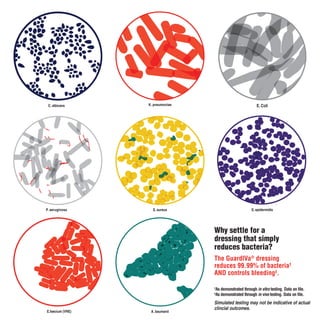
C. albicans
P. aeruginosa
E.faecium (VRE)
K. pneumoniae
S. aureus
A. baumanii
E. Coli
S. epidermidis
Why settle for a
dressing that simply
reduces bacteria?
The GuardIVa®
dressing
reduces 99.99% of bacteria†
AND controls bleeding‡
.
Simulated testing may not be indicative of actual
clincial outcomes.
†
As demonstrated through in vitro testing. Data on file.
‡
As demonstrated through in vivo testing. Data on file.
CONTROLS
BLEEDING
‡
The GuardIVa®
dressing not only reduces bacteria†
, but also controls surface bleeding‡
.The GuardIVa®
dressing contains Chlorhexidine
Gluconate (CHG) sufficient to reduce bacteria by 4 logs (or 99.99%)†, while also allowing healing more consistent with that of untreated
wounds‡
.What’s more, the GuardIVa®
dressing provides hemostasis and antimicrobial protection†
in the most critical 24 hours after
catheter placement and provides up to 7 days of sustained antimicrobial protection within the dressing.
The GuardIVa®
dressing is the ONLY antimicrobial dressing indicated
to control surface bleeding at insertion sites. It contains M·DOC™
(microdispersed oxidized cellulose), a proprietary compound designed
to stop bleeding. Wounds treated with the GuardIVa®
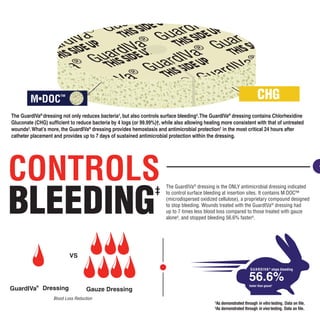
dressing had
up to 7 times less blood loss compared to those treated with gauze
alone‡
, and stopped bleeding 56.6% faster‡
.
†
As demonstrated through in vitro testing. Data on file.
‡
As demonstrated through in vivo testing. Data on file.
56.6%
faster than gauze†
GUARDIVA®
stops bleeding
Blood Loss Reduction
FINDING
BALANCEWITH CHG
INHIBITS
BACTERIAL GROWTH†
The GuardIVa®
dressing was tested against 8
microorganisms commonly associated with catheter-
related bloodstream infections (CRBSI). It has been
shown to reduce these bacteria by 4 logs or 99.99%†
,
and suppress re-growth of microorganisms on the skin‡
.
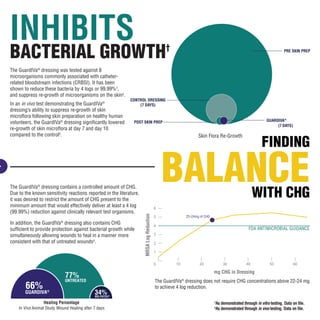
In an in vivo test demonstrating the GuardIVa®
dressing’s ability to suppress re-growth of skin
microflora following skin preparation on healthy human
volunteers, the GuardIVa®
dressing significantly lowered
re-growth of skin microflora at day 7 and day 10
compared to the control‡
.
The GuardIVa®
dressing contains a controlled amount of CHG.
Due to the known sensitivity reactions reported in the literature,
it was desired to restrict the amount of CHG present to the
minimum amount that would effectively deliver at least a 4 log
(99.99%) reduction against clinically relevant test organisms.
In addition, the GuardIVa®
dressing also contains CHG
sufficient to provide protection against bacterial growth while
simultaneously allowing wounds to heal in a manner more
consistent with that of untreated wounds‡
.
†
As demonstrated through in vitro testing. Data on file.
‡
As demonstrated through in vivo testing. Data on file.In Vivo Animal Study Wound Healing after 7 days
Healing Percentage
The GuardIVa®
dressing does not require CHG concentrations above 22-24 mg
to achieve 4 log reduction.
ACCESS SYSTEMS
Bard and GuardIVa are trademarks and/or registered trademarks of C. R. Bard, Inc. All other trademarks are the property of their respective owners.
© 2014 C. R. Bard, Inc. All rights reserved. MC_1215_01 1404R
BARD ACCESS SYSTEMS, INC. • 605 North 5600 West • Salt Lake City, UT 84116 USA • customer service: 800-545-0890 • clinical information: 800-555-7422
www.bardaccess.com
GuardIVa®
dressing Indications for Use:
The GuardIVa®
Antimicrobial Hemostatic IV Dressing is intended for use as a hydrophilic wound dressing to absorb exudate, cover and protect
catheter sites. Common applications include IV catheters, other intravenous catheters and percutaneous devices. It is also indicated for control
of surface bleeding from percutaneous catheters and vascular access sites.
Additional Information:
The GuardIVa®
dressing is not clinically tested for its activity to reduce local infections, catheter related blood stream (CRBSI),
and skin colonization of microorganisms commonly related to CRBSI.
Precautions:
Bard®
GuardIVa®
Antimicrobial Hemostatic IV Dressing is not intended to treat infection.
Warning:
Do not use the GuardIVa®
dressing on patients with a known sensitivity to chlorhexidine gluconate. The use of chlorhexidine gluconate
containing products has been reported to cause irritation, sensitization, and generalized allergic reactions. If any such reactions occur,
discontinue use of dressing immediately, and if severe, contact a physician.
Please consult package insert for more detailed safety information and instructions for use.

GuardIVa Brochure

  • 1.
    DON’T LET YOUR GUARDDOWN ACCESS SYSTEMS
  • 3.
    C. albicans P. aeruginosa E.faecium(VRE) K. pneumoniae S. aureus A. baumanii E. Coli S. epidermidis Why settle for a dressing that simply reduces bacteria? The GuardIVa® dressing reduces 99.99% of bacteria† AND controls bleeding‡ . Simulated testing may not be indicative of actual clincial outcomes. † As demonstrated through in vitro testing. Data on file. ‡ As demonstrated through in vivo testing. Data on file.
  • 4.
    CONTROLS BLEEDING ‡ The GuardIVa® dressing notonly reduces bacteria† , but also controls surface bleeding‡ .The GuardIVa® dressing contains Chlorhexidine Gluconate (CHG) sufficient to reduce bacteria by 4 logs (or 99.99%)†, while also allowing healing more consistent with that of untreated wounds‡ .What’s more, the GuardIVa® dressing provides hemostasis and antimicrobial protection† in the most critical 24 hours after catheter placement and provides up to 7 days of sustained antimicrobial protection within the dressing. The GuardIVa® dressing is the ONLY antimicrobial dressing indicated to control surface bleeding at insertion sites. It contains M·DOC™ (microdispersed oxidized cellulose), a proprietary compound designed to stop bleeding. Wounds treated with the GuardIVa® dressing had up to 7 times less blood loss compared to those treated with gauze alone‡ , and stopped bleeding 56.6% faster‡ . † As demonstrated through in vitro testing. Data on file. ‡ As demonstrated through in vivo testing. Data on file. 56.6% faster than gauze† GUARDIVA® stops bleeding Blood Loss Reduction
  • 5.
    FINDING BALANCEWITH CHG INHIBITS BACTERIAL GROWTH† TheGuardIVa® dressing was tested against 8 microorganisms commonly associated with catheter- related bloodstream infections (CRBSI). It has been shown to reduce these bacteria by 4 logs or 99.99%† , and suppress re-growth of microorganisms on the skin‡ . In an in vivo test demonstrating the GuardIVa® dressing’s ability to suppress re-growth of skin microflora following skin preparation on healthy human volunteers, the GuardIVa® dressing significantly lowered re-growth of skin microflora at day 7 and day 10 compared to the control‡ . The GuardIVa® dressing contains a controlled amount of CHG. Due to the known sensitivity reactions reported in the literature, it was desired to restrict the amount of CHG present to the minimum amount that would effectively deliver at least a 4 log (99.99%) reduction against clinically relevant test organisms. In addition, the GuardIVa® dressing also contains CHG sufficient to provide protection against bacterial growth while simultaneously allowing wounds to heal in a manner more consistent with that of untreated wounds‡ . † As demonstrated through in vitro testing. Data on file. ‡ As demonstrated through in vivo testing. Data on file.In Vivo Animal Study Wound Healing after 7 days Healing Percentage The GuardIVa® dressing does not require CHG concentrations above 22-24 mg to achieve 4 log reduction.
  • 6.
    ACCESS SYSTEMS Bard andGuardIVa are trademarks and/or registered trademarks of C. R. Bard, Inc. All other trademarks are the property of their respective owners. © 2014 C. R. Bard, Inc. All rights reserved. MC_1215_01 1404R BARD ACCESS SYSTEMS, INC. • 605 North 5600 West • Salt Lake City, UT 84116 USA • customer service: 800-545-0890 • clinical information: 800-555-7422 www.bardaccess.com GuardIVa® dressing Indications for Use: The GuardIVa® Antimicrobial Hemostatic IV Dressing is intended for use as a hydrophilic wound dressing to absorb exudate, cover and protect catheter sites. Common applications include IV catheters, other intravenous catheters and percutaneous devices. It is also indicated for control of surface bleeding from percutaneous catheters and vascular access sites. Additional Information: The GuardIVa® dressing is not clinically tested for its activity to reduce local infections, catheter related blood stream (CRBSI), and skin colonization of microorganisms commonly related to CRBSI. Precautions: Bard® GuardIVa® Antimicrobial Hemostatic IV Dressing is not intended to treat infection. Warning: Do not use the GuardIVa® dressing on patients with a known sensitivity to chlorhexidine gluconate. The use of chlorhexidine gluconate containing products has been reported to cause irritation, sensitization, and generalized allergic reactions. If any such reactions occur, discontinue use of dressing immediately, and if severe, contact a physician. Please consult package insert for more detailed safety information and instructions for use.