GUARANTEES IN LENDING TRANSACTIONS:
What you Forgot you Knew
Simon P. Crawford, Partner
Bennett Jones LLP
Jacob Dubelaar, Associate
Bennett Jones LLP
Everything in business, and therefore everything in the practice of business law, is now faster,
more compressed, more standardized and more commoditized that ever before. Where once we
hand-marked marginal changes to a common document and exchanged it back and forth once to
twice by three day mail delivery before closing, now we electronically blackline a document and
email it in moments, allowing for sometimes dozens of versions of comments to be exchanged
between solicitors.
And to accommodate faster closings and to encourage risk uniformity, there has been a rapid
movement among lenders to standard form loan documents, and a decreased appetite among
lenders to entertain changes to them, on the belief that a commitment of quick and cheap
mortgage money is a fair rebuttal to a borrower who wants to make changes to the bank's
standard loan documents.
Which is to say, that many practitioners in mortgage loan practices often find themselves
practicing less law and more transaction administration. They are being told more and more that
they don’t have room to negotiate bank documents. And for the most part, there is often little
resistance on the part of borrowers, because less negotiation invariably means lower legal fees.
But in all of this, there remains the underlying obligation on the solicitor to ensure that the loan
documents work – that they make sense – that they are enforceable – that they are assembled and
structured in a way that achieves the business expectations of the client – and not make the
assumption that just because the documents are "standard form" or have been printed from the
lender's on-line document warehouse, that they are correct in the circumstances of the
transaction.
And so this discussion, while not presuming to be exhaustive, is designed to remind lending
lawyers of some of the basic elements of just one type of loan document – the guarantee – and
act as a reminder of what some of the important elements of it are. This is a reminder to
transactional lawyers that loan guarantees are not simply preprinted documents that require a "fill
in the blanks" approach.
Guarantees have a long and somewhat tortured history. And for a half moment, let us consider
the family that guarantees belong to. The common law has long recognized the concept of a
"surety", a person who takes responsibility for another's performance of an undertaking or debt
or pledges property as security for such performance or payment.
2
I start with this common law concept of a surety, in part, to distinguish it from a guarantor. To
mimic an LSAT formulation, all guarantors are sureties but not all sureties are guarantors. And
without being too technical, the notion is as follows. One can agree to be responsible for the
obligations of debts for another in a number of ways, all of which are recognized at law as being
surety relationships. One way is by guarantee— a documented promise in favour of a third party
to perform the obligations or pay the liabilities of another should they fail to do so. Another way
is by indemnity— a promise to the third party to indemnify them for losses, costs and expenses
incurred should a third party fail to perform its obligations. And yet a third way, whether or not a
written guarantee or indemnity is given, is to offer a pledge of one's assets in favour of the third
party as security for the liabilities or performance of obligations by another.
This discussion will deal mainly with guarantees, but in doing so, it will touch on a number of
concepts that are common to all sureties.
So now that we have a reason for our discussion, let's have some rhyme. The approach we will
take to this analysis is to consider some of the more important provisions of a guarantee and to
consider issues that sometimes arise in the context of them, so that we are reminded of why these
things are in the document, and what happens when they are omitted, struck out or modified.
Before doing so, however, it would be first helpful to remember the law as it relates to two things
(a) guarantees and the requirement that they be evidenced in some manner in writing; and (b) the
conflict that sometimes arises between the pre-printed portion of a guarantee (or guarantee
contained in and built into a mortgage) and stand alone guarantee language.
1. Requirement for Guarantees to be evidenced by writing.
Guarantees are part of a special class of deeds and contracts subject to the Statute of Frauds,1
which provides as follows:
Writing required for certain contracts
4. No action shall be brought to charge any executor or administrator upon
any special promise to answer damages out of the executor’s or administrator’s
own estate, or to charge any person upon any special promise to answer for the
debt, default or miscarriage of any other person, or to charge any person upon
any contract or sale of lands, tenements or hereditaments, or any interest in or
concerning them, unless the agreement upon which the action is brought, or some
memorandum or note thereof is in writing and signed by the party to be charged
therewith or some person thereunto lawfully authorized by the party.
While there is no common law requirement that a guarantee be evidenced in writing, Section 4 of
the Statute of Frauds imposes a formal requirement that either a guarantee itself, or some
memorandum or note thereof, is evidenced in writing.2
The application of the Statute of Frauds
turns on whether the agreement (or such portion of the agreement at issue) gives rise to a primary
obligation or rather a "special" secondary or collateral obligation that constitutes a guarantee.
1
R.S.O. 1990, c. S. 19 (the "Statute of Frauds").
2
While there are a number of situations in which the requirement for written evidence may be dispensed with, the starting point of the analysis is
that such written evidence is required.
3
This distinction is discussed in greater detail below. In short, every agreement which is a
guarantee in substance must comply with the Statute of Frauds in form and, while the Statute of
Frauds does not require that any particular form be adhered to, the essential elements of the
agreement generally must be in writing.3
2. Conflict between pre-printed guarantee language and added language.
Subsection 8(1) of the Land Registration Reform Act4
permits the filing of standard charge terms
with the Ontario Director of Land Titles, and Subsection 9(1) of the LRRA deems a charge to
include a set of standard charge terms if the charge incorporates such set of standard charge
terms by reference to its filing number. This regime increases transaction efficiency and certainty
over time as counsel become familiar with the particulars of the standard charge terms, or so the
theory goes. However, as discussed by Doug Bourassa in his paper presented as part of a recent
CLE program, standard charge terms often include guarantee language, which gives rise to a risk
of a conflict between the standard charge terms and separate guarantee agreements, and
concomitant uncertainty. 5
Subsection 9(4) of the LRRA effectively provides that express charge terms prevail in the event
of a conflict with standard charge terms deemed to be included in the charge under the LRRA,
and courts have held, either with reference to Subsection 9(4) of the LRRA6
or otherwise,7
that
express terms included in a loan agreement prevail to the extent such terms conflict with
standard charge terms.
With these technical concepts in mind, let's turn to some of the more common guarantee
provisions, keeping in mind that the example guarantee text below is illustrative only.
3. Parties to a Guarantee
To: First Bank of Lawyerville (the "Bank")
Because a guarantee is a contract, it is subject to the ordinary requirements of contract, including
the requirements of offer, acceptance and consideration. An offer need not be explicitly stated,
but it must be possible to objectively determine that an offer has been made. Because a lender
rarely executes a guarantee document or otherwise expressly accepts a guarantee, guarantees
often take the form of a unilateral contract: the guarantee will provide, expressly or by
implication, that if the lender extends the loan to the borrower, the guarantor will guarantee
payment of the guaranteed obligations. In such case, acceptance by the lender is indicated by the
lender complying with the terms of the guarantee. While notice of acceptance is not required
unless the terms of the offer so require,8
the clearest evidence of offer and acceptance is an
3
A. MacDonald & Co. v. Fletcher, [1915] 22 BCR 298.
4
R.S.O. 1990, c. L.4 (the "LRRA").
5
Doug Bourassa, "How to Structure Personal and Corporate Guarantees in Mortgage Transactions or How I Learned to Stop Worrying and Love
the Law of Guarantees" (Paper presented at the CPD program Commercial Mortgage Transactions 2015, September 17, 2015), at page
13.
6
Royal Trust Corporation of Canada v. 502759 Ontario Ltd., 2000 CanLII 5738 (ON CA) at 38.
7
Bank of Nova Scotia v. Suthakaran, 2011 ONSC 6970 (CanLII) at 18.
8
Fraser v. Douglas, 5 WLR 52.
4
exchange of correspondence to that effect, or a written agreement signed by both parties and self-
evidently embodying the terms of a contract to which the parties have agreement.9
4. Recitals.
WHEREAS the Borrower has made application to the lender for the mortgage
facility and the lender has agreed to make such facility available to the Borrower
on the terms and conditions hereinafter set out.
AND WHEREAS, in consideration for the lender so doing, the Guarantor has
agreed to guarantee the obligations of the Borrower under the mortgage facility
on and subject to the terms herein set out.
Whereas parties to an agreement often find it useful to outline the factual basis for which the
agreement is being entered into, and whereas in recent years courts have increasingly considered
the document as a whole and the factual matrix when interpreting contracts, recitals can play a
useful, albeit somewhat uncertain and limited, role in the drafting of guarantees. Generally,
courts will look to recitals to determine the constraints and limits that the parties intended to
apply to the agreement, and recitals will be interpreted in accordance with two principles: (1)
where the operative provisions of a contract are clear and unambiguous, such provisions will
prevail over the recitals to the extent of a conflict, and (2) where the operative provisions of a
contract are unclear and ambiguous, courts may look to the recitals to resolve such ambiguity.
The subordination of recitals is somewhat inconsistent with the modern approach to contractual
interpretation in that "it gives no meaning to words which the parties chose to include in their
agreement (presumably for a reason), and it ignores the parties' own effort to express the context
in which their agreement has arisen."10
The second principle is consistent with the modern approach of interpreting a contract in light of
the entire document and the factual matrix. While there exists a line of cases suggesting that
recitals form part of the agreement as a whole and so should be interpreted in accordance with
the general rules of construction,11
counsel should be wary of including operative language in the
recitals themselves, or otherwise placing too much reliance on the wording of recitals.
9
Kevin McGuinness, The Law of Guarantee, 3rd
ed. (Markham: Lexis Nexis Canada, 2013)("McGuinness") at 4.183.
10
Geoff R. Hall, Canadian Contractual Interpretation Law, 2d ed (Markham: LexisNexis Canada, 2012) ("Hall") at 8.17.2.
11
See, for example, Canada Wide Magazines Ltd. v. Columbia Publishers Ltd. 1994 CanLII 3332 (BC SC).
5
5. Consideration
In consideration of the Lender making certain financial accommodations
available to the Borrower and at the request of the Borrower that the Guarantor
provide this Agreement, and for other good and valuable consideration, the
receipt and sufficiency of which are acknowledged, the Guarantor agrees with
and in favour of the Lender as follows:
As discussed above, guarantees are contracts and so guarantees require consideration in order to
be enforceable. The consideration for a guarantee may take the form of a benefit flowing from
lender directly to the guarantor, and oftentimes guarantees (as well as other contracts) will
include a statement to the effect that some nominal payment has been exchanged which, together
with other "good and valuable consideration", constitutes sufficient consideration. More often
than not (or dare I say, nearly always) the nominal consideration never actually changes hands
and so, if the nominal consideration is all you've got (or rather, purport to have), you may find
yourself a few peppercorns shy of an enforceable bargain. Furthermore, while courts will
generally not inquire as to the adequacy of consideration, some courts have recognized a
distinction between "nominal consideration" and "valuable consideration" and have held that,
notwithstanding the freedom of parties to make bad bargains, nominal consideration which is not
"real" consideration of some value in the eyes of the law does not constitute sufficient
consideration.12
In most instances the reference to nominal consideration is simply boilerplate language that does
not reflect the actual consideration changing hands, and the presence of such boilerplate
language certainly does not render a guarantee unenforceable: the consideration for a guarantee
need not be set out in writing,13
nor is it necessary that consideration flow to the guarantor,14
as
the consideration may simply be the lender suffering some detriment or providing some benefit
to a third party, such as the granting of credit by the lender to the borrower. However, a potential
issue arises where a guarantee is provided in circumstances where a borrower has defaulted or is
on the brink of default under an existing loan. The potential issue is that, while it is generally
sufficient that the lender has granted some specific type forbearance in consideration for a
guarantee, for example refraining from commencing legal proceedings against the borrower or
granting an extension for repayment of the underling debt, mere voluntary inaction on the part of
the lender does not constitute sufficient consideration.15
So what's to be made of all of this? Although a guarantee need not explicitly describe the
consideration for which it is granted, it is prudent to consider whether, given the context of the
transaction, valid consideration has in fact moved from the lender. When in doubt, spell it out
(particularly when acting for the lender). Ensure that the guarantee contains an accurate (but
sufficiently broad)16
description of the legally valuable consideration (for example making
12
See, for example, Glenelg Homestead Ltd v Wile, 2003 NSSC 155 (CanLII) at para. 26.
13
Statute of Frauds, at s. 6.
14
Canada Mortgage and Housing Corp. v. Elbarbari, 1996 CanLII 6712 (SK QB) per MacLean, J.
15
Crears v. Hunter (1887), 19 QBD 341 at 346.
16
There is case law suggesting that, by describing the consideration in overly-specific terms, the scope of the guarantee may inadvertently be
limited because, while the description of consideration is not conclusive, it is relevant in construing the terms for the contract itself.
See, for instance, ING Lease (UK) Limited v. Harwood [2007] EWHC 2292 (QB), in which the High Court of Justice (Queen's Bench
Division) partially relied on the wording of a guarantee's consideration clause in finding that certain obligations of the borrower did
6
available credit facilities or granting some specific forbearance to the borrower) for which the
guarantee is granted.
6. Guarantee is a secondary obligation not a primary one
The Guarantor unconditionally and irrevocably guarantees, as primary obligor
and not as surety…
A guarantee is a secondary obligation which arises only upon the "debt, default or miscarriage"17
of some third party. Because the liability is secondary to the principal borrower, a guarantor's
liability does not arise until the borrower defaults upon the guaranteed obligation. If the liability
constitutes a primary obligation (for example, a primary undertaking to make good a loss), it is
not a contract of guarantee.18
A party is free to assume primary liability in respect of the indebtedness of another and it is
common, for instance, for a guarantee to include a "principal debtor" clause, such as the clause
reproduced above, which provides that the liability of the guarantor is as "principal debtor" or
"primary obligor", and not as surety. It has been held that such a clause converts a guarantor into
a full-fledged principal debtor,19
the intended effect of which is to remove defences that may
otherwise be available to a guarantor. However, the full meaning and effect of a principal debtor
clause depends on the context of the agreement and the intentions of the parties to the
transaction, and there exists a line of cases20
which calls into question the effectiveness of such
clauses. As Professor McGuinness writes, "[a] principal debtor clause is, as best vague,
imprecise and general. It conveys no clear message to anyone."21
In Communities Economic Development Fund v. Canadian Pickle Corp.22
the Supreme Court of
Canada considered the nature of a guarantor's obligations and the meaning of a principal debtor
clause in the context of a guarantee of a loan which was ultimately found to be unenforceable by
the lender. Canadian Pickles involved a lender, Communities Economic Development Fund, that
was a statutory corporation created under the Manitoba Communities Economic Development
Fund Act for the public purpose of encouraging economic development in remote and isolated
regions, and a borrower, Canadian Pickles Corporation, that operated in Stony Mountain, a small
community located just outside of Winnipeg. The loan was guaranteed by the directors of the
borrower. When the borrower defaulted on the loan, the lender sued the borrower and the
guarantors. At trial, Stony Mountain was determined to be insufficiently remote and isolated to
fall within the scope of the lender's permitted lending activities and so the loan was found to be
invalid because it was ultra vires the lender. This finding was confirmed by the Manitoba Court
of Appeal and the Supreme Court of Canada. However, also at issue was whether a guarantor
not fall within the scope of the guarantee. See also Neil Levy & John Phillips, "Aspects of Guarantee Clauses and Their Drafting"
(September 2009), online: Guildhall Chambers
<http://www.guildhallchambers.co.uk/files/AspectsofguaranteeclausesFormattedNL.pdf>.
17
Statute of Frauds, supra note 1at s. 4.
18
Morin v. Hammond Lumber Co., [1923] SCR 140.
19
Canadian Imperial Bank of Commerce v. Patel (1990), 72 O/R/ (2d) 109 (H.C) at p. 119.
20
See, for example Manulife Bank of Canada v. Conlin 1996 CanLII 182 (SCC) ("Manulife") and Re Olympia & York Developments Ltd. [1998]
O.J. No 3482 (C.A.).
21
Kevin McGuinness, The Law of Guarantee, Third Edition (Markham, Ontario: LexisNexis 2013) ("McGuinness") at 15.152.
22
1991 CanLII 48 (SCC) ("Canadian Pickles").
7
remained liable to the lender notwithstanding that the underlying loan was void. The guarantee
included the following principal debtor clause:
That as between the Fund and the Guarantors, the Guarantors are and shall
continue to be jointly and severally liable as principal debtors under all the
covenants contained in the Security, notwithstanding the bankruptcy, insolvency
or going into liquidation of the Borrower, voluntary or otherwise, and
notwithstanding any transaction which may take place between the Fund and
Borrower or any neglect or default of the Fund which may otherwise operate as a
discharge, whether partial or absolute, of the Guarantors if they were sureties
only of the Borrower… 23
Iacobucci J. reasoned that, although the guarantors were free to agree to be liable as principal
debtors, on a plain reading of the guarantee, the guarantors were only principally liable in certain
listed circumstances which did not include invalidity of the principal debt. Because guarantors
were not liable to repay the debt in the event the principal debt was ultra vires the lender, the
lender's claim failed.
Canadian Pickles and several cases that followed have left a (we couldn't help it) "sour" taste in
the mouths of lenders. While a guarantor is free to assume principal liability for another party's
debt, little reliance should be placed on a principal debtor clause because, in Canadian Pickles
and elsewhere, the courts have taken a narrow reading of principal debtor clauses and have
demonstrated a willingness to disregard or limit the application of principal debtor clauses where
such clauses are found to be inconsistent with the broader contractual context.
23
Ibid, at 416.
8
7. Guarantees vs. Indemnities and Including both in the Agreement
Each Guarantor agrees to indemnify and save the Lender harmless from and
against all costs, losses, expenses, claims, liabilities and damages it may suffer as
a result or consequence of, any inability by the Lender to recover the ultimate
balance due or remaining unpaid to the Lender in respect of the Guaranteed
Obligations, including without limitation, legal fees incurred by or on behalf of
the Lender resulting from any action instituted on the basis of this Agreement,
and shall pay all such amounts to the Lender after demand as herein provided.
In Canadian Pickles Iacobucci J. discussed the distinction between a contract of guarantee, in
which the liability of the guarantor is usually coterminous with that of the principal debtor, and a
contract of indemnity, in which the indemnifier assumes a primary obligation and is liable
regardless of the liability of the principal debtor. While guarantees and indemnities are distinct
classes of contracts, in many instances it is difficult to distinguish the two in practice, a sentiment
echoed by Iacobucci J. by referencing an earlier case in which the distinction was described as
follows:
[i]t seems to me a most barren controversy [which] has raised many hair-splitting
distinctions of exactly that kind which brings the law into hatred, ridicule and
contempt by the public.24
Hatred, ridicule and contempt aside, the distinction between indemnities and guarantees remain
relevant in commercial lending transactions in at least two respects.
Firstly, because an indemnity creates a primary obligation which is not coterminous with the
obligations of a borrower, the scope of recovery under an indemnity can be greater than under a
guarantee. For example, indemnitees often indemnify the lender against any loss, including the
cost of legal fees, reasonably incurred by the lender in recovering amounts owing under the
underlying loan or the guarantee. While recovery for costs will only be allowed where a court
finds it just and proper on the facts of a given case, courts have demonstrated some willingness
to allow for such recovery by an indemnified party in connection with an indemnified matter. By
providing an indemnity for costs as well as for other losses incurred in connection with an
indemnified matter, an indemnitor is potentially underwriting a lender's expected profits as
opposed to merely agreeing to be answerable for the "debt, default or miscarriage" of some other
party.
Secondly, given the uncertainty surrounding principal debtor clauses and the ever-growing
number of defences available to guarantors, by incorporating an indemnity into a guarantee, a
primary obligation is created that is distinct from the secondary obligation of a guarantee and
that may be called upon if the guarantee should fail for any reason. While an indemnity may be
easier to enforce, a guarantee should still be maintained because, as a separate obligation, it
24
Ibid at 414, citing Halman L.J. in Yeoman Credit, Ltd. v. Latter, [1961] 2 All E.R. 295 (C.A.) at p. 299.
9
enables a lender to seek full and separate (from the underlying debt) recovery, particularly useful
in the context of a bankruptcy proceeding.
8. Joint, Several and Joint and Several Liability
Each Guarantor unconditionally and irrevocably guarantees to the Lender, and its
respective successors and assigns, the prompt payment and performance of the
Guaranteed Obligations forthwith upon demand by the Lender.
Often times, two or more parties provide guarantees in respect of the same loan transaction. In
such circumstances, a guarantor's liability may be joint, several, or joint and several.
Where guarantors are jointly liable in respect of the same debt, they are together liable for the
full amount of the guaranteed debt and the obligations are not cumulative. For example, where A
and B jointly provide a guarantee to C of $100 of a particular debt, the total value of the
guarantee is $100 but payment by either A or B will discharge the other.
Where two or more guarantors are severally liable in respect of distinct portions of the same
debt, then each guarantor may be called upon only for the portion of the debt for which it is
liable. For example, where A and B provide several guarantees to C of $50 of a particular debt,
then the total value of the guarantees are $100, but payment by A will not discharge B's
obligation to pay, and C must sue A and B separately for their promises.
For procedural convenience, a lender will prefer that guarantees from multiple guarantors be
provided on a joint and several basis. Chitty on Contracts defines joint and several liability as
follows:
Joint and several liability arises when two or more persons in the same
instrument jointly promise to do the same thing and also severally make separate
promises to do the same thing. Joint and several liability gives rise to one joint
obligation and to as many several obligations as there are joint and several
promisors. It is like joint liability in that co-promisors are not cumulatively liable,
so that performance by one discharges all; but it is free from most of the technical
rules governing joint liability. 25
25
HG Beale, ed, Chitty on Contracts, 29th ed (London, UK: Sweet & Maxwell, 2004) at 17-003.
10
9. Caps on Liability or Agreed upon Splits of Liability
The Guarantors hereby unconditionally and irrevocably grant a limited guarantee,
each on a several basis (and not on a joint and several basis) of the Guaranteed
Obligations, provided that the liability of each of the guarantors hereunder shall
be limited to fifty percent (50%) of the aggregate amount of the Loan Amount
outstanding at the time demand for payment is made hereunder, in each case to a
maximum amount of fifty thousand dollars ($50,000).
Where guarantees are provided on a several basis only, care should be taken to ensure that the
guarantee is properly limited to a fixed amount and/or a fixed percentage of the indebtedness of a
borrower, as the case may be. For example, if two parties provide several 50% guarantees in
respect of an underling debt, counsel should consider whether the intention is to limit the
guarantees to (i) an amount equal to 50% of the underling debt from time to time, (ii) an amount
equal to 50% of a fixed amount, or (iii) an amount equal to the lesser of (i) and (ii). If the
intention is to limit the guarantee by both proportion and amount, then this should be clearly
stated. Without proper limiting language, there is the potential unintended consequence of a
several guarantee guaranteeing an increasing proportion of the underlying debt as such debt is
paid down over time.
10. Specific, Continuing and All-Accounts Guarantees
"Guaranteed Obligations" means all present and future indebtedness, liabilities
and obligations of any and every kind, nature and description (whether direct or
indirect, joint or several, absolutely or contingent, matured or unmatured) of or
owing by the Borrower to the Lender at any time and from time to time, present
and future, under, in connection with or with respect to the Credit Agreement and
all documents, undertakings and agreements entered into by the Credit Parties
pursuant to or in connection with the Credit Agreement, and all amendments,
restatements, replacements, renewals, extensions, or supplements of, and
continuations to, each such agreement, undertaking or contract, or from any other
agreement, contract or dealing with any third party by which the Lender may be
or become in any manner a creditor of the Borrower, or howsoever otherwise
arising, and whether the Borrower is bound alone or with another or others, and
whether as principal or surety, and including without limitation, all liabilities of
the Borrower arising as a consequence of its failure to pay or fulfill any of such
indebtedness, liabilities and obligations, and any unpaid balance thereof.
A guarantee can be limited by time, amount or scope of guaranteed obligations, or can be
indefinite in duration and guarantee all amounts owned by the borrower to the lender, without
reference to how those debts came into being. There are three basic types of guarantee: specific
or discrete guarantees, continuing guarantees, and all-accounts guarantees.
11
In a specific guarantee, not surprisingly, the guarantor undertakes liability in respect of a specific
liability of the principal. For example, if a loan of $100 is made to the borrower and the
guarantor guarantees the repayment of that loan and no other, the liability of the guarantor is in
the nature of a specific guarantee. Under a continuing guarantee, the guarantor undertakes to be
answerable for obligations of a given type that are owed by the borrower during the term of the
guarantee (for example, advances and re-advances under a loan facility). An all-accounts
guarantee covers any amount owing by the borrower to the lender from time to time.
The distinctions described above are fundamental and it is important to ensure that a guarantee
clearly specifies the obligations to which the guarantee is intended to apply.
11. Waivers of Defenses – Material Modifications to the Primary Obligation
Each Guarantor is and shall continue to be liable under this Agreement
notwithstanding the release, discharge, renewal, modification, variation or
amendment, in whole or in part, of the terms of any of the Guaranteed
Obligations or any Security (including without restriction any increase or
decrease in the Commitment, applicable interest rates, Applicable Rate or fees, or
any extension or reduction in the Maturity Date).
By virtue of law and equity, a guarantor generally has a great number of defences at their
fingertips to defeat a lender's attempt to call upon a guarantee. As guarantees are often prepared
in the lender's standard form, guarantees invariably include waivers of a great number of these
defences.
Chief among such defences is the protection provided by the general rule against material
alteration, which provides that where the terms of the guaranteed primary obligation are
materially altered, a guarantor that has not consented to such material alteration or waived its
rights in this regard will be released from liability under the guarantee.
In the 2013 decision of Royal Bank of Canada v. Samson Management & Solutions Ltd.,26
the
Ontario Court of Appeal considered the law of material alteration as it related to the
enforceability of a personal continuing guarantee. In Samson, RBC had provided a $150,000 loan
to the borrower in 2005. Ms. Cusack, the spouse of the principal of the borrower, provided a
personal continuing guarantee in the amount of $150,000, on RBC's standard form, of all present
and future liabilities of the borrower to RBC. In 2006 the loan was increased to $250,000 and
Ms. Cusack provided a new continuing guarantee to RBC in the amount of $250,000. Although
the loan was increased to $500,000 and 750,000 in 2008 and 2009, respectively, Ms. Cusack was
not asked to provide an increased guarantee and was not provided with copies of the new loan
documentation. In 2011 the borrower defaulted and RBC sought to enforce Ms. Cusack's 2006
guarantee.
The motion judge dismissed RBC's action against Ms. Cusack, relying heavily on the 1996
Supreme Court of Canada decision in Manulife in which Cory J. expressed the material alteration
rule as follows:
26
2013 ONCA 313 (CanLII) ("Samson").
12
It has long been clear that a guarantor will be released from liability on the
guarantee in circumstances where the creditor and the principal debtor agree to a
material alteration of the terms of the contract of debt without the consent of the
guarantor. The principle was enunciated by Cotton L.J. in Holme v. Brunskill
(1878), 3 Q.B.D. 495 (C.A.), at pp. 505-6, in this way.
The true rule in my opinion is, that if there is any agreement
between the principals with reference to the contract guaranteed,
the surety ought to be consulted, and that if he has not consented to
the alteration, although in cases where it is without inquiry evident
that the alteration is unsubstantial, or that it cannot be otherwise
than beneficial to the surety, the surety may not be discharged; yet,
that if it is not self-evident that the alteration is unsubstantial, or
one which cannot be prejudicial to the surety, the Court . . . will
hold that in such a case the surety himself must be the sole judge
whether or not he will consent to remain liable notwithstanding the
alteration, and that if he has not so consented he will be
discharged.27
The motion judge held that because Ms. Cusack did not waive her rights in equity or in common
law as a principal debtor28
or as a guarantor, and because Ms. Cusack was not given notice of the
material alterations to the loan in 2008 and 2009, the guarantee was unenforceable. RBC
appealed.
On appeal, Lauwers J.A. held that the guarantee was enforceable since "the application of the
language in the guarantee in the context leads to the conclusion that Ms. Cusack contracted out
of the protection provided by the common law, and is therefore liable under her guarantee."29
The first paragraph of the 2006 guarantee, which was described by Lauwers J.A. as 'critical',
provided that Ms. Cusack will pay on demand to RBC:
all debts and liabilities, present or future, direct or indirect, absolute or
contingent, mature or not, at any time owing by…" Samson to RBC, "or
remaining unpaid by the customer to the Bank, heretofore or hereafter incurred
or arising and… incurred by or arising from agreement or dealings between the
Bank and the customer…30
This clause, in addition to a number of other clauses expressly permitting RBC to make
alterations to the underling loan that might otherwise affect the enforceability of the guarantee,
led Lauwers J.A. to the conclusion that,
…while the subsequent advances to Samson were material alterations to the
principal loan document, they were contemplated by the parties, permitted by the
27
Manulife, supra note 20, at 2.
28
The 2006 guarantee provided that Ms. Cusack would become a principal debtor should RBC not be able to recover any sum of money on the
guarantee.
29
Samson, supra note 27, at 22.
30
Ibid, at 24.
13
clear language of the guarantee, and inherent in a continuing all accounts
guarantee…[t]hus, despite the material alterations in the underlying loan
arrangements, Ms. Cusack's personal guarantee remains enforceable given the
clear and unambiguous language of the guarantee and the factual context.31
Samson confirms that, while the common law and equity provide protections to a guarantor
regarding material alterations to the loan underling a guarantee, a guarantor is generally free to
contract out of such protections.32
All else equal, a guarantor is motivated to retain its rights to receive notice of and approve any
material alterations, while a lender is motivated to draft the scope of the guarantee in broad
language which explicitly confirms the continued application of the guarantee in the event the
loan obligations of the borrower are altered in any manner. Whatever the agreement, the
description of the guaranteed obligations (including alterations to same, if applicable) must be
drafted in clear and unambiguous terms and, even assuming razor-sharp drafting, it remains best
practice to have an existing guarantor confirm its guarantee in the event of a material alteration.
12. Waivers of Defences – Marshalling
Each Guarantor waives, to the fullest extent permitted by law, any right (whether
now or hereafter existing) to require the Lender, as a condition to the enforcement
of this Agreement, to marshall the assets of either the Borrower, any Guarantor or
any other Person or proceed against the Borrower, any Guarantor or any other
Person in any particular order
The equitable doctrine of marshalling is a remedy which is used to lessen the chance that a junior
creditor may lose its security solely at the whim of a senior creditor's choice of security to
pursue.33
The doctrine requires that if a creditor has two funds of a debtor to which it can look to
satisfy its claim, and a second creditor has available only one of those funds, then the first
creditor should order its recover against the funds in a manner that reserves the fund available for
the second creditor.34
In effect, this prevents a creditor who can resort to two funds of a debtor
from defeating another creditor who can only resort to one of them. For the doctrine to apply,
five basic criteria must generally be met:
a) Two creditors;
b) One common debtor;
c) Two funds of the debtor with the superior creditor having access to both the
inferior creditor to but one;
31
Ibid, at 63-64.
32
In Bauer v. The Bank of Montreal, 1980 CanLII 12 (SCC), the argument was made that a standard form waiver clause in a guarantee constituted
an 'exclusion clause', and was therefore subject to the more stringent rules of contractual interpretation applicable to exclusion clauses.
For the Supreme Court, McIntyre J. held at para. 109 that the clause under consideration was not an exemption clause subject to
special rules of construction, but was instead "a provision by which the guarantor has contracted himself out of the equitable right he
would have possessed in the absence of this term and he has, as a term of the contract between the bank and himself, given the bank
affirmative rights in this regard. That a guarantor in this situation is fully competent to so dispose of his affairs is beyond question…"
33
CIBC Mortgage Corporation v. Branch, 1999 CanLII 6394 (BC SC) at 6, citing Bruce MacDougall, "Marshalling and the Personal Property
Security Acts: Doing Unto Others…" (1994) 28:1 UBC L Rev 91,at 92.
34
Allison (Re), 1995 CanLII 7146 (ON SC).
14
d) No interference with the choice of remedy of the superior creditor; and
e) No prejudice to third parties.35
As set out in (d) and (e) above, the right to marshall assets is subject to two qualifications:
marshalling will not be permitted if it interferes with the paramount right of the first creditor to
pursue its remedies against either of the two funds, and marshalling will not be applied to the
prejudice of third parties. Where the first creditor chooses to recover its debt from fund available
to both debtors, courts will apply the doctrine to provide the junior creditor a right of
subrogation, which is discussed below.
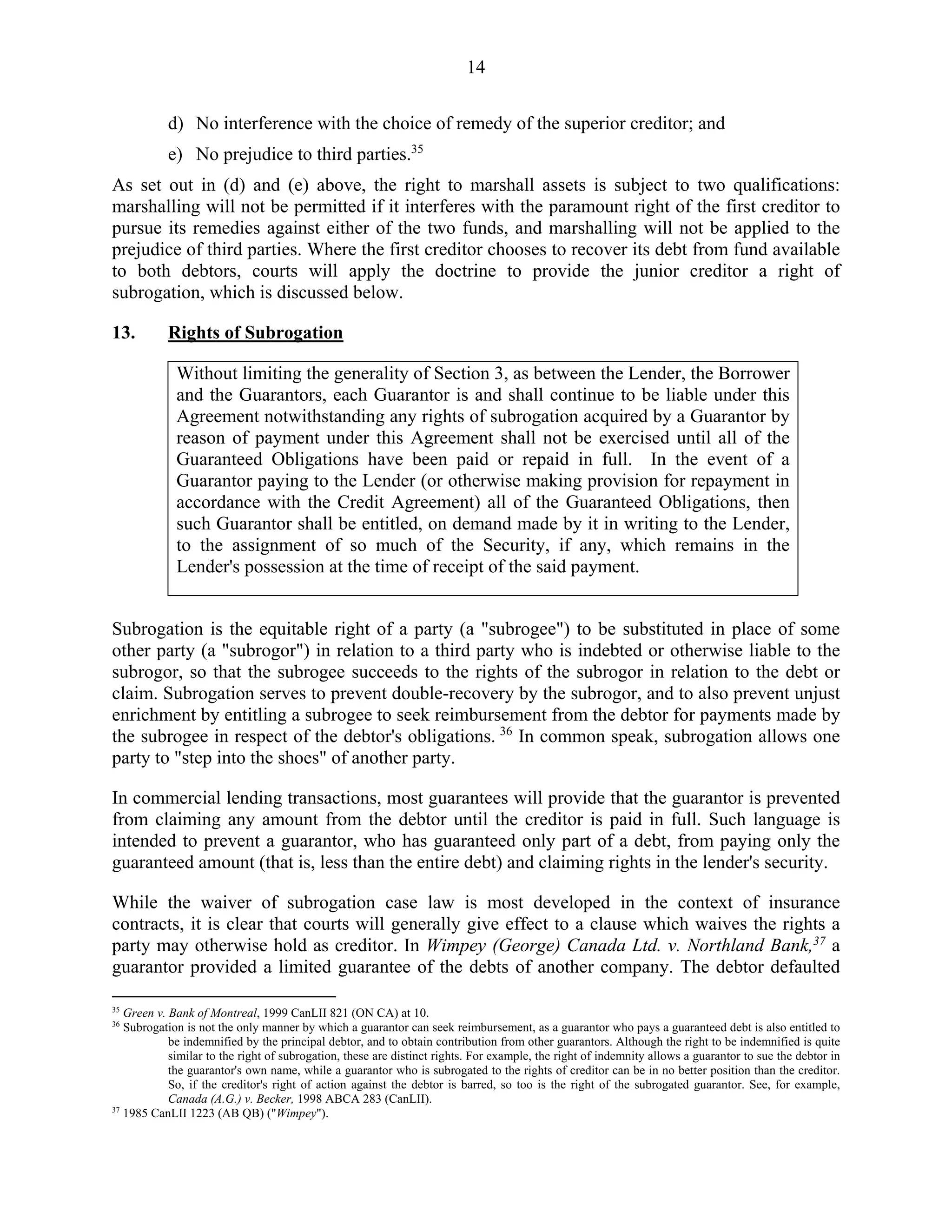
13. Rights of Subrogation
Without limiting the generality of Section 3, as between the Lender, the Borrower
and the Guarantors, each Guarantor is and shall continue to be liable under this
Agreement notwithstanding any rights of subrogation acquired by a Guarantor by
reason of payment under this Agreement shall not be exercised until all of the
Guaranteed Obligations have been paid or repaid in full. In the event of a
Guarantor paying to the Lender (or otherwise making provision for repayment in
accordance with the Credit Agreement) all of the Guaranteed Obligations, then
such Guarantor shall be entitled, on demand made by it in writing to the Lender,
to the assignment of so much of the Security, if any, which remains in the
Lender's possession at the time of receipt of the said payment.
Subrogation is the equitable right of a party (a "subrogee") to be substituted in place of some
other party (a "subrogor") in relation to a third party who is indebted or otherwise liable to the
subrogor, so that the subrogee succeeds to the rights of the subrogor in relation to the debt or
claim. Subrogation serves to prevent double-recovery by the subrogor, and to also prevent unjust
enrichment by entitling a subrogee to seek reimbursement from the debtor for payments made by
the subrogee in respect of the debtor's obligations. 36
In common speak, subrogation allows one
party to "step into the shoes" of another party.
In commercial lending transactions, most guarantees will provide that the guarantor is prevented
from claiming any amount from the debtor until the creditor is paid in full. Such language is
intended to prevent a guarantor, who has guaranteed only part of a debt, from paying only the
guaranteed amount (that is, less than the entire debt) and claiming rights in the lender's security.
While the waiver of subrogation case law is most developed in the context of insurance
contracts, it is clear that courts will generally give effect to a clause which waives the rights a
party may otherwise hold as creditor. In Wimpey (George) Canada Ltd. v. Northland Bank,37
a
guarantor provided a limited guarantee of the debts of another company. The debtor defaulted
35
Green v. Bank of Montreal, 1999 CanLII 821 (ON CA) at 10.
36
Subrogation is not the only manner by which a guarantor can seek reimbursement, as a guarantor who pays a guaranteed debt is also entitled to
be indemnified by the principal debtor, and to obtain contribution from other guarantors. Although the right to be indemnified is quite
similar to the right of subrogation, these are distinct rights. For example, the right of indemnity allows a guarantor to sue the debtor in
the guarantor's own name, while a guarantor who is subrogated to the rights of creditor can be in no better position than the creditor.
So, if the creditor's right of action against the debtor is barred, so too is the right of the subrogated guarantor. See, for example,
Canada (A.G.) v. Becker, 1998 ABCA 283 (CanLII).
37
1985 CanLII 1223 (AB QB) ("Wimpey").
15
and the guarantee was called by the lender. The guarantor paid the maximum amount that the
guarantor was obliged to pay under the guarantee, which was less than the amount owing by the
debtor to the lender, and demanded that the lender assign to the guarantor a proportionate share
of the mortgage granted by the debtor. The lender refused, relying in part on the express terms of
the guarantee to argue that the guarantor was only entitled to claim against the lender's securities
upon payment in full of the amount owing to the lender. McFadyen J. agreed, holding that
…even assuming that by the applications of certain general principles of law or
equity the plaintiff would be entitled to a pro rata share of the mortgage held by
the bank, the plaintiff has expressly contracted out of any such right.38
The express terms in question dealt with an assignment by the guarantor of indebtedness owed to
it by the debtor, and a postponement by the guarantor of its claims against the debtor. However,
the crux of this line of reasoning in Wimpey was that the guarantor had contracted out of rights
the guarantor may otherwise have had, as creditor of the debtor, prior to the repayment of the
whole of the debt owing to the lender.39
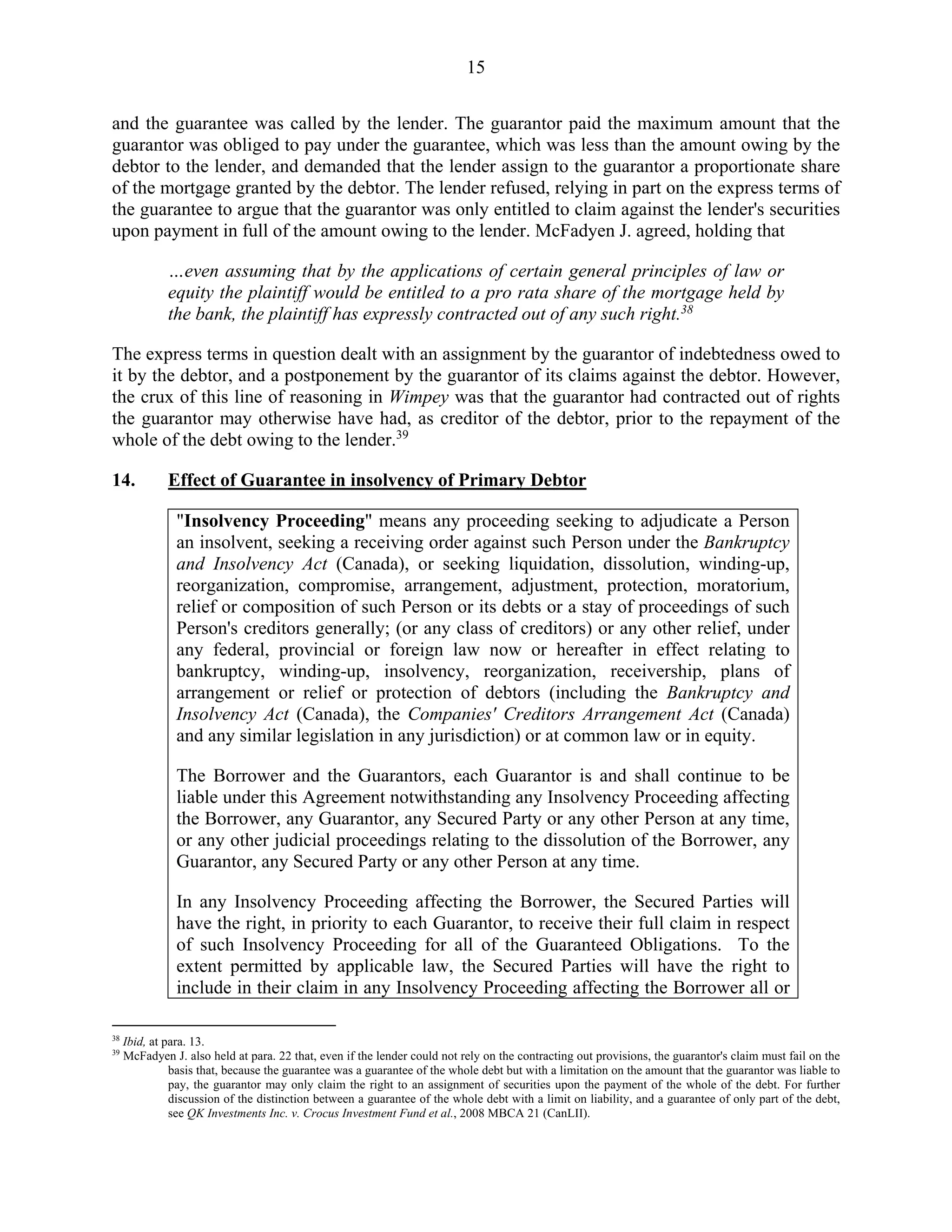
14. Effect of Guarantee in insolvency of Primary Debtor
"Insolvency Proceeding" means any proceeding seeking to adjudicate a Person
an insolvent, seeking a receiving order against such Person under the Bankruptcy
and Insolvency Act (Canada), or seeking liquidation, dissolution, winding-up,
reorganization, compromise, arrangement, adjustment, protection, moratorium,
relief or composition of such Person or its debts or a stay of proceedings of such
Person's creditors generally; (or any class of creditors) or any other relief, under
any federal, provincial or foreign law now or hereafter in effect relating to
bankruptcy, winding-up, insolvency, reorganization, receivership, plans of
arrangement or relief or protection of debtors (including the Bankruptcy and
Insolvency Act (Canada), the Companies' Creditors Arrangement Act (Canada)
and any similar legislation in any jurisdiction) or at common law or in equity.
The Borrower and the Guarantors, each Guarantor is and shall continue to be
liable under this Agreement notwithstanding any Insolvency Proceeding affecting
the Borrower, any Guarantor, any Secured Party or any other Person at any time,
or any other judicial proceedings relating to the dissolution of the Borrower, any
Guarantor, any Secured Party or any other Person at any time.
In any Insolvency Proceeding affecting the Borrower, the Secured Parties will
have the right, in priority to each Guarantor, to receive their full claim in respect
of such Insolvency Proceeding for all of the Guaranteed Obligations. To the
extent permitted by applicable law, the Secured Parties will have the right to
include in their claim in any Insolvency Proceeding affecting the Borrower all or
38
Ibid, at para. 13.
39
McFadyen J. also held at para. 22 that, even if the lender could not rely on the contracting out provisions, the guarantor's claim must fail on the
basis that, because the guarantee was a guarantee of the whole debt but with a limitation on the amount that the guarantor was liable to
pay, the guarantor may only claim the right to an assignment of securities upon the payment of the whole of the debt. For further
discussion of the distinction between a guarantee of the whole debt with a limit on liability, and a guarantee of only part of the debt,
see QK Investments Inc. v. Crocus Investment Fund et al., 2008 MBCA 21 (CanLII).
16
any part of the payments made by any Guarantor under this Agreement and, to
prove and rank for, and receive dividends in respect of, all such claims, all of
which rights and privileges as they relate and apply to each Guarantor are
assigned by such Guarantor to the Lender. To the extent permitted by applicable
law, the provisions of this Section shall be sufficient authority for any Person
making payment of any such dividends to pay the same directly to the Lender.
Upon the occurrence and during the continuance of an Event of Default, the
Lender will be entitled to receive all dividends or other payments in respect of all
of the above referenced claims until all of the Guaranteed Obligations are paid
and satisfied in full and the Guarantors will continue to be liable under this
Agreement for any unpaid balance of the Guaranteed Obligations. If any amount
is paid to any Guarantor under any Insolvency Proceeding affecting the Borrower
at any time following the occurrence and during the continuance of an Event of
Default and when any of the Guaranteed Obligations remain outstanding, such
amount will be received and held in trust by such Guarantor for the benefit of the
Lender and will be promptly paid to the Lender to be credited and applied against
the Guaranteed Obligations or the obligations of such Guarantor hereunder, as the
case may be. The Lender may in its discretion value as it sees fit, or may refrain
from valuing, any Security held by or for the benefit of the Lender.
Given that a guarantee is a secondary obligation to answer for the primary obligations of a
debtor, then upon the primary obligation coming to an end it may appear to follow that the
guarantor's obligations should similarly come to an end. As held by Collins, L. J. in the 1901
English Court of Appeal case Stacey v. Hill,40
"the release of a debtor discharges his guarantor".
However, in the context of an insolvent debtor who has been discharged from their debt,
discharging the guarantor would lead to an absurd result by defeating the very object of giving
and taking a guarantee.41
The Companies' Creditors Arrangement Act42
makes it clear that a guarantor is not released
where a debtor claims relief under the CCAA:
11.04 No order made under section 11.02 has affect on any action, suit or
proceeding against a person, other than the company in respect of whom the
order is made, who is obligated under a letter of credit or guarantee in relation to
the company.43
Similarly, Section 179 of the Bankruptcy and Insolvency Act44
provides that a discharge of a
bankrupt does not release a surety of the bankrupt:
179 An order of discharge does not release a person who at the time of the
bankruptcy was a partner or co-trustee with the bankrupt or was jointly bound or
40
[1901] 1 K.B. 660 (C.A.) ("Stacey Hill") at page 751.
41
Hindcastle Ltd. v. Barbara Attenborough Associates Ltd. [1996] 1 All ER 737.
42
R.S.C., 1985, c. C-36 ("CCAA").
43
Ibid, s. 11.04
44
R.S.C. 1985, c. B-3 ("BIA").
17
had made a joint contract with the bankrupt, or a person who was surety or in the
nature of a surety for the bankrupt.
Section 179 of the BIA was effectively ignored by the 1965 case of Cummer-Yonge Investments
Ltd. v. Fagot,45
a case that was decided in the leasing context and that stood for the proposition
that the disclaimer by a trustee in bankruptcy of a lease terminates a guarantor's obligation to
honour the tenant's covenants under the lease, on the basis that there were no longer any
obligations to guarantee. A number of cases46
fell in step with Cummer-Yonge. However, in the
Supreme Court in Crystalline Investments Ltd. v. Domgroup Ltd.,47
a case which also dealt with
the disclaimer of a bankrupt tenant's lease, Major J. held that Cummer-Yonge had created
uncertainty in leasing and bankruptcy and should be overruled:
The House of Lords went on to overrule Stacey v. Hill. In my opinion, Cummer-
Yonge should meet the same fate.48
The sample clause set out above aims to prevent a guarantor from seeking a release on the basis
of the debtor's insolvency. The clause also aims to prevent a guarantor who has paid amounts
owing under a partial guarantee from receiving a dividend out of the assets of the debtor prior to
the lender being paid in full.
15. Governing Law
This Agreement shall be governed by and construed in accordance with the laws
of the Province of Ontario and the federal laws of Canada applicable in the
Province of Ontario. Each Guarantor irrevocably submits to the non-exclusive
jurisdiction of the courts of competent jurisdiction in the Province of Ontario in
respect of any action or proceeding relating in any way to this Agreement.
As a general rule, parties are free to choose the law by which their contract is governed, and
where parties expressly stipulate that their contract is to be governed by the laws of a particular
jurisdiction, that law will be the proper law of the contract. This freedom is subject to certain
limitations however, including that the choice must be bona fide and legal there must be no
reason for avoiding the choice on the ground of public policy.49
While it is always a good idea to consider whether a particular choice of law may be illegal or
contrary to public policy, practitioners should take particular note of the fact that Alberta law
includes certain formal requirements applicable to guarantees that cannot easily be contracted out
of by means of a governing law clause.
The Alberta Guarantees Acknowledgement Act50
provides that no guarantee provided by an
individual is enforceable in Alberta unless such guarantor appears before a lawyer,
45
1965 CanLII 295 (ON SC) ("Cummer-Yonge").
46
See, for example, Targa Holdings Ltd. v. Whyte, 1974 ALTASCAD 36 (CanLII) and Titan Warehouse Club Inc. (Trustee of) v. Glenview Corp.
(1988), 67 C.B.R. (N.S.) 204 (S.C.O.).
47
2004 SCC 3 (CanLII) ("Crystalline").
48
Cummer-Yonge, supra note 53, at para. 42.
49
See, for example, Vita Food Products Inc. v. Unus Shipping Co.Ltd. [1939] 2 D.L.R. 1 and Bad Ass Coffee Company of Hawaii Inc. v. Bad Ass
Enterprises Inc., 2008 ABQB 404 (CanLII) at 17 ("Bad Ass").
50
RSA 2000, c G-11 (the "GAA"). The current version of the GAA was enacted on April 30, 2015.
18
acknowledges to the lawyer that they executed the guarantee and, in the presence of the lawyer,
executes a certificate in the form prescribed by the GAA. No other Canadian jurisdiction has
similar legislation, and Alberta case law requires strict compliance with the GAA. In Bharwani v.
Chenkalath,51
the Alberta Court of Appeal considered the requirements of the GAA:
The Act clearly expresses obligations that must be complied with as a matter of
public policy and as a pre-requisite to enforceability of a guarantee by an
individual in Alberta. The performance of those obligations cannot be waived or
estopped regardless of the individual guarantor’s actual knowledge of the
obligations undertaken in the guarantee.52
Because strict compliance with the GAA is required, practitioners should be wary of whether
Alberta law may apply to a personal guarantee, for instance in circumstances where the
guarantee is executed in Alberta or where the parties are resident in Alberta. A choice of law
clause may not circumvent the application of the GAA if the intention of the GAA, to protect
unsophisticated borrowers from unexpected debt, is thereby defeated.53
16. The interpretation of standard form guarantees
Broadly speaking, the ordinary rules of contractual interpretation apply to guarantees. However,
in Manulife, Cory J., speaking for the majority of seven member panel of the Supreme Court
(L’Heureux-Dubé, Gonthier and Iacobucci JJ dissenting) recognized that in “many if not most
cases of guarantees a contract of adhesion is involved”54
and described four special
considerations which apply to the contractual interpretation of guarantees:
1. any ambiguity in the terms of the guarantee should be construed against the party which
drew it, by applying the contra proferentem rule;55
2. because a guarantor has a favoured position in the law, their obligations sound be strictly
examined and strictly enforced;56
3. while parties are generally free to contract out of protection provided to a guarantor by
common law or equity, any such contracting out must be clear;57
and
4. guarantee clauses must be considered in the context of the entire transaction.58
51
2008 ABCA 148 (CanLII).
52
Ibid, at 28.
53
Bad Ass, supra note 50, at 24.
54
Manulife, supra note 20 at 7: "[t]hat is to say the document is drawn by the lending institution on a standard form. The borrower and the guarantor
have little or no part in the negotiation of the agreement. They have no choice but to comply with its terms if the loan is to be granted. Often
the guarantors are family members with limited commercial experience. As a matter of accommodation for a family member or friend they
sign the guarantee. Many guarantors are unsophisticated and vulnerable. Yet the guarantee extended as a favour may result in a financial
tragedy for the guarantor.'
55
Ibid at 8.
56
Ibid at 10.
57
Ibid at 4, citing First City Capital Ltd. v. Hall, [1993] O.J. No. 135, 11 O.R. (3d) 792) at 796 (Ont. C.A.).
58
Ibid at 16.
19
As Geoff R. Hall writes:
The modifications are driven not by interpretive concerns about giving effect to
the parties’ intentions but rather by the concern of furthering certain substantive
legal protections afforded to guarantors. As such, the interpretation of guarantees
is a relatively rare instance, along with employment contracts, franchise
contracts, and a few other instances, in which the courts use contractual
interpretation to advance certain social and policy goals beyond the usual policy
goal of interpretive accuracy.59
The special nature of the contractual interpretation of guarantees should not be overstated.
Iacobucci J., for the dissent in Manulife, was of the view that no special rule of construction was
applicable to guarantees,60
and a number of cases both before and after Manulife have held that
the rules respecting the interpretation of guarantees are essentially the same as the rules
governing the interpretation of deeds and contracts generally, which rules were recently
described by Rothstein J (for the Supreme Court) in the 2014 Sattva61
decision as follows:
…the interpretation of contracts has evolved towards a practical, common-sense
approach not dominated by technical rules of construction. The overriding
concern is to determine “the intent of the parties and the scope of their
understanding”…[t]o do so, a decision-maker must read the contract as a whole,
giving the words used their ordinary and grammatical meaning, consistent with
the surrounding circumstances known to the parties at the time of formation of the
contract.62
In Sattva, a case considering the standard of review applicable to commercial arbitrations
conducted under the British Columbia Arbitration Act, the Supreme Court drew the following
conclusions, among others, regarding the interpretation of contracts:
1. The parol evidence rule does not apply to preclude evidence of surrounding
circumstances when interpreting the words of a written contract;63
2. Contractual interpretation involves issues of mixed fact and law as it is an exercise in
which the principles of contractual interpretation are applied to the words of the written
contract, considered in light of the factual matrix;64
and
3. Except where it is possible to identify an "extricable question of law" in disputes over
contractual interpretation65
, questions of contractual interpretation, as questions of mixed
fact and law, will be held to a standard of review of reasonableness, not correctness.66
59
Hall, supra note 10 at 7.6.1.
60
Manulife, supra note 20 at 78.
61
Sattva Capital Corp. v. Creston Moly Corp., [2014] 2 SCR 633, 2014 SCC 53 (CanLII) ("Sattva").
62
Ibid at 49.
63
Ibid at 59.
64
Ibid at 50.
65
In which case the standard of review would be correctness, as opposed to the standard of palpable and overriding error or reasonableness.
66
Sattva, supra note 62 at 75.
20
Given the narrow context in which Sattva was decided, Earl A. Cherniak has suggested that
Rothstein J's comments on the standard of review applicable to arbitral and trial decisions on
contractual interpretation were obiter,67
and courts have distinguished Sattva in a recent line of
cases considering the interpretation of standard form insurance contracts.
For example, in the recent case of MacDonald v. Chicago Title Insurance Company of Canada,68
a case involving the interpretation of a standard-form title insurance policy, Hourigan J., for a
three member panel of the Ontario Court of Appeal, declined to place too much weight on the
factual matrix, reasoning that
…the importance of the factual matrix is far less significant, if at all, in the
context of interpreting standard form contracts or contract of adhesion where the
parties do not negotiate terms and the contract is put to the receiving party on a
take-it-or-leave-it proposition…[t]he terms of the Title Policy were simply not
negotiated in any meaningful sense and it would be illusory to suggest that
anything could be inferred about the meaning of the contract from the facts
surrounding its formation.69
Because it is artificial to consider the factual matrix in interpreting a standard form contract, and
with reference to the public policy consideration of providing consistency in the interpretation of
standard form contracts,70
Hourigan J. held that the interpretation of standard form contracts is a
matter of law, not mixed fact and law, and so is subject to the standard of review of correctness,
not reasonableness.
Similarly, in Ledcor Construction Limited v. Northbridge Indemnity Insurance Company,71
another case dealing with the interpretation of standard form contracts, the Alberta Court of
Appeal has held that "[t]o the extent that interpretation of an insurance contract is a mixed
question of fact and law, it falls on the extreme end of that "spectrum of particularity", and the
standard of review for interpretation of insurance policies is correctness."72
Essentially, MacDonald and Ledcor stand for the proposition that the standard of review of
standard form insurance contracts is correctness, not reasonableness, because the factual matrix
is of minimal significance to the interpretation of such contracts and so such interpretation is not
(or is barely) a matter of mixed fact and law. While these cases concerned insurance policies, a
highly specialized form of contract, these decisions may be instructive as to the relevance of
surrounding circumstances when interpreting standard form contracts generally, including
standard form guarantees.
Interestingly, this departure from Sattva also appears to call into question, at least in the context
of standard form guarantees, the special interpretive rule in Manulife that guarantee clauses must
be considered in the context of the entire transaction.
67
Earl A. Cherniak, “Sattva Revisited” (2015) 34:2 Advocates' Soc J 6.
68
2015 ONCA 842 (CanLII) ("MacDonald").
69
Ibid, at 33-34.
70
Ibid, at 38.
71
2015 ABCA 1212 (CanLII) ("Ledcor").
72
Ibid, at 18.

Guarantees in Lending Transactions

  • 1.
    GUARANTEES IN LENDINGTRANSACTIONS: What you Forgot you Knew Simon P. Crawford, Partner Bennett Jones LLP Jacob Dubelaar, Associate Bennett Jones LLP Everything in business, and therefore everything in the practice of business law, is now faster, more compressed, more standardized and more commoditized that ever before. Where once we hand-marked marginal changes to a common document and exchanged it back and forth once to twice by three day mail delivery before closing, now we electronically blackline a document and email it in moments, allowing for sometimes dozens of versions of comments to be exchanged between solicitors. And to accommodate faster closings and to encourage risk uniformity, there has been a rapid movement among lenders to standard form loan documents, and a decreased appetite among lenders to entertain changes to them, on the belief that a commitment of quick and cheap mortgage money is a fair rebuttal to a borrower who wants to make changes to the bank's standard loan documents. Which is to say, that many practitioners in mortgage loan practices often find themselves practicing less law and more transaction administration. They are being told more and more that they don’t have room to negotiate bank documents. And for the most part, there is often little resistance on the part of borrowers, because less negotiation invariably means lower legal fees. But in all of this, there remains the underlying obligation on the solicitor to ensure that the loan documents work – that they make sense – that they are enforceable – that they are assembled and structured in a way that achieves the business expectations of the client – and not make the assumption that just because the documents are "standard form" or have been printed from the lender's on-line document warehouse, that they are correct in the circumstances of the transaction. And so this discussion, while not presuming to be exhaustive, is designed to remind lending lawyers of some of the basic elements of just one type of loan document – the guarantee – and act as a reminder of what some of the important elements of it are. This is a reminder to transactional lawyers that loan guarantees are not simply preprinted documents that require a "fill in the blanks" approach. Guarantees have a long and somewhat tortured history. And for a half moment, let us consider the family that guarantees belong to. The common law has long recognized the concept of a "surety", a person who takes responsibility for another's performance of an undertaking or debt or pledges property as security for such performance or payment.
  • 2.
    2 I start withthis common law concept of a surety, in part, to distinguish it from a guarantor. To mimic an LSAT formulation, all guarantors are sureties but not all sureties are guarantors. And without being too technical, the notion is as follows. One can agree to be responsible for the obligations of debts for another in a number of ways, all of which are recognized at law as being surety relationships. One way is by guarantee— a documented promise in favour of a third party to perform the obligations or pay the liabilities of another should they fail to do so. Another way is by indemnity— a promise to the third party to indemnify them for losses, costs and expenses incurred should a third party fail to perform its obligations. And yet a third way, whether or not a written guarantee or indemnity is given, is to offer a pledge of one's assets in favour of the third party as security for the liabilities or performance of obligations by another. This discussion will deal mainly with guarantees, but in doing so, it will touch on a number of concepts that are common to all sureties. So now that we have a reason for our discussion, let's have some rhyme. The approach we will take to this analysis is to consider some of the more important provisions of a guarantee and to consider issues that sometimes arise in the context of them, so that we are reminded of why these things are in the document, and what happens when they are omitted, struck out or modified. Before doing so, however, it would be first helpful to remember the law as it relates to two things (a) guarantees and the requirement that they be evidenced in some manner in writing; and (b) the conflict that sometimes arises between the pre-printed portion of a guarantee (or guarantee contained in and built into a mortgage) and stand alone guarantee language. 1. Requirement for Guarantees to be evidenced by writing. Guarantees are part of a special class of deeds and contracts subject to the Statute of Frauds,1 which provides as follows: Writing required for certain contracts 4. No action shall be brought to charge any executor or administrator upon any special promise to answer damages out of the executor’s or administrator’s own estate, or to charge any person upon any special promise to answer for the debt, default or miscarriage of any other person, or to charge any person upon any contract or sale of lands, tenements or hereditaments, or any interest in or concerning them, unless the agreement upon which the action is brought, or some memorandum or note thereof is in writing and signed by the party to be charged therewith or some person thereunto lawfully authorized by the party. While there is no common law requirement that a guarantee be evidenced in writing, Section 4 of the Statute of Frauds imposes a formal requirement that either a guarantee itself, or some memorandum or note thereof, is evidenced in writing.2 The application of the Statute of Frauds turns on whether the agreement (or such portion of the agreement at issue) gives rise to a primary obligation or rather a "special" secondary or collateral obligation that constitutes a guarantee. 1 R.S.O. 1990, c. S. 19 (the "Statute of Frauds"). 2 While there are a number of situations in which the requirement for written evidence may be dispensed with, the starting point of the analysis is that such written evidence is required.
  • 3.
    3 This distinction isdiscussed in greater detail below. In short, every agreement which is a guarantee in substance must comply with the Statute of Frauds in form and, while the Statute of Frauds does not require that any particular form be adhered to, the essential elements of the agreement generally must be in writing.3 2. Conflict between pre-printed guarantee language and added language. Subsection 8(1) of the Land Registration Reform Act4 permits the filing of standard charge terms with the Ontario Director of Land Titles, and Subsection 9(1) of the LRRA deems a charge to include a set of standard charge terms if the charge incorporates such set of standard charge terms by reference to its filing number. This regime increases transaction efficiency and certainty over time as counsel become familiar with the particulars of the standard charge terms, or so the theory goes. However, as discussed by Doug Bourassa in his paper presented as part of a recent CLE program, standard charge terms often include guarantee language, which gives rise to a risk of a conflict between the standard charge terms and separate guarantee agreements, and concomitant uncertainty. 5 Subsection 9(4) of the LRRA effectively provides that express charge terms prevail in the event of a conflict with standard charge terms deemed to be included in the charge under the LRRA, and courts have held, either with reference to Subsection 9(4) of the LRRA6 or otherwise,7 that express terms included in a loan agreement prevail to the extent such terms conflict with standard charge terms. With these technical concepts in mind, let's turn to some of the more common guarantee provisions, keeping in mind that the example guarantee text below is illustrative only. 3. Parties to a Guarantee To: First Bank of Lawyerville (the "Bank") Because a guarantee is a contract, it is subject to the ordinary requirements of contract, including the requirements of offer, acceptance and consideration. An offer need not be explicitly stated, but it must be possible to objectively determine that an offer has been made. Because a lender rarely executes a guarantee document or otherwise expressly accepts a guarantee, guarantees often take the form of a unilateral contract: the guarantee will provide, expressly or by implication, that if the lender extends the loan to the borrower, the guarantor will guarantee payment of the guaranteed obligations. In such case, acceptance by the lender is indicated by the lender complying with the terms of the guarantee. While notice of acceptance is not required unless the terms of the offer so require,8 the clearest evidence of offer and acceptance is an 3 A. MacDonald & Co. v. Fletcher, [1915] 22 BCR 298. 4 R.S.O. 1990, c. L.4 (the "LRRA"). 5 Doug Bourassa, "How to Structure Personal and Corporate Guarantees in Mortgage Transactions or How I Learned to Stop Worrying and Love the Law of Guarantees" (Paper presented at the CPD program Commercial Mortgage Transactions 2015, September 17, 2015), at page 13. 6 Royal Trust Corporation of Canada v. 502759 Ontario Ltd., 2000 CanLII 5738 (ON CA) at 38. 7 Bank of Nova Scotia v. Suthakaran, 2011 ONSC 6970 (CanLII) at 18. 8 Fraser v. Douglas, 5 WLR 52.
  • 4.
    4 exchange of correspondenceto that effect, or a written agreement signed by both parties and self- evidently embodying the terms of a contract to which the parties have agreement.9 4. Recitals. WHEREAS the Borrower has made application to the lender for the mortgage facility and the lender has agreed to make such facility available to the Borrower on the terms and conditions hereinafter set out. AND WHEREAS, in consideration for the lender so doing, the Guarantor has agreed to guarantee the obligations of the Borrower under the mortgage facility on and subject to the terms herein set out. Whereas parties to an agreement often find it useful to outline the factual basis for which the agreement is being entered into, and whereas in recent years courts have increasingly considered the document as a whole and the factual matrix when interpreting contracts, recitals can play a useful, albeit somewhat uncertain and limited, role in the drafting of guarantees. Generally, courts will look to recitals to determine the constraints and limits that the parties intended to apply to the agreement, and recitals will be interpreted in accordance with two principles: (1) where the operative provisions of a contract are clear and unambiguous, such provisions will prevail over the recitals to the extent of a conflict, and (2) where the operative provisions of a contract are unclear and ambiguous, courts may look to the recitals to resolve such ambiguity. The subordination of recitals is somewhat inconsistent with the modern approach to contractual interpretation in that "it gives no meaning to words which the parties chose to include in their agreement (presumably for a reason), and it ignores the parties' own effort to express the context in which their agreement has arisen."10 The second principle is consistent with the modern approach of interpreting a contract in light of the entire document and the factual matrix. While there exists a line of cases suggesting that recitals form part of the agreement as a whole and so should be interpreted in accordance with the general rules of construction,11 counsel should be wary of including operative language in the recitals themselves, or otherwise placing too much reliance on the wording of recitals. 9 Kevin McGuinness, The Law of Guarantee, 3rd ed. (Markham: Lexis Nexis Canada, 2013)("McGuinness") at 4.183. 10 Geoff R. Hall, Canadian Contractual Interpretation Law, 2d ed (Markham: LexisNexis Canada, 2012) ("Hall") at 8.17.2. 11 See, for example, Canada Wide Magazines Ltd. v. Columbia Publishers Ltd. 1994 CanLII 3332 (BC SC).
  • 5.
    5 5. Consideration In considerationof the Lender making certain financial accommodations available to the Borrower and at the request of the Borrower that the Guarantor provide this Agreement, and for other good and valuable consideration, the receipt and sufficiency of which are acknowledged, the Guarantor agrees with and in favour of the Lender as follows: As discussed above, guarantees are contracts and so guarantees require consideration in order to be enforceable. The consideration for a guarantee may take the form of a benefit flowing from lender directly to the guarantor, and oftentimes guarantees (as well as other contracts) will include a statement to the effect that some nominal payment has been exchanged which, together with other "good and valuable consideration", constitutes sufficient consideration. More often than not (or dare I say, nearly always) the nominal consideration never actually changes hands and so, if the nominal consideration is all you've got (or rather, purport to have), you may find yourself a few peppercorns shy of an enforceable bargain. Furthermore, while courts will generally not inquire as to the adequacy of consideration, some courts have recognized a distinction between "nominal consideration" and "valuable consideration" and have held that, notwithstanding the freedom of parties to make bad bargains, nominal consideration which is not "real" consideration of some value in the eyes of the law does not constitute sufficient consideration.12 In most instances the reference to nominal consideration is simply boilerplate language that does not reflect the actual consideration changing hands, and the presence of such boilerplate language certainly does not render a guarantee unenforceable: the consideration for a guarantee need not be set out in writing,13 nor is it necessary that consideration flow to the guarantor,14 as the consideration may simply be the lender suffering some detriment or providing some benefit to a third party, such as the granting of credit by the lender to the borrower. However, a potential issue arises where a guarantee is provided in circumstances where a borrower has defaulted or is on the brink of default under an existing loan. The potential issue is that, while it is generally sufficient that the lender has granted some specific type forbearance in consideration for a guarantee, for example refraining from commencing legal proceedings against the borrower or granting an extension for repayment of the underling debt, mere voluntary inaction on the part of the lender does not constitute sufficient consideration.15 So what's to be made of all of this? Although a guarantee need not explicitly describe the consideration for which it is granted, it is prudent to consider whether, given the context of the transaction, valid consideration has in fact moved from the lender. When in doubt, spell it out (particularly when acting for the lender). Ensure that the guarantee contains an accurate (but sufficiently broad)16 description of the legally valuable consideration (for example making 12 See, for example, Glenelg Homestead Ltd v Wile, 2003 NSSC 155 (CanLII) at para. 26. 13 Statute of Frauds, at s. 6. 14 Canada Mortgage and Housing Corp. v. Elbarbari, 1996 CanLII 6712 (SK QB) per MacLean, J. 15 Crears v. Hunter (1887), 19 QBD 341 at 346. 16 There is case law suggesting that, by describing the consideration in overly-specific terms, the scope of the guarantee may inadvertently be limited because, while the description of consideration is not conclusive, it is relevant in construing the terms for the contract itself. See, for instance, ING Lease (UK) Limited v. Harwood [2007] EWHC 2292 (QB), in which the High Court of Justice (Queen's Bench Division) partially relied on the wording of a guarantee's consideration clause in finding that certain obligations of the borrower did
  • 6.
    6 available credit facilitiesor granting some specific forbearance to the borrower) for which the guarantee is granted. 6. Guarantee is a secondary obligation not a primary one The Guarantor unconditionally and irrevocably guarantees, as primary obligor and not as surety… A guarantee is a secondary obligation which arises only upon the "debt, default or miscarriage"17 of some third party. Because the liability is secondary to the principal borrower, a guarantor's liability does not arise until the borrower defaults upon the guaranteed obligation. If the liability constitutes a primary obligation (for example, a primary undertaking to make good a loss), it is not a contract of guarantee.18 A party is free to assume primary liability in respect of the indebtedness of another and it is common, for instance, for a guarantee to include a "principal debtor" clause, such as the clause reproduced above, which provides that the liability of the guarantor is as "principal debtor" or "primary obligor", and not as surety. It has been held that such a clause converts a guarantor into a full-fledged principal debtor,19 the intended effect of which is to remove defences that may otherwise be available to a guarantor. However, the full meaning and effect of a principal debtor clause depends on the context of the agreement and the intentions of the parties to the transaction, and there exists a line of cases20 which calls into question the effectiveness of such clauses. As Professor McGuinness writes, "[a] principal debtor clause is, as best vague, imprecise and general. It conveys no clear message to anyone."21 In Communities Economic Development Fund v. Canadian Pickle Corp.22 the Supreme Court of Canada considered the nature of a guarantor's obligations and the meaning of a principal debtor clause in the context of a guarantee of a loan which was ultimately found to be unenforceable by the lender. Canadian Pickles involved a lender, Communities Economic Development Fund, that was a statutory corporation created under the Manitoba Communities Economic Development Fund Act for the public purpose of encouraging economic development in remote and isolated regions, and a borrower, Canadian Pickles Corporation, that operated in Stony Mountain, a small community located just outside of Winnipeg. The loan was guaranteed by the directors of the borrower. When the borrower defaulted on the loan, the lender sued the borrower and the guarantors. At trial, Stony Mountain was determined to be insufficiently remote and isolated to fall within the scope of the lender's permitted lending activities and so the loan was found to be invalid because it was ultra vires the lender. This finding was confirmed by the Manitoba Court of Appeal and the Supreme Court of Canada. However, also at issue was whether a guarantor not fall within the scope of the guarantee. See also Neil Levy & John Phillips, "Aspects of Guarantee Clauses and Their Drafting" (September 2009), online: Guildhall Chambers <http://www.guildhallchambers.co.uk/files/AspectsofguaranteeclausesFormattedNL.pdf>. 17 Statute of Frauds, supra note 1at s. 4. 18 Morin v. Hammond Lumber Co., [1923] SCR 140. 19 Canadian Imperial Bank of Commerce v. Patel (1990), 72 O/R/ (2d) 109 (H.C) at p. 119. 20 See, for example Manulife Bank of Canada v. Conlin 1996 CanLII 182 (SCC) ("Manulife") and Re Olympia & York Developments Ltd. [1998] O.J. No 3482 (C.A.). 21 Kevin McGuinness, The Law of Guarantee, Third Edition (Markham, Ontario: LexisNexis 2013) ("McGuinness") at 15.152. 22 1991 CanLII 48 (SCC) ("Canadian Pickles").
  • 7.
    7 remained liable tothe lender notwithstanding that the underlying loan was void. The guarantee included the following principal debtor clause: That as between the Fund and the Guarantors, the Guarantors are and shall continue to be jointly and severally liable as principal debtors under all the covenants contained in the Security, notwithstanding the bankruptcy, insolvency or going into liquidation of the Borrower, voluntary or otherwise, and notwithstanding any transaction which may take place between the Fund and Borrower or any neglect or default of the Fund which may otherwise operate as a discharge, whether partial or absolute, of the Guarantors if they were sureties only of the Borrower… 23 Iacobucci J. reasoned that, although the guarantors were free to agree to be liable as principal debtors, on a plain reading of the guarantee, the guarantors were only principally liable in certain listed circumstances which did not include invalidity of the principal debt. Because guarantors were not liable to repay the debt in the event the principal debt was ultra vires the lender, the lender's claim failed. Canadian Pickles and several cases that followed have left a (we couldn't help it) "sour" taste in the mouths of lenders. While a guarantor is free to assume principal liability for another party's debt, little reliance should be placed on a principal debtor clause because, in Canadian Pickles and elsewhere, the courts have taken a narrow reading of principal debtor clauses and have demonstrated a willingness to disregard or limit the application of principal debtor clauses where such clauses are found to be inconsistent with the broader contractual context. 23 Ibid, at 416.
  • 8.
    8 7. Guarantees vs.Indemnities and Including both in the Agreement Each Guarantor agrees to indemnify and save the Lender harmless from and against all costs, losses, expenses, claims, liabilities and damages it may suffer as a result or consequence of, any inability by the Lender to recover the ultimate balance due or remaining unpaid to the Lender in respect of the Guaranteed Obligations, including without limitation, legal fees incurred by or on behalf of the Lender resulting from any action instituted on the basis of this Agreement, and shall pay all such amounts to the Lender after demand as herein provided. In Canadian Pickles Iacobucci J. discussed the distinction between a contract of guarantee, in which the liability of the guarantor is usually coterminous with that of the principal debtor, and a contract of indemnity, in which the indemnifier assumes a primary obligation and is liable regardless of the liability of the principal debtor. While guarantees and indemnities are distinct classes of contracts, in many instances it is difficult to distinguish the two in practice, a sentiment echoed by Iacobucci J. by referencing an earlier case in which the distinction was described as follows: [i]t seems to me a most barren controversy [which] has raised many hair-splitting distinctions of exactly that kind which brings the law into hatred, ridicule and contempt by the public.24 Hatred, ridicule and contempt aside, the distinction between indemnities and guarantees remain relevant in commercial lending transactions in at least two respects. Firstly, because an indemnity creates a primary obligation which is not coterminous with the obligations of a borrower, the scope of recovery under an indemnity can be greater than under a guarantee. For example, indemnitees often indemnify the lender against any loss, including the cost of legal fees, reasonably incurred by the lender in recovering amounts owing under the underlying loan or the guarantee. While recovery for costs will only be allowed where a court finds it just and proper on the facts of a given case, courts have demonstrated some willingness to allow for such recovery by an indemnified party in connection with an indemnified matter. By providing an indemnity for costs as well as for other losses incurred in connection with an indemnified matter, an indemnitor is potentially underwriting a lender's expected profits as opposed to merely agreeing to be answerable for the "debt, default or miscarriage" of some other party. Secondly, given the uncertainty surrounding principal debtor clauses and the ever-growing number of defences available to guarantors, by incorporating an indemnity into a guarantee, a primary obligation is created that is distinct from the secondary obligation of a guarantee and that may be called upon if the guarantee should fail for any reason. While an indemnity may be easier to enforce, a guarantee should still be maintained because, as a separate obligation, it 24 Ibid at 414, citing Halman L.J. in Yeoman Credit, Ltd. v. Latter, [1961] 2 All E.R. 295 (C.A.) at p. 299.
  • 9.
    9 enables a lenderto seek full and separate (from the underlying debt) recovery, particularly useful in the context of a bankruptcy proceeding. 8. Joint, Several and Joint and Several Liability Each Guarantor unconditionally and irrevocably guarantees to the Lender, and its respective successors and assigns, the prompt payment and performance of the Guaranteed Obligations forthwith upon demand by the Lender. Often times, two or more parties provide guarantees in respect of the same loan transaction. In such circumstances, a guarantor's liability may be joint, several, or joint and several. Where guarantors are jointly liable in respect of the same debt, they are together liable for the full amount of the guaranteed debt and the obligations are not cumulative. For example, where A and B jointly provide a guarantee to C of $100 of a particular debt, the total value of the guarantee is $100 but payment by either A or B will discharge the other. Where two or more guarantors are severally liable in respect of distinct portions of the same debt, then each guarantor may be called upon only for the portion of the debt for which it is liable. For example, where A and B provide several guarantees to C of $50 of a particular debt, then the total value of the guarantees are $100, but payment by A will not discharge B's obligation to pay, and C must sue A and B separately for their promises. For procedural convenience, a lender will prefer that guarantees from multiple guarantors be provided on a joint and several basis. Chitty on Contracts defines joint and several liability as follows: Joint and several liability arises when two or more persons in the same instrument jointly promise to do the same thing and also severally make separate promises to do the same thing. Joint and several liability gives rise to one joint obligation and to as many several obligations as there are joint and several promisors. It is like joint liability in that co-promisors are not cumulatively liable, so that performance by one discharges all; but it is free from most of the technical rules governing joint liability. 25 25 HG Beale, ed, Chitty on Contracts, 29th ed (London, UK: Sweet & Maxwell, 2004) at 17-003.
  • 10.
    10 9. Caps onLiability or Agreed upon Splits of Liability The Guarantors hereby unconditionally and irrevocably grant a limited guarantee, each on a several basis (and not on a joint and several basis) of the Guaranteed Obligations, provided that the liability of each of the guarantors hereunder shall be limited to fifty percent (50%) of the aggregate amount of the Loan Amount outstanding at the time demand for payment is made hereunder, in each case to a maximum amount of fifty thousand dollars ($50,000). Where guarantees are provided on a several basis only, care should be taken to ensure that the guarantee is properly limited to a fixed amount and/or a fixed percentage of the indebtedness of a borrower, as the case may be. For example, if two parties provide several 50% guarantees in respect of an underling debt, counsel should consider whether the intention is to limit the guarantees to (i) an amount equal to 50% of the underling debt from time to time, (ii) an amount equal to 50% of a fixed amount, or (iii) an amount equal to the lesser of (i) and (ii). If the intention is to limit the guarantee by both proportion and amount, then this should be clearly stated. Without proper limiting language, there is the potential unintended consequence of a several guarantee guaranteeing an increasing proportion of the underlying debt as such debt is paid down over time. 10. Specific, Continuing and All-Accounts Guarantees "Guaranteed Obligations" means all present and future indebtedness, liabilities and obligations of any and every kind, nature and description (whether direct or indirect, joint or several, absolutely or contingent, matured or unmatured) of or owing by the Borrower to the Lender at any time and from time to time, present and future, under, in connection with or with respect to the Credit Agreement and all documents, undertakings and agreements entered into by the Credit Parties pursuant to or in connection with the Credit Agreement, and all amendments, restatements, replacements, renewals, extensions, or supplements of, and continuations to, each such agreement, undertaking or contract, or from any other agreement, contract or dealing with any third party by which the Lender may be or become in any manner a creditor of the Borrower, or howsoever otherwise arising, and whether the Borrower is bound alone or with another or others, and whether as principal or surety, and including without limitation, all liabilities of the Borrower arising as a consequence of its failure to pay or fulfill any of such indebtedness, liabilities and obligations, and any unpaid balance thereof. A guarantee can be limited by time, amount or scope of guaranteed obligations, or can be indefinite in duration and guarantee all amounts owned by the borrower to the lender, without reference to how those debts came into being. There are three basic types of guarantee: specific or discrete guarantees, continuing guarantees, and all-accounts guarantees.
  • 11.
    11 In a specificguarantee, not surprisingly, the guarantor undertakes liability in respect of a specific liability of the principal. For example, if a loan of $100 is made to the borrower and the guarantor guarantees the repayment of that loan and no other, the liability of the guarantor is in the nature of a specific guarantee. Under a continuing guarantee, the guarantor undertakes to be answerable for obligations of a given type that are owed by the borrower during the term of the guarantee (for example, advances and re-advances under a loan facility). An all-accounts guarantee covers any amount owing by the borrower to the lender from time to time. The distinctions described above are fundamental and it is important to ensure that a guarantee clearly specifies the obligations to which the guarantee is intended to apply. 11. Waivers of Defenses – Material Modifications to the Primary Obligation Each Guarantor is and shall continue to be liable under this Agreement notwithstanding the release, discharge, renewal, modification, variation or amendment, in whole or in part, of the terms of any of the Guaranteed Obligations or any Security (including without restriction any increase or decrease in the Commitment, applicable interest rates, Applicable Rate or fees, or any extension or reduction in the Maturity Date). By virtue of law and equity, a guarantor generally has a great number of defences at their fingertips to defeat a lender's attempt to call upon a guarantee. As guarantees are often prepared in the lender's standard form, guarantees invariably include waivers of a great number of these defences. Chief among such defences is the protection provided by the general rule against material alteration, which provides that where the terms of the guaranteed primary obligation are materially altered, a guarantor that has not consented to such material alteration or waived its rights in this regard will be released from liability under the guarantee. In the 2013 decision of Royal Bank of Canada v. Samson Management & Solutions Ltd.,26 the Ontario Court of Appeal considered the law of material alteration as it related to the enforceability of a personal continuing guarantee. In Samson, RBC had provided a $150,000 loan to the borrower in 2005. Ms. Cusack, the spouse of the principal of the borrower, provided a personal continuing guarantee in the amount of $150,000, on RBC's standard form, of all present and future liabilities of the borrower to RBC. In 2006 the loan was increased to $250,000 and Ms. Cusack provided a new continuing guarantee to RBC in the amount of $250,000. Although the loan was increased to $500,000 and 750,000 in 2008 and 2009, respectively, Ms. Cusack was not asked to provide an increased guarantee and was not provided with copies of the new loan documentation. In 2011 the borrower defaulted and RBC sought to enforce Ms. Cusack's 2006 guarantee. The motion judge dismissed RBC's action against Ms. Cusack, relying heavily on the 1996 Supreme Court of Canada decision in Manulife in which Cory J. expressed the material alteration rule as follows: 26 2013 ONCA 313 (CanLII) ("Samson").
  • 12.
    12 It has longbeen clear that a guarantor will be released from liability on the guarantee in circumstances where the creditor and the principal debtor agree to a material alteration of the terms of the contract of debt without the consent of the guarantor. The principle was enunciated by Cotton L.J. in Holme v. Brunskill (1878), 3 Q.B.D. 495 (C.A.), at pp. 505-6, in this way. The true rule in my opinion is, that if there is any agreement between the principals with reference to the contract guaranteed, the surety ought to be consulted, and that if he has not consented to the alteration, although in cases where it is without inquiry evident that the alteration is unsubstantial, or that it cannot be otherwise than beneficial to the surety, the surety may not be discharged; yet, that if it is not self-evident that the alteration is unsubstantial, or one which cannot be prejudicial to the surety, the Court . . . will hold that in such a case the surety himself must be the sole judge whether or not he will consent to remain liable notwithstanding the alteration, and that if he has not so consented he will be discharged.27 The motion judge held that because Ms. Cusack did not waive her rights in equity or in common law as a principal debtor28 or as a guarantor, and because Ms. Cusack was not given notice of the material alterations to the loan in 2008 and 2009, the guarantee was unenforceable. RBC appealed. On appeal, Lauwers J.A. held that the guarantee was enforceable since "the application of the language in the guarantee in the context leads to the conclusion that Ms. Cusack contracted out of the protection provided by the common law, and is therefore liable under her guarantee."29 The first paragraph of the 2006 guarantee, which was described by Lauwers J.A. as 'critical', provided that Ms. Cusack will pay on demand to RBC: all debts and liabilities, present or future, direct or indirect, absolute or contingent, mature or not, at any time owing by…" Samson to RBC, "or remaining unpaid by the customer to the Bank, heretofore or hereafter incurred or arising and… incurred by or arising from agreement or dealings between the Bank and the customer…30 This clause, in addition to a number of other clauses expressly permitting RBC to make alterations to the underling loan that might otherwise affect the enforceability of the guarantee, led Lauwers J.A. to the conclusion that, …while the subsequent advances to Samson were material alterations to the principal loan document, they were contemplated by the parties, permitted by the 27 Manulife, supra note 20, at 2. 28 The 2006 guarantee provided that Ms. Cusack would become a principal debtor should RBC not be able to recover any sum of money on the guarantee. 29 Samson, supra note 27, at 22. 30 Ibid, at 24.
  • 13.
    13 clear language ofthe guarantee, and inherent in a continuing all accounts guarantee…[t]hus, despite the material alterations in the underlying loan arrangements, Ms. Cusack's personal guarantee remains enforceable given the clear and unambiguous language of the guarantee and the factual context.31 Samson confirms that, while the common law and equity provide protections to a guarantor regarding material alterations to the loan underling a guarantee, a guarantor is generally free to contract out of such protections.32 All else equal, a guarantor is motivated to retain its rights to receive notice of and approve any material alterations, while a lender is motivated to draft the scope of the guarantee in broad language which explicitly confirms the continued application of the guarantee in the event the loan obligations of the borrower are altered in any manner. Whatever the agreement, the description of the guaranteed obligations (including alterations to same, if applicable) must be drafted in clear and unambiguous terms and, even assuming razor-sharp drafting, it remains best practice to have an existing guarantor confirm its guarantee in the event of a material alteration. 12. Waivers of Defences – Marshalling Each Guarantor waives, to the fullest extent permitted by law, any right (whether now or hereafter existing) to require the Lender, as a condition to the enforcement of this Agreement, to marshall the assets of either the Borrower, any Guarantor or any other Person or proceed against the Borrower, any Guarantor or any other Person in any particular order The equitable doctrine of marshalling is a remedy which is used to lessen the chance that a junior creditor may lose its security solely at the whim of a senior creditor's choice of security to pursue.33 The doctrine requires that if a creditor has two funds of a debtor to which it can look to satisfy its claim, and a second creditor has available only one of those funds, then the first creditor should order its recover against the funds in a manner that reserves the fund available for the second creditor.34 In effect, this prevents a creditor who can resort to two funds of a debtor from defeating another creditor who can only resort to one of them. For the doctrine to apply, five basic criteria must generally be met: a) Two creditors; b) One common debtor; c) Two funds of the debtor with the superior creditor having access to both the inferior creditor to but one; 31 Ibid, at 63-64. 32 In Bauer v. The Bank of Montreal, 1980 CanLII 12 (SCC), the argument was made that a standard form waiver clause in a guarantee constituted an 'exclusion clause', and was therefore subject to the more stringent rules of contractual interpretation applicable to exclusion clauses. For the Supreme Court, McIntyre J. held at para. 109 that the clause under consideration was not an exemption clause subject to special rules of construction, but was instead "a provision by which the guarantor has contracted himself out of the equitable right he would have possessed in the absence of this term and he has, as a term of the contract between the bank and himself, given the bank affirmative rights in this regard. That a guarantor in this situation is fully competent to so dispose of his affairs is beyond question…" 33 CIBC Mortgage Corporation v. Branch, 1999 CanLII 6394 (BC SC) at 6, citing Bruce MacDougall, "Marshalling and the Personal Property Security Acts: Doing Unto Others…" (1994) 28:1 UBC L Rev 91,at 92. 34 Allison (Re), 1995 CanLII 7146 (ON SC).
  • 14.
    14 d) No interferencewith the choice of remedy of the superior creditor; and e) No prejudice to third parties.35 As set out in (d) and (e) above, the right to marshall assets is subject to two qualifications: marshalling will not be permitted if it interferes with the paramount right of the first creditor to pursue its remedies against either of the two funds, and marshalling will not be applied to the prejudice of third parties. Where the first creditor chooses to recover its debt from fund available to both debtors, courts will apply the doctrine to provide the junior creditor a right of subrogation, which is discussed below. 13. Rights of Subrogation Without limiting the generality of Section 3, as between the Lender, the Borrower and the Guarantors, each Guarantor is and shall continue to be liable under this Agreement notwithstanding any rights of subrogation acquired by a Guarantor by reason of payment under this Agreement shall not be exercised until all of the Guaranteed Obligations have been paid or repaid in full. In the event of a Guarantor paying to the Lender (or otherwise making provision for repayment in accordance with the Credit Agreement) all of the Guaranteed Obligations, then such Guarantor shall be entitled, on demand made by it in writing to the Lender, to the assignment of so much of the Security, if any, which remains in the Lender's possession at the time of receipt of the said payment. Subrogation is the equitable right of a party (a "subrogee") to be substituted in place of some other party (a "subrogor") in relation to a third party who is indebted or otherwise liable to the subrogor, so that the subrogee succeeds to the rights of the subrogor in relation to the debt or claim. Subrogation serves to prevent double-recovery by the subrogor, and to also prevent unjust enrichment by entitling a subrogee to seek reimbursement from the debtor for payments made by the subrogee in respect of the debtor's obligations. 36 In common speak, subrogation allows one party to "step into the shoes" of another party. In commercial lending transactions, most guarantees will provide that the guarantor is prevented from claiming any amount from the debtor until the creditor is paid in full. Such language is intended to prevent a guarantor, who has guaranteed only part of a debt, from paying only the guaranteed amount (that is, less than the entire debt) and claiming rights in the lender's security. While the waiver of subrogation case law is most developed in the context of insurance contracts, it is clear that courts will generally give effect to a clause which waives the rights a party may otherwise hold as creditor. In Wimpey (George) Canada Ltd. v. Northland Bank,37 a guarantor provided a limited guarantee of the debts of another company. The debtor defaulted 35 Green v. Bank of Montreal, 1999 CanLII 821 (ON CA) at 10. 36 Subrogation is not the only manner by which a guarantor can seek reimbursement, as a guarantor who pays a guaranteed debt is also entitled to be indemnified by the principal debtor, and to obtain contribution from other guarantors. Although the right to be indemnified is quite similar to the right of subrogation, these are distinct rights. For example, the right of indemnity allows a guarantor to sue the debtor in the guarantor's own name, while a guarantor who is subrogated to the rights of creditor can be in no better position than the creditor. So, if the creditor's right of action against the debtor is barred, so too is the right of the subrogated guarantor. See, for example, Canada (A.G.) v. Becker, 1998 ABCA 283 (CanLII). 37 1985 CanLII 1223 (AB QB) ("Wimpey").
  • 15.
    15 and the guaranteewas called by the lender. The guarantor paid the maximum amount that the guarantor was obliged to pay under the guarantee, which was less than the amount owing by the debtor to the lender, and demanded that the lender assign to the guarantor a proportionate share of the mortgage granted by the debtor. The lender refused, relying in part on the express terms of the guarantee to argue that the guarantor was only entitled to claim against the lender's securities upon payment in full of the amount owing to the lender. McFadyen J. agreed, holding that …even assuming that by the applications of certain general principles of law or equity the plaintiff would be entitled to a pro rata share of the mortgage held by the bank, the plaintiff has expressly contracted out of any such right.38 The express terms in question dealt with an assignment by the guarantor of indebtedness owed to it by the debtor, and a postponement by the guarantor of its claims against the debtor. However, the crux of this line of reasoning in Wimpey was that the guarantor had contracted out of rights the guarantor may otherwise have had, as creditor of the debtor, prior to the repayment of the whole of the debt owing to the lender.39 14. Effect of Guarantee in insolvency of Primary Debtor "Insolvency Proceeding" means any proceeding seeking to adjudicate a Person an insolvent, seeking a receiving order against such Person under the Bankruptcy and Insolvency Act (Canada), or seeking liquidation, dissolution, winding-up, reorganization, compromise, arrangement, adjustment, protection, moratorium, relief or composition of such Person or its debts or a stay of proceedings of such Person's creditors generally; (or any class of creditors) or any other relief, under any federal, provincial or foreign law now or hereafter in effect relating to bankruptcy, winding-up, insolvency, reorganization, receivership, plans of arrangement or relief or protection of debtors (including the Bankruptcy and Insolvency Act (Canada), the Companies' Creditors Arrangement Act (Canada) and any similar legislation in any jurisdiction) or at common law or in equity. The Borrower and the Guarantors, each Guarantor is and shall continue to be liable under this Agreement notwithstanding any Insolvency Proceeding affecting the Borrower, any Guarantor, any Secured Party or any other Person at any time, or any other judicial proceedings relating to the dissolution of the Borrower, any Guarantor, any Secured Party or any other Person at any time. In any Insolvency Proceeding affecting the Borrower, the Secured Parties will have the right, in priority to each Guarantor, to receive their full claim in respect of such Insolvency Proceeding for all of the Guaranteed Obligations. To the extent permitted by applicable law, the Secured Parties will have the right to include in their claim in any Insolvency Proceeding affecting the Borrower all or 38 Ibid, at para. 13. 39 McFadyen J. also held at para. 22 that, even if the lender could not rely on the contracting out provisions, the guarantor's claim must fail on the basis that, because the guarantee was a guarantee of the whole debt but with a limitation on the amount that the guarantor was liable to pay, the guarantor may only claim the right to an assignment of securities upon the payment of the whole of the debt. For further discussion of the distinction between a guarantee of the whole debt with a limit on liability, and a guarantee of only part of the debt, see QK Investments Inc. v. Crocus Investment Fund et al., 2008 MBCA 21 (CanLII).
  • 16.
    16 any part ofthe payments made by any Guarantor under this Agreement and, to prove and rank for, and receive dividends in respect of, all such claims, all of which rights and privileges as they relate and apply to each Guarantor are assigned by such Guarantor to the Lender. To the extent permitted by applicable law, the provisions of this Section shall be sufficient authority for any Person making payment of any such dividends to pay the same directly to the Lender. Upon the occurrence and during the continuance of an Event of Default, the Lender will be entitled to receive all dividends or other payments in respect of all of the above referenced claims until all of the Guaranteed Obligations are paid and satisfied in full and the Guarantors will continue to be liable under this Agreement for any unpaid balance of the Guaranteed Obligations. If any amount is paid to any Guarantor under any Insolvency Proceeding affecting the Borrower at any time following the occurrence and during the continuance of an Event of Default and when any of the Guaranteed Obligations remain outstanding, such amount will be received and held in trust by such Guarantor for the benefit of the Lender and will be promptly paid to the Lender to be credited and applied against the Guaranteed Obligations or the obligations of such Guarantor hereunder, as the case may be. The Lender may in its discretion value as it sees fit, or may refrain from valuing, any Security held by or for the benefit of the Lender. Given that a guarantee is a secondary obligation to answer for the primary obligations of a debtor, then upon the primary obligation coming to an end it may appear to follow that the guarantor's obligations should similarly come to an end. As held by Collins, L. J. in the 1901 English Court of Appeal case Stacey v. Hill,40 "the release of a debtor discharges his guarantor". However, in the context of an insolvent debtor who has been discharged from their debt, discharging the guarantor would lead to an absurd result by defeating the very object of giving and taking a guarantee.41 The Companies' Creditors Arrangement Act42 makes it clear that a guarantor is not released where a debtor claims relief under the CCAA: 11.04 No order made under section 11.02 has affect on any action, suit or proceeding against a person, other than the company in respect of whom the order is made, who is obligated under a letter of credit or guarantee in relation to the company.43 Similarly, Section 179 of the Bankruptcy and Insolvency Act44 provides that a discharge of a bankrupt does not release a surety of the bankrupt: 179 An order of discharge does not release a person who at the time of the bankruptcy was a partner or co-trustee with the bankrupt or was jointly bound or 40 [1901] 1 K.B. 660 (C.A.) ("Stacey Hill") at page 751. 41 Hindcastle Ltd. v. Barbara Attenborough Associates Ltd. [1996] 1 All ER 737. 42 R.S.C., 1985, c. C-36 ("CCAA"). 43 Ibid, s. 11.04 44 R.S.C. 1985, c. B-3 ("BIA").
  • 17.
    17 had made ajoint contract with the bankrupt, or a person who was surety or in the nature of a surety for the bankrupt. Section 179 of the BIA was effectively ignored by the 1965 case of Cummer-Yonge Investments Ltd. v. Fagot,45 a case that was decided in the leasing context and that stood for the proposition that the disclaimer by a trustee in bankruptcy of a lease terminates a guarantor's obligation to honour the tenant's covenants under the lease, on the basis that there were no longer any obligations to guarantee. A number of cases46 fell in step with Cummer-Yonge. However, in the Supreme Court in Crystalline Investments Ltd. v. Domgroup Ltd.,47 a case which also dealt with the disclaimer of a bankrupt tenant's lease, Major J. held that Cummer-Yonge had created uncertainty in leasing and bankruptcy and should be overruled: The House of Lords went on to overrule Stacey v. Hill. In my opinion, Cummer- Yonge should meet the same fate.48 The sample clause set out above aims to prevent a guarantor from seeking a release on the basis of the debtor's insolvency. The clause also aims to prevent a guarantor who has paid amounts owing under a partial guarantee from receiving a dividend out of the assets of the debtor prior to the lender being paid in full. 15. Governing Law This Agreement shall be governed by and construed in accordance with the laws of the Province of Ontario and the federal laws of Canada applicable in the Province of Ontario. Each Guarantor irrevocably submits to the non-exclusive jurisdiction of the courts of competent jurisdiction in the Province of Ontario in respect of any action or proceeding relating in any way to this Agreement. As a general rule, parties are free to choose the law by which their contract is governed, and where parties expressly stipulate that their contract is to be governed by the laws of a particular jurisdiction, that law will be the proper law of the contract. This freedom is subject to certain limitations however, including that the choice must be bona fide and legal there must be no reason for avoiding the choice on the ground of public policy.49 While it is always a good idea to consider whether a particular choice of law may be illegal or contrary to public policy, practitioners should take particular note of the fact that Alberta law includes certain formal requirements applicable to guarantees that cannot easily be contracted out of by means of a governing law clause. The Alberta Guarantees Acknowledgement Act50 provides that no guarantee provided by an individual is enforceable in Alberta unless such guarantor appears before a lawyer, 45 1965 CanLII 295 (ON SC) ("Cummer-Yonge"). 46 See, for example, Targa Holdings Ltd. v. Whyte, 1974 ALTASCAD 36 (CanLII) and Titan Warehouse Club Inc. (Trustee of) v. Glenview Corp. (1988), 67 C.B.R. (N.S.) 204 (S.C.O.). 47 2004 SCC 3 (CanLII) ("Crystalline"). 48 Cummer-Yonge, supra note 53, at para. 42. 49 See, for example, Vita Food Products Inc. v. Unus Shipping Co.Ltd. [1939] 2 D.L.R. 1 and Bad Ass Coffee Company of Hawaii Inc. v. Bad Ass Enterprises Inc., 2008 ABQB 404 (CanLII) at 17 ("Bad Ass"). 50 RSA 2000, c G-11 (the "GAA"). The current version of the GAA was enacted on April 30, 2015.
  • 18.
    18 acknowledges to thelawyer that they executed the guarantee and, in the presence of the lawyer, executes a certificate in the form prescribed by the GAA. No other Canadian jurisdiction has similar legislation, and Alberta case law requires strict compliance with the GAA. In Bharwani v. Chenkalath,51 the Alberta Court of Appeal considered the requirements of the GAA: The Act clearly expresses obligations that must be complied with as a matter of public policy and as a pre-requisite to enforceability of a guarantee by an individual in Alberta. The performance of those obligations cannot be waived or estopped regardless of the individual guarantor’s actual knowledge of the obligations undertaken in the guarantee.52 Because strict compliance with the GAA is required, practitioners should be wary of whether Alberta law may apply to a personal guarantee, for instance in circumstances where the guarantee is executed in Alberta or where the parties are resident in Alberta. A choice of law clause may not circumvent the application of the GAA if the intention of the GAA, to protect unsophisticated borrowers from unexpected debt, is thereby defeated.53 16. The interpretation of standard form guarantees Broadly speaking, the ordinary rules of contractual interpretation apply to guarantees. However, in Manulife, Cory J., speaking for the majority of seven member panel of the Supreme Court (L’Heureux-Dubé, Gonthier and Iacobucci JJ dissenting) recognized that in “many if not most cases of guarantees a contract of adhesion is involved”54 and described four special considerations which apply to the contractual interpretation of guarantees: 1. any ambiguity in the terms of the guarantee should be construed against the party which drew it, by applying the contra proferentem rule;55 2. because a guarantor has a favoured position in the law, their obligations sound be strictly examined and strictly enforced;56 3. while parties are generally free to contract out of protection provided to a guarantor by common law or equity, any such contracting out must be clear;57 and 4. guarantee clauses must be considered in the context of the entire transaction.58 51 2008 ABCA 148 (CanLII). 52 Ibid, at 28. 53 Bad Ass, supra note 50, at 24. 54 Manulife, supra note 20 at 7: "[t]hat is to say the document is drawn by the lending institution on a standard form. The borrower and the guarantor have little or no part in the negotiation of the agreement. They have no choice but to comply with its terms if the loan is to be granted. Often the guarantors are family members with limited commercial experience. As a matter of accommodation for a family member or friend they sign the guarantee. Many guarantors are unsophisticated and vulnerable. Yet the guarantee extended as a favour may result in a financial tragedy for the guarantor.' 55 Ibid at 8. 56 Ibid at 10. 57 Ibid at 4, citing First City Capital Ltd. v. Hall, [1993] O.J. No. 135, 11 O.R. (3d) 792) at 796 (Ont. C.A.). 58 Ibid at 16.
  • 19.
    19 As Geoff R.Hall writes: The modifications are driven not by interpretive concerns about giving effect to the parties’ intentions but rather by the concern of furthering certain substantive legal protections afforded to guarantors. As such, the interpretation of guarantees is a relatively rare instance, along with employment contracts, franchise contracts, and a few other instances, in which the courts use contractual interpretation to advance certain social and policy goals beyond the usual policy goal of interpretive accuracy.59 The special nature of the contractual interpretation of guarantees should not be overstated. Iacobucci J., for the dissent in Manulife, was of the view that no special rule of construction was applicable to guarantees,60 and a number of cases both before and after Manulife have held that the rules respecting the interpretation of guarantees are essentially the same as the rules governing the interpretation of deeds and contracts generally, which rules were recently described by Rothstein J (for the Supreme Court) in the 2014 Sattva61 decision as follows: …the interpretation of contracts has evolved towards a practical, common-sense approach not dominated by technical rules of construction. The overriding concern is to determine “the intent of the parties and the scope of their understanding”…[t]o do so, a decision-maker must read the contract as a whole, giving the words used their ordinary and grammatical meaning, consistent with the surrounding circumstances known to the parties at the time of formation of the contract.62 In Sattva, a case considering the standard of review applicable to commercial arbitrations conducted under the British Columbia Arbitration Act, the Supreme Court drew the following conclusions, among others, regarding the interpretation of contracts: 1. The parol evidence rule does not apply to preclude evidence of surrounding circumstances when interpreting the words of a written contract;63 2. Contractual interpretation involves issues of mixed fact and law as it is an exercise in which the principles of contractual interpretation are applied to the words of the written contract, considered in light of the factual matrix;64 and 3. Except where it is possible to identify an "extricable question of law" in disputes over contractual interpretation65 , questions of contractual interpretation, as questions of mixed fact and law, will be held to a standard of review of reasonableness, not correctness.66 59 Hall, supra note 10 at 7.6.1. 60 Manulife, supra note 20 at 78. 61 Sattva Capital Corp. v. Creston Moly Corp., [2014] 2 SCR 633, 2014 SCC 53 (CanLII) ("Sattva"). 62 Ibid at 49. 63 Ibid at 59. 64 Ibid at 50. 65 In which case the standard of review would be correctness, as opposed to the standard of palpable and overriding error or reasonableness. 66 Sattva, supra note 62 at 75.
  • 20.
    20 Given the narrowcontext in which Sattva was decided, Earl A. Cherniak has suggested that Rothstein J's comments on the standard of review applicable to arbitral and trial decisions on contractual interpretation were obiter,67 and courts have distinguished Sattva in a recent line of cases considering the interpretation of standard form insurance contracts. For example, in the recent case of MacDonald v. Chicago Title Insurance Company of Canada,68 a case involving the interpretation of a standard-form title insurance policy, Hourigan J., for a three member panel of the Ontario Court of Appeal, declined to place too much weight on the factual matrix, reasoning that …the importance of the factual matrix is far less significant, if at all, in the context of interpreting standard form contracts or contract of adhesion where the parties do not negotiate terms and the contract is put to the receiving party on a take-it-or-leave-it proposition…[t]he terms of the Title Policy were simply not negotiated in any meaningful sense and it would be illusory to suggest that anything could be inferred about the meaning of the contract from the facts surrounding its formation.69 Because it is artificial to consider the factual matrix in interpreting a standard form contract, and with reference to the public policy consideration of providing consistency in the interpretation of standard form contracts,70 Hourigan J. held that the interpretation of standard form contracts is a matter of law, not mixed fact and law, and so is subject to the standard of review of correctness, not reasonableness. Similarly, in Ledcor Construction Limited v. Northbridge Indemnity Insurance Company,71 another case dealing with the interpretation of standard form contracts, the Alberta Court of Appeal has held that "[t]o the extent that interpretation of an insurance contract is a mixed question of fact and law, it falls on the extreme end of that "spectrum of particularity", and the standard of review for interpretation of insurance policies is correctness."72 Essentially, MacDonald and Ledcor stand for the proposition that the standard of review of standard form insurance contracts is correctness, not reasonableness, because the factual matrix is of minimal significance to the interpretation of such contracts and so such interpretation is not (or is barely) a matter of mixed fact and law. While these cases concerned insurance policies, a highly specialized form of contract, these decisions may be instructive as to the relevance of surrounding circumstances when interpreting standard form contracts generally, including standard form guarantees. Interestingly, this departure from Sattva also appears to call into question, at least in the context of standard form guarantees, the special interpretive rule in Manulife that guarantee clauses must be considered in the context of the entire transaction. 67 Earl A. Cherniak, “Sattva Revisited” (2015) 34:2 Advocates' Soc J 6. 68 2015 ONCA 842 (CanLII) ("MacDonald"). 69 Ibid, at 33-34. 70 Ibid, at 38. 71 2015 ABCA 1212 (CanLII) ("Ledcor"). 72 Ibid, at 18.