Grouping
Students
Different groups
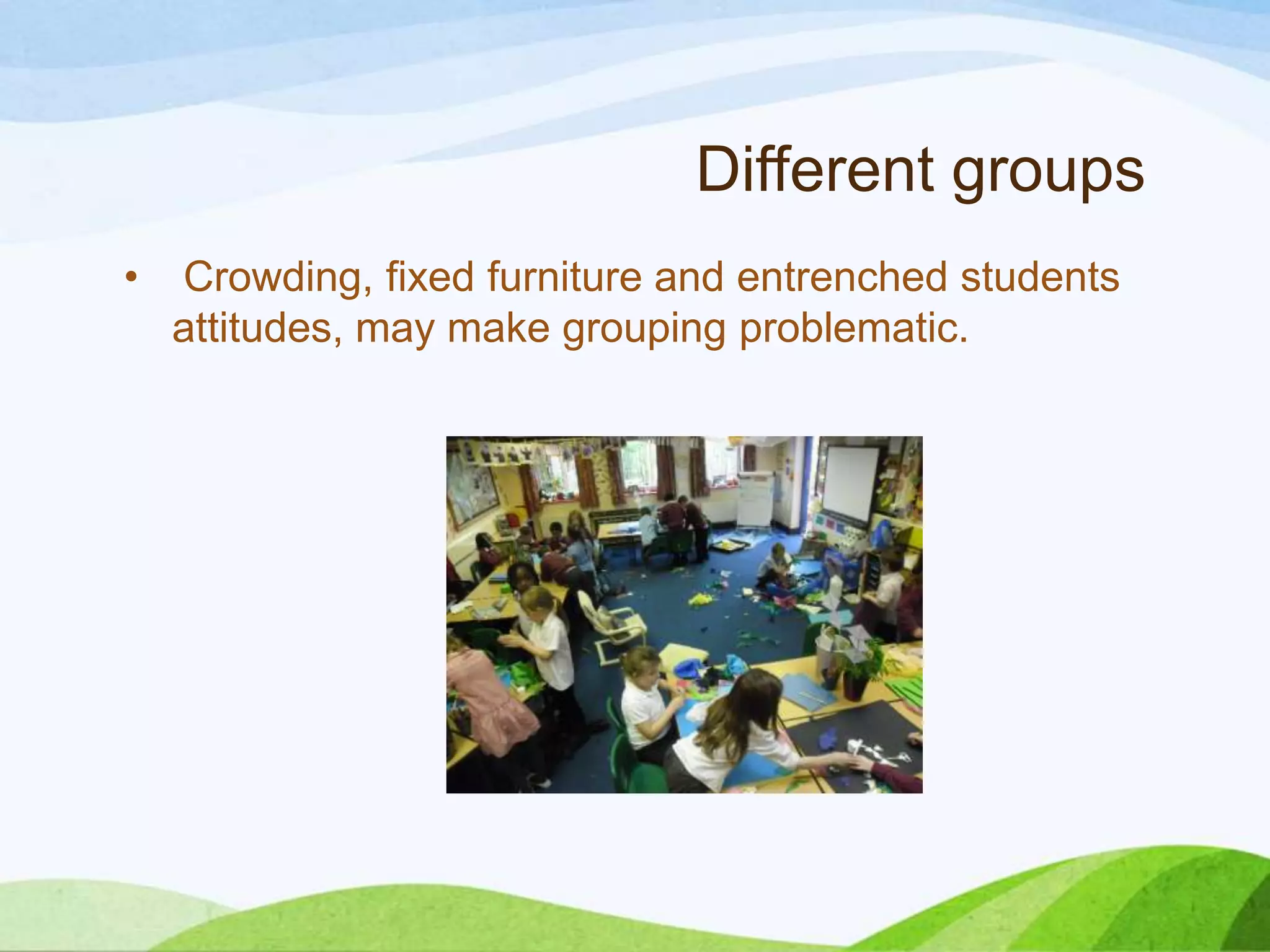
• Crowding, fixed furniture and entrenched students
attitudes, may make grouping problematic.
Whole – class teaching
Advantages of whole – class grouping:
o It reinforces a sense of belonging among the group
members.
o It allows teachers to “gauge the mood” of the class in general.
o If language learning is a collective endeavour, then “learning
takes place more effectively when language classes pull
together as unified groups”.
Disadvantages
• It favors the group rather than the individual.
• Individual students do not have much chance to say on
their own.
• Many students are disinclined to participate in front of
the whole class.
• It may not encourage students to take responsibility for
their own learning.
• It is not the best way to organized communicate
language teaching.
Seating whole classes
ORDERLY ROWS
• The teacher has a clear view of all students.
• It is perfect for: explaining grammar, watching a
video or a Power Point.
Horseshoe:
• Small groups.
• The teacher will probably be at the open end of the
arrangement since that may well be where the
board, overhead and computer are situated.
Circle:
• It makes a quite a strong statement about what the
teacher and students believe in.
Separate tables:
• Group work is easy to arrange.
• Useful in mixed-ability classes.
• Difficult to teach in whole-group activities.
Other seating arrangements:
• Enemy corners: two groups get into opposite
corners of the room.
• Opposing teams, and face to face : where
students sit in rows in rows to make pairs.
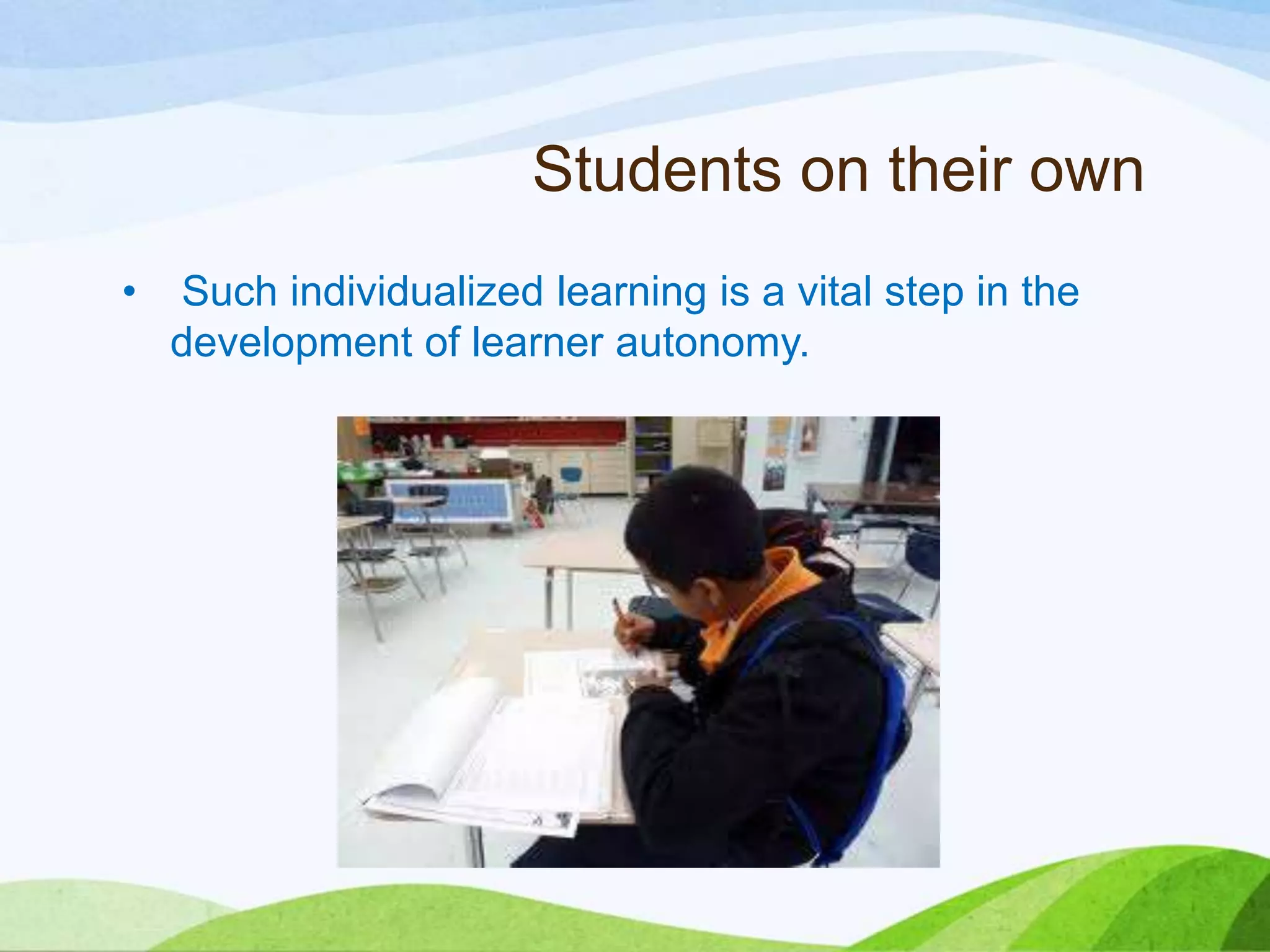
Students on their own
• Such individualized learning is a vital step in the
development of learner autonomy.
Advantages of individualized learning:
• It allows teachers to respond to individual
student differences.
• It is less stressful for students to perform.
• It can develop learner autonomy.
• It can be a way of restoring peace and
tranquility to a noisy and chaotic classroom.
Disadvantages:
• It does help a class develop a sense of
belonging.
• It takes much more time than interacting
with the whole class.
Pair Work
Advantages:
• Increases the amount of speaking time any one student
gets in class.
• Allows teachers to work with 1 or 2 pairs while other
students continue working.
• “Two heads are better than one”.
• Relatively quick and easy to organize.
Disadvantages:
• It is very noisy.
• The chances of misbehavior are greater with pairwork
than in a whole class setting.
• It is not always popular with students.
• Choosing a partner can be problematic.
Groupwork:
Students can:
•Write a story.
•Create a role-play.
•Watch, write or perform a video sequence.
Advantages:
• Increases the number of talking
opportunities.
• Personal relationships are less problematic.
• It encourages broader skills of cooperation
and negotiation than pairwork.
• It promotes learner autonomy.
• Students can choose their level of
participation.
Disadvantages:
•It is noisy.
• Not all students enjoy it.
• Individuals may fall into group roles that become
fossilized.
• Groups can take longer to organize than pairs.
Ringing the changes:
• The task: Many tasks suggest obvious student
groupings, we can usually adapt them for use with
other groupings.
• Variety in a sequence: It helps to provide a
variety, thus sustaining motivation.
• The mood: Changing the grouping of a class can
be a good way to change its mood when required.
Organizing pairwork and groupwork
• Making it work:
We can come with an agreement about when and how
to use different student groupings.
When we know how our students feel about pairwork
and grouping, we can decide, as with all action
research, what changes of method, if any, we need
to make.
Creating pairs and groups
• Friendship: Friends should sit with friends.
• Streaming: Pairwork should have a mixture of
weaker and stronger students.
• Chance: It demands little pre-planning, and, by
its very arbitrariness, stresses the cooperative
nature of working together.
•The task: Tasks determine the make up of
the pairs or groups.
•Changing groups: Just because we put
students in groups at the beginning of an
activity does not mean that they have to stay
in these groups until the end.
• Gender and status: In some contexts it may
not be appropriate to have men and women
working together.
Procedures for pairwork and
groupwork
• Before: Giving the students a time when the activity should
finish, and then sticking to it.
• During: Monitoring going around the class.
• After: We need to organized feedback. We want them to
discuss what occurred during the groupwork session and,
where necessary, add our own assessments and make
corrections.
Troubleshooting
• Finishing first: We need to have a series of
challenging task-related extensions for early finishers, so
that when a group has finished early, we can give them
an activity to complete while they are waiting.
• Awkward groups: We can separate best friends
for pairwork; we can put all the high-status figures in one
group.
One way of finding out about groups, in
particular, is simply to observe, noting
down how often each student speaks.

Grouping students

  • 1.
  • 2.
    Different groups • Crowding,fixed furniture and entrenched students attitudes, may make grouping problematic.
  • 3.
    Whole – classteaching Advantages of whole – class grouping: o It reinforces a sense of belonging among the group members. o It allows teachers to “gauge the mood” of the class in general. o If language learning is a collective endeavour, then “learning takes place more effectively when language classes pull together as unified groups”.
  • 4.
    Disadvantages • It favorsthe group rather than the individual. • Individual students do not have much chance to say on their own. • Many students are disinclined to participate in front of the whole class. • It may not encourage students to take responsibility for their own learning. • It is not the best way to organized communicate language teaching.
  • 5.
    Seating whole classes ORDERLYROWS • The teacher has a clear view of all students. • It is perfect for: explaining grammar, watching a video or a Power Point.
  • 6.
    Horseshoe: • Small groups. •The teacher will probably be at the open end of the arrangement since that may well be where the board, overhead and computer are situated. Circle: • It makes a quite a strong statement about what the teacher and students believe in.
  • 7.
    Separate tables: • Groupwork is easy to arrange. • Useful in mixed-ability classes. • Difficult to teach in whole-group activities. Other seating arrangements: • Enemy corners: two groups get into opposite corners of the room. • Opposing teams, and face to face : where students sit in rows in rows to make pairs.
  • 8.
    Students on theirown • Such individualized learning is a vital step in the development of learner autonomy.
  • 9.
    Advantages of individualizedlearning: • It allows teachers to respond to individual student differences. • It is less stressful for students to perform. • It can develop learner autonomy. • It can be a way of restoring peace and tranquility to a noisy and chaotic classroom.
  • 10.
    Disadvantages: • It doeshelp a class develop a sense of belonging. • It takes much more time than interacting with the whole class.
  • 11.
    Pair Work Advantages: • Increasesthe amount of speaking time any one student gets in class. • Allows teachers to work with 1 or 2 pairs while other students continue working. • “Two heads are better than one”. • Relatively quick and easy to organize.
  • 12.
    Disadvantages: • It isvery noisy. • The chances of misbehavior are greater with pairwork than in a whole class setting. • It is not always popular with students. • Choosing a partner can be problematic.
  • 13.
    Groupwork: Students can: •Write astory. •Create a role-play. •Watch, write or perform a video sequence.
  • 14.
    Advantages: • Increases thenumber of talking opportunities. • Personal relationships are less problematic. • It encourages broader skills of cooperation and negotiation than pairwork. • It promotes learner autonomy. • Students can choose their level of participation.
  • 15.
    Disadvantages: •It is noisy. •Not all students enjoy it. • Individuals may fall into group roles that become fossilized. • Groups can take longer to organize than pairs.
  • 16.
    Ringing the changes: •The task: Many tasks suggest obvious student groupings, we can usually adapt them for use with other groupings. • Variety in a sequence: It helps to provide a variety, thus sustaining motivation. • The mood: Changing the grouping of a class can be a good way to change its mood when required.
  • 17.
    Organizing pairwork andgroupwork • Making it work: We can come with an agreement about when and how to use different student groupings. When we know how our students feel about pairwork and grouping, we can decide, as with all action research, what changes of method, if any, we need to make.
  • 18.
    Creating pairs andgroups • Friendship: Friends should sit with friends. • Streaming: Pairwork should have a mixture of weaker and stronger students. • Chance: It demands little pre-planning, and, by its very arbitrariness, stresses the cooperative nature of working together.
  • 19.
    •The task: Tasksdetermine the make up of the pairs or groups. •Changing groups: Just because we put students in groups at the beginning of an activity does not mean that they have to stay in these groups until the end. • Gender and status: In some contexts it may not be appropriate to have men and women working together.
  • 20.
    Procedures for pairworkand groupwork • Before: Giving the students a time when the activity should finish, and then sticking to it. • During: Monitoring going around the class. • After: We need to organized feedback. We want them to discuss what occurred during the groupwork session and, where necessary, add our own assessments and make corrections.
  • 21.
    Troubleshooting • Finishing first:We need to have a series of challenging task-related extensions for early finishers, so that when a group has finished early, we can give them an activity to complete while they are waiting. • Awkward groups: We can separate best friends for pairwork; we can put all the high-status figures in one group.
  • 22.
    One way offinding out about groups, in particular, is simply to observe, noting down how often each student speaks.