Group DISCUSSION
Group DISCUSSION
Topics
Topics
• Definition of Group Discussion
• Group Discussion
• Prerequisites of a Group Discussion
• Benefits in Group Discussion
• Salient features
• Do’s and Don’ts in Group Discussion
• Important points in Group Discussion
• Accept criticism
• Suggestion
• Topics of importance frequently discussed
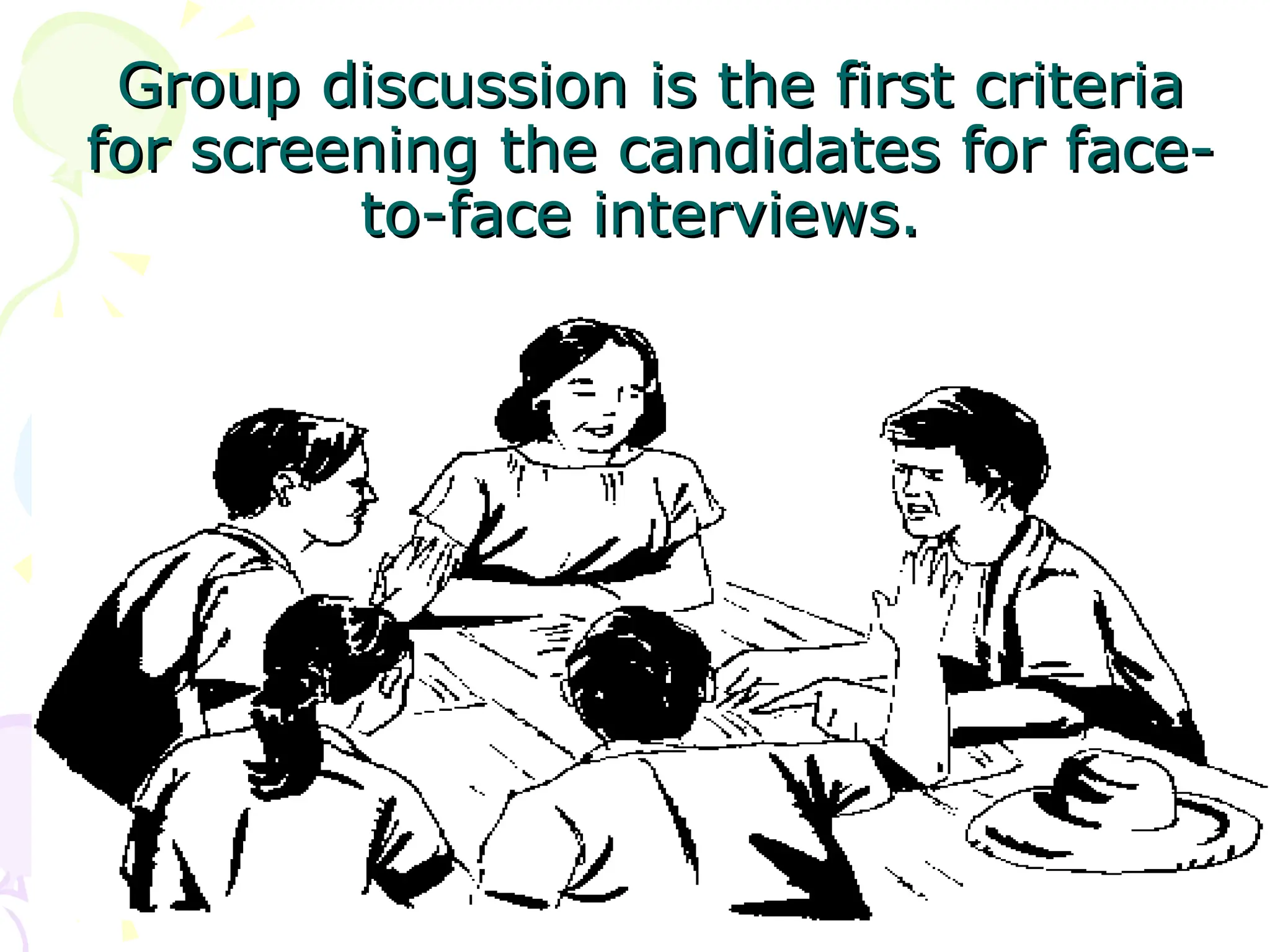
Group discussion is the first criteria
for screening the candidates for face-
to-face interviews.
to-face interviews.
Why Group Discussion????
• First thing Group Discussion is used
for mass elimination! And second
thing group discussion selection
criteria’s are based on actual
company requirements.
Definition of Group
Definition of Group
Discussion
Discussion
• Group Discussion is a modern
method of assessing students
personality.
• It is both a technique and an art and
a comprehensive tool to judge the
worthiness of the student and his
appropriateness for the job.
Group Discussion
Group Discussion
• The term suggests a discussion
among a group of persons.
• The group will have 8 & 12 members
who will express their views freely,
frankly in a friendly manner, on a topic
of current issue.
• Within a time limit of 20 to 30
minutes,the abilities of the members
of the group is measured.
Prerequisites of a Group
Discussion
Discussion
• Topics given by panelists
• Planning and preparation
• Knowledge with self-confidence
• Communication skills/ power of speech
• Presentation
• Body Language and personal
appearance
• Being calm and cool
Prerequisites of a Group
Discussion
Discussion
• Extensive knowledge base related to
state, country and globe.
• Areas are politics,sports,science & trade
commerce, Industry and Technology,
MNC,etc.
• Analyze the social,economical issues
logistically .
• Listening skills
• Co-operation.
Benefits in Group
Benefits in Group
discussion
discussion
• Stimulation of thinking in a new
way.
• Expansion of knowledge
• Understanding of your strength
and weakness.
• Your true personality is revealed
and qualities of leadership
crystallize
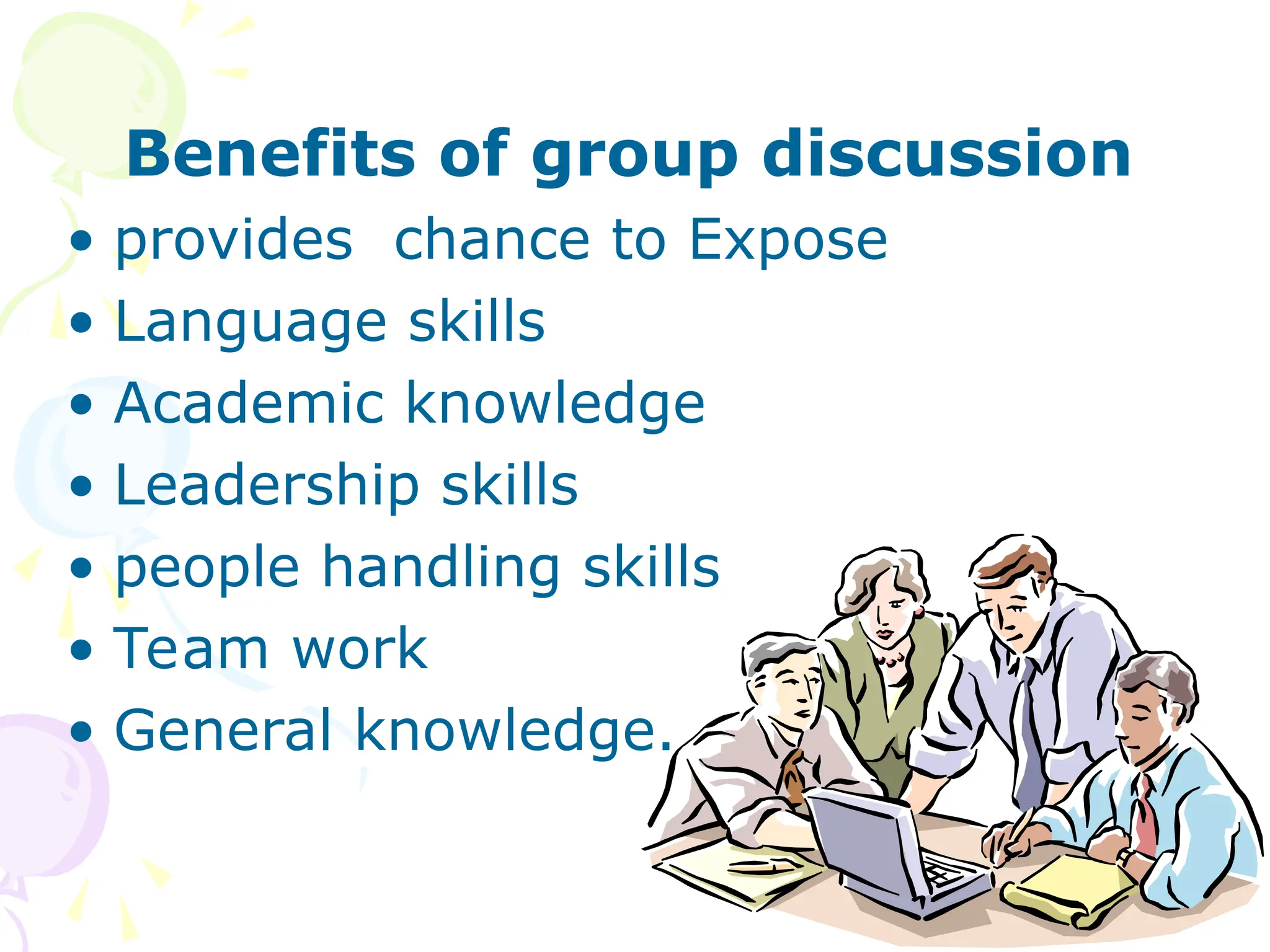
Benefits of group discussion
• provides chance to Expose
• Language skills
• Academic knowledge
• Leadership skills
• people handling skills
• Team work
• General knowledge.
Salient features of G.D
• Topic may be given to judge your
public speaking talent.
• Discussion revolves around a
specific subject.
• The examiner does not interfere
once he announced the topic.
• Maintain cordiality and free
expression of thought and opinion.
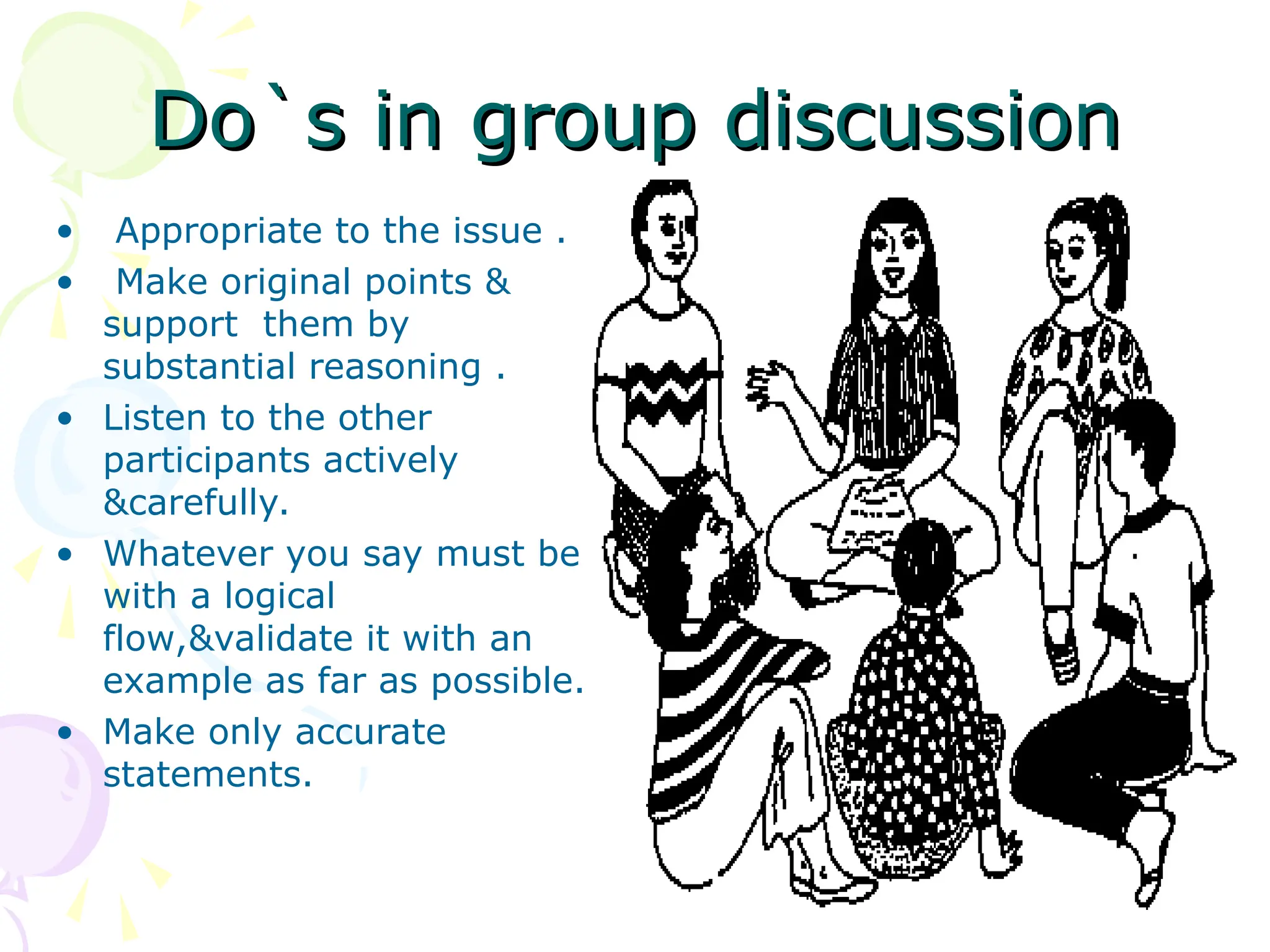
Do`s in group discussion
• Appropriate to the issue .
• Make original points &
support them by
substantial reasoning .
• Listen to the other
participants actively
&carefully.
• Whatever you say must be
with a logical
flow,&validate it with an
example as far as possible.
• Make only accurate
statements.
Do`s in group discussion
• Modulate the volume, pitch and tone.
• Be considerate to the feelings of the
others.
• Try to get your turn.
• Be an active and dynamic participant
by listening.
• Talk with confidence and self-
assurance.
Don’ts during group
Don’ts during group
discussion
discussion
• Being shy /nervous / keeping isolated
from G.D
• Interrupting another participant before
his arguments are over
• Speak in favour.
• Don’t make fun of any participant even
if his arguments are funny.
Don`ts during group discussion
• Don’t engage yourself in sub-group
conversation.
• Don’t repeat and use irrelevant
materials.
• Addressing yourself to the examiner.
• Worrying about making some
grammatical mistakes, for your interest
the matter you put across are important.
Important points in group
discussion
discussion
• Be assertive: An assertive person is direct ,
honest careful about not hurting others ‘self-
respect’.
• A patient listener: listening to another person
is one way of showing appreciation.
• Right language : Words can make friends &
right words at the right time make the best
results.
• Be analytical and fact-oriented : It is
necessary to make relevant points which can
be supported with facts and analyzed logically.
Accept criticism
Accept criticism
• If any member of the group criticizes or disapproves
a point, it is unwise to get upset or react sharply.
• In case the criticism is flimsy,the same can be
pointed out politely.
• Maximize participation ; one must try to contribute
fully, vigorously & steadily throughout the discussion.
• Show leadership ability: A group discussion also
evaluates your leadership qualities.
• Accept someone's point of view
• Praise the argument
Example: Remedial English
communication is necessary for college
students because they fail in
communication skill test.
Status of literacy of women , is increased
from 30% to 70% when compared to
past years, in employment sectors
organized ,in the IT & ITES field.
• Accept the contradicts view
• Express your argument with few facts,
cases, %,
Newspapers publications etc.
• Express without hurting others
feelings.
• Suggestions
• Never try to bluff.
• Practice group discussion with friends on
different subjects.
• Remember !speech is a powerful
weapon.
Topics of Importance frequently
discussed
discussed
• Is India Shining
• Mobile phones / Internet – a boon or nuisance
• Students focusing on software industry-good or
bad
• Child marriage
• India 2020
• Daughters are more caring than sons
• Influence of western culture in Indian
Universities
• Influence of computers in medical sciences
Evaluation Components
During a GD employers evaluate
potential for leadership and ability to
work in a team.
The four components generally
evaluated in a group discussion are:
 Knowledge
 Communication skills
 Group behaviour
 Leadership potential
Communication Skills
Candidate assessed in terms of:
• Active listening
• Clarity of thought and expression
• Apt language
• Appropriateness of body language
• Lucidity (Easily Understandable lang)
• Tone: Quality or character of the voice
expression a particular feeling or mood
• Voice: Power of speech
• Articulation: Act of speaking or
expressing an idea in words
• Fluency: Speaking or writing in an easy,
flowing style
• Modulation: Variations in rate, tone, or
volume of voice
• Good delivery: The ideas expressed
fluently in the right voice, right tone, and
right articulation.
• It isn’t sufficient to have ideas. They have to be
expressed effectively.
Apt Language
Apt Language
o Fluency and accuracy in use of
language free from grammatical errors.
o Directly, clearly and precisely put
ideas in a organized fashion.
o Simplicity and unambigusity
o Using too much of jargon or high-
sounding words or ambiguous
expressions may project as a show-off
and may not endear to group members.
Effective Use of Body
Language
Language
 Looking attentively at the speaker and
nodding
 While speaking, ensuring no one is
ignored. Looking at everybody.
 Avoiding overt gestures
 Avoiding pointing out fingers
 Avoiding monotonous posture by shifting
slightly in the chair or placing arm on the
back of your chair
 Not showing interest or dislike in the
topic.
 Even if one does not like the topic he
should try to develop interest and reveal
interest and enthusiasm through
appropriate facial expression.
Group Behaviour ( Team
Spirit)
Spirit)
• group behaviour is reflected in ability to
interact with other members of the group
on brief acquaintance.
• Emotional maturity and balance
promotes good interpersonal
relationships. One is expected to be
more people centric and less ego
centric.
• Remaining objective, empathetic, and non-
threatening, and behaving maturely as a
good team player
Essence
 Consistency participation
 Keenness in listening and observing
 Time sharing and orderly conduct
 Ability to handle turbulent situations
 Ability to cut excessively exuberant
participants down to size
 Ability to dominate the proceedings
without bullying others
 Avoiding personal comments
Leadership Skills
Leadership Skills
o The success of any team depends to a
large extent, on its leader.
o The candidate who possesses both
functional ability and coordinating ability
would emerge as the leader.
o Functional ability involves knowledge,
mental and physical energy, emotional
stability, objectivity, communication skill,
integrity and emotional intelligence
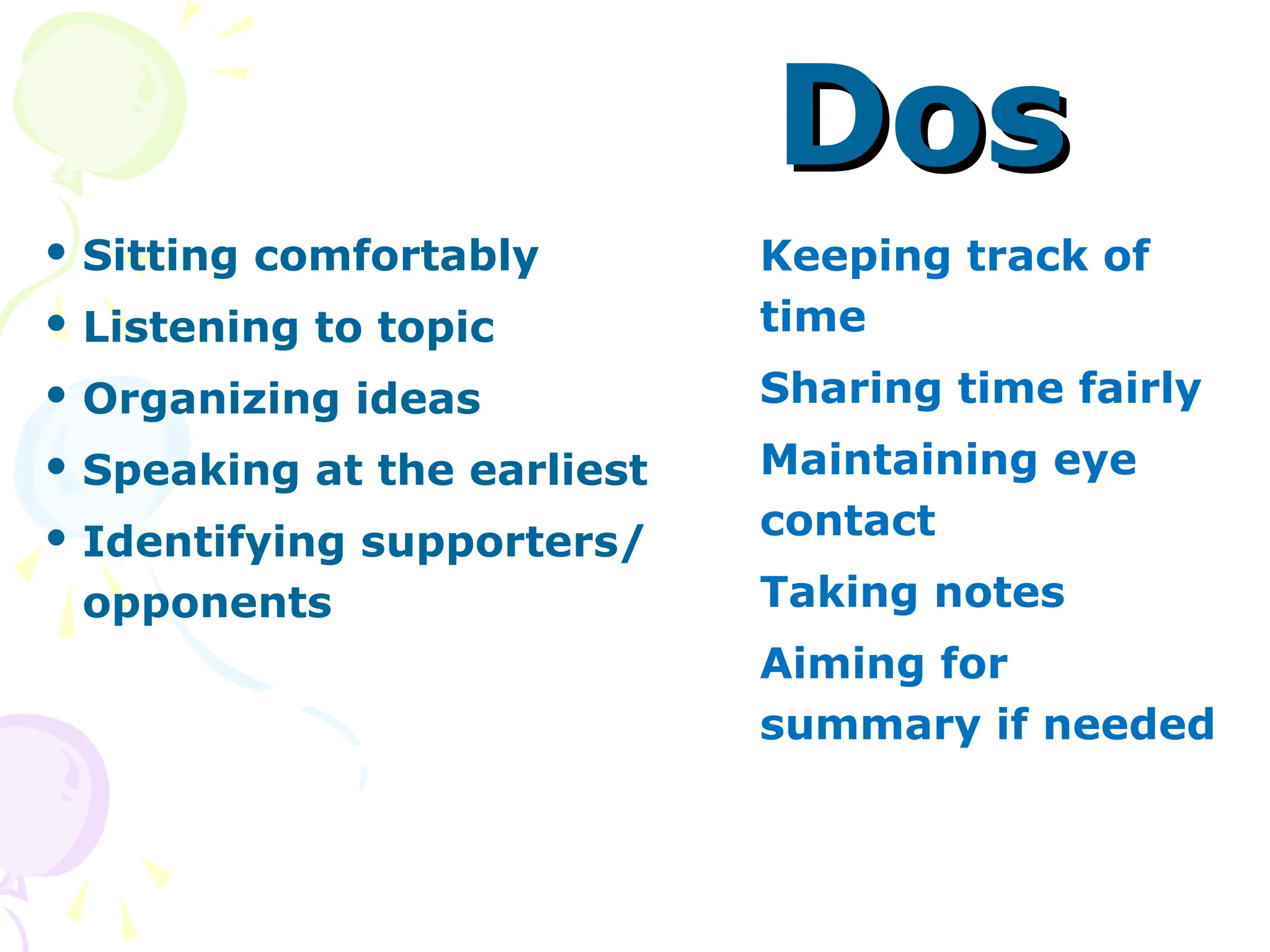
Dos
Dos
 Sitting comfortably
 Listening to topic
 Organizing ideas
 Speaking at the earliest
 Identifying supporters/
opponents
 Keeping track of
time
 Sharing time fairly
 Maintaining eye
contact
 Taking notes
 Aiming for
summary if needed
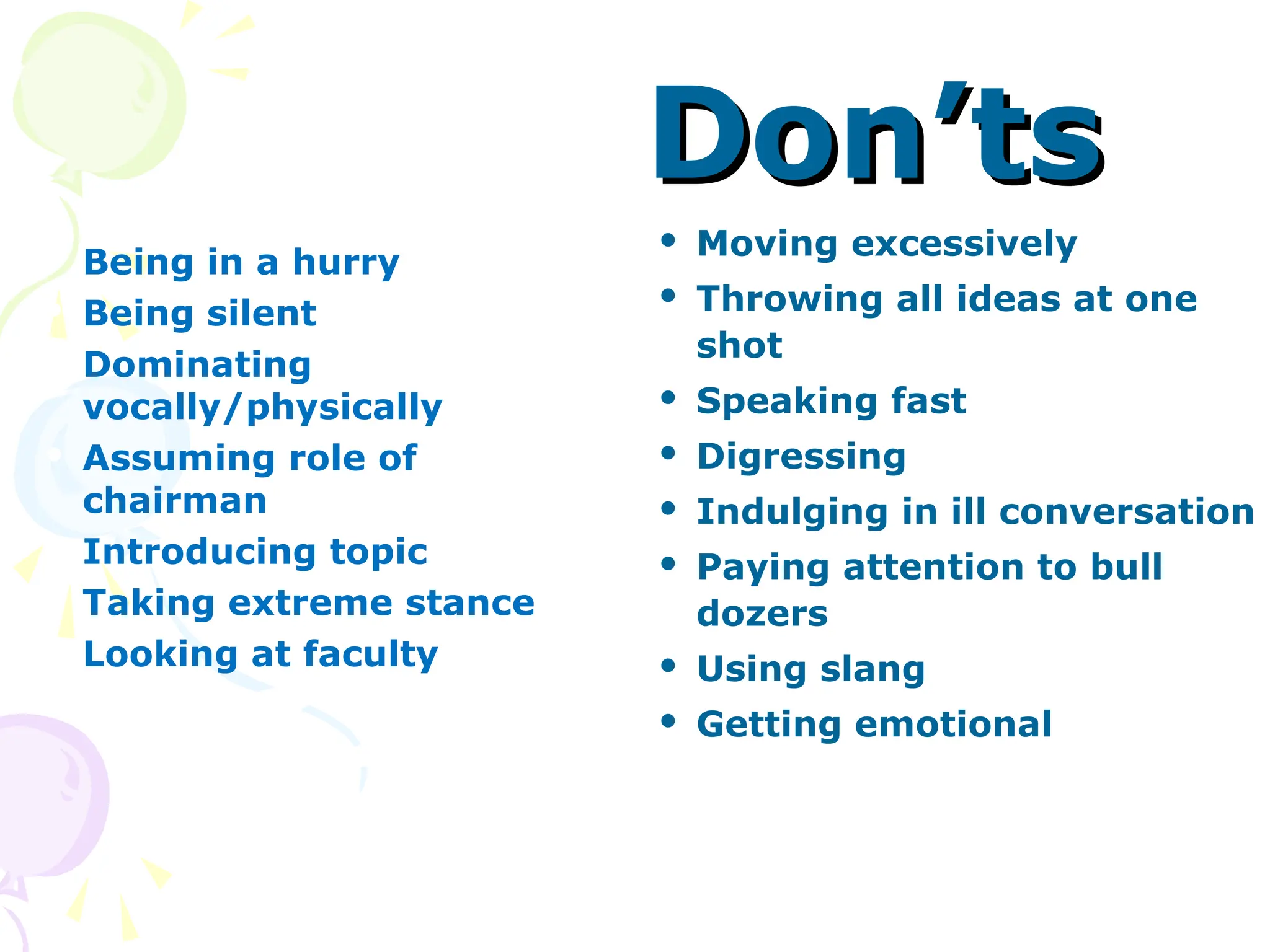
Don’ts
Don’ts
 Being in a hurry
 Being silent
 Dominating
vocally/physically
 Assuming role of
chairman
 Introducing topic
 Taking extreme stance
 Looking at faculty
 Moving excessively
 Throwing all ideas at one
shot
 Speaking fast
 Digressing
 Indulging in ill conversation
 Paying attention to bull
dozers
 Using slang
 Getting emotional
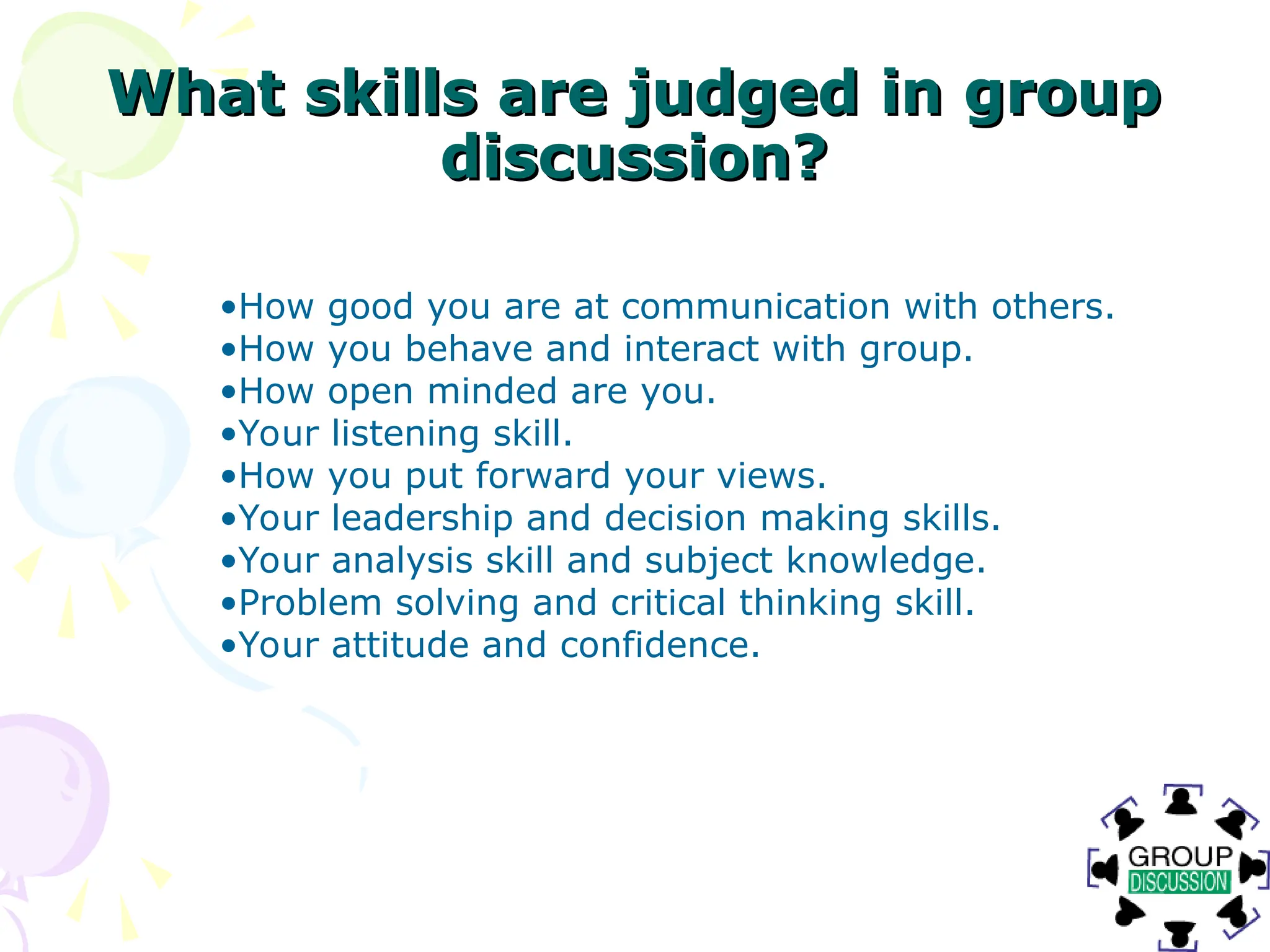
What skills are judged in group
discussion?
discussion?
•How good you are at communication with others.
•How you behave and interact with group.
•How open minded are you.
•Your listening skill.
•How you put forward your views.
•Your leadership and decision making skills.
•Your analysis skill and subject knowledge.
•Problem solving and critical thinking skill.
•Your attitude and confidence.

group discussion different types and roles1.ppt

group discussion different types and roles1.ppt

  • 1.
  • 2.
    Topics Topics • Definition ofGroup Discussion • Group Discussion • Prerequisites of a Group Discussion • Benefits in Group Discussion • Salient features • Do’s and Don’ts in Group Discussion • Important points in Group Discussion • Accept criticism • Suggestion • Topics of importance frequently discussed
  • 3.
    Group discussion isthe first criteria Group discussion is the first criteria for screening the candidates for face- for screening the candidates for face- to-face interviews. to-face interviews.
  • 4.
    Why Group Discussion???? WhyGroup Discussion???? • First thing Group Discussion is used for mass elimination! And second thing group discussion selection criteria’s are based on actual company requirements.
  • 5.
    Definition of Group Definitionof Group Discussion Discussion • Group Discussion is a modern method of assessing students personality. • It is both a technique and an art and a comprehensive tool to judge the worthiness of the student and his appropriateness for the job.
  • 6.
    Group Discussion Group Discussion •The term suggests a discussion among a group of persons. • The group will have 8 & 12 members who will express their views freely, frankly in a friendly manner, on a topic of current issue. • Within a time limit of 20 to 30 minutes,the abilities of the members of the group is measured.
  • 7.
    Prerequisites of aGroup Prerequisites of a Group Discussion Discussion • Topics given by panelists • Planning and preparation • Knowledge with self-confidence • Communication skills/ power of speech • Presentation • Body Language and personal appearance • Being calm and cool
  • 8.
    Prerequisites of aGroup Prerequisites of a Group Discussion Discussion • Extensive knowledge base related to state, country and globe. • Areas are politics,sports,science & trade commerce, Industry and Technology, MNC,etc. • Analyze the social,economical issues logistically . • Listening skills • Co-operation.
  • 9.
    Benefits in Group Benefitsin Group discussion discussion • Stimulation of thinking in a new way. • Expansion of knowledge • Understanding of your strength and weakness. • Your true personality is revealed and qualities of leadership crystallize
  • 10.
    Benefits of groupdiscussion • provides chance to Expose • Language skills • Academic knowledge • Leadership skills • people handling skills • Team work • General knowledge.
  • 11.
    Salient features ofG.D Salient features of G.D • Topic may be given to judge your public speaking talent. • Discussion revolves around a specific subject. • The examiner does not interfere once he announced the topic. • Maintain cordiality and free expression of thought and opinion.
  • 12.
    Do`s in groupdiscussion Do`s in group discussion • Appropriate to the issue . • Make original points & support them by substantial reasoning . • Listen to the other participants actively &carefully. • Whatever you say must be with a logical flow,&validate it with an example as far as possible. • Make only accurate statements.
  • 13.
    Do`s in groupdiscussion • Modulate the volume, pitch and tone. • Be considerate to the feelings of the others. • Try to get your turn. • Be an active and dynamic participant by listening. • Talk with confidence and self- assurance.
  • 14.
    Don’ts during group Don’tsduring group discussion discussion • Being shy /nervous / keeping isolated from G.D • Interrupting another participant before his arguments are over • Speak in favour. • Don’t make fun of any participant even if his arguments are funny.
  • 15.
    Don`ts during groupdiscussion • Don’t engage yourself in sub-group conversation. • Don’t repeat and use irrelevant materials. • Addressing yourself to the examiner. • Worrying about making some grammatical mistakes, for your interest the matter you put across are important.
  • 16.
    Important points ingroup Important points in group discussion discussion • Be assertive: An assertive person is direct , honest careful about not hurting others ‘self- respect’. • A patient listener: listening to another person is one way of showing appreciation. • Right language : Words can make friends & right words at the right time make the best results. • Be analytical and fact-oriented : It is necessary to make relevant points which can be supported with facts and analyzed logically.
  • 17.
    Accept criticism Accept criticism •If any member of the group criticizes or disapproves a point, it is unwise to get upset or react sharply. • In case the criticism is flimsy,the same can be pointed out politely. • Maximize participation ; one must try to contribute fully, vigorously & steadily throughout the discussion. • Show leadership ability: A group discussion also evaluates your leadership qualities.
  • 18.
    • Accept someone'spoint of view • Praise the argument Example: Remedial English communication is necessary for college students because they fail in communication skill test. Status of literacy of women , is increased from 30% to 70% when compared to past years, in employment sectors organized ,in the IT & ITES field.
  • 19.
    • Accept thecontradicts view • Express your argument with few facts, cases, %, Newspapers publications etc. • Express without hurting others feelings.
  • 20.
    • Suggestions • Nevertry to bluff. • Practice group discussion with friends on different subjects. • Remember !speech is a powerful weapon.
  • 21.
    Topics of Importancefrequently Topics of Importance frequently discussed discussed • Is India Shining • Mobile phones / Internet – a boon or nuisance • Students focusing on software industry-good or bad • Child marriage • India 2020 • Daughters are more caring than sons • Influence of western culture in Indian Universities • Influence of computers in medical sciences
  • 22.
    Evaluation Components Evaluation Components Duringa GD employers evaluate potential for leadership and ability to work in a team. The four components generally evaluated in a group discussion are:  Knowledge  Communication skills  Group behaviour  Leadership potential
  • 23.
    Communication Skills Communication Skills Candidateassessed in terms of: • Active listening • Clarity of thought and expression • Apt language • Appropriateness of body language • Lucidity (Easily Understandable lang)
  • 24.
    • Tone: Qualityor character of the voice expression a particular feeling or mood • Voice: Power of speech • Articulation: Act of speaking or expressing an idea in words • Fluency: Speaking or writing in an easy, flowing style • Modulation: Variations in rate, tone, or volume of voice • Good delivery: The ideas expressed fluently in the right voice, right tone, and right articulation. • It isn’t sufficient to have ideas. They have to be expressed effectively.
  • 25.
    Apt Language Apt Language oFluency and accuracy in use of language free from grammatical errors. o Directly, clearly and precisely put ideas in a organized fashion. o Simplicity and unambigusity o Using too much of jargon or high- sounding words or ambiguous expressions may project as a show-off and may not endear to group members.
  • 26.
    Effective Use ofBody Effective Use of Body Language Language  Looking attentively at the speaker and nodding  While speaking, ensuring no one is ignored. Looking at everybody.  Avoiding overt gestures  Avoiding pointing out fingers  Avoiding monotonous posture by shifting slightly in the chair or placing arm on the back of your chair  Not showing interest or dislike in the topic.  Even if one does not like the topic he should try to develop interest and reveal interest and enthusiasm through appropriate facial expression.
  • 27.
    Group Behaviour (Team Group Behaviour ( Team Spirit) Spirit) • group behaviour is reflected in ability to interact with other members of the group on brief acquaintance. • Emotional maturity and balance promotes good interpersonal relationships. One is expected to be more people centric and less ego centric. • Remaining objective, empathetic, and non- threatening, and behaving maturely as a good team player
  • 28.
    Essence  Consistency participation Keenness in listening and observing  Time sharing and orderly conduct  Ability to handle turbulent situations  Ability to cut excessively exuberant participants down to size  Ability to dominate the proceedings without bullying others  Avoiding personal comments
  • 29.
    Leadership Skills Leadership Skills oThe success of any team depends to a large extent, on its leader. o The candidate who possesses both functional ability and coordinating ability would emerge as the leader. o Functional ability involves knowledge, mental and physical energy, emotional stability, objectivity, communication skill, integrity and emotional intelligence
  • 30.
    Dos Dos  Sitting comfortably Listening to topic  Organizing ideas  Speaking at the earliest  Identifying supporters/ opponents  Keeping track of time  Sharing time fairly  Maintaining eye contact  Taking notes  Aiming for summary if needed
  • 31.
    Don’ts Don’ts  Being ina hurry  Being silent  Dominating vocally/physically  Assuming role of chairman  Introducing topic  Taking extreme stance  Looking at faculty  Moving excessively  Throwing all ideas at one shot  Speaking fast  Digressing  Indulging in ill conversation  Paying attention to bull dozers  Using slang  Getting emotional
  • 32.
    What skills arejudged in group What skills are judged in group discussion? discussion? •How good you are at communication with others. •How you behave and interact with group. •How open minded are you. •Your listening skill. •How you put forward your views. •Your leadership and decision making skills. •Your analysis skill and subject knowledge. •Problem solving and critical thinking skill. •Your attitude and confidence.