Presentation
on
Precision Agriculture (PA)
Presented by
Rama Krishna Satyaraj Guru
Ph.D. Agronomy
Dept. of Agronomy
College of Agriculture, Raipur
Indira Gandhi Krishi Vishwavidyalaya, Raipur (C.G.)
Submitted to
Dr. J. S. Urkurkar
Professor
Dept. of Agronomy
Pre GRTs GRTs Post GRTs
Farming Approach
Precision Agriculture
Precision Agriculture (PA) refers to the application of precise and correct amounts of
inputs like water, fertilizers, pesticides etc. at the correct time to the crop for increasing
its productivity and maximizing its yields. The use of inputs based on the right
quantity, at the right time and in the right place. This type of management is commonly
known as “Site-Specific Management”.
Spatial variability and temporal variability
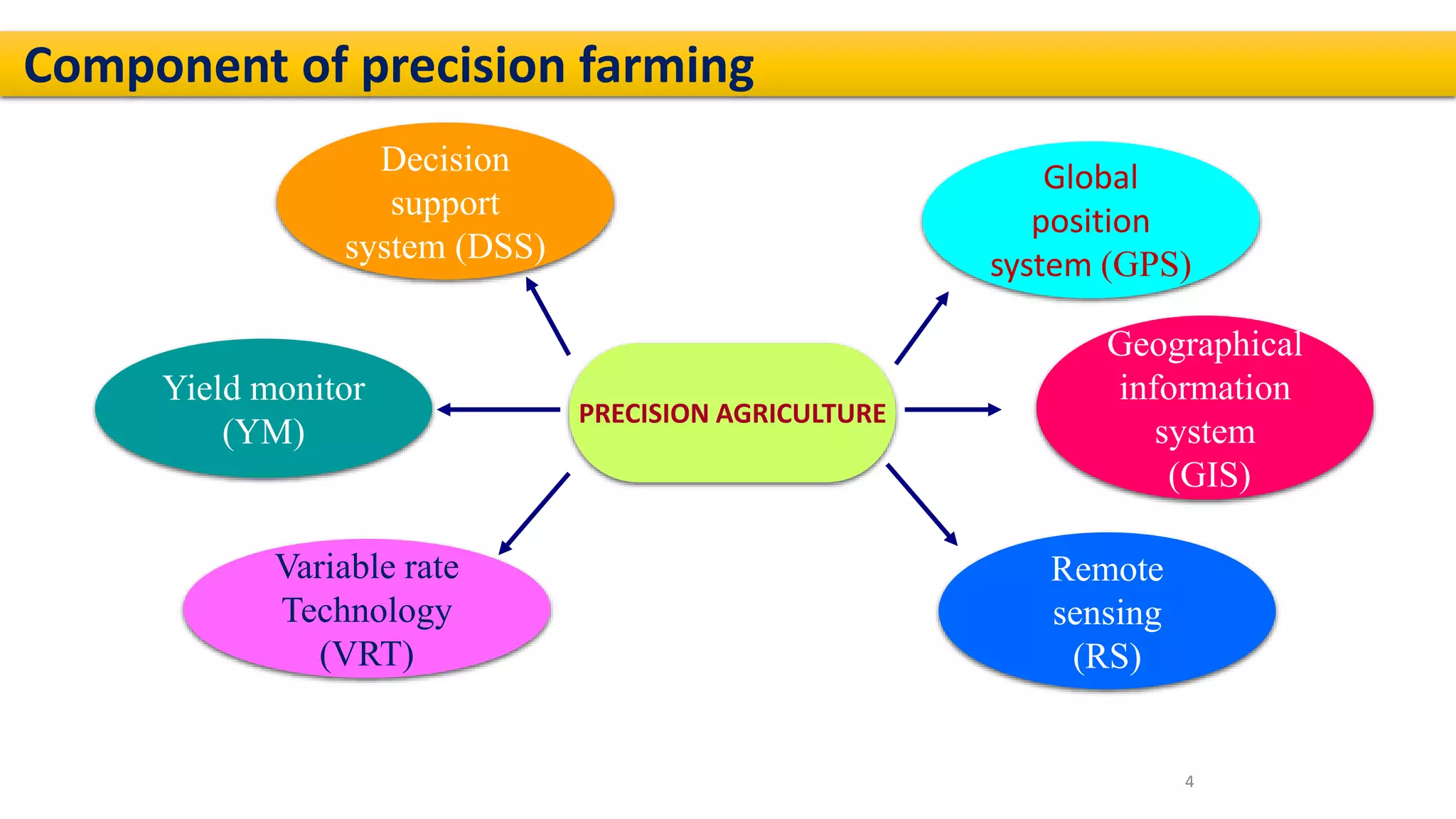
PRECISION AGRICULTURE
4
Decision
support
system (DSS)
Yield monitor
(YM)
Variable rate
Technology
(VRT)
Global
position
system (GPS)
Geographical
information
system
(GIS)
Remote
sensing
(RS)
Component of precision farming
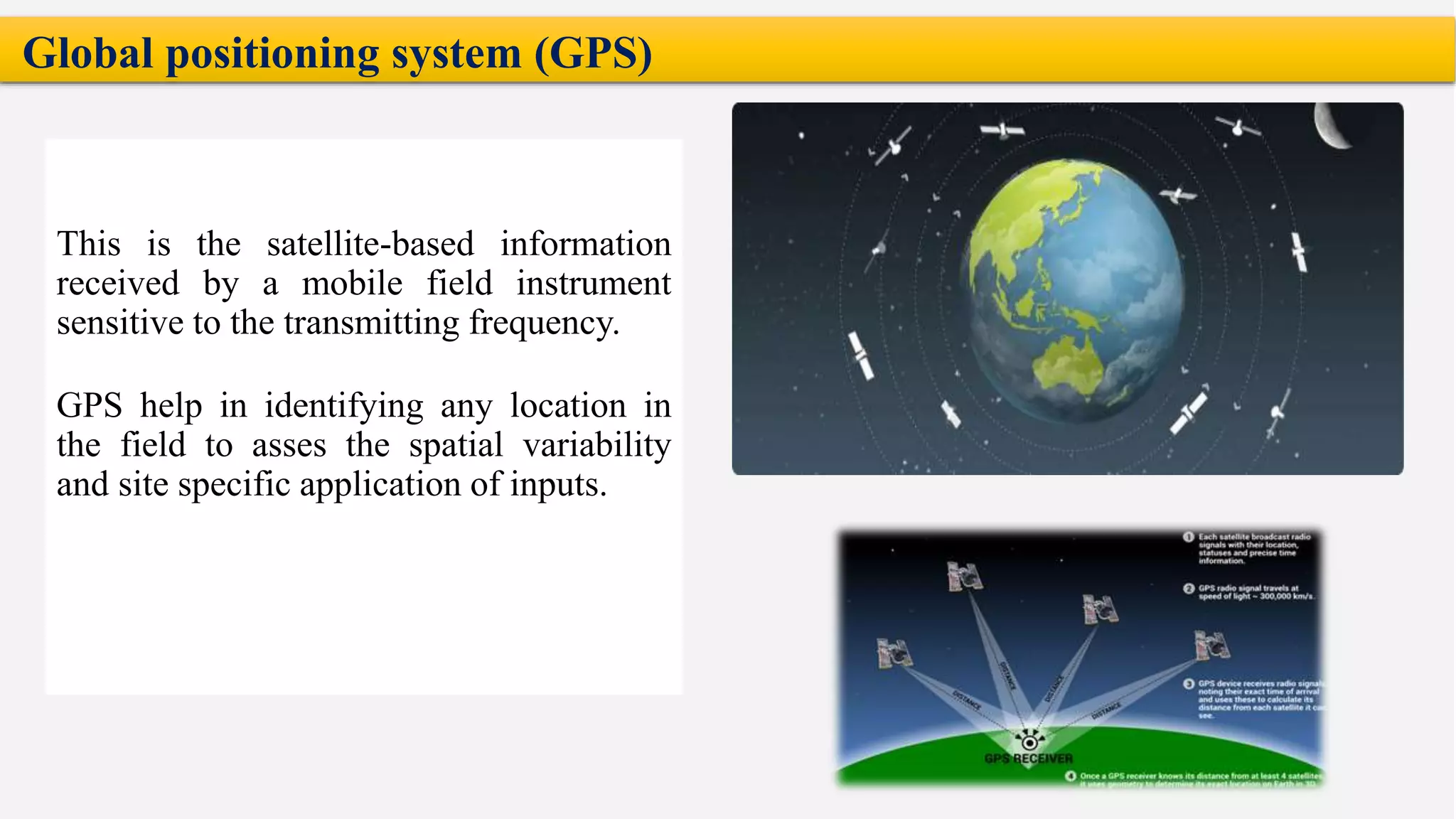
Global positioning system (GPS)
This is the satellite-based information
received by a mobile field instrument
sensitive to the transmitting frequency.
GPS help in identifying any location in
the field to asses the spatial variability
and site specific application of inputs.
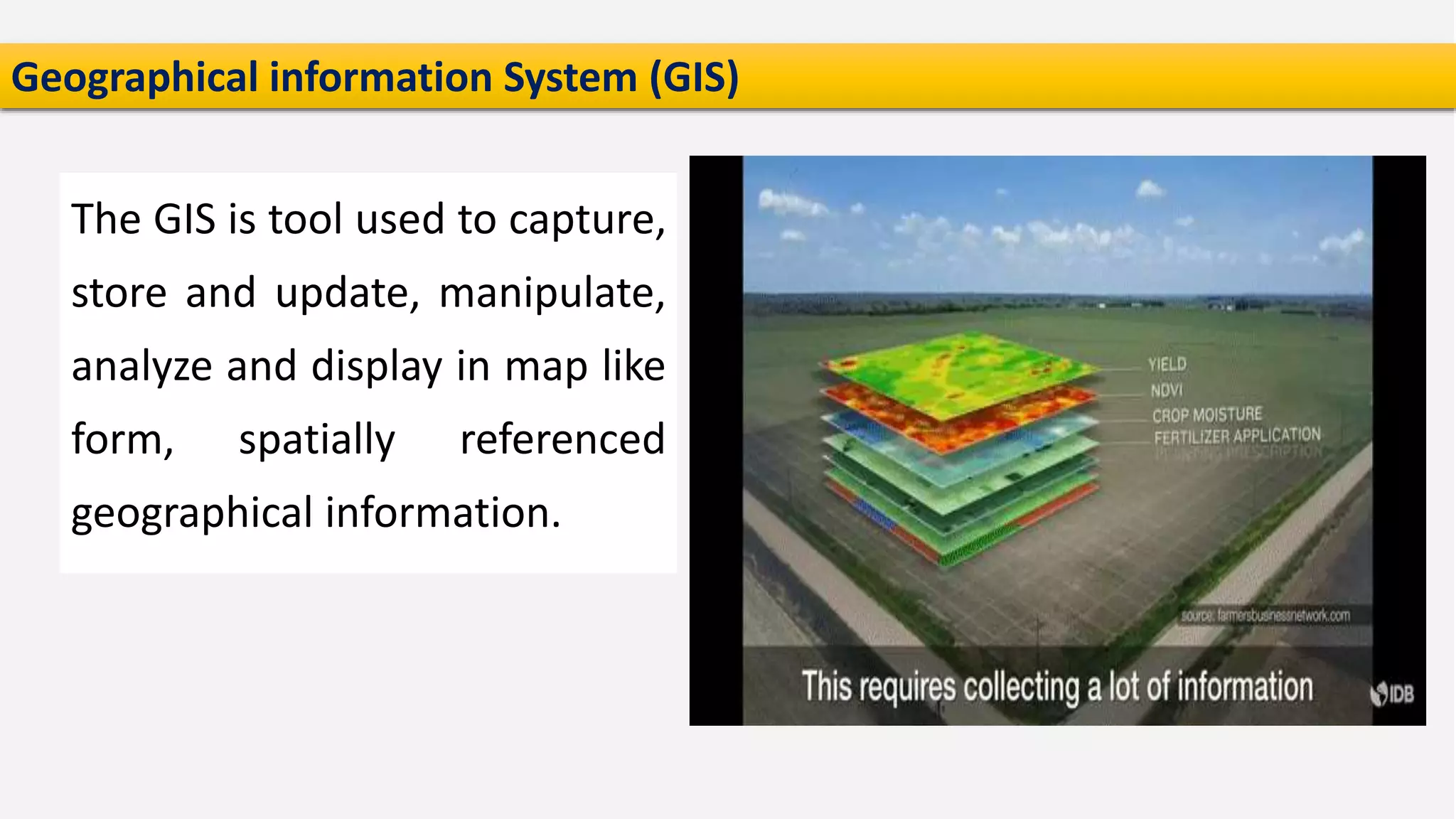
Geographical information System (GIS)
The GIS is tool used to capture,
store and update, manipulate,
analyze and display in map like
form, spatially referenced
geographical information.
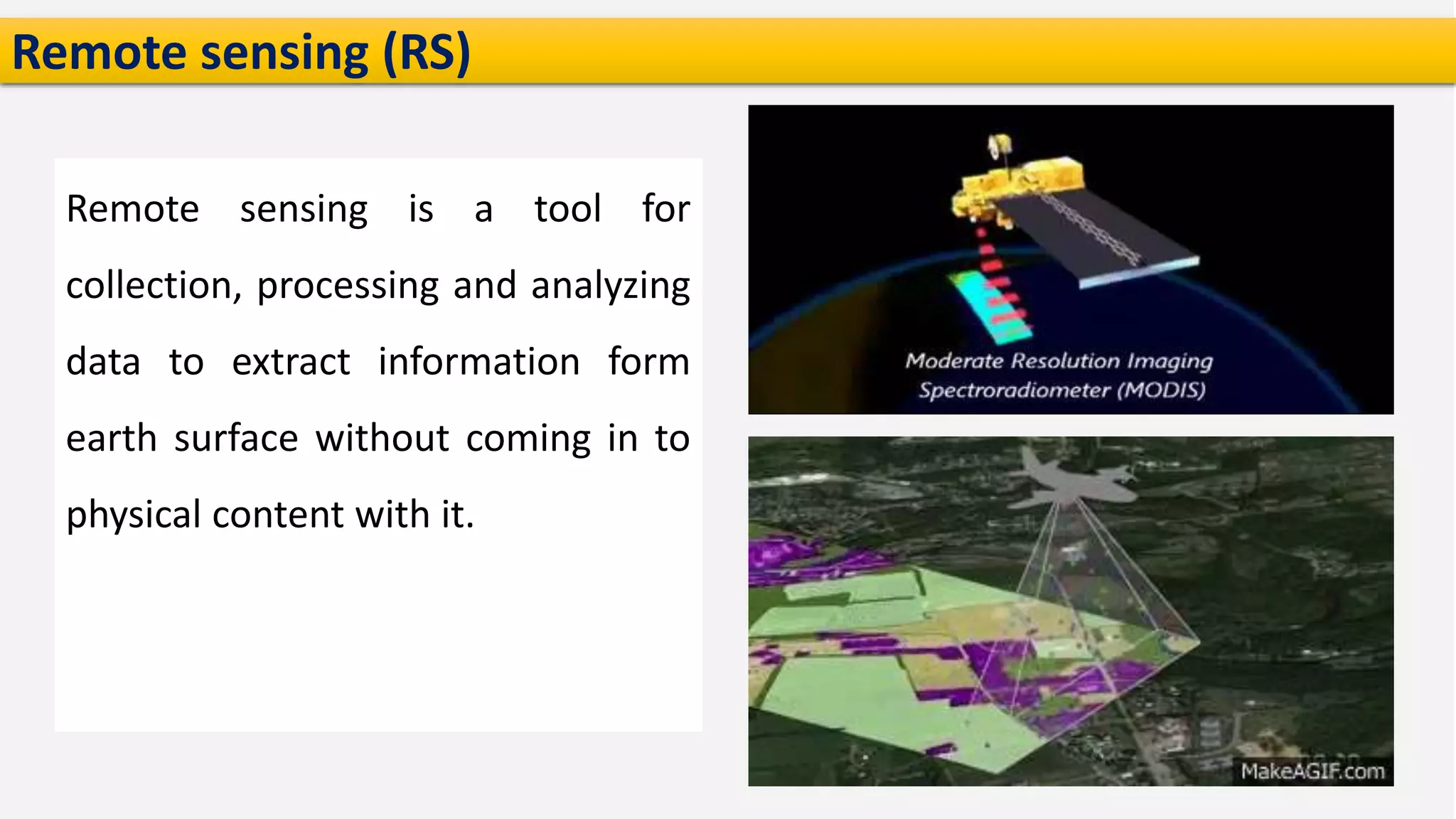
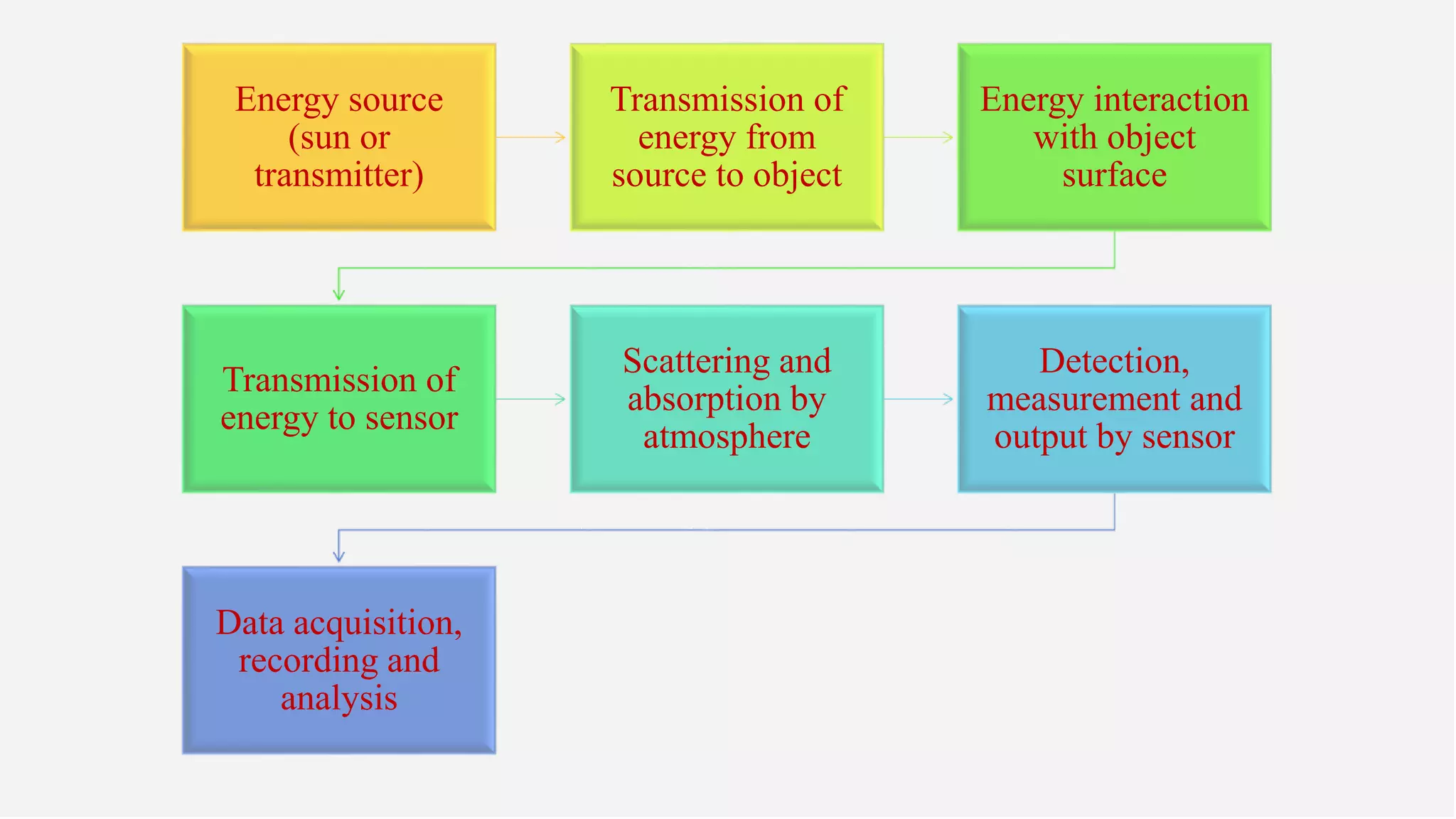
Remote sensing (RS)
Remote sensing is a tool for
collection, processing and analyzing
data to extract information form
earth surface without coming in to
physical content with it.
Energy source
(sun or
transmitter)
Transmission of
energy from
source to object
Energy interaction
with object
surface
Transmission of
energy to sensor
Scattering and
absorption by
atmosphere
Detection,
measurement and
output by sensor
Data acquisition,
recording and
analysis
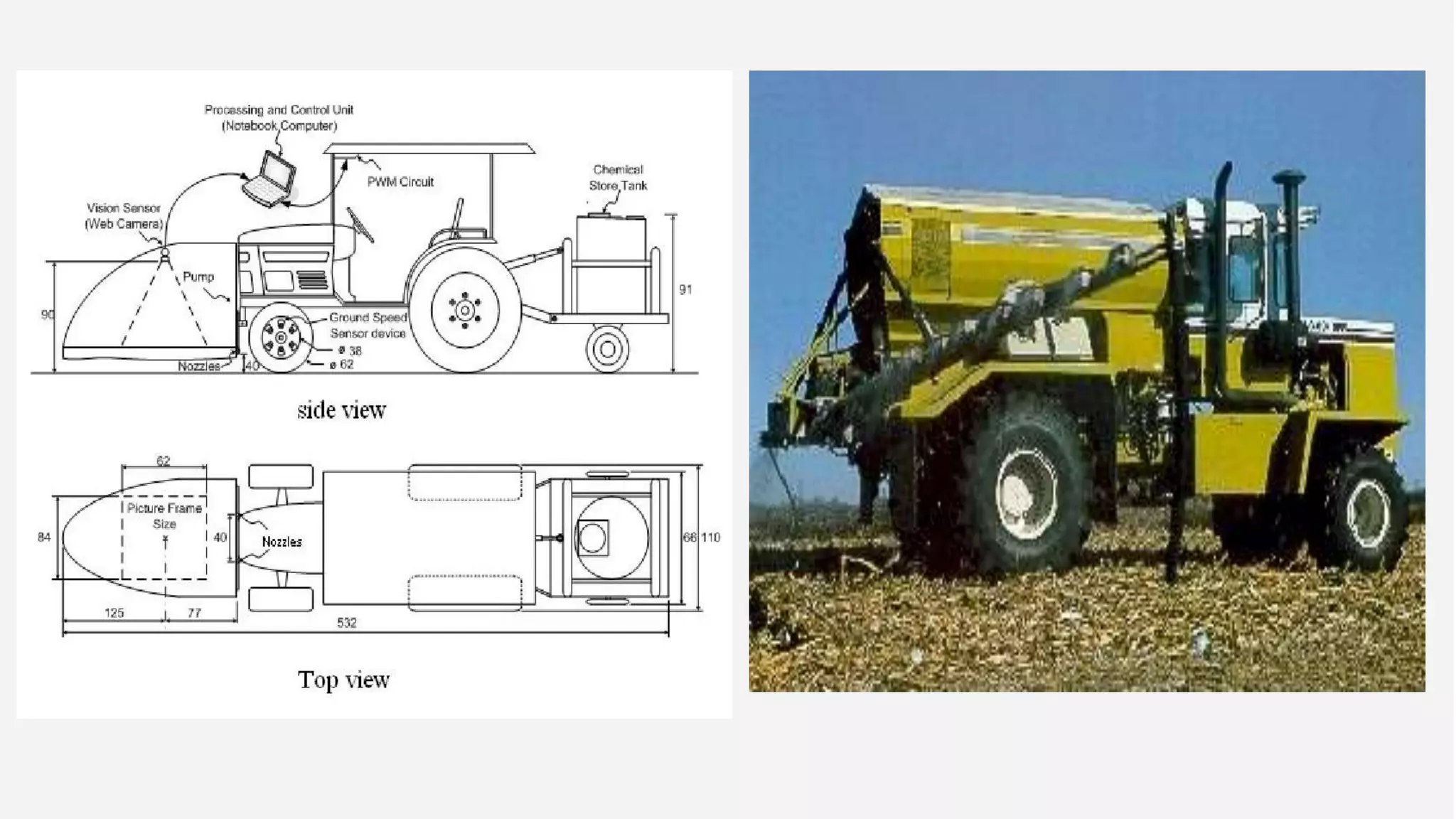
Variable rate Technology (VRT)
Consist of farmed field equipment
with the ability to precisely control
the rate of application of crop input
and tillage operation .
Use of heavy machines and
irrigation system
Variable Rate Controller
It is the implementation of gathered information for site specific
agriculture.
It consists of the machines and systems for the control of delivery rate
of chemical inputs such as fertilizers and pesticides, either liquid or
granular.
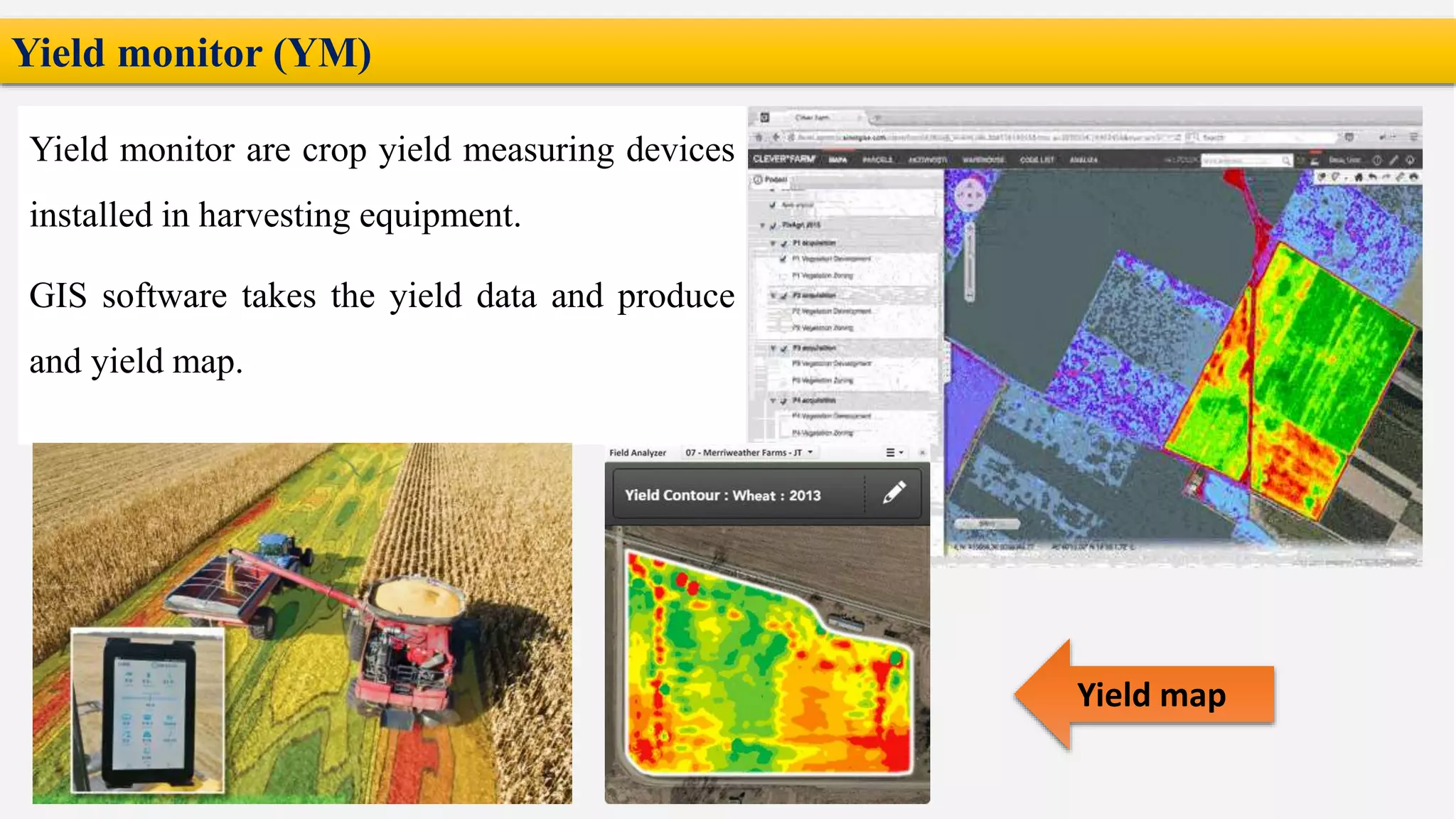
Yield monitor (YM)
Yield monitor are crop yield measuring devices
installed in harvesting equipment.
GIS software takes the yield data and produce
and yield map.
Yield map
Decision support system (DSS)
 It is a computerized program used to
support determinations, judgments, and
courses of action.
 It enables the farmers to make effective
decision for higher yield.
 It provide information about the expected
yield in each season with better accuracy
eg:- LCIS for Irrigation
Nutrient expert
Future tools in PA
 IoT (Internet of things)
 Data-driven agriculture
Big data analysis
 Farmbot
 Artificial Intelligence (AI)
Constraints in adaptation
Technological
factors
Informational
factors
Socio-economic
factors
Behavioural
factors
Farmers
perception
Institution
factors
Agro-ecological
factors
Environmental Effects of Precision Agriculture
Reduces greenhouse gas
emissions
Reduction of effluents
Reduce energy consumption
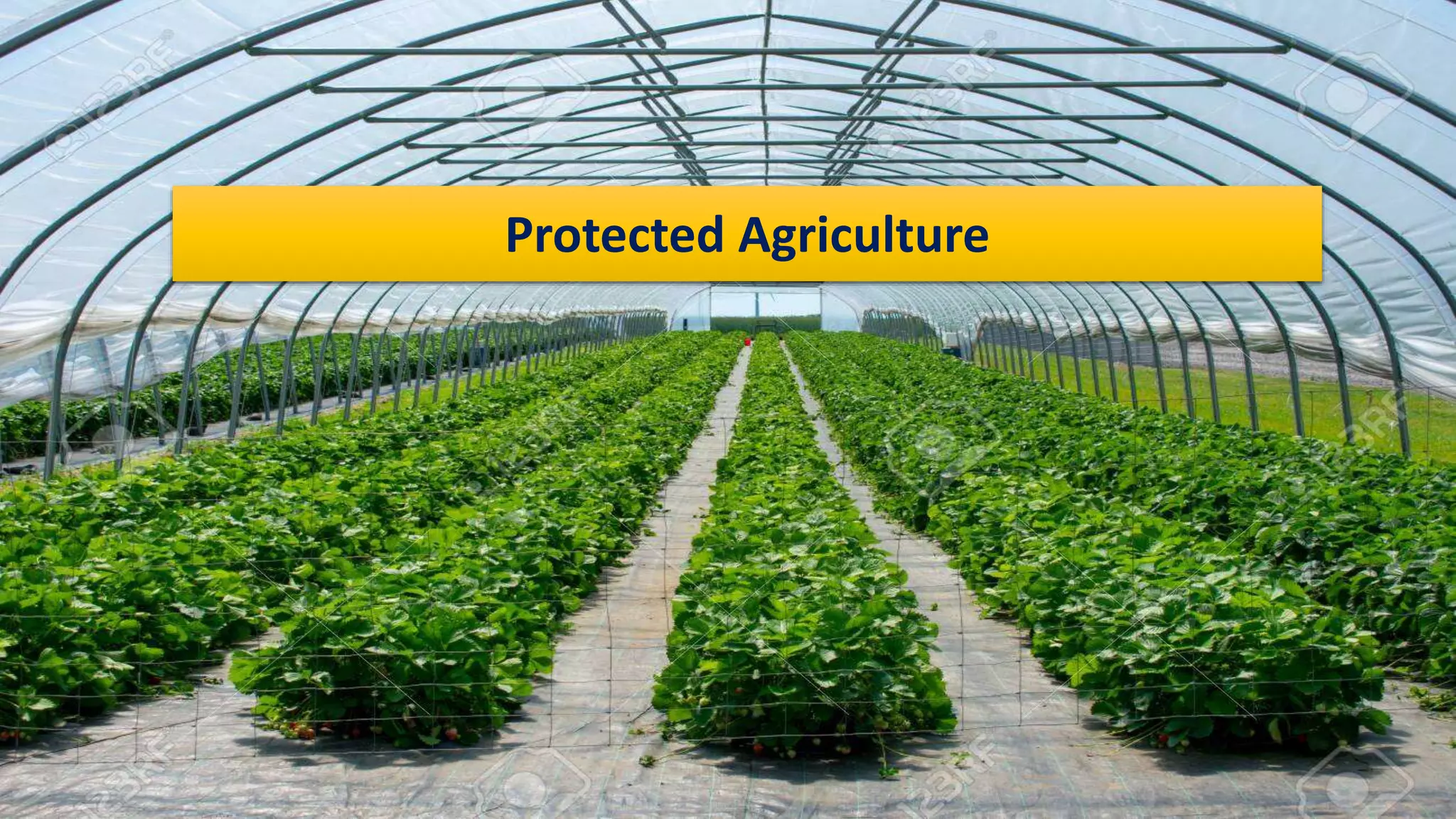
Protected Agriculture
Protected cultivation can be defined as a
cropping technique where the micro climate
surrounding the plant body is controlled
partially/fully as per the requirement of the
plant species grown during their period of
growth.
Protected Agriculture
• Crops could be grown under inclement climatic conditions when it is not possible
to grow in open field.
• Efficient utilization of precious inputs like water and nutrients.
• Early nursery and early cropping.
• Superior quality of the produce.
• Effective control against diseases, insect pests.
• Reduced expenditure on pest control.
• Protection against biotic and abiotic stresses (heavy rains, hails, birds etc.)
Need in Indian Scenario
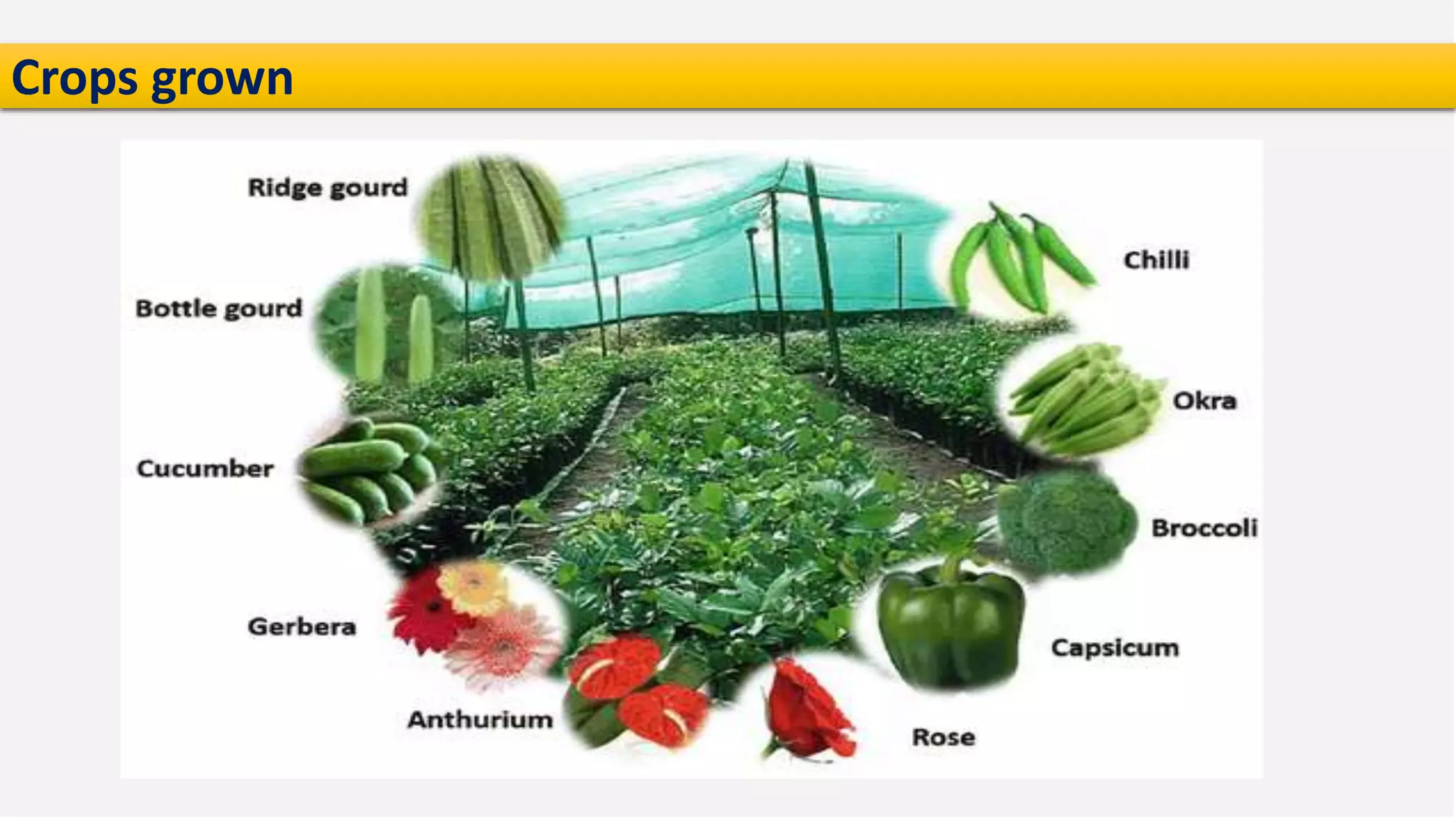
Crops grown
Strawberry
 Plastic Tunnel
i.High tunnel
ii.Low tunnel
 Greenhouse
 Net house
 Plastic Mulch
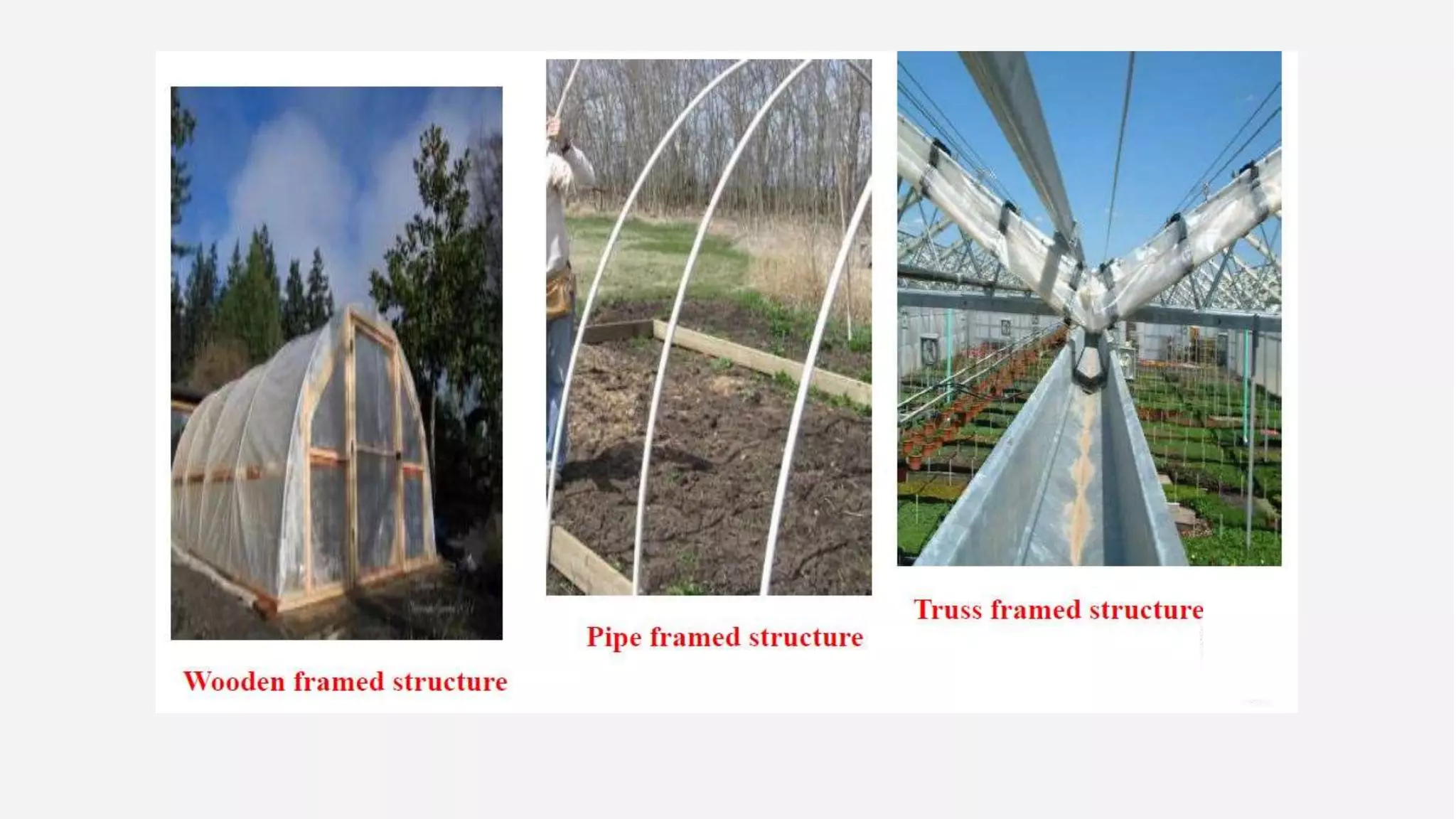
Protected structures
High Tunnel
Polyhouse
Low Tunnel
Net House
Roof
Side wall
Over all
structure
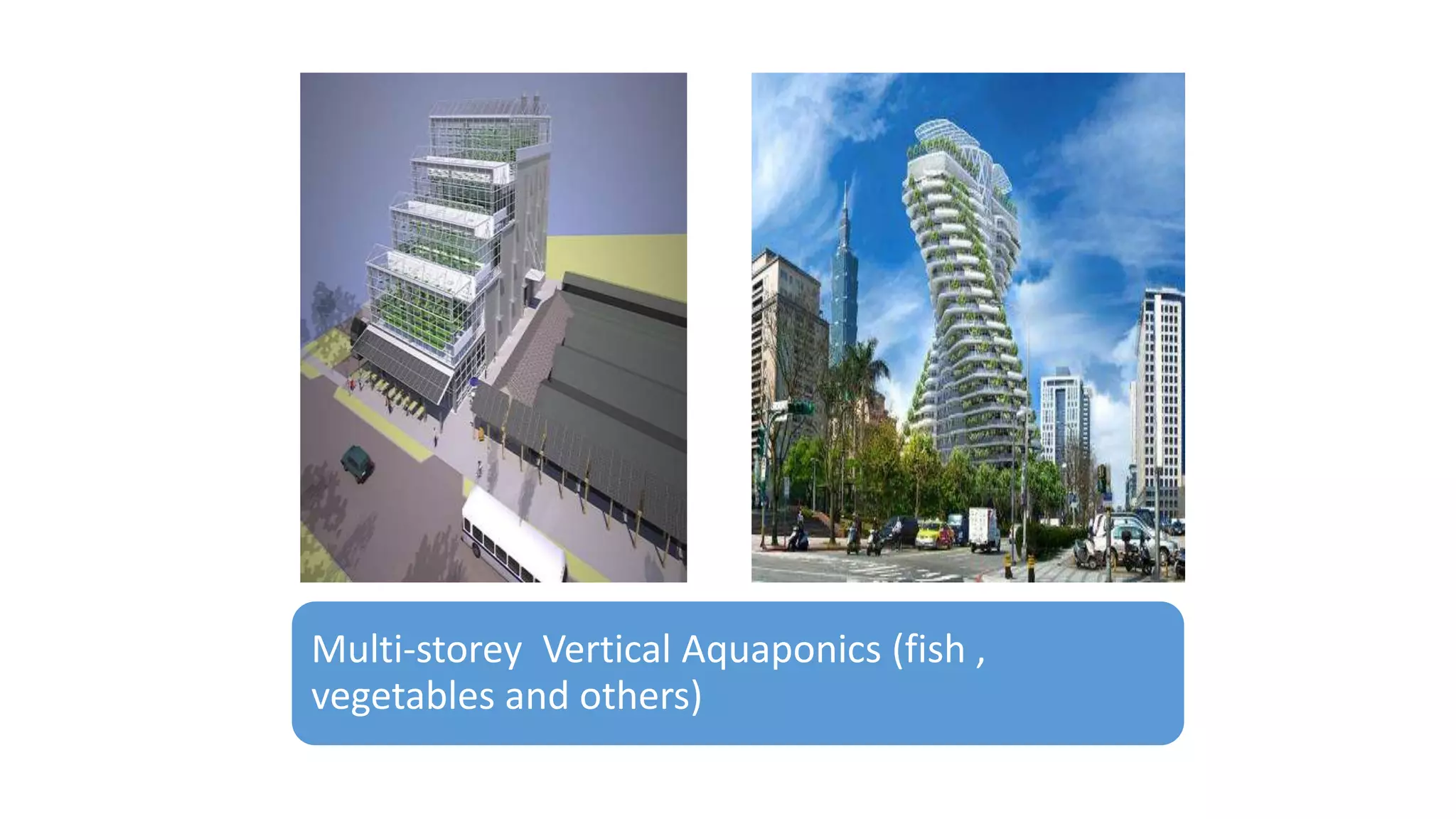
Multi-storey Vertical Aquaponics (fish ,
vegetables and others)
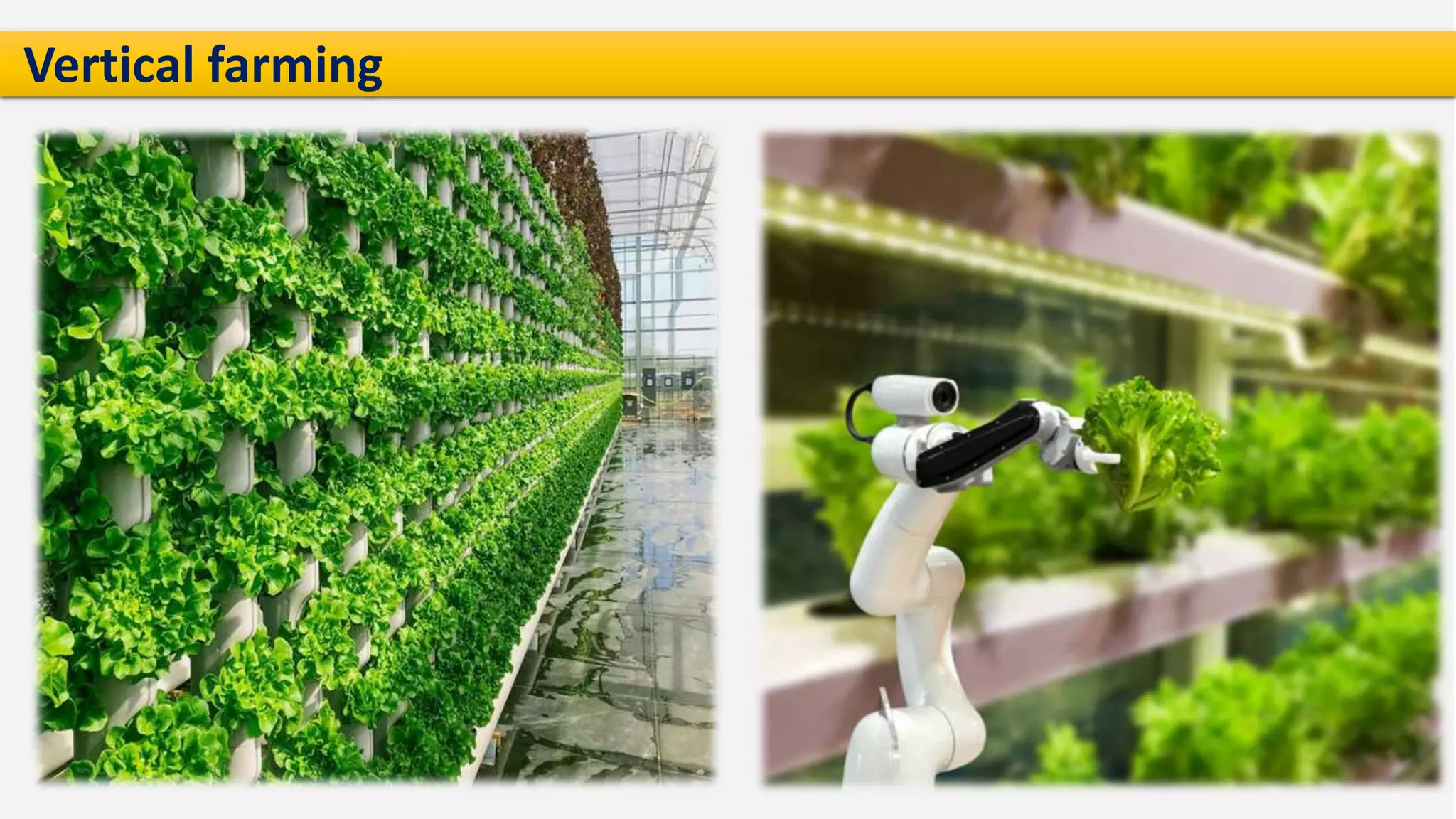
Vertical farming
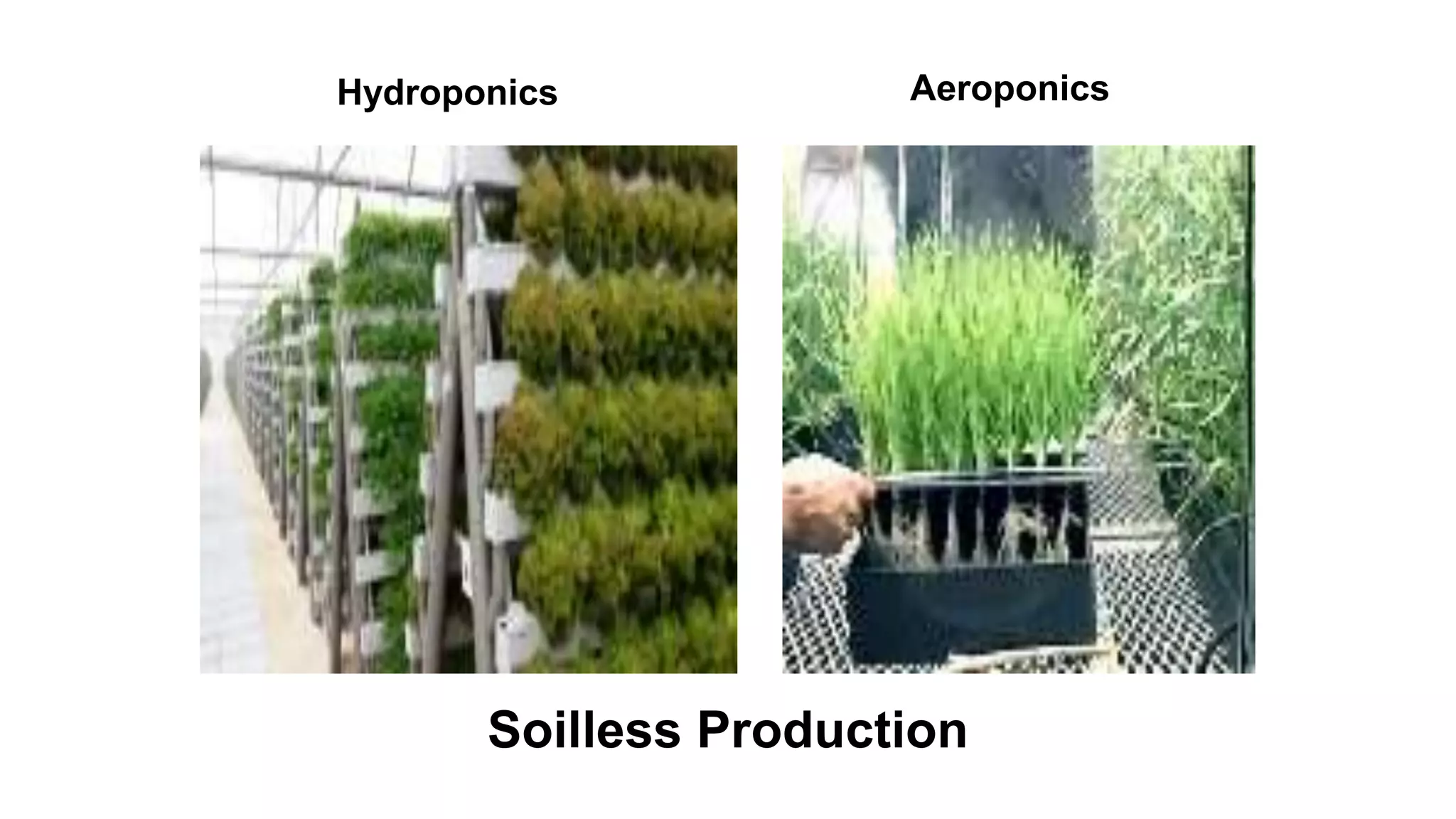
Hydroponics Aeroponics
Soilless Production
Kitchen Garden inside Kitchen
• Kitchen Nano Garden by Hyundai is a super cool concept for growing a
vegetable garden right in your kitchen
• Because light, water and nutrient supply is totally controllable, it's up to you
how quickly you want your veggies to grow.
• It will alert you if you're overwatering, over-lighting/sunning, or if your
plants need more nutrients.
• It even works to naturally purify the air in your home.
Kitchen Nano Garden by Hyundai
Above concepts are in the design phase, they pose great
promise for the future of indoor vertical gardening
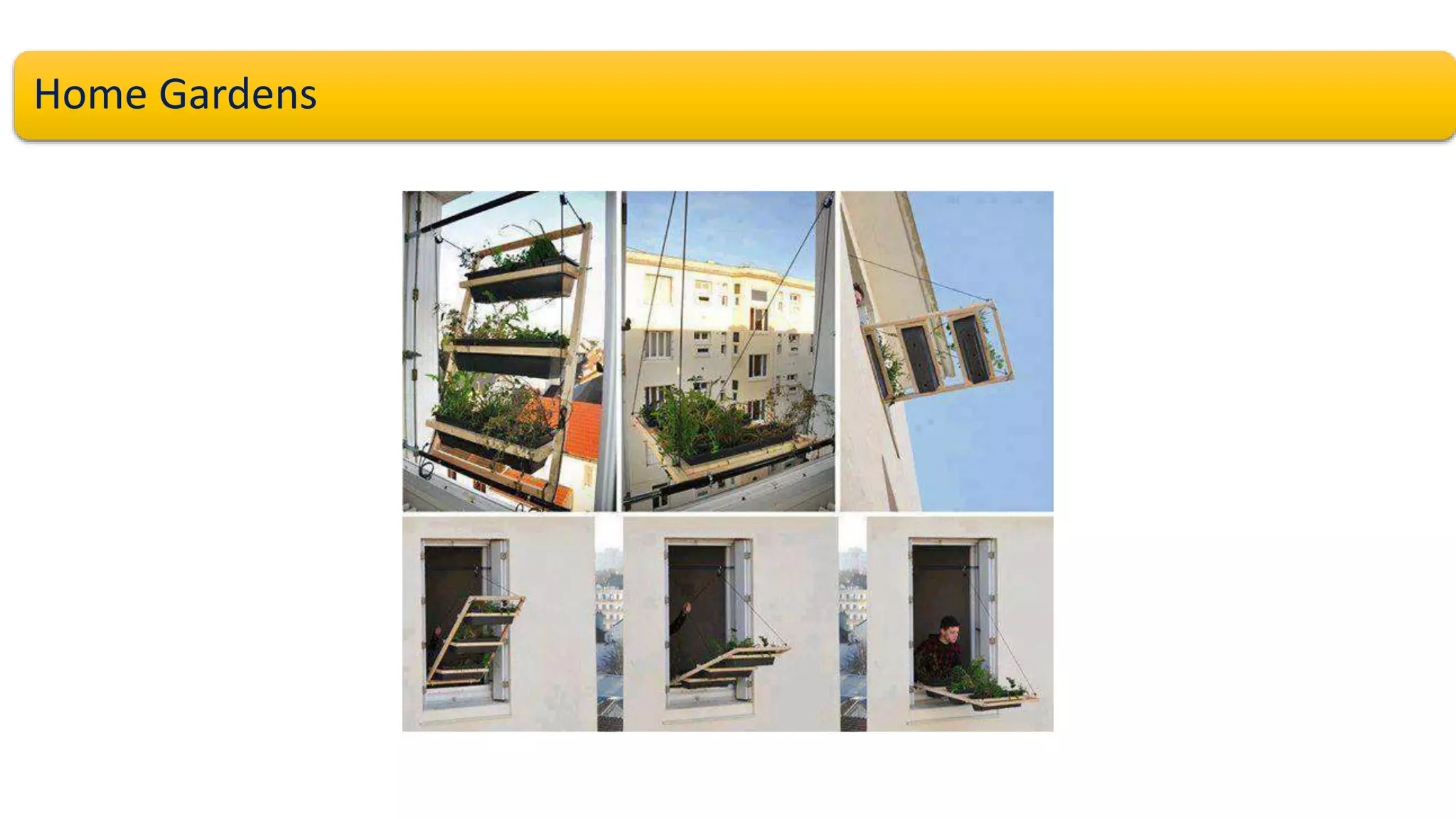
Home Gardens
IMPROVED NUTRITIVE VEGETABLES
(photo: Courtesy Dr P. Kalia)
Agricultural Robot or Agri-bot or bot
• The main area of application of robots in agriculture is at the harvesting
stage. Fruit picking robots, driverless tractor / sprayer, and sheep shearing robots
are designed to replace human labour.
• The agricultural industry is behind other complementary industries in using
robots because the sort of jobs involved in agriculture are not straightforward,
and many repetitive tasks are not exactly the same every time. In most cases, a
lot of factors have to be considered (e.g., the size and colour of the fruit to be
picked) before the commencement of a task.
• Robots can be used for other horticultural tasks such
as pruning, weeding, spraying , grafting, planting and monitoring.
• Robots can also be used in livestock applications (livestock robotics) such
as milking, washing and castrating.
• Answer to non availability of laborer for agriculture
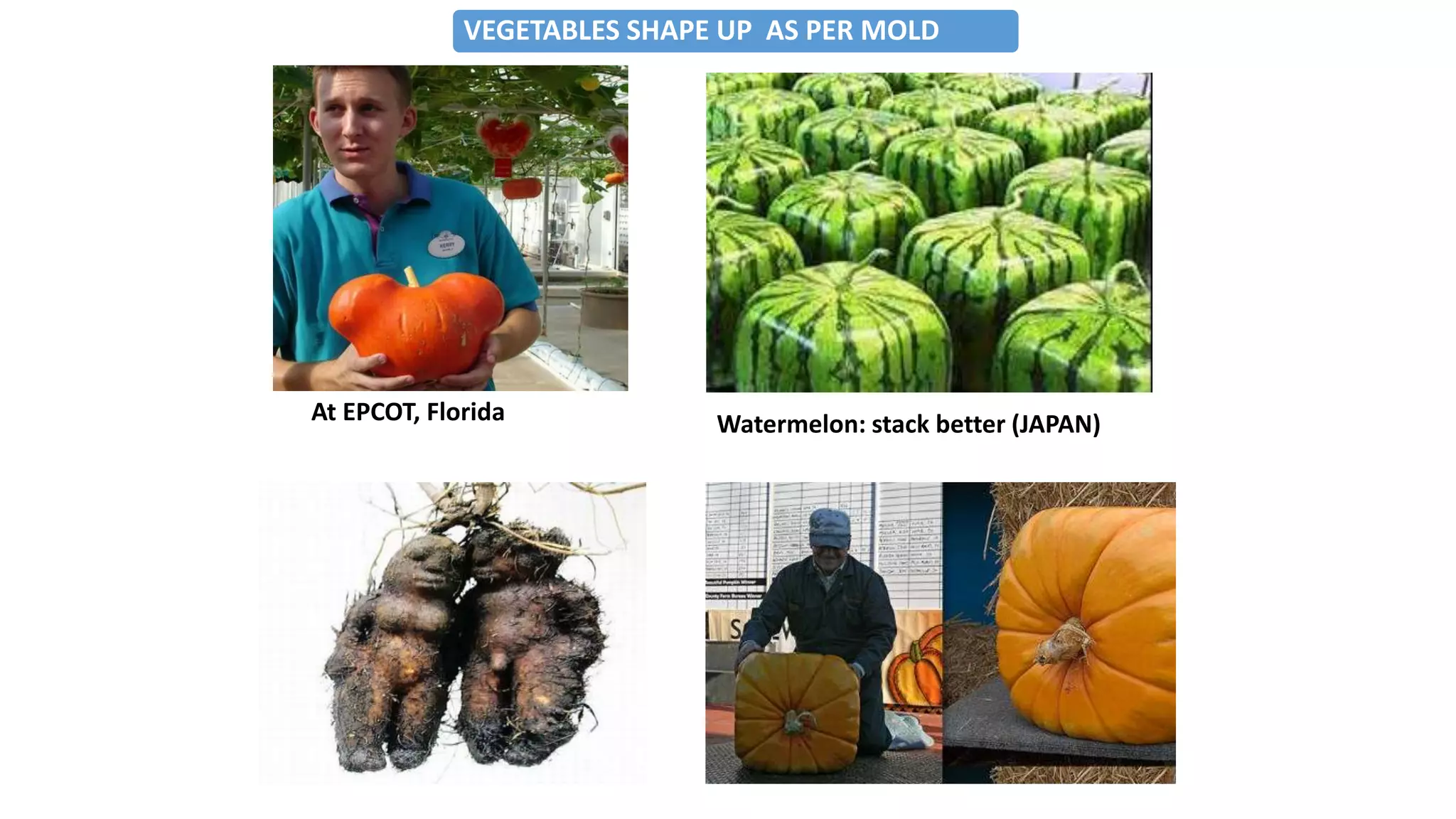
Watermelon: stack better (JAPAN)At EPCOT, Florida
VEGETABLES SHAPE UP AS PER MOLD
 In our surrounding atmosphere CO2 conc. is 0.03% means 300 ppm. Plants use this CO2 for
photosynthesis.
 In poly house, during night time there is no photosynthesis but CO2 is given out through
respiration.
 This CO2 remain accumulated around plants hence the CO2 conc. is higher inside the
polyhouse as compared to outside and this CO2 is again used by plants growing in poly house
for rapid photosynthesis.
Environmental parameters in Polyhouse
 For healthy and maximum growth of plant, the temperature requirement is between 260C to
300C during day time and 150C to 180C in night.
 The frame work of poly house is covered by polythene hence inner temperature can rise up to
400C.
 To control the temperature inside the poly house, ventilation as well as cooling pads and fans
are used.
Continue…
 Assurance of Quality seeds/nursery/ other planting material suitable for protected structures
 Regular uninterrupted power supply to maintain optimal growing conditions in protected
structures.
 Government should support needs to be extended module of temporary low cost structures.
 Large-scale promotion of low pressure drip irrigation system should be ensured for low-
cost small-scale protected cultivation.
 Self help group with scientific support for multiplication of quality planting material,
Large-scale motivation and training of educated unemployed youths in the field of
protected cultivation.
Strategies to boost production in protected structures
R k satyaraj guru pa

R k satyaraj guru pa

  • 1.
    Presentation on Precision Agriculture (PA) Presentedby Rama Krishna Satyaraj Guru Ph.D. Agronomy Dept. of Agronomy College of Agriculture, Raipur Indira Gandhi Krishi Vishwavidyalaya, Raipur (C.G.) Submitted to Dr. J. S. Urkurkar Professor Dept. of Agronomy
  • 2.
    Pre GRTs GRTsPost GRTs Farming Approach
  • 3.
    Precision Agriculture Precision Agriculture(PA) refers to the application of precise and correct amounts of inputs like water, fertilizers, pesticides etc. at the correct time to the crop for increasing its productivity and maximizing its yields. The use of inputs based on the right quantity, at the right time and in the right place. This type of management is commonly known as “Site-Specific Management”. Spatial variability and temporal variability
  • 4.
    PRECISION AGRICULTURE 4 Decision support system (DSS) Yieldmonitor (YM) Variable rate Technology (VRT) Global position system (GPS) Geographical information system (GIS) Remote sensing (RS) Component of precision farming
  • 5.
    Global positioning system(GPS) This is the satellite-based information received by a mobile field instrument sensitive to the transmitting frequency. GPS help in identifying any location in the field to asses the spatial variability and site specific application of inputs.
  • 7.
    Geographical information System(GIS) The GIS is tool used to capture, store and update, manipulate, analyze and display in map like form, spatially referenced geographical information.
  • 10.
    Remote sensing (RS) Remotesensing is a tool for collection, processing and analyzing data to extract information form earth surface without coming in to physical content with it.
  • 11.
    Energy source (sun or transmitter) Transmissionof energy from source to object Energy interaction with object surface Transmission of energy to sensor Scattering and absorption by atmosphere Detection, measurement and output by sensor Data acquisition, recording and analysis
  • 13.
    Variable rate Technology(VRT) Consist of farmed field equipment with the ability to precisely control the rate of application of crop input and tillage operation . Use of heavy machines and irrigation system
  • 14.
    Variable Rate Controller Itis the implementation of gathered information for site specific agriculture. It consists of the machines and systems for the control of delivery rate of chemical inputs such as fertilizers and pesticides, either liquid or granular.
  • 17.
    Yield monitor (YM) Yieldmonitor are crop yield measuring devices installed in harvesting equipment. GIS software takes the yield data and produce and yield map. Yield map
  • 18.
    Decision support system(DSS)  It is a computerized program used to support determinations, judgments, and courses of action.  It enables the farmers to make effective decision for higher yield.  It provide information about the expected yield in each season with better accuracy eg:- LCIS for Irrigation Nutrient expert
  • 19.
    Future tools inPA  IoT (Internet of things)  Data-driven agriculture Big data analysis  Farmbot  Artificial Intelligence (AI)
  • 20.
  • 21.
    Environmental Effects ofPrecision Agriculture Reduces greenhouse gas emissions Reduction of effluents Reduce energy consumption
  • 22.
  • 23.
    Protected cultivation canbe defined as a cropping technique where the micro climate surrounding the plant body is controlled partially/fully as per the requirement of the plant species grown during their period of growth. Protected Agriculture
  • 24.
    • Crops couldbe grown under inclement climatic conditions when it is not possible to grow in open field. • Efficient utilization of precious inputs like water and nutrients. • Early nursery and early cropping. • Superior quality of the produce. • Effective control against diseases, insect pests. • Reduced expenditure on pest control. • Protection against biotic and abiotic stresses (heavy rains, hails, birds etc.) Need in Indian Scenario
  • 25.
  • 26.
  • 27.
     Plastic Tunnel i.Hightunnel ii.Low tunnel  Greenhouse  Net house  Plastic Mulch Protected structures
  • 28.
  • 29.
  • 32.
    Multi-storey Vertical Aquaponics(fish , vegetables and others)
  • 33.
  • 34.
  • 35.
    Kitchen Garden insideKitchen • Kitchen Nano Garden by Hyundai is a super cool concept for growing a vegetable garden right in your kitchen • Because light, water and nutrient supply is totally controllable, it's up to you how quickly you want your veggies to grow. • It will alert you if you're overwatering, over-lighting/sunning, or if your plants need more nutrients. • It even works to naturally purify the air in your home.
  • 36.
    Kitchen Nano Gardenby Hyundai Above concepts are in the design phase, they pose great promise for the future of indoor vertical gardening
  • 37.
  • 38.
  • 39.
    Agricultural Robot orAgri-bot or bot • The main area of application of robots in agriculture is at the harvesting stage. Fruit picking robots, driverless tractor / sprayer, and sheep shearing robots are designed to replace human labour. • The agricultural industry is behind other complementary industries in using robots because the sort of jobs involved in agriculture are not straightforward, and many repetitive tasks are not exactly the same every time. In most cases, a lot of factors have to be considered (e.g., the size and colour of the fruit to be picked) before the commencement of a task. • Robots can be used for other horticultural tasks such as pruning, weeding, spraying , grafting, planting and monitoring. • Robots can also be used in livestock applications (livestock robotics) such as milking, washing and castrating. • Answer to non availability of laborer for agriculture
  • 40.
    Watermelon: stack better(JAPAN)At EPCOT, Florida VEGETABLES SHAPE UP AS PER MOLD
  • 41.
     In oursurrounding atmosphere CO2 conc. is 0.03% means 300 ppm. Plants use this CO2 for photosynthesis.  In poly house, during night time there is no photosynthesis but CO2 is given out through respiration.  This CO2 remain accumulated around plants hence the CO2 conc. is higher inside the polyhouse as compared to outside and this CO2 is again used by plants growing in poly house for rapid photosynthesis. Environmental parameters in Polyhouse
  • 42.
     For healthyand maximum growth of plant, the temperature requirement is between 260C to 300C during day time and 150C to 180C in night.  The frame work of poly house is covered by polythene hence inner temperature can rise up to 400C.  To control the temperature inside the poly house, ventilation as well as cooling pads and fans are used. Continue…
  • 44.
     Assurance ofQuality seeds/nursery/ other planting material suitable for protected structures  Regular uninterrupted power supply to maintain optimal growing conditions in protected structures.  Government should support needs to be extended module of temporary low cost structures.  Large-scale promotion of low pressure drip irrigation system should be ensured for low- cost small-scale protected cultivation.  Self help group with scientific support for multiplication of quality planting material, Large-scale motivation and training of educated unemployed youths in the field of protected cultivation. Strategies to boost production in protected structures