NYSE: GBX
April 2016
Investor Contact: Investor.Relations@gbrx.com
Website: www.gbrx.com
Safe Harbor Statement
UNDER THE PRIVATE SECURITIES LITIGATION REFORM ACT OF 1995: This presentation may contain forward-looking statements,
including statements regarding expected new railcar production volumes and schedules, expected customer demand for the
Company’s products and services, plans to adjust manufacturing capacity, restructuring plans, new railcar delivery volumes and
schedules, changes in demand for the Company’s railcar services and parts business, and the Company’s future financial
performance. Greenbrier uses words such as “anticipates,” “believes,” “forecast,” “potential,” “goal,” “contemplates,” “expects,”
“intends,” “plans,” “projects,” “hopes,” “seeks,” “estimates,” “strategy,” “could,” “would,” “should,” “likely,” “will,” “may,” “can,”
“designed to,” “future,” “foreseeable future” and similar expressions to identify forward-looking statements. These forward-looking
statements are not guarantees of future performance and are subject to certain risks and uncertainties that could cause actual
results to differ materially from in the results contemplated by the forward-looking statements. Factors that might cause such a
difference include, but are not limited to, reported backlog and awards are not indicative of our financial results; uncertainty or
changes in the credit markets and financial services industry; high levels of indebtedness and compliance with the terms of our
indebtedness; write-downs of goodwill, intangibles and other assets in future periods; sufficient availability of borrowing capacity;
fluctuations in demand for newly manufactured railcars or failure to obtain orders as anticipated in developing forecasts; loss of
one or more significant customers; customer payment defaults or related issues; sovereign risk to contracts, exchange rates or
property rights; actual future costs and the availability of materials and a trained workforce; failure to design or manufacture new
products or technologies or to achieve certification or market acceptance of new products or technologies; steel or specialty
component price fluctuations and availability and scrap surcharges; changes in product mix and the mix between segments;
labor disputes, energy shortages or operating difficulties that might disrupt manufacturing operations or the flow of cargo;
production difficulties and product delivery delays as a result of, among other matters, costs or inefficiencies associated with
expansion, start-up or changing of production lines or changes in production rates, changing technologies, transfer of production
between facilities or non-performance of alliance partners, subcontractors or suppliers; ability to obtain suitable contracts for the
sale of leased equipment and risks related to car hire and residual values; integration of current or future acquisitions and
establishment of joint ventures; succession planning; discovery of defects in railcars or services resulting in increased warranty costs
or litigation; physical damage or product or service liability claims that exceed our insurance coverage; train derailments or other
accidents or claims that could subject us to legal claims; actions or inactions by various regulatory agencies including potential
environmental remediation obligations or changing tank car or other rail car or railroad regulation; and issues arising from
investigations of whistleblower complaints; all as may be discussed in more detail under the headings "Risk Factors" and “Forward
Looking Statements” in our Annual Report on Form 10-K for the fiscal year ended August 31, 2015, and our other reports on file with
the Securities and Exchange Commission. Readers are cautioned not to place undue reliance on these forward-looking
statements, which reflect management's opinions only as of the date hereof. Except as otherwise required by law, we do not
assume any obligation to update any forward-looking statements.
1
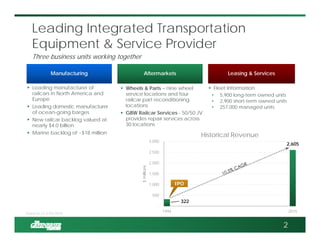
 Fleet Information
• 5,900 long-term owned units
• 2,900 short-term owned units
• 257,000 managed units
Three business units working together
Leading Integrated Transportation
Equipment & Service Provider
Aftermarkets Leasing & ServicesManufacturing
 Wheels & Parts – nine wheel
service locations and four
railcar part reconditioning
locations
 GBW Railcar Services - 50/50 JV
provides repair services across
30 locations
 Leading manufacturer of
railcars in North America and
Europe
 Leading domestic manufacturer
of ocean-going barges
 New railcar backlog valued at
nearly $4.0 billion
 Marine backlog of ~$18 million
2
322
2,605
-
500
1,000
1,500
2,000
2,500
3,000
1994 2015
$millions
Historical Revenue
IPOIPO
Data as of 2/29/2016
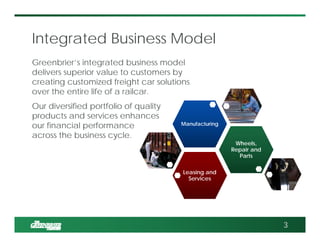
Greenbrier’s integrated business model
delivers superior value to customers by
creating customized freight car solutions
over the entire life of a railcar.
Our diversified portfolio of quality
products and services enhances
our financial performance
across the business cycle.
Integrated Business Model
Leasing and
Services
Wheels,
Repair and
Parts
Manufacturing
3
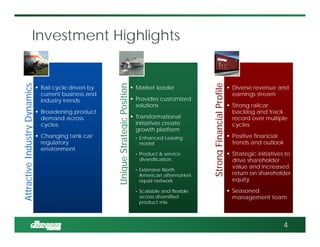
Investment Highlights
AttractiveIndustryDynamics
UniqueStrategicPosition
StrongFinancialProfile
4
 Rail cycle driven by
current business and
industry trends
 Broadening product
demand across
cycles
 Changing tank car
regulatory
environment
 Market leader
 Provides customized
solutions
 Transformational
initiatives create
growth platform
• Enhanced Leasing
model
• Product & service
diversification
• Extensive North
American aftermarket
repair network
• Scalable and flexible
across diversified
product mix
 Diverse revenue and
earnings stream
 Strong railcar
backlog and track
record over multiple
cycles
 Positive financial
trends and outlook
 Strategic initiatives to
drive shareholder
value and increased
return on shareholder
equity
 Seasoned
management team
30
35
40
45
50
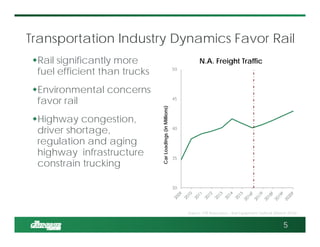
CarLoadings(inMillions)
N.A. Freight Traffic
Transportation Industry Dynamics Favor Rail
Rail significantly more
fuel efficient than trucks
Environmental concerns
favor rail
Highway congestion,
driver shortage,
regulation and aging
highway infrastructure
constrain trucking
5
Source: FTR Associates – Rail Equipment Outlook (March 2016)
0
10,000
20,000
30,000
40,000
50,000
60,000
70,000
80,000
90,000
2009
2010
2011
2012
2013
2014
2015
2016F
2017F
2018F
2019F
2020F
Units
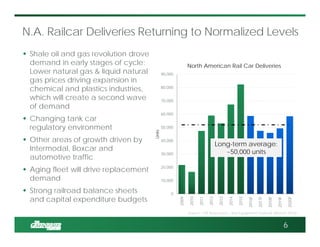
North American Rail Car Deliveries
N.A. Railcar Deliveries Returning to Normalized Levels
 Shale oil and gas revolution drove
demand in early stages of cycle;
Lower natural gas & liquid natural
gas prices driving expansion in
chemical and plastics industries,
which will create a second wave
of demand
 Changing tank car
regulatory environment
 Other areas of growth driven by
Intermodal, Boxcar and
automotive traffic
 Aging fleet will drive replacement
demand
 Strong railroad balance sheets
and capital expenditure budgets
6
Long-term average:
~50,000 units
Source: FTR Associates – Rail Equipment Outlook (March 2016)
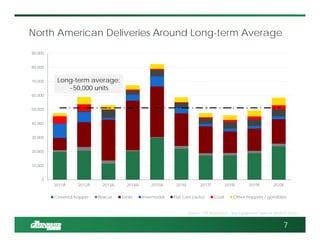
North American Deliveries Around Long-term Average
7
0
10,000
20,000
30,000
40,000
50,000
60,000
70,000
80,000
90,000
2011A 2012A 2013A 2014A 2015A 2016F 2017F 2018F 2019F 2020F
Covered hopper Boxcar Tanks Intermodal Flat cars (auto) Coal Other hoppers / gondolas
Long-term average:
~50,000 units
Source: FTR Associates – Rail Equipment Outlook (March 2016)
1.35
1.45
1.55
1.65
1.75
1.85
1.95
Millions
U.S. Rail Ton-miles
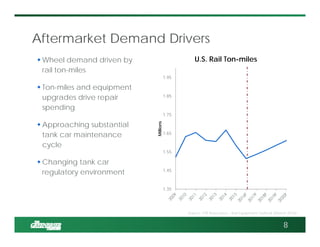
Aftermarket Demand Drivers
Source: FTR Associates – Rail Equipment Outlook (March 2016)
8
 Wheel demand driven by
rail ton-miles
 Ton-miles and equipment
upgrades drive repair
spending
 Approaching substantial
tank car maintenance
cycle
 Changing tank car
regulatory environment
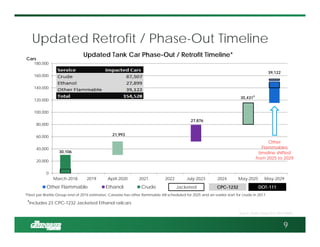
Updated Retrofit / Phase-Out Timeline
9
Source: Brattle Group 2015, DOT PHMSA
30,106
21,993
27,876
35,431†
39,122
0
20,000
40,000
60,000
80,000
100,000
120,000
140,000
160,000
180,000
March-2018 2019 April-2020 2021 2022 July-2023 2024 May-2025 May-2029
Updated Tank Car Phase-Out / Retrofit Timeline*
Other Flammable Ethanol Crude
Cars
Jacketed CPC-1232 DOT-111
*Fleet per Brattle Group end of 2015 estimates; Canada has other flammable still scheduled for 2025 and an earlier start for crude in 2017.
†Includes 23 CPC-1232 Jacketed Ethanol railcars
Other
Flammables
timeline shifted
from 2025 to 2029
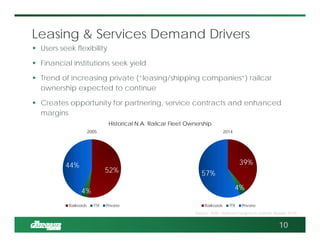
Leasing & Services Demand Drivers
 Users seek flexibility
 Financial institutions seek yield
 Trend of increasing private (“leasing/shipping companies”) railcar
ownership expected to continue
 Creates opportunity for partnering, service contracts and enhanced
margins
10
Source: AAR – Railroad Equipment Outlook (August 2014)
52%
4%
44%
2005
Railroads TTX Private
39%
4%
57%
2014
Railroads TTX Private
Historical N.A. Railcar Fleet Ownership
Unique Strategic Position
11
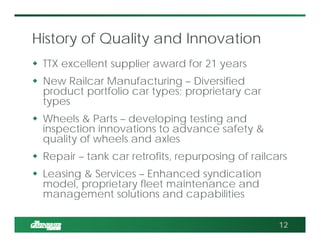
History of Quality and Innovation
 TTX excellent supplier award for 21 years
 New Railcar Manufacturing – Diversified
product portfolio car types; proprietary car
types
 Wheels & Parts – developing testing and
inspection innovations to advance safety &
quality of wheels and axles
 Repair – tank car retrofits, repurposing of railcars
 Leasing & Services – Enhanced syndication
model, proprietary fleet maintenance and
management solutions and capabilities
12
Transformational Initiatives Create
Diversified Growth Platform…
 Improves competitive position due to diverse product mix at
lower-cost, flexible manufacturing facilities
 Diversifies business mix by expanding repair and wheel
maintenance business - large aftermarket business provides
stability throughout business cycles
 Enhances leasing activities, capturing more value throughout
the railcar life cycle
 Expands available market by increasing throughput and
diversifying product portfolio while maintaining the quality
customers demand
 Expands geographic reach into new international markets
with recent entries into Brazil and Saudi Arabia
Greenbrier is well-positioned to benefit from numerous tailwinds. Our diversified business
model insulates Greenbrier from any major potential headwinds.
13
$749
$2,136
$102
$371
$92
$98
$0
$500
$1,000
$1,500
$2,000
$2,500
$3,000
2006 2015
$inmillions(%ofTotalRevenue)
Leasing & Services W&P Manufacturing
14
$943
$2,605
(10%)
(11%)
(79%)
(4%)
(82%)
(14%)
GBX, 13%
ARI, 21%
RAIL, 14%
TRN, 36%
Others, 16%
0%
20%
40%
60%
80%
100%
100% = 88,116 units
September 30, 2006
GBX, 30%
ARI, 6%
RAIL, 9%
TRN, 44%
Others, 11%
100% = 111,019 units
December 31, 2015
Revenue
FY 2016
Guidance
to exceed
$2.8 billion
North American Industry Backlog
Resulting in Revenue and Share Growth
Source: RSI ARCI (January 2016)
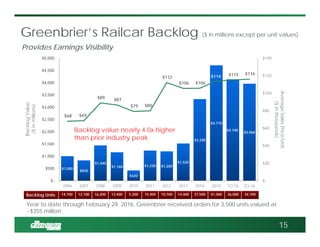
Greenbrier’s Railcar Backlog ($ in millions except per unit values)
Backlog Units 14,700 12,100 16,200 13,400 5,300 15,400 10,700 14,400 31,500 41,300 36,000 34,100
Year to date through February 29, 2016, Greenbrier received orders for 3,500 units valued at
~$355 million.
15
$1,000
$830
$1,440
$1,160
$420
$1,230 $1,200
$1,520
$3,330
$4,710
$4,140
$3,960
$68 $69
$89 $87
$79 $80
$112
$106 $106
$114 $115 $116
$-
$20
$40
$60
$80
$100
$120
$140
$-
$500
$1,000
$1,500
$2,000
$2,500
$3,000
$3,500
$4,000
$4,500
$5,000
2006 2007 2008 2009 2010 2011 2012 2013 2014 2015 1Q 16 2Q 16
AverageSalesPrice/Unit
($inthousands)
BacklogValue
($inmillions)
Provides Earnings Visibility
Backlog value nearly 4.0x higher
than prior industry peak
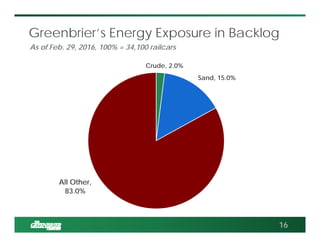
Greenbrier’s Energy Exposure in Backlog
16
As of Feb. 29, 2016, 100% = 34,100 railcars
Crude, 2.0%
Sand, 15.0%
All Other,
83.0%
$434
$0
$100
$200
$300
$400
$500
2009 2010 2011 2012 2013 2014 2015
Adj. EBITDA(1)
$5.93
$(1.00)
$-
$1.00
$2.00
$3.00
$4.00
$5.00
$6.00
2010 2011 2012 2013 2014 2015
Adjusted EPS(1)
21.1
0.0
3.0
6.0
9.0
12.0
15.0
18.0
21.0
2010 2011 2012 2013 2014 2015
Deliveries (Units)
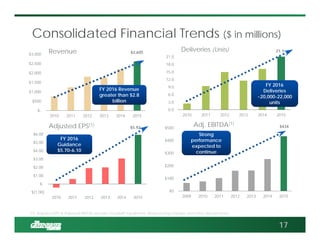
Consolidated Financial Trends ($ in millions)
(1) Adjusted EPS & Adjusted EBITDA exclude Goodwill impairment, Restructuring charges and other Special Items.
FY 2016
Deliveries
~20,000-22,000
units
FY 2016
Deliveries
~20,000-22,000
units
FY 2016
Guidance
$5.70-6.10
FY 2016
Guidance
$5.70-6.10
Strong
performance
expected to
continue
Strong
performance
expected to
continue
17
$2,605
$-
$500
$1,000
$1,500
$2,000
$2,500
$3,000
2010 2011 2012 2013 2014 2015
Revenue
FY 2016 Revenue
greater than $2.8
billion
FY 2016 Revenue
greater than $2.8
billion
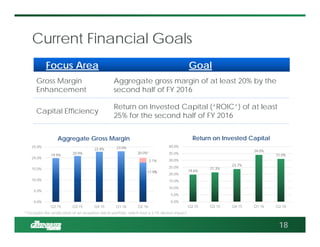
Current Financial Goals
Focus Area Goal
Gross Margin
Enhancement
Aggregate gross margin of at least 20% by the
second half of FY 2016
Capital Efficiency
Return on Invested Capital (“ROIC”) of at least
25% for the second half of FY 2016
18
19.9% 20.9%
22.8% 23.0%
20.0%*
2.1%
0.0%
5.0%
10.0%
15.0%
20.0%
25.0%
Q2 15 Q3 15 Q4 15 Q1 16 Q2 16
Aggregate Gross Margin
17.9% 19.6%
21.3%
23.7%
34.0%
31.0%
0.0%
5.0%
10.0%
15.0%
20.0%
25.0%
30.0%
35.0%
40.0%
Q2 15 Q3 15 Q4 15 Q1 16 Q2 16
Return on Invested Capital
(*) Excludes the syndication of an acquired railcar portfolio, which had a 2.1% dilutive impact.
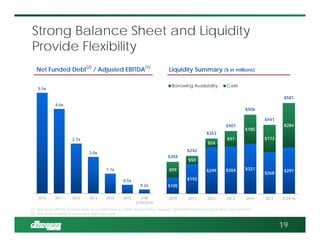
$105
$192
$299 $304 $321
$268
$297$99
$50
$54
$97
$185
$173
$284
$204
$242
$353
$401
$506
$441
$581
2010 2011 2012 2013 2014 2015 2/29/16
Borrowing Availability Cash
5.5x
4.6x
2.7x
2.0x
1.1x
0.5x
0.2x
0.0x
1.0x
2.0x
3.0x
4.0x
5.0x
6.0x
2010 2011 2012 2013 2014 2015 LTM
2/29/2016
Strong Balance Sheet and Liquidity
Provide Flexibility
Net Funded Debt
(2)
/ Adjusted EBITDA
(1)
Liquidity Summary ($ in millions)
19
(1) Adjusted EBITDA exclude gain on contribution to GBW, restructuring charges, goodwill impairment and other special items
(2) Net debt is defined as funded debt less cash
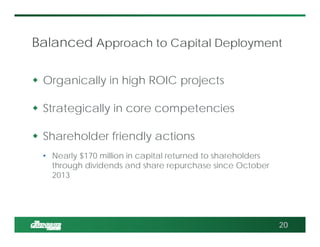
Balanced Approach to Capital Deployment
 Organically in high ROIC projects
 Strategically in core competencies
 Shareholder friendly actions
• Nearly $170 million in capital returned to shareholders
through dividends and share repurchase since October
2013
20
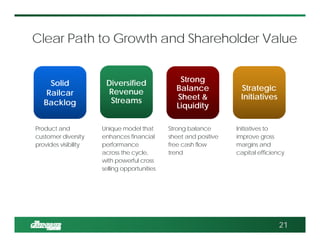
Strong balance
sheet and positive
free cash flow
trend
Clear Path to Growth and Shareholder Value
Product and
customer diversity
provides visibility
Unique model that
enhances financial
performance
across the cycle,
with powerful cross
selling opportunities
Initiatives to
improve gross
margins and
capital efficiency
Solid
Railcar
Backlog
Diversified
Revenue
Streams
Strong
Balance
Sheet &
Liquidity
Strategic
Initiatives
21
Appendix
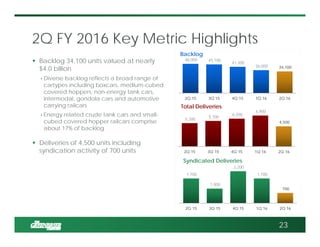
2Q FY 2016 Key Metric Highlights
23
46,000 45,100
41,300
36,000 34,100
2Q 15 3Q 15 4Q 15 1Q 16 2Q 16
Backlog
5,200
5,700
6,200
6,900
4,500
2Q 15 3Q 15 4Q 15 1Q 16 2Q 16
Total Deliveries
1,700
1,000
2,200
1,700
700
2Q 15 3Q 15 4Q 15 1Q 16 2Q 16
Syndicated Deliveries
 Backlog 34,100 units valued at nearly
$4.0 billion
• Diverse backlog reflects a broad range of
cartypes including boxcars, medium-cubed
covered hoppers, non-energy tank cars,
intermodal, gondola cars and automotive
carrying railcars
• Energy related crude tank cars and small-
cubed covered hopper railcars comprise
about 17% of backlog
 Deliveries of 4,500 units including
syndication activity of 700 units
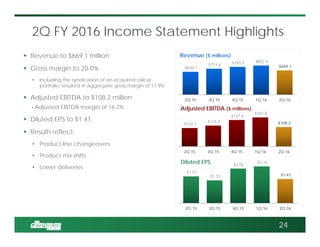
2Q FY 2016 Income Statement Highlights
24
$630.1
$714.6 $765.5 $802.4
$669.1
2Q 15 3Q 15 4Q 15 1Q 16 2Q 16
Revenue ($ millions)
$102.7
$116.3
$147.6
$161.8
$108.2
2Q 15 3Q 15 4Q 15 1Q 16 2Q 16
Adjusted EBITDA ($ millions)
$1.57
$1.33
$2.02
$2.15
$1.41
2Q 15 3Q 15 4Q 15 1Q 16 2Q 16
Diluted EPS
 Revenue to $669.1 million
 Gross margin to 20.0%
• Including the syndication of an acquired railcar
portfolio, resulted in aggregate gross margin of 17.9%
 Adjusted EBITDA to $108.2 million
• Adjusted EBITDA margin of 16.2%
 Diluted EPS to $1.41
 Results reflect:
• Product line changeovers
• Product mix shifts
• Lower deliveries
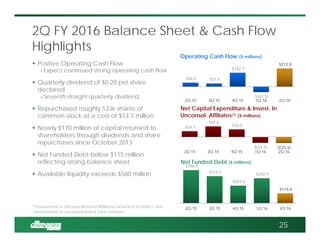
2Q FY 2016 Balance Sheet & Cash Flow
Highlights
25
$46.0 $37.4
$162.7
$(63.5)
$212.8
2Q 15 3Q 15 4Q 15 1Q 16 2Q 16
Operating Cash Flow ($ millions)
$24.1
$44.6
$32.0
$(24.5) $(25.6)
2Q 15 3Q 15 4Q 15 1Q 16 2Q 16
Net Capital Expenditure & Invest. In
Unconsol. Affiliates(1) ($ millions)
$386.4
$316.0
$204.4
$290.9
$114.0
2Q 15 3Q 15 4Q 15 1Q 16 2Q 16
Net Funded Debt ($ millions)
 Positive Operating Cash Flow
• Expect continued strong operating cash flow
 Quarterly dividend of $0.20 per share
declared
• Seventh straight quarterly dividend
 Repurchased roughly 533k shares of
common stock at a cost of $13.3 million
 Nearly $170 million of capital returned to
shareholders through dividends and share
repurchases since October 2013
 Net Funded Debt below $115 million
reflecting strong balance sheet
 Available liquidity exceeds $580 million
(1)Investment in Unconsolidated Affiliates included to reflect net
investments in unconsolidated joint ventures
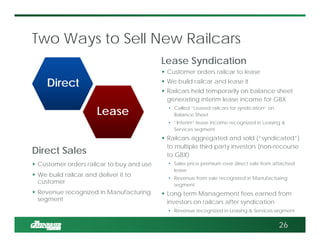
Two Ways to Sell New Railcars
Direct Sales
 Customer orders railcar to buy and use
 We build railcar and deliver it to
customer
 Revenue recognized in Manufacturing
segment
Lease Syndication
 Customer orders railcar to lease
 We build railcar and lease it
 Railcars held temporarily on balance sheet
generating interim lease income for GBX
• Called “Leased railcars for syndication” on
Balance Sheet
• “Interim” lease income recognized in Leasing &
Services segment
 Railcars aggregated and sold (“syndicated”)
to multiple third party investors (non-recourse
to GBX)
• Sales price premium over direct sale from attached
lease
• Revenue from sale recognized in Manufacturing
segment
 Long term Management fees earned from
investors on railcars after syndication
• Revenue recognized in Leasing & Services segment
26
Direct
Lease
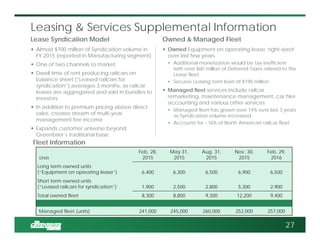
Leasing & Services Supplemental Information
Fleet Information
Units
Feb. 28,
2015
May 31,
2015
Aug. 31,
2015
Nov. 30,
2015
Feb. 29,
2016
Long term owned units
(“Equipment on operating lease”) 6,400 6,300 6,500 6,900 6,500
Short term owned units
(“Leased railcars for syndication”) 1,900 2,500 2,800 5,300 2,900
Total owned fleet 8,300 8,800 9,300 12,200 9,400
Managed fleet (units) 241,000 245,000 260,000 252,000 257,000
Owned & Managed Fleet
 Owned Equipment on operating lease ‘right-sized’
over last few years
• Additional monetization would be tax inefficient
with over $60 million of Deferred Taxes related to the
Lease fleet
• Secures Leasing term loan of $190 million
 Managed fleet services include railcar
remarketing, maintenance management, car hire
accounting and various other services
• Managed fleet has grown over 14% over last 3 years
as Syndication volume increased
• Accounts for ~16% of North American railcar fleet
Lease Syndication Model
 Almost $700 million of Syndication volume in
FY 2015 (reported in Manufacturing segment)
 One of two channels to market
 Dwell time of rent producing railcars on
balance sheet (“Leased railcars for
syndication”) averages 3 months, as railcar
leases are aggregated and sold in bundles to
investors
 In addition to premium pricing above direct
sales, creates stream of multi-year
management fee income
 Expands customer universe beyond
Greenbrier’s traditional base
27
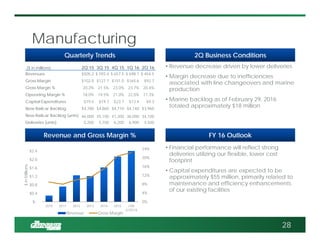
Manufacturing
Quarterly TrendsQuarterly Trends
Revenue and Gross Margin %Revenue and Gross Margin % FY 16 OutlookFY 16 Outlook
• Revenue decrease driven by lower deliveries
• Margin decrease due to inefficiencies
associated with line changeovers and marine
production
• Marine backlog as of February 29, 2016
totaled approximately $18 million
• Financial performance will reflect strong
deliveries utilizing our flexible, lower cost
footprint
• Capital expenditures are expected to be
approximately $55 million, primarily related to
maintenance and efficiency enhancements
of our existing facilities
($ in millions) 2Q 15 3Q 15 4Q 15 1Q 16 2Q 16
Revenues $505.2 $ 593.4 $ 657.5 $ 698.7 $ 454.5
Gross Margin $102.0 $127.7 $151.0 $165.6 $92.7
Gross Margin % 20.2% 21.5% 23.0% 23.7% 20.4%
Operating Margin % 18.0% 19.5% 21.0% 22.0% 17.3%
Capital Expenditures $19.5 $19.7 $23.7 $13.4 $9.3
New Railcar Backlog $4,780 $4,860 $4,710 $4,140 $3,960
New Railcar Backlog (units) 46,000 45,100 41,300 36,000 34,100
Deliveries (units) 5,200 5,700 6,200 6,900 4,500
2Q Business Conditions2Q Business Conditions
28
0%
4%
8%
12%
16%
20%
24%
$-
$0.4
$0.8
$1.2
$1.6
$2.0
$2.4
2010 2011 2012 2013 2014 2015 LTM
2/29/16
$inMillions
Revenue Gross Margin
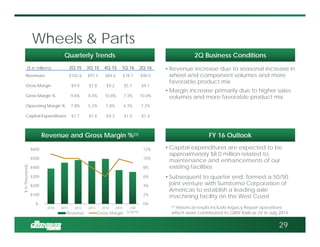
Wheels & Parts
Quarterly TrendsQuarterly Trends
Revenue and Gross Margin %(1)Revenue and Gross Margin %(1) FY 16 OutlookFY 16 Outlook
• Revenue increase due to seasonal increase in
wheel and component volumes and more
favorable product mix
• Margin increase primarily due to higher sales
volumes and more favorable product mix
• Capital expenditures are expected to be
approximately $8.0 million related to
maintenance and enhancements of our
existing facilities
• Subsequent to quarter end, formed a 50/50
joint venture with Sumitomo Corporation of
Americas to establish a leading axle
machining facility on the West Coast
2Q Business Conditions2Q Business Conditions
29
($ in millions) 2Q 15 3Q 15 4Q 15 1Q 16 2Q 16
Revenues $102.6 $97.4 $84.6 $78.7 $90.5
Gross Margin $9.9 $7.8 $9.2 $5.7 $9.1
Gross Margin % 9.6% 8.0% 10.8% 7.3% 10.0%
Operating Margin % 7.8% 5.2% 7.8% 4.3% 7.2%
Capital Expenditures $1.7 $1.6 $4.3 $1.0 $1.4
0%
2%
4%
6%
8%
10%
12%
$-
$100
$200
$300
$400
$500
$600
2010 2011 2012 2013 2014 2015 LTM
2/29/16
$inThousands
Revenue Gross Margin
(1) Historical results include legacy Repair operations
which were contributed to GBW Railcar JV in July 2014
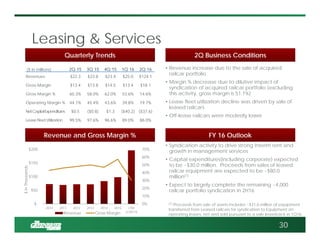
Leasing & Services
Quarterly Trends
Revenue and Gross Margin % FY 16 Outlook
• Revenue increase due to the sale of acquired
railcar portfolio
• Margin % decrease due to dilutive impact of
syndication of acquired railcar portfolio (excluding
this activity, gross margin is 51.1%)
• Lease fleet utilization decline was driven by sale of
leased railcars
• Off-lease railcars were modestly lower
• Syndication activity to drive strong interim rent and
growth in management services
• Capital expenditures(including corporate) expected
to be ~$30.0 million. Proceeds from sales of leased
railcar equipment are expected to be ~$80.0
million(1)
• Expect to largely complete the remaining ~4,000
railcar portfolio syndication in 2H16
2Q Business Conditions
30
($ in millions) 2Q 15 3Q 15 4Q 15 1Q 16 2Q 16
Revenues $22.3 $23.8 $23.4 $25.0 $124.1
Gross Margin $13.4 $13.8 $14.5 $13.4 $18.1
Gross Margin % 60.3% 58.0% 62.0% 53.6% 14.6%
Operating Margin % 44.1% 45.4% 43.6% 39.8% 19.7%
NetCapitalExpenditures $0.5 ($0.8) $1.3 ($40.2) ($37.6)
Lease Fleet Utilization 99.5% 97.6% 96.6% 89.0% 86.0%
0%
10%
20%
30%
40%
50%
60%
70%
$-
$50
$100
$150
$200
2010 2011 2012 2013 2014 2015 LTM
2/29/16
$inThousands
Revenue Gross Margin
(1) Proceeds from sale of assets includes ~$31.6 million of equipment
transferred from Leased railcars for syndication to Equipment on
operating leases, net and sold pursuant to a sale leaseback in 1Q16.
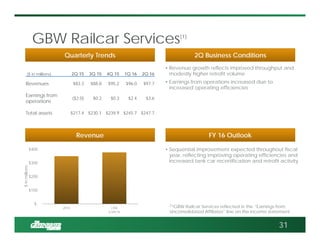
GBW Railcar Services(1)
Quarterly Trends
Revenue FY 16 Outlook
• Revenue growth reflects improved throughput and
modestly higher retrofit volume
• Earnings from operations increased due to
increased operating efficiencies
• Sequential improvement expected throughout fiscal
year, reflecting improving operating efficiencies and
increased tank car recertification and retrofit activity
2Q Business Conditions
31
($ in millions) 2Q 15 3Q 15 4Q 15 1Q 16 2Q 16
Revenues $83.3 $88.8 $95.2 $96.0 $97.7
Earnings from
operations
($2.0) $0.2 $0.3 $2.4 $3.6
Total assets $217.4 $230.1 $239.9 $245.7 $247.7
$-
$100
$200
$300
$400
2015 LTM
2/29/16
$inmillions
(1)GBW Railcar Services reflected in the “Earnings from
Unconsolidated Affiliates” line on the income statement
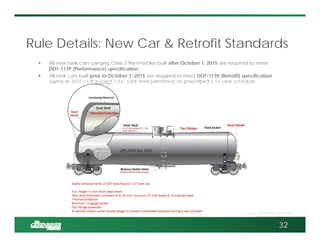
Rule Details: New Car & Retrofit Standards
 All new tank cars carrying Class 3 flammables built after October 1, 2015 are required to meet
DOT-117P (Performance) specification
 All tank cars built prior to October 1, 2015 are required to meet DOT-117R (Retrofit) specification
(same as DOT-117P except 7/16” tank shell permitted) on prescribed 2-10 year schedule
32
Source: DOT PHMSA, GBX Internal
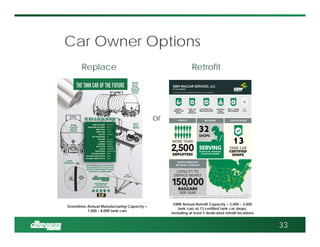
Car Owner Options
33
Replace
or
Retrofit
32
13
Greenbrier Annual Manufacturing Capacity =
7,000 – 8,000 tank cars
GBW Annual Retrofit Capacity = 2,000 – 3,000
tank cars at 13 certified tank car shops,
including at least 5 dedicated retrofit locations
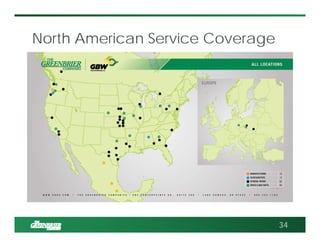
North American Service Coverage
34
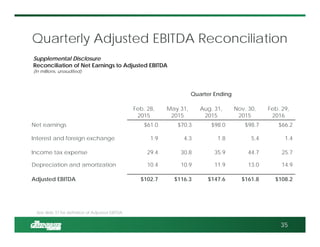
Quarterly Adjusted EBITDA Reconciliation
Supplemental Disclosure
Reconciliation of Net Earnings to Adjusted EBITDA
(In millions, unaudited)
Quarter Ending
Feb. 28,
2015
May 31,
2015
Aug. 31,
2015
Nov. 30,
2015
Feb. 29,
2016
Net earnings $61.0 $70.3 $98.0 $98.7 $66.2
Interest and foreign exchange 1.9 4.3 1.8 5.4 1.4
Income tax expense 29.4 30.8 35.9 44.7 25.7
Depreciation and amortization 10.4 10.9 11.9 13.0 14.9
Adjusted EBITDA $102.7 $116.3 $147.6 $161.8 $108.2
See slide 37 for definition of Adjusted EBITDA
35
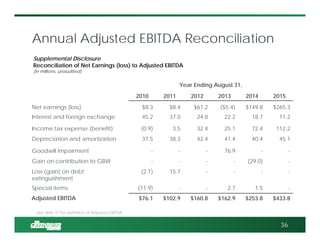
Annual Adjusted EBITDA Reconciliation
Supplemental Disclosure
Reconciliation of Net Earnings (loss) to Adjusted EBITDA
(In millions, unaudited)
Year Ending August 31,
2010 2011 2012 2013 2014 2015
Net earnings (loss) $8.3 $8.4 $61.2 ($5.4) $149.8 $265.3
Interest and foreign exchange 45.2 37.0 24.8 22.2 18.7 11.2
Income tax expense (benefit) (0.9) 3.5 32.4 25.1 72.4 112.2
Depreciation and amortization 37.5 38.3 42.4 41.4 40.4 45.1
Goodwill impairment - - - 76.9 - -
Gain on contribution to GBW - - - - (29.0) -
Loss (gain) on debt
extinguishment
(2.1) 15.7 - - - -
Special items (11.9) - - 2.7 1.5 -
Adjusted EBITDA $76.1 $102.9 $160.8 $162.9 $253.8 $433.8
See slide 37 for definition of Adjusted EBITDA
36
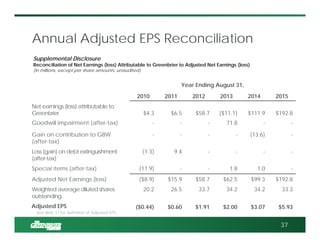
Annual Adjusted EPS Reconciliation
Year Ending August 31,
2010 2011 2012 2013 2014 2015
Net earnings (loss) attributable to
Greenbrier $4.3 $6.5 $58.7 ($11.1) $111.9 $192.8
Goodwill impairment (after-tax) - - - 71.8 - -
Gain on contribution to GBW
(after-tax)
- - - - (13.6) -
Loss (gain) on debt extinguishment
(after-tax)
(1.3) 9.4 - - - -
Special items (after-tax) (11.9) - - 1.8 1.0 -
Adjusted Net Earnings (loss) ($8.9) $15.9 $58.7 $62.5 $99.3 $192.8
Weighted average diluted shares
outstanding
20.2 26.5 33.7 34.2 34.2 33.3
Adjusted EPS ($0.44) $0.60 $1.91 $2.00 $3.07 $5.93
See slide 37 for definition of Adjusted EPS
Supplemental Disclosure
Reconciliation of Net Earnings (loss) Attributable to Greenbrier to Adjusted Net Earnings (loss)
(In millions, except per share amounts, unaudited)
37
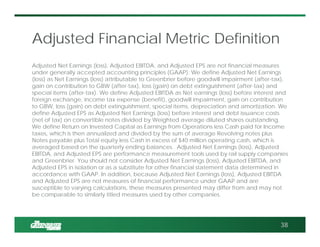
Adjusted Financial Metric Definition
Adjusted Net Earnings (loss), Adjusted EBITDA, and Adjusted EPS are not financial measures
under generally accepted accounting principles (GAAP). We define Adjusted Net Earnings
(loss) as Net Earnings (loss) attributable to Greenbrier before goodwill impairment (after-tax),
gain on contribution to GBW (after-tax), loss (gain) on debt extinguishment (after-tax) and
special items (after-tax). We define Adjusted EBITDA as Net earnings (loss) before interest and
foreign exchange, income tax expense (benefit), goodwill impairment, gain on contribution
to GBW, loss (gain) on debt extinguishment, special items, depreciation and amortization. We
define Adjusted EPS as Adjusted Net Earnings (loss) before interest and debt issuance costs
(net of tax) on convertible notes divided by Weighted average diluted shares outstanding.
We define Return on Invested Capital as Earnings from Operations less Cash paid for Income
taxes, which is then annualized and divided by the sum of average Revolving notes plus
Notes payable plus Total equity less Cash in excess of $40 million operating cash, which is
averaged based on the quarterly ending balances. Adjusted Net Earnings (loss), Adjusted
EBITDA, and Adjusted EPS are performance measurement tools used by rail supply companies
and Greenbrier. You should not consider Adjusted Net Earnings (loss), Adjusted EBITDA, and
Adjusted EPS in isolation or as a substitute for other financial statement data determined in
accordance with GAAP. In addition, because Adjusted Net Earnings (loss), Adjusted EBITDA
and Adjusted EPS are not measures of financial performance under GAAP and are
susceptible to varying calculations, these measures presented may differ from and may not
be comparable to similarly titled measures used by other companies.
38
Investor Contact: Investor.Relations@gbrx.com
Website: www.gbrx.com
NYSE: GBX
April 2016

Greenbrier Investor Relations presentation April 2016

  • 1.
    NYSE: GBX April 2016 InvestorContact: Investor.Relations@gbrx.com Website: www.gbrx.com
  • 2.
    Safe Harbor Statement UNDERTHE PRIVATE SECURITIES LITIGATION REFORM ACT OF 1995: This presentation may contain forward-looking statements, including statements regarding expected new railcar production volumes and schedules, expected customer demand for the Company’s products and services, plans to adjust manufacturing capacity, restructuring plans, new railcar delivery volumes and schedules, changes in demand for the Company’s railcar services and parts business, and the Company’s future financial performance. Greenbrier uses words such as “anticipates,” “believes,” “forecast,” “potential,” “goal,” “contemplates,” “expects,” “intends,” “plans,” “projects,” “hopes,” “seeks,” “estimates,” “strategy,” “could,” “would,” “should,” “likely,” “will,” “may,” “can,” “designed to,” “future,” “foreseeable future” and similar expressions to identify forward-looking statements. These forward-looking statements are not guarantees of future performance and are subject to certain risks and uncertainties that could cause actual results to differ materially from in the results contemplated by the forward-looking statements. Factors that might cause such a difference include, but are not limited to, reported backlog and awards are not indicative of our financial results; uncertainty or changes in the credit markets and financial services industry; high levels of indebtedness and compliance with the terms of our indebtedness; write-downs of goodwill, intangibles and other assets in future periods; sufficient availability of borrowing capacity; fluctuations in demand for newly manufactured railcars or failure to obtain orders as anticipated in developing forecasts; loss of one or more significant customers; customer payment defaults or related issues; sovereign risk to contracts, exchange rates or property rights; actual future costs and the availability of materials and a trained workforce; failure to design or manufacture new products or technologies or to achieve certification or market acceptance of new products or technologies; steel or specialty component price fluctuations and availability and scrap surcharges; changes in product mix and the mix between segments; labor disputes, energy shortages or operating difficulties that might disrupt manufacturing operations or the flow of cargo; production difficulties and product delivery delays as a result of, among other matters, costs or inefficiencies associated with expansion, start-up or changing of production lines or changes in production rates, changing technologies, transfer of production between facilities or non-performance of alliance partners, subcontractors or suppliers; ability to obtain suitable contracts for the sale of leased equipment and risks related to car hire and residual values; integration of current or future acquisitions and establishment of joint ventures; succession planning; discovery of defects in railcars or services resulting in increased warranty costs or litigation; physical damage or product or service liability claims that exceed our insurance coverage; train derailments or other accidents or claims that could subject us to legal claims; actions or inactions by various regulatory agencies including potential environmental remediation obligations or changing tank car or other rail car or railroad regulation; and issues arising from investigations of whistleblower complaints; all as may be discussed in more detail under the headings "Risk Factors" and “Forward Looking Statements” in our Annual Report on Form 10-K for the fiscal year ended August 31, 2015, and our other reports on file with the Securities and Exchange Commission. Readers are cautioned not to place undue reliance on these forward-looking statements, which reflect management's opinions only as of the date hereof. Except as otherwise required by law, we do not assume any obligation to update any forward-looking statements. 1
  • 3.
     Fleet Information •5,900 long-term owned units • 2,900 short-term owned units • 257,000 managed units Three business units working together Leading Integrated Transportation Equipment & Service Provider Aftermarkets Leasing & ServicesManufacturing  Wheels & Parts – nine wheel service locations and four railcar part reconditioning locations  GBW Railcar Services - 50/50 JV provides repair services across 30 locations  Leading manufacturer of railcars in North America and Europe  Leading domestic manufacturer of ocean-going barges  New railcar backlog valued at nearly $4.0 billion  Marine backlog of ~$18 million 2 322 2,605 - 500 1,000 1,500 2,000 2,500 3,000 1994 2015 $millions Historical Revenue IPOIPO Data as of 2/29/2016
  • 4.
    Greenbrier’s integrated businessmodel delivers superior value to customers by creating customized freight car solutions over the entire life of a railcar. Our diversified portfolio of quality products and services enhances our financial performance across the business cycle. Integrated Business Model Leasing and Services Wheels, Repair and Parts Manufacturing 3
  • 5.
    Investment Highlights AttractiveIndustryDynamics UniqueStrategicPosition StrongFinancialProfile 4  Railcycle driven by current business and industry trends  Broadening product demand across cycles  Changing tank car regulatory environment  Market leader  Provides customized solutions  Transformational initiatives create growth platform • Enhanced Leasing model • Product & service diversification • Extensive North American aftermarket repair network • Scalable and flexible across diversified product mix  Diverse revenue and earnings stream  Strong railcar backlog and track record over multiple cycles  Positive financial trends and outlook  Strategic initiatives to drive shareholder value and increased return on shareholder equity  Seasoned management team
  • 6.
    30 35 40 45 50 CarLoadings(inMillions) N.A. Freight Traffic TransportationIndustry Dynamics Favor Rail Rail significantly more fuel efficient than trucks Environmental concerns favor rail Highway congestion, driver shortage, regulation and aging highway infrastructure constrain trucking 5 Source: FTR Associates – Rail Equipment Outlook (March 2016)
  • 7.
    0 10,000 20,000 30,000 40,000 50,000 60,000 70,000 80,000 90,000 2009 2010 2011 2012 2013 2014 2015 2016F 2017F 2018F 2019F 2020F Units North American RailCar Deliveries N.A. Railcar Deliveries Returning to Normalized Levels  Shale oil and gas revolution drove demand in early stages of cycle; Lower natural gas & liquid natural gas prices driving expansion in chemical and plastics industries, which will create a second wave of demand  Changing tank car regulatory environment  Other areas of growth driven by Intermodal, Boxcar and automotive traffic  Aging fleet will drive replacement demand  Strong railroad balance sheets and capital expenditure budgets 6 Long-term average: ~50,000 units Source: FTR Associates – Rail Equipment Outlook (March 2016)
  • 8.
    North American DeliveriesAround Long-term Average 7 0 10,000 20,000 30,000 40,000 50,000 60,000 70,000 80,000 90,000 2011A 2012A 2013A 2014A 2015A 2016F 2017F 2018F 2019F 2020F Covered hopper Boxcar Tanks Intermodal Flat cars (auto) Coal Other hoppers / gondolas Long-term average: ~50,000 units Source: FTR Associates – Rail Equipment Outlook (March 2016)
  • 9.
    1.35 1.45 1.55 1.65 1.75 1.85 1.95 Millions U.S. Rail Ton-miles AftermarketDemand Drivers Source: FTR Associates – Rail Equipment Outlook (March 2016) 8  Wheel demand driven by rail ton-miles  Ton-miles and equipment upgrades drive repair spending  Approaching substantial tank car maintenance cycle  Changing tank car regulatory environment
  • 10.
    Updated Retrofit /Phase-Out Timeline 9 Source: Brattle Group 2015, DOT PHMSA 30,106 21,993 27,876 35,431† 39,122 0 20,000 40,000 60,000 80,000 100,000 120,000 140,000 160,000 180,000 March-2018 2019 April-2020 2021 2022 July-2023 2024 May-2025 May-2029 Updated Tank Car Phase-Out / Retrofit Timeline* Other Flammable Ethanol Crude Cars Jacketed CPC-1232 DOT-111 *Fleet per Brattle Group end of 2015 estimates; Canada has other flammable still scheduled for 2025 and an earlier start for crude in 2017. †Includes 23 CPC-1232 Jacketed Ethanol railcars Other Flammables timeline shifted from 2025 to 2029
  • 11.
    Leasing & ServicesDemand Drivers  Users seek flexibility  Financial institutions seek yield  Trend of increasing private (“leasing/shipping companies”) railcar ownership expected to continue  Creates opportunity for partnering, service contracts and enhanced margins 10 Source: AAR – Railroad Equipment Outlook (August 2014) 52% 4% 44% 2005 Railroads TTX Private 39% 4% 57% 2014 Railroads TTX Private Historical N.A. Railcar Fleet Ownership
  • 12.
  • 13.
    History of Qualityand Innovation  TTX excellent supplier award for 21 years  New Railcar Manufacturing – Diversified product portfolio car types; proprietary car types  Wheels & Parts – developing testing and inspection innovations to advance safety & quality of wheels and axles  Repair – tank car retrofits, repurposing of railcars  Leasing & Services – Enhanced syndication model, proprietary fleet maintenance and management solutions and capabilities 12
  • 14.
    Transformational Initiatives Create DiversifiedGrowth Platform…  Improves competitive position due to diverse product mix at lower-cost, flexible manufacturing facilities  Diversifies business mix by expanding repair and wheel maintenance business - large aftermarket business provides stability throughout business cycles  Enhances leasing activities, capturing more value throughout the railcar life cycle  Expands available market by increasing throughput and diversifying product portfolio while maintaining the quality customers demand  Expands geographic reach into new international markets with recent entries into Brazil and Saudi Arabia Greenbrier is well-positioned to benefit from numerous tailwinds. Our diversified business model insulates Greenbrier from any major potential headwinds. 13
  • 15.
    $749 $2,136 $102 $371 $92 $98 $0 $500 $1,000 $1,500 $2,000 $2,500 $3,000 2006 2015 $inmillions(%ofTotalRevenue) Leasing &Services W&P Manufacturing 14 $943 $2,605 (10%) (11%) (79%) (4%) (82%) (14%) GBX, 13% ARI, 21% RAIL, 14% TRN, 36% Others, 16% 0% 20% 40% 60% 80% 100% 100% = 88,116 units September 30, 2006 GBX, 30% ARI, 6% RAIL, 9% TRN, 44% Others, 11% 100% = 111,019 units December 31, 2015 Revenue FY 2016 Guidance to exceed $2.8 billion North American Industry Backlog Resulting in Revenue and Share Growth Source: RSI ARCI (January 2016)
  • 16.
    Greenbrier’s Railcar Backlog($ in millions except per unit values) Backlog Units 14,700 12,100 16,200 13,400 5,300 15,400 10,700 14,400 31,500 41,300 36,000 34,100 Year to date through February 29, 2016, Greenbrier received orders for 3,500 units valued at ~$355 million. 15 $1,000 $830 $1,440 $1,160 $420 $1,230 $1,200 $1,520 $3,330 $4,710 $4,140 $3,960 $68 $69 $89 $87 $79 $80 $112 $106 $106 $114 $115 $116 $- $20 $40 $60 $80 $100 $120 $140 $- $500 $1,000 $1,500 $2,000 $2,500 $3,000 $3,500 $4,000 $4,500 $5,000 2006 2007 2008 2009 2010 2011 2012 2013 2014 2015 1Q 16 2Q 16 AverageSalesPrice/Unit ($inthousands) BacklogValue ($inmillions) Provides Earnings Visibility Backlog value nearly 4.0x higher than prior industry peak
  • 17.
    Greenbrier’s Energy Exposurein Backlog 16 As of Feb. 29, 2016, 100% = 34,100 railcars Crude, 2.0% Sand, 15.0% All Other, 83.0%
  • 18.
    $434 $0 $100 $200 $300 $400 $500 2009 2010 20112012 2013 2014 2015 Adj. EBITDA(1) $5.93 $(1.00) $- $1.00 $2.00 $3.00 $4.00 $5.00 $6.00 2010 2011 2012 2013 2014 2015 Adjusted EPS(1) 21.1 0.0 3.0 6.0 9.0 12.0 15.0 18.0 21.0 2010 2011 2012 2013 2014 2015 Deliveries (Units) Consolidated Financial Trends ($ in millions) (1) Adjusted EPS & Adjusted EBITDA exclude Goodwill impairment, Restructuring charges and other Special Items. FY 2016 Deliveries ~20,000-22,000 units FY 2016 Deliveries ~20,000-22,000 units FY 2016 Guidance $5.70-6.10 FY 2016 Guidance $5.70-6.10 Strong performance expected to continue Strong performance expected to continue 17 $2,605 $- $500 $1,000 $1,500 $2,000 $2,500 $3,000 2010 2011 2012 2013 2014 2015 Revenue FY 2016 Revenue greater than $2.8 billion FY 2016 Revenue greater than $2.8 billion
  • 19.
    Current Financial Goals FocusArea Goal Gross Margin Enhancement Aggregate gross margin of at least 20% by the second half of FY 2016 Capital Efficiency Return on Invested Capital (“ROIC”) of at least 25% for the second half of FY 2016 18 19.9% 20.9% 22.8% 23.0% 20.0%* 2.1% 0.0% 5.0% 10.0% 15.0% 20.0% 25.0% Q2 15 Q3 15 Q4 15 Q1 16 Q2 16 Aggregate Gross Margin 17.9% 19.6% 21.3% 23.7% 34.0% 31.0% 0.0% 5.0% 10.0% 15.0% 20.0% 25.0% 30.0% 35.0% 40.0% Q2 15 Q3 15 Q4 15 Q1 16 Q2 16 Return on Invested Capital (*) Excludes the syndication of an acquired railcar portfolio, which had a 2.1% dilutive impact.
  • 20.
    $105 $192 $299 $304 $321 $268 $297$99 $50 $54 $97 $185 $173 $284 $204 $242 $353 $401 $506 $441 $581 20102011 2012 2013 2014 2015 2/29/16 Borrowing Availability Cash 5.5x 4.6x 2.7x 2.0x 1.1x 0.5x 0.2x 0.0x 1.0x 2.0x 3.0x 4.0x 5.0x 6.0x 2010 2011 2012 2013 2014 2015 LTM 2/29/2016 Strong Balance Sheet and Liquidity Provide Flexibility Net Funded Debt (2) / Adjusted EBITDA (1) Liquidity Summary ($ in millions) 19 (1) Adjusted EBITDA exclude gain on contribution to GBW, restructuring charges, goodwill impairment and other special items (2) Net debt is defined as funded debt less cash
  • 21.
    Balanced Approach toCapital Deployment  Organically in high ROIC projects  Strategically in core competencies  Shareholder friendly actions • Nearly $170 million in capital returned to shareholders through dividends and share repurchase since October 2013 20
  • 22.
    Strong balance sheet andpositive free cash flow trend Clear Path to Growth and Shareholder Value Product and customer diversity provides visibility Unique model that enhances financial performance across the cycle, with powerful cross selling opportunities Initiatives to improve gross margins and capital efficiency Solid Railcar Backlog Diversified Revenue Streams Strong Balance Sheet & Liquidity Strategic Initiatives 21
  • 23.
  • 24.
    2Q FY 2016Key Metric Highlights 23 46,000 45,100 41,300 36,000 34,100 2Q 15 3Q 15 4Q 15 1Q 16 2Q 16 Backlog 5,200 5,700 6,200 6,900 4,500 2Q 15 3Q 15 4Q 15 1Q 16 2Q 16 Total Deliveries 1,700 1,000 2,200 1,700 700 2Q 15 3Q 15 4Q 15 1Q 16 2Q 16 Syndicated Deliveries  Backlog 34,100 units valued at nearly $4.0 billion • Diverse backlog reflects a broad range of cartypes including boxcars, medium-cubed covered hoppers, non-energy tank cars, intermodal, gondola cars and automotive carrying railcars • Energy related crude tank cars and small- cubed covered hopper railcars comprise about 17% of backlog  Deliveries of 4,500 units including syndication activity of 700 units
  • 25.
    2Q FY 2016Income Statement Highlights 24 $630.1 $714.6 $765.5 $802.4 $669.1 2Q 15 3Q 15 4Q 15 1Q 16 2Q 16 Revenue ($ millions) $102.7 $116.3 $147.6 $161.8 $108.2 2Q 15 3Q 15 4Q 15 1Q 16 2Q 16 Adjusted EBITDA ($ millions) $1.57 $1.33 $2.02 $2.15 $1.41 2Q 15 3Q 15 4Q 15 1Q 16 2Q 16 Diluted EPS  Revenue to $669.1 million  Gross margin to 20.0% • Including the syndication of an acquired railcar portfolio, resulted in aggregate gross margin of 17.9%  Adjusted EBITDA to $108.2 million • Adjusted EBITDA margin of 16.2%  Diluted EPS to $1.41  Results reflect: • Product line changeovers • Product mix shifts • Lower deliveries
  • 26.
    2Q FY 2016Balance Sheet & Cash Flow Highlights 25 $46.0 $37.4 $162.7 $(63.5) $212.8 2Q 15 3Q 15 4Q 15 1Q 16 2Q 16 Operating Cash Flow ($ millions) $24.1 $44.6 $32.0 $(24.5) $(25.6) 2Q 15 3Q 15 4Q 15 1Q 16 2Q 16 Net Capital Expenditure & Invest. In Unconsol. Affiliates(1) ($ millions) $386.4 $316.0 $204.4 $290.9 $114.0 2Q 15 3Q 15 4Q 15 1Q 16 2Q 16 Net Funded Debt ($ millions)  Positive Operating Cash Flow • Expect continued strong operating cash flow  Quarterly dividend of $0.20 per share declared • Seventh straight quarterly dividend  Repurchased roughly 533k shares of common stock at a cost of $13.3 million  Nearly $170 million of capital returned to shareholders through dividends and share repurchases since October 2013  Net Funded Debt below $115 million reflecting strong balance sheet  Available liquidity exceeds $580 million (1)Investment in Unconsolidated Affiliates included to reflect net investments in unconsolidated joint ventures
  • 27.
    Two Ways toSell New Railcars Direct Sales  Customer orders railcar to buy and use  We build railcar and deliver it to customer  Revenue recognized in Manufacturing segment Lease Syndication  Customer orders railcar to lease  We build railcar and lease it  Railcars held temporarily on balance sheet generating interim lease income for GBX • Called “Leased railcars for syndication” on Balance Sheet • “Interim” lease income recognized in Leasing & Services segment  Railcars aggregated and sold (“syndicated”) to multiple third party investors (non-recourse to GBX) • Sales price premium over direct sale from attached lease • Revenue from sale recognized in Manufacturing segment  Long term Management fees earned from investors on railcars after syndication • Revenue recognized in Leasing & Services segment 26 Direct Lease
  • 28.
    Leasing & ServicesSupplemental Information Fleet Information Units Feb. 28, 2015 May 31, 2015 Aug. 31, 2015 Nov. 30, 2015 Feb. 29, 2016 Long term owned units (“Equipment on operating lease”) 6,400 6,300 6,500 6,900 6,500 Short term owned units (“Leased railcars for syndication”) 1,900 2,500 2,800 5,300 2,900 Total owned fleet 8,300 8,800 9,300 12,200 9,400 Managed fleet (units) 241,000 245,000 260,000 252,000 257,000 Owned & Managed Fleet  Owned Equipment on operating lease ‘right-sized’ over last few years • Additional monetization would be tax inefficient with over $60 million of Deferred Taxes related to the Lease fleet • Secures Leasing term loan of $190 million  Managed fleet services include railcar remarketing, maintenance management, car hire accounting and various other services • Managed fleet has grown over 14% over last 3 years as Syndication volume increased • Accounts for ~16% of North American railcar fleet Lease Syndication Model  Almost $700 million of Syndication volume in FY 2015 (reported in Manufacturing segment)  One of two channels to market  Dwell time of rent producing railcars on balance sheet (“Leased railcars for syndication”) averages 3 months, as railcar leases are aggregated and sold in bundles to investors  In addition to premium pricing above direct sales, creates stream of multi-year management fee income  Expands customer universe beyond Greenbrier’s traditional base 27
  • 29.
    Manufacturing Quarterly TrendsQuarterly Trends Revenueand Gross Margin %Revenue and Gross Margin % FY 16 OutlookFY 16 Outlook • Revenue decrease driven by lower deliveries • Margin decrease due to inefficiencies associated with line changeovers and marine production • Marine backlog as of February 29, 2016 totaled approximately $18 million • Financial performance will reflect strong deliveries utilizing our flexible, lower cost footprint • Capital expenditures are expected to be approximately $55 million, primarily related to maintenance and efficiency enhancements of our existing facilities ($ in millions) 2Q 15 3Q 15 4Q 15 1Q 16 2Q 16 Revenues $505.2 $ 593.4 $ 657.5 $ 698.7 $ 454.5 Gross Margin $102.0 $127.7 $151.0 $165.6 $92.7 Gross Margin % 20.2% 21.5% 23.0% 23.7% 20.4% Operating Margin % 18.0% 19.5% 21.0% 22.0% 17.3% Capital Expenditures $19.5 $19.7 $23.7 $13.4 $9.3 New Railcar Backlog $4,780 $4,860 $4,710 $4,140 $3,960 New Railcar Backlog (units) 46,000 45,100 41,300 36,000 34,100 Deliveries (units) 5,200 5,700 6,200 6,900 4,500 2Q Business Conditions2Q Business Conditions 28 0% 4% 8% 12% 16% 20% 24% $- $0.4 $0.8 $1.2 $1.6 $2.0 $2.4 2010 2011 2012 2013 2014 2015 LTM 2/29/16 $inMillions Revenue Gross Margin
  • 30.
    Wheels & Parts QuarterlyTrendsQuarterly Trends Revenue and Gross Margin %(1)Revenue and Gross Margin %(1) FY 16 OutlookFY 16 Outlook • Revenue increase due to seasonal increase in wheel and component volumes and more favorable product mix • Margin increase primarily due to higher sales volumes and more favorable product mix • Capital expenditures are expected to be approximately $8.0 million related to maintenance and enhancements of our existing facilities • Subsequent to quarter end, formed a 50/50 joint venture with Sumitomo Corporation of Americas to establish a leading axle machining facility on the West Coast 2Q Business Conditions2Q Business Conditions 29 ($ in millions) 2Q 15 3Q 15 4Q 15 1Q 16 2Q 16 Revenues $102.6 $97.4 $84.6 $78.7 $90.5 Gross Margin $9.9 $7.8 $9.2 $5.7 $9.1 Gross Margin % 9.6% 8.0% 10.8% 7.3% 10.0% Operating Margin % 7.8% 5.2% 7.8% 4.3% 7.2% Capital Expenditures $1.7 $1.6 $4.3 $1.0 $1.4 0% 2% 4% 6% 8% 10% 12% $- $100 $200 $300 $400 $500 $600 2010 2011 2012 2013 2014 2015 LTM 2/29/16 $inThousands Revenue Gross Margin (1) Historical results include legacy Repair operations which were contributed to GBW Railcar JV in July 2014
  • 31.
    Leasing & Services QuarterlyTrends Revenue and Gross Margin % FY 16 Outlook • Revenue increase due to the sale of acquired railcar portfolio • Margin % decrease due to dilutive impact of syndication of acquired railcar portfolio (excluding this activity, gross margin is 51.1%) • Lease fleet utilization decline was driven by sale of leased railcars • Off-lease railcars were modestly lower • Syndication activity to drive strong interim rent and growth in management services • Capital expenditures(including corporate) expected to be ~$30.0 million. Proceeds from sales of leased railcar equipment are expected to be ~$80.0 million(1) • Expect to largely complete the remaining ~4,000 railcar portfolio syndication in 2H16 2Q Business Conditions 30 ($ in millions) 2Q 15 3Q 15 4Q 15 1Q 16 2Q 16 Revenues $22.3 $23.8 $23.4 $25.0 $124.1 Gross Margin $13.4 $13.8 $14.5 $13.4 $18.1 Gross Margin % 60.3% 58.0% 62.0% 53.6% 14.6% Operating Margin % 44.1% 45.4% 43.6% 39.8% 19.7% NetCapitalExpenditures $0.5 ($0.8) $1.3 ($40.2) ($37.6) Lease Fleet Utilization 99.5% 97.6% 96.6% 89.0% 86.0% 0% 10% 20% 30% 40% 50% 60% 70% $- $50 $100 $150 $200 2010 2011 2012 2013 2014 2015 LTM 2/29/16 $inThousands Revenue Gross Margin (1) Proceeds from sale of assets includes ~$31.6 million of equipment transferred from Leased railcars for syndication to Equipment on operating leases, net and sold pursuant to a sale leaseback in 1Q16.
  • 32.
    GBW Railcar Services(1) QuarterlyTrends Revenue FY 16 Outlook • Revenue growth reflects improved throughput and modestly higher retrofit volume • Earnings from operations increased due to increased operating efficiencies • Sequential improvement expected throughout fiscal year, reflecting improving operating efficiencies and increased tank car recertification and retrofit activity 2Q Business Conditions 31 ($ in millions) 2Q 15 3Q 15 4Q 15 1Q 16 2Q 16 Revenues $83.3 $88.8 $95.2 $96.0 $97.7 Earnings from operations ($2.0) $0.2 $0.3 $2.4 $3.6 Total assets $217.4 $230.1 $239.9 $245.7 $247.7 $- $100 $200 $300 $400 2015 LTM 2/29/16 $inmillions (1)GBW Railcar Services reflected in the “Earnings from Unconsolidated Affiliates” line on the income statement
  • 33.
    Rule Details: NewCar & Retrofit Standards  All new tank cars carrying Class 3 flammables built after October 1, 2015 are required to meet DOT-117P (Performance) specification  All tank cars built prior to October 1, 2015 are required to meet DOT-117R (Retrofit) specification (same as DOT-117P except 7/16” tank shell permitted) on prescribed 2-10 year schedule 32 Source: DOT PHMSA, GBX Internal
  • 34.
    Car Owner Options 33 Replace or Retrofit 32 13 GreenbrierAnnual Manufacturing Capacity = 7,000 – 8,000 tank cars GBW Annual Retrofit Capacity = 2,000 – 3,000 tank cars at 13 certified tank car shops, including at least 5 dedicated retrofit locations
  • 35.
  • 36.
    Quarterly Adjusted EBITDAReconciliation Supplemental Disclosure Reconciliation of Net Earnings to Adjusted EBITDA (In millions, unaudited) Quarter Ending Feb. 28, 2015 May 31, 2015 Aug. 31, 2015 Nov. 30, 2015 Feb. 29, 2016 Net earnings $61.0 $70.3 $98.0 $98.7 $66.2 Interest and foreign exchange 1.9 4.3 1.8 5.4 1.4 Income tax expense 29.4 30.8 35.9 44.7 25.7 Depreciation and amortization 10.4 10.9 11.9 13.0 14.9 Adjusted EBITDA $102.7 $116.3 $147.6 $161.8 $108.2 See slide 37 for definition of Adjusted EBITDA 35
  • 37.
    Annual Adjusted EBITDAReconciliation Supplemental Disclosure Reconciliation of Net Earnings (loss) to Adjusted EBITDA (In millions, unaudited) Year Ending August 31, 2010 2011 2012 2013 2014 2015 Net earnings (loss) $8.3 $8.4 $61.2 ($5.4) $149.8 $265.3 Interest and foreign exchange 45.2 37.0 24.8 22.2 18.7 11.2 Income tax expense (benefit) (0.9) 3.5 32.4 25.1 72.4 112.2 Depreciation and amortization 37.5 38.3 42.4 41.4 40.4 45.1 Goodwill impairment - - - 76.9 - - Gain on contribution to GBW - - - - (29.0) - Loss (gain) on debt extinguishment (2.1) 15.7 - - - - Special items (11.9) - - 2.7 1.5 - Adjusted EBITDA $76.1 $102.9 $160.8 $162.9 $253.8 $433.8 See slide 37 for definition of Adjusted EBITDA 36
  • 38.
    Annual Adjusted EPSReconciliation Year Ending August 31, 2010 2011 2012 2013 2014 2015 Net earnings (loss) attributable to Greenbrier $4.3 $6.5 $58.7 ($11.1) $111.9 $192.8 Goodwill impairment (after-tax) - - - 71.8 - - Gain on contribution to GBW (after-tax) - - - - (13.6) - Loss (gain) on debt extinguishment (after-tax) (1.3) 9.4 - - - - Special items (after-tax) (11.9) - - 1.8 1.0 - Adjusted Net Earnings (loss) ($8.9) $15.9 $58.7 $62.5 $99.3 $192.8 Weighted average diluted shares outstanding 20.2 26.5 33.7 34.2 34.2 33.3 Adjusted EPS ($0.44) $0.60 $1.91 $2.00 $3.07 $5.93 See slide 37 for definition of Adjusted EPS Supplemental Disclosure Reconciliation of Net Earnings (loss) Attributable to Greenbrier to Adjusted Net Earnings (loss) (In millions, except per share amounts, unaudited) 37
  • 39.
    Adjusted Financial MetricDefinition Adjusted Net Earnings (loss), Adjusted EBITDA, and Adjusted EPS are not financial measures under generally accepted accounting principles (GAAP). We define Adjusted Net Earnings (loss) as Net Earnings (loss) attributable to Greenbrier before goodwill impairment (after-tax), gain on contribution to GBW (after-tax), loss (gain) on debt extinguishment (after-tax) and special items (after-tax). We define Adjusted EBITDA as Net earnings (loss) before interest and foreign exchange, income tax expense (benefit), goodwill impairment, gain on contribution to GBW, loss (gain) on debt extinguishment, special items, depreciation and amortization. We define Adjusted EPS as Adjusted Net Earnings (loss) before interest and debt issuance costs (net of tax) on convertible notes divided by Weighted average diluted shares outstanding. We define Return on Invested Capital as Earnings from Operations less Cash paid for Income taxes, which is then annualized and divided by the sum of average Revolving notes plus Notes payable plus Total equity less Cash in excess of $40 million operating cash, which is averaged based on the quarterly ending balances. Adjusted Net Earnings (loss), Adjusted EBITDA, and Adjusted EPS are performance measurement tools used by rail supply companies and Greenbrier. You should not consider Adjusted Net Earnings (loss), Adjusted EBITDA, and Adjusted EPS in isolation or as a substitute for other financial statement data determined in accordance with GAAP. In addition, because Adjusted Net Earnings (loss), Adjusted EBITDA and Adjusted EPS are not measures of financial performance under GAAP and are susceptible to varying calculations, these measures presented may differ from and may not be comparable to similarly titled measures used by other companies. 38
  • 40.