Green TechnologyBy:-Aniruddh De (10810006)		Paresh Kulkarni (10810042)		Ravi Pratap Singh (10810050)
OutlineEnvironment Objectives in 11th Five-Year PlanGreen TechnologyGoals of Green TechnologyAreas of Green TechnologyGreen ChemistryGreen NanotechnologyGreen BuildingGreen ITGreen EnergyGreen Marketing : new perspective of 4 PsTriple Bottom Line ModelTBL & CSRFuture of TBL
Environmental Objectives in 11th Five-Year Plan Increase forest & tree cover by 5%Attain WHO standards of air quality in all major cities by 2011-2012.Treat all urban waste water by 2011-2012 to clean river waters.Increase energy efficiency by 20 percentage points by 2016-2017.Estimated $3.6 billion has been spent for green technology in the U.S. and Europe in 2007Source: - Greenfile, EBSCO database.
Existing Laws for Green Technology Pennsylvania's  (a US state) new Mercury-Free Thermostat Law
 Sustainable Forestry Initiative : SFI 2005-2009 Standard is based on principles and measures that promote sustainable forest management and consider all forest values.
Wisconsin (a US state) recently enacted a law prohibiting disposal of certain electronics in landfills.
Taiwan passed a legislation that targets significant renewable energy generating capacity, that is expected to increase investment in solar photovoltaics and other approaches to sustainable power.
 Environmental Protection Agency has sent the White House a proposed finding that carbon dioxide is a danger to public health, a step that could trigger a clampdown on emissions of greenhouse gases.What is Green technology ?Green Technology is the application of the environmental science to conserve the natural environment and resources, and to curb the negative impacts of human involvement.The field of "green technology" encompasses a continuously evolving group of methods and materials, from techniques for generating energy to non-toxic cleaning products.
Goals of Green technology Sustainability - meeting present needs without compromising the ability of future generations to meet their own needs.
"Cradle to cradle" design - ending the "cradle to grave" cycle of manufactured products, by creating products that can be fully reclaimed or re-used.
Source reduction - reducing waste and pollution by changing patterns of production and consumption.
Innovation - developing alternatives to technologies - whether fossil fuel or chemical intensive agriculture.
Viability - economic activity around technologies and products that benefit the environment, speeding their implementation and creating new careers that truly protect the planet.Areas of Green technologyGreen Chemistry

Green Nanotechnology
Green Building
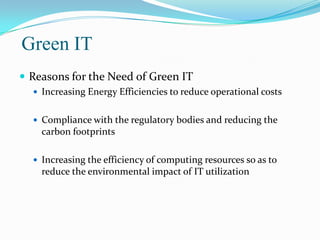
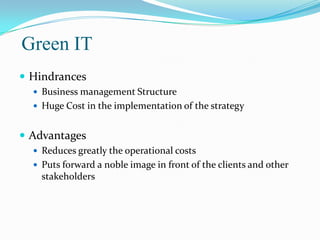
Green IT
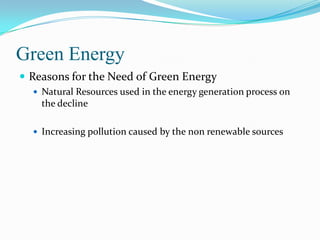
Green Energy GREEN CHEMISTRY    Utilisation of a set of principles that reduces or eliminates the use or generation of hazardous substances in  the design, manufacture and application of chemical products .
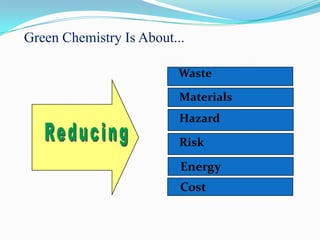
Green Chemistry Is About...WasteMaterialsHazardReducingRisk EnergyCost
Principles cover Green Chemistry ?Design of processes to maximize the amount of raw material that ends up in the product;Use of safe, environment-benign substances, including solvents, whenever possible;Design of energy efficient processes;Best form of waste disposal: not to create it in the first place.
The 12 Principles of Green Chemistry (1-6)Prevention Atom Economy Less Hazardous Chemical Synthesis Designing Safer Chemicals Safer Solvents and Auxiliaries Design for Energy Efficiency
The 12 Principles of Green Chemistry (7-12)Use of Renewable Feedstocks
Reduce Derivatives
Catalysis
Design for Degradation
Real-time Analysis for Pollution Prevention
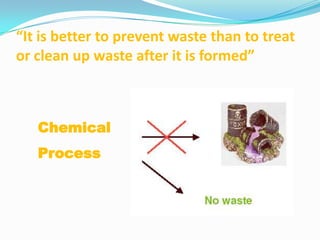
Inherently Safer Chemistry for Accident Prevention“It is better to prevent waste than to treat or clean up waste after it is formed”ChemicalProcess
Major uses of Green ChemistryGlobal Change - climate changeResource Depletion -increasingly viable technological for Renewable resources Food Supply - Agricultural methods & wastesToxics in the Environment - design for reduced hazards.
Awards in Green Chemistry The Presidential Green Chemistry Challenge Awards – In US since 1995.
1996, Dow chemical
2002, Cargill Dow
2003, Shaw Industries
The Royal Australian Chemical Institute (RACI)
The Canadian Green Chemistry Medal
The Green & Sustainable Chemistry Network(GSCN), - In JapanGreen Nanotechnology Green nanotechnology refers to the use of nanotechnology to enhance the environmental-sustainability of processes currently producing negative externalities.
Aims at : to minimize potential environmental and human health risks associated with the manufacture and use of nanotechnology products, and to encourage replacement of existing products with new nano-products that are more environmentally friendly throughout their lifecycle.Application of Green Nanotechnology Health Energy Information and communicationHeavy IndustryConsumer goods
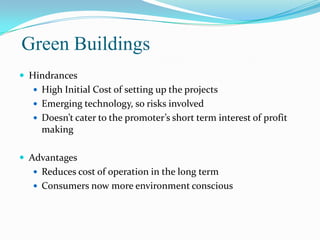
Green BuildingsReasons for the Need of Green Buildings:Increase in the number of buildings leading to greater consumption of Power.High rise buildings and construction as a whole, adversely affecting the environment.Corporate houses now need to put a check on the environmental pollution and degradation as a part of their CSR activities.

Green technology 06 42_50

  • 1.
    Green TechnologyBy:-Aniruddh De(10810006) Paresh Kulkarni (10810042) Ravi Pratap Singh (10810050)
  • 2.
    OutlineEnvironment Objectives in11th Five-Year PlanGreen TechnologyGoals of Green TechnologyAreas of Green TechnologyGreen ChemistryGreen NanotechnologyGreen BuildingGreen ITGreen EnergyGreen Marketing : new perspective of 4 PsTriple Bottom Line ModelTBL & CSRFuture of TBL
  • 3.
    Environmental Objectives in11th Five-Year Plan Increase forest & tree cover by 5%Attain WHO standards of air quality in all major cities by 2011-2012.Treat all urban waste water by 2011-2012 to clean river waters.Increase energy efficiency by 20 percentage points by 2016-2017.Estimated $3.6 billion has been spent for green technology in the U.S. and Europe in 2007Source: - Greenfile, EBSCO database.
  • 4.
    Existing Laws forGreen Technology Pennsylvania's (a US state) new Mercury-Free Thermostat Law
  • 5.
    Sustainable ForestryInitiative : SFI 2005-2009 Standard is based on principles and measures that promote sustainable forest management and consider all forest values.
  • 6.
    Wisconsin (a USstate) recently enacted a law prohibiting disposal of certain electronics in landfills.
  • 7.
    Taiwan passed alegislation that targets significant renewable energy generating capacity, that is expected to increase investment in solar photovoltaics and other approaches to sustainable power.
  • 8.
    Environmental ProtectionAgency has sent the White House a proposed finding that carbon dioxide is a danger to public health, a step that could trigger a clampdown on emissions of greenhouse gases.What is Green technology ?Green Technology is the application of the environmental science to conserve the natural environment and resources, and to curb the negative impacts of human involvement.The field of "green technology" encompasses a continuously evolving group of methods and materials, from techniques for generating energy to non-toxic cleaning products.
  • 9.
    Goals of Greentechnology Sustainability - meeting present needs without compromising the ability of future generations to meet their own needs.
  • 10.
    "Cradle to cradle"design - ending the "cradle to grave" cycle of manufactured products, by creating products that can be fully reclaimed or re-used.
  • 11.
    Source reduction - reducingwaste and pollution by changing patterns of production and consumption.
  • 12.
    Innovation - developing alternativesto technologies - whether fossil fuel or chemical intensive agriculture.
  • 13.
    Viability - economic activityaround technologies and products that benefit the environment, speeding their implementation and creating new careers that truly protect the planet.Areas of Green technologyGreen Chemistry
  • 14.
  • 15.
  • 16.
  • 17.
    Green Energy GREEN CHEMISTRY Utilisation of a set of principles that reduces or eliminates the use or generation of hazardous substances in the design, manufacture and application of chemical products .
  • 18.
    Green Chemistry IsAbout...WasteMaterialsHazardReducingRisk EnergyCost
  • 19.
    Principles cover GreenChemistry ?Design of processes to maximize the amount of raw material that ends up in the product;Use of safe, environment-benign substances, including solvents, whenever possible;Design of energy efficient processes;Best form of waste disposal: not to create it in the first place.
  • 20.
    The 12 Principlesof Green Chemistry (1-6)Prevention Atom Economy Less Hazardous Chemical Synthesis Designing Safer Chemicals Safer Solvents and Auxiliaries Design for Energy Efficiency
  • 21.
    The 12 Principlesof Green Chemistry (7-12)Use of Renewable Feedstocks
  • 22.
  • 23.
  • 24.
  • 25.
    Real-time Analysis forPollution Prevention
  • 26.
    Inherently Safer Chemistryfor Accident Prevention“It is better to prevent waste than to treat or clean up waste after it is formed”ChemicalProcess
  • 27.
    Major uses ofGreen ChemistryGlobal Change - climate changeResource Depletion -increasingly viable technological for Renewable resources Food Supply - Agricultural methods & wastesToxics in the Environment - design for reduced hazards.
  • 28.
    Awards in GreenChemistry The Presidential Green Chemistry Challenge Awards – In US since 1995.
  • 29.
  • 30.
  • 31.
  • 32.
    The Royal AustralianChemical Institute (RACI)
  • 33.
    The Canadian GreenChemistry Medal
  • 34.
    The Green &Sustainable Chemistry Network(GSCN), - In JapanGreen Nanotechnology Green nanotechnology refers to the use of nanotechnology to enhance the environmental-sustainability of processes currently producing negative externalities.
  • 35.
    Aims at :to minimize potential environmental and human health risks associated with the manufacture and use of nanotechnology products, and to encourage replacement of existing products with new nano-products that are more environmentally friendly throughout their lifecycle.Application of Green Nanotechnology Health Energy Information and communicationHeavy IndustryConsumer goods
  • 36.
    Green BuildingsReasons forthe Need of Green Buildings:Increase in the number of buildings leading to greater consumption of Power.High rise buildings and construction as a whole, adversely affecting the environment.Corporate houses now need to put a check on the environmental pollution and degradation as a part of their CSR activities.