
Dr. Salem Baidas
ENVIRONMENTAL SUSTAINABILITY SLIDESHOWS
FROM s2adesign.com
S2ADESIGN.COM
DEFINITION
01
BENEFITS
02
CHALLENGES
03
UN POLICY
04
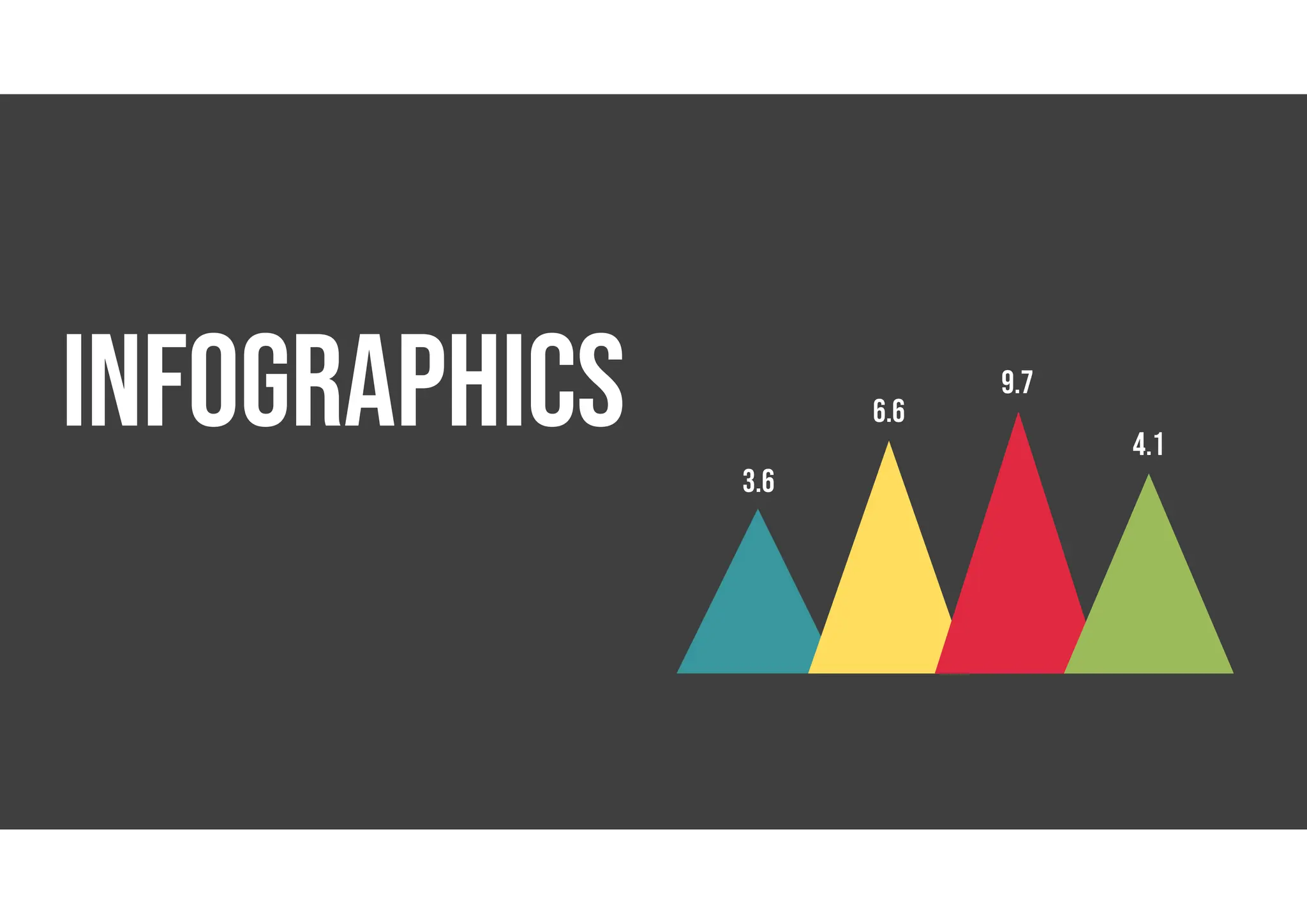
INFOGRAPHICS
05
A Branch of Computer Science that
Focuses on Developing Intelligent
Machines Capable of Performing
Tasks Requiring Human Intelligence.
Strategies to Reduce the Carbon
Footprint & Energy Consumption
Associated with AI Operations.
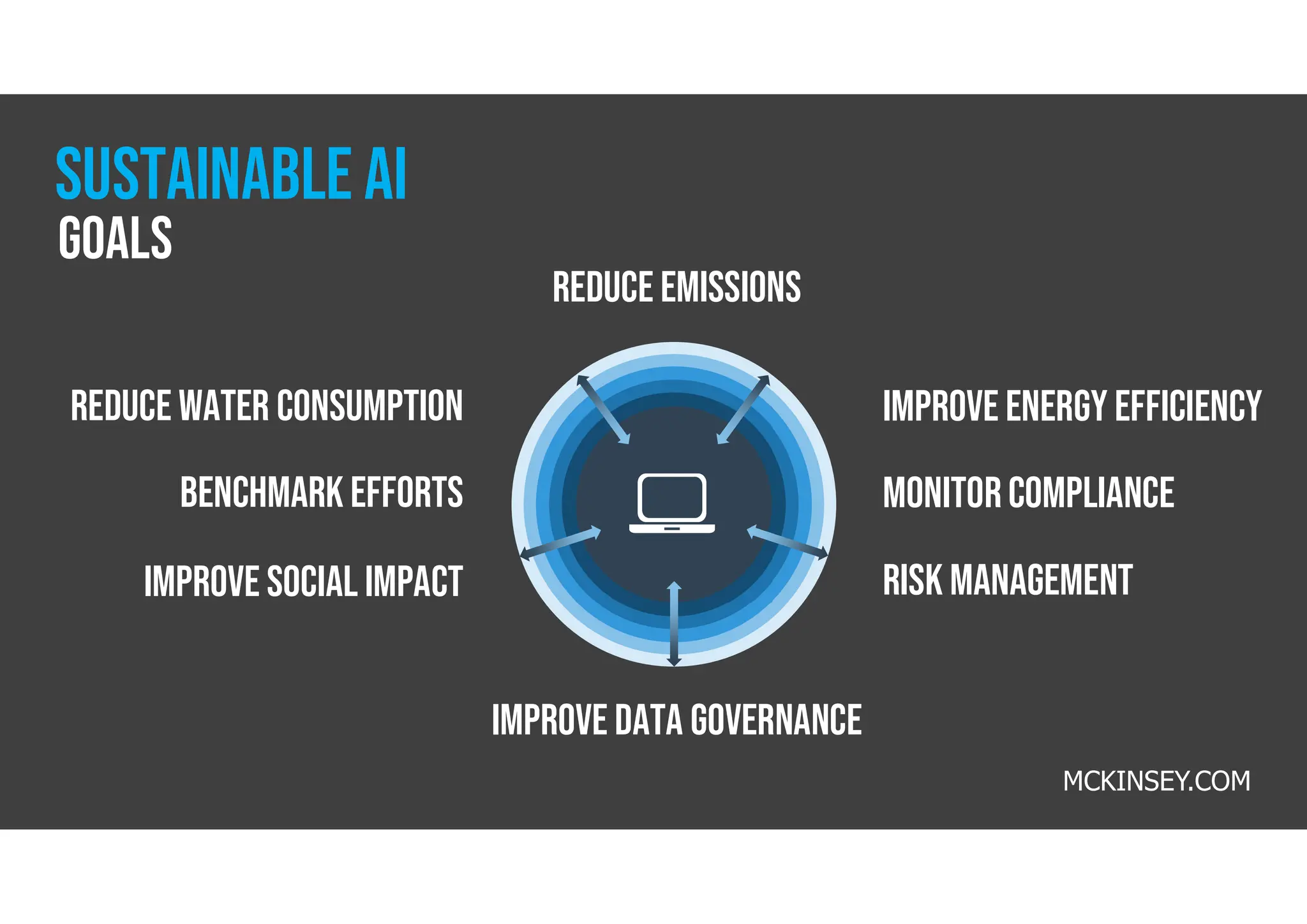
Improve energy efficiency
Monitorcompliance
reduce water consumption
Benchmark efforts
Improve social impact
Improve DATA governance
risk MANAGEMENT
Reduce emissions
MCKINSEY.COM
SUSTAINABLE ai
goals
ENERGY
EFFICIENCY
RENEWABLE
ENERGY
SMART
GRIDS
Smart
FARMING
Water
MANAGEMENT
Waste
MANAGEMENT
SDG
attainment
Biodiversity
Conservation
Climate change
mitigation
2030.BUILDERS
SUSTAINABLE ai
applications
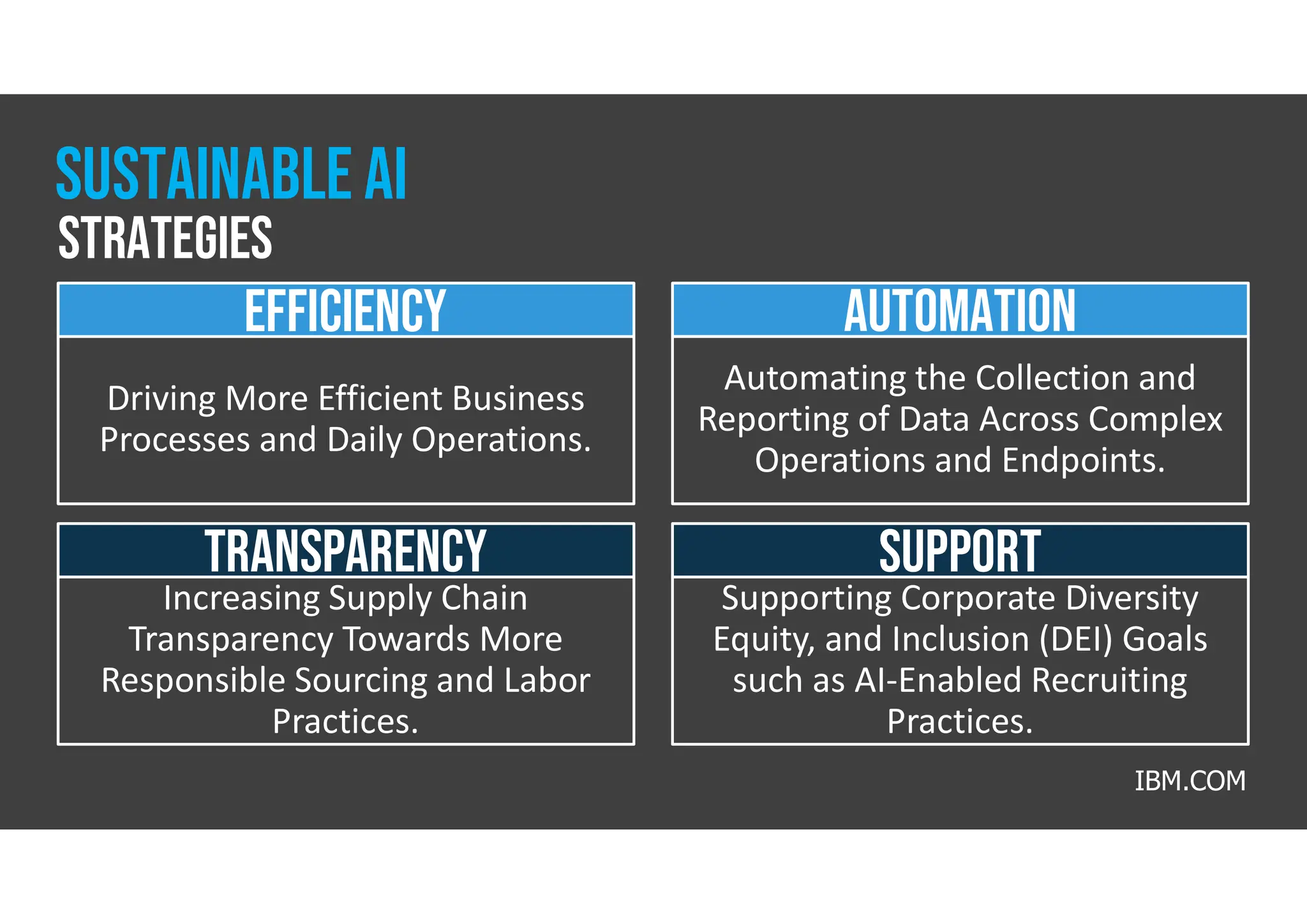
EFFICIENCY
Driving More Efficient Business
Processes and Daily Operations.
transparency
Increasing Supply Chain
Transparency Towards More
Responsible Sourcing and Labor
Practices.
AUTOMATION
Automating the Collection and
Reporting of Data Across Complex
Operations and Endpoints.
support
Supporting Corporate Diversity
Equity, and Inclusion (DEI) Goals
such as AI-Enabled Recruiting
Practices.
IBM.COM
SUSTAINABLE ai
STRATEGIES
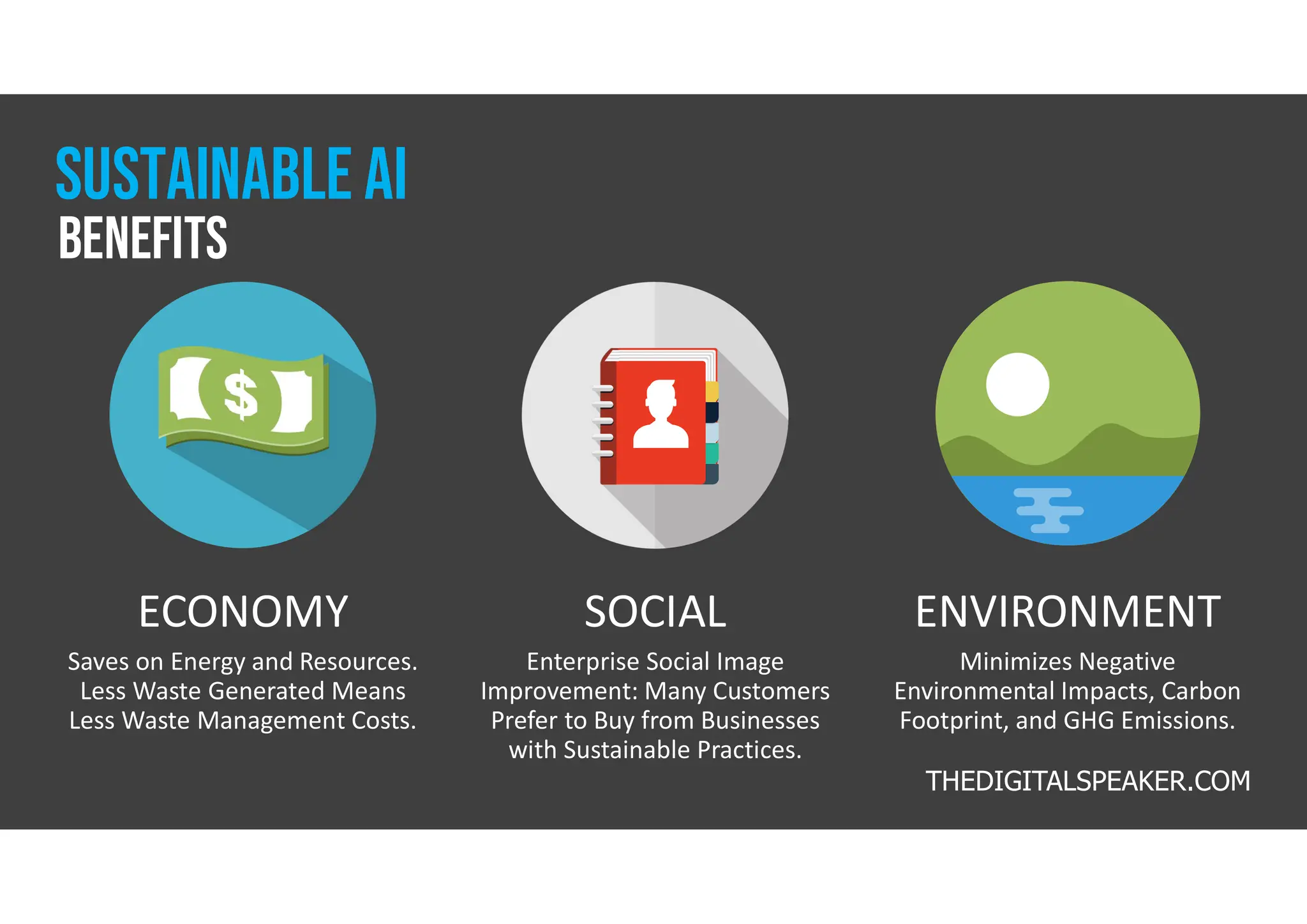
SUSTAINABLE ai
ECONOMY
Saves on Energy and Resources.
Less Waste Generated Means
Less Waste Management Costs.
SOCIAL
Enterprise Social Image
Improvement: Many Customers
Prefer to Buy from Businesses
with Sustainable Practices.
ENVIRONMENT
Minimizes Negative
Environmental Impacts, Carbon
Footprint, and GHG Emissions.
benefits
THEDIGITALSPEAKER.COM
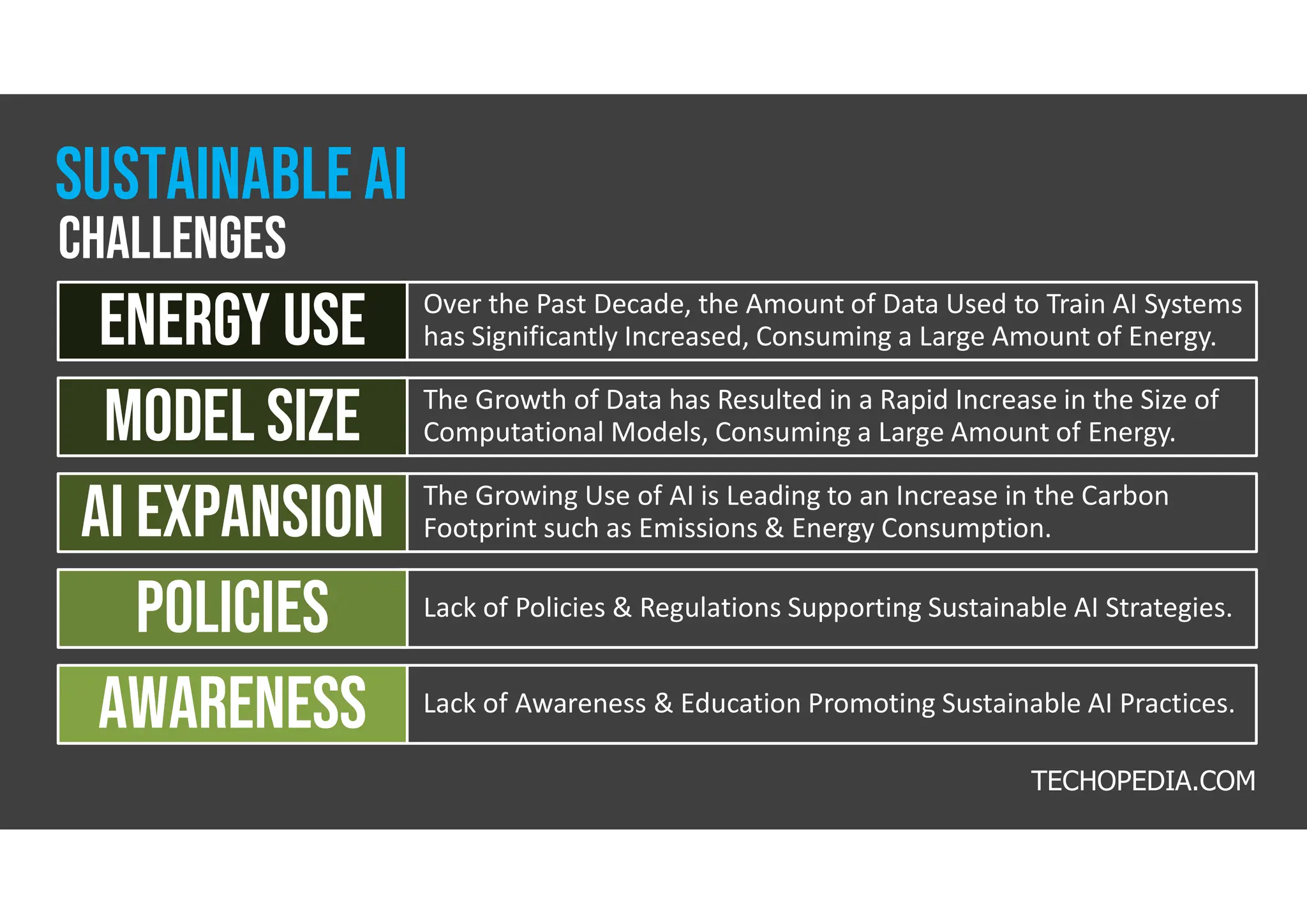
Over the Past Decade, the Amount of Data Used to Train AI Systems
has Significantly Increased, Consuming a Large Amount of Energy.
Energy use
The Growth of Data has Resulted in a Rapid Increase in the Size of
Computational Models, Consuming a Large Amount of Energy.
Model size
The Growing Use of AI is Leading to an Increase in the Carbon
Footprint such as Emissions & Energy Consumption.
Ai expansion
Lack of Policies & Regulations Supporting Sustainable AI Strategies.
policies
Lack of Awareness & Education Promoting Sustainable AI Practices.
awareness
SUSTAINABLE ai
CHALLENGES
TECHOPEDIA.COM
Prioritizing Data Quality over Quantity can Significantly Reduce
Energy Use: Using High-Quality Data & Avoiding Data Duplication.
Energy use
Using Smaller Models Eliminates the Need for Powerful Computers.
Techniques Include Model Compression & Knowledge Distillation.
Model size
Developing Energy-Efficient Hardware Specifically for AI Tasks.
Using Renewable Energy Sources Like Solar Power for Data Centers.
Ai expansion
Implementing Policies to Support Sustainable AI Operations as well
as Research & Development. Rewarding Energy-Efficient AI Systems.
policies
Launching Programs to Teach AI Professionals about Energy-Saving
Practices. Raising Awareness of Individuals and Organizations.
awareness
SUSTAINABLE ai
solutions
TECHOPEDIA.COM
In 2021, Under UNESCO's Auspices
the International Research Center
on Artificial Intelligence (IRCAI) was
Established to Advance Research on
the Use of Artificial Intelligence to
Achieve the SDGs by Showcasing
Relevant Projects Worldwide.
IRCAI.ORG
UNESCO Center in AI
AI for Sustainability
This is a placeholder text. This text
can be replaced with your own text.
This text can be replaced with your
own text. This is a placeholder text.
This text can be replaced with your
own text. This text can be replaced
with your own text.
9.7
6.6
4.1
3.6
tons – CO2 Equivalent
AI CAR HUMAN LIFE
AIINDEX.STANFORD.EDU
ANNUAL AI EMISSIONScomparison IN 2023
502
352
76
25
GPT-3
GROPHER
OPT
BLOOM
EMISSIONS FROM AI based LLMs IN 2023
tons – CO2 Equivalent
ARXIV.ORG
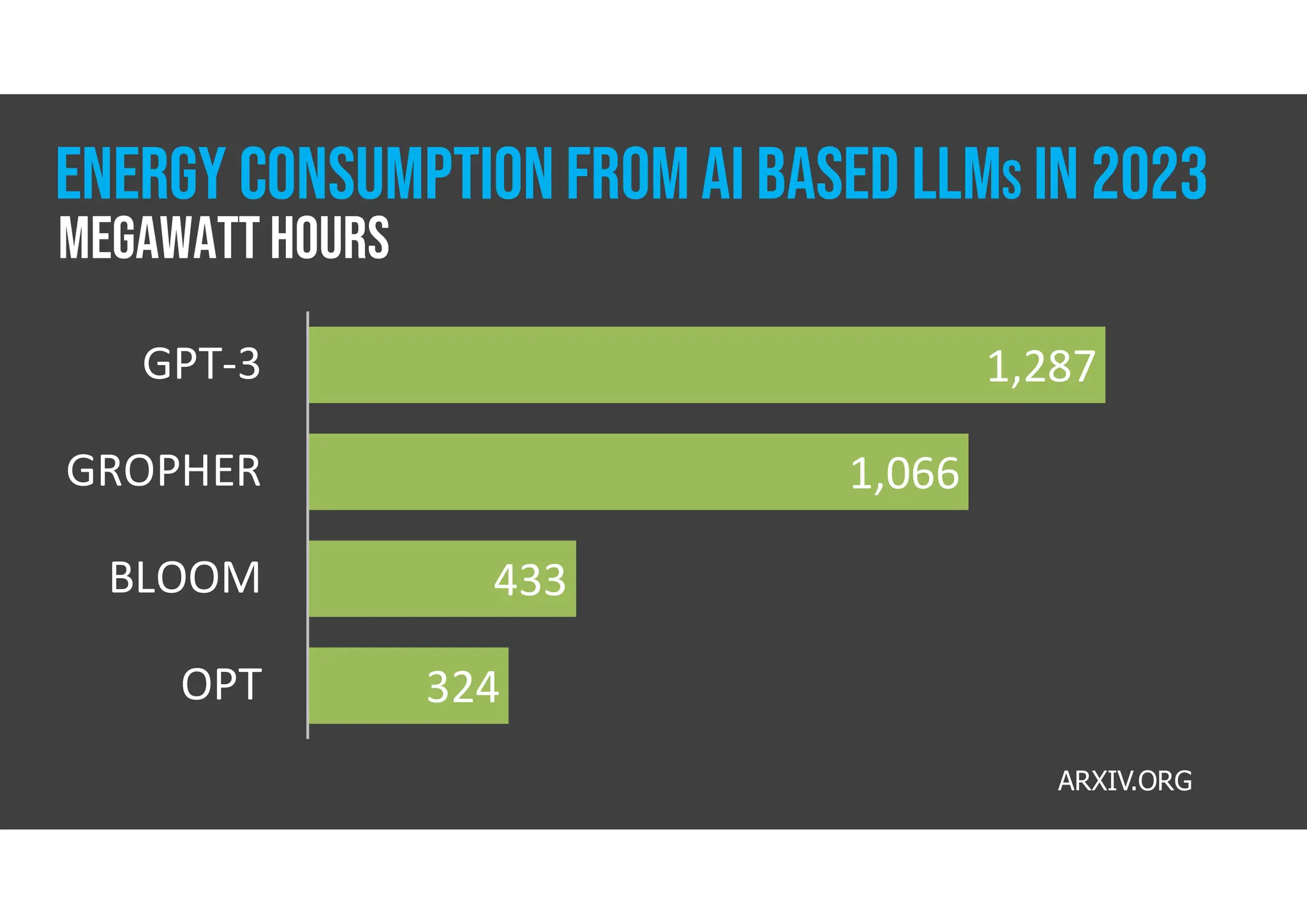
1,287
1,066
433
324
GPT-3
GROPHER
BLOOM
OPT
ENERGY CONSUMPTION FROM AI based LLMS IN 2023
megawatt hours
ARXIV.ORG
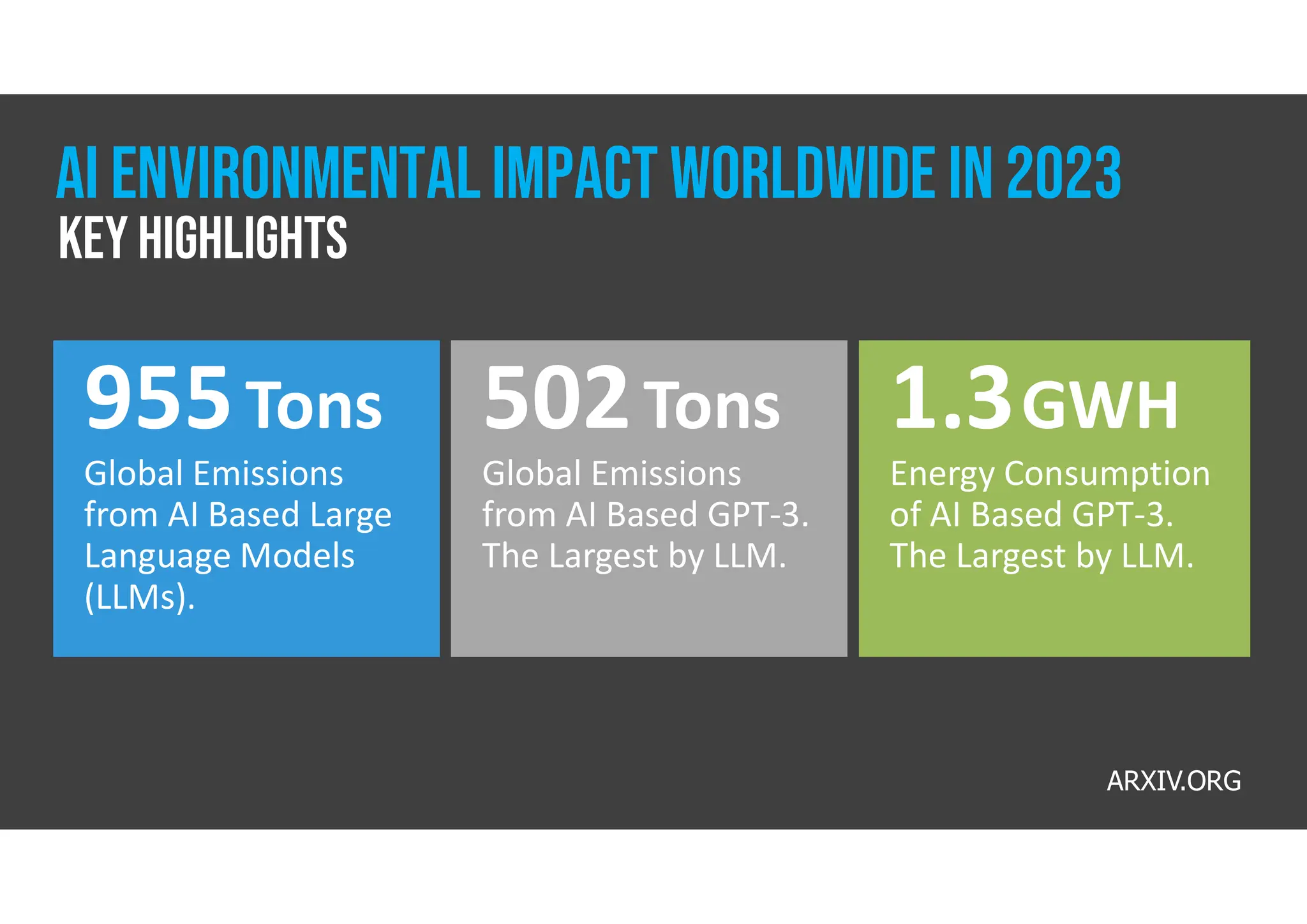
Ai environmentalimpact worldwide in 2023
502Tons
Global Emissions
from AI Based GPT-3.
The Largest by LLM.
1.3GWH
Energy Consumption
of AI Based GPT-3.
The Largest by LLM.
955Tons
Global Emissions
from AI Based Large
Language Models
(LLMs).
Key highlights
ARXIV.ORG
53
47
46
36
31
Developing
Markets
Asia-Pacific
Greater China
Europe
North America
companies takingsteps to reduce AI emissions
percent (2022)
MCKINSEY.COM
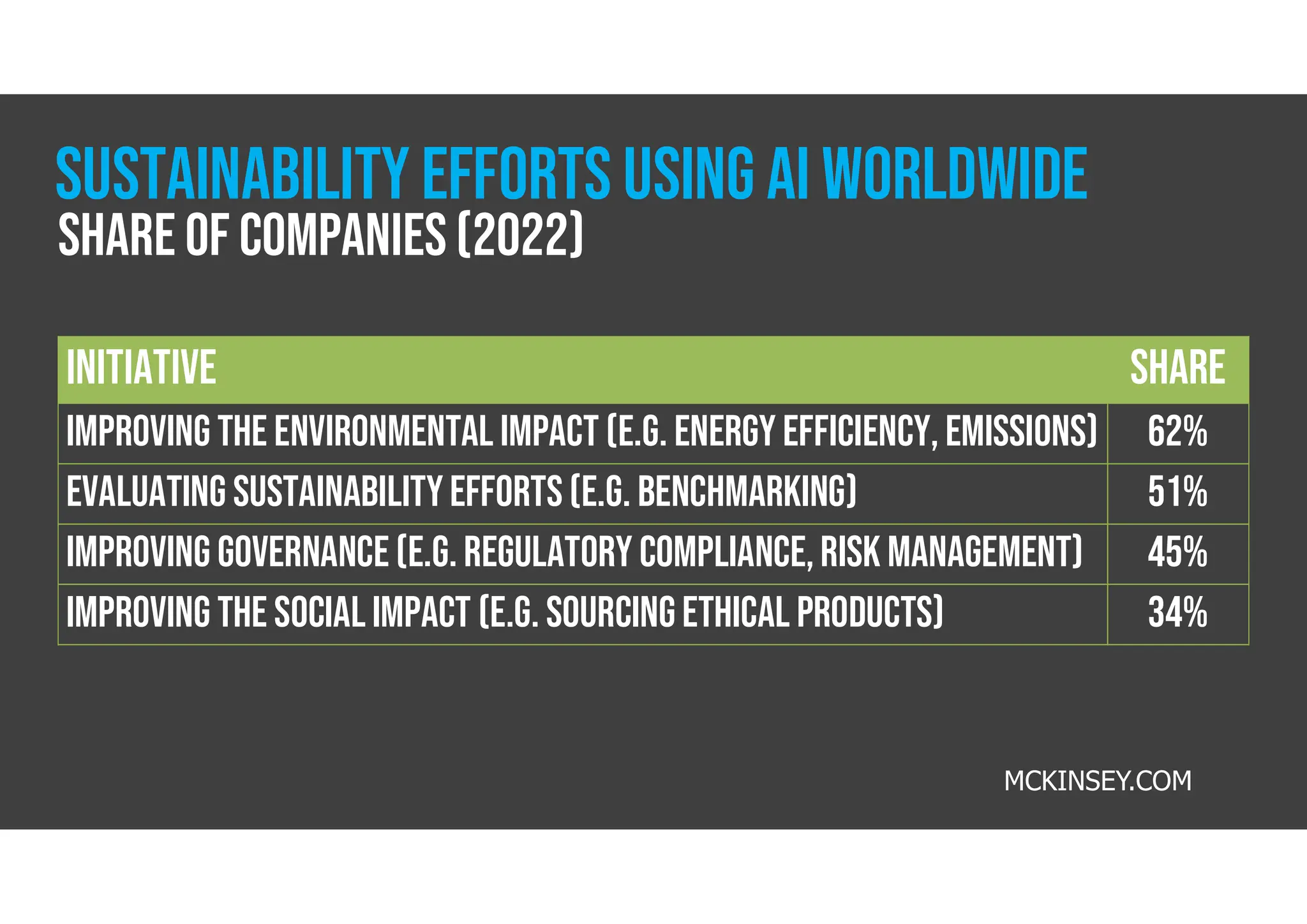
Share
initiative
62%
Improving the environmental impact (e.g. energy efficiency, emissions)
51%
Evaluating sustainabilityefforts(e.g. benchmarking)
45%
Improving governance(e.g. regulatory compliance,risk management)
34%
Improving the socialimpact (e.g. sourcingethical products)
Sustainability efforts using ai worldwide
Share of companies(2022)
MCKINSEY.COM
61
54
44
39
30
Greater China
Asia-Pacific
Developing
Markets
Europe
North America
MCKINSEY.COM
Sustainability efforts using ai worldwide
Share of companies(2022)
62%
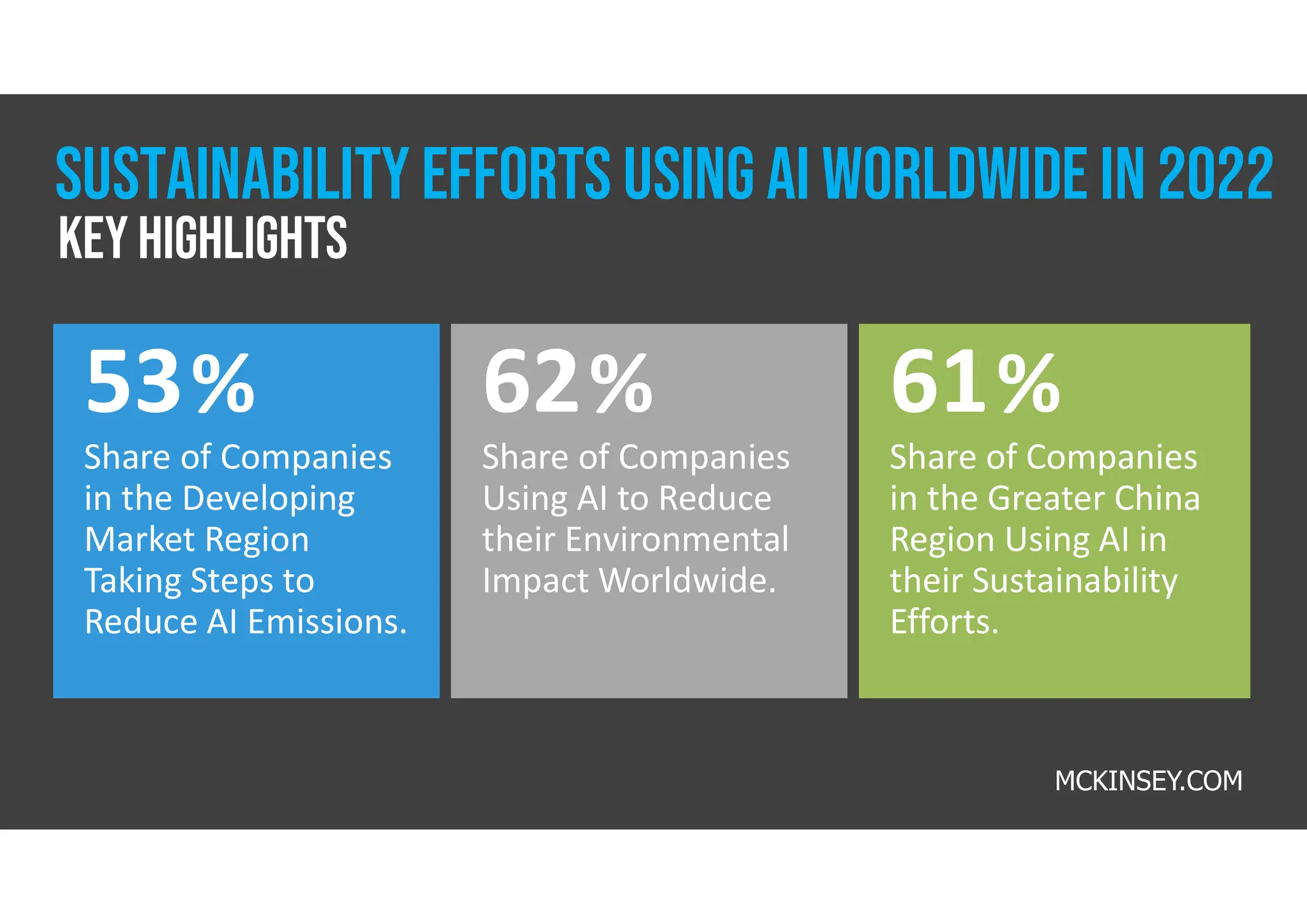
Share of Companies
Using AI to Reduce
their Environmental
Impact Worldwide.
61%
Share of Companies
in the Greater China
Region Using AI in
their Sustainability
Efforts.
53%
Share of Companies
in the Developing
Market Region
Taking Steps to
Reduce AI Emissions.
Key highlights
MCKINSEY.COM
Sustainability efforts using ai worldwide in 2022
S2ADesign.com

Green AI

  • 1.
  • 2.
  • 3.
  • 4.
    A Branch ofComputer Science that Focuses on Developing Intelligent Machines Capable of Performing Tasks Requiring Human Intelligence.
  • 5.
    Strategies to Reducethe Carbon Footprint & Energy Consumption Associated with AI Operations.
  • 6.
    Improve energy efficiency Monitorcompliance reducewater consumption Benchmark efforts Improve social impact Improve DATA governance risk MANAGEMENT Reduce emissions MCKINSEY.COM SUSTAINABLE ai goals
  • 7.
  • 8.
    EFFICIENCY Driving More EfficientBusiness Processes and Daily Operations. transparency Increasing Supply Chain Transparency Towards More Responsible Sourcing and Labor Practices. AUTOMATION Automating the Collection and Reporting of Data Across Complex Operations and Endpoints. support Supporting Corporate Diversity Equity, and Inclusion (DEI) Goals such as AI-Enabled Recruiting Practices. IBM.COM SUSTAINABLE ai STRATEGIES
  • 9.
    SUSTAINABLE ai ECONOMY Saves onEnergy and Resources. Less Waste Generated Means Less Waste Management Costs. SOCIAL Enterprise Social Image Improvement: Many Customers Prefer to Buy from Businesses with Sustainable Practices. ENVIRONMENT Minimizes Negative Environmental Impacts, Carbon Footprint, and GHG Emissions. benefits THEDIGITALSPEAKER.COM
  • 10.
    Over the PastDecade, the Amount of Data Used to Train AI Systems has Significantly Increased, Consuming a Large Amount of Energy. Energy use The Growth of Data has Resulted in a Rapid Increase in the Size of Computational Models, Consuming a Large Amount of Energy. Model size The Growing Use of AI is Leading to an Increase in the Carbon Footprint such as Emissions & Energy Consumption. Ai expansion Lack of Policies & Regulations Supporting Sustainable AI Strategies. policies Lack of Awareness & Education Promoting Sustainable AI Practices. awareness SUSTAINABLE ai CHALLENGES TECHOPEDIA.COM
  • 11.
    Prioritizing Data Qualityover Quantity can Significantly Reduce Energy Use: Using High-Quality Data & Avoiding Data Duplication. Energy use Using Smaller Models Eliminates the Need for Powerful Computers. Techniques Include Model Compression & Knowledge Distillation. Model size Developing Energy-Efficient Hardware Specifically for AI Tasks. Using Renewable Energy Sources Like Solar Power for Data Centers. Ai expansion Implementing Policies to Support Sustainable AI Operations as well as Research & Development. Rewarding Energy-Efficient AI Systems. policies Launching Programs to Teach AI Professionals about Energy-Saving Practices. Raising Awareness of Individuals and Organizations. awareness SUSTAINABLE ai solutions TECHOPEDIA.COM
  • 13.
    In 2021, UnderUNESCO's Auspices the International Research Center on Artificial Intelligence (IRCAI) was Established to Advance Research on the Use of Artificial Intelligence to Achieve the SDGs by Showcasing Relevant Projects Worldwide. IRCAI.ORG UNESCO Center in AI AI for Sustainability
  • 14.
    This is aplaceholder text. This text can be replaced with your own text. This text can be replaced with your own text. This is a placeholder text. This text can be replaced with your own text. This text can be replaced with your own text. 9.7 6.6 4.1 3.6
  • 16.
    tons – CO2Equivalent AI CAR HUMAN LIFE AIINDEX.STANFORD.EDU ANNUAL AI EMISSIONScomparison IN 2023
  • 17.
    502 352 76 25 GPT-3 GROPHER OPT BLOOM EMISSIONS FROM AIbased LLMs IN 2023 tons – CO2 Equivalent ARXIV.ORG
  • 18.
    1,287 1,066 433 324 GPT-3 GROPHER BLOOM OPT ENERGY CONSUMPTION FROMAI based LLMS IN 2023 megawatt hours ARXIV.ORG
  • 19.
    Ai environmentalimpact worldwidein 2023 502Tons Global Emissions from AI Based GPT-3. The Largest by LLM. 1.3GWH Energy Consumption of AI Based GPT-3. The Largest by LLM. 955Tons Global Emissions from AI Based Large Language Models (LLMs). Key highlights ARXIV.ORG
  • 21.
    53 47 46 36 31 Developing Markets Asia-Pacific Greater China Europe North America companiestakingsteps to reduce AI emissions percent (2022) MCKINSEY.COM
  • 22.
    Share initiative 62% Improving the environmentalimpact (e.g. energy efficiency, emissions) 51% Evaluating sustainabilityefforts(e.g. benchmarking) 45% Improving governance(e.g. regulatory compliance,risk management) 34% Improving the socialimpact (e.g. sourcingethical products) Sustainability efforts using ai worldwide Share of companies(2022) MCKINSEY.COM
  • 23.
  • 24.
    62% Share of Companies UsingAI to Reduce their Environmental Impact Worldwide. 61% Share of Companies in the Greater China Region Using AI in their Sustainability Efforts. 53% Share of Companies in the Developing Market Region Taking Steps to Reduce AI Emissions. Key highlights MCKINSEY.COM Sustainability efforts using ai worldwide in 2022
  • 25.