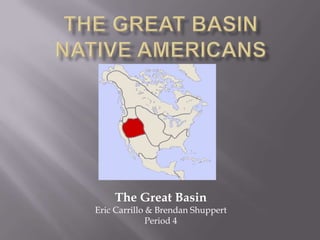
The Great Basin
Eric Carrillo & Brendan Shuppert
              Period 4
   Bannock Tribe
   Chemehuevi tribe
   Kawaiisu Tribe
   Mono Tribe
   Paiute Tribe
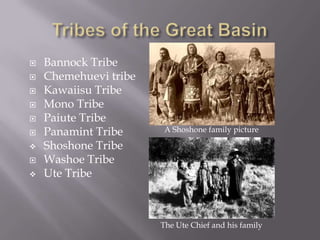
   Panamint Tribe      A Shoshone family picture

   Shoshone Tribe
   Washoe Tribe
   Ute Tribe


                       The Ute Chief and his family
The people of the Great Basin ate:   The tribes of the Great Basin didn’t often
• Buffalo                            farm because of the soil, so they relied on
• Elk                                hunting and finding food rather then
• Deer                               making it. They sometimes ate bugs and
• Crickets                           insects because of there lack of food.
• Grasshoppers
• Pinenuts
• Berries and seeds
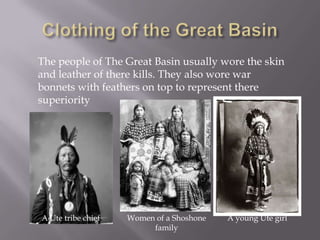
The people of The Great Basin usually wore the skin
and leather of there kills. They also wore war
bonnets with feathers on top to represent there
superiority


A Ute tribe chief   Women of a Shoshone   A young Ute girl
                         family
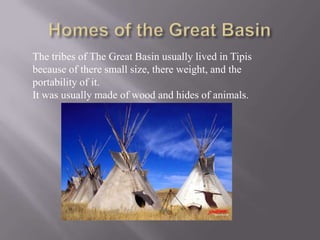
The tribes of The Great Basin usually lived in Tipis
because of there small size, there weight, and the
portability of it.
It was usually made of wood and hides of animals.
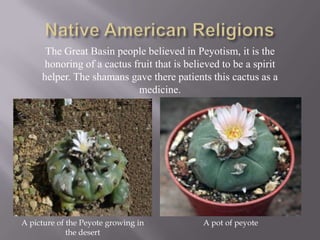
The Great Basin people believed in Peyotism, it is the
     honoring of a cactus fruit that is believed to be a spirit
     helper. The shamans gave there patients this cactus as a
                           medicine.


A picture of the Peyote growing in          A pot of peyote
             the desert
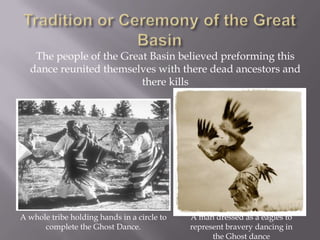
The people of the Great Basin believed preforming this
  dance reunited themselves with there dead ancestors and
                         there kills


A whole tribe holding hands in a circle to   A man dressed as a eagles to
      complete the Ghost Dance.              represent bravery dancing in
                                                   the Ghost dance
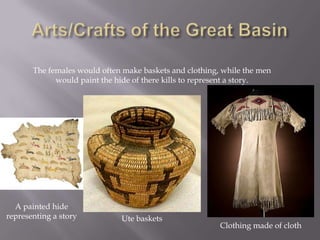
The females would often make baskets and clothing, while the men
             would paint the hide of there kills to represent a story.


  A painted hide
representing a story          Ute baskets
                                                         Clothing made of cloth
Sacajawea was a very famous Shashon
Indian. She served as a guide for Lewis and
Clark to help discover America. She had
only brung her baby on her famous journey


        A sculpture of Sacajawea
            made of bronze
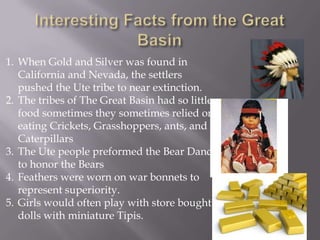
1. When Gold and Silver was found in
   California and Nevada, the settlers
   pushed the Ute tribe to near extinction.
2. The tribes of The Great Basin had so little
   food sometimes they sometimes relied on
   eating Crickets, Grasshoppers, ants, and
   Caterpillars
3. The Ute people preformed the Bear Dance
   to honor the Bears
4. Feathers were worn on war bonnets to
   represent superiority.
5. Girls would often play with store bought
   dolls with miniature Tipis.
   Griffin, Pierce. The Encyclopidia of Native
    Americans. Ney York: Penguin Group, 1995.
    Print.
   Charlotte, Greig. Native Americans. Bromall:
    Mason Crest Publishers Inc., 2002. Print.
   Mohal, . A Early American. St.Louis: Milliken,
    2003. Print.
   Http://www.legendsofamerica.com/bannock.
    html

Great Basin Native Americans

  • 1.
    The Great Basin EricCarrillo & Brendan Shuppert Period 4
  • 2.
    Bannock Tribe  Chemehuevi tribe  Kawaiisu Tribe  Mono Tribe  Paiute Tribe  Panamint Tribe A Shoshone family picture  Shoshone Tribe  Washoe Tribe  Ute Tribe The Ute Chief and his family
  • 3.
    The people ofthe Great Basin ate: The tribes of the Great Basin didn’t often • Buffalo farm because of the soil, so they relied on • Elk hunting and finding food rather then • Deer making it. They sometimes ate bugs and • Crickets insects because of there lack of food. • Grasshoppers • Pinenuts • Berries and seeds
  • 4.
    The people ofThe Great Basin usually wore the skin and leather of there kills. They also wore war bonnets with feathers on top to represent there superiority A Ute tribe chief Women of a Shoshone A young Ute girl family
  • 5.
    The tribes ofThe Great Basin usually lived in Tipis because of there small size, there weight, and the portability of it. It was usually made of wood and hides of animals.
  • 6.
    The Great Basinpeople believed in Peyotism, it is the honoring of a cactus fruit that is believed to be a spirit helper. The shamans gave there patients this cactus as a medicine. A picture of the Peyote growing in A pot of peyote the desert
  • 7.
    The people ofthe Great Basin believed preforming this dance reunited themselves with there dead ancestors and there kills A whole tribe holding hands in a circle to A man dressed as a eagles to complete the Ghost Dance. represent bravery dancing in the Ghost dance
  • 8.
    The females wouldoften make baskets and clothing, while the men would paint the hide of there kills to represent a story. A painted hide representing a story Ute baskets Clothing made of cloth
  • 9.
    Sacajawea was avery famous Shashon Indian. She served as a guide for Lewis and Clark to help discover America. She had only brung her baby on her famous journey A sculpture of Sacajawea made of bronze
  • 10.
    1. When Goldand Silver was found in California and Nevada, the settlers pushed the Ute tribe to near extinction. 2. The tribes of The Great Basin had so little food sometimes they sometimes relied on eating Crickets, Grasshoppers, ants, and Caterpillars 3. The Ute people preformed the Bear Dance to honor the Bears 4. Feathers were worn on war bonnets to represent superiority. 5. Girls would often play with store bought dolls with miniature Tipis.
  • 11.
    Griffin, Pierce. The Encyclopidia of Native Americans. Ney York: Penguin Group, 1995. Print.  Charlotte, Greig. Native Americans. Bromall: Mason Crest Publishers Inc., 2002. Print.  Mohal, . A Early American. St.Louis: Milliken, 2003. Print.  Http://www.legendsofamerica.com/bannock. html