using Java
2015
Data Structure
Prepared by: Mahmoud Rafeek Al-farra
in Java
10. Graphs
mfarra.cst.ps www.fb.com/MahmoudRFarra
Contents
Representing Graphs
Basic Graph Terminologies
Introduction
Modeling Graphs (Implementation)
Introduction
mfarra.cst.ps www.fb.com/MahmoudRFarra
 A graph is a nonlinear data structure with many
important applications.
 Many real-world problems can be solved using graph
algorithms.
 For example:
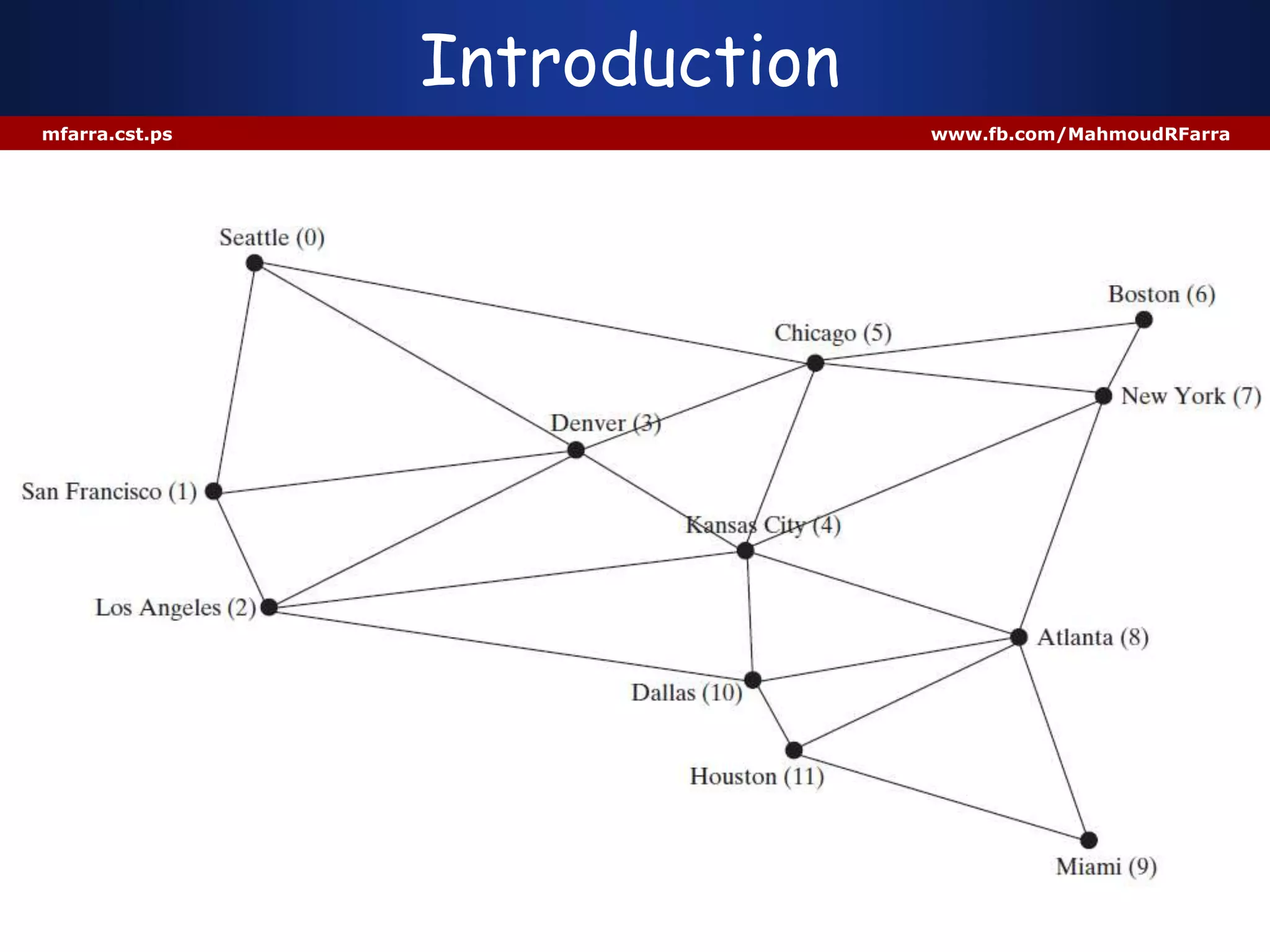
 The problem to find the least number of flights
between two cities can be modeled using a graph,
where the vertices represent cities and the edges
represent the flights between two adjacent
cities.
Introduction
mfarra.cst.ps www.fb.com/MahmoudRFarra
Introduction
mfarra.cst.ps www.fb.com/MahmoudRFarra
 The study of graph problems is known as graph
theory.
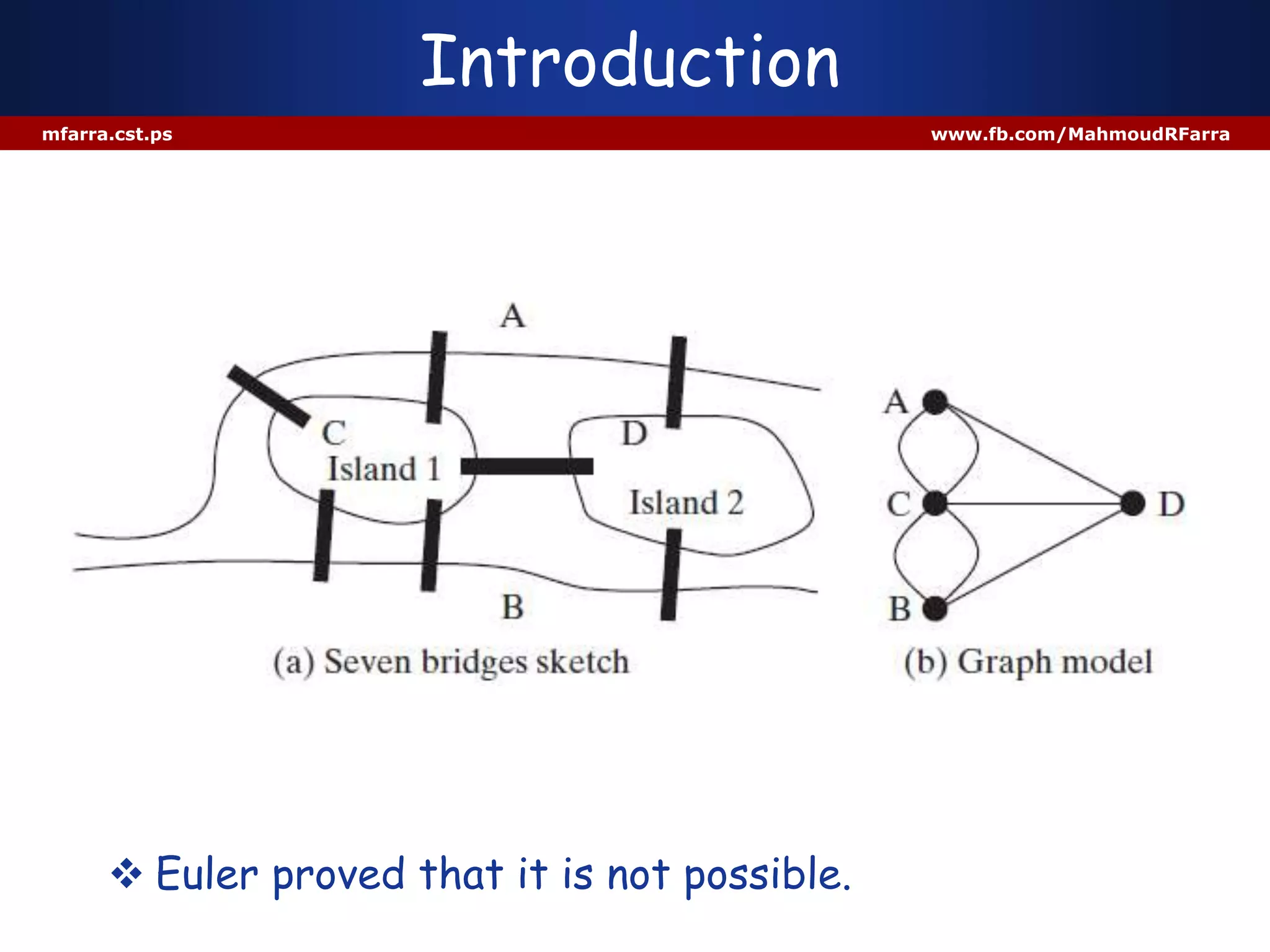
 There were two islands on the river. The city and
islands were connected by seven bridges.
 The question is, can one take a walk, cross each
bridge exactly once, and return to the starting
point?
 Euler proved that it is not possible.
Introduction
mfarra.cst.ps www.fb.com/MahmoudRFarra
 Euler proved that it is not possible.
Basic Graph Terminologies
mfarra.cst.ps www.fb.com/MahmoudRFarra
 A graph is a mathematical structure that represents
relationships among entities in the real world.
 A graph consists of a nonempty set of vertices (also
known as nodes or points), and a set of edges that
connect the vertices.
 For convenience:
 We define a graph as G = (V, E). Where
 V represents a set of vertices
 E represents a set of edges.
Basic Graph Terminologies
mfarra.cst.ps www.fb.com/MahmoudRFarra
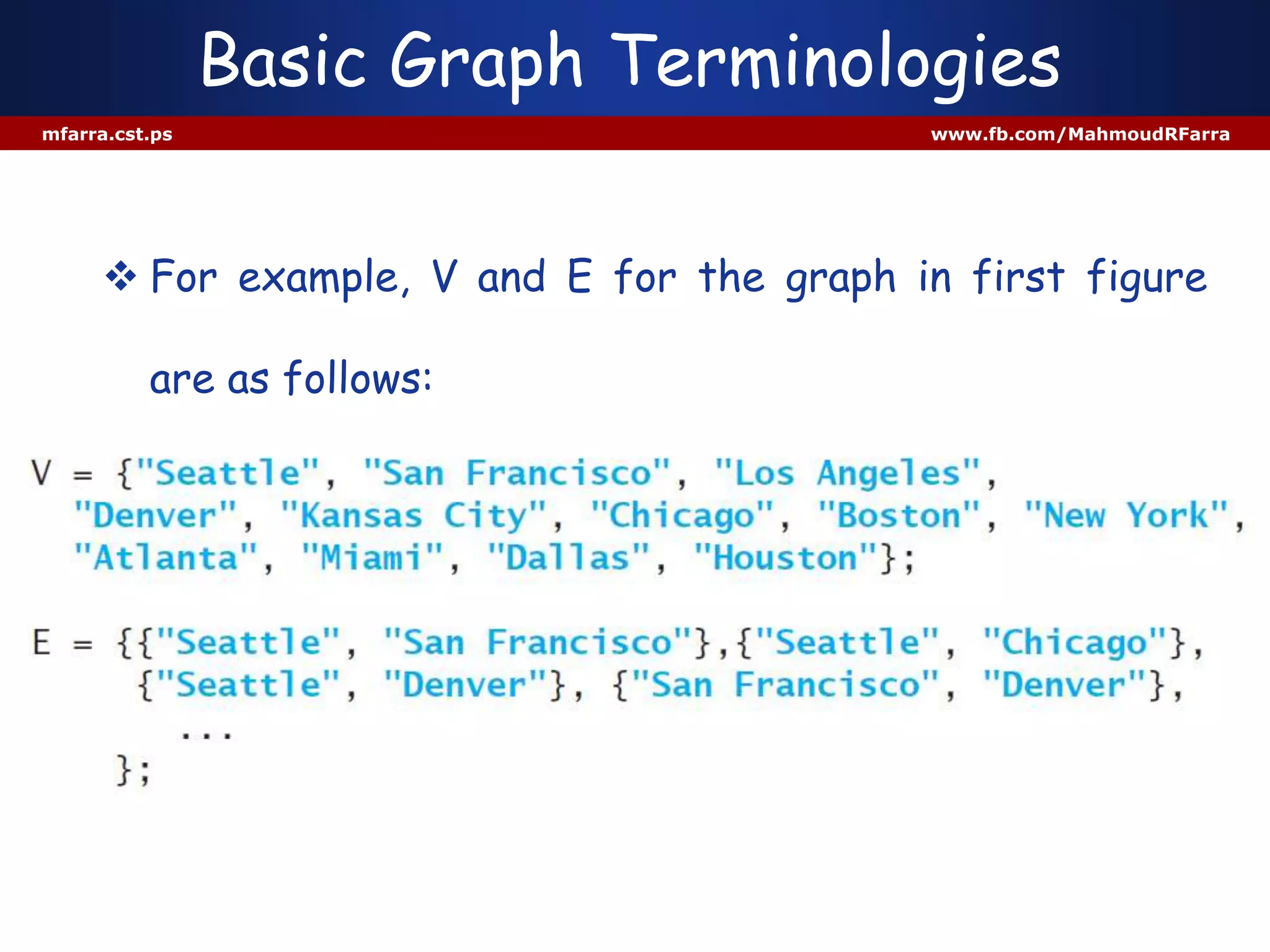
 For example, V and E for the graph in first figure
are as follows:
Basic Graph Terminologies
mfarra.cst.ps www.fb.com/MahmoudRFarra
 A graph may be directed or undirected.
 In a directed graph, each edge has a direction, which
indicates that you can move from one vertex to the
other through the edge.
 You can model parent/child relationships using a
directed graph, where an edge from vertex A to B
indicates that A is a parent of B.
Basic Graph Terminologies
mfarra.cst.ps www.fb.com/MahmoudRFarra
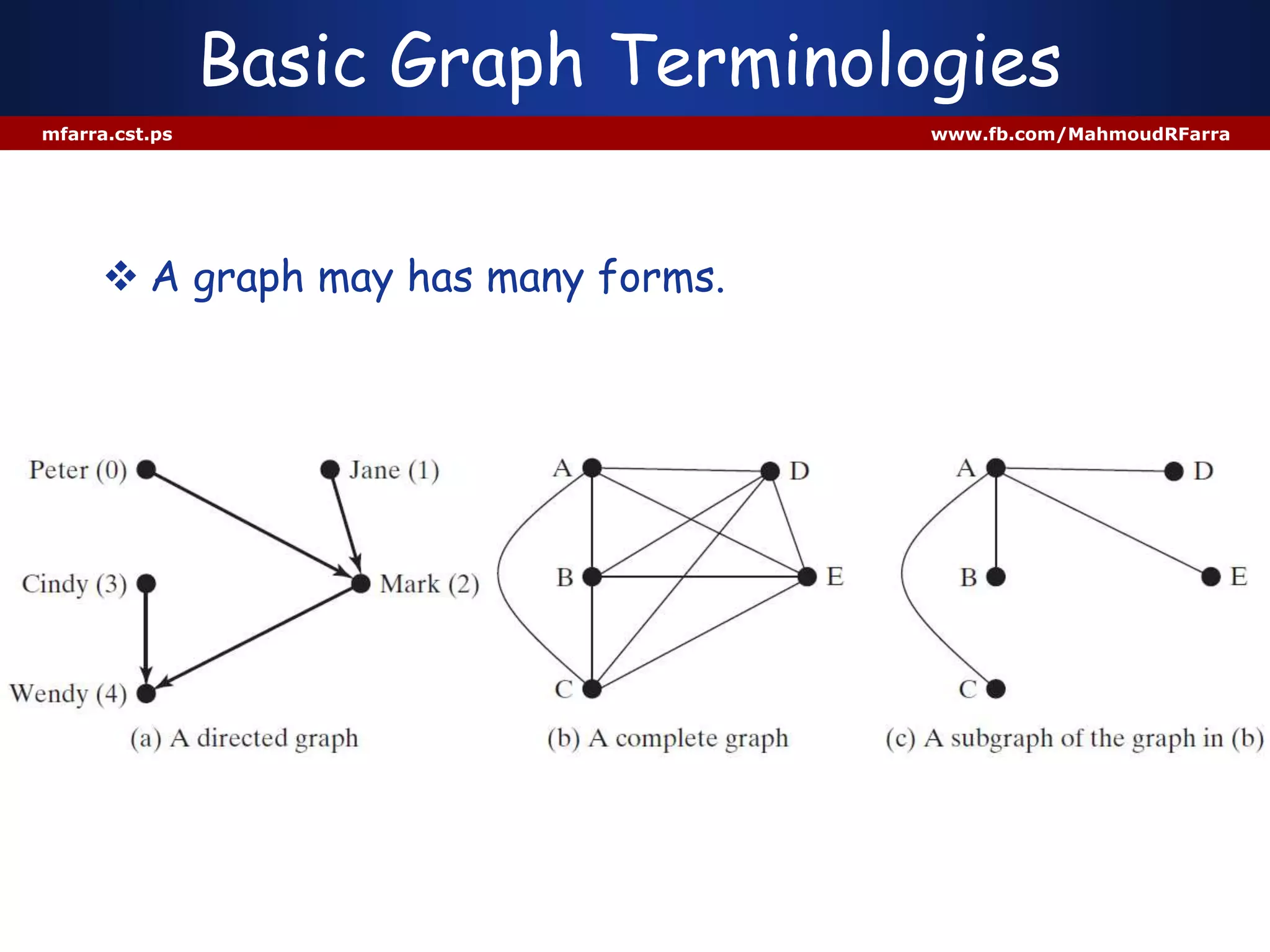
 A graph may has many forms.
Basic Graph Terminologies
mfarra.cst.ps www.fb.com/MahmoudRFarra
Before we introduce graph algorithms and applications, it is helpful to
get acquainted with graphs using the interactive tool at
www.cs.armstrong.edu/liang/animation/GraphLearningTool.html
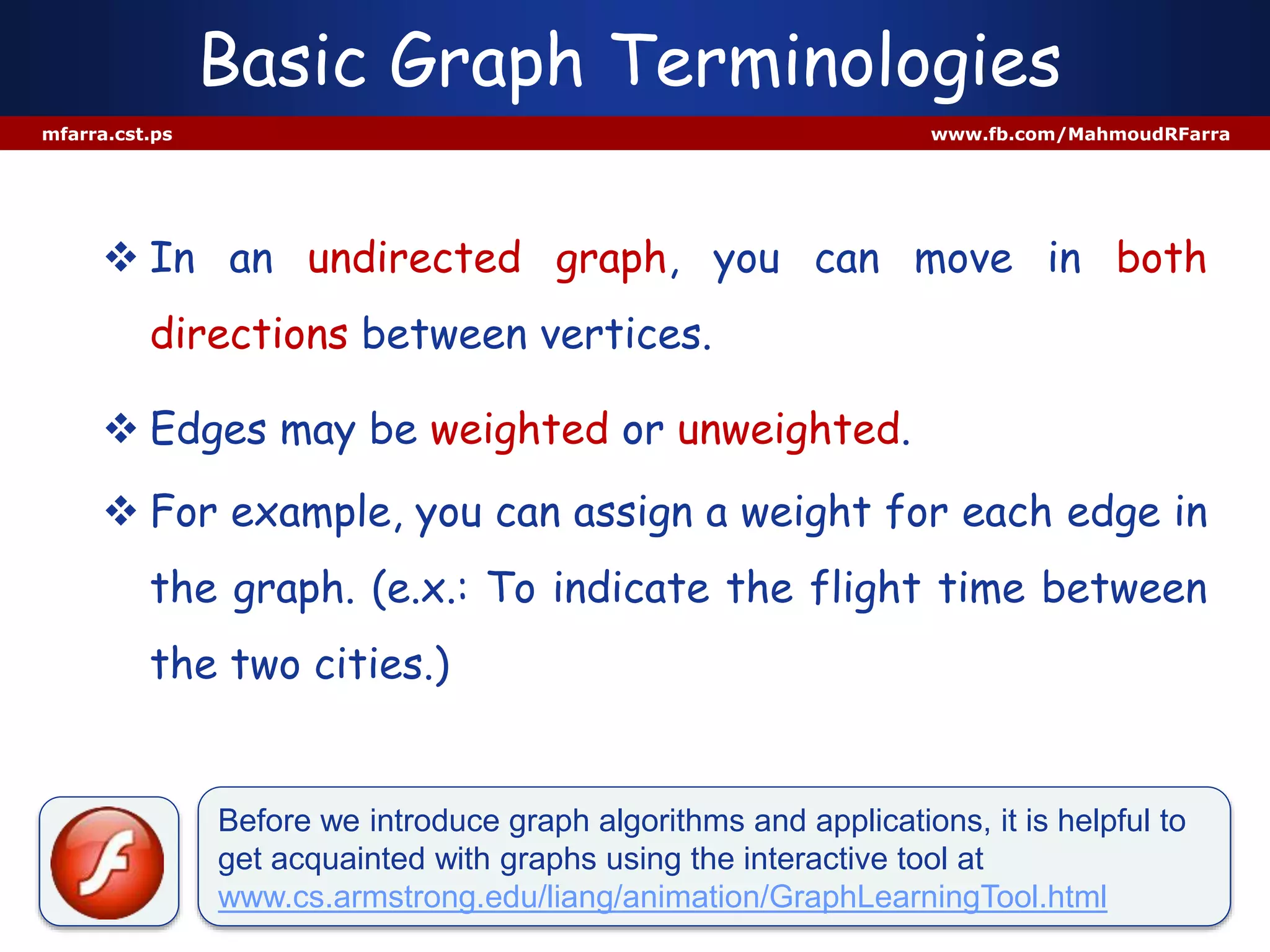
 In an undirected graph, you can move in both
directions between vertices.
 Edges may be weighted or unweighted.
 For example, you can assign a weight for each edge in
the graph. (e.x.: To indicate the flight time between
the two cities.)
Basic Graph Terminologies
mfarra.cst.ps www.fb.com/MahmoudRFarra
 Two vertices in a graph are said to be adjacent:
 if they are connected by the same edge.
 (Edges) if they are connected to the same vertex.
 An edge in a graph that joins two vertices is said to
be incident to both vertices.
 The degree of a vertex is the number of edges
incident to it.
Basic Graph Terminologies
mfarra.cst.ps www.fb.com/MahmoudRFarra
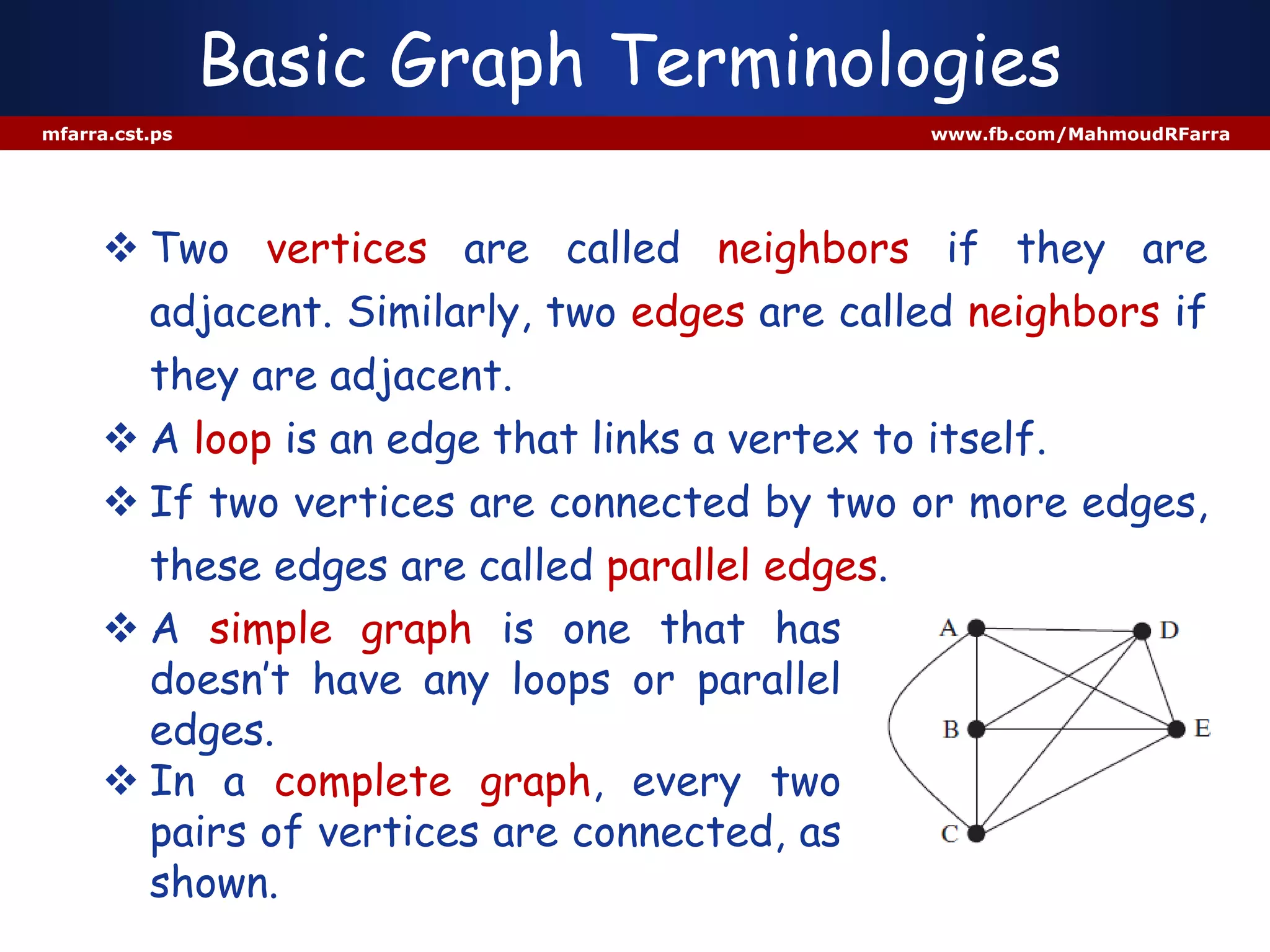
 Two vertices are called neighbors if they are
adjacent. Similarly, two edges are called neighbors if
they are adjacent.
 A loop is an edge that links a vertex to itself.
 If two vertices are connected by two or more edges,
these edges are called parallel edges.
 A simple graph is one that has
doesn’t have any loops or parallel
edges.
 In a complete graph, every two
pairs of vertices are connected, as
shown.
Basic Graph Terminologies
mfarra.cst.ps www.fb.com/MahmoudRFarra
 A graph is connected if there exists a path between
any two vertices in the graph.
 A subgraph of a graph G is a graph whose vertex set
is a subset of that of G and whose edge set is a
subset of that of G.
Representing Graphs
mfarra.cst.ps www.fb.com/MahmoudRFarra
 Representing a graph is to store its vertices and
edges in a program.
 The data structure for storing a graph is arrays or
lists.
Representing Graphs
mfarra.cst.ps www.fb.com/MahmoudRFarra
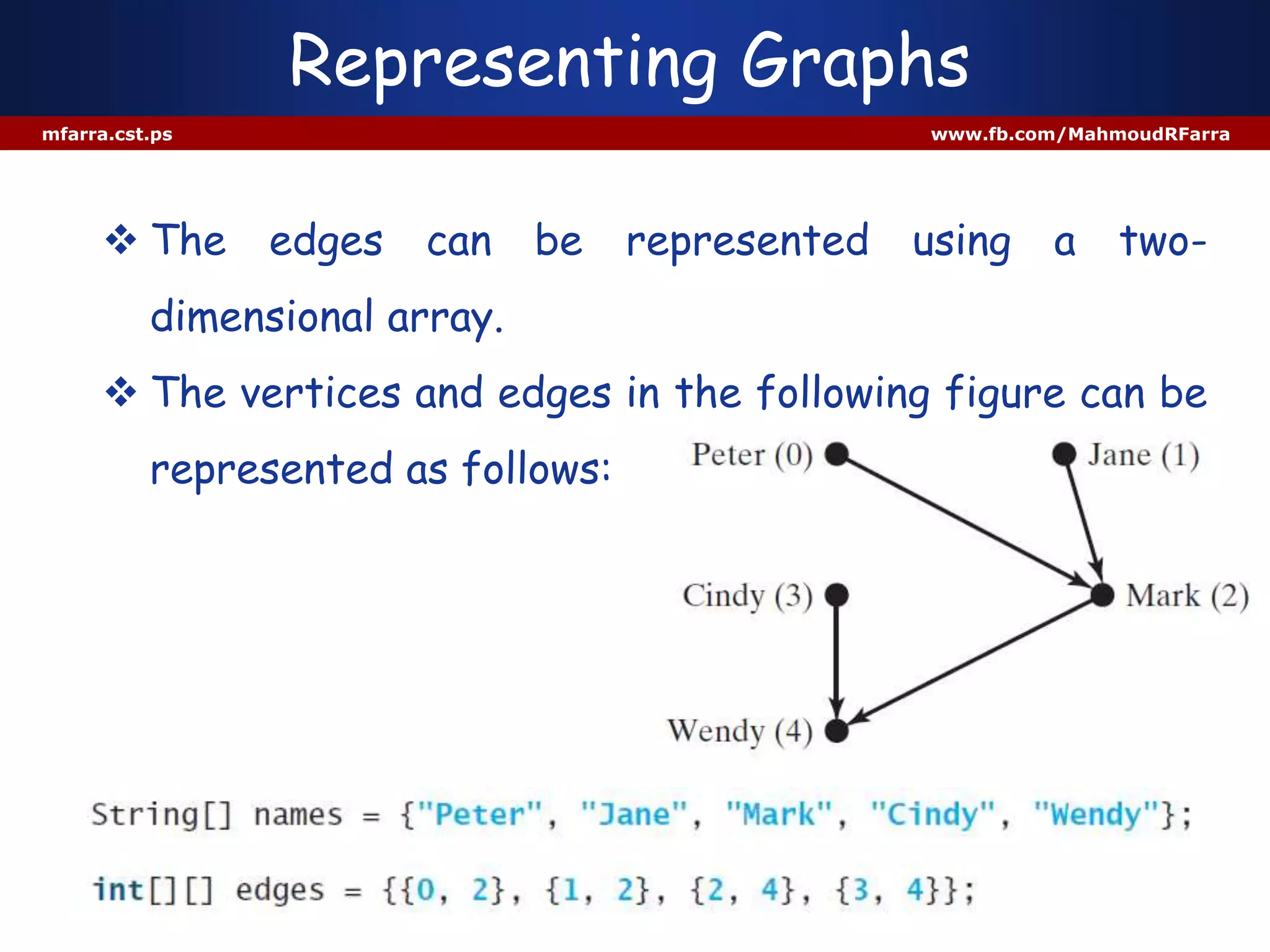
 The edges can be represented using a two-
dimensional array.
 The vertices and edges in the following figure can be
represented as follows:
Modeling Graphs (Implementation)
mfarra.cst.ps www.fb.com/MahmoudRFarra
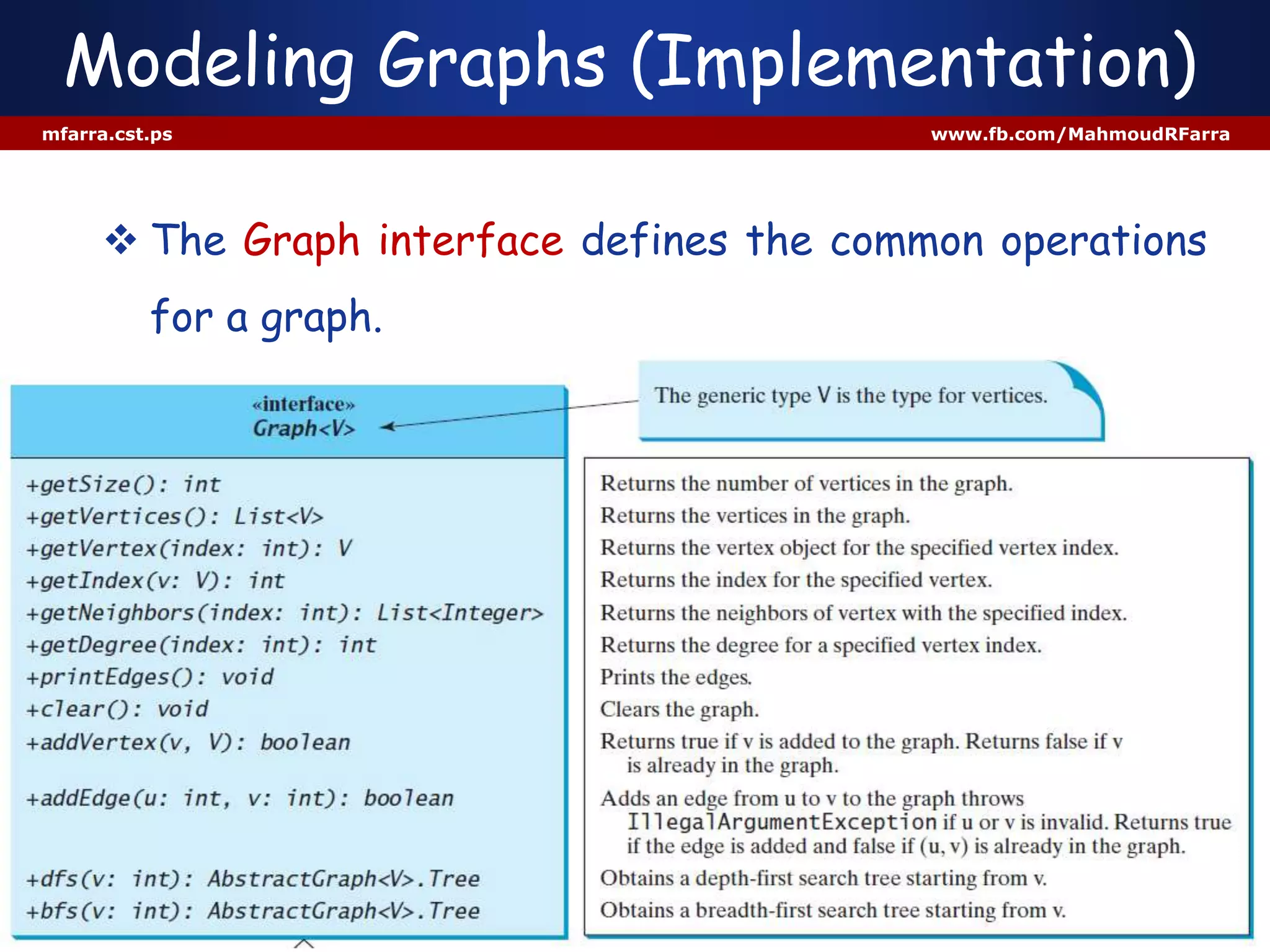
 The Graph interface defines the common operations
for a graph.
using Java
2015
FB: M a h m o u d R F a r r a
YouTube: M a h m o u d R F a r
SlidesShare: mralfarra
Thank you

Graphs data Structure

  • 1.
    using Java 2015 Data Structure Preparedby: Mahmoud Rafeek Al-farra in Java 10. Graphs
  • 2.
    mfarra.cst.ps www.fb.com/MahmoudRFarra Contents Representing Graphs BasicGraph Terminologies Introduction Modeling Graphs (Implementation)
  • 3.
    Introduction mfarra.cst.ps www.fb.com/MahmoudRFarra  Agraph is a nonlinear data structure with many important applications.  Many real-world problems can be solved using graph algorithms.  For example:  The problem to find the least number of flights between two cities can be modeled using a graph, where the vertices represent cities and the edges represent the flights between two adjacent cities.
  • 4.
  • 5.
    Introduction mfarra.cst.ps www.fb.com/MahmoudRFarra  Thestudy of graph problems is known as graph theory.  There were two islands on the river. The city and islands were connected by seven bridges.  The question is, can one take a walk, cross each bridge exactly once, and return to the starting point?  Euler proved that it is not possible.
  • 6.
  • 7.
    Basic Graph Terminologies mfarra.cst.pswww.fb.com/MahmoudRFarra  A graph is a mathematical structure that represents relationships among entities in the real world.  A graph consists of a nonempty set of vertices (also known as nodes or points), and a set of edges that connect the vertices.  For convenience:  We define a graph as G = (V, E). Where  V represents a set of vertices  E represents a set of edges.
  • 8.
    Basic Graph Terminologies mfarra.cst.pswww.fb.com/MahmoudRFarra  For example, V and E for the graph in first figure are as follows:
  • 9.
    Basic Graph Terminologies mfarra.cst.pswww.fb.com/MahmoudRFarra  A graph may be directed or undirected.  In a directed graph, each edge has a direction, which indicates that you can move from one vertex to the other through the edge.  You can model parent/child relationships using a directed graph, where an edge from vertex A to B indicates that A is a parent of B.
  • 10.
    Basic Graph Terminologies mfarra.cst.pswww.fb.com/MahmoudRFarra  A graph may has many forms.
  • 11.
    Basic Graph Terminologies mfarra.cst.pswww.fb.com/MahmoudRFarra Before we introduce graph algorithms and applications, it is helpful to get acquainted with graphs using the interactive tool at www.cs.armstrong.edu/liang/animation/GraphLearningTool.html  In an undirected graph, you can move in both directions between vertices.  Edges may be weighted or unweighted.  For example, you can assign a weight for each edge in the graph. (e.x.: To indicate the flight time between the two cities.)
  • 12.
    Basic Graph Terminologies mfarra.cst.pswww.fb.com/MahmoudRFarra  Two vertices in a graph are said to be adjacent:  if they are connected by the same edge.  (Edges) if they are connected to the same vertex.  An edge in a graph that joins two vertices is said to be incident to both vertices.  The degree of a vertex is the number of edges incident to it.
  • 13.
    Basic Graph Terminologies mfarra.cst.pswww.fb.com/MahmoudRFarra  Two vertices are called neighbors if they are adjacent. Similarly, two edges are called neighbors if they are adjacent.  A loop is an edge that links a vertex to itself.  If two vertices are connected by two or more edges, these edges are called parallel edges.  A simple graph is one that has doesn’t have any loops or parallel edges.  In a complete graph, every two pairs of vertices are connected, as shown.
  • 14.
    Basic Graph Terminologies mfarra.cst.pswww.fb.com/MahmoudRFarra  A graph is connected if there exists a path between any two vertices in the graph.  A subgraph of a graph G is a graph whose vertex set is a subset of that of G and whose edge set is a subset of that of G.
  • 15.
    Representing Graphs mfarra.cst.ps www.fb.com/MahmoudRFarra Representing a graph is to store its vertices and edges in a program.  The data structure for storing a graph is arrays or lists.
  • 16.
    Representing Graphs mfarra.cst.ps www.fb.com/MahmoudRFarra The edges can be represented using a two- dimensional array.  The vertices and edges in the following figure can be represented as follows:
  • 17.
    Modeling Graphs (Implementation) mfarra.cst.pswww.fb.com/MahmoudRFarra  The Graph interface defines the common operations for a graph.
  • 18.
    using Java 2015 FB: Ma h m o u d R F a r r a YouTube: M a h m o u d R F a r SlidesShare: mralfarra Thank you