Graphic Design AsCommunication Barnard Malcolm
download
https://ebookbell.com/product/graphic-design-as-communication-
barnard-malcolm-11646086
Explore and download more ebooks at ebookbell.com
2.
Here are somerecommended products that we believe you will be
interested in. You can click the link to download.
Graphic Design As Communication Malcolm Barnard
https://ebookbell.com/product/graphic-design-as-communication-malcolm-
barnard-5210266
Modern Monograms 1310 Graphic Designs Kiyoshi Takahashi
https://ebookbell.com/product/modern-monograms-1310-graphic-designs-
kiyoshi-takahashi-48901432
Playful Little Paperpieced Projects 37 Graphic Designs Tips From Top
Modern Quilters Tacha Bruecher
https://ebookbell.com/product/playful-little-paperpieced-
projects-37-graphic-designs-tips-from-top-modern-quilters-tacha-
bruecher-37242000
Popups Illustrated Books And Graphic Designs Of Czech Artist And Paper
Engineer Vojtech Kubata James A Findlay And Ellen Gk Rubin
https://ebookbell.com/product/popups-illustrated-books-and-graphic-
designs-of-czech-artist-and-paper-engineer-vojtech-kubata-james-a-
findlay-and-ellen-gk-rubin-43728446
3.
Adobe Photoshop Guide2021 The Complete Tutorial For Beginners Using
Adobe Photoshop To Master The Art Of Creating Amazing Graphic Designs
And Projects Richard Morrison
https://ebookbell.com/product/adobe-photoshop-guide-2021-the-complete-
tutorial-for-beginners-using-adobe-photoshop-to-master-the-art-of-
creating-amazing-graphic-designs-and-projects-richard-
morrison-57433494
Business Graphics 500 Designs That Link Graphic Aesthetic And Business
Savvy Steve Liska
https://ebookbell.com/product/business-graphics-500-designs-that-link-
graphic-aesthetic-and-business-savvy-steve-liska-4573438
1000 Graphic Elements Details For Distinctive Designs Wilson Harvey
https://ebookbell.com/product/1000-graphic-elements-details-for-
distinctive-designs-wilson-harvey-4574096
1000 More Graphic Elements Unique Elements For Distinctive Designs
Volume Ii Grant Design Collaborative
https://ebookbell.com/product/1000-more-graphic-elements-unique-
elements-for-distinctive-designs-volume-ii-grant-design-
collaborative-10813212
1000 Graphic Elements Special Details For Distinctive Designs Wilson
Harvey
https://ebookbell.com/product/1000-graphic-elements-special-details-
for-distinctive-designs-wilson-harvey-10833488
6.
What is thepoint of graphic design? Is it advertising or is it art? What
purpose does it serve in our society and culture? In this companion volume
to Fashion as Communication, Malcolm Barnard explores how meaning
and identity are at the core of every graphic design project and argues that
the role and function of graphic design is, and always has been, com-
munication.
Examining a range of theoretical approaches, including those of Shannon
and Weaver, Lasswell, Barthes, Derrida and Foucault, the author argues
that graphic design should be approached semiologically and treated as a
language rather than a form of art. He analyses how meaning is constructed
and communicated, and explains how graphic design relates to this con-
struction and reproduction of meaning.
Taking examples from advertising, magazines, illustration, website design,
comics, greetings cards and packaging, Graphic Design as Communication
looks at the ways in which graphic design contributes to the formation of
social and cultural identities, discussing the ways in which racial/ethnic, age
and gender groups are represented in graphic design, as well as how images
and texts communicate with different cultural groups.
Finally, the author explores how graphic design relates to both European
and American modernism, and its relevance to postmodernism and global-
isation in the twenty-first century and asks why, when graphic design is so
much an integral part of our society and culture, it is not better studied,
acknowledged and understood as art is.
Malcolm Barnard is Senior Lecturer in the history and theory of art
and design at the University of Derby. His previous publications include
Fashion as Communication (second edition, 2002), Art, Design and Visual
Culture (1998) and Approaches to Understanding Visual Culture (2001).
GRAPHIC DESIGN AS
COMMUNICATION
vii
CONTENTS
List of illustrationsx
Acknowledgements xi
1 INTRODUCTION 1
Introduction 1
Who is this book for? 5
What is this book about? 6
Chapter outlines 7
2 GRAPHIC DESIGN AND COMMUNICATION 9
Introduction 9
What is graphic design? 10
The functions of graphic design 13
Information 14
Persuasion 15
Decoration 15
Magic 15
Metalinguistic and phatic functions 16
What is communication? 18
Communication theory 20
Semiology 24
Signs and codes 26
Conclusion 28
Further reading 29
3 MEANING: WORDS AND IMAGES 30
Introduction 30
Types of signs 33
Meaning: denotation and connotation 35
Meaning: layout 38
Meaning: anchorage and relay 45
Foucault and graphic design 49
Metaphor/metonymy/synechdoche 50
13.
viii
CONTENTS
Conclusion 55
Further reading55
4 SOCIAL, CULTURAL AND ECONOMIC FUNCTIONS 57
Introduction 57
The relation to society and culture 57
Society 59
Social functions 61
Culture 66
Cultural functions 68
Childhood 68
Gender 72
The relation to economics 75
Consumption 77
Anti-consumption 77
Conclusion 80
Further reading 80
5 AUDIENCES AND MARKETS 82
Introduction 82
Target practice 83
Ethnicity/race 85
Age 92
Gender 104
Conclusion 108
Further reading 109
6 MODERNISM 111
Introduction 111
What is modernism? 111
Modernism and graphic design 113
European modernism 120
American modernism 129
Conclusion 134
Further reading 135
7 POSTMODERNISM AND GLOBALISATION 137
Introduction 137
What is postmodernism? 138
Postmodernism and graphic design 142
What is globalisation? 151
Globalisation and graphic design 153
Conclusion 160
Further reading 161
14.
CONTENTS
ix
8 GRAPHIC DESIGNAND ART 162
Introduction 162
Art, graphic design and meaning 163
The artist and the designer 164
Cultural significance 165
Expression and individuality 167
Creativity and problem-solving 169
Function 172
Aura 175
Conclusion 178
Further reading 178
9 CONCLUSION 179
Bibliography 184
Index 192
15.
ILLUSTRATIONS
x
1.1 Poster, ‘Goon. Jump.’ Channel 4 (2001) 2
3.1 Newspaper front page, Independent (January 2004) 31
3.2 Advertisement, Standard Life Bank (2004) 32
3.3 Diagram, Barthes on denotation/connotation (1977) 35
3.4 Typefaces from Morgan and Welton (1986) 37
3.5 Advertisement, Diesel (1995) 39
3.6 Magazine layout, Guitar magazine (January 2002) 42–3
3.7 Poster, Guerrilla Girls (1989) 44
3.8 2000AD (March 2004) 47
3.9 Illustration, Edward Gorey, The Haunted Tea-Cosy (1997) 48
3.10 Advertisement, Barclays Bank (2004) 52
3.11 Advertisement, Nail Polish (2004) 54
4.1 Illustration, Steve Caplin and Paul Jeremy (1993) 63
4.2 Cartoon, Steve Bell (2004) 65
4.3 Poster, Barnardo’s (2002) 70
4.4 Advertisement, USAir (1999) 73
4.5 Booklet front page, Selfridges (2004) 78
5.1 Poster, Benetton ‘Handcuffs’ (1989) 90
5.2 Poster, Benetton ‘Angel and Devil’ (1991) 92
5.3 Packaging, Tetleys (1995) 93
5.4 Packaging, Tetleys (2004) 94
5.5 Front cover, The People’s Friend (March 2004) 99
5.6 Front cover, My Weekly (March 2004) 101
5.7 Front cover, Find Out! (March 2004) 103
5.8 Packaging, Gillette Venus (2004) 106
5.9 Packaging, Gillette Mach3 Turbo (2004) 107
6.1 Photogram, El Lissitzsky, ‘TINTE’ (1924) 117
6.2 Poster, Zdanevitch, ‘The Bearded Heart’ (1923) 119
6.3 Book cover, F. T. Marinetti, Zang Tumb Tumb (1914) 123
7.1 Typeface, Elliott Earls, ‘Dysphasia’ (1995) 145
7.2 Front cover, book, Cranbrook Academy (1990) 149
16.
xi
ACKNOWLEDGEMENTS
I’d like tothank Rebecca Barden, Mark Durden, Helen Faulkner, Rob
Harland, Gus Hunnybun, Matt Jones, Rob Kettell, Helen Neil, Zora Payne,
Richard Tyler, Josie Walter and Julia Welbourne, for variously making/
helping me teach this stuff, recommending reading or examples, providing
illustrations, rubbishing my arguments and other welcome advice. Heather
Watkins and the staff in the Learning Resource Centre at the University of
Derby helped with Inter-Library Loans and Inter-Site Favours.
Thanks are due to all of the copyright-holders who granted permission
for the illustrations. Thanks to Calum Laird, Parker’s Seeds, The Pistachio
Information Service and D.C. Thomson for permission to use material from
The People’s Friend and My Weekly. And to the Research Group in the
School of Arts, Design and Technology at the University of Derby for
supporting a semester out of teaching. Every effort has been made to trace
all the copyright-holders, but if any have been inadvertently overlooked,
the publishers will be pleased to make the necessary arrangements at the
first opportunity.
18.
1
1
INTRODUCTION
INTRODUCTION
Most people seemore examples of graphic design before they get to work
than they see examples of art in a year. Before they are even fully awake,
most people will see the numbers and letters on the faces of alarm clocks,
the colours, shapes and lettering on tubes of toothpaste, the letters and
symbols on taps and showers, the signs for ‘On’ and ‘Off’ on the kettle, the
packaging of their tea or coffee, the station idents on morning television
and the print, photography and layout of the newspaper. This is before they
climb into cars (with front and rear badges and logos, and a dashboard full
of tiny pictures, symbols and numbers) or onto buses and trains (encrusted
with corporate identities, advertising and more badges and corporate
logos), and make it along the road (adorned with advertising, bus-stops,
shop-fronts and other signs giving warnings, instructions, information and
directions), to work (where yet more graphic design informs them of the
location of ‘Reception’, lavatory, lift and, in some cases, library). Graphic
design is everywhere. Yet it is often taken for granted, passing unnoticed
and unremarked as it blends in with the visual culture of everyday life.
Graphic design is even unnoticed by those unacknowledged legislators of
the lexical world, the compilers of dictionaries. It may come as something of
a surprise to learn that ‘graphic design’ and ‘graphic designer’ are included
in neither Chambers English Dictionary (1988) nor The Shorter Oxford
English Dictionary (1990 imprint). Writing in 1993, Alina Wheeler (1997:
84–5) noted that no American dictionary included these phrases either.
Moreover, assuming that anyone who has got this far already has an inkling
of what graphic design is (why pick up the book otherwise?), the fact that
entire cultures have a blind spot to something that is so obvious, that
literally stares people in the face every time they turn on a tap, glance at a
newspaper, open a pack of gum or click on a website, will be as inexplicable
as it is surprising. As Wheeler points out, these dictionaries pride
themselves on being up to date: they encourage members of the public to
inform them of new words and they employ teams of specialist experts who
19.
2
INTRODUCTION
are constantly alertto the spoken and written appearance of novel words.
How did they miss graphic design/er? There are even quite respectable
universities with departments of graphic design, who churn out thousands
of eminently employable graphic designers every year. How is it that the
words denoting them and the work they produce are not included in
dictionaries?
One explanation may begin with the idea that graphic design passes
unnoticed. Newspapers, gum-wrappers and websites are read for their
content, not for their layout, choice of typeface or use of colour. Most
people don’t even know they are reading the letters or words on their bath-
room taps; they study the newspaper headline for the politics or the sports
results and they pick up the gum with the blue wrapper and white writing.
What most people do not do is admire the sans serif in the bathroom, nor do
they marvel at the clarity of Helvetica on the page or appreciate the way the
nutritional information has been incorporated into the overall design of
the wrapper. The graphic work is invisible in that sense and the hitherto
insupportable claim of lazy and irresponsible designers everywhere, that
they are merely providing a vehicle with which to communicate someone
else’s message, suddenly finds a prop. If most graphic design passes most
people by most of the time, then it is no wonder that the language of most
people, as it is reported by dictionaries, does not include the words ‘graphic
design’.
However, maybe it is not so clear that all graphic design passes
unnoticed. It may be argued that some graphic design attracts a great deal
of notice, and that its power is held to be all but irresistible. In 2001, for
example, the British television company Channel 4 got into serious trouble
with the Advertising Standards Authority (ASA) over a poster it had pro-
duced to advertise one of its programmes (see Figure 1.1). The programme
concerned the sport known as ‘base-jumping’ (jumping, with a parachute,
from tall buildings) and the poster depicts a person standing at the edge of a
roof on a tall building. The text of the poster reads ‘Go on. Jump.’ Among
the complaints was one from the Samaritans, who said that ‘the force of the
caption and image could have led to copycat action’ (Wells 2001). In its
judgement, the ASA agreed with the Samaritans, saying that ‘the prominence
Figure 1.1 Poster, ‘Go on. Jump.’, Chanel 4 (2001). Courtesy of Channel 4
20.
INTRODUCTION
3
of the text:“Go on. Jump”, with the image of a person standing on the edge
of a high-rise building could have encouraged members of the public to
commit suicide’ (Wells 2001). A poster, a piece of graphic design containing
a single image and three words of text, is deemed by the ASA to be
powerful enough to encourage members of the public to kill themselves.
One problem here is that the example is a piece of advertising and is
presented and understood as such. Most people are familiar with
advertising; they know it when they see it and they are more or less happy to
be entertained, offended and persuaded by it. As William Dwiggins – whom
Margolin credits with coining the phrase ‘graphic design’ (Margolin 1994:
236) – pointed out in 1922, ‘advertising design is the only form of graphic
design that gets home to everybody’ (quoted in Jobling and Crowley
1996: 6). The word ‘advertising’ is, consequently, defined in every dictionary.
Now, while advertising is one of the functions performed by graphic design,
it is not the only function. There are other things that graphics does. There
is more to graphic design than advertising. Despite the references to text
and image, neither the Samaritans nor the ASA engage with the poster as a
poster, as a piece of graphic design. No mention is made of the typeface that
is used, why it is used or of the point size it is used in. No mention is made of
the way in which the image is constructed, or cropped, its style or even
whether it is in colour or black-and-white. No mention is made of the style
or function of the Channel 4 logo which is included in the poster. And no
mention is made of the layout, of how the text is positioned with relation to
the image. These features of the advert, which are common if not peculiar
to graphic design, pass apparently unnoticed, as do those of the newspaper
and gum-wrapper mentioned earlier.
Wheeler (1997) suggests that another explanation for the failure of
English dictionaries to define graphic design/er may be cultural. Japanese
dictionaries, she says, are perfectly happy and able to define ‘graphic
designer’ as the term is ‘in the mainstream of Japanese life’. That Japanese
culture assigns much greater importance to graphic design than the western
cultures mentioned so far may be seen in Taiga Uranaka’s (2001) article in
Japan Times Online. Uranaka goes into immense detail about the problems
associated with designing pictograms for the 2002 World Cup, explaining
the communication problems that arise if the picures are too abstract, or
too stylised, or too iconic (http://www.japantimes.co.jp/cgi-bin/getarticle.
pl5?sw20010924a1.htm). Wheeler seems to be correct to suggest that a
more sophisticated appreciation of graphic design is found in Japanese
culture and that the term is therefore deemed worthy of inclusion and
definition in dictionaries. However, since the early 1990s there have been
signs that the cultural profile of graphic design in western cultures is
beginning to be recognised. This may be partly on the back of a growing
interest in the image generally which, as the blurbs on the backs of such
books as Aumont’s (1997) The Image and Mitchell’s (1994) Picture Theory
21.
4
INTRODUCTION
testify, has beenseen to signify that a ‘pictorial turn’ has taken place in the
humanities since the early 1980s. There is now a distinct market for critical
texts which analyse and explain the workings of what is called graphic
design, as well as for more impressionistic, anecdotal or journalistic texts.
The former is represented by such texts as Kress and van Leeuwen’s (1996)
Reading Images: The Grammar of Visual Design and Jobling and Crowley’s
(1996) Graphic Design: Reproduction and Representation since 1800 which
bring sophisticated semiological, political and social concepts to bear on
graphic design. And the latter is epitomised by the Looking Closer series of
books, each of which contains a plethora of essays, from a variety of
sources, including practising graphic designers, teachers, historians and
design journalists (Bierut et al. 1994, 1997, 1999, 2002).
Another component or symptom of this growing interest in graphic
design is to be found in the increasing numbers of books and exhibitions
that are either by or about prominent designers. Lewis Blackwell’s (1995)
The End of Print: The Graphic Design of David Carson and Carson’s (2004)
Trek, Jon Wozencroft’s (1988, 1994) The Graphic Language of Neville
Brody and the work of such publishers as Laurence King, Booth Clibborn
Editions, Allworth Press and Gingko Press have done much to bring
graphic design to the attention of the general public. This growing interest
in graphic designers may be a belated response to the so-called ‘designer
decade’ of the 1980s, in which fashion designers, product designers and
furniture designers (along with architects) were lionised and championed in
the popular press, but it is no less welcome for that. However, while the
cultural profile of graphic design is slowly becoming more noticeable, and
the academic study of it is slowly becoming more sophisticated, the diction-
aries are still slow to adapt. The New Shorter Oxford English Dictionary
(1993) defines ‘graphic’ as a ‘product’ of the graphic arts or graphic design,
which is a start, at least. Unfortunately, it then goes on to define graphic
design in terms of ‘decoration’ or ‘pictures accompanying text’, which is not
a definition that many practitioners or students of graphic design would
either recognise or welcome.
Interest in the nature, role and function of graphic design is increasing on
both sides of the Atlantic. The central ideas of Naomi Klein’s (2000) No
Logo, brands and branding, are understood in terms of the ‘image’ and
meaning of those brands (Klein 2000: 4) and in relation to graphic design
and advertising. Branding is also understood as a level or type of meaning
and as a form of communication. Brands are said to be the ‘core meaning’ of
corporations and those ‘meaning brokers’ who are in charge of creating
such brands are described as ‘meaning seeking’ (Klein 2000: 21, 36).
Meaning, identity and communication are thus at the core of every graphic
design project and there is much interest in how they work. This book not
only is a response to the market for critical texts dealing with graphic
design, but also intends to contribute to the development of graphic design
22.
INTRODUCTION
5
as a subjectthat is worthy of serious critical and analytical attention.
Drawing from the full spectrum of graphic production, it seeks to provide
an introduction to graphic design as a form of communication. And it seeks
to contribute to these apparently urgent debates on the present role and
function of graphics by arguing that the role and function of graphics is, as it
always was, communication.
WHO IS THIS BOOK FOR?
This book has in mind students of graphic design, communication arts,
communication design, illustration and visual communication. It also has in
mind students of photography, communication studies, media studies and
cultural studies. And, given the ways in which art and design tend to run
into each other, in the realms of print-making and advertising, for example,
it does not ignore students of art (see Chapter 8, on Graphic Design and
Art). It is written for anyone who encounters or works with mass-produced
communication media and who wishes, or is obliged, to explain and analyse
such design. Most of the book will be of interest to degree and pre-degree
students of all the above disciplines. Some of it will also be of interest to
graduate-level students. However, given that there is almost nobody who
does not encounter mass-produced communicative design (few people will
never see a newspaper, a piece of packaging or a logo on a piece of clothing,
after all), there is a case for arguing that the book will be, or even should be,
of interest to everyone. Of course, there is also a case for arguing that, while
everyone may have experience of such graphics, not everyone will wish, or
be obliged, to understand, analyse or explain it.
This latter argument, however, begs the question. It presupposes that
people do not understand, analyse and explain their experience of graphics
all the time, whether they choose to or not and whether they are obliged to
or not. Nobody selects the first birthday card they see to send to their friend
or their mother, for example. Everybody selects one that they think is
appropriate. To that extent, they have interpreted and understood the
meaning and decided that it does or does not communicate the ‘right’
message (see the section on Gender in Chapter 5). It is more difficult to
argue that, in so far as someone understands a piece of graphic production
(a logo, a wrapper, a newspaper layout), they have already analysed and
explained it. But the decision or judgement that is involved in the selection
of the ‘right’ card for one’s friend or mother indicates that some form of
analysis has taken place, even if it is unconscious. People may find them-
selves in the position of Molière’s bourgeois gentleman, also occupied by
my newsagent who, having sold newspapers, magazines, paperbacks,
greetings cards, packs of cigarettes, bottles of drinks and stationery for
twenty years, was astonished to learn that he had had a shop full of graphic
design without knowing it. They may find that they have more experience
23.
6
INTRODUCTION
and understanding ofgraphic design than they knew, even if that experi-
ence and understanding is unexamined.
WHAT IS THIS BOOK ABOUT?
This book is proposed as a contribution to the explanation and critical
analysis of graphic design. The definition of graphic design used here is
intended to be very broad and inclusive: graphic design is considered as
communication. Expressed in terms of functions, or the tasks that graphics
performs, the definition covers magical, illustrative, persuasive and
informative graphics. (These functions, or tasks, are themselves explained
in detail in Chapter 2.) Expressed in terms of what might be called graphic
disciplines, or specialisms, the definition includes illustration, typography,
photography, layout, packaging design, book design, newspaper and maga-
zine design, corporate design and website design. Examples of all of these
will be found throughout the book.
A few words about ‘explanation’ and ‘critical analysis’ may also help to
give an idea of what this book is about. Explanation might be thought of as
providing answers to the question ‘Why does this piece of graphic design
look the way it does?’ Explanation here looks for the reasons why a layout,
a newspaper design or a birthday card is as it is. Why does this text run
illegibly up the side of the page? Why does my birthday card have Purple
Ronnie on it? Why is my newspaper arranged in six orderly, regimented
columns? Explanations may be sought in the function or task the piece of
design is intended to perform, or in the people it is communicating with, for
example. This text runs illegibly up the side of the page because it is in
an achingly trendy surfing magazine, communicating with a subculture of
achingly trendy young people and intended to construct and reinforce a
sense of belonging. My newspaper contains orderly columns because it is
intended to communicate clearly in five-point type and needs to accom-
modate rectangular photographs in the page.
Similarly, critical analysis seeks to account for what makes up a typo-
graphic design, a book cover or a flyer for your local ‘Nite-Spot’ and for
what makes that design, cover or flyer possible. What are the elements of
this flyer, and what has made it possible? The flyer may be analysed into its
elements (the choice of type, image, layout, paper and so on), and what
makes it up may be accounted for. How it is made possible could be
explained in terms of available print or reproductive technologies, the
market or audience it is aimed at, the existence of social and cultural
institutions such as leisure, clubbing, the music industry and so on. Were
there no cheap, fast presses or photocopiers, for example, the flyer might
not exist at all: if nightly entertainment were prohibited, or if there were no
sub-cultural groups interested in sex, drugs and loud music, then, similarly,
the flyer would probably not have been produced.
24.
INTRODUCTION
7
So, this isnot a ‘How to Do It’ book: it will not explain how to do website
design and you will not find any intentional advice on how to produce better
advertisements or typestyles, for example. Nor is it a ‘Book of Crits’:
‘critical’ does not mean fault-finding or judgemental here and you will find
neither detritus nor compliment heaped upon the heads of those responsible
for the Lycos homepage or the opening titles of Friends, for example. It is
about what meaning is, how meaning is constructed and communicated and
how graphic design relates to the construction and reproduction of meaning.
CHAPTER OUTLINES
Chapter 2 introduces graphic design and communication. Both are defined
and explained. The various functions of graphic design are enumerated
and untangled. And two schools of thought as to what sort of thing com-
munication is are outlined. The first, communication theory, is shown to be
inadequate to explain either graphic design, or graphic design as com-
munication. The second, semiology, is proposed as a more useful way of
conceiving what graphic design is and how it goes about communicating.
Chapter 3 develops these introductory explanations. Having said in
chapter two that communication is about constructing and reproducing
meaning, chapter three explains two different types or levels of meaning.
In addition to showing how images are meaningful, it also outlines how
layouts, the arrangements of image and text on a page, are significant. The
role of words in graphic design is explained, as are some of the problems
concerning the relation of words and images. Rhetoric, the art of persuasive
image-making, is introduced by looking at three central figures and
showing how graphic design can use them.
Chapter 4 takes issue with the contexts in which graphic design is found.
No graphic design has ever been produced outside of a society, a culture or
an economy and this chapter explains the way in which graphic production
relates to society, culture and economy. It also charts the jobs that graphic
design does in these contexts and argues basically that, were it not for
graphic design, there would be no societies, cultures and economies, at least
in the forms with which we are familiar with them. So, the construction of
social and cultural groups (such as ethnic groups and gender groups) and
the relation to economics (via consumption) are explained here.
In Chapter 5, what are commonly referred to as the markets, or the
audiences, with which graphic design communicates are introduced. The
problems involved in using terms such as ‘target markets’ will be explained
before investigating the ways in which racial/ethnic groups, age groups and
gender groups are represented in graphic design. Advertisements, maga-
zines and illustration are among the examples of graphic design that will
be used here to show how images and texts communicate with different
cultural groups.
25.
8
INTRODUCTION
The theme ofcommunication is approached from a more historical
perspective in Chapters 6 and 7. Chapter 6 will consider modernism and
graphic design. It will explain what is the difference between modernity and
modernism and show what it is that makes modern graphic design modern.
A selection of modernist highlights (the Bauhaus, Swiss design and
American corporate design) will be used to illustrate how modernism
manifested itself in graphics and how European modernist graphics differed
from American modernist graphics.
Postmodernism and graphic communication is the topic of Chapter 7.
The central ideas of postmodernism will be explained and the ways in which
some of the graphic design since the mid-1970s or so is postmodern will be
illustrated. Globalisation, which some commentators say is a key feature of
postmodernity, will also be dealt with in this chapter. First the idea of
globalisation itself will be explained and then the ways in which the idea has
affected graphic design will be investigated.
Chapter 8 considers a problem that many artists and graphic designers
seem unable to leave alone, whether graphic design is art, or not. This
chapter will consider six arguments which appear to show that graphic
design is different from art, but which are, in fact, invalid. These six
arguments concern things like expression, problem-solving, creativity, the
cultural significance of art and design and the nature of the activities that
artists and designers get up to. The chapter will then present one argument
which, it is claimed, really does show that graphic design is different
from art.
26.
9
2
GRAPHIC DESIGN AND
COMMUNICATION
INTRODUCTION
Thischapter will present different definitions of graphic design, drawing
ideas from practitioners and theorists in the history and theory of graphic
design. It will describe the functions of graphic design, and it will introduce
and explain the idea of communication. There are various everyday or
commonsense definitions of graphic design and they must be illuminated
and addressed. The chapter will first consider the most prevalent and
popular view of graphic design. This view is sometimes held by students of
graphic design, as well as by the general consuming public (see Crafton
Smith 1994: 300). This is the idea of graphic design as an innocent or
transparent medium, or vehicle, for the communication of messages and
information. It is often found where there is talk of graphic designers
sending messages to receivers (see Meggs 1992: 3 for example), or of
designers using ‘effective media’ for the ‘transmitting’ of messages or
‘information’ to ‘target audiences’ (see Cronan 2001: 216). There are
various problems involved in this conception of graphic design and they will
be explained here.
This chapter will also explain various models of how communication
works and it will assess how well each describes the business of graphic
design. It will consider classic theories of communication proposed by
Shannon and Weaver, Lasswell and others. It will also introduce some of
the basic ideas of a semiological model of communication, based on the
work of Saussure and Barthes, for example. The principal concepts and
methods of these models, along with their strengths and weaknesses, will be
clearly enumerated in this chapter. The main technical terms of
communication theory, and the ways in which they may be used to account
for graphic design, will also be explained here. Certain recent critiques of
certain models of communication and of graphic design’s implied role in
that communication must also be dealt with here.
27.
10
GRAPHIC DESIGN ANDCOMMUNICATION
WHAT IS GRAPHIC DESIGN?
Satisfactory definitions and explanations of what graphic design is are hard
to find. As noted in Chapter 1, some English dictionaries do not even
include the words ‘graphic design/er’ and, when they do, the definitions are
often less than helpful. As ever, etymology can help us to understand where
words have come from, what ancient associations they arrive with, as well as
what they have come to mean now.
The word ‘graphic’ in graphic design derives from the ancient Greek
word graphein, which meant ‘mark-making’ and which covers written and
drawn marks. The word ‘design’ entered English from the Renaissance
French word dessiner and the later Italian word disegno, which meant
drawing, planning, sketching and designing. The root is the Latin signum,
meaning ‘a mark’. There is evidently some overlap between ‘graphic’ and
‘design’: drawn marks are common to the definitions of both words, for
example. There is also some repetition, or tautology, within the definition
of ‘design’. And there is evidence that graphic design involves more than
mere mark-making; the presence of ‘planning’ and ‘designing’ should alert
us to the fact that thought and reflection are already included in the process
of producing written and drawn marks. These definitions generate a very
wide range of activities that might be called graphic design and this is why,
in Chapter 1, it was said that this book is intended for students of graphic
design, communication arts, communication design, illustration and visual
communication. The range of activities referenced by graphics and graphic
design in this book includes all of the preceding. Given the involvement of
such value-laden and cultural activities as reflection and thought, it also
intends to be relevant to students of communication studies, media studies
and cultural studies. And, given the definition of graphics in terms of mark-
making, and the ways in which art and design tend to run into each other (in
the realms of print-making and advertising, for example), it also raises
questions pertinent to artists. In order to discover what, if anything, all
these activities have in common, what it is that makes them graphic design,
the following paragraphs will consider two practitioner’s explanations of
what graphic design is.
Tibor Kalman proposes a very broad definition of graphic design. He says
it is ‘a medium . . . a means of communication’ consisting in ‘the use of words
and images on more or less everything, more or less everywhere’ (Kalman
1991: 51). Such a broad definition generates a wide variety of examples that
may be called graphic design and Kalman includes fourteenth-century
Japanese erotic engravings as well as twentieth-century ‘publications like
Hooters and Wild Vixens’, Hallmark cards as well as Esprit and the design
of cheap paperback books as well as of expensive hardbacks (Kalman
1991). Kalman’s selection is clearly intended to make the point that graphic
design is not limited to high culture or low culture and to that extent may be
28.
GRAPHIC DESIGN ANDCOMMUNICATION
11
applauded. This definition, however, does not exclude art: the production
of a single image, painted in oils on a canvas, would count as graphic design
on Kalman’s definition. Not everyone would be happy with the idea that
images such as the Mona Lisa, Guernica and Sunflowers are unproblematic-
ally graphic design. Therefore, it should perhaps be made explicit, as
Kalman does not, that the products of graphic design are always at least
potentially reproducible and it is worth noting in his defence that all of his
examples exist as multiple reproductions.
In his Graphic Design: A Concise History, Richard Hollis (1994) suggests
that graphic design is a form of ‘visual communication’. More precisely, it is
‘the business of making or choosing marks and arranging them on a surface
to convey an idea’ (Hollis 1994: 7). Like Kalman, Hollis presents graphic
design as a form of visual communication; it is there to ‘convey’ ideas. And,
like Kalman’s, his definition does not explicitly exclude the ‘artistic’
production of imagery; Monet’s oil paintings or Matisse’s collages are
examples of making, choosing and arranging marks on a surface in order to
convey an idea. Only later does Hollis insist that, ‘unlike the artist, the
designer plans for mechanical reproduction’ (Hollis 1994: 8). Again, it is the
point concerning actual or potential reproduction of the work that differen-
tiates graphic design from art; artistic production exists in unique ‘one-offs’
and graphic design is mass produced.
An alternative to these positions, from a more historical and theoretical
background, is to be found in Paul Jobling and David Crowley (1996). Most
importantly, they say that graphic design is a form of visual culture. It is
a form of culture. This is important because this is how graphic design will
be understood in this book. The cultural functions of graphic design will be
enumerated in more detail in Chapter 4. In order to determine what
constitutes graphic design, they propose three ‘interdependent factors’
(Jobling and Crowley 1996: 1, 3). The first is that graphic design is mass
reproduced. The second is that it is ‘affordable and/or made accessible to a
wide audience’. And the third is that it conveys ideas through a combin-
ation of words and image (Jobling and Crowley 1996: 3). Clearly, there can
be no problem with the first of their factors. The mass production or
reproduction of graphic design is necessary in order to distinguish it from
art (see Chapter 8 for more on this). However, the second and third factors
are acceptable up to a point, yet stand in need of some qualification. The
shapes and styles of the numbers and letters on the face of a Rolex watch
are undoubtedly the products of graphic design, yet few would claim that
Rolex watches are affordable or accessible to a wide audience in the sense
that many people can easily purchase them. The numbers and lettering are,
however, accessible in the sense that they are easily understood by a wide
range of people. Similarly, the logo on a Brooks Brothers’ Polo shirt is a
product of graphic design and relatively affordable. But a sheep hanging
from a bit of rope is inaccessible in the sense that few people will understand
29.
12
GRAPHIC DESIGN ANDCOMMUNICATION
it as signifying that particular company and even fewer will understand its
reference to the medieval dukes of Burgundy. The third factor is perhaps
the least defensible. If graphic design is the ‘juxtaposition or integration
of word and image’ (Jobling and Crowley 1996: 3), then most logos, all
typefaces, all text-only graphics and all image-only graphics are not graphic
design. The possibility of graphic production which is not a juxtaposition or
integration of word and image must be allowed.
While the question of how graphics relates to art will be dealt with in
more detail in Chapter 8, it is worth introducing some of the issues involved
here, especially as some people are keen to distinguish graphic design from
art precisely as a means of defining the former. One matter which exercises
many theorists is the ‘purity’ or otherwise of graphic design. In his essay, ‘Is
There a Fine Art to Illustration?’, Marshall Arisman (2000) places art,
illustration, graphic design and advertising in a scale of ‘purity’:
1 Fine Art is pure.
2 Illustration is the beginning of selling out.
3 Graphic Design is commercial art.
4 Advertising is selling – period.
(Arisman 2000: 3)
David Bland (1962) also distinguishes art from illustration in terms of
‘purity’: because illustration often has to do with words and letters, it is not
as ‘pure’ as fine art, which deals in images alone (Bland 1962: 13). Although
Arisman differentiates graphic design from art in terms of commerce and
Bland differentiates illustration from art in terms of the image–text relation,
both are concerned with ‘purity’ and both conclude that their respective
disciplines are somehow ‘impure’. The notion of ‘purity’ is an odd one with
which to distinguish practices of visual culture from each other and one which
does not really stand much scrutiny. Art inhabits an economic ‘context’, just
as much as graphic design and illustration. And fine art paintings are given
titles, even if the words do not always appear in the actual image, thus
establishing a relation to words. Fine art cannot be distinguished from
graphic design on the basis of ‘purity’; each is as ‘pure’, or ‘impure’ as the
other and the notion is of no use in the definition of graphic design.
However, as a working definition of graphic design, ‘the mass-production
or reproduction of image or text’ that may be gleaned from the preceding
accounts will suffice only if it is supplemented by stressing the economic
role, or commercial nature, of graphic design. Hollis (1994: 8), for example,
refers to the client who is paying for the graphic designer’s work: the idea
that graphic design is usually commissioned, bought and paid for by
someone who is not a designer must be stressed here. Although it is not to
suggest that fine art is not commissioned, bought and sold, it is to insist on
the commercial aspect of graphic design.
30.
GRAPHIC DESIGN ANDCOMMUNICATION
13
THE FUNCTIONS OF GRAPHIC DESIGN
The functions of graphic design may be approached from two directions.
There are the social, cultural and economic functions of graphic design ‘as a
whole’. And there are the functions of individual examples of graphic
design. The following sections will address the latter and Chapter 4 will
consider the former. Richard Hollis (1994: 9) proposes three basic functions
of examples of graphic design which, he says, have changed little over many
centuries. The first is ‘identification’: the role of graphics here is ‘to say
what something is, or where it came from’ (Hollis 1994: 10). Examples of
graphics performing this function include inn signs, heraldry, company
logos and labels on packaging. Hollis’s second function concerns ‘infor-
mation and instruction’ and the job of graphics here is to ‘indicate the
relationship of one thing to another in direction, position and scale’. Maps,
diagrams and direction signs are proposed as examples of graphics
performing these tasks. And the third function is that of ‘presentation and
promotion’ (Hollis 1994: 10). Posters and advertisements which aim to
catch a spectator’s eye and make the message ‘memorable’ are the
examples that Hollis supplies here.
Jacques Aumont also suggests there are three functions that graphic
images perform and that they are very old. He explains these functions as
the ‘symbolic’, the ‘epistemic’ and the ‘aesthetic’ (Aumont 1997: 54–5). In
symbolic images the image stands for, or represents, something else. The
something else might be a god, an idea or a cultural value and according to
Aumont (1997: 55), there is a ‘virtually endless’ number of such images.
These images may be religious or secular, but where they are religious they
are often believed to grant direct access to the realm of the sacred. Such
images may also be representational or abstract and they may be figurative
or non-figurative; images or personifications of Liberty, Charity, Christ,
Zeus or Buddha as well as abstract representations in the form of Christian
crosses, Hindu or Nazi swastikas and ancient Egyptian ankhs are therefore
understood to be symbolic in this sense. Epistemic images (from the ancient
Greek word for knowledge) are those which convey information about the
world and its contents. Such images may also be religious or secular; in both
stained glass windows and botanical illustrations, knowledge is communi-
cated. The nature of the information communicated by an epistemic image
can vary enormously and Aumont (1997) includes road maps, landscapes,
portraits and playing cards among his examples. Aesthetic images are those
‘intended to please the spectator [or] to produce in the spectator specific
sensations’ (Aumont 1997: 55) and Aumont suggests that this function has
become inseparable from the idea of art; that an image ‘aiming to produce
some aesthetic effect’ is taken automatically to be ‘art’. Ironically enough,
Aumont’s example of this phenomenon is advertising, a graphic product,
which he says strongly confuses the ‘artistic’ with the ‘aesthetic’.
31.
14
GRAPHIC DESIGN ANDCOMMUNICATION
Unfortunately, neither of these accounts of the function of graphics is
satisfactory: both are incomplete and Hollis’s is verging on the tautological.
There is little room in either account for a rhetorical function, for example.
Hollis mentions the word ‘promotion’ but explains posters and advertise-
ments only in terms of being ‘eye-catching’ and ‘memorable’: there is no
mention of persuasion or of altering the behaviour of the person whose eye
is caught. Aumont also finds no place for rhetorical images: he mentions
advertising, but only to explain it entirely in terms of a confusion between
the ‘artistic’ and the ‘aesthetic’. In describing the functions as ‘identifi-
cation’, ‘information’ and ‘presentation’, Hollis’s account comes close to
saying the same thing three times. In ‘identification’ the first function he
identifies, an image ‘says what something is’ (Hollis 1994: 10). To say what
something is sounds like providing information about that thing, which is
supposedly the second, different, function. To provide information about
that thing sounds suspiciously like a ‘presentation’, which is offered as the
third function. There is simply not enough difference between these things
that images do to constitute three different functions; as Hollis explains
them, they all perform the ‘informative’ function.
Consequently, these accounts must be supplemented and made more
logical. The four functions that will be described below were outlined in
an unpublished lecture given by Richard Tyler at what was then Leeds
Polytechnic. The source was given as being ‘based on St Thomas Aquinas’,
but in nearly twenty years I have not found that source. Some of these four
functions will be only marginally different from Hollis’s and Aumont’s,
others will be entirely different from them, but between them, they will
account for all graphic production.
Information
The first function is the informative function. The role of graphics here is to
impart (by definition new) knowledge, or intelligence. Clearly, this is much
the same as Aumont’s ‘epistemic’ function and covers everything described
by Hollis. Pub signs, shop-fronts, coats of arms, company logos and
packaging are all examples of graphics where one of the roles performed is
that of providing information. The information provided may be very basic,
that this place is a shop or a pub and not a private house, for example. It
may also be more sophisticated, telling us that these two families have
combined through marriage to form a new social unit, or that this company
is caring and efficient. Signage, in our towns and cities, on our highways and
motorways, along with maps, diagrams, portraits, landscapes and much
illustrative work are also providing information. Again, the type of infor-
mation may be very basic or it may be more complex. Some road or street
signs merely say that the public conveniences, or Birmingham, are this way.
Others distinguish motorways from minor roads, or tourist attractions, by
32.
GRAPHIC DESIGN ANDCOMMUNICATION
15
means of different background colours. In the United Kingdom, motorway
signs use a blue ground, minor roads a white ground and tourist attractions
are indicated by a brown background. And advertising has an informative
function; as described by Hollis (1994), one of the jobs an advert is there to
do is to inform the spectator that a certain product exists. Although it is
clearly not the whole story, one of the things that advertising undoubtedly
does is to inform the public.
Persuasion
The second function is the persuasive, or rhetorical function. Here the job
of graphics is to persuade, to convince or merely affect a change in thought
or behaviour. Again, this bears obvious resemblances to Aumont’s (1997)
description of the rhetorical image. It may be argued that all graphic
production has a rhetorical function, that it all exists in order to change
people’s thought or behaviour in some way or other. What, it may be
argued, is the point of a graphic sign that has no effect on anyone? Why
would a designer produce a sign intended to have no effect on its viewers?
Is such a sign even possible? The logo mentioned above informs of the
identity of the company but also and at the same time seeks to persuade us
that that company is caring and efficient. The rhetorical function takes
many forms. Advertising is only the most conspicuous example and may be
located on a spectrum of graphic production ranging from political
propaganda and electoral publicity to illustration and documentary.
Decoration
The third function is the decorative or aesthetic function. It should be
surprising that a graphic design historian such as Hollis (1994) does not
countenance the idea that graphic design might have a decorative function,
that it might be fun, or that it could be entertaining, ornamental and the
source of enjoyment and pleasure. Aumont (1997) begins to approach this
function when he describes aesthetic images as being intended to please the
spectator, but, like Hollis, his account stops short of explaining graphic
production as decorative.
Magic
The fourth function is the magical function. This is probably the least
obvious function of graphic production. However, it attempts to analyse
and explain two things that graphic design does. The first thing is hinted at
in Aumont’s (1997: 55) account when he suggests that symbolic images
somehow grant ‘access to the sphere of the sacred’ (compare Benjamin
1992: 218). The second thing is alluded to by Tibor Kalman (1991), when he
33.
16
GRAPHIC DESIGN ANDCOMMUNICATION
says that what most graphic design is about is ‘making something different
from what it truly is’ (quoted in McCarron 2001: 113). The first thing they
do is to make absent or distant people or places ‘present’ to us, the
spectator. When Aumont says that symbolic images give access to the realm
of the divine, he is describing the process by which the gods are made
present, or made to appear to humans, but there is clearly a secular version
of the function. If this were not true, then we would not keep pictures or
photographs of our loved ones in our wallets or on our desks and walls. Nor
would we feel distinctly uncomfortable at the prospect of sticking a needle
in the photograph of our mother, right in the eye. The second thing that
images do, and which concerns Kalman, is to transform one thing into
another thing. Thirty graphics students asked to draw a garden will produce
thirty different gardens, thus transforming one thing into another thing. It is
also well known that a garden painted by Monet is altogether a different
kind of place from a garden painted by Van Gogh. Ignoring for the moment
the question of whether we can have access to ‘what really is’, making things
appear and turning one thing into another thing are exactly what magicians
do and that is exactly why graphics may be said to have a magical function,
however residual, or primitive it may sound.
Metalinguistic and phatic functions
In his chapter ‘Drawing, Design and Semiotics’, Clive Ashwin proposes six
functions for graphic design. His ‘referential’ function covers the ground
covered by ‘Information’, and his emotive and conative (to do with the
desire to perform an action) functions correspond to ‘Persuasion’. Ashwin’s
account of the poetic or aesthetic function makes the point that a designer’s
work may be pleasurable to an interpreter, but that pleasure is not any
image’s only function (Ashwin 1989: 207). Ashwin is useful here because he
adds ‘metalinguistic’ and ‘phatic’ functions to the account of graphic design.
An example of phatic communication in speech would be someone saying
‘Hi there . . .’, ‘I see . . .’, ‘you know’, ‘uh huh’ or ‘anyway’ in the course of a
conversation. Such phrases are conventional and predictable; they are what
is known as ‘redundant’ in communication studies, and their purpose is to
initiate, continue or conclude a conversation. Ashwin (1989: 208) suggests
that comics are ‘rich in phatic devices and signs’. The ways in which draw-
ings are framed, whether as grid-based squares or rectangles or as chaotic
and overlapping, can indicate the relation between those frames and suggest
where one is to go next. Arrows, changes of viewpoint or of perspective and
moving from close-up to landscape are also phatic. The framing, or the
move from close-up to landscape, may have nothing to do with the narra-
tive, but it keeps the story going, it tells the reader where to look next.
A ‘metalanguage’ is a language that is used to talk about some other
language. A metalinguistic communication, therefore, is a communication
34.
GRAPHIC DESIGN ANDCOMMUNICATION
17
that comments on, explains, clarifies or qualifies another piece of communi-
cation (Ashwin 1989: 208). Quotation marks around a word or a piece of
text in this book, for example, indicate that someone else has written it, that
it is a concept that needs to be ‘handled with care’, or that it is singled out
for some other sort of special attention. Ashwin suggests that the ‘Key’ on a
map performs a metalinguistic function; it explains what shapes, lines or
colours used in the map mean. The metalinguistic function is therefore
connected to codes. Fiske (1990: 36) explains that, in order to understand a
word or an image, one needs to be clear which code is being used. Frames
are a good example: a frame around an image may indicate that it is to be
understood as a work of art, or that it is the next image in a comic, depend-
ing on the frame and the code that is being used.
It should be stressed that these functions are treated analytically here.
What this means is that the functions have been identified, separated and
explained in order to make them clearer. It is not the case that they can
always be separated in one’s experience of graphic design. One does not
first experience the ‘entertaining’ function and then, later, get persuaded by
the rhetorical function of an advertisement, for example. When one looks
at an advertisement, the pleasure of the image, its entertainment value, is
experienced at the same time as its persuasive function. Indeed, some
would argue that the pleasure engendered is an integral part of its rhetorical
power. Nor is it the case that an example of graphic design will perform only
one of these functions. There can be no piece of graphic design that is only
decorative, or only informative. It is the case that any and all examples of
graphic design will perform more than one of these functions. Two testing
examples will be discussed to show how these ideas work.
‘The Rhetoric of Neutrality’, by Robin Kinross (1989), can be read as
demonstrating how an example of graphic design which might be thought of
as performing only one function in fact performs another function as well.
He takes a railway timetable, an example that Gui Bonsiepe calls an
‘extreme case’, which might reasonably be thought to be purely informa-
tive, ‘innocent of all taint of rhetoric’ (Bonsiepe, quoted by Kinross 1989:
131–2). Kinross shows that the timetable also operates rhetorically, using
eloquence to persuade or influence others. He concentrates on the use of
typeface to make his point and reproduces three timetables, one from 1928
(which uses a nineteenth-century serif), one from after 1928 (which uses
Gill Sans) and one from 1974 (using Gill Sans again, but employing more
lower-case letters). The ‘major’ change which has taken place is the different
typeface, but Kinross also identifies changes of ‘detail’, substituting dashes
for dots in alternate rows, for example (Kinross 1989: 132). In the ‘sober’
context of the timetable, he says, even this tiny typographic detail repre-
sents the exercise of ‘eloquence’. The change of typeface is more obviously
rhetorical. The move from a serif to a sans serif gives the impression of
being ‘stripped for action’ (Kinross 1989: 136). Clearly, the sense of an
35.
18
GRAPHIC DESIGN ANDCOMMUNICATION
impediment-free, efficient and active train service is one that a railway
company will want to foster and if the typeface and layout can communi-
cate this, then they will use it. Kinross goes on to consider the use of colour,
and the typographical challenge to Gill Sans that was represented by
Univers. He concludes that the timetables do not only perform an informa-
tive function, but also persuade and influence, using typeface, layout and
colour to connote modernity, efficiency and even cultural identity.
A slightly less extreme, but no less illustrative, example, may be found in
many of Toulouse Lautrec’s posters. The 1891 poster for La Goulue at the
Moulin Rouge will be used here. It is almost the opposite of Kinross’s
example in that, where his example takes an example that appears to do
only one thing and shows that it in fact does another thing as well, this one
represents a piece of graphic design that performs all four of the main
functions identified earlier. The poster informs the viewer of the place and
times at which La Goulue will be dancing – every night at the Moulin
Rouge. It persuades the viewer to attend by presenting the location as a
popular, exciting and lively ‘night-spot’. The magical function may be said
to be performed in that something of the atmosphere, the energy, darkness
and sexuality of the place, is made present. And the decorative, aesthetic
function is performed by the use of colour, silhouette and composition:
many of these posters, of course, are reproduced in order to be hung on
people’s walls as decoration today.
WHAT IS COMMUNICATION?
All of the accounts of what graphic design is that have been noted so far
have insisted that graphic design is a means of communication. Kalman says
that graphics is a ‘means of communication’ (1991: 51). Hollis implies that it
is a kind of ‘visual communication’ (1994: 7). Although Jobling and Crowley
appear to eschew the word entirely, it is clear that ‘a means of conveying
ideas’ (1996: 3) indicates communication. So, this section must consider the
idea of communication. It will do this first by examining the way communi-
cation is described by practitioners and theorists of graphic design. It will
look at the metaphors used to describe and explain communication.
Second, it will look at the various models of communication that have been
proposed as descriptions of the transmission of messages or information.
However, as Kalman, Hollis and Jobling and Crowley all agree that
graphic design is communication, so they all agree that communication is
a ‘conveying’. They all use this metaphor of transporting or carrying
something from one place to another to explain communication. For these
practitioners and theorists, graphic design is the medium or vehicle by
means of which something is transported from one place to another. The
something that is thus transported or communicated is customarily referred
to as a message, and may be further specified as an idea or a meaning. The
36.
GRAPHIC DESIGN ANDCOMMUNICATION
19
‘places’ between which messages are conveyed are commonly described as
‘senders’ and ‘receivers’; communication is therefore understood as the
conveying of a message from sender to receiver.
This conception of communication is what lies at the root of the common
understanding of graphic design as an innocent, transparent medium, or a
neutral transporter of messages. This understanding emphasises the idea
that graphics is transparent in the sense that it adds nothing and takes
nothing away from the message; that it has no message of its own and does
not constitute a message in or by itself. A transparent medium is one that
distorts nothing that passes through it and graphics is often presented as
such a medium. The idea of the neutral vehicle is also popular. This is the
idea that, like a train or a bus, graphics does not affect its cargo: messages
are taken on at one end, taken off at the other end and remain unmodified
by either the vehicle itself or the journey. Some graphic designers believe
that this is the ideal to be achieved by graphic communication. Katherine
McCoy, for example, recalls her time working at the American design
company, Unimark International, a company dedicated to the idea of the
‘rationally objective professional’ graphic designer. She says that the stated
goal of the graphic designer at that company was to be the ‘neutral
transmitter of the client’s messages’ (McCoy 1997: 213).
These are fecund metaphors and may be multiplied almost at will.
However, they are metaphors and, although they cannot be eliminated or
avoided, they cannot pass uninspected. They must be inspected because
they predispose the people who use them to favour a specific model of
communication, which contains ideas that may be misleading or inaccurate.
Specifically, these metaphors predispose people to the model of communi-
cation that is used in communication theory, which will be investigated in
the following section. These problems are compounded because, as Derrida
points out, communication can only be described metaphorically (as
transporting or conveying), but metaphor is itself a kind of transporting,
to the extent that using ‘is’ here is problematic (Derrida 1978a: 6–7).
Metaphor is itself always already metaphorical in that its Greek derivation
suggests a carrying over from one place to another, a communication:
‘meta’ means over or beyond and ‘phero’ means transfer or convey. So,
communication is commonly explained in terms of a metaphor of carrying
over, a conveying from one place to another. But metaphor itself is already
a form of communication (a carrying over), which is what we are trying to
explain ‘in the first place’.
These reflections are clearly complex and difficult. Their consequences
are more complex and more difficult (see Derrida 1982a: 307–330; 1982b,
for example). However, they at least alert us to the problems involved in
certain models of communication. One of the consequences is that there
can be no neutral, objective conveying of a message, if by neutral and
objective is meant non-transforming or non-rhetorical. (Transforming
37.
20
GRAPHIC DESIGN ANDCOMMUNICATION
should be understood as referring only to the information or the message,
not to the receiver of the message. Information that does not transform the
receiver is not information (Wildbur and Burke 1998: 6)). Metaphor is a
rhetorical trope and it is transforming (it is describing one thing in terms of
another thing): if there is no non-metaphorical communication, then there
can be no non-transforming, non-rhetorical communication. The impossi-
bility of a neutral, information-only communication was shown by the
reading of Kinross (1989). The neutral, objective communication of infor-
mation by the railway timetable was seen to be impossible and was always
accompanied by, or transformed by, a rhetorical element. With these
problems in mind, the next section will investigate the models of communi-
cation that are found in communication theory.
COMMUNICATION THEORY
In Type and Image, Meggs (1992) begins his account of communication in
graphic design from the perspective of communication theory. Following
Shannon and Weaver (1949), he explains communication as the ‘transfer of
information between people’ and he defines information as ‘knowledge
about facts and events’ (Meggs 1992: 3). Meggs’ graphic depiction of this
theory makes its linear process quite clear (see diagram below).
First, the ‘information source’ produces the ‘raw information’ to be
transmitted and the transmitter (encoder) transforms the information into a
signal that is appropriate for the channel of communication. Then, the
receiver (decoder) translates the signal back into ‘the original message’ and
the recipient receives the message. All the while, the signal is subject to
potential ‘noise’, which is a ‘distortion’ of, or an ‘interference’ with, that
signal (Meggs 1992). Despite Shannon and Weaver’s claim that this model
will apply to all human communications (Fiske 1990: 6), the origins of this
theory in their work in telecommunications engineering are quite clear.
It is significant that Meggs makes no further use of this model in Type and
Image. He says that, although this theory ‘addresses the method of com-
munication’, it does not deal with the ‘content’ or ‘purpose’ of communi-
cation and is therefore ‘inadequate to explain communicative art forms
including . . . graphic design’ (Meggs 1992: 3). In fact, there are many things
that this theory does not deal with and there are a few things concerning the
‘method’ that are not entirely convincing. Even with electronic media,
which is where Shannon and Weaver (1949) start from, the identity of
Information
> Transmitter
> Signal
> Receiver
> Recipient
source (encoder) (in channel) (decoder) (destination)
^
Noise
source
38.
GRAPHIC DESIGN ANDCOMMUNICATION
21
transmitters and receivers is relatively unclear. Is the graphic designer the
‘information source’ on this account, or the ‘transmitter (encoder)’? Is the
client, perhaps, the ‘source’? The client will contract a designer for a
specific task, after all. In turn, the graphic designer will select the shapes,
lines, colours, typefaces and layouts that make up a website design, for
example: does that make him or her the ‘information source’? Similarly, is a
program such as Dreamweaver the information source or the transmitter
(encoder)? Or is the server the transmitter? Graphic designers also
interpret subjects and topics on behalf of clients and turn those subjects and
topics into visuals: does that make them the ‘encoder’? If not, why not?
More seriously, the theory does not account for the fact that a graphic
designer will know who the ‘recipient’ is (either the market or audience, or
the client), and tailor the image/text and layout to suit: to this extent, the
‘recipient’ has something like a ‘causal effect’ on the ‘transmitter’ and the
linear sequence is simply inaccurate. Similarly, with regard to the ‘receiver
(decoder)’ and the ‘recipient’: is the young black guy who interprets an
advertisement or magazine cover the ‘decoder’ or the ‘recipient’ or is the
white middle-class female client in some sense the ‘recipient’?
The nature of ‘noise’ is not clear in a graphic design context: the fact that
‘snow’ on a television screen might make the designer’s wizzy animated title
sequence difficult to see is true, but it is surely a trivial engineering problem
that need not detain graphic designers qua graphic designers. A more
interesting version of noise might be the plethora of pop-ups on a website,
which obscure part of the page one is trying to look at but, again, this might
also be a trivial engineering or programming problem. The idea of noise
(defined as ‘any signal received that was not transmitted by the source’:
Fiske 1990: 8) raises a number of problems for this theory of communi-
cation. The definition of noise as provided by Fiske seems to require that
the source knows what was and was not transmitted, that they are thus in in
full control of their message and signal. The source or sender must know
exactly what was transmitted in order to recognise that which was not
transmitted and therefore identify it as noise. How, then, are we to explain
the offence caused by ‘obscene’ advertisements? In 2003, some people
complained that one of the advertisements produced by the charity
Barnardo’s were offensive as it showed a cockroach emerging from a baby’s
mouth. If the sender knows what was transmitted (as they must do, in order
to tell noise from non-noise), then the offence is not noise and the offence
must have been intentionally ‘transmitted’ by the sender. Few graphic
designers and fewer advertisers, however, will admit to intentionally
broadcasting offensive material. If, however, the offence is noise, then the
sender cannot be in control of the signal and they cannot be said to know
what they are transmitting. However, there are not many graphic designers
who will admit to not being in control of their work and to communicating
unintended meanings.
39.
22
GRAPHIC DESIGN ANDCOMMUNICATION
Of course, it may be argued that ‘offensiveness’ is not a ‘signal’ on this
account, or that ‘offensiveness’ is a cultural variable and not part of the
process of communication. In this case, one would have to reply that a
theory which is unable to explain how ‘messages’ are found offensive by
people is clearly no theory of graphic communication. It is at this point that
Meggs’ objections to the theory become pertinent. He is clearly correct
regarding the content, or meaning, of the message: a satisfactory explan-
ation of communication would have to account for the content of that
communication. Similarly with ‘purpose’; an explanation of a piece of
communication would need to refer to the function the text/image was to
perform. As it is, Shannon and Weaver’s model explains neither content
nor purpose. Nor is it concerned with the social and cultural locations of
communication. The class, gender, nationality and cultural identity of the
people involved in communication, which have tremendous impact on
graphic communication, are no part of this model. To that extent, the model
fails to account for communication.
There are more sophisticated versions of this basic model of communi-
cation. One, which Fiske suggests has been followed by ‘most mass-
communication research’, is that provided by Lasswell (Fiske 1990: 30–1).
Lasswell’s version argues that communication can be explained as:
Who, says what, in which channel, to whom, with what effect.
(Fiske 1990: 30)
That this is a reproduction of Shannon and Weaver’s linear model is clear.
The element that has been added is the notion of ‘effect’. ‘Effect’ is some
change or alteration that is produced in the receiver (the ‘whom’), by what
is said. Lasswell’s model assumes that there is an effect, and that it is clearly
identifiable. If an ‘effect’ cannot be identified, how is one to know that
there has been an effect? The first problem here is the passivity of the
receiver. The audience of the message, the recipient, is said to be affected
by the message. The message acts upon the receiver and the receiver is
passively changed by it. However, the social and cultural contexts of these
messages is not included in the account. In the case of graphic design, the
‘who’ is unclear: is the client the ‘who’, or the designer, or an as yet unspeci-
fied combination of the two? To that extent, it is incomplete. The ways in
which the (culturally and socially located) receiver itself has an effect on the
sender are not included. To that extent, it is inaccurate.
Theodore Newcomb’s model of communication represents an attempt to
locate the role of communication in a social context. The role, or function,
as described by Fiske (1990: 31), is to maintain equilibrium within the social
system. Rather than a simple linear process, Newcomb proposes a
triangular structure, where A is the sender, B is the receiver and X is a part
of the social environment (see diagram on facing page).
40.
GRAPHIC DESIGN ANDCOMMUNICATION
23
A change in any one of these elements will effect a change in the others.
Fiske uses two examples to illustrate the changing ‘equilibrium’ between
these elements. In the first example, A is a Labour government, B
represents the trade unions and X is pay policy. He says that A and B,
who in theory ‘like each other’, will be under pressure to communicate
frequently in order to reach an agreement on X. In the second example, A is
a Conservative government, B is the trade unions and X is pay policy. In
this case, there will be less pressure on A and B to communicate about X as
they do not ‘like each other’ and are thus free to disagree on the matter. As
Fiske (1990: 32) says, in both cases the system is ‘in equilibrium’. While the
attempt to account for the social position of communication is welcome,
this model is not without its problems. The emphasis on the function of
communication as ‘maintaining equilibrium’ within the social system
sounds conservative. What of communication where either A, or A and B,
are critical of the X? In the case where both A and B are determined to
change X, Newcomb’s model has little to say. Like the two accounts already
discussed, Newcomb’s model cannot account for meaning. The identity of
the sender is also unclear. Is it the designer, the client, or the client’s
marketing department. Given Fiske’s example, might it be what have
become known in political circles as ‘spin doctors’?
A more general and more serious problem affecting all versions of this
model of communication concerns the conception of meaning that they
presuppose. Meaning is not mentioned in Shannon and Weaver’s, or
Newcomb’s account and it only appears as the ‘what’ of the communication
in Lasswell’s. A conception of meaning is, however, presupposed by all
these theories. The central metaphor discussed above gives that precon-
ception away. In that metaphor the meaning arrives at its destination
unaffected by the vehicle in which, or the journey by which, it is conveyed.
Meaning on these accounts is conceived as already formed, or as preceding
communication. This is where the notion of ‘target audiences’ (see
Bielenberg 1997: 183) comes from. Meaning is thought of as being like an
arrow, or a bullet (or a passenger on a bus), which exists before the
communication takes place and which does not change as it is transported
to its ‘target’, or destination. There is no room for the active consumer or
interpreter in these theories and alternative interpretations of the ‘message’
can only be seen as ‘missing the target’.
X
A B
▲
▲
▲
▲
41.
24
GRAPHIC DESIGN ANDCOMMUNICATION
Another of the underlying assumptions of the theory is that the aim of
communication is ‘efficiency’. This assumption comes from the theory’s
origins in telecommunications and may be connected to the way in which
graphic designers are sometimes characterised as visual ‘engineers’ (see
Bielenberg 1997: 183). Efficiency here means that the message arriving at
the receiver is or should be identical to the one transmitted. Any different
message that is received is seen as a ‘failure’ or a ‘breakdown’ in communi-
cation. Such an assumption cannot deal with or explain differences in the
interpretation of meaning. Where one ‘receiver’ interprets a typestyle as
conservative and another sees it as a little racy, where one ‘receiver’ will not
buy a packet of tea because the colours and layout used are ‘vulgar’ and
another sees them as ‘classy’, and where a ‘receiver’ objects to the depiction
of women in an advertisement as ‘degrading’ but another sees it as ‘a bit
of fun’, these theories would see only a ‘breakdown’ or a ‘failure’ in
communication. The idea that different people, from differing social and
cultural backgrounds, can actively interpret graphic designs in different
ways cannot be accounted for except as a failure. This is not a strength of
the theory. As Fiske says, the engineering and mathematical backgrounds
of the theories unfit them for dealing with different, more complex, forms
of communication (Fiske 1990: 6).
Finally, Raymond Williams (1980) argues in his Problems in Materialism
and Culture that the ‘means of communication are themselves means of
production’ (1980: 50). This is the idea that the notions of ‘senders’,
‘receivers’, ‘information’ and ‘messages’, used in communication theory,
ideologically reduce the idea that graphic design, for example, is a means of
social production. None of these ideas refers to anything ‘outside’ of the
linear process of communication. The social, cultural and economic
locations, or identities, of the people producing and interpreting graphic
design are detached or ignored in the talk of ‘sender’, ‘receiver’ and so on. It
makes little sense to ask after the social class of the sender, or the gender of
the receiver on these accounts and Williams suggests that this is to mask or
reduce the idea that what graphic design is doing is producing these social,
cultural and economic identities. These criticisms will be explored in more
detail in Chapter 4.
The next section will consider semiological models of communication, in
which meaning is produced in communication, it is the result of negotiation
between designers, clients, marketing people, interpreters and viewers and
spectators of graphic design. On these accounts, a different interpretation is
just that, not a failure of communication.
SEMIOLOGY
There are three main differences between the communication theories
discussed above and the semiological theories to be introduced in this
42.
GRAPHIC DESIGN ANDCOMMUNICATION
25
section (Fiske 1990: 2). The first difference concerns the nature of com-
munication itself. The second concerns the nature of the message. And the
third concerns the place of meaning and individuals in communication. First,
for the theories above, communication is the transmission of messages
(signals) and involves senders, signals, channels and receivers. For semi-
ology, communication is the ‘production and exchange of meanings’ (Fiske
1990: 2). This theory stresses the interaction involved in communication,
not the sending and passive receiving of messages. For semiological theories,
the cultural position of ‘senders’ and ‘receivers’ generates meaning, and the
exchange of meanings produces the cultural positions of senders and
receivers. Second, according to the theories above, a message (meaning) is
something transmitted in the process of communication. According to
semiology, the message or meaning is something constructed and inter-
preted in communication. As Fiske (1990: 3) says, the message is a
‘construction of signs which, through interacting with the receivers, produce
meanings’. This interaction, or negotiation, is what happens when the
‘receiver’ interprets the signs and codes of a message in terms of their
cultural beliefs and values. Third, meaning and individuals were ‘already
there’ for communication theory, but for semiology, communication is a
part of the social interaction in which both meaning and individuals are
produced, or constituted. There is no meaning before that ‘receiver’ inter-
prets the meaning of the message, producing themselves as a member of a
cultural group in that interpretation, and the meaning is not separable from
the interaction of communication (cf. Derrida 1981: 23–4).
An example or two might help. As a white, middle-class European male,
my reactions to, or interpretations of, Sex and the City are roughly the same
as other members of my class, gender and age group. The beliefs and values
that I hold as a member of those groups generate my interpretation of the
show: meaning results from the interaction between those values and the
show. In turn, it is that interpretation or negotiation that produces me as a
member of that cultural group. A black Muslim woman’s or a teenaged
girl’s reactions to the show would be entirely different and their interpre-
tations would constitute them as members of very different cultural groups.
The interaction, or negotiation, between their beliefs and values and the
show will produce the meaning that the show has for these other people.
There is, then, no meaning that pre-exists the interpretation of the show
and no sense of communication failure resulting from the different
interpretations. Similarly, a teenaged western metal fan’s reactions to the
typefaces, colours and layouts of Kerrang or Metal Maniacs magazine are
likely to be roughly the same as other members of that subcultural group.
That interpretation of the graphic design is one of the ways in which
membership of the cultural group is constituted. The liquid gold metallic
typeface, lurid contrasting colours and lumpen layout of Metal Maniacs will
mean something entirely different to an ageing folky and that different
43.
26
GRAPHIC DESIGN ANDCOMMUNICATION
interpretation will constitute them as a member of an entirely different
subcultural group.
Signs and codes
For semiological theories, signs and codes are the twin cultural bases of
messages and meanings. Communication is the construction and exchange
of meanings for semiology and meanings are explained in terms of signs and
codes. The message, or meaning, then, is a construction of signs that is
exchanged and interpreted according to codes, or cultural rules.
In semiological theory, the sign is what the linguist Saussure calls a ‘unity’
(1974: 66–7). It is a unity of signifier and signified. The signifier is the
‘material vehicle’ and the signified is the associated concept. By ‘material
vehicle’ is meant the sign’s image as we perceive it: the written, drawn,
printed or displayed piece of graphic design. The shapes, lines, colours,
textures and layouts of graphic design are all signifiers. By signified is
meant the concept associated with the signifier, what the signifier refers to.
The signified of the signifier ‘dog’ (the perceived shapes and lines making
up the word) is either ‘four-legged canine’, or ‘follow’. Depending on the
code being used, or the context the signifier appears in, one or other
signified would be correct here. In a set of traffic lights, the signifier that is
the red light is associated with the concept or signified ‘stop’. The signified
of the signifier (the shapes and lines making up the image shown in http://
www.apple.com/ipod could be ‘woman listening to music on her iPod’ or
just ‘dancing’, depending on the code, the context in which it was found.
It sounds odd at first, but the relationship between the signifier and the
signified is what Saussure (1974: 67–70) calls ‘arbitrary’. What he means by
this is that there is no natural, legal, personal or God-given reason for any
signifier being associated with any signified. The relation is ‘arbitrary’ in the
sense that the colour blue could just as well be associated with ‘stop’, the
word ‘cat’ could just as easily be associated with the concept of a ‘four-
legged canine’ and the image in the iPod ad could just as easily be associ-
ated with the concepts of ‘youth’, ‘fun’, ‘freedom’, ‘carefree’, ‘flirty’ or ‘nice
bracelet’ as with those mentioned above. It is not my personal decision that
the signifier ‘red’ is associated with ‘stop’, nor can I decide tomorrow that
from now on it will be associated with ‘Go’ (see the section on Expression
and Individuality in Chapter 8 for more on this). There is nothing natural
about the relation between the word ‘dog’ and the signified ‘four-legged
canine’: the word ‘cat’ would do the job just as well and other words in other
languages (chat, felis, katze, gato etc.) do the job perfectly well. Nor could
any government legislate for the relation between the shapes and lines in an
ad and what they are to be associated with.
Because the relationship between signifier and signified is arbitrary, it is
conventional. And because it is conventional, it is cultural. Another way of
44.
GRAPHIC DESIGN ANDCOMMUNICATION
27
saying this would be to say that, because the relationship is arbitrary, it is
only the differences between signs that generate meaning. Signs are
meaningful only because they differ from other signs, within a code or a
structure that organises those differences. Meaning is, therefore, a product
of difference. The word ‘dog’ means different things in the sentences, ‘this
dog is lost’ and ‘melancholy thoughts dog my every move’. The image in the
iPod ad would mean something different if it were to be found in a book of
cool dance moves or a bracelet catalogue. The sentences and the context
are codes or structures within which the elements have meaning. These
codes are cultural in that they are the rules shared and followed by a
community of sign-users. The code for the traffic lights has to be learned
(from The Highway Code in the United Kingdom) and it is shared by all
road users. The code that operates in the case of traffic lights is very simple:
‘red’ means stop, ‘red and amber’ means get ready to go, ‘green’ means go
and ‘amber’ means get ready to stop. The coloured lights are made
meaningful by their place in that structure. And the code is cultural in that a
community of sign-users (drivers) learn it and adhere to it.
(It is worth noting, parenthetically, that as the relation between the
signifier and the signified is arbitrary and because, therefore, signs make
sense only within a coded, culturally specific, set of differences, Isotype
cannot be the universal language it was designed to be. The Isotype for
liquid refreshment, for example, is a cocktail glass, as opposed to a wine
glass, a champagne glass, a beer glass and so on. This choice from the
paradigm of different glasses is ‘very American’, as Lupton and Miller
(1999: 42) say, and its meaning, that you can get a drink here, has to be
learned. A picture of a bottle might be ‘more universal’, but would still have
to be learned. They also point out that the only other depiction of a woman
(apart from the one wearing a stylised version of a garment ‘sometimes
worn by western women’ (Lupton and Miller 1999: 42), is in the sign for
‘ticket sales’. Here, culturally specific gender roles are reproduced by
having the women assisting the man (compare it with the USAir advertise-
ment in Chapter 4). There is no entirely non-arbitrary and purely iconic
signifier and therefore Isotype cannot be ‘universal’.)
The code may be explained as a structure. A structure is a set of ways in
which different elements can relate to each other. In semiology, there are
two ways in which elements can be different from, or can relate to, each
other. They can come before or after each other and they can substitute for
each other. The technical term for the difference between things that come
before or after one another is ‘syntagmatic difference’ and a sequence of
elements (an entire layout, for example) can be called a ‘syntagm’. The
term for elements that can substitute for each other is ‘paradigmatic
difference’ and the name for a group of elements that could substitute for
each other (fonts in MS Word, for example) is called a ‘paradigm’. In the
United Kingdom traffic lights example, red can be substituted for green or
45.
28
GRAPHIC DESIGN ANDCOMMUNICATION
amber, but not by blue or pink, and it comes after amber, but not after
green. Red, green and amber are thus a paradigmatic group and the
sequence ‘red, red and amber, green’ is a syntagm. In a comic strip, the
meaning of any one frame is produced by its syntagmatic relation to the
frames preceding and following it. It is also produced by its paradigmatic
relation to the frames that could, but do not, replace it.
To summarise: the semiological account of communication may use some
of the same words that are found in communications theory’s account
(message, for example), but the ways in which those words are used and
understood differs in each theory. So for semiology, communication is the
production and exchange of messages and meanings, not the transmission
of messages. A message or meaning is something constructed in communi-
cation, not something that pre-exists communication. The ‘receiver’ in
semiology is not really a receiver; in the active interpretation of the message,
meanings and receivers are constructed and reproduced according to the
cultural identity of the interpreter. Signs and codes are the bases of mean-
ings in semiology. And signs and codes are explained in terms of learned
and variable cultural rules. For semiology, then, communication is a cul-
tural phenomenon, not an engineering problem, as it is in communication
theory.
CONCLUSION
This chapter has tried to explain what graphic design is and what the
function of individual examples of graphic design could be. It has tried to
explain what communication is and it has looked at potential explanations
from communication theory and semiology. It has been argued that the
semiological theories are more appropriate to graphic design. The latter are
not handicapped by starting from an engineering or telecommunications
background, in which the emphasis is on the efficiency of signal trans-
mission. Instead, they are fully able to account for the social and cultural
production and exchange of meaning through signs and codes. There is a
sense, then, in which Kalman is correct when he says that ‘graphic design is
a language not a message’ (quoted in Bielenberg 1997: 184). Graphic design
does in fact deal with messages, but not in the way that communication
theory suggests. This is borne out, to an extent, by the terminology that
graphic designers and design journailsts use to describe what they are
doing. In the March 2004 edition of the British journal Design Week, for
example, a mixture of communication theory metaphors and semiological
concepts is to be found. Mel Maynard, design director at Brandhouse, says
that their new packaging for Sanctuary Spa’s beauty products use ‘self-
pampering cues’ and creates an ‘impression’ of a sanctuary. The use of the
word ‘cue’ suggests that a specific response is being invited by the
packaging, not that a message is being delivered. Martin Grimer employs a
46.
GRAPHIC DESIGN ANDCOMMUNICATION
29
mixture of the two approaches, suggesting on the one hand that his work
‘gives’ Hellmann’s products a consistent visual style and on the other that it
encourages different ‘associations’. ‘Gives’ in this context suggests that
meaning is an object that pre-exists the interpretation of it while
‘associations’ (of freshness and honesty) are connotations (Design Week,
March 2004: 4–5). The account of semiology begun here suggests that the
emphasis should be on graphic design as one of the ways in which meaning
is socially and culturally constructed and negotiated, that is, like a language.
The use of semiological theory will be continued in Chapter 3, which will
investigate the notion of meaning in more detail, using the ideas proposed
by Barthes and others.
FURTHER READING
● For more on Derrida’s account of communication, see his ‘Signature, Event,
Context’, in Derrida (1982a) Margins of Philosophy, Hemel Hempstead:
Harvester Wheatsheaf.
● The best introductory text, to which this chapter is clearly indebted, is John
Fiske’s (1990) Introduction to Communication Studies, London: Routledge. It
contains a detailed, approachable and critical account of both communication
theory and semiological theory. See especially his explanation of the relation
between highly motivated or constrained signs (which resemble the things they
are the signs for) and less motivated signs (which do not) and iconic and
symbolic signs (pp. 52–6).
● David Crow’s (2003) Visible Signs, Crans-Près-Céligny, Switzerland: AVA
Publishing SA, is a superb, visually stunning introduction to semiology for
graphic designers.
● For a summary of the debate between communication theory and semiological
theory, see Marilyn Crafton-Smith (1994) ‘Culture is the Limit: Pushing the
Boundaries of Graphic Design Criticism and Practice’, Visible Language, 28(4):
297–315. Crafton-Smith critically discusses Jorge Frascara’s (1988) ‘Graphic
Design: Fine Art or Social Science?’, Design Issues, 5(1): 18–29.
● Ellen Lupton’s essay ‘Reading Isotype’ and the chapter on ‘Modern Hiero-
glyphs’ in Lupton and Miller (1999) contain more detailed argument and
discussion on the role of culture in the understanding of Isotype.
● An internet semiotics encyclopedia can be found at http://www.arthist.lu.se/
kultsem/encyclo/intro.html. Produced by the University of Lund, it contains
material on visual semiotics as covered here. The University of Wales
Aberystwyth website at http://www.aber.ac.uk/media/ contains material on
advertising and visual analysis.
47.
30
3
MEANING: WORDS
AND IMAGES
INTRODUCTION
Thischapter will develop the themes of the previous chapter. Chapter 2
established communication as the production and exchange of messages,
which were explained as meanings. Meanings were seen to be the products
of signs and codes and the nature of signs and codes were introduced.
Chapter 3 will look at the notion of meaning in more detail. It will first
define three different types of signs: icon, index and symbol. Then it will
explain two types, or levels, of meaning (denotation and connotation) and
show how they are the result of differences and relations between signs,
codes and cultures. It will then move on to consider the relations between
words and images and illustrate the different functions that words can have
with regard to images. Some areas of graphic design, such as illustration,
can be predominantly dependent upon image alone. Other areas, what is
most commonly thought of as ‘graphic design’, perhaps, involve the use of
both images and words. And other areas, typography, for example,
concentrate on (the form of letters and) words alone.
For example, on the morning after the Hutton report was published in
the United Kingdom, the Independent newspaper entirely eschewed illus-
tration on its front page (Figure 3.1). (The Hutton report was intended to
be a description of the events preceding the death of the civil servant David
Kelly, who had been identified as having leaked sensitive information
concerning the Labour government’s policy on weapons of mass destruc-
tion and the war on Iraq to a BBC journalist.) The Independent’s front page
raised the question whether the report was a ‘whitewash’, whether it
covered up the government’s duplicity and responsibility, by using a white
front page with only twelve lines of type. Advertising for the Clinique
company in the 1990s characteristically used only a photograph of the
product in their advertisements, while some recent advertising for the
Standard Life building society (Figure 3.2) and the Big Issue used only a
variety of different typefaces to make their point. In the graphic design
industry, the company emediadigital.com concentrates solely on the use of
48.
THE INDEPENDENT
WHITEWASH?
THE HUTTON
REPORT
ASPECIAL ISSUE
(Republic or Ireland 1:0.9~1 6(1p
E
ight months ago, BBC reporter Andrew Gilligan broadcast his now infamous report casting doubt on
the Government's dossier on Iraq's weapons capability, a vital plank in its case for war. In the ensuing
furore between No 10 and the BBC,Government scientist David Kelly, who was revealed to be Gilligan's
source, was found dead in the woods. Tony Blair appointed Lord Hutton, a former Lord ChiefJustice
of Northern Ireland, to hold an inquiry into the circumstances surrounding Dr Kelly's death. He listened to 74
witnesses over 25 days, and yesterday published his 328-page reporl In it, he said Gilligan's assertions were
unfounded and criticised the BBC, whose chairman has now resigned. He said that Dr Kelly had broken the
rules goveruing civil servants in talking to journalists. He exonerated Tony Blair, cleared Alastair Campbell and
I
attached no blame to the government for the naming of Dr Kelly. So was this all an establishment
I] whitewash? And what of the central issue which Lord Hutton felt he could not address? If the
..:..c:::::..::=--,---1 September 2002 dossierwhich helped persuade the nation of the urgent need forwar (and triggered
::=:;-:::=:-:::-• this tragic chain ofevents) was indeed reliable,where, exactly, are Iraq's weapons of mass desbuction?
31
typography in advertising. The second part of John Hillis Miller’s (1992)
Illustration analyses many examples of the different ‘balance’ that may exist
between word and image; while drawing on this work, this chapter will
concentrate on a few key concepts.
So, having first explained the different types of sign, Chapter 3 will
consider the relation between meaning, words and images in the production
Figure 3.1 Newspaper front page, Independent (January 2004).
Courtesy of the Independent
49.
32
MEANING: WORDS ANDIMAGES
Figure 3.2 Advertisement, Standard Life Bank (2004).
Courtesy of Standard Life
50.
MEANING: WORDS ANDIMAGES
33
of meaning from a cultural perspective and from a formal perspective.
Formally, the relation of words and images has been considered under
the heading of ‘layout’ or composition. Gunther Kress and Theo van
Leeuwen’s (1996) work on ‘composition’ will be used here to explore the
links between culture, meaning and the different ways in which pages can
be laid out. In terms of the relation to culture, the relation has been con-
sidered in terms of various concepts; denotation, connotation, anchorage
and relay, for example. Roland Barthes’s account of these terms will be
explained and used to show the connection between culture and meaning.
Having introduced and explored these issues, the approach followed by
Foucault, in his correspondence with Magritte and in his This is Not a Pipe,
will be explained. The interrelation between the formal and the cultural,
the way the cultural construction of meaning and identity relates to graphic
devices will thus be made clear. Finally, the chapter will introduce some
more concepts from semiology. Metaphor, metonymy and synechdoche are
the names for some of the different visual operations that are performed
by graphic designers on ideas and things in the world. Visual examples of
these operations in advertising, photography and illustration will be
explained here.
TYPES OF SIGNS
The basic structure of all signs (the relation between signifier and signified)
was explained in Chapter 2. This section will explain the three different
forms that that relation can take: it will explain three types of sign. The
typology of signs to be used here comes from the work of an American
philosopher, C. S. Peirce (1839–1914), who was living and working at the
same time as Saussure (1857–1913) but apparently unaware of his work.
Peirce’s definition of the sign is remarkably similar to Saussure’s. Peirce
(1955: 99) says that ‘a sign . . . is something that stands to somebody for
something in some respect’. On Peirce’s account, then, most things can
function as a sign. It is the relation between the sign and its object, the thing
it stands for, that concerns us here because Peirce says that there are three
different ways in which the sign (the signifier in Saussure’s terms) can relate
to its object (the signified in Saussure’s terms). For the sake of convenience,
Saussure’s terminology will be adopted in order to explain these types of
sign. If there are three ways in which the signifier can relate to the signified,
then there are three different types of sign. These types are known as ‘icon’,
‘index’ and ‘symbol’ (Peirce 1955: 102).
In iconic signs, the relation between signifier and signified is one of
resemblance. The signifier resembles or looks like the signified in some
way. Good examples of iconic signs are photographs, in which the signifiers
(the shapes, lines, colours and textures) resemble the thing that the
photograph is of. The photograph in a passport or student identity card is
51.
34
MEANING: WORDS ANDIMAGES
almost guaranteed to resemble or look like the person it is the photograph
of; that is why photographs, rather than charcoal sketches, are used.
Cultural codes still play a part here, however. The story of how Picasso
sympathised with the man who showed him a ‘realistic’ photograph of his
wife by regretting that she was only two inches tall indicates that, only within
certain learned and understood limits, does the photograph ‘resemble’ its
object. Some paintings (representational portraits and landscapes, for
example) may be said to be iconic. There is a sense in which maps and
diagrams are iconic: the signifiers must resemble the signified in some way
for them to be useful maps and diagrams.
Indexical signs are those in which the signifier is causally or existentially
related to the signified. An advertisement in which the model’s hair streams
out behind her as she drives her open-top car contains an indexical sign: the
streaming hair (the signifier) is caused by the speed of the car (the signi-
fied). An advertisement for holidays in Barcelona which contains a picture
of the Sagrada Familia is indexical in that the cathedral (the signifier) is, it
exists, in Barcelona (the signified). And the drops of perspiration on the
sweaty workmen ogled by attractive women in Coke ads are indexical signs.
The perspiration (the signifier) has been caused by hunky masculine hard
work (the signified).
Peirce’s symbolic signs are the same as Saussure’s sign. Here the relation
between signifier and signified is conventional, or ‘arbitrary’ as Saussure
says. A community of sign-users has agreed that a signifier will stand for a
particular signified. In an Interflora advertisement, it is the roses and
not the gypsophila alongside them that stand for love. There is nothing to
prevent the gypsophila from standing for love, but the culture this advert-
isement is part of has agreed and conventionalised the relation between the
signifier (the roses) and the signified (love). The roses are thus a symbolic
sign on this account.
It should be noted that a single example of graphic design will often
contain iconic, indexical and symbolic signs. As Fiske (1990: 48), for
instance, has pointed out, the road sign for a crossroads in the UK Highway
Code is iconic, indexical and symbolic all at the same time. The red triangle
is symbolic: according to the Highway Code signs that are triangular with a
red border (and not circular, or blue) are warnings. The shape in the middle
is a mixture of icon and symbol. It is iconic in that it resembles a crossroads
and it is symbolic in that we have to know the convention that means it is
not a church, for example. Located by the side of the road, the sign is
indexical: the sign alerts drivers to the existence of a crossroads ahead. The
Isotype is also a mixture of iconic, indexical and symbolic. The sign for
‘woman’ is iconic in that it looks like a woman wearing something that some
women wear in some cultures (Lupton and Miller 1999: 42). It is indexical in
that, when seen at an airport or station, it indicates the presence or exist-
ence of a lavatory for women. And it is symbolic because the conventions
52.
MEANING: WORDS ANDIMAGES
35
surrounding its use must be learned in order to understand it; it does not
mean ‘Only skirts to be worn’ or ‘Brothel’, for example (Lupton and Miller
1999: 42). To the extent that it is symbolic, it cannot be ‘universal’.
MEANING: DENOTATION AND CONNOTATION
Denotation and connotation are two types, or two levels, of meaning. This
section will explain that, although both are based on signs and codes and to
that extent culturally relative, denotation is sometimes said to be less
culture specific than connotation. Knowing what denotation and connota-
tion are and how they work is necessary for the analysis of graphic design.
The distinction between these two levels of meaning is analytical in that,
although it is not found in our experience, it can help to explain and make
sense of that experience (see Baker 1985 for more on this). As Barthes
(1977a: 36–7) says, although they are usually experienced and understood
at the same time, analysing them can help to explain the ideological func-
tion of connotation. Connotation is an immensely powerful type of meaning:
all graphic design depends on it in order to be effective and graphic design is
effective because of the way connotation works. Connotation enables the
individual to be constructed as a member of a social group because it is
where the values and beliefs of a culture interact with the texts, images and
layouts of graphic design. As such, it may be thought of as the interface
between the individual and a culture: it is where the values and beliefs of a
culture generate meaning. Barthes provides a diagram, using the idea of the
sign, made up of signifier and signified, to explain in graphic form the
relation between denotation and connotation (see Figure 3.3).
The denotational meaning of an image is the answer to the question
‘What is this a picture of?’ The denotation of a typeface is the answer to
questions such as ‘What typeface is this?’, ‘What point size is being used
here?’ and ‘Is this a serif?’ Denotation is the ‘literal’ meaning of a piece of
graphic design and an account of denotational meaning can be correct or
incorrect. In the iPod advertisement mentioned in Chapter 2 the denotation
of the image might be ‘woman, dancing, listening to headphones, wearing
Signifier Signified
Sign
SIGNIFIER
SIGN
Denotation
SIGNIFIED CONNOTATION
Figure 3.3 Diagram, Barthes on denotation/connotation (1977)
53.
36
MEANING: WORDS ANDIMAGES
bracelet, shortish hair’ and so on. If it was suggested that the denotation of
the typeface was Times New Roman italic then the denotation would be
wrong. Barthes (1977a: 36) says that all that is needed to understand this
level of meaning is ‘the knowledge bound up with our perception’. What he
means is that, in order to understand or construct the denotation of a photo-
graph of a woman dancing, or of a shopping bag, all one needs to know is
what an image is and what a woman dancing, or a shopping bag, is. As he
says, this knowledge is ‘not nothing’: one needs to be a member of the sort
of culture that has photography, goes dancing and uses shopping bags in
order to understand or construct such an image. The construction or under-
standing of denotational meaning requires a low-level cultural knowledge,
but it is still a culture-specific knowledge (see Baker 1985).
The connotational meaning of an image is the answer to the question
‘What does this image make you feel?’ The connotation of a typeface is
the answer to the question ‘What does this typeface make you think of?’
Connotational meaning is the associations a piece of graphic design has for
an individual member of a culture; the way the image makes you think or
feel and it cannot be correct or incorrect. If you say the woman in the iPod
advertisement makes you think of nights out dancing in town, then that is
the connotation of the image for you. If you don’t live in the sort of culture
that has ‘nights out dancing in town’ then the image will not have that
connotation for you. Another connotational meaning might be that dancing
is a sin. If you are not part of a culture that thinks that dancing is sinful, then
this connotational meaning will be unavailable to you and you will not be
constructed as a member of that culture. This level of meaning requires a
much higher level of cultural knowledge in order to be constructed or
understood than denotational meaning. In Barthes’s famous account of the
Panzani pasta advertisement, he identifies four connotative signs: the
‘return from market’, ‘Italianicity’, the ‘total culinary service’ and ‘still life’.
In order to be able to construct or understand these connotations, one
needs to be a member of a culture in which going to a supermarket or shop
to get the shopping for oneself is practised. One also needs to be a member
of a society that is wealthy enough to offer holidays to other countries. In
the case of the last connotation, ‘still life’, one needs a relatively specialised
education in western art history. A member of the sort of culture where
hunting animals in the bush, or having other people to do that sort of thing
for you, is the way in which food is procured will not understand what is
involved in going to the supermarket and will not be able to construct or
understand the connotations of the advertisement.
Barthes’s example concerns the image that is found in the advertisement.
He is concerned with the the copy, or text, that appears, but his interest is
linguistic, not visual. However, the concept of connotation may be used to
analyse and explain typefaces, as well as images. An example of how
connotation may be applied to the visual explanation of typefaces is to be
54.
MEANING: WORDS ANDIMAGES
37
found in Morgan and Welton’s (1986) See What I Mean. They ask the reader
to consider these signs (Figure 3.4). As Morgan and Welton (1986: 31)
say, they look ‘odd’; there is something wrong about them. This oddness
or wrongness may be explained in terms of meaning, as the result of
connotation and cultural values. What is happening here is that two sets of
connotations, two sets of cultural expectations, are conflicting. In British
culture, cream teas are associated with ‘rural holidays, picturesque scenery
and old cottages’ (Morgan and Welton 1986: 31). These are the values,
associations or connotations that ‘cream teas’ has for those brought up in
British culture. However, the typeface which has been selected for the
words ‘cream teas’ has connotations of ‘technology, efficiency and the
future’ (Morgan and Welton 1986: 31). The connotations of the idea of
‘cream teas’ are not the same as those of the typeface that has been selected
and the face is experienced as inappropriate and odd. The same oddness is
experienced and the same explanation can be given for the ‘computer aided
design’ example. Here, the words would be associated with technology,
efficiency and the future but the typeface would be associated with half-
timbered buildings and picturesque old villages. The connotations, the
cultural values, of the words are not appropriate to the typeface, and again,
the effect is one of oddness. Where the connotational meaning that a type-
face has for a cultural group is not matched to the connotational meaning
that the words have, the effect is disconcerting.
Connotation is central to the account of communication that is being
proposed here. As already noted, it is where the beliefs and values held by
members of a culture interact with the text and imagery of graphic design.
Given this, it is therefore where graphic design meets what Marxists call
ideology. One of the simpler definitions of ideology in Marxism is that it is
the set of beliefs, ideas and values held by a social class. For Marxists, social
class is a product of economics; one’s position in capitalist economy
determines one’s social class (see Chapter 4 for more on this). The values,
ideas and beliefs (the ideology) held by a member of a social class are also
the product of one’s economically defined class position. Although Barthes
is not concerned with social class, he is concerned with the nature and
ideological function of connotation. Barthes (1977a: 49) says in ‘Rhetoric of
Figure 3.4 Typefaces from Morgan and Welton (1986)
rise. Are theprophet's words about Jerusalem too strong for large
portions of our own commercial communities? Men who know these
best will not say that they are. But let us cherish rather the powers
of commerce which make for truth. Let us tell men who engage in
trade that there are none for whom it is more easy to be clean and
straight; that lies, whether of action or of speech, only increase the
mental expense and the moral strain of life; and that the health, the
capacity, the foresight, the opportunities of a great merchant depend
ultimately on his resolve to be true and on the courage with which
he sticks to the truth.
One habit of falseness on which the prophet dwells is the use of
unjust scales and short measures. The stores or fortunes of his day
are stores of wickedness, because they have been accumulated by
the use of the lean ephah, the balances of wrong and the bag of
false weights. These are evils more common in the East than with
us: modern government makes them almost impossible. But, all the
same, ours is the sin of the scant measure, and the more so in
proportion to the greater speed and rivalry of our commercial life.
The prophet's name for it, measure of leanness, of consumption or
shrinkage, is a proper symbol of all those duties and offices of man
to man, the full and generous discharge of which is diminished by
the haste and the grudge of a prevalent selfishness. The speed of
modern life tends to shorten the time expended on every piece of
work, and to turn it out untempered and incomplete. The struggle
for life in commerce, the organised rivalry between labour and
capital, not only puts every man on his guard against giving any
other more than his due, but tempts him to use every opportunity to
scamp and curtail his own service and output. You will hear men
defend this parsimony as if it were a law. They say that business is
impossible without the temper which they call "sharpness" or the
habit which they call "cutting it fine." But such character and
conduct are the very decay of society. The shrinkage of the units
must always and everywhere mean the disintegration of the mass. A
society whose members strive to keep within their duties is a society
which cannot continue to cohere. Selfishness may be firmness, but it
57.
is the firmnessof frost, the rigour of death. Only the unselfish
excess of duty, only the generous loyalty to others, give to society
the compactness and indissolubleness of life. Who is responsible for
the enmity of classes, and the distrust which exists between capital
and labour? It is the workman whose one aim is to secure the
largest amount of wages for the smallest amount of work, and who
will, in his blind pursuit of that, wreck the whole trade of a town or a
district; it is the employer who believes he has no duties to his men
beyond paying them for their work the least that he can induce them
to take; it is the customer who only and ever looks to the cheapness
of an article—procurer in that prostitution of talent to the work of
scamping which is fast killing art, and joy and all pity for the bodies
and souls of our brothers. These are the true anarchists and
breakers-up of society. On their methods social coherence and
harmony are impossible. Life itself is impossible. No organism can
thrive whose various limbs are ever shrinking in upon themselves.
There is no life except by living to others.
But the prophet covers the whole evil when he says that the pious
are perished out of the land. Pious is a translation of despair. The
original means the man distinguished by "ḥesedh," that word which
we have on several occasions translated leal love, because it implies
not only an affection but loyalty to a relation. And, as the use of the
word frequently reminds us, "ḥesedh" is love and loyalty both to God
and to our fellow-men. We need not dissociate these: they are one.
But here it is the human direction in which the word looks. It means
a character which fulfils all the relations of society with the fidelity,
generosity and grace, which are the proper affections of man to
man. Such a character, says the prophet, is perished from the land.
Every man now lives for himself, and as a consequence preys upon
his brother. They all lie in wait for blood; they hunt every man his
brother with a net. This is not murder which the prophet describes:
it is the reckless, pitiless competition of the new conditions of life
developed in Judah by the long peace and commerce of the eighth
century. And he carries this selfishness into a very striking figure in
ver. 4: The best of them is as a thorn thicket, the most upright
58.
worse than aprickly hedge. He realises exactly what we mean by
sharpness and sharp-dealing: bristling self-interest, all points;
splendid in its own defence, but barren of fruit, and without nest or
covert for any life.
59.
CHAPTER XXXI
OUR MOTHEROF SORROWS
Micah vii. 7-20.
After so stern a charge, so condign a sentence, confession is natural,
and, with prayer for forgiveness and praise to the mercy of God, it
fitly closes the whole book. As we have seen,[916] the passage is a
cento of several fragments, from periods far apart in the history of
Israel. One historical allusion suits best the age of the Syrian wars;
another can only refer to the day of Jerusalem's ruin. In spirit and
language the Confessions resemble the prayers of the Exile. The
Doxology has echoes of several Scriptures.[917]
But from these fragments, it may be of many centuries, there rises
clear the One Essential Figure: Israel, all her secular woes upon her;
our Mother of Sorrows, at whose knees we learned our first prayers
of confession and penitence. Other nations have been our teachers
in art and wisdom and government. But she is our mistress in pain
and in patience, teaching men with what conscience they should
bear the chastening of the Almighty, with what hope and humility
they should wait for their God. Surely not less lovable, but only more
human, that her pale cheeks flush for a moment with the hate of the
enemy and the assurance of revenge. Her passion is soon gone, for
she feels her guilt to be greater; and, seeking forgiveness, her last
word is what man's must ever be, praise to the grace and mercy of
God.
Israel speaks:—
60.
But I willlook for the LORD,
I will wait for the God of my salvation:
My God will hear me!
Rejoice not, O mine enemy, at me:
If I be fallen, I rise;
If I sit in the darkness, the LORD is a light to me.
The anger of the LORD will I bear—
For I have sinned against Him—
Until that He take up my quarrel,
And execute my right.
He will carry me forth to the light;
I will look on His righteousness:
So shall mine enemy see, and shame cover her,
She that saith unto me, Where is Jehovah thy God?—
Mine eyes shall see her,
Now is she for trampling, like mire in the streets!
The prophet[918] responds:—
A day for the building of thy walls shall that day be!
Broad shall thy border be[919] on that day!
...[920]and shall come to thee
From Assyria unto Egypt, and from Egypt to the River,
And to Sea from Sea, and Mountain from Mountain;[921]
Though[922] the land be waste on account of her inhabitants,
Because of the fruit of their doings.
An Ancient Prayer:—
Shepherd Thy people with Thy staff,
The sheep of Thy heritage dwelling solitarily....[923]
May they pasture in Bashan and Gilead as in days of old!
As in the days when Thou wentest forth from the land of Miṣraim,
give us wonders to see!
61.
Nations shall seeand despair of all their might;
Their hands to their mouths shall they put,
Their ears shall be deafened.
They shall lick the dust like serpents;
Like worms of the ground from their fastnesses,
To Jehovah our God they shall come trembling,
And in fear before Thee!
A Doxology:—
Who is a God like to Thee? Forgiving iniquity,
And passing by transgression, to the remnant of His heritage;
He keepeth not hold of His anger for ever,
But One who delighteth in mercy is He;
He will come back, He will pity us,
He will tread underfoot our iniquities—
Yea, Thou wilt cast to the depths of the sea every one of our sins.
Thou wilt show faithfulness to Jacob, leal love to Abraham,
As Thou hast sworn to our fathers from the days of yore.
62.
INDEX OF PASSAGESAND TEXTS
A single text will always be found treated in the exposition of the
passage to which it belongs. Only the other important references to
it are given in this index. In the second of the columns Roman
numerals indicate the chapters, Arabic numerals the pages.
Amos
i., ii. 62
i. 1 61, 67 f., 69 n.
i. 2 81, 93, 98
i. 3-ii. VII.
ii. 13 72
iii.-vi. 62 ff.
iii.-iv. 3 62, 63, VIII.
iii. 3-8 81 ff., 89 ff., 196
iii. 7 198
iv. 4-13 IX., Sec. 1; 199 f.
iv. 11 68
iv. 12 197
iv. 13 164, 201 ff.
v. 63; IX., Sec. 2
v. 8, 9 166, 201 ff.
v. 26, 27 108, 170 ff., 204
vi. 63; IX., Sec. 3
vi. 9, 10 IX., Sec. 4
vi. 12 198
vii.-ix. 63 f.
vii.-viii. 4 70; V., Sec. 3
vii. 218
vii. 12 28 f.
63.
vii. 14, 1527, 74, 76 ff.
viii. 4-ix. 64; X.
viii. 4-14 X., Sec. 1
viii. 8 68, 95, 198
viii. 9 66, 95
ix. 1-6 64; X., Sec. 2
ix. 1 111, 151
ix. 5, 6 201 ff.
ix. 7-15 64; X., Sec. 3
Hosea
i. 1, Title 215 n. 406
i.-iii. 211, 212 ff.; XIV.; XXIII.
i. 7 213 n. 399
ii. 1-3 213, 249 n. 488
ii. 8 341
ii. 9 335
ii. 10 328
iii. 1 214
iii. 5 214
iv.-xiv. 215 ff.; XV.
iv.-vii. 7 223; XVI.
iv. XVI., Sec. 1
iv. 1 323
iv. 2 320
iv. 4 221 n. 430
iv. 4-9 324
iv. 6 320, 326, 330
iv. 9 335
iv. 12-14 241, 282, 323; XXIII.
iv. 15 224
iv. 17 342
64.
v. 1-14 XVI.,Sec. 2
v. 5 225, 337 f.
v. 10, 12-14 225
v. 15-vii. 2 XVI., Sec. 3
v. 14-vi. 1 222
vi. 1-4 344
vi. 5 221 n. 429
vi. 8, 9 216
vi. 11-vii. 1 222
vii. 3-7 XVI., Sec. 4
vii. 8-x. XVII.
vii. 8-viii. 3 XVII., Sec. 1
vii. 9-11 323, 337
vii. 16 335 n. 725
viii. 4-13 XVII., Sec. 2
viii. 4 221 n. 430
viii. 5 341
viii. 10 221 n. 432
viii. 13 221 n. 433
viii. 14 224
ix. 1-9 XVII., Sec. 3
ix. 1 340
ix. 2 221 n. 432
ix. 7 28, 222 n. 434
ix. 8, 9 222 n. 434
ix. 10-17 XVII., Sec. 4; XXIII.
ix. 17 222 n. 435
x. XVII., Sec. 5
x. 1, 2 38 n. 85
x. 5 221 n. 432 (read x. 5); 341, 342
x. 9 327 n. 711
x. 11, 12 225, 344 f.
x. 13 221 n. 432
65.
x. 14 217n. 420
x. 15 221 n. 432
xi. XVIII.
xi. 1 327
xi. 2-4 221 nn. 427-430
xi. 5 221 n. 430, 336 n. 730
xi. 8 XXIII.; 351
xii.-xiv. 1 XIX.
xii. XIX., Sec. 1
xii. 1 225
xii. 2 221 n. 432
xii. 3 225
xii. 4, 5 326
xii. 7 345
xii. 8 33
xii. 13, 14 327
xiii.-xiv. 1 XIX., Sec. 2
xiii. 2 342
xiii. 4 203, 226
xiii. 6 327, 330
xiii. 7 330 f.
xiv. 2-10 XX.
xiv. 3 343
xiv. 5 335 n. 725
xiv. 6-9 233
Micah
i. 1, Title 358
i.-iii. 358, 360, 362 ff.
i. 362 f.; XXV.
ii., iii. 363, 364; XXVI.
ii. 12, 13 359, 360, 362, 393 n. 859
66.
iii. 14 363n. 791
iv., v. 357, 358, 360, 365 ff.
iv. 1-7 XXVII.
iv. 1-5 358, 365
iv. 5 367
iv. 6-8 358, 367
iv. 8-13 367
iv. 8-v. XXVIII.
iv. 9-14 358, 359
iv. 11-13 358
iv. 14-v. 8 368
v. 8 359
v. 9-14 368
vi., vii. 357, 358, 359, 360, 369
vi. 1-8 369; XXIX.
vi. 9-vii. 6 XXX.
vi. 9-16 370
vii. 1-6 359, 371
vii. 7-20 359, 372 ff.; XXXI.
vii. 11 373
vii. 14-17 373
vii. 18-20 373
67.
FOOTNOTES:
[1] J. J.P. Valeton, jun., Amos en Hosea, 1894: quoted by
Budde in the Theologische Literaturzeitung, September, 1894.
[2] This date is very uncertain. It may have been 690, or
according to some 685.
[3] Including, of course, the historical books, Joshua to 2 Kings,
which were known as "the Former Prophets"; while what we call
the prophets Isaiah to Malachi were known as "the Latter."
[4] עשר תרי ספר, the Aramaic form of the Hebrew שנים עשר,
which appears with the other in the colophon to the book. A
later contraction is תריסר. This is the form transliterated in
Epiphanius: δαθαριασαρα.
[5] See Ryle, Canon of the O.T., p. 105.
[6] So Josephus, Contra Apion, i. 8 (circa 90 a.d.), reckons the
prophetical books as thirteen, of which the Minor Prophets
could only have been counted as one—whatever the other
twelve may have been. Melito of Sardis (c. 170), quoted by
Eusebius (Hist. Eccl., iv. 26), speaks of τῶν δώδεκα ἐν
μονοβίβλῳ. To Origen (c. 250: apud Ibid., vi. 25) they could
only have been one out of the twenty-two he gives for the O.T.
Cf. Jerome (Prolog. Galeatus), "Liber duodecim Prophetarum."
68.
[7] Οἱ ΔώδεκαΠροφῆται: Jesus son of Sirach xlix. 10; Τὸ
δωδεκα-πρόφητον.
[8] Augustine, De Civ. Dei, xviii. 29: cf. Jerome, Proem. in
Esaiam.
[9] The German usage generally preserves the numeral, "Die
zwölf kleinen Propheten."
[10] See Vol. II. on Zech. ix. ff.
[11] Talmud: Baba Bathra, 14a: cf. Rashi's Commentary.
[12] Talmud, ibid.
[13] So the Codices Vaticanus and Alexandrinus, but not Cod.
Sin. So also Cyril of Jerusalem ( † 386), Athanasius (365),
Gregory Naz. († 390), and the spurious Canon of the Council of
Laodicea (c. 400) and Epiphanius (403). See Ryle, Canon of the
O.T., 215 ff.
[14] By a forced interpretation of the phrase in chap. i. 2, When
the Lord spake at the first by Hosea (R.V.), Talmud: Baba
Bathra, 14a.
[15] For further considerations on this point see pp. 142, 194,
202 ff., 223 ff., 308, etc.
[16] Psalm lxxiv. 9.
[17] Herodotus, viii. 36, 37.
[18] Timæus, 71, 72. The whole passage is worth transcribing:
—
"No man, when in his senses, attains prophetic truth and
inspiration; but when he receives the inspired word either his
intelligence is enthralled by sleep, or he is demented by some
distemper or possession. And he who would understand what
he remembers to have been said, whether in dream or when he
69.
was awake, bythe prophetic and enthusiastic nature, or what
he has seen, must recover his senses; and then he will be able
to explain rationally what all such words and apparitions mean,
and what indications they afford, to this man or that, of past,
present, or future, good and evil. But, while he continues
demented, he cannot judge of the visions which he sees or the
words which he utters; the ancient saying is very true that 'only
a man in his senses can act or judge about himself and his own
affairs.' And for this reason it is customary to appoint diviners or
interpreters as discerners of the oracles of the gods. Some
persons call them prophets; they do not know that they are
only repeaters of dark sayings and visions, and are not to be
called prophets at all, but only interpreters of prophecy."—
Jowett's Translation.
[19] Nik., i. 91.
[20] Phædrus, 262 D.
[21] It is still a controversy whether the original meaning of the
Semitic root KHN is prophet, as in the Arabic KâHiN, or priest,
as in the Hebrew KôHeN.
[22] Cf. Jer. ii. 10: For pass over to the isles of Chittim, and see;
and send unto Kedar, and consider diligently; and see if there
be such a thing. Hath a nation changed their gods? From the
isles of Chittim unto Kedar—the limits of the Semitic world.
[23] Numbers xxiv. 4, falling but having his eyes open. Ver. 1,
enchantments ought to be omens.
[24] Instanced by Wellhausen, Skizzen u. Vorarb., No. v.
[25] אלהים איש
[26] ֶאה
ֹר
[27] חֶזה
70.
[28] Deut. xiii.1 ff. admits that heathen seers were able to
work miracles and give signs, as well as the prophets of
Jehovah.
[29] Cf. Mesha's account of himself and Chemosh on the
Moabite Stone, with the narrative of the taking of Ai in the Book
of Joshua.
[30] Cf. Kuenen: Gesammelte Alhandlungen (trans. by Budde),
p. 461.
[31] So in Deborah's Song.
[32] 1 Sam. ix. 9.
[33] 1 Sam. x. 1-16, xi. 1-11, 15. Chap. x. 17-27, xi. 12-14,
belong to other and later documents. Cf. Robertson Smith, Old
Testament in the Jewish Church, 135 ff.
[34] 1 Sam. xix. 20-24.
[35] What seemed most to induce the frenzy of the dervishes
whom I watched was the fixing of their attention upon, the
yearning of their minds after, the love of God. "Ya
habeebi!"—"O my beloved!"—they cried.
[36] Cornill, in the first of his lectures on Der Israelitische
Prophetismus, one of the very best popular studies of prophecy,
by a master on the subject. See p. 73 n.
[37] It is now past doubt that these were two sacred stones
used for decision in the case of an alternative issue. This is plain
from the amended reading of Saul's prayer in 1 Sam. xiv. 41, 42
(after the LXX.): O Jehovah God of Israel, wherefore hast Thou
not answered Thy servant this day? If the iniquity be in me or in
Jonathan my son, O Jehovah God of Israel, give Urim: and if it
be in Thy people Israel, give, I pray Thee, Thummim.
[38] Hosea iii. 4. See next chapter, p. 38.
71.
[39] Cf. Deut.xxviii. 34.
[40] 2 Sam. xii. 1 ff.
[41] 1 Kings xi. 29; xii. 22.
[42] 1 Kings xiv. 2, 7-11; xix. 15 f.; 2 Kings ix. 3 ff.
[43] 1 Kings xxii. 5 ff.; 2 Kings iii. 11 ff.
[44] 1 Kings xxi. 1 ff.
[45] 2 Kings vi.-viii., etc.
[46] 1 Kings xviii. 46; 2 Kings iii. 15.
[47] 3 Kings ix. 11. Mad fellow, not necessarily a term of
reproach.
[48] 1 Kings xviii. 4, cf. 19; 2 Kings ii. 3, 5; iv. 38-44; v. 20 ff.;
vi. 1 ff.; viii. 8 f., etc.
[49] 1 Kings xviii. 19; xxii. 6.
[50] So Elijah, 2 Kings i. 8: cf. John the Baptist, Matt. iii. 4.
[51] Hosea ix. 7.
[52] Jer. xxix. 26: Every man that is mad, and worketh himself
into prophecy (מתנבא, the same form as is used without moral
reproach in 1 Sam. x. 10 ff.).
[53] 1 Kings xxii.
[54] Amos vii. 12.
[55] He died in 798 or 797.
[56] 2 Kings x. 32, xiii. 20, 22.
[57] 2 Kings xiii. 14.
[58] vi. 12 ff., etc.
72.
[59] viii., etc.
[60]xiii. 17 ff.
[61] 2 Kings xiii. 22-25.
[62] xiv. 28, if not Damascus itself.
[63] 2 Kings xv.: cf. 2 Chron. xxvi.
[64] xii. 7 (Heb. ver. 8). Trans., As for Canaan, the balances,
etc.
[65] Amos, passim. Hosea viii. 14, etc.; Micah iii. 12; Isa. ix. 10.
[66] ארמון, a word not found in the Pentateuch, Joshua,
Judges, or Samuel, is used in 1 Kings xvi. 18, 2 Kings xv. 25, for
a citadel within the palace of the king. Similarly in Isa. xxv. 2;
Pro. xviii. 19. But in Amos generally of any large or grand
house. That the name first appears in the time of Omri's
alliance with Tyre, points to a Phœnician origin. Probably from
root ארם, to be high.
[67] Isa. ix. 10.
[68] 1 Kings xii. 25 ff., and Amos and Hosea passim.
[69] Hosea v. 1.
[70] 1 Kings xviii. 30 ff.
[71] 1 Kings xii. 25.
[72] Originally so called from their elevation (though oftener on
the flank than on the summit of a hill); but like the name High
Street or the Scottish High Kirk, the term came to be
dissociated from physical height and was applied to any
sanctuary, even in a hollow, like so many of the sacred wells.
[73] The sanctuary itself was probably on the present site of
the Burj Beitin (with the ruins of an early Christian Church),
73.
some few minutesto the south-east of the present village of
Beitin, which probably represents the city of Bethel that was
called Luz at the first.
[74] 1 Kings xii. 25 ff.; Amos vii.
[75] Amos iv. 4.
[76] Amos vii. 13.
[77] 1 Kings xii. 25 ff.
[78] Curiously enough conceived by many of the early Christian
Fathers as containing the second of the calves. Cyril, Comm. in
Hoseam, 5; Epiph., De Vitis Proph., 237; Chron. Pasc., 161.
[79] Josh. iv. 20 ff., v. 2 ff.; 1 Sam. xi. 14, 15, etc.; 2 Sam. xix.
15, 40. This Gilgal by Jericho fell to N. Israel after the
Disruption; but there is nothing in Amos or Hosea to tell us,
whether it or the Gilgal near Shiloh, which seems to have
absorbed the sanctity of the latter, is the shrine which they
couple with Bethel—except that they never talk of "going up" to
it. The passage from Epiphanius in previous note speaks of the
Gilgal with the calf as the "Gilgal which is in Shiloh."
[80] Site uncertain. See Hist. Geog., pp. 579, 586.
[81] Amos ix. 3. But cf. i. 2.
[82] 2 Kings xii. 28.
[83] See above, p. 37, n. 78.
[84] The Ephod, the plated thing; presumably a wooden image
covered either with a skin of metal or a cloak of metal. The
Teraphim were images in human shape.
[85] The menhir of modern Palestine—not a hewn pillar, but
oblong natural stone narrowing a little towards the top (cf. W.
R. Smith, Religion of the Semites, 183-188). From Hosea x. 1,
74.
2, it wouldappear that the maççeboth of the eighth century
were artificial. They make good maççeboth (A.V. wrongly
images).
[86] So indeed Hosea iii. 4 implies. The Asherah, the pole or
symbolic tree of Canaanite worship, does not appear to have
been used as a part of the ritual of Jehovah's worship. But, that
there was constantly a temptation so to use it, is clear from
Deut. xvi. 21, 22. See Driver on that passage.
[87] See below, p. 99.
[88] Amos iv. 4 ff.
[89] Amos vii. 4: cf. 2 Kings v. 23.
[90] Amos iv. 4 f.
[91] See below, p. 185.
[92] But whether these be by Amos see Chap. XI.
[93] Isa ix. 10.
[94] "The house of Omri": so even in Sargon's time, 722-705.
[95] The Black Obelisk of Salmanassar in the British Museum,
on which the messengers of Jehu are portrayed.
[96] 2 Kings x. 32 f.; xiii. 3.
[97] 2 Kings xiii. 14 ff.
[98] The phrase in 2 Kings xiii. 5, Jehovah gave Israel a saviour,
is interpreted by certain scholars as if the saviour were Assyria.
In xiv. 27 he is plainly said to be Jeroboam.
[99] The entering in of Hamath (2 Kings xiv. 25).
[100] Salmanassar II. in 850, 849, 846 to war against Dad'idri
of Damascus, and in 842 and 839 against Hazael, his successor.
75.
[101] See inthis series Isaiah, Vol. I., pp. 359 ff.
[102] See above, pp. 35 ff.
[103] To use the term which Amos adopts with such ironical
force: vi. 14.
[104] When we get down among the details we shall see clear
evidence for this fact, for instance, that Amos prophesied
against Israel at a time when he thought that the Lord's anger
was to be exhausted in purely natural chastisements of His
people, and before it was revealed to him that Assyria was
required to follow up these chastisements with a heavier blow.
See Chap. VI., Section 2.
[105] That is, of course, not the Nile, but the great Wady, at
present known as the Wady el 'Arish, which divides Palestine
from Egypt.
[106] So already in the JE narratives of the Pentateuch.
[107] Lecky: History of European Morals, I.
[108] The present writer has already pointed out this with
regard to Egypt and Phœnicia in Isaiah (Expositor's Bible
Series), I., Chaps. XXII. and XXIII., and with regard to Philistia
in Hist. Geog., p. 178.
[109] I put it this way only for the sake of making the logic
clear; for it is a mistake to say that the prophets at any time
held merely theoretic convictions. All their conviction was really
experimental—never held apart from some illustration or proof
of principle in actual history.
[110] צבאות יהוה: 1 Sam. i. 3; iv. 4; xvii. 45, where it is
explained by the parallel phrase God of the armies of Israel; 2
Sam. vi. 2, where it is connected with Israel's battle emblem,
the Ark (cf. Jer. xxii. 18); and so throughout Samuel and Kings,
and also Chronicles, the Psalms, and most prophets. The plural
76.
צבאות is neverused in the Old Testament except of human
hosts, and generally of the armies or hosts of Israel. The theory
therefore which sees the same meaning in the Divine title is
probably the correct one. It was first put forward by Herder
(Geist der Eb. Poesie, ii. 84, 85), and after some neglect it has
been revived by Kautzsch (Z. A. T. W., vi. ff.) and Stade (Gesch.,
i. 437, n. 3). The alternatives are that the hosts originally meant
those of heaven, either the angels (so, among others, Ewald,
Hist., Eng. Ed., iii. 62) or the stars (so Delitzsch, Kuenen,
Baudissin, Cheyne, Prophecies of Isaiah, i. 11). In the former of
these two there is some force; but the reason given for the
latter, that the name came to the front in Israel when the
people were being drawn into connection with star-worshipping
nations, especially Aram, seems to me baseless. Israel had not
been long in touch with Aram in Saul's time, yet even then the
name is accepted as if one of much earlier origin. A clear
account of the argument on the other side to that taken in this
note will be found in Smend, Altiestamentliche
Religionsgeschichte, pp. 185 ff.
[111] See below, Chap. XI.
[112] The full list of suspected passages is this: (1) References
to Judah—ii. 4, 5; vi. 1, in Zion; ix. 11, 12. (2) The three
Outbreaks of Praise—iv. 13; v. 8, 9; ix. 5, 6. (3) The Final Hope
—ix. 8-15, including vv. 11, 12, already mentioned. (4) Clauses
alleged to reflect a later stage of history—i. 9-12; v. 1, 2, 15; vi.
2, 14. (5) Suspected for incompatibility—viii. 11-13.
[113] So designated to distinguish him from the first Jeroboam,
the son of Nebat.
[114] Apart from the suspected parentheses already mentioned.
[115] Chap. vii.
[116] And, if vi. 2 be genuine, Hamath.
77.
[117] 2 Chron.xxvi. 6. In the list of the Philistine cities, Amos i.
6-8, Gath does not occur, and in harmony with this in vi. 2 it is
said to be overthrown; see pp. 173 f.
[118] 2 Kings. In Amos ii. 3 the ruler of Moab is called, not
king, but ׁשופט, or regent, such as Jeroboam substituted for the
king of Moab.
[119] According to Grätz's emendation of vi. 13: we have taken
Lo-Debar and Karnaim. Perhaps too in iii. 12, though the verse
is very obscure, some settlement of Israelites in Damascus is
implied. For Jeroboam's conquest of Aram (2 Kings xiv. 28), see
p. 177.
[120] In 775 to Erini, "the country of the cedars"—that is,
Mount Amanus, near the Gulf of Antioch; in 773 to Damascus;
in 772 to Hadrach.
[121] vi. 1.
[122] vii. 9.
[123] Even König denies that the title is from Amos (Einleitung,
307); yet the ground on which he does so, the awkwardness of
the double relative, does not appear sufficient. One does not
write a title in the same style as an ordinary sentence.
[124] Zech. xiv. 5, and probably Isa. ix. 9, 10 (Eng.).
[125] iv. 11.
[126] Of course it is always possible to suspect—and let us by
all means exhaust the possibilities of suspicion—that the title
has been added by a scribe, who interpreted the forebodings of
judgment which Amos expresses in the terms of earthquake as
if they were the predictions of a real earthquake, and was
anxious to show, by inserting the title, how they were fulfilled in
the great convulsion of Uzziah's days. But to such a suspicion
we have a complete answer. No later scribe, who understood
78.
the book hewas dealing with, would have prefixed to it a title,
with the motive just suspected, when in chap. iv. he read that
an earthquake had just taken place. The very fact that such a
title appears over a book, which speaks of the earthquake as
past, surely attests the bona fides of the title. With that mention
in chap. iv. of the earthquake as past, none would have
ventured to say that Amos began to prophesy before the
earthquake unless they had known this to be the case.
[127] Except for the later additions, not by Amos, to be
afterwards noted.
[128] Cf. ii. 13; v. 11.; vi. 8, 10; vii. 9, 16; viii. 8 (?).
[129] See below, p. 221.
[130] Cornill: Der Israelitische Prophetismus. Five Lectures for
the Educated Laity. 1894.
[131] Amos vii. 14. See further pp. 76 f.
[132] Khurbet Taḳûa', Hebrew Teḳôa', וֹקעְּת, from תקע, to blow
a trumpet (cf. Jer. vi. 1, Blow the trumpet in Tekoa) or to pitch a
tent. The latter seems the more probable derivation of the
name, and suggests a nomadic origin, which agrees with the
position of Tekoa on the borders of the desert. Tekoa does not
occur in the list of the towns taken by Joshua. There are really
no reasons for supposing that some other Tekoa is meant. The
two that have been alleged are (1) that Amos exclusively refers
to the Northern Kingdom, (2) that sycomores do not grow at
such levels as Tekoa. These are dealt with on pp. 79 and 77
respectively.
[133] 2 Chron. xx. 20.
[134] ֹנֵקד, nôḳêd, is doubtless the same as the Arabic
"naḳḳâd," or keeper of the "naḳad," defined by Freytag as a
short-legged and deformed race of sheep in the Bahrein
province of Arabia, from which comes the proverb "viler than a
79.
naḳad"; yet thewool is very fine. The king of Moab is called
נֹוֵקד in 2 Kings iii. 4 (A.V. sheep-master). In vii. 14 Amos calls
himself ּבֹוֵקר, cattleman, which there is no reason to alter, as
some do, to וֹנֵקד.
[135] וֹּבֵלס, bôlês, probably from a root (found in Æthiopic)
balas, a fig; hence one who had to do with figs, handled them,
ripened them.
[136] The Egyptian sycomore, Ficus sycomorus, is not found in
Syria above one thousand feet above the sea, while Tekoa is
more than twice as high as that. Cf. 1 Kings x. 27, the
sycomores that are in the vale or valley land, 1 ;ֵעֶמק Chron.
xxvii. 28, the sycomores that are in the low plains. "The
sycamore grows in sand on the edge of the desert as vigorously
as in the midst of a well-watered country. Its roots go deep in
search of water, which infiltrates as far as the gorges of the
hills, and they absorb it freely even where drought seems to
reign supreme" (Maspero on the Egyptian sycomore; The Dawn
of Civilization, translated by McClure, p. 26). "Everywhere on
the confines of cultivated ground, and even at some distance
from the valley, are fine single sycamores flourishing as though
by miracle amid the sand.... They drink from water, which has
infiltrated from the Nile, and whose existence is nowise
betrayed upon the surface of the soil" (ib., 121). Always and
still reverenced by Moslem and Christian.
[137] So practically Oort (Th. Tjidsch., 1891, 121 ff.), when
compelled to abandon his previous conclusion (ib., 1880, 122
ff.) that the Tekoa of Amos lay in Northern Israel.
[138] In 1891 we met the Rushaideh, who cultivate Engedi,
encamped just below Tekoa. But at other parts of the borders
between the hill-country of Judæa and the desert, and between
Moab and the desert, we found round most of the herdsmen's
central wells a few fig-trees or pomegranates, or even apricots
occasionally.
80.
[139] Luke i.80.
[140] Mark i. 18.
[141] v. 5; viii. 14.
[142] See p. 36.
[143] Prov. xxxi. 24.
[144] vi. 10.
[145] i. 9.
[146] v. 16.
[147] v. 21 ff.
[148] li. 7, 8.
[149] viii. 4 ff.
[150] vi. 1, 4-7.
[151] See pp. 136 f.
[152] i. 2.
[153] ׁשופר, as has been pointed out, means in early Israel
always the trumpet blown as a summons to war; only in later
Israel was the name given to the temple trumpet.
[154] See further on this important passage pp. 89 ff.
[155] Shall a little bird fall on the snare earthwards and there
be no noose about her? Shall a snare rise from the ground and
not be taking something? On this see p. 82. Its meaning seems
to be equivalent to the Scottish proverb: "There's aye some
water whan the stirkie droons."
[156] There is thus no reason to alter the words who shall not
prophesy to who shall not tremble—as Wellhausen does. To do
81.
so is toblunt the point of the argument.
[157] See Chap. IV.
[158] See pp. 53 ff.
[159] See pp. 69 f.
[160] viii. 8.
[161] viii. 9.
[162] v. 14.
[163] How far Assyria assisted the development of prophecy we
have already seen. But we have been made aware, at the same
time, that Assyria's service to Israel in this respect presupposed
the possession by the prophets of certain beliefs in the
character and will of their God, Jehovah. The prophets' faith
could never have risen to the magnitude of the new problems
set to it by Assyria if there had not been already inherent in it
that belief in the sovereignty of a Righteousness of which all
things material were but the instruments.
[164] Compare, for instance, Hosea's condemnation of Jehu's
murder of Joram, with Elisha's command to do it; also 2 Kings
iii. 19, 25, with Deut. xx. 19.
[165] See above, p. 10.
[166] Isa. xxviii.
[167] Amos ii.
[168] Ante, p. 74.
[169] i. 2.
[170] Therefore we see at a glance how utterly inadequate is
Renan's brilliant comparison of Amos to a modern revolutionary
journalist (Histoire du Peuple Israel, II.). Journalist indeed! How
82.
all this would-becosmopolitan and impartial critic's judgments
smack of the boulevards!
[171] Exod. xx.; incorporated in the JE book of history, and,
according to nearly all critics, complete by 750; the contents
must have been familiar in Israel long before that. There is no
trace in Amos of any influence peculiar to either the
Deuteronomic or the Levitical legislation.
[172] See especially Schultz, O. T. Theol., Eng. Trans. by
Paterson, I. 214.
[173] ii. 9-11. On this passage see further p. 137.
[174] If iv. 13, v. 8 and ix. 6 be genuine, this remark equally
applies to belief in Jehovah as Creator.
[175] Kayser, Old Testament Theology.
[176] v. 6, 14.
[177] See above, p. 18.
[178] iii. 2.
[179] v. 21 ff.
[180] Jer. vii. 22 f.
[181] See above, p. 23.
[182] v. 21-23.
[183] vi. 8.
[184] ix. 8
[185] viii. 7.
[186] Chap. V., p. 71.
[187] vii. 11.
83.
[188] On theministry of eighth-century prophets to the people
see the author's Isaiah, I., p. 119.
[189] So LXX., followed by Hitzig and Wellhausen, by reading
ֵיֶצר for וֹיֵצר.
[190] Cf. Hist. Geography of the Holy Land, pp. 64 ff. The word
translated spring crop above is לקש, and from the same root as
the name of the latter rain, ַמְלוֹקׁש, which falls in the end of
March or beginning of April. Cf. Zeitschrift des deutschen
Palästina-Vereins, IV. 83; VIII. 62.
[191] Cf. 1 Kings xviii. 5 with 1 Sam. vii. 15, 17; 1 Kings iv. 7 ff.
See Robertson Smith, Religion of the Semites, 228.
[192] LXX.: Who shall raise up Jacob again?
[193] So Professor A. B. Davidson. But the grammar might
equally well afford the rendering one calling that the Lord will
punish with the fire, the ל of לריב marking the introduction of
indirect speech (cf. Ewald, § 338a). But Hitzig for קרא reads
קרה (Deut. xxv. 18), to occur, happen. So similarly Wellhausen,
es nahte sich zu strafen mit Feuer der Herr Jahve. All these
renderings yield practically the same meaning.
[194] A. B. Davidson, Syntax, § 57, Rem. 1.
[195] i. 19 f.
[196] Cf. Micah ii. 3. ֵחֶלק is the word used, and according to
the motive given above stands well for the climax of the fire's
destructive work. This meets the objection of Wellhausen, who
proposes to omit ֵחֶלק, because the heat does not dry up first
the great deep and then the fields (Ackerflur). This is to mistake
the obvious point of the sentence. The drought was so great
that, after the fountains were exhausted, it seemed as if the
solid framework of the land, described with very apt pathos as
the Portion, would be the next to disappear. Some take הלק as
divided, therefore cultivated, ground.
84.
[197] So forinstance, Von Orelli.
[198] Chap. iv.
[199] See Chap. IV., p. 51.
[200] Literally of the plummet, an obscure expression. It cannot
mean plumb-straight, for the wall is condemned.
[201] 2 Kings xxi. 13: I will stretch over Jerusalem the line of
Samaria and the plummet or weight ()ִמְׁשֹקֶלת of the house of
Ahab. Isa. xxxiv. 11: He shall stretch over it the cord of
confusion, and the weights (literally stones) of emptiness.
[202] John xix. 12.
[203] The word seer is here used in a contemptuous sense, and
has therefore to be translated by some such word as visionary.
[204] Literally eat.
[205] ַמְמָלָכה —ֵּביתthat is, a central or capital sanctuary. Cf.
ִעיר ַהַּמְמָלָכה (1 Sam. xxvii. 5), city of the kingdom, i.e. chief or
capital town.
[206] 1 Kings xii. 26, 27.
[207] Prophet and prophet's son are equivalent terms, the latter
meaning one of the professional guilds of prophets. There is no
need to change herdsman, בוקר, as Wellhausen does, into
נוקד, shepherd, the word used in i. 1.
[208] Cf. Wellhausen, Hist., Eng. Ed., § 6: "Amos was the
founder and the purest type of a new order of prophecy."
[209] As is done in chap. vi. 2, ix. 7.
[210] So against Israel in chap. iv.
[211] So Isa. v. 25: נטויה ידו ועוד אפו שב לא Cf. Ezek. xx. 22:
ידי את והשיבותי
85.
[212] פׁשעים
[213] Calledlûh, i.e. slab.
[214] These Syrian campaigns in Gilead must have taken place
between 839 and 806, the long interval during which Damascus
enjoyed freedom from Assyrian invasion.
[215] 2 Kings viii. 12; xiii. 7: cf. above, p. 31.
[216] He delivered them into the hand of Hazael king of Aram,
and into the hand of Ben-Hadad the son of Hazael, continually
(2 Kings xiii. 3).
[217] No need here to render prince, as some do.
[218] So the LXX.
[219] The present Baalbek (Baal of the Beḳ'a?). Wellhausen
throws doubt on the idea that Heliopolis was at this time an
Aramean town.
[220] ix. 7.
[221] Doughty: Arabia Deserta, I. 335.
[222] On the close connection of Edom and Gaza see Hist.
Geog., pp. 182 ff.
[223] See Hist. Geog., pp. 194 ff. Wellhausen thinks Gath was
not yet destroyed, and quotes vi. 2; Micah i. 10, 14. But we
know that Hazael destroyed it, and that fact, taken in
conjunction with its being the only omission here from the five
Philistine towns, is evidence enough. In the passages quoted by
Wellhausen there is nothing to the contrary: vi. 2 implies that
Gath has fallen; Micah i. 10 is the repetition of an old proverb.
[224] Farrar, 53; Pusey on ver. 9; Pietschmann, Geschichte der
Phönizier, 298.
86.
Welcome to ourwebsite – the perfect destination for book lovers and
knowledge seekers. We believe that every book holds a new world,
offering opportunities for learning, discovery, and personal growth.
That’s why we are dedicated to bringing you a diverse collection of
books, ranging from classic literature and specialized publications to
self-development guides and children's books.
More than just a book-buying platform, we strive to be a bridge
connecting you with timeless cultural and intellectual values. With an
elegant, user-friendly interface and a smart search system, you can
quickly find the books that best suit your interests. Additionally,
our special promotions and home delivery services help you save time
and fully enjoy the joy of reading.
Join us on a journey of knowledge exploration, passion nurturing, and
personal growth every day!
ebookbell.com



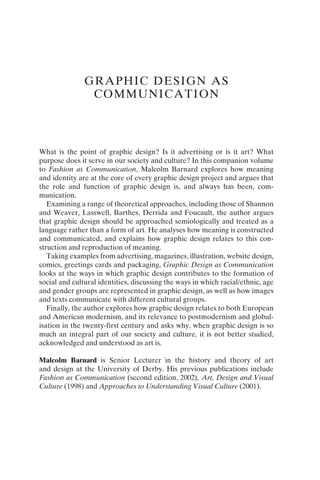




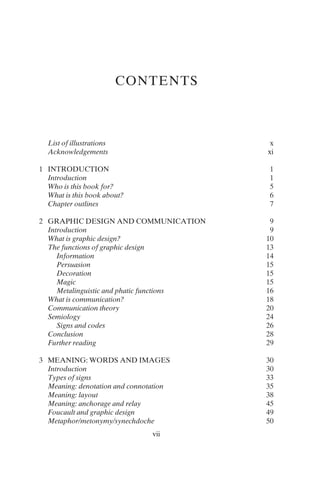
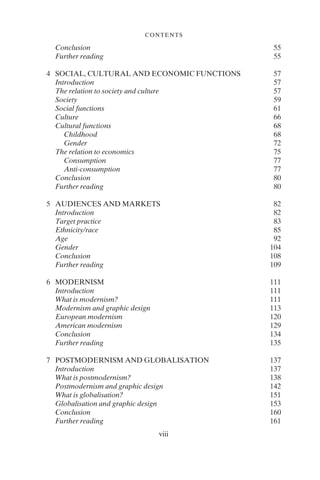
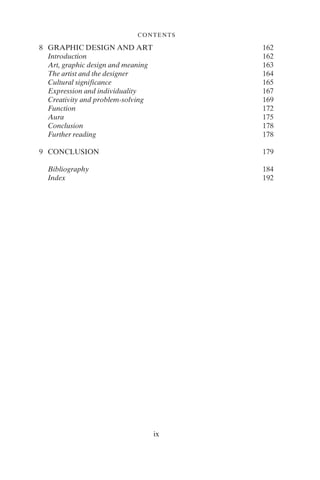

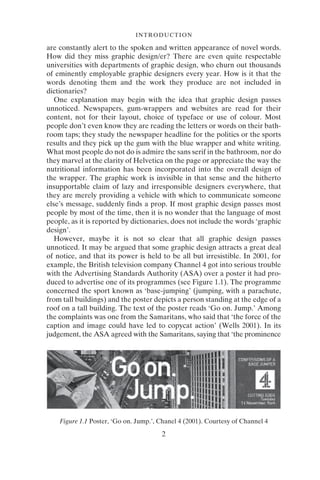
![GRAPHIC DESIGN AND COMMUNICATION
13
THE FUNCTIONS OF GRAPHIC DESIGN
The functions of graphic design may be approached from two directions.
There are the social, cultural and economic functions of graphic design ‘as a
whole’. And there are the functions of individual examples of graphic
design. The following sections will address the latter and Chapter 4 will
consider the former. Richard Hollis (1994: 9) proposes three basic functions
of examples of graphic design which, he says, have changed little over many
centuries. The first is ‘identification’: the role of graphics here is ‘to say
what something is, or where it came from’ (Hollis 1994: 10). Examples of
graphics performing this function include inn signs, heraldry, company
logos and labels on packaging. Hollis’s second function concerns ‘infor-
mation and instruction’ and the job of graphics here is to ‘indicate the
relationship of one thing to another in direction, position and scale’. Maps,
diagrams and direction signs are proposed as examples of graphics
performing these tasks. And the third function is that of ‘presentation and
promotion’ (Hollis 1994: 10). Posters and advertisements which aim to
catch a spectator’s eye and make the message ‘memorable’ are the
examples that Hollis supplies here.
Jacques Aumont also suggests there are three functions that graphic
images perform and that they are very old. He explains these functions as
the ‘symbolic’, the ‘epistemic’ and the ‘aesthetic’ (Aumont 1997: 54–5). In
symbolic images the image stands for, or represents, something else. The
something else might be a god, an idea or a cultural value and according to
Aumont (1997: 55), there is a ‘virtually endless’ number of such images.
These images may be religious or secular, but where they are religious they
are often believed to grant direct access to the realm of the sacred. Such
images may also be representational or abstract and they may be figurative
or non-figurative; images or personifications of Liberty, Charity, Christ,
Zeus or Buddha as well as abstract representations in the form of Christian
crosses, Hindu or Nazi swastikas and ancient Egyptian ankhs are therefore
understood to be symbolic in this sense. Epistemic images (from the ancient
Greek word for knowledge) are those which convey information about the
world and its contents. Such images may also be religious or secular; in both
stained glass windows and botanical illustrations, knowledge is communi-
cated. The nature of the information communicated by an epistemic image
can vary enormously and Aumont (1997) includes road maps, landscapes,
portraits and playing cards among his examples. Aesthetic images are those
‘intended to please the spectator [or] to produce in the spectator specific
sensations’ (Aumont 1997: 55) and Aumont suggests that this function has
become inseparable from the idea of art; that an image ‘aiming to produce
some aesthetic effect’ is taken automatically to be ‘art’. Ironically enough,
Aumont’s example of this phenomenon is advertising, a graphic product,
which he says strongly confuses the ‘artistic’ with the ‘aesthetic’.](https://image.slidesharecdn.com/5823043-250617100528-97c57d51/85/Graphic-Design-As-Communication-Barnard-Malcolm-30-320.jpg)
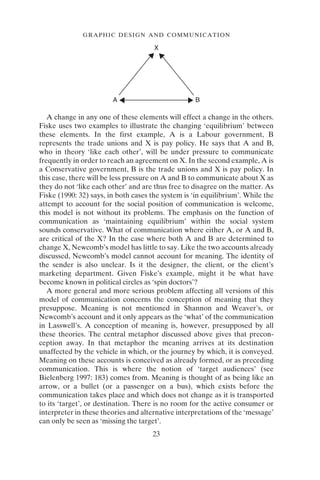
![THE INDEPENDENT
WHITEWASH?
THE HUTTON
REPORT
A SPECIAL ISSUE
(Republic or Ireland 1:0.9~1 6(1p
E
ight months ago, BBC reporter Andrew Gilligan broadcast his now infamous report casting doubt on
the Government's dossier on Iraq's weapons capability, a vital plank in its case for war. In the ensuing
furore between No 10 and the BBC,Government scientist David Kelly, who was revealed to be Gilligan's
source, was found dead in the woods. Tony Blair appointed Lord Hutton, a former Lord ChiefJustice
of Northern Ireland, to hold an inquiry into the circumstances surrounding Dr Kelly's death. He listened to 74
witnesses over 25 days, and yesterday published his 328-page reporl In it, he said Gilligan's assertions were
unfounded and criticised the BBC, whose chairman has now resigned. He said that Dr Kelly had broken the
rules goveruing civil servants in talking to journalists. He exonerated Tony Blair, cleared Alastair Campbell and
I
attached no blame to the government for the naming of Dr Kelly. So was this all an establishment
I] whitewash? And what of the central issue which Lord Hutton felt he could not address? If the
..:..c:::::..::=--,---1 September 2002 dossierwhich helped persuade the nation of the urgent need forwar (and triggered
::=:;-:::=:-:::-• this tragic chain ofevents) was indeed reliable,where, exactly, are Iraq's weapons of mass desbuction?
31
typography in advertising. The second part of John Hillis Miller’s (1992)
Illustration analyses many examples of the different ‘balance’ that may exist
between word and image; while drawing on this work, this chapter will
concentrate on a few key concepts.
So, having first explained the different types of sign, Chapter 3 will
consider the relation between meaning, words and images in the production
Figure 3.1 Newspaper front page, Independent (January 2004).
Courtesy of the Independent](https://image.slidesharecdn.com/5823043-250617100528-97c57d51/85/Graphic-Design-As-Communication-Barnard-Malcolm-48-320.jpg)

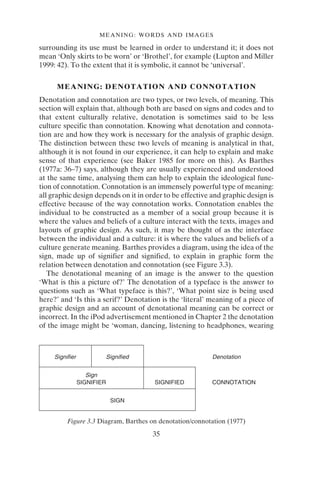
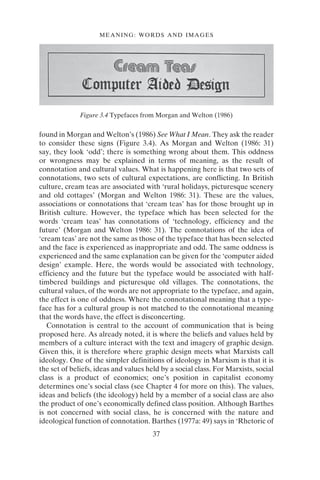


![CHAPTER XXXI
OUR MOTHER OF SORROWS
Micah vii. 7-20.
After so stern a charge, so condign a sentence, confession is natural,
and, with prayer for forgiveness and praise to the mercy of God, it
fitly closes the whole book. As we have seen,[916] the passage is a
cento of several fragments, from periods far apart in the history of
Israel. One historical allusion suits best the age of the Syrian wars;
another can only refer to the day of Jerusalem's ruin. In spirit and
language the Confessions resemble the prayers of the Exile. The
Doxology has echoes of several Scriptures.[917]
But from these fragments, it may be of many centuries, there rises
clear the One Essential Figure: Israel, all her secular woes upon her;
our Mother of Sorrows, at whose knees we learned our first prayers
of confession and penitence. Other nations have been our teachers
in art and wisdom and government. But she is our mistress in pain
and in patience, teaching men with what conscience they should
bear the chastening of the Almighty, with what hope and humility
they should wait for their God. Surely not less lovable, but only more
human, that her pale cheeks flush for a moment with the hate of the
enemy and the assurance of revenge. Her passion is soon gone, for
she feels her guilt to be greater; and, seeking forgiveness, her last
word is what man's must ever be, praise to the grace and mercy of
God.
Israel speaks:—](https://image.slidesharecdn.com/5823043-250617100528-97c57d51/85/Graphic-Design-As-Communication-Barnard-Malcolm-59-320.jpg)
![But I will look for the LORD,
I will wait for the God of my salvation:
My God will hear me!
Rejoice not, O mine enemy, at me:
If I be fallen, I rise;
If I sit in the darkness, the LORD is a light to me.
The anger of the LORD will I bear—
For I have sinned against Him—
Until that He take up my quarrel,
And execute my right.
He will carry me forth to the light;
I will look on His righteousness:
So shall mine enemy see, and shame cover her,
She that saith unto me, Where is Jehovah thy God?—
Mine eyes shall see her,
Now is she for trampling, like mire in the streets!
The prophet[918] responds:—
A day for the building of thy walls shall that day be!
Broad shall thy border be[919] on that day!
...[920]and shall come to thee
From Assyria unto Egypt, and from Egypt to the River,
And to Sea from Sea, and Mountain from Mountain;[921]
Though[922] the land be waste on account of her inhabitants,
Because of the fruit of their doings.
An Ancient Prayer:—
Shepherd Thy people with Thy staff,
The sheep of Thy heritage dwelling solitarily....[923]
May they pasture in Bashan and Gilead as in days of old!
As in the days when Thou wentest forth from the land of Miṣraim,
give us wonders to see!](https://image.slidesharecdn.com/5823043-250617100528-97c57d51/85/Graphic-Design-As-Communication-Barnard-Malcolm-60-320.jpg)
![FOOTNOTES:
[1] J. J. P. Valeton, jun., Amos en Hosea, 1894: quoted by
Budde in the Theologische Literaturzeitung, September, 1894.
[2] This date is very uncertain. It may have been 690, or
according to some 685.
[3] Including, of course, the historical books, Joshua to 2 Kings,
which were known as "the Former Prophets"; while what we call
the prophets Isaiah to Malachi were known as "the Latter."
[4] עשר תרי ספר, the Aramaic form of the Hebrew שנים עשר,
which appears with the other in the colophon to the book. A
later contraction is תריסר. This is the form transliterated in
Epiphanius: δαθαριασαρα.
[5] See Ryle, Canon of the O.T., p. 105.
[6] So Josephus, Contra Apion, i. 8 (circa 90 a.d.), reckons the
prophetical books as thirteen, of which the Minor Prophets
could only have been counted as one—whatever the other
twelve may have been. Melito of Sardis (c. 170), quoted by
Eusebius (Hist. Eccl., iv. 26), speaks of τῶν δώδεκα ἐν
μονοβίβλῳ. To Origen (c. 250: apud Ibid., vi. 25) they could
only have been one out of the twenty-two he gives for the O.T.
Cf. Jerome (Prolog. Galeatus), "Liber duodecim Prophetarum."](https://image.slidesharecdn.com/5823043-250617100528-97c57d51/85/Graphic-Design-As-Communication-Barnard-Malcolm-67-320.jpg)
![[7] Οἱ Δώδεκα Προφῆται: Jesus son of Sirach xlix. 10; Τὸ
δωδεκα-πρόφητον.
[8] Augustine, De Civ. Dei, xviii. 29: cf. Jerome, Proem. in
Esaiam.
[9] The German usage generally preserves the numeral, "Die
zwölf kleinen Propheten."
[10] See Vol. II. on Zech. ix. ff.
[11] Talmud: Baba Bathra, 14a: cf. Rashi's Commentary.
[12] Talmud, ibid.
[13] So the Codices Vaticanus and Alexandrinus, but not Cod.
Sin. So also Cyril of Jerusalem ( † 386), Athanasius (365),
Gregory Naz. († 390), and the spurious Canon of the Council of
Laodicea (c. 400) and Epiphanius (403). See Ryle, Canon of the
O.T., 215 ff.
[14] By a forced interpretation of the phrase in chap. i. 2, When
the Lord spake at the first by Hosea (R.V.), Talmud: Baba
Bathra, 14a.
[15] For further considerations on this point see pp. 142, 194,
202 ff., 223 ff., 308, etc.
[16] Psalm lxxiv. 9.
[17] Herodotus, viii. 36, 37.
[18] Timæus, 71, 72. The whole passage is worth transcribing:
—
"No man, when in his senses, attains prophetic truth and
inspiration; but when he receives the inspired word either his
intelligence is enthralled by sleep, or he is demented by some
distemper or possession. And he who would understand what
he remembers to have been said, whether in dream or when he](https://image.slidesharecdn.com/5823043-250617100528-97c57d51/85/Graphic-Design-As-Communication-Barnard-Malcolm-68-320.jpg)
![was awake, by the prophetic and enthusiastic nature, or what
he has seen, must recover his senses; and then he will be able
to explain rationally what all such words and apparitions mean,
and what indications they afford, to this man or that, of past,
present, or future, good and evil. But, while he continues
demented, he cannot judge of the visions which he sees or the
words which he utters; the ancient saying is very true that 'only
a man in his senses can act or judge about himself and his own
affairs.' And for this reason it is customary to appoint diviners or
interpreters as discerners of the oracles of the gods. Some
persons call them prophets; they do not know that they are
only repeaters of dark sayings and visions, and are not to be
called prophets at all, but only interpreters of prophecy."—
Jowett's Translation.
[19] Nik., i. 91.
[20] Phædrus, 262 D.
[21] It is still a controversy whether the original meaning of the
Semitic root KHN is prophet, as in the Arabic KâHiN, or priest,
as in the Hebrew KôHeN.
[22] Cf. Jer. ii. 10: For pass over to the isles of Chittim, and see;
and send unto Kedar, and consider diligently; and see if there
be such a thing. Hath a nation changed their gods? From the
isles of Chittim unto Kedar—the limits of the Semitic world.
[23] Numbers xxiv. 4, falling but having his eyes open. Ver. 1,
enchantments ought to be omens.
[24] Instanced by Wellhausen, Skizzen u. Vorarb., No. v.
[25] אלהים איש
[26] ֶאה
ֹר
[27] חֶזה](https://image.slidesharecdn.com/5823043-250617100528-97c57d51/85/Graphic-Design-As-Communication-Barnard-Malcolm-69-320.jpg)
![[28] Deut. xiii. 1 ff. admits that heathen seers were able to
work miracles and give signs, as well as the prophets of
Jehovah.
[29] Cf. Mesha's account of himself and Chemosh on the
Moabite Stone, with the narrative of the taking of Ai in the Book
of Joshua.
[30] Cf. Kuenen: Gesammelte Alhandlungen (trans. by Budde),
p. 461.
[31] So in Deborah's Song.
[32] 1 Sam. ix. 9.
[33] 1 Sam. x. 1-16, xi. 1-11, 15. Chap. x. 17-27, xi. 12-14,
belong to other and later documents. Cf. Robertson Smith, Old
Testament in the Jewish Church, 135 ff.
[34] 1 Sam. xix. 20-24.
[35] What seemed most to induce the frenzy of the dervishes
whom I watched was the fixing of their attention upon, the
yearning of their minds after, the love of God. "Ya
habeebi!"—"O my beloved!"—they cried.
[36] Cornill, in the first of his lectures on Der Israelitische
Prophetismus, one of the very best popular studies of prophecy,
by a master on the subject. See p. 73 n.
[37] It is now past doubt that these were two sacred stones
used for decision in the case of an alternative issue. This is plain
from the amended reading of Saul's prayer in 1 Sam. xiv. 41, 42
(after the LXX.): O Jehovah God of Israel, wherefore hast Thou
not answered Thy servant this day? If the iniquity be in me or in
Jonathan my son, O Jehovah God of Israel, give Urim: and if it
be in Thy people Israel, give, I pray Thee, Thummim.
[38] Hosea iii. 4. See next chapter, p. 38.](https://image.slidesharecdn.com/5823043-250617100528-97c57d51/85/Graphic-Design-As-Communication-Barnard-Malcolm-70-320.jpg)
![[39] Cf. Deut. xxviii. 34.
[40] 2 Sam. xii. 1 ff.
[41] 1 Kings xi. 29; xii. 22.
[42] 1 Kings xiv. 2, 7-11; xix. 15 f.; 2 Kings ix. 3 ff.
[43] 1 Kings xxii. 5 ff.; 2 Kings iii. 11 ff.
[44] 1 Kings xxi. 1 ff.
[45] 2 Kings vi.-viii., etc.
[46] 1 Kings xviii. 46; 2 Kings iii. 15.
[47] 3 Kings ix. 11. Mad fellow, not necessarily a term of
reproach.
[48] 1 Kings xviii. 4, cf. 19; 2 Kings ii. 3, 5; iv. 38-44; v. 20 ff.;
vi. 1 ff.; viii. 8 f., etc.
[49] 1 Kings xviii. 19; xxii. 6.
[50] So Elijah, 2 Kings i. 8: cf. John the Baptist, Matt. iii. 4.
[51] Hosea ix. 7.
[52] Jer. xxix. 26: Every man that is mad, and worketh himself
into prophecy (מתנבא, the same form as is used without moral
reproach in 1 Sam. x. 10 ff.).
[53] 1 Kings xxii.
[54] Amos vii. 12.
[55] He died in 798 or 797.
[56] 2 Kings x. 32, xiii. 20, 22.
[57] 2 Kings xiii. 14.
[58] vi. 12 ff., etc.](https://image.slidesharecdn.com/5823043-250617100528-97c57d51/85/Graphic-Design-As-Communication-Barnard-Malcolm-71-320.jpg)
![[59] viii., etc.
[60] xiii. 17 ff.
[61] 2 Kings xiii. 22-25.
[62] xiv. 28, if not Damascus itself.
[63] 2 Kings xv.: cf. 2 Chron. xxvi.
[64] xii. 7 (Heb. ver. 8). Trans., As for Canaan, the balances,
etc.
[65] Amos, passim. Hosea viii. 14, etc.; Micah iii. 12; Isa. ix. 10.
[66] ארמון, a word not found in the Pentateuch, Joshua,
Judges, or Samuel, is used in 1 Kings xvi. 18, 2 Kings xv. 25, for
a citadel within the palace of the king. Similarly in Isa. xxv. 2;
Pro. xviii. 19. But in Amos generally of any large or grand
house. That the name first appears in the time of Omri's
alliance with Tyre, points to a Phœnician origin. Probably from
root ארם, to be high.
[67] Isa. ix. 10.
[68] 1 Kings xii. 25 ff., and Amos and Hosea passim.
[69] Hosea v. 1.
[70] 1 Kings xviii. 30 ff.
[71] 1 Kings xii. 25.
[72] Originally so called from their elevation (though oftener on
the flank than on the summit of a hill); but like the name High
Street or the Scottish High Kirk, the term came to be
dissociated from physical height and was applied to any
sanctuary, even in a hollow, like so many of the sacred wells.
[73] The sanctuary itself was probably on the present site of
the Burj Beitin (with the ruins of an early Christian Church),](https://image.slidesharecdn.com/5823043-250617100528-97c57d51/85/Graphic-Design-As-Communication-Barnard-Malcolm-72-320.jpg)
![some few minutes to the south-east of the present village of
Beitin, which probably represents the city of Bethel that was
called Luz at the first.
[74] 1 Kings xii. 25 ff.; Amos vii.
[75] Amos iv. 4.
[76] Amos vii. 13.
[77] 1 Kings xii. 25 ff.
[78] Curiously enough conceived by many of the early Christian
Fathers as containing the second of the calves. Cyril, Comm. in
Hoseam, 5; Epiph., De Vitis Proph., 237; Chron. Pasc., 161.
[79] Josh. iv. 20 ff., v. 2 ff.; 1 Sam. xi. 14, 15, etc.; 2 Sam. xix.
15, 40. This Gilgal by Jericho fell to N. Israel after the
Disruption; but there is nothing in Amos or Hosea to tell us,
whether it or the Gilgal near Shiloh, which seems to have
absorbed the sanctity of the latter, is the shrine which they
couple with Bethel—except that they never talk of "going up" to
it. The passage from Epiphanius in previous note speaks of the
Gilgal with the calf as the "Gilgal which is in Shiloh."
[80] Site uncertain. See Hist. Geog., pp. 579, 586.
[81] Amos ix. 3. But cf. i. 2.
[82] 2 Kings xii. 28.
[83] See above, p. 37, n. 78.
[84] The Ephod, the plated thing; presumably a wooden image
covered either with a skin of metal or a cloak of metal. The
Teraphim were images in human shape.
[85] The menhir of modern Palestine—not a hewn pillar, but
oblong natural stone narrowing a little towards the top (cf. W.
R. Smith, Religion of the Semites, 183-188). From Hosea x. 1,](https://image.slidesharecdn.com/5823043-250617100528-97c57d51/85/Graphic-Design-As-Communication-Barnard-Malcolm-73-320.jpg)
![2, it would appear that the maççeboth of the eighth century
were artificial. They make good maççeboth (A.V. wrongly
images).
[86] So indeed Hosea iii. 4 implies. The Asherah, the pole or
symbolic tree of Canaanite worship, does not appear to have
been used as a part of the ritual of Jehovah's worship. But, that
there was constantly a temptation so to use it, is clear from
Deut. xvi. 21, 22. See Driver on that passage.
[87] See below, p. 99.
[88] Amos iv. 4 ff.
[89] Amos vii. 4: cf. 2 Kings v. 23.
[90] Amos iv. 4 f.
[91] See below, p. 185.
[92] But whether these be by Amos see Chap. XI.
[93] Isa ix. 10.
[94] "The house of Omri": so even in Sargon's time, 722-705.
[95] The Black Obelisk of Salmanassar in the British Museum,
on which the messengers of Jehu are portrayed.
[96] 2 Kings x. 32 f.; xiii. 3.
[97] 2 Kings xiii. 14 ff.
[98] The phrase in 2 Kings xiii. 5, Jehovah gave Israel a saviour,
is interpreted by certain scholars as if the saviour were Assyria.
In xiv. 27 he is plainly said to be Jeroboam.
[99] The entering in of Hamath (2 Kings xiv. 25).
[100] Salmanassar II. in 850, 849, 846 to war against Dad'idri
of Damascus, and in 842 and 839 against Hazael, his successor.](https://image.slidesharecdn.com/5823043-250617100528-97c57d51/85/Graphic-Design-As-Communication-Barnard-Malcolm-74-320.jpg)
![[101] See in this series Isaiah, Vol. I., pp. 359 ff.
[102] See above, pp. 35 ff.
[103] To use the term which Amos adopts with such ironical
force: vi. 14.
[104] When we get down among the details we shall see clear
evidence for this fact, for instance, that Amos prophesied
against Israel at a time when he thought that the Lord's anger
was to be exhausted in purely natural chastisements of His
people, and before it was revealed to him that Assyria was
required to follow up these chastisements with a heavier blow.
See Chap. VI., Section 2.
[105] That is, of course, not the Nile, but the great Wady, at
present known as the Wady el 'Arish, which divides Palestine
from Egypt.
[106] So already in the JE narratives of the Pentateuch.
[107] Lecky: History of European Morals, I.
[108] The present writer has already pointed out this with
regard to Egypt and Phœnicia in Isaiah (Expositor's Bible
Series), I., Chaps. XXII. and XXIII., and with regard to Philistia
in Hist. Geog., p. 178.
[109] I put it this way only for the sake of making the logic
clear; for it is a mistake to say that the prophets at any time
held merely theoretic convictions. All their conviction was really
experimental—never held apart from some illustration or proof
of principle in actual history.
[110] צבאות יהוה: 1 Sam. i. 3; iv. 4; xvii. 45, where it is
explained by the parallel phrase God of the armies of Israel; 2
Sam. vi. 2, where it is connected with Israel's battle emblem,
the Ark (cf. Jer. xxii. 18); and so throughout Samuel and Kings,
and also Chronicles, the Psalms, and most prophets. The plural](https://image.slidesharecdn.com/5823043-250617100528-97c57d51/85/Graphic-Design-As-Communication-Barnard-Malcolm-75-320.jpg)
![צבאות is never used in the Old Testament except of human
hosts, and generally of the armies or hosts of Israel. The theory
therefore which sees the same meaning in the Divine title is
probably the correct one. It was first put forward by Herder
(Geist der Eb. Poesie, ii. 84, 85), and after some neglect it has
been revived by Kautzsch (Z. A. T. W., vi. ff.) and Stade (Gesch.,
i. 437, n. 3). The alternatives are that the hosts originally meant
those of heaven, either the angels (so, among others, Ewald,
Hist., Eng. Ed., iii. 62) or the stars (so Delitzsch, Kuenen,
Baudissin, Cheyne, Prophecies of Isaiah, i. 11). In the former of
these two there is some force; but the reason given for the
latter, that the name came to the front in Israel when the
people were being drawn into connection with star-worshipping
nations, especially Aram, seems to me baseless. Israel had not
been long in touch with Aram in Saul's time, yet even then the
name is accepted as if one of much earlier origin. A clear
account of the argument on the other side to that taken in this
note will be found in Smend, Altiestamentliche
Religionsgeschichte, pp. 185 ff.
[111] See below, Chap. XI.
[112] The full list of suspected passages is this: (1) References
to Judah—ii. 4, 5; vi. 1, in Zion; ix. 11, 12. (2) The three
Outbreaks of Praise—iv. 13; v. 8, 9; ix. 5, 6. (3) The Final Hope
—ix. 8-15, including vv. 11, 12, already mentioned. (4) Clauses
alleged to reflect a later stage of history—i. 9-12; v. 1, 2, 15; vi.
2, 14. (5) Suspected for incompatibility—viii. 11-13.
[113] So designated to distinguish him from the first Jeroboam,
the son of Nebat.
[114] Apart from the suspected parentheses already mentioned.
[115] Chap. vii.
[116] And, if vi. 2 be genuine, Hamath.](https://image.slidesharecdn.com/5823043-250617100528-97c57d51/85/Graphic-Design-As-Communication-Barnard-Malcolm-76-320.jpg)
![[117] 2 Chron. xxvi. 6. In the list of the Philistine cities, Amos i.
6-8, Gath does not occur, and in harmony with this in vi. 2 it is
said to be overthrown; see pp. 173 f.
[118] 2 Kings. In Amos ii. 3 the ruler of Moab is called, not
king, but ׁשופט, or regent, such as Jeroboam substituted for the
king of Moab.
[119] According to Grätz's emendation of vi. 13: we have taken
Lo-Debar and Karnaim. Perhaps too in iii. 12, though the verse
is very obscure, some settlement of Israelites in Damascus is
implied. For Jeroboam's conquest of Aram (2 Kings xiv. 28), see
p. 177.
[120] In 775 to Erini, "the country of the cedars"—that is,
Mount Amanus, near the Gulf of Antioch; in 773 to Damascus;
in 772 to Hadrach.
[121] vi. 1.
[122] vii. 9.
[123] Even König denies that the title is from Amos (Einleitung,
307); yet the ground on which he does so, the awkwardness of
the double relative, does not appear sufficient. One does not
write a title in the same style as an ordinary sentence.
[124] Zech. xiv. 5, and probably Isa. ix. 9, 10 (Eng.).
[125] iv. 11.
[126] Of course it is always possible to suspect—and let us by
all means exhaust the possibilities of suspicion—that the title
has been added by a scribe, who interpreted the forebodings of
judgment which Amos expresses in the terms of earthquake as
if they were the predictions of a real earthquake, and was
anxious to show, by inserting the title, how they were fulfilled in
the great convulsion of Uzziah's days. But to such a suspicion
we have a complete answer. No later scribe, who understood](https://image.slidesharecdn.com/5823043-250617100528-97c57d51/85/Graphic-Design-As-Communication-Barnard-Malcolm-77-320.jpg)
![the book he was dealing with, would have prefixed to it a title,
with the motive just suspected, when in chap. iv. he read that
an earthquake had just taken place. The very fact that such a
title appears over a book, which speaks of the earthquake as
past, surely attests the bona fides of the title. With that mention
in chap. iv. of the earthquake as past, none would have
ventured to say that Amos began to prophesy before the
earthquake unless they had known this to be the case.
[127] Except for the later additions, not by Amos, to be
afterwards noted.
[128] Cf. ii. 13; v. 11.; vi. 8, 10; vii. 9, 16; viii. 8 (?).
[129] See below, p. 221.
[130] Cornill: Der Israelitische Prophetismus. Five Lectures for
the Educated Laity. 1894.
[131] Amos vii. 14. See further pp. 76 f.
[132] Khurbet Taḳûa', Hebrew Teḳôa', וֹקעְּת, from תקע, to blow
a trumpet (cf. Jer. vi. 1, Blow the trumpet in Tekoa) or to pitch a
tent. The latter seems the more probable derivation of the
name, and suggests a nomadic origin, which agrees with the
position of Tekoa on the borders of the desert. Tekoa does not
occur in the list of the towns taken by Joshua. There are really
no reasons for supposing that some other Tekoa is meant. The
two that have been alleged are (1) that Amos exclusively refers
to the Northern Kingdom, (2) that sycomores do not grow at
such levels as Tekoa. These are dealt with on pp. 79 and 77
respectively.
[133] 2 Chron. xx. 20.
[134] ֹנֵקד, nôḳêd, is doubtless the same as the Arabic
"naḳḳâd," or keeper of the "naḳad," defined by Freytag as a
short-legged and deformed race of sheep in the Bahrein
province of Arabia, from which comes the proverb "viler than a](https://image.slidesharecdn.com/5823043-250617100528-97c57d51/85/Graphic-Design-As-Communication-Barnard-Malcolm-78-320.jpg)
![naḳad"; yet the wool is very fine. The king of Moab is called
נֹוֵקד in 2 Kings iii. 4 (A.V. sheep-master). In vii. 14 Amos calls
himself ּבֹוֵקר, cattleman, which there is no reason to alter, as
some do, to וֹנֵקד.
[135] וֹּבֵלס, bôlês, probably from a root (found in Æthiopic)
balas, a fig; hence one who had to do with figs, handled them,
ripened them.
[136] The Egyptian sycomore, Ficus sycomorus, is not found in
Syria above one thousand feet above the sea, while Tekoa is
more than twice as high as that. Cf. 1 Kings x. 27, the
sycomores that are in the vale or valley land, 1 ;ֵעֶמק Chron.
xxvii. 28, the sycomores that are in the low plains. "The
sycamore grows in sand on the edge of the desert as vigorously
as in the midst of a well-watered country. Its roots go deep in
search of water, which infiltrates as far as the gorges of the
hills, and they absorb it freely even where drought seems to
reign supreme" (Maspero on the Egyptian sycomore; The Dawn
of Civilization, translated by McClure, p. 26). "Everywhere on
the confines of cultivated ground, and even at some distance
from the valley, are fine single sycamores flourishing as though
by miracle amid the sand.... They drink from water, which has
infiltrated from the Nile, and whose existence is nowise
betrayed upon the surface of the soil" (ib., 121). Always and
still reverenced by Moslem and Christian.
[137] So practically Oort (Th. Tjidsch., 1891, 121 ff.), when
compelled to abandon his previous conclusion (ib., 1880, 122
ff.) that the Tekoa of Amos lay in Northern Israel.
[138] In 1891 we met the Rushaideh, who cultivate Engedi,
encamped just below Tekoa. But at other parts of the borders
between the hill-country of Judæa and the desert, and between
Moab and the desert, we found round most of the herdsmen's
central wells a few fig-trees or pomegranates, or even apricots
occasionally.](https://image.slidesharecdn.com/5823043-250617100528-97c57d51/85/Graphic-Design-As-Communication-Barnard-Malcolm-79-320.jpg)
![[139] Luke i. 80.
[140] Mark i. 18.
[141] v. 5; viii. 14.
[142] See p. 36.
[143] Prov. xxxi. 24.
[144] vi. 10.
[145] i. 9.
[146] v. 16.
[147] v. 21 ff.
[148] li. 7, 8.
[149] viii. 4 ff.
[150] vi. 1, 4-7.
[151] See pp. 136 f.
[152] i. 2.
[153] ׁשופר, as has been pointed out, means in early Israel
always the trumpet blown as a summons to war; only in later
Israel was the name given to the temple trumpet.
[154] See further on this important passage pp. 89 ff.
[155] Shall a little bird fall on the snare earthwards and there
be no noose about her? Shall a snare rise from the ground and
not be taking something? On this see p. 82. Its meaning seems
to be equivalent to the Scottish proverb: "There's aye some
water whan the stirkie droons."
[156] There is thus no reason to alter the words who shall not
prophesy to who shall not tremble—as Wellhausen does. To do](https://image.slidesharecdn.com/5823043-250617100528-97c57d51/85/Graphic-Design-As-Communication-Barnard-Malcolm-80-320.jpg)
![so is to blunt the point of the argument.
[157] See Chap. IV.
[158] See pp. 53 ff.
[159] See pp. 69 f.
[160] viii. 8.
[161] viii. 9.
[162] v. 14.
[163] How far Assyria assisted the development of prophecy we
have already seen. But we have been made aware, at the same
time, that Assyria's service to Israel in this respect presupposed
the possession by the prophets of certain beliefs in the
character and will of their God, Jehovah. The prophets' faith
could never have risen to the magnitude of the new problems
set to it by Assyria if there had not been already inherent in it
that belief in the sovereignty of a Righteousness of which all
things material were but the instruments.
[164] Compare, for instance, Hosea's condemnation of Jehu's
murder of Joram, with Elisha's command to do it; also 2 Kings
iii. 19, 25, with Deut. xx. 19.
[165] See above, p. 10.
[166] Isa. xxviii.
[167] Amos ii.
[168] Ante, p. 74.
[169] i. 2.
[170] Therefore we see at a glance how utterly inadequate is
Renan's brilliant comparison of Amos to a modern revolutionary
journalist (Histoire du Peuple Israel, II.). Journalist indeed! How](https://image.slidesharecdn.com/5823043-250617100528-97c57d51/85/Graphic-Design-As-Communication-Barnard-Malcolm-81-320.jpg)
![all this would-be cosmopolitan and impartial critic's judgments
smack of the boulevards!
[171] Exod. xx.; incorporated in the JE book of history, and,
according to nearly all critics, complete by 750; the contents
must have been familiar in Israel long before that. There is no
trace in Amos of any influence peculiar to either the
Deuteronomic or the Levitical legislation.
[172] See especially Schultz, O. T. Theol., Eng. Trans. by
Paterson, I. 214.
[173] ii. 9-11. On this passage see further p. 137.
[174] If iv. 13, v. 8 and ix. 6 be genuine, this remark equally
applies to belief in Jehovah as Creator.
[175] Kayser, Old Testament Theology.
[176] v. 6, 14.
[177] See above, p. 18.
[178] iii. 2.
[179] v. 21 ff.
[180] Jer. vii. 22 f.
[181] See above, p. 23.
[182] v. 21-23.
[183] vi. 8.
[184] ix. 8
[185] viii. 7.
[186] Chap. V., p. 71.
[187] vii. 11.](https://image.slidesharecdn.com/5823043-250617100528-97c57d51/85/Graphic-Design-As-Communication-Barnard-Malcolm-82-320.jpg)
![[188] On the ministry of eighth-century prophets to the people
see the author's Isaiah, I., p. 119.
[189] So LXX., followed by Hitzig and Wellhausen, by reading
ֵיֶצר for וֹיֵצר.
[190] Cf. Hist. Geography of the Holy Land, pp. 64 ff. The word
translated spring crop above is לקש, and from the same root as
the name of the latter rain, ַמְלוֹקׁש, which falls in the end of
March or beginning of April. Cf. Zeitschrift des deutschen
Palästina-Vereins, IV. 83; VIII. 62.
[191] Cf. 1 Kings xviii. 5 with 1 Sam. vii. 15, 17; 1 Kings iv. 7 ff.
See Robertson Smith, Religion of the Semites, 228.
[192] LXX.: Who shall raise up Jacob again?
[193] So Professor A. B. Davidson. But the grammar might
equally well afford the rendering one calling that the Lord will
punish with the fire, the ל of לריב marking the introduction of
indirect speech (cf. Ewald, § 338a). But Hitzig for קרא reads
קרה (Deut. xxv. 18), to occur, happen. So similarly Wellhausen,
es nahte sich zu strafen mit Feuer der Herr Jahve. All these
renderings yield practically the same meaning.
[194] A. B. Davidson, Syntax, § 57, Rem. 1.
[195] i. 19 f.
[196] Cf. Micah ii. 3. ֵחֶלק is the word used, and according to
the motive given above stands well for the climax of the fire's
destructive work. This meets the objection of Wellhausen, who
proposes to omit ֵחֶלק, because the heat does not dry up first
the great deep and then the fields (Ackerflur). This is to mistake
the obvious point of the sentence. The drought was so great
that, after the fountains were exhausted, it seemed as if the
solid framework of the land, described with very apt pathos as
the Portion, would be the next to disappear. Some take הלק as
divided, therefore cultivated, ground.](https://image.slidesharecdn.com/5823043-250617100528-97c57d51/85/Graphic-Design-As-Communication-Barnard-Malcolm-83-320.jpg)
![[197] So for instance, Von Orelli.
[198] Chap. iv.
[199] See Chap. IV., p. 51.
[200] Literally of the plummet, an obscure expression. It cannot
mean plumb-straight, for the wall is condemned.
[201] 2 Kings xxi. 13: I will stretch over Jerusalem the line of
Samaria and the plummet or weight ()ִמְׁשֹקֶלת of the house of
Ahab. Isa. xxxiv. 11: He shall stretch over it the cord of
confusion, and the weights (literally stones) of emptiness.
[202] John xix. 12.
[203] The word seer is here used in a contemptuous sense, and
has therefore to be translated by some such word as visionary.
[204] Literally eat.
[205] ַמְמָלָכה —ֵּביתthat is, a central or capital sanctuary. Cf.
ִעיר ַהַּמְמָלָכה (1 Sam. xxvii. 5), city of the kingdom, i.e. chief or
capital town.
[206] 1 Kings xii. 26, 27.
[207] Prophet and prophet's son are equivalent terms, the latter
meaning one of the professional guilds of prophets. There is no
need to change herdsman, בוקר, as Wellhausen does, into
נוקד, shepherd, the word used in i. 1.
[208] Cf. Wellhausen, Hist., Eng. Ed., § 6: "Amos was the
founder and the purest type of a new order of prophecy."
[209] As is done in chap. vi. 2, ix. 7.
[210] So against Israel in chap. iv.
[211] So Isa. v. 25: נטויה ידו ועוד אפו שב לא Cf. Ezek. xx. 22:
ידי את והשיבותי](https://image.slidesharecdn.com/5823043-250617100528-97c57d51/85/Graphic-Design-As-Communication-Barnard-Malcolm-84-320.jpg)
![[212] פׁשעים
[213] Called lûh, i.e. slab.
[214] These Syrian campaigns in Gilead must have taken place
between 839 and 806, the long interval during which Damascus
enjoyed freedom from Assyrian invasion.
[215] 2 Kings viii. 12; xiii. 7: cf. above, p. 31.
[216] He delivered them into the hand of Hazael king of Aram,
and into the hand of Ben-Hadad the son of Hazael, continually
(2 Kings xiii. 3).
[217] No need here to render prince, as some do.
[218] So the LXX.
[219] The present Baalbek (Baal of the Beḳ'a?). Wellhausen
throws doubt on the idea that Heliopolis was at this time an
Aramean town.
[220] ix. 7.
[221] Doughty: Arabia Deserta, I. 335.
[222] On the close connection of Edom and Gaza see Hist.
Geog., pp. 182 ff.
[223] See Hist. Geog., pp. 194 ff. Wellhausen thinks Gath was
not yet destroyed, and quotes vi. 2; Micah i. 10, 14. But we
know that Hazael destroyed it, and that fact, taken in
conjunction with its being the only omission here from the five
Philistine towns, is evidence enough. In the passages quoted by
Wellhausen there is nothing to the contrary: vi. 2 implies that
Gath has fallen; Micah i. 10 is the repetition of an old proverb.
[224] Farrar, 53; Pusey on ver. 9; Pietschmann, Geschichte der
Phönizier, 298.](https://image.slidesharecdn.com/5823043-250617100528-97c57d51/85/Graphic-Design-As-Communication-Barnard-Malcolm-85-320.jpg)