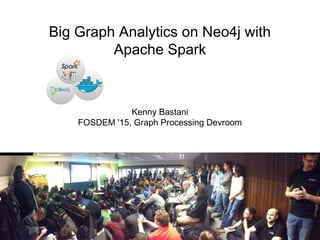
Big Graph Analytics on Neo4j with
Apache Spark
Kenny Bastani
FOSDEM '15, Graph Processing Devroom
My background
Second year speaking in the graph devroom
Extremely thankful for all the organizers of this
devroom have done for this technology
Thank you organizers!
I apologize in advance for these
incredibly low-budget slides
Engineer + Evangelism
I evangelize about Neo4j and graph database
technology
I am an engineer at Digital Insight, a Silicon Valley
based SaaS banking platform provider.
Engineering
NCR/Digital Insight
$18 Trillion per year in ATM withdrawals
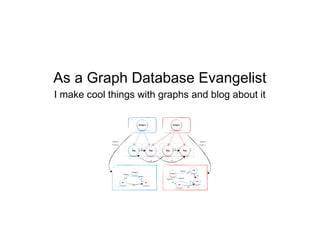
As a Graph Database Evangelist
I make cool things with graphs and blog about it
Just so we're clear…
I'm not selling you anything today
Agenda
Let's try and have some fun.
We're going to run PageRank on all human knowledge.
After a lot of low-budget slides.
The Problem
It's hard to analyze graphs at scale
The importance of graph algorithms
PageRank gave us Google
Friend of a friend gave us Facebook
Every hacker and tinkerer should be
able to turn world changing ideas into a
reality
Every research scientist who needs
graph analytics to save millions of lives
should have that power
The simple fact is that you are brilliant
but your brilliant ideas require complex
big data analytics
So then you need to learn a lot of
things or steal a lot of money to change
the world
Why is it so hard to do this stuff?
Enemy #1:
Relational Databases
Relational databases store data in ways that make it
difficult to extract graphs for analysis
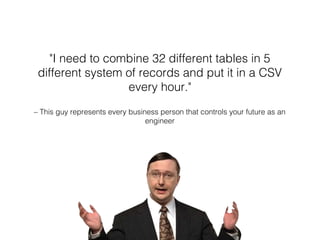
– This guy represents every business person that controls your future as an
engineer
"I need to combine 32 different tables in 5
different system of records and put it in a CSV
every hour."
You're probably thinking…
Sorry business, no PageRank for you!
But you courageously move forward
regardless
This is what is likely to happen next.
Enemy #2:
Big Data
If you still think Big Data is a buzz word
You haven't had to feel the pain of failing at it.
When you hit a wall because your data is
too big
You start to see what this big data thing is all about.
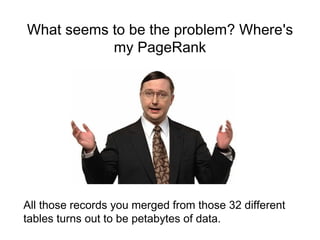
What seems to be the problem? Where's
my PageRank
All those records you merged from those 32 different
tables turns out to be petabytes of data.
Frantic and scared
You turn to your most dependable friend
You might search for a
Now that you know that Big Data is the
real deal
You read "Big Data for Dummies" and continue to
tackle the PageRank problem
Distributed File Systems
Distributed file systems are a foundational component
of big data analytics
Chops things into manageable sized blocks, usually
64mb
Spreads those blocks out across a cluster of VM
resources
Hadoop MapReduce
Worth mentioning, Hadoop started this whole
MapReduce craze
You could translate the raw data from a CSV and turn
it into a map of keys to values
Keys are distributed per node and used to reduce the
values into a partitioned analysis
Ok so now you know about Big Data,
Hadoop, HDFS
You fire up your Amazon EC2 Hadoop cluster...
This guy is still waiting…
You hold your breath..
And submit the PageRank job…
You wait…
3 hours later…
Out of memory: heap space exceeded!
It must be the configs
You check the configs
Increase the heap space
Do some Stackoverflow trolling
And you submit the PageRank job again…
Graph algorithms can be evil at scale
It depends on the complexity of your graph
How many strongly connected components you have
But since some graph algorithms like PageRank are
iterative
You have to iterate from one stage and use the results
of the previous stage
It doesn't matter how many nodes you
have in your cluster
For iterative graph algorithms the complexity of the
graph will make you or break you
Graphs with high complexity need a lot of memory to
be processed iteratively
This guy is going to have to settle for
collaborative filtering
Neo4j Mazerunner Project
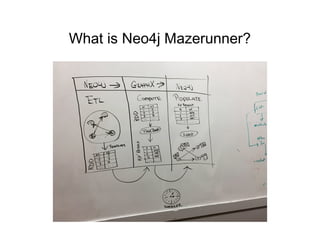
What is Neo4j Mazerunner?
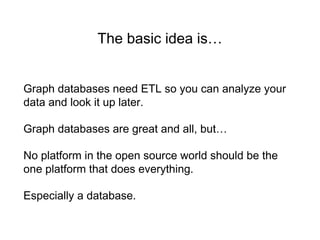
The basic idea is…
Graph databases need ETL so you can analyze your
data and look it up later.
Graph databases are great and all, but…
No platform in the open source world should be the
one platform that does everything.
Especially a database.
Docker
If you're not up on Docker, let me give you a quick
intro.
Docker
Docker is a VM framework that lets you easily create a
recipe for an image and deploy applications with ease.
The idea is that infrastructure and operational
complexity makes it hard for agile development of new
products.
Why?
If I am an engineer on a product team, I want to
choose my own software libraries and languages to
solve problems.
Microservices for the win
So here is the future of software development:
• Cloud OS like Apache Mesos manages datacenter
resources
• If you build a new service, use whatever application
framework you want. As long as you communicate
over REST.
Microservices cont.
Docker gives you the freedom to use Neo4j, or
OrientDB, or MongoDB or whatever application
dependency you want inside your container.
Because of something called graceful degradation, if
OrientDB or Neo4j fail at being everything, they'll fault
only within their container and not bring your entire
SaaS platform to its knees.
Beware of the monolith…
Monolithic apps are those software platforms that just
try and do every possible damn thing. They're like
Swiss army knives of the software world.
If you rely on one service to do everything, your entire
platform is going to come down when it fails.
And it will fail…
Docker cont.
Summarizing:
• Docker containerizes your bad engineering
decisions without bringing down your platform.
• So I'm pretty much a fan of that.
So is this guy…
Mazerunner runs on Docker
You can pull it down and deploy it safely and roll the
dice on some awesome analytics capabilities that lend
well to graph data models.
HDFS and Apache Spark
Apache Spark is a really interesting open source
project.
It is a scalable big data and machine learning platform.
It also lets you do in-memory analytics on a graph
dataset.
So I wrote the world's first analysis
service for a graph database that does
2-way ETL
That scared a lot of people in the
"graph databases are infallible" club
Analysis is not a lookup
Analytics on graphs takes massive amounts of
system resources and might bring down your OLTP
capabilities as it competes to share system
resources
Now let's fire up Neo4j Mazerunner
Demo Goals:
• I will hopefully be successful at showing you how
to install Mazerunner on Docker
• I will demo you an analysis job scheduler that
extracts subgraphs, analyzes them, and pops the
results back to Neo4j
Where do we go now?
Become a committer to the project and let's make it better
Find the link on my blog — www.kennybastani.com
Thanks!
Follow me on Twitter:
http://www.twitter.com/kennybastani

Big Graph Analytics on Neo4j with Apache Spark

  • 1.
    Big Graph Analyticson Neo4j with Apache Spark Kenny Bastani FOSDEM '15, Graph Processing Devroom
  • 2.
    My background Second yearspeaking in the graph devroom Extremely thankful for all the organizers of this devroom have done for this technology Thank you organizers!
  • 3.
    I apologize inadvance for these incredibly low-budget slides
  • 4.
    Engineer + Evangelism Ievangelize about Neo4j and graph database technology I am an engineer at Digital Insight, a Silicon Valley based SaaS banking platform provider.
  • 5.
  • 6.
    As a GraphDatabase Evangelist I make cool things with graphs and blog about it
  • 7.
    Just so we'reclear… I'm not selling you anything today
  • 8.
    Agenda Let's try andhave some fun. We're going to run PageRank on all human knowledge. After a lot of low-budget slides.
  • 9.
    The Problem It's hardto analyze graphs at scale
  • 10.
    The importance ofgraph algorithms PageRank gave us Google Friend of a friend gave us Facebook
  • 11.
    Every hacker andtinkerer should be able to turn world changing ideas into a reality
  • 12.
    Every research scientistwho needs graph analytics to save millions of lives should have that power
  • 13.
    The simple factis that you are brilliant but your brilliant ideas require complex big data analytics
  • 14.
    So then youneed to learn a lot of things or steal a lot of money to change the world
  • 15.
    Why is itso hard to do this stuff?
  • 16.
    Enemy #1: Relational Databases Relationaldatabases store data in ways that make it difficult to extract graphs for analysis
  • 17.
    – This guyrepresents every business person that controls your future as an engineer "I need to combine 32 different tables in 5 different system of records and put it in a CSV every hour."
  • 18.
  • 19.
    Sorry business, noPageRank for you!
  • 20.
    But you courageouslymove forward regardless This is what is likely to happen next.
  • 21.
    Enemy #2: Big Data Ifyou still think Big Data is a buzz word You haven't had to feel the pain of failing at it.
  • 22.
    When you hita wall because your data is too big You start to see what this big data thing is all about.
  • 23.
    What seems tobe the problem? Where's my PageRank All those records you merged from those 32 different tables turns out to be petabytes of data.
  • 24.
    Frantic and scared Youturn to your most dependable friend
  • 25.
  • 26.
    Now that youknow that Big Data is the real deal You read "Big Data for Dummies" and continue to tackle the PageRank problem
  • 27.
    Distributed File Systems Distributedfile systems are a foundational component of big data analytics Chops things into manageable sized blocks, usually 64mb Spreads those blocks out across a cluster of VM resources
  • 28.
    Hadoop MapReduce Worth mentioning,Hadoop started this whole MapReduce craze You could translate the raw data from a CSV and turn it into a map of keys to values Keys are distributed per node and used to reduce the values into a partitioned analysis
  • 29.
    Ok so nowyou know about Big Data, Hadoop, HDFS You fire up your Amazon EC2 Hadoop cluster...
  • 30.
    This guy isstill waiting…
  • 31.
    You hold yourbreath.. And submit the PageRank job… You wait…
  • 32.
    3 hours later… Outof memory: heap space exceeded!
  • 33.
    It must bethe configs You check the configs Increase the heap space Do some Stackoverflow trolling And you submit the PageRank job again…
  • 34.
    Graph algorithms canbe evil at scale It depends on the complexity of your graph How many strongly connected components you have But since some graph algorithms like PageRank are iterative You have to iterate from one stage and use the results of the previous stage
  • 35.
    It doesn't matterhow many nodes you have in your cluster For iterative graph algorithms the complexity of the graph will make you or break you Graphs with high complexity need a lot of memory to be processed iteratively
  • 36.
    This guy isgoing to have to settle for collaborative filtering
  • 37.
  • 38.
    What is Neo4jMazerunner?
  • 39.
    The basic ideais… Graph databases need ETL so you can analyze your data and look it up later. Graph databases are great and all, but… No platform in the open source world should be the one platform that does everything. Especially a database.
  • 40.
    Docker If you're notup on Docker, let me give you a quick intro.
  • 41.
    Docker Docker is aVM framework that lets you easily create a recipe for an image and deploy applications with ease. The idea is that infrastructure and operational complexity makes it hard for agile development of new products.
  • 42.
    Why? If I aman engineer on a product team, I want to choose my own software libraries and languages to solve problems.
  • 43.
    Microservices for thewin So here is the future of software development: • Cloud OS like Apache Mesos manages datacenter resources • If you build a new service, use whatever application framework you want. As long as you communicate over REST.
  • 44.
    Microservices cont. Docker givesyou the freedom to use Neo4j, or OrientDB, or MongoDB or whatever application dependency you want inside your container. Because of something called graceful degradation, if OrientDB or Neo4j fail at being everything, they'll fault only within their container and not bring your entire SaaS platform to its knees.
  • 45.
    Beware of themonolith… Monolithic apps are those software platforms that just try and do every possible damn thing. They're like Swiss army knives of the software world. If you rely on one service to do everything, your entire platform is going to come down when it fails. And it will fail…
  • 46.
    Docker cont. Summarizing: • Dockercontainerizes your bad engineering decisions without bringing down your platform. • So I'm pretty much a fan of that.
  • 47.
    So is thisguy…
  • 48.
    Mazerunner runs onDocker You can pull it down and deploy it safely and roll the dice on some awesome analytics capabilities that lend well to graph data models.
  • 49.
    HDFS and ApacheSpark Apache Spark is a really interesting open source project. It is a scalable big data and machine learning platform. It also lets you do in-memory analytics on a graph dataset.
  • 50.
    So I wrotethe world's first analysis service for a graph database that does 2-way ETL
  • 51.
    That scared alot of people in the "graph databases are infallible" club
  • 52.
  • 53.
    Analytics on graphstakes massive amounts of system resources and might bring down your OLTP capabilities as it competes to share system resources
  • 54.
    Now let's fireup Neo4j Mazerunner Demo Goals: • I will hopefully be successful at showing you how to install Mazerunner on Docker • I will demo you an analysis job scheduler that extracts subgraphs, analyzes them, and pops the results back to Neo4j
  • 55.
    Where do wego now? Become a committer to the project and let's make it better Find the link on my blog — www.kennybastani.com
  • 56.
    Thanks! Follow me onTwitter: http://www.twitter.com/kennybastani