GRANULATION TECHNOLOGY
INTRODUCTION
Granulation is the process in which primary powder particles are made to adhere to
form larger, multi- particle entities called granules.
It is the process of collecting particles together by creating bonds between them.
Bonds are formed by compression or by using a binding agent.
Granulation is extensively used in the manufacturing of tablets and pellets
Granulation may be defined as a size enlargement process which converts fine or
coarse particles into physically stronger and larger agglomerates having good flow
property, better compression characteristics and uniformity.
GRANULATION TECHNOLOGY
“The art and science for process and
production of granules is known as
Granulation Technology”.
GRANULES
Granules are powder particles that have been
aggregated to form a larger particle, which is usually
0.2 - 4.0 mm in diameter.
Granules are also prepared as an intermediate in tablet
manufacture.
DISPENSING OF GRANULES
Bulk granules for internal use
Divided granules (i.e. single preparations) for internal use
Insufflations for administration to ear, nose or throat
Antibiotic syrups to be reconstituted before use
Powders for reconstitution into injections
Dry powder inhalers.
PHARMACEUTICAL IMPORTANCE
To prevent segregation of the constituents of the powder mixture.
To improve the flow properties.
To improve the compression characteristics of the mixture.
To reduce caking of hygroscopic materials on storage.
As granules are denser than the parent powder mix, they occupy
less volume per unit weight.
Easy for storage.
ADVANTAGES OF GRANULES
Granules have better flow properties than powders. Because of this, granulations are
commonly used in tablet making to facilitate the free flow of material from the feeding
container (or hopper) into the tablet presses.
Granules also are more easily wetted by liquids than certain light and fluffy powders
(which tend to float on the surface) and are often preferred for dry products intended to
be constituted into solutions or suspensions e.g., products containing antibiotic drugs
that are unstable in aqueous solution are prepared as small granules for reconstitution.
Granules have more physical and chemical stability than powders, to the effects of
atmospheric humidity and are less likely to cake or harden upon standing.
Granules can also be coated to mask the disagreeable taste of medicaments but
powders cannot be coated.
Large doses can be easily administered as granules as compared to tablets
DISADVANTAGES OF GRANULES
Process is expensive because of labor, space, time, special
equipment and energy requirement.
Loss of material during various stages of processing.
Moisture sensitive and thermolabile drugs are poor candidates.
Any incompatibility between the formulation components is
aggravated during the processing.
PREPARATION OF GRANULES
Granules are prepared by,
1. Wet method
2. Dry method
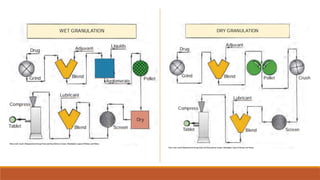
WET METHOD
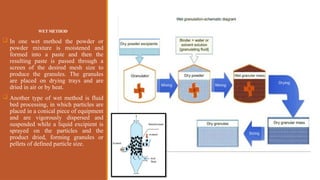
WETMETHOD
 In one wet method the powder or
powder mixture is moistened and
formed into a paste and then the
resulting paste is passed through a
screen of the desired mesh size to
produce the granules. The granules
are placed on drying trays and are
dried in air or by heat.
 Another type of wet method is fluid
bed processing, in which particles are
placed in a conical piece of equipment
and are vigorously dispersed and
suspended while a liquid excipient is
sprayed on the particles and the
product dried, forming granules or
pellets of defined particle size.
DRY METHOD
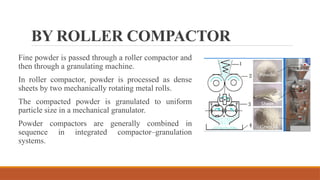
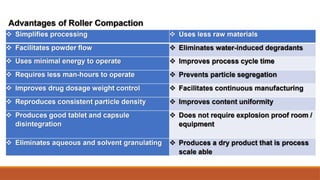
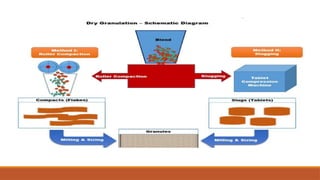
BY ROLLER COMPACTOR
Fine powder is passed through a roller compactor and
then through a granulating machine.
In roller compactor, powder is processed as dense
sheets by two mechanically rotating metal rolls.
The compacted powder is granulated to uniform
particle size in a mechanical granulator.
Powder compactors are generally combined in
sequence in integrated compactor–granulation
systems.
Steps of the roller compaction process
•The bulk material is first introduced into a funnel. The funnel is fitted with an
agitator, feed auger, and tamp auger to transfer the material toward the rotating
rollers.
•A given force is then applied to compact the material passing through the rollers.
•The high pressure applied onto the material works to form the material into a
ribbon-shaped compact mass.
•The ribbons are then moved to a rotor sieve mill to create the final granules at
the desired particle size.
•Fine particles that are smaller than the desired size have a higher chance of
getting stuck together again, so they are sent back to the funnel for a second
round of granulation. This keeps product loss to a minimum.
BY SLUGGING
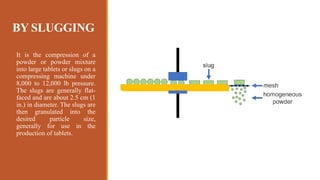
It is the compression of a
powder or powder mixture
into large tablets or slugs on a
compressing machine under
8,000 to 12,000 lb pressure.
The slugs are generally flat-
faced and are about 2.5 cm (1
in.) in diameter. The slugs are
then granulated into the
desired particle size,
generally for use in the
production of tablets.
Steps of the slugging process
•A powder blend is fed into a tablet press.
•The blend is compressed into extra large tablets or slugs (typically 25 mm
in diameter and 10-15 mm in thickness) using flat-faced punches.
•The slugs are subjected to screening both before and after the slugging
procedure.
•The slugs are then broken down into the desired particle size by a hammer
mill or an oscillating granulator.
•The milled particles are screened to form the final granules.
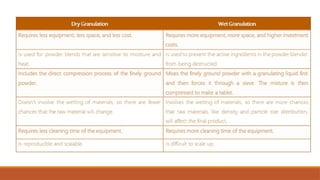
Advantages of dry granulation process
•The process doesn't use any liquid or solvent, suitable for moisture-sensitive APIs or excipients.
•This method does not involve the drying stage, so it is ideal for processing heat-sensitive materials.
•A better granular blend helps prevent caking or clumping. Also, such a blend makes it easier to transfer the
material to processes further down the production line. And compaction and milling in the dry granulation
process are essential to transform bulky substances into the desired particle size.
•The method makes compacted and milled powder easier to compress during tableting.
•The process can adjust the compaction force and milling process parameters. This helps control the granule
hardness and particle size.
•It is a scalable process, allowing operations to be carried out in either a batch or a continuous fashion. Its
versatility makes it ideal for scaling up material processing applications from lab to commercial production.
•The process only requires a roller compactor, mill, sieve, feeder, and discharging equipment. So, it generally
takes up much less space than other processing methods.
•Since the method doesn't require liquid binders and additional drying operations, it helps cut down on the
costs of materials, labor, and energy use.
Disadvantages of dry granulation
•The major disadvantage of the method is that it makes a higher percentage of fines
or non-compacted particles. This can lower the quality of the final product.
•The process is not suitable for all materials. The powder blend to be granulated
must have the desired compressibility to form a compact mass under pressure.
•The roller compaction method requires a piece of specialized heavy-duty
equipment.
•The process tends to produce friable tablets.
•It creates a significant amount of dust, which may lead to cross-contamination.
POSSIBLE FACTORS AFFECTING THE RAPID RELEASE OF
DRUG IN THE RESPECTIVE STEPS UNDER DRYAND WET
GRANULATION METHODS.
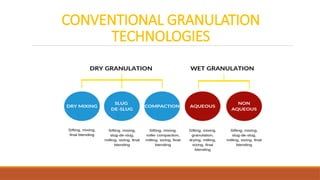
CONVENTIONAL GRANULATION
TECHNOLOGIES
ADVANCED GRANULATION TECHNOLOGIES
With the existence of conventional methods of granulation, it was
next to impossible to superimpose the conventional methods to the
requirements of taking a step towards novel drug delivery systems.
In order to fill that gap, a whole bunch of advanced granulation
techniques have been introduced time to time.
Advanced Granulation Technologies
Advanced granulation techniques have been developed in recent years including
 Pneumatic dry granulation
 Freeze granulation technology
 Foam binder technology
 Melt granulation technology
 Steam granulation
 Moisture activated dry granulation (MADG)
Thermal adhesion granulation process (TAGP)
GRANULATION TECHNIQUES used in the pharmaceuticals .pptx

  • 1.
  • 2.
    INTRODUCTION Granulation is theprocess in which primary powder particles are made to adhere to form larger, multi- particle entities called granules. It is the process of collecting particles together by creating bonds between them. Bonds are formed by compression or by using a binding agent. Granulation is extensively used in the manufacturing of tablets and pellets Granulation may be defined as a size enlargement process which converts fine or coarse particles into physically stronger and larger agglomerates having good flow property, better compression characteristics and uniformity.
  • 3.
    GRANULATION TECHNOLOGY “The artand science for process and production of granules is known as Granulation Technology”.
  • 4.
    GRANULES Granules are powderparticles that have been aggregated to form a larger particle, which is usually 0.2 - 4.0 mm in diameter. Granules are also prepared as an intermediate in tablet manufacture.
  • 5.
    DISPENSING OF GRANULES Bulkgranules for internal use Divided granules (i.e. single preparations) for internal use Insufflations for administration to ear, nose or throat Antibiotic syrups to be reconstituted before use Powders for reconstitution into injections Dry powder inhalers.
  • 6.
    PHARMACEUTICAL IMPORTANCE To preventsegregation of the constituents of the powder mixture. To improve the flow properties. To improve the compression characteristics of the mixture. To reduce caking of hygroscopic materials on storage. As granules are denser than the parent powder mix, they occupy less volume per unit weight. Easy for storage.
  • 7.
    ADVANTAGES OF GRANULES Granuleshave better flow properties than powders. Because of this, granulations are commonly used in tablet making to facilitate the free flow of material from the feeding container (or hopper) into the tablet presses. Granules also are more easily wetted by liquids than certain light and fluffy powders (which tend to float on the surface) and are often preferred for dry products intended to be constituted into solutions or suspensions e.g., products containing antibiotic drugs that are unstable in aqueous solution are prepared as small granules for reconstitution. Granules have more physical and chemical stability than powders, to the effects of atmospheric humidity and are less likely to cake or harden upon standing. Granules can also be coated to mask the disagreeable taste of medicaments but powders cannot be coated. Large doses can be easily administered as granules as compared to tablets
  • 8.
    DISADVANTAGES OF GRANULES Processis expensive because of labor, space, time, special equipment and energy requirement. Loss of material during various stages of processing. Moisture sensitive and thermolabile drugs are poor candidates. Any incompatibility between the formulation components is aggravated during the processing.
  • 9.
    PREPARATION OF GRANULES Granulesare prepared by, 1. Wet method 2. Dry method
  • 10.
  • 11.
    WETMETHOD  In onewet method the powder or powder mixture is moistened and formed into a paste and then the resulting paste is passed through a screen of the desired mesh size to produce the granules. The granules are placed on drying trays and are dried in air or by heat.  Another type of wet method is fluid bed processing, in which particles are placed in a conical piece of equipment and are vigorously dispersed and suspended while a liquid excipient is sprayed on the particles and the product dried, forming granules or pellets of defined particle size.
  • 12.
  • 13.
    BY ROLLER COMPACTOR Finepowder is passed through a roller compactor and then through a granulating machine. In roller compactor, powder is processed as dense sheets by two mechanically rotating metal rolls. The compacted powder is granulated to uniform particle size in a mechanical granulator. Powder compactors are generally combined in sequence in integrated compactor–granulation systems.
  • 14.
    Steps of theroller compaction process •The bulk material is first introduced into a funnel. The funnel is fitted with an agitator, feed auger, and tamp auger to transfer the material toward the rotating rollers. •A given force is then applied to compact the material passing through the rollers. •The high pressure applied onto the material works to form the material into a ribbon-shaped compact mass. •The ribbons are then moved to a rotor sieve mill to create the final granules at the desired particle size. •Fine particles that are smaller than the desired size have a higher chance of getting stuck together again, so they are sent back to the funnel for a second round of granulation. This keeps product loss to a minimum.
  • 16.
    BY SLUGGING It isthe compression of a powder or powder mixture into large tablets or slugs on a compressing machine under 8,000 to 12,000 lb pressure. The slugs are generally flat- faced and are about 2.5 cm (1 in.) in diameter. The slugs are then granulated into the desired particle size, generally for use in the production of tablets.
  • 17.
    Steps of theslugging process •A powder blend is fed into a tablet press. •The blend is compressed into extra large tablets or slugs (typically 25 mm in diameter and 10-15 mm in thickness) using flat-faced punches. •The slugs are subjected to screening both before and after the slugging procedure. •The slugs are then broken down into the desired particle size by a hammer mill or an oscillating granulator. •The milled particles are screened to form the final granules.
  • 19.
    Advantages of drygranulation process •The process doesn't use any liquid or solvent, suitable for moisture-sensitive APIs or excipients. •This method does not involve the drying stage, so it is ideal for processing heat-sensitive materials. •A better granular blend helps prevent caking or clumping. Also, such a blend makes it easier to transfer the material to processes further down the production line. And compaction and milling in the dry granulation process are essential to transform bulky substances into the desired particle size. •The method makes compacted and milled powder easier to compress during tableting. •The process can adjust the compaction force and milling process parameters. This helps control the granule hardness and particle size. •It is a scalable process, allowing operations to be carried out in either a batch or a continuous fashion. Its versatility makes it ideal for scaling up material processing applications from lab to commercial production. •The process only requires a roller compactor, mill, sieve, feeder, and discharging equipment. So, it generally takes up much less space than other processing methods. •Since the method doesn't require liquid binders and additional drying operations, it helps cut down on the costs of materials, labor, and energy use.
  • 20.
    Disadvantages of drygranulation •The major disadvantage of the method is that it makes a higher percentage of fines or non-compacted particles. This can lower the quality of the final product. •The process is not suitable for all materials. The powder blend to be granulated must have the desired compressibility to form a compact mass under pressure. •The roller compaction method requires a piece of specialized heavy-duty equipment. •The process tends to produce friable tablets. •It creates a significant amount of dust, which may lead to cross-contamination.
  • 23.
    POSSIBLE FACTORS AFFECTINGTHE RAPID RELEASE OF DRUG IN THE RESPECTIVE STEPS UNDER DRYAND WET GRANULATION METHODS.
  • 24.
  • 25.
    ADVANCED GRANULATION TECHNOLOGIES Withthe existence of conventional methods of granulation, it was next to impossible to superimpose the conventional methods to the requirements of taking a step towards novel drug delivery systems. In order to fill that gap, a whole bunch of advanced granulation techniques have been introduced time to time.
  • 26.
    Advanced Granulation Technologies Advancedgranulation techniques have been developed in recent years including  Pneumatic dry granulation  Freeze granulation technology  Foam binder technology  Melt granulation technology  Steam granulation  Moisture activated dry granulation (MADG) Thermal adhesion granulation process (TAGP)