
GPs’ role in quality use of medicines in Australia
Enhancements to Australia’s medicines vigilance scheme
Dr Jane Cook
Branch Head,
Pharmacovigilance and Special Access Branch
Medicines Regulation Division, Therapeutic Goods Administration
GP17 RACGP Conference
27 October 2017
Overview
• How are medicines made available
for use in Australia?
• Why do we want to monitor the
safety of medicines once
registered?
• How can GPs help ensure Quality
Use of Medicines and why would
they want to?
• You need information to be
informed
• What do patients expect from GPs
when they prescribe a medicine –
what information do they want?
• What’s new?
Pharmacovigilance: The latest enhancements
1
How are medicines made available for use in Australia?
TGA assesses safety, efficacy and safety…
… PBAC assesses cost effectiveness
Pharmacovigilance: The Australian landscape 2
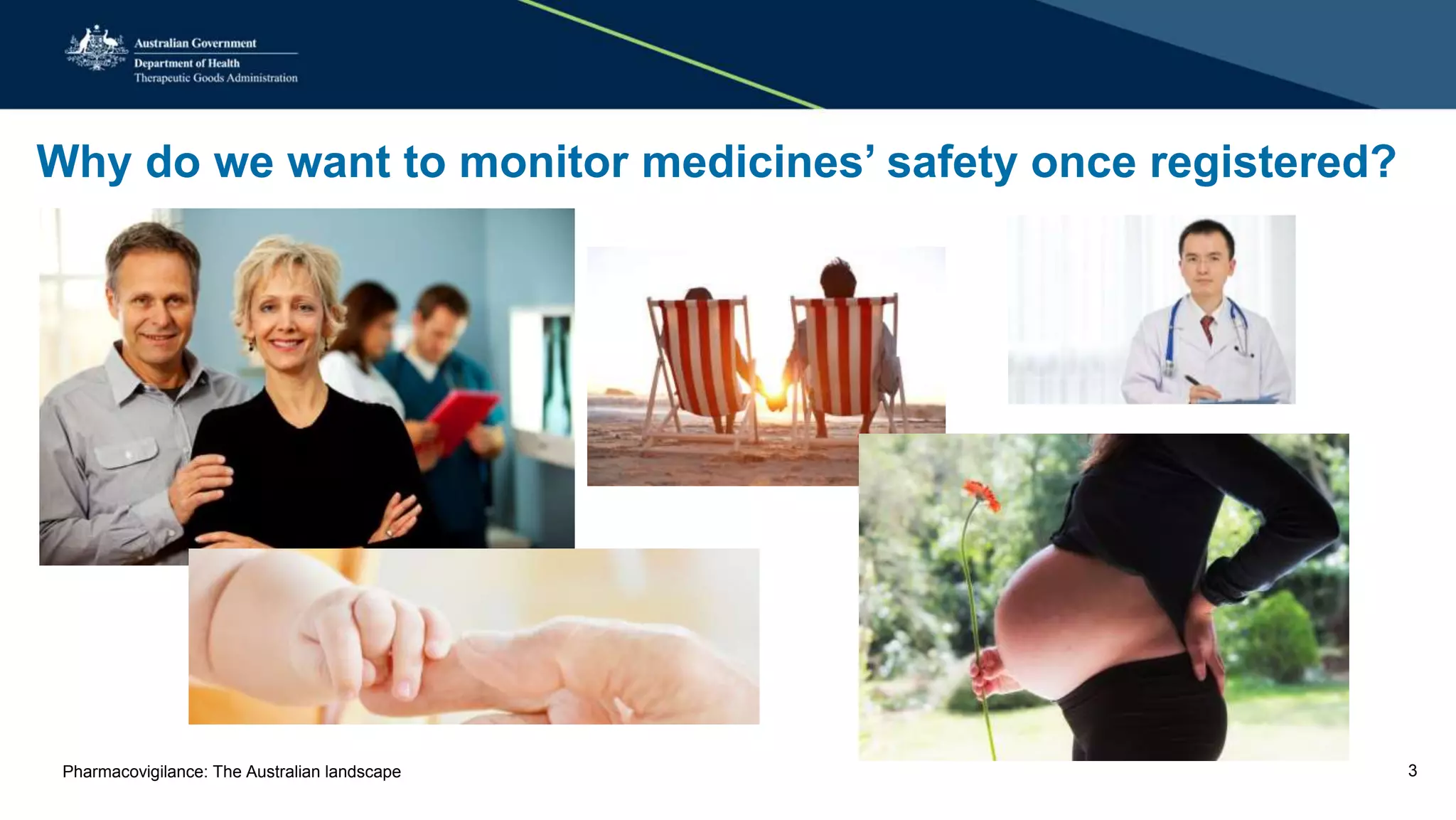
Why do we want to monitor medicines’ safety once registered?
Pharmacovigilance: The Australian landscape 3
Post-market monitoring identifies …
• New adverse events or a
change in the rates of known
adverse events.
• Production and other quality
issues.
Pharmacovigilance: The latest enhancements 4
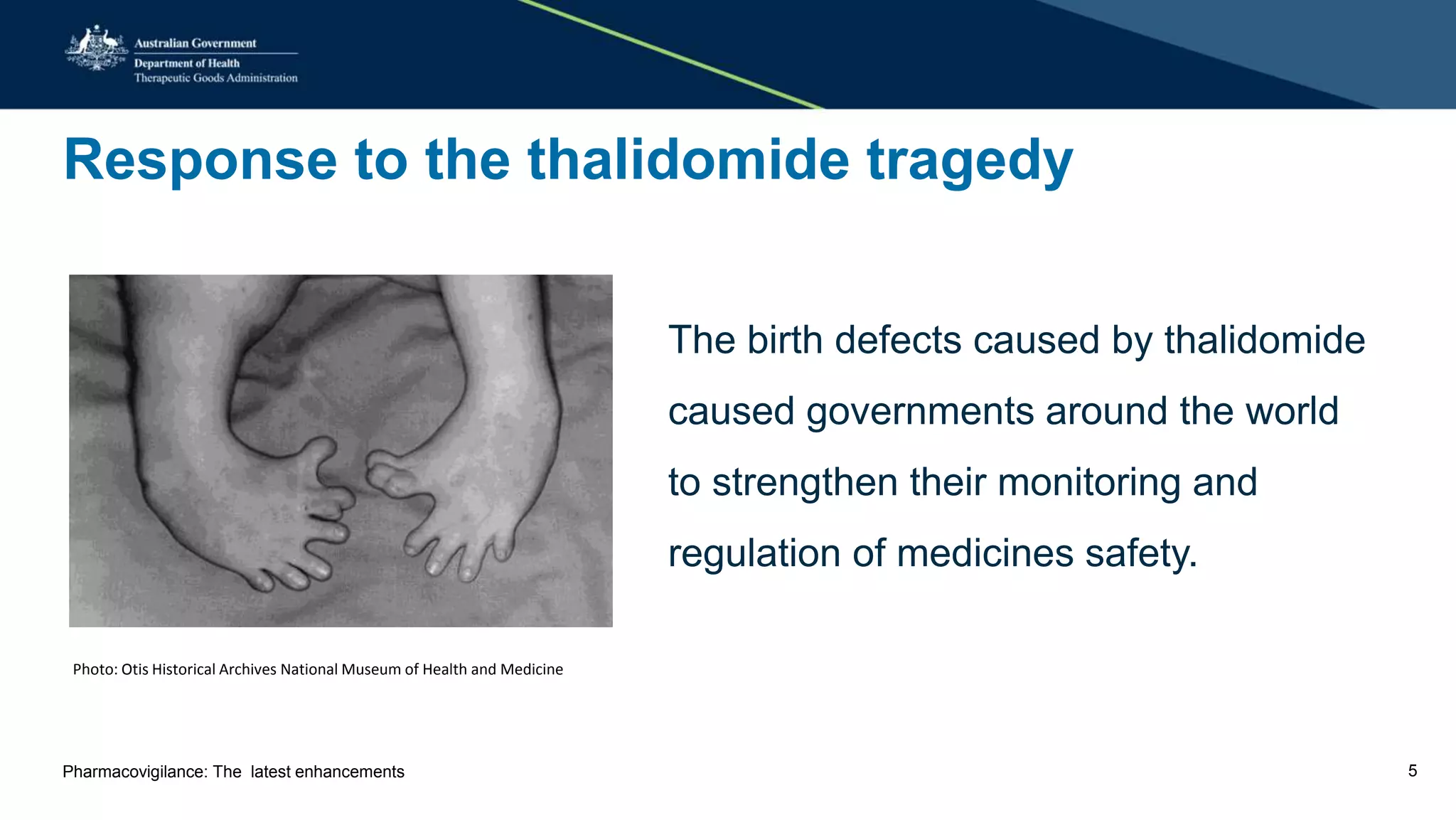
Response to the thalidomide tragedy
Photo: Otis Historical Archives National Museum of Health and Medicine
The birth defects caused by thalidomide
caused governments around the world
to strengthen their monitoring and
regulation of medicines safety.
Pharmacovigilance: The latest enhancements 5
You need information to be informed
Providing the best healthcare requires information
to flow various ways, including:
• from patient to doctor
• from doctor to patient
• from TGA to doctor
• from doctor to TGA.
Pharmacovigilance: The latest enhancements 6
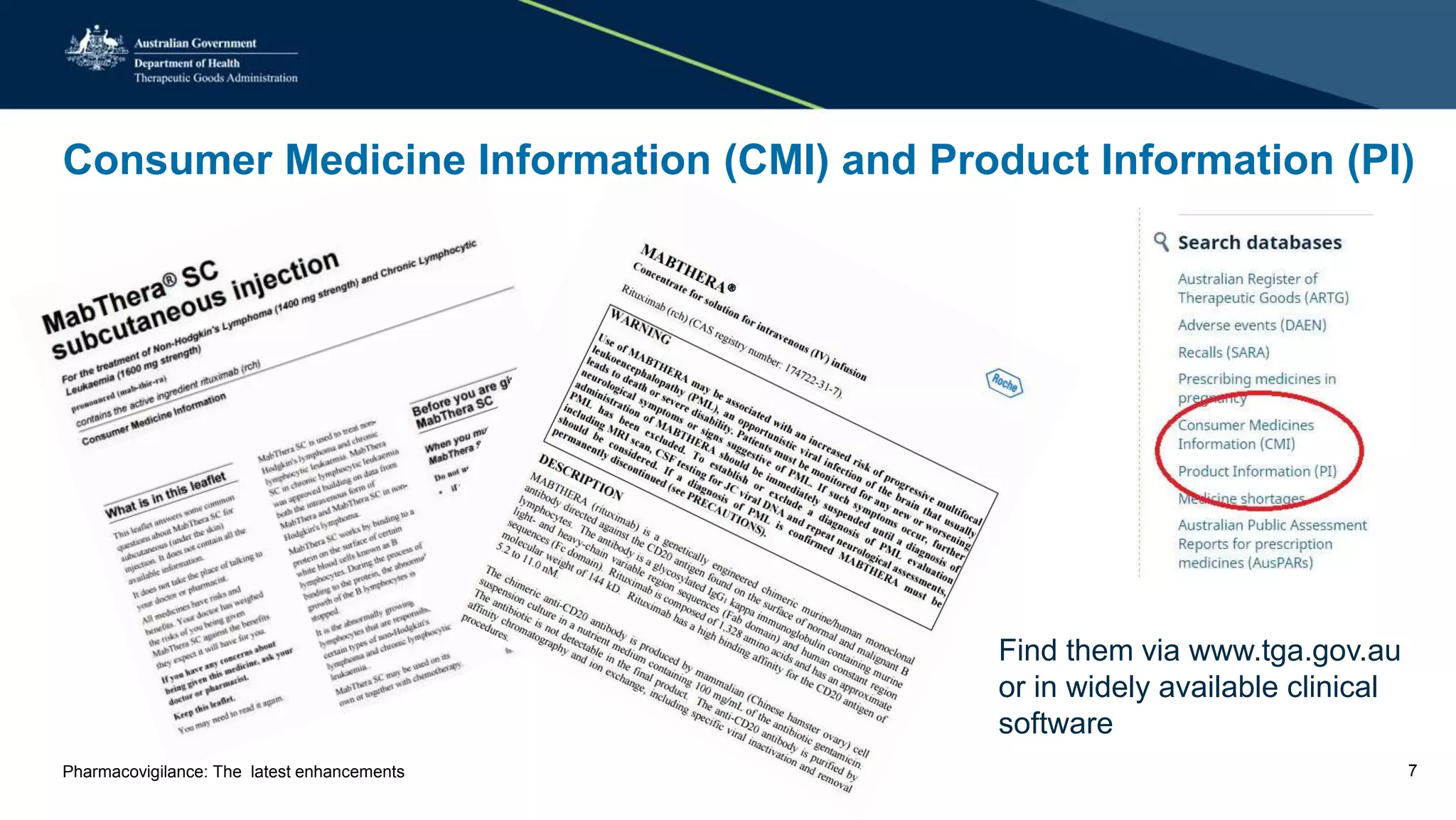
Find them via www.tga.gov.au
or in widely available clinical
software
Pharmacovigilance: The latest enhancements 7
Consumer Medicine Information (CMI) and Product Information (PI)
Information from doctor to patient: CMIs
• Provide the CMI to the patient or advise them how
they can obtain the CMI from their pharmacist.
• The CMI provides important information about the
symptoms that patients may have when they use
the medicine you have prescribed.
• Providing a CMI improves compliance.
Pharmacovigilance: The Australian landscape 8
Information from TGA & sponsor to doctor: PI
• A product information (PI) document has been
written by the pharmaceutical company
responsible for the medicine and approved by the
TGA.
• A PI provides objective information about the
quality, safety and effectiveness of the medicine.
• This information is intended to assist health
professionals in prescribing and dispensing
medicines.
Find PIs via:
www.tga.gov.au, the Medsearch app or widely available
clinical software
Pharmacovigilance: The latest enhancements 9
Product Information reformatting
The Product Information (PI) is being reformatted to:
• improve its usability for health professionals, by
bringing critical clinical information to the front of the PI
– indications, dosage and administration,
contraindications,
precautions, adverse events
– align format with other countries
• Transition to the new format will be over three years
• All PIs in the market will be in the new format by the
end of 2020
Pharmacovigilance: The latest enhancements 10
Other sources of information from TGA
The TGA publishes a range of other information relevant to GPs including:
• Medicines Safety Update (MSU) and Medical Devices Safety Update (MDSU)
• Safety alerts
• Recalls
• Monitoring communications
• Medicines shortages notifications
Subscribe at www.tga.gov.au/subscribe-updates
Pharmacovigilance: The latest enhancements 11
Information flowing from doctors to TGA please
report your adverse events
• GPs are among those best-placed to provide
the most useful adverse event reports.
• Analysis of adverse event reports is a major
tool used in monitoring medicine safety in
Australia.
• The easiest way to report is online via our
website.
www.tga.gov.au/reporting-problems Image: www.gratisography.com
Pharmacovigilance: The latest enhancements 12
▼ Black Triangle Scheme
• Identifies new medicines and those being used in new ways
• Encourages the reporting of adverse events associated with their use
• The symbol and text will appear on the PI and CMI, and TGA-related materials
PI:
CMI:
▼This medicinal product is subject to additional monitoring. This will allow quick
identification of new safety information. Healthcare professionals are asked to
report any suspected adverse events.
▼This medicine is subject to additional monitoring. This will allow quick
identification of new safety information. You can help by reporting any side effects
you may get.
Pharmacovigilance: The latest enhancements 13
▼ Black Triangle Scheme – inclusion criteria
• All new medicines, except:
− biosimilars
− seasonal influenza vaccines
• Medicines with a provisional extension of indications
• Extensions of indication into significantly different conditions or patient groups
may be included
– e.g. for an oncology to rheumatology indication
Pharmacovigilance: The Australian landscape 14
▼ Black Triangle Scheme – implementation
• Scheme starts in January 2018
• 5 year duration for standard registration and then lapses
• Provisional registration period
• Inclusion automatically lapses at the end of the agreed period
Pharmacovigilance: The latest enhancements 15
▼ Black Triangle Scheme – more information
• We will conduct information campaigns for both health professionals and
consumers in coming months using a range of channels.
• Keep an eye on your professional bodies’ journals and newsletters.
• More information is also available on the TGA website.
Visit: www.tga.gov.au/black-triangle
Pharmacovigilance: The Australian landscape 16
New Provisional Approval pathway
A new Provisional Pathway will allow certain
medicines to be provisionally registered on the
ARTG:
• Some medicines will be able to reach Australian
patients up to two years earlier.
• An option where the potential benefit of earlier
availability outweighs the risk that additional
data are still required.
The TGA particularly encourages adverse event reports for these medicines.
Pharmacovigilance: The Australian landscape 17
Other monitoring
• AusVaxSafety – A national collaborative active vaccine safety surveillance initiative
– SmartVax and Vaxtracker – Software programs run by GPs and immunisation
clinics that send an SMS or email to patients or carers following vaccination
– STARSS – Study evaluating the use of SMS and telephone follow-up after
vaccination
• We are trialing combining and monitoring de-identified information from various
sources to detect safety signals.
• We will be able to use data from ‘My Health Record’ when the program is up-and-
running.
Pharmacovigilance: The latest enhancements 18
Your role as a health professional
GPs can play an important role by reporting any
suspected adverse events to the TGA.
We are particularly interested in:
− suspected reactions involving new medicines
(this is where Black Triangle comes in!)
− serious or unexpected reactions to medicines
− serious medicine interactions
• You don't need to be certain, just suspicious!
• Reports can be made online, or by phone, fax or
email
• Visit the TGA website for more information:
www.tga.gov.au/reporting-problems
Pharmacovigilance: The Australian landscape 19
Codeine Rescheduling
Up-scheduling of codeine to Schedule 4 (Prescription Only)
• From 1 February 2018, medicines containing codeine will no longer be available without a prescription
• The rescheduling decision was made on the grounds of public safety and potential for abuse
• Research shows that over-the-counter low-dose codeine can cause:
– opioid tolerance
– dependence
– addiction
– poisoning
– death
• Addiction as a result of regular use can occur without the patient realising
• Visit the TGA website (www.tga.gov.au/codeine-info-hub) for resources on codeine access or visit the
TGA exhibition space for more information
Pharmacovigilance: The Australian landscape 20
Therapeutic Goods Evaluation Panel
Would you like to evaluate for the TGA as an External Evaluator?
• The TGA is currently looking to appoint suitably
qualified and experienced individuals and organisations
with expertise in various scientific and medical fields to
the Therapeutic Goods Evaluation Panel.
• Evaluation services in the areas of clinical medicines
and technologies, nonclinical sciences and quality of
pharmaceutical therapeutic goods.
• Request for Tender open on AusTender
• Industry briefings/information sessions in November
2017
TGA tenders (https://www.tga.gov.au/tga-tenders)
21
GPs’ role in quality use of medicines in Australia

GPs’ role in quality use of medicines in Australia

  • 1.
    GPs’ role inquality use of medicines in Australia Enhancements to Australia’s medicines vigilance scheme Dr Jane Cook Branch Head, Pharmacovigilance and Special Access Branch Medicines Regulation Division, Therapeutic Goods Administration GP17 RACGP Conference 27 October 2017
  • 2.
    Overview • How aremedicines made available for use in Australia? • Why do we want to monitor the safety of medicines once registered? • How can GPs help ensure Quality Use of Medicines and why would they want to? • You need information to be informed • What do patients expect from GPs when they prescribe a medicine – what information do they want? • What’s new? Pharmacovigilance: The latest enhancements 1
  • 3.
    How are medicinesmade available for use in Australia? TGA assesses safety, efficacy and safety… … PBAC assesses cost effectiveness Pharmacovigilance: The Australian landscape 2
  • 4.
    Why do wewant to monitor medicines’ safety once registered? Pharmacovigilance: The Australian landscape 3
  • 5.
    Post-market monitoring identifies… • New adverse events or a change in the rates of known adverse events. • Production and other quality issues. Pharmacovigilance: The latest enhancements 4
  • 6.
    Response to thethalidomide tragedy Photo: Otis Historical Archives National Museum of Health and Medicine The birth defects caused by thalidomide caused governments around the world to strengthen their monitoring and regulation of medicines safety. Pharmacovigilance: The latest enhancements 5
  • 7.
    You need informationto be informed Providing the best healthcare requires information to flow various ways, including: • from patient to doctor • from doctor to patient • from TGA to doctor • from doctor to TGA. Pharmacovigilance: The latest enhancements 6
  • 8.
    Find them viawww.tga.gov.au or in widely available clinical software Pharmacovigilance: The latest enhancements 7 Consumer Medicine Information (CMI) and Product Information (PI)
  • 9.
    Information from doctorto patient: CMIs • Provide the CMI to the patient or advise them how they can obtain the CMI from their pharmacist. • The CMI provides important information about the symptoms that patients may have when they use the medicine you have prescribed. • Providing a CMI improves compliance. Pharmacovigilance: The Australian landscape 8
  • 10.
    Information from TGA& sponsor to doctor: PI • A product information (PI) document has been written by the pharmaceutical company responsible for the medicine and approved by the TGA. • A PI provides objective information about the quality, safety and effectiveness of the medicine. • This information is intended to assist health professionals in prescribing and dispensing medicines. Find PIs via: www.tga.gov.au, the Medsearch app or widely available clinical software Pharmacovigilance: The latest enhancements 9
  • 11.
    Product Information reformatting TheProduct Information (PI) is being reformatted to: • improve its usability for health professionals, by bringing critical clinical information to the front of the PI – indications, dosage and administration, contraindications, precautions, adverse events – align format with other countries • Transition to the new format will be over three years • All PIs in the market will be in the new format by the end of 2020 Pharmacovigilance: The latest enhancements 10
  • 12.
    Other sources ofinformation from TGA The TGA publishes a range of other information relevant to GPs including: • Medicines Safety Update (MSU) and Medical Devices Safety Update (MDSU) • Safety alerts • Recalls • Monitoring communications • Medicines shortages notifications Subscribe at www.tga.gov.au/subscribe-updates Pharmacovigilance: The latest enhancements 11
  • 13.
    Information flowing fromdoctors to TGA please report your adverse events • GPs are among those best-placed to provide the most useful adverse event reports. • Analysis of adverse event reports is a major tool used in monitoring medicine safety in Australia. • The easiest way to report is online via our website. www.tga.gov.au/reporting-problems Image: www.gratisography.com Pharmacovigilance: The latest enhancements 12
  • 14.
    ▼ Black TriangleScheme • Identifies new medicines and those being used in new ways • Encourages the reporting of adverse events associated with their use • The symbol and text will appear on the PI and CMI, and TGA-related materials PI: CMI: ▼This medicinal product is subject to additional monitoring. This will allow quick identification of new safety information. Healthcare professionals are asked to report any suspected adverse events. ▼This medicine is subject to additional monitoring. This will allow quick identification of new safety information. You can help by reporting any side effects you may get. Pharmacovigilance: The latest enhancements 13
  • 15.
    ▼ Black TriangleScheme – inclusion criteria • All new medicines, except: − biosimilars − seasonal influenza vaccines • Medicines with a provisional extension of indications • Extensions of indication into significantly different conditions or patient groups may be included – e.g. for an oncology to rheumatology indication Pharmacovigilance: The Australian landscape 14
  • 16.
    ▼ Black TriangleScheme – implementation • Scheme starts in January 2018 • 5 year duration for standard registration and then lapses • Provisional registration period • Inclusion automatically lapses at the end of the agreed period Pharmacovigilance: The latest enhancements 15
  • 17.
    ▼ Black TriangleScheme – more information • We will conduct information campaigns for both health professionals and consumers in coming months using a range of channels. • Keep an eye on your professional bodies’ journals and newsletters. • More information is also available on the TGA website. Visit: www.tga.gov.au/black-triangle Pharmacovigilance: The Australian landscape 16
  • 18.
    New Provisional Approvalpathway A new Provisional Pathway will allow certain medicines to be provisionally registered on the ARTG: • Some medicines will be able to reach Australian patients up to two years earlier. • An option where the potential benefit of earlier availability outweighs the risk that additional data are still required. The TGA particularly encourages adverse event reports for these medicines. Pharmacovigilance: The Australian landscape 17
  • 19.
    Other monitoring • AusVaxSafety– A national collaborative active vaccine safety surveillance initiative – SmartVax and Vaxtracker – Software programs run by GPs and immunisation clinics that send an SMS or email to patients or carers following vaccination – STARSS – Study evaluating the use of SMS and telephone follow-up after vaccination • We are trialing combining and monitoring de-identified information from various sources to detect safety signals. • We will be able to use data from ‘My Health Record’ when the program is up-and- running. Pharmacovigilance: The latest enhancements 18
  • 20.
    Your role asa health professional GPs can play an important role by reporting any suspected adverse events to the TGA. We are particularly interested in: − suspected reactions involving new medicines (this is where Black Triangle comes in!) − serious or unexpected reactions to medicines − serious medicine interactions • You don't need to be certain, just suspicious! • Reports can be made online, or by phone, fax or email • Visit the TGA website for more information: www.tga.gov.au/reporting-problems Pharmacovigilance: The Australian landscape 19
  • 21.
    Codeine Rescheduling Up-scheduling ofcodeine to Schedule 4 (Prescription Only) • From 1 February 2018, medicines containing codeine will no longer be available without a prescription • The rescheduling decision was made on the grounds of public safety and potential for abuse • Research shows that over-the-counter low-dose codeine can cause: – opioid tolerance – dependence – addiction – poisoning – death • Addiction as a result of regular use can occur without the patient realising • Visit the TGA website (www.tga.gov.au/codeine-info-hub) for resources on codeine access or visit the TGA exhibition space for more information Pharmacovigilance: The Australian landscape 20
  • 22.
    Therapeutic Goods EvaluationPanel Would you like to evaluate for the TGA as an External Evaluator? • The TGA is currently looking to appoint suitably qualified and experienced individuals and organisations with expertise in various scientific and medical fields to the Therapeutic Goods Evaluation Panel. • Evaluation services in the areas of clinical medicines and technologies, nonclinical sciences and quality of pharmaceutical therapeutic goods. • Request for Tender open on AusTender • Industry briefings/information sessions in November 2017 TGA tenders (https://www.tga.gov.au/tga-tenders) 21

Editor's Notes

  • #4 For a medicine to be available in Australia it is assessed for safety (are there any significant adverse effects that could cause harm to the patient), efficacy (does the drug have a positive effect in treating the condition) and quality (is the dose consistent and are there no impurities or defects in the medicine) by the TGA following an application by a sponsor of that medicine (someone who takes responsibility for ensuring that the medicine remains safe for use once it is available). For a medicine to be subsidised – that is reimbursed - it needs to be assessed by the Pharmaceutical Benefits Advisory Committee (PBAC) for reimbursement under the Pharmaceutical Benefits Scheme (PBS). Therefore some medicines can be prescribed but will not reimbursed by the government meaning the patient will need to pay the full price for the medicine as it is not subsidised by the government.
  • #5 Limited data from clinical trials due to inclusion and exclusion criteria. Limited information from clinical trials about use in children, the elderly and pregnant women. Limited information in people with co-morbidities or multiple medications. Statistical aspects focus on efficacy endpoints not safety. Experimental environment – tightly controlled v ‘real world’. Relatively short duration of trials – late adverse events not identified.
  • #9 GPs should consider: How much do you know about the medicines you prescribe and where do you get the information that helps you decide what to prescribe? How often do you read the Product Information and know about who not to prescribe to? How often do you recommend obtaining or provide Consumer Medicine Information to patients? CMI and PI can be downloaded: via links on the front page of www.tga.gov.au via the TGA’s Medsearch app (Apple and Android versions available) via widely available clinical software.
  • #10 When prescribing a medicine for the first time to a patient consider the following: What benefits should they expect in the first hours, days or weeks when taking the medicine Discuss common adverse events especially those that may occur before any benefit from the medicine may occur and whether these are likely to resolve. What side effects they experience should be reported to you as they may need to cease the medication. Providing CMIs improves compliance: Evidence that written information increases compliance (Smith, N.A. et al. (1986) Effects of intervention on medication compliance in children with asthma. MJA 1 Feb 144(3). P119-122). Evidence that consumers have little experience of CMI being discussed or provided by health care professionals (Koo M. et al (2002) Consumer opinions on medicines information and factors affecting its use – an Australian experience. International Journal of Pharmacy Practice. June 2002)
  • #12 The new format will apply to new medicines and any medicines with new PI information - e.g. extended indications, safety updates.
  • #14 You can report suspected adverse events to any medicine or vaccine available in Australia, including prescription medicines, over-the-counter medicines and complementary medicines. The TGA particularly requests reports of: suspected adverse events involving new medicines suspected drug interactions unexpected adverse events (i.e. reactions that are not described in the Product Information) serious adverse events, such as those suspected of causing: ƒƒinability to work admission to hospital ƒprolongation of hospitalisation ƒincreased investigation or treatment costs ƒdanger to life ƒbirth defects ƒdeath. Even if you are unsure whether to report, you should report serious adverse events.
  • #19 The PI and CMI for these medicines will be marked with the Black Triangle .
  • #20 AusVaxSafety – A national collaborative active vaccine safety surveillance initiative lead by the National Centre for Immunisation Research & Surveillance(NCIRS) and funded by the Australian Government Department of Health Sentinel active participant-based surveillance across more than 156 sites: SmartVax and Vaxtracker – Software programs run by general practitioners and immunisation clinics that send an SMS or email to patients or carers following vaccination STARSS – NHMRC funded study evaluating the use of SMS and telephone follow-up after vaccination De-identified information from these sources are combined and monitored by AusVaxSafety to detect safety signals. In 2017, AusVaxSafety surveillance is being conducted for the following vaccines and age groups: Influenza vaccine in all ages during influenza season (April–October) Pertussis (whooping cough)-containing booster vaccines in children aged 12 months to <7 years Zoster (shingles) vaccine in adults aged 70–79 years Analysis of de-identified health data sets Two feasibility projects in progress: Prescription sequence symmetry analysis of PBS data to enhance signal detection Analysis of data from the SAX institute 45-and-up study and linked services datasets to enhance signal verification