Gary Cobb Multnomah County Co-Chair  Kathy L. Brazell, MPA, MNPM Executive Director Governor’s Council on Alcohol and Drug Abuse Programs February 21, 2006
The Recovery Association Project (RAP)  is an organization dedicated to creating a vehicle for people in recovery to speak out and challenge the stigma associated with addiction and alcoholism to create an environment where people in recovery can share their success and advocate for progressive change in substance abuse related policy.
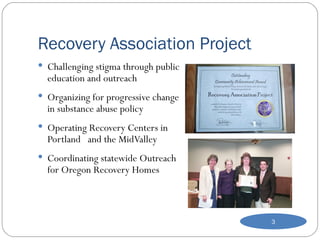
Recovery Association Project Challenging stigma through public education and outreach Organizing for progressive change in substance abuse policy Operating Recovery Centers in Portland  and the MidValley Coordinating statewide Outreach for Oregon Recovery Homes
Legislative Priorities for the Recovery Association Project The most indispensable supports for those suffering from the disease of addiction are:  (1) Treatment and Recovery Services (2) Health care (3) Housing These three essential supports, provided in concert, can lead to success and self-sufficiency for people with addictions.
Legislative Priorities for the Recovery Association Project The provision and coordination of chemical dependency treatment, physical healthcare, mental health treatment, housing and special needs services can break the cycle of addiction and homelessness.  There is much greater demand in all three areas than there is capacity: people being turned away from treatment centers and safety net health clinics daily, and long waiting lists for affordable housing.
The Power of Recovery support: Gary Cobb’s Story Gary Cobb grew up in Topeka, Kansas with a father who was a chronic alcoholic and drug abuser.  He dropped out of school in the seventh grade and began abusing these substances himself.  Eventually he was arrested, and chose to enlist in the U.S. Coast Guard rather than face time in jail. Yet for the next two decades, he continued to abuse hard drugs and alcohol.
The Power of Recovery support: Gary Cobb’s Story In 2000, Gary participated in Central City Concern’s recovery programs.  Treatment services supported by the Oregon Health Plan Safe shelter in transitional and then permanent Alcohol and Drug Free housing He is now employed at Central City Concern  Clean and sober for 5 years
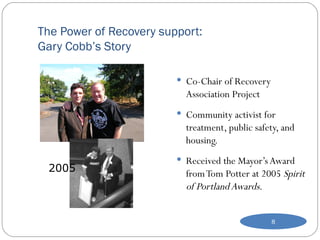
The Power of Recovery support: Gary Cobb’s Story Co-Chair of Recovery Association Project  Community activist for treatment, public safety, and housing. Received the Mayor’s Award from Tom Potter at 2005  Spirit of Portland Awards. 2005
The Power of Recovery support: Gary Cobb’s Story Illustrates essential supports to move from active addiction to sustained recovery.  RAP’s Legislative Priorities: Treatment and Recovery services Oregon Health Plan Alcohol and Drug Free Housing Gary is now an advocate for those in recovery .
Legislative Priority #1 Increase Treatment and Recovery Services
There is insufficient capacity in the treatment system  Every piece of Meth legislation including penalties must include a treatment accompaniment.  Oregon communities need increased treatment capacity to handle influx when jail beds are full  By mandating more treatment without increasing capacity, Oregon will not solve the issue. This is a public safety issue – use Public Safety dollars
RAP’s mission    ….Challenging the stigma  Only 1 in 10 addicts and alcoholics in the State receive treatment Methamphetamine addicts are NO harder to treat than clients recovering from crack/cocaine, heroin, prescription drugs or alcohol.  Heroin clients are typically the hardest population Meth is not new: Oregon has been treating Meth addicts for 25 years
Treatment is a better investment Cost average about $1,200 per month (including rent) or $6,000 for 6 months Compare this to cost of emergency room visits, jail, prison, or child services
Equity issue Oregon needs to bring up the bottom You can bring everyone up to the same level but you can’t bring people down  To de-fund existing programs is unthinkable  It is bad policy to de-fund some services to pay for others.
Legislative Priority #2 Save the  Oregon Health Plan
Health care is essential for recovery Most people with addictions have multiple health problems as a result of years of substance abuse and homelessness.  Chronic conditions such as hepatitis C, diabetes, and other ailments are common among people with addictions. They are sicker than the general public overall.  Without primary health care to address their medical needs, it is very difficult for people to remain in recovery.
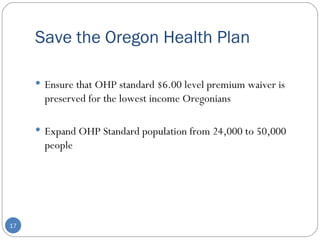
Save the Oregon Health Plan Ensure that OHP standard $6.00 level premium waiver is preserved for the lowest income Oregonians Expand OHP Standard population from 24,000 to 50,000 people
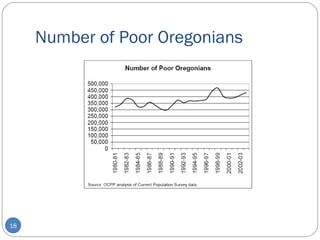
Number of Poor Oregonians
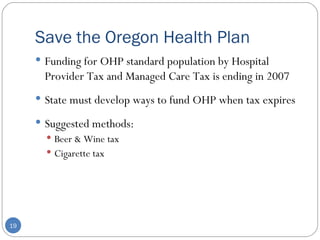
Save the Oregon Health Plan Funding for OHP standard population by Hospital Provider Tax and Managed Care Tax is ending in 2007 State must develop ways to fund OHP when tax expires Suggested methods:  Beer & Wine tax Cigarette tax
Legislative Priority #3 Increase funding for  Alcohol and Drug Free Housing
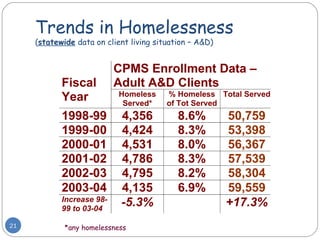
Trends in Homelessness ( statewide  data on client living situation – A&D) *any homelessness
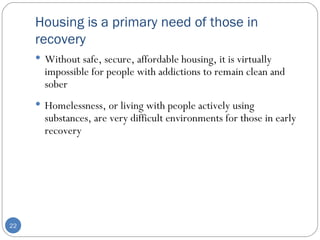
Housing is a primary need of those in recovery Without safe, secure, affordable housing, it is virtually impossible for people with addictions to remain clean and sober Homelessness, or living with people actively using substances, are very difficult environments for those in early recovery
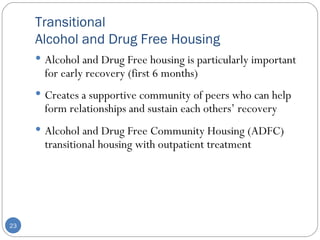
Transitional  Alcohol and Drug Free Housing Alcohol and Drug Free housing is particularly important for early recovery (first 6 months) Creates a supportive community of peers who can help form relationships and sustain each others’ recovery Alcohol and Drug Free Community Housing (ADFC) transitional housing with outpatient treatment
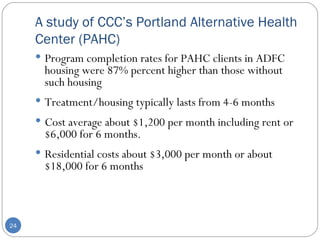
A study of CCC’s Portland Alternative Health Center (PAHC) Program completion rates for PAHC clients in ADFC housing were 87% percent higher than those without such housing Treatment/housing typically lasts from 4-6 months Cost average about $1,200 per month including rent or $6,000 for 6 months. Residential costs about $3,000 per month or about $18,000 for 6 months
A study of CCC’s Portland Alternative Health Center (PAHC) Clients include methamphetamine, heroin, crack/cocaine, prescription and alcohol addicts. 80% are homeless, 55% Chronically Homeless 55-60% average successful completion of treatment and transitional housing. About 70% of successful graduates are sober and in permanent housing 12 months after graduation.
Longer term  Alcohol and Drug Free Housing Oregon Recovery Homes Model used statewide in metropolitan and rural communities AMH Contracts with Central City Concern and Recovery Association Project
Oregon Recovery Homes Revolving Loan Fund -  CCC Outreach Coordinators –  RAP Travel statewide to help residents open homes and network with the community AMH currently funding 5 statewide Outreach Coordinators
Oregon Recovery Homes Recovering people reside in self-run homes for an average of 16 months Primarily supports “Oxford House” model Currently over  170 Oxford Houses  in Oregon accommodating about  1300  people in recovery Oxford House Leadership Summits held in June 2007 (with AMH funds) & June 2008
Oregon Recovery Homes   Data from 2001 Survey: 77.4% of Oregon Oxford House residents  had been homeless; average length of  homelessness was 9.5 months Mean age:  36 years, 2 months Average education:  12.23 years Employment rate:  84.3% Mean monthly income:  $1,467 Residents with history of jail time:  90% Prior residence:  48% from home/apartment; 18% from jail; 16% from homelessness;  11% from rented room; 6.3% from hospital  or halfway house
Equity issue  Rural homes take more intensive staff investment  Staff trains entire communities to accept and support residents Whereas in metro areas more infrastructure and networks exist to provide support for homes  Fund Outreach Coordinators to go into small, rural communities to build support networks using relatively small investment This amount invested in communities without treatment infrastructure would not have the same results.
“ The person who says it cannot be done should not interrupt the person doing it.”  --Chinese Proverb

Gov Council 06

  • 1.
    Gary Cobb MultnomahCounty Co-Chair Kathy L. Brazell, MPA, MNPM Executive Director Governor’s Council on Alcohol and Drug Abuse Programs February 21, 2006
  • 2.
    The Recovery AssociationProject (RAP) is an organization dedicated to creating a vehicle for people in recovery to speak out and challenge the stigma associated with addiction and alcoholism to create an environment where people in recovery can share their success and advocate for progressive change in substance abuse related policy.
  • 3.
    Recovery Association ProjectChallenging stigma through public education and outreach Organizing for progressive change in substance abuse policy Operating Recovery Centers in Portland and the MidValley Coordinating statewide Outreach for Oregon Recovery Homes
  • 4.
    Legislative Priorities forthe Recovery Association Project The most indispensable supports for those suffering from the disease of addiction are: (1) Treatment and Recovery Services (2) Health care (3) Housing These three essential supports, provided in concert, can lead to success and self-sufficiency for people with addictions.
  • 5.
    Legislative Priorities forthe Recovery Association Project The provision and coordination of chemical dependency treatment, physical healthcare, mental health treatment, housing and special needs services can break the cycle of addiction and homelessness. There is much greater demand in all three areas than there is capacity: people being turned away from treatment centers and safety net health clinics daily, and long waiting lists for affordable housing.
  • 6.
    The Power ofRecovery support: Gary Cobb’s Story Gary Cobb grew up in Topeka, Kansas with a father who was a chronic alcoholic and drug abuser. He dropped out of school in the seventh grade and began abusing these substances himself. Eventually he was arrested, and chose to enlist in the U.S. Coast Guard rather than face time in jail. Yet for the next two decades, he continued to abuse hard drugs and alcohol.
  • 7.
    The Power ofRecovery support: Gary Cobb’s Story In 2000, Gary participated in Central City Concern’s recovery programs. Treatment services supported by the Oregon Health Plan Safe shelter in transitional and then permanent Alcohol and Drug Free housing He is now employed at Central City Concern Clean and sober for 5 years
  • 8.
    The Power ofRecovery support: Gary Cobb’s Story Co-Chair of Recovery Association Project Community activist for treatment, public safety, and housing. Received the Mayor’s Award from Tom Potter at 2005 Spirit of Portland Awards. 2005
  • 9.
    The Power ofRecovery support: Gary Cobb’s Story Illustrates essential supports to move from active addiction to sustained recovery. RAP’s Legislative Priorities: Treatment and Recovery services Oregon Health Plan Alcohol and Drug Free Housing Gary is now an advocate for those in recovery .
  • 10.
    Legislative Priority #1Increase Treatment and Recovery Services
  • 11.
    There is insufficientcapacity in the treatment system Every piece of Meth legislation including penalties must include a treatment accompaniment. Oregon communities need increased treatment capacity to handle influx when jail beds are full By mandating more treatment without increasing capacity, Oregon will not solve the issue. This is a public safety issue – use Public Safety dollars
  • 12.
    RAP’s mission ….Challenging the stigma Only 1 in 10 addicts and alcoholics in the State receive treatment Methamphetamine addicts are NO harder to treat than clients recovering from crack/cocaine, heroin, prescription drugs or alcohol. Heroin clients are typically the hardest population Meth is not new: Oregon has been treating Meth addicts for 25 years
  • 13.
    Treatment is abetter investment Cost average about $1,200 per month (including rent) or $6,000 for 6 months Compare this to cost of emergency room visits, jail, prison, or child services
  • 14.
    Equity issue Oregonneeds to bring up the bottom You can bring everyone up to the same level but you can’t bring people down To de-fund existing programs is unthinkable It is bad policy to de-fund some services to pay for others.
  • 15.
    Legislative Priority #2Save the Oregon Health Plan
  • 16.
    Health care isessential for recovery Most people with addictions have multiple health problems as a result of years of substance abuse and homelessness. Chronic conditions such as hepatitis C, diabetes, and other ailments are common among people with addictions. They are sicker than the general public overall. Without primary health care to address their medical needs, it is very difficult for people to remain in recovery.
  • 17.
    Save the OregonHealth Plan Ensure that OHP standard $6.00 level premium waiver is preserved for the lowest income Oregonians Expand OHP Standard population from 24,000 to 50,000 people
  • 18.
    Number of PoorOregonians
  • 19.
    Save the OregonHealth Plan Funding for OHP standard population by Hospital Provider Tax and Managed Care Tax is ending in 2007 State must develop ways to fund OHP when tax expires Suggested methods: Beer & Wine tax Cigarette tax
  • 20.
    Legislative Priority #3Increase funding for Alcohol and Drug Free Housing
  • 21.
    Trends in Homelessness( statewide data on client living situation – A&D) *any homelessness
  • 22.
    Housing is aprimary need of those in recovery Without safe, secure, affordable housing, it is virtually impossible for people with addictions to remain clean and sober Homelessness, or living with people actively using substances, are very difficult environments for those in early recovery
  • 23.
    Transitional Alcoholand Drug Free Housing Alcohol and Drug Free housing is particularly important for early recovery (first 6 months) Creates a supportive community of peers who can help form relationships and sustain each others’ recovery Alcohol and Drug Free Community Housing (ADFC) transitional housing with outpatient treatment
  • 24.
    A study ofCCC’s Portland Alternative Health Center (PAHC) Program completion rates for PAHC clients in ADFC housing were 87% percent higher than those without such housing Treatment/housing typically lasts from 4-6 months Cost average about $1,200 per month including rent or $6,000 for 6 months. Residential costs about $3,000 per month or about $18,000 for 6 months
  • 25.
    A study ofCCC’s Portland Alternative Health Center (PAHC) Clients include methamphetamine, heroin, crack/cocaine, prescription and alcohol addicts. 80% are homeless, 55% Chronically Homeless 55-60% average successful completion of treatment and transitional housing. About 70% of successful graduates are sober and in permanent housing 12 months after graduation.
  • 26.
    Longer term Alcohol and Drug Free Housing Oregon Recovery Homes Model used statewide in metropolitan and rural communities AMH Contracts with Central City Concern and Recovery Association Project
  • 27.
    Oregon Recovery HomesRevolving Loan Fund - CCC Outreach Coordinators – RAP Travel statewide to help residents open homes and network with the community AMH currently funding 5 statewide Outreach Coordinators
  • 28.
    Oregon Recovery HomesRecovering people reside in self-run homes for an average of 16 months Primarily supports “Oxford House” model Currently over 170 Oxford Houses in Oregon accommodating about 1300 people in recovery Oxford House Leadership Summits held in June 2007 (with AMH funds) & June 2008
  • 29.
    Oregon Recovery Homes Data from 2001 Survey: 77.4% of Oregon Oxford House residents had been homeless; average length of homelessness was 9.5 months Mean age: 36 years, 2 months Average education: 12.23 years Employment rate: 84.3% Mean monthly income: $1,467 Residents with history of jail time: 90% Prior residence: 48% from home/apartment; 18% from jail; 16% from homelessness; 11% from rented room; 6.3% from hospital or halfway house
  • 30.
    Equity issue Rural homes take more intensive staff investment Staff trains entire communities to accept and support residents Whereas in metro areas more infrastructure and networks exist to provide support for homes Fund Outreach Coordinators to go into small, rural communities to build support networks using relatively small investment This amount invested in communities without treatment infrastructure would not have the same results.
  • 31.
    “ The personwho says it cannot be done should not interrupt the person doing it.” --Chinese Proverb