
The Role of Interfacial Tension in Controlling the Detergency of Dishwashing Liquid in Removing Crude Oil from Oil Soaked BirdsANDREW CHEN
Abstract	In 2010, the Deepwater Horizon oil spill off the Gulf of Mexico released 208 million gallons of oil into the environment.  Oil affects the plumage of birds, leaving birds unable to insulate themselves or fly effectively.  Oil can also lead to severe damage to internal organs with if accidently ingested.  To clean birds, environmentalists use store bought dishwashing detergents most exclusively and notably Dawn Dishwashing Detergent.  Detergents are used because of their surfactant abilities which remove the interfacial tension between oil and water, letting the water clean the oil.  However, does interfacial tension have a role on the detergency of oil on feathers? In literatures, studies have only done work on interfacial tension on soil or fabrics, but not feathers.   It has been shown that lower interfacial tensions improve the detergency of oil on clothes and soils.  It is hypothesized that since lower interfacial tensions in the oil and water interface improve the efficacy of detergents in oil removal from soil and fabrics, then the detergent that provides the lower interfacial tension will have better efficacy in oil removal from feathers.  Results from this experiment could be used to help companies to develop a specific soap or detergent for cleaning birds or help environmentalists find alternative detergents if Dawn is not available.	To test this, 5 detergents were used to clean oil covered feathers.  These tests were conducted in the same manner that environmentalists use to clean the feathers of actual oiled birds.  This procedure included creating a 1% solution of a detergent, finding the interfacial tension that it would produce, stirring the solution at 600 rpm and cleaning a single oil covered feather for 15 1 minute trials.  After each trial, L values and photographs were taken to measure the cleanness of the feather.  Results showed that the detergents with lower interfacial tensions did clean feathers more effectively, which in turn supports the hypothesis.  The results from this experiment are consistent with the theory of how interfacial tension helps in removing oil from a surface.
April  20th , 2010 Deep Water Horizon Oil Spill occurred affecting over 34,000 birdsOil has a severe effect on birds-Affects the plumage of their feathersBirds will accidently ingest oil, leading to serious internal damageOil does not mix with water because of their high interfacial tension and therefore cannot simply be washed off by waterInterfacial tension is free energy between two different interfacesThe International Bird Rescue Research Center uses detergent to clean birdsDetergents contain surfactant properties, which is why they are so effective for cleaningINTRODUCTION
Surfactants have hydrophilic and hydrophobic components. Hydrophilic head group will attach to waterHydrophobic chain hates water, but is attracted to oilAs more surfactant molecules attach to the water-oil interface, the interfacial tension between the water and oil will be reducedStudies conducted by Unilever Research Laboratory  and the Egyptian Petroleum Research Institute have tested the different effects of interfacial tension on different fabrics and soils. Their results have shown that lower interfacial tensions in the oil and water interface improve the efficacy of detergents in oil removal from soil and fabrics. However, there have been no studies on the effect of interfacial tension on the oil removal from feathersINTRODUCTION
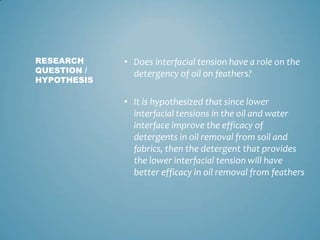
Does interfacial tension have a role on the detergency of oil on feathers?  It is hypothesized that since lower interfacial tensions in the oil and water interface improve the efficacy of detergents in oil removal from soil and fabrics, then the detergent that provides the lower interfacial tension will have better efficacy in oil removal from feathersRESEARCH QUESTION / HYPOTHESIS
IV: Detergents with different Interfacial TensionsDV: Detergency of oil on feathersControl: No detergent/ tap waterIndependent Variable / Dependent Variable / Control
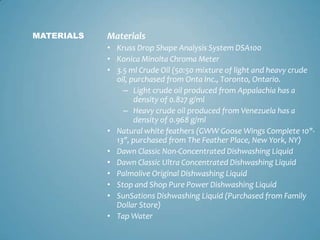
MaterialsKruss Drop Shape Analysis System DSA100Konica Minolta Chroma Meter3.5 ml Crude Oil (50:50 mixture of light and heavy crude oil, purchased from Onta Inc., Toronto, Ontario. Light crude oil produced from Appalachia has a density of 0.827 g/ml Heavy crude oil produced from Venezuela has a density of 0.968 g/mlNatural white feathers (GWW Goose Wings Complete 10"-13", purchased from The Feather Place, New York, NY)Dawn Classic Non-Concentrated Dishwashing LiquidDawn Classic Ultra Concentrated Dishwashing LiquidPalmolive Original Dishwashing LiquidStop and Shop Pure Power Dishwashing LiquidSunSations Dishwashing Liquid (Purchased from Family Dollar Store)Tap WaterMaterials
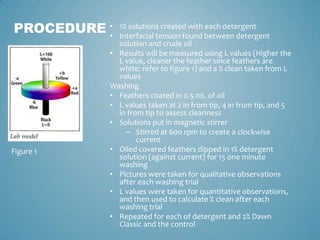
Procedure1% solutions created with each detergentInterfacial tension found between detergent solution and crude oil Results will be measured using L values (Higher the L value, cleaner the feather since feathers are white: refer to figure 1) and a % clean taken from L valuesWashingFeathers coated in 0.5 mL of oilL values taken at 2 in from tip, 4 in from tip, and 5 in from tip to assess cleanness Solutions put in magnetic stirrerStirred at 600 rpm to create a clockwise currentOiled covered feathers dipped in 1% detergent solution (against current) for 15 one minute washingPictures were taken for qualitative observations after each washing trialL values were taken for quantitative observations, and then used to calculate % clean after each washing trialRepeated for each of detergent and 2% Dawn Classic and the control Figure 1
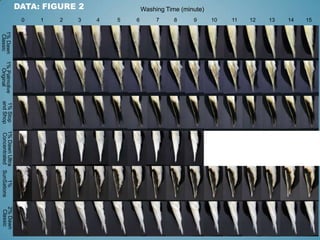
DATA: Figure 2Washing Time (minute)01234567891011121314151% DawnClassic1% PalmoliveOriginal1% Stopand Shop1% Dawn UltraConcentrated1%SunSations2% DawnClassic
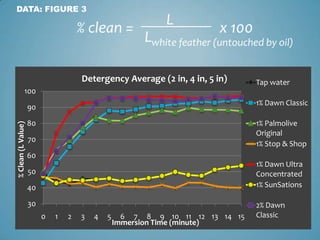
DATA: Figure 3Lx 100% clean =Lwhitefeather (untouched by oil)h
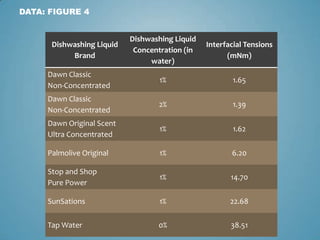
DATA: Figure 4
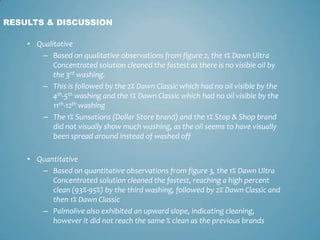
RESULTS & DISCUSSIONQualitativeBased on qualitative observations from figure 2, the 1% Dawn Ultra Concentrated solution cleaned the fastest as there is no visible oil by the 3rd washing.  This is followed by the 2% Dawn Classic which had no oil visible by the 4th-5th washing and the 1% Dawn Classic which had no oil visible by the 11th-12th washingThe 1% Sunsations (Dollar Store brand) and the 1% Stop & Shop brand did not visually show much washing, as the oil seems to have visually been spread around instead of washed offQuantitativeBased on quantitative observations from figure 3, the 1% Dawn Ultra Concentrated solution cleaned the fastest, reaching a high percent clean (93%-95%) by the third washing, followed by 2% Dawn Classic and then 1% Dawn ClassicPalmolive also exhibited an upward slope, indicating cleaning, however it did not reach the same % clean as the previous brands
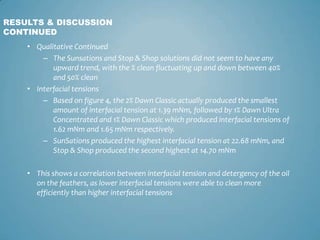
RESULTS & DISCUSSION ContinuedQualitative ContinuedThe Sunsations and Stop & Shop solutions did not seem to have any upward trend, with the % clean fluctuating up and down between 40% and 50% cleanInterfacial tensionsBased on figure 4, the 2% Dawn Classic actually produced the smallest amount of interfacial tension at 1.39 mNm, followed by 1% Dawn Ultra Concentrated and 1% Dawn Classic which produced interfacial tensions of 1.62 mNm and 1.65 mNm respectively.SunSations produced the highest interfacial tension at 22.68 mNm, and Stop & Shop produced the second highest at 14.70 mNmThis shows a correlation between interfacial tension and detergency of the oil on the feathers, as lower interfacial tensions were able to clean more efficiently than higher interfacial tensions
In conclusion, the hypothesis is accepted because 1% and 2% Dawn Classic and Dawn Ultra Concentrated had the lowest interfacial tensions and also had the best percent cleanHowever, interfacial tension does not tell how fast the detergents will clean as detergents with lower interfacial tensions seemed to clean faster than some detergents with slightly higher interfacial tensionsCONCLUSION
Not enough feathersVariation in L values because it was hard to position in the exact same locationSpreading of oil not controlled as possibleTemperature not controlled as well as possibleIs the surfactant concentration different?Errors/ Future WOrk
BIBLIOGRAPHY"Detergent Chemistry." Detergent Chemistry. Chemistry and New Zealand. Web. 10 Dec. 2010. <http://www.chemistry.co.nz/deterginfo.htm>."IBRRC: How Oil Affects Birds." How Oil Affects Birds. IBRRC. Web. 4 Dec. 2010. <http://www.ibrrc.org/oil_affects.html>."IBRRC: Oiled Bird Procedures." IBRRC Home. International Bird Research Rescue Center. Web. 4 Dec. 2010. <http://www.ibrrc.org/oiled_bird_procedures.html>."Interfacial Tension." INTERFACIAL TENSION. MIT. Web. 18 Dec. 2010. <http://web.mit.edu/nnf/education/wettability/interfacial.html>.Jůza, J. "The Pendant Drop Method of Surface Tension Measurement: Equation Interpolating the Shape Factor Tables for Several Selected Planes." Czechoslovak Journal of Physics, 19-24 June 1994. Web. 16 Dec. 2010. <http://www.springerlink.com/content/n510973p8675h585/>.Lindbloom, Bruce Justin. Welcome to Bruce Lindbloom's Web Site. 2003. Web. 30 Dec. 2010. <http://www.brucelindbloom.com/index.html?UPLab.html>."Surface Tension." Test Page for Apache Installation. Web. 10 Dec. 2010. <http://hyperphysics.phy-astr.gsu.edu/hbase/surten.html>."Surfactants: Detergent Chemistry." Chemistry and New Zealand. Web. 10 Dec. 2010. <http://www.chemistry.co.nz/surfactants.htm>."USA.gov: The U.S. Government's Official Web Portal." Answers.USA.gov. Web. 30 Dec. 2011. <http://answers.usa.gov/system/selfservice.controller?CONFIGURATION=1000&PARTITION_ID=1&CMD=VIEW_ARTICLE&ARTICLE_ID=12057&USERTYPE=1&LANGUAGE=en&COUNTRY=US>. "USFWS - FWS Deepwater Horizon Oil Spill Response." Bird Impact Data from DOI‐ERDC Database. Www.fws.gov. Web. 30 Dec. 2010. <http://www.fws.gov/home/dhoilspill/collectionreports.html>.Miller, Clarence A., and Kirk H. Raney. "Solubilization-emulsification Mechanisms of Detergency." Colloids and Surfaces A: Physicochemical and Engineering Aspects, 1993. Web. 30 Dec. 2010. <http://www.firp.ula.ve/archivos/cuadernos/93_COLSUA_Miller_Detergency.pdf>.
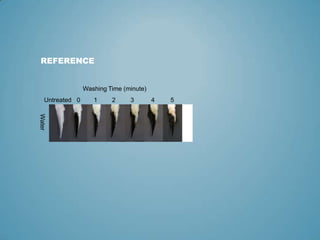
REFERENCEWashing Time (minute)Untreated012345Water

Google Science Fair Summary

  • 1.
    The Role ofInterfacial Tension in Controlling the Detergency of Dishwashing Liquid in Removing Crude Oil from Oil Soaked BirdsANDREW CHEN
  • 2.
    Abstract In 2010, theDeepwater Horizon oil spill off the Gulf of Mexico released 208 million gallons of oil into the environment. Oil affects the plumage of birds, leaving birds unable to insulate themselves or fly effectively. Oil can also lead to severe damage to internal organs with if accidently ingested. To clean birds, environmentalists use store bought dishwashing detergents most exclusively and notably Dawn Dishwashing Detergent. Detergents are used because of their surfactant abilities which remove the interfacial tension between oil and water, letting the water clean the oil. However, does interfacial tension have a role on the detergency of oil on feathers? In literatures, studies have only done work on interfacial tension on soil or fabrics, but not feathers. It has been shown that lower interfacial tensions improve the detergency of oil on clothes and soils. It is hypothesized that since lower interfacial tensions in the oil and water interface improve the efficacy of detergents in oil removal from soil and fabrics, then the detergent that provides the lower interfacial tension will have better efficacy in oil removal from feathers. Results from this experiment could be used to help companies to develop a specific soap or detergent for cleaning birds or help environmentalists find alternative detergents if Dawn is not available. To test this, 5 detergents were used to clean oil covered feathers. These tests were conducted in the same manner that environmentalists use to clean the feathers of actual oiled birds. This procedure included creating a 1% solution of a detergent, finding the interfacial tension that it would produce, stirring the solution at 600 rpm and cleaning a single oil covered feather for 15 1 minute trials. After each trial, L values and photographs were taken to measure the cleanness of the feather. Results showed that the detergents with lower interfacial tensions did clean feathers more effectively, which in turn supports the hypothesis. The results from this experiment are consistent with the theory of how interfacial tension helps in removing oil from a surface.
  • 3.
    April 20th, 2010 Deep Water Horizon Oil Spill occurred affecting over 34,000 birdsOil has a severe effect on birds-Affects the plumage of their feathersBirds will accidently ingest oil, leading to serious internal damageOil does not mix with water because of their high interfacial tension and therefore cannot simply be washed off by waterInterfacial tension is free energy between two different interfacesThe International Bird Rescue Research Center uses detergent to clean birdsDetergents contain surfactant properties, which is why they are so effective for cleaningINTRODUCTION
  • 4.
    Surfactants have hydrophilicand hydrophobic components. Hydrophilic head group will attach to waterHydrophobic chain hates water, but is attracted to oilAs more surfactant molecules attach to the water-oil interface, the interfacial tension between the water and oil will be reducedStudies conducted by Unilever Research Laboratory  and the Egyptian Petroleum Research Institute have tested the different effects of interfacial tension on different fabrics and soils. Their results have shown that lower interfacial tensions in the oil and water interface improve the efficacy of detergents in oil removal from soil and fabrics. However, there have been no studies on the effect of interfacial tension on the oil removal from feathersINTRODUCTION
  • 5.
    Does interfacial tensionhave a role on the detergency of oil on feathers? It is hypothesized that since lower interfacial tensions in the oil and water interface improve the efficacy of detergents in oil removal from soil and fabrics, then the detergent that provides the lower interfacial tension will have better efficacy in oil removal from feathersRESEARCH QUESTION / HYPOTHESIS
  • 6.
    IV: Detergents withdifferent Interfacial TensionsDV: Detergency of oil on feathersControl: No detergent/ tap waterIndependent Variable / Dependent Variable / Control
  • 7.
    MaterialsKruss Drop ShapeAnalysis System DSA100Konica Minolta Chroma Meter3.5 ml Crude Oil (50:50 mixture of light and heavy crude oil, purchased from Onta Inc., Toronto, Ontario. Light crude oil produced from Appalachia has a density of 0.827 g/ml Heavy crude oil produced from Venezuela has a density of 0.968 g/mlNatural white feathers (GWW Goose Wings Complete 10"-13", purchased from The Feather Place, New York, NY)Dawn Classic Non-Concentrated Dishwashing LiquidDawn Classic Ultra Concentrated Dishwashing LiquidPalmolive Original Dishwashing LiquidStop and Shop Pure Power Dishwashing LiquidSunSations Dishwashing Liquid (Purchased from Family Dollar Store)Tap WaterMaterials
  • 8.
    Procedure1% solutions createdwith each detergentInterfacial tension found between detergent solution and crude oil Results will be measured using L values (Higher the L value, cleaner the feather since feathers are white: refer to figure 1) and a % clean taken from L valuesWashingFeathers coated in 0.5 mL of oilL values taken at 2 in from tip, 4 in from tip, and 5 in from tip to assess cleanness Solutions put in magnetic stirrerStirred at 600 rpm to create a clockwise currentOiled covered feathers dipped in 1% detergent solution (against current) for 15 one minute washingPictures were taken for qualitative observations after each washing trialL values were taken for quantitative observations, and then used to calculate % clean after each washing trialRepeated for each of detergent and 2% Dawn Classic and the control Figure 1
  • 9.
    DATA: Figure 2WashingTime (minute)01234567891011121314151% DawnClassic1% PalmoliveOriginal1% Stopand Shop1% Dawn UltraConcentrated1%SunSations2% DawnClassic
  • 10.
    DATA: Figure 3Lx100% clean =Lwhitefeather (untouched by oil)h
  • 11.
  • 12.
    RESULTS & DISCUSSIONQualitativeBasedon qualitative observations from figure 2, the 1% Dawn Ultra Concentrated solution cleaned the fastest as there is no visible oil by the 3rd washing. This is followed by the 2% Dawn Classic which had no oil visible by the 4th-5th washing and the 1% Dawn Classic which had no oil visible by the 11th-12th washingThe 1% Sunsations (Dollar Store brand) and the 1% Stop & Shop brand did not visually show much washing, as the oil seems to have visually been spread around instead of washed offQuantitativeBased on quantitative observations from figure 3, the 1% Dawn Ultra Concentrated solution cleaned the fastest, reaching a high percent clean (93%-95%) by the third washing, followed by 2% Dawn Classic and then 1% Dawn ClassicPalmolive also exhibited an upward slope, indicating cleaning, however it did not reach the same % clean as the previous brands
  • 13.
    RESULTS & DISCUSSIONContinuedQualitative ContinuedThe Sunsations and Stop & Shop solutions did not seem to have any upward trend, with the % clean fluctuating up and down between 40% and 50% cleanInterfacial tensionsBased on figure 4, the 2% Dawn Classic actually produced the smallest amount of interfacial tension at 1.39 mNm, followed by 1% Dawn Ultra Concentrated and 1% Dawn Classic which produced interfacial tensions of 1.62 mNm and 1.65 mNm respectively.SunSations produced the highest interfacial tension at 22.68 mNm, and Stop & Shop produced the second highest at 14.70 mNmThis shows a correlation between interfacial tension and detergency of the oil on the feathers, as lower interfacial tensions were able to clean more efficiently than higher interfacial tensions
  • 14.
    In conclusion, thehypothesis is accepted because 1% and 2% Dawn Classic and Dawn Ultra Concentrated had the lowest interfacial tensions and also had the best percent cleanHowever, interfacial tension does not tell how fast the detergents will clean as detergents with lower interfacial tensions seemed to clean faster than some detergents with slightly higher interfacial tensionsCONCLUSION
  • 15.
    Not enough feathersVariationin L values because it was hard to position in the exact same locationSpreading of oil not controlled as possibleTemperature not controlled as well as possibleIs the surfactant concentration different?Errors/ Future WOrk
  • 16.
    BIBLIOGRAPHY"Detergent Chemistry." DetergentChemistry. Chemistry and New Zealand. Web. 10 Dec. 2010. <http://www.chemistry.co.nz/deterginfo.htm>."IBRRC: How Oil Affects Birds." How Oil Affects Birds. IBRRC. Web. 4 Dec. 2010. <http://www.ibrrc.org/oil_affects.html>."IBRRC: Oiled Bird Procedures." IBRRC Home. International Bird Research Rescue Center. Web. 4 Dec. 2010. <http://www.ibrrc.org/oiled_bird_procedures.html>."Interfacial Tension." INTERFACIAL TENSION. MIT. Web. 18 Dec. 2010. <http://web.mit.edu/nnf/education/wettability/interfacial.html>.Jůza, J. "The Pendant Drop Method of Surface Tension Measurement: Equation Interpolating the Shape Factor Tables for Several Selected Planes." Czechoslovak Journal of Physics, 19-24 June 1994. Web. 16 Dec. 2010. <http://www.springerlink.com/content/n510973p8675h585/>.Lindbloom, Bruce Justin. Welcome to Bruce Lindbloom's Web Site. 2003. Web. 30 Dec. 2010. <http://www.brucelindbloom.com/index.html?UPLab.html>."Surface Tension." Test Page for Apache Installation. Web. 10 Dec. 2010. <http://hyperphysics.phy-astr.gsu.edu/hbase/surten.html>."Surfactants: Detergent Chemistry." Chemistry and New Zealand. Web. 10 Dec. 2010. <http://www.chemistry.co.nz/surfactants.htm>."USA.gov: The U.S. Government's Official Web Portal." Answers.USA.gov. Web. 30 Dec. 2011. <http://answers.usa.gov/system/selfservice.controller?CONFIGURATION=1000&PARTITION_ID=1&CMD=VIEW_ARTICLE&ARTICLE_ID=12057&USERTYPE=1&LANGUAGE=en&COUNTRY=US>. "USFWS - FWS Deepwater Horizon Oil Spill Response." Bird Impact Data from DOI‐ERDC Database. Www.fws.gov. Web. 30 Dec. 2010. <http://www.fws.gov/home/dhoilspill/collectionreports.html>.Miller, Clarence A., and Kirk H. Raney. "Solubilization-emulsification Mechanisms of Detergency." Colloids and Surfaces A: Physicochemical and Engineering Aspects, 1993. Web. 30 Dec. 2010. <http://www.firp.ula.ve/archivos/cuadernos/93_COLSUA_Miller_Detergency.pdf>.
  • 17.