© 2014 mona sabet
1
What does it take to be
THE BEST
at what you do?
© 2014 mona sabet
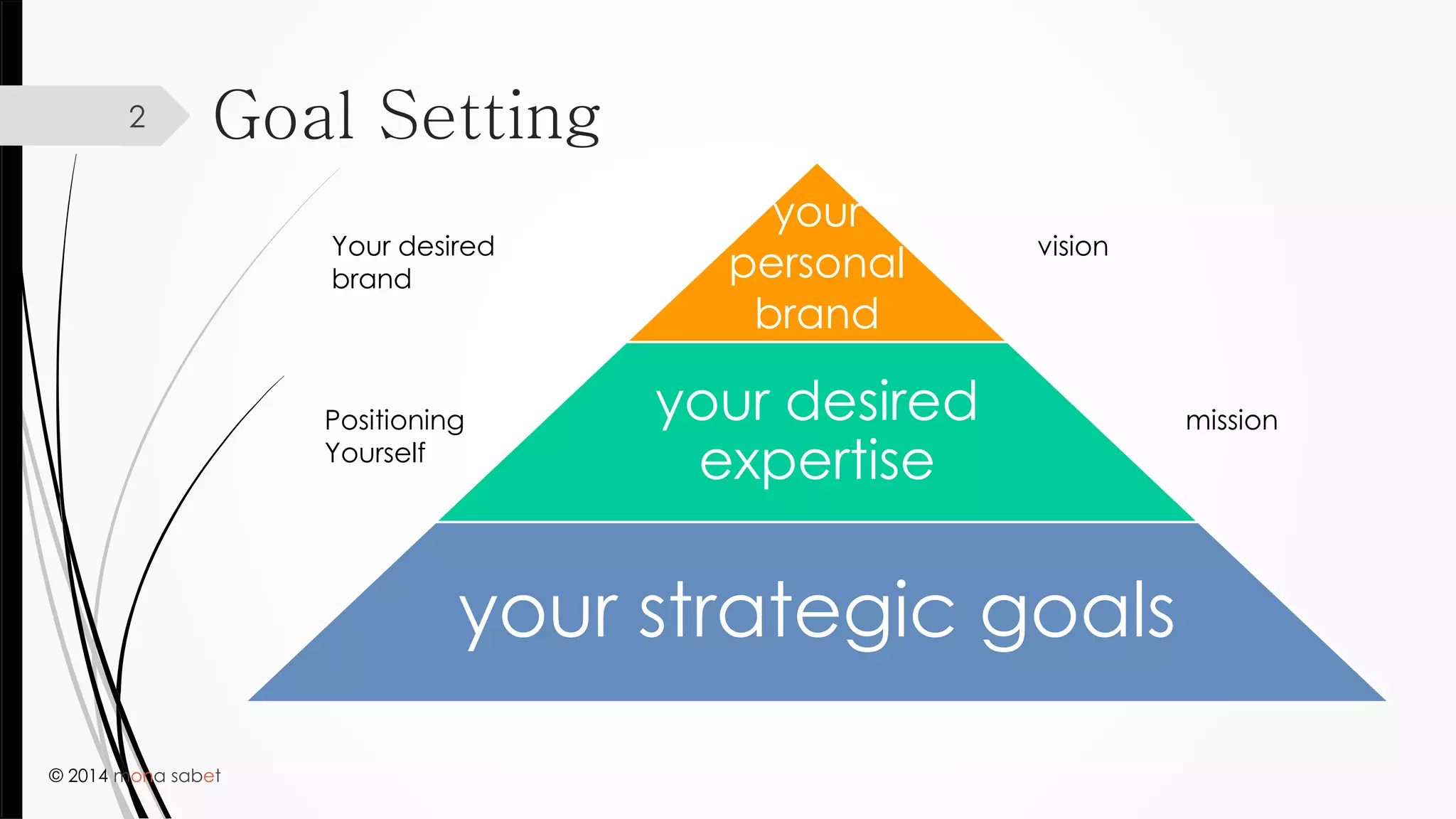
2 Goal Setting
your
personal
brand
visionYour desired
brand
your desired
expertise
missionPositioning
Yourself
your strategic goals
© 2014 mona sabet
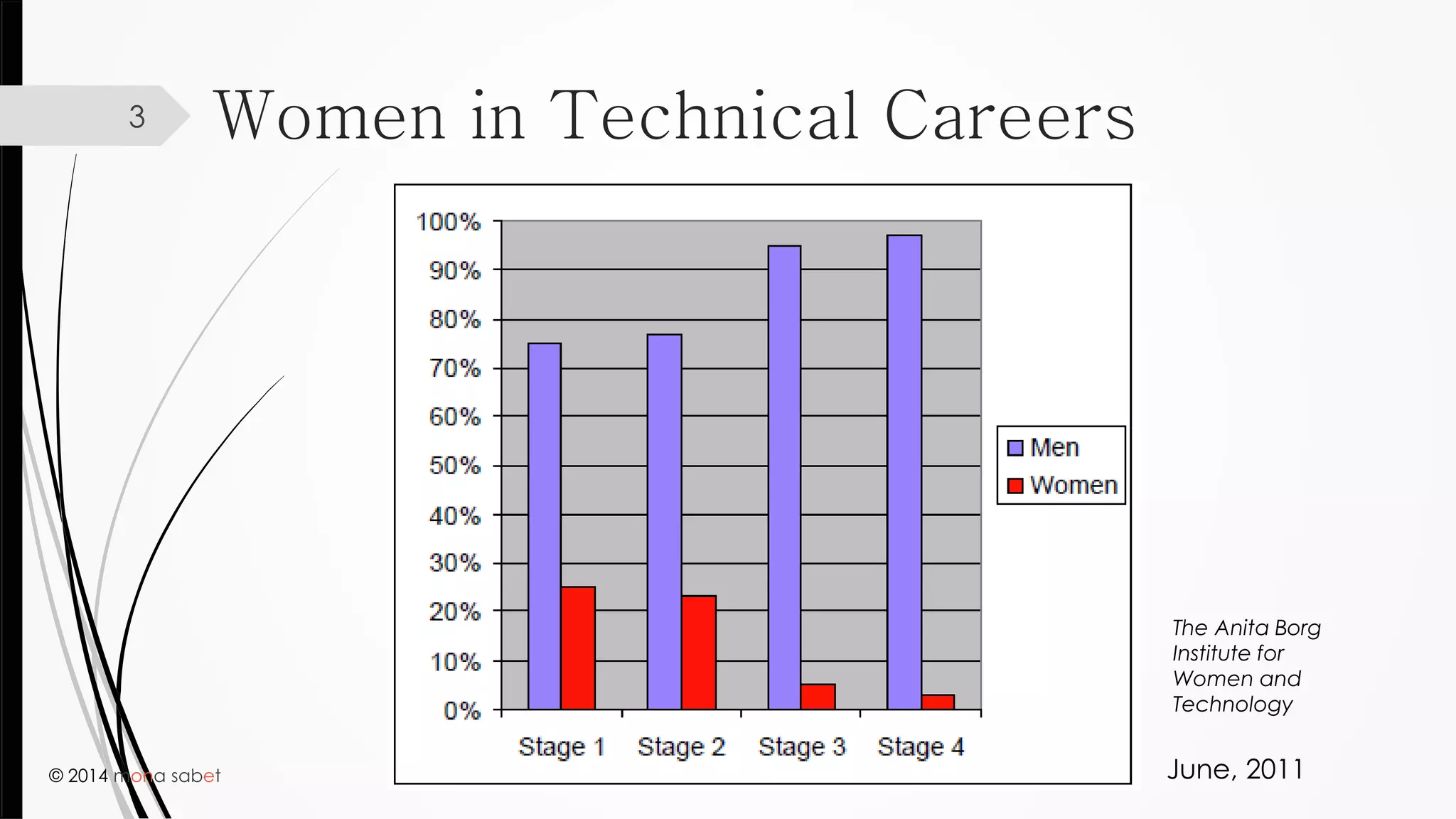
3 Women in Technical Careers
June, 2011
The Anita Borg
Institute for
Women and
Technology
© 2014 mona sabet
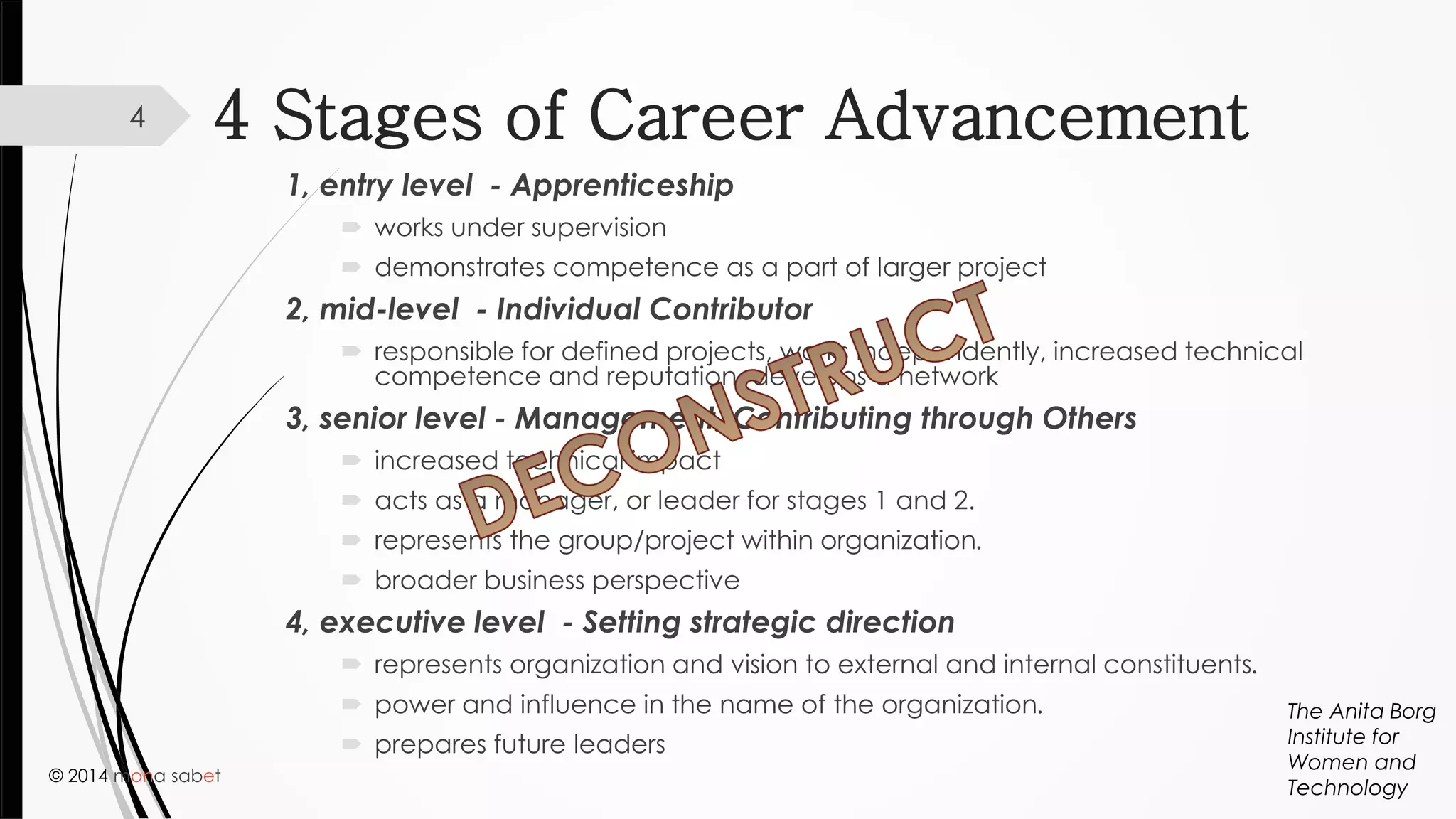
4 Stages of Career Advancement
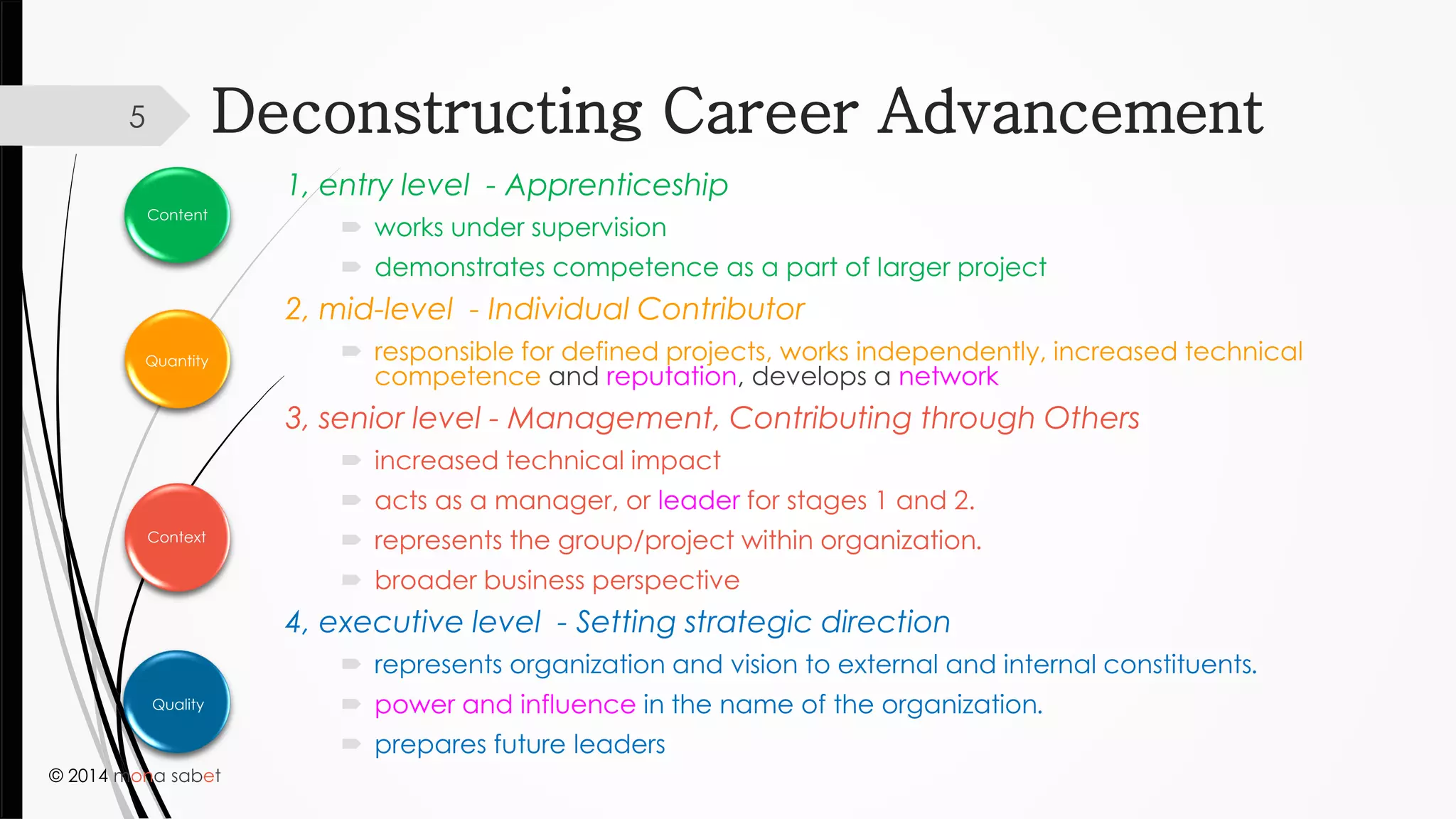
1, entry level - Apprenticeship
 works under supervision
 demonstrates competence as a part of larger project
2, mid-level - Individual Contributor
 responsible for defined projects, works independently, increased technical
competence and reputation, develops a network
3, senior level - Management, Contributing through Others
 increased technical impact
 acts as a manager, or leader for stages 1 and 2.
 represents the group/project within organization.
 broader business perspective
4, executive level - Setting strategic direction
 represents organization and vision to external and internal constituents.
 power and influence in the name of the organization.
 prepares future leaders
4
The Anita Borg
Institute for
Women and
Technology
© 2014 mona sabet
Deconstructing Career Advancement
1, entry level - Apprenticeship
 works under supervision
 demonstrates competence as a part of larger project
2, mid-level - Individual Contributor
 responsible for defined projects, works independently, increased technical
competence and reputation, develops a network
3, senior level - Management, Contributing through Others
 increased technical impact
 acts as a manager, or leader for stages 1 and 2.
 represents the group/project within organization.
 broader business perspective
4, executive level - Setting strategic direction
 represents organization and vision to external and internal constituents.
 power and influence in the name of the organization.
 prepares future leaders
5
Content
Quantity
Context
Quality
© 2014 mona sabet
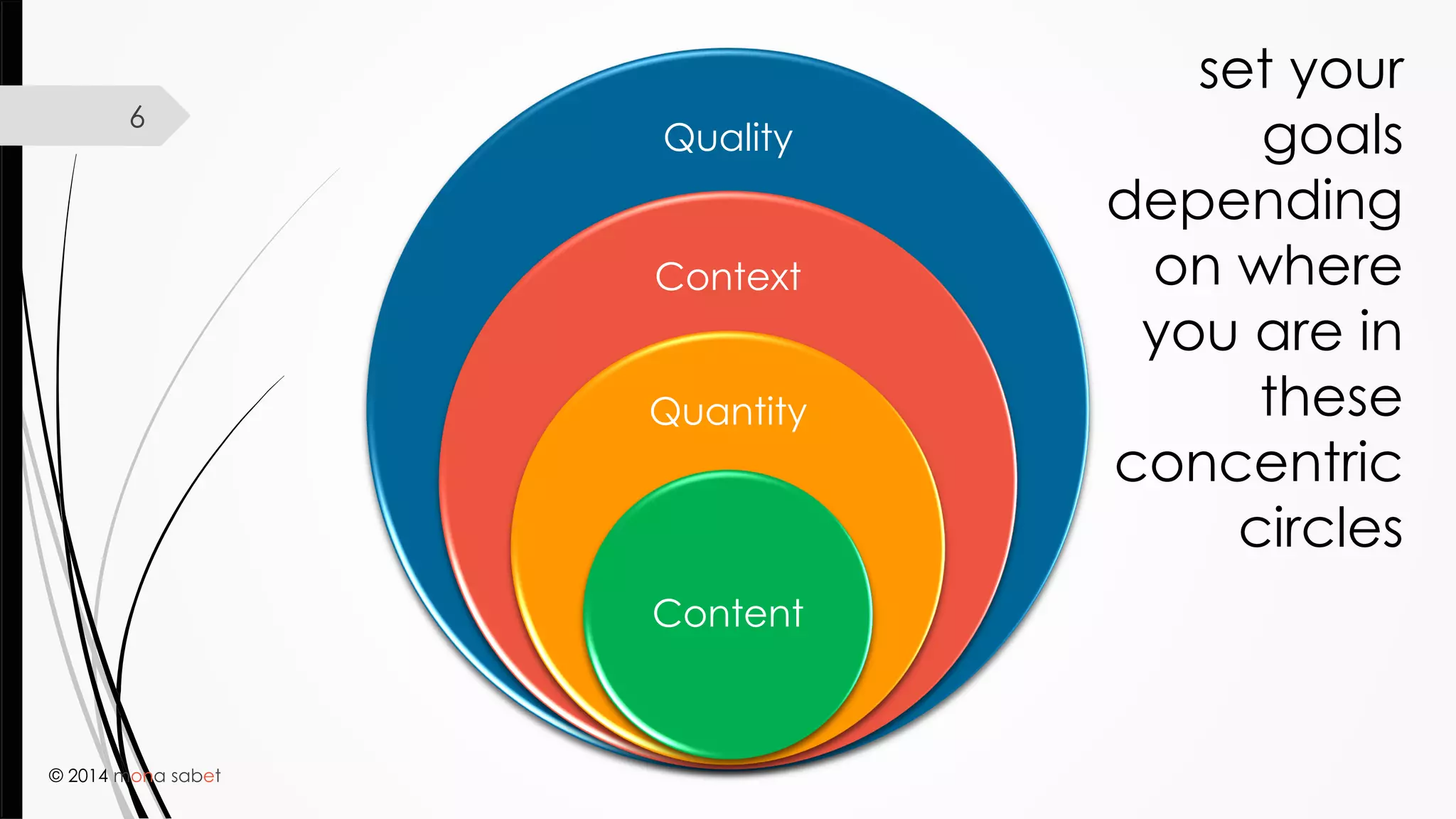
6
Quality
Context
Quantity
Content
set your
goals
depending
on where
you are in
these
concentric
circles
© 2014 mona sabet
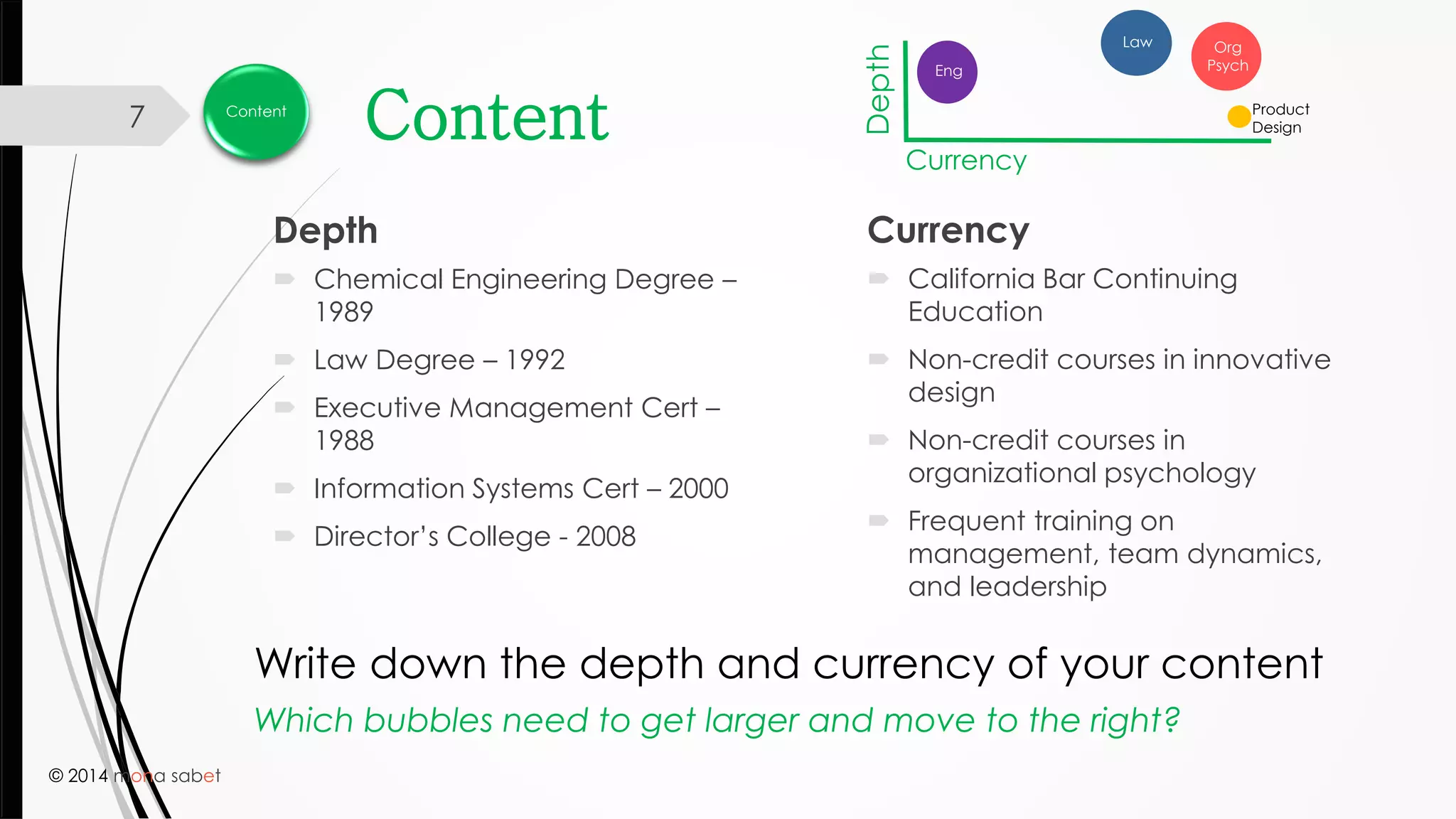
Depth
 Chemical Engineering Degree –
1989
 Law Degree – 1992
 Executive Management Cert –
1988
 Information Systems Cert – 2000
 Director’s College - 2008
Currency
 California Bar Continuing
Education
 Non-credit courses in innovative
design
 Non-credit courses in
organizational psychology
 Frequent training on
management, team dynamics,
and leadership
7 Content
Write down the depth and currency of your content
Content
Depth
Currency
Which bubbles need to get larger and move to the right?
Eng
Law Org
Psych
Product
Design
© 2014 mona sabet
8 ContentContent
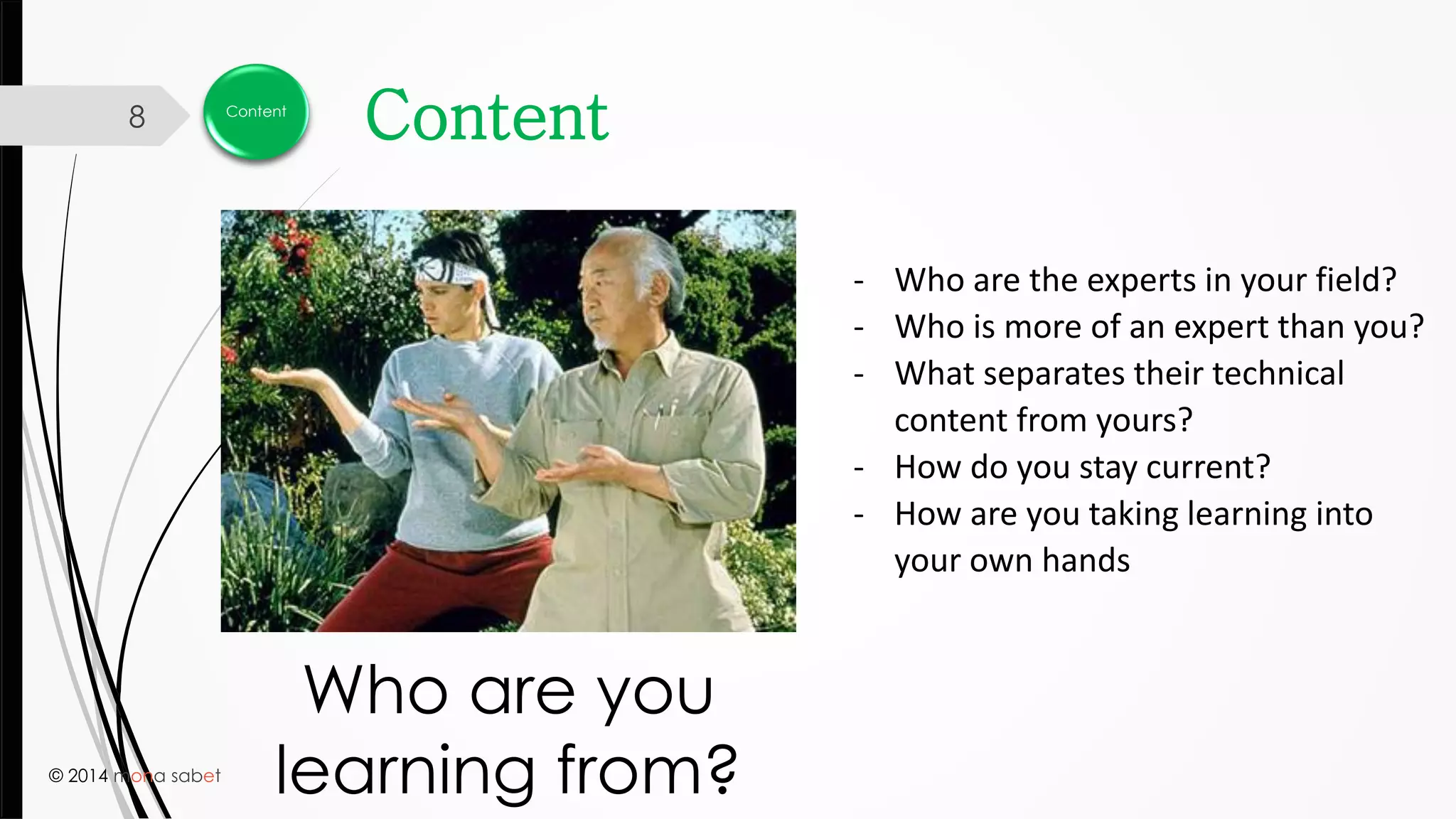
Who are you
learning from?
- Who are the experts in your field?
- Who is more of an expert than you?
- What separates their technical
content from yours?
- How do you stay current?
- How are you taking learning into
your own hands
© 2014 mona sabet
9
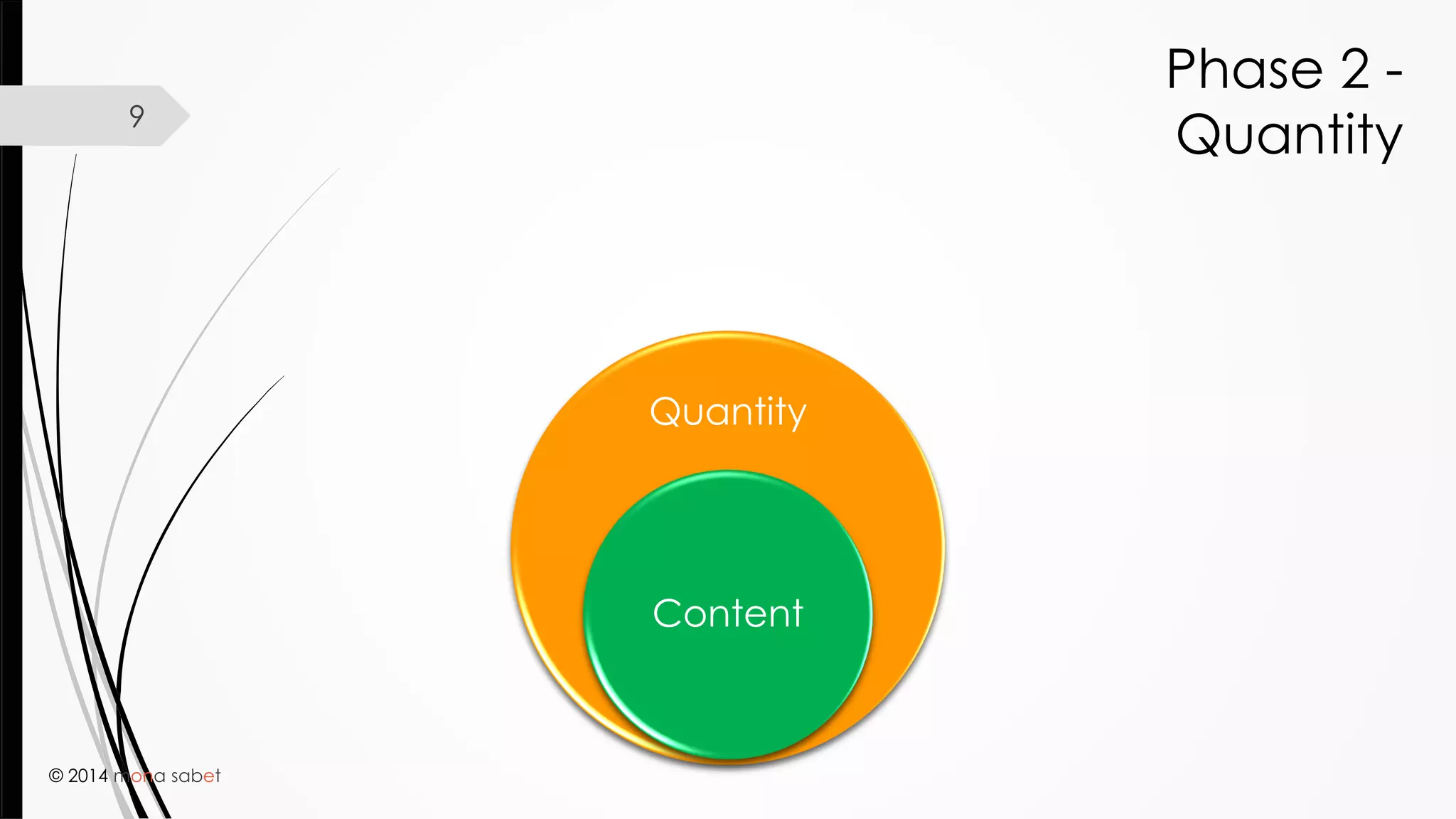
Quantity
Content
Phase 2 -
Quantity
© 2014 mona sabet
10 Quantity
Quantity
© 2014 mona sabet
Quantity11 Quantity
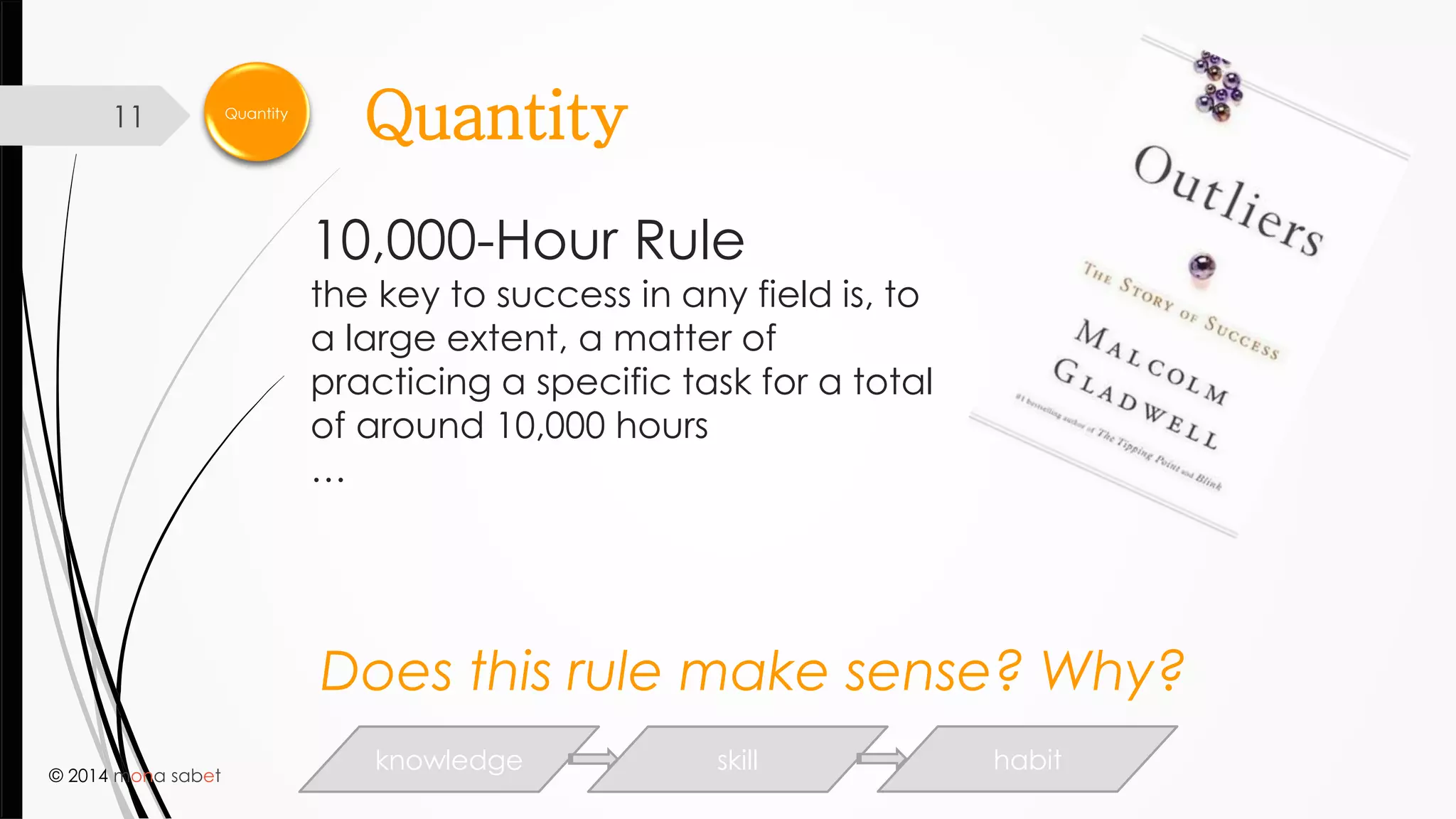
10,000-Hour Rule
the key to success in any field is, to
a large extent, a matter of
practicing a specific task for a total
of around 10,000 hours
…
Does this rule make sense? Why?
knowledge skill habit
© 2014 mona sabet
12
The elite software developer is the programmer who spends all
day pounding code at work, and after leaving work she writes
open source software on her own time.
The elite football player is the guy who spends all day on the
practice field with his teammates, and after practice he goes
home to watch game films.
The elite physician listens to medical podcasts in the car during a
long commute.
The elites are obsessed with what they do.
Continuous ImprovementQuantity
© 2014 mona sabet
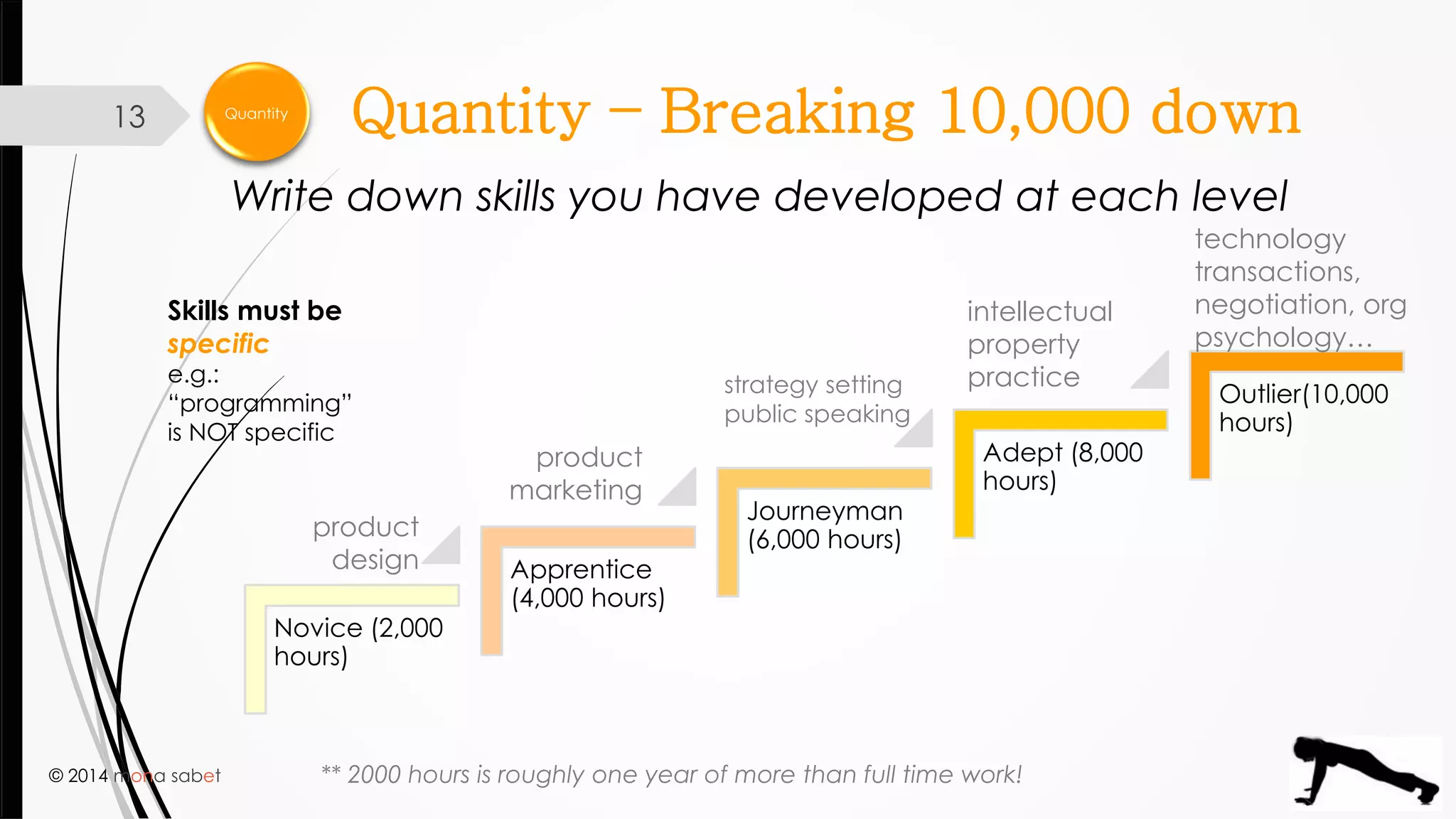
Novice (2,000
hours)
Apprentice
(4,000 hours)
Journeyman
(6,000 hours)
Adept (8,000
hours)
Outlier(10,000
hours)
13 Quantity – Breaking 10,000 down
Write down skills you have developed at each level
Quantity
** 2000 hours is roughly one year of more than full time work!
product
marketing
product
design
strategy setting
public speaking
intellectual
property
practice
technology
transactions,
negotiation, org
psychology…
Skills must be
specific
e.g.:
“programming”
is NOT specific
© 2014 mona sabet
14 QuantityQuantity
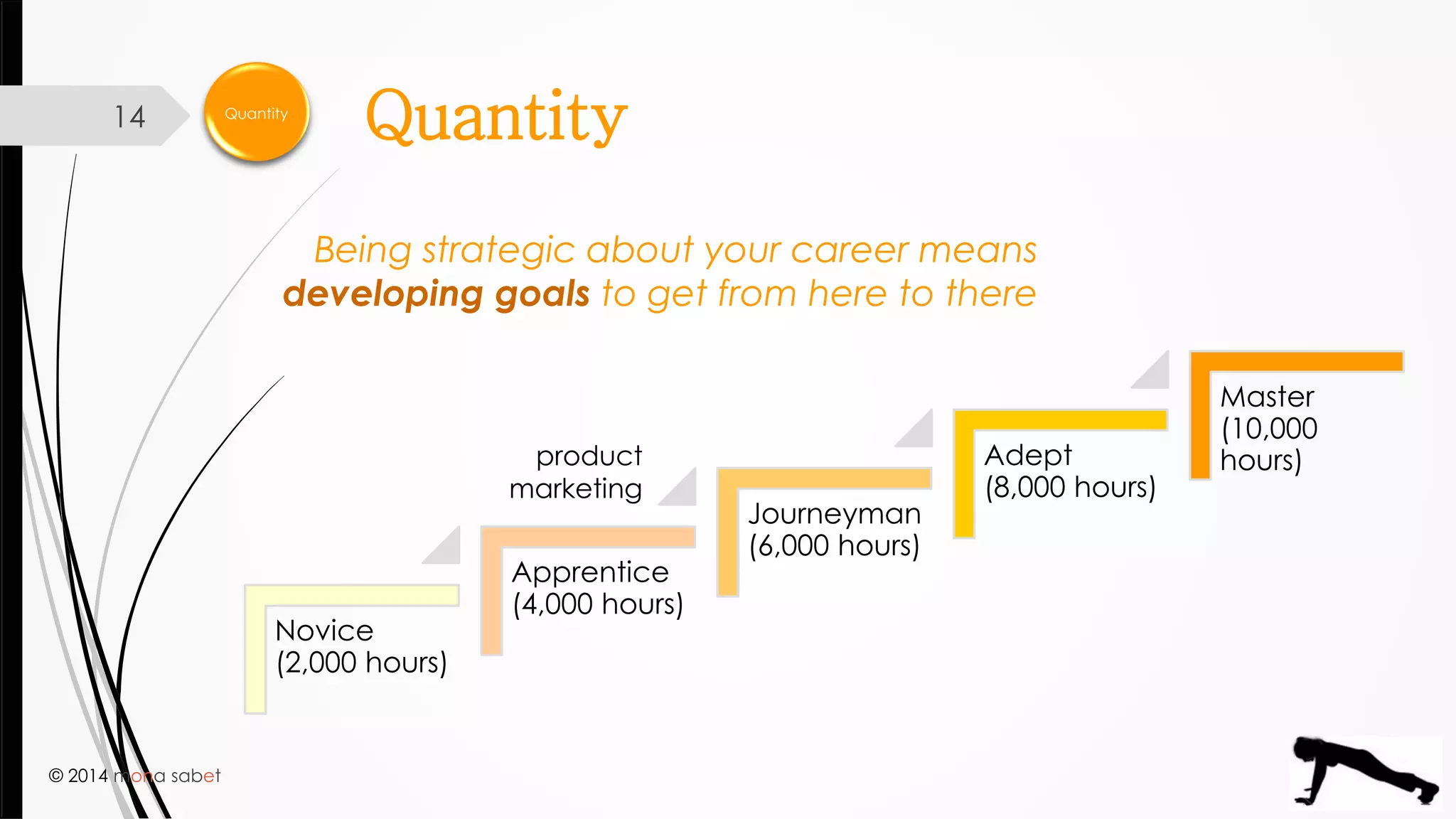
Novice
(2,000 hours)
Apprentice
(4,000 hours)
Journeyman
(6,000 hours)
Adept
(8,000 hours)
Master
(10,000
hours)product
marketing
Being strategic about your career means
developing goals to get from here to there
© 2014 mona sabet
15
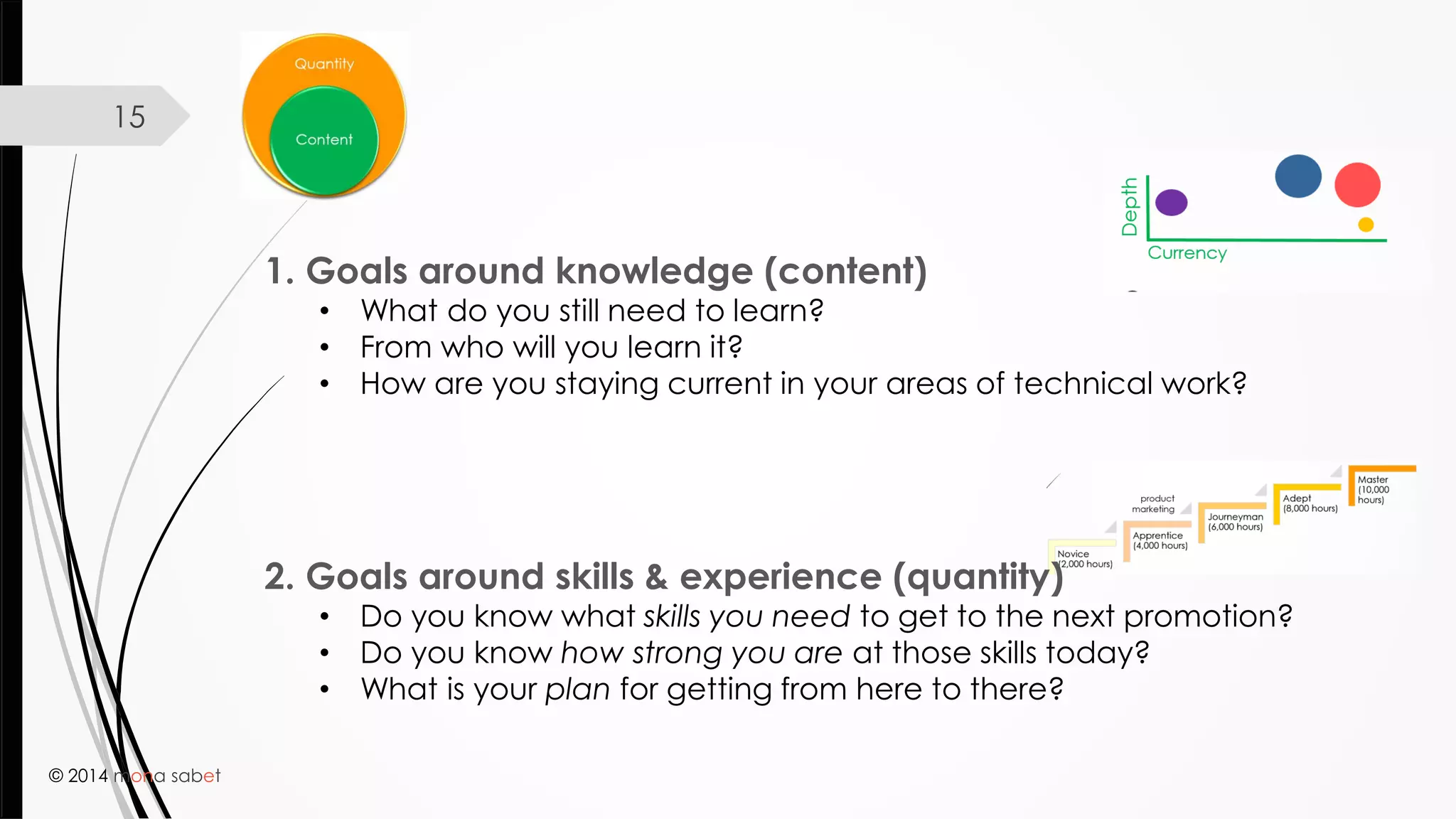
1. Goals around knowledge (content)
• What do you still need to learn?
• From who will you learn it?
• How are you staying current in your areas of technical work?
2. Goals around skills & experience (quantity)
• Do you know what skills you need to get to the next promotion?
• Do you know how strong you are at those skills today?
• What is your plan for getting from here to there?
© 2014 mona sabet
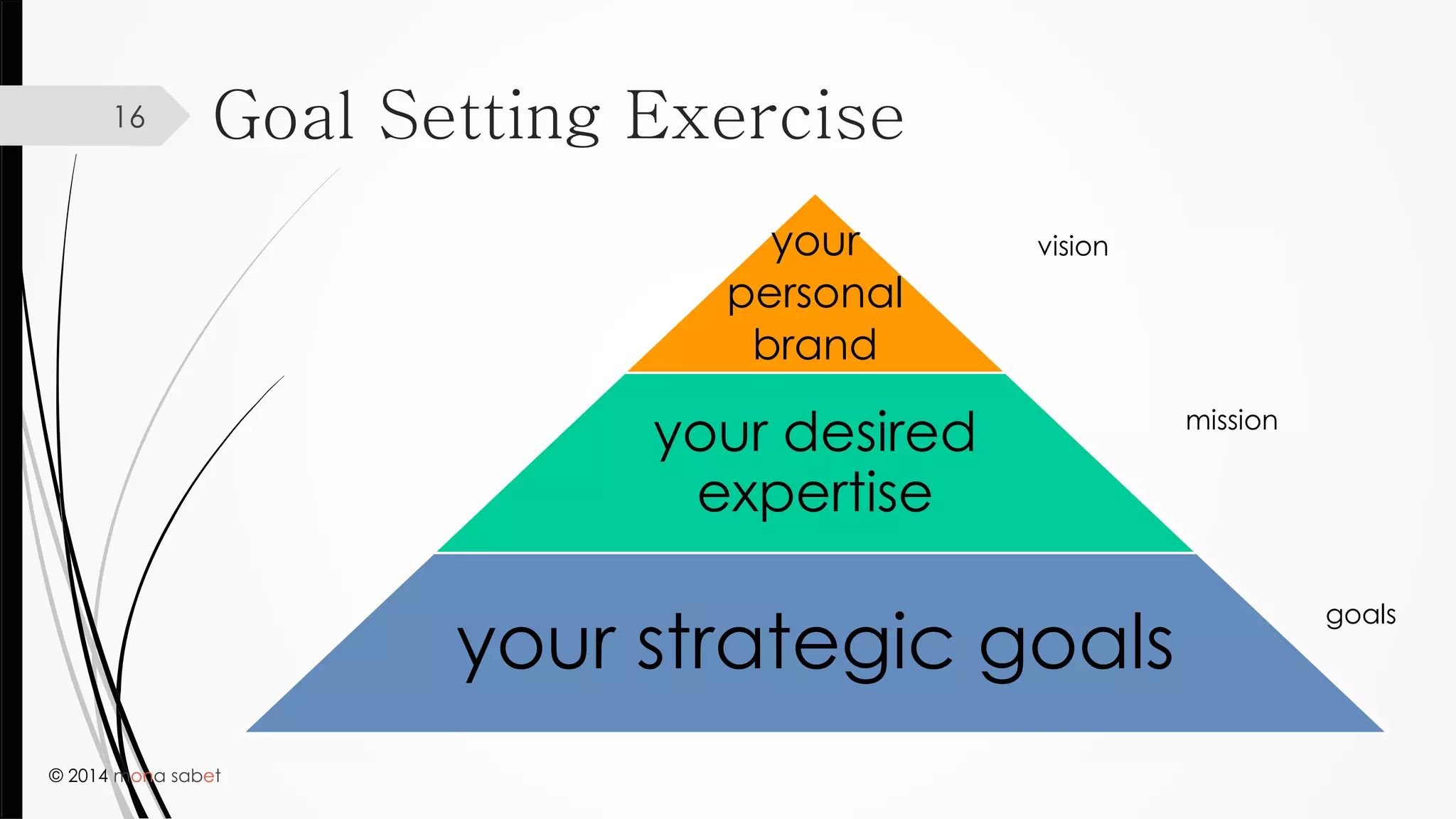
16 Goal Setting Exercise
your
personal
brand
your desired
expertise
your strategic goals
vision
mission
goals
© 2014 mona sabet
17
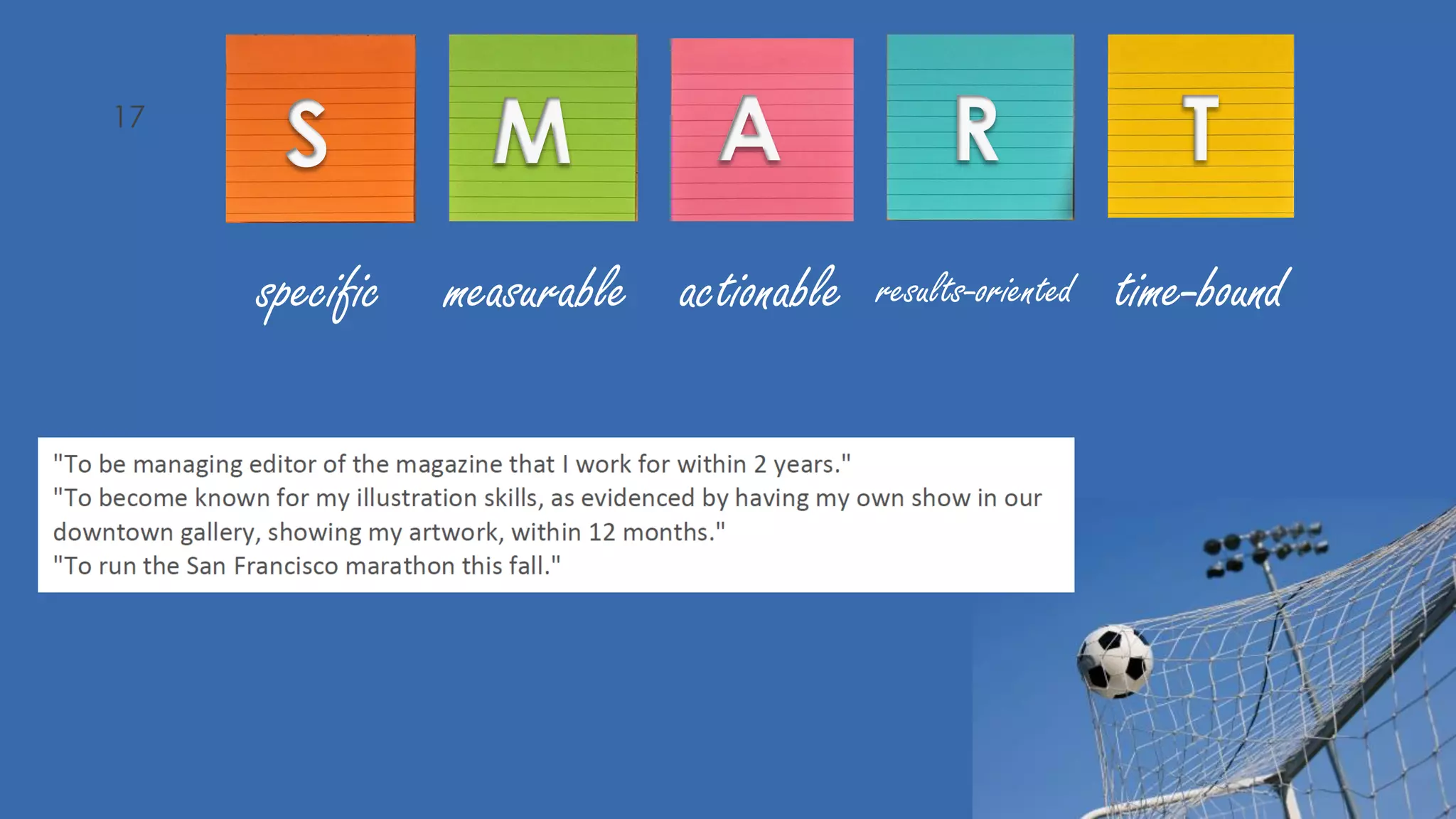
S M RA T
specific measurable actionable results-oriented time-bound
© 2014 mona sabet
18
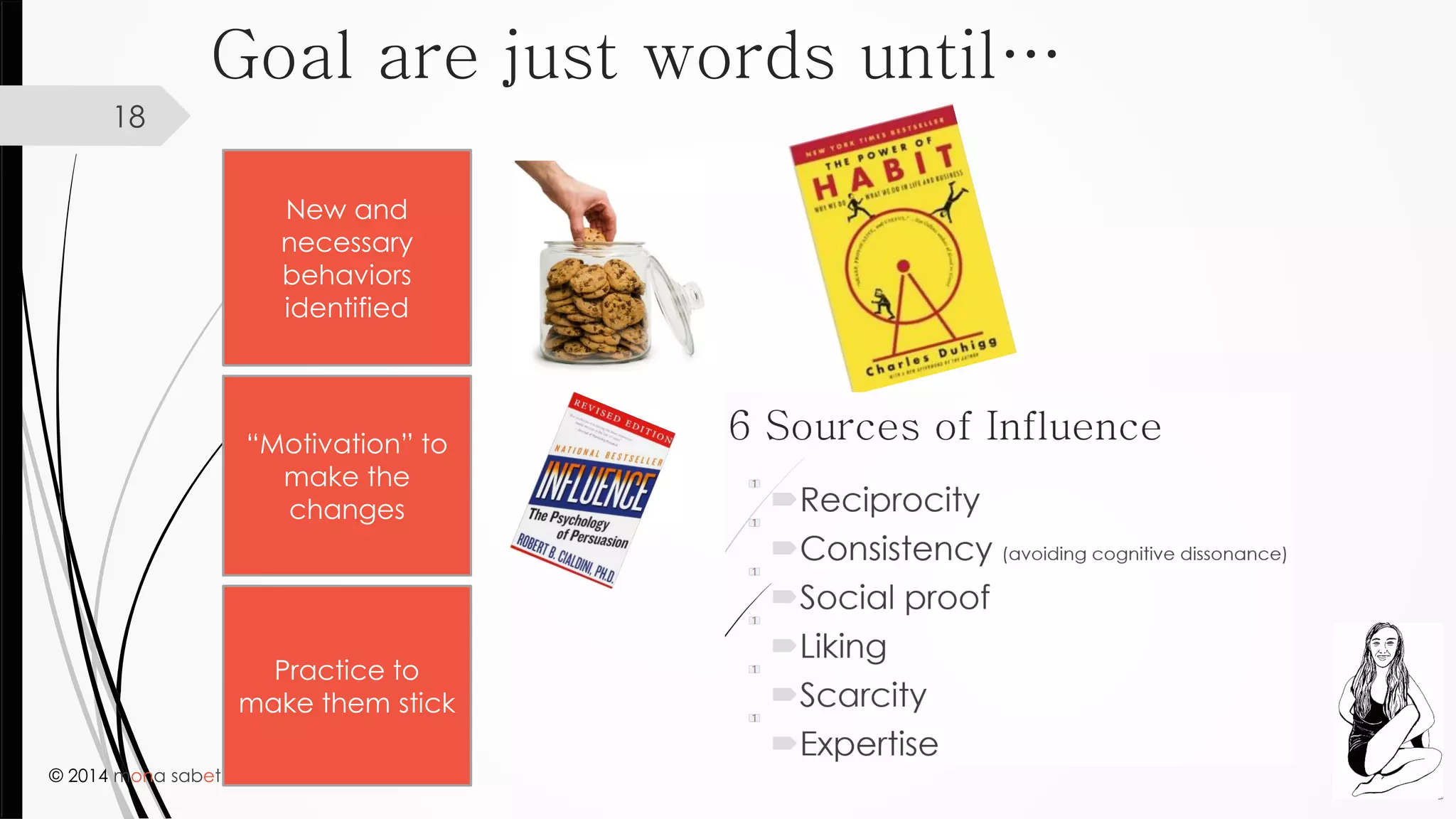
New and
necessary
behaviors
identified
“Motivation” to
make the
changes
Goal are just words until…
Practice to
make them stick
© 2014 mona sabet
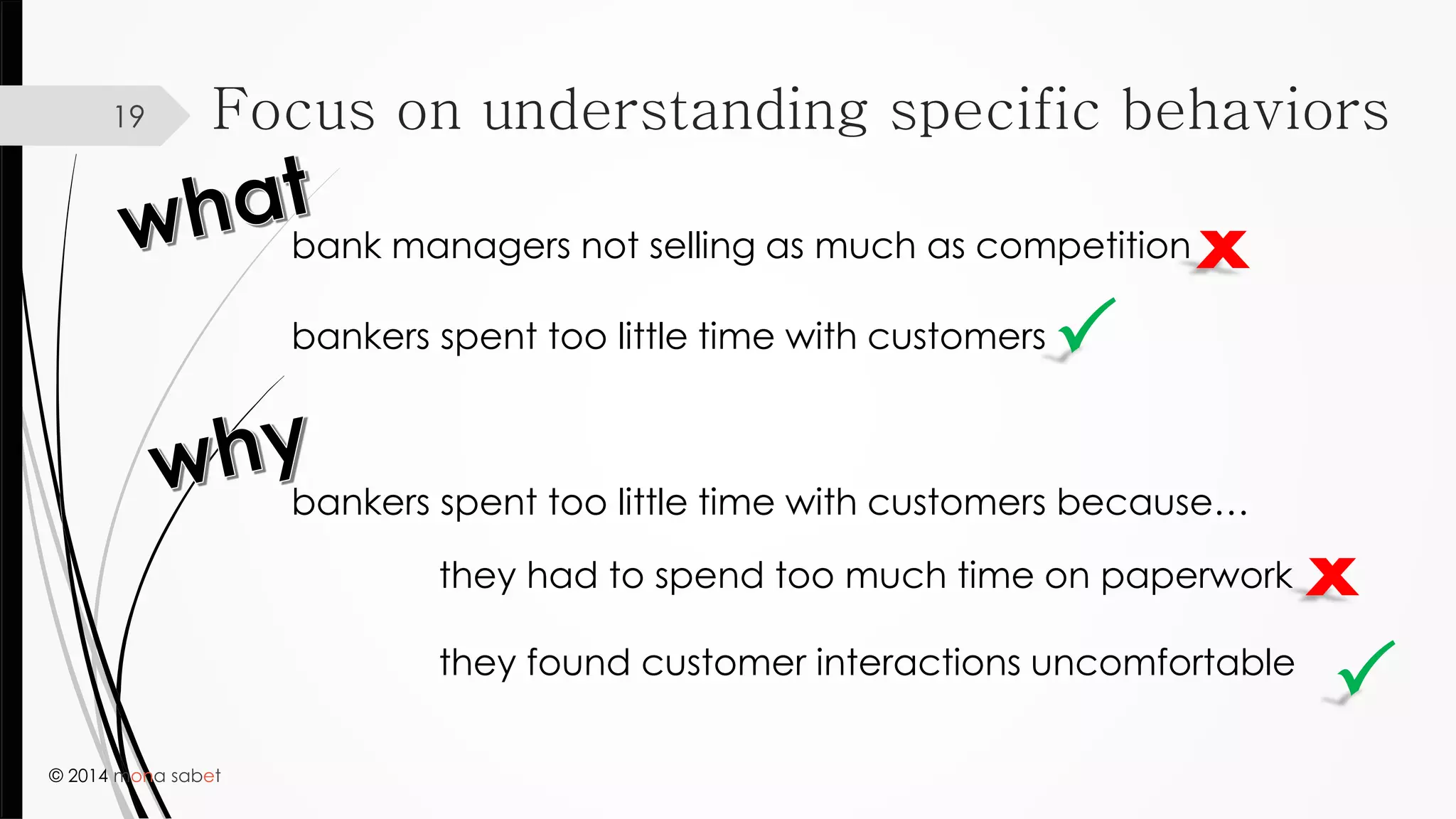
19 Focus on understanding specific behaviors
bank managers not selling as much as competitionx
bankers spent too little time with customers
x
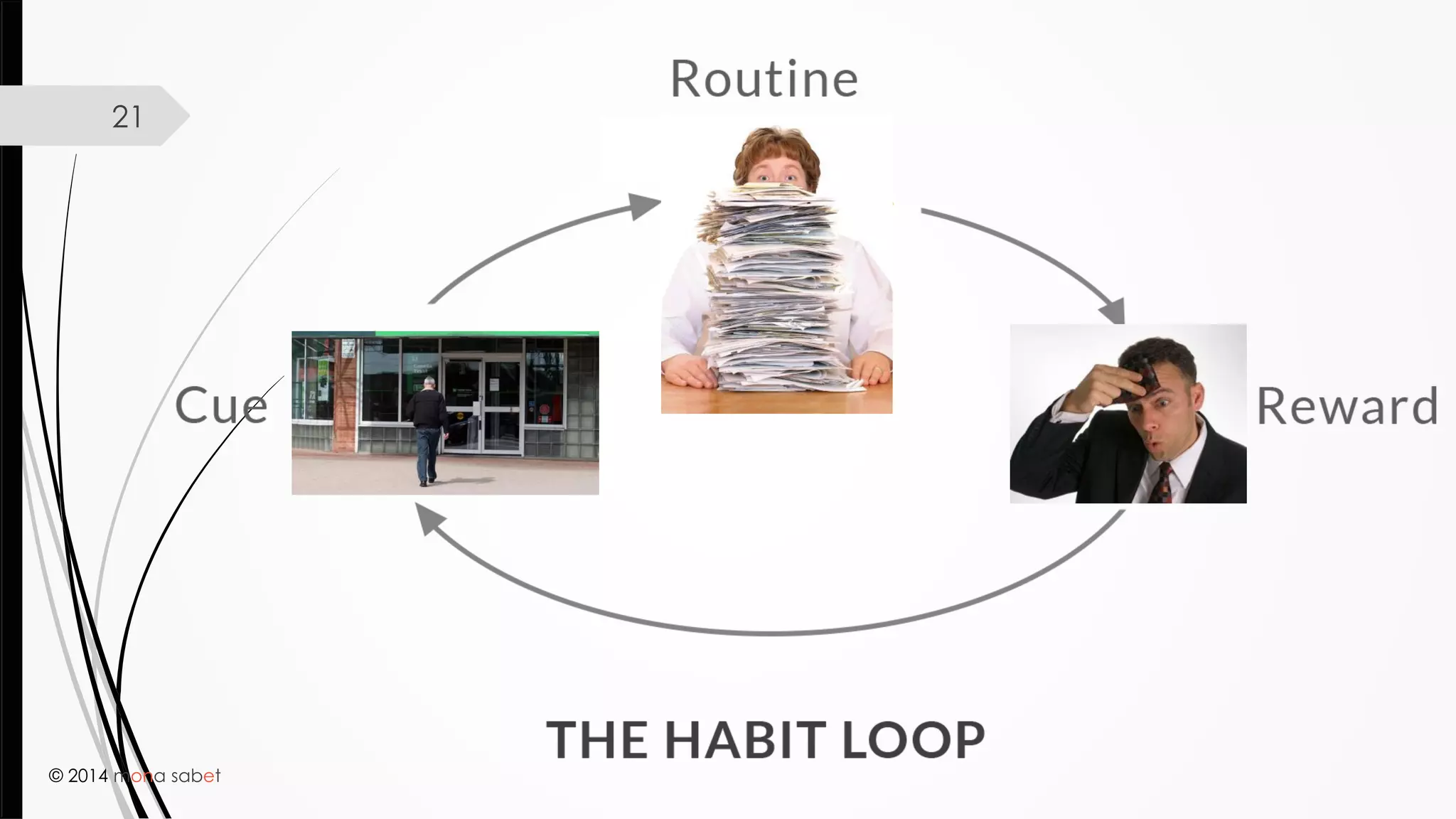
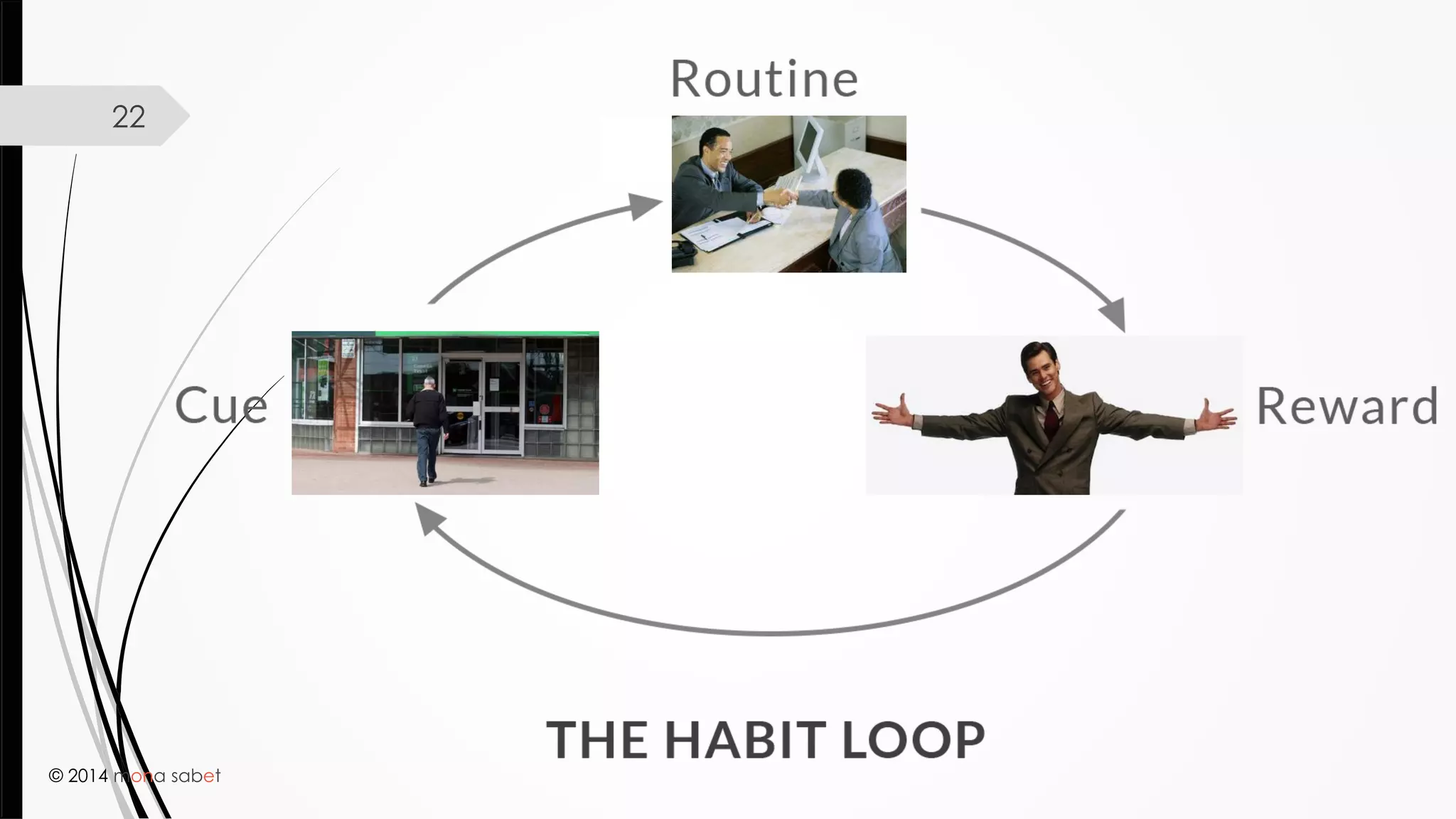
bankers spent too little time with customers because…
they had to spend too much time on paperwork
they found customer interactions uncomfortable


© 2014 mona sabet
20
© 2014 mona sabet
21
© 2014 mona sabet
22
© 2014 mona sabet
23
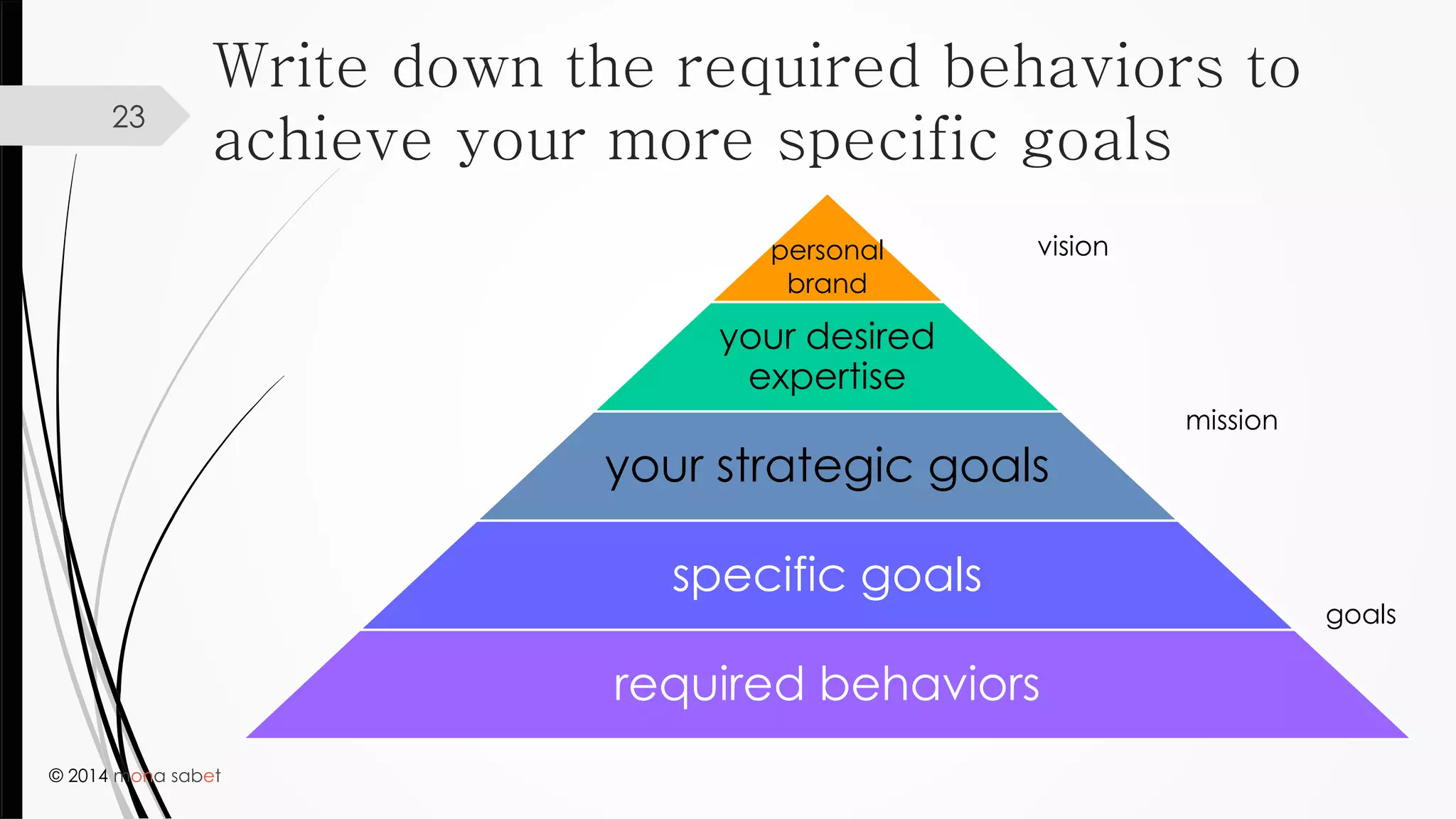
Write down the required behaviors to
achieve your more specific goals
personal
brand
your desired
expertise
your strategic goals
specific goals
required behaviors
vision
mission
goals
© 2014 mona sabet
24
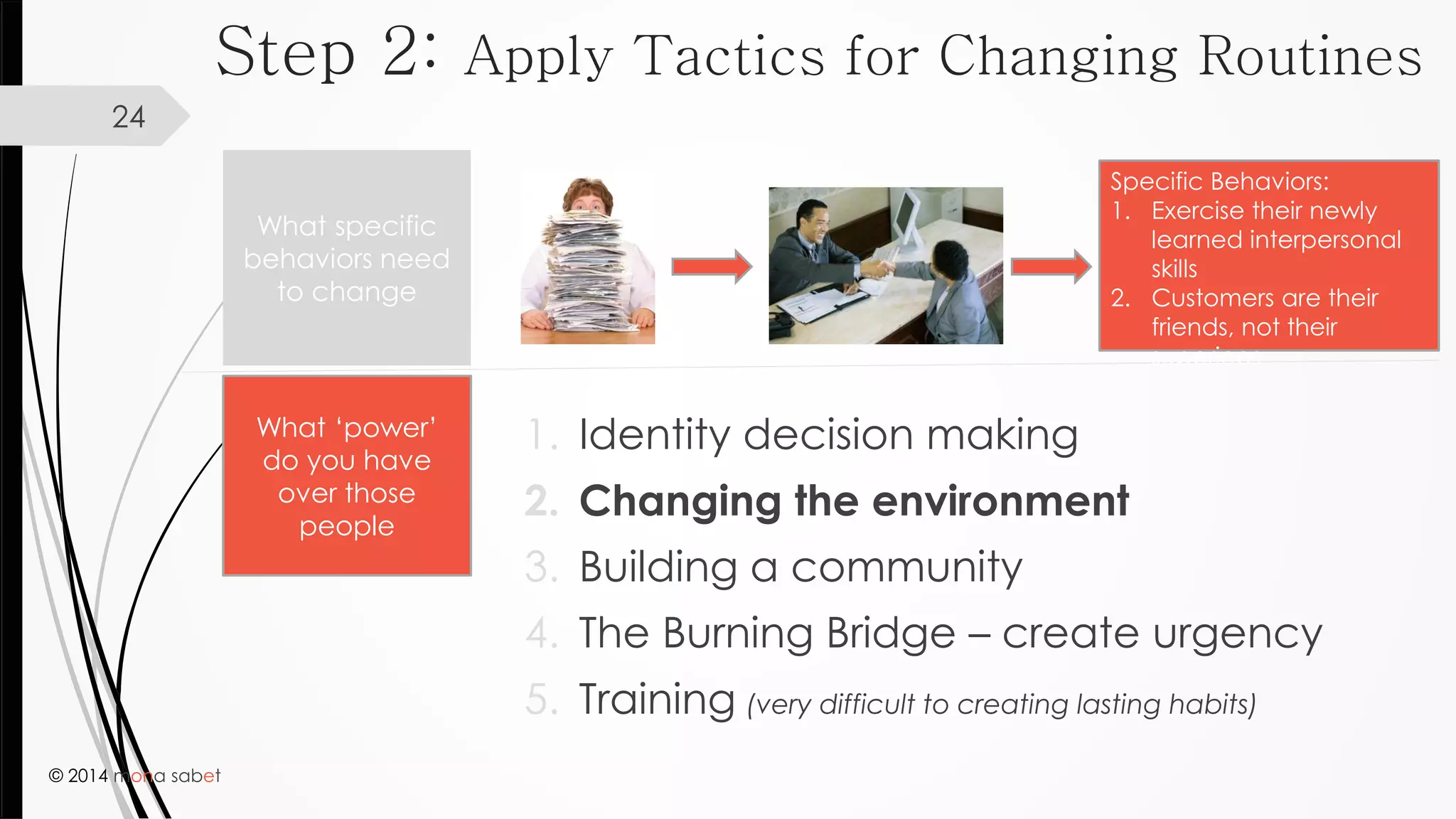
What specific
behaviors need
to change
What ‘power’
do you have
over those
people
Step 2: Apply Tactics for Changing Routines
1. Identity decision making
2. Changing the environment
3. Building a community
4. The Burning Bridge – create urgency
5. Training (very difficult to creating lasting habits)
Specific Behaviors:
1. Exercise their newly
learned interpersonal
skills
2. Customers are their
friends, not their
superioes
© 2014 mona sabet
Changing Environment25
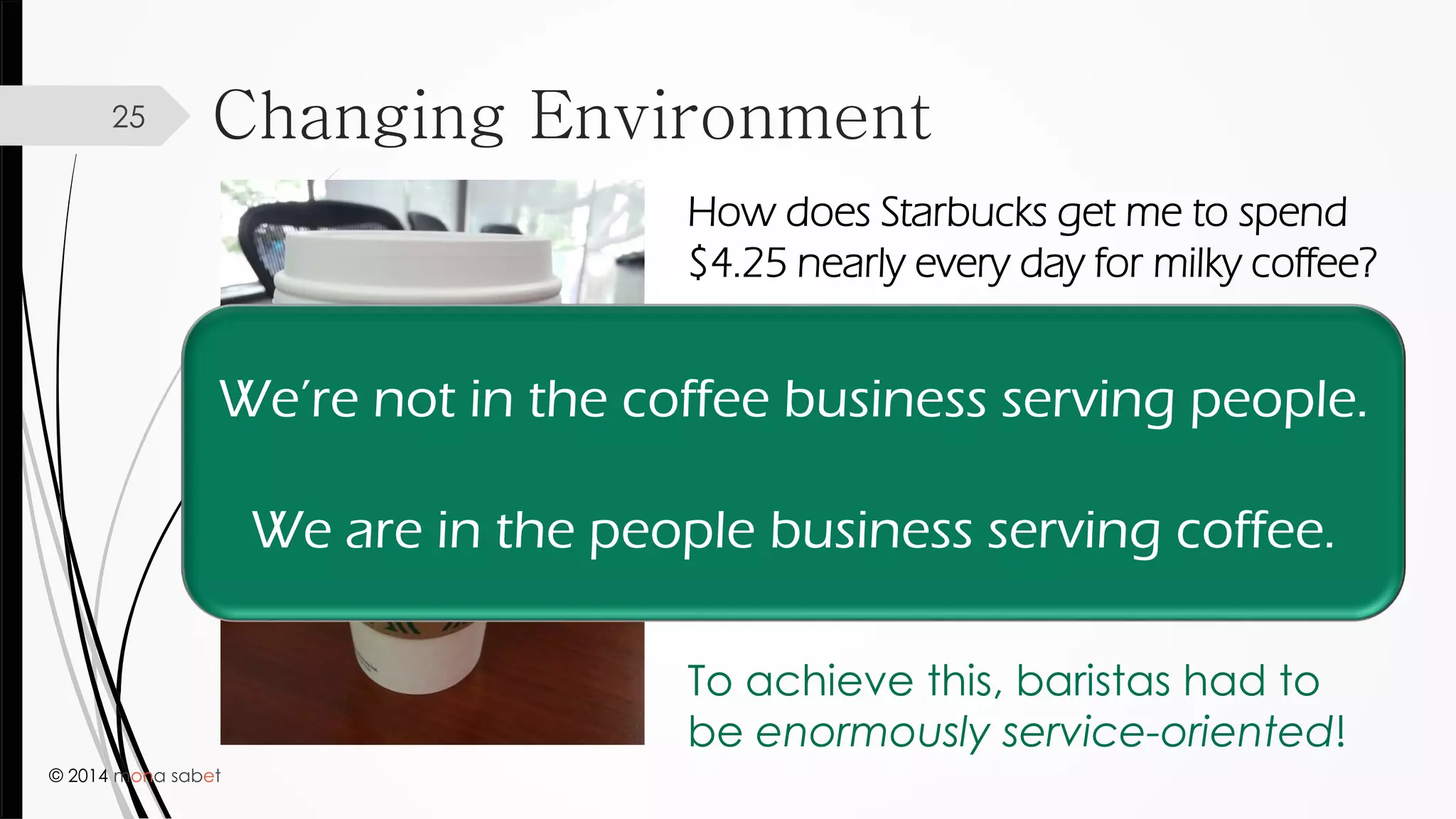
How does Starbucks get me to spend
$4.25 nearly every day for milky coffee?
They intentionally cultivated an
environment where baristas
make you feel like they are
thrilled to serve you exactly what
you want.
To achieve this, baristas had to
be enormously service-oriented!
We’re not in the coffee business serving people.
We are in the people business serving coffee.
© 2014 mona sabet
Changing Environment26
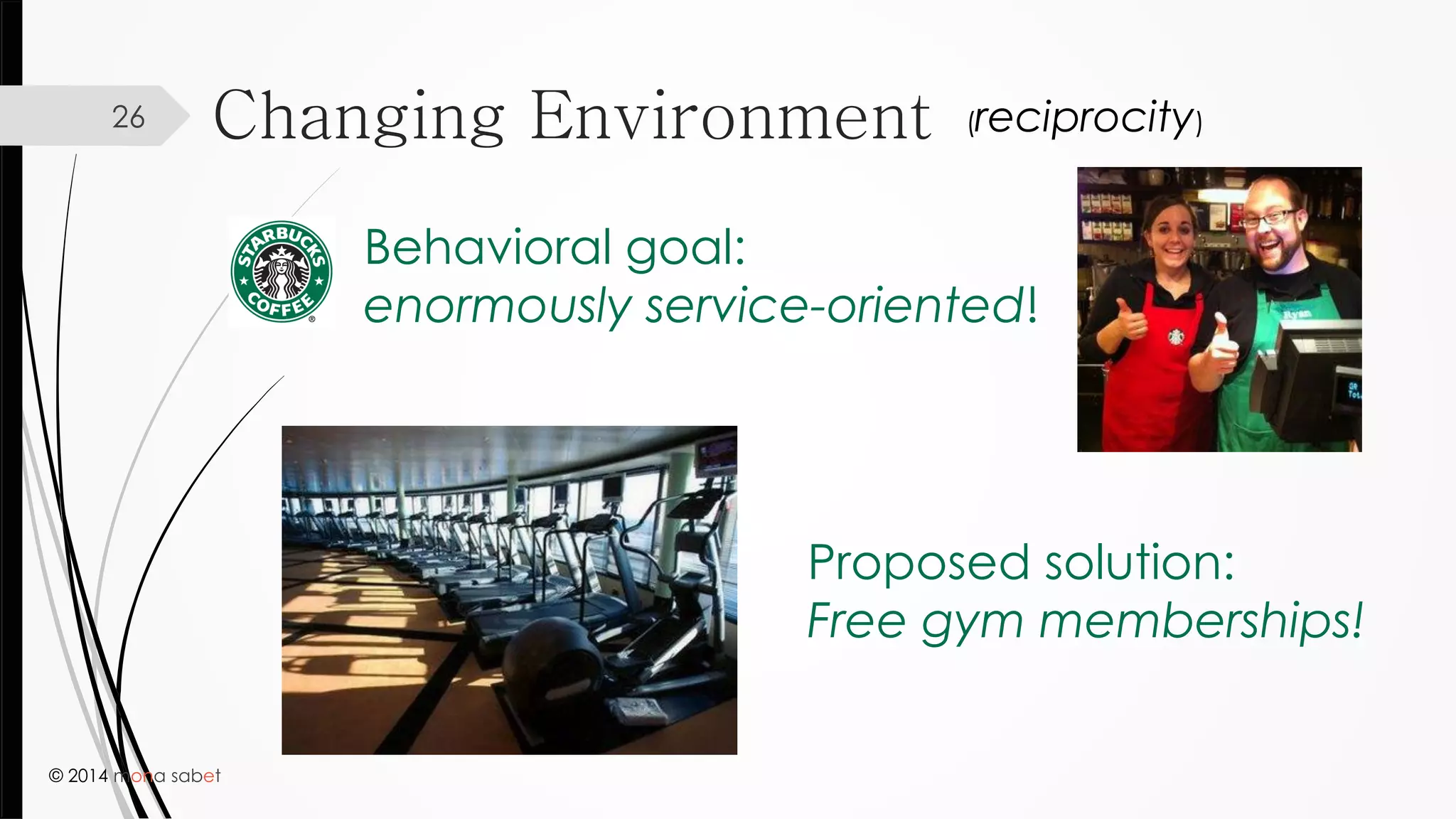
Behavioral goal:
enormously service-oriented!
Proposed solution:
Free gym memberships!
(reciprocity)
© 2014 mona sabet
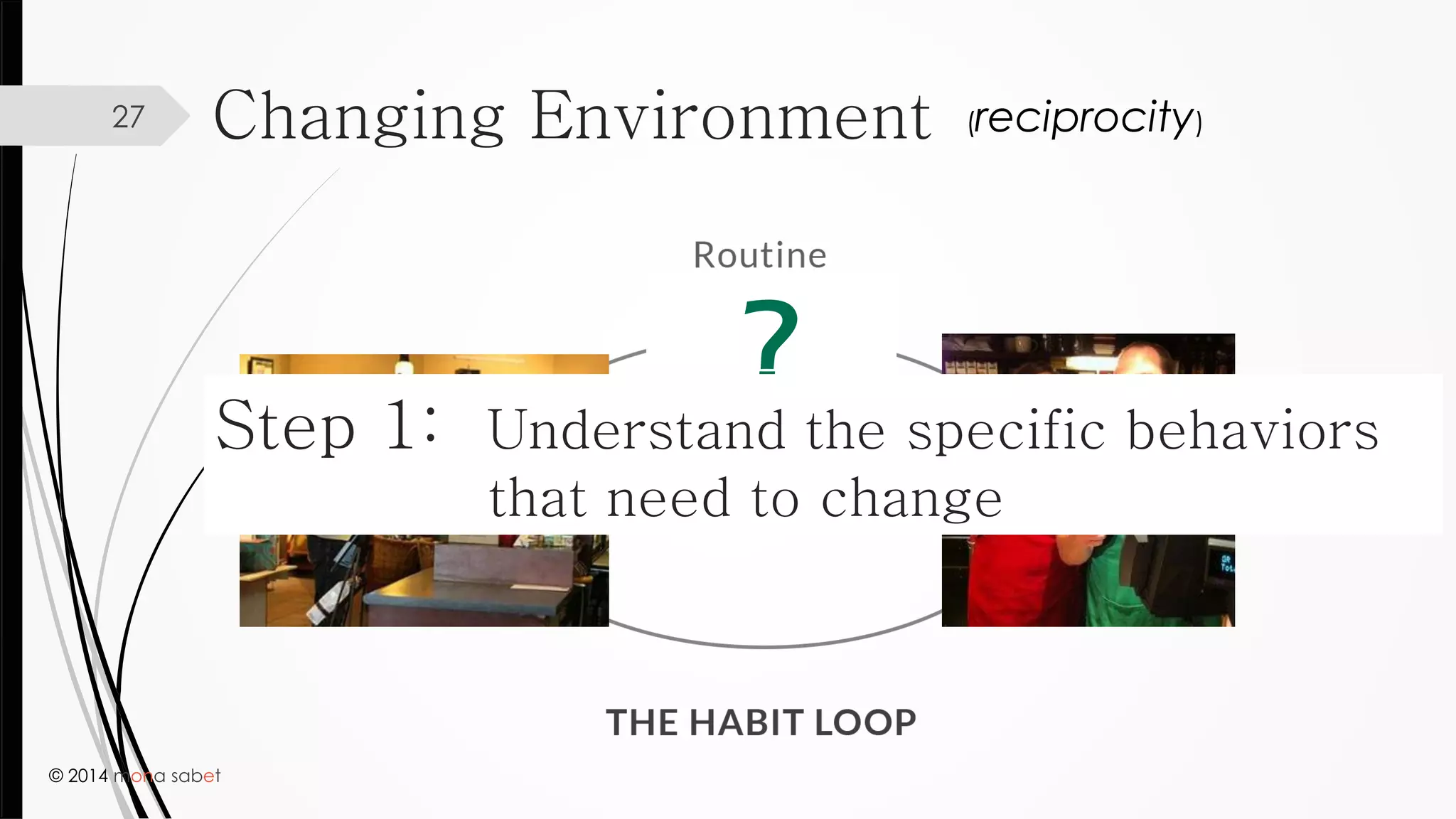
27
?
Step 1: Understand the specific behaviors
that need to change
Changing Environment (reciprocity)
© 2014 mona sabet
28
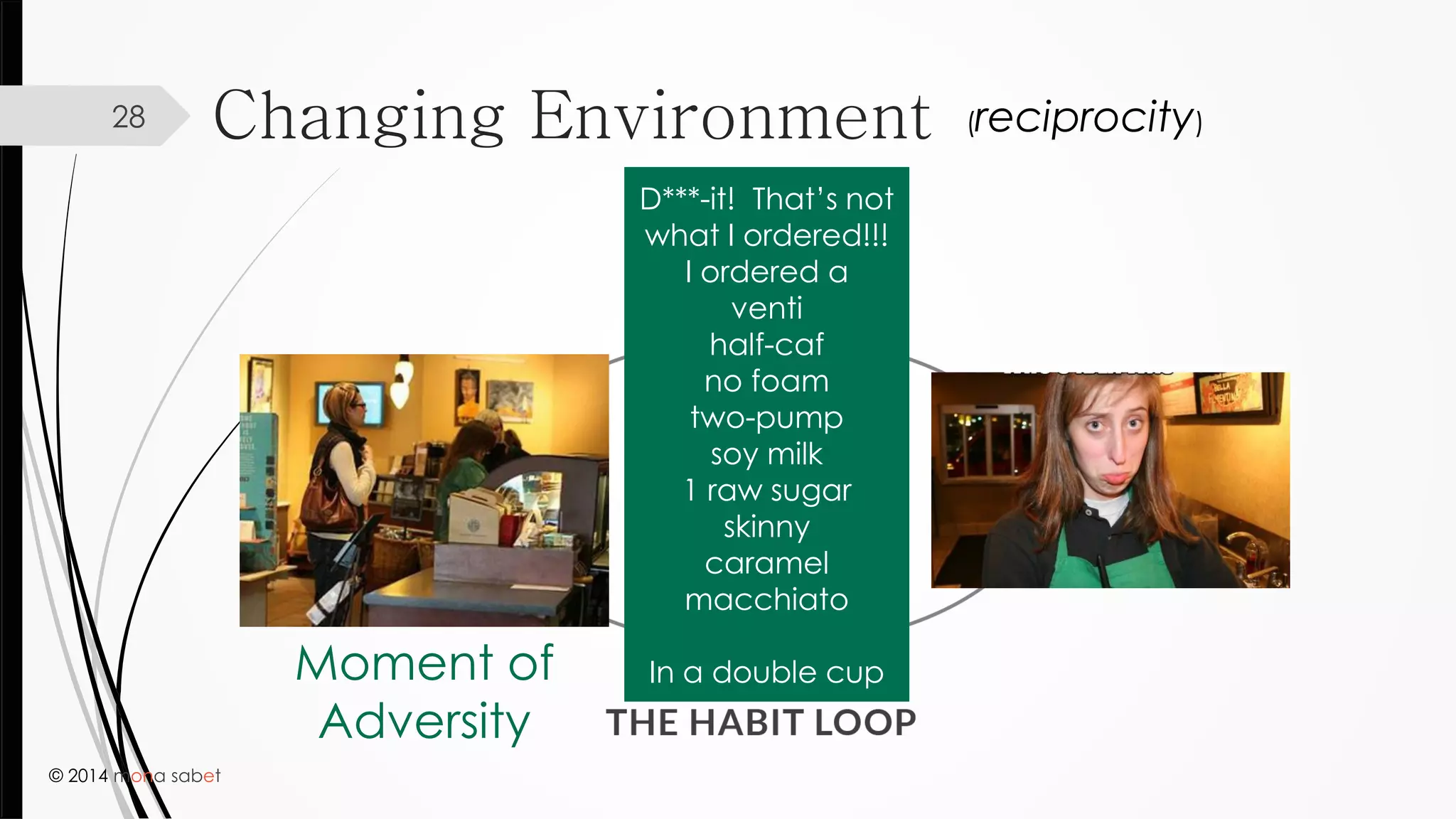
?
D***-it! That’s not
what I ordered!!!
I ordered a
venti
half-caf
no foam
two-pump
soy milk
1 raw sugar
skinny
caramel
macchiato
In a double cupMoment of
Adversity
Changing Environment (reciprocity)
© 2014 mona sabet
29
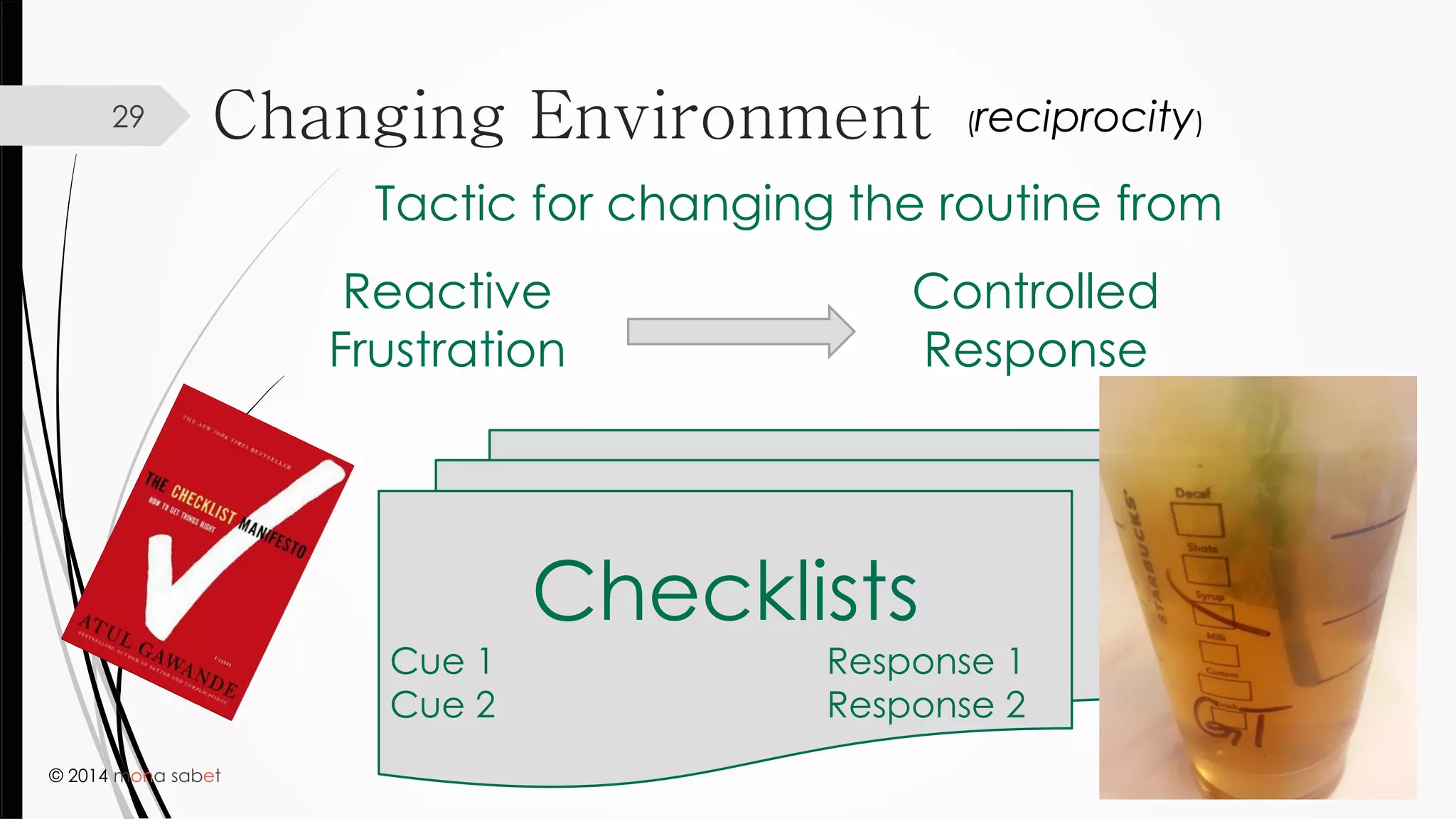
Tactic for changing the routine from
Reactive
Frustration
Controlled
Response
Checklists
Cue 1 Response 1
Cue 2 Response 2
Changing Environment (reciprocity)
© 2014 mona sabet
30
Step 3: Practice Your Routine
© 2014 mona sabet
31
Step 3: Practice Your Routine
© 2014 mona sabet
32
Step 3: Practice Your Routine
© 2014 mona sabet
33
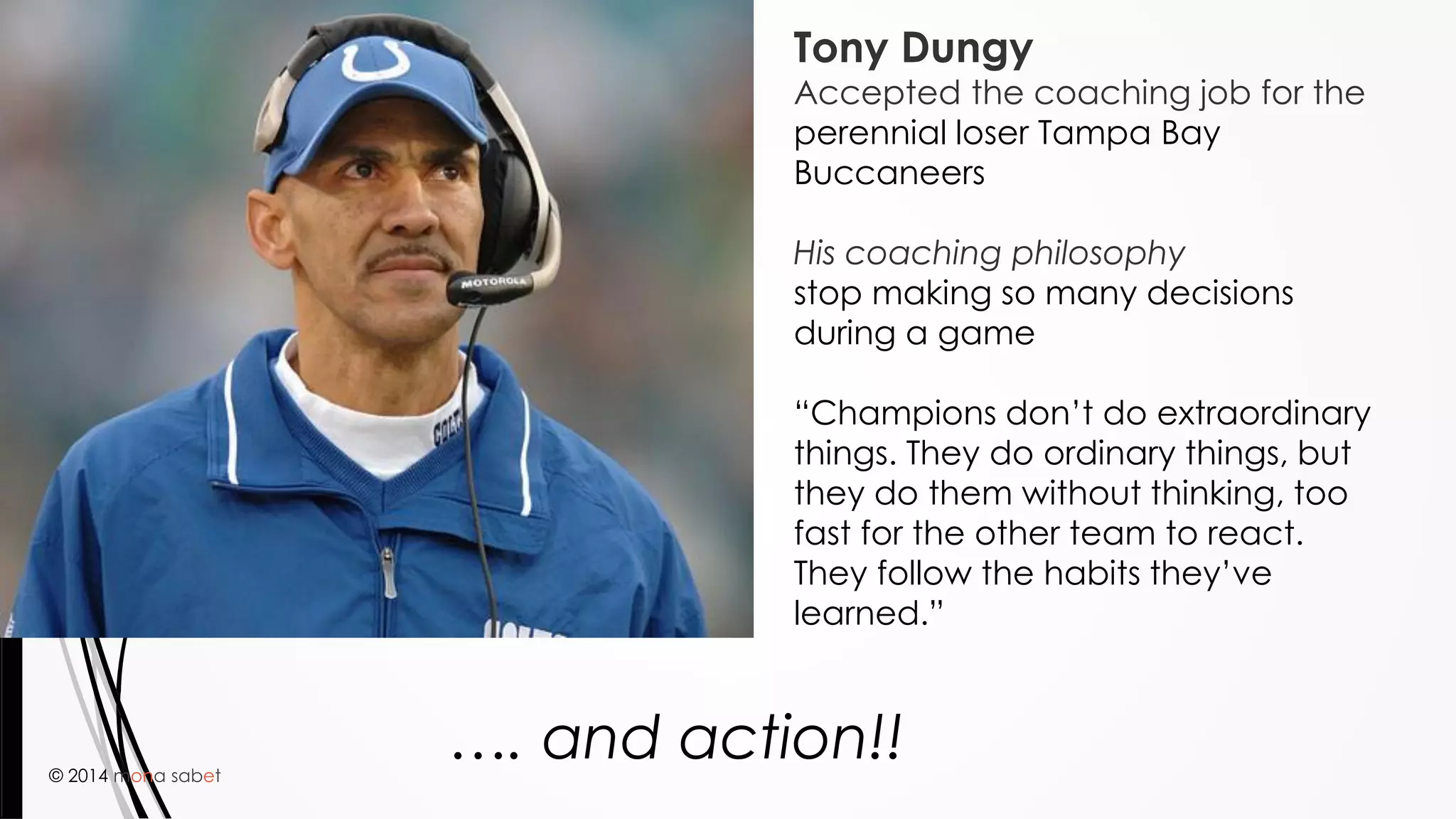
Tony Dungy
Accepted the coaching job for the
perennial loser Tampa Bay
Buccaneers
His coaching philosophy
stop making so many decisions
during a game
“Champions don’t do extraordinary
things. They do ordinary things, but
they do them without thinking, too
fast for the other team to react.
They follow the habits they’ve
learned.”
…. and action!!
© 2014 mona sabet
34
"At practice, the scout team ran that same play and
I got beat on it. [Coach] Bill [Belichick] told me,
'You've got to be on that.' At that time [of the play],
memorization came through. I just jumped the route.
I just made a play. Just do your job -- do it the best
way you can. I just did my job."

Goal Setting Presentation

  • 1.
    © 2014 monasabet 1 What does it take to be THE BEST at what you do?
  • 2.
    © 2014 monasabet 2 Goal Setting your personal brand visionYour desired brand your desired expertise missionPositioning Yourself your strategic goals
  • 3.
    © 2014 monasabet 3 Women in Technical Careers June, 2011 The Anita Borg Institute for Women and Technology
  • 4.
    © 2014 monasabet 4 Stages of Career Advancement 1, entry level - Apprenticeship  works under supervision  demonstrates competence as a part of larger project 2, mid-level - Individual Contributor  responsible for defined projects, works independently, increased technical competence and reputation, develops a network 3, senior level - Management, Contributing through Others  increased technical impact  acts as a manager, or leader for stages 1 and 2.  represents the group/project within organization.  broader business perspective 4, executive level - Setting strategic direction  represents organization and vision to external and internal constituents.  power and influence in the name of the organization.  prepares future leaders 4 The Anita Borg Institute for Women and Technology
  • 5.
    © 2014 monasabet Deconstructing Career Advancement 1, entry level - Apprenticeship  works under supervision  demonstrates competence as a part of larger project 2, mid-level - Individual Contributor  responsible for defined projects, works independently, increased technical competence and reputation, develops a network 3, senior level - Management, Contributing through Others  increased technical impact  acts as a manager, or leader for stages 1 and 2.  represents the group/project within organization.  broader business perspective 4, executive level - Setting strategic direction  represents organization and vision to external and internal constituents.  power and influence in the name of the organization.  prepares future leaders 5 Content Quantity Context Quality
  • 6.
    © 2014 monasabet 6 Quality Context Quantity Content set your goals depending on where you are in these concentric circles
  • 7.
    © 2014 monasabet Depth  Chemical Engineering Degree – 1989  Law Degree – 1992  Executive Management Cert – 1988  Information Systems Cert – 2000  Director’s College - 2008 Currency  California Bar Continuing Education  Non-credit courses in innovative design  Non-credit courses in organizational psychology  Frequent training on management, team dynamics, and leadership 7 Content Write down the depth and currency of your content Content Depth Currency Which bubbles need to get larger and move to the right? Eng Law Org Psych Product Design
  • 8.
    © 2014 monasabet 8 ContentContent Who are you learning from? - Who are the experts in your field? - Who is more of an expert than you? - What separates their technical content from yours? - How do you stay current? - How are you taking learning into your own hands
  • 9.
    © 2014 monasabet 9 Quantity Content Phase 2 - Quantity
  • 10.
    © 2014 monasabet 10 Quantity Quantity
  • 11.
    © 2014 monasabet Quantity11 Quantity 10,000-Hour Rule the key to success in any field is, to a large extent, a matter of practicing a specific task for a total of around 10,000 hours … Does this rule make sense? Why? knowledge skill habit
  • 12.
    © 2014 monasabet 12 The elite software developer is the programmer who spends all day pounding code at work, and after leaving work she writes open source software on her own time. The elite football player is the guy who spends all day on the practice field with his teammates, and after practice he goes home to watch game films. The elite physician listens to medical podcasts in the car during a long commute. The elites are obsessed with what they do. Continuous ImprovementQuantity
  • 13.
    © 2014 monasabet Novice (2,000 hours) Apprentice (4,000 hours) Journeyman (6,000 hours) Adept (8,000 hours) Outlier(10,000 hours) 13 Quantity – Breaking 10,000 down Write down skills you have developed at each level Quantity ** 2000 hours is roughly one year of more than full time work! product marketing product design strategy setting public speaking intellectual property practice technology transactions, negotiation, org psychology… Skills must be specific e.g.: “programming” is NOT specific
  • 14.
    © 2014 monasabet 14 QuantityQuantity Novice (2,000 hours) Apprentice (4,000 hours) Journeyman (6,000 hours) Adept (8,000 hours) Master (10,000 hours)product marketing Being strategic about your career means developing goals to get from here to there
  • 15.
    © 2014 monasabet 15 1. Goals around knowledge (content) • What do you still need to learn? • From who will you learn it? • How are you staying current in your areas of technical work? 2. Goals around skills & experience (quantity) • Do you know what skills you need to get to the next promotion? • Do you know how strong you are at those skills today? • What is your plan for getting from here to there?
  • 16.
    © 2014 monasabet 16 Goal Setting Exercise your personal brand your desired expertise your strategic goals vision mission goals
  • 17.
    © 2014 monasabet 17 S M RA T specific measurable actionable results-oriented time-bound
  • 18.
    © 2014 monasabet 18 New and necessary behaviors identified “Motivation” to make the changes Goal are just words until… Practice to make them stick
  • 19.
    © 2014 monasabet 19 Focus on understanding specific behaviors bank managers not selling as much as competitionx bankers spent too little time with customers x bankers spent too little time with customers because… they had to spend too much time on paperwork they found customer interactions uncomfortable  
  • 20.
    © 2014 monasabet 20
  • 21.
    © 2014 monasabet 21
  • 22.
    © 2014 monasabet 22
  • 23.
    © 2014 monasabet 23 Write down the required behaviors to achieve your more specific goals personal brand your desired expertise your strategic goals specific goals required behaviors vision mission goals
  • 24.
    © 2014 monasabet 24 What specific behaviors need to change What ‘power’ do you have over those people Step 2: Apply Tactics for Changing Routines 1. Identity decision making 2. Changing the environment 3. Building a community 4. The Burning Bridge – create urgency 5. Training (very difficult to creating lasting habits) Specific Behaviors: 1. Exercise their newly learned interpersonal skills 2. Customers are their friends, not their superioes
  • 25.
    © 2014 monasabet Changing Environment25 How does Starbucks get me to spend $4.25 nearly every day for milky coffee? They intentionally cultivated an environment where baristas make you feel like they are thrilled to serve you exactly what you want. To achieve this, baristas had to be enormously service-oriented! We’re not in the coffee business serving people. We are in the people business serving coffee.
  • 26.
    © 2014 monasabet Changing Environment26 Behavioral goal: enormously service-oriented! Proposed solution: Free gym memberships! (reciprocity)
  • 27.
    © 2014 monasabet 27 ? Step 1: Understand the specific behaviors that need to change Changing Environment (reciprocity)
  • 28.
    © 2014 monasabet 28 ? D***-it! That’s not what I ordered!!! I ordered a venti half-caf no foam two-pump soy milk 1 raw sugar skinny caramel macchiato In a double cupMoment of Adversity Changing Environment (reciprocity)
  • 29.
    © 2014 monasabet 29 Tactic for changing the routine from Reactive Frustration Controlled Response Checklists Cue 1 Response 1 Cue 2 Response 2 Changing Environment (reciprocity)
  • 30.
    © 2014 monasabet 30 Step 3: Practice Your Routine
  • 31.
    © 2014 monasabet 31 Step 3: Practice Your Routine
  • 32.
    © 2014 monasabet 32 Step 3: Practice Your Routine
  • 33.
    © 2014 monasabet 33 Tony Dungy Accepted the coaching job for the perennial loser Tampa Bay Buccaneers His coaching philosophy stop making so many decisions during a game “Champions don’t do extraordinary things. They do ordinary things, but they do them without thinking, too fast for the other team to react. They follow the habits they’ve learned.” …. and action!!
  • 34.
    © 2014 monasabet 34 "At practice, the scout team ran that same play and I got beat on it. [Coach] Bill [Belichick] told me, 'You've got to be on that.' At that time [of the play], memorization came through. I just jumped the route. I just made a play. Just do your job -- do it the best way you can. I just did my job."