Glories of Srimad
Bhagavatam from 2nd
Canto
Srimad Bhagavatam is filled with Best Questions and Best
Answers
|| 2.1.1 ||
çré-çuka uväca
varéyän eña te praçnaù
kåto loka-hitaà nåpa |
ätmavit-sammataù puàsäà
çrotavyädiñu yaù paraù ||
Çukadeva said: O King (nåpa)! Your question is most excellent
(varéyän te kåto eña praçnaù). Your question which is the highest
among all such questions (çrotavyädiñu yaù paraù) is beneficial
for the people (loka-hitaà), and approved by the assembly of sages
(ätmavit-sammataù).
Verse Summary: It is an excellent question because it is beneficial
for all and is approved by the sages.
Srimad Bhagavatam Pastimes attract the Heart of even Self-Satisfied
Atmaramas
|| 2.1.7 ||
präyeëa munayo räjan
nivåttä vidhi-ñedhataù |
nairguëya-sthä ramante sma
guëänukathane hareù ||
O King (räjan)! Generally (präyeëa) the sages (munayah) who are
beyond rules and prohibitions (nivåttä vidhi-ñedhataù), who are
situated beyond the guëas (nairguëya-sthä), take pleasure (ramante
sma) in glorifying the qualities of the Lord (hareù guëa anukathane).
Verse Summary: “What is the proof? Have practitioners of other
paths really attained success by practicing bhakti?”
Yes. Many self-realized sages (jnanis and yogis) take great pleasure in
glorifying the Lord.
Srimad Bhagavatam Pastimes attract the Heart of even Self-
Satisfied Atmaramas
|| 2.1.8||
idaà bhägavataà näma
puräëaà brahma-sammitam |
adhétavän dväparädau
pitur dvaipäyanäd aham ||
At the end of the Dväpara-yuga (dväpara ädau), I studied
(adhétavän aham) this great supplement of Vedic literature named
Çrémad-Bhägavatam (idaà bhägavataà näma puräëaà), which is
equal to all the Vedas (brahma-sammitam), from my father, Çréla
Dvaipäyana Vyäsadeva (pituh dvaipäyanäd).
Verse Summary: “Give me some specific example.”
Take my example. I learnt this Bhagavatam from my father
vyasadeva.
Srimad Bhagavatam Pastimes attract the Heart of even Self-
Satisfied Atmaramas
|| 2.1.9 ||
pariniñöhito ’pi nairguëya
uttama-çloka-lélayä |
gåhéta-cetä räjarñe
äkhyänaà yad adhétavän ||
O King (räjarñe)! Though I was fixed in brahman (pariniñöhitah api) and
beyond the guëas (nairguëya), my mind became attracted (gåhéta-cetä)
to the pastimes of the Lord (uttama-çloka-lélayä). I thus learned about his
pastimes (äkhyänaà yad adhétavän).
Verse Summary: Despite the fact that I was fixed in Brahman, the
pastimes of the Lord attracted me so much that I was forced to learn
them from my father.
Srimad Bhagavatam is shared between Two Pure Devotees
|| 2.1.10 ||
tad ahaà te ’bhidhäsyämi
mahä-pauruñiko bhavän |
yasya çraddadhatäm äçu
syän mukunde matiù saté ||
I will tell them to you (tad ahaà te abhidhäsyämi). You are a great
personality (bhavän mahä-pauruñikah), who, among the faithful
(yasya çraddadhatäm), will quickly fix (äçu syät) your pure mind
(matiù saté) on Kåñëa (mukunde).
Verse Summary: Now, in response to your questions, I will
speak the same Bhagavatam. Because you are a great
personality, hearing this scripture will quickly fix your pure mind
on Krsna.
Srimad Bhagavatam gives Yuga-dharma “Hari-nama Sankirtan” as
the essence of all practices
|| 2.1.11 ||
etan nirvidyamänänäm
icchatäm akuto-bhayam |
yoginäà nåpa nirëétaà
harer nämänukértanam ||
O King(nåpa), constant chanting of the holy name of the Lord after the
ways of the great authorities (harer näma anukértanam) is the
doubtless and fearless way of success for all (akuto-bhayam nirëétaà),
including those who are free from all material desires
(nirvidyamänänäm), those who are desirous of all material enjoyment
(icchatäm), and also those who are self-satisfied by dint of
transcendental knowledge (yoginäà).
Verse Summary: I mentioned to you that Bhakti is the topmost process.
Of the 9 limbs of bhakti, Kirtanam is the topmost. Of the various types of
Kirtanam, Hari-nama-anu-kirtanam is the best.
Srimad Bhagavatam Presents the Conclusion of Brahma’s Research
|| 2.2.34 ||
bhagavän brahma kärtsnyena
trir anvékñya manéñayä |
tad adhyavasyat küöa-stho
ratir ätman yato bhavet ||
The great personality Brahmä (bhagavän brahma), with great
attention and concentration of the mind (kärtsnyena manéñayä),
studied the Vedas three times (trir anvékñya), and after scrutinizingly
examining them, he ascertained that (tad adhyavasyat) attraction for
the Supreme Personality of Godhead Çré Kåñëa is the highest
perfection of religion (yato küöa-stho ätmany ratir bhavet).
Verse Summary: The Supreme Lord Himself reviewed the vedas three
times and concluded that attainment of Prema is the highest perfection
of religion.
Glories of Hearing Srimad Bhagavatam
|| 2.2.37 ||
pibanti ye bhagavata ätmanaù satäà
kathämåtaà çravaëa-puöeñu sambhåtam |
punanti te viñaya-vidüñitäçayaà
vrajanti tac-caraëa-saroruhäntikam ||
Those who drink (pibanti ye) the sweet pastimes (kathämåtaà) of
the Lord and his devotees (bhagavata ätmanaù satäà) held in the
cups of their ears (çravaëa-puöeñu sambhåtam) clean their hearts
of all contamination (punanti te viñaya-vidüñita äçayaà) and
attain the lotus feet of the Lord for service (vrajanti tac-caraëa-
saroruha antikam).
Verse Summary: 2 main benefits of practicing sadhana bhakti: a)
purification of heart b) attainment of Lord’s lotus feet.
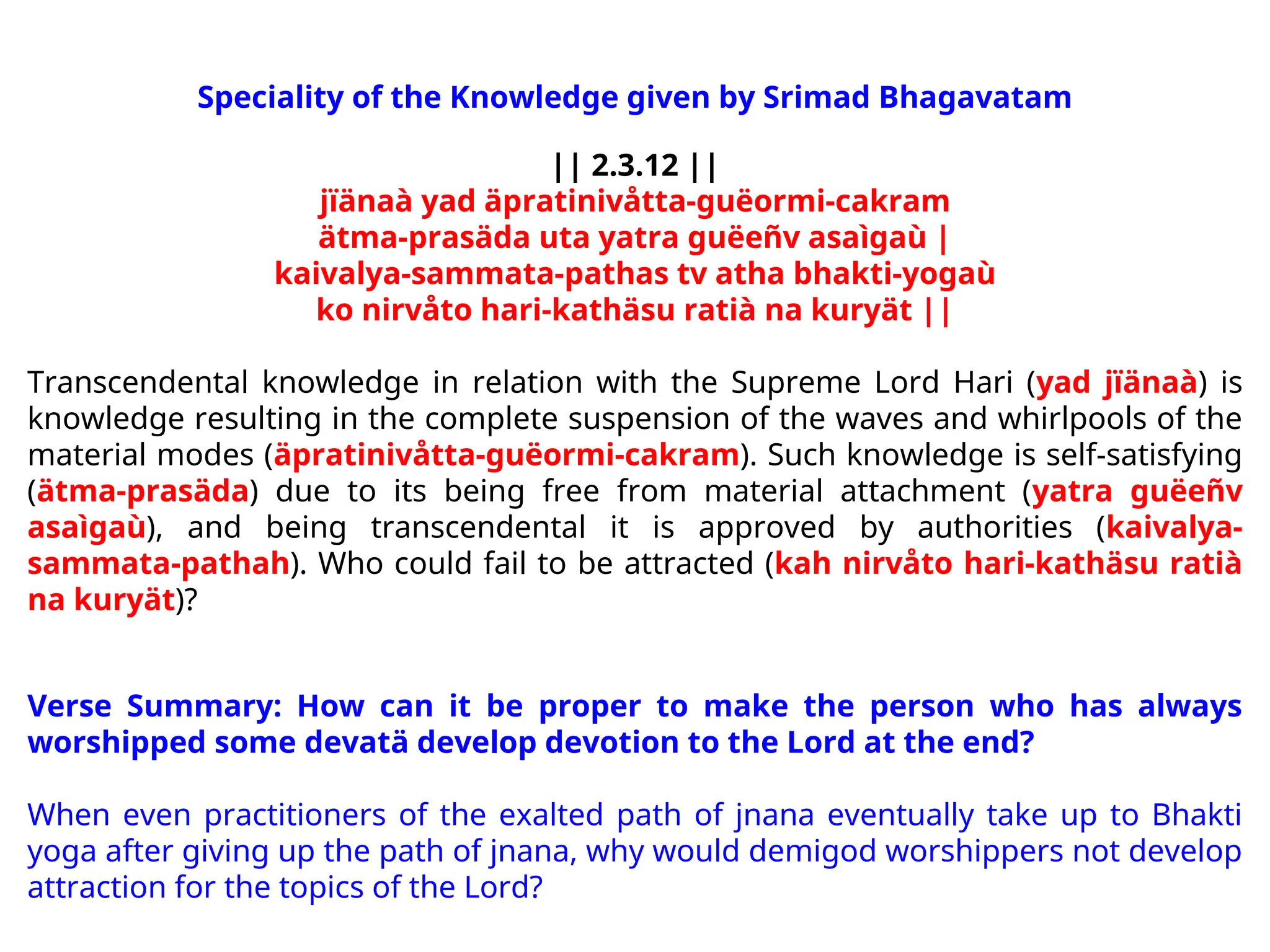
Speciality of the Knowledge given by Srimad Bhagavatam
|| 2.3.12 ||
jïänaà yad äpratinivåtta-guëormi-cakram
ätma-prasäda uta yatra guëeñv asaìgaù |
kaivalya-sammata-pathas tv atha bhakti-yogaù
ko nirvåto hari-kathäsu ratià na kuryät ||
Transcendental knowledge in relation with the Supreme Lord Hari (yad jïänaà) is
knowledge resulting in the complete suspension of the waves and whirlpools of the
material modes (äpratinivåtta-guëormi-cakram). Such knowledge is self-satisfying
(ätma-prasäda) due to its being free from material attachment (yatra guëeñv
asaìgaù), and being transcendental it is approved by authorities (kaivalya-
sammata-pathah). Who could fail to be attracted (kah nirvåto hari-kathäsu ratià
na kuryät)?
Verse Summary: How can it be proper to make the person who has always
worshipped some devatä develop devotion to the Lord at the end?
When even practitioners of the exalted path of jnana eventually take up to Bhakti
yoga after giving up the path of jnana, why would demigod worshippers not develop
attraction for the topics of the Lord?
Words of Srimad Bhagavatam destroys ignorance
|| 2.4.5 ||
räjoväca—
samécénaà vaco brahman
sarva-jïasya tavänagha |
tamo viçéryate mahyaà
hareù kathayataù kathäm ||
The King said: O sinless brähmaëa (anagha brahman)! When
you, full of knowledge (sarva-jïasya), speak topics of the Lord
(hareù kathayataù kathäm), my ignorance is destroyed (tamo
viçéryate mahyaà). Those words are fitting (tava vacah
samécénaà).
Verse Summary: My ignorance is getting destroyed by your
fitting words.
Srimad Bhagavatam is nectar emanating from Vyasadev’s mouth
|| 2.4.24 ||
namas tasmai bhagavate
väsudeväya vedhase |
papur jïänam ayaà saumyä
yan-mukhämburuhäsavam ||
I offer my respectful obeisances unto Çréla Vyäsadeva, the
incarnation of Väsudeva (namas tasmai bhagavate väsudeväya)
who compiled the Vedic scriptures (vedhase). The pure devotees
drink up (ayaà saumyä papuh) the nectarean transcendental
knowledge (jïänam äsavam) dropping from the lotus-like mouth of
the Lord (yad-mukhämburuha).
Verse Summary: I offer my respectful obeisances unto Çréla
Vyäsadeva, the knowledge dropping from whose mouth the pure
devotees always drink.
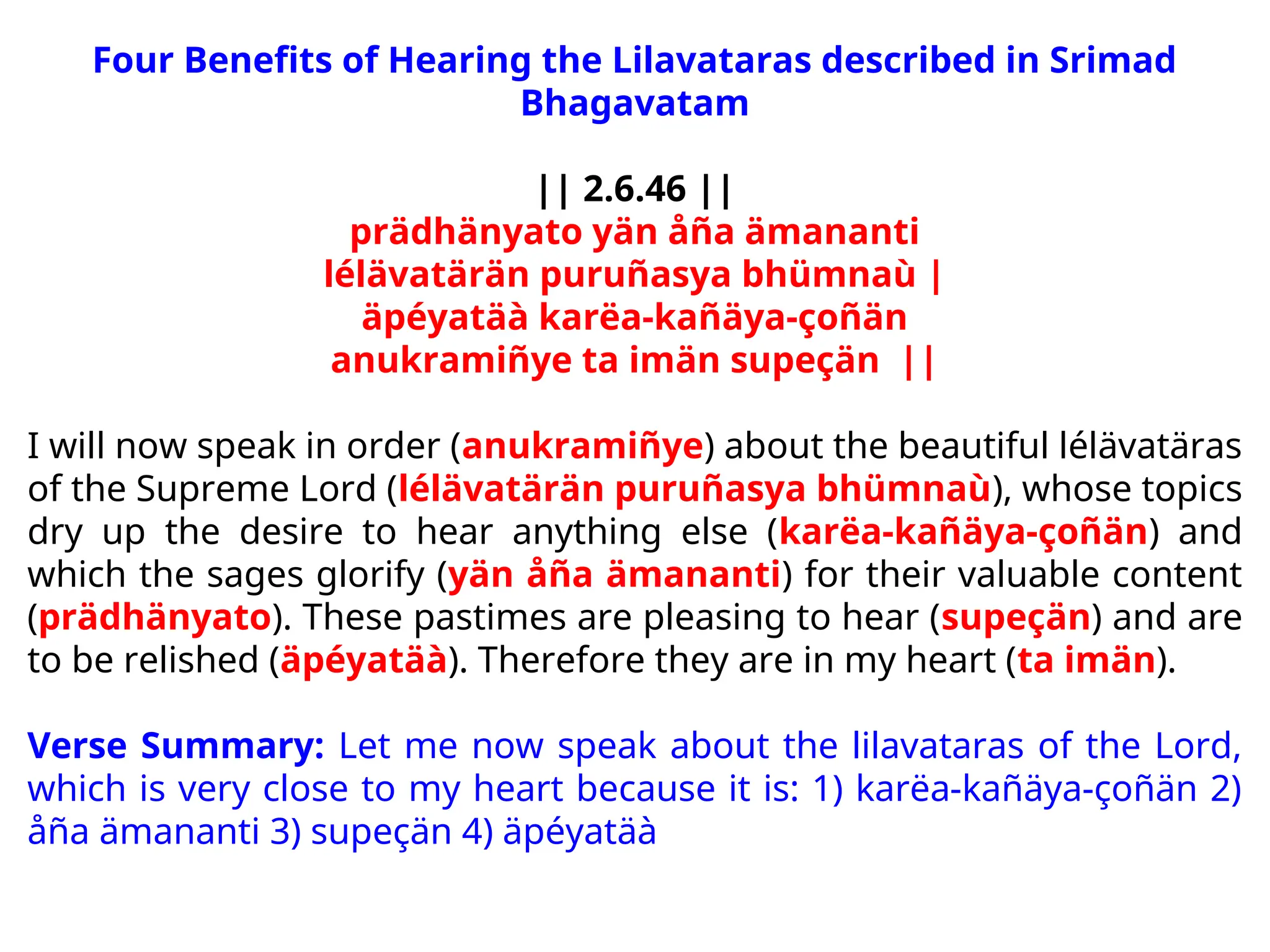
Four Benefits of Hearing the Lilavataras described in Srimad
Bhagavatam
|| 2.6.46 ||
prädhänyato yän åña ämananti
lélävatärän puruñasya bhümnaù |
äpéyatäà karëa-kañäya-çoñän
anukramiñye ta imän supeçän ||
I will now speak in order (anukramiñye) about the beautiful lélävatäras
of the Supreme Lord (lélävatärän puruñasya bhümnaù), whose topics
dry up the desire to hear anything else (karëa-kañäya-çoñän) and
which the sages glorify (yän åña ämananti) for their valuable content
(prädhänyato). These pastimes are pleasing to hear (supeçän) and are
to be relished (äpéyatäà). Therefore they are in my heart (ta imän).
Verse Summary: Let me now speak about the lilavataras of the Lord,
which is very close to my heart because it is: 1) karëa-kañäya-çoñän 2)
åña ämananti 3) supeçän 4) äpéyatäà
Srimad Bhagavatam is Collection of Lord’s Vibhuti
|| 2.7.51 ||
idaà bhägavataà näma
yan me bhagavatoditam |
saìgraho ’yaà vibhüténäà
tvam etad vipulé kuru ||
This work called Bhägavatam (idaà bhägavataà näma),
spoken to me by the Lord (yad me bhagavatä uditam), is a
collection of the Lord’s vibhütis (ayaà vibhüténäà saìgrahah).
You should distribute it everywhere (tvam etad vipulé kuru).
Verse Summary: This work called Bhägavatam, spoken to me
by the Lord, is a collection of the Lord’s vibhütis. You should
distribute it everywhere.
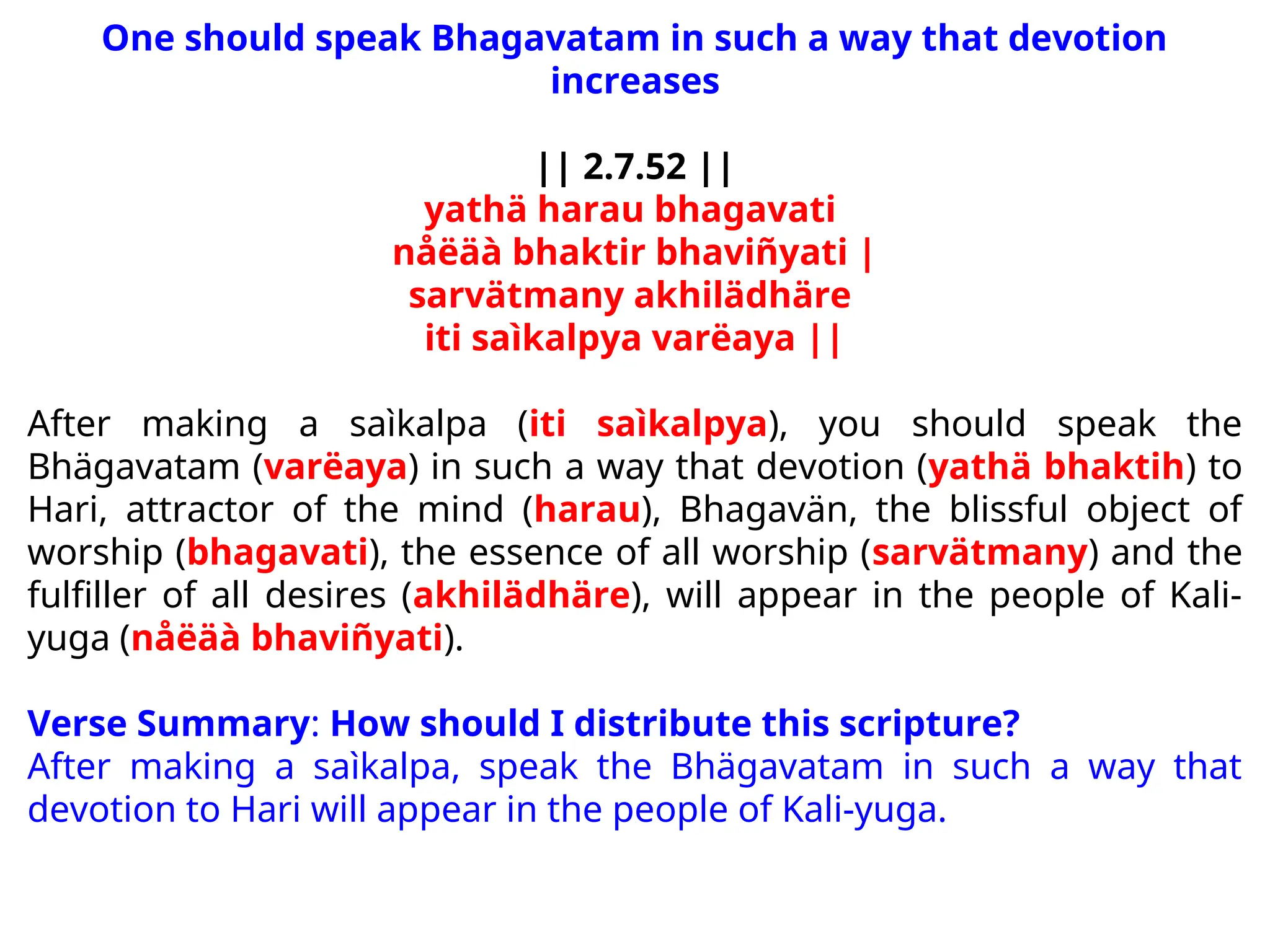
One should speak Bhagavatam in such a way that devotion
increases
|| 2.7.52 ||
yathä harau bhagavati
nåëäà bhaktir bhaviñyati |
sarvätmany akhilädhäre
iti saìkalpya varëaya ||
After making a saìkalpa (iti saìkalpya), you should speak the
Bhägavatam (varëaya) in such a way that devotion (yathä bhaktih) to
Hari, attractor of the mind (harau), Bhagavän, the blissful object of
worship (bhagavati), the essence of all worship (sarvätmany) and the
fulfiller of all desires (akhilädhäre), will appear in the people of Kali-
yuga (nåëäà bhaviñyati).
Verse Summary: How should I distribute this scripture?
After making a saìkalpa, speak the Bhägavatam in such a way that
devotion to Hari will appear in the people of Kali-yuga.
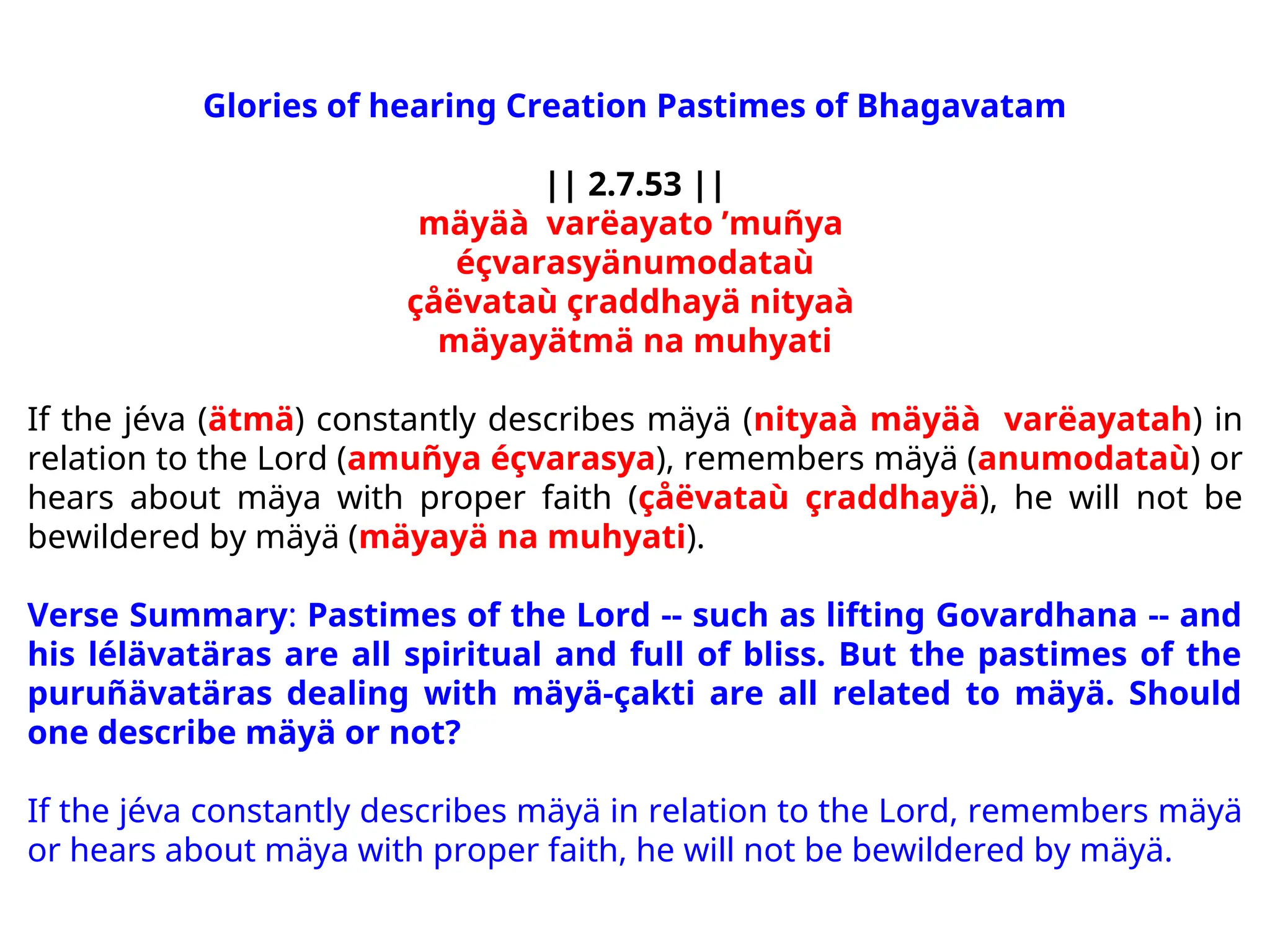
Glories of hearing Creation Pastimes of Bhagavatam
|| 2.7.53 ||
mäyäà varëayato ’muñya
éçvarasyänumodataù
çåëvataù çraddhayä nityaà
mäyayätmä na muhyati
If the jéva (ätmä) constantly describes mäyä (nityaà mäyäà varëayatah) in
relation to the Lord (amuñya éçvarasya), remembers mäyä (anumodataù) or
hears about mäya with proper faith (çåëvataù çraddhayä), he will not be
bewildered by mäyä (mäyayä na muhyati).
Verse Summary: Pastimes of the Lord -- such as lifting Govardhana -- and
his lélävatäras are all spiritual and full of bliss. But the pastimes of the
puruñävatäras dealing with mäyä-çakti are all related to mäyä. Should
one describe mäyä or not?
If the jéva constantly describes mäyä in relation to the Lord, remembers mäyä
or hears about mäya with proper faith, he will not be bewildered by mäyä.
Bhagavatam Topics are all auspicious for the World
|| 2.8.1-2 ||
räjoväca—
brahmaëä codito brahman guëäkhyäne ’guëasya ca |
yasmai yasmai yathä präha närado deva-darçanaù ||
etad veditum icchämi tattvaà tattva-vidäà vara |
harer adbhuta-véryasya kathä loka-sumaìgaläù ||
The King said: O brähmaëa (brahman)! O best of knowers of truth (tattva-
vidäà vara)! I desire to know (veditum icchämi) exactly the truth (etad
tattvaà) that Närada -- seer of Kåñëa (närado deva-darçanaù) and taught
by Brahmä (brahmaëä coditah) -- spoke to others (yasmai yasmai yathä
präha) while explaining the qualities of the Lord (guëäkhyäne) who is
without material qualities (aguëasya). Topics (kathä) of the Lord who has
astonishing powers (harer adbhuta-véryasya) are all-auspicious for the
world (loka-sumaìgaläù).
Verse Summary: Please describe about Narada muni’s preaching exploits.
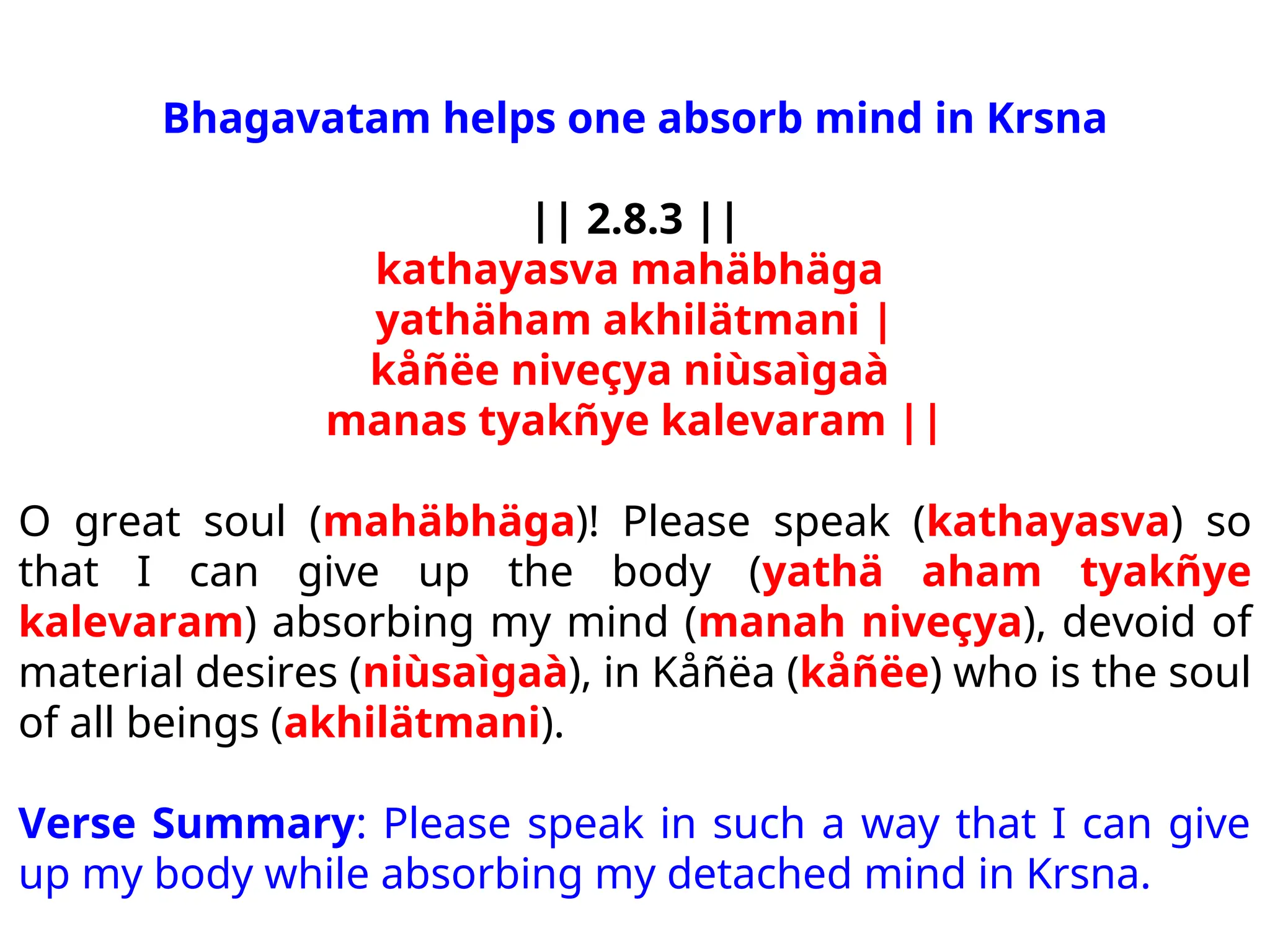
Bhagavatam helps one absorb mind in Krsna
|| 2.8.3 ||
kathayasva mahäbhäga
yathäham akhilätmani |
kåñëe niveçya niùsaìgaà
manas tyakñye kalevaram ||
O great soul (mahäbhäga)! Please speak (kathayasva) so
that I can give up the body (yathä aham tyakñye
kalevaram) absorbing my mind (manah niveçya), devoid of
material desires (niùsaìgaà), in Kåñëa (kåñëe) who is the soul
of all beings (akhilätmani).
Verse Summary: Please speak in such a way that I can give
up my body while absorbing my detached mind in Krsna.
How Bhagavatam helps one absorb mind in Krsna
|| 2.8.4 ||
çåëvataù çraddhayä nityaà
gåëataç ca sva-ceñöitam |
kälena nätidérgheëa
bhagavän viçate hådi ||
The Lord (bhagavän) quickly (na ati dérgheëa) enters the
heart of the devotee (viçate hådi) who with faith
(çraddhayä) continually hears (çåëvataù nityaà) and chants
about the Lord’s activities (gåëatah ca sva-ceñöitam).
Verse Summary: The Lord quickly enters the heart of one
who faithfully hears about Him.
How Bhagavatam helps one absorb mind in Krsna
|| 2.8.5 ||
praviñöaù karëa-randhreëa
svänäà bhäva-saroruham |
dhunoti çamalaà kåñëaù
salilasya yathä çarat ||
Kåñëa (kåñëaù), entering (praviñöaù) the lotus of the heart
(bhäva-saroruham) through the ears (karëa-randhreëa) of
the devotees (svänäà), washes away all contamination
(dhunoti çamalaà) until it is completely pure like the pools of
water in the autumn seasons (salilasya yathä çarat).
Verse Summary: Krsna, in the form of Hari-katha, enters the
heart through the ears, and washes away all contamination.
How Bhagavatam helps one absorb mind in Krsna
|| 2.8.6 ||
dhautätmä puruñaù kåñëa-
päda-mülaà na muïcati |
mukta-sarva-parikleçaù
pänthaù sva-çaraëaà yathä ||
The person with a pure heart (dhautätmä puruñaù) does not give
up the root of the feet of Kåñëa (kåñëa- päda-mülaà na muïcati).
He is like a traveler (yathä pänthaù), who, giving up all sufferings
after earning wealth (mukta-sarva-parikleçaù), does not leave his
house (sva-çaraëaà).
Verse Summary: Such a purified person does not give up the feet
of Krsna.
Hearing Bhagavatam helps one rise above bodily platform
|| 2.8.26 ||
na me ’savaù paräyanti
brahmann anaçanäd amé |
pibato ’cyuta-péyüñam
tad väkyäbdhi-viniùsåtam ||
O brähmaëa (brahmann)! My life airs are not disturbed (na me
asavaù paräyanti) from fasting (anaçanäd amé) since I am
drinking the nectar of Kåñëa (pibato acyuta-péyüñam) which is
flowing down from the ocean of your speeches (tad väkya abdhi-
viniùsåtam). Therefore quickly tell me Kåñëa’s pastimes (implied).
Verse Summary: I am certainly not affected by hunger or thirst
since I am drinking the nectar of Krsna which is flowing from your
mouth. Pleaase continue.
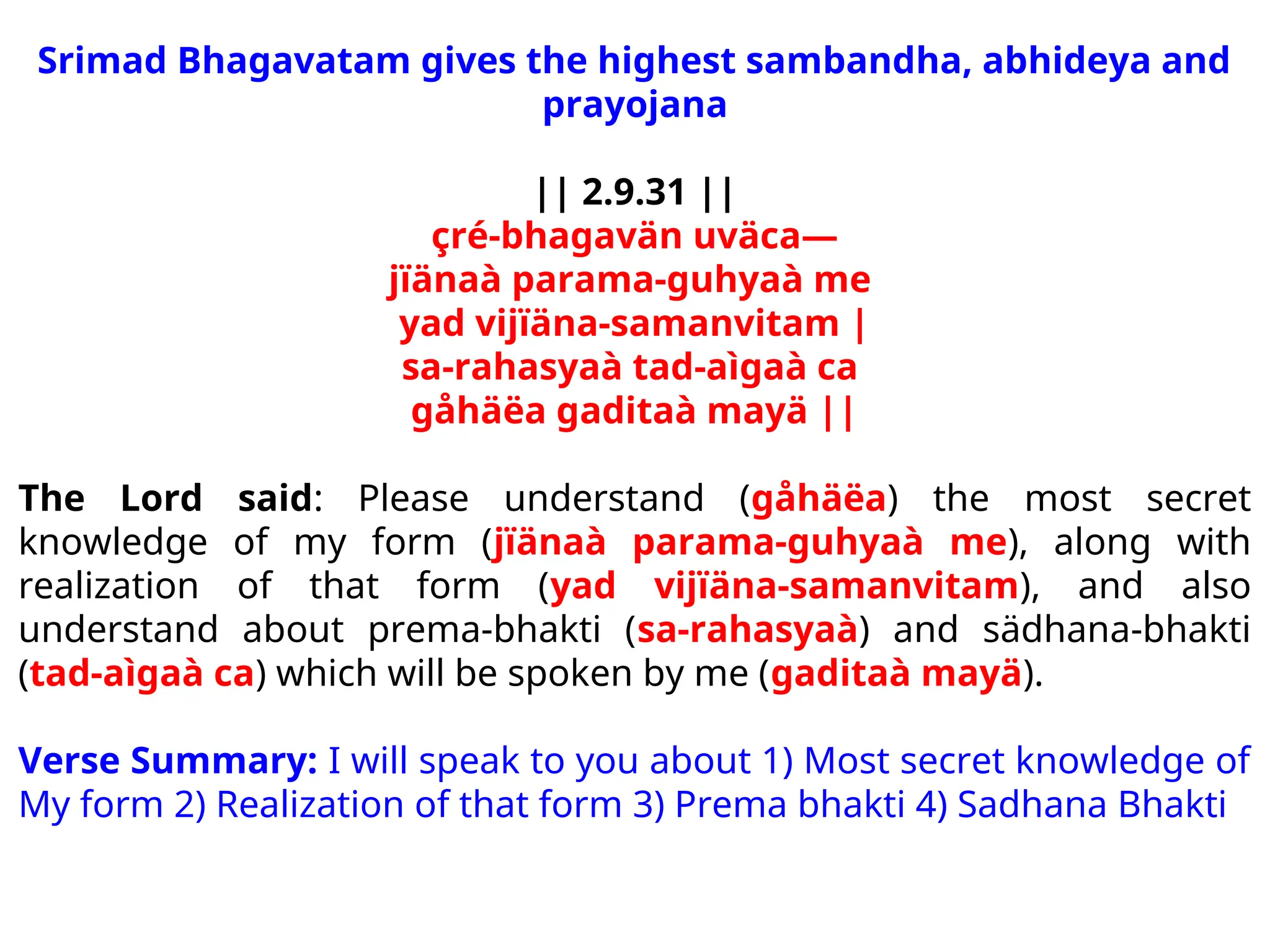
Srimad Bhagavatam gives the highest sambandha, abhideya and
prayojana
|| 2.9.31 ||
çré-bhagavän uväca—
jïänaà parama-guhyaà me
yad vijïäna-samanvitam |
sa-rahasyaà tad-aìgaà ca
gåhäëa gaditaà mayä ||
The Lord said: Please understand (gåhäëa) the most secret
knowledge of my form (jïänaà parama-guhyaà me), along with
realization of that form (yad vijïäna-samanvitam), and also
understand about prema-bhakti (sa-rahasyaà) and sädhana-bhakti
(tad-aìgaà ca) which will be spoken by me (gaditaà mayä).
Verse Summary: I will speak to you about 1) Most secret knowledge of
My form 2) Realization of that form 3) Prema bhakti 4) Sadhana Bhakti
Bhagavatam gives the Perfect realization of the form of the
Lord
|| 2.9.32 ||
yävän ahaà yathä-bhävo
yad-rüpa-guëa-karmakaù |
tathaiva tattva-vijïänam
astu te mad-anugrahät ||
By my mercy (mad-anugrahät), may you attain (astu te) perfect
realization (tattva-vijïänam) of whatever (tathaiva) dimensions
(yävän), intentions (yathä-bhävo), forms, qualities and
pastimes (yad-rüpa-guëa-karmakaù) I manifest (ahaà).
Verse Summary: By My mercy, you will attain perfect realization
of the dimensions of my forms, My intentions, qualities and
pastimes.
Catuh Sloki-1 – Bhagavatam speaks about the material and spiritual
forms of the Lord
|| 2.9.33||
aham eväsam evägre
nänyad yat sad-asat-param |
paçcäd ahaà yad etac ca
yo ’vaçiñyeta so ’smy aham ||
I alone (aham eva), who am non-different from (na anyad) that which is
superior to all cause and effect (yat sad-asat-param), existed (äsam)
previous to creation of the universe (agre). I alone exist (ahaà) as the
universe (yad etat) after the creation of the universe (paçcäd), and I
alone remain at the destruction (yah avaçiñyeta sah asmy aham).
Verse Summary: The Lord alone existed previous to creation of the
universe as the Lord of the spiritual world, after creation He alone exists
as the material universe, as the supersoul and as His various avataras,
and during destruction also He alone exists as the Lord of Vaikuntha.
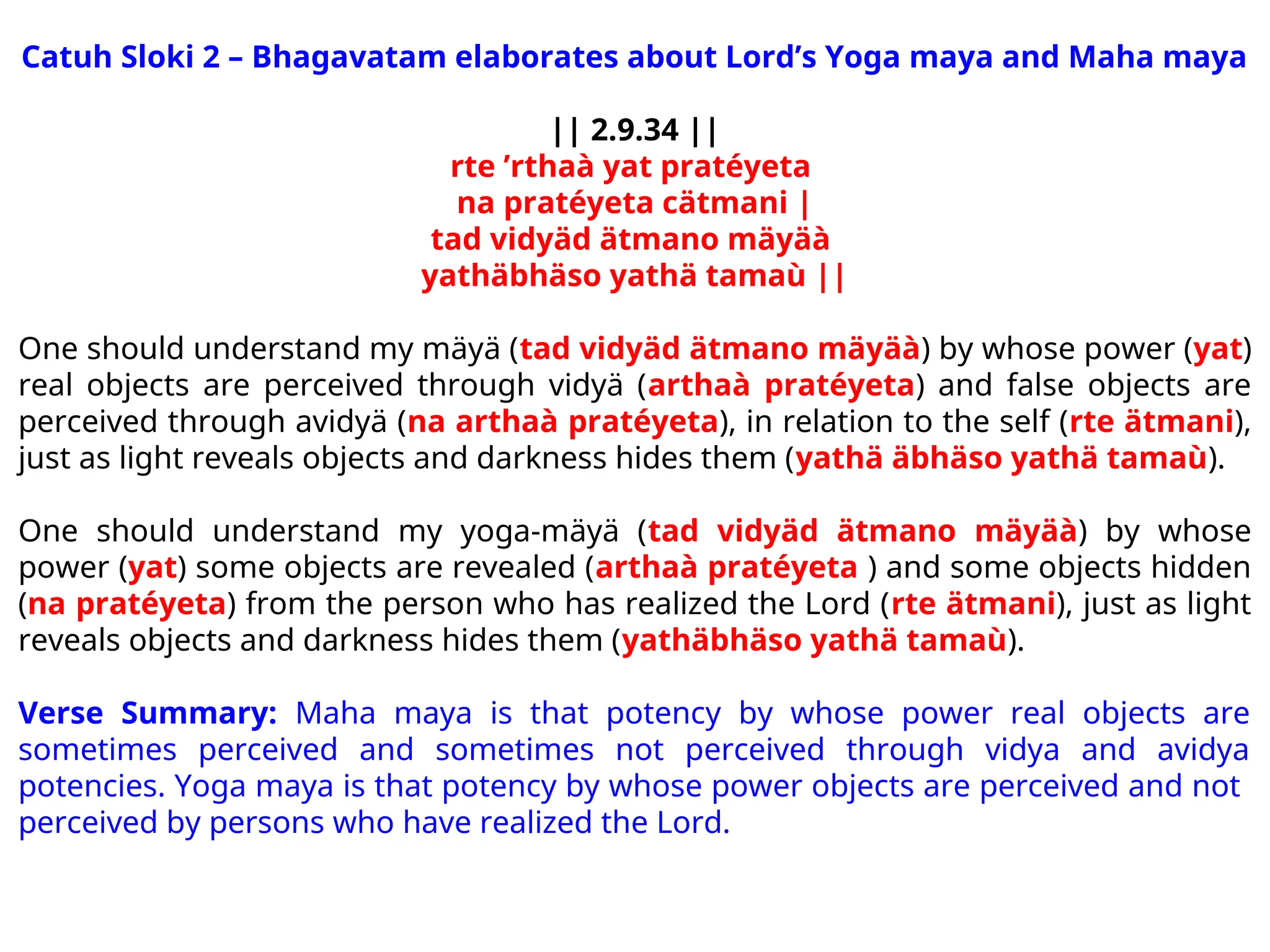
Catuh Sloki 2 – Bhagavatam elaborates about Lord’s Yoga maya and Maha maya
|| 2.9.34 ||
rte ’rthaà yat pratéyeta
na pratéyeta cätmani |
tad vidyäd ätmano mäyäà
yathäbhäso yathä tamaù ||
One should understand my mäyä (tad vidyäd ätmano mäyäà) by whose power (yat)
real objects are perceived through vidyä (arthaà pratéyeta) and false objects are
perceived through avidyä (na arthaà pratéyeta), in relation to the self (rte ätmani),
just as light reveals objects and darkness hides them (yathä äbhäso yathä tamaù).
One should understand my yoga-mäyä (tad vidyäd ätmano mäyäà) by whose
power (yat) some objects are revealed (arthaà pratéyeta ) and some objects hidden
(na pratéyeta) from the person who has realized the Lord (rte ätmani), just as light
reveals objects and darkness hides them (yathäbhäso yathä tamaù).
Verse Summary: Maha maya is that potency by whose power real objects are
sometimes perceived and sometimes not perceived through vidya and avidya
potencies. Yoga maya is that potency by whose power objects are perceived and not
perceived by persons who have realized the Lord.
Catuh Sloki 3 – Bhagavatam elaborates about Lord’s dealings with
the material and spiritual worlds
|| 2.9.35 ||
yathä mahänti bhütäni
bhüteñüccävaceñv anu |
praviñöäny apraviñöäni
tathä teñu na teñv aham ||
Just as the elements (yathä mahänti bhütäni) enter (anu praviñöäny)
into all beings (bhüteñu ucca avaceñu) and also remain separate
(apraviñöäni), I (tathä aham) enter into all beings and remain
separate when I perform my pastimes (teñu na teñv). In pastimes
related to the material world I remain detached and in pastimes related
to devotees, I am attached.
Verse Summary: The Lord is detached in relationship with the activities
of maha maya and is very much attached in relationship with the
activities of yoga maya.
Catuh Sloki 4 – Bhagavatam establishes the superiority of Bhakti as
Sadhana through teaching to Brahma
|| 2.9.36 ||
etävad eva jijïäsyaà
tattva-jijïäsunätmanaù |
anvaya-vyatirekäbhyäà
yat syät sarvatra sarvadä ||
The person desiring to know the best sädhana and the goal of that
sädhana (tattva-jijïäsunä ätmanaù) must learn by surrender to guru
(jijïäsyaà) about this truth (etävad eva) which is determined as the best
by obtaining positive results through performance (anvaya) and by lack
of results through non-performance (vyatirekäbhyäà), and by
performance at all times and all places (yat syät sarvatra sarvadä).
Verse Summary: Only by practice of Bhakti can you overcome lethargy
and pride.
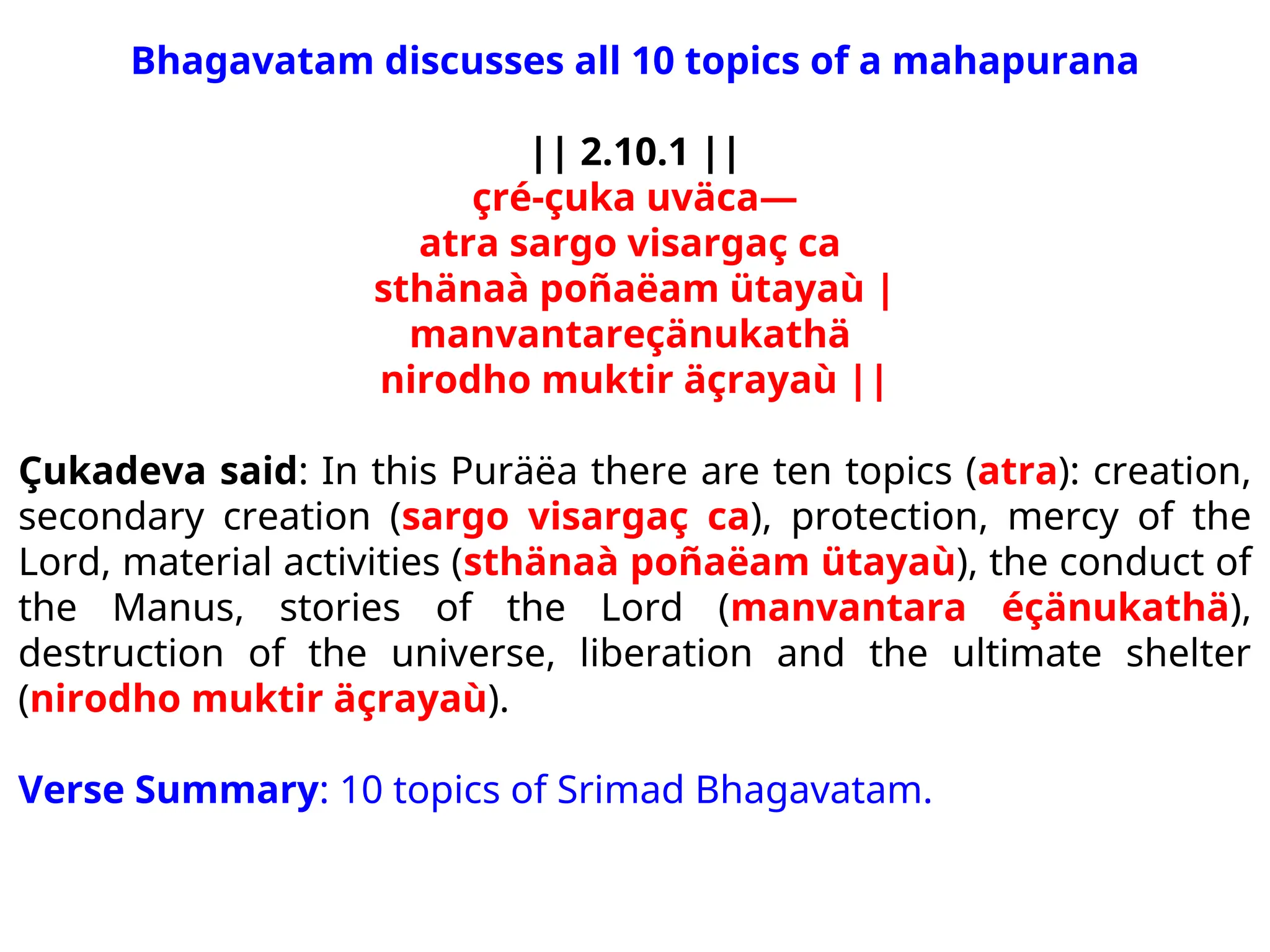
Bhagavatam discusses all 10 topics of a mahapurana
|| 2.10.1 ||
çré-çuka uväca—
atra sargo visargaç ca
sthänaà poñaëam ütayaù |
manvantareçänukathä
nirodho muktir äçrayaù ||
Çukadeva said: In this Puräëa there are ten topics (atra): creation,
secondary creation (sargo visargaç ca), protection, mercy of the
Lord, material activities (sthänaà poñaëam ütayaù), the conduct of
the Manus, stories of the Lord (manvantara éçänukathä),
destruction of the universe, liberation and the ultimate shelter
(nirodho muktir äçrayaù).
Verse Summary: 10 topics of Srimad Bhagavatam.
Bhagavatam discusses the other 9 topics for the sole
purpose of establishing the superiority of Bhagavan
|| 2.10.2 ||
daçamasya viçuddhy-arthaà
navänäm iha lakñaëam |
varëayanti mahätmänaù
çrutenärthena cäïjasä ||
The great devotees such as Vidura and Maitreya describe
properly (mahätmänaù varëayanti aïjasä) the nine
topics (navänäm iha lakñaëam) in order to impart the
highest knowledge of the tenth topic (daçamasya
viçuddhy-arthaà), through the words of the scripture and
stories to illustrate their meaning (çrutena ca arthena).
Verse Summary: Great devotees describe the other 9
topics to impart the highest knowledge of the 10th
topic.
glories of Srimad Bhagavatam from 2nd Canto.ppt

  • 1.
  • 2.
    Srimad Bhagavatam isfilled with Best Questions and Best Answers || 2.1.1 || çré-çuka uväca varéyän eña te praçnaù kåto loka-hitaà nåpa | ätmavit-sammataù puàsäà çrotavyädiñu yaù paraù || Çukadeva said: O King (nåpa)! Your question is most excellent (varéyän te kåto eña praçnaù). Your question which is the highest among all such questions (çrotavyädiñu yaù paraù) is beneficial for the people (loka-hitaà), and approved by the assembly of sages (ätmavit-sammataù). Verse Summary: It is an excellent question because it is beneficial for all and is approved by the sages.
  • 3.
    Srimad Bhagavatam Pastimesattract the Heart of even Self-Satisfied Atmaramas || 2.1.7 || präyeëa munayo räjan nivåttä vidhi-ñedhataù | nairguëya-sthä ramante sma guëänukathane hareù || O King (räjan)! Generally (präyeëa) the sages (munayah) who are beyond rules and prohibitions (nivåttä vidhi-ñedhataù), who are situated beyond the guëas (nairguëya-sthä), take pleasure (ramante sma) in glorifying the qualities of the Lord (hareù guëa anukathane). Verse Summary: “What is the proof? Have practitioners of other paths really attained success by practicing bhakti?” Yes. Many self-realized sages (jnanis and yogis) take great pleasure in glorifying the Lord.
  • 4.
    Srimad Bhagavatam Pastimesattract the Heart of even Self- Satisfied Atmaramas || 2.1.8|| idaà bhägavataà näma puräëaà brahma-sammitam | adhétavän dväparädau pitur dvaipäyanäd aham || At the end of the Dväpara-yuga (dväpara ädau), I studied (adhétavän aham) this great supplement of Vedic literature named Çrémad-Bhägavatam (idaà bhägavataà näma puräëaà), which is equal to all the Vedas (brahma-sammitam), from my father, Çréla Dvaipäyana Vyäsadeva (pituh dvaipäyanäd). Verse Summary: “Give me some specific example.” Take my example. I learnt this Bhagavatam from my father vyasadeva.
  • 5.
    Srimad Bhagavatam Pastimesattract the Heart of even Self- Satisfied Atmaramas || 2.1.9 || pariniñöhito ’pi nairguëya uttama-çloka-lélayä | gåhéta-cetä räjarñe äkhyänaà yad adhétavän || O King (räjarñe)! Though I was fixed in brahman (pariniñöhitah api) and beyond the guëas (nairguëya), my mind became attracted (gåhéta-cetä) to the pastimes of the Lord (uttama-çloka-lélayä). I thus learned about his pastimes (äkhyänaà yad adhétavän). Verse Summary: Despite the fact that I was fixed in Brahman, the pastimes of the Lord attracted me so much that I was forced to learn them from my father.
  • 6.
    Srimad Bhagavatam isshared between Two Pure Devotees || 2.1.10 || tad ahaà te ’bhidhäsyämi mahä-pauruñiko bhavän | yasya çraddadhatäm äçu syän mukunde matiù saté || I will tell them to you (tad ahaà te abhidhäsyämi). You are a great personality (bhavän mahä-pauruñikah), who, among the faithful (yasya çraddadhatäm), will quickly fix (äçu syät) your pure mind (matiù saté) on Kåñëa (mukunde). Verse Summary: Now, in response to your questions, I will speak the same Bhagavatam. Because you are a great personality, hearing this scripture will quickly fix your pure mind on Krsna.
  • 7.
    Srimad Bhagavatam givesYuga-dharma “Hari-nama Sankirtan” as the essence of all practices || 2.1.11 || etan nirvidyamänänäm icchatäm akuto-bhayam | yoginäà nåpa nirëétaà harer nämänukértanam || O King(nåpa), constant chanting of the holy name of the Lord after the ways of the great authorities (harer näma anukértanam) is the doubtless and fearless way of success for all (akuto-bhayam nirëétaà), including those who are free from all material desires (nirvidyamänänäm), those who are desirous of all material enjoyment (icchatäm), and also those who are self-satisfied by dint of transcendental knowledge (yoginäà). Verse Summary: I mentioned to you that Bhakti is the topmost process. Of the 9 limbs of bhakti, Kirtanam is the topmost. Of the various types of Kirtanam, Hari-nama-anu-kirtanam is the best.
  • 8.
    Srimad Bhagavatam Presentsthe Conclusion of Brahma’s Research || 2.2.34 || bhagavän brahma kärtsnyena trir anvékñya manéñayä | tad adhyavasyat küöa-stho ratir ätman yato bhavet || The great personality Brahmä (bhagavän brahma), with great attention and concentration of the mind (kärtsnyena manéñayä), studied the Vedas three times (trir anvékñya), and after scrutinizingly examining them, he ascertained that (tad adhyavasyat) attraction for the Supreme Personality of Godhead Çré Kåñëa is the highest perfection of religion (yato küöa-stho ätmany ratir bhavet). Verse Summary: The Supreme Lord Himself reviewed the vedas three times and concluded that attainment of Prema is the highest perfection of religion.
  • 9.
    Glories of HearingSrimad Bhagavatam || 2.2.37 || pibanti ye bhagavata ätmanaù satäà kathämåtaà çravaëa-puöeñu sambhåtam | punanti te viñaya-vidüñitäçayaà vrajanti tac-caraëa-saroruhäntikam || Those who drink (pibanti ye) the sweet pastimes (kathämåtaà) of the Lord and his devotees (bhagavata ätmanaù satäà) held in the cups of their ears (çravaëa-puöeñu sambhåtam) clean their hearts of all contamination (punanti te viñaya-vidüñita äçayaà) and attain the lotus feet of the Lord for service (vrajanti tac-caraëa- saroruha antikam). Verse Summary: 2 main benefits of practicing sadhana bhakti: a) purification of heart b) attainment of Lord’s lotus feet.
  • 10.
    Speciality of theKnowledge given by Srimad Bhagavatam || 2.3.12 || jïänaà yad äpratinivåtta-guëormi-cakram ätma-prasäda uta yatra guëeñv asaìgaù | kaivalya-sammata-pathas tv atha bhakti-yogaù ko nirvåto hari-kathäsu ratià na kuryät || Transcendental knowledge in relation with the Supreme Lord Hari (yad jïänaà) is knowledge resulting in the complete suspension of the waves and whirlpools of the material modes (äpratinivåtta-guëormi-cakram). Such knowledge is self-satisfying (ätma-prasäda) due to its being free from material attachment (yatra guëeñv asaìgaù), and being transcendental it is approved by authorities (kaivalya- sammata-pathah). Who could fail to be attracted (kah nirvåto hari-kathäsu ratià na kuryät)? Verse Summary: How can it be proper to make the person who has always worshipped some devatä develop devotion to the Lord at the end? When even practitioners of the exalted path of jnana eventually take up to Bhakti yoga after giving up the path of jnana, why would demigod worshippers not develop attraction for the topics of the Lord?
  • 11.
    Words of SrimadBhagavatam destroys ignorance || 2.4.5 || räjoväca— samécénaà vaco brahman sarva-jïasya tavänagha | tamo viçéryate mahyaà hareù kathayataù kathäm || The King said: O sinless brähmaëa (anagha brahman)! When you, full of knowledge (sarva-jïasya), speak topics of the Lord (hareù kathayataù kathäm), my ignorance is destroyed (tamo viçéryate mahyaà). Those words are fitting (tava vacah samécénaà). Verse Summary: My ignorance is getting destroyed by your fitting words.
  • 12.
    Srimad Bhagavatam isnectar emanating from Vyasadev’s mouth || 2.4.24 || namas tasmai bhagavate väsudeväya vedhase | papur jïänam ayaà saumyä yan-mukhämburuhäsavam || I offer my respectful obeisances unto Çréla Vyäsadeva, the incarnation of Väsudeva (namas tasmai bhagavate väsudeväya) who compiled the Vedic scriptures (vedhase). The pure devotees drink up (ayaà saumyä papuh) the nectarean transcendental knowledge (jïänam äsavam) dropping from the lotus-like mouth of the Lord (yad-mukhämburuha). Verse Summary: I offer my respectful obeisances unto Çréla Vyäsadeva, the knowledge dropping from whose mouth the pure devotees always drink.
  • 13.
    Four Benefits ofHearing the Lilavataras described in Srimad Bhagavatam || 2.6.46 || prädhänyato yän åña ämananti lélävatärän puruñasya bhümnaù | äpéyatäà karëa-kañäya-çoñän anukramiñye ta imän supeçän || I will now speak in order (anukramiñye) about the beautiful lélävatäras of the Supreme Lord (lélävatärän puruñasya bhümnaù), whose topics dry up the desire to hear anything else (karëa-kañäya-çoñän) and which the sages glorify (yän åña ämananti) for their valuable content (prädhänyato). These pastimes are pleasing to hear (supeçän) and are to be relished (äpéyatäà). Therefore they are in my heart (ta imän). Verse Summary: Let me now speak about the lilavataras of the Lord, which is very close to my heart because it is: 1) karëa-kañäya-çoñän 2) åña ämananti 3) supeçän 4) äpéyatäà
  • 14.
    Srimad Bhagavatam isCollection of Lord’s Vibhuti || 2.7.51 || idaà bhägavataà näma yan me bhagavatoditam | saìgraho ’yaà vibhüténäà tvam etad vipulé kuru || This work called Bhägavatam (idaà bhägavataà näma), spoken to me by the Lord (yad me bhagavatä uditam), is a collection of the Lord’s vibhütis (ayaà vibhüténäà saìgrahah). You should distribute it everywhere (tvam etad vipulé kuru). Verse Summary: This work called Bhägavatam, spoken to me by the Lord, is a collection of the Lord’s vibhütis. You should distribute it everywhere.
  • 15.
    One should speakBhagavatam in such a way that devotion increases || 2.7.52 || yathä harau bhagavati nåëäà bhaktir bhaviñyati | sarvätmany akhilädhäre iti saìkalpya varëaya || After making a saìkalpa (iti saìkalpya), you should speak the Bhägavatam (varëaya) in such a way that devotion (yathä bhaktih) to Hari, attractor of the mind (harau), Bhagavän, the blissful object of worship (bhagavati), the essence of all worship (sarvätmany) and the fulfiller of all desires (akhilädhäre), will appear in the people of Kali- yuga (nåëäà bhaviñyati). Verse Summary: How should I distribute this scripture? After making a saìkalpa, speak the Bhägavatam in such a way that devotion to Hari will appear in the people of Kali-yuga.
  • 16.
    Glories of hearingCreation Pastimes of Bhagavatam || 2.7.53 || mäyäà varëayato ’muñya éçvarasyänumodataù çåëvataù çraddhayä nityaà mäyayätmä na muhyati If the jéva (ätmä) constantly describes mäyä (nityaà mäyäà varëayatah) in relation to the Lord (amuñya éçvarasya), remembers mäyä (anumodataù) or hears about mäya with proper faith (çåëvataù çraddhayä), he will not be bewildered by mäyä (mäyayä na muhyati). Verse Summary: Pastimes of the Lord -- such as lifting Govardhana -- and his lélävatäras are all spiritual and full of bliss. But the pastimes of the puruñävatäras dealing with mäyä-çakti are all related to mäyä. Should one describe mäyä or not? If the jéva constantly describes mäyä in relation to the Lord, remembers mäyä or hears about mäya with proper faith, he will not be bewildered by mäyä.
  • 17.
    Bhagavatam Topics areall auspicious for the World || 2.8.1-2 || räjoväca— brahmaëä codito brahman guëäkhyäne ’guëasya ca | yasmai yasmai yathä präha närado deva-darçanaù || etad veditum icchämi tattvaà tattva-vidäà vara | harer adbhuta-véryasya kathä loka-sumaìgaläù || The King said: O brähmaëa (brahman)! O best of knowers of truth (tattva- vidäà vara)! I desire to know (veditum icchämi) exactly the truth (etad tattvaà) that Närada -- seer of Kåñëa (närado deva-darçanaù) and taught by Brahmä (brahmaëä coditah) -- spoke to others (yasmai yasmai yathä präha) while explaining the qualities of the Lord (guëäkhyäne) who is without material qualities (aguëasya). Topics (kathä) of the Lord who has astonishing powers (harer adbhuta-véryasya) are all-auspicious for the world (loka-sumaìgaläù). Verse Summary: Please describe about Narada muni’s preaching exploits.
  • 18.
    Bhagavatam helps oneabsorb mind in Krsna || 2.8.3 || kathayasva mahäbhäga yathäham akhilätmani | kåñëe niveçya niùsaìgaà manas tyakñye kalevaram || O great soul (mahäbhäga)! Please speak (kathayasva) so that I can give up the body (yathä aham tyakñye kalevaram) absorbing my mind (manah niveçya), devoid of material desires (niùsaìgaà), in Kåñëa (kåñëe) who is the soul of all beings (akhilätmani). Verse Summary: Please speak in such a way that I can give up my body while absorbing my detached mind in Krsna.
  • 19.
    How Bhagavatam helpsone absorb mind in Krsna || 2.8.4 || çåëvataù çraddhayä nityaà gåëataç ca sva-ceñöitam | kälena nätidérgheëa bhagavän viçate hådi || The Lord (bhagavän) quickly (na ati dérgheëa) enters the heart of the devotee (viçate hådi) who with faith (çraddhayä) continually hears (çåëvataù nityaà) and chants about the Lord’s activities (gåëatah ca sva-ceñöitam). Verse Summary: The Lord quickly enters the heart of one who faithfully hears about Him.
  • 20.
    How Bhagavatam helpsone absorb mind in Krsna || 2.8.5 || praviñöaù karëa-randhreëa svänäà bhäva-saroruham | dhunoti çamalaà kåñëaù salilasya yathä çarat || Kåñëa (kåñëaù), entering (praviñöaù) the lotus of the heart (bhäva-saroruham) through the ears (karëa-randhreëa) of the devotees (svänäà), washes away all contamination (dhunoti çamalaà) until it is completely pure like the pools of water in the autumn seasons (salilasya yathä çarat). Verse Summary: Krsna, in the form of Hari-katha, enters the heart through the ears, and washes away all contamination.
  • 21.
    How Bhagavatam helpsone absorb mind in Krsna || 2.8.6 || dhautätmä puruñaù kåñëa- päda-mülaà na muïcati | mukta-sarva-parikleçaù pänthaù sva-çaraëaà yathä || The person with a pure heart (dhautätmä puruñaù) does not give up the root of the feet of Kåñëa (kåñëa- päda-mülaà na muïcati). He is like a traveler (yathä pänthaù), who, giving up all sufferings after earning wealth (mukta-sarva-parikleçaù), does not leave his house (sva-çaraëaà). Verse Summary: Such a purified person does not give up the feet of Krsna.
  • 22.
    Hearing Bhagavatam helpsone rise above bodily platform || 2.8.26 || na me ’savaù paräyanti brahmann anaçanäd amé | pibato ’cyuta-péyüñam tad väkyäbdhi-viniùsåtam || O brähmaëa (brahmann)! My life airs are not disturbed (na me asavaù paräyanti) from fasting (anaçanäd amé) since I am drinking the nectar of Kåñëa (pibato acyuta-péyüñam) which is flowing down from the ocean of your speeches (tad väkya abdhi- viniùsåtam). Therefore quickly tell me Kåñëa’s pastimes (implied). Verse Summary: I am certainly not affected by hunger or thirst since I am drinking the nectar of Krsna which is flowing from your mouth. Pleaase continue.
  • 23.
    Srimad Bhagavatam givesthe highest sambandha, abhideya and prayojana || 2.9.31 || çré-bhagavän uväca— jïänaà parama-guhyaà me yad vijïäna-samanvitam | sa-rahasyaà tad-aìgaà ca gåhäëa gaditaà mayä || The Lord said: Please understand (gåhäëa) the most secret knowledge of my form (jïänaà parama-guhyaà me), along with realization of that form (yad vijïäna-samanvitam), and also understand about prema-bhakti (sa-rahasyaà) and sädhana-bhakti (tad-aìgaà ca) which will be spoken by me (gaditaà mayä). Verse Summary: I will speak to you about 1) Most secret knowledge of My form 2) Realization of that form 3) Prema bhakti 4) Sadhana Bhakti
  • 24.
    Bhagavatam gives thePerfect realization of the form of the Lord || 2.9.32 || yävän ahaà yathä-bhävo yad-rüpa-guëa-karmakaù | tathaiva tattva-vijïänam astu te mad-anugrahät || By my mercy (mad-anugrahät), may you attain (astu te) perfect realization (tattva-vijïänam) of whatever (tathaiva) dimensions (yävän), intentions (yathä-bhävo), forms, qualities and pastimes (yad-rüpa-guëa-karmakaù) I manifest (ahaà). Verse Summary: By My mercy, you will attain perfect realization of the dimensions of my forms, My intentions, qualities and pastimes.
  • 25.
    Catuh Sloki-1 –Bhagavatam speaks about the material and spiritual forms of the Lord || 2.9.33|| aham eväsam evägre nänyad yat sad-asat-param | paçcäd ahaà yad etac ca yo ’vaçiñyeta so ’smy aham || I alone (aham eva), who am non-different from (na anyad) that which is superior to all cause and effect (yat sad-asat-param), existed (äsam) previous to creation of the universe (agre). I alone exist (ahaà) as the universe (yad etat) after the creation of the universe (paçcäd), and I alone remain at the destruction (yah avaçiñyeta sah asmy aham). Verse Summary: The Lord alone existed previous to creation of the universe as the Lord of the spiritual world, after creation He alone exists as the material universe, as the supersoul and as His various avataras, and during destruction also He alone exists as the Lord of Vaikuntha.
  • 26.
    Catuh Sloki 2– Bhagavatam elaborates about Lord’s Yoga maya and Maha maya || 2.9.34 || rte ’rthaà yat pratéyeta na pratéyeta cätmani | tad vidyäd ätmano mäyäà yathäbhäso yathä tamaù || One should understand my mäyä (tad vidyäd ätmano mäyäà) by whose power (yat) real objects are perceived through vidyä (arthaà pratéyeta) and false objects are perceived through avidyä (na arthaà pratéyeta), in relation to the self (rte ätmani), just as light reveals objects and darkness hides them (yathä äbhäso yathä tamaù). One should understand my yoga-mäyä (tad vidyäd ätmano mäyäà) by whose power (yat) some objects are revealed (arthaà pratéyeta ) and some objects hidden (na pratéyeta) from the person who has realized the Lord (rte ätmani), just as light reveals objects and darkness hides them (yathäbhäso yathä tamaù). Verse Summary: Maha maya is that potency by whose power real objects are sometimes perceived and sometimes not perceived through vidya and avidya potencies. Yoga maya is that potency by whose power objects are perceived and not perceived by persons who have realized the Lord.
  • 27.
    Catuh Sloki 3– Bhagavatam elaborates about Lord’s dealings with the material and spiritual worlds || 2.9.35 || yathä mahänti bhütäni bhüteñüccävaceñv anu | praviñöäny apraviñöäni tathä teñu na teñv aham || Just as the elements (yathä mahänti bhütäni) enter (anu praviñöäny) into all beings (bhüteñu ucca avaceñu) and also remain separate (apraviñöäni), I (tathä aham) enter into all beings and remain separate when I perform my pastimes (teñu na teñv). In pastimes related to the material world I remain detached and in pastimes related to devotees, I am attached. Verse Summary: The Lord is detached in relationship with the activities of maha maya and is very much attached in relationship with the activities of yoga maya.
  • 28.
    Catuh Sloki 4– Bhagavatam establishes the superiority of Bhakti as Sadhana through teaching to Brahma || 2.9.36 || etävad eva jijïäsyaà tattva-jijïäsunätmanaù | anvaya-vyatirekäbhyäà yat syät sarvatra sarvadä || The person desiring to know the best sädhana and the goal of that sädhana (tattva-jijïäsunä ätmanaù) must learn by surrender to guru (jijïäsyaà) about this truth (etävad eva) which is determined as the best by obtaining positive results through performance (anvaya) and by lack of results through non-performance (vyatirekäbhyäà), and by performance at all times and all places (yat syät sarvatra sarvadä). Verse Summary: Only by practice of Bhakti can you overcome lethargy and pride.
  • 29.
    Bhagavatam discusses all10 topics of a mahapurana || 2.10.1 || çré-çuka uväca— atra sargo visargaç ca sthänaà poñaëam ütayaù | manvantareçänukathä nirodho muktir äçrayaù || Çukadeva said: In this Puräëa there are ten topics (atra): creation, secondary creation (sargo visargaç ca), protection, mercy of the Lord, material activities (sthänaà poñaëam ütayaù), the conduct of the Manus, stories of the Lord (manvantara éçänukathä), destruction of the universe, liberation and the ultimate shelter (nirodho muktir äçrayaù). Verse Summary: 10 topics of Srimad Bhagavatam.
  • 30.
    Bhagavatam discusses theother 9 topics for the sole purpose of establishing the superiority of Bhagavan || 2.10.2 || daçamasya viçuddhy-arthaà navänäm iha lakñaëam | varëayanti mahätmänaù çrutenärthena cäïjasä || The great devotees such as Vidura and Maitreya describe properly (mahätmänaù varëayanti aïjasä) the nine topics (navänäm iha lakñaëam) in order to impart the highest knowledge of the tenth topic (daçamasya viçuddhy-arthaà), through the words of the scripture and stories to illustrate their meaning (çrutena ca arthena). Verse Summary: Great devotees describe the other 9 topics to impart the highest knowledge of the 10th topic.