Under the guidance of
Dr. Shena Mathew
GLOBAL WIRELESS
E-VOTING
SYSYTEM
PRESENTED By,
JAYESH J
12110031
S7 CS-A
SOE,CUSAT
CONTENTS
INTRODUCTION
PRESENT SYSTEM
PROPOSED SYDTEM
VOTING MACHINE
EYE RETINA SCANNING
INTERFACE DEVICE
CONTENTS
WORKING OF WHOLE SYSTEM
HURDLES IN PATH OF IMPLEMENTATION
FUTURE ENHANCEMENT
CONCLUSION
REFERENCE
INTRODUCTION
“Global Wireless E-Voting” is an intelligent voting
system which can determine the eligibility of the
voter by scanning the eye pattern .
Vote count is not kept into the same machine
itself instead of it is stored in the remote server
by converting it into radio waves.
More secure than conventional voting system
PRESENT SYSTEM
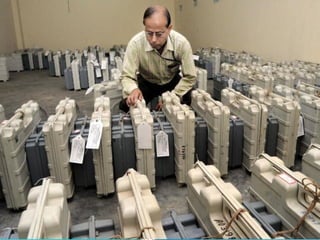
In present system each and every booth is given
an electronic machine which stores the votes of
the people.
Control of present system is given to the incharge
officer who checks the eligibility of the candidates
for voting.
Finally incharge collect all the voting machine at a
place and go for counting
Click icon to add picture
G.L ABHISHEK
DISADVANTAGES OF
PRESENT SYSTEM
The machine is not able to recognize the
eligibility of a candidate, so the corrupted officers
may misguide the people
The corrupted officers may increase the count of
the voting.
After voting if any technical problems or damage
occurs with the machines it may leads to the re
election
CONTINUED…
During transportation of the machines, the
person in charge can change the status of
machines and even may destroy.
This system is not a cost effective one. Since we
need security, in charge officers, secured place for
counting and election place.
The voting take place where the machine is
located.
PROPOSED SYSTEM
In this system we trying to keep counting of votes
in to a remote secured system.
Our machine can check the eligibility of the
candidate by itself, so there is no question of
corruption.
In this system we are using an electronic circuit
which enable the voter to vote and transfer this
vote to the remote system using mobile tower.
CONTINUED..
A error in a vote does not affect the remaining
system, there by reducing the risk of re-election.
Cost for an election is comparatively less than
current system
 A person even can vote from a mobile system and
also from Internet
EXPLANATION
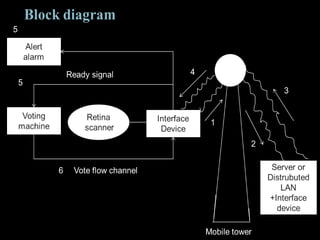
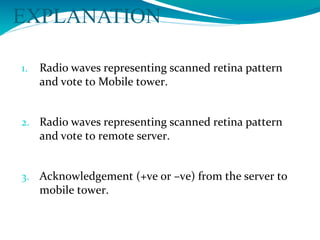
1. Radio waves representing scanned retina pattern
and vote to Mobile tower.
2. Radio waves representing scanned retina pattern
and vote to remote server.
3. Acknowledgement (+ve or –ve) from the server to
mobile tower.
CONTINUED..
4. Acknowledgement (+ve or –ve) from mobile
tower to Interface device.
5. Ready signal if retina is scanned properly to
voting machine. And if –ve signal then alert
alarm will be activated.
6. Accepted vote is made to flow to the interface
device.
VOTING MACHINE
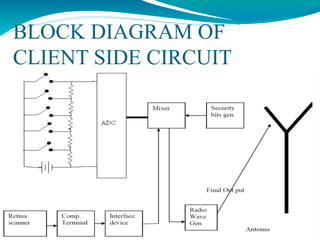
The voting machine is actually a device which
generates the different voltages for different votes.
These voltages are fed to the (ADC) which is then
converted to digital bits then can be converted to
radio waves.
BLOCK DIAGRAM OF
CLIENT SIDE CIRCUIT
EYE RETINA SCANNING
A biometric identifier known as a retinal scan is used
to map the unique patterns of a person's retina.
These eye retina machine can be a high quality web
cam or device which can capture the images
effectively.
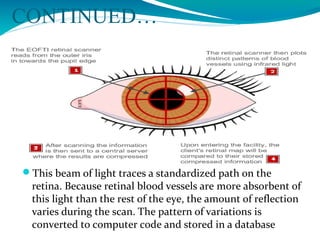
A retinal scan is performed by casting an unperceived
beam of low-energy infrared light into a person’s eye
as they look through the scanner's eyepiece.
CONTINUED…
This beam of light traces a standardized path on the
retina. Because retinal blood vessels are more absorbent of
this light than the rest of the eye, the amount of reflection
varies during the scan. The pattern of variations is
converted to computer code and stored in a database
INTERFACE DEVICE
This is an electronic kit which converts the
input digital signals such as (retina pattern +
votes+ secure bits) to radio waves.
Working of the whole system
Whenever voters enter to voting booth then he will
be instructed to directly look at retina scanning
machine and the machine scans the retina.
Once retina scanning properly confirmed then voter
is made to vote
Now the whole data including the retina pattern is
sent to interfacing device which converts it into radio
waves and these radio waves are sent to mobile tower
And then to the remote server, where the
authentication and voters identification is stored into
a secured database.
CONTINUED…
The received data is first converted into digital format
from the radio waves through the interface device kept at
the server side, and from the encrypted data retina pattern
and vote separated.
Next the retina pattern is matched against the existing
database .
If match is found then flag is checked which indicates its
voting status i.e. +ve ack.
This ack is recognized by the receiver kept at the voter
side and machine is made to scan next retina pattern and
vote, otherwise if –ve ack then alert alarm is made to ring
HURDLES IN THE PATH OF
IMPLEMENTATION
Security
Efficiency
Geographical problem
Security
Uses Key Complex Encryption algorithm
 First it finds the length of the string
Generate the random numbers equal to the
length of the string
Add the corresponding Characters from the given
string and random values
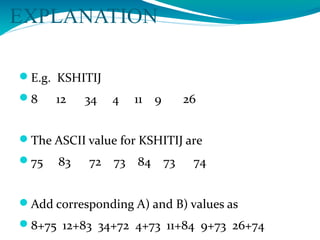
EXPLANATION
E.g. KSHITIJ
8 12 34 4 11 9 26
The ASCII value for KSHITIJ are
75 83 72 73 84 73 74
Add corresponding A) and B) values as
8+75 12+83 34+72 4+73 11+84 9+73 26+74
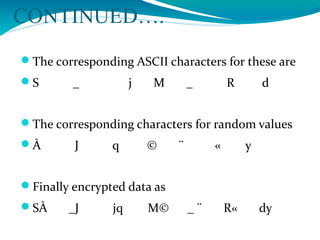
CONTINUED….
The corresponding ASCII characters for these are
S _ j M _ R d
The corresponding characters for random values
À J q © ¨ « y
Finally encrypted data as
SÀ _J jq M© _ ¨ R« dy
EFFICIENCY
Applying compression Algorithms
Using distributed Operating system environment
with multiple servers.
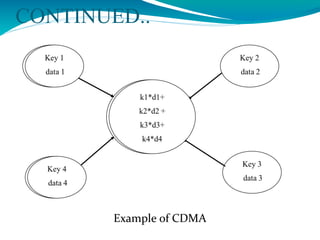
CDMA technique
CONTINUED..
Example of CDMA
GEOGRAPHICAL
PROBLEMS
It occurs where the technical facilities like
mobile tower or Internet service is not present.
In this case will convert the vote and retina
pattern into the electrical information.
And pass it when we reach the area where the
technical facilities like internet or mobile tower is
available.
Here the eye scanner will be web cam.
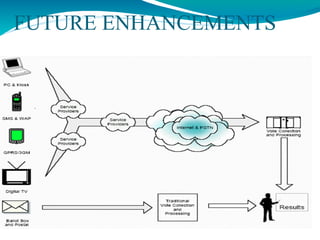
FUTURE ENHANCEMENTS
CONCLUSION
Provides high level of security, authentication,
reliability, and corruption-free mechanism.
By this we can get result with in minute after the
completion of voting.
Minimum manpower Utilization, hence mechanism is
error free.
REFERENCE
Boylestead “Electronic Devices and Circuit
Theory” 10/e Pearson Education, June 2012
Herbert Taub and Donald Schilling “Digital
Integrated Electronics” McGraw-Hill Internatinoal
Editions, 01-Jan-1977

GLOBAL WIRELESS E-VOTING (JAYESH J CUSAT)

  • 1.
    Under the guidanceof Dr. Shena Mathew GLOBAL WIRELESS E-VOTING SYSYTEM PRESENTED By, JAYESH J 12110031 S7 CS-A SOE,CUSAT
  • 2.
    CONTENTS INTRODUCTION PRESENT SYSTEM PROPOSED SYDTEM VOTINGMACHINE EYE RETINA SCANNING INTERFACE DEVICE
  • 3.
    CONTENTS WORKING OF WHOLESYSTEM HURDLES IN PATH OF IMPLEMENTATION FUTURE ENHANCEMENT CONCLUSION REFERENCE
  • 4.
    INTRODUCTION “Global Wireless E-Voting”is an intelligent voting system which can determine the eligibility of the voter by scanning the eye pattern . Vote count is not kept into the same machine itself instead of it is stored in the remote server by converting it into radio waves. More secure than conventional voting system
  • 5.
    PRESENT SYSTEM In presentsystem each and every booth is given an electronic machine which stores the votes of the people. Control of present system is given to the incharge officer who checks the eligibility of the candidates for voting. Finally incharge collect all the voting machine at a place and go for counting
  • 6.
    Click icon toadd picture G.L ABHISHEK
  • 7.
    DISADVANTAGES OF PRESENT SYSTEM Themachine is not able to recognize the eligibility of a candidate, so the corrupted officers may misguide the people The corrupted officers may increase the count of the voting. After voting if any technical problems or damage occurs with the machines it may leads to the re election
  • 8.
    CONTINUED… During transportation ofthe machines, the person in charge can change the status of machines and even may destroy. This system is not a cost effective one. Since we need security, in charge officers, secured place for counting and election place. The voting take place where the machine is located.
  • 9.
    PROPOSED SYSTEM In thissystem we trying to keep counting of votes in to a remote secured system. Our machine can check the eligibility of the candidate by itself, so there is no question of corruption. In this system we are using an electronic circuit which enable the voter to vote and transfer this vote to the remote system using mobile tower.
  • 10.
    CONTINUED.. A error ina vote does not affect the remaining system, there by reducing the risk of re-election. Cost for an election is comparatively less than current system  A person even can vote from a mobile system and also from Internet
  • 12.
    EXPLANATION 1. Radio wavesrepresenting scanned retina pattern and vote to Mobile tower. 2. Radio waves representing scanned retina pattern and vote to remote server. 3. Acknowledgement (+ve or –ve) from the server to mobile tower.
  • 13.
    CONTINUED.. 4. Acknowledgement (+veor –ve) from mobile tower to Interface device. 5. Ready signal if retina is scanned properly to voting machine. And if –ve signal then alert alarm will be activated. 6. Accepted vote is made to flow to the interface device.
  • 14.
    VOTING MACHINE The votingmachine is actually a device which generates the different voltages for different votes. These voltages are fed to the (ADC) which is then converted to digital bits then can be converted to radio waves.
  • 15.
  • 16.
    EYE RETINA SCANNING Abiometric identifier known as a retinal scan is used to map the unique patterns of a person's retina. These eye retina machine can be a high quality web cam or device which can capture the images effectively. A retinal scan is performed by casting an unperceived beam of low-energy infrared light into a person’s eye as they look through the scanner's eyepiece.
  • 17.
    CONTINUED… This beam oflight traces a standardized path on the retina. Because retinal blood vessels are more absorbent of this light than the rest of the eye, the amount of reflection varies during the scan. The pattern of variations is converted to computer code and stored in a database
  • 18.
    INTERFACE DEVICE This isan electronic kit which converts the input digital signals such as (retina pattern + votes+ secure bits) to radio waves.
  • 19.
    Working of thewhole system Whenever voters enter to voting booth then he will be instructed to directly look at retina scanning machine and the machine scans the retina. Once retina scanning properly confirmed then voter is made to vote Now the whole data including the retina pattern is sent to interfacing device which converts it into radio waves and these radio waves are sent to mobile tower And then to the remote server, where the authentication and voters identification is stored into a secured database.
  • 20.
    CONTINUED… The received datais first converted into digital format from the radio waves through the interface device kept at the server side, and from the encrypted data retina pattern and vote separated. Next the retina pattern is matched against the existing database . If match is found then flag is checked which indicates its voting status i.e. +ve ack. This ack is recognized by the receiver kept at the voter side and machine is made to scan next retina pattern and vote, otherwise if –ve ack then alert alarm is made to ring
  • 21.
    HURDLES IN THEPATH OF IMPLEMENTATION Security Efficiency Geographical problem
  • 22.
    Security Uses Key ComplexEncryption algorithm  First it finds the length of the string Generate the random numbers equal to the length of the string Add the corresponding Characters from the given string and random values
  • 23.
    EXPLANATION E.g. KSHITIJ 8 1234 4 11 9 26 The ASCII value for KSHITIJ are 75 83 72 73 84 73 74 Add corresponding A) and B) values as 8+75 12+83 34+72 4+73 11+84 9+73 26+74
  • 24.
    CONTINUED…. The corresponding ASCIIcharacters for these are S _ j M _ R d The corresponding characters for random values À J q © ¨ « y Finally encrypted data as SÀ _J jq M© _ ¨ R« dy
  • 25.
    EFFICIENCY Applying compression Algorithms Usingdistributed Operating system environment with multiple servers. CDMA technique
  • 26.
  • 27.
    GEOGRAPHICAL PROBLEMS It occurs wherethe technical facilities like mobile tower or Internet service is not present. In this case will convert the vote and retina pattern into the electrical information. And pass it when we reach the area where the technical facilities like internet or mobile tower is available. Here the eye scanner will be web cam.
  • 28.
  • 29.
    CONCLUSION Provides high levelof security, authentication, reliability, and corruption-free mechanism. By this we can get result with in minute after the completion of voting. Minimum manpower Utilization, hence mechanism is error free.
  • 30.
    REFERENCE Boylestead “Electronic Devicesand Circuit Theory” 10/e Pearson Education, June 2012 Herbert Taub and Donald Schilling “Digital Integrated Electronics” McGraw-Hill Internatinoal Editions, 01-Jan-1977

Editor's Notes