Get Organized:  Tips for finding and managing your research   Jo-Anne Naslund  UBC Education Library [email_address] 604-822-0940
Outline Keep a research journal Be clear about what you are doing Read some books about research Consult some writing references  Get started, keep going, keep writing Don’t give up
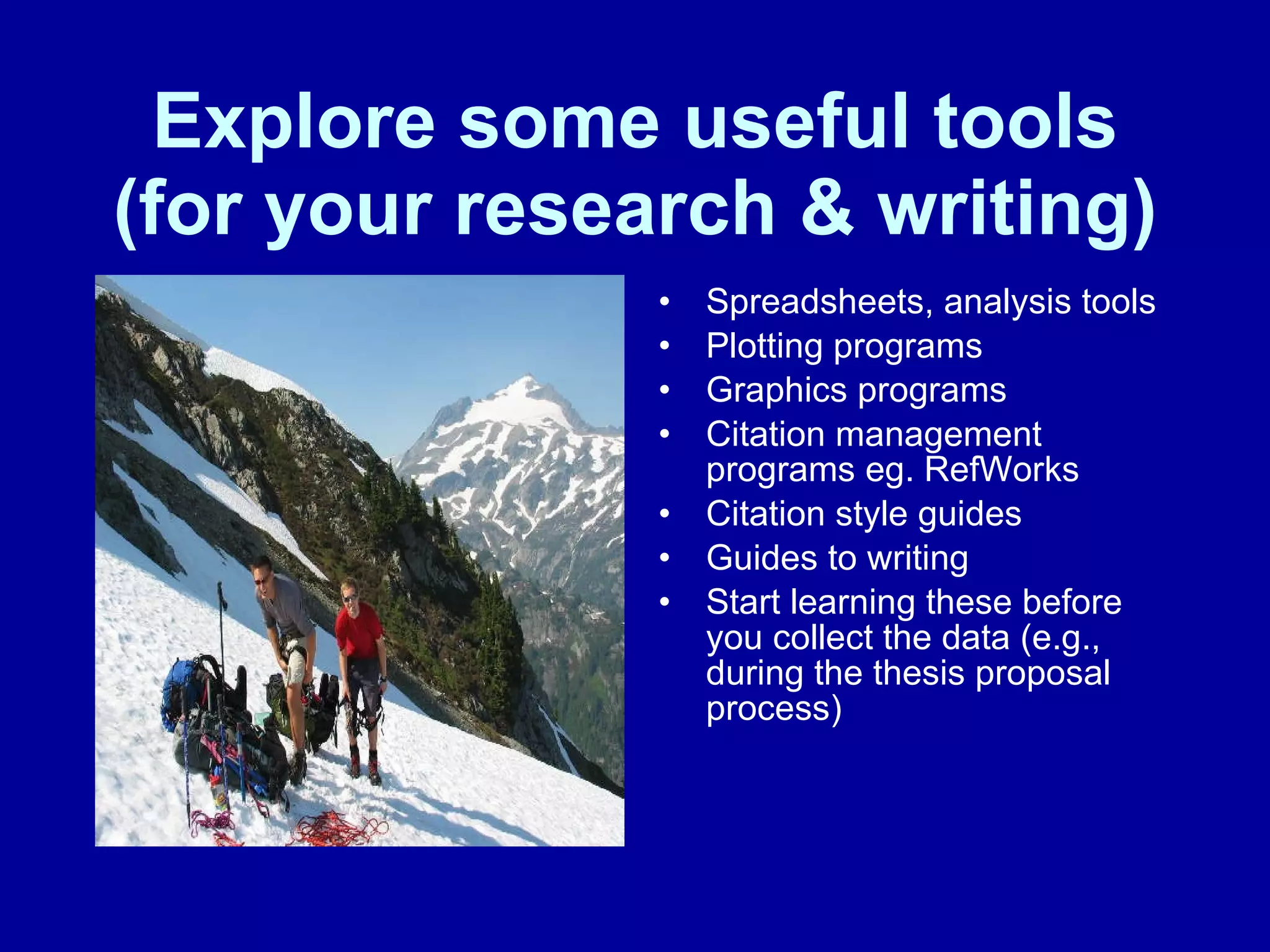
Explore some useful tools (for your research & writing) Spreadsheets, analysis tools Plotting programs Graphics programs Citation management programs eg. RefWorks Citation style guides Guides to writing Start learning these before you collect the data (e.g., during the thesis proposal process)
Writing Resources Use books, not just web sites to help your writing Citation style manual (APA, MLA, Chicago etc.) maybe even a thesaurus and a dictionary of synonyms and antonyms.
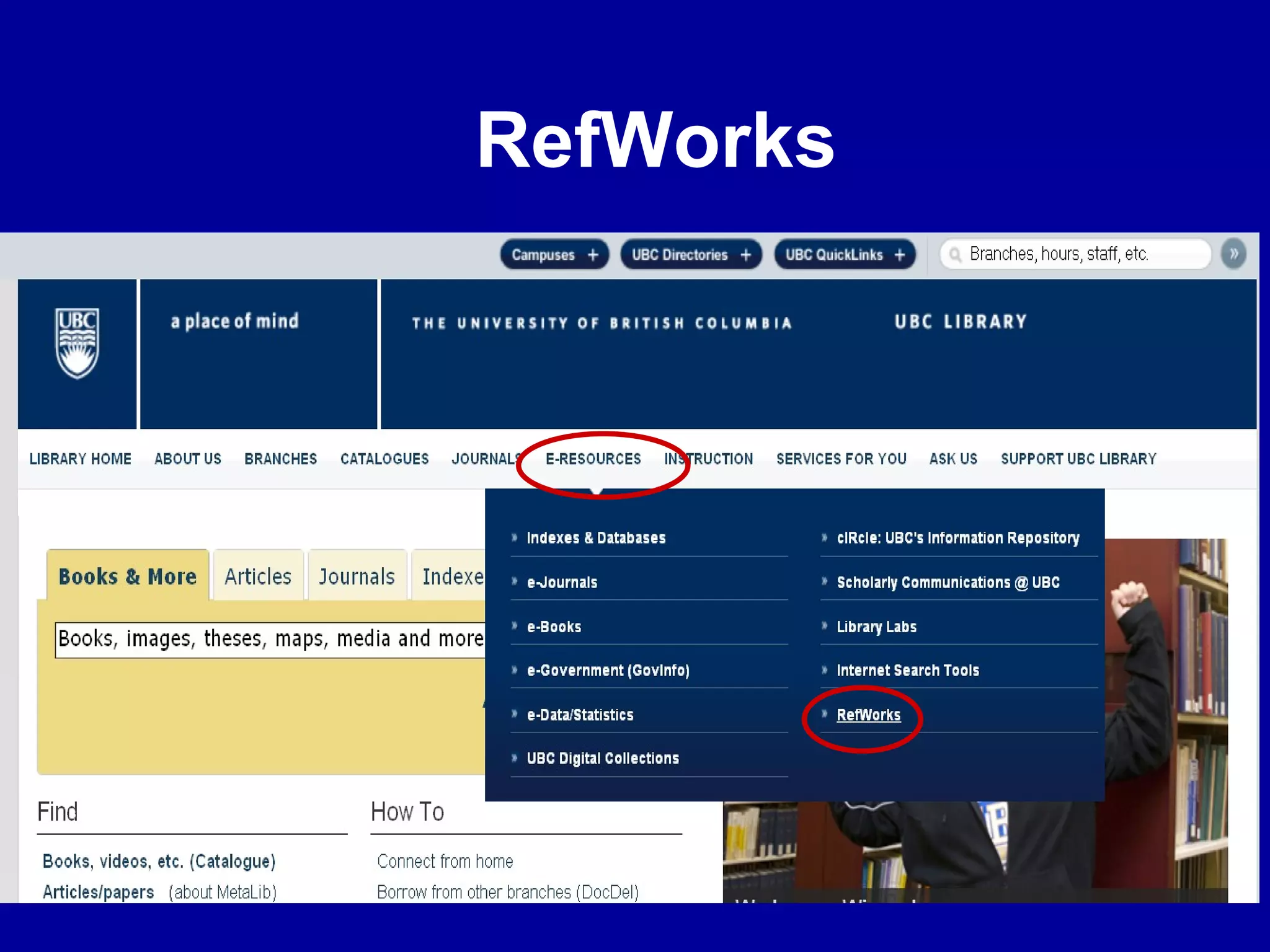
RefWorks
Keep a research journal   Folder on your desk top Online Google docs Physical notebook or binder File box NOTE:  Something that is with you whenever and where ever.
Purpose of a research journal   Idea generation Plan your time and set target dates  Track your search tools Record your search strategies Keep questions and answers together
A reader/reviewer will ask:   what is the research question?    is it a good question? (has  it been answered before? Why is it a useful question to work on?)  did the author convince me that the question was adequately answered?   has the author made an  adequate contribution to knowledge? Chinneck, J. (1999). “How to Organize Your Thesis”  Retrieved July 26, 2010 at  http:// www.sce.carleton.ca/faculty/chinneck/thesis.html
Know your task Clarify information needed  Get background information Design search strategy Choose places to search Use searching techniques  Get to the fulltext Manage results Evaluate the information  Cite references
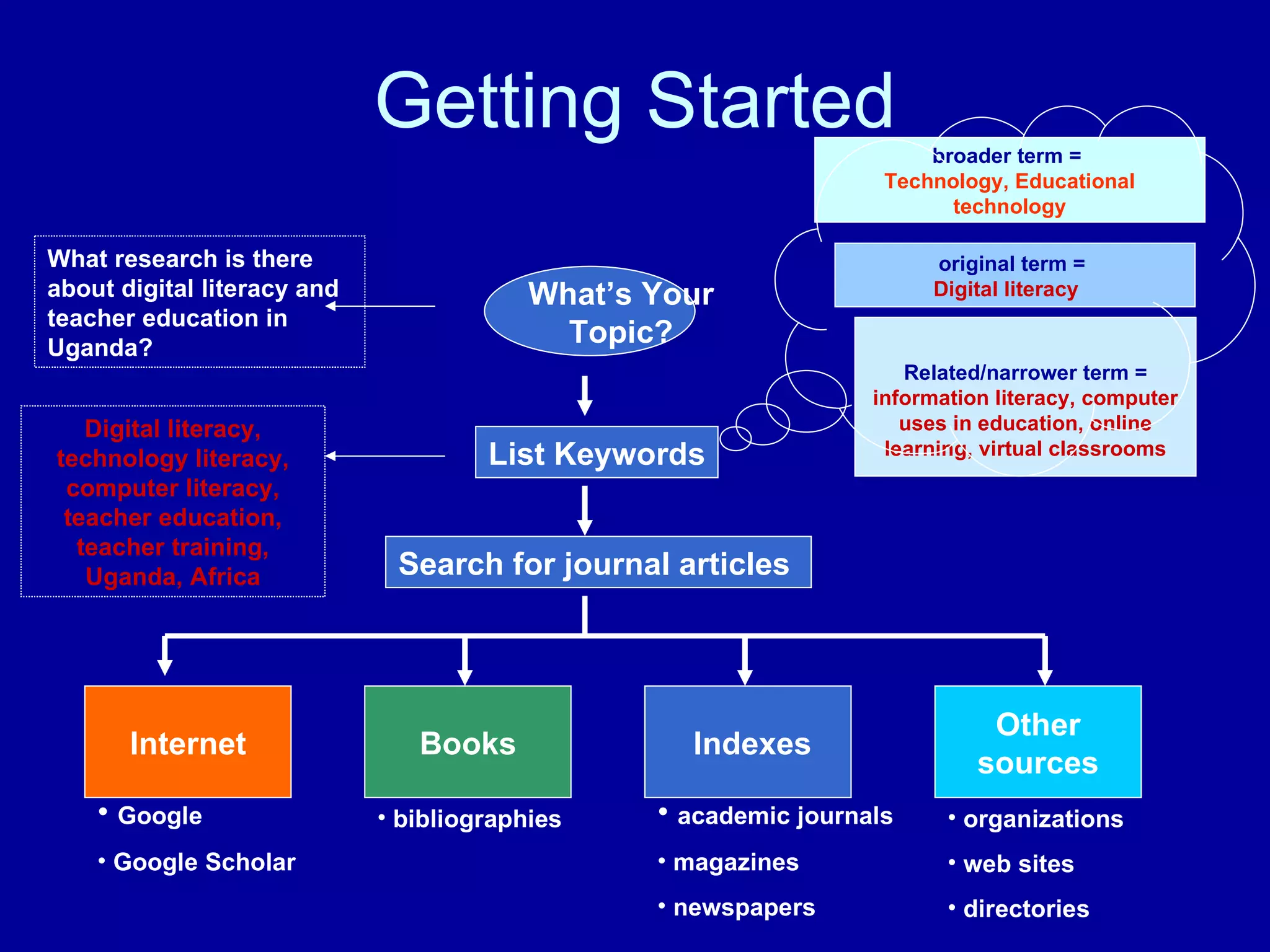
Getting Started What’s Your Topic? List Keywords Search for journal articles  Internet Books Indexes Other sources Google Google Scholar What research is there about digital literacy and teacher education in Uganda? Digital literacy, technology literacy, computer literacy, teacher education, teacher training, Uganda, Africa broader term =  Technology, Educational technology original term =   Digital literacy  Related/narrower term =   information literacy, computer uses in education, online learning, virtual classrooms academic journals magazines newspapers organizations web sites directories bibliographies
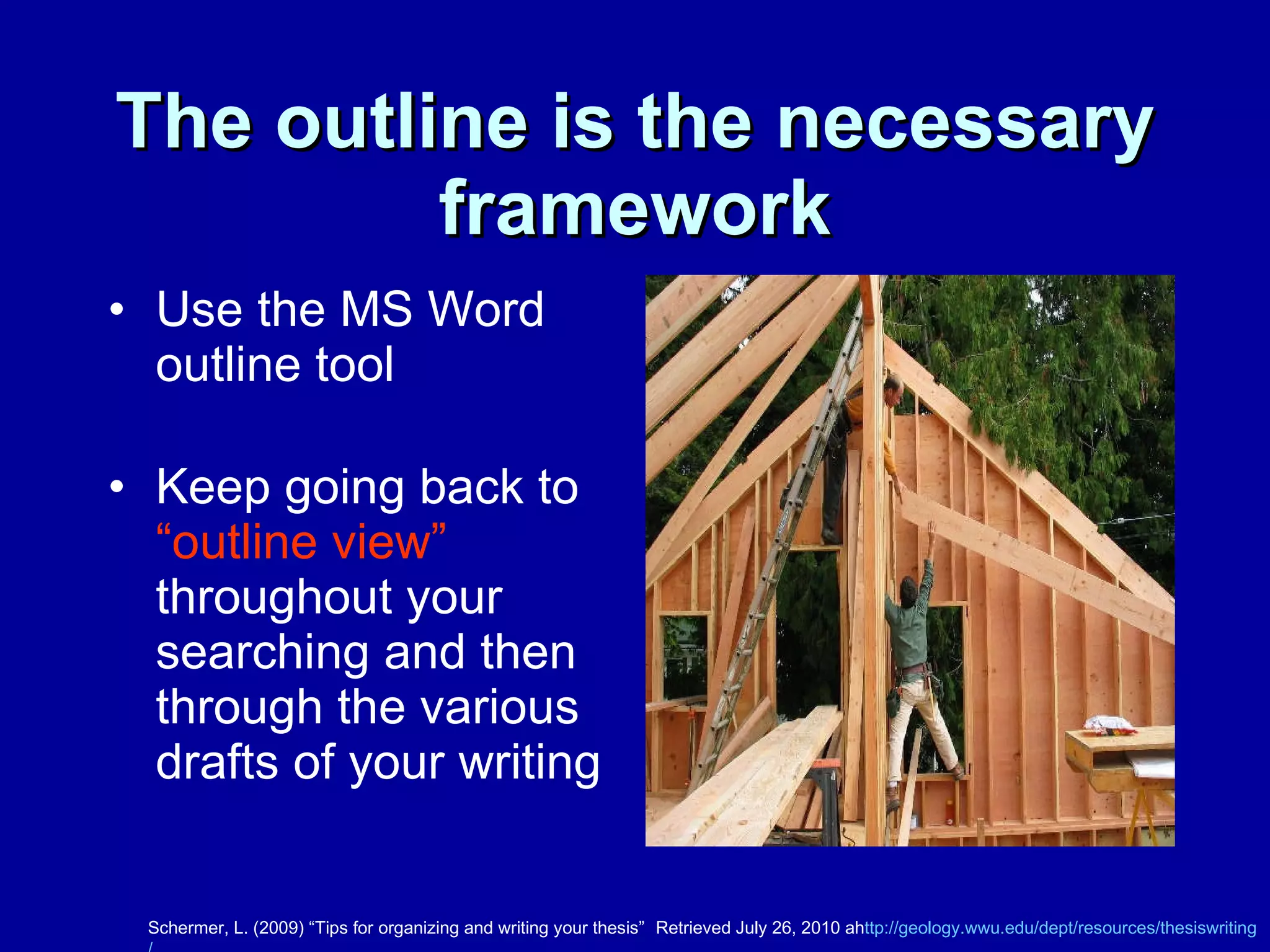
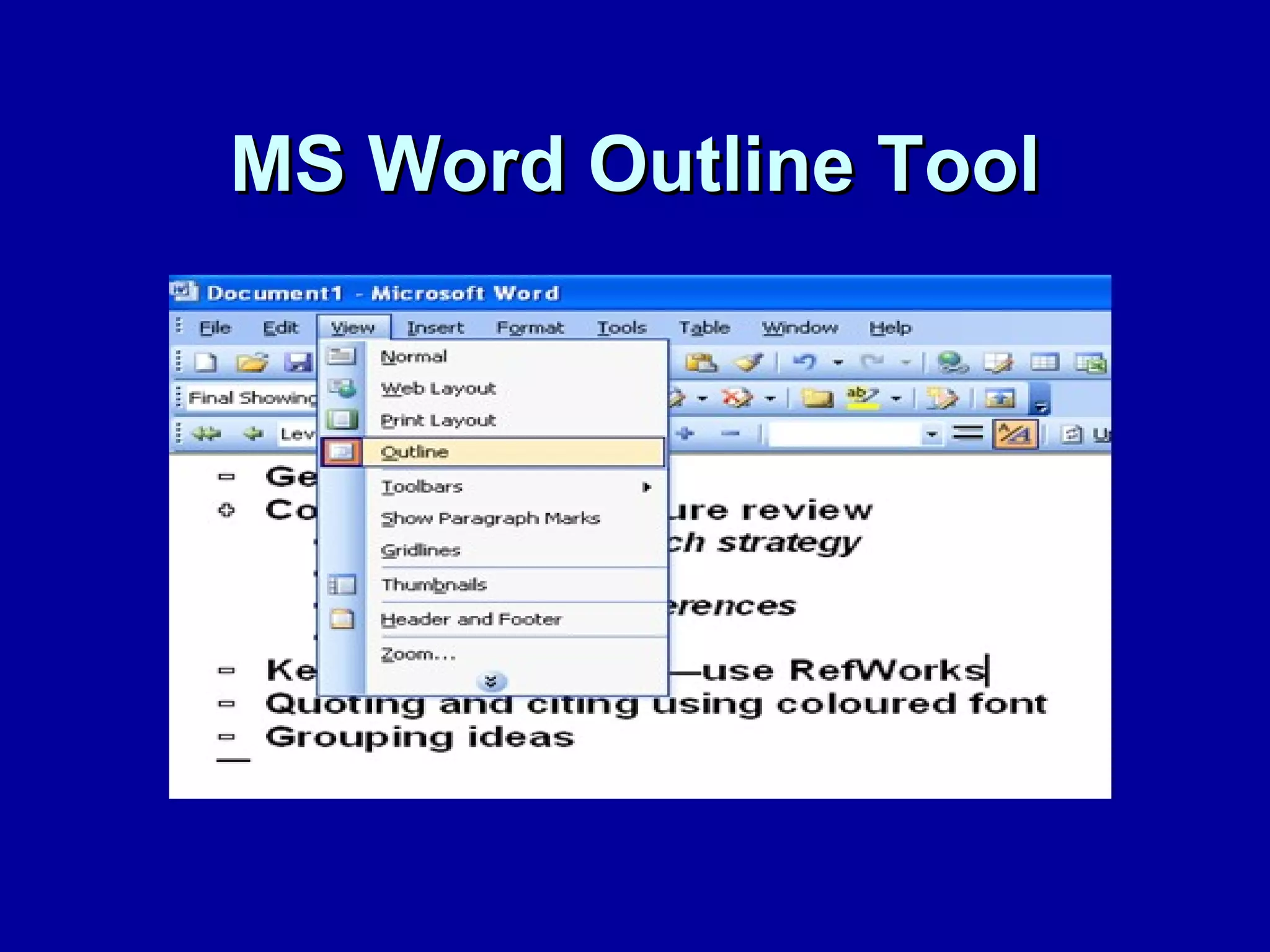
The outline is the necessary framework Use the MS Word outline tool Keep going back to  “outline view”  throughout your searching and then through the various drafts of your writing Schermer, L. (2009) “Tips for organizing and writing your thesis”  Retrieved July 26, 2010 ah ttp://geology.wwu.edu/dept/resources/thesiswriting / writingbrownbag.ppt
MS Word Outline Tool
Create the Outline   Prepare an extended outline.  Use MS Word “outline” tool  List each section and subsection  For each section and subsection, write a brief point-form description of the contents.  Review with your advisor.
Keep to the point Place extraneous information in a miscellaneous file Focus and eliminate items  Revisit your outline
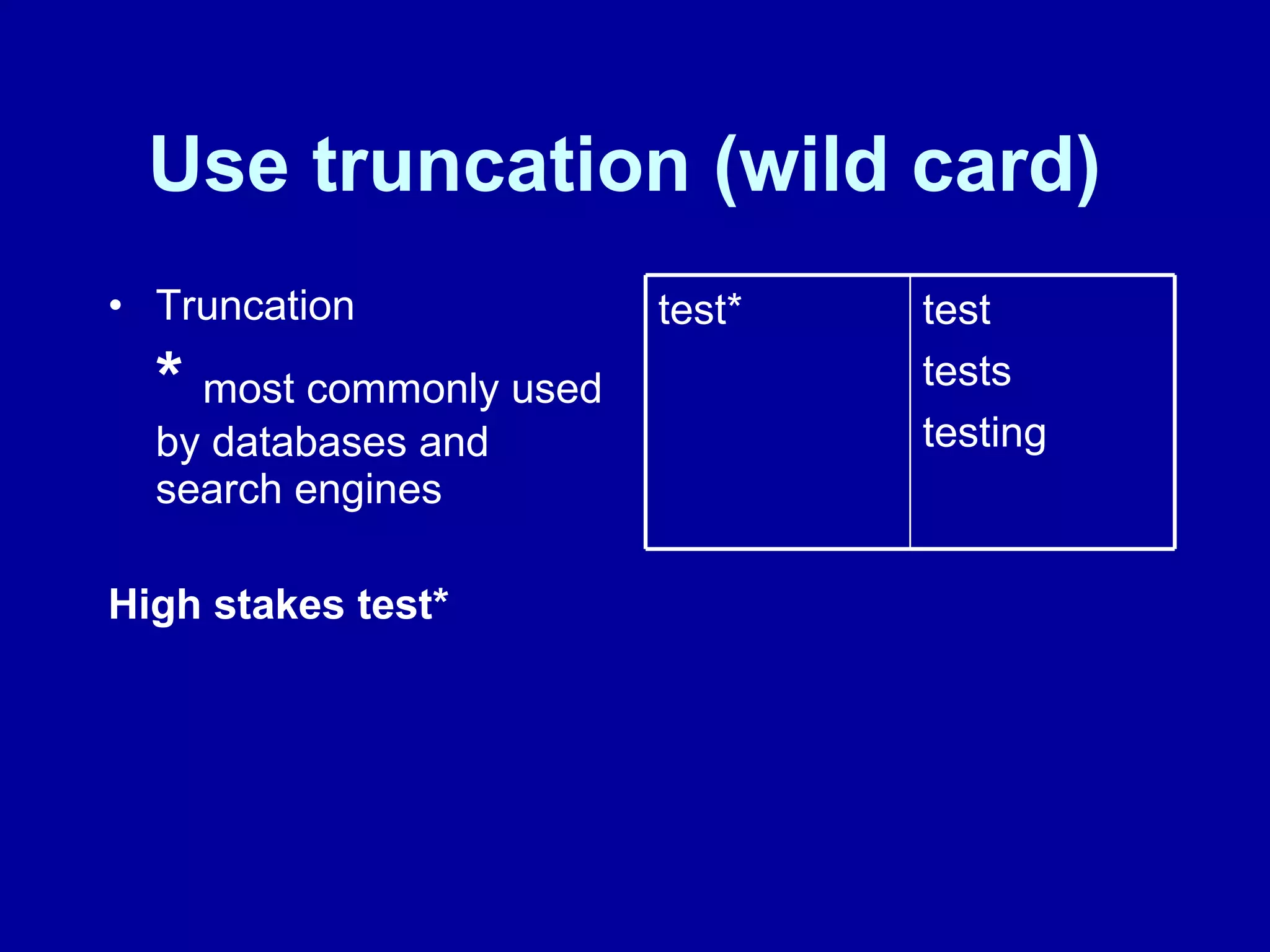
Build a search strategy Key word search Generate a list of terms—synonyms I want to find out about schooling and effects of  accountability.  AND AND AND + High stakes tests  Public education program effectiveness Elementary education accountability schooling Idea 2 Idea 1
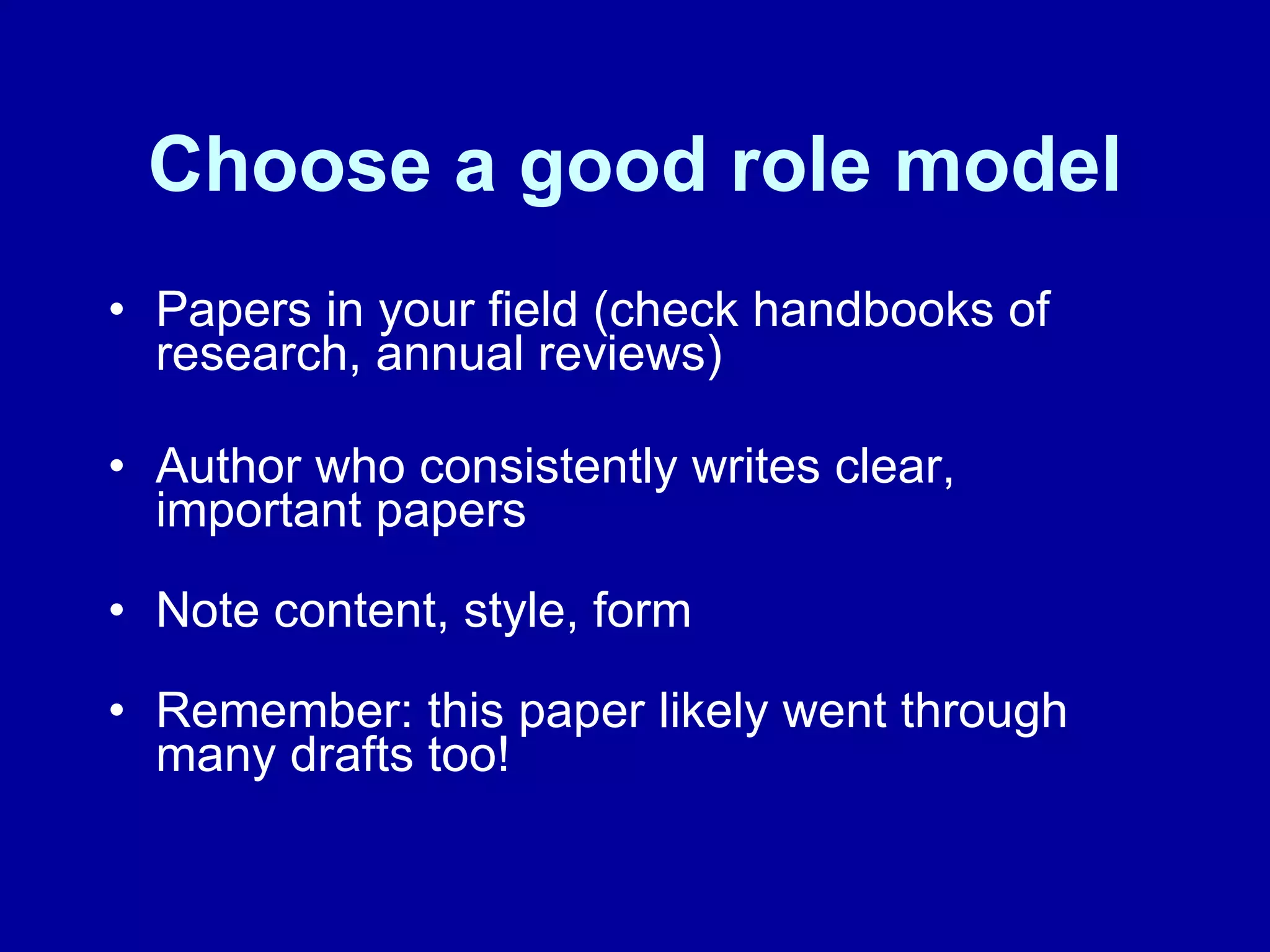
Use truncation (wild card)   Truncation  *  most commonly used by databases and search engines High stakes test* test tests testing test*
Choose a good role model Papers in your field (check handbooks of research, annual reviews) Author who consistently writes clear, important papers Note content, style, form Remember: this paper likely went through many drafts too!
Organization Single most important concepts. Outline critical observations and reasoning that support the concepts Draft the body of the text : methods first, observations next, interpretations last. Draft in rough the contextual elements: conclusion first, introduction next, abstract last. Insert transitional sections, paragraphs, and sentences.
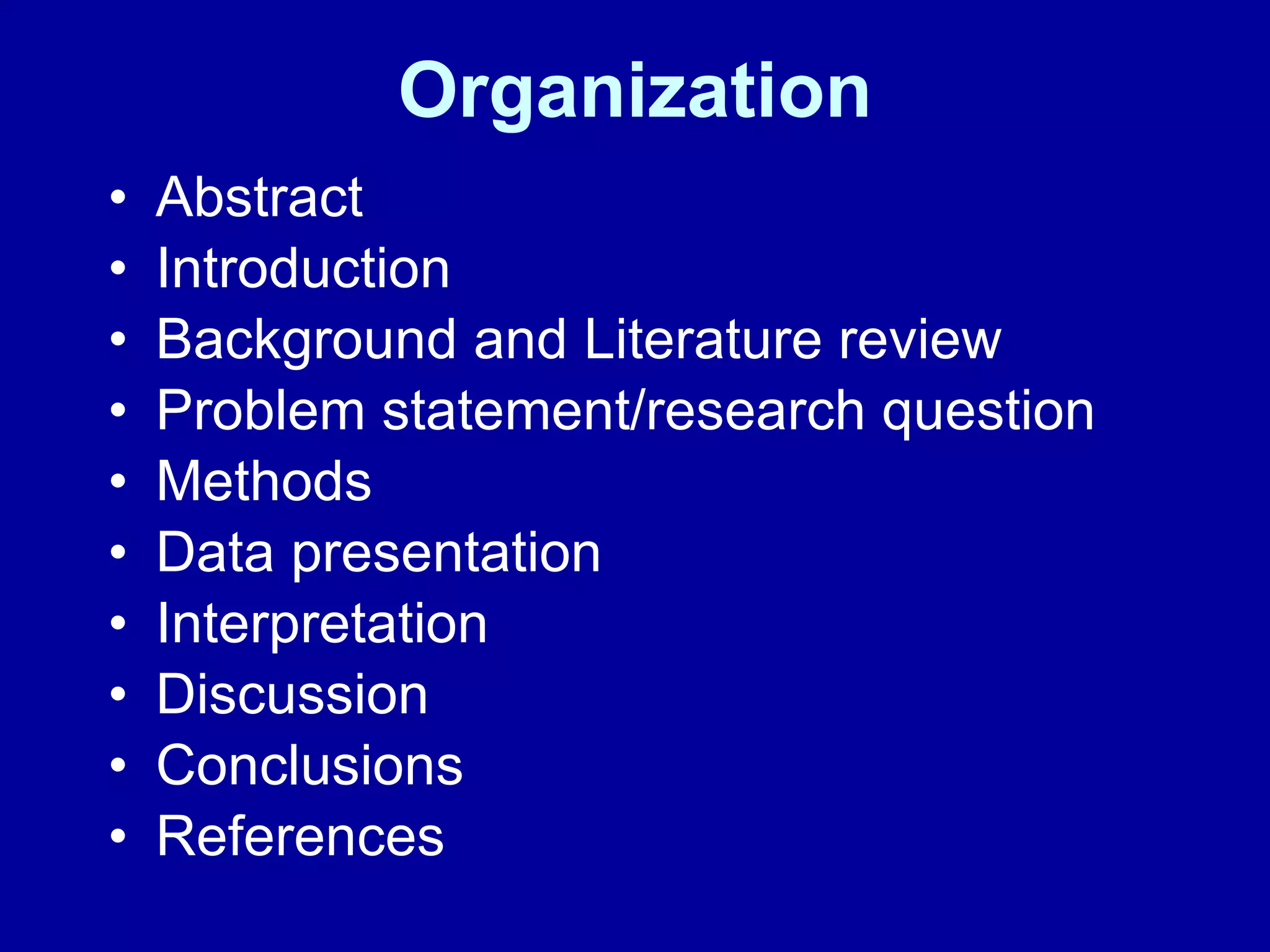
Organization Abstract Introduction Background and Literature review Problem statement/research question Methods Data presentation Interpretation Discussion Conclusions References
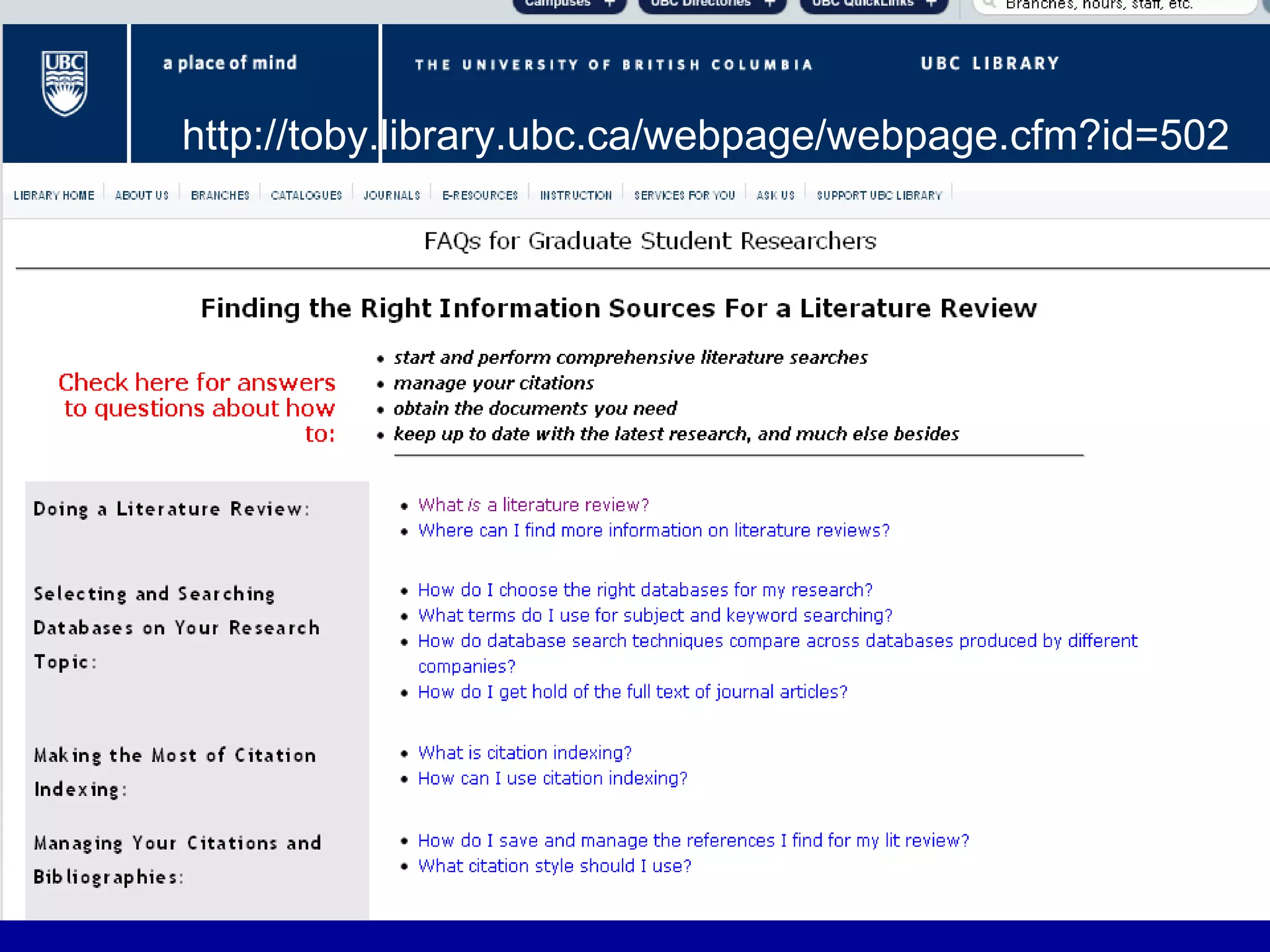
http://toby.library.ubc.ca/webpage/webpage.cfm?id=502
Literature Review Limited to the state of the art  relevant to your thesis . Organize this section  by idea , and not by author or by publication. Often comes after the problem statement Some advisors do not expect a long lit. review for the thesis proposal or the thesis--be sure you ask your committee! Schermer, L. (2009) “Tips for organizing and writing your thesis”  Retrieved July 26, 2010 ah ttp://geology.wwu.edu/dept/resources/thesiswriting / writingbrownbag.ppt
Literature review Provides context for and details about the motivation for the project States why the problem is important Describes what others have done and hence sets a benchmark for the current project Justifies the use of specific techniques or problem solving procedures Schermer, L. (2009) “Tips for organizing and writing your thesis”  Retrieved July 26, 2010 ah ttp://geology.wwu.edu/dept/resources/thesiswriting / writingbrownbag.ppt
Tips for literature review Keep up with current literature in your field of study  Jot down key points of an article and note the journal title and place of publication  Devise a tagging/folder system that will allow you to retrieve the paper quickly. (e.g. use RefWorks)  Make sure that you have read and understood cited work  – quoted material in red
Tips for literature review Organize your content according to ideas instead of individual publications.  Do not simply quote or paraphrase the contents of published articles. Weave the information into focused views. Demonstrate your deeper understanding of the topic. Do not be tempted to summarize everything you have read; only include those relevant to your main points. Chinneck, J. (1999). “How to Organize Your Thesis”  Retrieved July 26, 2010 at  http:// www.sce.carleton.ca/faculty/chinneck/thesis.html
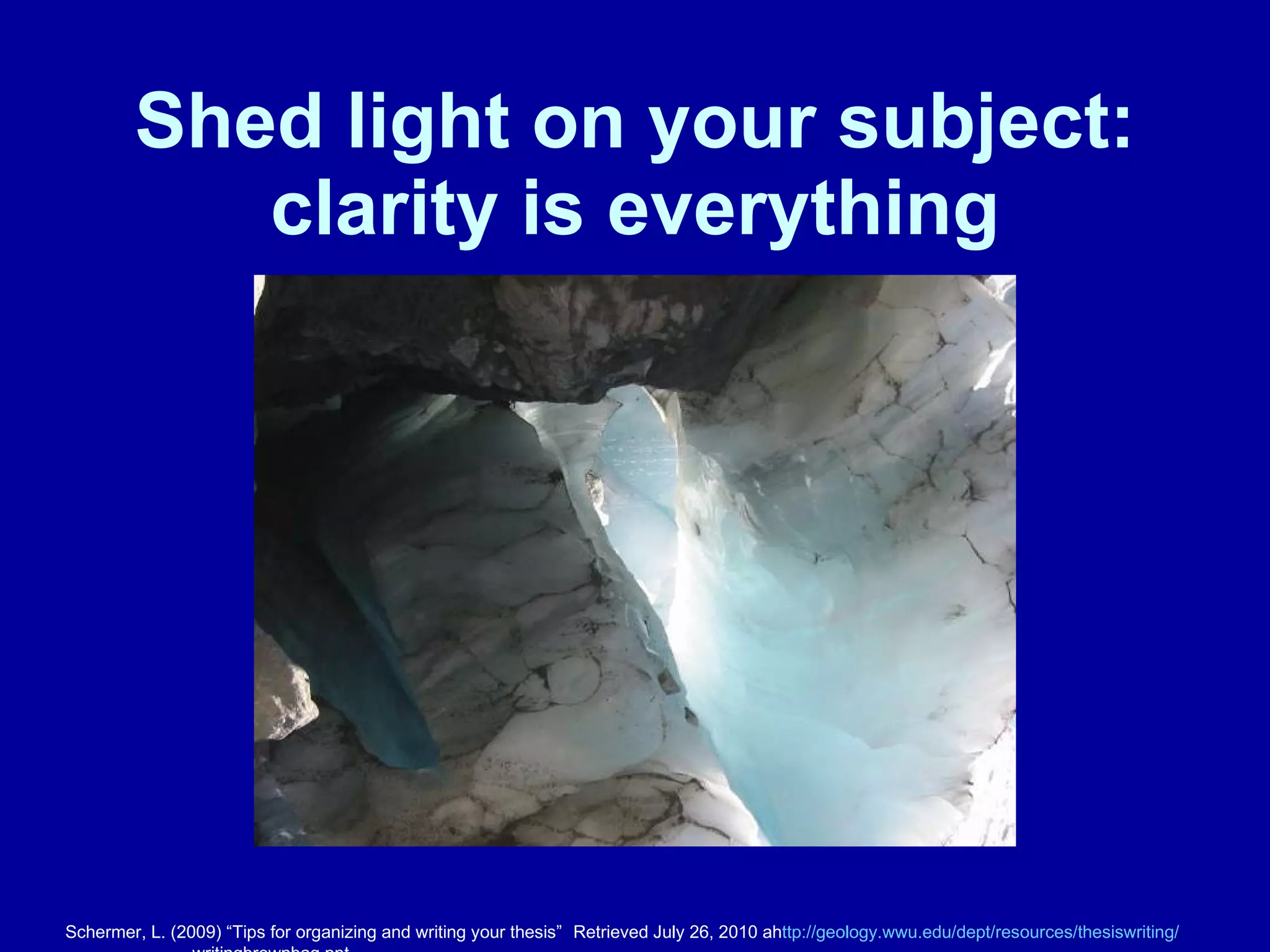
Shed light on your subject: clarity is everything Schermer, L. (2009) “Tips for organizing and writing your thesis”  Retrieved July 26, 2010 ah ttp://geology.wwu.edu/dept/resources/thesiswriting / writingbrownbag.ppt
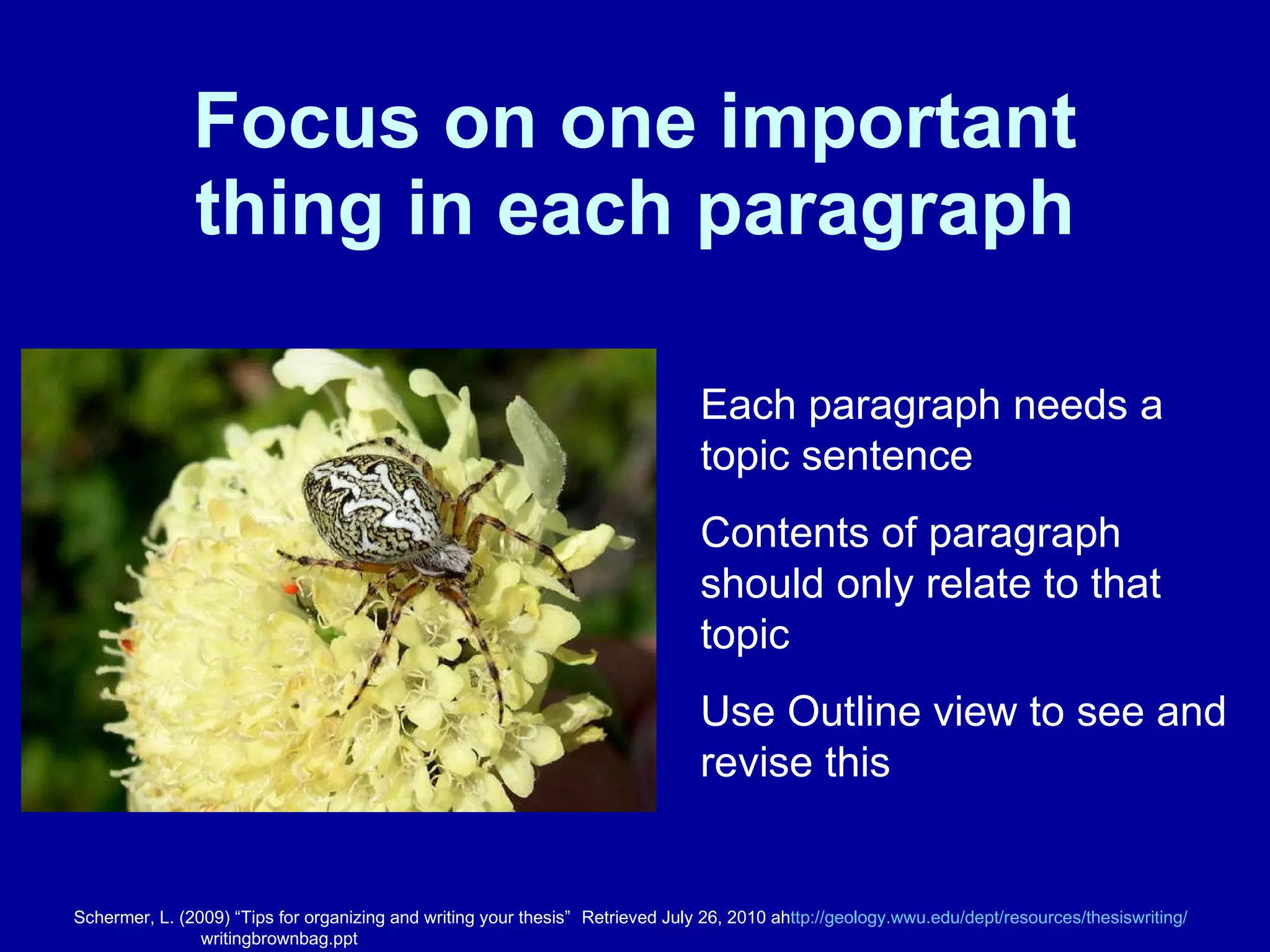
Focus on one important thing in each paragraph Each paragraph needs a topic sentence Contents of paragraph should only relate to that topic Use Outline view to see and revise this Schermer, L. (2009) “Tips for organizing and writing your thesis”  Retrieved July 26, 2010 ah ttp://geology.wwu.edu/dept/resources/thesiswriting / writingbrownbag.ppt
References Include all  references cited, including those in Tables and Figure captions.  Use consistent style throughout –learn the style used in your discipline Use RefWorks program (start NOW building your library database)
Getting over writers block Pile of poo  theory write something, anything & mold it afterward  Quiet that voice in your head that says  “this sucks”-- just get something on paper for a start Start the  pile of poo  early enough so you can leave it for a day or so, then come back to it. Have confidence that you know more about your project than anyone else does, you just need to convey that knowledge  Schermer, L. (2009) “Tips for organizing and writing your thesis”  Retrieved July 26, 2010 at  http:// geology.wwu.edu/dept/resources/thesiswriting / writingbrownbag.ppt
Keep going Write as you go Share writing early and often    Deal with procrastination.  Identify a time and location where you can write with good focus and few distractions, and take advantage of it regularly -- at least weekly, possibly daily
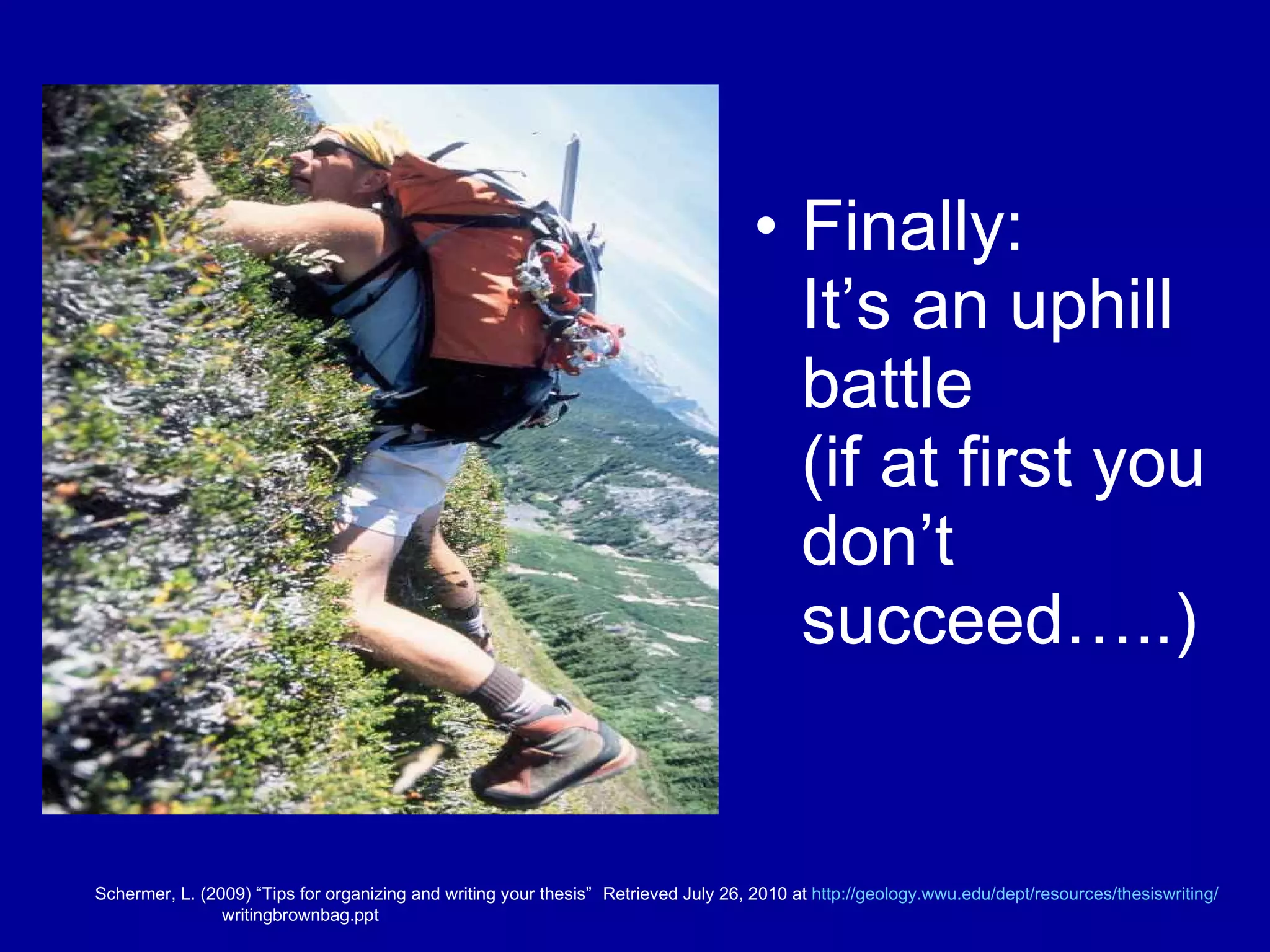
Finally: It’s an uphill battle (if at first you don’t succeed…..) Schermer, L. (2009) “Tips for organizing and writing your thesis”  Retrieved July 26, 2010 at  http:// geology.wwu.edu/dept/resources/thesiswriting / writingbrownbag.ppt
References Chinneck, J. (1999). “How to Organize Your Thesis”  Retrieved July 26, 2010 at  http://www.sce.carleton.ca/faculty/chinneck/thesis.html Newcastle University.  School of Engineering and Advanced Materials. (2009) Writing Tips. Retrieved July 26, 2010 at  http:// lorien.ncl.ac.uk/ming/Dept/Tips/writing/writeindex.htm Schermer, L. (2009) “Tips for organizing and writing your thesis” Retrieved July 26, 2010 at  http://geology.wwu.edu/dept/resources/thesiswriting/ writingbrownbag.ppt

Getorganized

  • 1.
    Get Organized: Tips for finding and managing your research Jo-Anne Naslund UBC Education Library [email_address] 604-822-0940
  • 2.
    Outline Keep aresearch journal Be clear about what you are doing Read some books about research Consult some writing references Get started, keep going, keep writing Don’t give up
  • 3.
    Explore some usefultools (for your research & writing) Spreadsheets, analysis tools Plotting programs Graphics programs Citation management programs eg. RefWorks Citation style guides Guides to writing Start learning these before you collect the data (e.g., during the thesis proposal process)
  • 4.
    Writing Resources Usebooks, not just web sites to help your writing Citation style manual (APA, MLA, Chicago etc.) maybe even a thesaurus and a dictionary of synonyms and antonyms.
  • 5.
  • 6.
    Keep a researchjournal Folder on your desk top Online Google docs Physical notebook or binder File box NOTE: Something that is with you whenever and where ever.
  • 7.
    Purpose of aresearch journal Idea generation Plan your time and set target dates Track your search tools Record your search strategies Keep questions and answers together
  • 8.
    A reader/reviewer willask: what is the research question? is it a good question? (has it been answered before? Why is it a useful question to work on?) did the author convince me that the question was adequately answered? has the author made an adequate contribution to knowledge? Chinneck, J. (1999). “How to Organize Your Thesis” Retrieved July 26, 2010 at http:// www.sce.carleton.ca/faculty/chinneck/thesis.html
  • 9.
    Know your taskClarify information needed Get background information Design search strategy Choose places to search Use searching techniques Get to the fulltext Manage results Evaluate the information Cite references
  • 10.
    Getting Started What’sYour Topic? List Keywords Search for journal articles Internet Books Indexes Other sources Google Google Scholar What research is there about digital literacy and teacher education in Uganda? Digital literacy, technology literacy, computer literacy, teacher education, teacher training, Uganda, Africa broader term = Technology, Educational technology original term = Digital literacy Related/narrower term = information literacy, computer uses in education, online learning, virtual classrooms academic journals magazines newspapers organizations web sites directories bibliographies
  • 11.
    The outline isthe necessary framework Use the MS Word outline tool Keep going back to “outline view” throughout your searching and then through the various drafts of your writing Schermer, L. (2009) “Tips for organizing and writing your thesis” Retrieved July 26, 2010 ah ttp://geology.wwu.edu/dept/resources/thesiswriting / writingbrownbag.ppt
  • 12.
  • 13.
    Create the Outline Prepare an extended outline. Use MS Word “outline” tool List each section and subsection For each section and subsection, write a brief point-form description of the contents. Review with your advisor.
  • 14.
    Keep to thepoint Place extraneous information in a miscellaneous file Focus and eliminate items Revisit your outline
  • 15.
    Build a searchstrategy Key word search Generate a list of terms—synonyms I want to find out about schooling and effects of accountability. AND AND AND + High stakes tests Public education program effectiveness Elementary education accountability schooling Idea 2 Idea 1
  • 16.
    Use truncation (wildcard) Truncation * most commonly used by databases and search engines High stakes test* test tests testing test*
  • 17.
    Choose a goodrole model Papers in your field (check handbooks of research, annual reviews) Author who consistently writes clear, important papers Note content, style, form Remember: this paper likely went through many drafts too!
  • 18.
    Organization Single mostimportant concepts. Outline critical observations and reasoning that support the concepts Draft the body of the text : methods first, observations next, interpretations last. Draft in rough the contextual elements: conclusion first, introduction next, abstract last. Insert transitional sections, paragraphs, and sentences.
  • 19.
    Organization Abstract IntroductionBackground and Literature review Problem statement/research question Methods Data presentation Interpretation Discussion Conclusions References
  • 20.
  • 21.
    Literature Review Limitedto the state of the art relevant to your thesis . Organize this section by idea , and not by author or by publication. Often comes after the problem statement Some advisors do not expect a long lit. review for the thesis proposal or the thesis--be sure you ask your committee! Schermer, L. (2009) “Tips for organizing and writing your thesis” Retrieved July 26, 2010 ah ttp://geology.wwu.edu/dept/resources/thesiswriting / writingbrownbag.ppt
  • 22.
    Literature review Providescontext for and details about the motivation for the project States why the problem is important Describes what others have done and hence sets a benchmark for the current project Justifies the use of specific techniques or problem solving procedures Schermer, L. (2009) “Tips for organizing and writing your thesis” Retrieved July 26, 2010 ah ttp://geology.wwu.edu/dept/resources/thesiswriting / writingbrownbag.ppt
  • 23.
    Tips for literaturereview Keep up with current literature in your field of study Jot down key points of an article and note the journal title and place of publication Devise a tagging/folder system that will allow you to retrieve the paper quickly. (e.g. use RefWorks) Make sure that you have read and understood cited work – quoted material in red
  • 24.
    Tips for literaturereview Organize your content according to ideas instead of individual publications. Do not simply quote or paraphrase the contents of published articles. Weave the information into focused views. Demonstrate your deeper understanding of the topic. Do not be tempted to summarize everything you have read; only include those relevant to your main points. Chinneck, J. (1999). “How to Organize Your Thesis” Retrieved July 26, 2010 at http:// www.sce.carleton.ca/faculty/chinneck/thesis.html
  • 25.
    Shed light onyour subject: clarity is everything Schermer, L. (2009) “Tips for organizing and writing your thesis” Retrieved July 26, 2010 ah ttp://geology.wwu.edu/dept/resources/thesiswriting / writingbrownbag.ppt
  • 26.
    Focus on oneimportant thing in each paragraph Each paragraph needs a topic sentence Contents of paragraph should only relate to that topic Use Outline view to see and revise this Schermer, L. (2009) “Tips for organizing and writing your thesis” Retrieved July 26, 2010 ah ttp://geology.wwu.edu/dept/resources/thesiswriting / writingbrownbag.ppt
  • 27.
    References Include all references cited, including those in Tables and Figure captions. Use consistent style throughout –learn the style used in your discipline Use RefWorks program (start NOW building your library database)
  • 28.
    Getting over writersblock Pile of poo theory write something, anything & mold it afterward Quiet that voice in your head that says “this sucks”-- just get something on paper for a start Start the pile of poo early enough so you can leave it for a day or so, then come back to it. Have confidence that you know more about your project than anyone else does, you just need to convey that knowledge Schermer, L. (2009) “Tips for organizing and writing your thesis” Retrieved July 26, 2010 at http:// geology.wwu.edu/dept/resources/thesiswriting / writingbrownbag.ppt
  • 29.
    Keep going Writeas you go Share writing early and often Deal with procrastination. Identify a time and location where you can write with good focus and few distractions, and take advantage of it regularly -- at least weekly, possibly daily
  • 30.
    Finally: It’s anuphill battle (if at first you don’t succeed…..) Schermer, L. (2009) “Tips for organizing and writing your thesis” Retrieved July 26, 2010 at http:// geology.wwu.edu/dept/resources/thesiswriting / writingbrownbag.ppt
  • 31.
    References Chinneck, J.(1999). “How to Organize Your Thesis” Retrieved July 26, 2010 at http://www.sce.carleton.ca/faculty/chinneck/thesis.html Newcastle University. School of Engineering and Advanced Materials. (2009) Writing Tips. Retrieved July 26, 2010 at http:// lorien.ncl.ac.uk/ming/Dept/Tips/writing/writeindex.htm Schermer, L. (2009) “Tips for organizing and writing your thesis” Retrieved July 26, 2010 at http://geology.wwu.edu/dept/resources/thesiswriting/ writingbrownbag.ppt

Editor's Notes

  • #6 To access Refworks from home you will need to set up a VPN. Setting up a VPN will make your research life much easier. This connection also allows you to access full text journal articles and ebooks.
  • #11 Before you begin searching it is useful to be clear about what it is you are looking for and what terms could be used for the topic. List keywords that may be useful. Think broadly and specifically. Journal articles can be found by searching the internet, by referring to bibliographies in the books, by using article indexes and via other sources such as directories, web sites and organizations. An organization in British Columbia that is most helpful for educators regarding learning disabilities is SET BC.
  • #24 You may have read dozens upon dozens of papers, but there will be some that do not contribute to the points that your are trying to make, or there will be papers that give identical information. Because of the time you spent trying to understand them, you may be tempted incorporate all that you have read. Attempting to do this will make what is already a difficult task impossible do not simply quote or paraphrase the contents of published articles . You should try to weave the information into focussed views, incorporating where possible, your own opinions and comments. This will demonstrate your deeper understanding of the topic.
  • #25 You may have read dozens upon dozens of papers, but there will be some that do not contribute to the points that your are trying to make, or there will be papers that give identical information. Because of the time you spent trying to understand them, you may be tempted incorporate all that you have read. Attempting to do this will make what is already a difficult task impossible do not simply quote or paraphrase the contents of published articles . You should try to weave the information into focussed views, incorporating where possible, your own opinions and comments. This will demonstrate your deeper understanding of the topic.
  • #30 students should be able to write the "previous work" and "geologic setting" sections in year 1. They should be writing "methodology" as they do the work. This way 2/3 of the thesis is written before they have any results. Of course, there will be revisions and additions later, but that's no reason not to start early. Keep lists of tasks, broken into small manageable pieces, including writing tasks (a few pages at a time).