Chapter 1: the establishment and
development of the Weimar
Republic
1919 to January 1933
 The First World War, which began in 1914, had split Europe into tow armed camps,
with Germany. Austria Hungary and Turkey (the Central Powers) fighting against
Britain, France and Russia (the Allies).
 Russia made peace with Germany in 1917, but the USA joined the Allies.
 In order to try to defeat the Allies before large numbers of American troops arrived,
Germany launched a massive attack against Allied forces in France in the spring of
1918.
 At first this was very successful, but war-weariness and the strength of the Allies
brought it to a halt.
 On 29 September, the chief of staff, general Ludendorff, informed his superior, Field
Marshal Paul Von Hindenburg and Chancellor Hertling that the ear was lost and that
Germany should appeal to the USA for an armistice.
 Ludendorff urged the creation of more democratic regime to show that Germany was
serious about making peace.
The consequences of the First World
War
 Impact on the German people
 News of impending defeat in late October/early November
1918 caused a shock, despite the increasing food shortages
caused by the naval blockade, as Germany had defeated
Russia, and German troops were still in Northern France and
Belgium.
 During the war the army commanders had been telling he
people that they were close to victory.
 The navy disagreed with an armistice and ordered the fleet to
seas, but this lead to a mutiny, which was followed by the
establishment of soviets in many cities across Germany.
The consequences of the First World
War
 Political impact
 On 9 November the Kaiser abdicated.
 Power went to the council of People’s Representatives, a temporary government under Friedrich Ebert,
the leader of the largest political party, the SPD, until a national assembly could be elected.
 It appeared as if Germany was on the verge of a revolution.
 Ebert and the SPD did not want a revolution like in Russia because it would:
1. Lead to civil war
2. Disrupt demobilisation
3. Disrupt the distribution of food
4. Hinder peace negotiations
 Ebert was able to prevent a revolution for the following reasons
1. He maintained the support of the army by not reforming it or creating a new force.
2. He kept the support of industrialists, who negotiated with trade unions the Central Working Association
Agreement, which gave workers an eight-hour day and established workers’ councils large companies.
3. The working class was divided between the communists (KPD), who wanted a Soviet style of
government and supported of the SPD, who wanted a parliamentary system.
The consequences of the First World
War
 Economic impact
 The war had a consider economic impact on Germany,
with the following results when it ended in 1918:
 Industrial production was only two-third that of 1913
 National income was one0third that of 1913
 There were 600,000 widows and two millions children
without fathers, with the result that by 1925 the state was
spending one-third of its budget on war pensions.
The consequences of the First World
War
 Social impact
 The war deepened divisions within German society, with
huge gaps in the living standards between rich and
poor.
 This situation had been made worse by the restrictions
placed on workers’ earnings during the war, while factor
oweners had been able to make large profits.
 During the war, many women had worked in factors and
some believed that this had damaged family values.
The consequences of the First World
War
 The establishment of a republic
 Following the Kaiser’s abdication, Ebert signed an armistice and
announced that the Republic would guarantee:
1. Freedom of speech
2. Freedom of worship
3. Better working conditions
 A new constitution was drawn up, but the change in government
from an autocratic system to a new democratic government
created opposition and challenges.
 This helped to create the ‘stab-in-the-back’ myth, which claimed
that Germany had been betrayed by politicians such as Ebert and
that it was this that prevented Germany from winning the war.
The consequences of the First World
War
 Given the military position of Germany at the end of the
war, the government hoped that it would be able to
negotiate a moderate peace so that it would be able to
recover its strength.
 Germany did not want tot pay reparations, apart from the
cost of damage in Northern France and Belgium, but it was
willing to give up Alsace-Lorraine and some land in Poland.
 However, it expected Austria and other German speaking
regions to be able to join Germany.
 Germany expected to join the League of Nations and
remain a great power.
The impact of the Treaty o0f
Versailles
 The terns of the Treaty of Versailles
 With the Treaty of Versailles, Germany lost 10% of its
land, 12.5 % of its population, 16 % of its coal and 48 % of
its iron industry; as well as all its colonies
 It was also weakened militarily, and had to accept guilt
for starting the war and pay reparations, effectively
destroying its position as a great power.
The impact of the Treaty o0f
Versailles
 Land lost
 Upper Silesia, which contained coal and steel works
 The Saar, which was placed under the control of the League of Nationa
for 15 years
 The Rhineland, which was to be occupied by Allied forced for 15 years.
 Military reductions
 The army was reduced to 100,000 men
 The navy was reduced to 15,00 men
 The General Staff was disbanded
 Germany was not allowed, tanks, aircraft, submarines or poison gas
 The number of ships was limited.
The impact of the Treaty o0f
Versailles
 Reparations
 At the time of Versailles, it was not known how much damage had been
caused, which led to the establishment of the Reparations Commission
to investigate how much Germany could afford.
 The Commission did not report until 1921.
 The figure was finally fixed at £6,600 million, but some was to be paid in
goods.
 The ability of Germany to pay had caused debate: Germany claimed it
could not afford to pay, while historians have argued that it could, and
that the demands were less than the punishment it gave to Russia at the
Treaty of Brest-Litovsk.
 In order to justify punishing Germany, the ‘War Guilt’ clause (Clause 231),
declared that Germany was guilty of starting the war.
The impact of the Treaty o0f
Versailles
 Was the treaty harsh?
 Germany had little choice but to sign the treaty, as the naval blockage was still in
force and the Allies were in the Rhineland, ready to invade.
 The seizure of industrial lands and the loss of colonies made it harder for Germany
to pay the reparations.
 Many Germans lived under the Allied occupations, while others were forced to live
in other countries, such as Poland.
 Most Germans disapproved of the treaty; the government lost support by signing
it; and it created long-term bitterness.
 However, the treaty was not as harsh as it appears.
 German views that they had not lost the war meant that no matter what treaty
had been signed, there would have been opposition.
 The creation of new, smaller states in Central Europe also meant that Germany
was still the strongest power there, and as Gustav Stresemann would show, it
could soon recover.
The impact of the Treaty o0f
Versailles
 Many German people wanted the return of the
Kaiser, and the new republic was unpopular from the
very start, with its position further weakened by the
signing of the Treaty of Versailles.
 The period from 1919 to 1923 was one of continuous
crisis and this further damaged the reputations of the
Republic.
 The economic and social legacy of the war only added
to the problems of the Republic.
The challenges to Weimar, 1919-23
 The Weimar Constitution
 Some have argued that the constitution weakened the Republic as it
created instability.
 There were three key elements to the constitution:
 The president was directly elected by universal franchise; he chose the
chancellor and could declare a state of emergency.
 The Reichsrat was the upper house, where individual states were
represented.
 The Reichstag was the lower house, elected by universal franchise and on
the basis of proportional representation. This system allowed many small
parties to gain representation and meant that governments were
coalitions, which was subject to frequent change.
 There were also many parties, such as the right-wing DNVP, that were
opposed to the Weimar democracy.
The challenges to Weimar, 1919-23
 The challenges from the left.
 Many workers had hoped for the establishment of a series of soviets, factory councils and the
nationalisation of industry, but these hopes did not materialise.
 The decision to give power to parliament and the lack of reforms led to the resignation of the
Independent Socialists from the People’s Representatives, and to the formation of the Communist
Party (KPD).
 The KPD attempted to size power, through the Spartacist Revolt, in Berlin in January 1919.
 Karl Liebknecht and Rosa Luxemburg, two of its leaders were murdered and the revolt was put down
by the Freikorps.
 There were further challenges from the left and soviets were set up in Munich and Bremen.
 However, these were also crushed.
 An uprising also broke out in the Ruhr in March 1920 and the KPD soon controlled much of the region,
 This was crushed by the Friekorps.
The challenges to Weimar, 1919-23
 The challenges from the right
 Many extreme parties emerged on the right, most
notable the German Workers’ Party, whose meetings
Hitler attended.
 The major challenge in Weimar came from the Kapp
Putch in March 1920, led by Wolfgang Kapp, the founder
of the German fatherland Party, following government
attempts to disband the Freikorps.
 It was defeated by trade unions calling a general strike,
which paralysed public services.
The challenges to Weimar, 1919-23
 The crisis of 1923
 The occupation of the Ruhr
 In January 1923, Germany fell behind in its reparation
payments and France and Belgium occupied the Ruhr.
 This united Germany; reparations payments were halted and
workers in the Ruhr went on strike.
 This put pressure on the economy and added to inflation,
made worse by the government printing money to pay the
strike.
 The French brought in their own workers and this increased
tensions further.
The challenges to Weimar, 1919-23
 The crises of 1923 (continued)
 Hyperinflation
 The war had caused inflation in Germany but by printing
more money to pay the strikers and compensate for lost
tax revenues, the value of the mark fell so that it was
worthless.
 This destroyed savings and ruined those on fixed incomes.
 Prices rose so fast that the black market and barter
flourished.
 Some, such as industrialists, did gain from this situation.
The challenges to Weimar, 1919-23
 The crises of 1923 (continued)
 Munich Putsch
 Bavaria was governed by a conservative Catholic regime.
 It wanted to untie the nationalist right, which included the Nazi party,
to restore traditional values.
 Despite some opposition, the plan was for a putsch in Munich and
then a march on Berlin.
 Hitler acted and seized the Bavarian state governor.
 After initial success, it was defeated by police.
 Sixteen Nazis and three police were killed; Hitler was arrested, put on
train and sentenced to imprisonment for five years, but was released
after just nine months (showing sympathy towards Nazi idealogies).
The challenges to Weimar, 1919-23
 Why did the Weimar survive?
 There were other political murders during this period:
 Karls Gareis, leader of the USPD
 Matthias Erzberger
 Walter Rathenau, the foreign minister.
 Yet the Republic survived for a number of reasons:
 The government took effective action
 Many in Germany were willing to give Weimar a chance
 Political opposition was weaker than it appeared.
The challenges to Weimar, 1919-23
 The appointment of Gustav Stresemann and the
establishment of a ‘Great Coalition’ in September 1923
are often seen as the beginning of a period of
recovery for the Republic.
 Passive resistance in the Ruhr was ended and a new
currency, the Rentenmark, was introduced.
Stresemann and the Golden Years
 Economic recovery
 Industrial production gradually recovered, so that by 1927 it had returned to pre- First
World War levels.
 The recovery was helped by loans of 800 million marks from America with the Dawes
Plan, which also rescheduled reparation payments.
 Stabilising the economy resulted in the cost of exports rising; therefore, industrialists
looked to cut their costs, often by making workers redundant.
 Germany also became heavily dependent on loans, which, if withdrawn, would have a
serious impact.
 Agriculture did not fully recover and was then hit by a depression in 1927 due to global
overproduction.
 Farmers complained that food was imported so that in return Germany could export
industrial goods.
 This created resentment in the countryside.
Stresemann and the Golden Years
 Political stability
 Coalitions continued to be unstable as the largest parties, the
SPD and liberal, disagreed over economic and social policies.
 Parties that supported democracy did well in these years, so
that by 1928 they had 136 more seats than radical parties, with
the Nazis winning less than 3 % of the vote.
 However, support for the liberal parties did decline and
special-interest parties gained support.
 In 1925 Hindenburg was elected president.
 His support for the Republic was lukewarm; he wanted to
exclude the SPD from government and bring in the right-wing
DNVP.
Stresemann and the Golden Years
 Social improvements
 During the Stresemann years there were numerous social
improvements:
 Wages for workers rose
 An eight-hour day was introduced
 The standard of living rose
 Welfare benefits and pensions increased.
 However, there were still problems:
 Farmworkers’ earnings were only half the national average by 1929.
 There were still extremes of wealth and poverty
 There were wage disputes and strikes.
 There was concern about the cost of the welfare system and the level
of taxation.
Stresemann and the Golden Years
 Foreign policy success?
 It appeared that Stresemann was able to achieve a number of foreign
policy successes, which revised the Treaty of Versailles in Germany’s
favour. However, many of the agreements angered the nationalists, who
did not want to negotiate with their former enemies:
 The Locarno Treaties of 1925 guaranteed Germany’s frontiers with France
and Belgium, but not Germany’s frontiers in the east.
 In 1926, Germany joined the League of Nations.
 In January 1927, the Allied Disarmament Commission withdrew from
Germany.
 In August 1927, Allied troops were withdrawn from garrisons in the
Rhineland.
 The Young Plan, which reduced reparations, was signed in 1929, and
Britain and France agreed to evacuate the Rhineland by the end of June
1930.
Stresemann and the Golden Years
 The flourishing of culture
 Architecture flourished, seen in the works of the
Bauhaus group, Painters, such as Otto Dix, formed the
New Objectivity Movement.
 The film industry grew, producing controversial films,
such as ‘All Quiet on the Western Front’, which angered
nationalists.
 Jazz was popular in the nightclubs and bars in many
cities.
Stresemann and the Golden Years
 Success?
 Despite the achievements:
 The Republic did not win loyalty from either the left or the right.
 Many were scandalised by the culture, particularly the cabaret clubs,
which mocked the values of the ‘old Germany’ with jazz and often
nudity.
 The economy was burdened by the war, the cost of welfare and
reparations.
 Governments were short-lived, as a result of unstable coalitions.
 However, there were signs of recovery and stability in many
cities.
Stresemann and the Golden Years
 In October 1929, the US stock market collapsed.
 The Wall Street Crash led to a world economic crisis.
The impact of the Great Depression
 Economic impact
 The Great Depression had a particularly severe impact on
Germany because of American loans and investment.
 The collapse of the American economy and resulted in US firms
and banks recalling loans.
 The problems began in the autumn of 1928, but by spring 1929,
unemployment in Germany had climbed to 2.5 million.
 The Wall Street Crash only added to the problem:
 Unemployment continued to rise.
 Demand for German goods collapsed.
 Loans on which Germany relied were recalled
 Production was cut back, creating more unemployment.
The impact of the Great Depression
 Economic impact (continued)
 By 1932, nearly one-third of workers were registered
unemployed, while others were working shorter hours
or had taken pay cuts.
 This led to increased poverty and people were unable to
pay rents and mortgages.
 Government income fell, so the government struggled
to pay benefits, as the system was designed to cope
with only 800,000 unemployed.
The impact of the Great Depression
 Political impact
 Many young unemployed joined paramilitary groups, such as
the Nazi SA or the Communist Rotfront.
 This gave them a sense of belonging and something to do.
 The Depression weakened the Great Coalition.
 Divisions over the unemployment insurance system created a
crisis.
 The SPD did not want cuts, while the German People’s Party
(DVP) argued for cuts.
 Industrialists argued that the welfare stat should be
abolished because of costs.
The impact of the Great Depression
 Political impact (continued)
 An attempt at compromise failed and the Cabinet
resigned.
 This weakened democracy.
 Hindenburg used the opportunity to bring in the right-
wing Heinrich Brüning, who supported Hindenburg’s
policy of rearming Germany.
The impact of the Great Depression
 Political impact (continued)
 Brüning did not have a majority and stated that if he was
declared he would ask for the Reichstag to be dissolved and rule
by emergency decree.
 This happening following attempts to increase taxes and cut
welfare.
 Historians have disagreed about his aims:
 Some have argued that he was worried hyperinflation would return.
 Some have argued that he wanted to provoke a crisis so reparations
would be cancelled.
 Elections took place in September 1930, which allowed the Nazi
Party to make considers gains.
 It appeared to offer simple solutions to Germany’s problems.
The impact of the Great Depression
 Political impact (continued)
 Although the Nazis made considerable gains in the election, it
still left a divided Reichstag and problems continued in 1931 and
1932, giving the impression to many that democracy was unable
to deal with the situation, while unemployment continued to
rise.
 Brüning had to rely increasingly on rule by emergency decree,
which further weakened democracy.
 As the government appeared unable to deal with the crisis,
people turned more and more to extreme parties, not just the
Nazis.
 Support for communism also grew, and this worried industrialists
and the middle class.
The impact of the Great Depression
 The banking crisis of July 1931
 The Austrian bank Kreditanstalt collapsed in July 1931.
 Banks had only a small money in reserve, and with the collapse of
Kreditanstalt, customers in other banks began to withdraw their money.
 Banks were forced to close and the government was forced to support
them.
 This event led to France blocking plans for an emergency loan to
Germany.
 However, it was agreed that a one-year suspension of reparation
payments should be allowed, and in 1932, a committee of international
financial experts agreed that reparations inter-Allied debts should be
cancelled.
 However, in May 1932, Brüning was dismissed, leading to a period a
further instability and a rapid change in chancellors.
The impact of the Great Depression
 The NSDAP (National Socialist German Workers’
Party), or Nazis, had begun as the German Workers’
Party, under the leadership of Anton Drexler.
 Hitler attended meetings and was soon placed in
charge of propaganda and political ideas.
 In 1920, it announced its 25-point programme and
changed its name to the NSDAP.
 In 1921, Hitler became leader
The rise and appeal of the Nazis
 The Munich Putsch, 1923
 Hitler’s attempt to seize power in Bavaria failed, but it
had important consequences:
 It led to a change in tactics, as Hitler declared to win power
through the ballot box
 It brought him national publicity.
 Following the putsch, the light sentence of five years
although he served only nine months, showed there was
sympathy for his views.
The rise and appeal of the Nazis
 The Nazi Party, 1924-29
 While he was in prison, Hitler wrote the book Mein Kampf, which
set out his ideas for Germany.
 During this time, the party collapsed and he had to rebuild it.
 There was little support for the party, as Weimar appeared to be
recovering.
 Although the Nazis won 32 seats in elections in 1924, this
decreased to 14 by the end of the the year and 12 in 1928.
 Hitler also used the time to build support.
 A network of local parties and the Hitler Youth and Students’
League were established.
 In 1929, Goebbels was put in charge of propaganda.
The rise and appeal of the Nazis
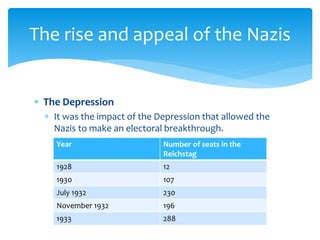
 The Depression
 It was the impact of the Depression that allowed the
Nazis to make an electoral breakthrough.
The rise and appeal of the Nazis
Year Number of seats in the
Reichstag
1928 12
1930 107
July 1932 230
November 1932 196
1933 288
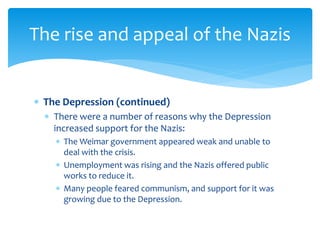
 The Depression (continued)
 There were a number of reasons why the Depression
increased support for the Nazis:
 The Weimar government appeared weak and unable to
deal with the crisis.
 Unemployment was rising and the Nazis offered public
works to reduce it.
 Many people feared communism, and support for it was
growing due to the Depression.
The rise and appeal of the Nazis
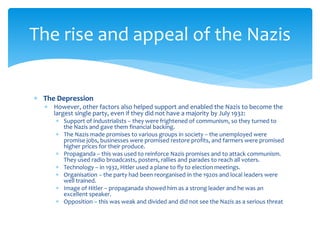
 The Depression
 However, other factors also helped support and enabled the Nazis to become the
largest single party, even if they did not have a majority by July 1932:
 Support of industrialists – they were frightened of communism, so they turned to
the Nazis and gave them financial backing.
 The Nazis made promises to various groups in society – the unemployed were
promise jobs, businesses were promised restore profits, and farmers were promised
higher prices for their produce.
 Propaganda – this was used to reinforce Nazis promises and to attack communism.
They used radio broadcasts, posters, rallies and parades to reach all voters.
 Technology – in 1932, Hitler used a plane to fly to election meetings.
 Organisation – the party had been reorganised in the 1920s and local leaders were
well trained.
 Image of Hitler – propaganada showed him as a strong leader and he was an
excellent speaker.
 Opposition – this was weak and divided and did not see the Nazis as a serious threat
The rise and appeal of the Nazis
 The Depression (continued)
 Not all who voted for the Nazis shared their views, but
they shared Nazi dears – this is known as negative
cohesion.
 However, the elections results for November 1932
suggest that support for the Nazis had peaked and was
starting to decline.
The rise and appeal of the Nazis
 With the Nazi vote falling the November 1932
election, it is perhaps surprising that Hitler was
appointed Chancellor in January 1933.
 There were a number of reasons for his appointment.
Hitler’s admission to power in
January 1933.
 The failure of von Papen
 Although the Nazis were the largest party in the Reichstag after the July
1932 election, it was Franz von Papen who was appointed chancellor.
 He wanted to create a more authoritarian state.
 He ended the ban on the SA, which led to an increase in street violence.
 Violence in Hamburg led to von Papen taking over the Prussian state
government, as it could no longer maintain order.
 This destroyed the idea of each state in Germany having power over
certain aspects of government, such as the police (known as federal
principle) and led to increased power being given to the national
government (known as the centralisation of the state).
Hitler’s admission to power in
January 1933.
 The failure of von Papen (continued)
 Hitler had demanded the right to form a government as
the largest party, but was offered the post of vice
chancellor, which he rejected.
 Von Papen did not have a majority, and with the support
of the president was determined to dissolve the
Reichstag and hold fresh elections.
 However, this failed, as the opposition passed a vote of
no confidence.
Hitler’s admission to power in
January 1933.
 The failure of von Papen (continued)
 New elections were held in November 1932, but the
Nazis lacked the funds for a dynamic campaign.
 Their involvement in a transport strike in Berlin
appeared to show that they were moving to the left and
this frightened many middle-class voters.
 As a result, they lost 2 million voters.
Hitler’s admission to power in
January 1933.
 The failure of von Schliecher
 With the army unwilling to support von Papen, the
government was dismissed and Kurt von Schliecher was
appointed chancellor on 2 December 1932.
 He approached some Nazis to join the government, but
Hitler blocked it.
 He also tried to get the support of the SPD and trade
unions through promising economic reforms.
 The worried industrialists, who now looked to a von
Papen-Hitler coalition.
Hitler’s admission to power in
January 1933.
 ‘Backstairs intrigue’
 This is the term used by the historian Alan Bullock to describe how Hitler
came to power.
 Having been removed from power, von Papen began talks with Hitler,
using intermediaries.
 With von Schliecher unable to gain a majority in the Reichstag, Hitler’s
position was strengthen.
 Hindenburg lost confidence in von Schliecher and instructed von Papen
to talk with Hitler.
 Hindenburg and his advisers believed that the Nazis were in decline and
therefore would be easier to control.
 Hindenburg withdrew support from von Schliecher, who resigned on 28
January 1933.
Hitler’s admission to power in
January 1933.
 ‘Backstairs intrigue’ (continued)
 Hitler demanded the position of chancellor and the
positions of minister of the interior and minister for
Prussia for other Nazis.
 Von Papen agreed, as nationalists would be in nine
other positions in the Cabinet.
 On 28 Jan, Hindenburg agreed.
 Hitler was appointed chancellor on 30 Jan 1933.
Hitler’s admission to power in
January 1933.
 Could Hitler’s appointment have been avoided?
 Some have argued that Hitler’s popularity depende don
unemployment and that once unemployment fell, so
would support for the Nazis.
 By December 1932:
 The Nazi Party was nearly bankrupt
 The economy was starting to recover.
 Unable to gain power, the Nazis’ promises could not be
fulfilled.
Hitler’s admission to power in
January 1933.
 Could Hitler’s appointment have been avoided?
(continued)
 However, Hitler’s appointment became more liely as
Hindenburg and von Papen had been unable to establish
an authoritarian government.
 In order to get into power, von Papen had no choice but
to forma coalition with Hitler.
 It appeared that with the Nazis having only three seats
in the Cabinet, their power would be limited and could
soon be dispensed with.
Hitler’s admission to power in
January 1933.

Germnay chap one

  • 1.
    Chapter 1: theestablishment and development of the Weimar Republic 1919 to January 1933
  • 2.
     The FirstWorld War, which began in 1914, had split Europe into tow armed camps, with Germany. Austria Hungary and Turkey (the Central Powers) fighting against Britain, France and Russia (the Allies).  Russia made peace with Germany in 1917, but the USA joined the Allies.  In order to try to defeat the Allies before large numbers of American troops arrived, Germany launched a massive attack against Allied forces in France in the spring of 1918.  At first this was very successful, but war-weariness and the strength of the Allies brought it to a halt.  On 29 September, the chief of staff, general Ludendorff, informed his superior, Field Marshal Paul Von Hindenburg and Chancellor Hertling that the ear was lost and that Germany should appeal to the USA for an armistice.  Ludendorff urged the creation of more democratic regime to show that Germany was serious about making peace. The consequences of the First World War
  • 3.
     Impact onthe German people  News of impending defeat in late October/early November 1918 caused a shock, despite the increasing food shortages caused by the naval blockade, as Germany had defeated Russia, and German troops were still in Northern France and Belgium.  During the war the army commanders had been telling he people that they were close to victory.  The navy disagreed with an armistice and ordered the fleet to seas, but this lead to a mutiny, which was followed by the establishment of soviets in many cities across Germany. The consequences of the First World War
  • 4.
     Political impact On 9 November the Kaiser abdicated.  Power went to the council of People’s Representatives, a temporary government under Friedrich Ebert, the leader of the largest political party, the SPD, until a national assembly could be elected.  It appeared as if Germany was on the verge of a revolution.  Ebert and the SPD did not want a revolution like in Russia because it would: 1. Lead to civil war 2. Disrupt demobilisation 3. Disrupt the distribution of food 4. Hinder peace negotiations  Ebert was able to prevent a revolution for the following reasons 1. He maintained the support of the army by not reforming it or creating a new force. 2. He kept the support of industrialists, who negotiated with trade unions the Central Working Association Agreement, which gave workers an eight-hour day and established workers’ councils large companies. 3. The working class was divided between the communists (KPD), who wanted a Soviet style of government and supported of the SPD, who wanted a parliamentary system. The consequences of the First World War
  • 5.
     Economic impact The war had a consider economic impact on Germany, with the following results when it ended in 1918:  Industrial production was only two-third that of 1913  National income was one0third that of 1913  There were 600,000 widows and two millions children without fathers, with the result that by 1925 the state was spending one-third of its budget on war pensions. The consequences of the First World War
  • 6.
     Social impact The war deepened divisions within German society, with huge gaps in the living standards between rich and poor.  This situation had been made worse by the restrictions placed on workers’ earnings during the war, while factor oweners had been able to make large profits.  During the war, many women had worked in factors and some believed that this had damaged family values. The consequences of the First World War
  • 7.
     The establishmentof a republic  Following the Kaiser’s abdication, Ebert signed an armistice and announced that the Republic would guarantee: 1. Freedom of speech 2. Freedom of worship 3. Better working conditions  A new constitution was drawn up, but the change in government from an autocratic system to a new democratic government created opposition and challenges.  This helped to create the ‘stab-in-the-back’ myth, which claimed that Germany had been betrayed by politicians such as Ebert and that it was this that prevented Germany from winning the war. The consequences of the First World War
  • 8.
     Given themilitary position of Germany at the end of the war, the government hoped that it would be able to negotiate a moderate peace so that it would be able to recover its strength.  Germany did not want tot pay reparations, apart from the cost of damage in Northern France and Belgium, but it was willing to give up Alsace-Lorraine and some land in Poland.  However, it expected Austria and other German speaking regions to be able to join Germany.  Germany expected to join the League of Nations and remain a great power. The impact of the Treaty o0f Versailles
  • 9.
     The ternsof the Treaty of Versailles  With the Treaty of Versailles, Germany lost 10% of its land, 12.5 % of its population, 16 % of its coal and 48 % of its iron industry; as well as all its colonies  It was also weakened militarily, and had to accept guilt for starting the war and pay reparations, effectively destroying its position as a great power. The impact of the Treaty o0f Versailles
  • 10.
     Land lost Upper Silesia, which contained coal and steel works  The Saar, which was placed under the control of the League of Nationa for 15 years  The Rhineland, which was to be occupied by Allied forced for 15 years.  Military reductions  The army was reduced to 100,000 men  The navy was reduced to 15,00 men  The General Staff was disbanded  Germany was not allowed, tanks, aircraft, submarines or poison gas  The number of ships was limited. The impact of the Treaty o0f Versailles
  • 11.
     Reparations  Atthe time of Versailles, it was not known how much damage had been caused, which led to the establishment of the Reparations Commission to investigate how much Germany could afford.  The Commission did not report until 1921.  The figure was finally fixed at £6,600 million, but some was to be paid in goods.  The ability of Germany to pay had caused debate: Germany claimed it could not afford to pay, while historians have argued that it could, and that the demands were less than the punishment it gave to Russia at the Treaty of Brest-Litovsk.  In order to justify punishing Germany, the ‘War Guilt’ clause (Clause 231), declared that Germany was guilty of starting the war. The impact of the Treaty o0f Versailles
  • 12.
     Was thetreaty harsh?  Germany had little choice but to sign the treaty, as the naval blockage was still in force and the Allies were in the Rhineland, ready to invade.  The seizure of industrial lands and the loss of colonies made it harder for Germany to pay the reparations.  Many Germans lived under the Allied occupations, while others were forced to live in other countries, such as Poland.  Most Germans disapproved of the treaty; the government lost support by signing it; and it created long-term bitterness.  However, the treaty was not as harsh as it appears.  German views that they had not lost the war meant that no matter what treaty had been signed, there would have been opposition.  The creation of new, smaller states in Central Europe also meant that Germany was still the strongest power there, and as Gustav Stresemann would show, it could soon recover. The impact of the Treaty o0f Versailles
  • 13.
     Many Germanpeople wanted the return of the Kaiser, and the new republic was unpopular from the very start, with its position further weakened by the signing of the Treaty of Versailles.  The period from 1919 to 1923 was one of continuous crisis and this further damaged the reputations of the Republic.  The economic and social legacy of the war only added to the problems of the Republic. The challenges to Weimar, 1919-23
  • 14.
     The WeimarConstitution  Some have argued that the constitution weakened the Republic as it created instability.  There were three key elements to the constitution:  The president was directly elected by universal franchise; he chose the chancellor and could declare a state of emergency.  The Reichsrat was the upper house, where individual states were represented.  The Reichstag was the lower house, elected by universal franchise and on the basis of proportional representation. This system allowed many small parties to gain representation and meant that governments were coalitions, which was subject to frequent change.  There were also many parties, such as the right-wing DNVP, that were opposed to the Weimar democracy. The challenges to Weimar, 1919-23
  • 15.
     The challengesfrom the left.  Many workers had hoped for the establishment of a series of soviets, factory councils and the nationalisation of industry, but these hopes did not materialise.  The decision to give power to parliament and the lack of reforms led to the resignation of the Independent Socialists from the People’s Representatives, and to the formation of the Communist Party (KPD).  The KPD attempted to size power, through the Spartacist Revolt, in Berlin in January 1919.  Karl Liebknecht and Rosa Luxemburg, two of its leaders were murdered and the revolt was put down by the Freikorps.  There were further challenges from the left and soviets were set up in Munich and Bremen.  However, these were also crushed.  An uprising also broke out in the Ruhr in March 1920 and the KPD soon controlled much of the region,  This was crushed by the Friekorps. The challenges to Weimar, 1919-23
  • 16.
     The challengesfrom the right  Many extreme parties emerged on the right, most notable the German Workers’ Party, whose meetings Hitler attended.  The major challenge in Weimar came from the Kapp Putch in March 1920, led by Wolfgang Kapp, the founder of the German fatherland Party, following government attempts to disband the Freikorps.  It was defeated by trade unions calling a general strike, which paralysed public services. The challenges to Weimar, 1919-23
  • 17.
     The crisisof 1923  The occupation of the Ruhr  In January 1923, Germany fell behind in its reparation payments and France and Belgium occupied the Ruhr.  This united Germany; reparations payments were halted and workers in the Ruhr went on strike.  This put pressure on the economy and added to inflation, made worse by the government printing money to pay the strike.  The French brought in their own workers and this increased tensions further. The challenges to Weimar, 1919-23
  • 18.
     The crisesof 1923 (continued)  Hyperinflation  The war had caused inflation in Germany but by printing more money to pay the strikers and compensate for lost tax revenues, the value of the mark fell so that it was worthless.  This destroyed savings and ruined those on fixed incomes.  Prices rose so fast that the black market and barter flourished.  Some, such as industrialists, did gain from this situation. The challenges to Weimar, 1919-23
  • 19.
     The crisesof 1923 (continued)  Munich Putsch  Bavaria was governed by a conservative Catholic regime.  It wanted to untie the nationalist right, which included the Nazi party, to restore traditional values.  Despite some opposition, the plan was for a putsch in Munich and then a march on Berlin.  Hitler acted and seized the Bavarian state governor.  After initial success, it was defeated by police.  Sixteen Nazis and three police were killed; Hitler was arrested, put on train and sentenced to imprisonment for five years, but was released after just nine months (showing sympathy towards Nazi idealogies). The challenges to Weimar, 1919-23
  • 20.
     Why didthe Weimar survive?  There were other political murders during this period:  Karls Gareis, leader of the USPD  Matthias Erzberger  Walter Rathenau, the foreign minister.  Yet the Republic survived for a number of reasons:  The government took effective action  Many in Germany were willing to give Weimar a chance  Political opposition was weaker than it appeared. The challenges to Weimar, 1919-23
  • 21.
     The appointmentof Gustav Stresemann and the establishment of a ‘Great Coalition’ in September 1923 are often seen as the beginning of a period of recovery for the Republic.  Passive resistance in the Ruhr was ended and a new currency, the Rentenmark, was introduced. Stresemann and the Golden Years
  • 22.
     Economic recovery Industrial production gradually recovered, so that by 1927 it had returned to pre- First World War levels.  The recovery was helped by loans of 800 million marks from America with the Dawes Plan, which also rescheduled reparation payments.  Stabilising the economy resulted in the cost of exports rising; therefore, industrialists looked to cut their costs, often by making workers redundant.  Germany also became heavily dependent on loans, which, if withdrawn, would have a serious impact.  Agriculture did not fully recover and was then hit by a depression in 1927 due to global overproduction.  Farmers complained that food was imported so that in return Germany could export industrial goods.  This created resentment in the countryside. Stresemann and the Golden Years
  • 23.
     Political stability Coalitions continued to be unstable as the largest parties, the SPD and liberal, disagreed over economic and social policies.  Parties that supported democracy did well in these years, so that by 1928 they had 136 more seats than radical parties, with the Nazis winning less than 3 % of the vote.  However, support for the liberal parties did decline and special-interest parties gained support.  In 1925 Hindenburg was elected president.  His support for the Republic was lukewarm; he wanted to exclude the SPD from government and bring in the right-wing DNVP. Stresemann and the Golden Years
  • 24.
     Social improvements During the Stresemann years there were numerous social improvements:  Wages for workers rose  An eight-hour day was introduced  The standard of living rose  Welfare benefits and pensions increased.  However, there were still problems:  Farmworkers’ earnings were only half the national average by 1929.  There were still extremes of wealth and poverty  There were wage disputes and strikes.  There was concern about the cost of the welfare system and the level of taxation. Stresemann and the Golden Years
  • 25.
     Foreign policysuccess?  It appeared that Stresemann was able to achieve a number of foreign policy successes, which revised the Treaty of Versailles in Germany’s favour. However, many of the agreements angered the nationalists, who did not want to negotiate with their former enemies:  The Locarno Treaties of 1925 guaranteed Germany’s frontiers with France and Belgium, but not Germany’s frontiers in the east.  In 1926, Germany joined the League of Nations.  In January 1927, the Allied Disarmament Commission withdrew from Germany.  In August 1927, Allied troops were withdrawn from garrisons in the Rhineland.  The Young Plan, which reduced reparations, was signed in 1929, and Britain and France agreed to evacuate the Rhineland by the end of June 1930. Stresemann and the Golden Years
  • 26.
     The flourishingof culture  Architecture flourished, seen in the works of the Bauhaus group, Painters, such as Otto Dix, formed the New Objectivity Movement.  The film industry grew, producing controversial films, such as ‘All Quiet on the Western Front’, which angered nationalists.  Jazz was popular in the nightclubs and bars in many cities. Stresemann and the Golden Years
  • 27.
     Success?  Despitethe achievements:  The Republic did not win loyalty from either the left or the right.  Many were scandalised by the culture, particularly the cabaret clubs, which mocked the values of the ‘old Germany’ with jazz and often nudity.  The economy was burdened by the war, the cost of welfare and reparations.  Governments were short-lived, as a result of unstable coalitions.  However, there were signs of recovery and stability in many cities. Stresemann and the Golden Years
  • 28.
     In October1929, the US stock market collapsed.  The Wall Street Crash led to a world economic crisis. The impact of the Great Depression
  • 29.
     Economic impact The Great Depression had a particularly severe impact on Germany because of American loans and investment.  The collapse of the American economy and resulted in US firms and banks recalling loans.  The problems began in the autumn of 1928, but by spring 1929, unemployment in Germany had climbed to 2.5 million.  The Wall Street Crash only added to the problem:  Unemployment continued to rise.  Demand for German goods collapsed.  Loans on which Germany relied were recalled  Production was cut back, creating more unemployment. The impact of the Great Depression
  • 30.
     Economic impact(continued)  By 1932, nearly one-third of workers were registered unemployed, while others were working shorter hours or had taken pay cuts.  This led to increased poverty and people were unable to pay rents and mortgages.  Government income fell, so the government struggled to pay benefits, as the system was designed to cope with only 800,000 unemployed. The impact of the Great Depression
  • 31.
     Political impact Many young unemployed joined paramilitary groups, such as the Nazi SA or the Communist Rotfront.  This gave them a sense of belonging and something to do.  The Depression weakened the Great Coalition.  Divisions over the unemployment insurance system created a crisis.  The SPD did not want cuts, while the German People’s Party (DVP) argued for cuts.  Industrialists argued that the welfare stat should be abolished because of costs. The impact of the Great Depression
  • 32.
     Political impact(continued)  An attempt at compromise failed and the Cabinet resigned.  This weakened democracy.  Hindenburg used the opportunity to bring in the right- wing Heinrich Brüning, who supported Hindenburg’s policy of rearming Germany. The impact of the Great Depression
  • 33.
     Political impact(continued)  Brüning did not have a majority and stated that if he was declared he would ask for the Reichstag to be dissolved and rule by emergency decree.  This happening following attempts to increase taxes and cut welfare.  Historians have disagreed about his aims:  Some have argued that he was worried hyperinflation would return.  Some have argued that he wanted to provoke a crisis so reparations would be cancelled.  Elections took place in September 1930, which allowed the Nazi Party to make considers gains.  It appeared to offer simple solutions to Germany’s problems. The impact of the Great Depression
  • 34.
     Political impact(continued)  Although the Nazis made considerable gains in the election, it still left a divided Reichstag and problems continued in 1931 and 1932, giving the impression to many that democracy was unable to deal with the situation, while unemployment continued to rise.  Brüning had to rely increasingly on rule by emergency decree, which further weakened democracy.  As the government appeared unable to deal with the crisis, people turned more and more to extreme parties, not just the Nazis.  Support for communism also grew, and this worried industrialists and the middle class. The impact of the Great Depression
  • 35.
     The bankingcrisis of July 1931  The Austrian bank Kreditanstalt collapsed in July 1931.  Banks had only a small money in reserve, and with the collapse of Kreditanstalt, customers in other banks began to withdraw their money.  Banks were forced to close and the government was forced to support them.  This event led to France blocking plans for an emergency loan to Germany.  However, it was agreed that a one-year suspension of reparation payments should be allowed, and in 1932, a committee of international financial experts agreed that reparations inter-Allied debts should be cancelled.  However, in May 1932, Brüning was dismissed, leading to a period a further instability and a rapid change in chancellors. The impact of the Great Depression
  • 36.
     The NSDAP(National Socialist German Workers’ Party), or Nazis, had begun as the German Workers’ Party, under the leadership of Anton Drexler.  Hitler attended meetings and was soon placed in charge of propaganda and political ideas.  In 1920, it announced its 25-point programme and changed its name to the NSDAP.  In 1921, Hitler became leader The rise and appeal of the Nazis
  • 37.
     The MunichPutsch, 1923  Hitler’s attempt to seize power in Bavaria failed, but it had important consequences:  It led to a change in tactics, as Hitler declared to win power through the ballot box  It brought him national publicity.  Following the putsch, the light sentence of five years although he served only nine months, showed there was sympathy for his views. The rise and appeal of the Nazis
  • 38.
     The NaziParty, 1924-29  While he was in prison, Hitler wrote the book Mein Kampf, which set out his ideas for Germany.  During this time, the party collapsed and he had to rebuild it.  There was little support for the party, as Weimar appeared to be recovering.  Although the Nazis won 32 seats in elections in 1924, this decreased to 14 by the end of the the year and 12 in 1928.  Hitler also used the time to build support.  A network of local parties and the Hitler Youth and Students’ League were established.  In 1929, Goebbels was put in charge of propaganda. The rise and appeal of the Nazis
  • 39.
     The Depression It was the impact of the Depression that allowed the Nazis to make an electoral breakthrough. The rise and appeal of the Nazis Year Number of seats in the Reichstag 1928 12 1930 107 July 1932 230 November 1932 196 1933 288
  • 40.
     The Depression(continued)  There were a number of reasons why the Depression increased support for the Nazis:  The Weimar government appeared weak and unable to deal with the crisis.  Unemployment was rising and the Nazis offered public works to reduce it.  Many people feared communism, and support for it was growing due to the Depression. The rise and appeal of the Nazis
  • 41.
     The Depression However, other factors also helped support and enabled the Nazis to become the largest single party, even if they did not have a majority by July 1932:  Support of industrialists – they were frightened of communism, so they turned to the Nazis and gave them financial backing.  The Nazis made promises to various groups in society – the unemployed were promise jobs, businesses were promised restore profits, and farmers were promised higher prices for their produce.  Propaganda – this was used to reinforce Nazis promises and to attack communism. They used radio broadcasts, posters, rallies and parades to reach all voters.  Technology – in 1932, Hitler used a plane to fly to election meetings.  Organisation – the party had been reorganised in the 1920s and local leaders were well trained.  Image of Hitler – propaganada showed him as a strong leader and he was an excellent speaker.  Opposition – this was weak and divided and did not see the Nazis as a serious threat The rise and appeal of the Nazis
  • 42.
     The Depression(continued)  Not all who voted for the Nazis shared their views, but they shared Nazi dears – this is known as negative cohesion.  However, the elections results for November 1932 suggest that support for the Nazis had peaked and was starting to decline. The rise and appeal of the Nazis
  • 43.
     With theNazi vote falling the November 1932 election, it is perhaps surprising that Hitler was appointed Chancellor in January 1933.  There were a number of reasons for his appointment. Hitler’s admission to power in January 1933.
  • 44.
     The failureof von Papen  Although the Nazis were the largest party in the Reichstag after the July 1932 election, it was Franz von Papen who was appointed chancellor.  He wanted to create a more authoritarian state.  He ended the ban on the SA, which led to an increase in street violence.  Violence in Hamburg led to von Papen taking over the Prussian state government, as it could no longer maintain order.  This destroyed the idea of each state in Germany having power over certain aspects of government, such as the police (known as federal principle) and led to increased power being given to the national government (known as the centralisation of the state). Hitler’s admission to power in January 1933.
  • 45.
     The failureof von Papen (continued)  Hitler had demanded the right to form a government as the largest party, but was offered the post of vice chancellor, which he rejected.  Von Papen did not have a majority, and with the support of the president was determined to dissolve the Reichstag and hold fresh elections.  However, this failed, as the opposition passed a vote of no confidence. Hitler’s admission to power in January 1933.
  • 46.
     The failureof von Papen (continued)  New elections were held in November 1932, but the Nazis lacked the funds for a dynamic campaign.  Their involvement in a transport strike in Berlin appeared to show that they were moving to the left and this frightened many middle-class voters.  As a result, they lost 2 million voters. Hitler’s admission to power in January 1933.
  • 47.
     The failureof von Schliecher  With the army unwilling to support von Papen, the government was dismissed and Kurt von Schliecher was appointed chancellor on 2 December 1932.  He approached some Nazis to join the government, but Hitler blocked it.  He also tried to get the support of the SPD and trade unions through promising economic reforms.  The worried industrialists, who now looked to a von Papen-Hitler coalition. Hitler’s admission to power in January 1933.
  • 48.
     ‘Backstairs intrigue’ This is the term used by the historian Alan Bullock to describe how Hitler came to power.  Having been removed from power, von Papen began talks with Hitler, using intermediaries.  With von Schliecher unable to gain a majority in the Reichstag, Hitler’s position was strengthen.  Hindenburg lost confidence in von Schliecher and instructed von Papen to talk with Hitler.  Hindenburg and his advisers believed that the Nazis were in decline and therefore would be easier to control.  Hindenburg withdrew support from von Schliecher, who resigned on 28 January 1933. Hitler’s admission to power in January 1933.
  • 49.
     ‘Backstairs intrigue’(continued)  Hitler demanded the position of chancellor and the positions of minister of the interior and minister for Prussia for other Nazis.  Von Papen agreed, as nationalists would be in nine other positions in the Cabinet.  On 28 Jan, Hindenburg agreed.  Hitler was appointed chancellor on 30 Jan 1933. Hitler’s admission to power in January 1933.
  • 50.
     Could Hitler’sappointment have been avoided?  Some have argued that Hitler’s popularity depende don unemployment and that once unemployment fell, so would support for the Nazis.  By December 1932:  The Nazi Party was nearly bankrupt  The economy was starting to recover.  Unable to gain power, the Nazis’ promises could not be fulfilled. Hitler’s admission to power in January 1933.
  • 51.
     Could Hitler’sappointment have been avoided? (continued)  However, Hitler’s appointment became more liely as Hindenburg and von Papen had been unable to establish an authoritarian government.  In order to get into power, von Papen had no choice but to forma coalition with Hitler.  It appeared that with the Nazis having only three seats in the Cabinet, their power would be limited and could soon be dispensed with. Hitler’s admission to power in January 1933.