GEOMETRY JOURNALCHAPTER 1
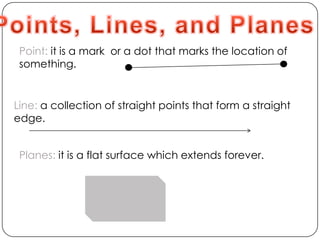
Points, Lines, and PlanesPoint: it is a mark  or a dot that marks the location of something.Line: a collection of straight points that form a straight edge.Planes: it is a flat surface which extends forever.
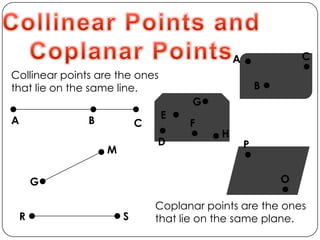
Collinear Points andCoplanar PointsCACollinear points are the ones that lie on the same line. BGEABCFHDPMOGCoplanar points are the ones that lie on the same plane.RS
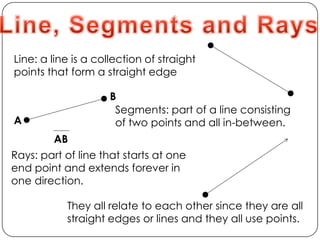
Line, Segments and RaysLine: a line is a collection of straight points that form a straight edgeBSegments: part of a line consisting of two points and all in-between.AABRays: part of line that starts at one end point and extends forever in one direction. They all relate to each other since they are all straight edges or linesand they all use points.
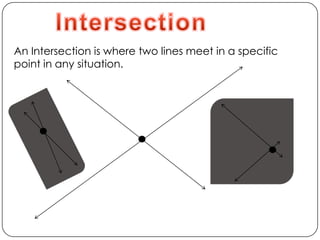
IntersectionAn Intersection is where two lines meet in a specific pointin any situation.
Postulate, Axiom,and TheoremPostulate and Axiom are the same thing. They are terms that are accepted without proofs. While a Theorem has to be accepted only if there if proof and it has already been proven.
Ruler PostulateTo measure a segment you need to use a ruler and subtract the values at the end points. The hallway is 60 meters and a student runs from 25 meter up to the end, how many meters did he run?               35metersIf my garden if 148 meter long, and my cousin started rolling from 40 meters and he reaches the wall, how many meters has he rolled?108metersRodrigo’s desk is 4 meters and he makes a car travel from one end to the other, how many meters has he traveled?4meters
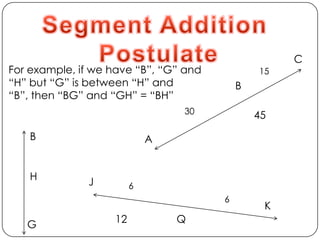
Segment Addition PostulateC For example, if we have “B”, “G” and “H” but “G” is between “H” and “B”, then “BG” and “GH” = “BH”15B 3045BA HJ66K Q 12G
Distance Between Two Points on a CoordinatePlaneIf you want to find the distance between two points on a coordinate plane you just need to take “X”1 and “X”2 and square them. Do the same for “Y”1 and “Y”2. After that you add those two and square the final answer.
Congruence and EqualityCongruence is two things with the same measure, but might not know the value. It is similar to equality since they are both two things that are equal. They are different because you can see if both shapes are congruent but if you don’t have a value you cannot see if they are equal, so with congruence you just need a measure but with equality you need a value.
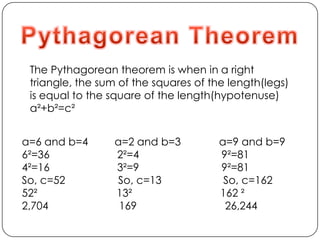
Pythagorean TheoremThe Pythagorean theorem is when in a right triangle, the sum of the squares of the length(legs) is equal to the square of the length(hypotenuse)a²+b²=c²a=6 and b=4         a=2 and b=3             a=9 and b=96²=36                       2²=4                            9²=814²=16                       3²=9                            9²=81So, c=52                  So, c=13                     So, c=16252²                           13²                              162 ²2,704                        169                              26,244
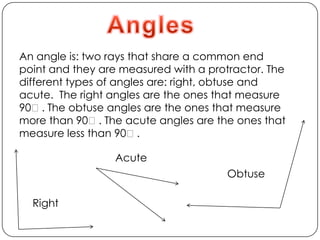
AnglesAn angle is: two rays that share a common end point and they are measured with a protractor. The different types of angles are: right, obtuse and acute.  The right angles are the ones that measure 90ᵒ. The obtuse angles are the ones that measure more than 90ᵒ. The acute angles are the ones that measure less than 90ᵒ.AcuteObtuseRight
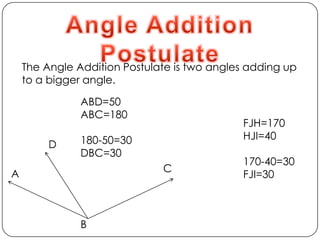
Angle Addition PostulateThe Angle Addition Postulate is two angles adding up to a bigger angle.ABD=50ABC=180180-50=30DBC=30FJH=170HJI=40170-40=30FJI=30DCAB
MidpointA midpoint is the exact middle of a segment. It is like if it is cut in the perfect half. To find the midpoint you need to get a little passed the middle, with your compass you draw a line from one side, and then do the same for the other. When done, you need to draw a line between the two lines you drew which formed an “X” and there you have your midpoint!
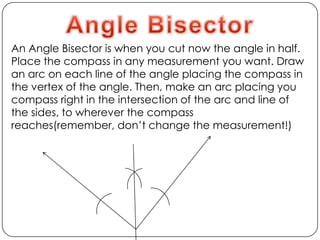
Angle BisectorAn Angle Bisector is when you cut now the angle in half. Place the compass in any measurement you want. Draw an arc on each line of the angle placing the compass in the vertex of the angle. Then, make an arc placing you compass right in the intersection of the arc and line of the sides, to wherever the compass reaches(remember, don’t change the measurement!)
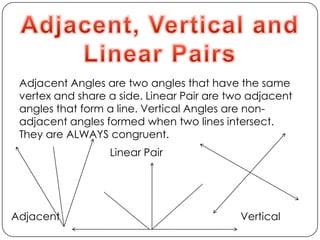
Adjacent, Vertical and Linear PairsAdjacent Angles are two angles that have the same vertex and share a side. Linear Pair are two adjacent angles that form a line. Vertical Angles are non-adjacent angles formed when two lines intersect. They are ALWAYS congruent.Linear PairAdjacentVertical
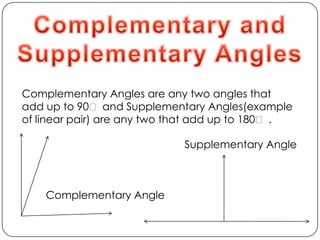
Complementary and Supplementary AnglesComplementary Angles are any two angles that add up to 90ᵒ and Supplementary Angles(example of linear pair) are any two that add up to 180ᵒ .Supplementary AngleComplementary Angle
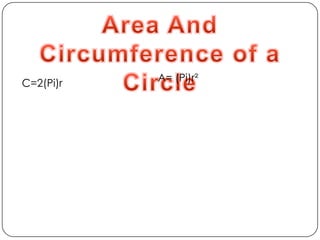
Area And Circumference of a CircleA= (Pi)r²C=2(Pi)r
Five Step ProcessFirst you need to read the problem patiently, don’t give up on the first time you read it. Read it a couple of times if needed. Then, jot down the key words that we learned in the beginning of the year and other words that are important.Write a problem with all those key words, translations and etc.Then solve the problem and check your answer to see if it is correct.Last but not least, answer the question  in a complete sentence or with the units.

Geometry

  • 1.
  • 2.
    Points, Lines, andPlanesPoint: it is a mark or a dot that marks the location of something.Line: a collection of straight points that form a straight edge.Planes: it is a flat surface which extends forever.
  • 3.
    Collinear Points andCoplanarPointsCACollinear points are the ones that lie on the same line. BGEABCFHDPMOGCoplanar points are the ones that lie on the same plane.RS
  • 4.
    Line, Segments andRaysLine: a line is a collection of straight points that form a straight edgeBSegments: part of a line consisting of two points and all in-between.AABRays: part of line that starts at one end point and extends forever in one direction. They all relate to each other since they are all straight edges or linesand they all use points.
  • 5.
    IntersectionAn Intersection iswhere two lines meet in a specific pointin any situation.
  • 6.
    Postulate, Axiom,and TheoremPostulateand Axiom are the same thing. They are terms that are accepted without proofs. While a Theorem has to be accepted only if there if proof and it has already been proven.
  • 7.
    Ruler PostulateTo measurea segment you need to use a ruler and subtract the values at the end points. The hallway is 60 meters and a student runs from 25 meter up to the end, how many meters did he run? 35metersIf my garden if 148 meter long, and my cousin started rolling from 40 meters and he reaches the wall, how many meters has he rolled?108metersRodrigo’s desk is 4 meters and he makes a car travel from one end to the other, how many meters has he traveled?4meters
  • 8.
    Segment Addition PostulateCFor example, if we have “B”, “G” and “H” but “G” is between “H” and “B”, then “BG” and “GH” = “BH”15B 3045BA HJ66K Q 12G
  • 9.
    Distance Between TwoPoints on a CoordinatePlaneIf you want to find the distance between two points on a coordinate plane you just need to take “X”1 and “X”2 and square them. Do the same for “Y”1 and “Y”2. After that you add those two and square the final answer.
  • 10.
    Congruence and EqualityCongruenceis two things with the same measure, but might not know the value. It is similar to equality since they are both two things that are equal. They are different because you can see if both shapes are congruent but if you don’t have a value you cannot see if they are equal, so with congruence you just need a measure but with equality you need a value.
  • 11.
    Pythagorean TheoremThe Pythagoreantheorem is when in a right triangle, the sum of the squares of the length(legs) is equal to the square of the length(hypotenuse)a²+b²=c²a=6 and b=4 a=2 and b=3 a=9 and b=96²=36 2²=4 9²=814²=16 3²=9 9²=81So, c=52 So, c=13 So, c=16252² 13² 162 ²2,704 169 26,244
  • 12.
    AnglesAn angle is:two rays that share a common end point and they are measured with a protractor. The different types of angles are: right, obtuse and acute. The right angles are the ones that measure 90ᵒ. The obtuse angles are the ones that measure more than 90ᵒ. The acute angles are the ones that measure less than 90ᵒ.AcuteObtuseRight
  • 13.
    Angle Addition PostulateTheAngle Addition Postulate is two angles adding up to a bigger angle.ABD=50ABC=180180-50=30DBC=30FJH=170HJI=40170-40=30FJI=30DCAB
  • 14.
    MidpointA midpoint isthe exact middle of a segment. It is like if it is cut in the perfect half. To find the midpoint you need to get a little passed the middle, with your compass you draw a line from one side, and then do the same for the other. When done, you need to draw a line between the two lines you drew which formed an “X” and there you have your midpoint!
  • 15.
    Angle BisectorAn AngleBisector is when you cut now the angle in half. Place the compass in any measurement you want. Draw an arc on each line of the angle placing the compass in the vertex of the angle. Then, make an arc placing you compass right in the intersection of the arc and line of the sides, to wherever the compass reaches(remember, don’t change the measurement!)
  • 16.
    Adjacent, Vertical andLinear PairsAdjacent Angles are two angles that have the same vertex and share a side. Linear Pair are two adjacent angles that form a line. Vertical Angles are non-adjacent angles formed when two lines intersect. They are ALWAYS congruent.Linear PairAdjacentVertical
  • 17.
    Complementary and SupplementaryAnglesComplementary Angles are any two angles that add up to 90ᵒ and Supplementary Angles(example of linear pair) are any two that add up to 180ᵒ .Supplementary AngleComplementary Angle
  • 18.
    Area And Circumferenceof a CircleA= (Pi)r²C=2(Pi)r
  • 19.
    Five Step ProcessFirstyou need to read the problem patiently, don’t give up on the first time you read it. Read it a couple of times if needed. Then, jot down the key words that we learned in the beginning of the year and other words that are important.Write a problem with all those key words, translations and etc.Then solve the problem and check your answer to see if it is correct.Last but not least, answer the question in a complete sentence or with the units.