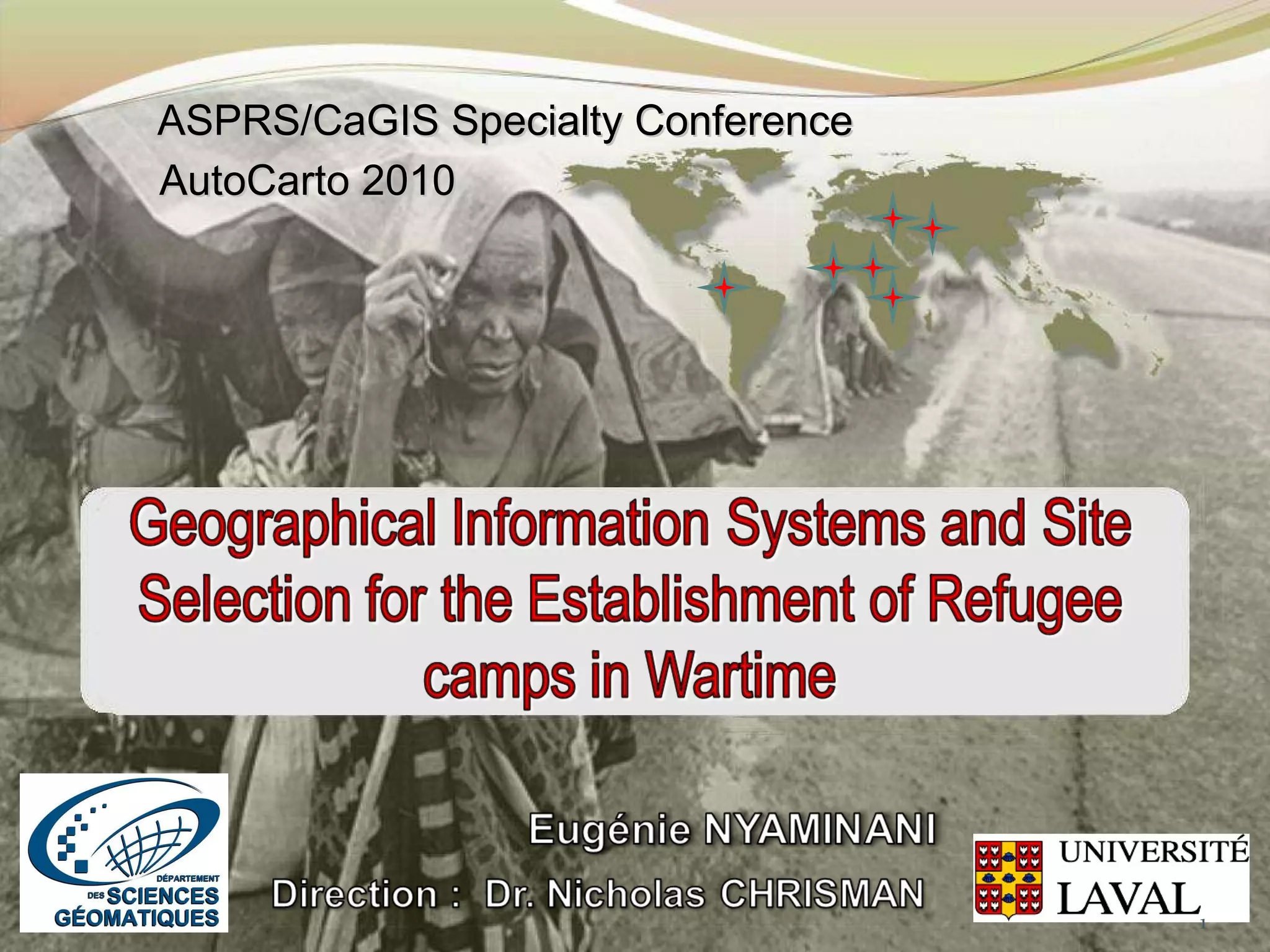
ASPRS/CaGIS Specialty Conference  AutoCarto 2010
Humanitarian Geomatics The application of GI Science to complex humanitarian emergencies More specifically: The role of GIS in the site selection process for the establishment of refugee camps.  Why ?  Despite  a remarkable expansion  an expressed interest by humanitarian workers GIS technology has been advanced as a tool for management of refugee camps it is not widely applied for camp siting.
Goals of this research  Main Goal Describe the reasons for non-use of GIS in the site selection process. Secondary Goals Evaluate the needs of humanitarian workers in site selection Evaluate the methods used Evaluate the spatial character of the needs of the humanitarian workers and the possibilities offered by GIS.
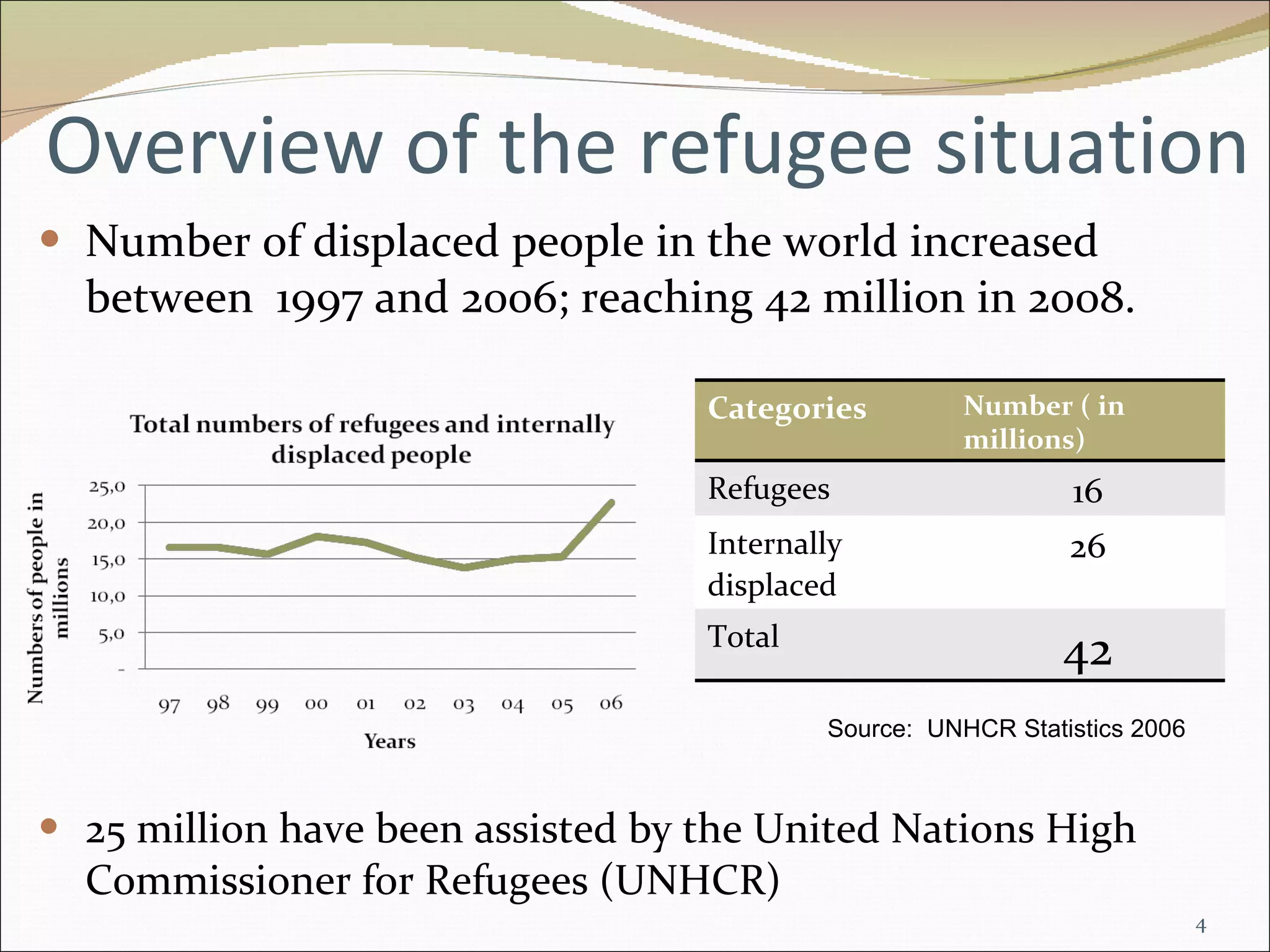
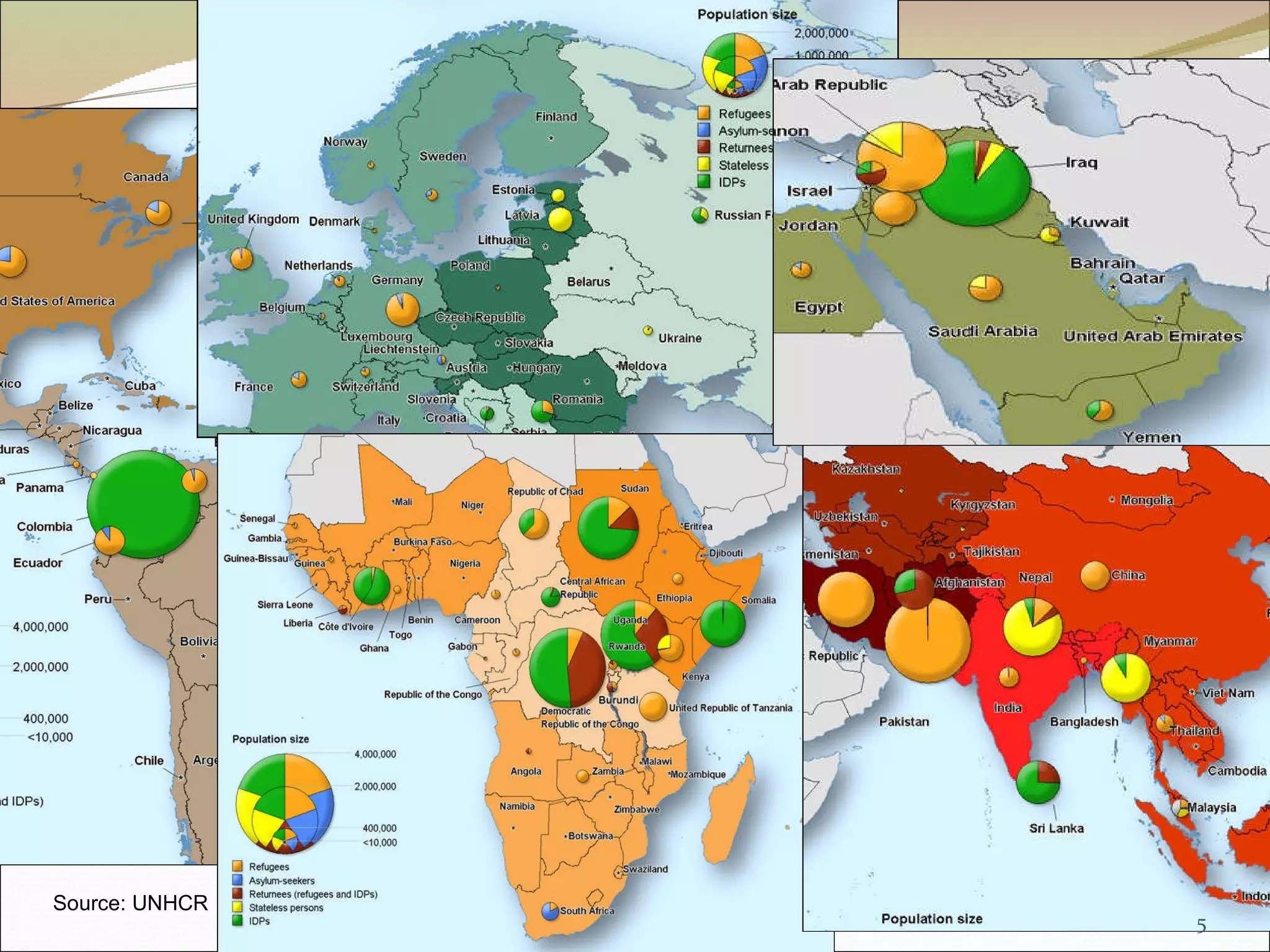
Overview of the refugee situation Number of displaced people in the world increased between  1997 and 2006; reaching 42 million in 2008. 25 million have been assisted by the United Nations High Commissioner for Refugees (UNHCR)   Source:  UNHCR Statistics 2006 Categories Number ( in millions) Refugees  16 Internally displaced   26 Total 42
Source: UNHCR
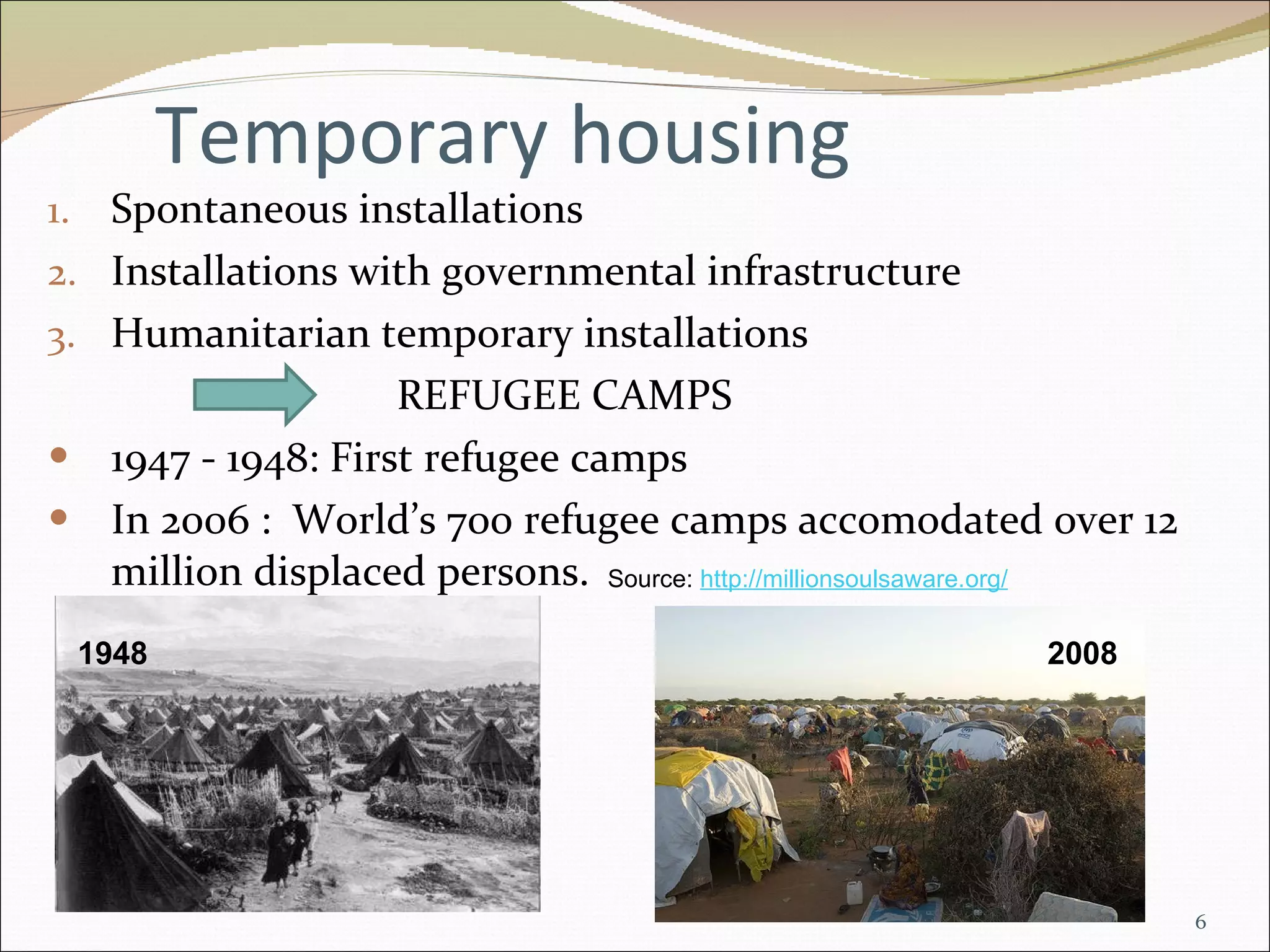
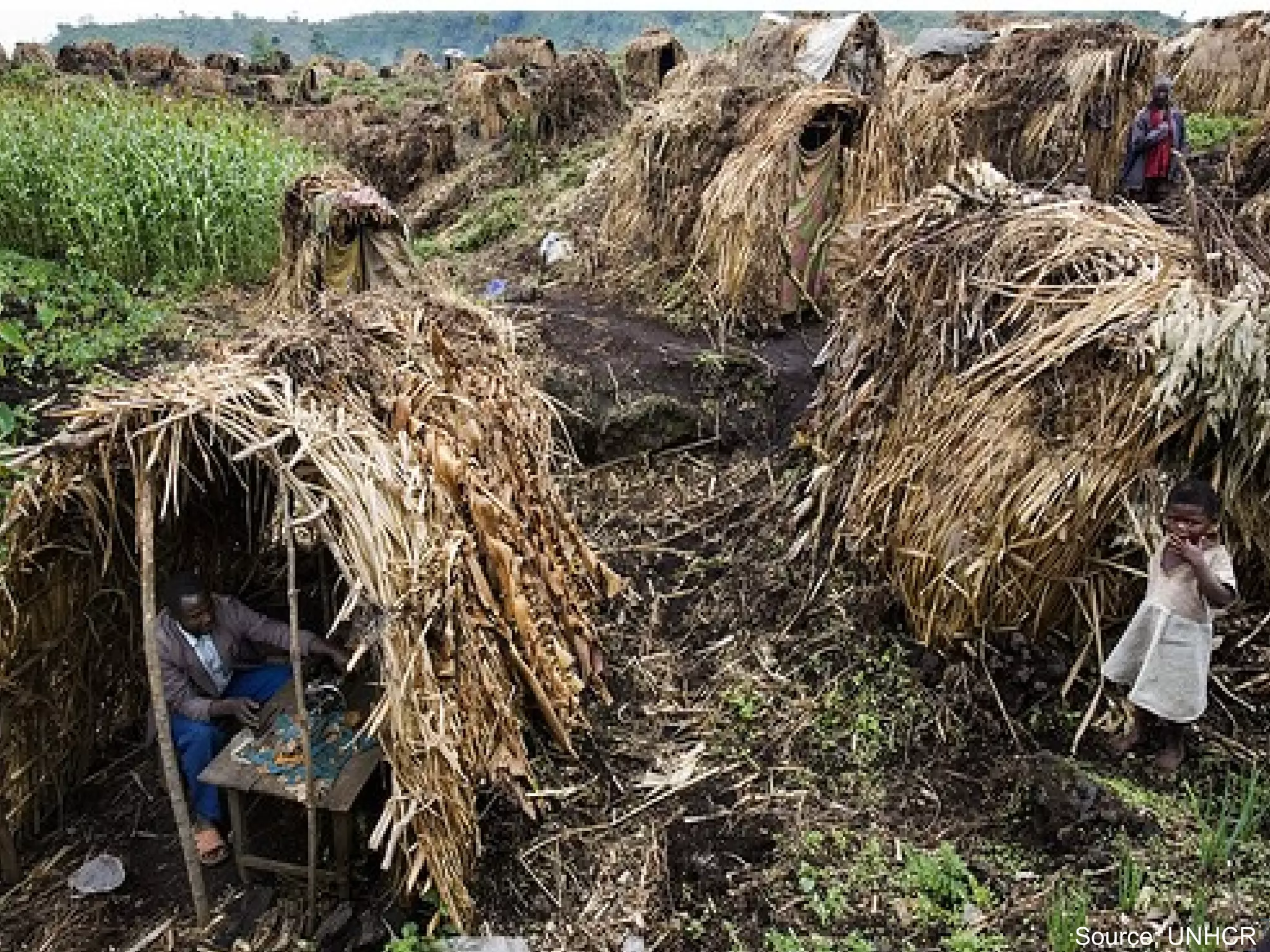
Temporary housing Spontaneous installations Installations with governmental infrastructure Humanitarian temporary installations REFUGEE CAMPS  1947 - 1948: First refugee camps In 2006 :  World’s 700 refugee camps accomodated over 12 million displaced persons.  Source:  http://millionsoulsaware.org / 1948 2008
Source: UNHCR
Source: UNRWA
Source: UNHCR
Source: UNHCR
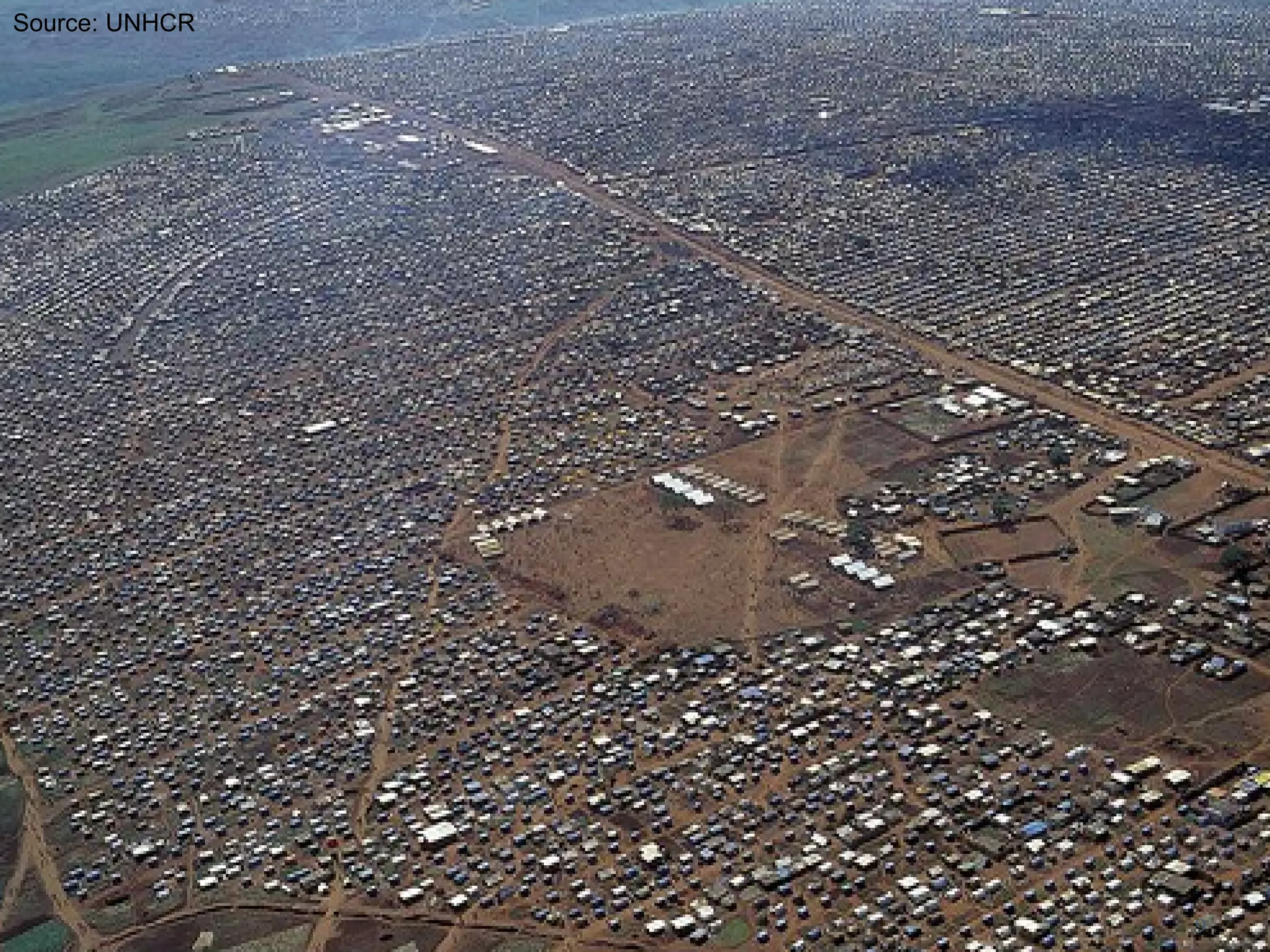
Site selection Important  to locate an optimal site Ensure camp’s viability with respect to logistics of aid delivery (food and water) and camp management Ensure camp safety Environmental  protection Site selection process:  Processing of spatial data Making a choice among alternatives based on defined criteria
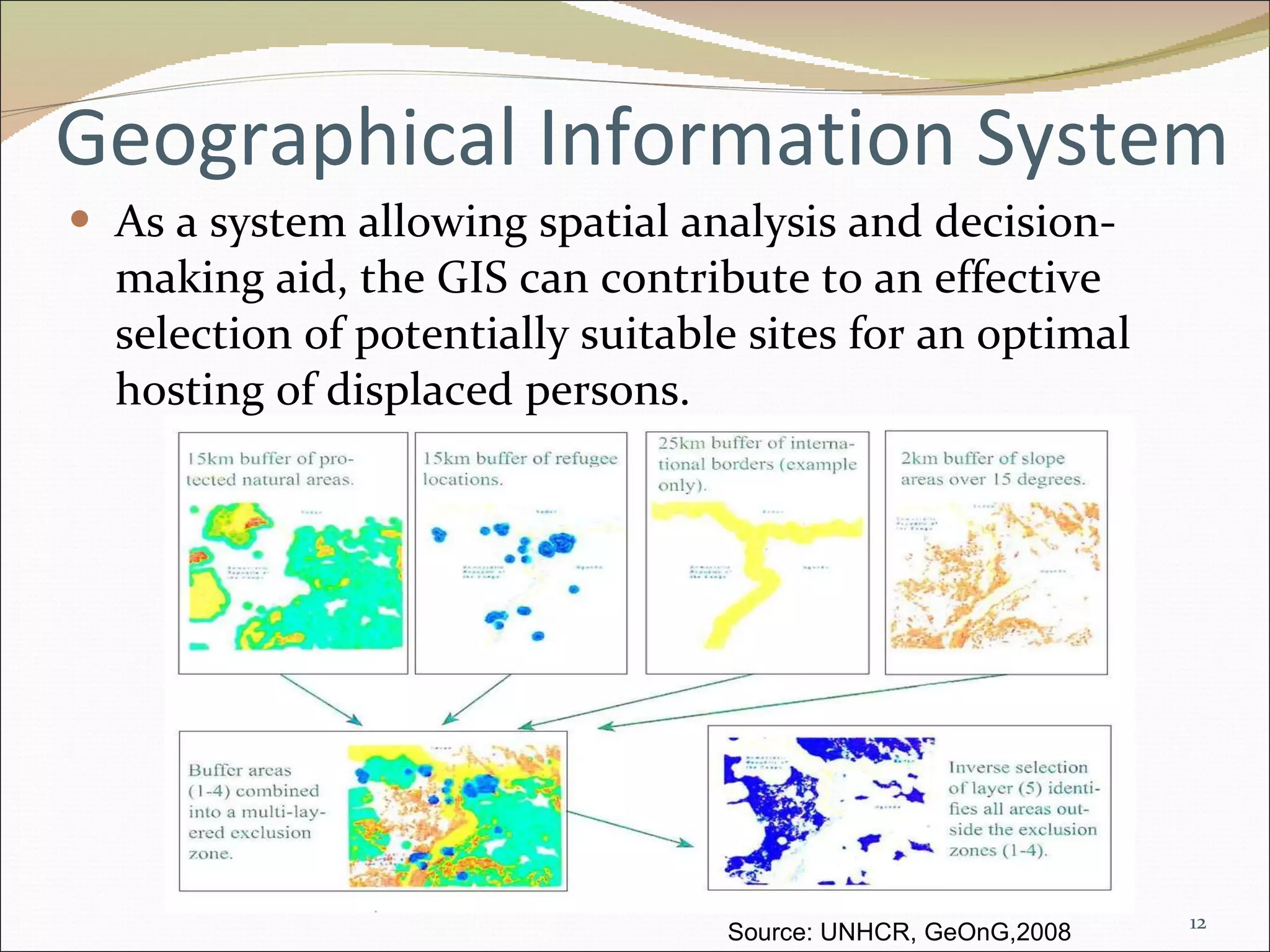
Geographical Information System As a system allowing spatial analysis and decision-making aid, the GIS can contribute to an effective selection of potentially suitable sites for an optimal hosting of displaced persons. Source: UNHCR, GeOnG,2008
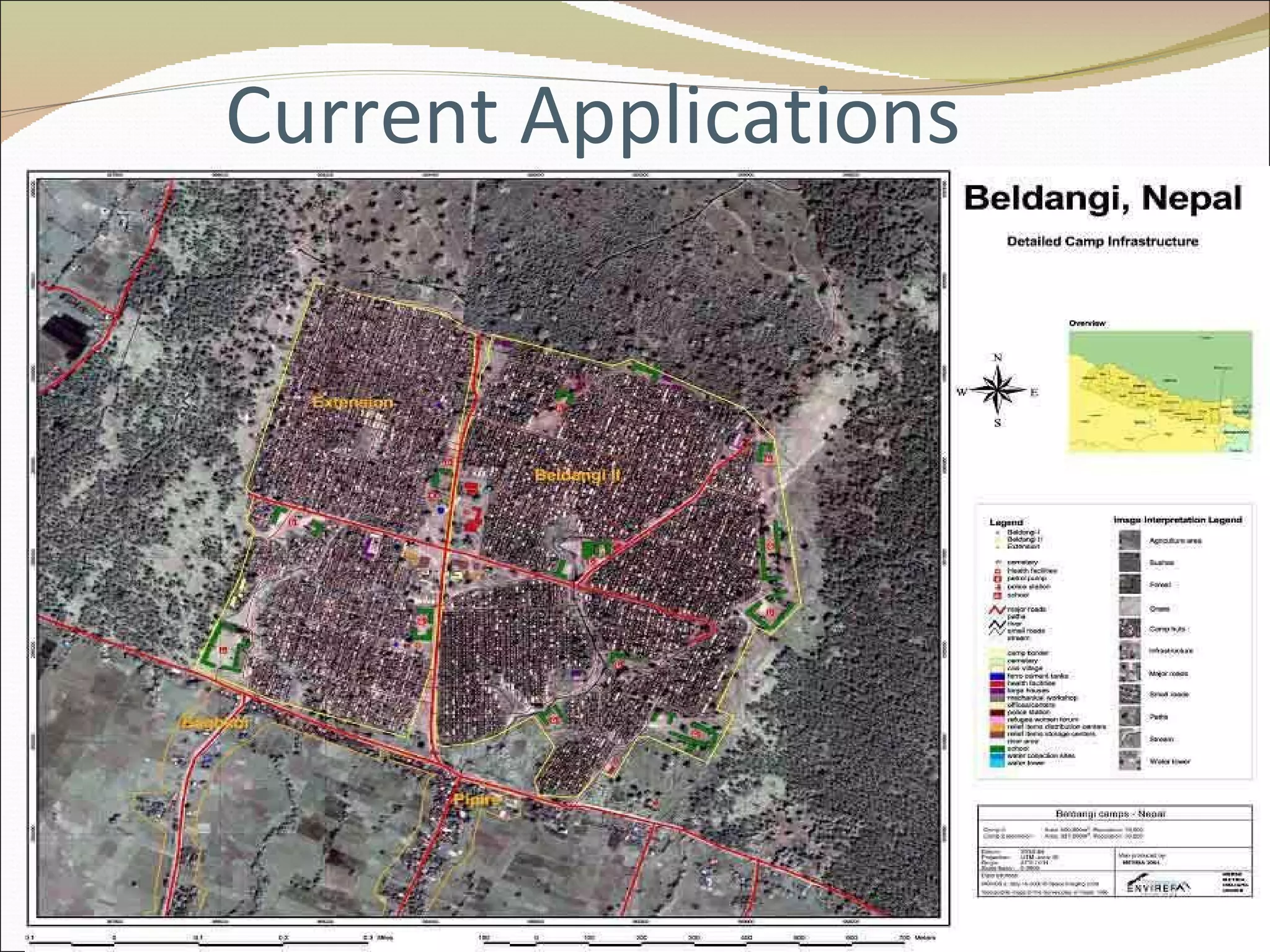
Current Applications
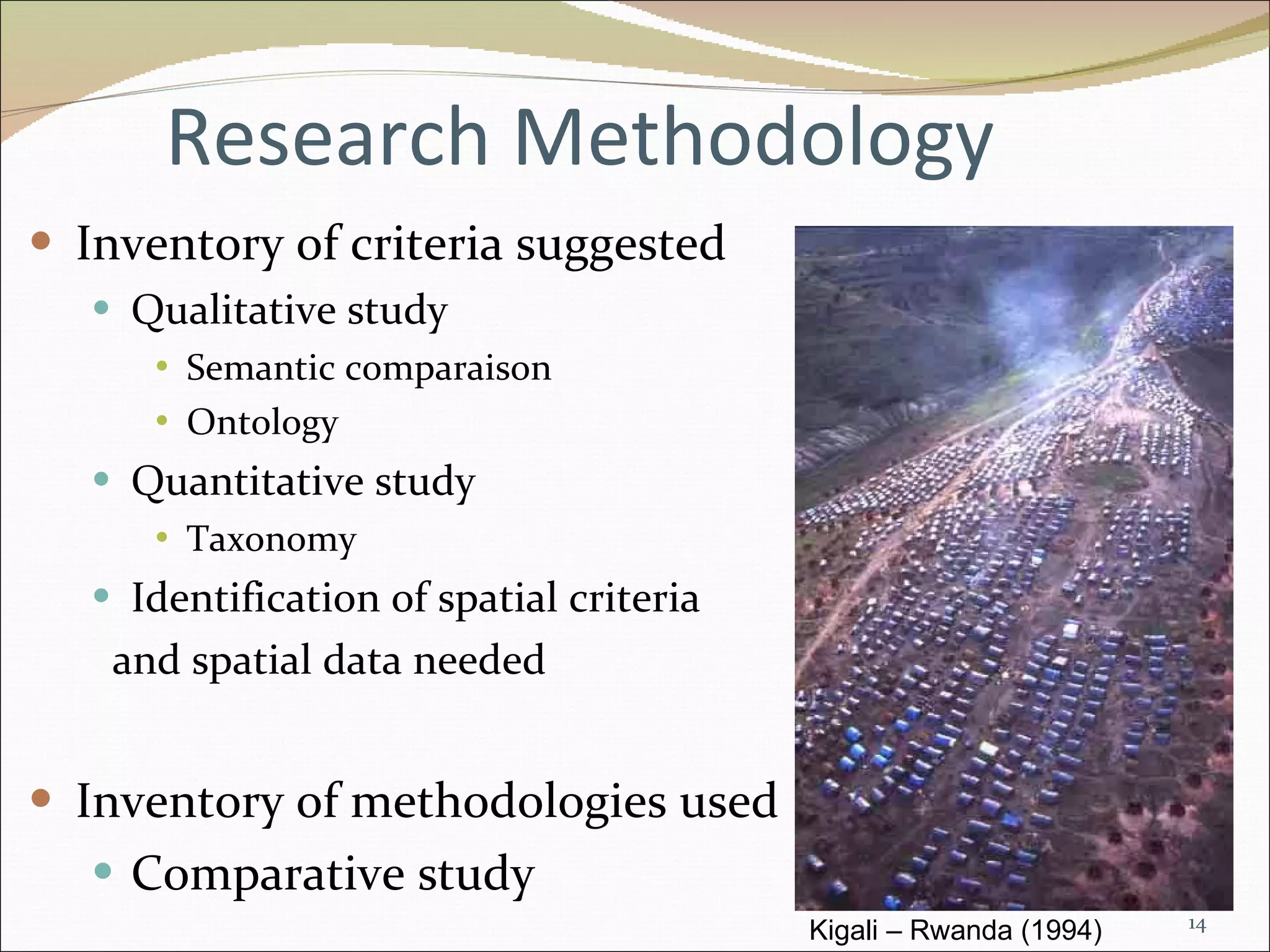
Inventory of criteria suggested Qualitative study  Semantic comparaison Ontology Quantitative study  Taxonomy Identification of spatial criteria and spatial data needed Inventory of methodologies used Comparative study Research Methodology Kigali – Rwanda (1994)
Sources
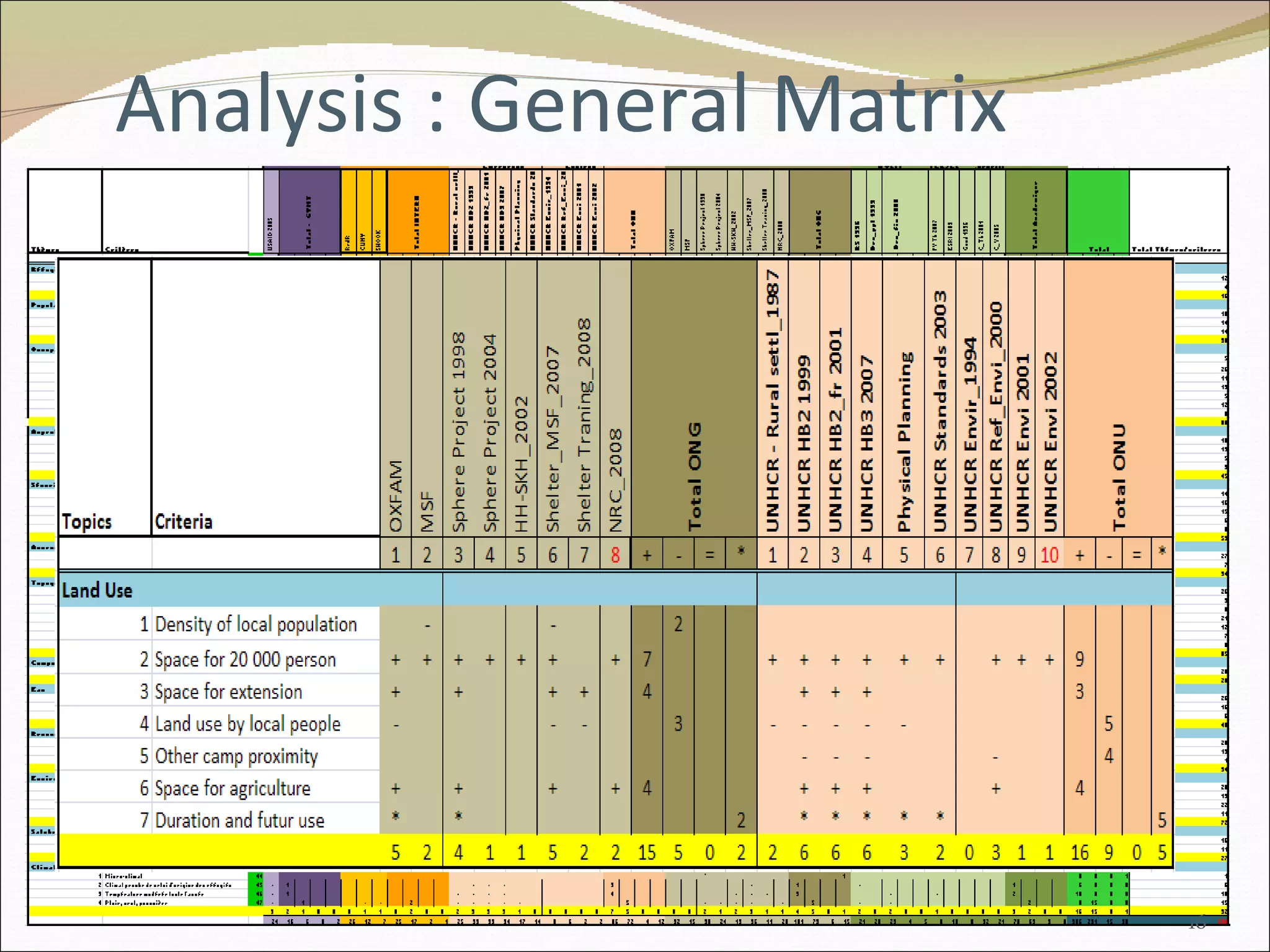
Analysis : General   Matrix
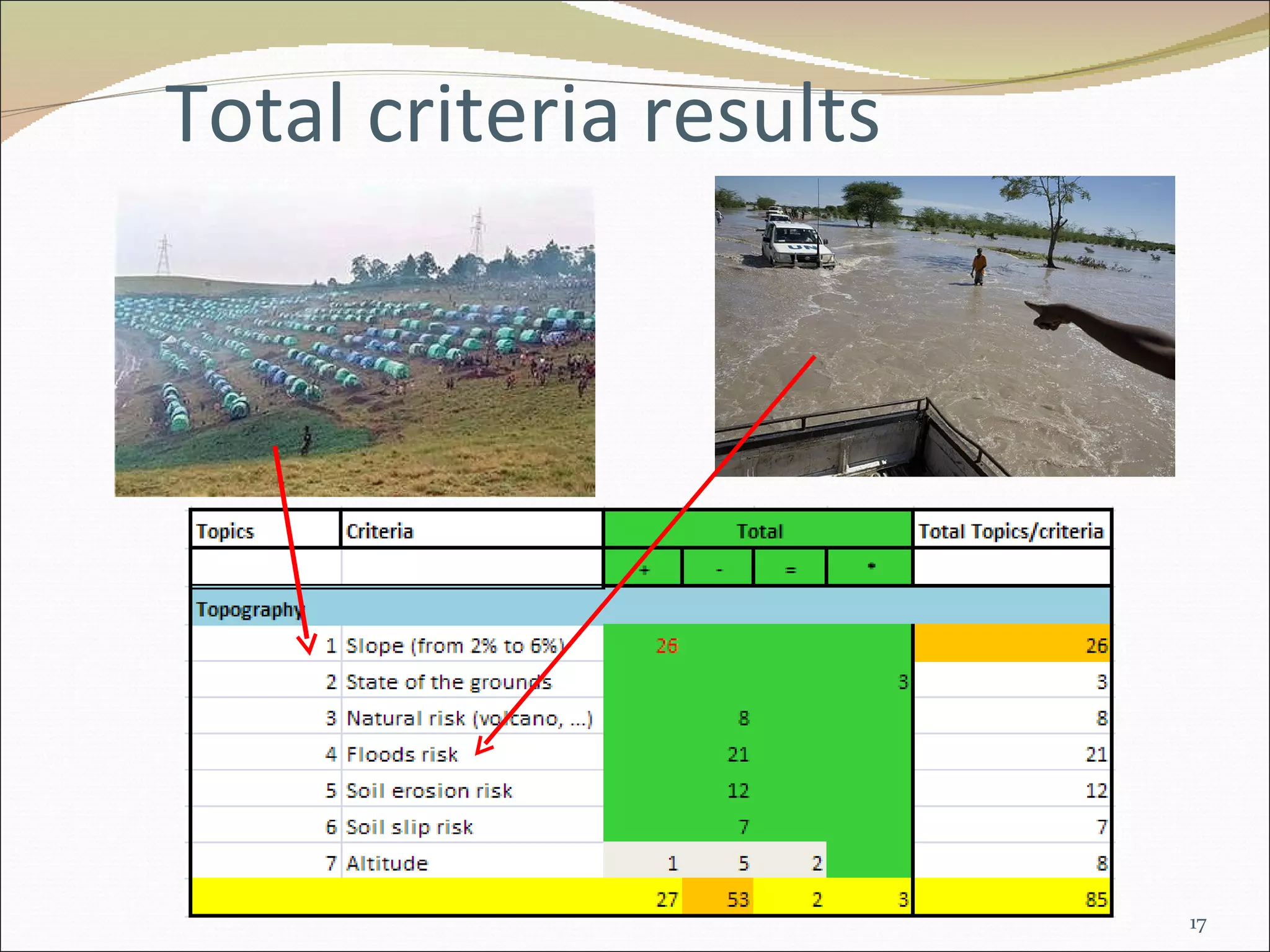
Total criteria results
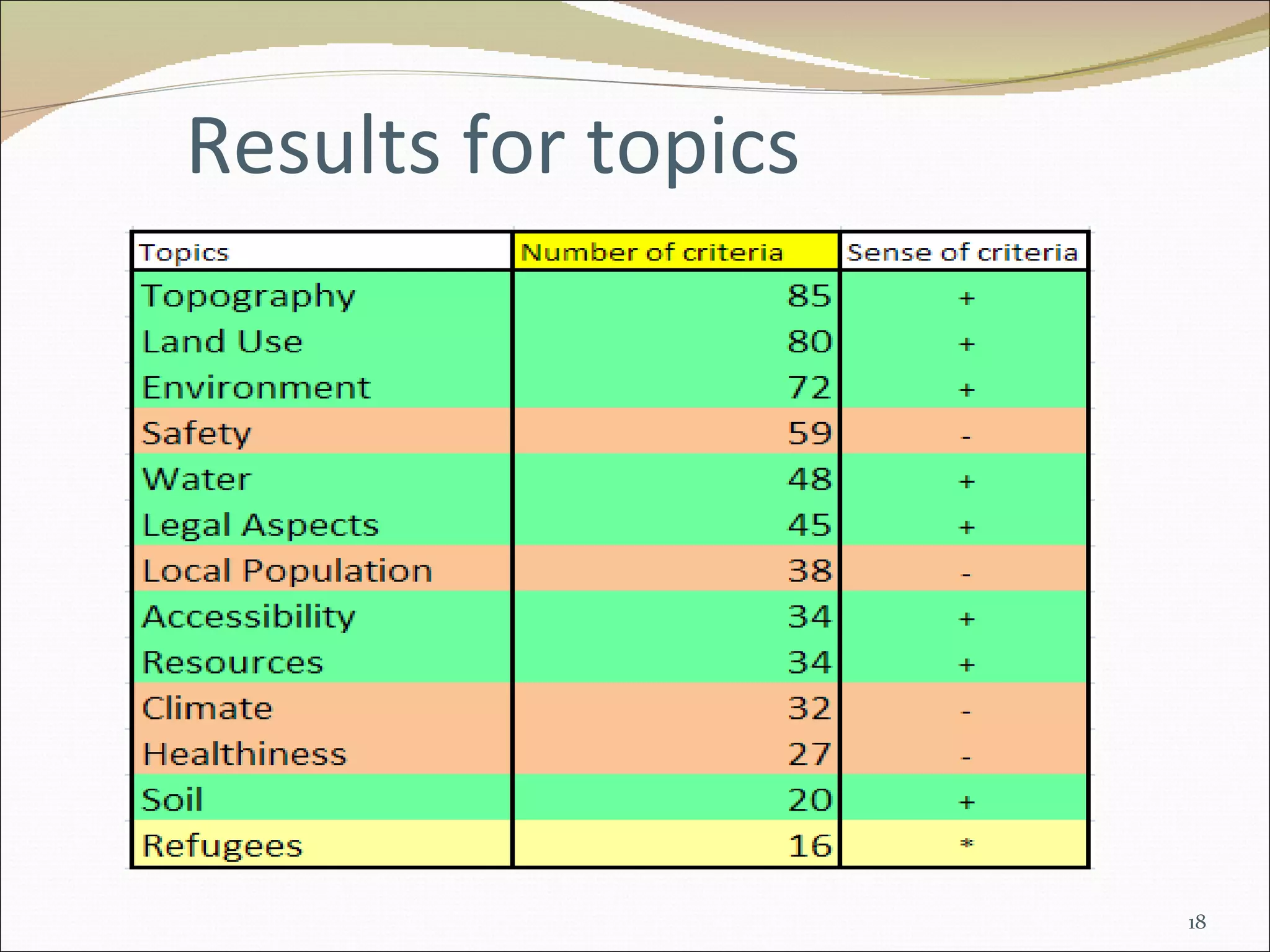
Results for topics
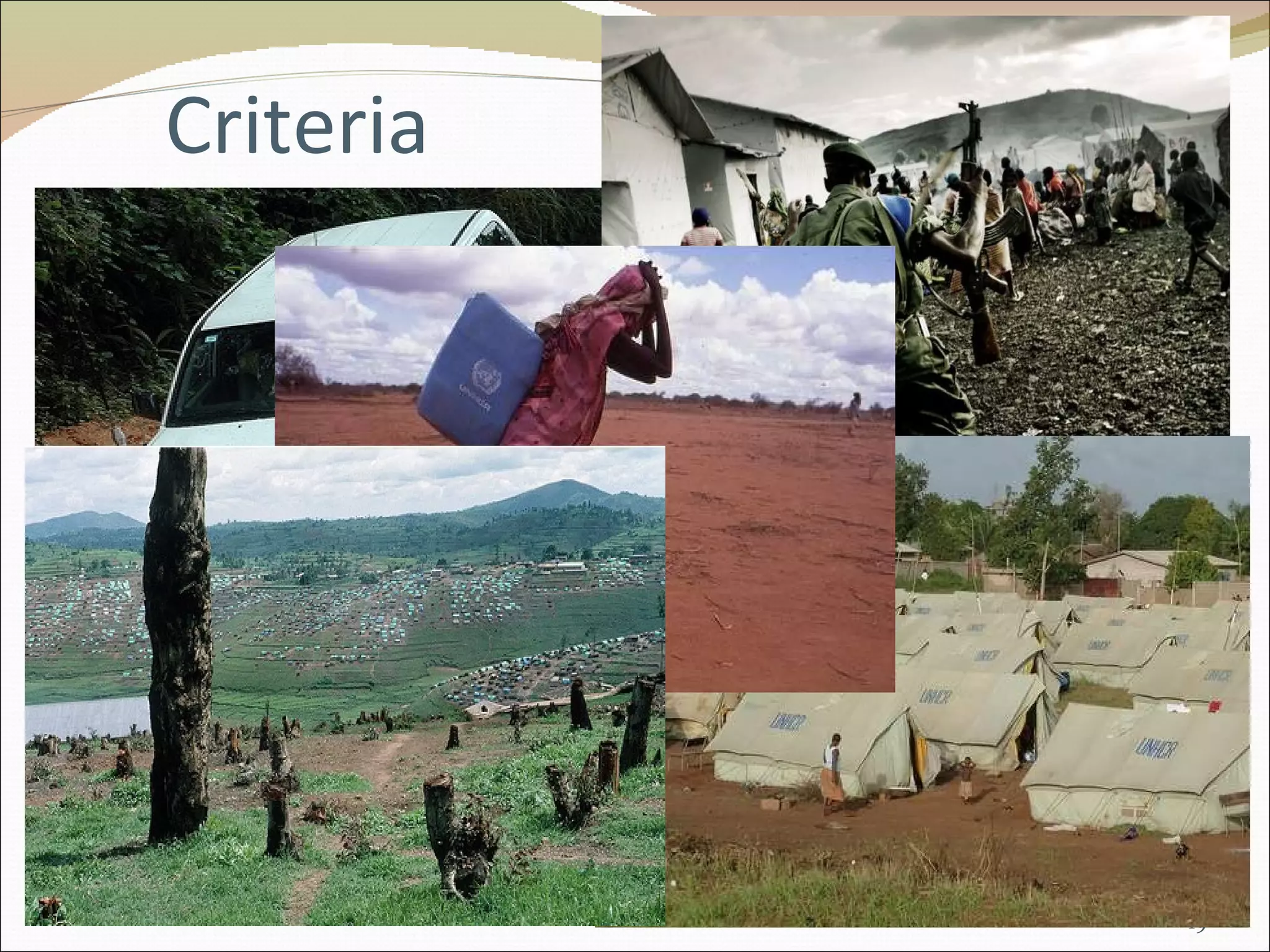
Criteria
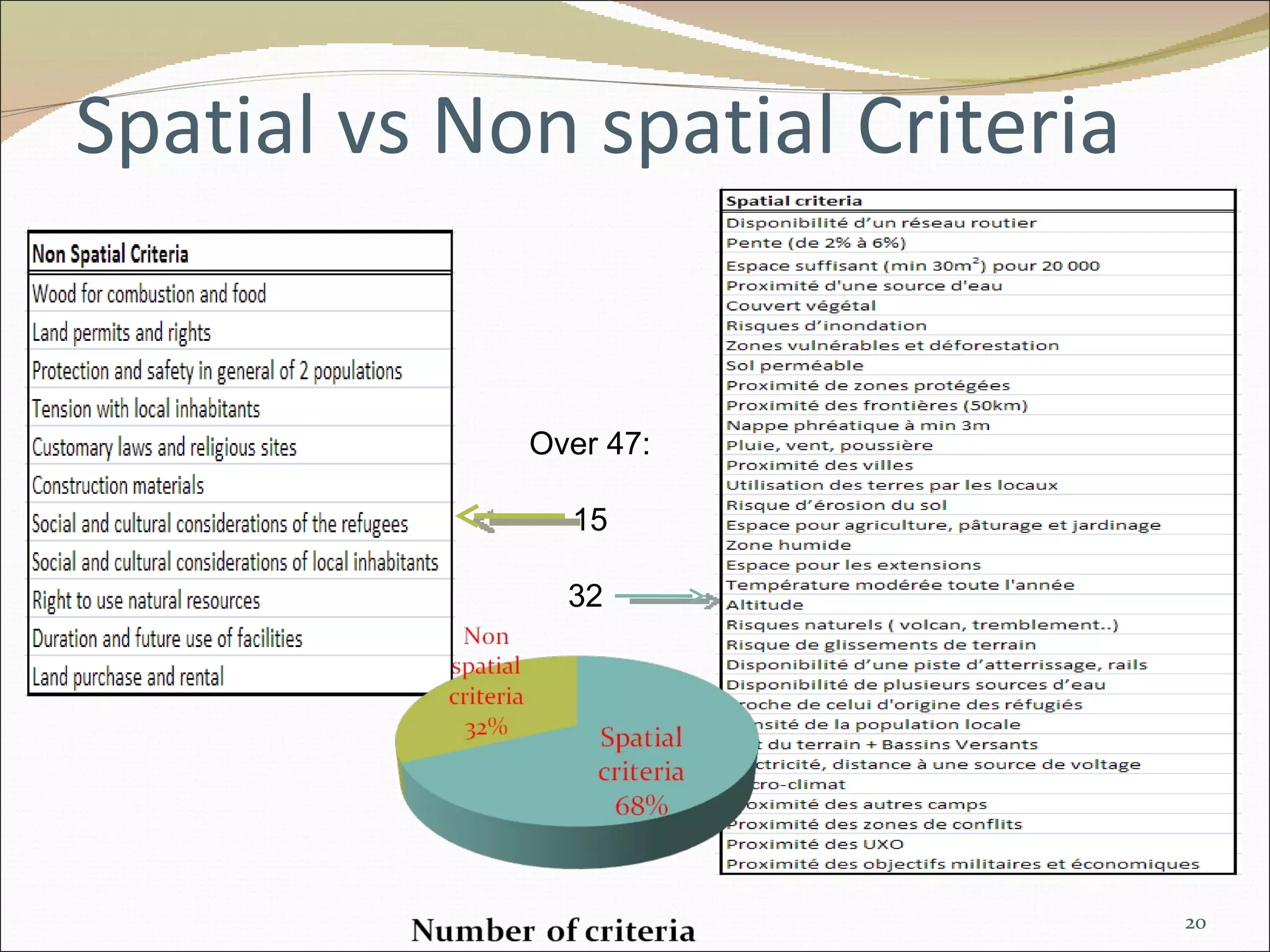
Spatial vs Non spatial Criteria Over 47: 15 32
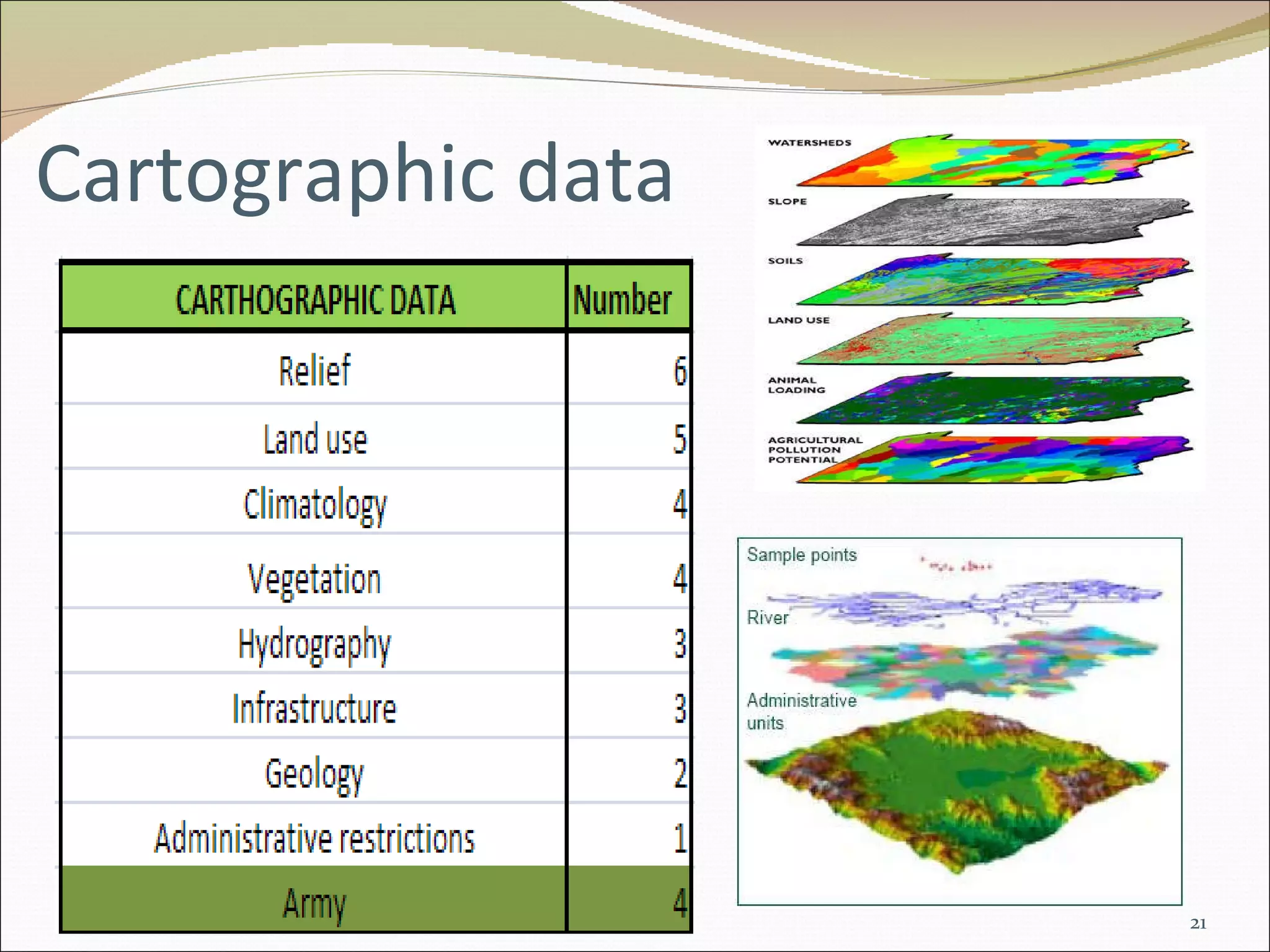
Cartographic data
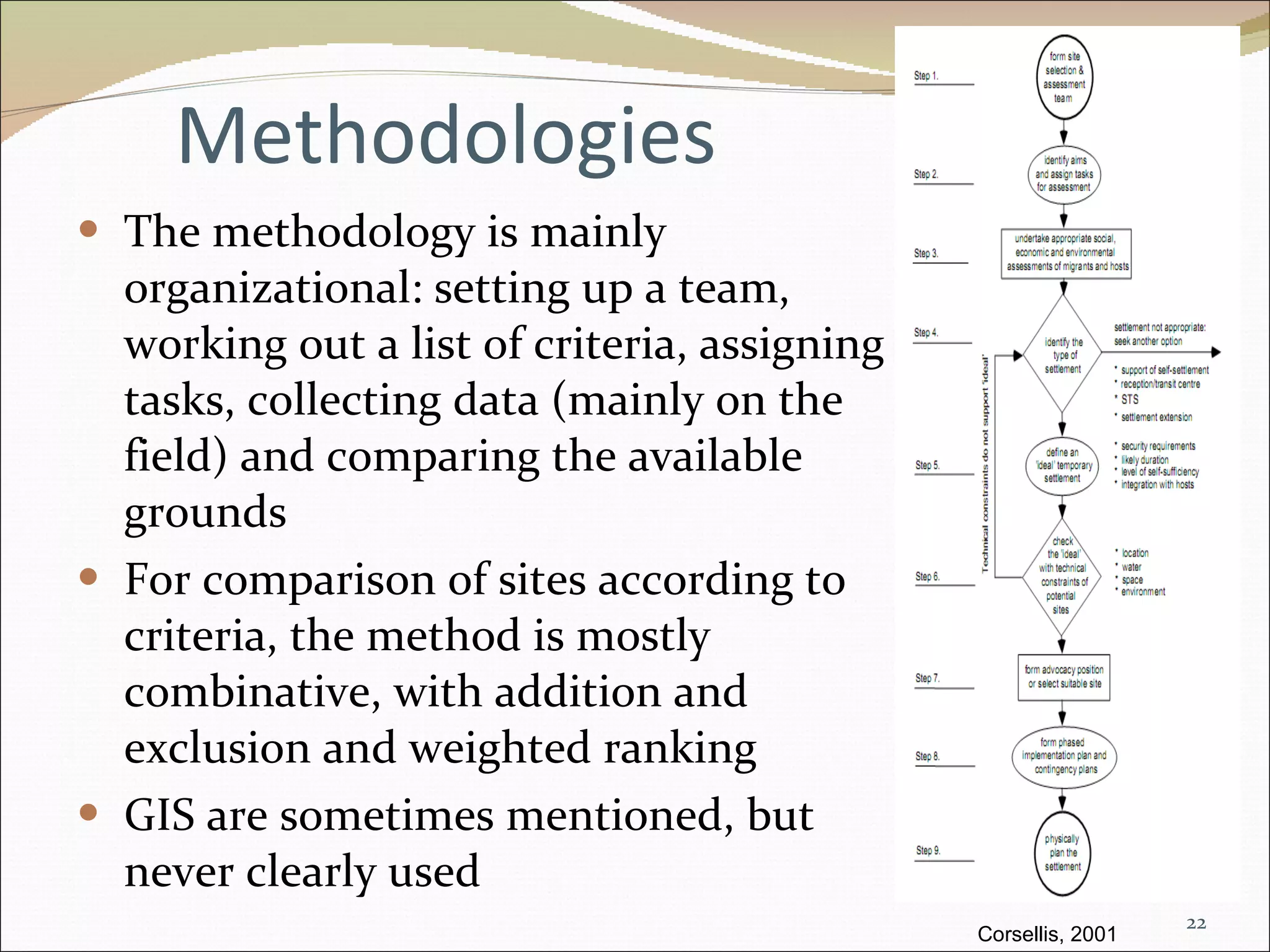
Methodologies The methodology is mainly organizational: setting up a team, working out a list of criteria, assigning tasks, collecting data (mainly on the field) and comparing the available grounds For comparison of sites according to criteria, the method is mostly combinative, with addition and exclusion and weighted ranking GIS are sometimes mentioned, but never clearly used Corsellis, 2001
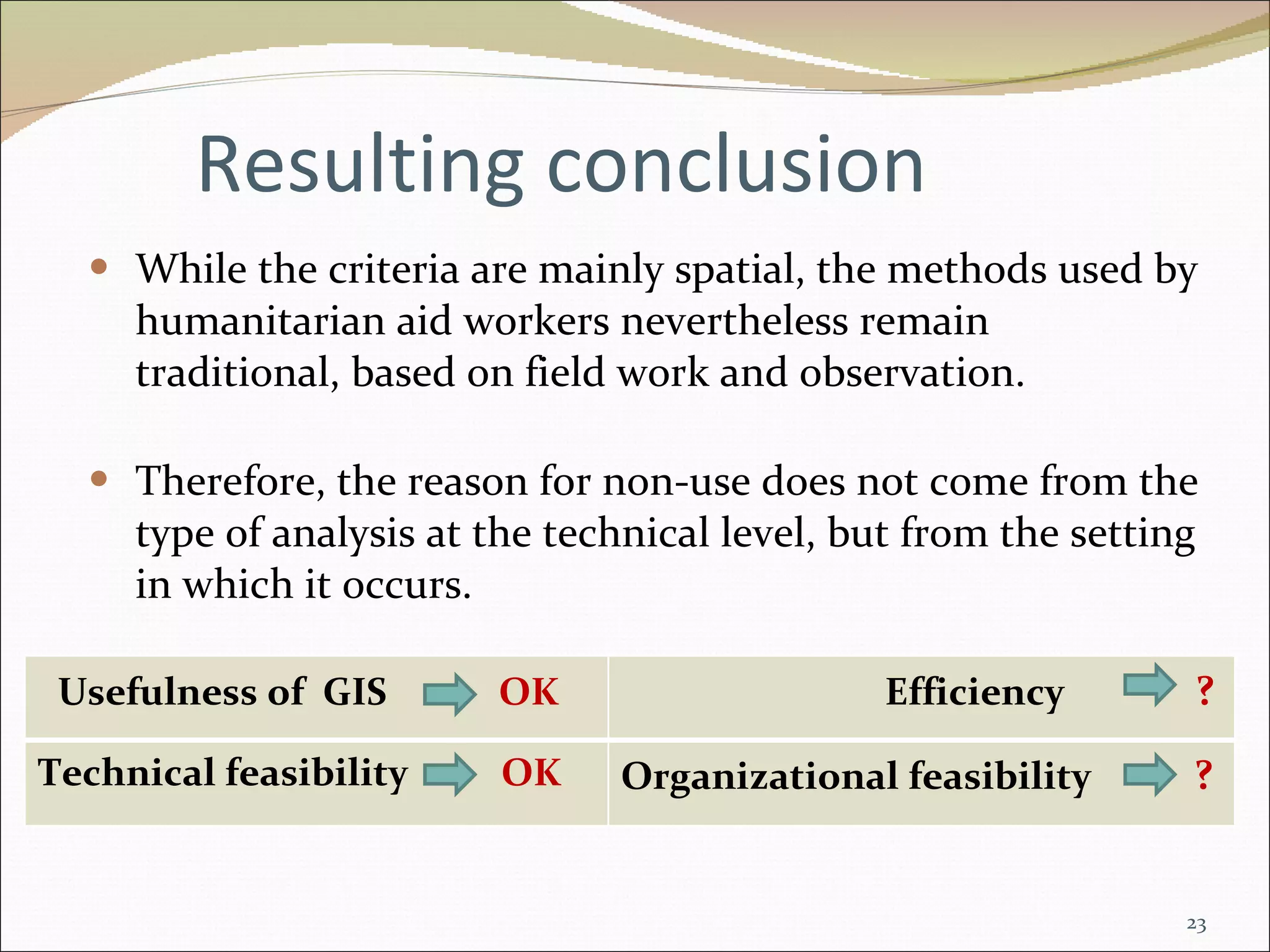
Resulting conclusion While the criteria are mainly spatial, the methods used by humanitarian aid workers nevertheless remain traditional, based on field work and observation. Therefore, the reason for non-use does not come from the type of analysis at the technical level, but from the setting in which it occurs. Usefulness of  GIS  OK Efficiency  ? Technical feasibility  OK Organizational feasibility  ?
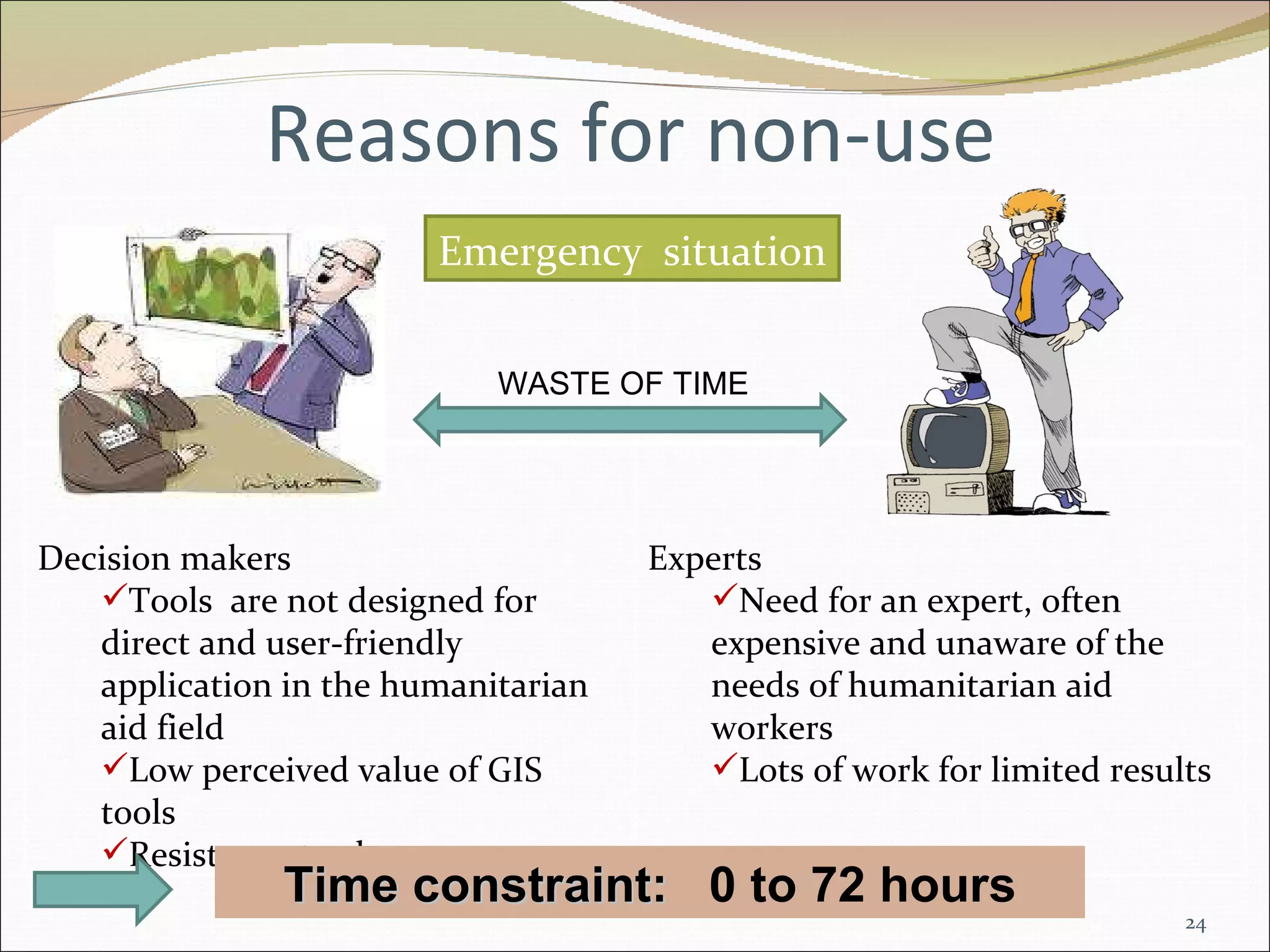
Reasons for non-use Time constraint:  0 to 72 hours Emergency  situation WASTE OF TIME Decision makers Tools  are not designed for direct and user-friendly application in the humanitarian aid field Low perceived value of GIS tools Resistance to change Experts Need for an expert, often expensive and unaware of the needs of humanitarian aid workers Lots of work for limited results
Conclusion Although GIS tools are available to the agencies, they are typically used for tasks which are not subject to time constraints imposed by emergency. (ex: cartography, management of statistical data in camps, etc…)  In order to ensure direct use for site  selection, the following changes might be necessary:  Spread  expert evaluation among the decision makers Improve user-friendliness of the tool Grant immediate access to the useful data bases for types of circumstances
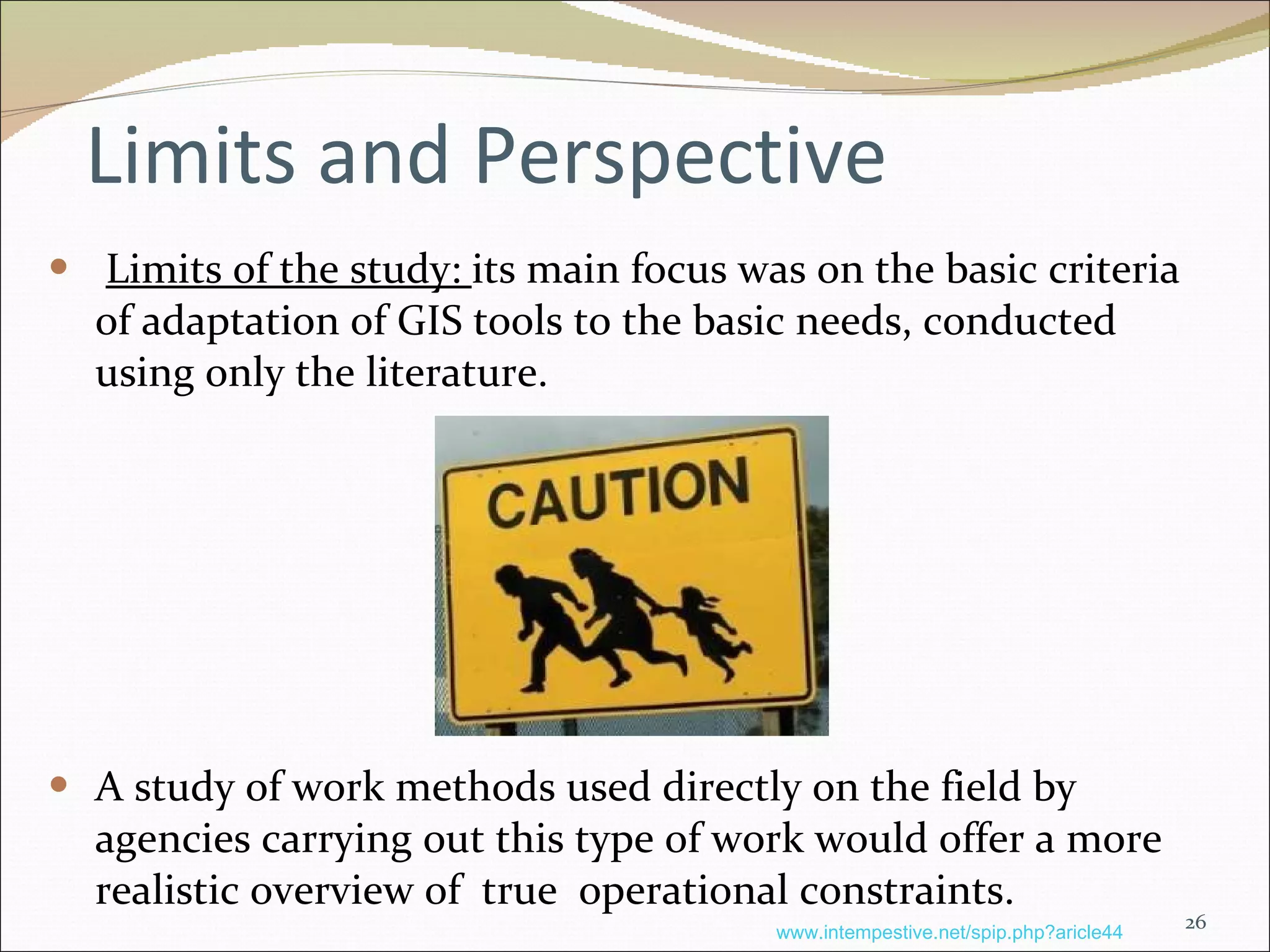
Limits and Perspective Limits of the study:  its main focus was on the basic criteria of adaptation of GIS tools to the basic needs, conducted using only the literature. A study of work methods used directly on the field by agencies carrying out this type of work would offer a more realistic overview of  true  operational constraints.   www.intempestive.net/spip.php?aricle44
Source: UNHCR
THANK YOU  Source: UNHCR

Geo Hum E Autocarto2010

  • 1.
  • 2.
    Humanitarian Geomatics Theapplication of GI Science to complex humanitarian emergencies More specifically: The role of GIS in the site selection process for the establishment of refugee camps. Why ? Despite a remarkable expansion an expressed interest by humanitarian workers GIS technology has been advanced as a tool for management of refugee camps it is not widely applied for camp siting.
  • 3.
    Goals of thisresearch Main Goal Describe the reasons for non-use of GIS in the site selection process. Secondary Goals Evaluate the needs of humanitarian workers in site selection Evaluate the methods used Evaluate the spatial character of the needs of the humanitarian workers and the possibilities offered by GIS.
  • 4.
    Overview of therefugee situation Number of displaced people in the world increased between 1997 and 2006; reaching 42 million in 2008. 25 million have been assisted by the United Nations High Commissioner for Refugees (UNHCR) Source: UNHCR Statistics 2006 Categories Number ( in millions) Refugees 16 Internally displaced 26 Total 42
  • 5.
  • 6.
    Temporary housing Spontaneousinstallations Installations with governmental infrastructure Humanitarian temporary installations REFUGEE CAMPS 1947 - 1948: First refugee camps In 2006 : World’s 700 refugee camps accomodated over 12 million displaced persons. Source: http://millionsoulsaware.org / 1948 2008
  • 7.
  • 8.
  • 9.
  • 10.
  • 11.
    Site selection Important to locate an optimal site Ensure camp’s viability with respect to logistics of aid delivery (food and water) and camp management Ensure camp safety Environmental protection Site selection process: Processing of spatial data Making a choice among alternatives based on defined criteria
  • 12.
    Geographical Information SystemAs a system allowing spatial analysis and decision-making aid, the GIS can contribute to an effective selection of potentially suitable sites for an optimal hosting of displaced persons. Source: UNHCR, GeOnG,2008
  • 13.
  • 14.
    Inventory of criteriasuggested Qualitative study Semantic comparaison Ontology Quantitative study Taxonomy Identification of spatial criteria and spatial data needed Inventory of methodologies used Comparative study Research Methodology Kigali – Rwanda (1994)
  • 15.
  • 16.
  • 17.
  • 18.
  • 19.
  • 20.
    Spatial vs Nonspatial Criteria Over 47: 15 32
  • 21.
  • 22.
    Methodologies The methodologyis mainly organizational: setting up a team, working out a list of criteria, assigning tasks, collecting data (mainly on the field) and comparing the available grounds For comparison of sites according to criteria, the method is mostly combinative, with addition and exclusion and weighted ranking GIS are sometimes mentioned, but never clearly used Corsellis, 2001
  • 23.
    Resulting conclusion Whilethe criteria are mainly spatial, the methods used by humanitarian aid workers nevertheless remain traditional, based on field work and observation. Therefore, the reason for non-use does not come from the type of analysis at the technical level, but from the setting in which it occurs. Usefulness of GIS OK Efficiency ? Technical feasibility OK Organizational feasibility ?
  • 24.
    Reasons for non-useTime constraint: 0 to 72 hours Emergency situation WASTE OF TIME Decision makers Tools are not designed for direct and user-friendly application in the humanitarian aid field Low perceived value of GIS tools Resistance to change Experts Need for an expert, often expensive and unaware of the needs of humanitarian aid workers Lots of work for limited results
  • 25.
    Conclusion Although GIStools are available to the agencies, they are typically used for tasks which are not subject to time constraints imposed by emergency. (ex: cartography, management of statistical data in camps, etc…) In order to ensure direct use for site selection, the following changes might be necessary: Spread expert evaluation among the decision makers Improve user-friendliness of the tool Grant immediate access to the useful data bases for types of circumstances
  • 26.
    Limits and PerspectiveLimits of the study: its main focus was on the basic criteria of adaptation of GIS tools to the basic needs, conducted using only the literature. A study of work methods used directly on the field by agencies carrying out this type of work would offer a more realistic overview of true operational constraints.   www.intempestive.net/spip.php?aricle44
  • 27.
  • 28.
    THANK YOU Source: UNHCR

Editor's Notes

  • #7 60 years later, they look the same. Remain similar.
  • #8 No infrastructure, self-built
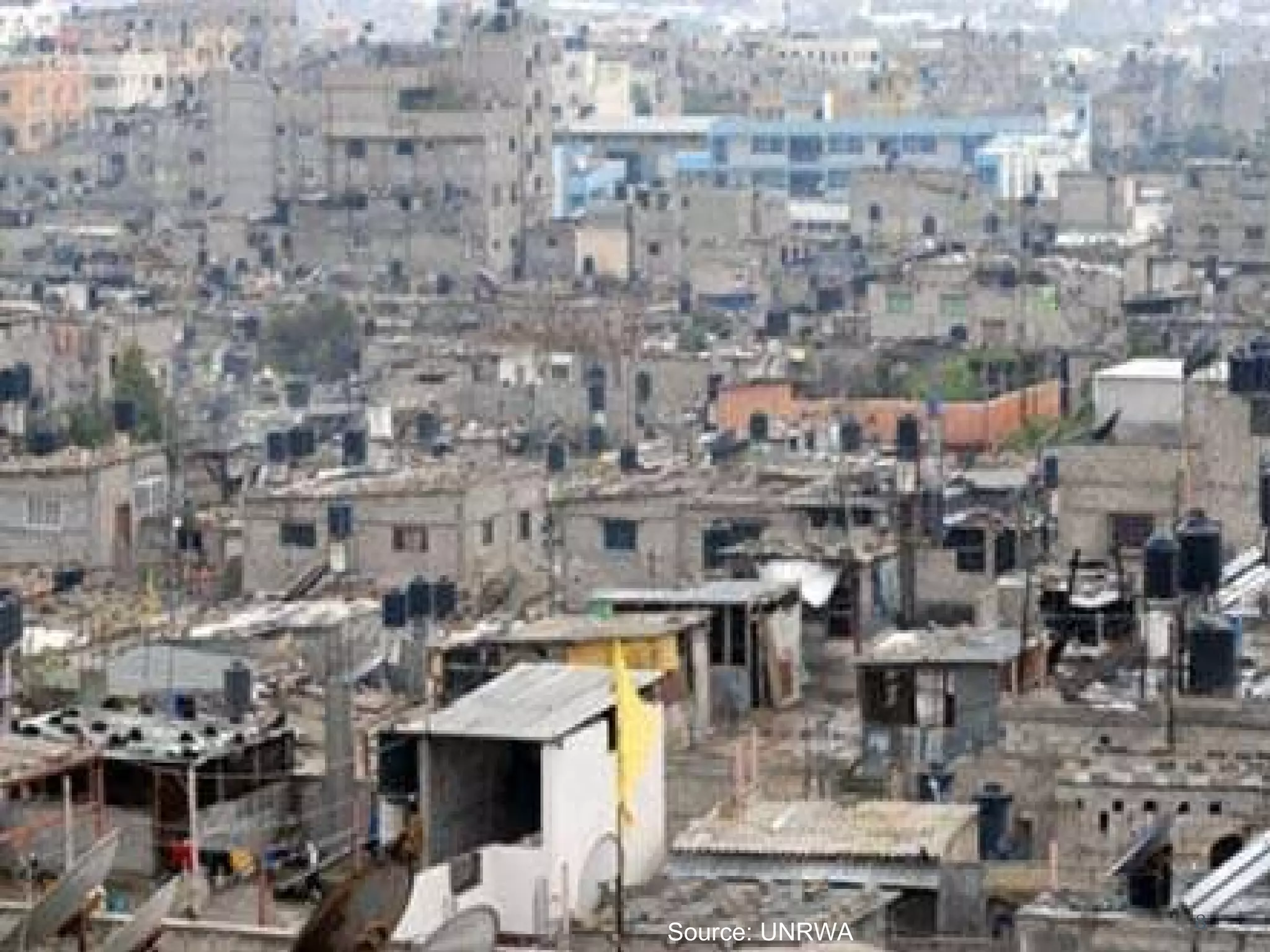
  • #9 Over years, can become cities (Gaza Strip).
  • #10 Can be huge, covering large spaces.
  • #11 And they are oftern located in the middle of nowhere, as this IRIDIMI Camp. In Sudan in 2006. http://www.shelterproject.org As tool for spatial analysis which contributes to decision making, the GIS can contribute to an effective selection of suitable potential site for an optimal hosting of refugees. During the Darfur crisis, the UNHCR had to manage a population of more than 1.5 million, on a large territory like France. (2004)
  • #14   but nothing about camp siting.
  • #18 As results for criteria, we have kept 47 criteria grouped into 13 topics. For each of then, we had expressed a desired situation with a +…. The most feared situtation
  • #19 As results for topics we found that the most important ones are :
  • #25 Time is of the essence.