GENE Transfer Techniques
By
Dr. Priti D.Diwan
Assistant Professor
Department of Zoology
J.D.Patil Sangludkar Mahavidyalay Daryapur.
Transformation:
• Transformation is the process by which genetic makeup
of an organism is altered by the insertion of new gene(or
exogenous DNA) into its genome .This is usually done
using vectors such as plasmids.
• The aim of producing transgenic plants is to-
a) Improve crop yields.
b) Improvement of varietal trait.
c) Give cultivated plants more protection against their
pests, parasites and harsh weather conditions.
History
• Transformation was first demonstrated in 1928 by British
bacteriologist Frederick Griffith in Diplococcus pneumonia.
• In 1944 this "transforming principle" was identified as being
genetic by Oswald Avery, Colin MacLeod, and Maclyn
McCarty
• Transformation using electroporation was developed in the
late 1980s.
• Particle bombardment discovered (gene gun) by John Sanford
in the 1980s.
Methods of plant transformation:
• INDIRECT METHOD: Agrobacterium mediated gene transfer.
• DIRECT METHODS :
 Particle gun/biolistic/ballistic method of DNA delivary.
 Chemical method;Polyethylene glycol (PEG)/protoplast fusion.
 Microinjection.
 Macroinjection.
 Electroporation.
 Lipofection; Liposome mediated gene transfer.
 Fibre mediated DNA delivary.
 LASER induced DNA delivary.
 Pollen transformation.
 DNA delivary via Growing pollen tubes.
 Direct DNA uptake by mature zygotic embryos.
DIRECT METHODS
1. PARTICLE GUN METHOD.
 A gene gun or a biolistic particle delivery
system, designed for plant transformation, is a
device for injecting cells with genetic information.
The payload is an elemental particle of a heavy
metal(tungston/gold) called microprojectiles
coated with plasmid DNA.
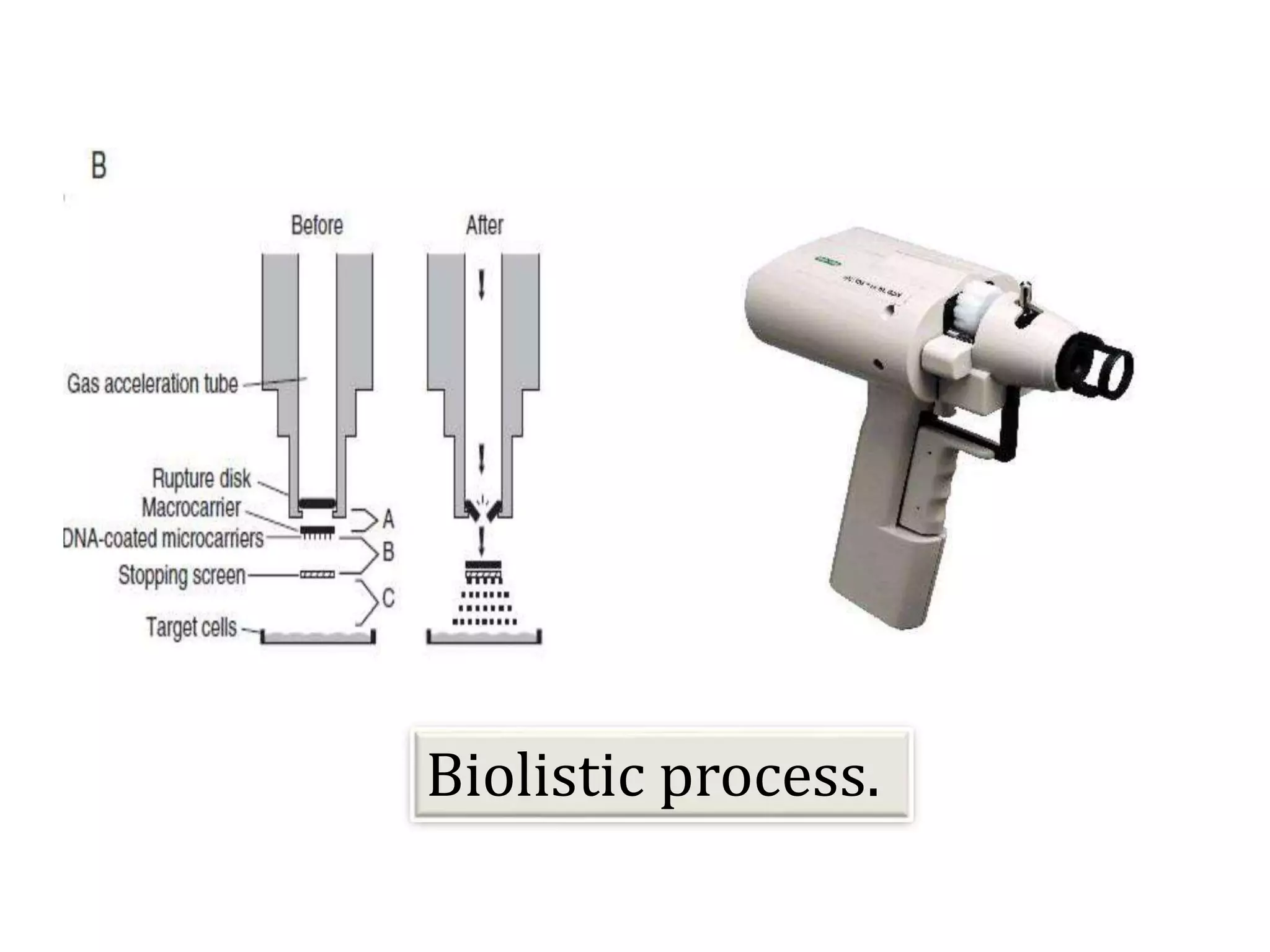
Biolistic process.
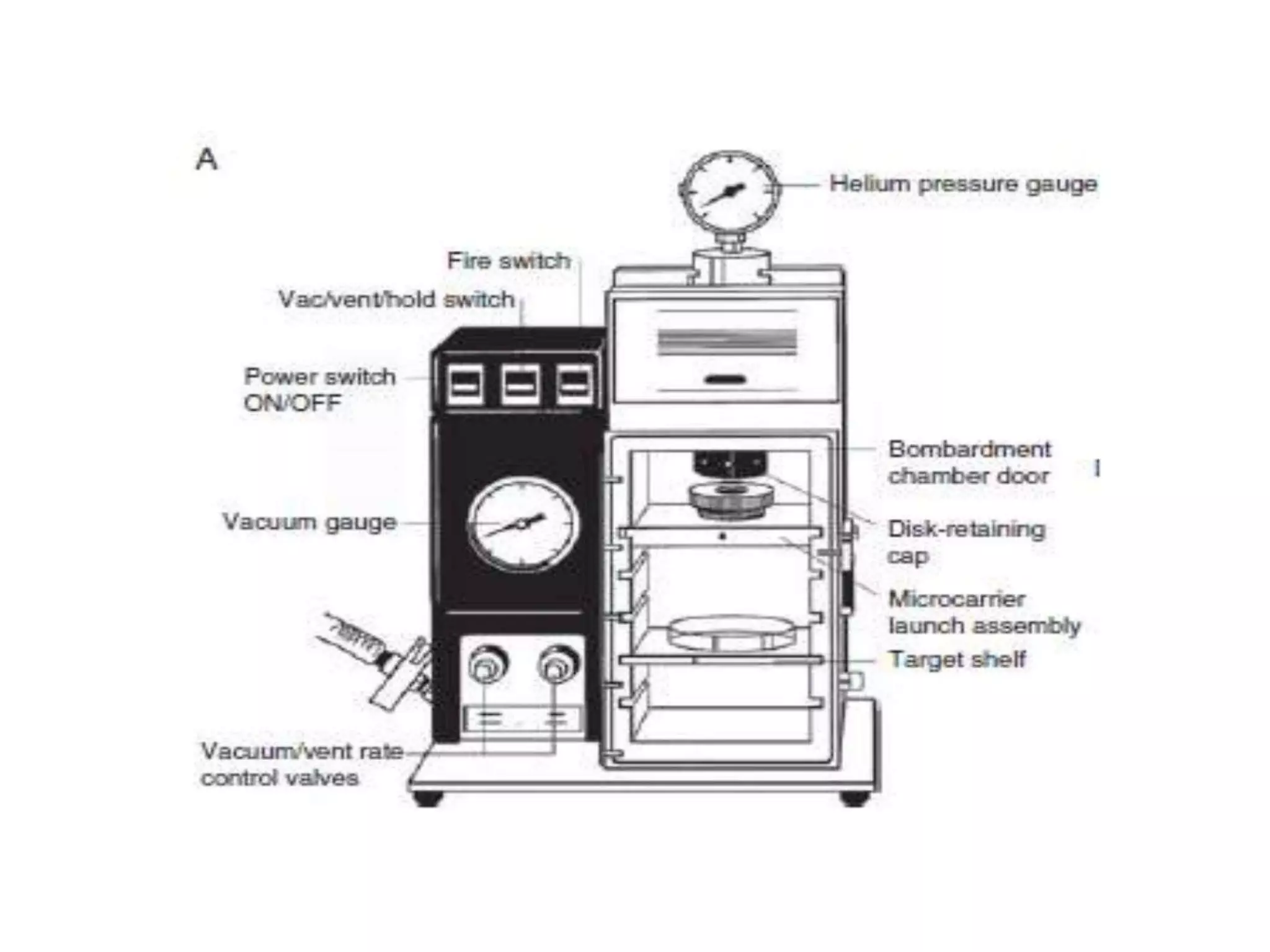
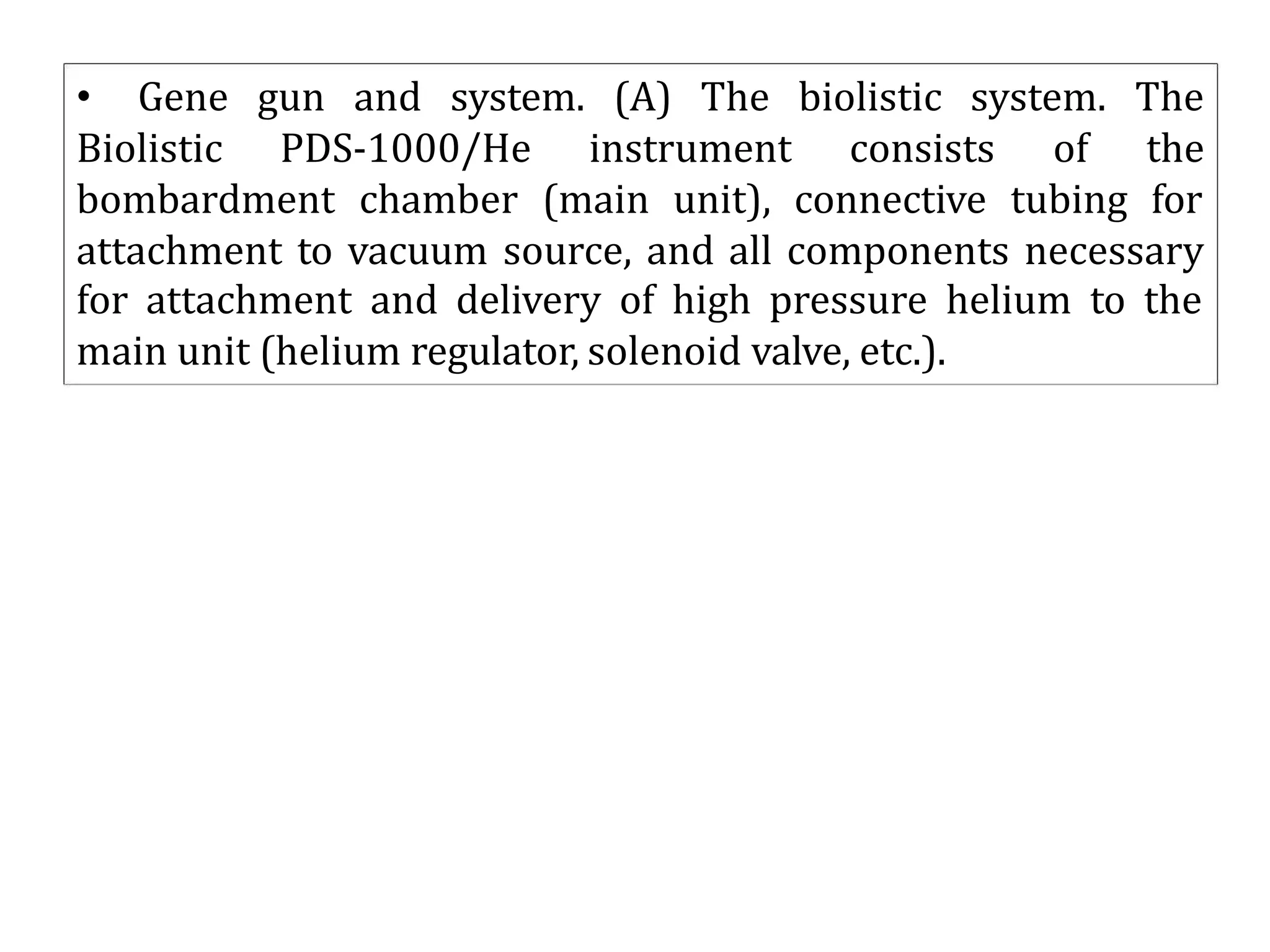
• Gene gun and system. (A) The biolistic system. The
Biolistic PDS-1000/He instrument consists of the
bombardment chamber (main unit), connective tubing for
attachment to vacuum source, and all components necessary
for attachment and delivery of high pressure helium to the
main unit (helium regulator, solenoid valve, etc.).
Principle:
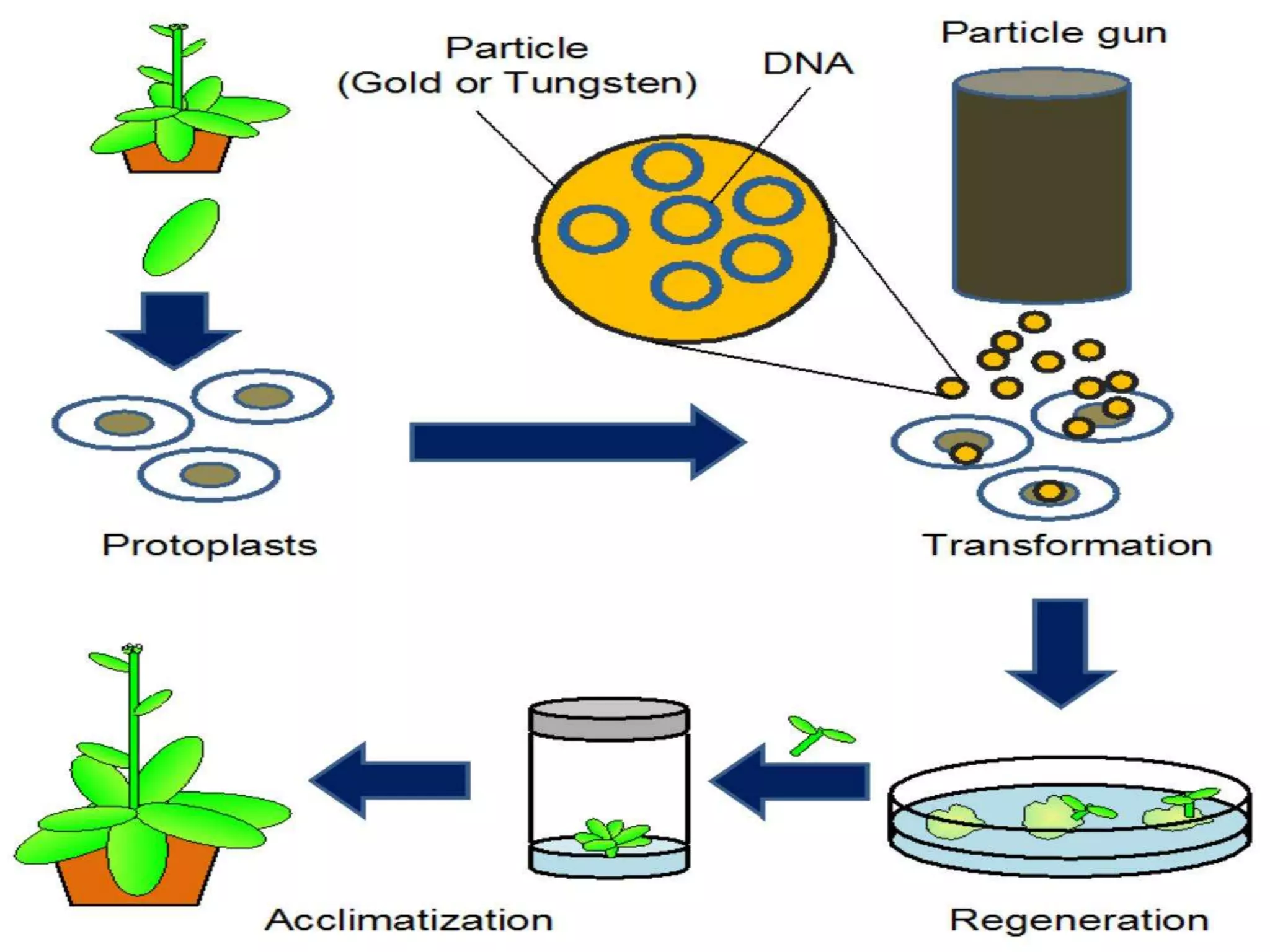
 The gold or tungsten particles are coated with the
DNA that is used to be transform the plant tissue.
 The particles are propelled at high speed into the
target plant material where the DNA is released
within the cell and can integrate into the genome.
 Two types of plant tissues are used for particle
bombardment:
a) Primary explants that are bombarded and then
induced to become embryogenic.
b) Proliferating embryonic cultures that are
bombarded and then allowed to proliferate further
and subsequently regenerate.
How the PDS-1000/bombardment System Works :
 The sample to be transformed is placed in the bombardment
chamber, which is evacuated to sub atmospheric pressure.
 The instrument is fired; helium flows into the gas
acceleration tube and is held until the specific pressure of the
rupture disk is reached.
 The disk bursts, and the helium shock wave drives the
macrocarrier disk (which carries the coated microparticles) a
short distance toward the stopping screen.
 The stopping screen retains the macrocarrier, while the
microparticles pass through the screen into the bombardment
chamber and penetrate the target cells
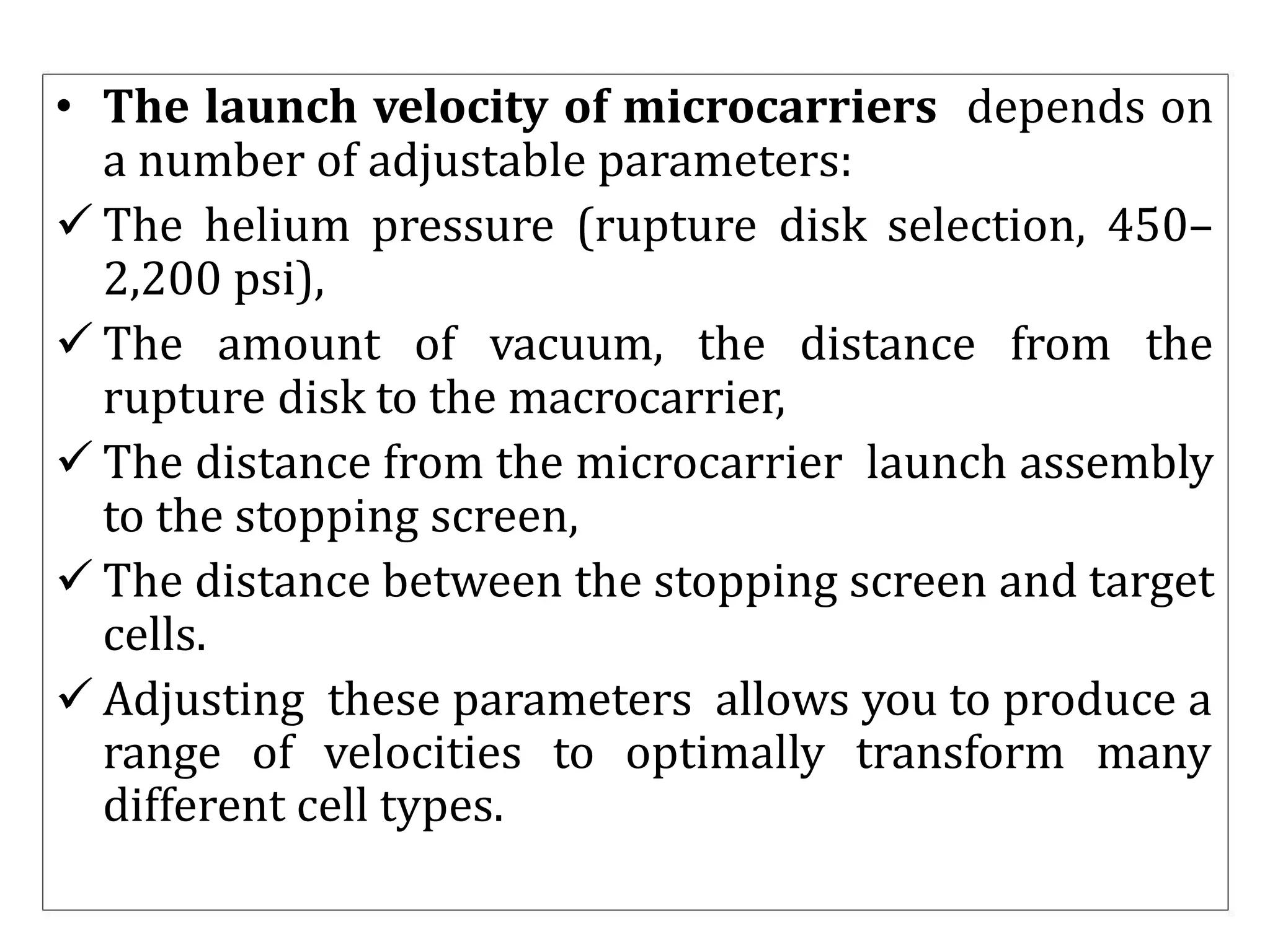
• The launch velocity of microcarriers depends on
a number of adjustable parameters:
 The helium pressure (rupture disk selection, 450–
2,200 psi),
 The amount of vacuum, the distance from the
rupture disk to the macrocarrier,
 The distance from the microcarrier launch assembly
to the stopping screen,
 The distance between the stopping screen and target
cells.
 Adjusting these parameters allows you to produce a
range of velocities to optimally transform many
different cell types.
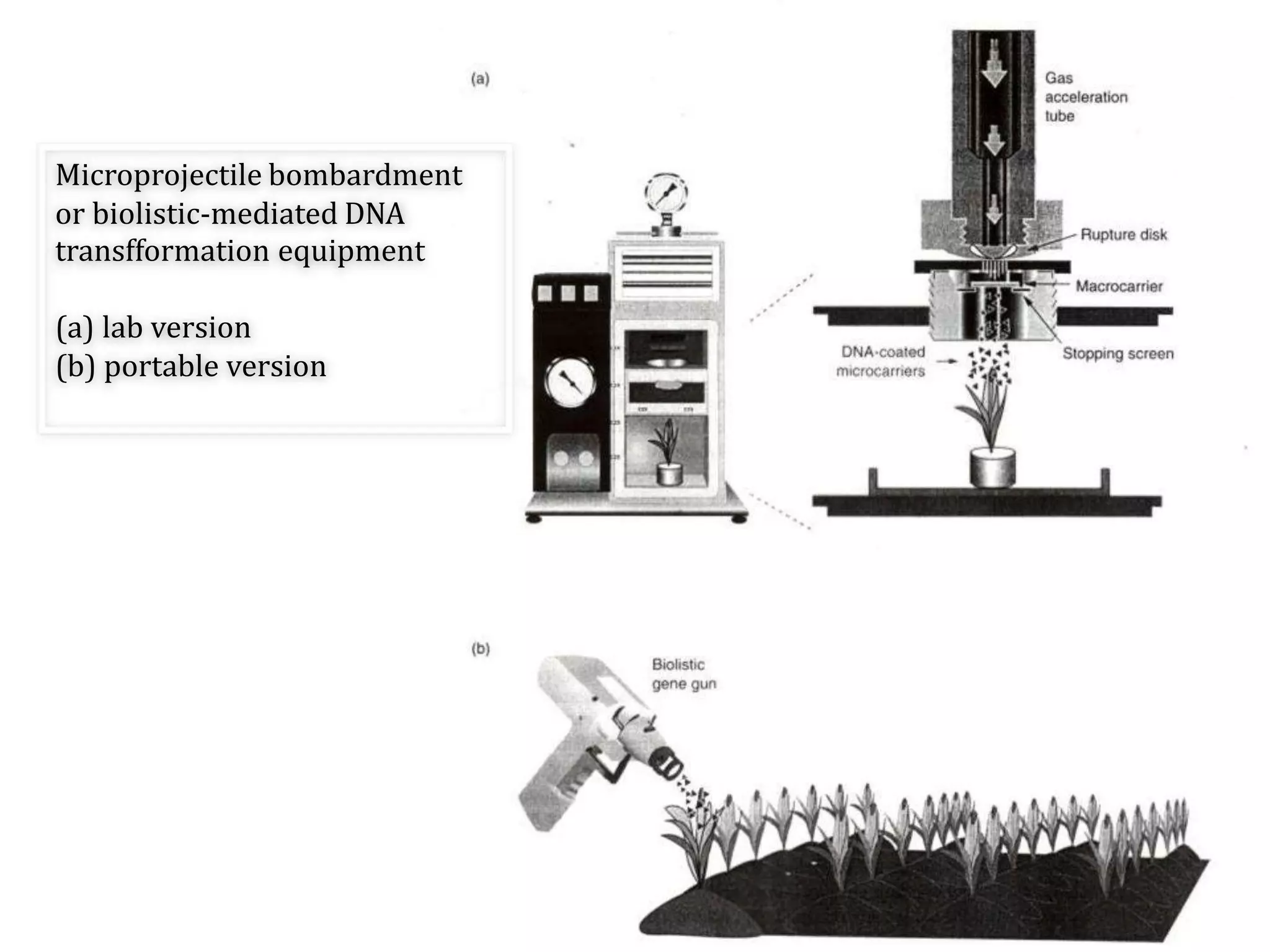
Microprojectile bombardment
or biolistic-mediated DNA
transfformation equipment
(a) lab version
(b) portable version
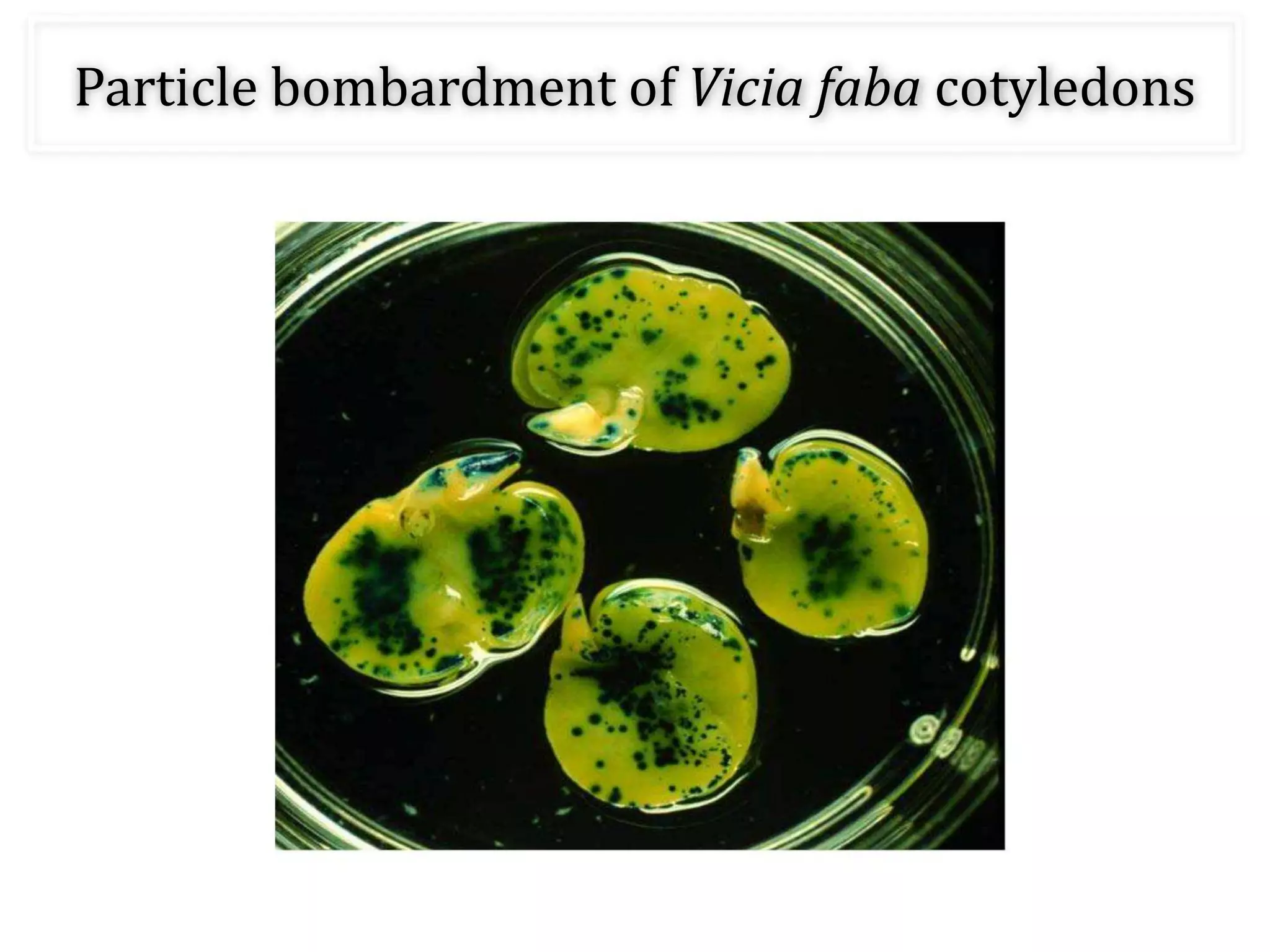
Particle bombardment of Vicia faba cotyledons
Polyethylene glycol (PEG) mediated transformation -
the chemical method.
 Plant protoplast can be transformed with naked DNA by
treatment with PEG in the presence of divalent cations .
e. g., Calcium.
 PEG and divalent cations destabilize the plasma
membrane of the plant protoplast and rendered it
permeable to naked DNA.
 DNA enters the nucleus and integrates into the host
genome.
Disadvantage and advantages of PEG:
 Regeneration of fertile plants from protoplasts is a
problematic for some species bcoz of secondary
metabolites accumulation or any compounds.
 The DNA used for transformation is also susceptible to
degradation and rearrangement.
 Despite the limitations,
 The technique have the advantage i.e., protoplast can
be isolated and transformed in number of plants species.
Electroporation:
• It can be used to deliver DNAinto
plant cells and protoplasts.
• The genes of interest require plant
regulatory sequence.
• Plant materials is incubated in a buffer
solution containing DNA and
subjected to high-voltage electric
pulse.
• The DNA then migrates through high-
voltage-induced pores in the plasma
membrane and integrates into the
genome.
• It can be used to transform all the
major cereals particularly rice, wheat,
maize.
ELECTROPORATER:
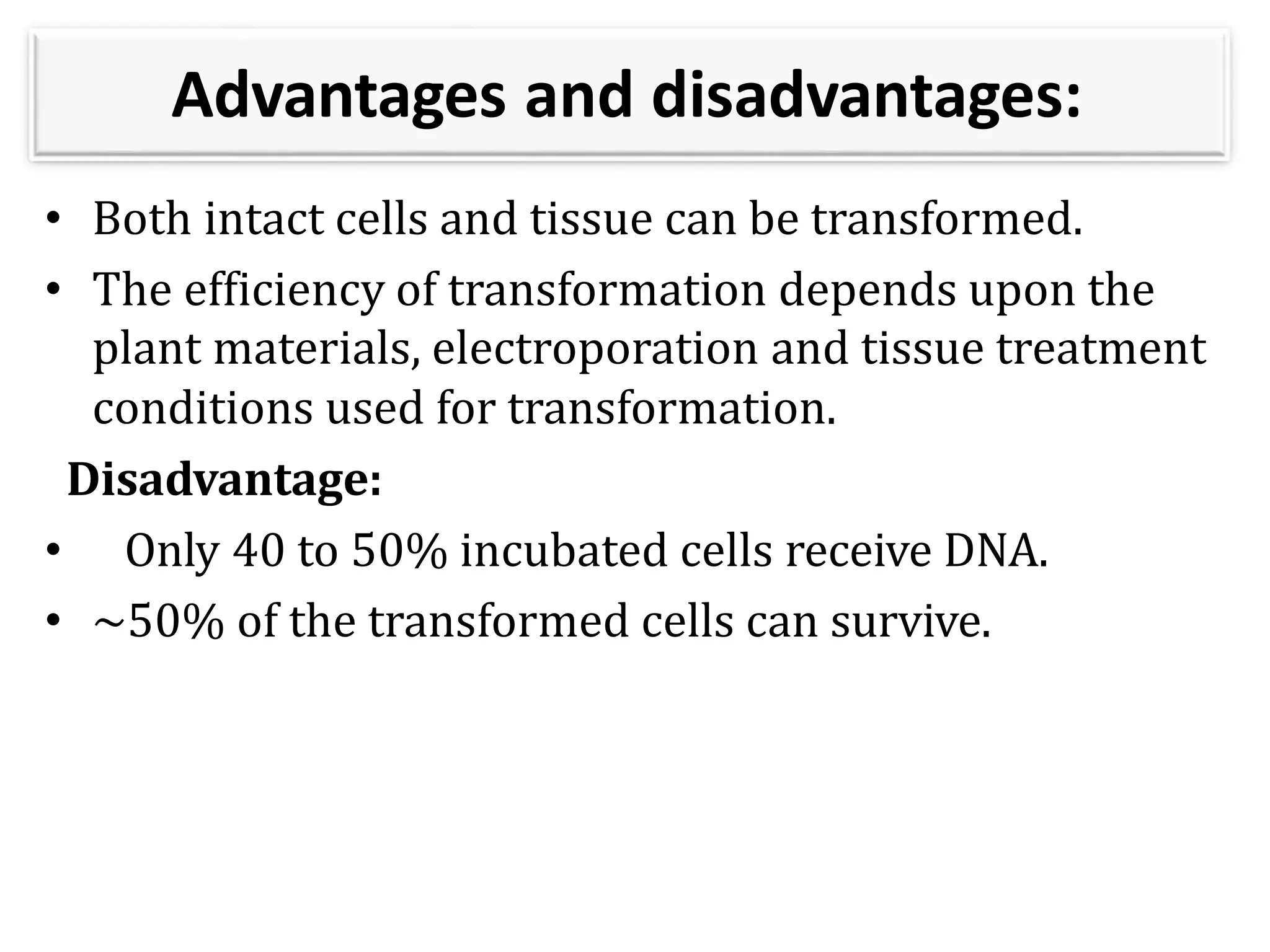
Advantages and disadvantages:
• Both intact cells and tissue can be transformed.
• The efficiency of transformation depends upon the
plant materials, electroporation and tissue treatment
conditions used for transformation.
Disadvantage:
• Only 40 to 50% incubated cells receive DNA.
• ~50% of the transformed cells can survive.
Microinjection
Microinjection techniques for
plant protoplasts utilize a holding
pipette for immobilizing the
protoplast while an injection
pipette is utilized to inject the
macromolecule.
 In order to manipulate the
protoplasts without damage, the
protoplasts are cultured for from
about 1 to 5 days before the
injection is performed to allow for
partial regeneration of the cell wall.
• It was found that injection through the partially
regenerated cell wall could still be accomplished
and particular compartments of the cell could be
targeted.
• The methods are particularly useful for
transformation of plant protoplasts with
exogenous genes.
Macro injection;
• The injection of plasmid DNA(or uncloned
native DNA) into the lumen of developing
inflorescence using a hypodermic syringe
called macroinjection.
Laser induced DNA delivery.
• LASERs punctures transient holes in cell
membrane through which DNA may enter into
the cell cytoplasm.
• But, There is no information/report on gene
expression or stable integration.
Advantages and disadvantages of direct
gene transfer :
 Advantage- Widespread use of transformation of
cereal crops that initially proved difficult to
transformation with Agrobacterium.
 Disadvantage- They tend to lead higher frequency
of transgene rearrangement and higher copy number.
This can lead to high frequency of gene silencing.
genetransformation
genetransformation
genetransformation

genetransformation

  • 1.
    GENE Transfer Techniques By Dr.Priti D.Diwan Assistant Professor Department of Zoology J.D.Patil Sangludkar Mahavidyalay Daryapur.
  • 2.
    Transformation: • Transformation isthe process by which genetic makeup of an organism is altered by the insertion of new gene(or exogenous DNA) into its genome .This is usually done using vectors such as plasmids. • The aim of producing transgenic plants is to- a) Improve crop yields. b) Improvement of varietal trait. c) Give cultivated plants more protection against their pests, parasites and harsh weather conditions.
  • 3.
    History • Transformation wasfirst demonstrated in 1928 by British bacteriologist Frederick Griffith in Diplococcus pneumonia. • In 1944 this "transforming principle" was identified as being genetic by Oswald Avery, Colin MacLeod, and Maclyn McCarty • Transformation using electroporation was developed in the late 1980s. • Particle bombardment discovered (gene gun) by John Sanford in the 1980s.
  • 4.
    Methods of planttransformation: • INDIRECT METHOD: Agrobacterium mediated gene transfer. • DIRECT METHODS :  Particle gun/biolistic/ballistic method of DNA delivary.  Chemical method;Polyethylene glycol (PEG)/protoplast fusion.  Microinjection.  Macroinjection.  Electroporation.  Lipofection; Liposome mediated gene transfer.  Fibre mediated DNA delivary.  LASER induced DNA delivary.  Pollen transformation.  DNA delivary via Growing pollen tubes.  Direct DNA uptake by mature zygotic embryos.
  • 5.
    DIRECT METHODS 1. PARTICLEGUN METHOD.  A gene gun or a biolistic particle delivery system, designed for plant transformation, is a device for injecting cells with genetic information. The payload is an elemental particle of a heavy metal(tungston/gold) called microprojectiles coated with plasmid DNA.
  • 7.
  • 8.
    • Gene gunand system. (A) The biolistic system. The Biolistic PDS-1000/He instrument consists of the bombardment chamber (main unit), connective tubing for attachment to vacuum source, and all components necessary for attachment and delivery of high pressure helium to the main unit (helium regulator, solenoid valve, etc.).
  • 9.
    Principle:  The goldor tungsten particles are coated with the DNA that is used to be transform the plant tissue.  The particles are propelled at high speed into the target plant material where the DNA is released within the cell and can integrate into the genome.  Two types of plant tissues are used for particle bombardment: a) Primary explants that are bombarded and then induced to become embryogenic. b) Proliferating embryonic cultures that are bombarded and then allowed to proliferate further and subsequently regenerate.
  • 10.
    How the PDS-1000/bombardmentSystem Works :  The sample to be transformed is placed in the bombardment chamber, which is evacuated to sub atmospheric pressure.  The instrument is fired; helium flows into the gas acceleration tube and is held until the specific pressure of the rupture disk is reached.  The disk bursts, and the helium shock wave drives the macrocarrier disk (which carries the coated microparticles) a short distance toward the stopping screen.  The stopping screen retains the macrocarrier, while the microparticles pass through the screen into the bombardment chamber and penetrate the target cells
  • 11.
    • The launchvelocity of microcarriers depends on a number of adjustable parameters:  The helium pressure (rupture disk selection, 450– 2,200 psi),  The amount of vacuum, the distance from the rupture disk to the macrocarrier,  The distance from the microcarrier launch assembly to the stopping screen,  The distance between the stopping screen and target cells.  Adjusting these parameters allows you to produce a range of velocities to optimally transform many different cell types.
  • 12.
    Microprojectile bombardment or biolistic-mediatedDNA transfformation equipment (a) lab version (b) portable version
  • 14.
    Particle bombardment ofVicia faba cotyledons
  • 15.
    Polyethylene glycol (PEG)mediated transformation - the chemical method.  Plant protoplast can be transformed with naked DNA by treatment with PEG in the presence of divalent cations . e. g., Calcium.  PEG and divalent cations destabilize the plasma membrane of the plant protoplast and rendered it permeable to naked DNA.  DNA enters the nucleus and integrates into the host genome.
  • 16.
    Disadvantage and advantagesof PEG:  Regeneration of fertile plants from protoplasts is a problematic for some species bcoz of secondary metabolites accumulation or any compounds.  The DNA used for transformation is also susceptible to degradation and rearrangement.  Despite the limitations,  The technique have the advantage i.e., protoplast can be isolated and transformed in number of plants species.
  • 17.
    Electroporation: • It canbe used to deliver DNAinto plant cells and protoplasts. • The genes of interest require plant regulatory sequence. • Plant materials is incubated in a buffer solution containing DNA and subjected to high-voltage electric pulse. • The DNA then migrates through high- voltage-induced pores in the plasma membrane and integrates into the genome. • It can be used to transform all the major cereals particularly rice, wheat, maize.
  • 18.
  • 19.
    Advantages and disadvantages: •Both intact cells and tissue can be transformed. • The efficiency of transformation depends upon the plant materials, electroporation and tissue treatment conditions used for transformation. Disadvantage: • Only 40 to 50% incubated cells receive DNA. • ~50% of the transformed cells can survive.
  • 20.
    Microinjection Microinjection techniques for plantprotoplasts utilize a holding pipette for immobilizing the protoplast while an injection pipette is utilized to inject the macromolecule.  In order to manipulate the protoplasts without damage, the protoplasts are cultured for from about 1 to 5 days before the injection is performed to allow for partial regeneration of the cell wall.
  • 21.
    • It wasfound that injection through the partially regenerated cell wall could still be accomplished and particular compartments of the cell could be targeted. • The methods are particularly useful for transformation of plant protoplasts with exogenous genes.
  • 22.
    Macro injection; • Theinjection of plasmid DNA(or uncloned native DNA) into the lumen of developing inflorescence using a hypodermic syringe called macroinjection.
  • 23.
    Laser induced DNAdelivery. • LASERs punctures transient holes in cell membrane through which DNA may enter into the cell cytoplasm. • But, There is no information/report on gene expression or stable integration.
  • 24.
    Advantages and disadvantagesof direct gene transfer :  Advantage- Widespread use of transformation of cereal crops that initially proved difficult to transformation with Agrobacterium.  Disadvantage- They tend to lead higher frequency of transgene rearrangement and higher copy number. This can lead to high frequency of gene silencing.