Advanced Java Programming
Topic: Generics
By
Ravi Kant Sahu
Asst. Professor, LPU
Contents
 Introduction
 Benefits of Generics
 Generic Classes and Interfaces
 Generic Methods
 Wildcard Generic Types
 Restrictions on Generics
Ravi Kant Sahu, Asst. Professor @ Lovely Professional University, Punjab (India)
Introduction
 Enables to create classes, interfaces, and methods in which
the type of data upon which they operate is specified as a
parameter.
 Introduced in Java by jdk 1.5.
 Generics means parameterized types.
 Generics add the type-safety.
 Generics add stability to your code by making more of
your bugs detectable at compile time.
Ravi Kant Sahu, Asst. Professor @ Lovely Professional University, Punjab (India)
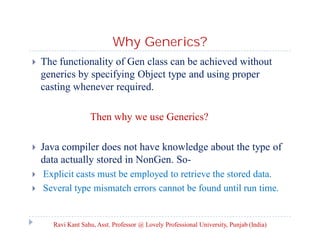
Why Generics?
 The functionality of Gen class can be achieved without
generics by specifying Object type and using proper
casting whenever required.
Then why we use Generics?
 Java compiler does not have knowledge about the type of
data actually stored in NonGen. So-
 Explicit casts must be employed to retrieve the stored data.
 Several type mismatch errors cannot be found until run time.
Ravi Kant Sahu, Asst. Professor @ Lovely Professional University, Punjab (India)
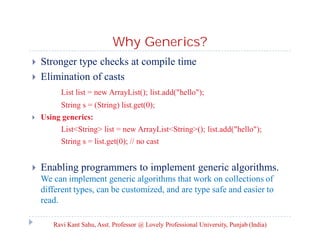
Why Generics?
 Stronger type checks at compile time
 Elimination of casts
List list = new ArrayList(); list.add("hello");
String s = (String) list.get(0);
 Using generics:
List<String> list = new ArrayList<String>(); list.add("hello");
String s = list.get(0); // no cast
 Enabling programmers to implement generic algorithms.
We can implement generic algorithms that work on collections of
different types, can be customized, and are type safe and easier to
read.
Ravi Kant Sahu, Asst. Professor @ Lovely Professional University, Punjab (India)
Advantage of Generics
 The ability to create type-safe code in which type-
mismatch errors are caught at compile time is a key
advantage of generics.
Ravi Kant Sahu, Asst. Professor @ Lovely Professional University, Punjab (India)
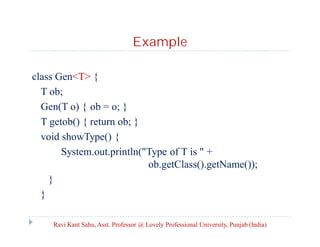
Example
class Gen<T> {
T ob;
Gen(T o) { ob = o; }
T getob() { return ob; }
void showType() {
System.out.println("Type of T is " +
ob.getClass().getName());
}
}
Ravi Kant Sahu, Asst. Professor @ Lovely Professional University, Punjab (India)
class GenDemo {
public static void main(String args[]) {
Gen<Integer> iOb;
iOb = new Gen<Integer>(88);
iOb.showType();
int v = iOb.getob();
System.out.println("value: " + v);
Gen<String> strOb = new Gen<String>("Generics
Test");
strOb.showType();
String str = strOb.getob();
System.out.println("value: " + str);
} }
Ravi Kant Sahu, Asst. Professor @ Lovely Professional University, Punjab (India)
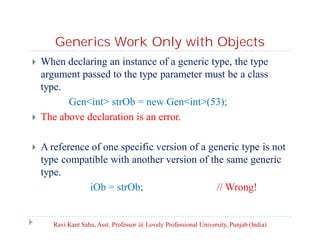
Generics Work Only with Objects
 When declaring an instance of a generic type, the type
argument passed to the type parameter must be a class
type.
Gen<int> strOb = new Gen<int>(53);
 The above declaration is an error.
 A reference of one specific version of a generic type is not
type compatible with another version of the same generic
type.
iOb = strOb; // Wrong!
Ravi Kant Sahu, Asst. Professor @ Lovely Professional University, Punjab (India)
Generic class
Ravi Kant Sahu, Asst. Professor @ Lovely Professional University, Punjab (India)
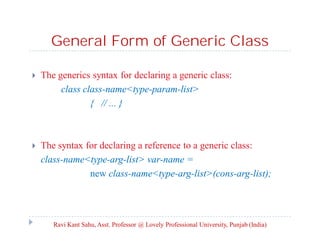
General Form of Generic Class
 The generics syntax for declaring a generic class:
class class-name<type-param-list>
{ // ... }
 The syntax for declaring a reference to a generic class:
class-name<type-arg-list> var-name =
new class-name<type-arg-list>(cons-arg-list);
Ravi Kant Sahu, Asst. Professor @ Lovely Professional University, Punjab (India)
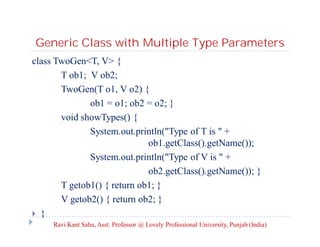
Generic Class with Multiple Type Parameters
class TwoGen<T, V> {
T ob1; V ob2;
TwoGen(T o1, V o2) {
ob1 = o1; ob2 = o2; }
void showTypes() {
System.out.println("Type of T is " +
ob1.getClass().getName());
System.out.println("Type of V is " +
ob2.getClass().getName()); }
T getob1() { return ob1; }
V getob2() { return ob2; }
 }
Ravi Kant Sahu, Asst. Professor @ Lovely Professional University, Punjab (India)
class SimpGen {
public static void main(String args[]) {
TwoGen<Integer, String> t =
new TwoGen<Integer, String>(16920, "Ravi
Kant");
t.showTypes();
int v = t.getob1();
System.out.println("value: " + v);
String str = t.getob2();
System.out.println("value: " + str);
}
}
Ravi Kant Sahu, Asst. Professor @ Lovely Professional University, Punjab (India)
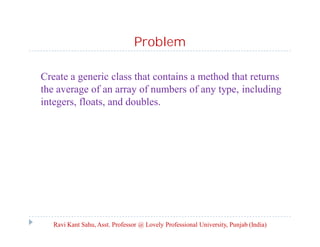
Problem
Create a generic class that contains a method that returns
the average of an array of numbers of any type, including
integers, floats, and doubles.
Ravi Kant Sahu, Asst. Professor @ Lovely Professional University, Punjab (India)
Possible Solution
class Stats<T> {
T[] nums;
Stats(T[] o) {
nums = o;
}
double average() {
double sum = 0.0;
for(int i=0; i < nums.length; i++)
sum += nums[i].doubleValue(); // Error!!!
return sum / nums.length;
}
}
Ravi Kant Sahu, Asst. Professor @ Lovely Professional University, Punjab (India)
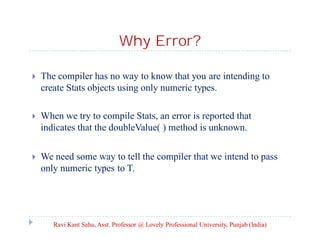
Why Error?
 The compiler has no way to know that you are intending to
create Stats objects using only numeric types.
 When we try to compile Stats, an error is reported that
indicates that the doubleValue( ) method is unknown.
 We need some way to tell the compiler that we intend to pass
only numeric types to T.
Ravi Kant Sahu, Asst. Professor @ Lovely Professional University, Punjab (India)
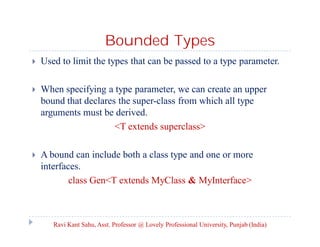
Bounded Types
 Used to limit the types that can be passed to a type parameter.
 When specifying a type parameter, we can create an upper
bound that declares the super-class from which all type
arguments must be derived.
<T extends superclass>
 A bound can include both a class type and one or more
interfaces.
class Gen<T extends MyClass & MyInterface>
Ravi Kant Sahu, Asst. Professor @ Lovely Professional University, Punjab (India)
WILD CARD GeneRICS
Ravi Kant Sahu, Asst. Professor @ Lovely Professional University, Punjab (India)
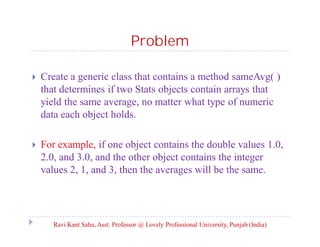
Problem
 Create a generic class that contains a method sameAvg( )
that determines if two Stats objects contain arrays that
yield the same average, no matter what type of numeric
data each object holds.
 For example, if one object contains the double values 1.0,
2.0, and 3.0, and the other object contains the integer
values 2, 1, and 3, then the averages will be the same.
Ravi Kant Sahu, Asst. Professor @ Lovely Professional University, Punjab (India)
Possible Solution
Integer inums[] = { 1, 2, 3, 4 }; Double dnums[] = { 1.1, 2.2, 3.3, 4.4 };
Stats<Integer> iob = new Stats<Integer>(inums);
Stats<Double> dob = new Stats<Double>(dnums);
if(iob.sameAvg(dob))
System.out.println("Averages are the same.");
else
System.out.println("Averages differ.");
boolean same_Avg(Stats<T> ob)
{
if(average() == ob.average())
return true;
return false;
}
Ravi Kant Sahu, Asst. Professor @ Lovely Professional University, Punjab (India)
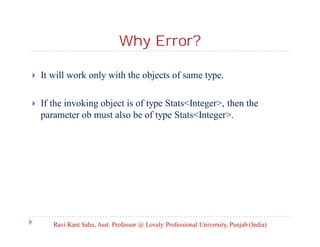
Why Error?
 It will work only with the objects of same type.
 If the invoking object is of type Stats<Integer>, then the
parameter ob must also be of type Stats<Integer>.
Ravi Kant Sahu, Asst. Professor @ Lovely Professional University, Punjab (India)
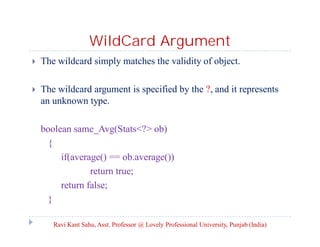
WildCard Argument
 The wildcard simply matches the validity of object.
 The wildcard argument is specified by the ?, and it represents
an unknown type.
boolean same_Avg(Stats<?> ob)
{
if(average() == ob.average())
return true;
return false;
}
Ravi Kant Sahu, Asst. Professor @ Lovely Professional University, Punjab (India)
Generic Method
Ravi Kant Sahu, Asst. Professor @ Lovely Professional University, Punjab (India)
Generic Method
 It is possible to declare a generic method that uses one or more
type parameters.
 Methods inside a generic class are automatically generic
relative to the type parameters.
 It is possible to create a generic method that is enclosed within
a non-generic class.
Ravi Kant Sahu, Asst. Professor @ Lovely Professional University, Punjab (India)
Generic Methods
 The type parameters are declared before the return type of
the method.
 Generic methods can be either static or non-static.
<type-param-list> ret-type method-name(param-list) {…}
Example:
static <T, V extends T> boolean isIn (T x, V[] y)
Ravi Kant Sahu, Asst. Professor @ Lovely Professional University, Punjab (India)
Generic interfaces
Ravi Kant Sahu, Asst. Professor @ Lovely Professional University, Punjab (India)
Generic Interfaces
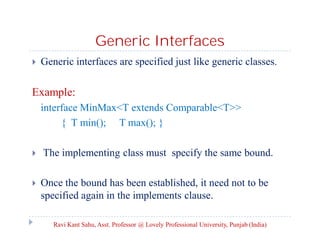
 Generic interfaces are specified just like generic classes.
Example:
interface MinMax<T extends Comparable<T>>
{ T min(); T max(); }
 The implementing class must specify the same bound.
 Once the bound has been established, it need not to be
specified again in the implements clause.
Ravi Kant Sahu, Asst. Professor @ Lovely Professional University, Punjab (India)
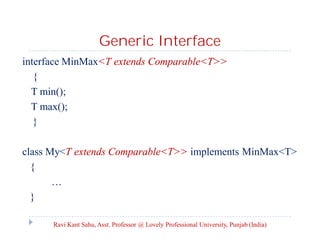
Generic Interface
interface MinMax<T extends Comparable<T>>
{
T min();
T max();
}
class My<T extends Comparable<T>> implements MinMax<T>
{
…
}
Ravi Kant Sahu, Asst. Professor @ Lovely Professional University, Punjab (India)
Generic constructors
Ravi Kant Sahu, Asst. Professor @ Lovely Professional University, Punjab (India)
Generic Constructors
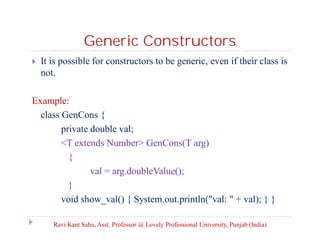
 It is possible for constructors to be generic, even if their class is
not.
Example:
class GenCons {
private double val;
<T extends Number> GenCons(T arg)
{
val = arg.doubleValue();
}
void show_val() { System.out.println("val: " + val); } }
Ravi Kant Sahu, Asst. Professor @ Lovely Professional University, Punjab (India)
ERASURE
Ravi Kant Sahu, Asst. Professor @ Lovely Professional University, Punjab (India)
Erasure
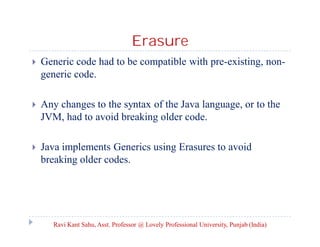
 Generic code had to be compatible with pre-existing, non-
generic code.
 Any changes to the syntax of the Java language, or to the
JVM, had to avoid breaking older code.
 Java implements Generics using Erasures to avoid
breaking older codes.
Ravi Kant Sahu, Asst. Professor @ Lovely Professional University, Punjab (India)
Working of Erasure
 When Java code is compiled, all generic type information
is removed (erased).
 This includes replacing type parameters with their bound
type, which is Object if no explicit bound is specified.
 Then applying the appropriate casts (as determined by the
type arguments) to maintain type compatibility with the
types specified by the type arguments.
Ravi Kant Sahu, Asst. Professor @ Lovely Professional University, Punjab (India)
Erasures
 The compiler enforces type compatibility.
 It means that no type parameters exist at run time.
 They are simply a source-code mechanism.
Ravi Kant Sahu, Asst. Professor @ Lovely Professional University, Punjab (India)
Generic restrictions
Ravi Kant Sahu, Asst. Professor @ Lovely Professional University, Punjab (India)
Generic Restrictions
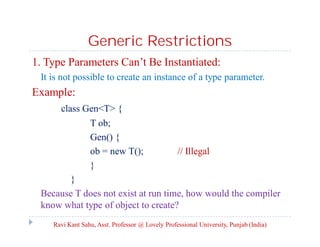
1. Type Parameters Can’t Be Instantiated:
It is not possible to create an instance of a type parameter.
Example:
class Gen<T> {
T ob;
Gen() {
ob = new T(); // Illegal
}
}
Because T does not exist at run time, how would the compiler
know what type of object to create?
Ravi Kant Sahu, Asst. Professor @ Lovely Professional University, Punjab (India)
Generic Restrictions
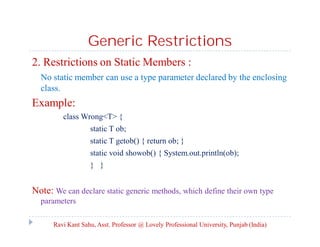
2. Restrictions on Static Members :
No static member can use a type parameter declared by the enclosing
class.
Example:
class Wrong<T> {
static T ob;
static T getob() { return ob; }
static void showob() { System.out.println(ob);
} }
Note: We can declare static generic methods, which define their own type
parameters
Ravi Kant Sahu, Asst. Professor @ Lovely Professional University, Punjab (India)
Generic Restrictions
3. Generic Array Restrictions:
 We cannot instantiate an array whose base type is a type
parameter.
 We cannot create an array of type-specific generic references.
Ravi Kant Sahu, Asst. Professor @ Lovely Professional University, Punjab (India)
class Gen<T extends Number> {
T ob;
T vals[]; // OK
Gen(T o, T[] nums) {
ob = o; // This statement is illegal.
// vals = new T[10]; // can't create an array of T
vals = nums; // OK to assign reference to existent array
}
}
Ravi Kant Sahu, Asst. Professor @ Lovely Professional University, Punjab (India)
class GenArrays {
public static void main(String args[]) {
Integer n[] = { 1, 2, 3, 4, 5 };
Gen<Integer> iOb = new Gen<Integer>(50, n);
// Can't create an array of type-specific generic references.
// Gen<Integer> gens[] = new Gen<Integer>[10]; // Wrong!
// This is OK.
Gen<?> gens[] = new Gen<?>[10]; // OK
}
}
Ravi Kant Sahu, Asst. Professor @ Lovely Professional University, Punjab (India)
Generic Restrictions
4. Generic Exception Restrictions:
 A generic class cannot extend Throwable.
 This means that we cannot create generic exception classes.
Ravi Kant Sahu, Asst. Professor @ Lovely Professional University, Punjab (India)
Generics

Generics

  • 1.
    Advanced Java Programming Topic:Generics By Ravi Kant Sahu Asst. Professor, LPU
  • 2.
    Contents  Introduction  Benefitsof Generics  Generic Classes and Interfaces  Generic Methods  Wildcard Generic Types  Restrictions on Generics Ravi Kant Sahu, Asst. Professor @ Lovely Professional University, Punjab (India)
  • 3.
    Introduction  Enables tocreate classes, interfaces, and methods in which the type of data upon which they operate is specified as a parameter.  Introduced in Java by jdk 1.5.  Generics means parameterized types.  Generics add the type-safety.  Generics add stability to your code by making more of your bugs detectable at compile time. Ravi Kant Sahu, Asst. Professor @ Lovely Professional University, Punjab (India)
  • 4.
    Why Generics?  Thefunctionality of Gen class can be achieved without generics by specifying Object type and using proper casting whenever required. Then why we use Generics?  Java compiler does not have knowledge about the type of data actually stored in NonGen. So-  Explicit casts must be employed to retrieve the stored data.  Several type mismatch errors cannot be found until run time. Ravi Kant Sahu, Asst. Professor @ Lovely Professional University, Punjab (India)
  • 5.
    Why Generics?  Strongertype checks at compile time  Elimination of casts List list = new ArrayList(); list.add("hello"); String s = (String) list.get(0);  Using generics: List<String> list = new ArrayList<String>(); list.add("hello"); String s = list.get(0); // no cast  Enabling programmers to implement generic algorithms. We can implement generic algorithms that work on collections of different types, can be customized, and are type safe and easier to read. Ravi Kant Sahu, Asst. Professor @ Lovely Professional University, Punjab (India)
  • 6.
    Advantage of Generics The ability to create type-safe code in which type- mismatch errors are caught at compile time is a key advantage of generics. Ravi Kant Sahu, Asst. Professor @ Lovely Professional University, Punjab (India)
  • 7.
    Example class Gen<T> { Tob; Gen(T o) { ob = o; } T getob() { return ob; } void showType() { System.out.println("Type of T is " + ob.getClass().getName()); } } Ravi Kant Sahu, Asst. Professor @ Lovely Professional University, Punjab (India)
  • 8.
    class GenDemo { publicstatic void main(String args[]) { Gen<Integer> iOb; iOb = new Gen<Integer>(88); iOb.showType(); int v = iOb.getob(); System.out.println("value: " + v); Gen<String> strOb = new Gen<String>("Generics Test"); strOb.showType(); String str = strOb.getob(); System.out.println("value: " + str); } } Ravi Kant Sahu, Asst. Professor @ Lovely Professional University, Punjab (India)
  • 9.
    Generics Work Onlywith Objects  When declaring an instance of a generic type, the type argument passed to the type parameter must be a class type. Gen<int> strOb = new Gen<int>(53);  The above declaration is an error.  A reference of one specific version of a generic type is not type compatible with another version of the same generic type. iOb = strOb; // Wrong! Ravi Kant Sahu, Asst. Professor @ Lovely Professional University, Punjab (India)
  • 10.
    Generic class Ravi KantSahu, Asst. Professor @ Lovely Professional University, Punjab (India)
  • 11.
    General Form ofGeneric Class  The generics syntax for declaring a generic class: class class-name<type-param-list> { // ... }  The syntax for declaring a reference to a generic class: class-name<type-arg-list> var-name = new class-name<type-arg-list>(cons-arg-list); Ravi Kant Sahu, Asst. Professor @ Lovely Professional University, Punjab (India)
  • 12.
    Generic Class withMultiple Type Parameters class TwoGen<T, V> { T ob1; V ob2; TwoGen(T o1, V o2) { ob1 = o1; ob2 = o2; } void showTypes() { System.out.println("Type of T is " + ob1.getClass().getName()); System.out.println("Type of V is " + ob2.getClass().getName()); } T getob1() { return ob1; } V getob2() { return ob2; }  } Ravi Kant Sahu, Asst. Professor @ Lovely Professional University, Punjab (India)
  • 13.
    class SimpGen { publicstatic void main(String args[]) { TwoGen<Integer, String> t = new TwoGen<Integer, String>(16920, "Ravi Kant"); t.showTypes(); int v = t.getob1(); System.out.println("value: " + v); String str = t.getob2(); System.out.println("value: " + str); } } Ravi Kant Sahu, Asst. Professor @ Lovely Professional University, Punjab (India)
  • 14.
    Problem Create a genericclass that contains a method that returns the average of an array of numbers of any type, including integers, floats, and doubles. Ravi Kant Sahu, Asst. Professor @ Lovely Professional University, Punjab (India)
  • 15.
    Possible Solution class Stats<T>{ T[] nums; Stats(T[] o) { nums = o; } double average() { double sum = 0.0; for(int i=0; i < nums.length; i++) sum += nums[i].doubleValue(); // Error!!! return sum / nums.length; } } Ravi Kant Sahu, Asst. Professor @ Lovely Professional University, Punjab (India)
  • 16.
    Why Error?  Thecompiler has no way to know that you are intending to create Stats objects using only numeric types.  When we try to compile Stats, an error is reported that indicates that the doubleValue( ) method is unknown.  We need some way to tell the compiler that we intend to pass only numeric types to T. Ravi Kant Sahu, Asst. Professor @ Lovely Professional University, Punjab (India)
  • 17.
    Bounded Types  Usedto limit the types that can be passed to a type parameter.  When specifying a type parameter, we can create an upper bound that declares the super-class from which all type arguments must be derived. <T extends superclass>  A bound can include both a class type and one or more interfaces. class Gen<T extends MyClass & MyInterface> Ravi Kant Sahu, Asst. Professor @ Lovely Professional University, Punjab (India)
  • 18.
    WILD CARD GeneRICS RaviKant Sahu, Asst. Professor @ Lovely Professional University, Punjab (India)
  • 19.
    Problem  Create ageneric class that contains a method sameAvg( ) that determines if two Stats objects contain arrays that yield the same average, no matter what type of numeric data each object holds.  For example, if one object contains the double values 1.0, 2.0, and 3.0, and the other object contains the integer values 2, 1, and 3, then the averages will be the same. Ravi Kant Sahu, Asst. Professor @ Lovely Professional University, Punjab (India)
  • 20.
    Possible Solution Integer inums[]= { 1, 2, 3, 4 }; Double dnums[] = { 1.1, 2.2, 3.3, 4.4 }; Stats<Integer> iob = new Stats<Integer>(inums); Stats<Double> dob = new Stats<Double>(dnums); if(iob.sameAvg(dob)) System.out.println("Averages are the same."); else System.out.println("Averages differ."); boolean same_Avg(Stats<T> ob) { if(average() == ob.average()) return true; return false; } Ravi Kant Sahu, Asst. Professor @ Lovely Professional University, Punjab (India)
  • 21.
    Why Error?  Itwill work only with the objects of same type.  If the invoking object is of type Stats<Integer>, then the parameter ob must also be of type Stats<Integer>. Ravi Kant Sahu, Asst. Professor @ Lovely Professional University, Punjab (India)
  • 22.
    WildCard Argument  Thewildcard simply matches the validity of object.  The wildcard argument is specified by the ?, and it represents an unknown type. boolean same_Avg(Stats<?> ob) { if(average() == ob.average()) return true; return false; } Ravi Kant Sahu, Asst. Professor @ Lovely Professional University, Punjab (India)
  • 23.
    Generic Method Ravi KantSahu, Asst. Professor @ Lovely Professional University, Punjab (India)
  • 24.
    Generic Method  Itis possible to declare a generic method that uses one or more type parameters.  Methods inside a generic class are automatically generic relative to the type parameters.  It is possible to create a generic method that is enclosed within a non-generic class. Ravi Kant Sahu, Asst. Professor @ Lovely Professional University, Punjab (India)
  • 25.
    Generic Methods  Thetype parameters are declared before the return type of the method.  Generic methods can be either static or non-static. <type-param-list> ret-type method-name(param-list) {…} Example: static <T, V extends T> boolean isIn (T x, V[] y) Ravi Kant Sahu, Asst. Professor @ Lovely Professional University, Punjab (India)
  • 26.
    Generic interfaces Ravi KantSahu, Asst. Professor @ Lovely Professional University, Punjab (India)
  • 27.
    Generic Interfaces  Genericinterfaces are specified just like generic classes. Example: interface MinMax<T extends Comparable<T>> { T min(); T max(); }  The implementing class must specify the same bound.  Once the bound has been established, it need not to be specified again in the implements clause. Ravi Kant Sahu, Asst. Professor @ Lovely Professional University, Punjab (India)
  • 28.
    Generic Interface interface MinMax<Textends Comparable<T>> { T min(); T max(); } class My<T extends Comparable<T>> implements MinMax<T> { … } Ravi Kant Sahu, Asst. Professor @ Lovely Professional University, Punjab (India)
  • 29.
    Generic constructors Ravi KantSahu, Asst. Professor @ Lovely Professional University, Punjab (India)
  • 30.
    Generic Constructors  Itis possible for constructors to be generic, even if their class is not. Example: class GenCons { private double val; <T extends Number> GenCons(T arg) { val = arg.doubleValue(); } void show_val() { System.out.println("val: " + val); } } Ravi Kant Sahu, Asst. Professor @ Lovely Professional University, Punjab (India)
  • 31.
    ERASURE Ravi Kant Sahu,Asst. Professor @ Lovely Professional University, Punjab (India)
  • 32.
    Erasure  Generic codehad to be compatible with pre-existing, non- generic code.  Any changes to the syntax of the Java language, or to the JVM, had to avoid breaking older code.  Java implements Generics using Erasures to avoid breaking older codes. Ravi Kant Sahu, Asst. Professor @ Lovely Professional University, Punjab (India)
  • 33.
    Working of Erasure When Java code is compiled, all generic type information is removed (erased).  This includes replacing type parameters with their bound type, which is Object if no explicit bound is specified.  Then applying the appropriate casts (as determined by the type arguments) to maintain type compatibility with the types specified by the type arguments. Ravi Kant Sahu, Asst. Professor @ Lovely Professional University, Punjab (India)
  • 34.
    Erasures  The compilerenforces type compatibility.  It means that no type parameters exist at run time.  They are simply a source-code mechanism. Ravi Kant Sahu, Asst. Professor @ Lovely Professional University, Punjab (India)
  • 35.
    Generic restrictions Ravi KantSahu, Asst. Professor @ Lovely Professional University, Punjab (India)
  • 36.
    Generic Restrictions 1. TypeParameters Can’t Be Instantiated: It is not possible to create an instance of a type parameter. Example: class Gen<T> { T ob; Gen() { ob = new T(); // Illegal } } Because T does not exist at run time, how would the compiler know what type of object to create? Ravi Kant Sahu, Asst. Professor @ Lovely Professional University, Punjab (India)
  • 37.
    Generic Restrictions 2. Restrictionson Static Members : No static member can use a type parameter declared by the enclosing class. Example: class Wrong<T> { static T ob; static T getob() { return ob; } static void showob() { System.out.println(ob); } } Note: We can declare static generic methods, which define their own type parameters Ravi Kant Sahu, Asst. Professor @ Lovely Professional University, Punjab (India)
  • 38.
    Generic Restrictions 3. GenericArray Restrictions:  We cannot instantiate an array whose base type is a type parameter.  We cannot create an array of type-specific generic references. Ravi Kant Sahu, Asst. Professor @ Lovely Professional University, Punjab (India)
  • 39.
    class Gen<T extendsNumber> { T ob; T vals[]; // OK Gen(T o, T[] nums) { ob = o; // This statement is illegal. // vals = new T[10]; // can't create an array of T vals = nums; // OK to assign reference to existent array } } Ravi Kant Sahu, Asst. Professor @ Lovely Professional University, Punjab (India)
  • 40.
    class GenArrays { publicstatic void main(String args[]) { Integer n[] = { 1, 2, 3, 4, 5 }; Gen<Integer> iOb = new Gen<Integer>(50, n); // Can't create an array of type-specific generic references. // Gen<Integer> gens[] = new Gen<Integer>[10]; // Wrong! // This is OK. Gen<?> gens[] = new Gen<?>[10]; // OK } } Ravi Kant Sahu, Asst. Professor @ Lovely Professional University, Punjab (India)
  • 41.
    Generic Restrictions 4. GenericException Restrictions:  A generic class cannot extend Throwable.  This means that we cannot create generic exception classes. Ravi Kant Sahu, Asst. Professor @ Lovely Professional University, Punjab (India)