Inheritance in Java
• Inheritance in java is a mechanism in which one
object acquires all the properties and
behaviours of parent object.
• The idea behind inheritance in java is that you
can create new classes that are built upon
existing classes. When you inherit from an
existing class, you can reuse methods and fields
of parent class, and you can add new methods
and fields also.
• Inheritance represents the IS-A relationship,
also known as parent-child relationship.
Why use inheritance in java
• For Method Overriding (so runtime
polymorphism can be achieved).
• For Code Reusability.
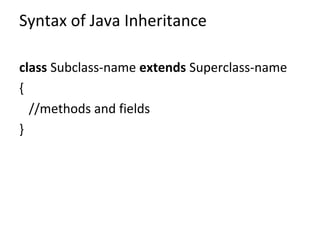
Syntax of Java Inheritance
class Subclass-name extends Superclass-name
{
//methods and fields
}
The extends keyword indicates that you are
making a new class that derives from an
existing class. The meaning of "extends" is to
increase the functionality.
In the terminology of Java, a class which is
inherited is called parent or super class and
the new class is called child or subclass.
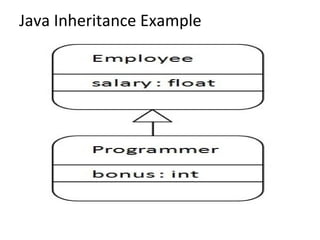
Java Inheritance Example
• As displayed in the above figure, Programmer
is the subclass and Employee is the superclass.
Relationship between two classes
is Programmer IS-A Employee. It means that
Programmer is a type of Employee.
class Employee
{
float salary=40000;
}
class Programmer extends Employee{
int bonus=10000;
public static void main(String args[]){
Programmer p=new Programmer();
System.out.println("Programmer salary is:"+p.salary);
System.out.println("Bonus of Programmer is:"+p.bonus);
} }
Types of inheritance in java
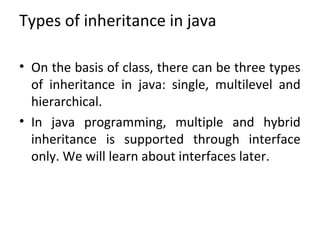
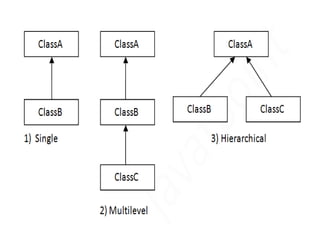
• On the basis of class, there can be three types
of inheritance in java: single, multilevel and
hierarchical.
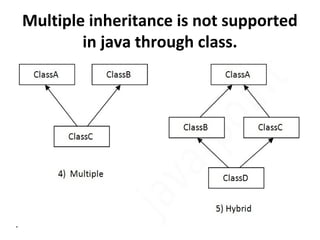
• In java programming, multiple and hybrid
inheritance is supported through interface
only. We will learn about interfaces later.
Multiple inheritance is not supported
in java through class.
Single Inheritance Example
• class Animal{
• void eat(){System.out.println("eating...");}
• }
• class Dog extends Animal{
• void bark(){System.out.println("barking...");}
• }
• class TestInheritance{
• public static void main(String args[]){
• Dog d=new Dog();
• d.bark();
• d.eat();
• }}
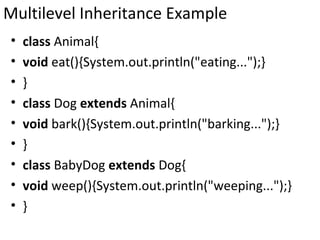
Multilevel Inheritance Example
• class Animal{
• void eat(){System.out.println("eating...");}
• }
• class Dog extends Animal{
• void bark(){System.out.println("barking...");}
• }
• class BabyDog extends Dog{
• void weep(){System.out.println("weeping...");}
• }
• class TestInheritance2{
• public static void main(String args[]){
• BabyDog d=new BabyDog();
• d.weep();
• d.bark();
• d.eat();
• }}
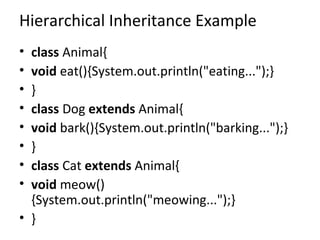
Hierarchical Inheritance Example
• class Animal{
• void eat(){System.out.println("eating...");}
• }
• class Dog extends Animal{
• void bark(){System.out.println("barking...");}
• }
• class Cat extends Animal{
• void meow()
{System.out.println("meowing...");}
• }
• class TestInheritance3{  
• public static void main(String args[]){  
• Cat c=new Cat();  
• c.meow();  
• c.eat();  
• //c.bark();//C.T.Error  
• }}  
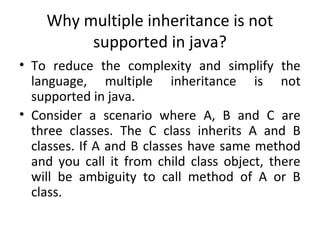
Why multiple inheritance is not 
supported in java?
• To  reduce  the  complexity  and  simplify  the 
language,  multiple  inheritance  is  not 
supported in java.
• Consider  a  scenario  where  A,  B  and  C  are 
three  classes.  The  C  class  inherits  A  and  B 
classes. If A and B classes have same method 
and  you  call  it  from  child  class  object,  there 
will  be  ambiguity  to  call  method  of  A  or  B 
class.
• Since  compile  time  errors  are  better  than 
runtime  errors,  java  renders  compile  time 
error if you inherit 2 classes. So whether you 
have same method or different, there will be 
compile time error now.
• class A{  
• void msg(){System.out.println("Hello");}  
• }  
• class B{  
• void msg(){System.out.println("Welcome");}  
• }  
• class C extends A,B{//suppose if it were  
•    
•  Public Static void main(String args[]){  
•    C obj=new C();  
•    obj.msg();//Now which msg() method would be
 invoked?  
• }  }  

Inheritance in java

  • 1.
  • 2.
    • Inheritance injava is a mechanism in which one object acquires all the properties and behaviours of parent object. • The idea behind inheritance in java is that you can create new classes that are built upon existing classes. When you inherit from an existing class, you can reuse methods and fields of parent class, and you can add new methods and fields also. • Inheritance represents the IS-A relationship, also known as parent-child relationship.
  • 3.
    Why use inheritancein java • For Method Overriding (so runtime polymorphism can be achieved). • For Code Reusability.
  • 4.
    Syntax of JavaInheritance class Subclass-name extends Superclass-name { //methods and fields }
  • 5.
    The extends keywordindicates that you are making a new class that derives from an existing class. The meaning of "extends" is to increase the functionality. In the terminology of Java, a class which is inherited is called parent or super class and the new class is called child or subclass.
  • 6.
  • 7.
    • As displayedin the above figure, Programmer is the subclass and Employee is the superclass. Relationship between two classes is Programmer IS-A Employee. It means that Programmer is a type of Employee.
  • 8.
    class Employee { float salary=40000; } classProgrammer extends Employee{ int bonus=10000; public static void main(String args[]){ Programmer p=new Programmer(); System.out.println("Programmer salary is:"+p.salary); System.out.println("Bonus of Programmer is:"+p.bonus); } }
  • 9.
    Types of inheritancein java • On the basis of class, there can be three types of inheritance in java: single, multilevel and hierarchical. • In java programming, multiple and hybrid inheritance is supported through interface only. We will learn about interfaces later.
  • 11.
    Multiple inheritance isnot supported in java through class.
  • 12.
    Single Inheritance Example •class Animal{ • void eat(){System.out.println("eating...");} • } • class Dog extends Animal{ • void bark(){System.out.println("barking...");} • } • class TestInheritance{ • public static void main(String args[]){ • Dog d=new Dog(); • d.bark(); • d.eat(); • }}
  • 13.
    Multilevel Inheritance Example •class Animal{ • void eat(){System.out.println("eating...");} • } • class Dog extends Animal{ • void bark(){System.out.println("barking...");} • } • class BabyDog extends Dog{ • void weep(){System.out.println("weeping...");} • }
  • 14.
    • class TestInheritance2{ •public static void main(String args[]){ • BabyDog d=new BabyDog(); • d.weep(); • d.bark(); • d.eat(); • }}
  • 15.
    Hierarchical Inheritance Example •class Animal{ • void eat(){System.out.println("eating...");} • } • class Dog extends Animal{ • void bark(){System.out.println("barking...");} • } • class Cat extends Animal{ • void meow() {System.out.println("meowing...");} • }
  • 16.
    • class TestInheritance3{   • public static void main(String args[]){   •Cat c=new Cat();   • c.meow();   • c.eat();   • //c.bark();//C.T.Error   • }}  
  • 17.
    Why multiple inheritance is not  supported in java? • To  reduce the  complexity  and  simplify  the  language,  multiple  inheritance  is  not  supported in java. • Consider  a  scenario  where  A,  B  and  C  are  three  classes.  The  C  class  inherits  A  and  B  classes. If A and B classes have same method  and  you  call  it  from  child  class  object,  there  will  be  ambiguity  to  call  method  of  A  or  B  class.
  • 18.
    • Since  compile time  errors  are  better  than  runtime  errors,  java  renders  compile  time  error if you inherit 2 classes. So whether you  have same method or different, there will be  compile time error now.
  • 19.
    • class A{   • void msg(){System.out.println("Hello");}   •}   • class B{   • void msg(){System.out.println("Welcome");}   • }   • class C extends A,B{//suppose if it were   •     •  Public Static void main(String args[]){   •    C obj=new C();   •    obj.msg();//Now which msg() method would be  invoked?   • }  }