General Principles of Analytical
Method of Validation
Presented by Shobha Kumari (1912081)
B.Pharmacy (6th sem)
G.H.G. Khalsa college of Pharmacy Gurusar Sadhar, Ludhiana
Introduction
 Validation is the process of establishing documentary evidence
demonstrating that a procedure, process, activity carried out in
testing and then production maintain the desirable level of
compliance all stages.
 The process of providing the analytical procedure is acceptable or
its intended us.(ICH Q2)
 The analytical methods used for analyzing clinical sample should be
validated. Validation is a process of planned and systematic study
to confirm that it is suitable for intendeduse.
 Analytical method are used to test and ensure the quality, purity,
potency of drug substance.
 Analytical method are followed from official Pharmacopeia or
developed by users.
 Validation of analytical procedure is a process in which laboratory
studies are conducted to establish .
Need of validate an Analytical method
For assuring the quality of system
For achieving the acceptance of the
product( safe for human use)
Mandatory requirement for registration of
any pharmaceutical product
Mandatory requirement for accreditation
as per ISO guideline
Type of analytical procedure to be
Validated
Identification tests (Identification test ensure the
identity of analyte in sample by comparing s property of
sample with standard.)
Quantitative test for impurity content
Limit test for control of impurity
Assay procedure (Quantitativetest of active moiety in
sample of drug substance or product)
When should revalidation be done?
✓ Change in the process for synthesis of the drug
substance
✓ Change in composition of finished product
✓ Change in analytical procedure
✓ Transfer of method from one laboratory to other
✓ Changes in major pieces of equipment
instrument.
Validation CHARACTERISTICS
 Specificity
 Range
 Linearity
 Accuracy
 Precision
 Detection limit
 Quantitative limit
 Robustness
 System suitability testing
Specificity
It should be conducted during the validation of
identification tests, determination of impurities and the
assay.
It is ability to measure unequivocally the desired analyte in
presence of components such as excipient and impurities
that may also expected to be present.
Linearity
 It indicates the ability to produce results that are directly proportional to the
concentration of the analyte in sample.
Range
The range is derived from the linearity studies
and depend on intended application of
procedure.
It is interval between the upper and lower
concentration (amount) of analyte in the
sample for which it has been demonstrated that
the analytical procedure has been suitable level
of precision, accuracy and linearity.
Accuracy
It is analytical method is the closeness of
test results obtained by that method to
the true value.
Determination: Accuracy should be
established across the specified range of
the analytical procedure.
Assay (drug substance, drug products)
Impurities (Quantitative)
Precision
The precision of an analytical procedure expresses
the Closeness of agreement between a series of
measurements obtained from multiple sampling of
same homogenous sample under prescribed
conditions.
Robustness
 It should be evaluated during the development phase
and evaluation process depend on the type of
procedure being studied. The result from the separate
samples are influenced by changes in operational and
environment conditions (temperatures, pH). It shows
reliability of analysis when deliberate variations are
made in method parameters.
 Some example of typical variations in liquid
chromatography include:
✓ Influence of variations of pH in mobile phase
✓ Influence of variations in mobile phase composition
✓ Temperatures
✓ Different columns
LOD( limit of detection) :
It is the smallest quantity of an
analytes that can be detected.
Quantitative limits
It is lowest concentration of an analyte in a
simple that may be determined with
acceptable accuracy and precision.
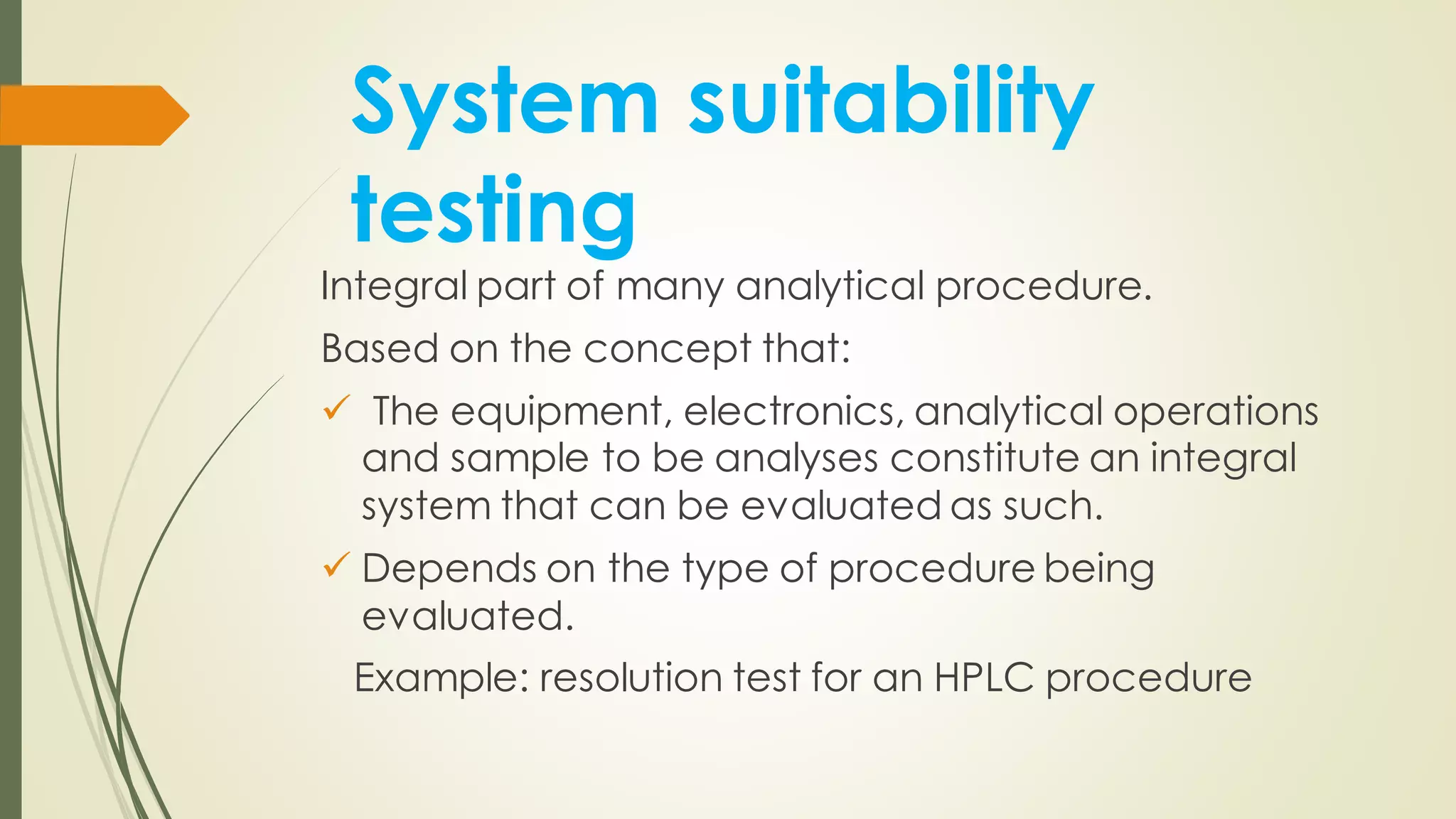
System suitability
testing
Integral part of many analytical procedure.
Based on the concept that:
✓ The equipment, electronics, analytical operations
and sample to be analyses constitute an integral
system that can be evaluated as such.
✓ Depends on the type of procedure being
evaluated.
Example: resolution test for an HPLC procedure
Refrences:
https://www.slideshare.net › analytic.Analytical method
validation – SlideShare
https://slideplayer.com › slideANALYTICAL METHOD
VALIDATION - ppt download – SlidePlayer
https://www.google.com/url?sa=t&source=web&rct=j&
url=https://www.slideshare.net/gaurav11288/analytical-
method-validation-
15380089&ved=2ahUKEwjV47_Jkbn3AhWuzDgGHQkcB8
UQFnoECBEQAQ&usg=AOvVaw1qroChmUwWLYF3ggs
Wow_q
https://slideplayer.com › slideAnalytical Method
Validation - ppt download - SlidePlayer
Thank you

General Principles of Analytical Method of Validation.pdf

  • 1.
    General Principles ofAnalytical Method of Validation Presented by Shobha Kumari (1912081) B.Pharmacy (6th sem) G.H.G. Khalsa college of Pharmacy Gurusar Sadhar, Ludhiana
  • 2.
    Introduction  Validation isthe process of establishing documentary evidence demonstrating that a procedure, process, activity carried out in testing and then production maintain the desirable level of compliance all stages.  The process of providing the analytical procedure is acceptable or its intended us.(ICH Q2)  The analytical methods used for analyzing clinical sample should be validated. Validation is a process of planned and systematic study to confirm that it is suitable for intendeduse.  Analytical method are used to test and ensure the quality, purity, potency of drug substance.  Analytical method are followed from official Pharmacopeia or developed by users.  Validation of analytical procedure is a process in which laboratory studies are conducted to establish .
  • 3.
    Need of validatean Analytical method For assuring the quality of system For achieving the acceptance of the product( safe for human use) Mandatory requirement for registration of any pharmaceutical product Mandatory requirement for accreditation as per ISO guideline
  • 4.
    Type of analyticalprocedure to be Validated Identification tests (Identification test ensure the identity of analyte in sample by comparing s property of sample with standard.) Quantitative test for impurity content Limit test for control of impurity Assay procedure (Quantitativetest of active moiety in sample of drug substance or product)
  • 5.
    When should revalidationbe done? ✓ Change in the process for synthesis of the drug substance ✓ Change in composition of finished product ✓ Change in analytical procedure ✓ Transfer of method from one laboratory to other ✓ Changes in major pieces of equipment instrument.
  • 6.
    Validation CHARACTERISTICS  Specificity Range  Linearity  Accuracy  Precision  Detection limit  Quantitative limit  Robustness  System suitability testing
  • 7.
    Specificity It should beconducted during the validation of identification tests, determination of impurities and the assay. It is ability to measure unequivocally the desired analyte in presence of components such as excipient and impurities that may also expected to be present.
  • 8.
    Linearity  It indicatesthe ability to produce results that are directly proportional to the concentration of the analyte in sample.
  • 9.
    Range The range isderived from the linearity studies and depend on intended application of procedure. It is interval between the upper and lower concentration (amount) of analyte in the sample for which it has been demonstrated that the analytical procedure has been suitable level of precision, accuracy and linearity.
  • 10.
    Accuracy It is analyticalmethod is the closeness of test results obtained by that method to the true value. Determination: Accuracy should be established across the specified range of the analytical procedure. Assay (drug substance, drug products) Impurities (Quantitative)
  • 11.
    Precision The precision ofan analytical procedure expresses the Closeness of agreement between a series of measurements obtained from multiple sampling of same homogenous sample under prescribed conditions.
  • 12.
    Robustness  It shouldbe evaluated during the development phase and evaluation process depend on the type of procedure being studied. The result from the separate samples are influenced by changes in operational and environment conditions (temperatures, pH). It shows reliability of analysis when deliberate variations are made in method parameters.  Some example of typical variations in liquid chromatography include: ✓ Influence of variations of pH in mobile phase ✓ Influence of variations in mobile phase composition ✓ Temperatures ✓ Different columns
  • 13.
    LOD( limit ofdetection) : It is the smallest quantity of an analytes that can be detected. Quantitative limits It is lowest concentration of an analyte in a simple that may be determined with acceptable accuracy and precision.
  • 14.
    System suitability testing Integral partof many analytical procedure. Based on the concept that: ✓ The equipment, electronics, analytical operations and sample to be analyses constitute an integral system that can be evaluated as such. ✓ Depends on the type of procedure being evaluated. Example: resolution test for an HPLC procedure
  • 15.
    Refrences: https://www.slideshare.net › analytic.Analyticalmethod validation – SlideShare https://slideplayer.com › slideANALYTICAL METHOD VALIDATION - ppt download – SlidePlayer https://www.google.com/url?sa=t&source=web&rct=j& url=https://www.slideshare.net/gaurav11288/analytical- method-validation- 15380089&ved=2ahUKEwjV47_Jkbn3AhWuzDgGHQkcB8 UQFnoECBEQAQ&usg=AOvVaw1qroChmUwWLYF3ggs Wow_q https://slideplayer.com › slideAnalytical Method Validation - ppt download - SlidePlayer
  • 16.