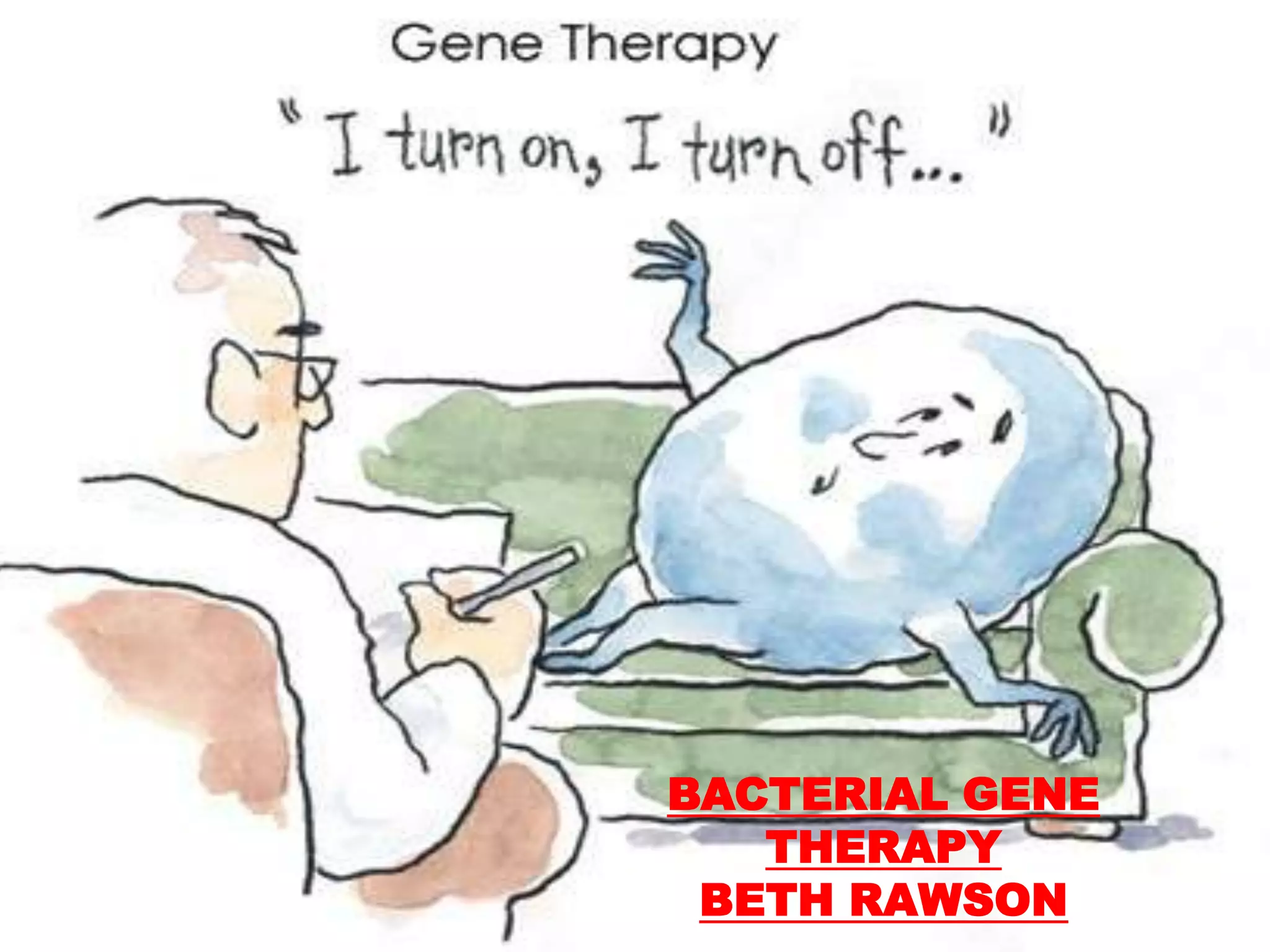
BACTERIAL GENE
   THERAPY
 BETH RAWSON
WHAT GENE THERAPY?
• A technique used to substitute defective
  genes in an individual with genes that do
  work.
• These defects cause diseases and illnesses.
• The scientific world is trying to understand the
  way our body reacts without these genes and
  why our genes sometimes aren’t “on.”
When did it Start?
• James Watson and Francis Crick learned about the double helix of DNA in 1953.
• Gene therapy evolved in the Recombinant DNA Era, in the 1980s.
What Happens?
1. Cut a piece of DNA with restriction
   enzymes
2. Insert the pieces into a plasmid
3. Analyze gene
4. Define defect or disease
5. Make a plan for treatment (example in
   steps 6 and 7)
6. Replace defective cells with “normal”
   cells
7. Insert new cells into patient through
   vectors
Types of Gene Therapy
• Somatic Cells:              • Germline Cells:
1. Majority of cells in the   1. Cells exist in sperm
   human body                    and eggs
2. Not passed on to           2. Potential of having
   future generations            negative effect for
3. Less controversial and        future generations
   more effective if          3. Potentially most
   started sooner                effective
Somatic Cells
•   Cells are removed from
    body before treatment.
•   Grown in lab, fix gene and
    insert back into body
    through blood stream.
•   Many cells to work with.
•   Higher risk for older children
    or young adults.
•   Used to treat illnesses such
    as cancer, cystic fibrosis, and
    muscular dystrophy.
Germline Cells
• Correct abnormalities of
  gene involved in
  reproduction.
• Abnormalities are seen
  before becoming tissue.
• Controversial- “playing
  God” with unformed tissue.
• Most effective during
  embryonic stage.
• Potential negative affects
  on future generations.
Vector Deliveries
                   1. EX-VIVO METHOD
• Outside living body.
• “Normal cells” are inserted in
  vector.
• Blood cells with defective gene
  are removed from patient.
• Patient’s blood is mixed with
  viruses from vector.
• Combination of new and old cells
  are put back into the patient.
• Protein is produced to fight
  disease.
Vector Deliveries
                      2. IN-VIVO METHOD
• Inside living body.
• Does not use patient’s cells.
• Vectors are given “new” and
  “affective” cells.
• New cells put into patient’s
  bloodstream.
• New cells bind with targeted
  diseased cells.
• Reverses effect of gene.
BACTOFECTION:
Newer method of gene therapy.
• Uses bacteria for a direct transfer of the gene to the
  individual.
• Bacterial strains deliver the genes to the plasmid and
  into the cells.
• Bacteria used as “vehicle” to transfer genetic
  information to the cell.
Positive Aspects
• Has “incredible therapeutic
  potential.”
• Potential to find cures to
  genetic diseases.
• Defects can be eliminated
  and not passed on to future
  children.
• Stops suffering of patient and
  family.
Negative Aspects
• Immune system can destroy the
  vector.
• Very expensive for patient.
• “Make the rich, richer, and the
  poor, poorer.”
• “Designer babies” may be made.
• Harmful effects.
• Against religious beliefs.
• “Playing with God and Mother
  Nature.”
WORKS CITED
•   Bergeson, Emilie R. "The Ethics of Gene Therapy." The Ethics of Gene Therapy. Web.
    15 May 2012.
    <http://www.ndsu.edu/pubweb/~mcclean/plsc431/students/bergeson.htm>.
•   Bose, Debopriya. “Gene Therapy Pros and Cons.” Web. 15. 2012.
    <http://www.buzzle.com/articles/gene-therapy-pros-and-cons.html>
•   "Gene Therapy Reverses Type 1 Diabetes in Mice, Study Finds." ScienceDaily.
    ScienceDaily, 06 June 2011. Web. 9 May 2012.
    <http://www.sciencedaily.com/releases/2011/06/110606092738.htm>.
•   Nature.com. Nature Publishing Group. Web. 15 May 2012.
    <http://www.nature.com/gt/journal/v13/n2/full/3302635a.html>.
•   "Types of Gene Therapy." « Walesgenepark.co.uk. Web. 15 May 2012.
    <http://www.walesgenepark.co.uk/types-of-gene-therapy-2>.

Gene therapy pp

  • 1.
    BACTERIAL GENE THERAPY BETH RAWSON
  • 2.
    WHAT GENE THERAPY? •A technique used to substitute defective genes in an individual with genes that do work. • These defects cause diseases and illnesses. • The scientific world is trying to understand the way our body reacts without these genes and why our genes sometimes aren’t “on.”
  • 3.
    When did itStart? • James Watson and Francis Crick learned about the double helix of DNA in 1953. • Gene therapy evolved in the Recombinant DNA Era, in the 1980s.
  • 4.
    What Happens? 1. Cuta piece of DNA with restriction enzymes 2. Insert the pieces into a plasmid 3. Analyze gene 4. Define defect or disease 5. Make a plan for treatment (example in steps 6 and 7) 6. Replace defective cells with “normal” cells 7. Insert new cells into patient through vectors
  • 5.
    Types of GeneTherapy • Somatic Cells: • Germline Cells: 1. Majority of cells in the 1. Cells exist in sperm human body and eggs 2. Not passed on to 2. Potential of having future generations negative effect for 3. Less controversial and future generations more effective if 3. Potentially most started sooner effective
  • 6.
    Somatic Cells • Cells are removed from body before treatment. • Grown in lab, fix gene and insert back into body through blood stream. • Many cells to work with. • Higher risk for older children or young adults. • Used to treat illnesses such as cancer, cystic fibrosis, and muscular dystrophy.
  • 7.
    Germline Cells • Correctabnormalities of gene involved in reproduction. • Abnormalities are seen before becoming tissue. • Controversial- “playing God” with unformed tissue. • Most effective during embryonic stage. • Potential negative affects on future generations.
  • 8.
    Vector Deliveries 1. EX-VIVO METHOD • Outside living body. • “Normal cells” are inserted in vector. • Blood cells with defective gene are removed from patient. • Patient’s blood is mixed with viruses from vector. • Combination of new and old cells are put back into the patient. • Protein is produced to fight disease.
  • 9.
    Vector Deliveries 2. IN-VIVO METHOD • Inside living body. • Does not use patient’s cells. • Vectors are given “new” and “affective” cells. • New cells put into patient’s bloodstream. • New cells bind with targeted diseased cells. • Reverses effect of gene.
  • 10.
    BACTOFECTION: Newer method ofgene therapy. • Uses bacteria for a direct transfer of the gene to the individual. • Bacterial strains deliver the genes to the plasmid and into the cells. • Bacteria used as “vehicle” to transfer genetic information to the cell.
  • 11.
    Positive Aspects • Has“incredible therapeutic potential.” • Potential to find cures to genetic diseases. • Defects can be eliminated and not passed on to future children. • Stops suffering of patient and family.
  • 12.
    Negative Aspects • Immunesystem can destroy the vector. • Very expensive for patient. • “Make the rich, richer, and the poor, poorer.” • “Designer babies” may be made. • Harmful effects. • Against religious beliefs. • “Playing with God and Mother Nature.”
  • 13.
    WORKS CITED • Bergeson, Emilie R. "The Ethics of Gene Therapy." The Ethics of Gene Therapy. Web. 15 May 2012. <http://www.ndsu.edu/pubweb/~mcclean/plsc431/students/bergeson.htm>. • Bose, Debopriya. “Gene Therapy Pros and Cons.” Web. 15. 2012. <http://www.buzzle.com/articles/gene-therapy-pros-and-cons.html> • "Gene Therapy Reverses Type 1 Diabetes in Mice, Study Finds." ScienceDaily. ScienceDaily, 06 June 2011. Web. 9 May 2012. <http://www.sciencedaily.com/releases/2011/06/110606092738.htm>. • Nature.com. Nature Publishing Group. Web. 15 May 2012. <http://www.nature.com/gt/journal/v13/n2/full/3302635a.html>. • "Types of Gene Therapy." « Walesgenepark.co.uk. Web. 15 May 2012. <http://www.walesgenepark.co.uk/types-of-gene-therapy-2>.