Module 4 
INDIVIDUAL 
DIFFERENCES
Take the Challenge! 
In this module, challenge yourself to: 
 identify the different factors that bring about 
diversity in the classroom. 
 demonstrate a positive attitude towards 
diversity as an enriching element in the 
learning environment. 
 come up with teaching strategies.
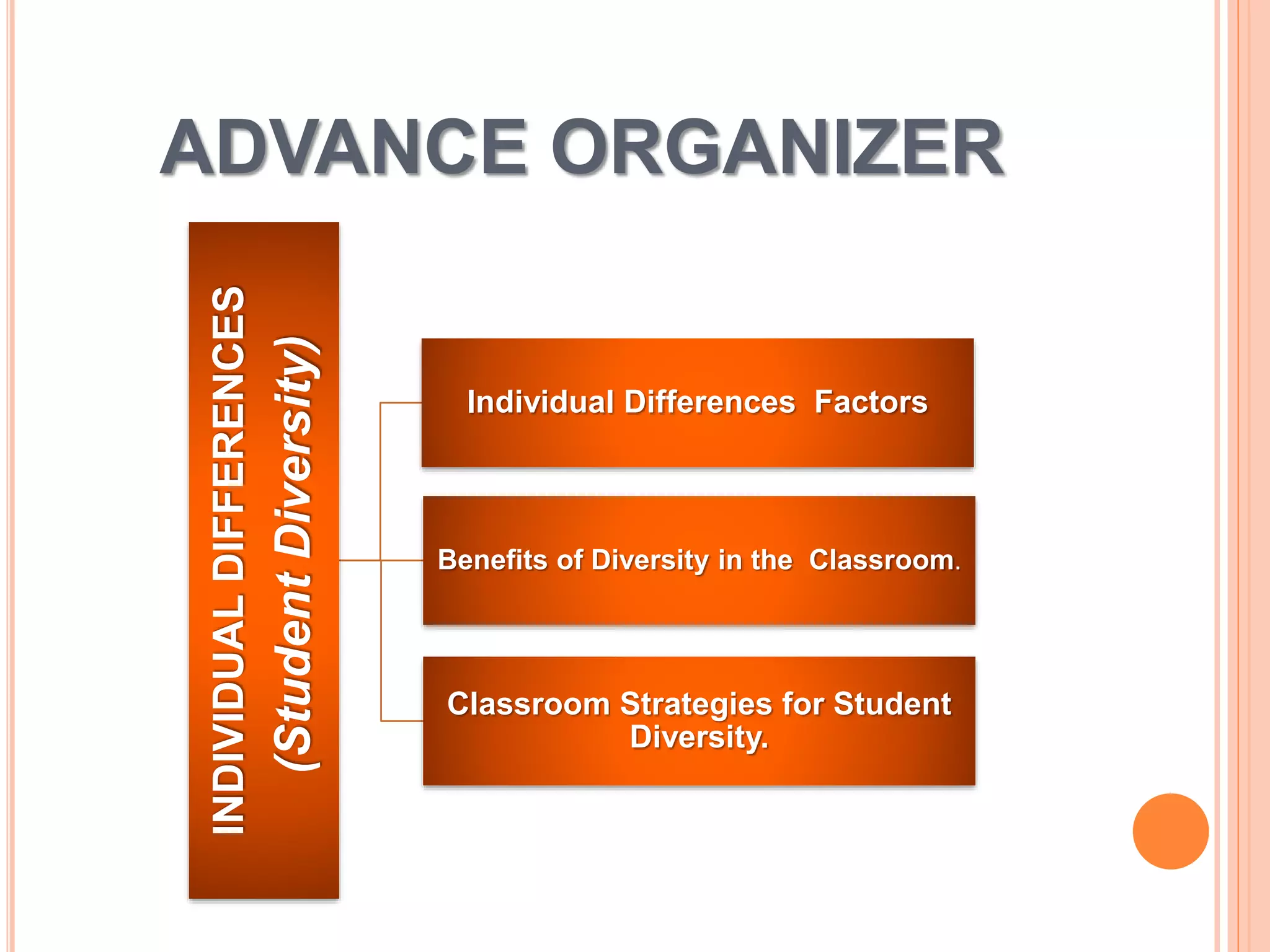
ADVANCE ORGANIZER 
INDIVIDUAL DIFFERENCES 
(Student Diversity) 
Individual Differences Factors 
Benefits of Diversity in the Classroom. 
Classroom Strategies for Student 
Diversity.
Activity: 
Provide information about your 
1. name: 
2. age: 
3. gender: 
4. nationality: 
5. province: 
6. language/dialects spoken: 
7. hobbies/interests: 
8. favorite subjects: 
9. subject you are best in: 
10. subject you find difficult: 
11. ambition:(what you want to be in the future)
ANALYSIS: 
1. In what ways are you and your classmates 
similar? 
2. In what ways are you and your classmates 
different? 
3. How does a girl differ from a boy in behavior? 
4. In what ways does an American differ from a 
Filipino? 
5. How does life in the province differ from that in 
the city? 
6. Are you glad you have similarities? 
differences?
FACTORS THAT BRING ABOUT STUDENT 
DIVERSITY 
In all learning environments, individuals 
interact with others who are in some way 
different from them. It also comes from other 
factors like the following: 
 Socioeconomic status 
 Thinking/learning style (module 8) 
 Exceptionalities (module 9)
HOW STUDENT DIVERSITY ENRICHES THE 
LEARNING ENVIRONMENT? 
1. Students’ self-awareness is enhanced by diversity. 
2. Student diversity contributes to cognitive 
development. 
“The classroom is peculiarly the marketplace of ideas.” –William J. Brennan 
3. Student diversity prepares learners for their role 
as responsible members of society. 
“The classroom can provide more than just theory given by the teacher in a 
lecture. With student diversity, the classroom becomes a ‘public place’ where 
community can be practiced.” –Suzanne Morse 
4. Student diversity can promote harmony.
SOME TIPS ON STUDENT 
DIVERSITY 
1. Encourage learners to share their personal history and 
experiences. 
2. Integrate learning experiences and activities which 
promote students’ multicultural and cross-cultural 
awareness. 
3. Aside from highlighting diversity, identify patterns of 
unity that transcend group differences. 
“ Every human is, at the same time, like all other humans, like 
some humans, and like no other human.” –Clyde Kluckholn cited in Wong, 
1991) 
4. Communicate high expectations to students from all 
sub-groups.
5. Use varied instructional methods to accommodate 
student diversity in learning styles. 
6. Vary the examples you use to illustrate concepts in 
order to provide multiple contexts that are relevant to 
students from diverse backgrounds. 
7. Adapt to the students’ diverse backgrounds and 
learning styles by allowing them personal choice and 
decision-making opportunities concerning what they 
will learn and how they will learn it. 
8. Diversify your methods of assessing and evaluating 
student learning. 
9. Purposely, form small-discussion groups of students 
from diverse backgrounds. You can form groups of 
students with different learning styles, different 
cultural background, etc.
Thank you 
and 
Good night!

Facilitating Learning Module 4

  • 1.
    Module 4 INDIVIDUAL DIFFERENCES
  • 2.
    Take the Challenge! In this module, challenge yourself to:  identify the different factors that bring about diversity in the classroom.  demonstrate a positive attitude towards diversity as an enriching element in the learning environment.  come up with teaching strategies.
  • 3.
    ADVANCE ORGANIZER INDIVIDUALDIFFERENCES (Student Diversity) Individual Differences Factors Benefits of Diversity in the Classroom. Classroom Strategies for Student Diversity.
  • 4.
    Activity: Provide informationabout your 1. name: 2. age: 3. gender: 4. nationality: 5. province: 6. language/dialects spoken: 7. hobbies/interests: 8. favorite subjects: 9. subject you are best in: 10. subject you find difficult: 11. ambition:(what you want to be in the future)
  • 5.
    ANALYSIS: 1. Inwhat ways are you and your classmates similar? 2. In what ways are you and your classmates different? 3. How does a girl differ from a boy in behavior? 4. In what ways does an American differ from a Filipino? 5. How does life in the province differ from that in the city? 6. Are you glad you have similarities? differences?
  • 6.
    FACTORS THAT BRINGABOUT STUDENT DIVERSITY In all learning environments, individuals interact with others who are in some way different from them. It also comes from other factors like the following:  Socioeconomic status  Thinking/learning style (module 8)  Exceptionalities (module 9)
  • 7.
    HOW STUDENT DIVERSITYENRICHES THE LEARNING ENVIRONMENT? 1. Students’ self-awareness is enhanced by diversity. 2. Student diversity contributes to cognitive development. “The classroom is peculiarly the marketplace of ideas.” –William J. Brennan 3. Student diversity prepares learners for their role as responsible members of society. “The classroom can provide more than just theory given by the teacher in a lecture. With student diversity, the classroom becomes a ‘public place’ where community can be practiced.” –Suzanne Morse 4. Student diversity can promote harmony.
  • 8.
    SOME TIPS ONSTUDENT DIVERSITY 1. Encourage learners to share their personal history and experiences. 2. Integrate learning experiences and activities which promote students’ multicultural and cross-cultural awareness. 3. Aside from highlighting diversity, identify patterns of unity that transcend group differences. “ Every human is, at the same time, like all other humans, like some humans, and like no other human.” –Clyde Kluckholn cited in Wong, 1991) 4. Communicate high expectations to students from all sub-groups.
  • 9.
    5. Use variedinstructional methods to accommodate student diversity in learning styles. 6. Vary the examples you use to illustrate concepts in order to provide multiple contexts that are relevant to students from diverse backgrounds. 7. Adapt to the students’ diverse backgrounds and learning styles by allowing them personal choice and decision-making opportunities concerning what they will learn and how they will learn it. 8. Diversify your methods of assessing and evaluating student learning. 9. Purposely, form small-discussion groups of students from diverse backgrounds. You can form groups of students with different learning styles, different cultural background, etc.
  • 10.
    Thank you and Good night!