Communication
Communication
for Various
for Various
Purposes
Purposes
GEC103 PURPOSIVE COMMUNICATION:
UNIT 3
Lesson 1: Informative,
Persuasive, and
Persuasive, and
Argumentative Speeches
Defining each Communication Type
and its Purpose
and its Purpose
1. Informative: Shares facts and explanations
objectively to increase understanding.
Seen in: Textbooks, news, lectures.
Purpose: To educate or increase understanding by
presenting facts objectively.
Persuasive: Aims to influence beliefs or actions using
emotion or logic.
Seen in: Ads, speeches, opinion pieces.
Purpose: To convince the audience to adopt a belief,
attitude, or take action.
Defining each Communication Type
and its Purpose
and its Purpose
Argumentative: Defends a claim using logic,
evidence, and counterarguments.
Seen in: Debates, essays, research papers.
Purpose: To defend a claim using logic and
evidence, while addressing counterpoints.
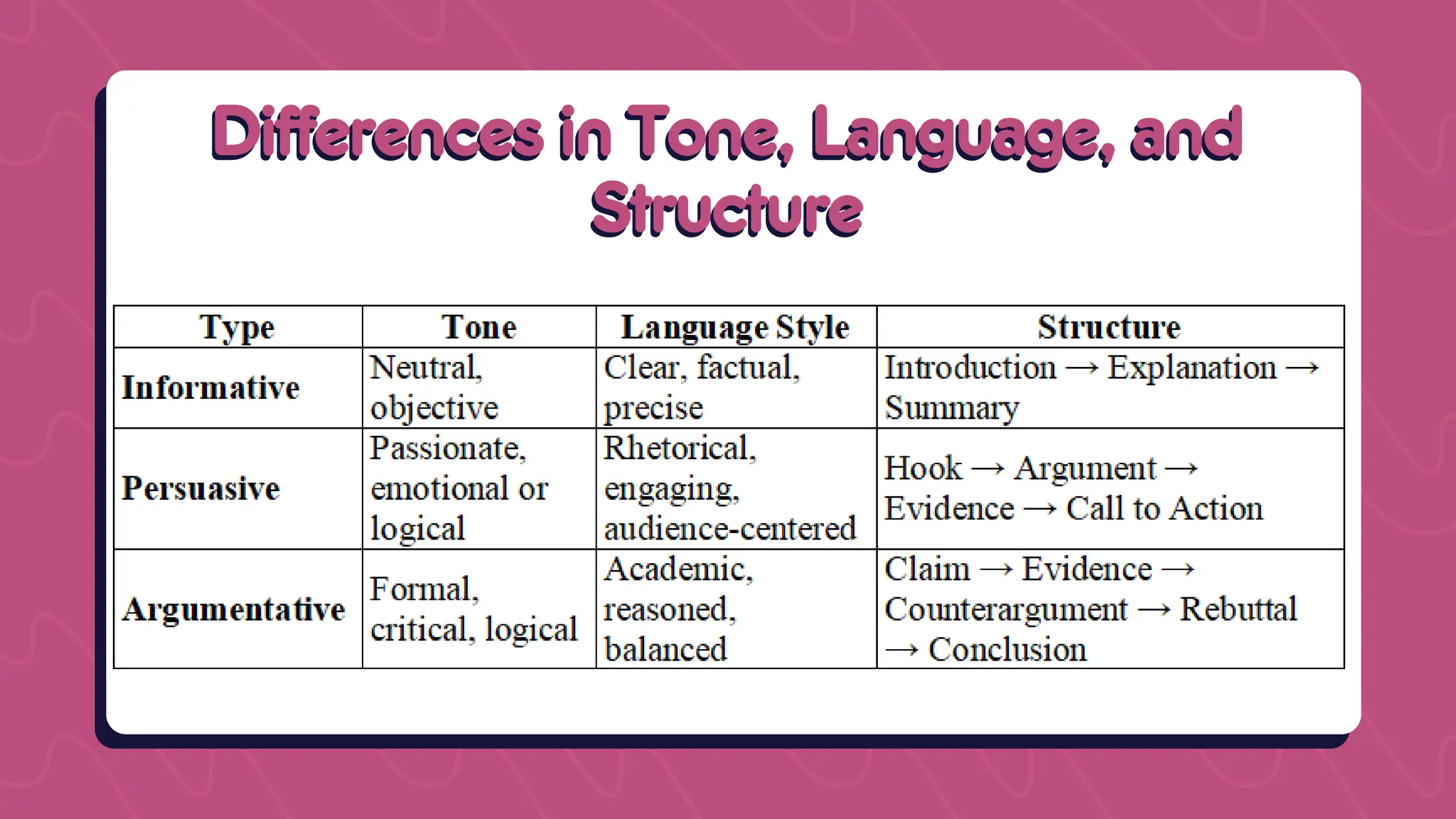
Differences in Tone, Language, and
Structure
Structure
Defining each Communication Type
and its Purpose
and its Purpose
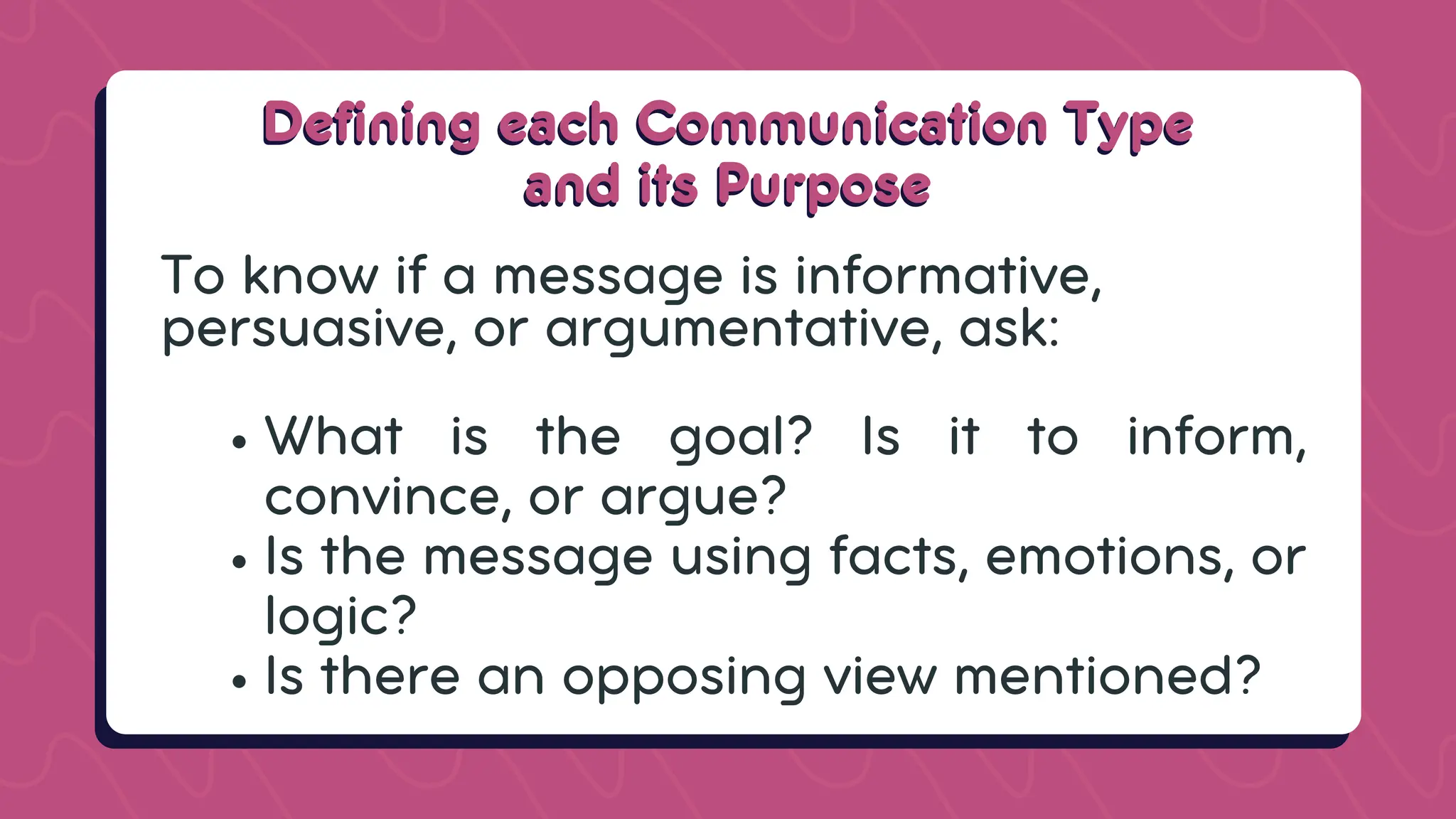
To know if a message is informative,
persuasive, or argumentative, ask:
What is the goal? Is it to inform,
convince, or argue?
Is the message using facts, emotions, or
logic?
Is there an opposing view mentioned?
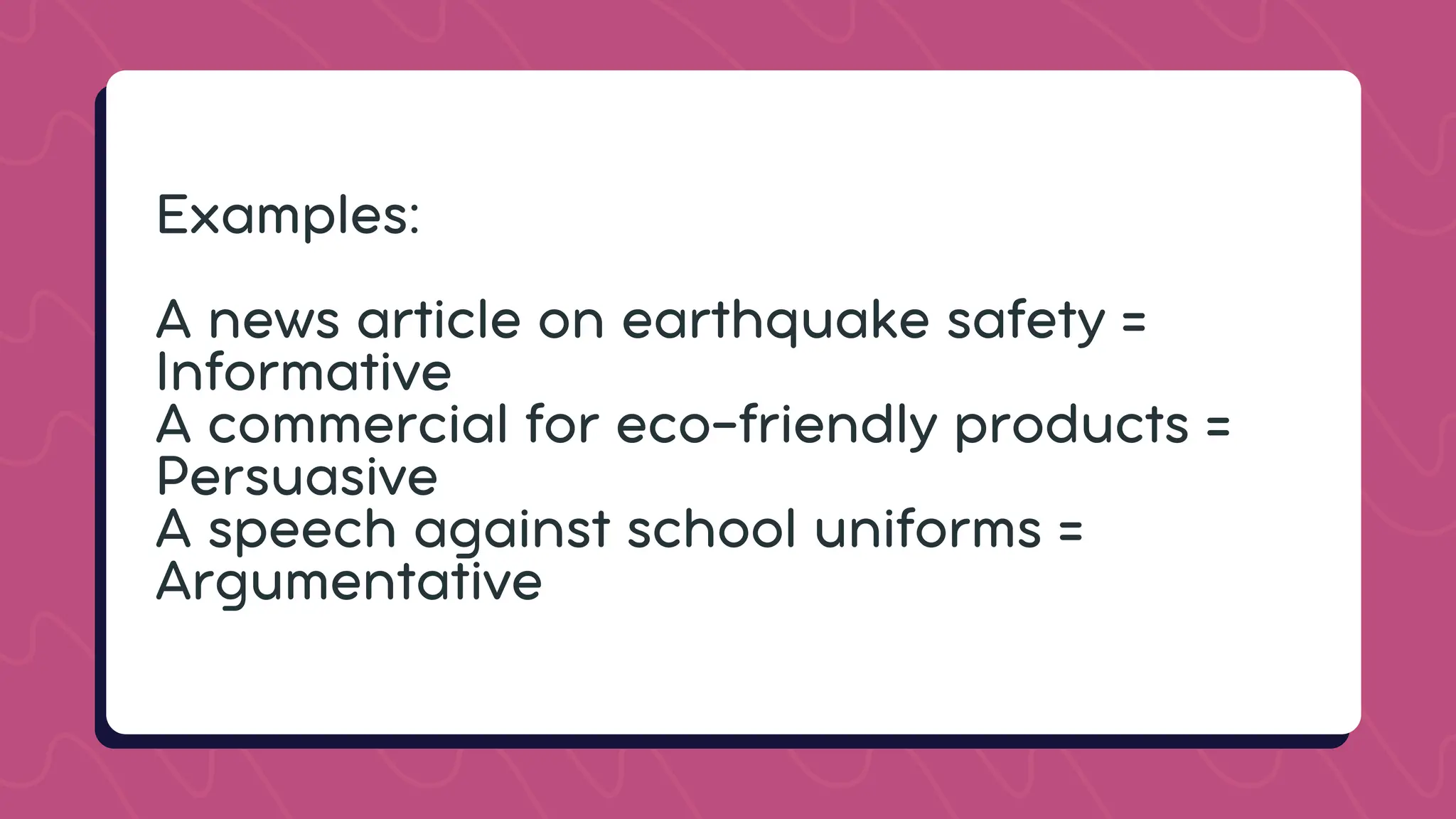
Examples:
A news article on earthquake safety =
Informative
A commercial for eco-friendly products =
Persuasive
A speech against school uniforms =
Argumentative
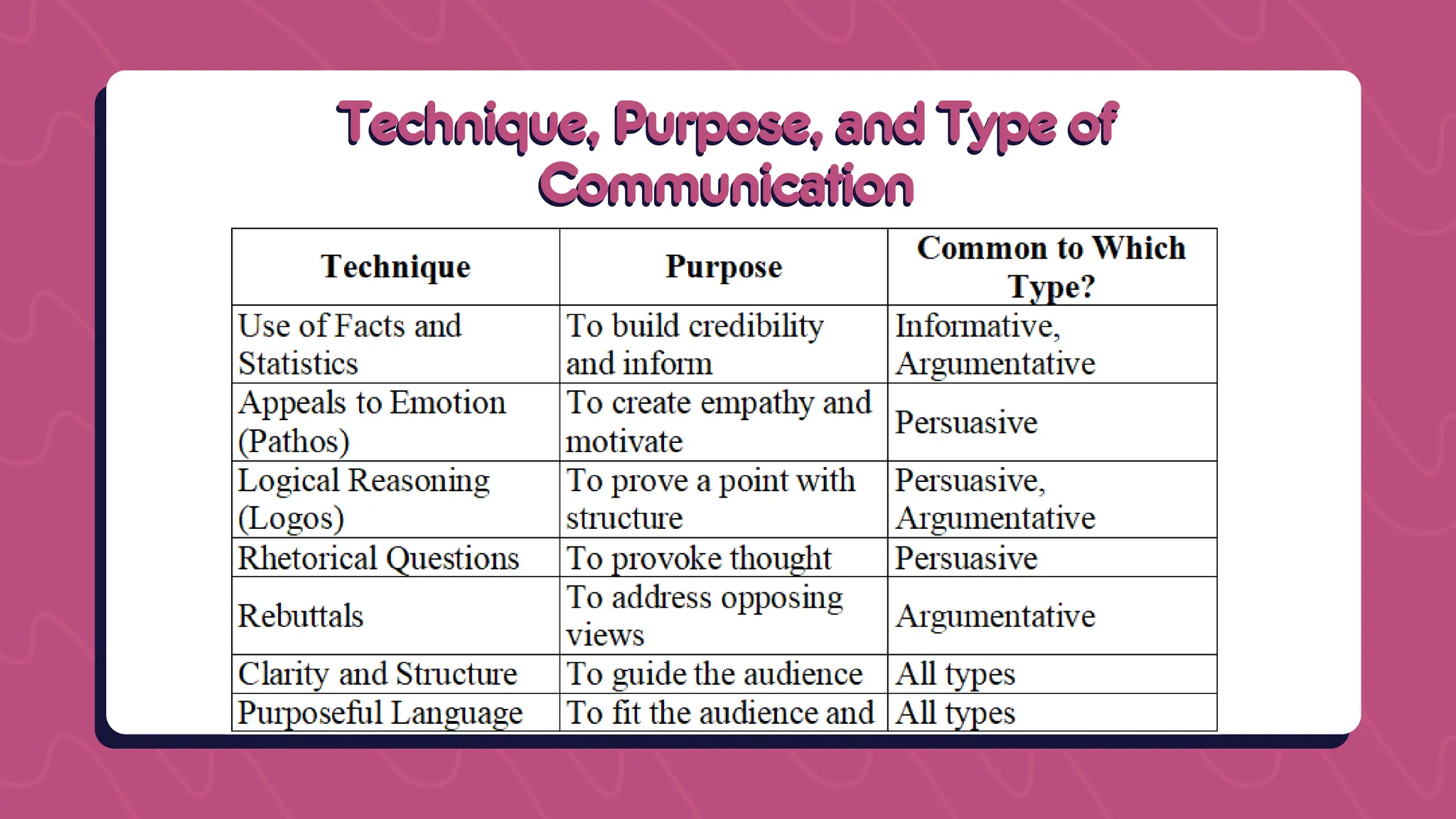
Technique, Purpose, and Type of
Communication
Communication
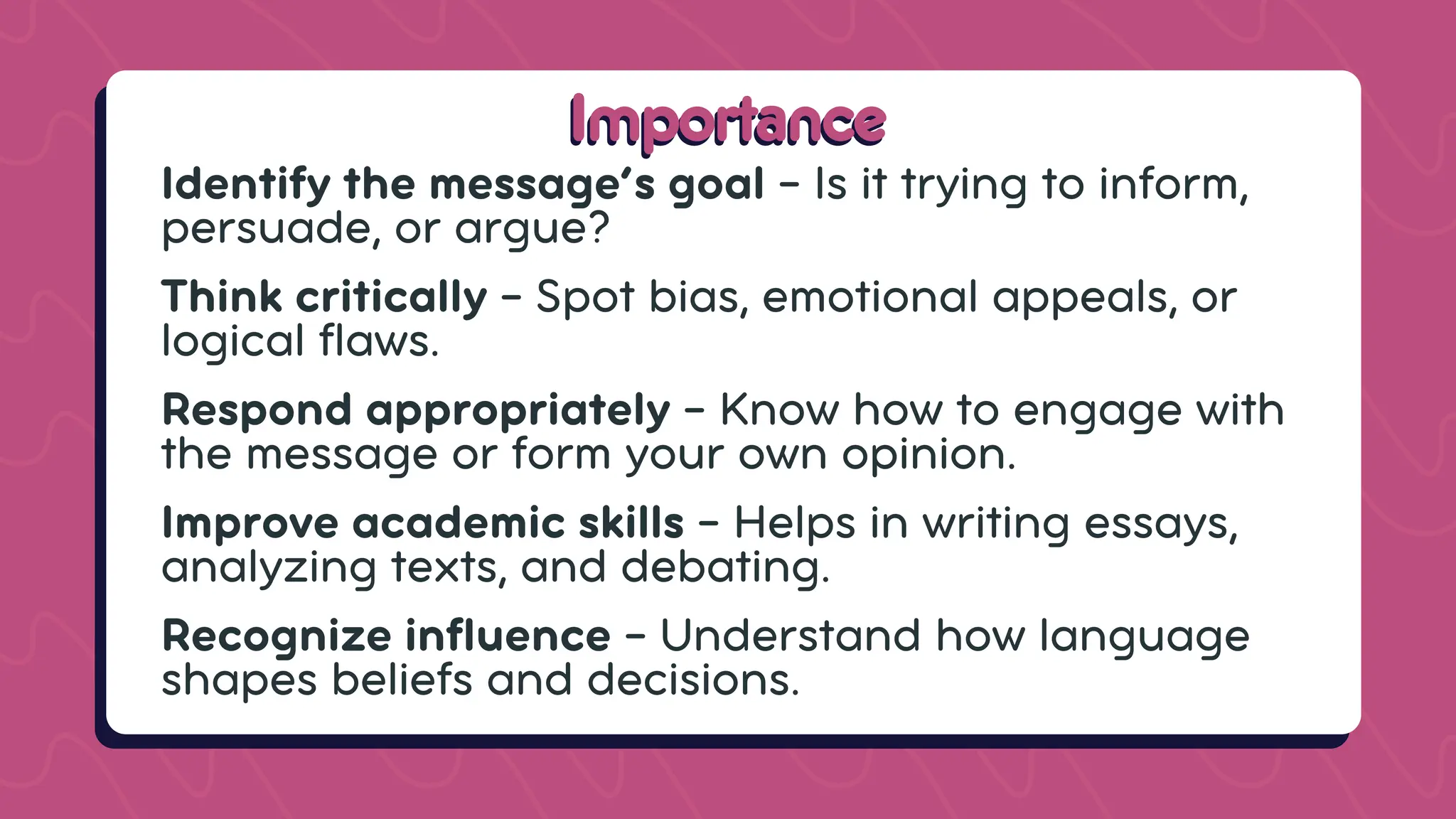
Importance
Importance
Identify the message’s goal – Is it trying to inform,
persuade, or argue?
Think critically – Spot bias, emotional appeals, or
logical flaws.
Respond appropriately – Know how to engage with
the message or form your own opinion.
Improve academic skills – Helps in writing essays,
analyzing texts, and debating.
Recognize influence – Understand how language
shapes beliefs and decisions.
Lesson 2:
Lesson 2:
Principles and Types
of Speeches
of Speeches
I. Principles of Effective Speech Delivery
Appearance: Look friendly and relatable to
connect with the audience.
Movement: Move with purpose; avoid nervous
gestures.
Posture: Stand tall and relaxed to show
confidence.
Facial Expressions: Match your expressions
to your message; smile warmly.
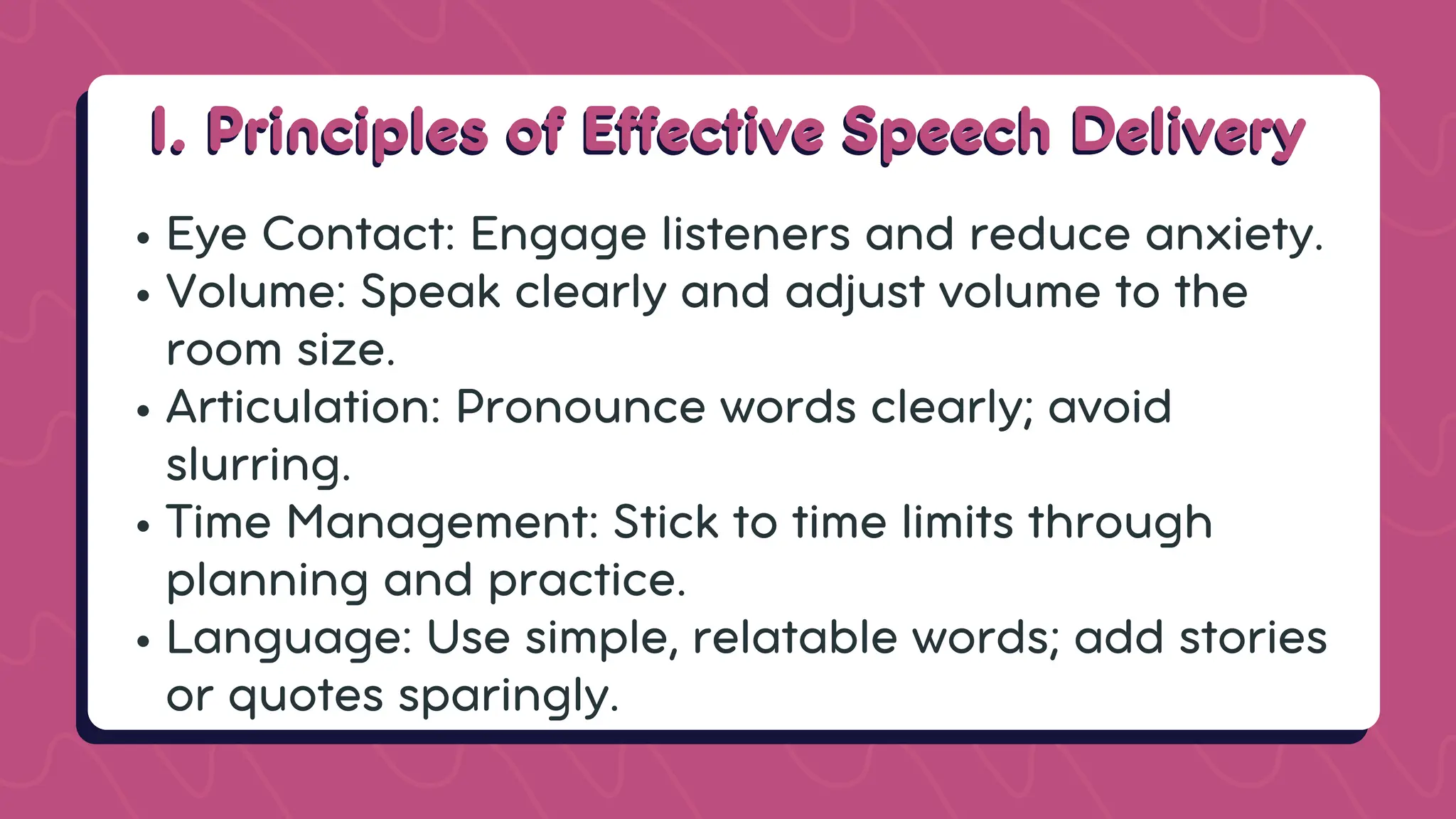
I. Principles of Effective Speech Delivery
Eye Contact: Engage listeners and reduce anxiety.
Volume: Speak clearly and adjust volume to the
room size.
Articulation: Pronounce words clearly; avoid
slurring.
Time Management: Stick to time limits through
planning and practice.
Language: Use simple, relatable words; add stories
or quotes sparingly.
II. Types of Speech
II. Types of Speech
1) Manuscript Speech - This type involves
reading a speech word-for-word from a
written script, allowing precise control over
wording.
2) Memorized Speech - Here, the entire
speech is committed to memory. While it may
seem structured, the risk of forgetting lines
can make the delivery appear unnatural or
rushed.
II. Types of Speech
II. Types of Speech
3)ImpromptuSpeech-Givenwithlittleorno
preparation,impromptuspeechesarecommonindaily
interactions.Theyrequirequickthinkingand
adaptability.
4)ExtemporaneousSpeech-Thisformatbalances
preparationandspontaneity.Usingnotesoranoutline,
speakersmaintainanatural,conversationaltone,
makingitoneofthemosteffectivemethodsforpublic
speaking.
III. Non-verbal Codes in Oral
Communication
Communication
Nonverbal communication enhances trust,
clarity, and engagement when used correctly.
Awareness of body language, facial
expressions, and other nonverbal elements
strengthenspresentationeffectiveness
Key Elements of Nonverbal Communication
EyeContact:Showsinterest;toolittleortoomuch
affectsconnection.
FacialExpressions:Expressemotionsclearlyacross
cultures.
BodyMovement&Posture:Reflectsconfidenceor
discomfort.
Touch:Conveysemotion—e.g.,handshakeorgrip.
Space:Signalscloseness,authority,ordominance.
Voice:Tone,pace,andvolumeshapehowmessages
arereceived.
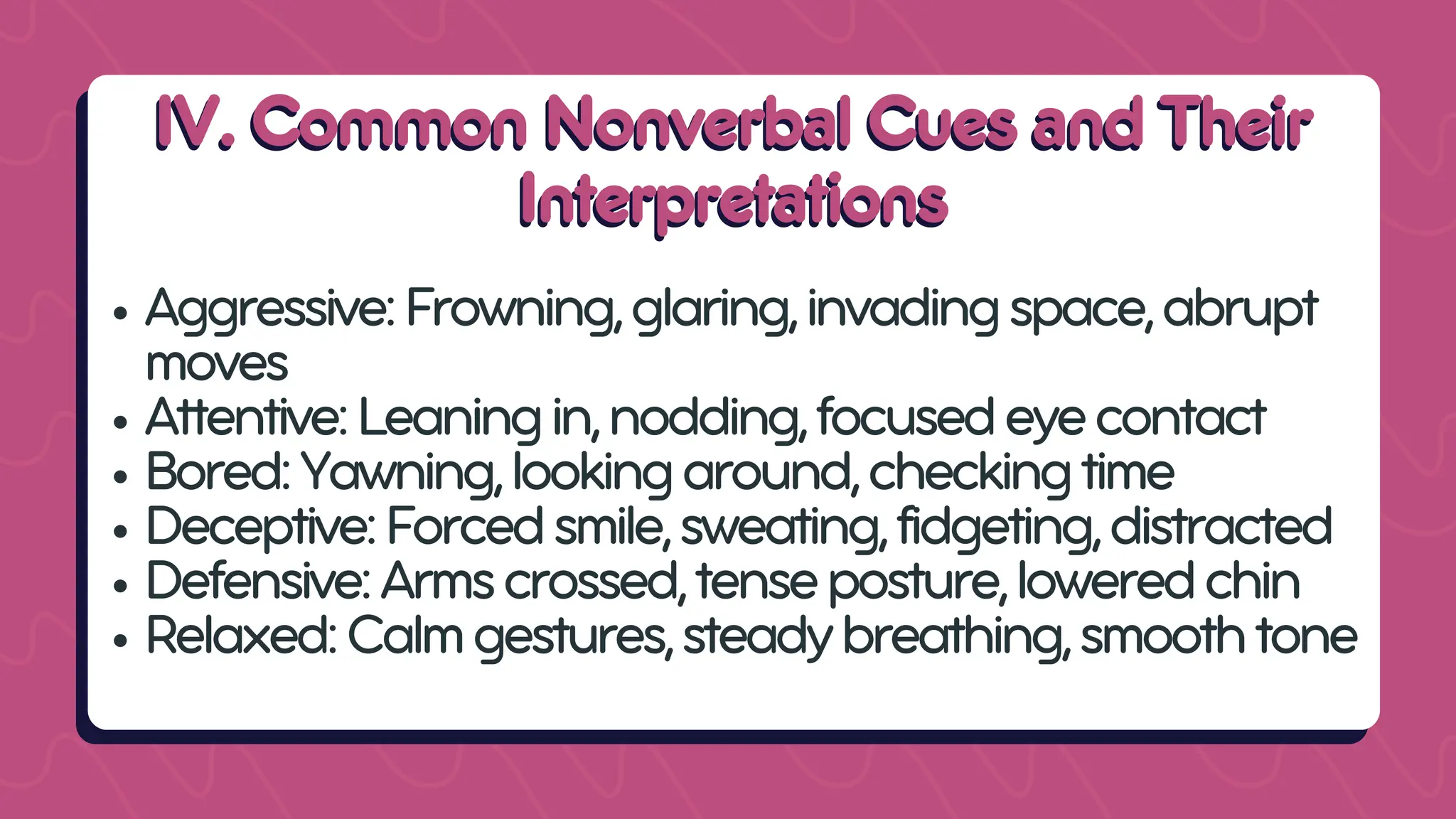
IV. Common Nonverbal Cues and Their
Interpretations
Interpretations
Aggressive:Frowning,glaring,invadingspace,abrupt
moves
Attentive:Leaningin,nodding,focusedeyecontact
Bored:Yawning,lookingaround,checkingtime
Deceptive:Forcedsmile,sweating,fidgeting,distracted
Defensive:Armscrossed,tenseposture,loweredchin
Relaxed:Calmgestures,steadybreathing,smoothtone
Lesson 3:
Lesson 3:
Public Speaking
Public Speaking
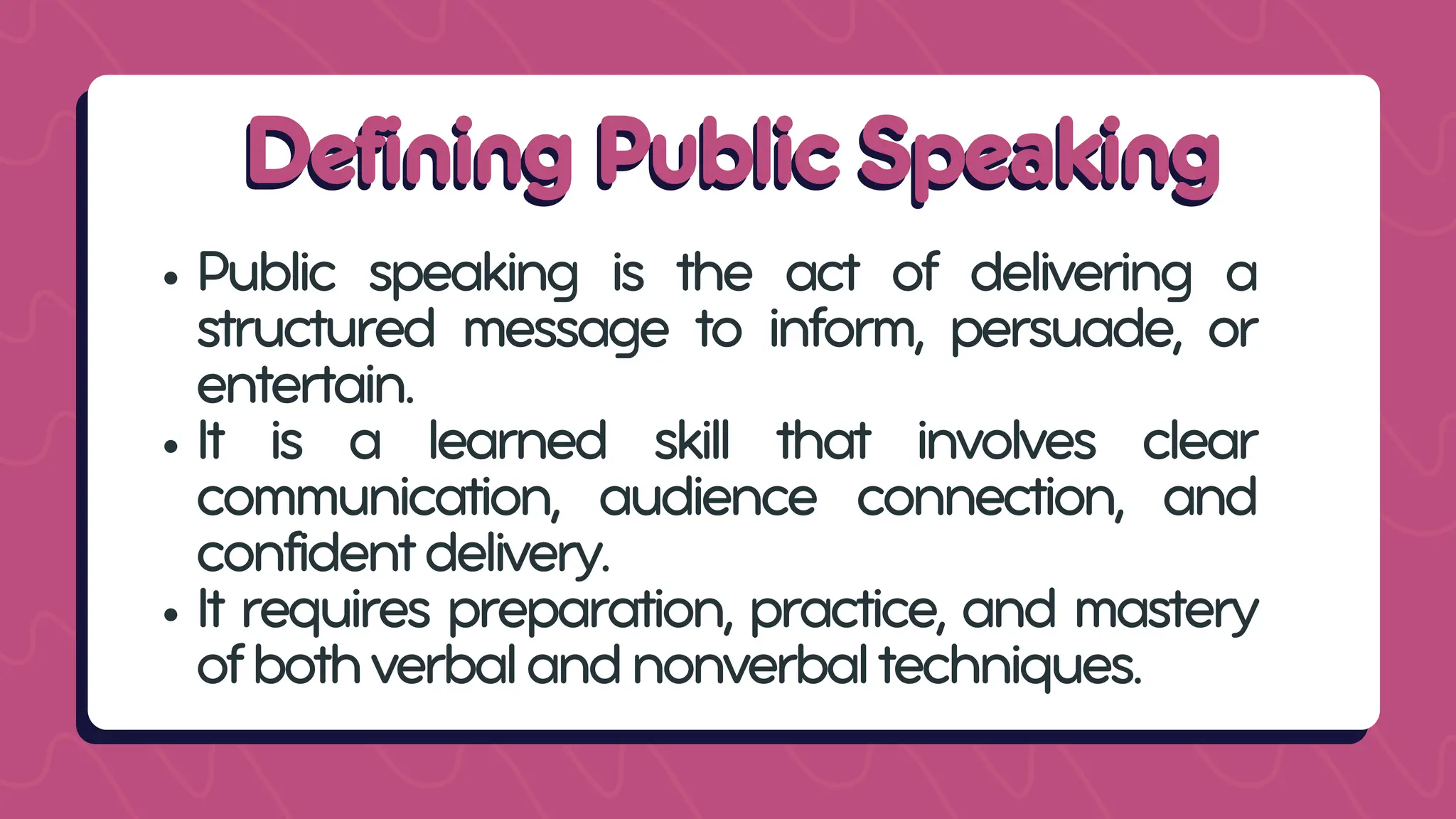
Defining Public Speaking
Public speaking is the act of delivering a
structured message to inform, persuade, or
entertain.
It is a learned skill that involves clear
communication, audience connection, and
confidentdelivery.
It requires preparation, practice, and mastery
ofbothverbalandnonverbaltechniques.
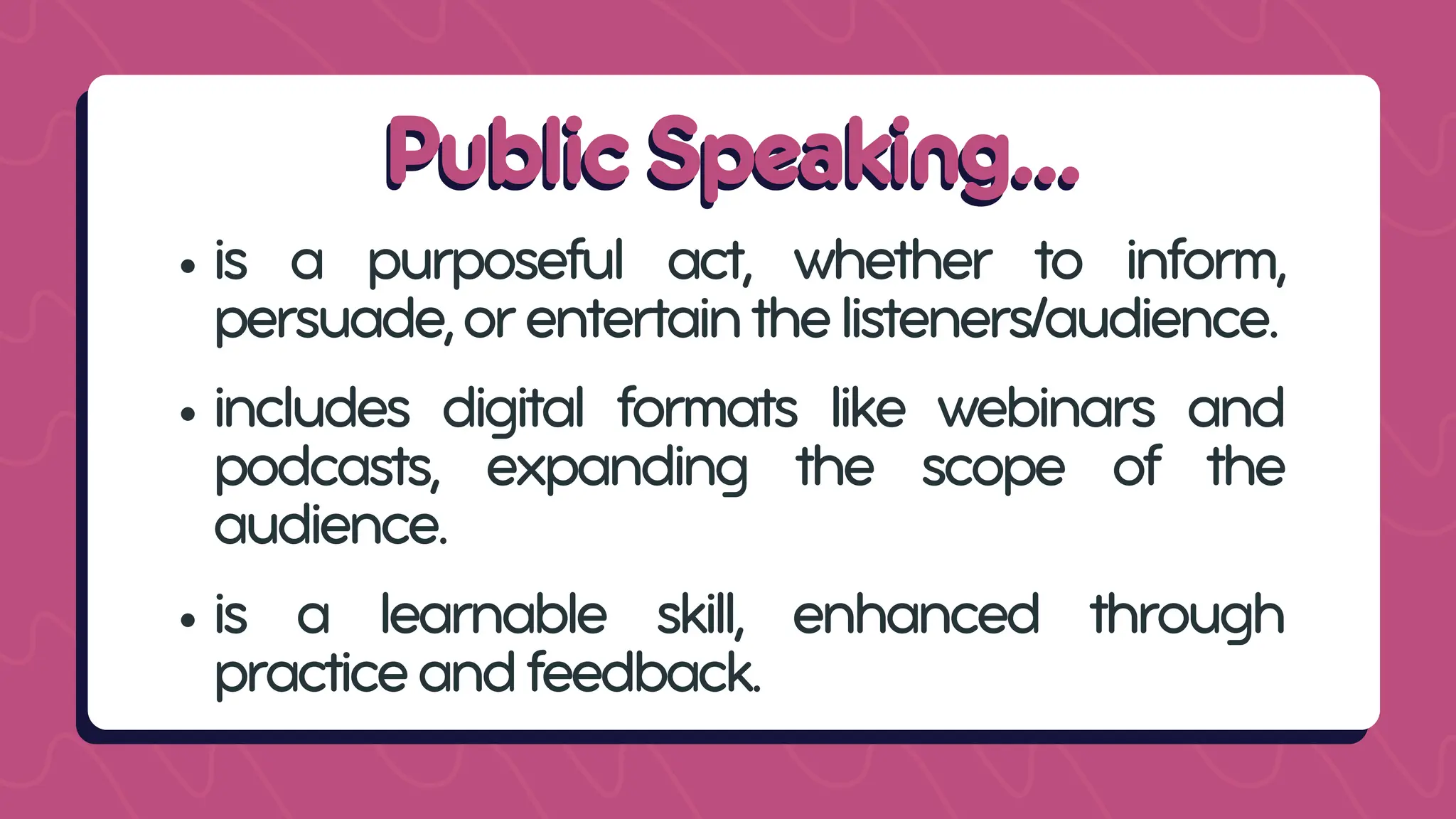
Public Speaking...
Public Speaking...
is a purposeful act, whether to inform,
persuade,orentertainthelisteners/audience.
includes digital formats like webinars and
podcasts, expanding the scope of the
audience.
is a learnable skill, enhanced through
practiceandfeedback.
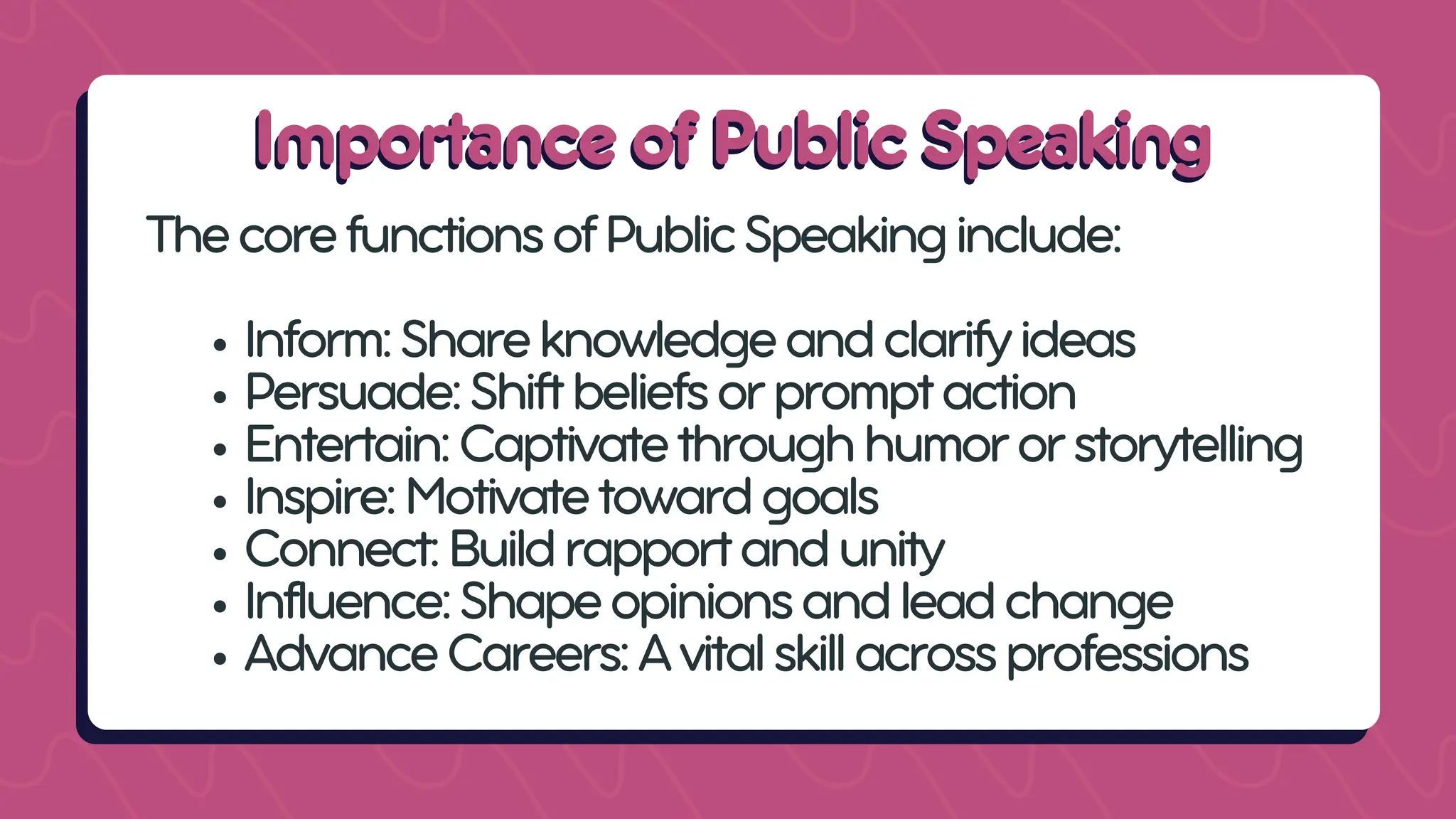
Importance of Public Speaking
ThecorefunctionsofPublicSpeakinginclude:
Inform:Shareknowledgeandclarifyideas
Persuade:Shiftbeliefsorpromptaction
Entertain:Captivatethroughhumororstorytelling
Inspire:Motivatetowardgoals
Connect:Buildrapportandunity
Influence:Shapeopinionsandleadchange
AdvanceCareers:Avitalskillacrossprofessions
Elements of Public Speaking
Effective public speaking is a multifaceted skill that
combines key elements to deliver a powerful and
memorablemessage,whichincludes:
1)Content&Organization
Research&Planning:Ensureaccuracyandrelevance.
Structure:Clearintro,body,andconclusion.
Clarity:Usesimple,directlanguage.
Storytelling:Addrelatablenarratives.
VisualAids:Supportideaswithvisuals.
2)Voice&Articulation
Volume&Pace:Speakclearlyandvaryrhythm.
Enunciation:Pronouncewordsprecisely.
Tone & Pauses: Use emotion and strategic pauses for
emphasis.
3)BodyLanguage&Gestures
Posture & Movement: Stand confidently and move with
purpose.
Eye Contact & Gestures: Engage visually and
physically.
FacialExpressions:Showemotiontoconnect.
4)AudienceEngagement
Know Your Audience: Tailor content to
theirinterests.
Interaction:Encourageparticipation.
Relatability: Share personal or familiar
examples.
Q&A & Feedback: Respond thoughtfully
andlearnfrominput.
Managing Public Speaking Anxiety
(Glossophobia)
(Glossophobia)
Calmyouself(MentallyandPhysically)
PrepareandPracticerepeatedly
ThinkPositively
Get support from your friends, mentors, or
teachers
Trytherapy(ifneeded)
Structure of a Good Speech
Astrongandgoodspeechhasthreemainparts:
1)Introduction
Grab the attention - use a story, question,
funfacts
Givebackgroundorcontext
shareyourmainpurposeoridea
2)Body
Presentyourkeypointsclearlyandinorder
Support each point with examples, facts, or
stories
Use smooth transitions to connect ideas
(transitionaldevices)
3)Conclusion
Summarizeyourmainpoints
Giveacalltoactionorfinalmessage
End with something memorable (quote, strong
statement,orchallenge)
Why Public Speaking is
Important?
Important?
Public speaking is important because it helps you
communicate ideas clearly, build confidence, and
connect with others. It opens doors to career
opportunities, strengthens leadership skills, and
promotes personal growth. Public speaking turns
ideasintoimpact.
Lesson 4:
Lesson 4:
Making Inquiries
Making Inquiries
(Letters, Emails, Job
interview)
interview)
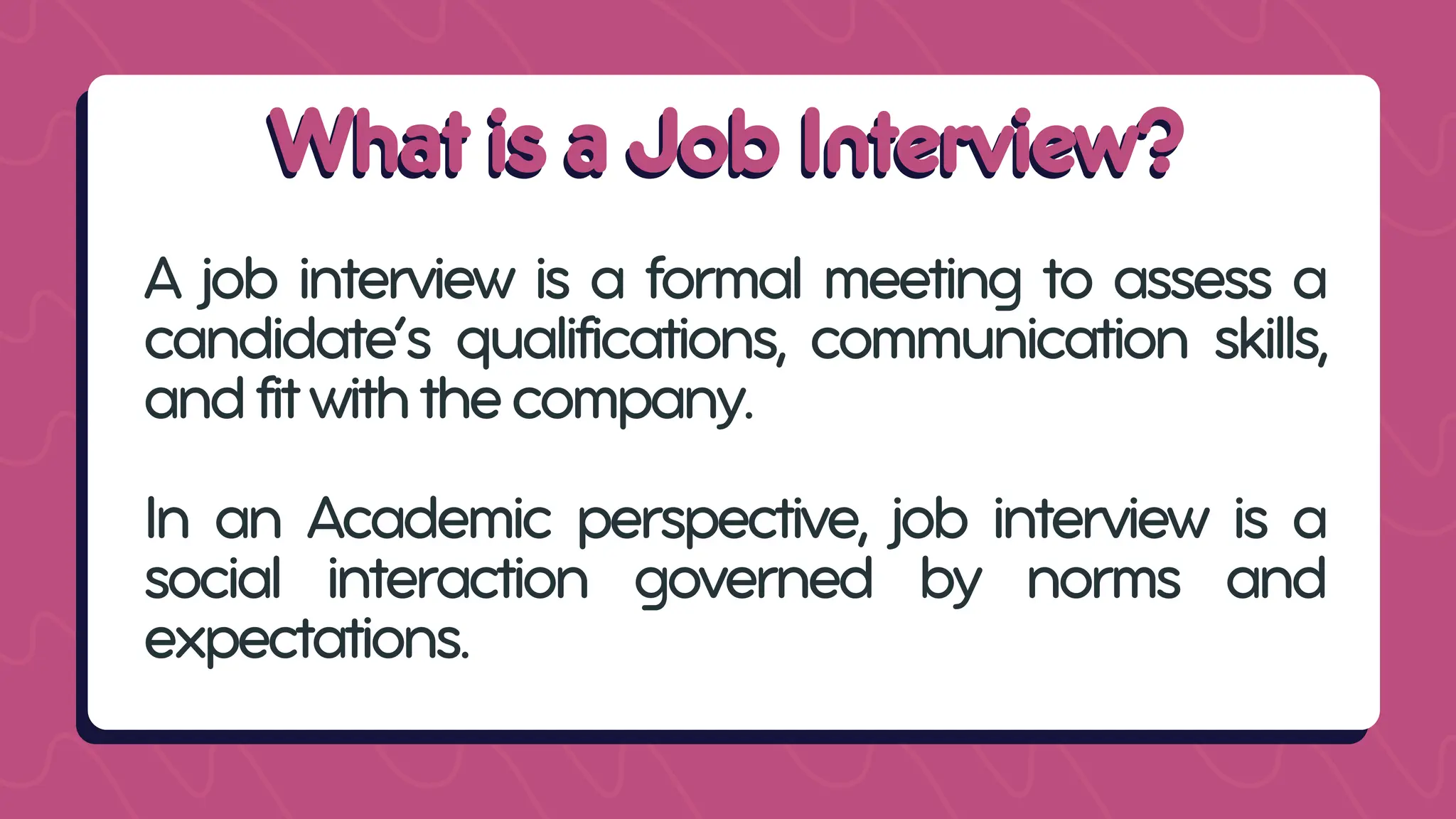
What is a Job Interview?
A job interview is a formal meeting to assess a
candidate’s qualifications, communication skills,
andfitwiththecompany.
In an Academic perspective, job interview is a
social interaction governed by norms and
expectations.
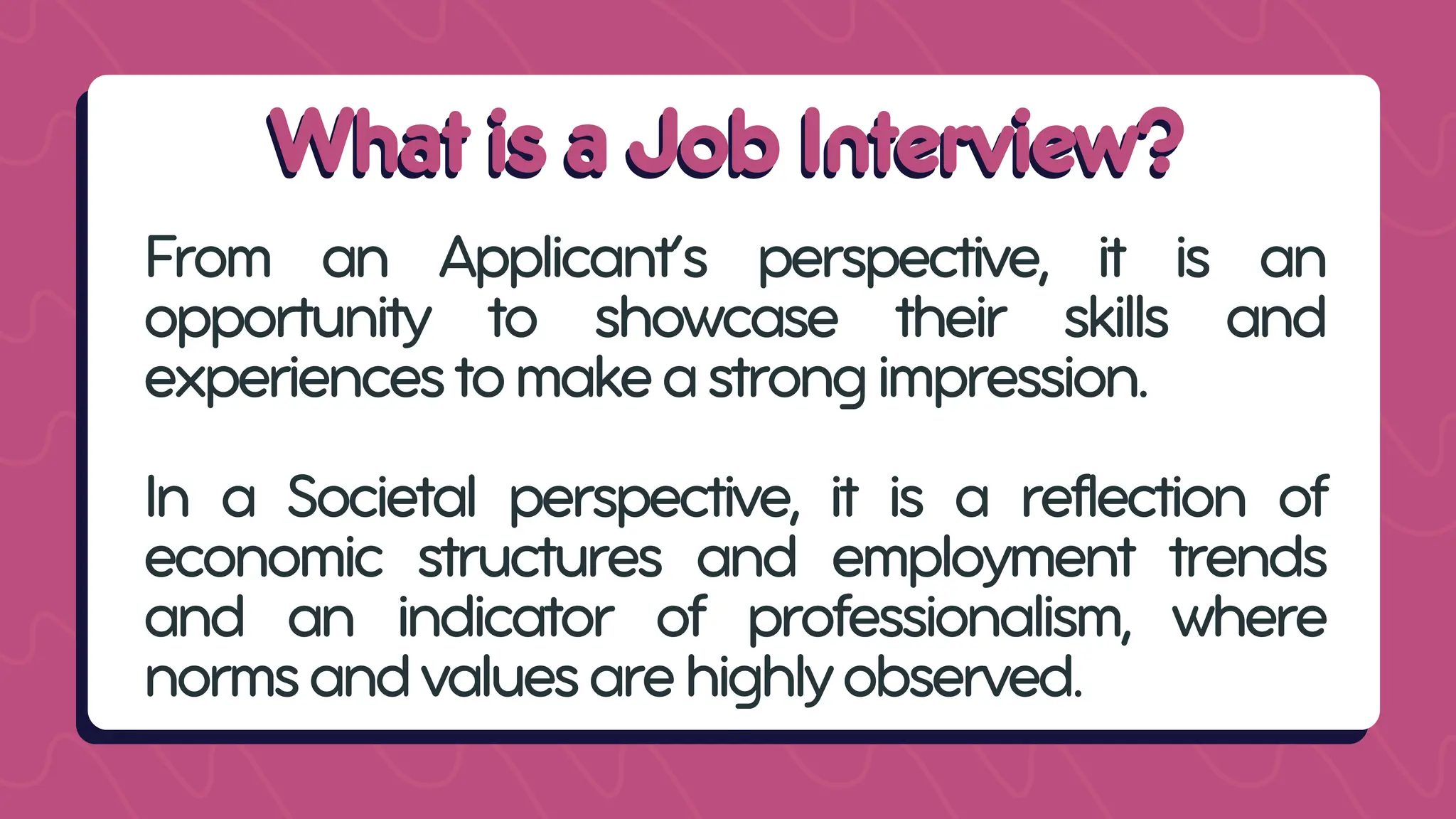
What is a Job Interview?
From an Applicant’s perspective, it is an
opportunity to showcase their skills and
experiencestomakeastrongimpression.
In a Societal perspective, it is a reflection of
economic structures and employment trends
and an indicator of professionalism, where
normsandvaluesarehighlyobserved.
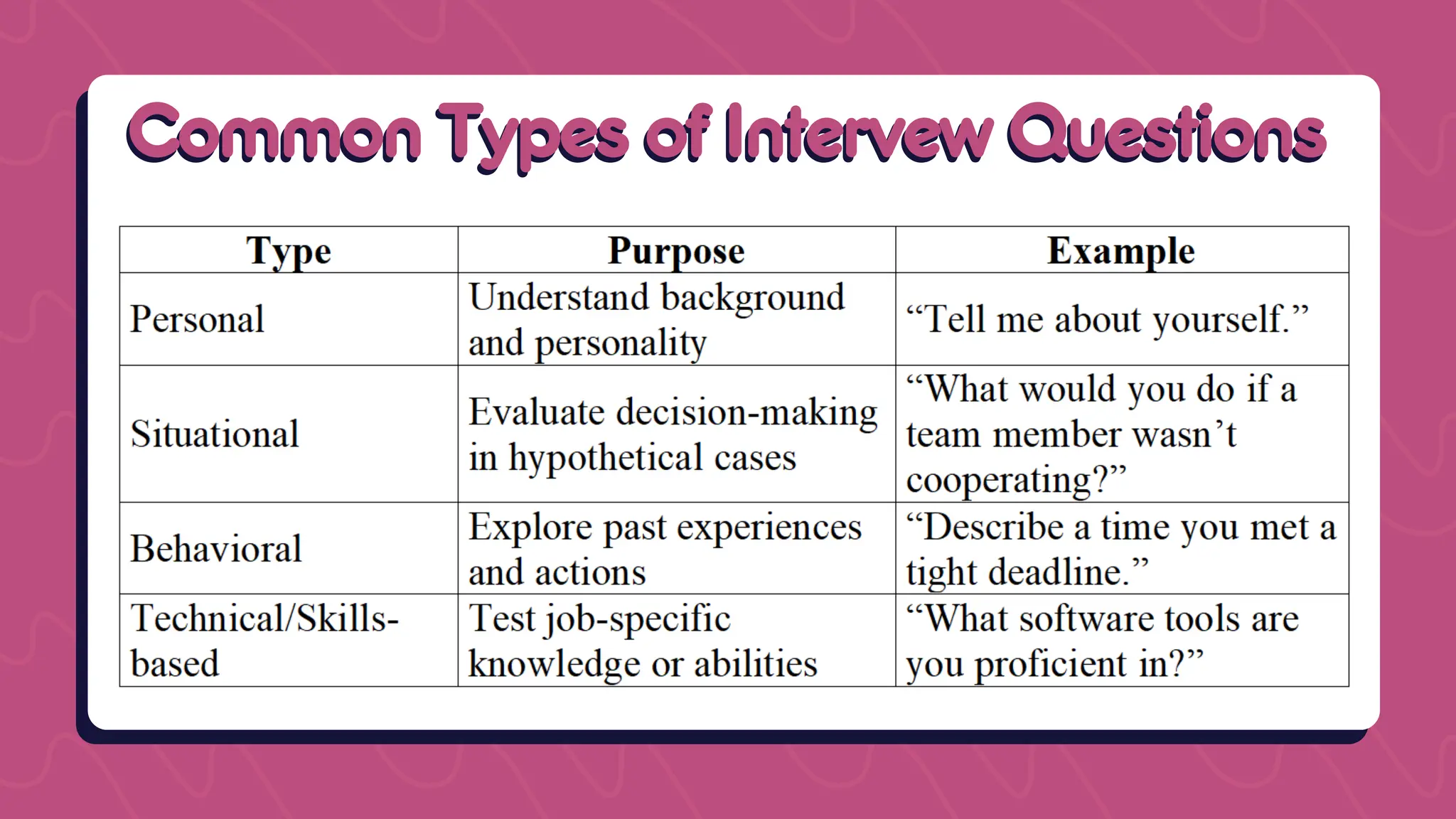
Common Types of Intervew Questions
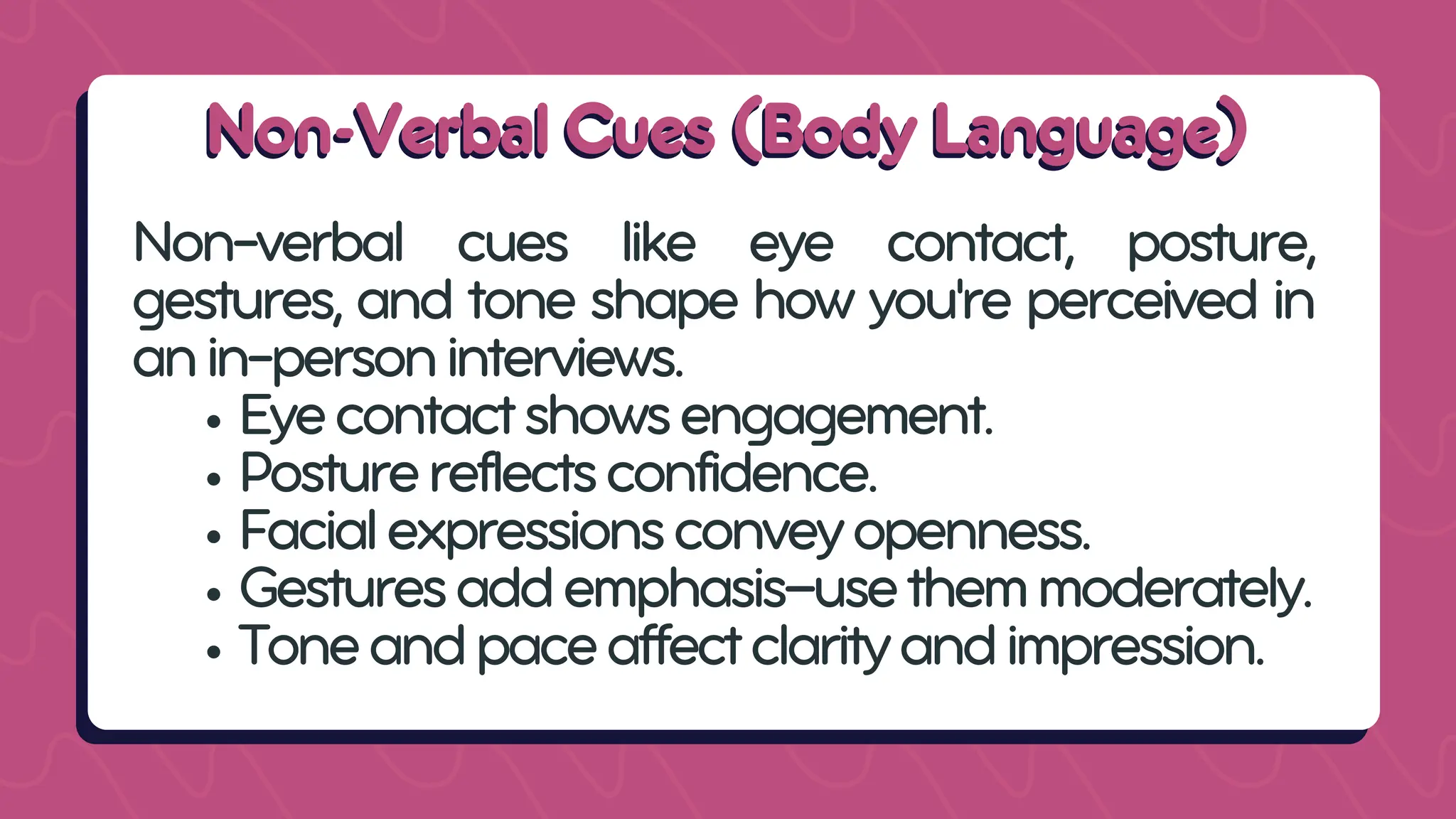
Non-Verbal Cues (Body Language)
Non-verbal cues like eye contact, posture,
gestures, and tone shape how you're perceived in
anin-personinterviews.
Eyecontactshowsengagement.
Posturereflectsconfidence.
Facialexpressionsconveyopenness.
Gesturesaddemphasis—usethemmoderately.
Toneandpaceaffectclarityandimpression.
Non-Verbal Cues (Body Language)
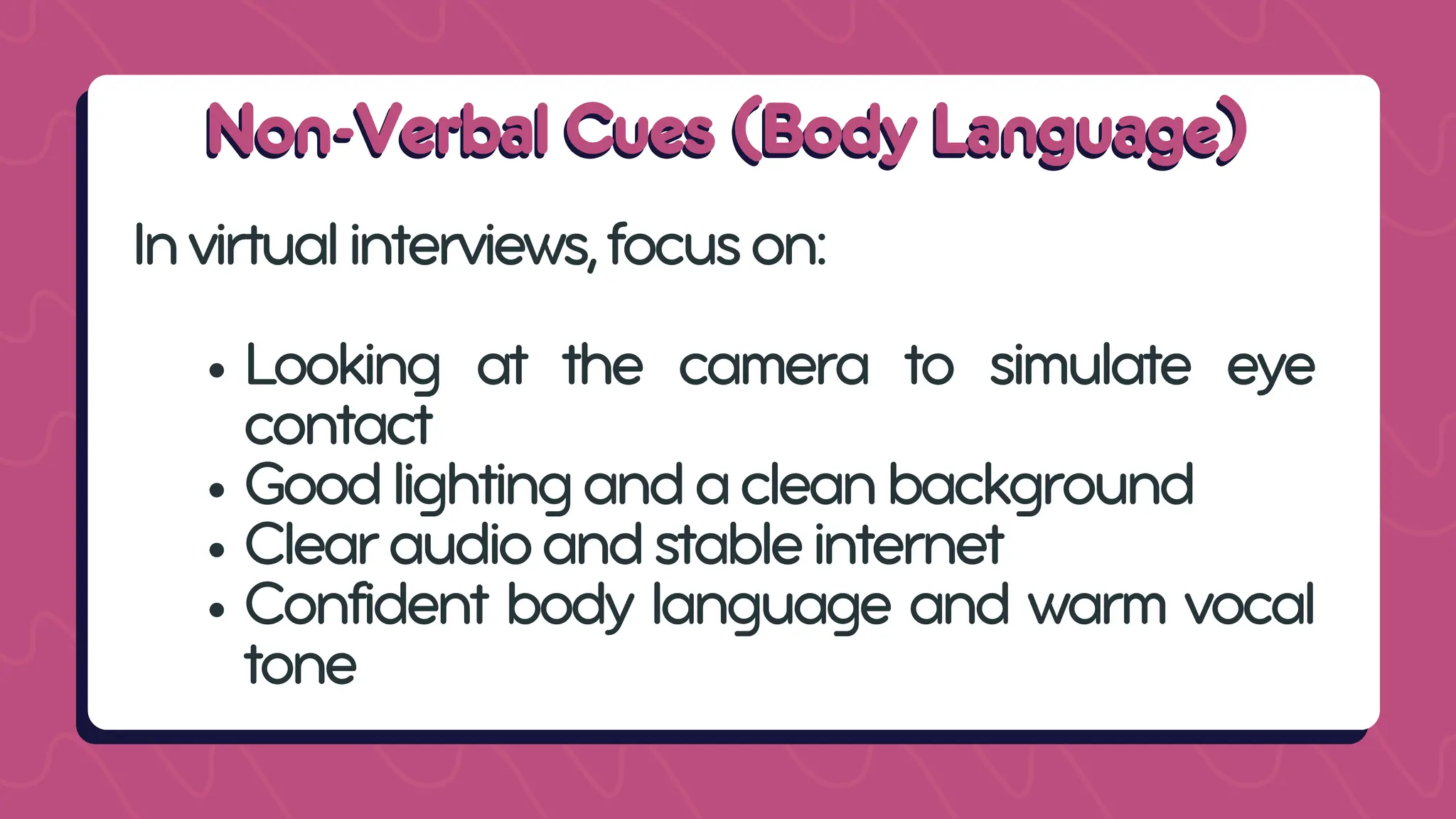
Invirtualinterviews,focuson:
Looking at the camera to simulate eye
contact
Goodlightingandacleanbackground
Clearaudioandstableinternet
Confident body language and warm vocal
tone
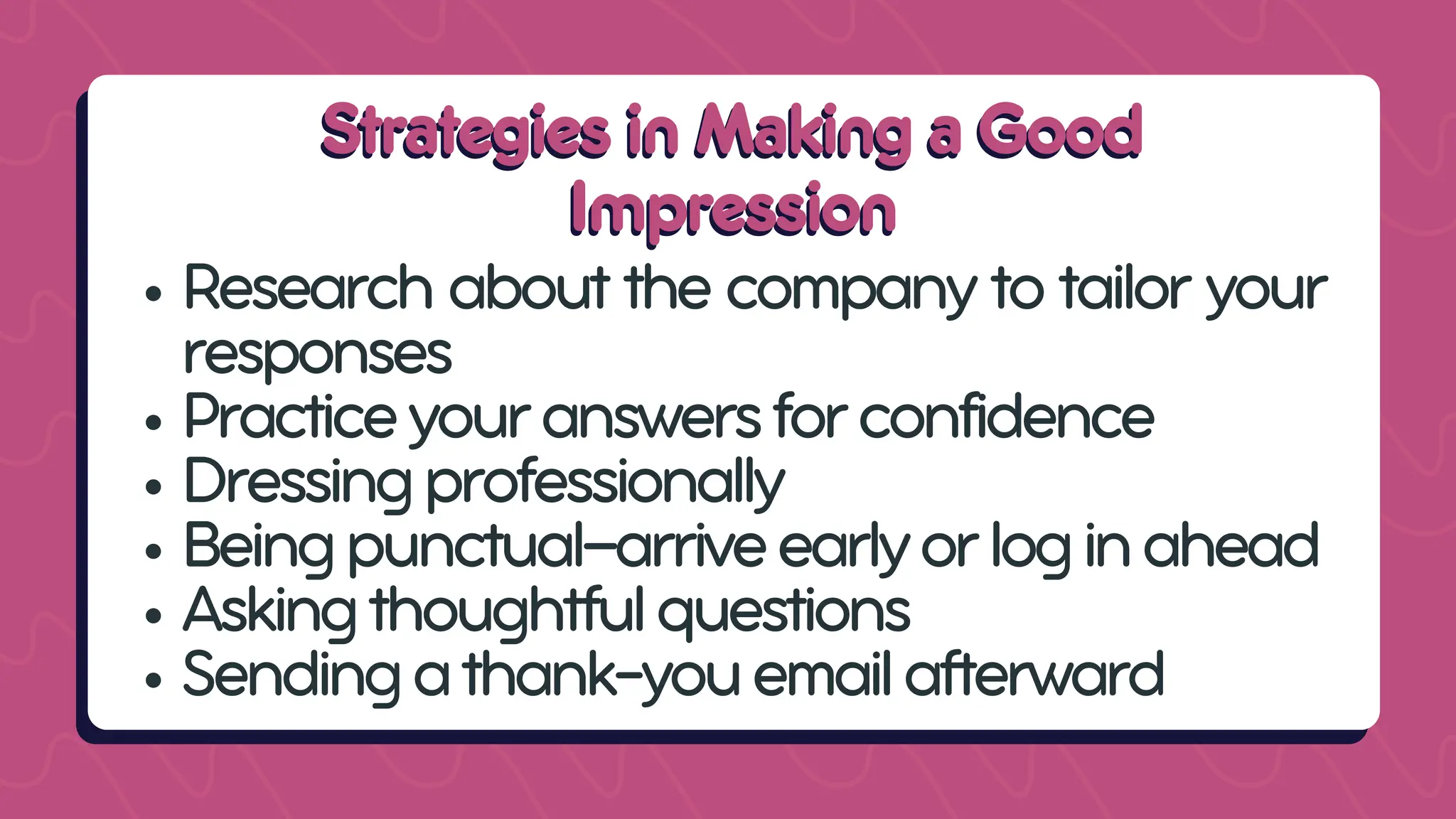
Strategies in Making a Good
Impression
Impression
Research about the company to tailor your
responses
Practiceyouranswersforconfidence
Dressingprofessionally
Beingpunctual—arriveearlyorloginahead
Askingthoughtfulquestions
Sendingathank-youemailafterward
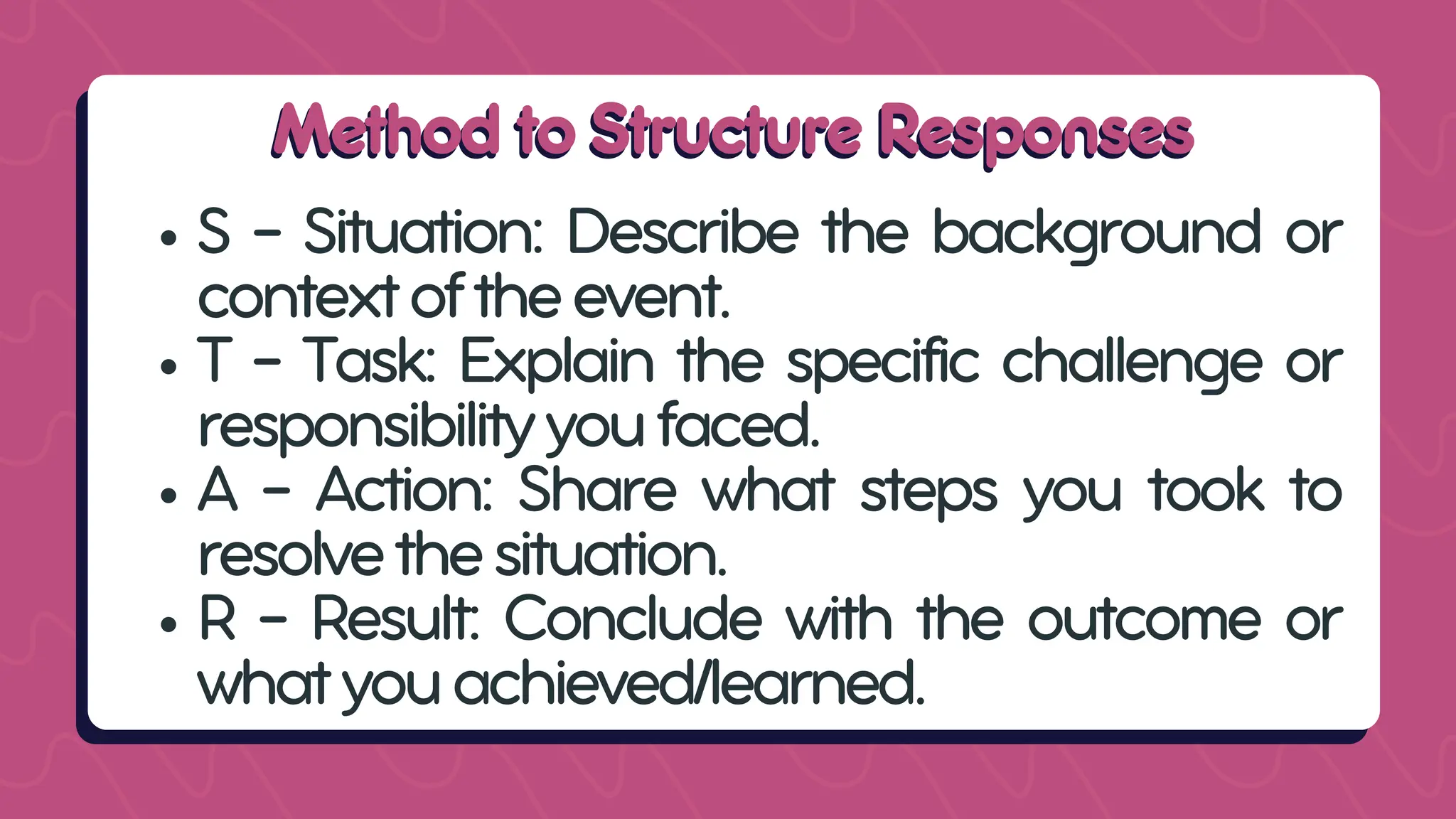
Method to Structure Responses
S – Situation: Describe the background or
contextoftheevent.
T – Task: Explain the specific challenge or
responsibilityyoufaced.
A – Action: Share what steps you took to
resolvethesituation.
R – Result: Conclude with the outcome or
whatyouachieved/learned.
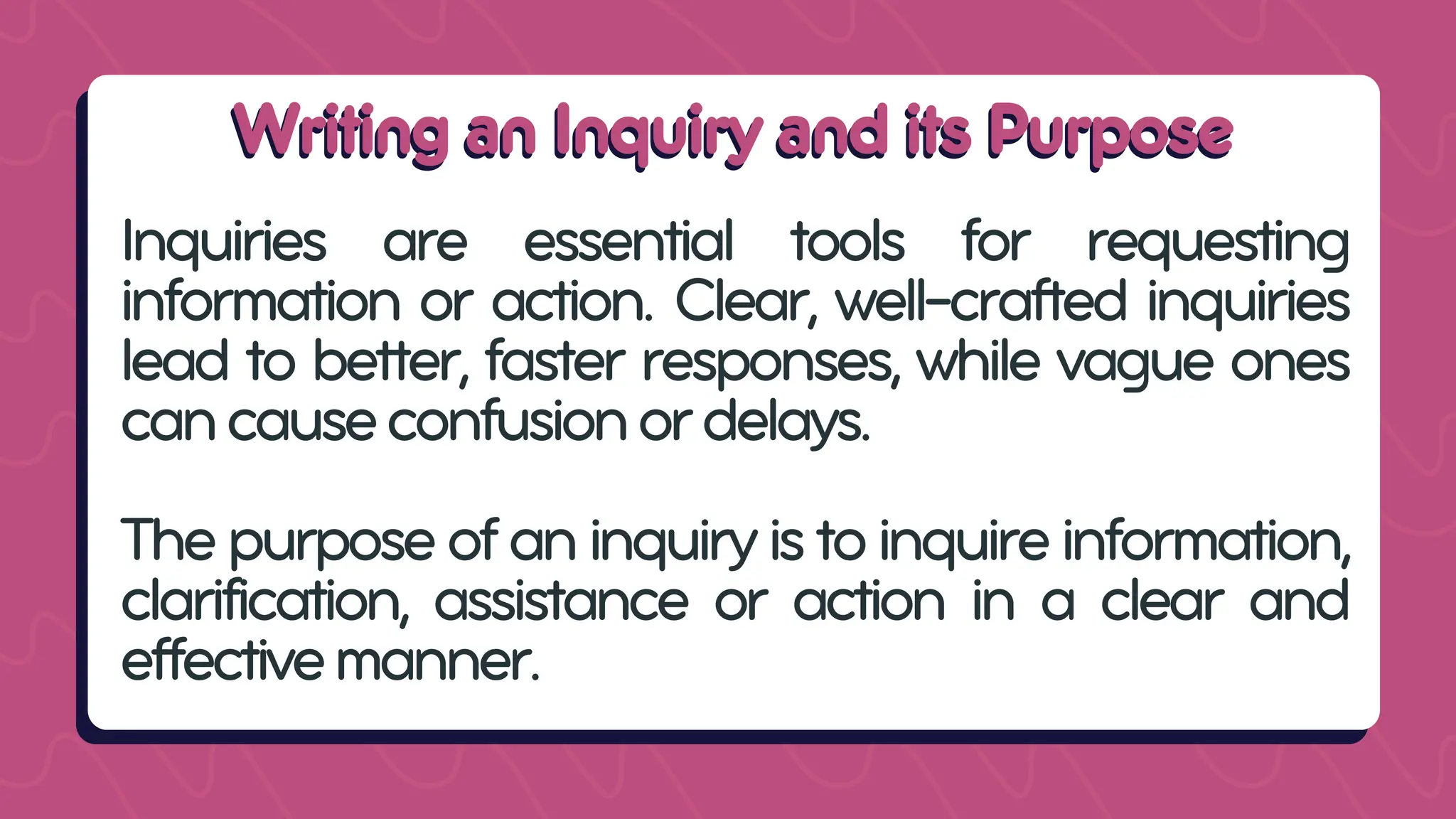
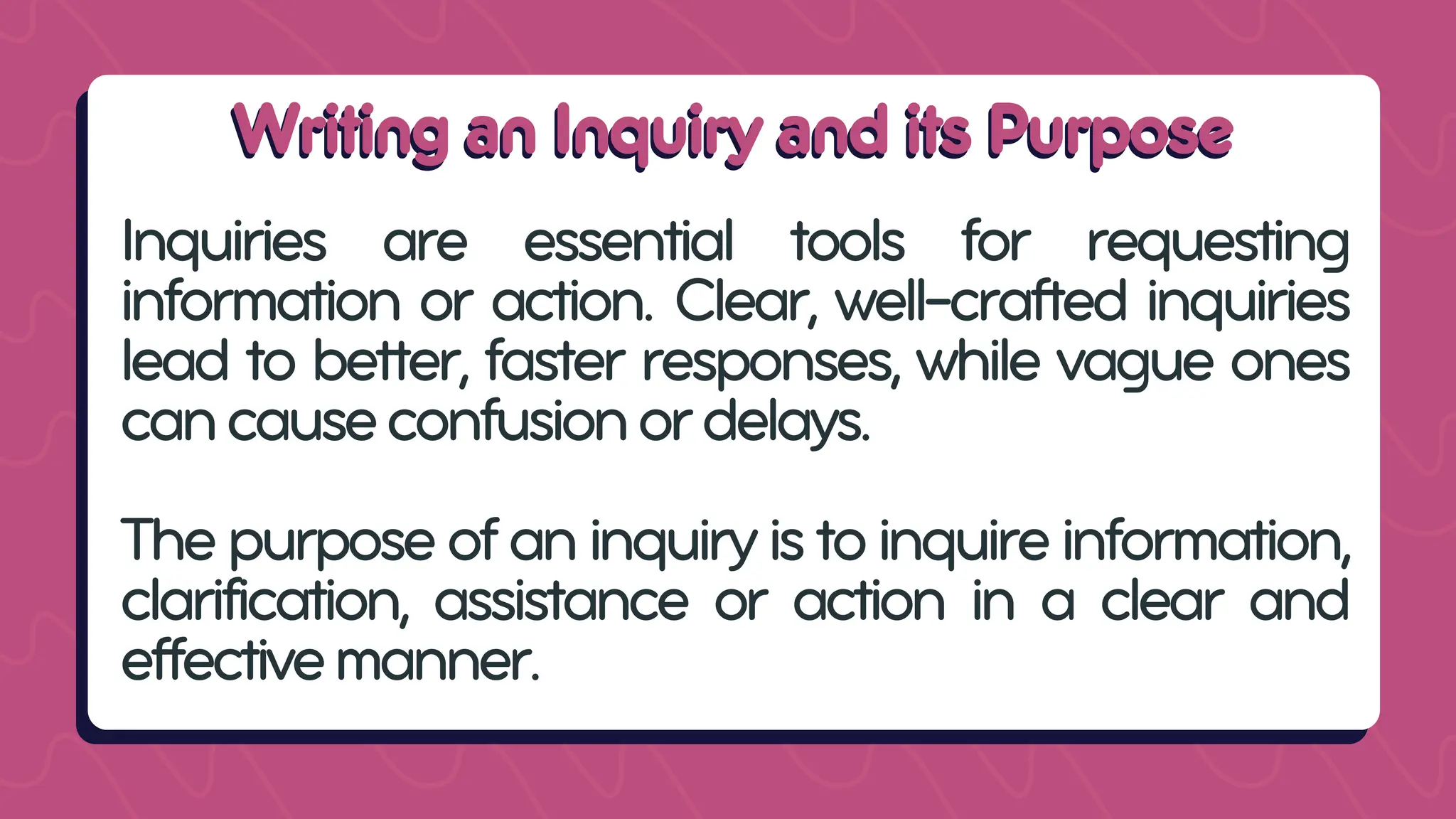
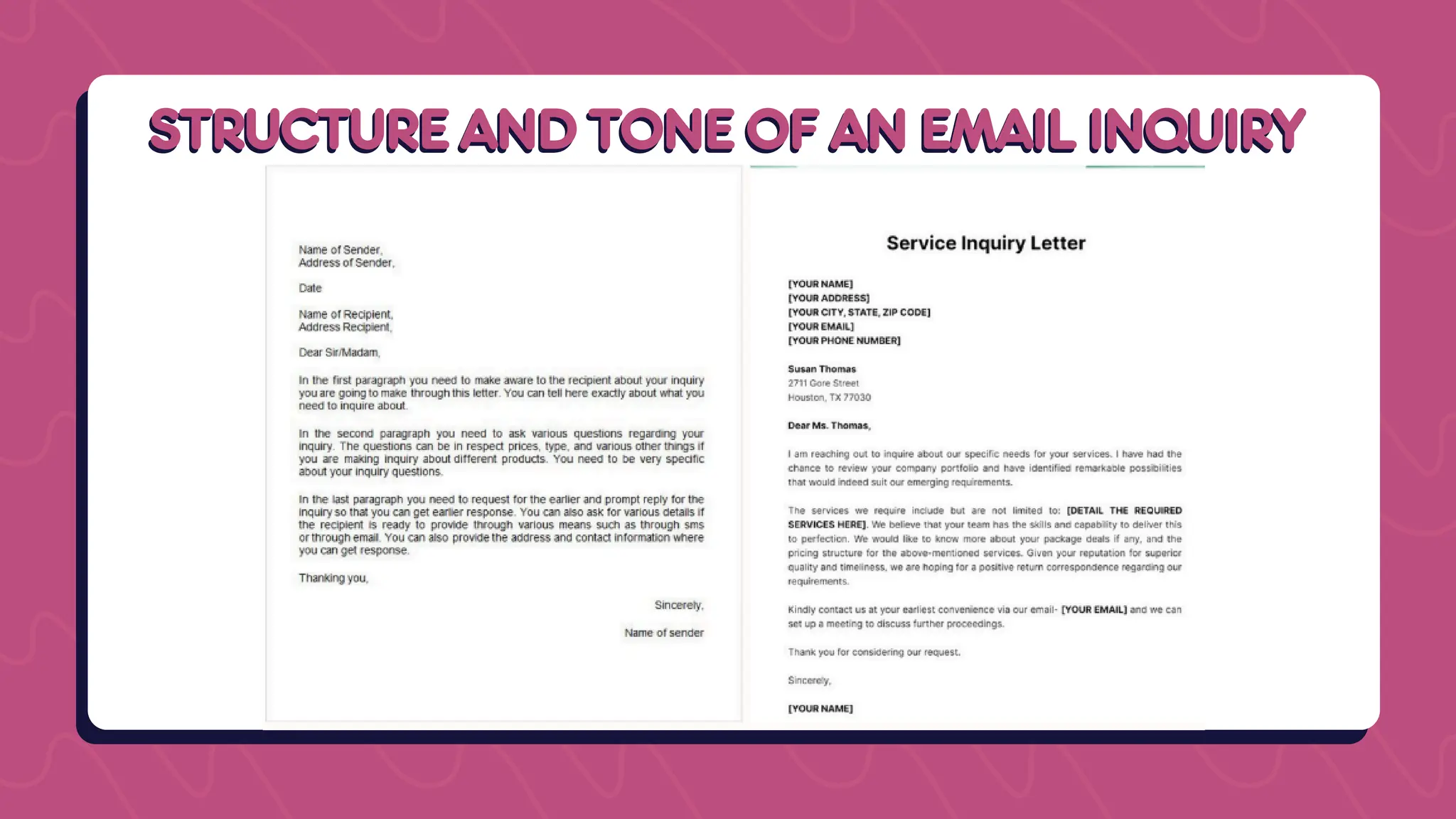
Writing an Inquiry and its Purpose
Inquiries are essential tools for requesting
information or action. Clear, well-crafted inquiries
lead to better, faster responses, while vague ones
cancauseconfusionordelays.
Thepurposeofaninquiryistoinquireinformation,
clarification, assistance or action in a clear and
effectivemanner.
Writing an Inquiry and its Purpose
Inquiries are essential tools for requesting
information or action. Clear, well-crafted inquiries
lead to better, faster responses, while vague ones
cancauseconfusionordelays.
Thepurposeofaninquiryistoinquireinformation,
clarification, assistance or action in a clear and
effectivemanner.
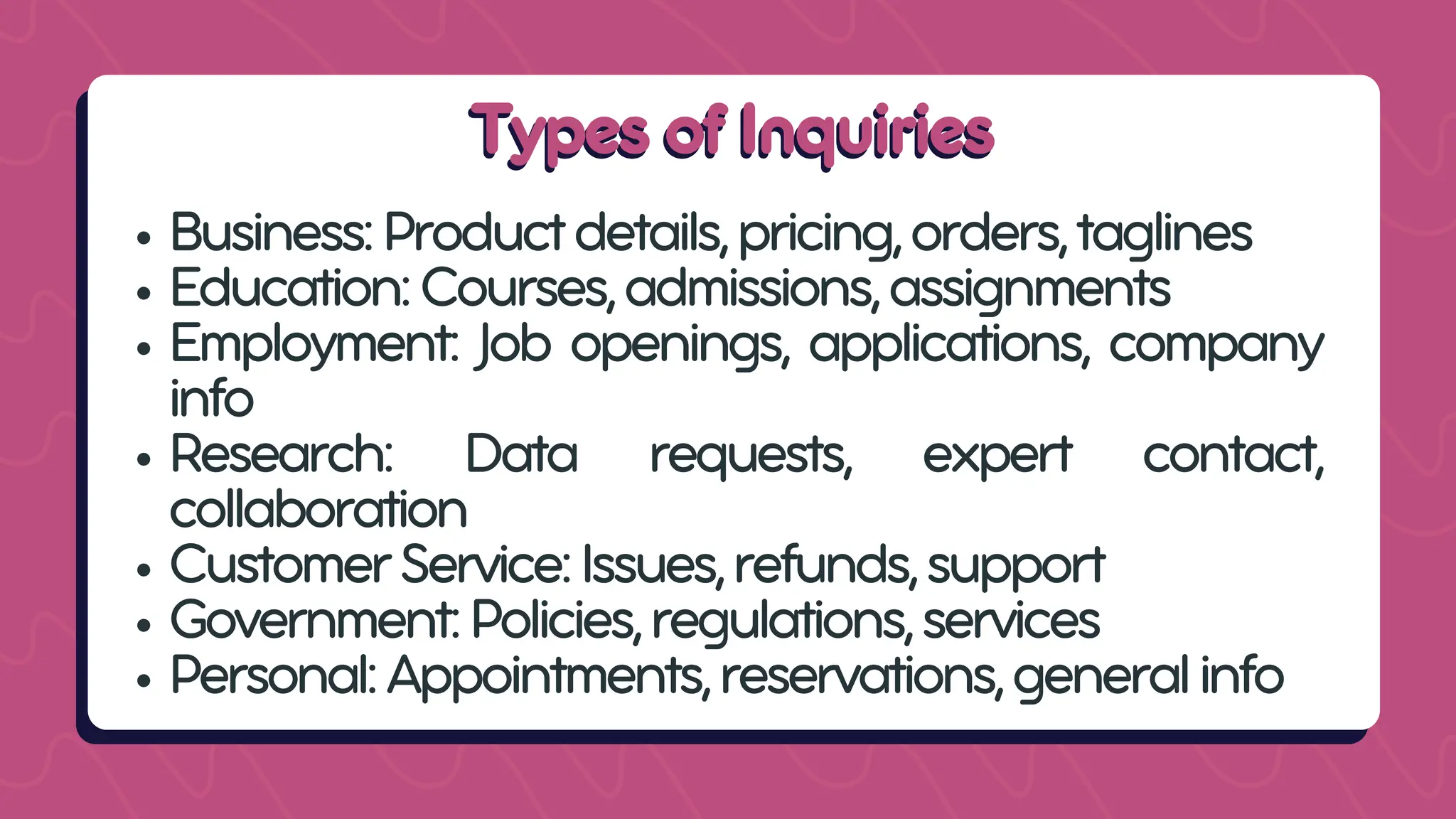
Types of Inquiries
Types of Inquiries
Business:Productdetails,pricing,orders,taglines
Education:Courses,admissions,assignments
Employment: Job openings, applications, company
info
Research: Data requests, expert contact,
collaboration
CustomerService:Issues,refunds,support
Government:Policies,regulations,services
Personal:Appointments,reservations,generalinfo
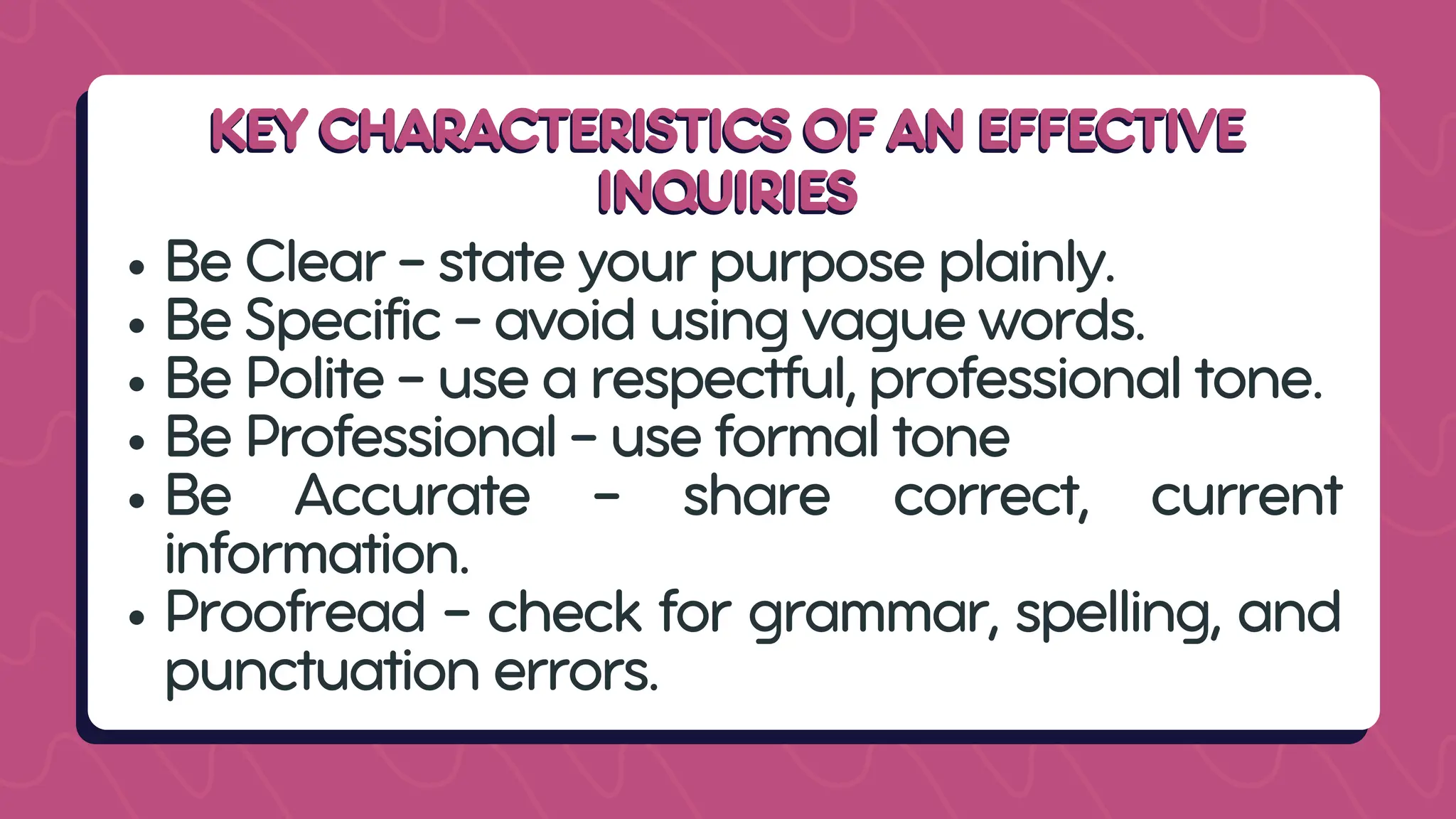
KEY CHARACTERISTICS OF AN EFFECTIVE
INQUIRIES
INQUIRIES
Be Clear - state your purpose plainly.
Be Specific - avoid using vague words.
Be Polite - use a respectful, professional tone.
Be Professional - use formal tone
Be Accurate - share correct, current
information.
Proofread - check for grammar, spelling, and
punctuation errors.
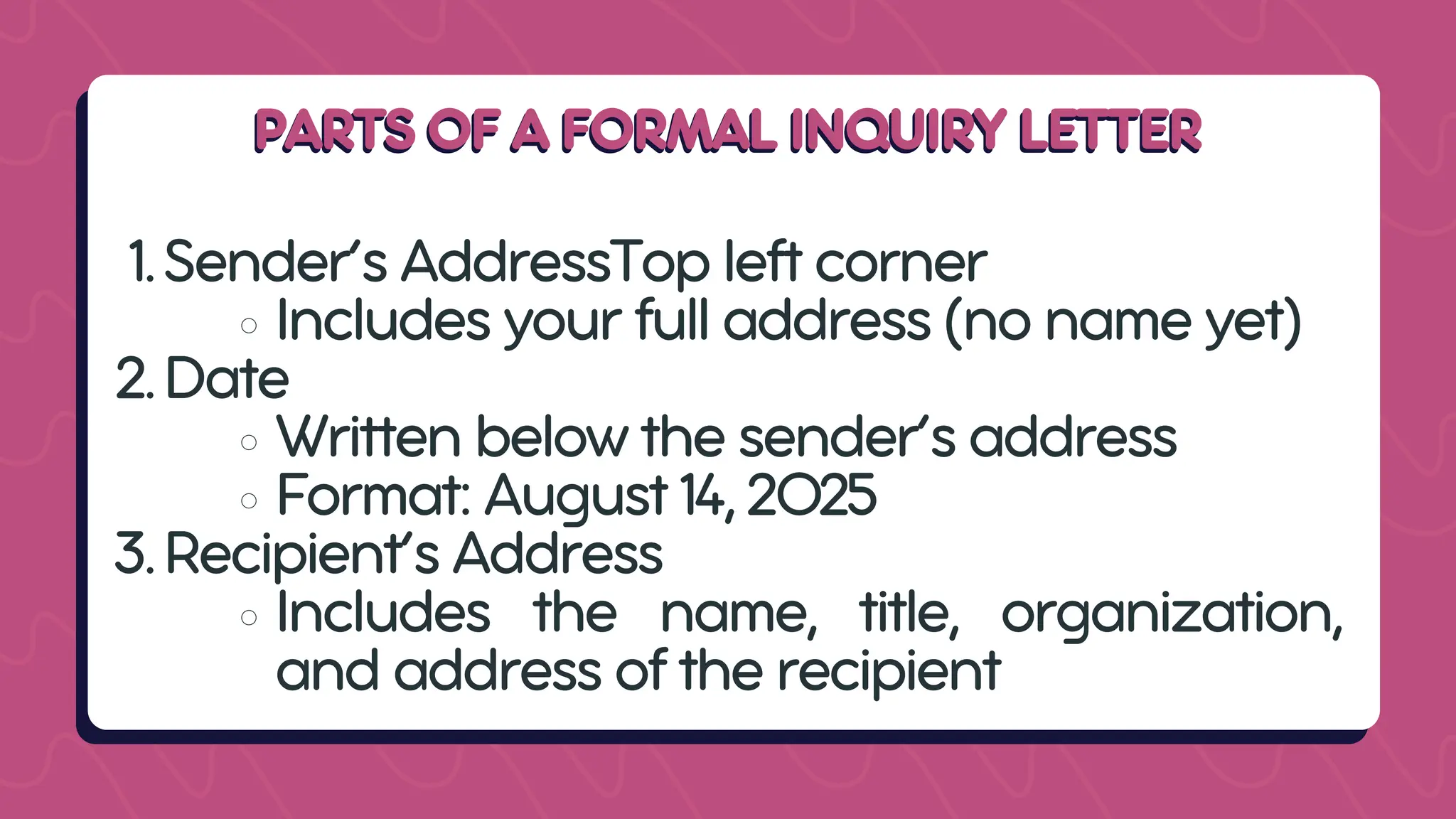
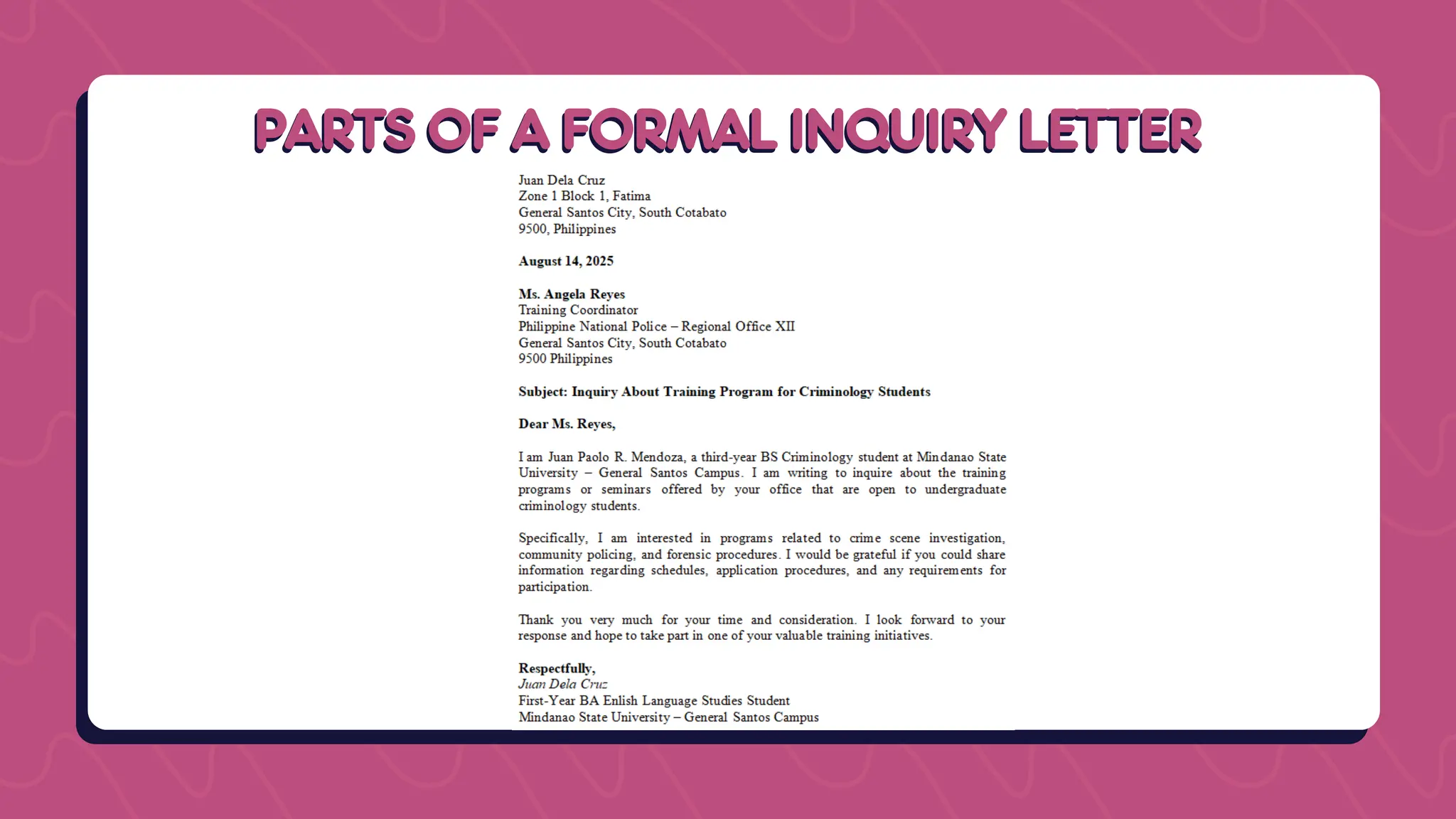
PARTS OF A FORMAL INQUIRY LETTER
1.Sender’s AddressTop left corner
Includes your full address (no name yet)
2.Date
Written below the sender’s address
Format: August 14, 2025
3.Recipient’s Address
Includes the name, title, organization,
and address of the recipient
PARTS OF A FORMAL INQUIRY LETTER
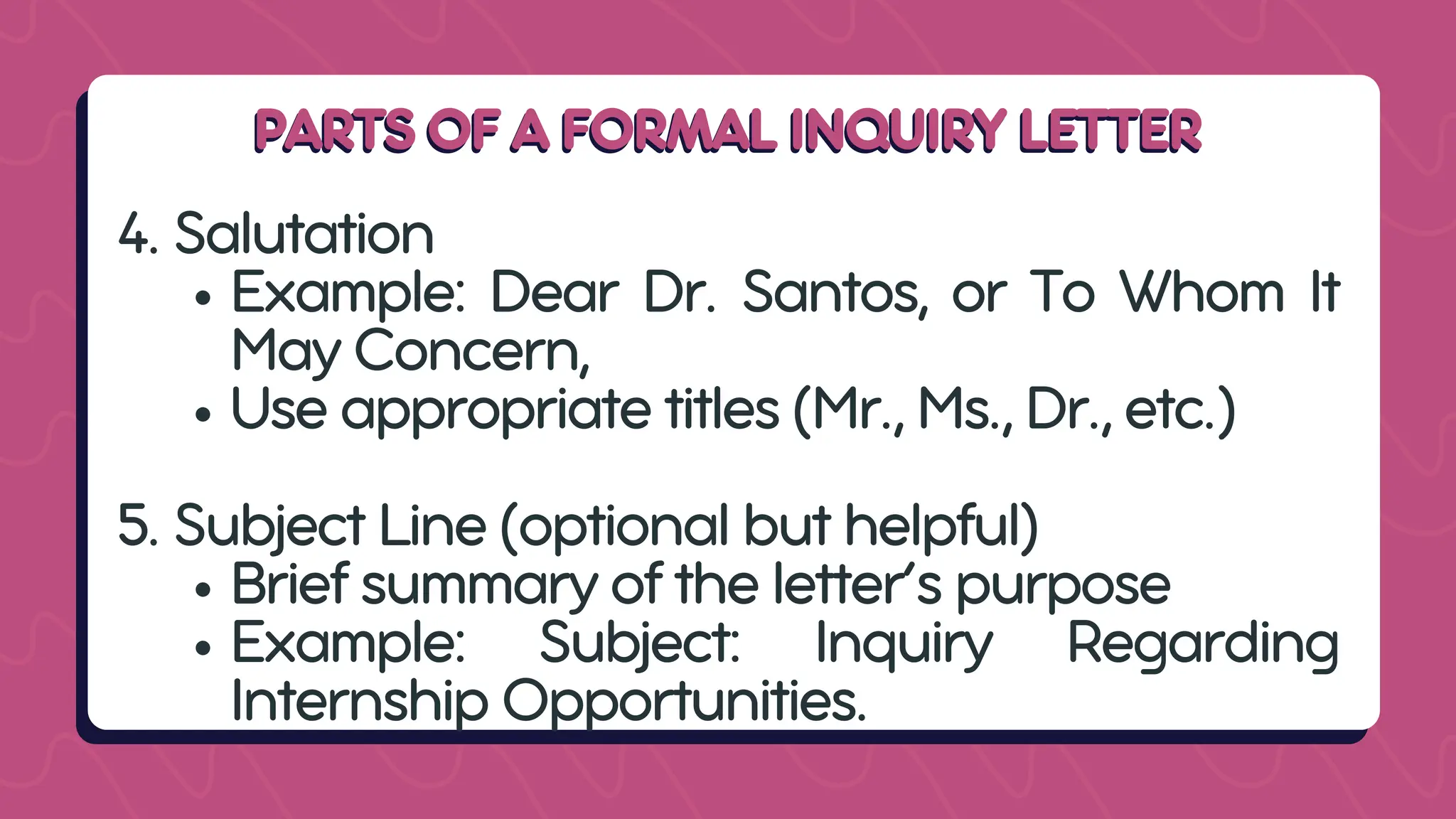
4. Salutation
Example: Dear Dr. Santos, or To Whom It
May Concern,
Use appropriate titles (Mr., Ms., Dr., etc.)
5. Subject Line (optional but helpful)
Brief summary of the letter’s purpose
Example: Subject: Inquiry Regarding
Internship Opportunities.
PARTS OF A FORMAL INQUIRY LETTER
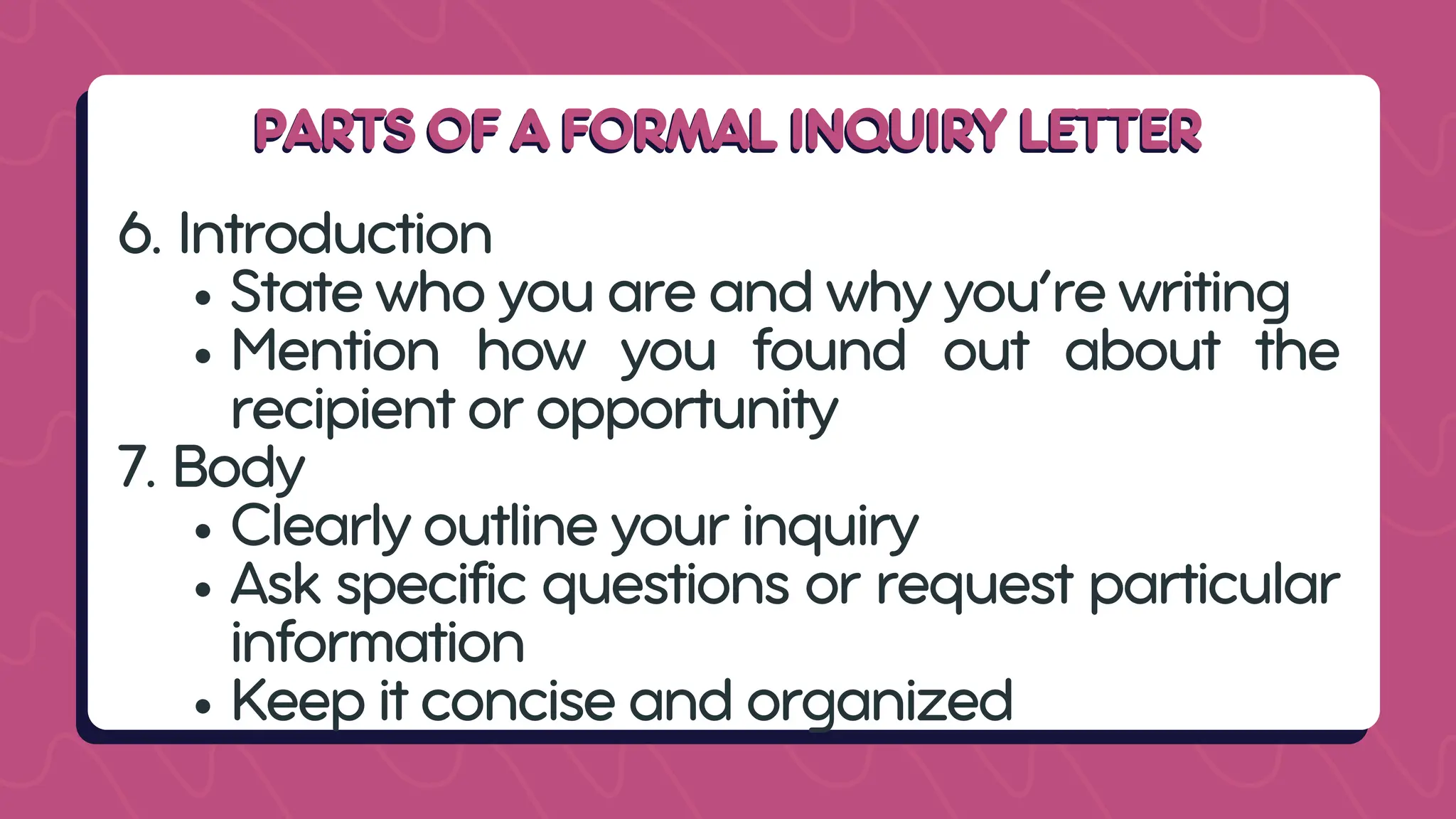
6. Introduction
State who you are and why you’re writing
Mention how you found out about the
recipient or opportunity
7. Body
Clearly outline your inquiry
Ask specific questions or request particular
information
Keep it concise and organized
PARTS OF A FORMAL INQUIRY LETTER
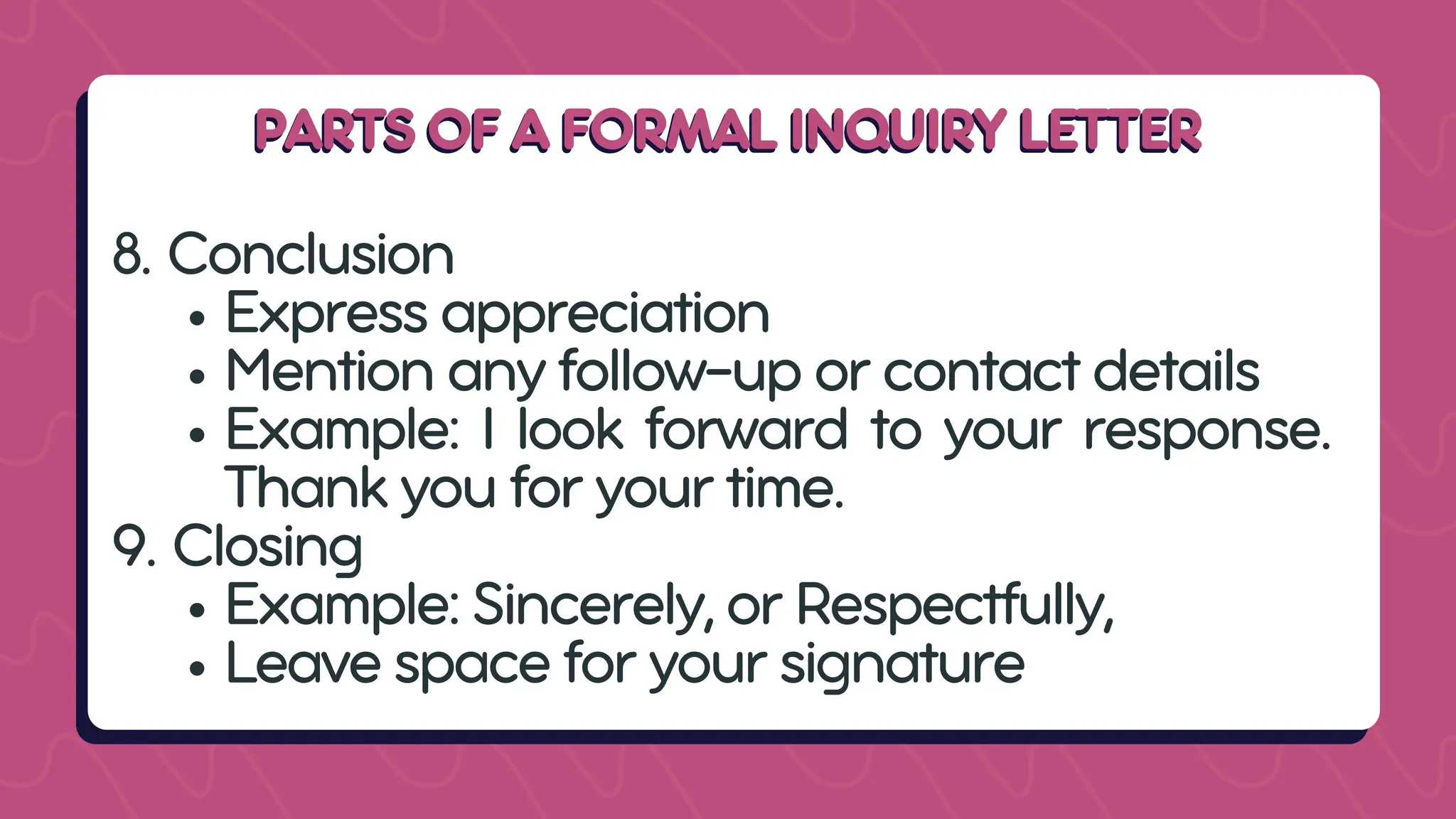
8. Conclusion
Express appreciation
Mention any follow-up or contact details
Example: I look forward to your response.
Thank you for your time.
9. Closing
Example: Sincerely, or Respectfully,
Leave space for your signature
PARTS OF A FORMAL INQUIRY LETTER
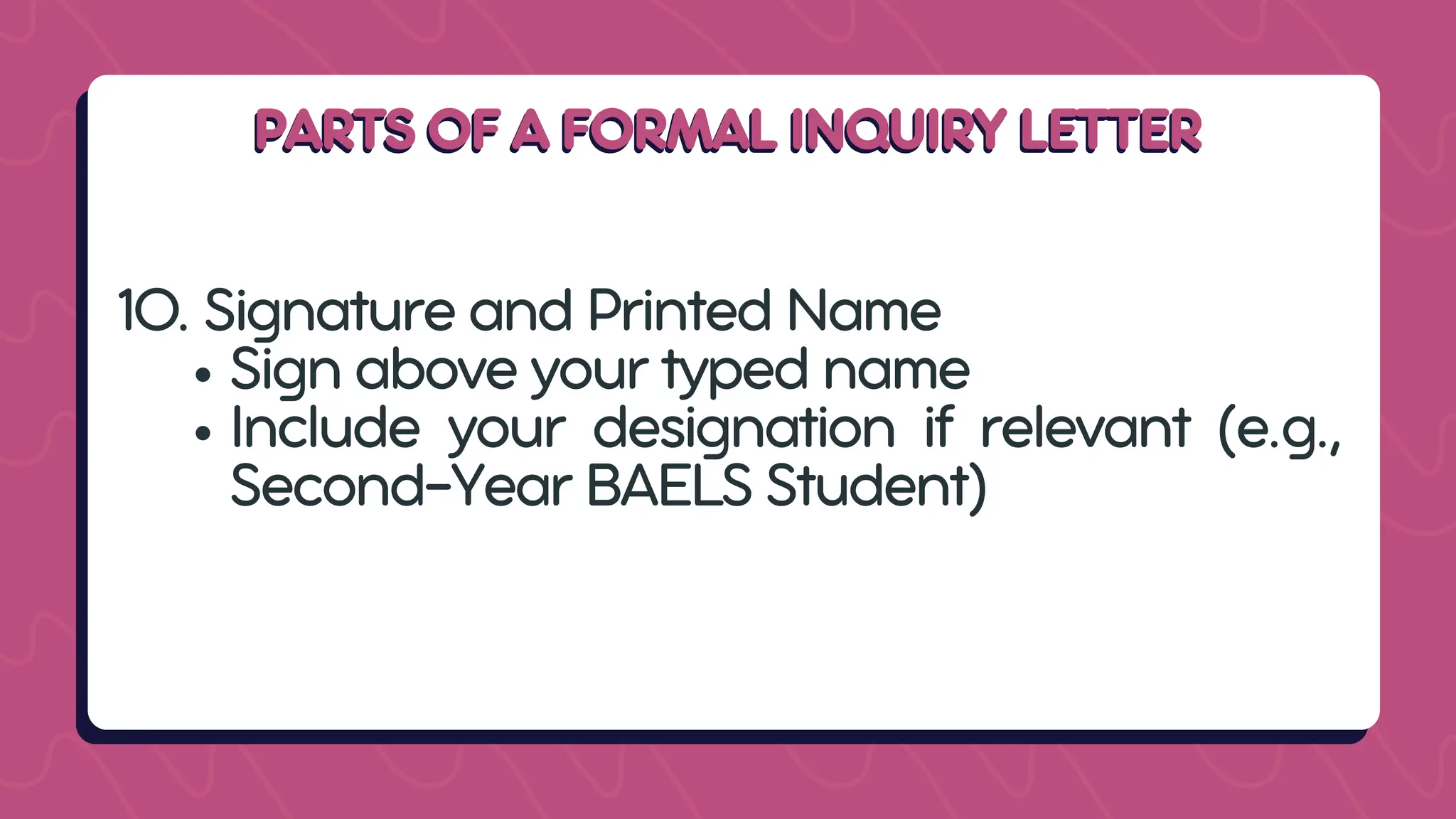
10. Signature and Printed Name
Sign above your typed name
Include your designation if relevant (e.g.,
Second-Year BAELS Student)
PARTS OF A FORMAL INQUIRY LETTER
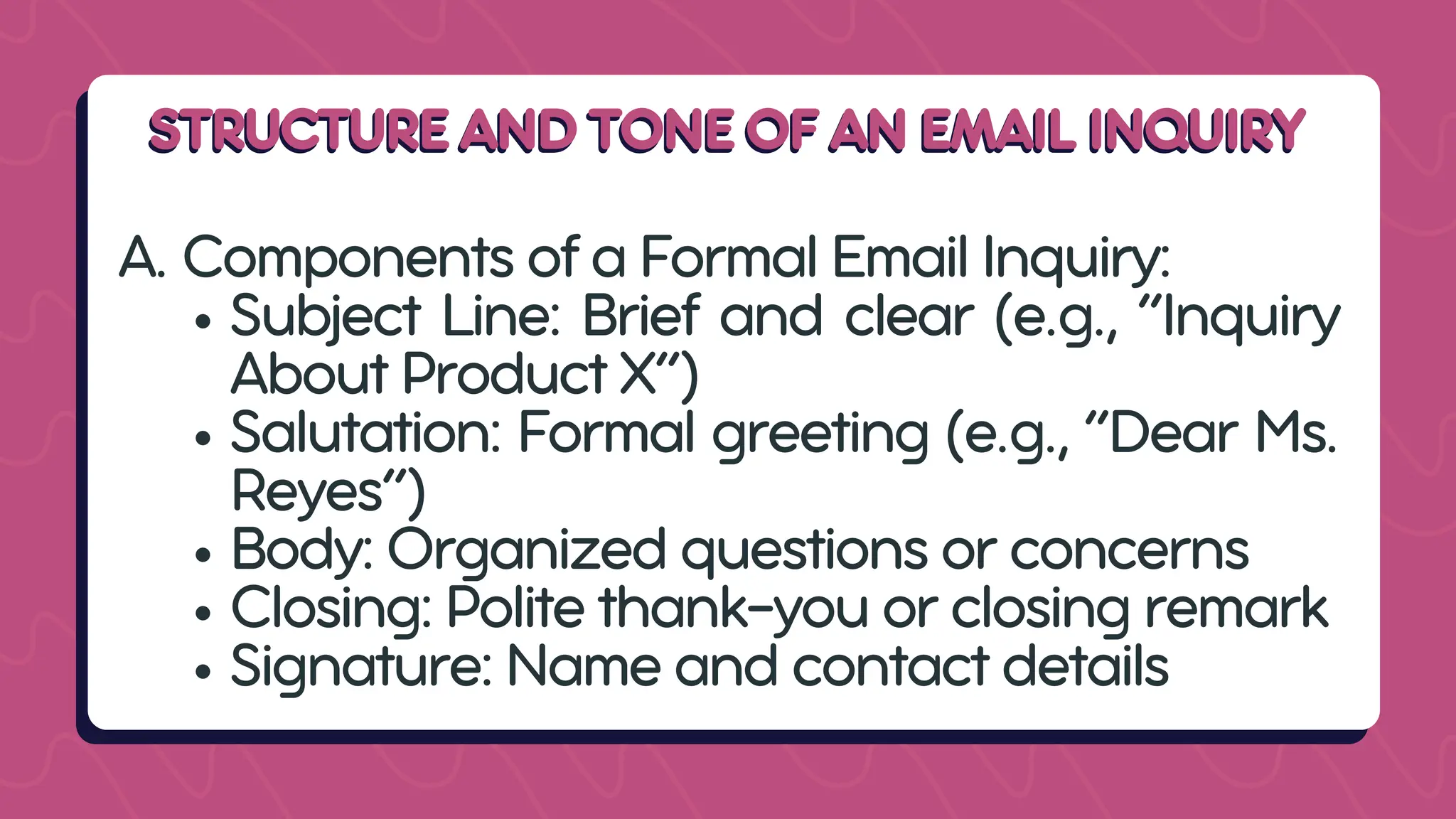
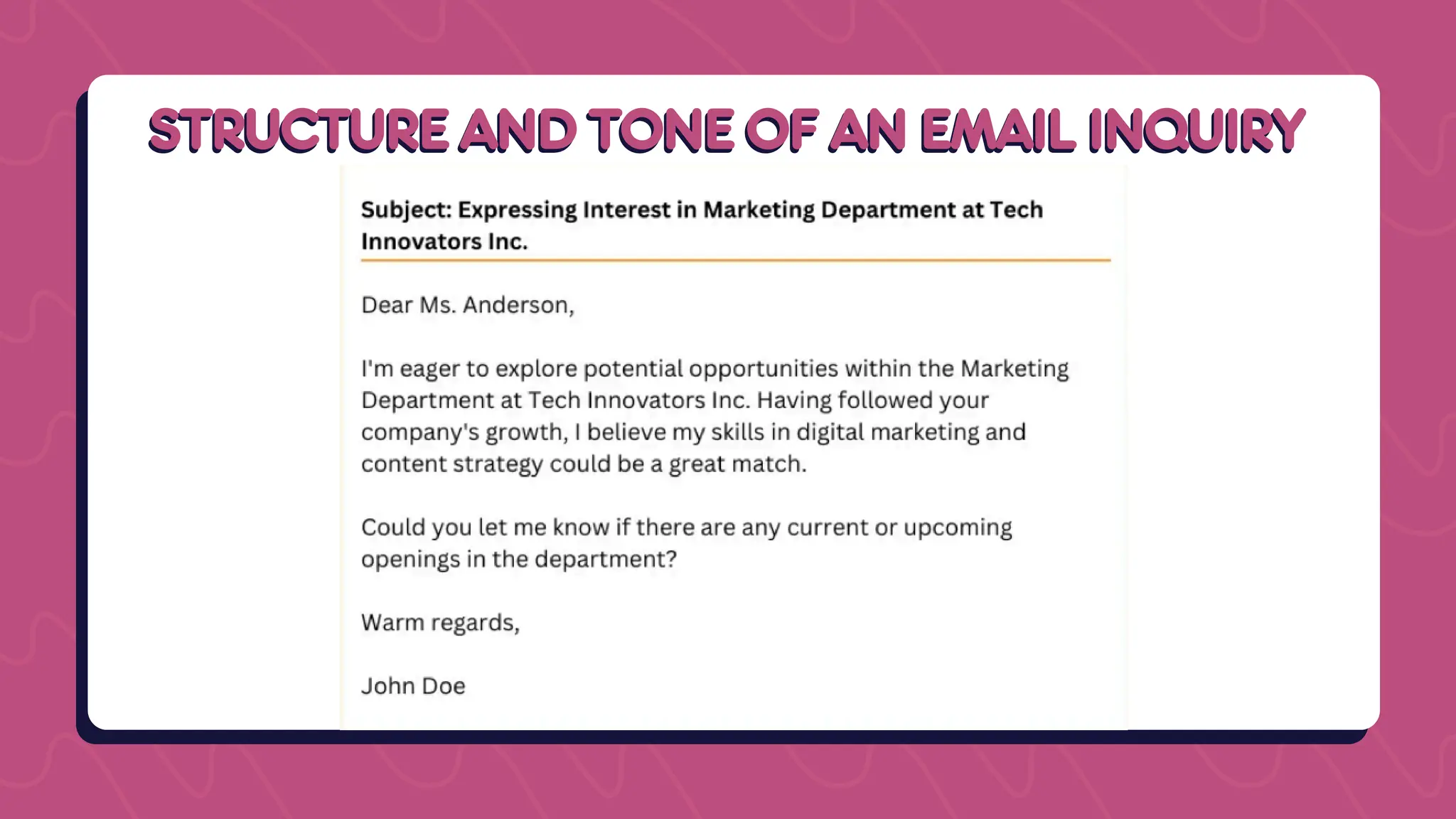
STRUCTURE AND TONE OF AN EMAIL INQUIRY
A. Components of a Formal Email Inquiry:
Subject Line: Brief and clear (e.g., “Inquiry
About Product X”)
Salutation: Formal greeting (e.g., “Dear Ms.
Reyes”)
Body: Organized questions or concerns
Closing: Polite thank-you or closing remark
Signature: Name and contact details
STRUCTURE AND TONE OF AN EMAIL INQUIRY
Lesson 5:
Lesson 5:
THE DEBATE
THE DEBATE
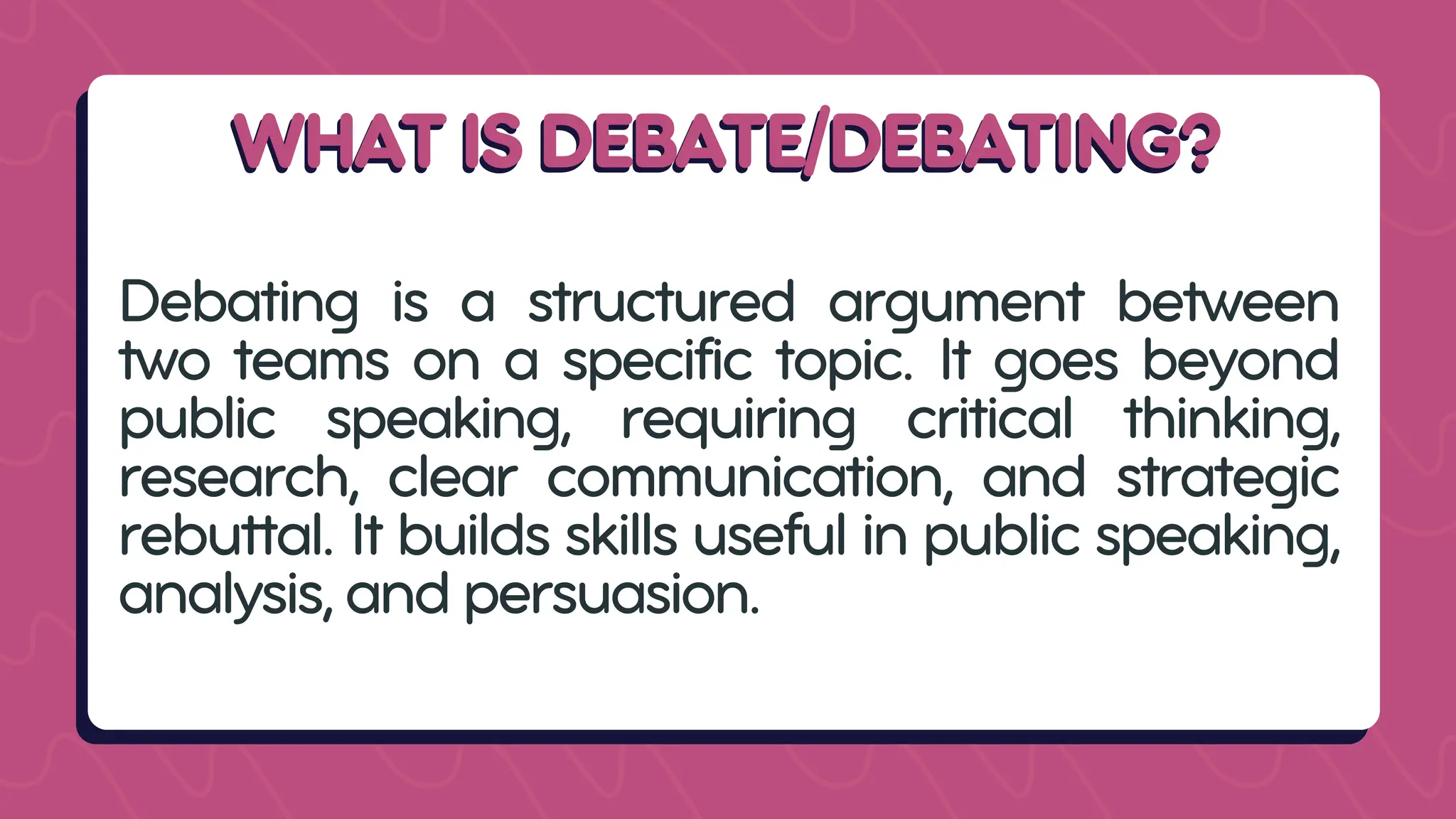
WHAT IS DEBATE/DEBATING?
Debating is a structured argument between
two teams on a specific topic. It goes beyond
public speaking, requiring critical thinking,
research, clear communication, and strategic
rebuttal. It builds skills useful in public speaking,
analysis, and persuasion.
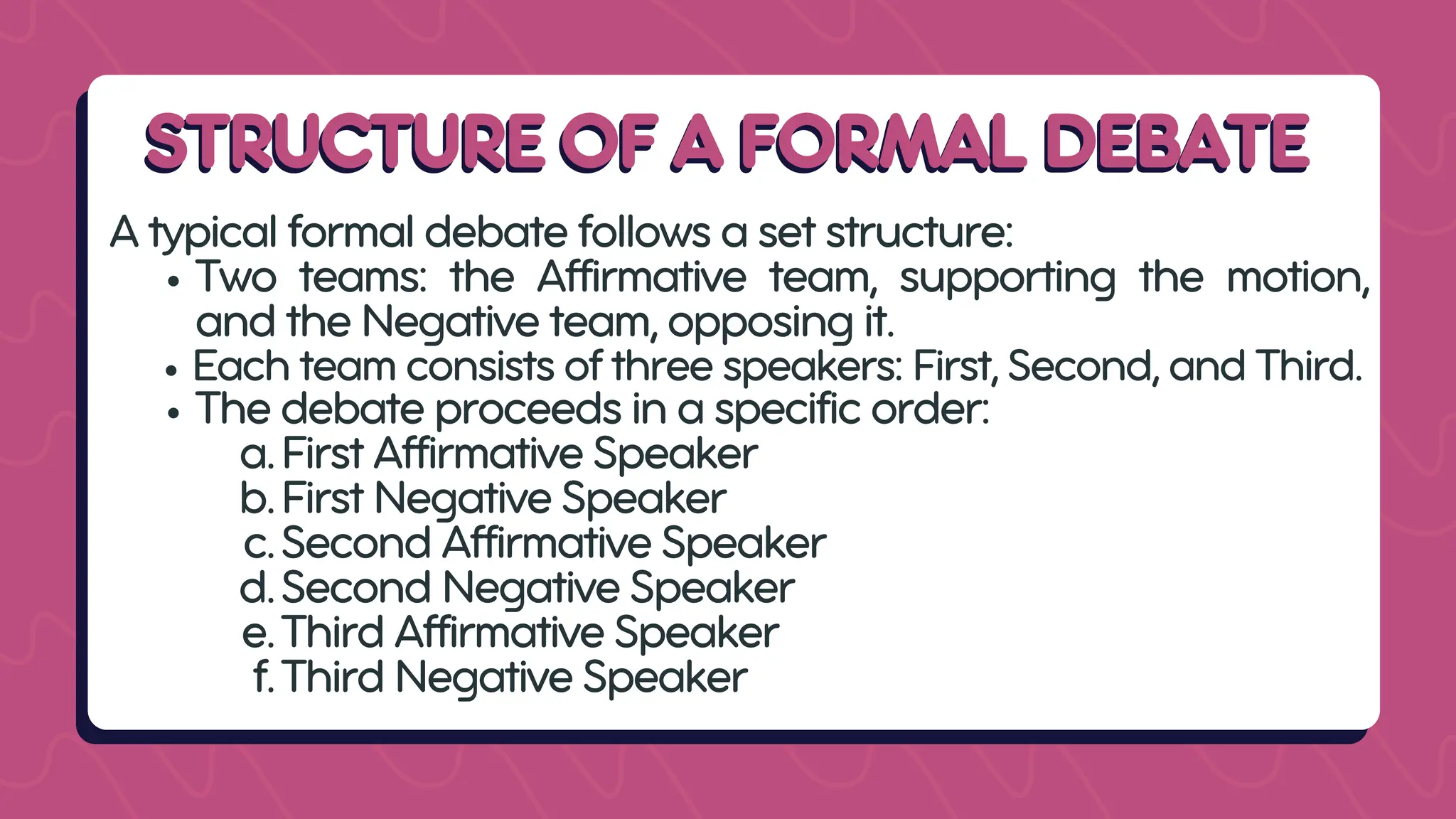
STRUCTURE OF A FORMAL DEBATE
A typical formal debate follows a set structure:
Two teams: the Affirmative team, supporting the motion,
and the Negative team, opposing it.
Each team consists of three speakers: First, Second, and Third.
The debate proceeds in a specific order:
a.First Affirmative Speaker
b.First Negative Speaker
c.Second Affirmative Speaker
d.Second Negative Speaker
e.Third Affirmative Speaker
f.Third Negative Speaker
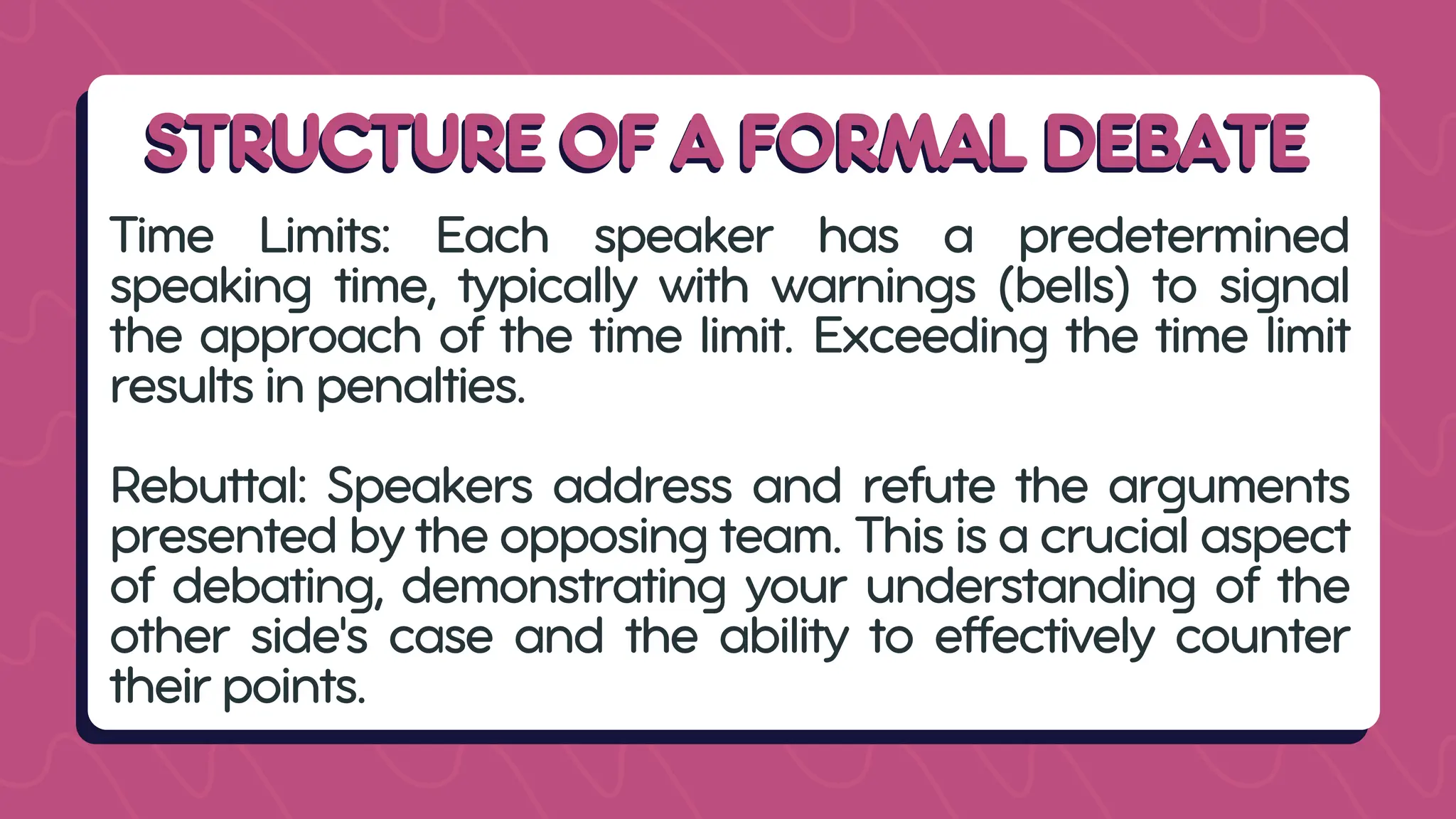
STRUCTURE OF A FORMAL DEBATE
Time Limits: Each speaker has a predetermined
speaking time, typically with warnings (bells) to signal
the approach of the time limit. Exceeding the time limit
results in penalties.
Rebuttal: Speakers address and refute the arguments
presented by the opposing team. This is a crucial aspect
of debating, demonstrating your understanding of the
other side's case and the ability to effectively counter
their points.
ROLES AND RESPONSIBILITIES
Chairman: Presides over the debate, ensuring fair
play and adherence to rules.
Timekeeper: Tracks the speaking time of each
debater and signals time warnings.
Adjudicator: Evaluates the debate and determines
the winning team based on criteria such as
argumentation, presentation, and rebuttal.
Team Responsibilities: Teams often have specific
roles, such as one team handling paperwork
PRE-DEBATE PREPARATIONS
Understanding the Motion - break down key
termsandpossibleangles.
Research - use credible sources to support
yourpoints.
Buildclear,logicalargumentswithevidence.
Predictandcounteropposingarguments.
Coordinatewithteammatesforaunifiedcase.
Rehearse and review to refine delivery and
timing.
DEFINING AND INTERPRETING THE
TOPIC
TOPIC
Definition: Clearly define key terms in the
motion to ensure shared understanding
andfocus.
Interpretation: Explain your team's view of
the motion, clarify ambiguities, and
highlightyourfocus.Bereadytodefendit.
DEVELOPING AND DELIVERING A
SPEECH
SPEECH
Cue Cards: Use keywords and short
phrases—nofullsentences.
Timing:Practicetostaywithintimelimits.
Delivery: Speak clearly, confidently, and
use eye contact, gestures, and vocal
variety.
REBUTTAL TECHNIQUES
REBUTTAL TECHNIQUES
Spot Flaws in opponent’s
arguments.
Counter with alternative views and
evidence.
Challenge their evidence’s validity.
Rebut clearly, tying points to your
main case.
REBUTTAL TECHNIQUES
REBUTTAL TECHNIQUES
Spot Flaws in opponent’s
arguments.
Counter with alternative views and
evidence.
Challenge their evidence’s validity.
Rebut clearly, tying points to your
main case.

GEC102 Purposive Communication - UNIT 3.pdf

  • 1.
  • 2.
    Lesson 1: Informative, Lesson1: Informative, Persuasive, and Persuasive, and Argumentative Speeches Argumentative Speeches
  • 3.
    Defining each CommunicationType Defining each Communication Type and its Purpose and its Purpose 1. Informative: Shares facts and explanations objectively to increase understanding. Seen in: Textbooks, news, lectures. Purpose: To educate or increase understanding by presenting facts objectively. Persuasive: Aims to influence beliefs or actions using emotion or logic. Seen in: Ads, speeches, opinion pieces. Purpose: To convince the audience to adopt a belief, attitude, or take action.
  • 4.
    Defining each CommunicationType Defining each Communication Type and its Purpose and its Purpose Argumentative: Defends a claim using logic, evidence, and counterarguments. Seen in: Debates, essays, research papers. Purpose: To defend a claim using logic and evidence, while addressing counterpoints.
  • 5.
    Differences in Tone,Language, and Differences in Tone, Language, and Structure Structure
  • 6.
    Defining each CommunicationType Defining each Communication Type and its Purpose and its Purpose To know if a message is informative, persuasive, or argumentative, ask: What is the goal? Is it to inform, convince, or argue? Is the message using facts, emotions, or logic? Is there an opposing view mentioned?
  • 7.
    Examples: A news articleon earthquake safety = Informative A commercial for eco-friendly products = Persuasive A speech against school uniforms = Argumentative
  • 8.
    Technique, Purpose, andType of Technique, Purpose, and Type of Communication Communication
  • 9.
    Importance Importance Identify the message’sgoal – Is it trying to inform, persuade, or argue? Think critically – Spot bias, emotional appeals, or logical flaws. Respond appropriately – Know how to engage with the message or form your own opinion. Improve academic skills – Helps in writing essays, analyzing texts, and debating. Recognize influence – Understand how language shapes beliefs and decisions.
  • 10.
    Lesson 2: Lesson 2: Principlesand Types Principles and Types of Speeches of Speeches
  • 11.
    I. Principles ofEffective Speech Delivery I. Principles of Effective Speech Delivery Appearance: Look friendly and relatable to connect with the audience. Movement: Move with purpose; avoid nervous gestures. Posture: Stand tall and relaxed to show confidence. Facial Expressions: Match your expressions to your message; smile warmly.
  • 12.
    I. Principles ofEffective Speech Delivery I. Principles of Effective Speech Delivery Eye Contact: Engage listeners and reduce anxiety. Volume: Speak clearly and adjust volume to the room size. Articulation: Pronounce words clearly; avoid slurring. Time Management: Stick to time limits through planning and practice. Language: Use simple, relatable words; add stories or quotes sparingly.
  • 13.
    II. Types ofSpeech II. Types of Speech 1) Manuscript Speech - This type involves reading a speech word-for-word from a written script, allowing precise control over wording. 2) Memorized Speech - Here, the entire speech is committed to memory. While it may seem structured, the risk of forgetting lines can make the delivery appear unnatural or rushed.
  • 14.
    II. Types ofSpeech II. Types of Speech 3)ImpromptuSpeech-Givenwithlittleorno preparation,impromptuspeechesarecommonindaily interactions.Theyrequirequickthinkingand adaptability. 4)ExtemporaneousSpeech-Thisformatbalances preparationandspontaneity.Usingnotesoranoutline, speakersmaintainanatural,conversationaltone, makingitoneofthemosteffectivemethodsforpublic speaking.
  • 15.
    III. Non-verbal Codesin Oral III. Non-verbal Codes in Oral Communication Communication Nonverbal communication enhances trust, clarity, and engagement when used correctly. Awareness of body language, facial expressions, and other nonverbal elements strengthenspresentationeffectiveness
  • 16.
    Key Elements ofNonverbal Communication Key Elements of Nonverbal Communication EyeContact:Showsinterest;toolittleortoomuch affectsconnection. FacialExpressions:Expressemotionsclearlyacross cultures. BodyMovement&Posture:Reflectsconfidenceor discomfort. Touch:Conveysemotion—e.g.,handshakeorgrip. Space:Signalscloseness,authority,ordominance. Voice:Tone,pace,andvolumeshapehowmessages arereceived.
  • 17.
    IV. Common NonverbalCues and Their IV. Common Nonverbal Cues and Their Interpretations Interpretations Aggressive:Frowning,glaring,invadingspace,abrupt moves Attentive:Leaningin,nodding,focusedeyecontact Bored:Yawning,lookingaround,checkingtime Deceptive:Forcedsmile,sweating,fidgeting,distracted Defensive:Armscrossed,tenseposture,loweredchin Relaxed:Calmgestures,steadybreathing,smoothtone
  • 18.
    Lesson 3: Lesson 3: PublicSpeaking Public Speaking
  • 19.
    Defining Public Speaking DefiningPublic Speaking Public speaking is the act of delivering a structured message to inform, persuade, or entertain. It is a learned skill that involves clear communication, audience connection, and confidentdelivery. It requires preparation, practice, and mastery ofbothverbalandnonverbaltechniques.
  • 20.
    Public Speaking... Public Speaking... isa purposeful act, whether to inform, persuade,orentertainthelisteners/audience. includes digital formats like webinars and podcasts, expanding the scope of the audience. is a learnable skill, enhanced through practiceandfeedback.
  • 21.
    Importance of PublicSpeaking Importance of Public Speaking ThecorefunctionsofPublicSpeakinginclude: Inform:Shareknowledgeandclarifyideas Persuade:Shiftbeliefsorpromptaction Entertain:Captivatethroughhumororstorytelling Inspire:Motivatetowardgoals Connect:Buildrapportandunity Influence:Shapeopinionsandleadchange AdvanceCareers:Avitalskillacrossprofessions
  • 22.
    Elements of PublicSpeaking Elements of Public Speaking Effective public speaking is a multifaceted skill that combines key elements to deliver a powerful and memorablemessage,whichincludes: 1)Content&Organization Research&Planning:Ensureaccuracyandrelevance. Structure:Clearintro,body,andconclusion. Clarity:Usesimple,directlanguage. Storytelling:Addrelatablenarratives. VisualAids:Supportideaswithvisuals.
  • 23.
    2)Voice&Articulation Volume&Pace:Speakclearlyandvaryrhythm. Enunciation:Pronouncewordsprecisely. Tone & Pauses:Use emotion and strategic pauses for emphasis. 3)BodyLanguage&Gestures Posture & Movement: Stand confidently and move with purpose. Eye Contact & Gestures: Engage visually and physically. FacialExpressions:Showemotiontoconnect.
  • 24.
    4)AudienceEngagement Know Your Audience:Tailor content to theirinterests. Interaction:Encourageparticipation. Relatability: Share personal or familiar examples. Q&A & Feedback: Respond thoughtfully andlearnfrominput.
  • 25.
    Managing Public SpeakingAnxiety Managing Public Speaking Anxiety (Glossophobia) (Glossophobia) Calmyouself(MentallyandPhysically) PrepareandPracticerepeatedly ThinkPositively Get support from your friends, mentors, or teachers Trytherapy(ifneeded)
  • 26.
    Structure of aGood Speech Structure of a Good Speech Astrongandgoodspeechhasthreemainparts: 1)Introduction Grab the attention - use a story, question, funfacts Givebackgroundorcontext shareyourmainpurposeoridea
  • 27.
    2)Body Presentyourkeypointsclearlyandinorder Support each pointwith examples, facts, or stories Use smooth transitions to connect ideas (transitionaldevices) 3)Conclusion Summarizeyourmainpoints Giveacalltoactionorfinalmessage End with something memorable (quote, strong statement,orchallenge)
  • 28.
    Why Public Speakingis Why Public Speaking is Important? Important? Public speaking is important because it helps you communicate ideas clearly, build confidence, and connect with others. It opens doors to career opportunities, strengthens leadership skills, and promotes personal growth. Public speaking turns ideasintoimpact.
  • 29.
    Lesson 4: Lesson 4: MakingInquiries Making Inquiries (Letters, Emails, Job (Letters, Emails, Job interview) interview)
  • 30.
    What is aJob Interview? What is a Job Interview? A job interview is a formal meeting to assess a candidate’s qualifications, communication skills, andfitwiththecompany. In an Academic perspective, job interview is a social interaction governed by norms and expectations.
  • 31.
    What is aJob Interview? What is a Job Interview? From an Applicant’s perspective, it is an opportunity to showcase their skills and experiencestomakeastrongimpression. In a Societal perspective, it is a reflection of economic structures and employment trends and an indicator of professionalism, where normsandvaluesarehighlyobserved.
  • 32.
    Common Types ofIntervew Questions Common Types of Intervew Questions
  • 33.
    Non-Verbal Cues (BodyLanguage) Non-Verbal Cues (Body Language) Non-verbal cues like eye contact, posture, gestures, and tone shape how you're perceived in anin-personinterviews. Eyecontactshowsengagement. Posturereflectsconfidence. Facialexpressionsconveyopenness. Gesturesaddemphasis—usethemmoderately. Toneandpaceaffectclarityandimpression.
  • 34.
    Non-Verbal Cues (BodyLanguage) Non-Verbal Cues (Body Language) Invirtualinterviews,focuson: Looking at the camera to simulate eye contact Goodlightingandacleanbackground Clearaudioandstableinternet Confident body language and warm vocal tone
  • 35.
    Strategies in Makinga Good Strategies in Making a Good Impression Impression Research about the company to tailor your responses Practiceyouranswersforconfidence Dressingprofessionally Beingpunctual—arriveearlyorloginahead Askingthoughtfulquestions Sendingathank-youemailafterward
  • 36.
    Method to StructureResponses Method to Structure Responses S – Situation: Describe the background or contextoftheevent. T – Task: Explain the specific challenge or responsibilityyoufaced. A – Action: Share what steps you took to resolvethesituation. R – Result: Conclude with the outcome or whatyouachieved/learned.
  • 37.
    Writing an Inquiryand its Purpose Writing an Inquiry and its Purpose Inquiries are essential tools for requesting information or action. Clear, well-crafted inquiries lead to better, faster responses, while vague ones cancauseconfusionordelays. Thepurposeofaninquiryistoinquireinformation, clarification, assistance or action in a clear and effectivemanner.
  • 38.
    Writing an Inquiryand its Purpose Writing an Inquiry and its Purpose Inquiries are essential tools for requesting information or action. Clear, well-crafted inquiries lead to better, faster responses, while vague ones cancauseconfusionordelays. Thepurposeofaninquiryistoinquireinformation, clarification, assistance or action in a clear and effectivemanner.
  • 39.
    Types of Inquiries Typesof Inquiries Business:Productdetails,pricing,orders,taglines Education:Courses,admissions,assignments Employment: Job openings, applications, company info Research: Data requests, expert contact, collaboration CustomerService:Issues,refunds,support Government:Policies,regulations,services Personal:Appointments,reservations,generalinfo
  • 40.
    KEY CHARACTERISTICS OFAN EFFECTIVE KEY CHARACTERISTICS OF AN EFFECTIVE INQUIRIES INQUIRIES Be Clear - state your purpose plainly. Be Specific - avoid using vague words. Be Polite - use a respectful, professional tone. Be Professional - use formal tone Be Accurate - share correct, current information. Proofread - check for grammar, spelling, and punctuation errors.
  • 41.
    PARTS OF AFORMAL INQUIRY LETTER PARTS OF A FORMAL INQUIRY LETTER 1.Sender’s AddressTop left corner Includes your full address (no name yet) 2.Date Written below the sender’s address Format: August 14, 2025 3.Recipient’s Address Includes the name, title, organization, and address of the recipient
  • 42.
    PARTS OF AFORMAL INQUIRY LETTER PARTS OF A FORMAL INQUIRY LETTER 4. Salutation Example: Dear Dr. Santos, or To Whom It May Concern, Use appropriate titles (Mr., Ms., Dr., etc.) 5. Subject Line (optional but helpful) Brief summary of the letter’s purpose Example: Subject: Inquiry Regarding Internship Opportunities.
  • 43.
    PARTS OF AFORMAL INQUIRY LETTER PARTS OF A FORMAL INQUIRY LETTER 6. Introduction State who you are and why you’re writing Mention how you found out about the recipient or opportunity 7. Body Clearly outline your inquiry Ask specific questions or request particular information Keep it concise and organized
  • 44.
    PARTS OF AFORMAL INQUIRY LETTER PARTS OF A FORMAL INQUIRY LETTER 8. Conclusion Express appreciation Mention any follow-up or contact details Example: I look forward to your response. Thank you for your time. 9. Closing Example: Sincerely, or Respectfully, Leave space for your signature
  • 45.
    PARTS OF AFORMAL INQUIRY LETTER PARTS OF A FORMAL INQUIRY LETTER 10. Signature and Printed Name Sign above your typed name Include your designation if relevant (e.g., Second-Year BAELS Student)
  • 46.
    PARTS OF AFORMAL INQUIRY LETTER PARTS OF A FORMAL INQUIRY LETTER
  • 47.
    STRUCTURE AND TONEOF AN EMAIL INQUIRY STRUCTURE AND TONE OF AN EMAIL INQUIRY A. Components of a Formal Email Inquiry: Subject Line: Brief and clear (e.g., “Inquiry About Product X”) Salutation: Formal greeting (e.g., “Dear Ms. Reyes”) Body: Organized questions or concerns Closing: Polite thank-you or closing remark Signature: Name and contact details
  • 48.
    STRUCTURE AND TONEOF AN EMAIL INQUIRY STRUCTURE AND TONE OF AN EMAIL INQUIRY
  • 49.
    STRUCTURE AND TONEOF AN EMAIL INQUIRY STRUCTURE AND TONE OF AN EMAIL INQUIRY
  • 50.
    Lesson 5: Lesson 5: THEDEBATE THE DEBATE
  • 51.
    WHAT IS DEBATE/DEBATING? WHATIS DEBATE/DEBATING? Debating is a structured argument between two teams on a specific topic. It goes beyond public speaking, requiring critical thinking, research, clear communication, and strategic rebuttal. It builds skills useful in public speaking, analysis, and persuasion.
  • 52.
    STRUCTURE OF AFORMAL DEBATE STRUCTURE OF A FORMAL DEBATE A typical formal debate follows a set structure: Two teams: the Affirmative team, supporting the motion, and the Negative team, opposing it. Each team consists of three speakers: First, Second, and Third. The debate proceeds in a specific order: a.First Affirmative Speaker b.First Negative Speaker c.Second Affirmative Speaker d.Second Negative Speaker e.Third Affirmative Speaker f.Third Negative Speaker
  • 53.
    STRUCTURE OF AFORMAL DEBATE STRUCTURE OF A FORMAL DEBATE Time Limits: Each speaker has a predetermined speaking time, typically with warnings (bells) to signal the approach of the time limit. Exceeding the time limit results in penalties. Rebuttal: Speakers address and refute the arguments presented by the opposing team. This is a crucial aspect of debating, demonstrating your understanding of the other side's case and the ability to effectively counter their points.
  • 54.
    ROLES AND RESPONSIBILITIES ROLESAND RESPONSIBILITIES Chairman: Presides over the debate, ensuring fair play and adherence to rules. Timekeeper: Tracks the speaking time of each debater and signals time warnings. Adjudicator: Evaluates the debate and determines the winning team based on criteria such as argumentation, presentation, and rebuttal. Team Responsibilities: Teams often have specific roles, such as one team handling paperwork
  • 55.
    PRE-DEBATE PREPARATIONS PRE-DEBATE PREPARATIONS Understandingthe Motion - break down key termsandpossibleangles. Research - use credible sources to support yourpoints. Buildclear,logicalargumentswithevidence. Predictandcounteropposingarguments. Coordinatewithteammatesforaunifiedcase. Rehearse and review to refine delivery and timing.
  • 56.
    DEFINING AND INTERPRETINGTHE DEFINING AND INTERPRETING THE TOPIC TOPIC Definition: Clearly define key terms in the motion to ensure shared understanding andfocus. Interpretation: Explain your team's view of the motion, clarify ambiguities, and highlightyourfocus.Bereadytodefendit.
  • 57.
    DEVELOPING AND DELIVERINGA DEVELOPING AND DELIVERING A SPEECH SPEECH Cue Cards: Use keywords and short phrases—nofullsentences. Timing:Practicetostaywithintimelimits. Delivery: Speak clearly, confidently, and use eye contact, gestures, and vocal variety.
  • 58.
    REBUTTAL TECHNIQUES REBUTTAL TECHNIQUES SpotFlaws in opponent’s arguments. Counter with alternative views and evidence. Challenge their evidence’s validity. Rebut clearly, tying points to your main case.
  • 59.
    REBUTTAL TECHNIQUES REBUTTAL TECHNIQUES SpotFlaws in opponent’s arguments. Counter with alternative views and evidence. Challenge their evidence’s validity. Rebut clearly, tying points to your main case.