GE SSP
PHILIPPINE CONSTITUTION AND
HUMAN RIGHTS
How to answer an essay
1. Answer in 2 - 3 paragraphs.
2. ]st par. Answer whether yes or no as to
the liability. Followed by the legal basis of
your answer based on law or a supreme
court case.
(Ex. X Company, being the employer
of Y, he is entitled to a 13th month pay as
required by law. )
3. 2nd par. Apply the relevant facts of the
case to the law you cited in paragraph 1.
(Ex. In the case at bar, Y was able to serve
3 months of service for X Company, from
June 1 to August 30, 2023. Thus, he is
entitled to 1/12 of his total salary earned for
the year as required by law.)
• An answer could also be an application
of the exception of the General rule
If such is the case, provide for the General
rule in brief and then discuss more on the
exception and apply the same to the facts
of the case.
Ex. In the case at bar, while the General
Rule is that the payment of 13th pay
requires prior rendition of service of at least
1 month. The law provides for an
exception, that those retail and service
establishments regularly employing less
than 10 EE shall not be required to pay 13th
month pay to its employee's
Thus, by way of exception, since the
establishment on has nine (9) employees, X
Company is not required to pay Y 13th
month pay(Max 3rd paragraph)
TOPICS
I. Fundamental Principles and Concepts
II. Labor Relations
Ill. Termination of Employment
IV. Management Prerogative
V. Labor Standards
I. Fundamental Principles and Concepts
A. Legal Basis
B. Construction in favor of labor
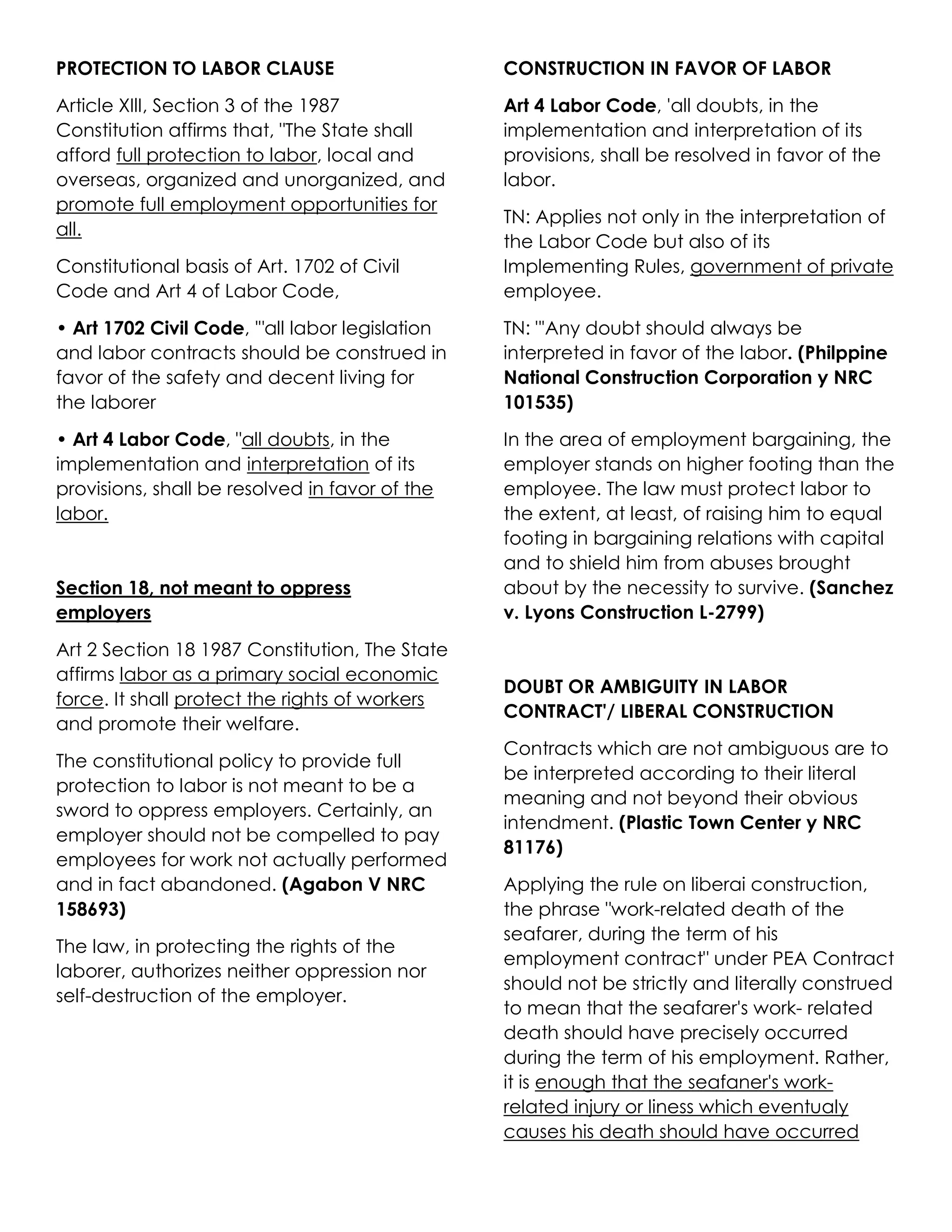
LEGAL BASIS
ARTICLE II 1987 CONSTITUTION
STATE POLICIES
Section 9. The State shall promote a just
and dynamic social order that will ensure
the prosperity and independence of the
nation and free the people from poverty
through policies that provide adequate
social services, promote full employment, a
rising standard of living, and an improved
quality of life for all
Section 14. The State recognizes the role of
women in nation-building, and shall ensure
the fundamental equality before the law of
women and men.
Section 18. The State affirms labor as a
primary social economic force, It shall
protect the rights of workers and promote
their welfare.
Section 20. The State recoghizes the
indispensable role of the private sector,
encourages private enterprise, and
provides incentives to needed investments.
PROTECTION TO LABOR CLAUSE
Article XIlI, Section 3 of the 1987
Constitution affirms that, "The State shall
afford full protection to labor, local and
overseas, organized and unorganized, and
promote full employment opportunities for
all.
Constitutional basis of Art. 1702 of Civil
Code and Art 4 of Labor Code,
• Art 1702 Civil Code, '"all labor legislation
and labor contracts should be construed in
favor of the safety and decent living for
the laborer
• Art 4 Labor Code, "all doubts, in the
implementation and interpretation of its
provisions, shall be resolved in favor of the
labor.
Section 18, not meant to oppress
employers
Art 2 Section 18 1987 Constitution, The State
affirms labor as a primary social economic
force. It shall protect the rights of workers
and promote their welfare.
The constitutional policy to provide full
protection to labor is not meant to be a
sword to oppress employers. Certainly, an
employer should not be compelled to pay
employees for work not actually performed
and in fact abandoned. (Agabon V NRC
158693)
The law, in protecting the rights of the
laborer, authorizes neither oppression nor
self-destruction of the employer.
CONSTRUCTION IN FAVOR OF LABOR
Art 4 Labor Code, 'all doubts, in the
implementation and interpretation of its
provisions, shall be resolved in favor of the
labor.
TN: Applies not only in the interpretation of
the Labor Code but also of its
Implementing Rules, government of private
employee.
TN: "'Any doubt should always be
interpreted in favor of the labor. (Philppine
National Construction Corporation y NRC
101535)
In the area of employment bargaining, the
employer stands on higher footing than the
employee. The law must protect labor to
the extent, at least, of raising him to equal
footing in bargaining relations with capital
and to shield him from abuses brought
about by the necessity to survive. (Sanchez
v. Lyons Construction L-2799)
DOUBT OR AMBIGUITY IN LABOR
CONTRACT'/ LIBERAL CONSTRUCTION
Contracts which are not ambiguous are to
be interpreted according to their literal
meaning and not beyond their obvious
intendment. (Plastic Town Center y NRC
81176)
Applying the rule on liberai construction,
the phrase "work-related death of the
seafarer, during the term of his
employment contract" under PEA Contract
should not be strictly and literally construed
to mean that the seafarer's work- related
death should have precisely occurred
during the term of his employment. Rather,
it is enough that the seafaner's work-
related injury or liness which eventualy
causes his death should have occurred
during the term of his employment. (Phil,
Transmarine Carriers v NlRC 1238915)
II. LABOR RELATIONS
A. EMPLOYER-EMPLOYEE RELATIONSHIP
B. KINDS OF EMPLOYMENT
C. SUBCONTRACTING VS LABOR-ONLY
CONTRACTING
TESTS TO DETERMINE EE-ER RELATIONSHIP
1. FOUR-FOLD TEST
a) Selection and engagement of the EE;
b) Payment of wages or salaries;
c) Power of dismissal;
d) Power of control of the EE's conduct.
CONTROL TEST, CONTROLLING TEST
It addresses the issue of whether controls or
has reserved the right to control the EE not
only as to the result of the work to be done,
but also as to the means and methods by
which the same is to be accomplished.
(Galego v Bayer Philippines 179807)
2-TIERED TEST OF EMPLOYMENT
RELATIONSHIP
While the controlling test may be the most
important to determine the ER-ER
relationship, however, in certain cases,
control test is not sufficient, owing to the
complexity of such relationship where
several positions have been held by the
worker.
I. Employer's power of control to the EE as
to the means and methods & results
[control test]
II. Underlying economic realities of the
activity or relationship (economic reality
test) (Francisco v NLIC 170097)
The economic reality, test calls for the
determination of the nature of the
relationship based on the circumstances of
the whole economic activity. This is
determined by asking whether the worker
is dependent on the alleged employer for
its continued employment in that line of
business (Halferty v Putlse Drug Company)
Francisco was an employee of an
employee of of Kasel Corporation, where
she simultaneously held several positions
because she was under the direct control
and supervision of Kamamura, the
corporations consultant. She reported for
regularly and served in various Consultant
capacities as Accountant, Liaison Officer.
Acting manager and corporate secretary
and tax services and performing functions
necessary and desirable for the operation
of the corporation.
Under the economic reality test, Francisco
is said to be an employee because she
had served the company for 6 year before
her dismissal, receiving check indicating
her salary, benefits, 13th month pay, bonus,
allowances, as well as deductions and
Social Security System contributions, These
pieces of evidence shows the existence of
an ER-EE relationship
PRINCIPLES ON ER-EE RELATIONSHIP
a) relationship of the ER and EE is
contractual in nature. It may be an oral o
written contract. A written contract is not
necessary for the creation and yalidity of
the relationship (Compania Maritima v
Emesta Cabagnot Vda. De Ho L-17362)
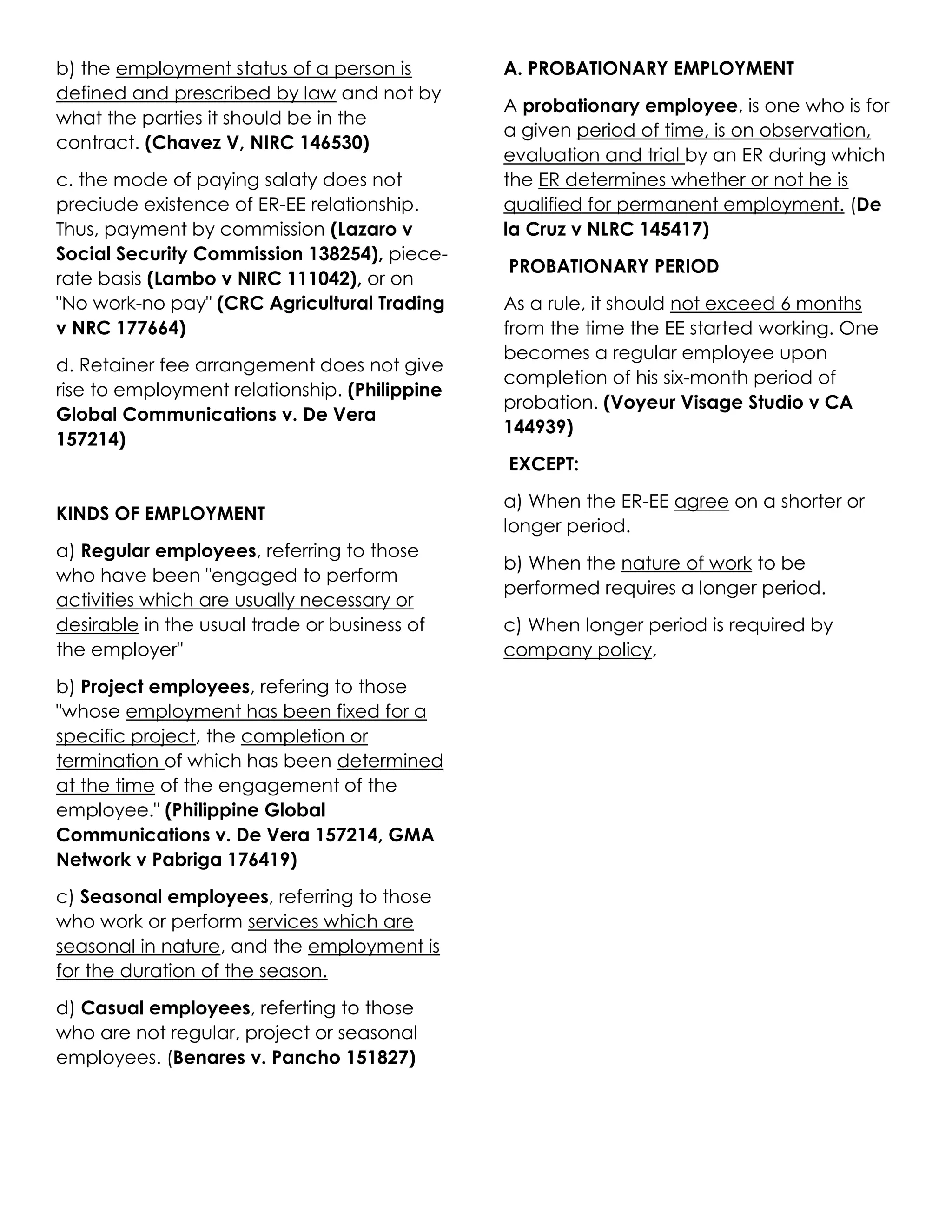
b) the employment status of a person is
defined and prescribed by law and not by
what the parties it should be in the
contract. (Chavez V, NIRC 146530)
c. the mode of paying salaty does not
preciude existence of ER-EE relationship.
Thus, payment by commission (Lazaro v
Social Security Commission 138254), piece-
rate basis (Lambo v NIRC 111042), or on
"No work-no pay" (CRC Agricultural Trading
v NRC 177664)
d. Retainer fee arrangement does not give
rise to employment relationship. (Philippine
Global Communications v. De Vera
157214)
KINDS OF EMPLOYMENT
a) Regular employees, referring to those
who have been "engaged to perform
activities which are usually necessary or
desirable in the usual trade or business of
the employer"
b) Project employees, refering to those
"whose employment has been fixed for a
specific project, the completion or
termination of which has been determined
at the time of the engagement of the
employee." (Philippine Global
Communications v. De Vera 157214, GMA
Network v Pabriga 176419)
c) Seasonal employees, referring to those
who work or perform services which are
seasonal in nature, and the employment is
for the duration of the season.
d) Casual employees, referting to those
who are not regular, project or seasonal
employees. (Benares v. Pancho 151827)
A. PROBATIONARY EMPLOYMENT
A probationary employee, is one who is for
a given period of time, is on observation,
evaluation and trial by an ER during which
the ER determines whether or not he is
qualified for permanent employment. (De
la Cruz v NLRC 145417)
PROBATIONARY PERIOD
As a rule, it should not exceed 6 months
from the time the EE started working. One
becomes a regular employee upon
completion of his six-month period of
probation. (Voyeur Visage Studio v CA
144939)
EXCEPT:
a) When the ER-EE agree on a shorter or
longer period.
b) When the nature of work to be
performed requires a longer period.
c) When longer period is required by
company policy,

GE SSP - Labor Law Part One - Philippines

  • 1.
    GE SSP PHILIPPINE CONSTITUTIONAND HUMAN RIGHTS How to answer an essay 1. Answer in 2 - 3 paragraphs. 2. ]st par. Answer whether yes or no as to the liability. Followed by the legal basis of your answer based on law or a supreme court case. (Ex. X Company, being the employer of Y, he is entitled to a 13th month pay as required by law. ) 3. 2nd par. Apply the relevant facts of the case to the law you cited in paragraph 1. (Ex. In the case at bar, Y was able to serve 3 months of service for X Company, from June 1 to August 30, 2023. Thus, he is entitled to 1/12 of his total salary earned for the year as required by law.) • An answer could also be an application of the exception of the General rule If such is the case, provide for the General rule in brief and then discuss more on the exception and apply the same to the facts of the case. Ex. In the case at bar, while the General Rule is that the payment of 13th pay requires prior rendition of service of at least 1 month. The law provides for an exception, that those retail and service establishments regularly employing less than 10 EE shall not be required to pay 13th month pay to its employee's Thus, by way of exception, since the establishment on has nine (9) employees, X Company is not required to pay Y 13th month pay(Max 3rd paragraph) TOPICS I. Fundamental Principles and Concepts II. Labor Relations Ill. Termination of Employment IV. Management Prerogative V. Labor Standards I. Fundamental Principles and Concepts A. Legal Basis B. Construction in favor of labor LEGAL BASIS ARTICLE II 1987 CONSTITUTION STATE POLICIES Section 9. The State shall promote a just and dynamic social order that will ensure the prosperity and independence of the nation and free the people from poverty through policies that provide adequate social services, promote full employment, a rising standard of living, and an improved quality of life for all Section 14. The State recognizes the role of women in nation-building, and shall ensure the fundamental equality before the law of women and men. Section 18. The State affirms labor as a primary social economic force, It shall protect the rights of workers and promote their welfare. Section 20. The State recoghizes the indispensable role of the private sector, encourages private enterprise, and provides incentives to needed investments.
  • 2.
    PROTECTION TO LABORCLAUSE Article XIlI, Section 3 of the 1987 Constitution affirms that, "The State shall afford full protection to labor, local and overseas, organized and unorganized, and promote full employment opportunities for all. Constitutional basis of Art. 1702 of Civil Code and Art 4 of Labor Code, • Art 1702 Civil Code, '"all labor legislation and labor contracts should be construed in favor of the safety and decent living for the laborer • Art 4 Labor Code, "all doubts, in the implementation and interpretation of its provisions, shall be resolved in favor of the labor. Section 18, not meant to oppress employers Art 2 Section 18 1987 Constitution, The State affirms labor as a primary social economic force. It shall protect the rights of workers and promote their welfare. The constitutional policy to provide full protection to labor is not meant to be a sword to oppress employers. Certainly, an employer should not be compelled to pay employees for work not actually performed and in fact abandoned. (Agabon V NRC 158693) The law, in protecting the rights of the laborer, authorizes neither oppression nor self-destruction of the employer. CONSTRUCTION IN FAVOR OF LABOR Art 4 Labor Code, 'all doubts, in the implementation and interpretation of its provisions, shall be resolved in favor of the labor. TN: Applies not only in the interpretation of the Labor Code but also of its Implementing Rules, government of private employee. TN: "'Any doubt should always be interpreted in favor of the labor. (Philppine National Construction Corporation y NRC 101535) In the area of employment bargaining, the employer stands on higher footing than the employee. The law must protect labor to the extent, at least, of raising him to equal footing in bargaining relations with capital and to shield him from abuses brought about by the necessity to survive. (Sanchez v. Lyons Construction L-2799) DOUBT OR AMBIGUITY IN LABOR CONTRACT'/ LIBERAL CONSTRUCTION Contracts which are not ambiguous are to be interpreted according to their literal meaning and not beyond their obvious intendment. (Plastic Town Center y NRC 81176) Applying the rule on liberai construction, the phrase "work-related death of the seafarer, during the term of his employment contract" under PEA Contract should not be strictly and literally construed to mean that the seafarer's work- related death should have precisely occurred during the term of his employment. Rather, it is enough that the seafaner's work- related injury or liness which eventualy causes his death should have occurred
  • 3.
    during the termof his employment. (Phil, Transmarine Carriers v NlRC 1238915) II. LABOR RELATIONS A. EMPLOYER-EMPLOYEE RELATIONSHIP B. KINDS OF EMPLOYMENT C. SUBCONTRACTING VS LABOR-ONLY CONTRACTING TESTS TO DETERMINE EE-ER RELATIONSHIP 1. FOUR-FOLD TEST a) Selection and engagement of the EE; b) Payment of wages or salaries; c) Power of dismissal; d) Power of control of the EE's conduct. CONTROL TEST, CONTROLLING TEST It addresses the issue of whether controls or has reserved the right to control the EE not only as to the result of the work to be done, but also as to the means and methods by which the same is to be accomplished. (Galego v Bayer Philippines 179807) 2-TIERED TEST OF EMPLOYMENT RELATIONSHIP While the controlling test may be the most important to determine the ER-ER relationship, however, in certain cases, control test is not sufficient, owing to the complexity of such relationship where several positions have been held by the worker. I. Employer's power of control to the EE as to the means and methods & results [control test] II. Underlying economic realities of the activity or relationship (economic reality test) (Francisco v NLIC 170097) The economic reality, test calls for the determination of the nature of the relationship based on the circumstances of the whole economic activity. This is determined by asking whether the worker is dependent on the alleged employer for its continued employment in that line of business (Halferty v Putlse Drug Company) Francisco was an employee of an employee of of Kasel Corporation, where she simultaneously held several positions because she was under the direct control and supervision of Kamamura, the corporations consultant. She reported for regularly and served in various Consultant capacities as Accountant, Liaison Officer. Acting manager and corporate secretary and tax services and performing functions necessary and desirable for the operation of the corporation. Under the economic reality test, Francisco is said to be an employee because she had served the company for 6 year before her dismissal, receiving check indicating her salary, benefits, 13th month pay, bonus, allowances, as well as deductions and Social Security System contributions, These pieces of evidence shows the existence of an ER-EE relationship PRINCIPLES ON ER-EE RELATIONSHIP a) relationship of the ER and EE is contractual in nature. It may be an oral o written contract. A written contract is not necessary for the creation and yalidity of the relationship (Compania Maritima v Emesta Cabagnot Vda. De Ho L-17362)
  • 4.
    b) the employmentstatus of a person is defined and prescribed by law and not by what the parties it should be in the contract. (Chavez V, NIRC 146530) c. the mode of paying salaty does not preciude existence of ER-EE relationship. Thus, payment by commission (Lazaro v Social Security Commission 138254), piece- rate basis (Lambo v NIRC 111042), or on "No work-no pay" (CRC Agricultural Trading v NRC 177664) d. Retainer fee arrangement does not give rise to employment relationship. (Philippine Global Communications v. De Vera 157214) KINDS OF EMPLOYMENT a) Regular employees, referring to those who have been "engaged to perform activities which are usually necessary or desirable in the usual trade or business of the employer" b) Project employees, refering to those "whose employment has been fixed for a specific project, the completion or termination of which has been determined at the time of the engagement of the employee." (Philippine Global Communications v. De Vera 157214, GMA Network v Pabriga 176419) c) Seasonal employees, referring to those who work or perform services which are seasonal in nature, and the employment is for the duration of the season. d) Casual employees, referting to those who are not regular, project or seasonal employees. (Benares v. Pancho 151827) A. PROBATIONARY EMPLOYMENT A probationary employee, is one who is for a given period of time, is on observation, evaluation and trial by an ER during which the ER determines whether or not he is qualified for permanent employment. (De la Cruz v NLRC 145417) PROBATIONARY PERIOD As a rule, it should not exceed 6 months from the time the EE started working. One becomes a regular employee upon completion of his six-month period of probation. (Voyeur Visage Studio v CA 144939) EXCEPT: a) When the ER-EE agree on a shorter or longer period. b) When the nature of work to be performed requires a longer period. c) When longer period is required by company policy,