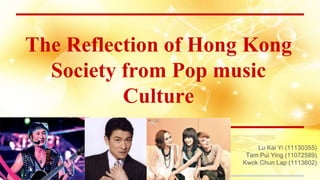
The Reflection of Hong Kong
Society from Pop music
Culture
Lu Kai Yi (11130355)
Tam Pui Ying (11072589)
Kwok Chun Lap (1113602)
Content
1.Aims
2.Features of Hong Kong Popular Music Culture
3.1970s
4.1980s
5.1990s
6. 2000 Society+ onwards
7.Conclusion
8.Reference
Aims
•Know more about the relationship between Society and
popular music culture
•To show the evidence that there had had changes of the
society since 1970s
•Show how the society and culture affect the development
of pop music culture in Hong Kong
•Reveal the features of each selected period
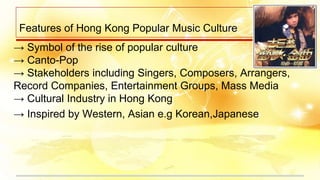
Features of Hong Kong Popular Music Culture
→ Symbol of the rise of popular culture
→ Canto-Pop
→ Stakeholders including Singers, Composers, Arrangers,
Record Companies, Entertainment Groups, Mass Media
→ Cultural Industry in Hong Kong
→ Inspired by Western, Asian e.g Korean,Japanese
1970s Society
→ An important decade including important events and
the development of society
→ Inspiration for the content of many Canto-pop songs
→ Start expansion of the usage of Cantonese
→ Establishment for an international cosmopolitan city
because of the colonial British Government
→ Increased industrialisation, commercialisation
→ Mass Media
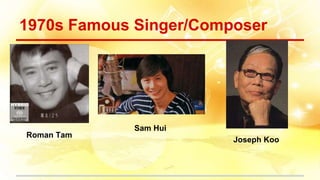
1970s Famous Singer/Composer
Roman Tam
Joseph Koo
Sam Hui
The Features of 1970’s Pop Music
→ Canto-pop
-->TVB: Theme Song
→ Mixtures of Western Styles and Chinese
music elements
→ Love Song
→ Sam Hui, Joseph Koo
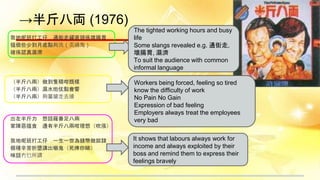
→半斤八両 (1976)
我地呢班打工仔 通街走糴直頭係壞腸胃
搵個些少到月底點夠洗(奀過鬼)
確係認真濕滯
(半斤八兩)做到隻積咁既樣
(半斤八兩)濕水炮仗點會響
(半斤八兩)夠薑鎗走去搶
出左半斤力 想話羅番足八兩
家陣惡搵食 邊有半斤八兩咁理想(吹漲)
我地呢班打工仔 一生一世為錢幣做奴隸
個種辛苦折墮講出嚇鬼(死俾你睇)
咪話冇乜所謂
The tighted working hours and busy
life
Some slangs revealed e.g. 通街走,
壞腸胃, 濕濟
To suit the audience with common
informal language
Workers being forced, feeling so tired
know the difficulty of work
No Pain No Gain
Expression of bad feeling
Employers always treat the employees
very bad
It shows that labours always work for
income and always exploited by their
boss and remind them to express their
feelings bravely
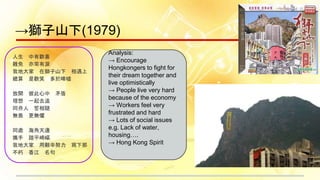
→獅子山下(1979)
人生 中有歡喜
難免 亦常有淚
我地大家 在獅子山下 相遇上
總算 是歡笑 多於唏噓
放開 彼此心中 矛盾
理想 一起去追
同舟人 誓相隨
無畏 更無懼
同處 海角天邊
攜手 踏平崎嶇
我地大家 用艱辛努力 寫下那
不朽 香江 名句
Analysis:
→ Encourage
Hongkongers to fight for
their dream together and
live optimistically
→ People live very hard
because of the economy
→ Workers feel very
frustrated and hard
→ Lots of social issues
e.g. Lack of water,
housing….
→ Hong Kong Spirit
Social Content of 1970s Popular Song
→ Deal with a range of social and economic
issues such as exploitation of workers
→ Represent the feeling from Hongkongers
→ Become very popular until now
→ Hongkongers need to work very hard to earn
their wages
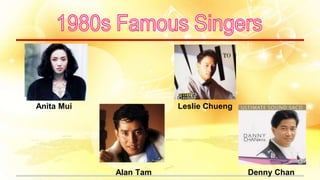
Anita Mui Leslie Chueng
Alan Tam Denny Chan
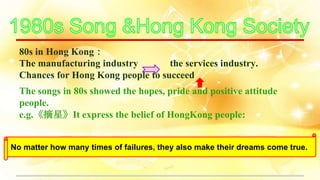
80s in Hong Kong:
The manufacturing industry the services industry.
Chances for Hong Kong people to succeed
The songs in 80s showed the hopes, pride and positive attitude
people.
e.g.《摘星》It express the belief of HongKong people:
No matter how many times of failures, they also make their dreams come true.
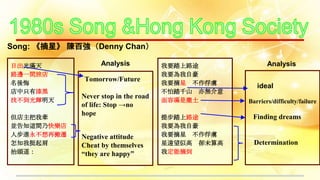
日出光滿天
路邊一間旅店
名後悔
店中只有漆黑
找不到光輝明天
但店主把我牽
並告知這間乃快樂店
人步進永不想再搬遷
怎知我挺起肩
抬頭道:
我要踏上路途
我要為我自豪
我要摘星 不作俘虜
不怕踏千山 亦無介意
面容滿是塵土
提步踏上路途
我要為我自豪
我要摘星 不作俘虜
星遠望似高 卻未算高
我定能摘到
Song: 《摘星》 陳百強(Denny Chan)
Analysis
ideal
Barriers/difficulty/failure
Finding dreams
Determination
Analysis
Tomorrow/Future
Never stop in the road
of life: Stop →no
hope
Negative attitude
Cheat by themselves
“they are happy”
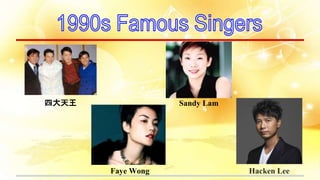
四大天王 Sandy Lam
Faye Wong Hacken Lee
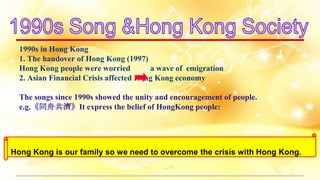
1990s in Hong Kong
1. The handover of Hong Kong (1997)
Hong Kong people were worried a wave of emigration
2. Asian Financial Crisis affected Hong Kong economy
The songs since 1990s showed the unity and encouragement of people.
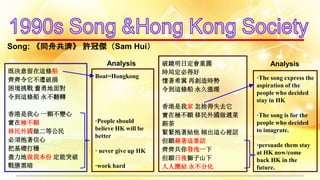
e.g.《同舟共濟》It express the belief of HongKong people:
Hong Kong is our family so we need to overcome the crisis with Hong Kong.
Song: 《同舟共濟》 許冠傑(Sam Hui)
既決意留在這條船
齊齊令它不遭破損
困境挑戰 奮勇地面對
令到這條船 永不翻轉
香港是我心 一顆不變心
實在極不願
移民外國做二等公民
必須抱著信心
把基礎打穩
盡力地做我本份 定能突破
戰勝黑暗
破鏡明日定會重圓
時局定必得好
懷著希冀 再創造時勢
令到這條船 永久溫暖
香港是我家 怎捨得失去它
實在極不願 移民外國做遞菜
斟茶
緊緊抱著結他 傾出這心裡話
但願藉著這番話
齊齊共你發洩一下
但願日後獅子山下
人人團結 永不分化
Analysis Analysis
·The song express the
aspiration of the
people who decided
stay in HK
·The song is for the
people who decided
to imagrate.
·persuade them stay
at HK now/come
back HK in the
future.
Boat=Hongkong
·People should
believe HK will be
better
· never give up HK
·work hard
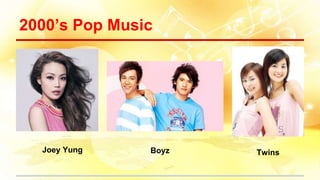
2000’s Pop Music
TwinsJoey Yung Boyz
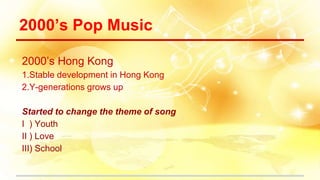
2000’s Pop Music
2000’s Hong Kong
1.Stable development in Hong Kong
2.Y-generations grows up
Started to change the theme of song
I ) Youth
II ) Love
III) School
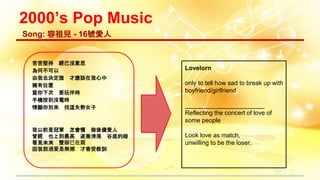
2000’s Pop Music
苦苦堅持 經已沒意思
為何不可以
由我去決定誰 才應該在我心中
擁有位置
當你下次 要玩伴時
手機按到沒電時
情願你別來 找這失勢女子
我以前是冠軍 怎會慣 做後備愛人
曾經 也上到最高 逐漸滑落 谷底的暗
看見未來 雙腳已在震
因我說過愛是無撼 才會受教訓
Song: 容祖兒 - 16號愛人
Lovelorn
only to tell how sad to break up with
boyfriend/girlfriend
_______________________
Reflecting the concert of love of
some people
Look love as match,
unwilling to be the loser.
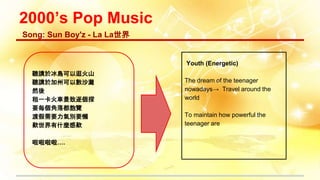
2000’s Pop Music
聽講於冰島可以逛火山
聽講於加州可以數沙灘
然後
租一卡火車景致逐個探
要每個角落都飽覽
渡假需要力氣別要懶
歎世界有什麼感歎
啦啦啦啦….
Song: Sun Boy'z - La La世界
Youth (Energetic)
The dream of the teenager
nowadays→ Travel around the
world
To maintain how powerful the
teenager are
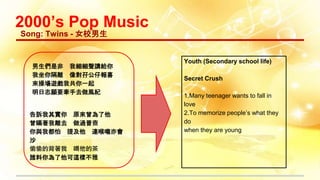
2000’s Pop Music
Song: Twins - 女校男生
男生們是非 我細細聲講給你
我坐你隔離 像對孖公仔報喜
來操場遊戲我共你一起
明日志願要牽手去做風紀
告訴我其實你 原來曾為了他
曾瞞著我離去 做過普查
你與我都怕 提及他 連喉嚨亦會
沙
偷偷的背著我 喝他的茶
誰料你為了他可這樣不雅
Youth (Secondary school life)
Secret Crush
1.Many teenager wants to fall in
love
2.To memorize people’s what they
do
when they are young
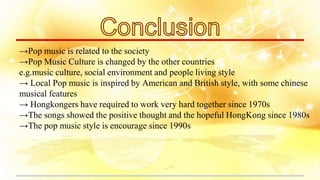
→Pop music is related to the society
→Pop Music Culture is changed by the other countries
e.g.music culture, social environment and people living style
→ Local Pop music is inspired by American and British style, with some chinese
musical features
→ Hongkongers have required to work very hard together since 1970s
→The songs showed the positive thought and the hopeful HongKong since 1980s
→The pop music style is encourage since 1990s
ReferenceChan Ming Hong(2007). 從《獅子山下》到「許冠傑金曲」到《始終有你》-
「香港人的歌」與「香港人」有什麼關係?. Retrieved from
http://www.ln.edu.hk/mcsln/7th_issue/feature_01.shtml
Wong Sze Ling(2012). 《半斤八兩》—a—詞人簡介、歌詞解讀
Retrieved from
http://cantonpopblog.blogspot.hk/2012/04/blog-post_1392.html
Lau Man Chun(2003). A study of Hong Kong Popular Music Industry(1930-2000). Hong
Kong: The University of Hong Kong.
Man Oi Kuen(1998). Cantonese Popular Song in Hong Kong in the 1970s: An
Examination of Musical Content and Social Context Inselected Case Studies. Hong Kong:
The University of Hong Kong
Wong Jum Sum(2003). The Rise and Decline of Cantopop. Hong Kong: The University
of Hong Kong
Yiu Wai Chu and Eve Leung(2013). Remapping Hong Kong Popular Music: Covers,
Localisation and the Waning Hybridity of Cantopop. Popular Music, 32, pp 65-78.
London: Cambridge University Press.
Matthew M. Chew(2011). Hybridity, Empowerment and Subversiveness in Cantopop
Electronic Dance Music. London: Taylor &Francis Group

GE Presentation Powerpoint

  • 1.
    The Reflection ofHong Kong Society from Pop music Culture Lu Kai Yi (11130355) Tam Pui Ying (11072589) Kwok Chun Lap (1113602)
  • 2.
    Content 1.Aims 2.Features of HongKong Popular Music Culture 3.1970s 4.1980s 5.1990s 6. 2000 Society+ onwards 7.Conclusion 8.Reference
  • 3.
    Aims •Know more aboutthe relationship between Society and popular music culture •To show the evidence that there had had changes of the society since 1970s •Show how the society and culture affect the development of pop music culture in Hong Kong •Reveal the features of each selected period
  • 4.
    Features of HongKong Popular Music Culture → Symbol of the rise of popular culture → Canto-Pop → Stakeholders including Singers, Composers, Arrangers, Record Companies, Entertainment Groups, Mass Media → Cultural Industry in Hong Kong → Inspired by Western, Asian e.g Korean,Japanese
  • 5.
    1970s Society → Animportant decade including important events and the development of society → Inspiration for the content of many Canto-pop songs → Start expansion of the usage of Cantonese → Establishment for an international cosmopolitan city because of the colonial British Government → Increased industrialisation, commercialisation → Mass Media
  • 6.
    1970s Famous Singer/Composer RomanTam Joseph Koo Sam Hui
  • 7.
    The Features of1970’s Pop Music → Canto-pop -->TVB: Theme Song → Mixtures of Western Styles and Chinese music elements → Love Song → Sam Hui, Joseph Koo
  • 8.
    →半斤八両 (1976) 我地呢班打工仔 通街走糴直頭係壞腸胃 搵個些少到月底點夠洗(奀過鬼) 確係認真濕滯 (半斤八兩)做到隻積咁既樣 (半斤八兩)濕水炮仗點會響 (半斤八兩)夠薑鎗走去搶 出左半斤力想話羅番足八兩 家陣惡搵食 邊有半斤八兩咁理想(吹漲) 我地呢班打工仔 一生一世為錢幣做奴隸 個種辛苦折墮講出嚇鬼(死俾你睇) 咪話冇乜所謂 The tighted working hours and busy life Some slangs revealed e.g. 通街走, 壞腸胃, 濕濟 To suit the audience with common informal language Workers being forced, feeling so tired know the difficulty of work No Pain No Gain Expression of bad feeling Employers always treat the employees very bad It shows that labours always work for income and always exploited by their boss and remind them to express their feelings bravely
  • 9.
    →獅子山下(1979) 人生 中有歡喜 難免 亦常有淚 我地大家在獅子山下 相遇上 總算 是歡笑 多於唏噓 放開 彼此心中 矛盾 理想 一起去追 同舟人 誓相隨 無畏 更無懼 同處 海角天邊 攜手 踏平崎嶇 我地大家 用艱辛努力 寫下那 不朽 香江 名句 Analysis: → Encourage Hongkongers to fight for their dream together and live optimistically → People live very hard because of the economy → Workers feel very frustrated and hard → Lots of social issues e.g. Lack of water, housing…. → Hong Kong Spirit
  • 10.
    Social Content of1970s Popular Song → Deal with a range of social and economic issues such as exploitation of workers → Represent the feeling from Hongkongers → Become very popular until now → Hongkongers need to work very hard to earn their wages
  • 12.
    Anita Mui LeslieChueng Alan Tam Denny Chan
  • 13.
    80s in HongKong: The manufacturing industry the services industry. Chances for Hong Kong people to succeed The songs in 80s showed the hopes, pride and positive attitude people. e.g.《摘星》It express the belief of HongKong people: No matter how many times of failures, they also make their dreams come true.
  • 14.
    日出光滿天 路邊一間旅店 名後悔 店中只有漆黑 找不到光輝明天 但店主把我牽 並告知這間乃快樂店 人步進永不想再搬遷 怎知我挺起肩 抬頭道: 我要踏上路途 我要為我自豪 我要摘星 不作俘虜 不怕踏千山 亦無介意 面容滿是塵土 提步踏上路途 我要為我自豪 我要摘星不作俘虜 星遠望似高 卻未算高 我定能摘到 Song: 《摘星》 陳百強(Denny Chan) Analysis ideal Barriers/difficulty/failure Finding dreams Determination Analysis Tomorrow/Future Never stop in the road of life: Stop →no hope Negative attitude Cheat by themselves “they are happy”
  • 16.
  • 17.
    1990s in HongKong 1. The handover of Hong Kong (1997) Hong Kong people were worried a wave of emigration 2. Asian Financial Crisis affected Hong Kong economy The songs since 1990s showed the unity and encouragement of people. e.g.《同舟共濟》It express the belief of HongKong people: Hong Kong is our family so we need to overcome the crisis with Hong Kong.
  • 18.
    Song: 《同舟共濟》 許冠傑(SamHui) 既決意留在這條船 齊齊令它不遭破損 困境挑戰 奮勇地面對 令到這條船 永不翻轉 香港是我心 一顆不變心 實在極不願 移民外國做二等公民 必須抱著信心 把基礎打穩 盡力地做我本份 定能突破 戰勝黑暗 破鏡明日定會重圓 時局定必得好 懷著希冀 再創造時勢 令到這條船 永久溫暖 香港是我家 怎捨得失去它 實在極不願 移民外國做遞菜 斟茶 緊緊抱著結他 傾出這心裡話 但願藉著這番話 齊齊共你發洩一下 但願日後獅子山下 人人團結 永不分化 Analysis Analysis ·The song express the aspiration of the people who decided stay in HK ·The song is for the people who decided to imagrate. ·persuade them stay at HK now/come back HK in the future. Boat=Hongkong ·People should believe HK will be better · never give up HK ·work hard
  • 20.
  • 21.
    2000’s Pop Music 2000’sHong Kong 1.Stable development in Hong Kong 2.Y-generations grows up Started to change the theme of song I ) Youth II ) Love III) School
  • 22.
    2000’s Pop Music 苦苦堅持經已沒意思 為何不可以 由我去決定誰 才應該在我心中 擁有位置 當你下次 要玩伴時 手機按到沒電時 情願你別來 找這失勢女子 我以前是冠軍 怎會慣 做後備愛人 曾經 也上到最高 逐漸滑落 谷底的暗 看見未來 雙腳已在震 因我說過愛是無撼 才會受教訓 Song: 容祖兒 - 16號愛人 Lovelorn only to tell how sad to break up with boyfriend/girlfriend _______________________ Reflecting the concert of love of some people Look love as match, unwilling to be the loser.
  • 23.
    2000’s Pop Music 聽講於冰島可以逛火山 聽講於加州可以數沙灘 然後 租一卡火車景致逐個探 要每個角落都飽覽 渡假需要力氣別要懶 歎世界有什麼感歎 啦啦啦啦…. Song:Sun Boy'z - La La世界 Youth (Energetic) The dream of the teenager nowadays→ Travel around the world To maintain how powerful the teenager are
  • 24.
    2000’s Pop Music Song:Twins - 女校男生 男生們是非 我細細聲講給你 我坐你隔離 像對孖公仔報喜 來操場遊戲我共你一起 明日志願要牽手去做風紀 告訴我其實你 原來曾為了他 曾瞞著我離去 做過普查 你與我都怕 提及他 連喉嚨亦會 沙 偷偷的背著我 喝他的茶 誰料你為了他可這樣不雅 Youth (Secondary school life) Secret Crush 1.Many teenager wants to fall in love 2.To memorize people’s what they do when they are young
  • 25.
    →Pop music isrelated to the society →Pop Music Culture is changed by the other countries e.g.music culture, social environment and people living style → Local Pop music is inspired by American and British style, with some chinese musical features → Hongkongers have required to work very hard together since 1970s →The songs showed the positive thought and the hopeful HongKong since 1980s →The pop music style is encourage since 1990s
  • 26.
    ReferenceChan Ming Hong(2007).從《獅子山下》到「許冠傑金曲」到《始終有你》- 「香港人的歌」與「香港人」有什麼關係?. Retrieved from http://www.ln.edu.hk/mcsln/7th_issue/feature_01.shtml Wong Sze Ling(2012). 《半斤八兩》—a—詞人簡介、歌詞解讀 Retrieved from http://cantonpopblog.blogspot.hk/2012/04/blog-post_1392.html Lau Man Chun(2003). A study of Hong Kong Popular Music Industry(1930-2000). Hong Kong: The University of Hong Kong. Man Oi Kuen(1998). Cantonese Popular Song in Hong Kong in the 1970s: An Examination of Musical Content and Social Context Inselected Case Studies. Hong Kong: The University of Hong Kong Wong Jum Sum(2003). The Rise and Decline of Cantopop. Hong Kong: The University of Hong Kong Yiu Wai Chu and Eve Leung(2013). Remapping Hong Kong Popular Music: Covers, Localisation and the Waning Hybridity of Cantopop. Popular Music, 32, pp 65-78. London: Cambridge University Press. Matthew M. Chew(2011). Hybridity, Empowerment and Subversiveness in Cantopop Electronic Dance Music. London: Taylor &Francis Group