Henry R. Kang (1/2010)
General Chemistry
Lecture 10
Nomenclature of
Chemical Compounds
Contents
• Naming Ionic Compounds
• Naming Molecular Compounds
• Naming Simple Acids
• Naming Oxoacids
• Naming Bases
• Common Names
• Introduction to Organic Compounds
 Naming simple organic compounds
Henry R. Kang (1/2010)
Types of Chemical Compounds
• Inorganic Compounds
 Ionic compounds
 Molecular compounds
 Acids and bases
 Hydrates
• Organic Compounds
 Compounds contain carbon in combination
with other elements such as hydrogen, oxygen,
nitrogen, sulfur, phosphorus, fluorine or
chlorine.
Henry R. Kang (1/2010)
Naming
Ionic Compounds
Henry R. Kang (1/2010)
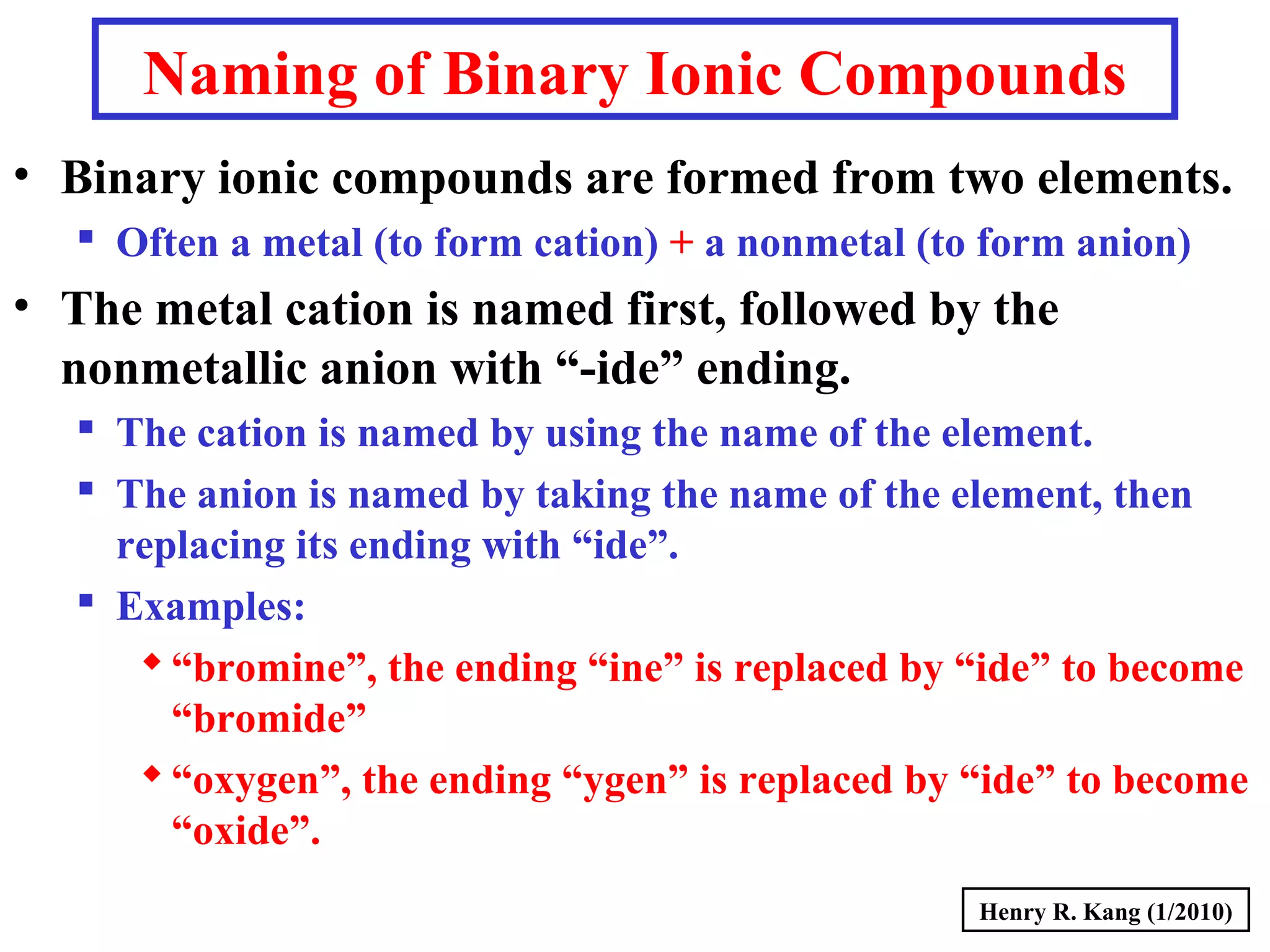
Naming of Binary Ionic Compounds
• Binary ionic compounds are formed from two elements.
 Often a metal (to form cation) + a nonmetal (to form anion)
• The metal cation is named first, followed by the
nonmetallic anion with “-ide” ending.
 The cation is named by using the name of the element.
 The anion is named by taking the name of the element, then
replacing its ending with “ide”.
 Examples:
“bromine”, the ending “ine” is replaced by “ide” to become
“bromide”
“oxygen”, the ending “ygen” is replaced by “ide” to become
“oxide”.
Henry R. Kang (1/2010)
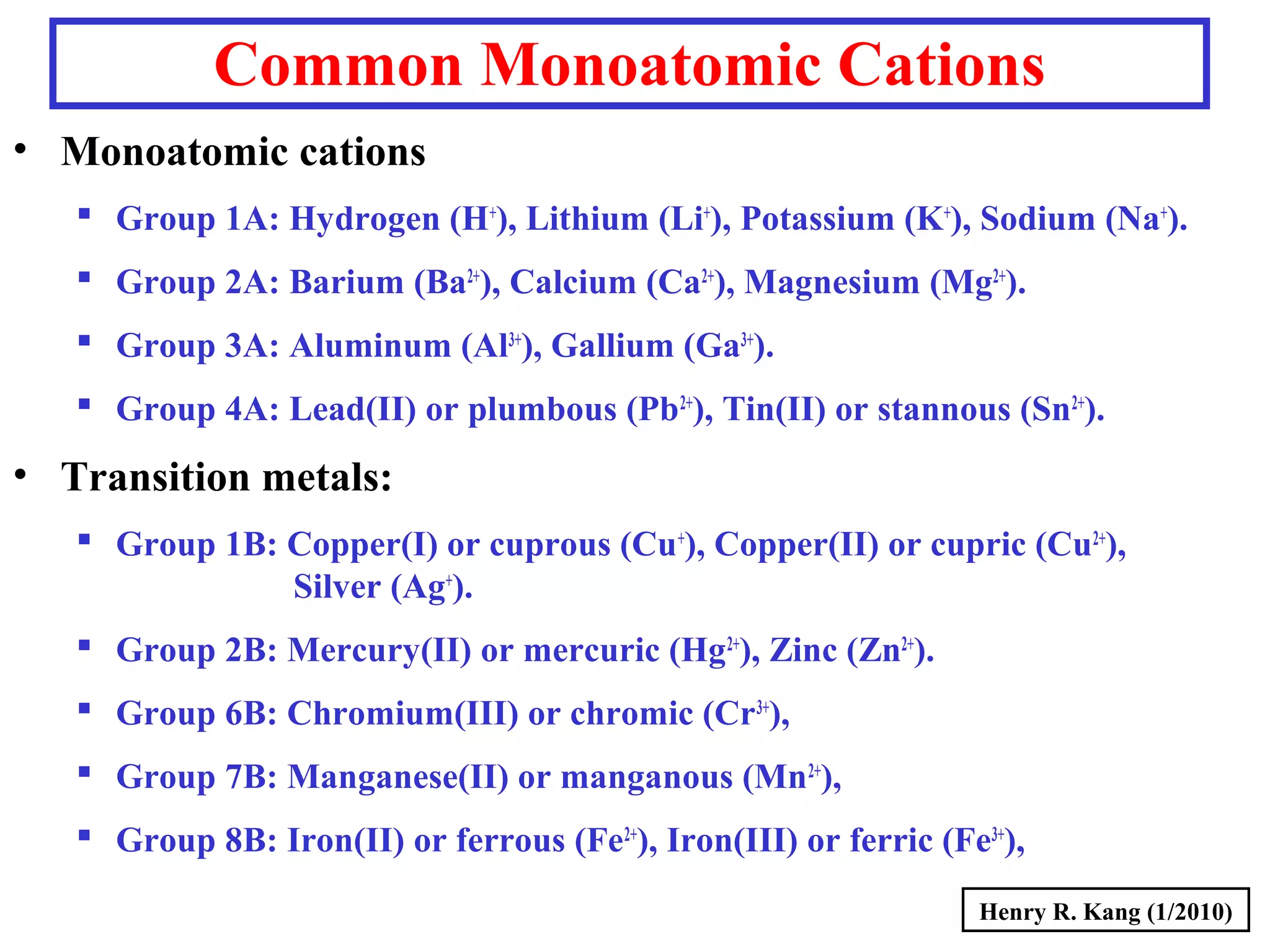
Common Monoatomic Cations
• Monoatomic cations
 Group 1A: Hydrogen (H+
), Lithium (Li+
), Potassium (K+
), Sodium (Na+
).
 Group 2A: Barium (Ba2+
), Calcium (Ca2+
), Magnesium (Mg2+
).
 Group 3A: Aluminum (Al3+
), Gallium (Ga3+
).
 Group 4A: Lead(II) or plumbous (Pb2+
), Tin(II) or stannous (Sn2+
).
• Transition metals:
 Group 1B: Copper(I) or cuprous (Cu+
), Copper(II) or cupric (Cu2+
),
Silver (Ag+
).
 Group 2B: Mercury(II) or mercuric (Hg2+
), Zinc (Zn2+
).
 Group 6B: Chromium(III) or chromic (Cr3+
),
 Group 7B: Manganese(II) or manganous (Mn2+
),
 Group 8B: Iron(II) or ferrous (Fe2+
), Iron(III) or ferric (Fe3+
),
Henry R. Kang (1/2010)
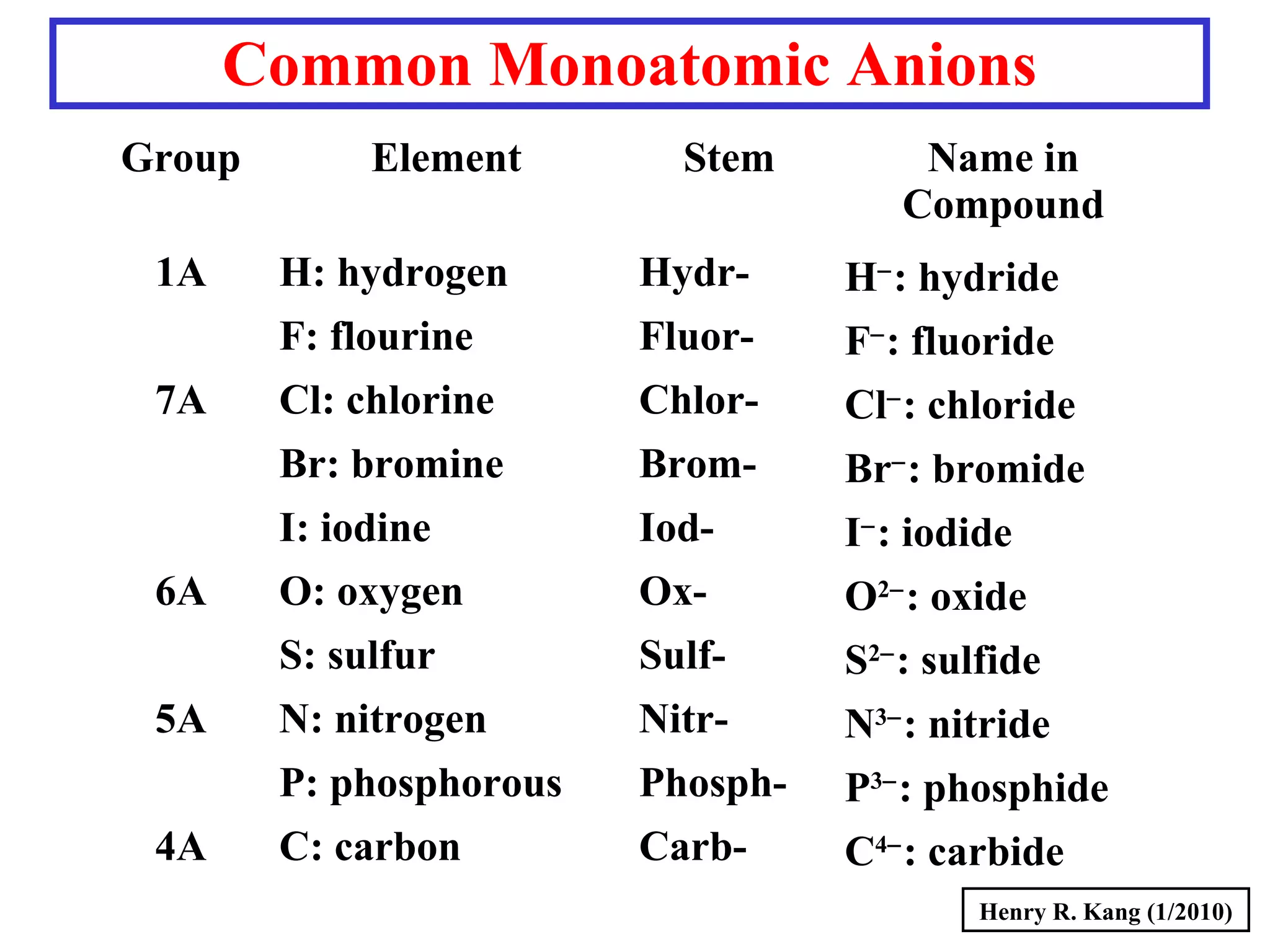
Common Monoatomic Anions
Group Element Stem Name in
Compound
1A H: hydrogen Hydr- H−
: hydride
F: flourine Fluor- F−
: fluoride
7A Cl: chlorine Chlor- Cl−
: chloride
Br: bromine Brom- Br−
: bromide
I: iodine Iod- I−
: iodide
6A O: oxygen Ox- O2−
: oxide
S: sulfur Sulf- S2−
: sulfide
5A N: nitrogen Nitr- N3−
: nitride
P: phosphorous Phosph- P3−
: phosphide
4A C: carbon Carb- C4−
: carbide
Henry R. Kang (1/2010)
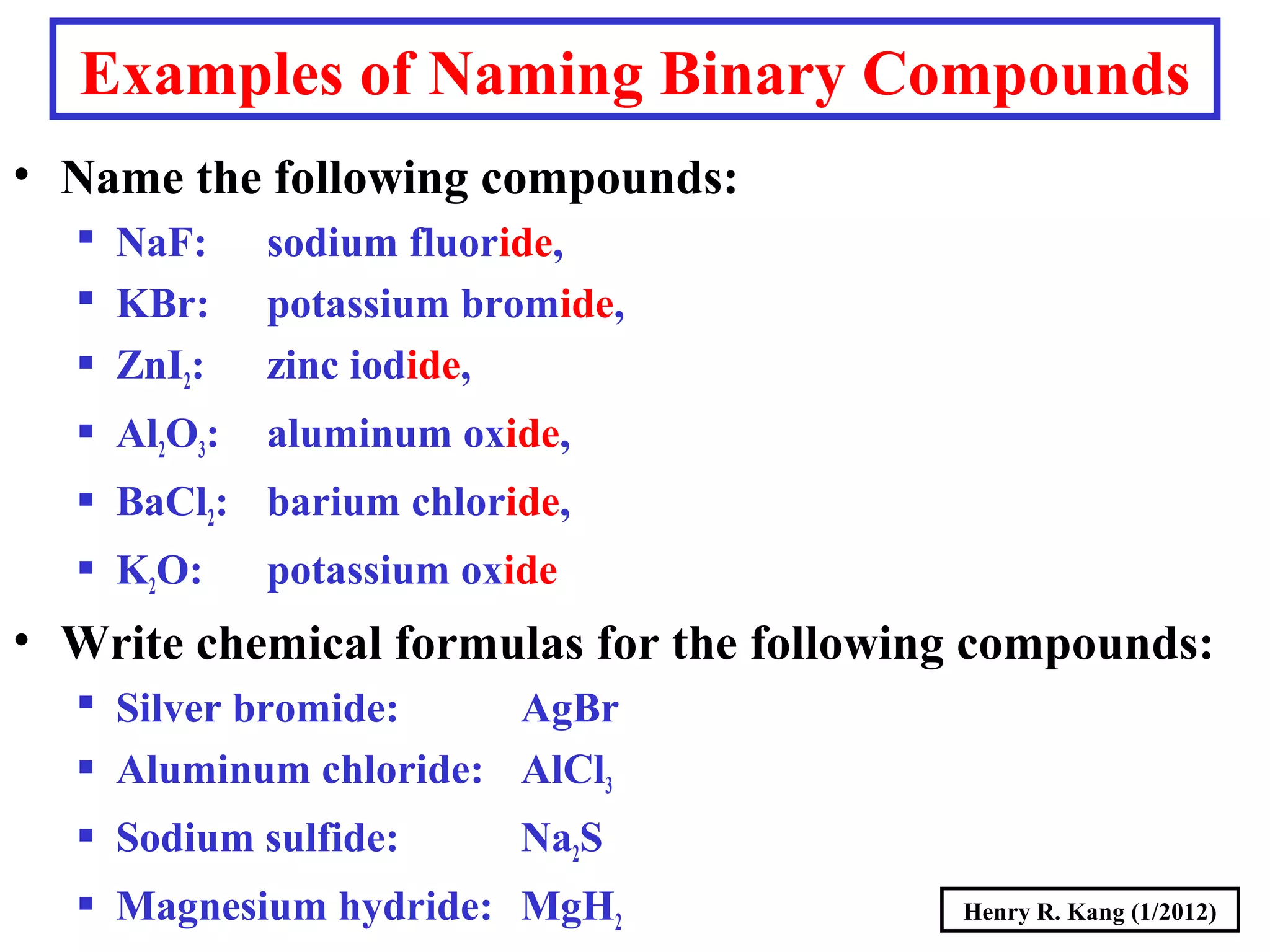
Examples of Naming Binary Compounds
• Name the following compounds:
 NaF: sodium fluoride,
 KBr: potassium bromide,
 ZnI2: zinc iodide,
 Al2O3: aluminum oxide,
 BaCl2: barium chloride,
 K2O: potassium oxide
• Write chemical formulas for the following compounds:
 Silver bromide: AgBr
 Aluminum chloride: AlCl3
 Sodium sulfide: Na2S
 Magnesium hydride: MgH2 Henry R. Kang (1/2012)
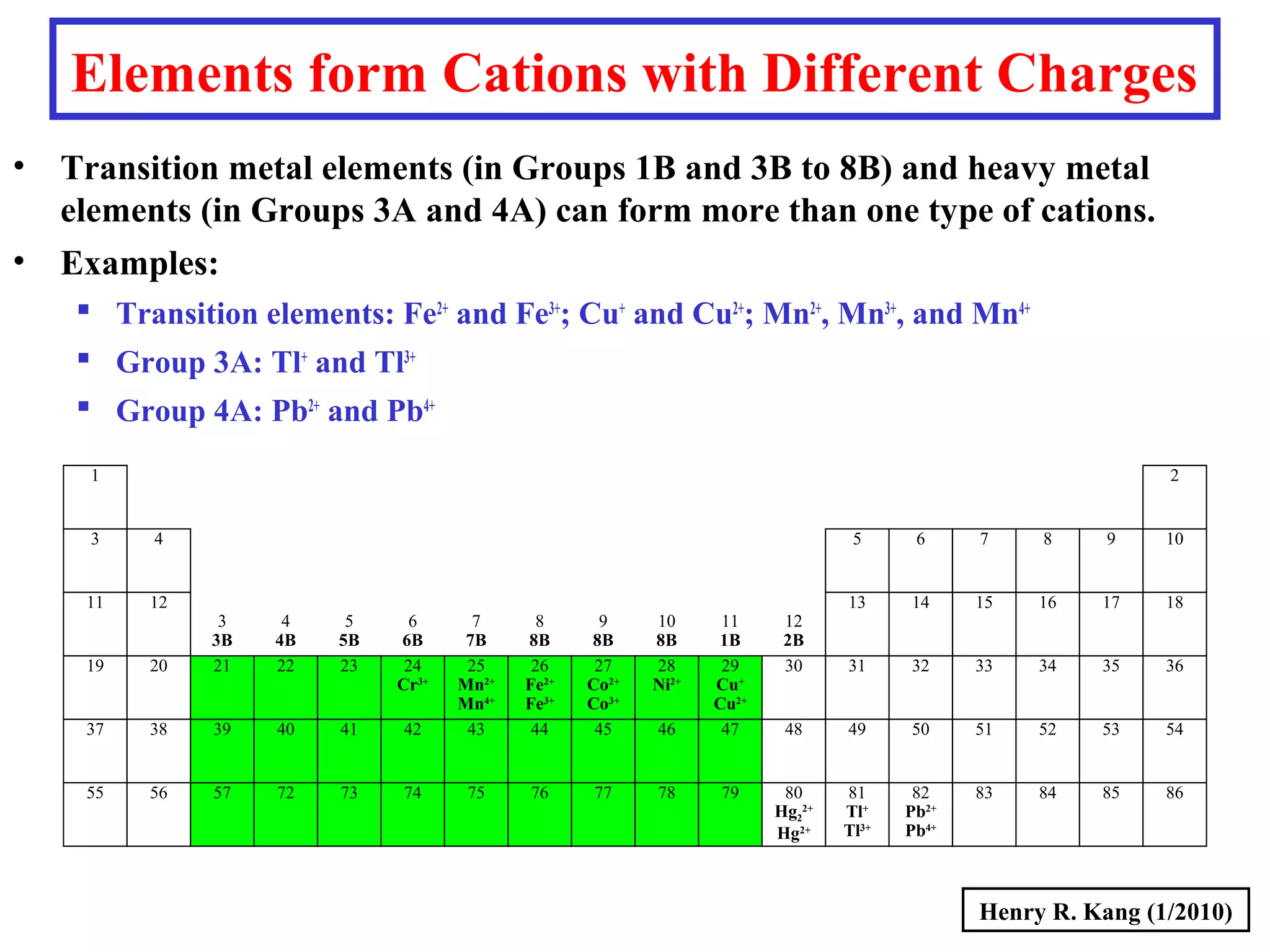
Elements form Cations with Different Charges
• Transition metal elements (in Groups 1B and 3B to 8B) and heavy metal
elements (in Groups 3A and 4A) can form more than one type of cations.
• Examples:
 Transition elements: Fe2+
and Fe3+
; Cu+
and Cu2+
; Mn2+
, Mn3+
, and Mn4+
 Group 3A: Tl+
and Tl3+
 Group 4A: Pb2+
and Pb4+
3
37
19
11
55
20
10
3231 36353433
15 16 17 18
42
14
38 41
57
4039
56
49 50 51 52 53 54
7372 74
43 44 45 46 47 48
76 79 83 84 85 8675 80
Hg2
2+
Hg2+
78 81
Tl+
Tl3+
77 82
Pb2+
Pb4+
4
1
9
2
5 6 7 8
5
5B
4
4B
6
6B
3
3B
8
8B
7
7B
9
8B
10
8B
11
1B
12
2B
30
1312
24
Cr3+
232221 29
Cu+
Cu2+
28
Ni2+
27
Co2+
Co3+
26
Fe2+
Fe3+
25
Mn2+
Mn4+
Henry R. Kang (1/2010)
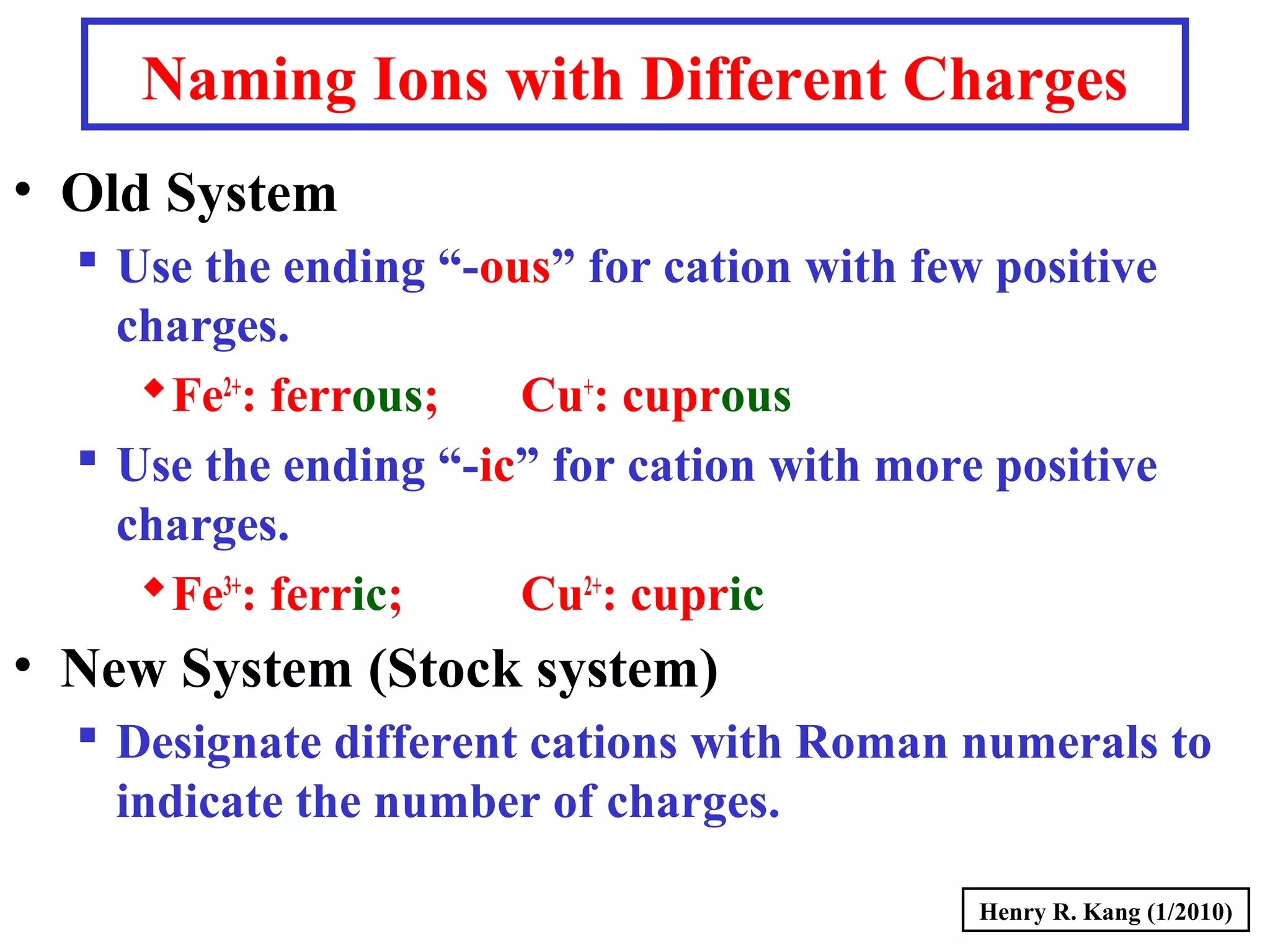
Naming Ions with Different Charges
• Old System
 Use the ending “-ous” for cation with few positive
charges.
Fe2+
: ferrous; Cu+
: cuprous
 Use the ending “-ic” for cation with more positive
charges.
Fe3+
: ferric; Cu2+
: cupric
• New System (Stock system)
 Designate different cations with Roman numerals to
indicate the number of charges.
Henry R. Kang (1/2010)
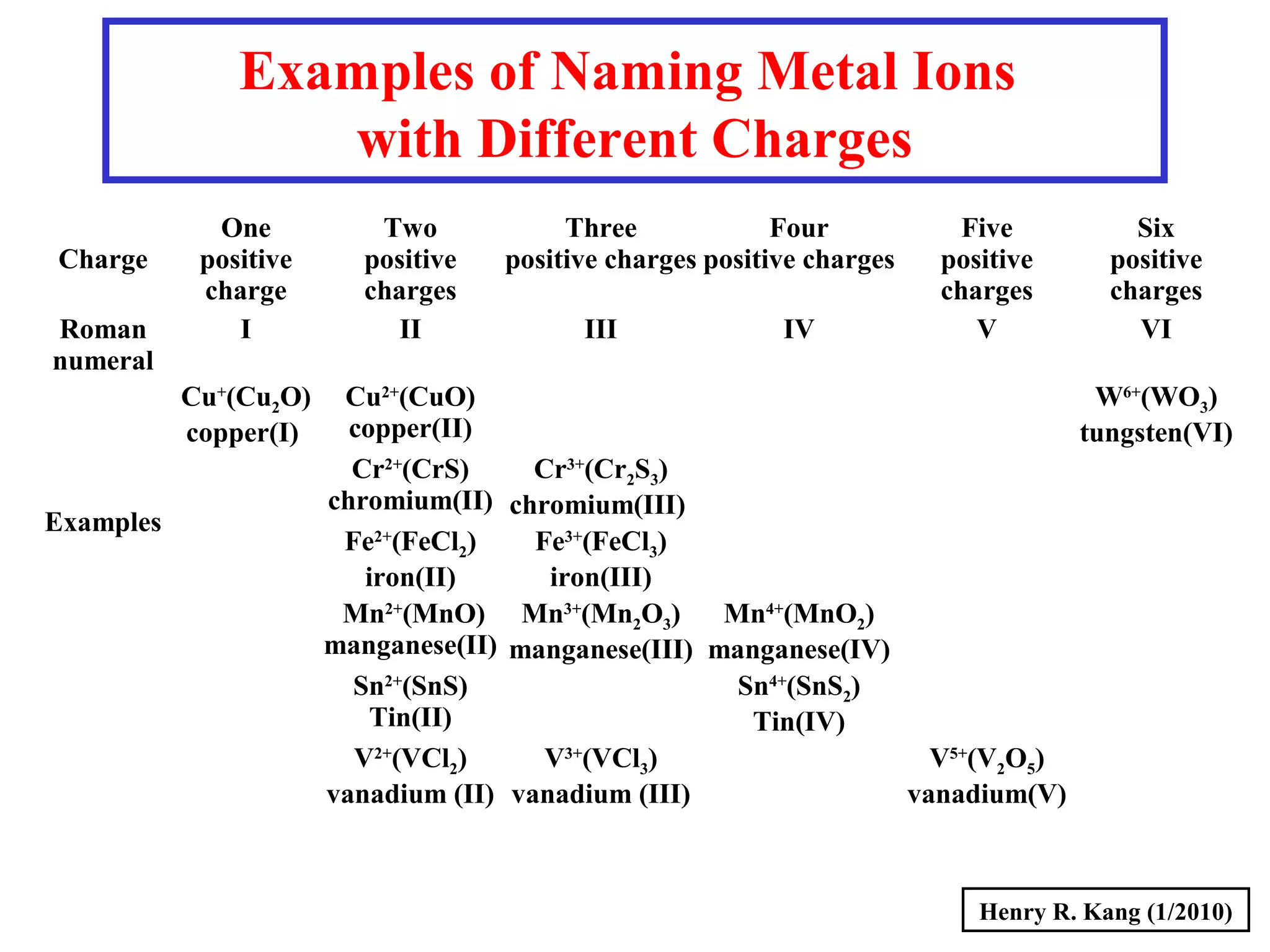
Examples of Naming Metal Ions
with Different Charges
Charge
One
positive
charge
Two
positive
charges
Three
positive charges
Four
positive charges
Five
positive
charges
Six
positive
charges
Roman
numeral
I II III IV V VI
Examples
Cu+
(Cu2O)
copper(I)
Cu2+
(CuO)
copper(II)
W6+
(WO3)
tungsten(VI)
Cr2+
(CrS)
chromium(II)
Cr3+
(Cr2S3)
chromium(III)
Fe2+
(FeCl2)
iron(II)
Fe3+
(FeCl3)
iron(III)
Mn2+
(MnO)
manganese(II)
Mn3+
(Mn2O3)
manganese(III)
Mn4+
(MnO2)
manganese(IV)
Sn2+
(SnS)
Tin(II)
Sn4+
(SnS2)
Tin(IV)
V2+
(VCl2)
vanadium (II)
V3+
(VCl3)
vanadium (III)
V5+
(V2O5)
vanadium(V)
Henry R. Kang (1/2010)
Examples of Naming Metal
Compounds with Different Charges
• FeCl2: Iron(II) chloride
• FeCl3: Iron(III) chloride
• CrS : Chromium(II) sulfide
• Cr2S3 : Chromium(III) sulfide
• MnO : Manganese(II) oxide
• Mn2O3 : Manganese(III) oxide
• MnO2 : Manganese(IV) oxide
• Lead(IV) oxide : PbO2
• Lead(II) oxide : PbO
• Tin(II) sulfide : SnS
• Tin(IV) sulfide : SnS
Henry R. Kang (1/2010)
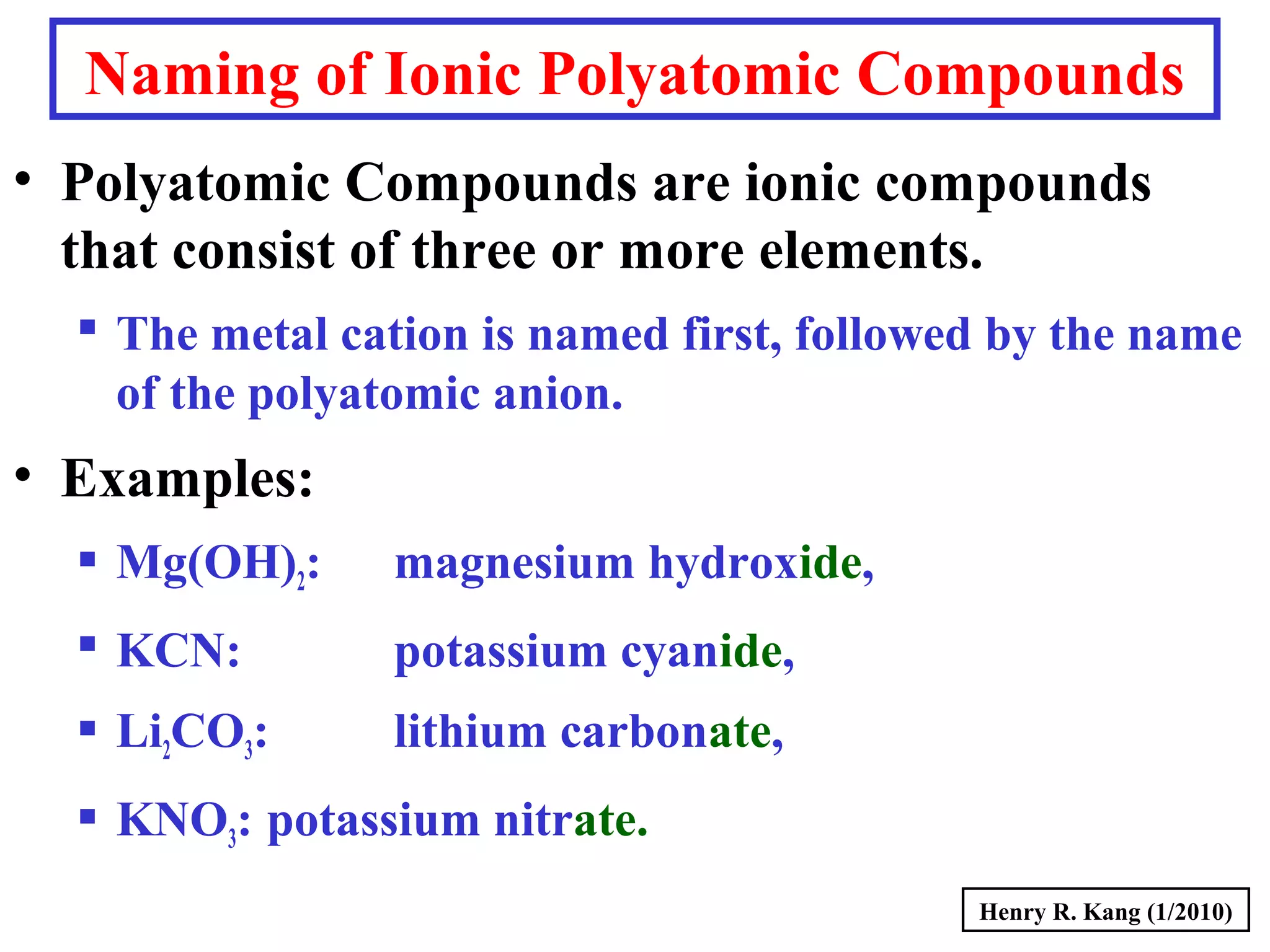
Naming of Ionic Polyatomic Compounds
• Polyatomic Compounds are ionic compounds
that consist of three or more elements.
 The metal cation is named first, followed by the name
of the polyatomic anion.
• Examples:
 Mg(OH)2: magnesium hydroxide,
 KCN: potassium cyanide,
 Li2CO3: lithium carbonate,
 KNO3: potassium nitrate.
Henry R. Kang (1/2010)
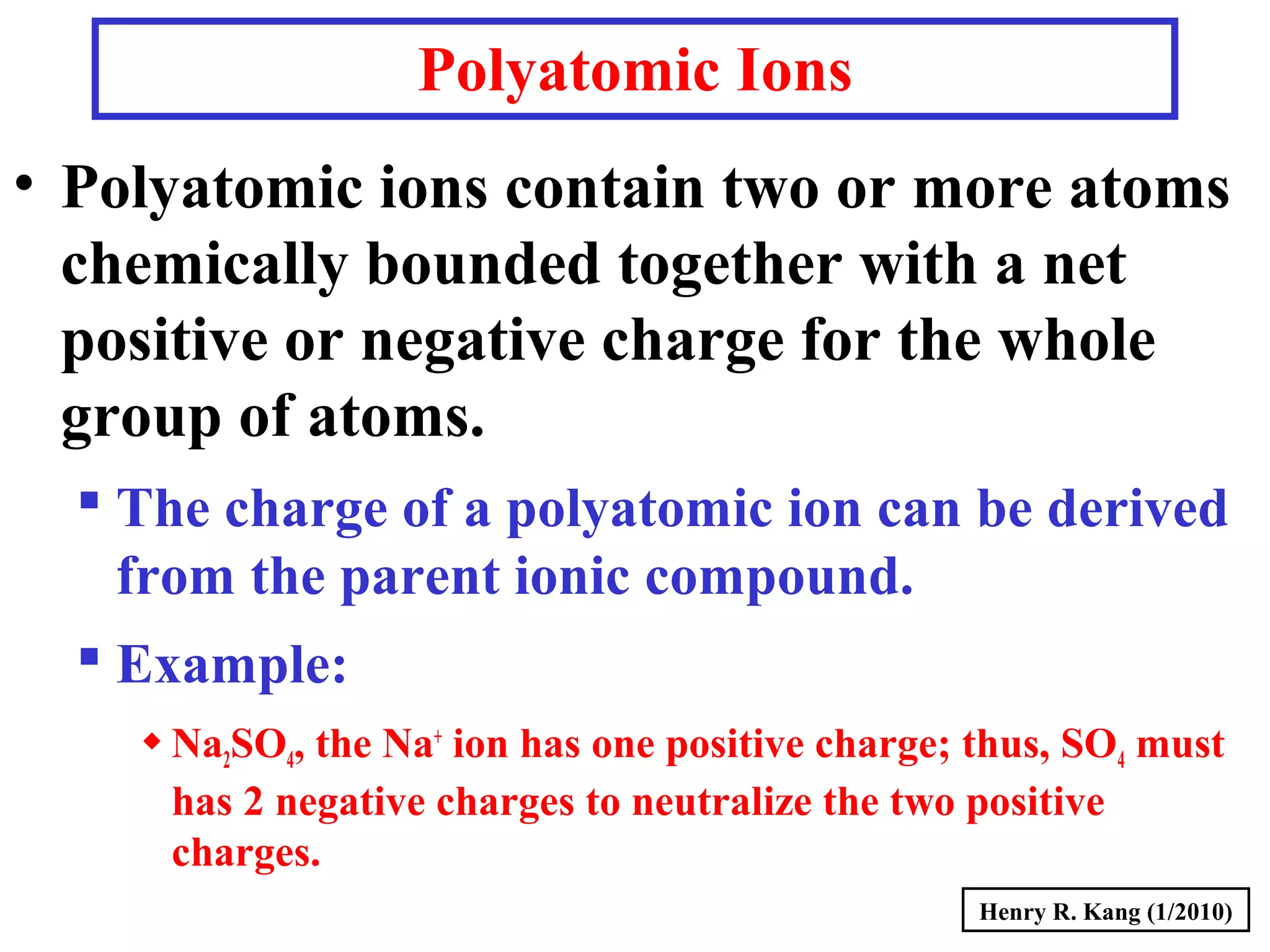
Polyatomic Ions
• Polyatomic ions contain two or more atoms
chemically bounded together with a net
positive or negative charge for the whole
group of atoms.
 The charge of a polyatomic ion can be derived
from the parent ionic compound.
 Example:
Na2SO4, the Na+
ion has one positive charge; thus, SO4 must
has 2 negative charges to neutralize the two positive
charges.
Henry R. Kang (1/2010)
Some Common Polyatomic Anions and Cations
Anion (One negative charge) Formula Anion (Two negative charges) Formula
Acetate CH3COO–
Carbonate CO3
2–
Chlorate ClO3
–
Chromate CrO4
2–
Chlorite ClO2
–
Dichromate Cr2O7
2–
Cyanide CN–
Hydrogen phosphate (biphosphate) HPO4
2–
Dihydrogen phosphate H2PO4
–
Oxalate C2O4
2–
Hydrogen carbonate (bicarbonate) HCO3
–
Peroxide O2
2–
Hydrogen oxalate HC2O4
–
Sulfate SO4
2–
Hydrogen sulfate (bisulfate) HSO4
–
Sulfite SO3
2–
Hydrogen sulfite (bisulfite) HSO3
–
Silicate SiO3
2–
Hydrogen sulfide HS–
Anion (Three negative charges)
Hydroxide OH–
Arsenate AsO4
3–
Hypochlorite ClO–
Borate BO3
3–
Nitrate NO3
–
Phosphate PO4
3–
Nitrite NO2
–
Phosphite PO3
3–
Perchlorate ClO4
–
Cation
Permanganate MnO4
–
Ammonium NH4
+
Thiocyanate SCN–
Mercurous [or Mercury(I)] Hg2
2+Henry R. Kang (1/2010)
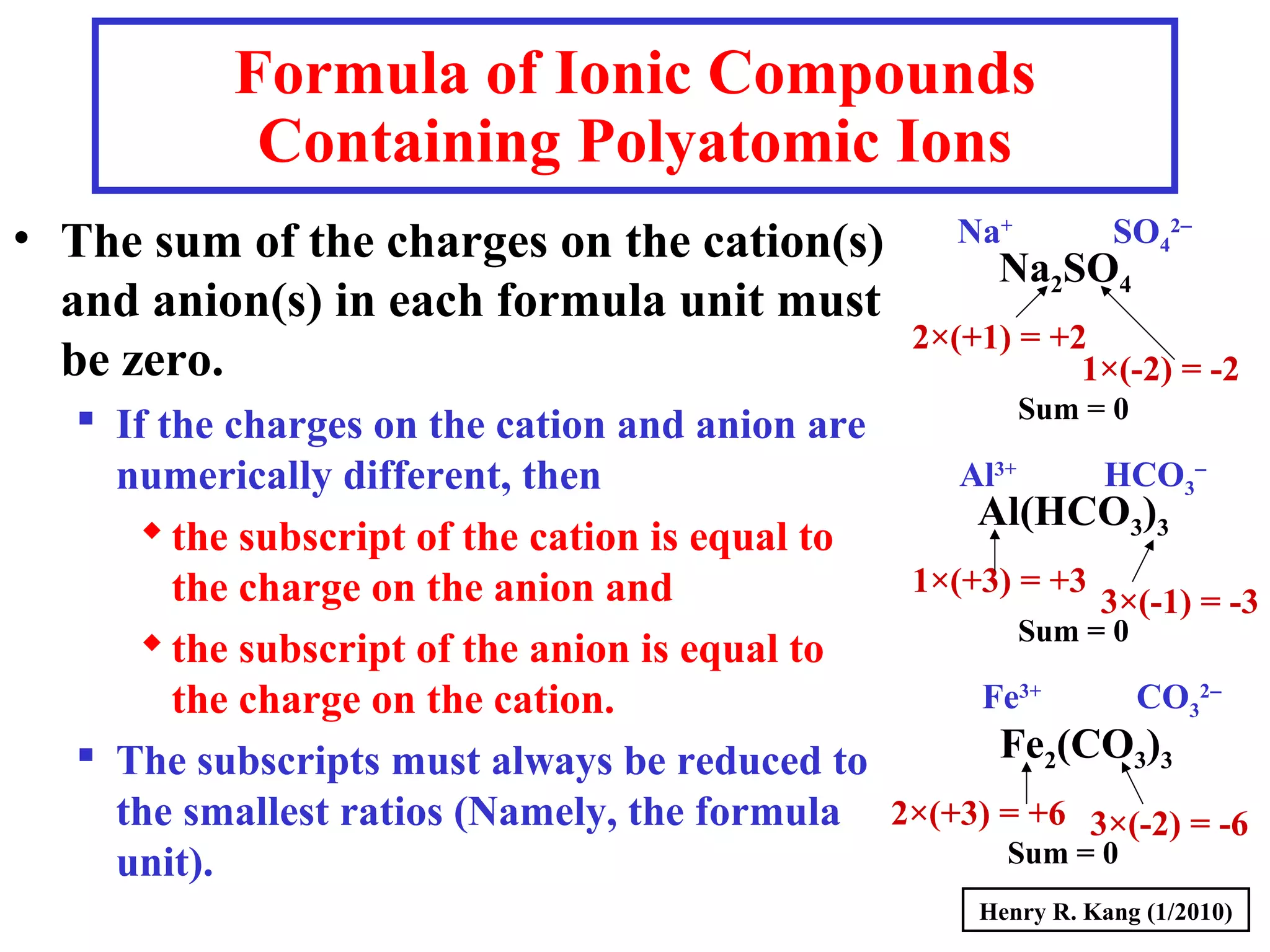
Formula of Ionic Compounds
Containing Polyatomic Ions
• The sum of the charges on the cation(s)
and anion(s) in each formula unit must
be zero.
 If the charges on the cation and anion are
numerically different, then
the subscript of the cation is equal to
the charge on the anion and
the subscript of the anion is equal to
the charge on the cation.
 The subscripts must always be reduced to
the smallest ratios (Namely, the formula
unit).
Na2SO4
Na+
SO4
2−
2×(+1) = +2
1×(-2) = -2
Sum = 0
Al(HCO3)3
Al3+
HCO3
−
1×(+3) = +3
3×(-1) = -3
Sum = 0
Fe2(CO3)3
Fe3+
CO3
2−
2×(+3) = +6 3×(-2) = -6
Sum = 0
Henry R. Kang (1/2010)
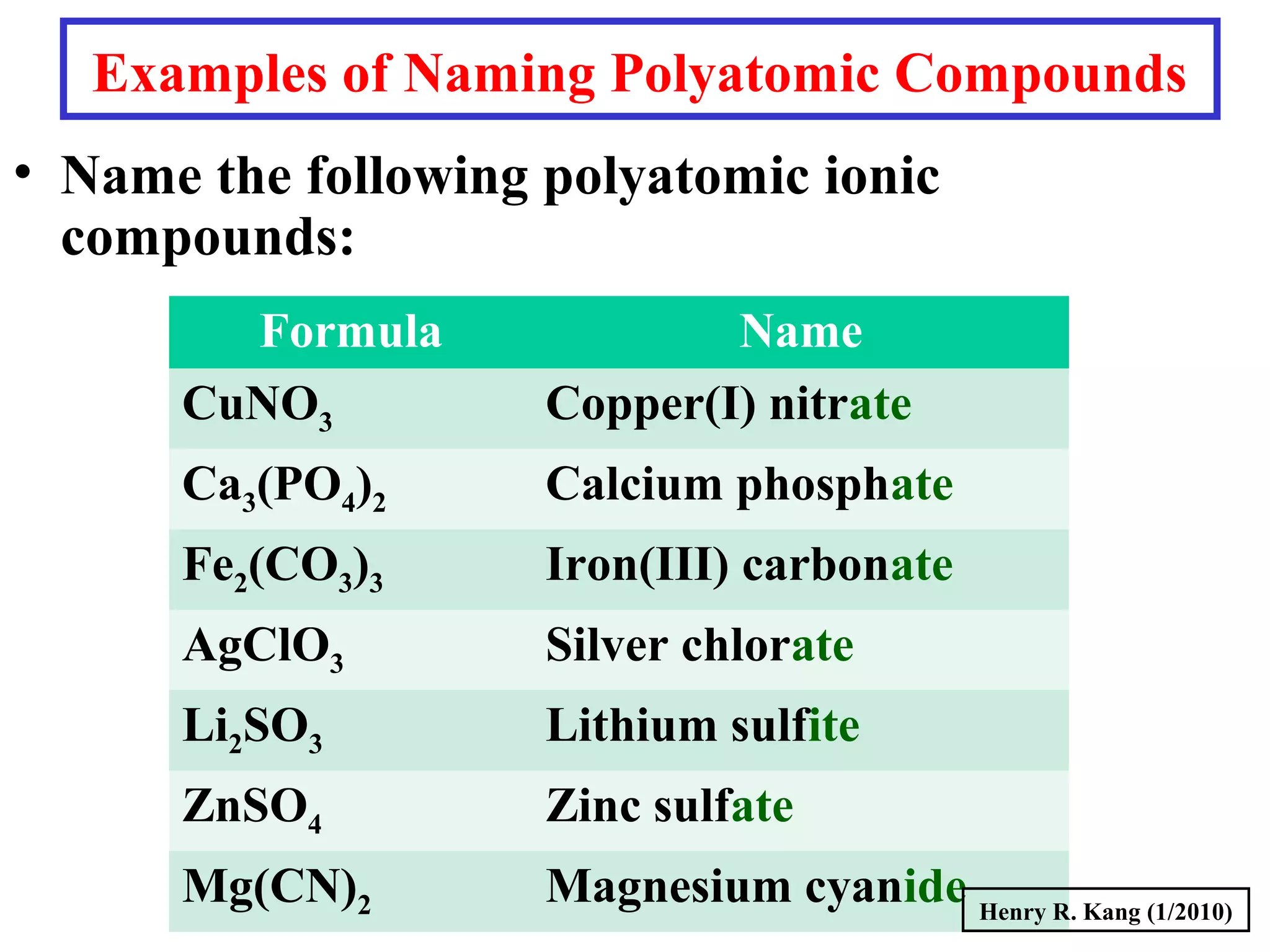
Examples of Naming Polyatomic Compounds
• Name the following polyatomic ionic
compounds:
Formula Name
CuNO3 Copper(I) nitrate
Ca3(PO4)2 Calcium phosphate
Fe2(CO3)3 Iron(III) carbonate
AgClO3 Silver chlorate
Li2SO3 Lithium sulfite
ZnSO4 Zinc sulfate
Mg(CN)2 Magnesium cyanide Henry R. Kang (1/2010)
Naming
Simple Molecular
Compounds
Henry R. Kang (1/2010)
Nomenclature of Covalent Compounds
• Molecular compounds contain nonmetals or
(nonmetals + metalloids)
• Last element ends in “ide”.
• Element left in periodic table is named first.
• Example: HF, hydrogen fluoride
• Element closest to bottom of group is named first.
• Example: SO2, sulfur dioxide
• If more than one compound can be formed from
the same elements, use prefixes to indicate the
number of each kind of atom.
• NO: nitrogen monoxide
• NO2: nitrogen dioxide
• N2O: dinitrogen monoxide
• N2O4: dinitrogen tetraoxide
• N2O5: dinitrogen pentoxide
Prefix Number
Mono- 1
Di- 2
Tri- 3
Tetra- 4
Penta- 5
Hexa- 6
Hepta- 7
Octa- 8
Nona- 9
Deca- 10
Greek Prefixes
Henry R. Kang (1/2010)
Examples of Naming Molecular Compounds
• Name the following molecular compounds:
 HI: hydrogen iodide
 NF3: nitrogen trifluoride
 SiCl4: silicon tetrachloride
 N2Cl4: dinitrogen tetrachloride
 SO2: sulfur dioxide
 SO3: sulfur trioxide
 NO2: nitrogen dioxide (Smog gas: Toxic!)
 N2O: dinitrogen monoxide (Laughing gas)
 Note that the “o” is omitted in “mono”
 P4O10: tetraphosphorus decoxide
 Note that the “a” is omitted in “deca”
 Cl2O7: dichlorine heptoxide Henry R. Kang (1/2010)
Examples of Writing Molecular Formulas
• Write chemical formulas for the following
molecular compounds:
 Carbon disulfide
CS2
 Disilicon hexabromide
Si2Br6
 Sulfur tetrafluoride
SF4
 Dinitrogen pentoxide
Note that the “a” is omitted in “penta”
N2O5
Henry R. Kang (1/2010)
Nomenclature of Inorganic Compounds
Ionic
Compound
Molecular
Compound
Cation: metal
or NH4
+
Anion: mono-
or polyatomic
Binary compounds of nonmetals
Cation has only one charge value
(Alkali metal cations, Alkaline earth
metal ions, Ag+
, Al3+
, Cd2+
, and Zn2+
)
Cation has more than one charge value with
different anion (All other metal cations.)
Use prefixes for both elements.
(Prefix “mono-” usually is omitted for the first element).
Add -ide to the root of the second element.
Name metal first.
For monoatomic anion, add -ide to the root of the element.
For polyatomic anion, use name of the anion.
Name metal first. For elements can form different cations,
specify charge with Roman numeral in parentheses.
For monoatomic anion, add -ide to the root of the element.
For polyatomic anion, use the name of the anion.
Binary acids
Prefix hydro- and add the suffix -ic acid.
Inorganic
Compound
Henry R. Kang (8/2010)
Naming
Simple Acids,
Oxoacids, and
Simple Bases
Henry R. Kang (1/2010)
Simple Acids
• A simple acid is a compound that yields hydrogen ions (H+
) when
dissolved in water.
 It consists H element and a nonmetal element (or a polyatomic anion).
• Simple acids are named by adding prefix “hydro-” to the name of
the nonmetal element and replacing the ending with the suffix “-ic
acid”.
• Some anions and corresponding acids.
Anion Acid Acid Name Molecular Name
F-
(fluoride) HF(aq) Hydrofluoric acid HF(g): Hydrogen fluoride
Cl-
(chloride) HCl(aq) Hydrochloric acid HCl(g): Hydrogen chloride
Br-
(bromide) HBr(aq) Hydrobromic acid HBr(l): Hydrogen bromide
I-
(iodide) HI(aq) Hydroiodic acid HI(s): Hydrogen iodide
CN-
(cyanide) HCN(aq) Hydrocyanic acid HCN(g): Hydrogen cyanide
S2-
(sulfide) H2S(aq) Hydrosulfuric acid H2S(g): Hydrogen sulfide
Henry R. Kang (1/2010)
Oxoacids
• Oxoacids are acids that contain hydrogen, oxygen, and another
element (the central element)
 Usually, the H goes first, followed by the central element, then O.
• Oxoanion is the anion of the oxoacid that hydrogen ions have been
removed.
• Some common oxoacids and oxoanions:
Oxoacid Name Oxoacid Formula Oxoanion Formula Oxoanion Name
Nitric acid HNO3 NO3
− Nitrate
Chloric acid HClO3 ClO3
− Chlorate
Carbonic acid H2CO3 CO3
2− Carbonate
Sulfuric acid H2SO4 SO4
2− Sulfate
Phosphoric acid H3PO4 PO4
3− Phosphate
This set of oxoacids are considered as the reference acids.
Henry R. Kang (1/2010)
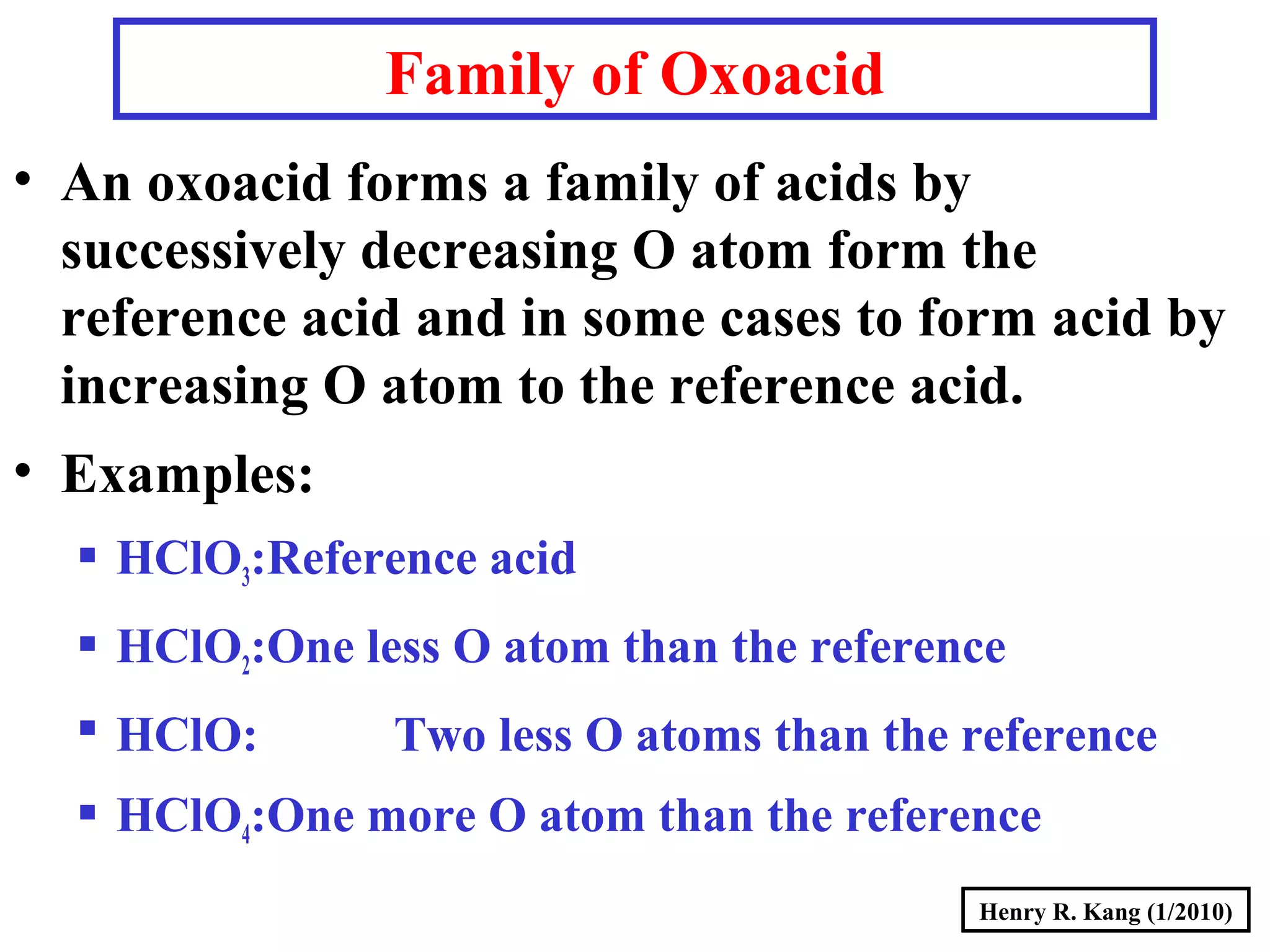
Family of Oxoacid
• An oxoacid forms a family of acids by
successively decreasing O atom form the
reference acid and in some cases to form acid by
increasing O atom to the reference acid.
• Examples:
 HClO3:Reference acid
 HClO2:One less O atom than the reference
 HClO: Two less O atoms than the reference
 HClO4:One more O atom than the reference
Henry R. Kang (1/2010)
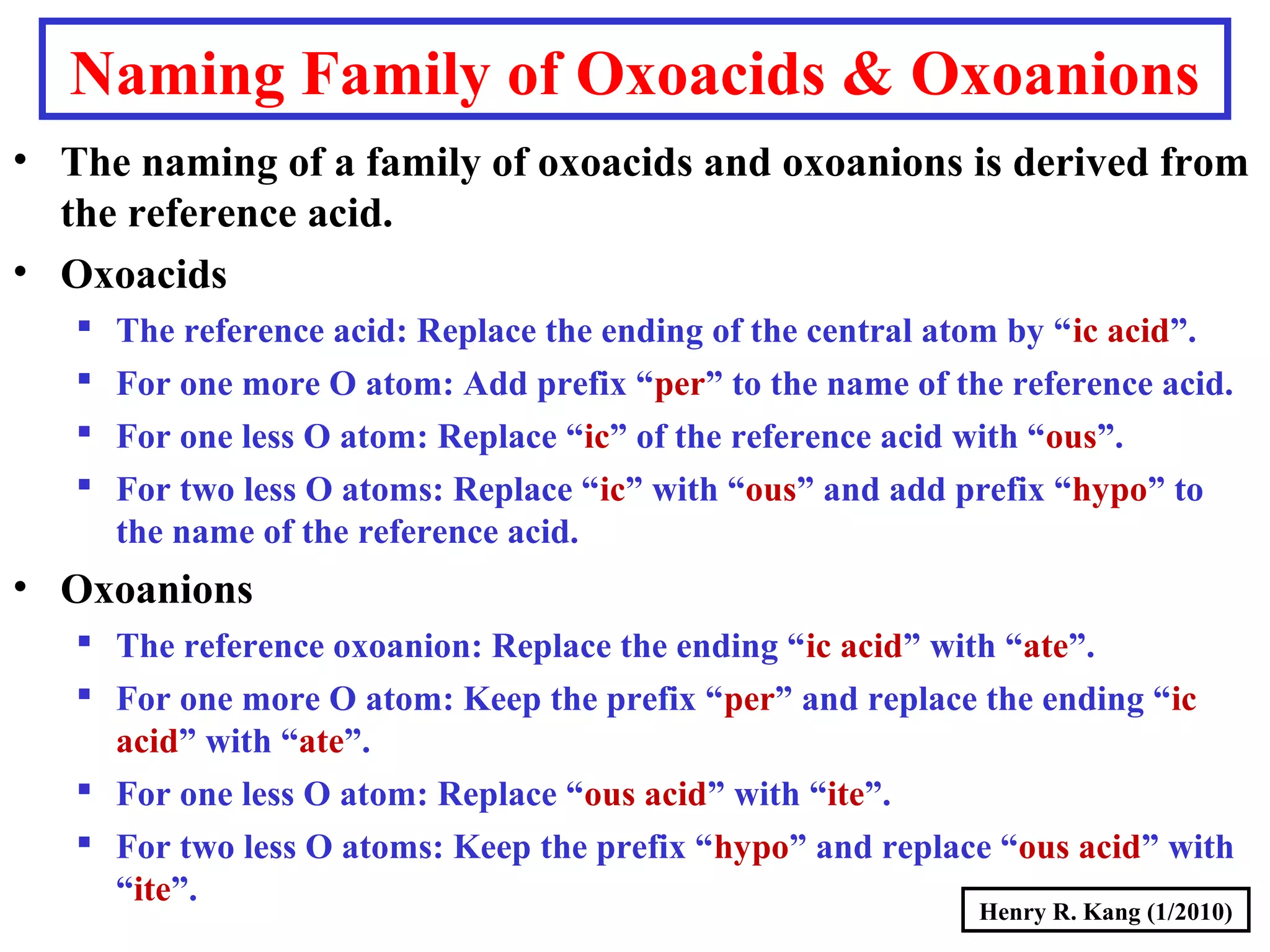
Naming Family of Oxoacids & Oxoanions
• The naming of a family of oxoacids and oxoanions is derived from
the reference acid.
• Oxoacids
 The reference acid: Replace the ending of the central atom by “ic acid”.
 For one more O atom: Add prefix “per” to the name of the reference acid.
 For one less O atom: Replace “ic” of the reference acid with “ous”.
 For two less O atoms: Replace “ic” with “ous” and add prefix “hypo” to
the name of the reference acid.
• Oxoanions
 The reference oxoanion: Replace the ending “ic acid” with “ate”.
 For one more O atom: Keep the prefix “per” and replace the ending “ic
acid” with “ate”.
 For one less O atom: Replace “ous acid” with “ite”.
 For two less O atoms: Keep the prefix “hypo” and replace “ous acid” with
“ite”.
Naming Oxoacid and Oxoanion: HNO3
Oxoacid Oxoanion
Example Example
Representative
“-ic” acid
“-ous” acid
“hypo-” “-ous” acid
“-ate”
“-ite”
“hypo-” “-ite”
HNO3
nitric acid
HNO2
nitrous acid
HNO
hyponitrous acid
Removal of
all H ions
NO3
−
nitate
NO2
−
nitrite
NO−
hyponitrite
-[O]
-[O]
Reference acid
Henry R. Kang (8/2010)
Naming Oxoacid & Oxoanion: H2SO4
Oxoacid Oxoanion
Example Example
Representative
“-ic” acid
“-ous” acid
“hypo-” “-ous” acid
“-ate”
“-ite”
“hypo-” “-ite”
H2SO4
sulfuric acid
H2SO3
sulfurous acid
H2SO2
hyposulfurous
acid
Removal of
all H ions
SO4
2−
sulfate
SO3
2−
sulfite
SO2
2−
hyposulfite
-[O]
-[O]
Reference acid
Henry R. Kang (1/2012)
Naming Oxoacids & Oxoanions: H3PO4
Oxoacid Oxoanion
Example Example
Representative
“-ic” acid
“-ous” acid
“hypo-” “-ous” acid
“-ate”
“-ite”
“hypo-”
“-ite”
H3PO4
H3PO3
phosphoric acid
H3PO2
phosphorous acid
hypophosphorous
acid
PO4
3−
Removal
of all H ions
PO3
3−
phosphate
PO2
3−
phosphite
hypophosphite
-[O]
-[O]
Reference acid
Henry R. Kang (8/2010)
Henry R. Kang (1/2010)
Naming Oxoacids & Oxoanion: HBrO3
Example Example
“per-” “-ic” acid
Representative
“-ic” acid
“-ous” acid
“hypo-” “-ous” acid
“per-” “-ate”
“-ate”
“-ite”
“hypo-”
“-ite”
HBrO4
perbromic acid
HBrO3
bromic acid
HBrO2
bromous acid
HBrO
hypobromou
s acid
BrO4
−
perbromate
BrO3
−
bromate
BrO2
−
bromite
BrO−
hypobromite
+[O]
-[O]
-[O]
Reference acid
Henry R. Kang (1/2010)
Examples of Naming Oxoacids & Salts
• Name the following oxoacid, oxoanion, and salts:
 H3PO3: Phosphorous acid
 One fewer O than the reference phosphoric acid (H3PO4)
 IO4
-
: Periodate
 One more O than the reference iodic acid (HIO3).
 HBrO: Hypobromous acid
 Two fewer O atoms than the reference bromic acid (HBrO3).
 HSO4
-
: Hydrogen sulfate ion
 Cu(NO3)2: Copper(II) nitrate [Stock system]
 KH2PO4: Potassium dihydrogen phosphate
 NH4ClO3: Ammonium chlorate
 Li2SO3: Lithium sulfite (one less O than the reference)
Henry R. Kang (1/2010)
Examples of Formulas of Oxo-Salts
• Write chemical formulas for the following
compounds:
 Mercury(I) nitrite: Hg2(NO2)2
Note that mercury(I) ion exists as a diatomic ion (Hg2
2+
)
 Rubidium sulfate: Rb2SO4
 Cadmium carbonate: CdCO3
 Nickel(II) nitrate: Ni(NO3)2
 Calcium phosphate: Ca3(PO4)2
 Chromium(II) chlorate: Cr(ClO3)2
 Lead(IV) sulfate: Pb(SO )
Henry R. Kang (1/2010)
Simple Bases
• A simple base is a substance that yields
hydroxide ions (OH–
) when dissolved in water.
• Naming Bases
 Bases are named by the name of the metal cation first,
followed by the word “hydroxide”.
• Examples:
 NaOH: sodium hydroxide
 KOH: potassium hydroxide
 Ba(OH)2: barium hydroxide
 NH3: ammonia (ammonia hydroxide?)
NH3 + H2O  NH4
+
+ OH–
Hydrates
• Hydrates are compounds that have a specific number of
water molecules attached to them.
• Naming Hydrates
 Hydrates are named by naming the salt first, followed by the
word “hydrate” with “prefix” to indicate the number of water
molecules.
• Examples:
 BaCl2.2H2O: barium chloride dihydrate
 LiCl.H2O: lithium chloride monohydrate
 MgSO4.7H2O: magnesium sulfate heptahydrate
 CuSO4.5H2O: copper(II) sulfate pentahydrate
 CuSO4.5H2O is blue crystal-like compound, while CuSO4 is a white
powder-like compound. Henry R. Kang (1/2010)
Common Names
Formula Common Name Systematic Name
H2O Water Dihydrogen monoxide
H2S Hydrogen sulfide Dihydrogen monsulfide
NH3 Ammonia Trihydrogen nitride
PH3 Phosphine Trihydrogen phoside
CO2(s) Dry ice Carbon dioxide (solid)
NaCl Table salt Sodium chloride
N2O Laughing gas Dinitrogen monoxide
NaHCO3 Baking soda Sodium hydrogen carbonate
CH4 Methane Carbon tetrahydride
SiH4 Silane Silicon tetrahydride
Frequently encountered molecular compounds often have
common names.
Henry R. Kang (1/2010)
Introduction
of
Organic Compounds
Henry R. Kang (1/2010)
Organic Compounds
• Organic compounds contain carbon in combination with
other elements such as hydrogen, oxygen, nitrogen,
sulfur, phosphorus, fluorine or chlorine.
 Most, if not all, organic compounds are covalent compounds.
• The chemical characteristics and properties of organic
compounds are largely determined by the functional
groups.
• Major functional groups:
 Hydroxyl group (-OH); example: Ethanol, C2H5OH
 Amino group (-NH2); example: Methylamine, CH3NH2
 Carbonyl group (C=O); example: Formaldehyde, H2C=O
 Carboxyl group (-COOH); example: Acetic acid, CH3COOH
Henry R. Kang (1/2010)
Name & Formula of First 10 Alkanes
• Methane, CH4
• Ethane, C2H6(CH3CH3)
• Propane, C3H8(CH3CH2CH3)
• Butane, C4H10(CH3CH2CH2CH3)
• Pentane, C5H12(CH3CH2CH2CH2CH3)
• Hexane, C6H14(CH3CH2CH2CH2CH2CH3)
• Heptane, C7H16(CH3CH2CH2CH2CH2CH2CH3)
• Octane, C8H18(CH3CH2CH2CH2CH2CH2CH2CH3)
• Nonane, C9H20
(CH3CH2CH2CH2CH2CH2CH2CH2CH3)
• Decane, C10H22
(CH3CH2CH2CH2CH2CH2CH2CH2CH2CH3)
Prefix Meaning
Mono- 1
Di- 2
Tri- 3
Tetra- 4
Penta- 5
Hexa- 6
Hepta- 7
Octa- 8
Nona- 9
Deca- 10
Henry R. Kang (1/2010)

GC-S010-Nomenclature

  • 1.
    Henry R. Kang(1/2010) General Chemistry Lecture 10 Nomenclature of Chemical Compounds
  • 2.
    Contents • Naming IonicCompounds • Naming Molecular Compounds • Naming Simple Acids • Naming Oxoacids • Naming Bases • Common Names • Introduction to Organic Compounds  Naming simple organic compounds Henry R. Kang (1/2010)
  • 3.
    Types of ChemicalCompounds • Inorganic Compounds  Ionic compounds  Molecular compounds  Acids and bases  Hydrates • Organic Compounds  Compounds contain carbon in combination with other elements such as hydrogen, oxygen, nitrogen, sulfur, phosphorus, fluorine or chlorine. Henry R. Kang (1/2010)
  • 4.
  • 5.
    Naming of BinaryIonic Compounds • Binary ionic compounds are formed from two elements.  Often a metal (to form cation) + a nonmetal (to form anion) • The metal cation is named first, followed by the nonmetallic anion with “-ide” ending.  The cation is named by using the name of the element.  The anion is named by taking the name of the element, then replacing its ending with “ide”.  Examples: “bromine”, the ending “ine” is replaced by “ide” to become “bromide” “oxygen”, the ending “ygen” is replaced by “ide” to become “oxide”. Henry R. Kang (1/2010)
  • 6.
    Common Monoatomic Cations •Monoatomic cations  Group 1A: Hydrogen (H+ ), Lithium (Li+ ), Potassium (K+ ), Sodium (Na+ ).  Group 2A: Barium (Ba2+ ), Calcium (Ca2+ ), Magnesium (Mg2+ ).  Group 3A: Aluminum (Al3+ ), Gallium (Ga3+ ).  Group 4A: Lead(II) or plumbous (Pb2+ ), Tin(II) or stannous (Sn2+ ). • Transition metals:  Group 1B: Copper(I) or cuprous (Cu+ ), Copper(II) or cupric (Cu2+ ), Silver (Ag+ ).  Group 2B: Mercury(II) or mercuric (Hg2+ ), Zinc (Zn2+ ).  Group 6B: Chromium(III) or chromic (Cr3+ ),  Group 7B: Manganese(II) or manganous (Mn2+ ),  Group 8B: Iron(II) or ferrous (Fe2+ ), Iron(III) or ferric (Fe3+ ), Henry R. Kang (1/2010)
  • 7.
    Common Monoatomic Anions GroupElement Stem Name in Compound 1A H: hydrogen Hydr- H− : hydride F: flourine Fluor- F− : fluoride 7A Cl: chlorine Chlor- Cl− : chloride Br: bromine Brom- Br− : bromide I: iodine Iod- I− : iodide 6A O: oxygen Ox- O2− : oxide S: sulfur Sulf- S2− : sulfide 5A N: nitrogen Nitr- N3− : nitride P: phosphorous Phosph- P3− : phosphide 4A C: carbon Carb- C4− : carbide Henry R. Kang (1/2010)
  • 8.
    Examples of NamingBinary Compounds • Name the following compounds:  NaF: sodium fluoride,  KBr: potassium bromide,  ZnI2: zinc iodide,  Al2O3: aluminum oxide,  BaCl2: barium chloride,  K2O: potassium oxide • Write chemical formulas for the following compounds:  Silver bromide: AgBr  Aluminum chloride: AlCl3  Sodium sulfide: Na2S  Magnesium hydride: MgH2 Henry R. Kang (1/2012)
  • 9.
    Elements form Cationswith Different Charges • Transition metal elements (in Groups 1B and 3B to 8B) and heavy metal elements (in Groups 3A and 4A) can form more than one type of cations. • Examples:  Transition elements: Fe2+ and Fe3+ ; Cu+ and Cu2+ ; Mn2+ , Mn3+ , and Mn4+  Group 3A: Tl+ and Tl3+  Group 4A: Pb2+ and Pb4+ 3 37 19 11 55 20 10 3231 36353433 15 16 17 18 42 14 38 41 57 4039 56 49 50 51 52 53 54 7372 74 43 44 45 46 47 48 76 79 83 84 85 8675 80 Hg2 2+ Hg2+ 78 81 Tl+ Tl3+ 77 82 Pb2+ Pb4+ 4 1 9 2 5 6 7 8 5 5B 4 4B 6 6B 3 3B 8 8B 7 7B 9 8B 10 8B 11 1B 12 2B 30 1312 24 Cr3+ 232221 29 Cu+ Cu2+ 28 Ni2+ 27 Co2+ Co3+ 26 Fe2+ Fe3+ 25 Mn2+ Mn4+ Henry R. Kang (1/2010)
  • 10.
    Naming Ions withDifferent Charges • Old System  Use the ending “-ous” for cation with few positive charges. Fe2+ : ferrous; Cu+ : cuprous  Use the ending “-ic” for cation with more positive charges. Fe3+ : ferric; Cu2+ : cupric • New System (Stock system)  Designate different cations with Roman numerals to indicate the number of charges. Henry R. Kang (1/2010)
  • 11.
    Examples of NamingMetal Ions with Different Charges Charge One positive charge Two positive charges Three positive charges Four positive charges Five positive charges Six positive charges Roman numeral I II III IV V VI Examples Cu+ (Cu2O) copper(I) Cu2+ (CuO) copper(II) W6+ (WO3) tungsten(VI) Cr2+ (CrS) chromium(II) Cr3+ (Cr2S3) chromium(III) Fe2+ (FeCl2) iron(II) Fe3+ (FeCl3) iron(III) Mn2+ (MnO) manganese(II) Mn3+ (Mn2O3) manganese(III) Mn4+ (MnO2) manganese(IV) Sn2+ (SnS) Tin(II) Sn4+ (SnS2) Tin(IV) V2+ (VCl2) vanadium (II) V3+ (VCl3) vanadium (III) V5+ (V2O5) vanadium(V) Henry R. Kang (1/2010)
  • 12.
    Examples of NamingMetal Compounds with Different Charges • FeCl2: Iron(II) chloride • FeCl3: Iron(III) chloride • CrS : Chromium(II) sulfide • Cr2S3 : Chromium(III) sulfide • MnO : Manganese(II) oxide • Mn2O3 : Manganese(III) oxide • MnO2 : Manganese(IV) oxide • Lead(IV) oxide : PbO2 • Lead(II) oxide : PbO • Tin(II) sulfide : SnS • Tin(IV) sulfide : SnS Henry R. Kang (1/2010)
  • 13.
    Naming of IonicPolyatomic Compounds • Polyatomic Compounds are ionic compounds that consist of three or more elements.  The metal cation is named first, followed by the name of the polyatomic anion. • Examples:  Mg(OH)2: magnesium hydroxide,  KCN: potassium cyanide,  Li2CO3: lithium carbonate,  KNO3: potassium nitrate. Henry R. Kang (1/2010)
  • 14.
    Polyatomic Ions • Polyatomicions contain two or more atoms chemically bounded together with a net positive or negative charge for the whole group of atoms.  The charge of a polyatomic ion can be derived from the parent ionic compound.  Example: Na2SO4, the Na+ ion has one positive charge; thus, SO4 must has 2 negative charges to neutralize the two positive charges. Henry R. Kang (1/2010)
  • 15.
    Some Common PolyatomicAnions and Cations Anion (One negative charge) Formula Anion (Two negative charges) Formula Acetate CH3COO– Carbonate CO3 2– Chlorate ClO3 – Chromate CrO4 2– Chlorite ClO2 – Dichromate Cr2O7 2– Cyanide CN– Hydrogen phosphate (biphosphate) HPO4 2– Dihydrogen phosphate H2PO4 – Oxalate C2O4 2– Hydrogen carbonate (bicarbonate) HCO3 – Peroxide O2 2– Hydrogen oxalate HC2O4 – Sulfate SO4 2– Hydrogen sulfate (bisulfate) HSO4 – Sulfite SO3 2– Hydrogen sulfite (bisulfite) HSO3 – Silicate SiO3 2– Hydrogen sulfide HS– Anion (Three negative charges) Hydroxide OH– Arsenate AsO4 3– Hypochlorite ClO– Borate BO3 3– Nitrate NO3 – Phosphate PO4 3– Nitrite NO2 – Phosphite PO3 3– Perchlorate ClO4 – Cation Permanganate MnO4 – Ammonium NH4 + Thiocyanate SCN– Mercurous [or Mercury(I)] Hg2 2+Henry R. Kang (1/2010)
  • 16.
    Formula of IonicCompounds Containing Polyatomic Ions • The sum of the charges on the cation(s) and anion(s) in each formula unit must be zero.  If the charges on the cation and anion are numerically different, then the subscript of the cation is equal to the charge on the anion and the subscript of the anion is equal to the charge on the cation.  The subscripts must always be reduced to the smallest ratios (Namely, the formula unit). Na2SO4 Na+ SO4 2− 2×(+1) = +2 1×(-2) = -2 Sum = 0 Al(HCO3)3 Al3+ HCO3 − 1×(+3) = +3 3×(-1) = -3 Sum = 0 Fe2(CO3)3 Fe3+ CO3 2− 2×(+3) = +6 3×(-2) = -6 Sum = 0 Henry R. Kang (1/2010)
  • 17.
    Examples of NamingPolyatomic Compounds • Name the following polyatomic ionic compounds: Formula Name CuNO3 Copper(I) nitrate Ca3(PO4)2 Calcium phosphate Fe2(CO3)3 Iron(III) carbonate AgClO3 Silver chlorate Li2SO3 Lithium sulfite ZnSO4 Zinc sulfate Mg(CN)2 Magnesium cyanide Henry R. Kang (1/2010)
  • 18.
  • 19.
    Nomenclature of CovalentCompounds • Molecular compounds contain nonmetals or (nonmetals + metalloids) • Last element ends in “ide”. • Element left in periodic table is named first. • Example: HF, hydrogen fluoride • Element closest to bottom of group is named first. • Example: SO2, sulfur dioxide • If more than one compound can be formed from the same elements, use prefixes to indicate the number of each kind of atom. • NO: nitrogen monoxide • NO2: nitrogen dioxide • N2O: dinitrogen monoxide • N2O4: dinitrogen tetraoxide • N2O5: dinitrogen pentoxide Prefix Number Mono- 1 Di- 2 Tri- 3 Tetra- 4 Penta- 5 Hexa- 6 Hepta- 7 Octa- 8 Nona- 9 Deca- 10 Greek Prefixes Henry R. Kang (1/2010)
  • 20.
    Examples of NamingMolecular Compounds • Name the following molecular compounds:  HI: hydrogen iodide  NF3: nitrogen trifluoride  SiCl4: silicon tetrachloride  N2Cl4: dinitrogen tetrachloride  SO2: sulfur dioxide  SO3: sulfur trioxide  NO2: nitrogen dioxide (Smog gas: Toxic!)  N2O: dinitrogen monoxide (Laughing gas)  Note that the “o” is omitted in “mono”  P4O10: tetraphosphorus decoxide  Note that the “a” is omitted in “deca”  Cl2O7: dichlorine heptoxide Henry R. Kang (1/2010)
  • 21.
    Examples of WritingMolecular Formulas • Write chemical formulas for the following molecular compounds:  Carbon disulfide CS2  Disilicon hexabromide Si2Br6  Sulfur tetrafluoride SF4  Dinitrogen pentoxide Note that the “a” is omitted in “penta” N2O5 Henry R. Kang (1/2010)
  • 22.
    Nomenclature of InorganicCompounds Ionic Compound Molecular Compound Cation: metal or NH4 + Anion: mono- or polyatomic Binary compounds of nonmetals Cation has only one charge value (Alkali metal cations, Alkaline earth metal ions, Ag+ , Al3+ , Cd2+ , and Zn2+ ) Cation has more than one charge value with different anion (All other metal cations.) Use prefixes for both elements. (Prefix “mono-” usually is omitted for the first element). Add -ide to the root of the second element. Name metal first. For monoatomic anion, add -ide to the root of the element. For polyatomic anion, use name of the anion. Name metal first. For elements can form different cations, specify charge with Roman numeral in parentheses. For monoatomic anion, add -ide to the root of the element. For polyatomic anion, use the name of the anion. Binary acids Prefix hydro- and add the suffix -ic acid. Inorganic Compound Henry R. Kang (8/2010)
  • 23.
    Naming Simple Acids, Oxoacids, and SimpleBases Henry R. Kang (1/2010)
  • 24.
    Simple Acids • Asimple acid is a compound that yields hydrogen ions (H+ ) when dissolved in water.  It consists H element and a nonmetal element (or a polyatomic anion). • Simple acids are named by adding prefix “hydro-” to the name of the nonmetal element and replacing the ending with the suffix “-ic acid”. • Some anions and corresponding acids. Anion Acid Acid Name Molecular Name F- (fluoride) HF(aq) Hydrofluoric acid HF(g): Hydrogen fluoride Cl- (chloride) HCl(aq) Hydrochloric acid HCl(g): Hydrogen chloride Br- (bromide) HBr(aq) Hydrobromic acid HBr(l): Hydrogen bromide I- (iodide) HI(aq) Hydroiodic acid HI(s): Hydrogen iodide CN- (cyanide) HCN(aq) Hydrocyanic acid HCN(g): Hydrogen cyanide S2- (sulfide) H2S(aq) Hydrosulfuric acid H2S(g): Hydrogen sulfide Henry R. Kang (1/2010)
  • 25.
    Henry R. Kang(1/2010) Oxoacids • Oxoacids are acids that contain hydrogen, oxygen, and another element (the central element)  Usually, the H goes first, followed by the central element, then O. • Oxoanion is the anion of the oxoacid that hydrogen ions have been removed. • Some common oxoacids and oxoanions: Oxoacid Name Oxoacid Formula Oxoanion Formula Oxoanion Name Nitric acid HNO3 NO3 − Nitrate Chloric acid HClO3 ClO3 − Chlorate Carbonic acid H2CO3 CO3 2− Carbonate Sulfuric acid H2SO4 SO4 2− Sulfate Phosphoric acid H3PO4 PO4 3− Phosphate This set of oxoacids are considered as the reference acids.
  • 26.
    Henry R. Kang(1/2010) Family of Oxoacid • An oxoacid forms a family of acids by successively decreasing O atom form the reference acid and in some cases to form acid by increasing O atom to the reference acid. • Examples:  HClO3:Reference acid  HClO2:One less O atom than the reference  HClO: Two less O atoms than the reference  HClO4:One more O atom than the reference
  • 27.
    Henry R. Kang(1/2010) Naming Family of Oxoacids & Oxoanions • The naming of a family of oxoacids and oxoanions is derived from the reference acid. • Oxoacids  The reference acid: Replace the ending of the central atom by “ic acid”.  For one more O atom: Add prefix “per” to the name of the reference acid.  For one less O atom: Replace “ic” of the reference acid with “ous”.  For two less O atoms: Replace “ic” with “ous” and add prefix “hypo” to the name of the reference acid. • Oxoanions  The reference oxoanion: Replace the ending “ic acid” with “ate”.  For one more O atom: Keep the prefix “per” and replace the ending “ic acid” with “ate”.  For one less O atom: Replace “ous acid” with “ite”.  For two less O atoms: Keep the prefix “hypo” and replace “ous acid” with “ite”.
  • 28.
    Naming Oxoacid andOxoanion: HNO3 Oxoacid Oxoanion Example Example Representative “-ic” acid “-ous” acid “hypo-” “-ous” acid “-ate” “-ite” “hypo-” “-ite” HNO3 nitric acid HNO2 nitrous acid HNO hyponitrous acid Removal of all H ions NO3 − nitate NO2 − nitrite NO− hyponitrite -[O] -[O] Reference acid Henry R. Kang (8/2010)
  • 29.
    Naming Oxoacid &Oxoanion: H2SO4 Oxoacid Oxoanion Example Example Representative “-ic” acid “-ous” acid “hypo-” “-ous” acid “-ate” “-ite” “hypo-” “-ite” H2SO4 sulfuric acid H2SO3 sulfurous acid H2SO2 hyposulfurous acid Removal of all H ions SO4 2− sulfate SO3 2− sulfite SO2 2− hyposulfite -[O] -[O] Reference acid Henry R. Kang (1/2012)
  • 30.
    Naming Oxoacids &Oxoanions: H3PO4 Oxoacid Oxoanion Example Example Representative “-ic” acid “-ous” acid “hypo-” “-ous” acid “-ate” “-ite” “hypo-” “-ite” H3PO4 H3PO3 phosphoric acid H3PO2 phosphorous acid hypophosphorous acid PO4 3− Removal of all H ions PO3 3− phosphate PO2 3− phosphite hypophosphite -[O] -[O] Reference acid Henry R. Kang (8/2010)
  • 31.
    Henry R. Kang(1/2010) Naming Oxoacids & Oxoanion: HBrO3 Example Example “per-” “-ic” acid Representative “-ic” acid “-ous” acid “hypo-” “-ous” acid “per-” “-ate” “-ate” “-ite” “hypo-” “-ite” HBrO4 perbromic acid HBrO3 bromic acid HBrO2 bromous acid HBrO hypobromou s acid BrO4 − perbromate BrO3 − bromate BrO2 − bromite BrO− hypobromite +[O] -[O] -[O] Reference acid
  • 32.
    Henry R. Kang(1/2010) Examples of Naming Oxoacids & Salts • Name the following oxoacid, oxoanion, and salts:  H3PO3: Phosphorous acid  One fewer O than the reference phosphoric acid (H3PO4)  IO4 - : Periodate  One more O than the reference iodic acid (HIO3).  HBrO: Hypobromous acid  Two fewer O atoms than the reference bromic acid (HBrO3).  HSO4 - : Hydrogen sulfate ion  Cu(NO3)2: Copper(II) nitrate [Stock system]  KH2PO4: Potassium dihydrogen phosphate  NH4ClO3: Ammonium chlorate  Li2SO3: Lithium sulfite (one less O than the reference)
  • 33.
    Henry R. Kang(1/2010) Examples of Formulas of Oxo-Salts • Write chemical formulas for the following compounds:  Mercury(I) nitrite: Hg2(NO2)2 Note that mercury(I) ion exists as a diatomic ion (Hg2 2+ )  Rubidium sulfate: Rb2SO4  Cadmium carbonate: CdCO3  Nickel(II) nitrate: Ni(NO3)2  Calcium phosphate: Ca3(PO4)2  Chromium(II) chlorate: Cr(ClO3)2  Lead(IV) sulfate: Pb(SO )
  • 34.
    Henry R. Kang(1/2010) Simple Bases • A simple base is a substance that yields hydroxide ions (OH– ) when dissolved in water. • Naming Bases  Bases are named by the name of the metal cation first, followed by the word “hydroxide”. • Examples:  NaOH: sodium hydroxide  KOH: potassium hydroxide  Ba(OH)2: barium hydroxide  NH3: ammonia (ammonia hydroxide?) NH3 + H2O  NH4 + + OH–
  • 35.
    Hydrates • Hydrates arecompounds that have a specific number of water molecules attached to them. • Naming Hydrates  Hydrates are named by naming the salt first, followed by the word “hydrate” with “prefix” to indicate the number of water molecules. • Examples:  BaCl2.2H2O: barium chloride dihydrate  LiCl.H2O: lithium chloride monohydrate  MgSO4.7H2O: magnesium sulfate heptahydrate  CuSO4.5H2O: copper(II) sulfate pentahydrate  CuSO4.5H2O is blue crystal-like compound, while CuSO4 is a white powder-like compound. Henry R. Kang (1/2010)
  • 36.
    Common Names Formula CommonName Systematic Name H2O Water Dihydrogen monoxide H2S Hydrogen sulfide Dihydrogen monsulfide NH3 Ammonia Trihydrogen nitride PH3 Phosphine Trihydrogen phoside CO2(s) Dry ice Carbon dioxide (solid) NaCl Table salt Sodium chloride N2O Laughing gas Dinitrogen monoxide NaHCO3 Baking soda Sodium hydrogen carbonate CH4 Methane Carbon tetrahydride SiH4 Silane Silicon tetrahydride Frequently encountered molecular compounds often have common names. Henry R. Kang (1/2010)
  • 37.
  • 38.
    Organic Compounds • Organiccompounds contain carbon in combination with other elements such as hydrogen, oxygen, nitrogen, sulfur, phosphorus, fluorine or chlorine.  Most, if not all, organic compounds are covalent compounds. • The chemical characteristics and properties of organic compounds are largely determined by the functional groups. • Major functional groups:  Hydroxyl group (-OH); example: Ethanol, C2H5OH  Amino group (-NH2); example: Methylamine, CH3NH2  Carbonyl group (C=O); example: Formaldehyde, H2C=O  Carboxyl group (-COOH); example: Acetic acid, CH3COOH Henry R. Kang (1/2010)
  • 39.
    Name & Formulaof First 10 Alkanes • Methane, CH4 • Ethane, C2H6(CH3CH3) • Propane, C3H8(CH3CH2CH3) • Butane, C4H10(CH3CH2CH2CH3) • Pentane, C5H12(CH3CH2CH2CH2CH3) • Hexane, C6H14(CH3CH2CH2CH2CH2CH3) • Heptane, C7H16(CH3CH2CH2CH2CH2CH2CH3) • Octane, C8H18(CH3CH2CH2CH2CH2CH2CH2CH3) • Nonane, C9H20 (CH3CH2CH2CH2CH2CH2CH2CH2CH3) • Decane, C10H22 (CH3CH2CH2CH2CH2CH2CH2CH2CH2CH3) Prefix Meaning Mono- 1 Di- 2 Tri- 3 Tetra- 4 Penta- 5 Hexa- 6 Hepta- 7 Octa- 8 Nona- 9 Deca- 10 Henry R. Kang (1/2010)