1
Application of Green Logistics in
Supply Chain Management: a
Case of DHL
Prepared By: Gaurav Uprety
MBA-II Semester
Kantipur International College (KIC)
2
 Concept of Green Logistics
 Concept of Supply Chain Management
 Concept of Green Supply Chain Management
 Statement of Problem
 Objective of the Study
 Research Design
 Sources of Data
 Major Findings and Conclusion
 Recommendations
Contents
3
 In simple sense, Logistics refers to the overall process
of managing how resources are acquired, stored,
handled and transmitted to their final destination.
 In common parlance, Green logistics refers to the set of
sustainable policies and measures aimed at reducing
the environmental impact caused by the activities of
business area.
Concept of Green Logistics
4
 Supply chain is said to be the network of organization
for procuring materials, transforming raw materials
into the finished products and distributing the finished
products to the ultimate consumers.
 According to Professor Douglas M Lambert, “Supply
Chain Management as the integration of business
process from the end user through original supplier
who provide products, services and information that
adds value for the customers.”
Concept of Supply Chain Management
5
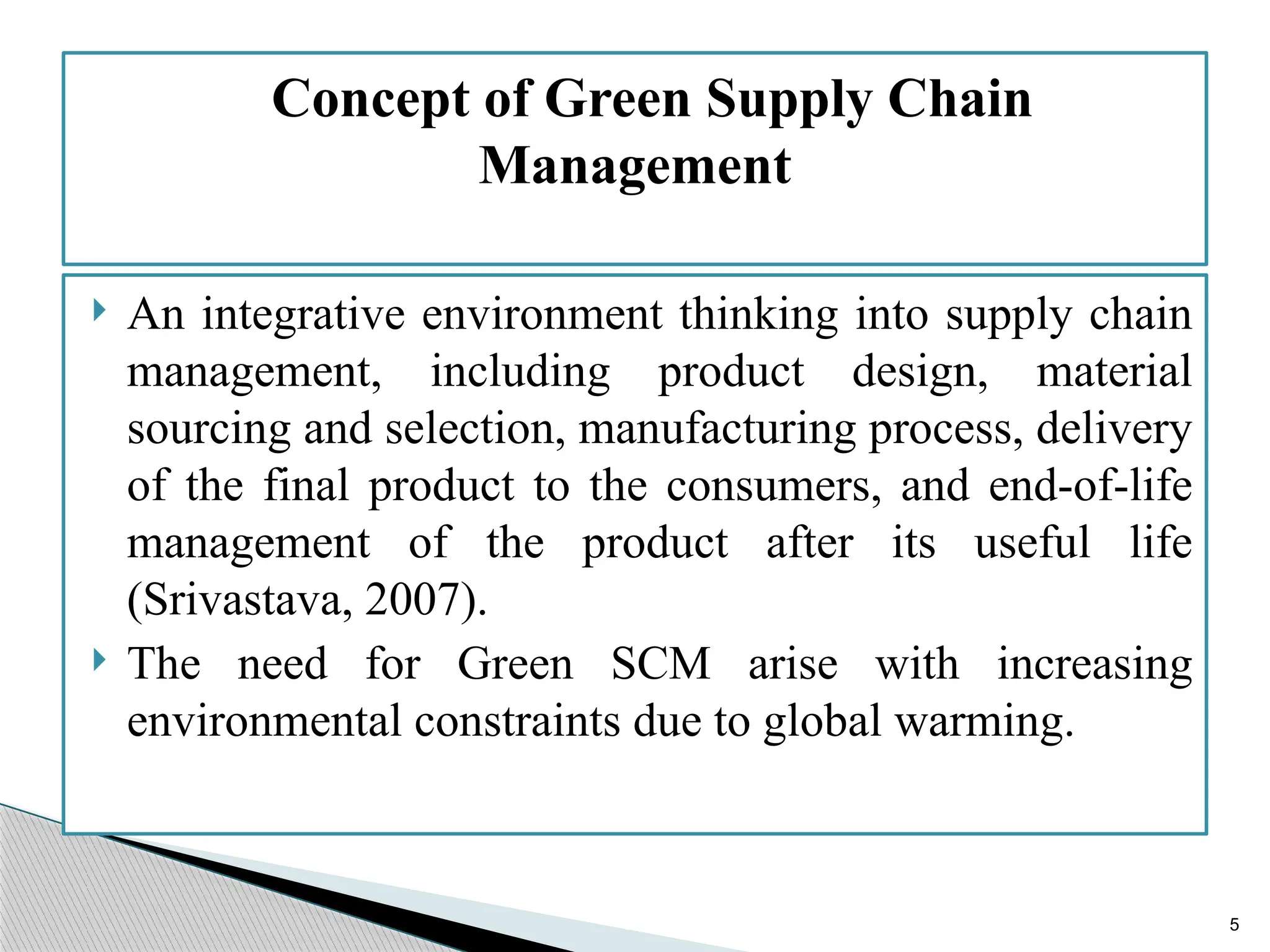
 An integrative environment thinking into supply chain
management, including product design, material
sourcing and selection, manufacturing process, delivery
of the final product to the consumers, and end-of-life
management of the product after its useful life
(Srivastava, 2007).
 The need for Green SCM arise with increasing
environmental constraints due to global warming.
Concept of Green Supply Chain
Management
6
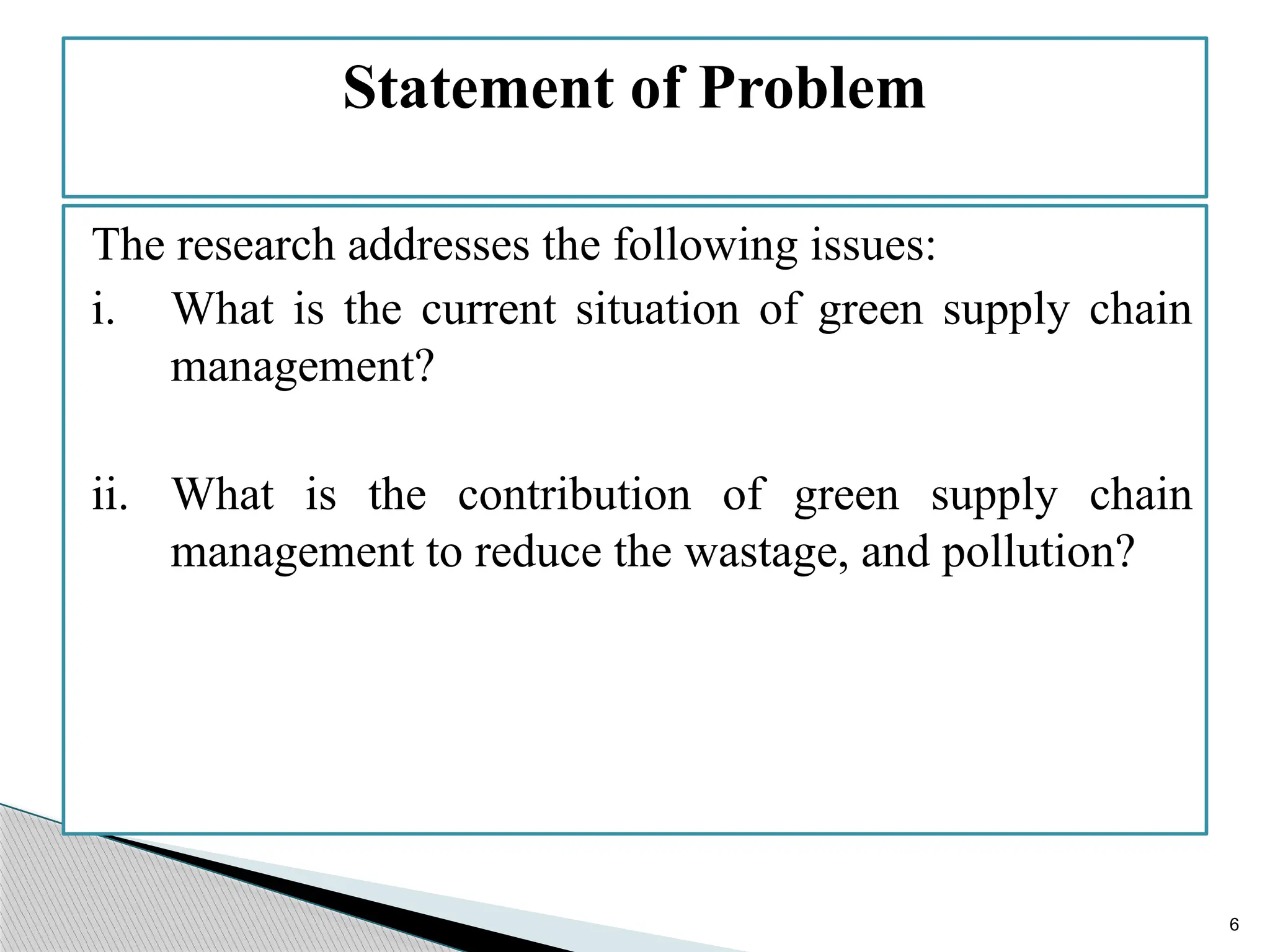
The research addresses the following issues:
i. What is the current situation of green supply chain
management?
ii. What is the contribution of green supply chain
management to reduce the wastage, and pollution?
Statement of Problem
7
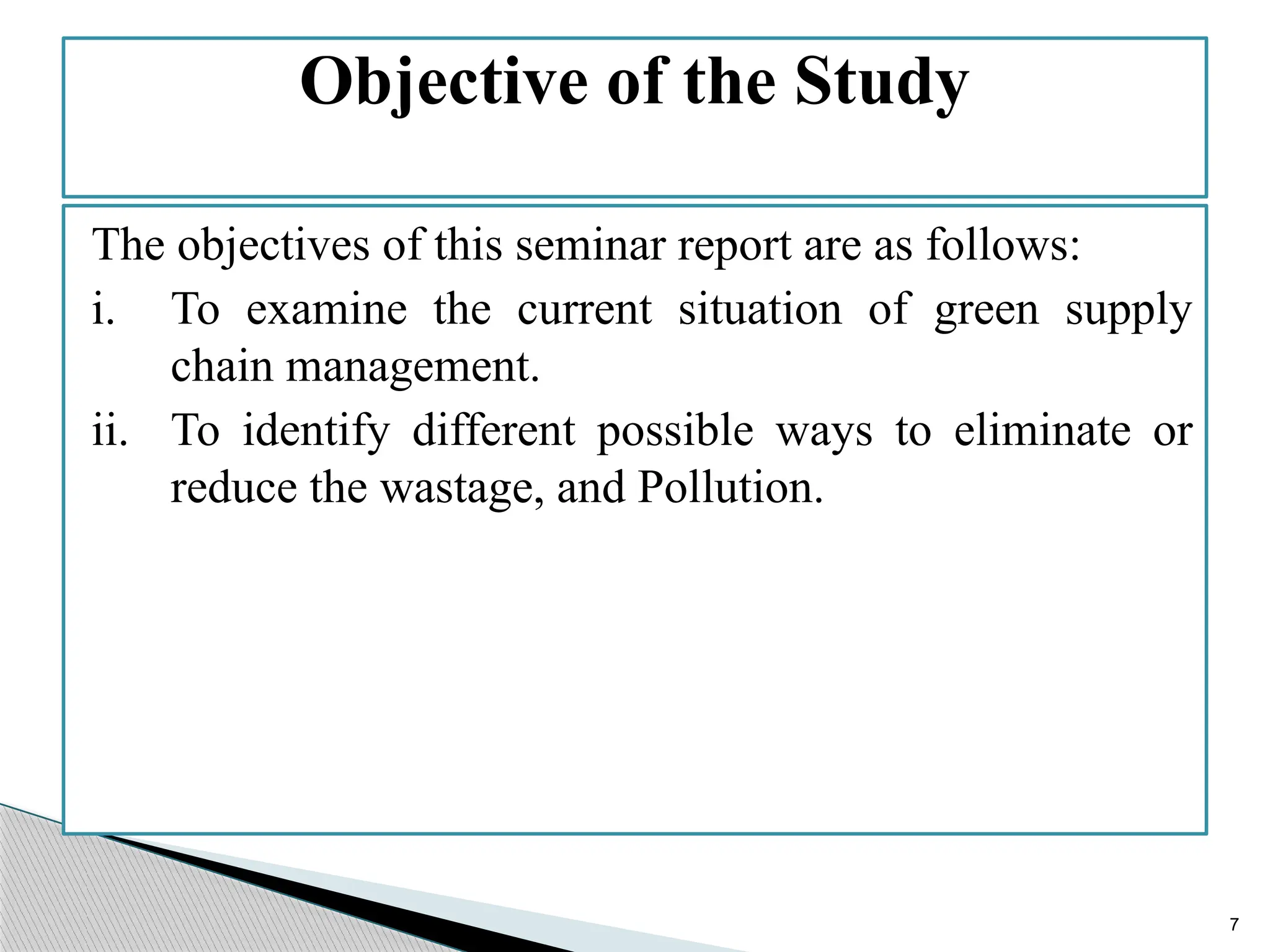
The objectives of this seminar report are as follows:
i. To examine the current situation of green supply
chain management.
ii. To identify different possible ways to eliminate or
reduce the wastage, and Pollution.
Objective of the Study
8
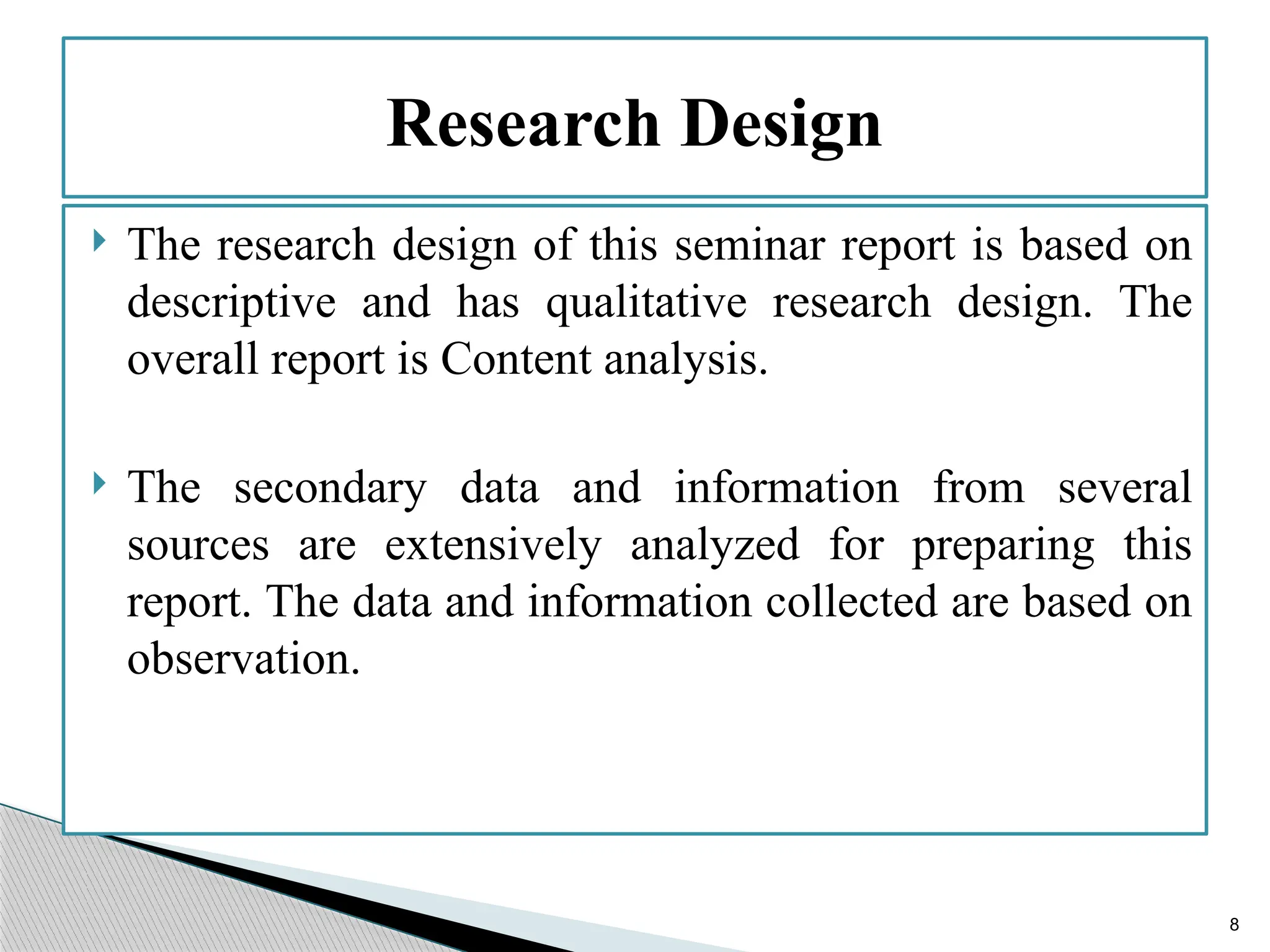
 The research design of this seminar report is based on
descriptive and has qualitative research design. The
overall report is Content analysis.
 The secondary data and information from several
sources are extensively analyzed for preparing this
report. The data and information collected are based on
observation.
Research Design
9
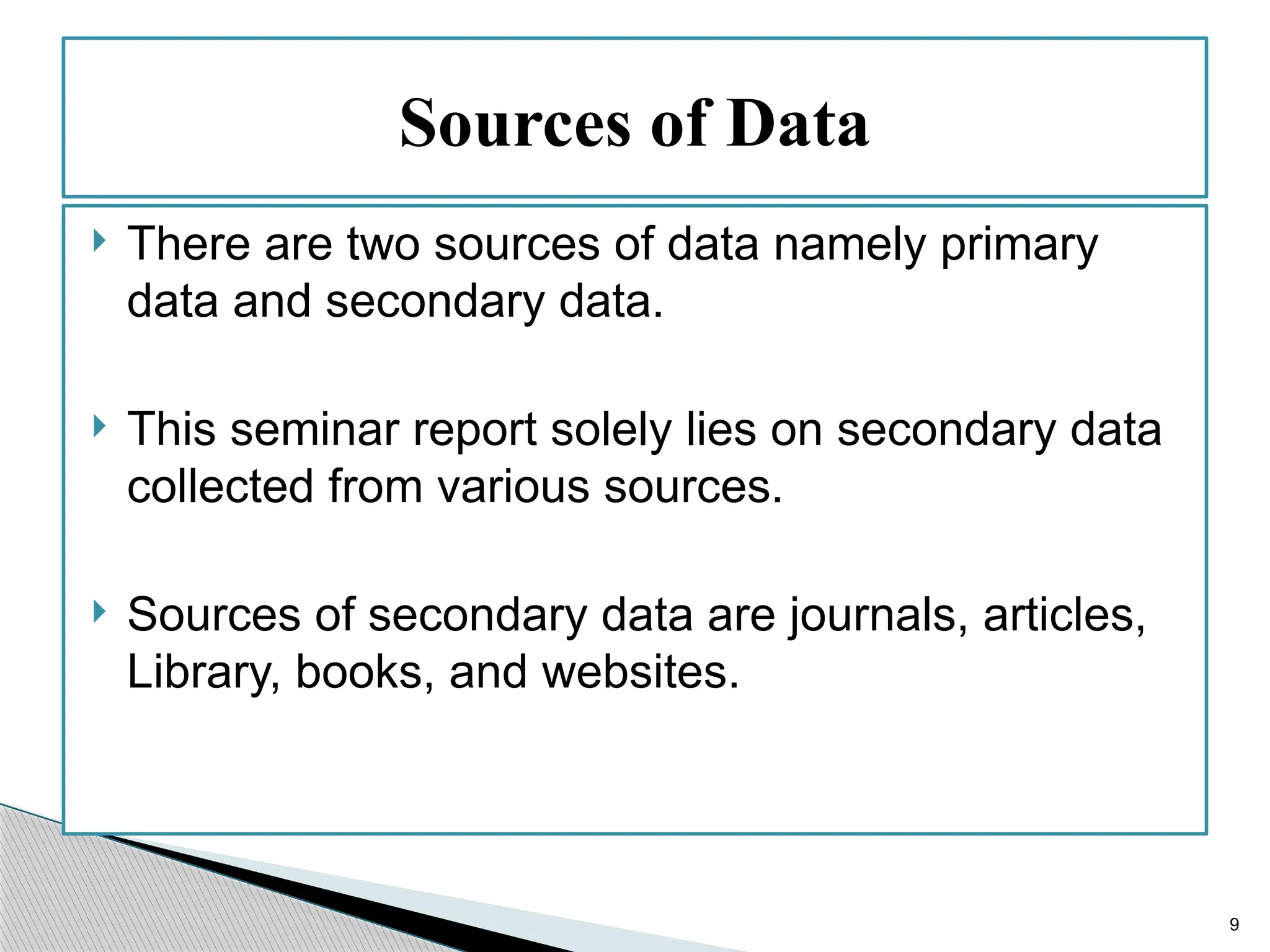
 There are two sources of data namely primary
data and secondary data.
 This seminar report solely lies on secondary data
collected from various sources.
 Sources of secondary data are journals, articles,
Library, books, and websites.
Sources of Data
10
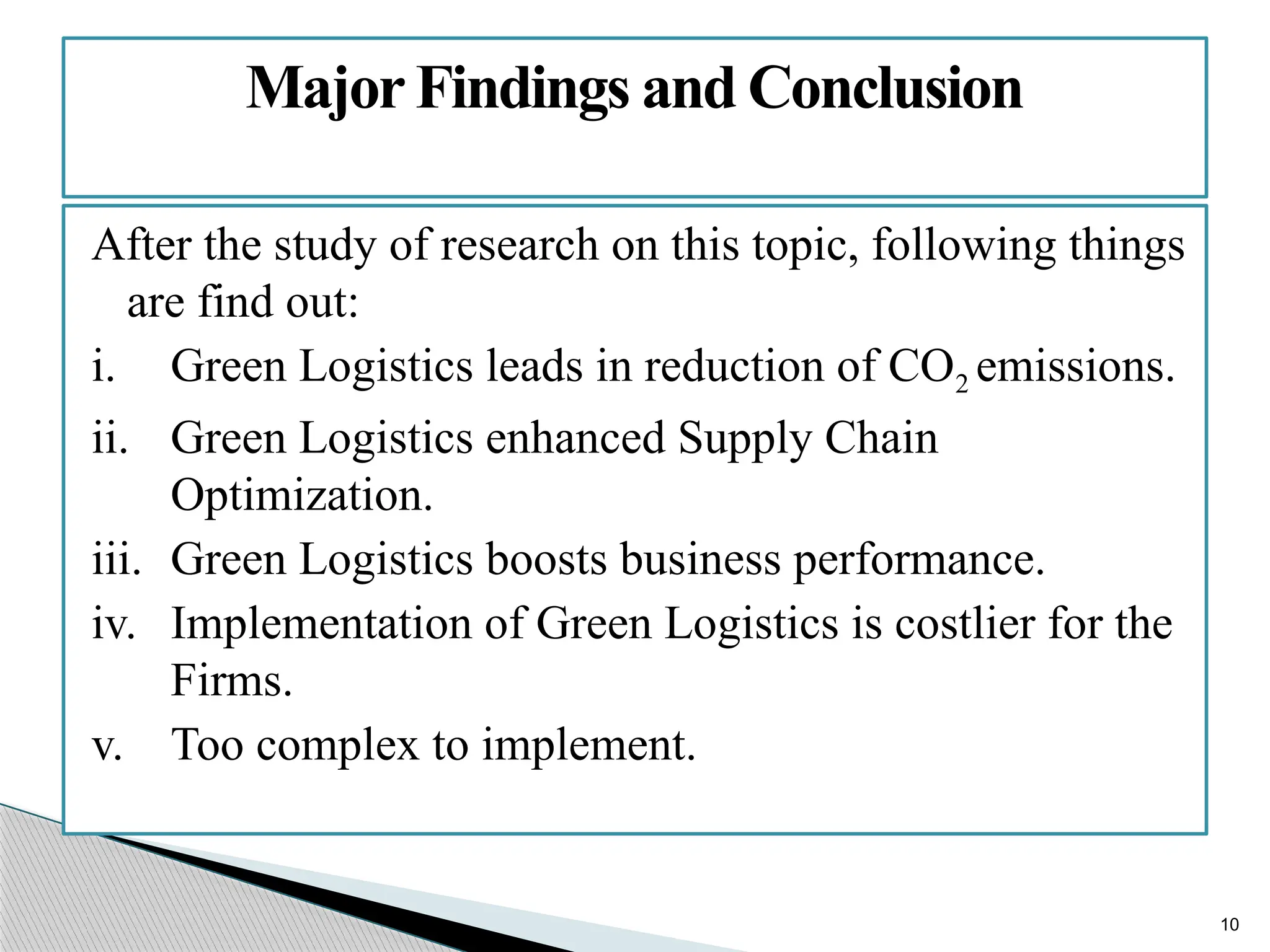
After the study of research on this topic, following things
are find out:
i. Green Logistics leads in reduction of CO2 emissions.
ii. Green Logistics enhanced Supply Chain
Optimization.
iii. Green Logistics boosts business performance.
iv. Implementation of Green Logistics is costlier for the
Firms.
v. Too complex to implement.
MajorFindings and Conclusion
11
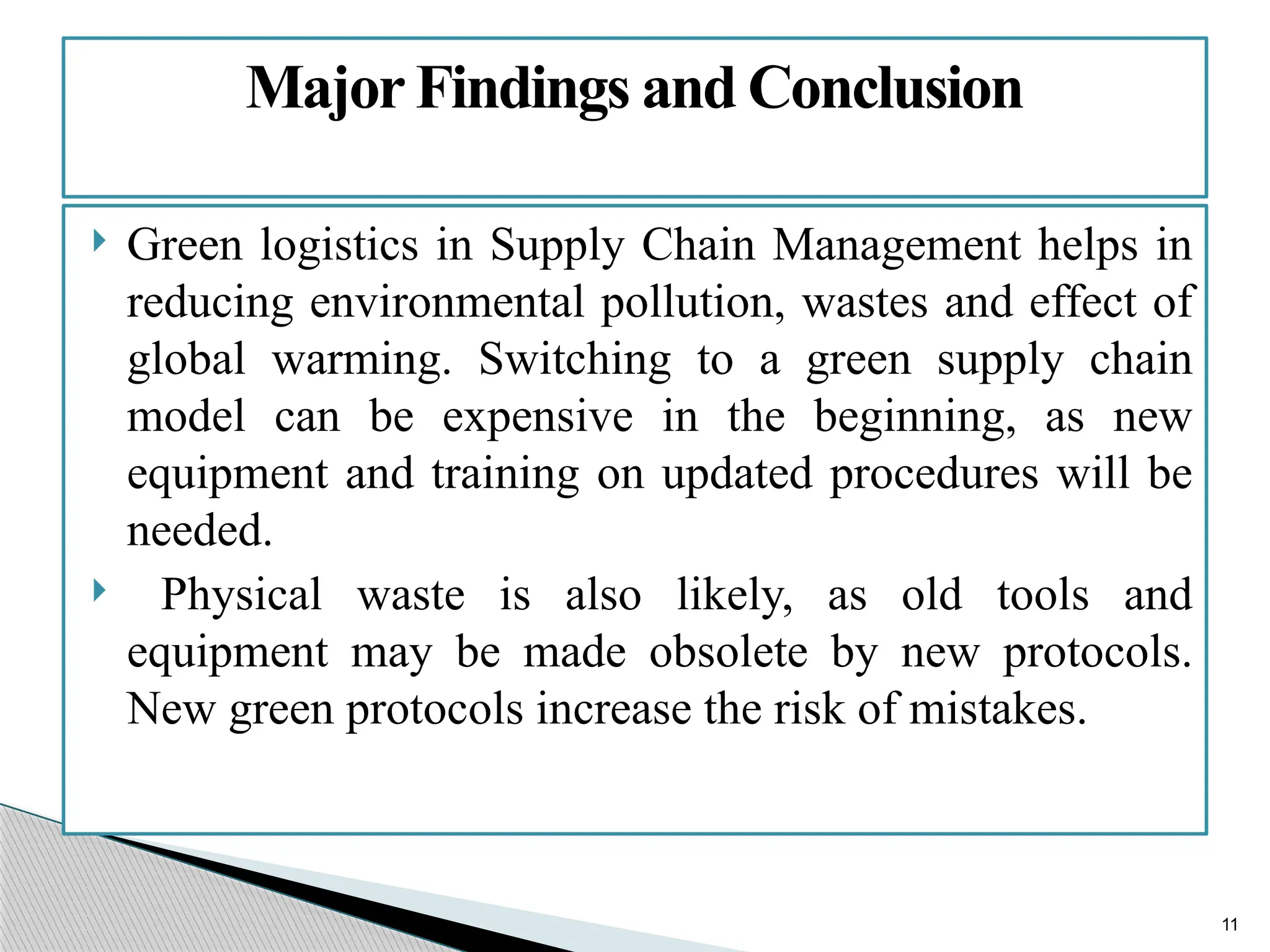
 Green logistics in Supply Chain Management helps in
reducing environmental pollution, wastes and effect of
global warming. Switching to a green supply chain
model can be expensive in the beginning, as new
equipment and training on updated procedures will be
needed.
 Physical waste is also likely, as old tools and
equipment may be made obsolete by new protocols.
New green protocols increase the risk of mistakes.
MajorFindings and Conclusion
12
 Errors may lead to product waste, poor transportation
planning, and the unnecessary consumption of natural
resources. Calculating transportation routes to
minimize fuel usage and environmental impact isn't an
easy task.
Major Findings and Conclusion
13
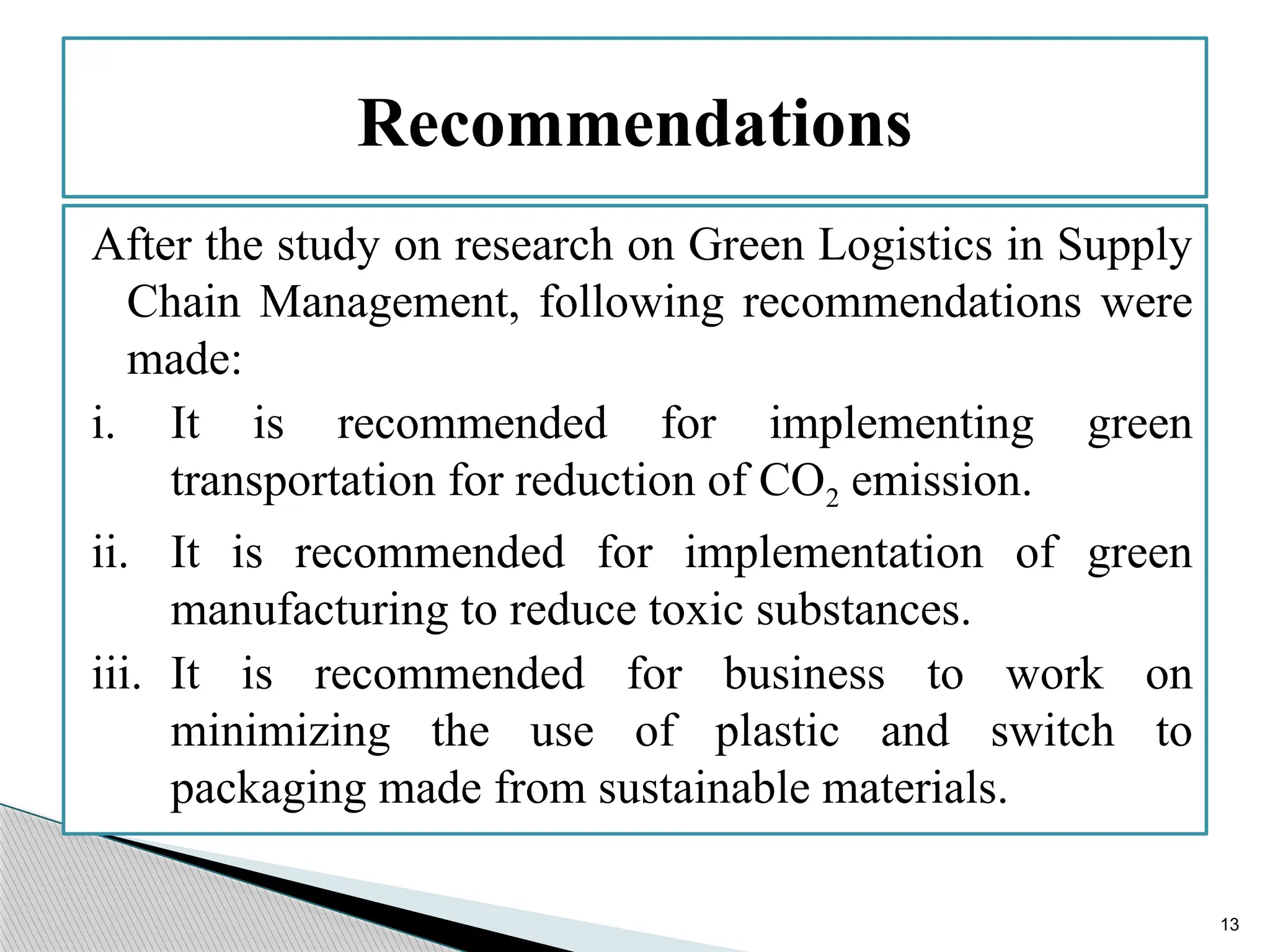
After the study on research on Green Logistics in Supply
Chain Management, following recommendations were
made:
i. It is recommended for implementing green
transportation for reduction of CO2 emission.
ii. It is recommended for implementation of green
manufacturing to reduce toxic substances.
iii. It is recommended for business to work on
minimizing the use of plastic and switch to
packaging made from sustainable materials.
Recommendations
14
iv. It is recommended for effective use of collaborative
planning and forecasting which in-turn reduces the
overall energy requirements of organizations.
v. Automation of transportation planning process which
prepares in advance for unanticipated events in the
supply chain.
Recommendations
15

GAURAV SEMINAR PRESENTATION.pptx can aid for presentation

  • 1.
    1 Application of GreenLogistics in Supply Chain Management: a Case of DHL Prepared By: Gaurav Uprety MBA-II Semester Kantipur International College (KIC)
  • 2.
    2  Concept ofGreen Logistics  Concept of Supply Chain Management  Concept of Green Supply Chain Management  Statement of Problem  Objective of the Study  Research Design  Sources of Data  Major Findings and Conclusion  Recommendations Contents
  • 3.
    3  In simplesense, Logistics refers to the overall process of managing how resources are acquired, stored, handled and transmitted to their final destination.  In common parlance, Green logistics refers to the set of sustainable policies and measures aimed at reducing the environmental impact caused by the activities of business area. Concept of Green Logistics
  • 4.
    4  Supply chainis said to be the network of organization for procuring materials, transforming raw materials into the finished products and distributing the finished products to the ultimate consumers.  According to Professor Douglas M Lambert, “Supply Chain Management as the integration of business process from the end user through original supplier who provide products, services and information that adds value for the customers.” Concept of Supply Chain Management
  • 5.
    5  An integrativeenvironment thinking into supply chain management, including product design, material sourcing and selection, manufacturing process, delivery of the final product to the consumers, and end-of-life management of the product after its useful life (Srivastava, 2007).  The need for Green SCM arise with increasing environmental constraints due to global warming. Concept of Green Supply Chain Management
  • 6.
    6 The research addressesthe following issues: i. What is the current situation of green supply chain management? ii. What is the contribution of green supply chain management to reduce the wastage, and pollution? Statement of Problem
  • 7.
    7 The objectives ofthis seminar report are as follows: i. To examine the current situation of green supply chain management. ii. To identify different possible ways to eliminate or reduce the wastage, and Pollution. Objective of the Study
  • 8.
    8  The researchdesign of this seminar report is based on descriptive and has qualitative research design. The overall report is Content analysis.  The secondary data and information from several sources are extensively analyzed for preparing this report. The data and information collected are based on observation. Research Design
  • 9.
    9  There aretwo sources of data namely primary data and secondary data.  This seminar report solely lies on secondary data collected from various sources.  Sources of secondary data are journals, articles, Library, books, and websites. Sources of Data
  • 10.
    10 After the studyof research on this topic, following things are find out: i. Green Logistics leads in reduction of CO2 emissions. ii. Green Logistics enhanced Supply Chain Optimization. iii. Green Logistics boosts business performance. iv. Implementation of Green Logistics is costlier for the Firms. v. Too complex to implement. MajorFindings and Conclusion
  • 11.
    11  Green logisticsin Supply Chain Management helps in reducing environmental pollution, wastes and effect of global warming. Switching to a green supply chain model can be expensive in the beginning, as new equipment and training on updated procedures will be needed.  Physical waste is also likely, as old tools and equipment may be made obsolete by new protocols. New green protocols increase the risk of mistakes. MajorFindings and Conclusion
  • 12.
    12  Errors maylead to product waste, poor transportation planning, and the unnecessary consumption of natural resources. Calculating transportation routes to minimize fuel usage and environmental impact isn't an easy task. Major Findings and Conclusion
  • 13.
    13 After the studyon research on Green Logistics in Supply Chain Management, following recommendations were made: i. It is recommended for implementing green transportation for reduction of CO2 emission. ii. It is recommended for implementation of green manufacturing to reduce toxic substances. iii. It is recommended for business to work on minimizing the use of plastic and switch to packaging made from sustainable materials. Recommendations
  • 14.
    14 iv. It isrecommended for effective use of collaborative planning and forecasting which in-turn reduces the overall energy requirements of organizations. v. Automation of transportation planning process which prepares in advance for unanticipated events in the supply chain. Recommendations
  • 15.