University of Aberdeen
LITHOFACIES CONTROLLED PERMEABILITY
STRUCTURE IN AEOLIAN SYSTEMS – AN OUTCROP
BASED STUDY FROM THE PAGE SANDSTONE,
ARIZONA
LAURA-JANE CHRISTINE FYFE
51445966
BSc Aberdeen
A final project submitted in part fulfillment for the degree of Master of Science in
Integrated Petroleum Geoscience at the University of Aberdeen
May - August 2015
IN ASSOCIATION WITH:


  i	
  
ABSTRACT
Within the petroleum industry aeolian reservoirs have historically been regarded as
homogeneous, isotropic, highly permeable ‘tanks’ of sandstone, with high recovery
factors and production rates. Variable production and recovery from mature fields
suggests this is an over-simplification. This project aims to challenge this simplistic
view of aeolian deposits, conducting research into how permeability heterogeneity
varies throughout a dry aeolian system and is possible implications for petroleum
reservoir production rates and recovery factors.
Fieldwork undertaken on the Page Sandstone, Arizona identified nine lithofacies,
across the dune, dune plinth and interdune architectural elements. Samples were
collected for each lithofacies and tri-axially cored. Petrophysical analysis of the core
plugs was undertaken through: nitrogen permeametry, helium porosimetry, along with
a grain-size analysis, to assess petrophysical variation.
Each Page Sandstone lithofacies exhibits distinct ranges in petrophysical values and
hence should be considered as an individual entity when analyzing the permeability
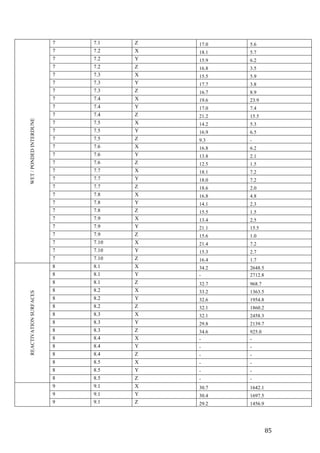
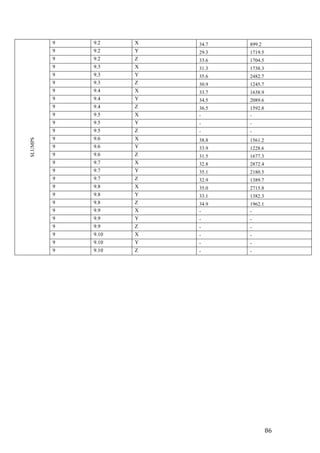
structure of the outcrop. Analysis confirmed permeability heterogeneity multiple
scales, with a range in permeability of over 3 orders of magnitude. Permeability varies
on the macro-scale by several hundred millidarcies and on the mega-scale by several
darcies. Permeability (k) was determined to be anisotropic with kV (perpendicular to
bedding – Z axis) displaying generally lower permeabilities than either of the
permeability values for kh (parallel to bedding – X & Y axis). For example in wind
ripple dominated sediments permeability can be up to 12 times greater parallel to
bedding than perpendicular to bedding.
The trends and relationships of permeability related to architectural elements and
individual lithofacies, determined within this study, may be used as an analogue to
improve understanding of other aeolian outcrops and reservoirs. Realistic upscaling of
macro-scale permeability heterogeneity for reservoir modeling can be undertaken
using representative elemental volumes.
  ii	
  
AUTHOR’S DECLARATION


University of Aberdeen
MSc Final Project 2015.
Declaration of academic integrity
This final report is my own composition and has not been submitted previously for
any other degree. Where the work of others has been utilized this has been clearly
indicated and the sources acknowledged.
Signed:……………………………………………………………
Name (print)……………………………………………
Date:……………………………


  iii	
  
ACKNOWLEDGEMENTS
I would like to thank RWE Dea for funding this MSc research project. I would like to
thank John Howell and Dave Healy, my MSc project advisors, for being so patient
and taking the time to answer my many questions. I would also like to thank Colm
Pierce and Miguel Owens for all their help and support during and after the fieldwork.
This project would not be what it is without the help of Colin Taylor and Elizabeth
Naessens, who I thank for helping show me how to use the many petrophysical
machines. I would like to thank Corelab ltd. for assisting with the coring of my core
plugs on short notice. I would like to acknowledge Andrew Vaughan for taking the
time to read over my dissertation and for providing great feedback. Andrew and
Christine Fyfe have been a constant support throughout and I would like to thank
them for all their words of encouragement. Lastly I would like to thank Stuart Greig
for keeping me going, for all the kind words and for all the cups of tea.
Thank you all.
  iv	
  
TABLE OF CONTENTS
Abstract………………………………………………………………………………...i
Authors Declaration……………………………………………………………....…...ii
Acknowledgements……………………………………………………………..……..iii
List of Figures………………………………………………………………………...vi
List of Tables…………………………………………………………………………..x
1.INTRODUCTION
1.1 Motivation………………………………………………………………... 1
1.2 Research Objectives………………………………………..…………...... 3
1.3 Literary Review………………………………………….….……………. 4
2.STUDY AREA
2.1 Geographic and Geological Overview…………………………………… 5
2.2 The Page Sandstone……………………………………………………… 7
2.2.1 Location of Study……………………………………………..... 7
2.2.2 Page Geological Overview………..…………………………... 10
2.2.3 Stratigraphy…………………………………………………… 12
3.SEDIMENTOLOGY
3.1 Page Sedimentary Description………………………………………….. 13
3.2 Identification of Lithofacies……………………………….……………. 14
3.2.1 Aeolian Lithofacies Descriptions……………...……………… 16
3.3 Hypotheses of Lithofacies Effects On Porosity & Permeability………... 24
3.4 Page Log……………………………………………...…………………. 25
4.METHODOLOGY
4.1 Sampling………………………………………………………………... 27
4.2 Laboratory Methods………………………………………….…………. 28
4.2.1 Permeability…………………………………………..………. 28
4.2.2 Porosity……………………………………………………….. 29
4.2.3 Particle Size Analysis…………………………………………. 31
5.QUALITY CONTROL & DATA UNCERTAINTY…………………………….. 32
5.1 Discussion of Possible Gas Bypass Affects…………………………….. 33
6.RESULTS
6.1 Petrophysical Results……………………………………………...……. 34
6.1.1 Variation from Hypothesis…………………………………..…37
6.2 Grain size and Thin Section Analysis………………..…………………. 39
6.3 Permeability………………………………………………………….…. 45
  v	
  
6.4 Permeability Anisotropy……………………..…………………………. 49
6.5 Representative Elemental Models………………………..……………... 56
7.DISCUSSION
7.1 A Comparison of Results with Previous Studies……………………….. 61
7.2 A Discussion of Study Results………………………………………….. 62
8.CONCLUSION…………………………………………...………………………. 68
9.REFERENCES…………………………………………………………....………. 70
APPENDIX A………………………………………………………………………. 73
APPENDIX B………………………………………………………………………. 80
  vi	
  
LIST OF FIGURES
Figure 1: Map showing the Jurassic tectonic setting of the Colorado Plateau during the Middle
San Rafael deposition. The Cordilleran Arc is observed to the west of the Colorado
Plateau. The area within the back arc basins forms a series of highs and lows, which
can be directly related to the developing arc structure. A large continental plain is
observed to form several hundred miles to the east of the arc, situated perfectly for
the formation of large aeolian erg systems (Blakey, 1989).
Figure 2: Location of the study area indicated on regional geological maps (Billingsley &
Priest, 2013).
Figure 3: Maps 1 & 2 Geological Key (Billingsley & Priest, 2013).
Figure 4: A series of paleogeographic maps highlighting the development and abandonment of
the Page Erg. The maps show the development of the erg to the east of the Carmel
Sea during the Early Bathonian. The erg changes in dimensions, shape and location
throughout the Bathonian, finally being abandoned in the Late Bathonian, when the
restricted seaway transgresses east. The study area is indicated by the red circle and
shows that the area was predominantly covered by the Page erg throughout its
existence (Blakey, 1983).
Figure 5: Burial history of the Navajo Sandstone at Buckskin Gulch, located 25km west of
Page. The burial history of the Navajo Sandstone at Buckskin Gulch is understood to
be very similar to what is expected of the burial history of the Page Sandstone at
Page. This is due to Buckskin Gulch being located in close proximity to Page and the
fact that the Page Sandstone sits stratigraphically directly above the Navajo
Sandstone, meaning little variation in the expected depth of burial (After Fossen et al,
2011).
Figure 6: (Left) Stratigraphic column of Glen Canyon National Recreation Area and vicinity,
including thickness, age, weathering habits, and lithology. The Page Sandstone is
highlighted (Chidsey et al, 2000). (Right) Correlation of Jurassic rocks at selected
sections in southwestern Utah and north-central Arizona. The figure shows the
stratigraphic, age equivalent deposits of the Page Sandstone within the area (Peterson
& Pipiringos, 1979).
Figure 7: Architectural elements of the dune and their associated lithofacies (After Douglas,
2010).
Figure 8: A photograph of Grainflow Influenced Strata from the Page Sandstone, Arizona.
Figure 9: A photograph of Dominantly Grainflow Strata from the Page Sandstone, Arizona.
Figure 10: A photograph of Predominantly Grainflow Strata from the Page Sandstone, Arizona.
Figure 11: A photograph of Dry Wind Rippled Strata from the Page Sandstone, Arizona.
Figure 12: A set of photographs of Coarse Grained Wind Rippled Strata from the Page
Sandstone, Arizona.
Figure 13: A photograph of Damp Interdune Strata from the Page Sandstone, Arizona.
Pages
6
8
9
10
11
12
15
16
17
18
19
20
21
  vii	
  
Figure 14: A photograph of Wet/Ponded Interdune Strata from the Page Sandstone, Arizona.
Figure 15: A photograph of a Reactivation Surface from the Page Sandstone, Arizona.
Figure 16: A photograph of a Slump from the Page Sandstone, Arizona.
Figure 17: Diagrams showing the location and route of the log undertook within the Page
Sandstone (After Google Earth, 2015).
Figure 18: Page Log.
Figure 19: Diagrams showing the coring of tri-axially orientated core plugs from rock samples
collected from the Page Sandstone, Arizona.
Figure 20: Graph demonstrating how the Klinkenberg correction was applied to the measured
permeability of the Page core plugs using Nitrogen Permeametry.
Figure 21: Schematic diagram of a Helium Porosimeter (Torsæter, 2000).
Figure 22: Petrophysical properties of the Page Sandstone plotted in accordance to lithofacies.
Figure 23: Petrophysical properties of the Page Sandstone plotted in accordance to lithofacies.
Figure 24: Petrophysical properties of the Page Sandstone plotted in accordance to dune
architecture.
Figure 25: Petrophysical properties of the dune lithofacies; Grainflow Influenced (facies 1),
Dominantly Grainflow (facies 2) and Predominantly Grainflow (facies 3).
Figure 26: Petrophysical properties of the dune plinth lithofacies; Dry Wind Rippled Lamination
(facies 4) and Coarse Grained Wind Rippled Lamination (facies 5).
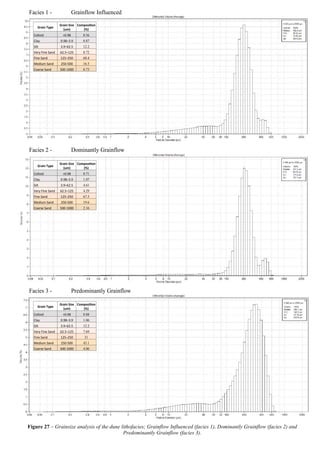
Figure 27: Grainsize analysis of the dune lithofacies; Grainflow Influenced (facies 1),
Dominantly Grainflow (facies 2) and Predominantly Grainflow (facies 3).
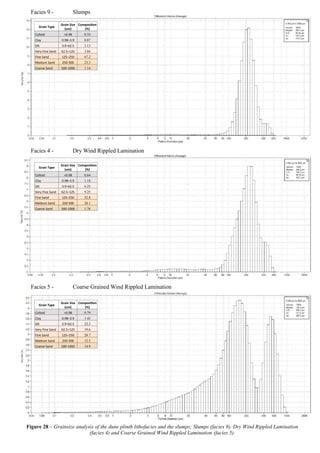
Figure 28: Grainsize analysis of the dune plinth lithofacies and the slumps; Slumps (facies 9),
Dry Wind Rippled Lamination (facies 4) and Coarse Grained Wind Rippled
Lamination (facies 5).
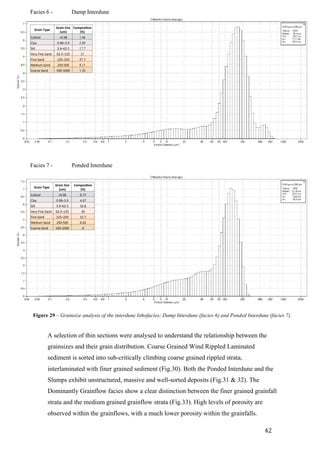
Figure 29: Grainsize analysis of the interdune lithofacies; Damp Interdune (facies 6) and Ponded
Interdune (facies 7).
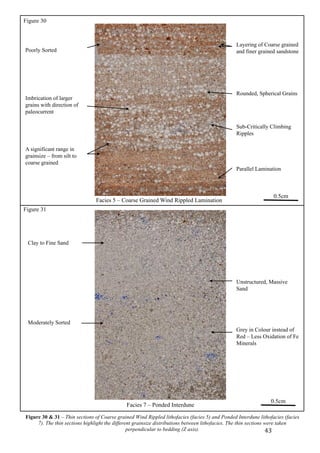
Figure 30: Thin sections of Coarse grained Wind Rippled lithofacies (facies 5) and Ponded
Interdune lithofacies (facies 7). The thin sections highlight the different grainsize
distributions between lithofacies. The thin sections were taken perpendicular to
bedding (Z axis).
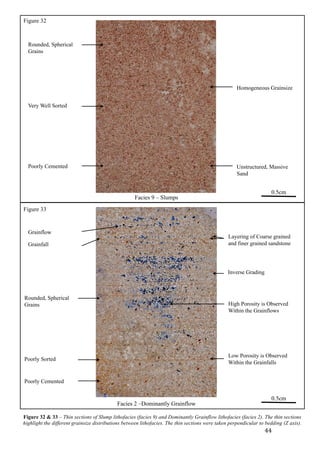
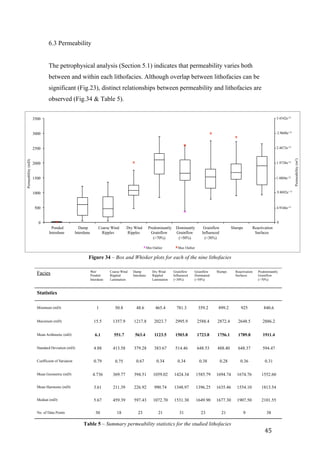
Figure 32: Thin sections of Slump lithofacies (facies 9) and Dominantly Grainflow lithofacies
(facies 2). The thin sections highlight the different grainsize distributions between
lithofacies. The thin sections were taken perpendicular to bedding (Z axis).
& 31
	
  
& 33
	
  
22
23
24
25
26
27
29
30
35
35
36
38
38
40
41
42
43
44
  viii	
  
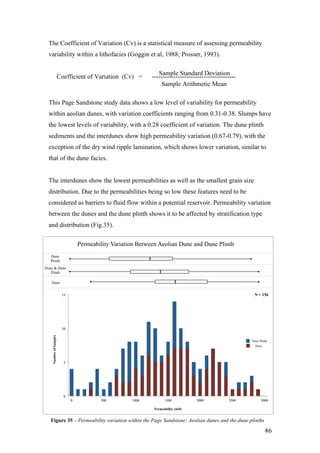
Figure 34: Box and Whisker plots for each of the nine lithofacies.
Figure 35: Permeability variation within the Page Sandstone: Aeolian dunes and the dune
plinths.
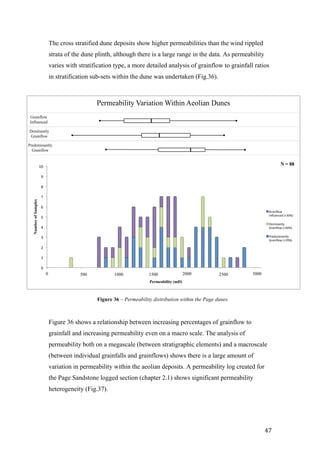
Figure 36: Permeability distribution within the Page dunes.
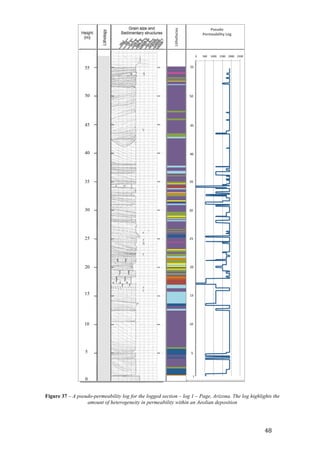
Figure 37: A pseudo-permeability log for the logged section – log 1 – Page, Arizona. The log
highlights the amount of heterogeneity in permeability within an Aeolian deposition.
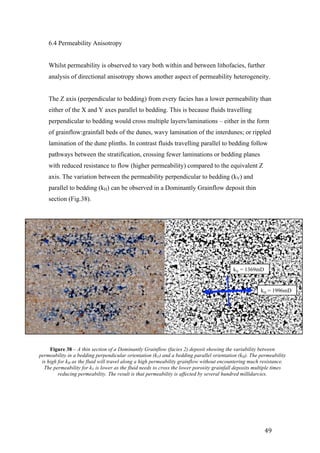
Figure 38: A thin section of a Dominantly Grainflow (facies 2) deposit showing the variability
between permeability in a bedding perpendicular orientation (kV) and a bedding
parallel orientation (kH). The permeability is high for kH as the fluid will travel along
a high permeability grainflow without encountering much resistance. The
permeability for kV is lower as the fluid needs to cross the lower porosity grainfall
deposits multiple times reducing permeability. The result is that permeability is
affected by several hundred millidarcies.
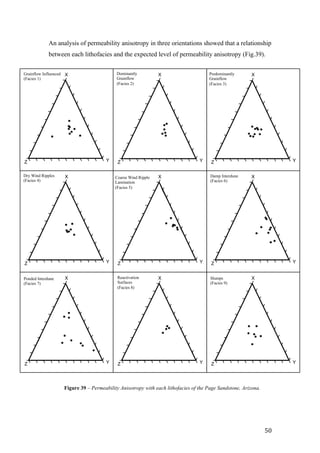
Figure 39: Permeability Anisotropy with each lithofacies of the Page Sandstone, Arizona.
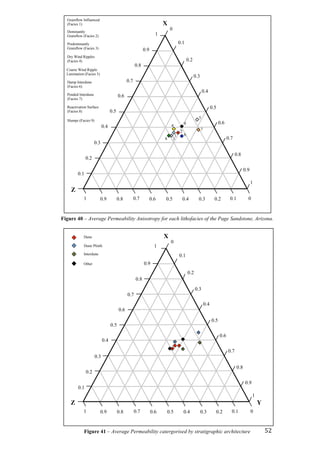
Figure 40: Average Permeability Anisotropy for each lithofacies of the Page Sandstone,
Arizona.
Figure 41: Average Permeability catergorised by stratigraphic architecture
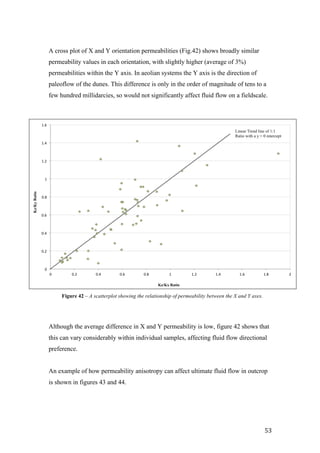
Figure 42: A scatterplot showing the relationship of permeability between the X and Y axes.
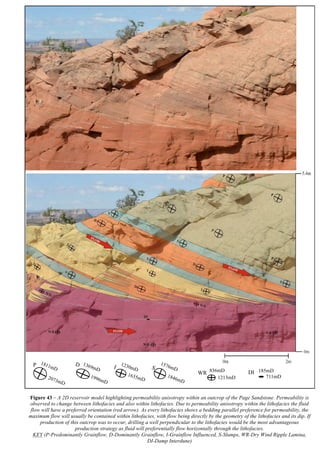
Figure 43: A 2D reservoir model highlighting permeability anisotropy within an outcrop of the
Page Sandstone. Permeability is observed to change between lithofacies and also
within lithofacies. Due to permeability anisotropy within the lithofacies the fluid
flow will have a preferred orientation (red arrow). As every lithofacies shows a
bedding parallel preference for permeability, the maximum flow will usually be
contained within lithofacies, with flow being directly by the geometry of the
lithofacies and its dip. If production of this outcrop was to occur, drilling a well
perpendicular to the lithofacies would be the most advantageous production strategy
as fluid will preferentially flow horizontally through the lithofacies.
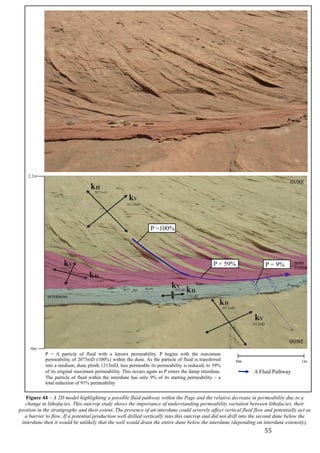
Figure 44: A 2D model highlighting a possible fluid pathway within the Page and the relative
decrease in permeability due to a change in lithofacies. This outcrop study shows the
importance of understanding permeability variation between lithofacies, their
position in the stratigraphy and their extent. The presence of an interdune could
severely affect vertical fluid flow and potentially act as a barrier to flow. If a
potential production well drilled vertically into this outcrop and did not drill into the
second dune below the interdune then it would be unlikely that the well would drain
the entire dune below the interdune (depending on interdune extensity).
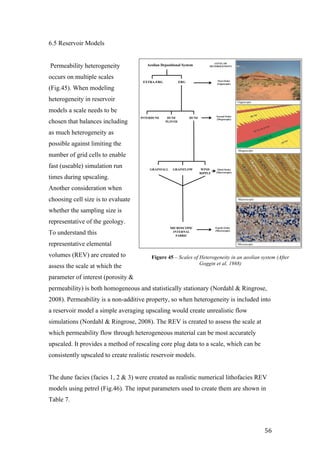
Figure 45: Scales of Heterogeneity in an aeolian system (After Goggin et al, 1988)
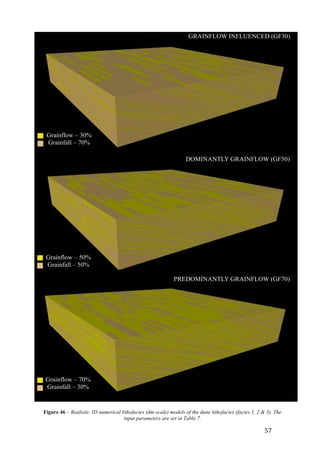
Figure 46: Realistic 3D numerical lithofacies (dm-scale) models of the dune lithofacies (facies
1, 2 & 3). The input parameters are set in Table 7.
45
46
47
48
49
50
52
52
53
54
55
56
57
  ix	
  
Figure 47: Petrophysical Models. Petrophysical properties (Porosity, Permeability kV & kH)
obtained from the petrophysical analysis of the Page core plugs, were inputted into
the lithofacies models, which have been used as base models for structure and
lithofacies. Numerous models were created to observe how permeability varies with
different sets of model parameters.
Figure 48: Histogram by Chandler et al. (1989) showing Page Sandstone permeability data.
Figure 49: A comparison of the level of heterogeneity that cane be appraised at outcrop or in
core (pseudo permeability log) and what can be appraised in the subsurface by
logging tools or sidewall cores. A lot of the finer detail of permeability variation is
missed which could have a direct impact on the ability to fully appraise permeability
within the reservoir. The NMR log has been plotted with a 3ft (0.9m) vertical
resolution and the Sidewall cores at a 16ft (5m) vertical resolution.
59
61
67
  x	
  
LIST OF TABLES
Table 1: Sedimentary observations of the architectural elements of the Page Sandstone, Page,
Arizona.
Table 2: Descriptions and interpretations of the nine lithofacies defined within the Page
Sandstone, Page, Arizona.
Table 3: An assessment of steps taken during quality control to allow for the gathering of
accurate results.
Table 4: An assessment of the main uncertainties and their potential margins for error.
Table 5: Summary permeability statistics for the studied lithofacies.
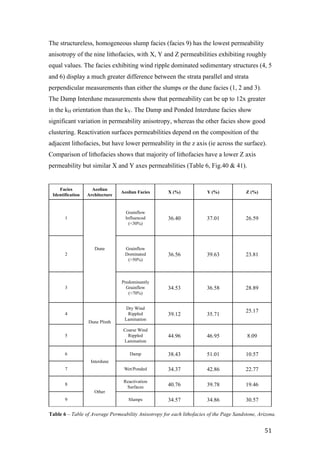
Table 6: Table of Average Permeability Anisotropy for each lithofacies of the Page
Sandstone, Arizona.
Table 7: Input parameters for the Representative Elemental Volumes. The input parameters
were selected from field observations and personal knowledge of reservoir modeling.
Table 8: A comparision between upscaling using a Representative Elemental Volumes and
from upscaling by averaging core plug values.
Table 9: A summary of the outcomes of upscaling the Representative Elemental Volumes.
Table 10: Elements that need to be considered when building reservoir models. This study has
only focused on the lithofacies element and the petrophysical properties. As the Page
is an outcrop analogue the fluid type has not been included in the study. The Page has
only been buried to 2km depth with little obvious signs of significant applied stress
regime, so it was concluded for this study for changes to the permeability structure
due to burial history to be insignificant. Diagenesis and faults is observed within the
Page to be kept to a minimum. Due to the lack of significant faulting and diagenesis,
it is assumed that these parameters are minor in their effect on permeability structure.
As other parameters are observed to be only minor in their effects on the Page, it
makes this outcrop a good study for the effects of lithofacies on permeability
structure. If the Page outcrop was to be compared to subsurface reservoirs the other
modeling parameters will need to be considered and their impact on the preliminarily
permeability structure defined by the lithofacies assessed.
Pages
13
14
32
33
45
51
58
60
60
66
  1	
  
1. INTRODUCTION
1.1 Motivation
Within the petroleum industry aeolian reservoirs have historically been regarded as
homogeneous, isotropic, highly permeable ‘tanks’ of sandstone, with high recovery
factors and production rates (North & Prosser, 1993). Production histories of mature
aeolian fields within the southern North Sea and the western United States show this
to be an oversimplification (North & Prosser, 1993). The high recovery factors of
aeolian reservoirs, typically around 60% for oil reservoirs and 90% for gas reservoirs,
are only achievable by utilising a variety of secondary and tertiary recovery
techniques, together with infill drilling to produce bypassed hydrocarbons (Fryberger
& Hern, 2014). The need to apply these techniques to achieve high recovery rates in
aeolian reservoirs suggests that there is heterogeneity present (Fryberger & Hern,
2014). Poor understanding of heterogeneity and its effect within aeolian reservoirs
can lead to sub-optimal field development decisions, unplanned additional costs and
loss of potential hydrocarbon recovery.
Fully integrated petroleum reservoir models are commonly created to quantify fields’
flow characteristic and recovery potential to support development investment
decisions. Such models are used in mature fields to locate remaining hydrocarbons
and maximize hydrocarbon recovery (Prosser & Maskall, 1993). A key component in
creating robust reservoir models is to understand the uncertainties of the petrophysical
rock properties and how they vary laterally and vertically, at both a field scale and on
a micro-scale. Permeability anisotropy is one petrophysical property integral to
understanding how the hydrocarbons will flow and needs to be well understood in
order to create realistic reservoir models.
Reservoir analogues may be used to understand and constrain uncertainties in
reservoir modeling, when available well data is limited or insufficient to represent the
spatial variation in the reservoir (Alexander, 1993). Analogue studies are able to
provide large datasets of relevant and tailored geological data from suitable outcrops,
due to the relative ease of data acquisition. Analogue data sets can be used to establish
  2	
  
trends, relationships and quantitative analysis to provide or supplement data for a
petroleum reservoir, which is lacking this detail.
The Völkersen field has an aeolian sandstone reservoir with sufficient permeability
heterogeneity to require a detailed analogue study to understand and predict variations
in petrophysical properties and permeability anisotropy within it. This paper is part of
a full-scale reservoir modeling study, which will help reduce petrophysical
uncertainties and enable more accurate reservoir modeling to improve field
development decisions by its owners.
  3	
  
1.2 Research Objectives
The primary objective of this project is to understand how permeability varies within
a diverse range of aeolian lithofacies. A secondary aim is to gather a dataset that
samples the full range of aeolian lithofacies through analyisis of their petrophysical
properties. The data for this study was gathered from the Middle Jurassic Page
Sandstone Formation, Arizona. This formation was selected as it incorporates a wide
range of aeolian lithofacies, parent dune morphologies and migratory behavior, as
well as its similarities to many of RWE Dea’s invested aeolian reservoirs.
Key deliverables of this dissertation are:
◊ A dataset of porosity and permeability for a full range of aeolian lithofacies
◊ Determination of statistical relationships between lithofacies types and
permeability/porosity
◊ Determination of the scale at which permeability varies between and within
lithofacies
◊ Quantification of permeability heterogeneity through tri-axial orientations
The petrophysical data collected will in future be integrated into the Page Virtual
Outcrop reservoir model, where it will be used to investigate controls on production.
This reservoir model will be used as an analogue for fluid movement through the
Völkersen gas field, as well as other Rotliegendes reservoirs.
  4	
  
1.3 Literary Review
Permeability is difficult to accurately ascertain in subsurface reservoirs (Alexander,
1993). Due to this factor permeability is commonly associated with high levels of
uncertainty.
Either because of simplistic pre-conceptions or from a lack of available quantified
data, aeolian reservoirs are not believed to display significant variation in their
permeability anisotropy (Goggin et al, 1992). Goggin et al. 1992 study demonstrated
that permeability distributions within aeolian rocks are complex on a range of scales
and, to a degree, are predictable. The view that permeability within aeolian sediments
was inhomogeneous, was further supported by Prosser and Maskall (1993), who
showed that permeability could vary by over three orders of magnitude.
The most dominant controls on permeability anisotropy within aeolian sediments are
stratification types and geometry, which are a direct result of depositional processes
(Goggin et al, 1988; Prosser & Maskall, 1993). Hence lithofacies, due to their
variation in depositional processes, should show variability in permeability
anisotropy. Poor understanding of the relationships between geological features and
permeability distribution (Kv & Kh) at different scales is a major limitation
encountered by most reservoir models (Alexander, 1993). An understanding and
prediction of permeability variations enable more effective fluid movement
modelling, leading to better decision-making and increased production and recovery
from hydrocarbon reservoirs.
  5	
  
2. STUDY AREA	
  
2.1 Geographic and Geological Overview
The geological rock record of the Late Paleozoic through to the Late Jurassic of the
Colorado Plateau, Western Interior of the United States, displays the largest known
preserved accumulation of aeolian strata (Kocurek, 1999). Its thickness and extent
was a result of a unique combination of paleogeography, climate and tectonic history.
The climate was primarily arid for most of the Late Paleozoic and Early Mesozoic,
being situated 15-30°N of the equator (Blakey, 1994; Loope et al. 2004). A
fluctuating, but generally low, water table combined with the arid climate enabled the
development of extensive aeolian erg systems, which cover much of present day,
Utah and Arizona (Blakey, 1994). Accommodation was created by back arc
subsidence from the developing Mesozoic Cordilleran Arc (Fig.1), situated to the
west of the Colorado Plateau (Dickinson, 2004), together with foreland basin
subsidence from the early development of the Elko Orogeny (Thorman & Peterson,
2003).
The continued development of the Cordilleran arc complex during the Mesozoic
created a large flat continental plain in the backarc basin (Blakey, 1994). This proved
ideal for the development of giant aeolian erg complexes. Aeolian strata distribution
and accumulation during the late Paleozoic to Early Mesozoic was controlled directly
by the arc’s architectural development in a NW-SE orientation (Kocurek, 2009).
During the Jurassic, sediment was supplied by westerly flowing rivers and southerly
flowing coastal currents, within a restricted inland sea. This was transported and
reworked by northerly winds, creating a positive loop for multiple reworking of
sediment (Blakely, 1988). The size and position of aeolian erg complexes changed
according to fluctuations in climate and tectonic activity. The maximum extent of
aeolian ergs occurred during the Early and Middle Jurassic (Blakely, 1988). A large
sediment supply and significant accommodation space allowed for accumulation of a
thick succession of aeolian deposits to be preserved within the rock record.
  6	
  
Figure 1 – Map showing the Jurassic tectonic setting of the Colorado Plateau during the Middle San Rafael
deposition. The Cordilleran Arc is observed to the west of the Colorado Plateau. The area within the back arc basins
forms a series of highs and lows, which can be directly related to the developing arc structure. A large continental
plain is observed to form several hundred miles to the east of the arc, situated perfectly for the formation of large
aeolian erg systems (Blakey, 1989).
  7	
  
2.2 The Page Sandstone
2.2.1 Location of Study
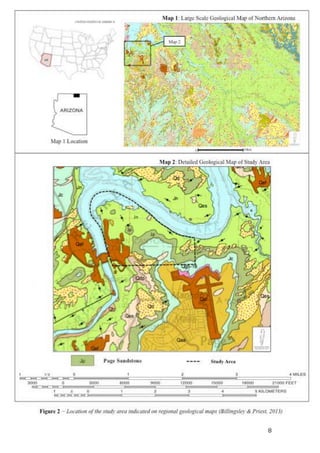
This study was undertaken on outcrops of Page Sandstone situated to the north-west
of the town on Page, Arizona (Fig.2 & 3).
The Virtual Outcrop Geology (VOG) Group is creating reservoir models of outcrops
across the western United States, for use as analogues to improve the accuracy of
reservoir models for many fields worldwide. The Page Sandstone outcrops north-west
of Page are currently being developed as an analogue to the Völkersen gas field,
Germany, to enable a better understanding of the controls on its production. The
results of this MSc study and its associated data will provide a detailed petrophysical
input into an integrated field reservoir model of selected Page outcrops.
  8	
  
  9	
  
Table&1.!Age!and!elevation!of!floodplain!and!terrace1gra
River!from!Glen!Canyon!Dam!to!Badger!Rapids,!a!25!m
Refer!to!locations!of!separate!older!terrace1gravel!depos
Map$unit Age
Qf Holocene
Qg1
Young!and!intermediate!terrace1gravel!
Floodplain!deposits
Older!terrace1gravel!deposits
Holocene
Qg2 Holocene
Qg3 Holocene
Qg4 Holocene!and!Pleistocene(?)
Qg5 Holocene!and!Pleistocene(?)
Qg6 Holocene(?)!and!Pleistocene
Qg7 Pleistocene
Qg8 Pleistocene
Qg9 Pleistocene
Qg9a Pleistocene
Qg10 Pleistocene
Qg11 Pleistocene
Qg12 Pleistocene
Qg13 Pleistocene
Qg14 Pleistocene
Qg15 Pleistocene
Qg16 Pleistocene!and!Pliocene(?)
Qg17 Pleistocene!and!Pliocene(?)
Qg18 Pleistocene!and!Pliocene(?)
112°00'
111°00'
37°00'
36°30'
Marble
Canyon
Vermilion
Cliffs!Lodge
Cliff
Dwellers
Lodge
Lees!Ferry
LeChee
Copper!Mine
Page
Kaibito
RAINBOW
PLATEAU
PARIA PLATEAU
Ferry Swale
Vermilion
Cliffs
STRIP
ARIZONA
MARBLE PLATEAU
NAVAJO&&INDIAN
RESERVATIONHouse Rock Valley
VERMILION&CLIFFS
NATIONAL&MONUMENT
Glen
Canyon
Dam
GLEN&CANYON
NRA
89
89A
98
LeChee Rock
Tse Esgizii Butte
Cummings
Mesa
Kaibito
Creek
Creek
Navajo
C
olorado2River
Paria2River
KAIBITO
PLATEAU
COW1SPRINGS
SYNCLINE
PRESTON1MESA
ANTICLINE
TUBA1CITY
SYNCLINE
ECHO1CLIFFS
MONOCLINE
EMINENCE
BREAK1FAULT
FENCE
FAULT
LIMESTONE
RIDGE
ANTICLINE
PARIA1PLATEAU1SYNCLINE
LAST
CHANCE
ANTICLINE
RED1LAKE
MONOCLINE
KAIBITO
SYNCLINE
F
F
F
Figure&1.!Map!of!the!Glen!Canyon!Dam!30’!x!60’!quadrangle!showing!cultural!and!physiographic!features!as!well!as!major!geologic!structures.
Boxes!define!area!of!maps!in!figure!2.
Cedar
Mountain
Echo
Cliffs
GRAND&CANYON
NATIONAL&PARK
Bitter!Springs
89
White
Mesa
2B
2A
Geologic Map of the Glen Ca
Ph
Pc
Pe
Ms
Mr
Ms
co
cp
Jn
Jk
Jks
Jm
cs
mu
ms
mlm
Pkh
Pkf
Pt
Jcu
Jc
JpJcj
Je
Jr
Jms
Km
Kd
Qg3 Qa3
Qv Qtr Ql
Qg4
Qa4 Qg5-18
Tgs
QdpQdQes QdlQsQaf Qf Qg1QdluQdb Qdm Qa2Qg2Qa1 Qps Qae
Pliocene
Upper
Triassic
Lower!Triassic
Middle(?)!and
Lower!Triassic
Cisuralian
Middle!Jurassic
Lower!Jurassic
Glen
Canyon
Group
San
Rafael
Group
Holocene
Pleistocene
QUATERNARY
JURASSIC
TRIASSIC
PERMIAN
CORRELATION&OF&MAP&UNITS
SURFICIAL&DEPOSITS
SEDIMENTARY&ROCKS
TERTIARY
Upper
Cretaceous
Unconformity
Unconformity
Unconformity
Unconformity
Unconformity
Unconformity
Unconformity
Unconformity
Unconformity
Unconformity
Unconformity
Unconformity
Unconformity
Unconformity
Unconformity
Upper!and!Lower
Mississippian
MISSISSIPPIAN
CRETACEOUS
Upper,!Middle!and
Lower!Pennsylvanian
and!Upper
Mississippian
Upper!Mississippian
PENNSYLVANIAN
Supai
Group
Miocene
Upper!Jurassic
National P
U.S. Department of the Interior
U.S. Geological Survey
Qg14
Qg1
Qg13
Qg5Qg6
Qg5
Qg6
Qg5
BA
111°37'30''
36°52'30''
111°30'
35
35
?
M
M ?
F
F
F
oo
Qf
Qs
Qaf
Qd
Qes
Qdp
Qdb
Qdl
Jk
Kd
Km
Je
Jks
Jc
Jms
Jr
Jn
Jp
Jcj
Jcu
Jm
co
cp
cs
mu
ms
mlm
Pkh
Pkf
Pt
Pc
Ph
Pe
ms
Ms
Mr
Qa4
Qg4
Tgs
Qae
Qps
Qa3
Qg3
Ql
Qg5-18
Qtr
Qv
Qg2
Qa2
Qa1
Qg1
Qdlu
Qdm
LIST&OF&MAP&UNITS
[Some!map!units!are!too!small!to!distinguish!unit!identification!by!color.!These!units!are!labeled!
where!possible`!all!units!are!attributed!in!the!geodatabase]
SURFICIAL&DEPOSITS
Artificial&fill&and&quarries&(Holocene)
StreamMchannel&deposits&(Holocene)
Floodplain&deposits&(Holocene)
Sand&sheet&deposits&(Holocene)
Dune&sand&and&sand&sheet&deposits,&undivided&(Holocene)
Linear&dune&deposits&(Holocene)
Parabolic&dune&deposits&(Holocene)
Barchan&dune&deposits&(Holocene)
Mixed&dune&deposits&(Holocene)
Linear&dune&and&sand&sheet&deposits,&undivided&(Holocene)
Young&terraceMgravel&deposits&(Holocene)
Young&alluvial&fan&deposits&(Holocene)
Intermediate&terraceMgravel&deposits&(Holocene)
Intermediate&alluvial&fan&deposits&(Holocene)
Ponded&sediments&(Holocene)
Mixed&alluvium&and&eolian&deposits&(Holocene)
Old&terraceMgravel&deposits&(Holocene)
Old&alluvial&fan&deposits&(Holocene)
ValleyMfill&deposits&(Holocene&and&Pleistocene(?))
Talus&and&rockMfall&deposits&(Holocene&and&Pleistocene(?))
Landslide&deposits&(Holocene&and&Pleistocene)
Older&terraceMgravel&deposits&(Pleistocene)
Older&alluvial&fan&deposits&(Pleistocene&and&Pliocene(?))
Oldest&terraceMgravel&deposits,&undivided&(Pleistocene&and&Pliocene(?))
Gravel&and&sedimentary&deposits&(Pliocene(?)&or&Miocene(?))
SEDIMENTARY&ROCKS
Mancos&Shale&(Upper&Cretaceous)
Dakota&Sandstone&(Upper&Cretaceous)
Morrison&Formation&(Upper&Jurassic)
Salt&Wash&Member
San&Rafael&Group&(Middle&Jurassic)
Romana&Sandstone
Entrada&Sandstone
Carmel&Formation,&undivided
Paria&River&Member&and&Winsor&Member,&undivided
Judd&Hollow&Tongue&and&Page&Sandstone&Tongues,&undivided
Page&Sandstone
Glen&Canyon&Group&(Lower&Jurassic)
Navajo&Sandstone
Kayenta&Formation,&undivided
Springdale&Sandstone&Member
Moenave&Formation&and&Wingate&Sandstone,&undivided
Chinle&Formation&(Upper&Triassic)
Owl&Rock&Member&
Petrified&Forest&Member
Shinarump&Member
Moenkopi&Formation&(Middle(?)&and&Lower&Triassic)
Upper&red&member&(Middle(?)&and&Lower&Triassic)
Shnabkaib&Member&(Lower&Triassic)
Lower&red&member,&Virgin&Limestone&Member,&and&middle&red&member,&
undivided&(Lower&Triassic)
Kaibab&Formation&(Cisuralian)
Harrisburg&Member
Fossil&Mountain&Member
Toroweap&Formation,&undivided&(Cisuralian)
Coconino&Sandstone&(Cisuralian)
Hermit&Formation&(Cisuralian)
Supai&Group&(Cisuralian,&Pennsylvanian,&and&Upper&Mississippian)
Esplanade&Sandstone&(Cisuralian)
Wescogame&(Upper&Pennsylvanian),&Manakacha&(Middle&Pennsylvanian)&
and&Watahomigi&(Lower&Pennsylvanian&and&Upper&Mississippian)&FormaM
tions,&undivided
Surprise&Canyon&Formation&(Upper&Mississippian)
Redwall&Limestone,&undivided&(Upper&and&Lower&Mississippian)
EXPLANATION&OF&MAP&SYMBOLS
Contact—Contacts!between!all!alluvial!and!eolian!units!are!approximate!and!
arbitrary
Fault—Dashed!where!inferred`!dotted!where!concealed`!bar!and!ball!on!down1
thrown!side.!Showing!fault!offset!in!feet
Folds—Showing!trace!of!axial!surface!and!direction!of!plunge`!dotted!where!
location!is!concealed
Anticline
Plunging&anticline
Syncline
Plunging&syncline
Monocline
Strike&and&dip&of&beds
Inclined—Showing!dip!measured!in!the!field
Implied—Interpreted!from!aerial!photographs`!dip!not!determined
Strike&of&vertical&and&subvertical&joints—Interpreted!from!aerial!photographs`!
symbol!placed!where!joints!are!most!visible!on!aerial!photographs
Collapse&structure—Black!dot!shows!circular!collapse!structure!characterized!by!
strata!dipping!inward!toward!a!central!point.!Magenta!dot!shows!circular!
collapse!structure!characterized!by!strata!dipping!inward!toward!a!central!point!
and!brecciated!rock
Sinkhole
Mine&or&prospect
Fracture—Open!fracture!(0.5!to!3.5!m!wide)!without!offset
Offset&fracture—Open!fracture!(0.5!to!3.5!m!wide)!with!offset!(generally!less!than!
1.5!m
Prepared In Cooperation With The
National Park Service, U.S. Forest Service, Bureau of Land Management, and Navajo Nation
Scientific Investigati
Pamphlet
Figure 3 – Map 1 & 2 Geological Key (Billingsley & Priest, 2013)
  10	
  
2.2.2 Page Geological Overview
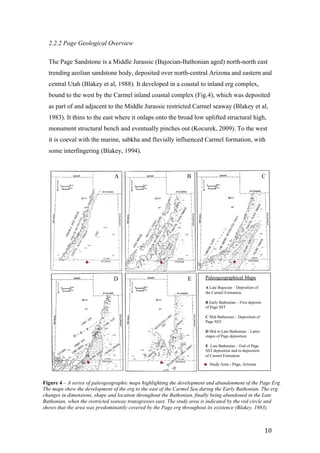
The Page Sandstone is a Middle Jurassic (Bajocian-Bathonian aged) north-north east
trending aeolian sandstone body, deposited over north-central Arizona and eastern and
central Utah (Blakey et al, 1988). It developed in a coastal to inland erg complex,
bound to the west by the Carmel inland coastal complex (Fig.4), which was deposited
as part of and adjacent to the Middle Jurassic restricted Carmel seaway (Blakey et al,
1983). It thins to the east where it onlaps onto the broad low uplifted structural high,
monument structural bench and eventually pinches out (Kocurek, 2009). To the west
it is coeval with the marine, sabkha and fluvially influenced Carmel formation, with
some interfingering (Blakey, 1994).
MIDDLE JURASSIC SEDIMENTATION, SOUTHERN UTAH
O
WYOMING
AC
UTAH
ARIZONA
93
LAKEY, F. PETERSON, M. V. CAPUTO, R. C. GEESAMAN, AND B. J. VOORHEES
AHO
•)
WYOMIN G
[
& / $
' UTAH I
"ARIZONA "
I
IDAHO
_ _ w ,
of
R. C. BLAKEY, F. PETERSON, M. V. CAPUTO, R. C. GEESAMAN, AND B. J. VOORHEES
94
MIDDLE JURASSIC SEDIMENTATION, SOUTHERN UTAH
95
MIDDLE JURASSIC SEDIMENTATION, SOUTHERN UTAH
Arizona:
A B C
D E Paleogeographical Maps
A Late Bajocian – Deposition of
the Carmel Formation
B Early Bathonian – First deposits
of Page SST
C Mid Bathonian – Deposition of
Page SST
D Mid to Late Bathonian – Latter
stages of Page deposition
E Late Bathonian – End of Page
SST deposition and re-deposition
of Carmel Formation
Study Area - Page, Arizona
Figure 4 – A series of paleogeographic maps highlighting the development and abandonment of the Page Erg.
The maps show the development of the erg to the east of the Carmel Sea during the Early Bathonian. The erg
changes in dimensions, shape and location throughout the Bathonian, finally being abandoned in the Late
Bathonian, when the restricted seaway transgresses east. The study area is indicated by the red circle and
shows that the area was predominantly covered by the Page erg throughout its existence (Blakey, 1983).
  11	
  
The Page Sandstone is a complex assemblage of dunes, interdunes and extra-dune
deposits. The stratification and sedimentological architecture of the predominantly
cross-stratified deposits indicate diverse dune morphologies, lithofacies and migratory
behavior (Pierce, C. Howell, J. & Reike, H., 2014). The Page is believed to represent
a dry aeolian system, although with a highly fluctuating water table, allowing for the
presence of damp and wet interdunes (Kocurek, 2009).
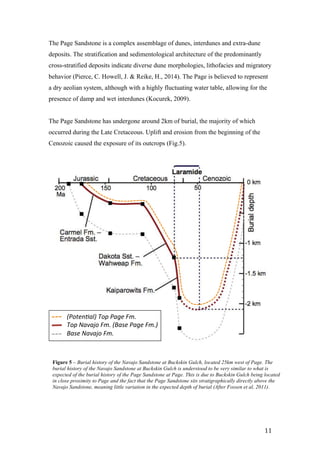
The Page Sandstone has undergone around 2km of burial, the majority of which
occurred during the Late Cretaceous. Uplift and erosion from the beginning of the
Cenozoic caused the exposure of its outcrops (Fig.5).
(Poten'al)+Top+Page+Fm.+
Top+Navajo+Fm.+(Base+Page+Fm.)+
Base+Navajo+Fm.+
Figure 5 – Burial history of the Navajo Sandstone at Buckskin Gulch, located 25km west of Page. The
burial history of the Navajo Sandstone at Buckskin Gulch is understood to be very similar to what is
expected of the burial history of the Page Sandstone at Page. This is due to Buckskin Gulch being located
in close proximity to Page and the fact that the Page Sandstone sits stratigraphically directly above the
Navajo Sandstone, meaning little variation in the expected depth of burial (After Fossen et al, 2011).
  12	
  
2.2.3 Stratigraphy
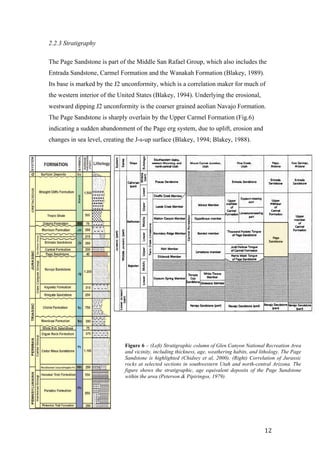
The Page Sandstone is part of the Middle San Rafael Group, which also includes the
Entrada Sandstone, Carmel Formation and the Wanakah Formation (Blakey, 1989).
Its base is marked by the J2 unconformity, which is a correlation maker for much of
the western interior of the United States (Blakey, 1994). Underlying the erosional,
westward dipping J2 unconformity is the coarser grained aeolian Navajo Formation.
The Page Sandstone is sharply overlain by the Upper Carmel Formation (Fig.6)
indicating a sudden abandonment of the Page erg system, due to uplift, erosion and
changes in sea level, creating the J-s-up surface (Blakey, 1994; Blakey, 1988).


2000 Utah Geological Association Publication 29
5
of Glen Canyon National Recreation Area and vicinity, including thickness, age,
. Photographs: (1) View north from Dangling Rope Marina. (2) View east near
yon, Green River. (4) Junction of Dirty Devil and Colorado Rivers, near Hite
Green and Colorado Rivers, view up Colorado River. Note: Page Sandstone is
one.
	
  
Figure 6 – (Left) Stratigraphic column of Glen Canyon National Recreation Area
and vicinity, including thickness, age, weathering habits, and lithology. The Page
Sandstone is highlighted (Chidsey et al, 2000). (Right) Correlation of Jurassic
rocks at selected sections in southwestern Utah and north-central Arizona. The
figure shows the stratigraphic, age equivalent deposits of the Page Sandstone
within the area (Peterson & Pipiringos, 1979).
  13	
  
3. SEDIMENTOLOGY 	
  
3.1 Page sedimentary description
The Page Sandstone is mineralogically very mature, being composed of over 95%
quartz, classifying the sandstone as a quartz arenite. It is predominantly fine to
medium grained, ranging from beige to dark red in colour, with spherical, rounded
well-sorted, poorly cemented grains. It is mainly composed of dune deposits with
sparse, non-laterally continuous interdune deposits.
A detailed sedimentological description of the Page Sandstone was undertaken as part
of fieldwork in May 2015 (Table 1). Sand-sheet deposits are sparse to non-existent
within the study area, and are difficult to identify from wind-rippled dune plinths, so
are not classified within this study.
Table 1 – Sedimentary observations of the architectural elements of the Page Sandstone, Page,
Arizona.
Aeolian
Architecture
Sedimentary Description Sedimentary Structures Bed Set Thickness Sedimentary Dip
DUNE Beige to light orange, mature to
supermature, very well sorted,
friable, poorly cemented,
medium grained quartz arenite.
Grains are well rounded and
spherical.
Large scale planar-tabular and trough cross
stratification including both tangential and
asymptotic geometries. Within the sets a
local range of paleocurrent directions are
measured but showing a predominant trend
to the south.
The bed sets are
observed to display a
range of thicknesses
from 0.55m to 5m thick.
Cross stratification
ranges from 0-24°,
but most
commonly dips at
20°.
INTERDUNE
Light orange to dark red, mature,
well sorted, moderately
cemented, fine grained
sandstone.
Massive homogeneous beds to
discontinuous slightly wavy lamination is
observed for the wet/ponded interdunes and
low amplitude wind rippled lamination to
slight wavy lamination for the drier, damp
interdunes. The interdunes are non laterally
continuous and are commonly associated
with polygonal fracturation.
Interdune thickness
ranges from 1.5cm to
0.75m
The interdunes are
deposited
horizontal or with a
couple of degree
dip.
DUNE
PLINTH
Beige to dark orange, mature,
well sorted, poorly cemented,
fine to coarse grained sandstone.
Grains are well rounded and
spherical.
The coarse grained wind ripples
are more common within the
lower sections of the page
sandstone, within the first 5-6m.
Low amplitude wind ripples. These wind
ripple laminations are predominantly
tabular and extensive and are commonly
found at the base of bedsets but can be
interbedded with other facies.
Vary significantly in
thickness from a few
centimeters to a couple
of meters in thickness
The wind ripples of
the dune plinth
usually occur
horizontal or with a
few degree dip.
SLUMPS
Beige to light orange, very
mature, very well sorted, poorly
cemented, medium grained
sandstone. Grains are well
rounded and spherical.
The slumps show no internal sedimentary
structures and exhibit tapering shapes.
Slumps are observed to follow the cross-
stratum of a dune but more commonly are
seen to erode into the underlying strata.
Slumps can range from a
few ten’s of centimeters
in length to several
meters long and
centimeters to ten’s of
centimeters thick.
The slumps vary in
dip but commonly
dip between 20 to
30°.
  14	
  
3.2 Identification of lithofacies
Page Sandstone aeolian deposits were characterized into lithofacies to analyse
variation of petrophysical characteristics within an aeolian system. A lithofacies is
defined as “a rock unit with a distinctive set of characteristics such as lithology, grain-
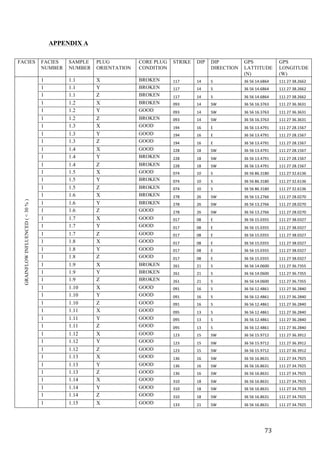
size or sedimentary structure, and is generally produced by a particular process or
depositional environment” (Bloomfield et al, 2006). Nine lithofacies were identified
spread across a variety of aeolian architectural elements of the Page erg. A summary
of their description and interpretation is given in Table 2.
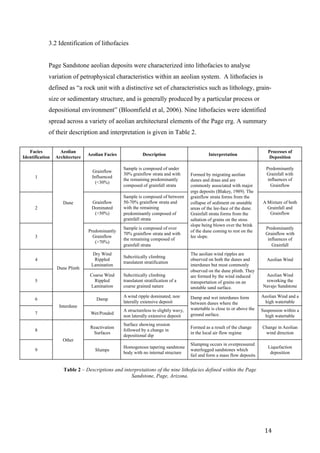
Table 2 – Descriptions and interpretations of the nine lithofacies defined within the Page
Sandstone, Page, Arizona.
Facies
Identification
Aeolian
Architecture
Aeolian Facies Description Interpretation
Processes of
Deposition
1
Dune
Grainflow
Influenced
(<30%)
Sample is composed of under
30% grainflow strata and with
the remaining predominantly
composed of grainfall strata
Formed by migrating aeolian
dunes and draas and are
commonly associated with major
ergs deposits (Blakey, 1989). The
grainflow strata forms from the
collapse of sediment on unstable
areas of the lee-face of the dune.
Grainfall strata forms from the
saltation of grains on the stoss
slope being blown over the brink
of the dune coming to rest on the
lee slope.
Predominantly
Grainfall with
influences of
Grainflow
2
Grainflow
Dominated
(>50%)
Sample is composed of between
50-70% grainflow strata and
with the remaining
predominantly composed of
grainfall strata
A Mixture of both
Grainfall and
Grainflow
3
Predominantly
Grainflow
(>70%)
Sample is composed of over
70% grainflow strata and with
the remaining composed of
grainfall strata
Predominantly
Grainflow with
influences of
Grainfall
4
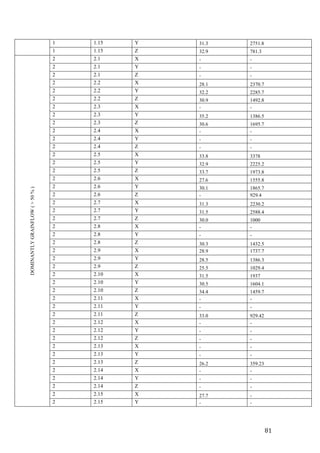
Dune Plinth
Dry Wind
Rippled
Lamination
Subcritically climbing
translatent stratification
The aeolian wind ripples are
observed on both the dunes and
interdunes but most commonly
observed on the dune plinth. They
are formed by the wind induced
transportation of grains on an
unstable sand surface.
Aeolian Wind
5
Coarse Wind
Rippled
Lamination
Subcritically climbing
translatent stratification of a
coarse grained nature
Aeolian Wind
reworking the
Navajo Sandstone
6
Interdune
Damp
A wind ripple dominated, non
laterally extensive deposit
Damp and wet interdunes form
between dunes where the
watertable is close to or above the
ground surface.
Aeolian Wind and a
high watertable
7 Wet/Ponded
A structureless to slightly wavy,
non laterally extensive deposit
Suspension within a
high watertable
8
Other
Reactivation
Surfaces
Surface showing erosion
followed by a change in
depositional dip
Formed as a result of the change
in the local air flow regime
Change in Aeolian
wind direction
9 Slumps
Homogenous tapering sandstone
body with no internal structure
Slumping occurs in overpressured
waterlogged sandstones which
fail and form a mass flow deposits
Liquefaction
deposition
  15	
  
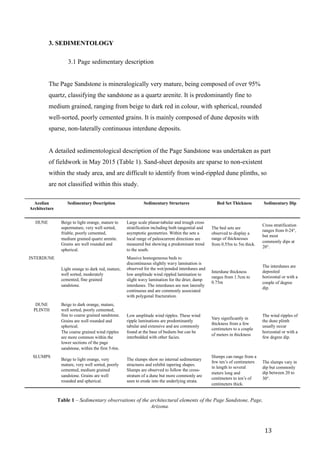
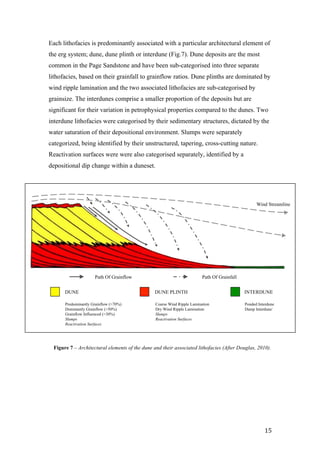
Each lithofacies is predominantly associated with a particular architectural element of
the erg system; dune, dune plinth or interdune (Fig.7). Dune deposits are the most
common in the Page Sandstone and have been sub-categorised into three separate
lithofacies, based on their grainfall to grainflow ratios. Dune plinths are dominated by
wind ripple lamination and the two associated lithofacies are sub-categorised by
grainsize. The interdunes comprise a smaller proportion of the deposits but are
significant for their variation in petrophysical properties compared to the dunes. Two
interdune lithofacies were categorised by their sedimentary structures, dictated by the
water saturation of their depositional environment. Slumps were separately
categorized, being identified by their unstructured, tapering, cross-cutting nature.
Reactivation surfaces were were also categorised separately, identified by a
depositional dip change within a duneset.


Figure 7 – Architectural elements of the dune and their associated lithofacies (After Douglas, 2010).
Wind Streamline
Path Of Grainflow Path Of Grainfall
DUNE DUNE PLINTH INTERDUNE
Predominantly Grainflow (>70%)
Dominantly Grainflow (>50%)
Grainflow Influenced (<30%)
Slumps
Reactivation Surfaces
Coarse Wind Ripple Lamination
Dry Wind Ripple Lamination
Slumps
Reactivation Surfaces
Ponded Interdune
Damp Interdune`
  16	
  
3.2.1 Aeolian Lithofacies Descriptions	
  
Facies 1: Grainflow Influenced (<30%)
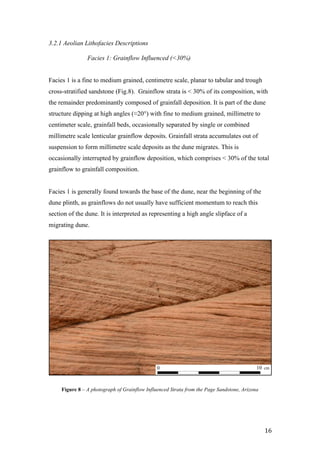
Facies 1 is a fine to medium grained, centimetre scale, planar to tabular and trough
cross-stratified sandstone (Fig.8). Grainflow strata is < 30% of its composition, with
the remainder predominantly composed of grainfall deposition. It is part of the dune
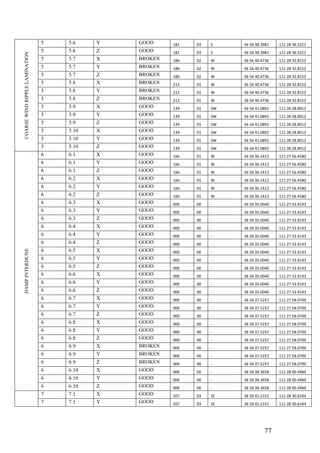
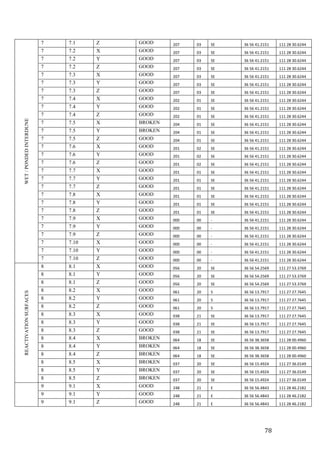
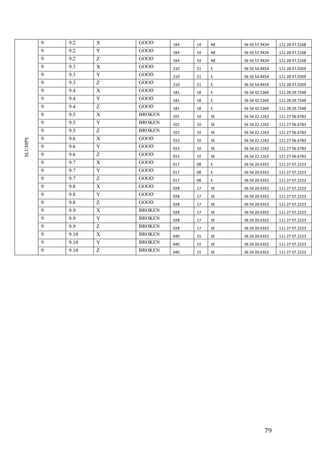
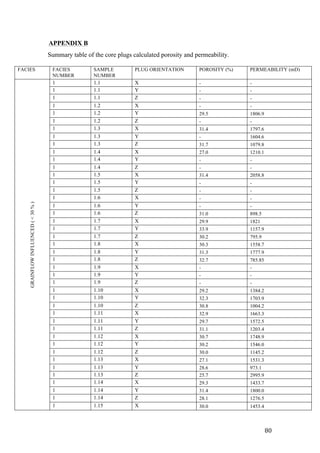
structure dipping at high angles (≈20°) with fine to medium grained, millimetre to
centimeter scale, grainfall beds, occasionally separated by single or combined
millimetre scale lenticular grainflow deposits. Grainfall strata accumulates out of
suspension to form millimetre scale deposits as the dune migrates. This is
occasionally interrupted by grainflow deposition, which comprises < 30% of the total
grainflow to grainfall composition.
Facies 1 is generally found towards the base of the dune, near the beginning of the
dune plinth, as grainflows do not usually have sufficient momentum to reach this
section of the dune. It is interpreted as representing a high angle slipface of a
migrating dune.	
  
0 10 cm
Figure 8 – A photograph of Grainflow Influenced Strata from the Page Sandstone, Arizona
  17	
  
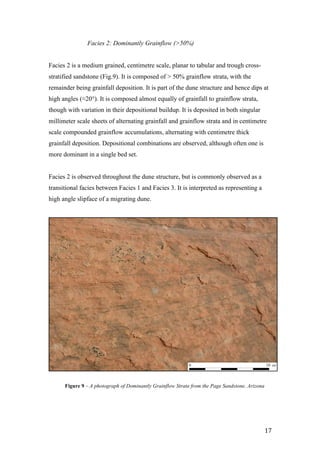
Facies 2: Dominantly Grainflow (>50%)
Facies 2 is a medium grained, centimetre scale, planar to tabular and trough cross-
stratified sandstone (Fig.9). It is composed of > 50% grainflow strata, with the
remainder being grainfall deposition. It is part of the dune structure and hence dips at
high angles (≈20°). It is composed almost equally of grainfall to grainflow strata,
though with variation in their depositional buildup. It is deposited in both singular
millimeter scale sheets of alternating grainfall and grainflow strata and in centimetre
scale compounded grainflow accumulations, alternating with centimetre thick
grainfall deposition. Depositional combinations are observed, although often one is
more dominant in a single bed set.
Facies 2 is observed throughout the dune structure, but is commonly observed as a
transitional facies between Facies 1 and Facies 3. It is interpreted as representing a
high angle slipface of a migrating dune.
0 10 cm
Figure 9 – A photograph of Dominantly Grainflow Strata from the Page Sandstone, Arizona
  18	
  
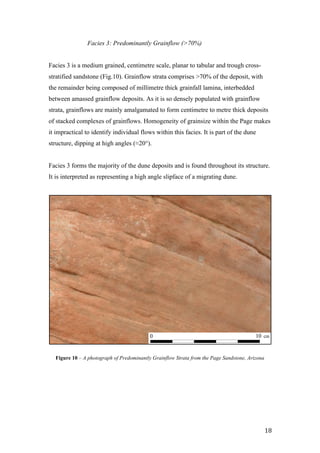
Facies 3: Predominantly Grainflow (>70%)
Facies 3 is a medium grained, centimetre scale, planar to tabular and trough cross-
stratified sandstone (Fig.10). Grainflow strata comprises >70% of the deposit, with
the remainder being composed of millimetre thick grainfall lamina, interbedded
between amassed grainflow deposits. As it is so densely populated with grainflow
strata, grainflows are mainly amalgamated to form centimetre to metre thick deposits
of stacked complexes of grainflows. Homogeneity of grainsize within the Page makes
it impractical to identify individual flows within this facies. It is part of the dune
structure, dipping at high angles (≈20°).
Facies 3 forms the majority of the dune deposits and is found throughout its structure.
It is interpreted as representing a high angle slipface of a migrating dune.
0 10 cm
Figure 10 – A photograph of Predominantly Grainflow Strata from the Page Sandstone, Arizona
  19	
  
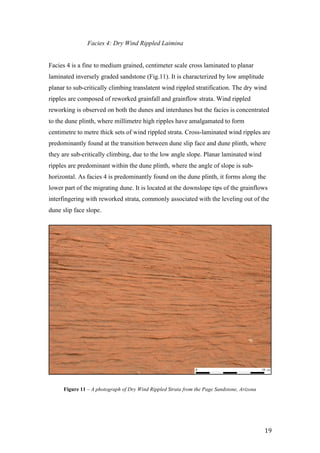
Facies 4: Dry Wind Rippled Laimina
Facies 4 is a fine to medium grained, centimeter scale cross laminated to planar
laminated inversely graded sandstone (Fig.11). It is characterized by low amplitude
planar to sub-critically climbing translatent wind rippled stratification. The dry wind
ripples are composed of reworked grainfall and grainflow strata. Wind rippled
reworking is observed on both the dunes and interdunes but the facies is concentrated
to the dune plinth, where millimetre high ripples have amalgamated to form
centimetre to metre thick sets of wind rippled strata. Cross-laminated wind ripples are
predominantly found at the transition between dune slip face and dune plinth, where
they are sub-critically climbing, due to the low angle slope. Planar laminated wind
ripples are predominant within the dune plinth, where the angle of slope is sub-
horizontal. As facies 4 is predominantly found on the dune plinth, it forms along the
lower part of the migrating dune. It is located at the downslope tips of the grainflows
interfingering with reworked strata, commonly associated with the leveling out of the
dune slip face slope.
0 10 cm
Figure 11 – A photograph of Dry Wind Rippled Strata from the Page Sandstone, Arizona
  20	
  
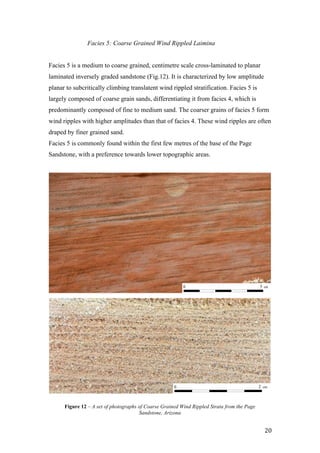
Facies 5: Coarse Grained Wind Rippled Laimina
Facies 5 is a medium to coarse grained, centimetre scale cross-laminated to planar
laminated inversely graded sandstone (Fig.12). It is characterized by low amplitude
planar to subcritically climbing translatent wind rippled stratification. Facies 5 is
largely composed of coarse grain sands, differentiating it from facies 4, which is
predominantly composed of fine to medium sand. The coarser grains of facies 5 form
wind ripples with higher amplitudes than that of facies 4. These wind ripples are often
draped by finer grained sand.
Facies 5 is commonly found within the first few metres of the base of the Page
Sandstone, with a preference towards lower topographic areas.
0 5 cm
0 2 cm
Figure 12 – A set of photographs of Coarse Grained Wind Rippled Strata from the Page
Sandstone, Arizona
  21	
  
Facies 6: Damp Interdune
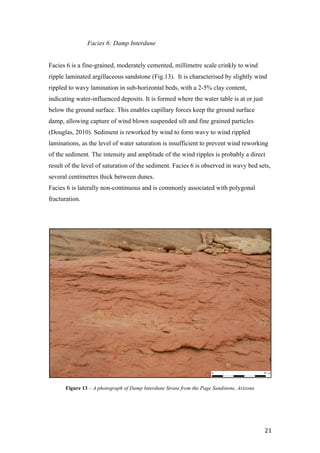
Facies 6 is a fine-grained, moderately cemented, millimetre scale crinkly to wind
ripple laminated argillaceous sandstone (Fig.13). It is characterised by slightly wind
rippled to wavy lamination in sub-horizontal beds, with a 2-5% clay content,
indicating water-influenced deposits. It is formed where the water table is at or just
below the ground surface. This enables capillary forces keep the ground surface
damp, allowing capture of wind blown suspended silt and fine grained particles
(Douglas, 2010). Sediment is reworked by wind to form wavy to wind rippled
laminations, as the level of water saturation is insufficient to prevent wind reworking
of the sediment. The intensity and amplitude of the wind ripples is probably a direct
result of the level of saturation of the sediment. Facies 6 is observed in wavy bed sets,
several centimetres thick between dunes.
Facies 6 is laterally non-continuous and is commonly associated with polygonal
fracturation.
0 10 cm
Figure 13 – A photograph of Damp Interdune Strata from the Page Sandstone, Arizona
  22	
  
Facies 7: Wet/Ponded Interdune
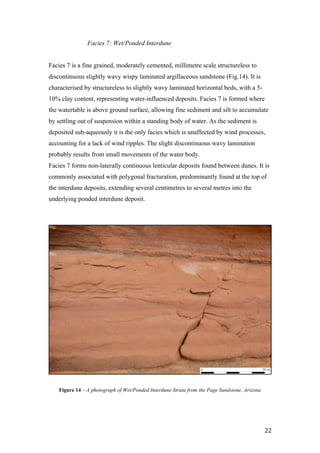
Facies 7 is a fine grained, moderately cemented, millimetre scale structureless to
discontinuous slightly wavy wispy laminated argillaceous sandstone (Fig.14). It is
characterised by structureless to slightly wavy laminated horizontal beds, with a 5-
10% clay content, representing water-influenced deposits. Facies 7 is formed where
the watertable is above ground surface, allowing fine sediment and silt to accumulate
by settling out of suspension within a standing body of water. As the sediment is
deposited sub-aqueously it is the only facies which is unaffected by wind processes,
accounting for a lack of wind ripples. The slight discontinuous wavy lamination
probably results from small movements of the water body.
Facies 7 forms non-laterally continuous lenticular deposits found between dunes. It is
commonly associated with polygonal fracturation, predominantly found at the top of
the interdune deposits, extending several centimetres to several metres into the
underlying ponded interdune deposit.
0 10 cm
Figure 14 – A photograph of Wet/Ponded Interdune Strata from the Page Sandstone, Arizona
  23	
  
Facies 8: Reactivation Surfaces (3rd
Order Bounding Surface)
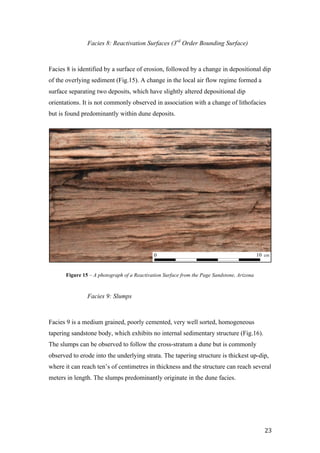
Facies 8 is identified by a surface of erosion, followed by a change in depositional dip
of the overlying sediment (Fig.15). A change in the local air flow regime formed a
surface separating two deposits, which have slightly altered depositional dip
orientations. It is not commonly observed in association with a change of lithofacies
but is found predominantly within dune deposits.
0 10 cm
Facies 9: Slumps
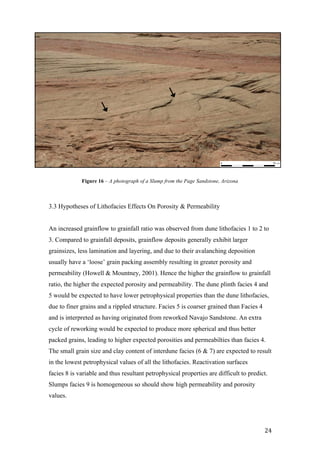
Facies 9 is a medium grained, poorly cemented, very well sorted, homogeneous
tapering sandstone body, which exhibits no internal sedimentary structure (Fig.16).
The slumps can be observed to follow the cross-stratum a dune but is commonly
observed to erode into the underlying strata. The tapering structure is thickest up-dip,
where it can reach ten’s of centimetres in thickness and the structure can reach several
meters in length. The slumps predominantly originate in the dune facies.
Figure 15 – A photograph of a Reactivation Surface from the Page Sandstone, Arizona
  24	
  
3.3 Hypotheses of Lithofacies Effects On Porosity & Permeability
An increased grainflow to grainfall ratio was observed from dune lithofacies 1 to 2 to
3. Compared to grainfall deposits, grainflow deposits generally exhibit larger
grainsizes, less lamination and layering, and due to their avalanching deposition
usually have a ‘loose’ grain packing assembly resulting in greater porosity and
permeability (Howell & Mountney, 2001). Hence the higher the grainflow to grainfall
ratio, the higher the expected porosity and permeability. The dune plinth facies 4 and
5 would be expected to have lower petrophysical properties than the dune lithofacies,
due to finer grains and a rippled structure. Facies 5 is coarser grained than Facies 4
and is interpreted as having originated from reworked Navajo Sandstone. An extra
cycle of reworking would be expected to produce more spherical and thus better
packed grains, leading to higher expected porosities and permeabilties than facies 4.
The small grain size and clay content of interdune facies (6 & 7) are expected to result
in the lowest petrophysical values of all the lithofacies. Reactivation surfaces
facies 8 is variable and thus resultant petrophysical properties are difficult to predict.
Slumps facies 9 is homogeneous so should show high permeability and porosity
values.
Figure 16 – A photograph of a Slump from the Page Sandstone, Arizona
0 50 cm
  25	
  
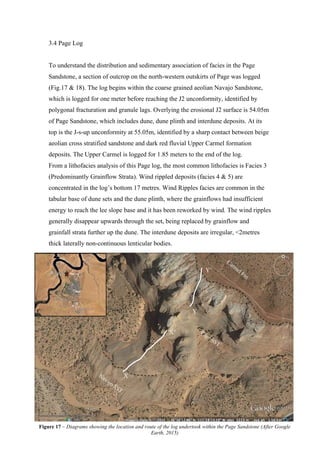
3.4 Page Log
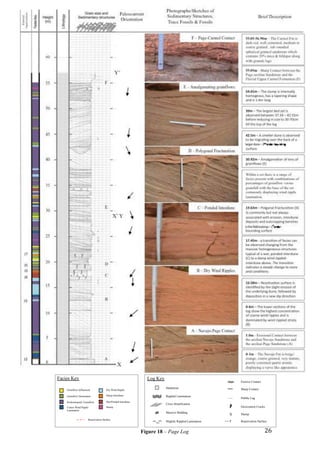
To understand the distribution and sedimentary association of facies in the Page
Sandstone, a section of outcrop on the north-western outskirts of Page was logged
(Fig.17 & 18). The log begins within the coarse grained aeolian Navajo Sandstone,
which is logged for one meter before reaching the J2 unconformity, identified by
polygonal fracturation and granule lags. Overlying the erosional J2 surface is 54.05m
of Page Sandstone, which includes dune, dune plinth and interdune deposits. At its
top is the J-s-up unconformity at 55.05m, identified by a sharp contact between beige
aeolian cross stratified sandstone and dark red fluvial Upper Carmel formation
deposits. The Upper Carmel is logged for 1.85 meters to the end of the log.
From a lithofacies analysis of this Page log, the most common lithofacies is Facies 3
(Predominantly Grainflow Strata). Wind rippled deposits (facies 4 & 5) are
concentrated in the log’s bottom 17 metres. Wind Ripples facies are common in the
tabular base of dune sets and the dune plinth, where the grainflows had insufficient
energy to reach the lee slope base and it has been reworked by wind. The wind ripples
generally disappear upwards through the set, being replaced by grainflow and
grainfall strata further up the dune. The interdune deposits are irregular, <2metres
thick laterally non-continuous lenticular bodies.
X
X’
Y’
Y
Page%
Page%Log%
Navajo SST
Carmel Fm
Page SST
Figure 17 – Diagrams showing the location and route of the log undertook within the Page Sandstone (After Google
Earth, 2015)
  26	
  Figure 18 – Page Log
Log Key
r
S
Reactivation Surface
Slump
Desiccation Cracks
Rippled Lamination
Cross Stratification
Massive Bedding
Pebble Lag
Sharp Contact
Erosive Contact
Slightly Rippled Lamination ---
….
Sandstone
Grainflow Influenced
Grainflow Dominated
Predominantly Grainflow
Coarse Wind Ripple
Lamination
Dry Wind Ripple
Damp Interdune
Wet/Ponded Interdune
Slump
Facies Key
Reactivation Surface
  27	
  
4. METHODOLOGY
4.1 Sampling
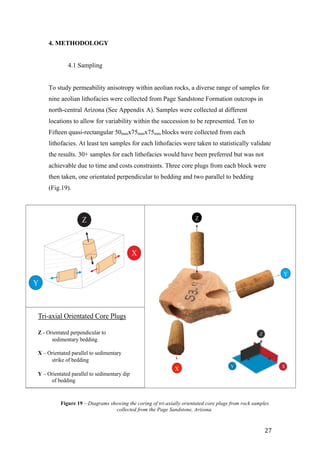
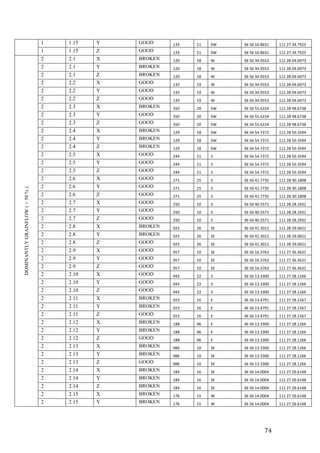
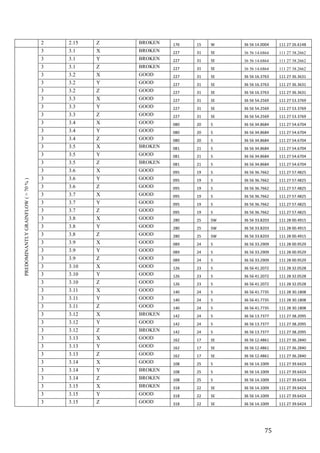
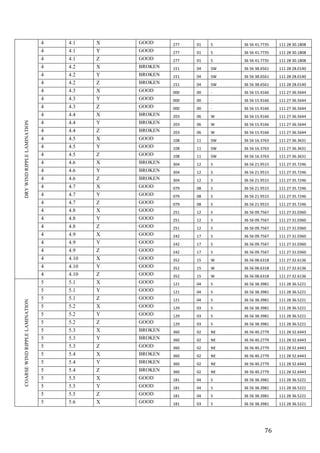
To study permeability anisotropy within aeolian rocks, a diverse range of samples for
nine aeolian lithofacies were collected from Page Sandstone Formation outcrops in
north-central Arizona (See Appendix A). Samples were collected at different
locations to allow for variability within the succession to be represented. Ten to
Fifteen quasi-rectangular 50mmx75mmx75mm blocks were collected from each
lithofacies. At least ten samples for each lithofacies were taken to statistically validate
the results. 30+ samples for each lithofacies would have been preferred but was not
achievable due to time and costs constraints. Three core plugs from each block were
then taken, one orientated perpendicular to bedding and two parallel to bedding
(Fig.19).
Y
Z
X
Tri-axial Orientated Core Plugs
Z - Orientated perpendicular to
sedimentary bedding
X – Orientated parallel to sedimentary
strike of bedding
Y – Orientated parallel to sedimentary dip
of bedding
Y
Z
X
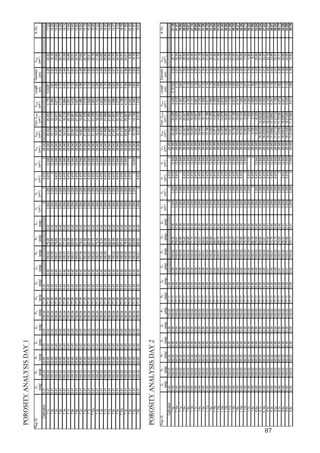
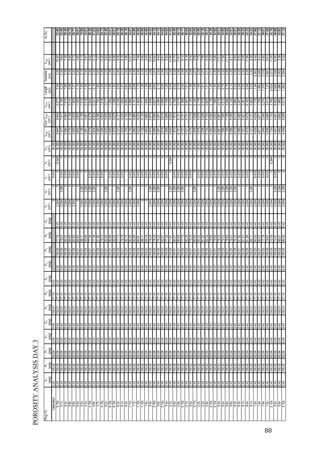
Figure 19 – Diagrams showing the coring of tri-axially orientated core plugs from rock samples
collected from the Page Sandstone, Arizona.
  28	
  
The coring of the 1” diameter core plugs was undertaken with Corelab Ltd. at their
Dyce Aberdeen base, using a method of dry coring, due to the samples friability.
4.2 Laboratory Methods
Petrophysical properties analysed in the laboratory included porosity and permeability
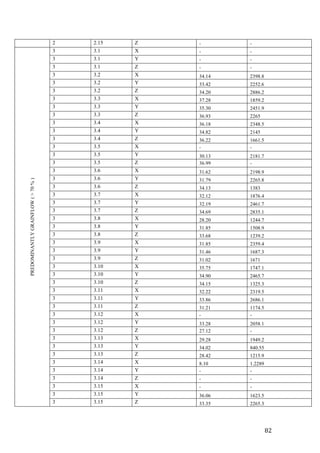
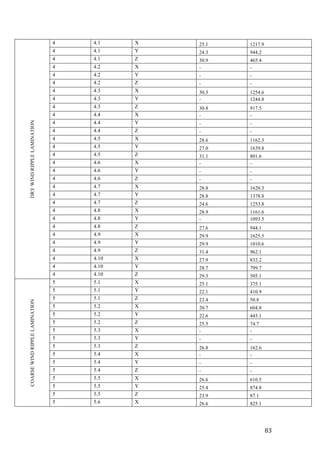
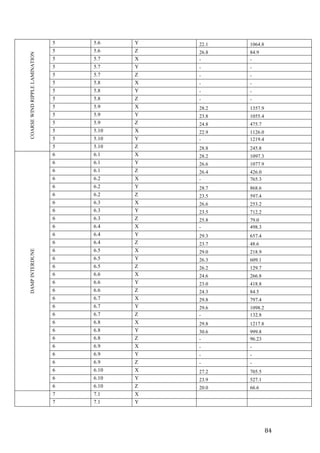
(See Appendix B for full data set). Thin sections and a particle size analysis were also
undertaken.
4.2.1 Permeability
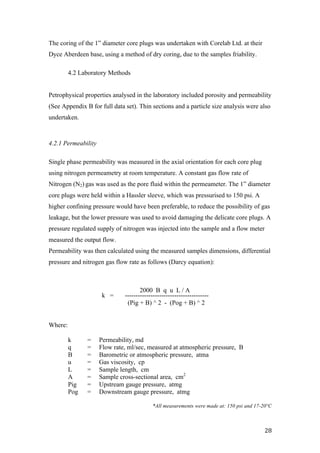
Single phase permeability was measured in the axial orientation for each core plug
using nitrogen permeametry at room temperature. A constant gas flow rate of
Nitrogen (N2) gas was used as the pore fluid within the permeameter. The 1” diameter
core plugs were held within a Hassler sleeve, which was pressurised to 150 psi. A
higher confining pressure would have been preferable, to reduce the possibility of gas
leakage, but the lower pressure was used to avoid damaging the delicate core plugs. A
pressure regulated supply of nitrogen was injected into the sample and a flow meter
measured the output flow.
Permeability was then calculated using the measured samples dimensions, differential
pressure and nitrogen gas flow rate as follows (Darcy equation):
k = ---------------------------------------
(Pig + B) ^ 2 - (Pog + B) ^ 2
Where:
k = Permeability, md
q = Flow rate, ml/sec, measured at atmospheric pressure, B
B = Barometric or atmospheric pressure, atma
u = Gas viscosity, cp
L = Sample length, cm
A = Sample cross-sectional area, cm2
Pig = Upstream gauge pressure, atmg
Pog = Downstream gauge pressure, atmg
*All measurements were made at: 150 psi and 17-20°C
2000 B q u L / A
  29	
  
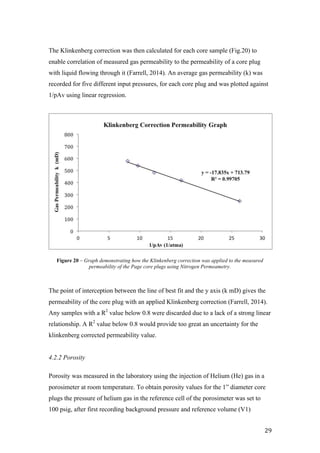
The Klinkenberg correction was then calculated for each core sample (Fig.20) to
enable correlation of measured gas permeability to the permeability of a core plug
with liquid flowing through it (Farrell, 2014). An average gas permeability (k) was
recorded for five different input pressures, for each core plug and was plotted against
1/pAv using linear regression.
The point of interception between the line of best fit and the y axis (k mD) gives the
permeability of the core plug with an applied Klinkenberg correction (Farrell, 2014).
Any samples with a R2
value below 0.8 were discarded due to a lack of a strong linear
relationship. A R2
value below 0.8 would provide too great an uncertainty for the
klinkenberg corrected permeability value.
4.2.2 Porosity
Porosity was measured in the laboratory using the injection of Helium (He) gas in a
porosimeter at room temperature. To obtain porosity values for the 1” diameter core
plugs the pressure of helium gas in the reference cell of the porosimeter was set to
100 psig, after first recording background pressure and reference volume (V1)
Figure 20 – Graph demonstrating how the Klinkenberg correction was applied to the measured
permeability of the Page core plugs using Nitrogen Permeametry.
  30	
  
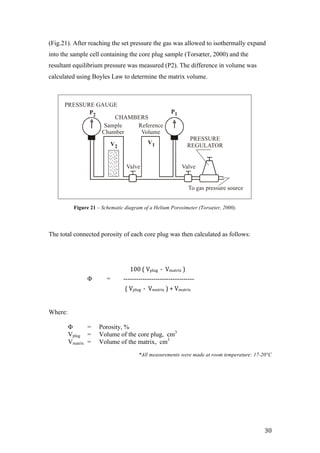
(Fig.21). After reaching the set pressure the gas was allowed to isothermally expand
into the sample cell containing the core plug sample (Torsæter, 2000) and the
resultant equilibrium pressure was measured (P2). The difference in volume was
calculated using Boyles Law to determine the matrix volume.
22
5.3.2 Pore Volume Measurement
All the methods measuring pore volume yield effective porosity. The methods are based
on either the extraction of a fluid from the rock or the introduction of a fluid into the pore
spaces of the rock.
One of the most used methods is the helium technique, which employs Boyle’s law. The
helium gas in the reference cell isothermally expands into a sample cell. After expansion,
the resultant equilibrium pressure is measured. The Helium porosimeter apparatus is
shown schematically in Fig. 5.2.
CHAMBERS
Sample
Chamber
Reference
Volume
PRESSURE GAUGE
P2
P1
V2
V1
Valve Valve
PRESSURE
REGULATOR
To gas pressure source
Fig. 5.2: Schematic diagram of helium porosimeter apparatus.
Helium has advantages over other gases because: (1) its small molecules rapidly
penetrated small pores, (2) it is inert and does not adsorb on rock surfaces as air may do,
(3) helium can be considered as an ideal gas (i.e., z = 1.0) for pressures and temperatures
usually employed in the test, and (4) helium has a high diffusivity and therefore affords a
useful means for determining porosity of low permeability rocks.
The total connected porosity of each core plug was then calculated as follows:
Φ = ---------------------------------
Where:
Φ = Porosity, %
Vplug = Volume of the core plug, cm3
Vmatrix = Volume of the matrix, cm3
*All measurements were made at room temperature: 17-20°C
100	
  (	
  Vplug	
  	
  -­‐	
  	
  Vmatrix	
  )	
  
(	
  Vplug	
  	
  -­‐	
  	
  Vmatrix	
  )	
  +	
  Vmatrix	
  
Figure 21 – Schematic diagram of a Helium Porosimeter (Torsæter, 2000).
  31	
  
4.2.3 Particle Size Analysis
The particle size analysis was undertaken using the LS 13 320 Particle Size Analyzer.
Particle size distribution for each facies was determined by suspending a 3g sample
within a test tube of water, which was then analyzed by measuring the pattern of light
scattering on the 126 particle detectors, within the Particle Size Analyser.
  32	
  
5. QUALITY CONTROL & DATA UNCERTAINTY
The data presented within this this project is subject to error factors and uncertainties.
Quality control was undertaken at each step of data gathering to reduce the error
factors and uncertainty in order to increase the ultimate accuracy of the results
(Table.3).
QUALITY CONTROL
Sampling
• When collecting samples from the field, each sample was checked for friability and
significant fracturation. Samples were obtained from the least weathered sections of
the outcrops to reduce weathering’s affect on results.
• Samples were gathered from various locations, stratigraphic points and from different
sized dune sets so variability within the outcrop can be represented.
• At the outcrop each sample’s X,Y and Z orientations were labeled on the sample and
recorded along with strike, dip, dip orientation, way up and numbered to ensure
orientation coring was accurate.
Coring
• If the coring of a sample at orientation was to difficult to undertake, it was cut using
a rock saw perpendicular to the core’s orientation to enable clean accurate coring.
• Each core plug underwent quality control by checking for fractures and damage or
channeling down the plugs sides. Core plugs that showed any sign of visible damage
they were discarded.
• After cutting the plugs to set lengths (2”, 1.75”, 1.5”, 1.25”, 1”, 0.75”, 0.5”±0.03”)
using a rock saw, the length and diameter of each core plug was re-measured five
time to an accuracy of 0.001cm, with an average recorded for each dimension.
Laboratory
Measurements
Porosity
• The Porosimeter was calibrated using known volumes at the start of every session
and was re-calibrated every 5 hours to reduce the effect of changing temperatures and
swelling of the core holder.
• The pressure in the reference cell was set to 100psi (±0.02psi).
Permeability
• The permeameter was calibrated using samples of known permeabilities before
permeability measurements were undertaken.
• The confining nitrogen gas pressure was set to 150psi (±0.02psi).
• Permeability recordings were undertaken a total of five times using five different
confining pressures to allow for an accurate correlation between flow rate and
permeability to be recorded.
• The pressures were allowed to settle for a minimum of one minute before a reading
was taken to allow for equilibration.
• The hassler sleeve pressure was set to an accuracy of ± 0.01psi.
• Any Klinkenberg corrected graph with an R2 value of less than 0.8 was discarded, as
there was not a strong enough correlation in the data, to give accurate results.
After completion of permeability and porosity analysis, the core plugs underwent quality
control to check whether they had been damaged during the analysis. If damage was found the
result obtained for that core plug was discarded.
Table 3 – An assessment of steps taken during quality control to allow for the gathering of
accurate results
  33	
  
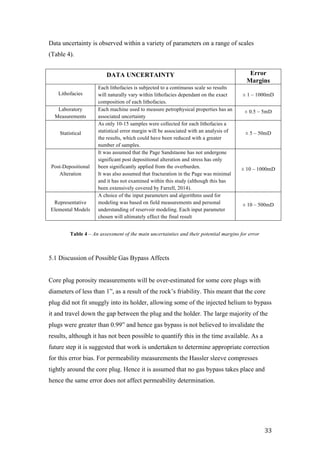
Data uncertainty is observed within a variety of parameters on a range of scales
(Table 4).
DATA UNCERTAINTY Error
Margins
Lithofacies
Each lithofacies is subjected to a continuous scale so results
will naturally vary within lithofacies dependant on the exact
composition of each lithofacies.
± 1 – 1000mD
Laboratory
Measurements
Each machine used to measure petrophysical properties has an
associated uncertainty
± 0.5 – 5mD
Statistical
As only 10-15 samples were collected for each lithofacies a
statistical error margin will be associated with an analysis of
the results, which could have been reduced with a greater
number of samples.
± 5 – 50mD
Post-Depositional
Alteration
It was assumed that the Page Sandstaone has not undergone
significant post depositional alteration and stress has only
been significantly applied from the overburden.
It was also assumed that fracturation in the Page was minimal
and it has not examined within this study (although this has
been extensively covered by Farrell, 2014).
± 10 – 1000mD
Representative
Elemental Models
A choice of the input parameters and algorithms used for
modeling was based on field measurements and personal
understanding of reservoir modeling. Each input parameter
chosen will ultimately effect the final result
± 10 – 500mD
5.1 Discussion of Possible Gas Bypass Affects
Core plug porosity measurements will be over-estimated for some core plugs with
diameters of less than 1”, as a result of the rock’s friability. This meant that the core
plug did not fit snuggly into its holder, allowing some of the injected helium to bypass
it and travel down the gap between the plug and the holder. The large majority of the
plugs were greater than 0.99” and hence gas bypass is not believed to invalidate the
results, although it has not been possible to quantify this in the time available. As a
future step it is suggested that work is undertaken to determine appropriate correction
for this error bias. For permeability measurements the Hassler sleeve compresses
tightly around the core plug. Hence it is assumed that no gas bypass takes place and
hence the same error does not affect permeability determination.
Table 4 – An assessment of the main uncertainties and their potential margins for error
  34	
  
6. RESULTS
6.1 Petrophysical Results
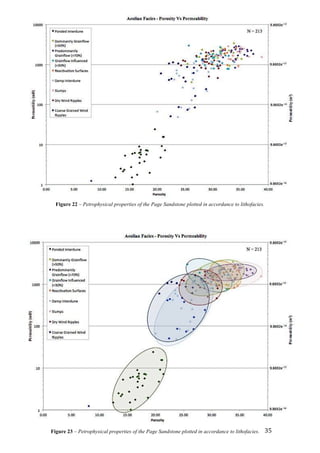
Porosity and permeability measurements were undertaken on a total of 213 core
plugs, taken from all nine lithofacies. These were plotted on a scatterplot and
categorised by lithofacies (Fig.22 & 23).
A wide range in porosity and permeability is observed within the aeolian deposits,
with porosity varying from 8.1% to 38.8%, and permeability ranging from 1 to
2995.9mD. A spread of permeability values over three orders of magnitude is
sufficient to strongly influence fluid flow within the stratigraphy (Gaud, 2012).
Significant overlap of petrophysical values is observed when the nine lithofacies are
plotted together, with the exception of the ponded interdune. This overlap means
direct identification of other lithofacies is not possible from just porosity and
permeability values, as there are no uniquely distinct ranges for each lithofacies. The
significant overlap is because differences between some of the lithofacies are
sedimentologically subtle, so a large change in petrophysical properties would not be
expected.
  35	
  
Figure 22 – Petrophysical properties of the Page Sandstone plotted in accordance to lithofacies.
Figure 23 – Petrophysical properties of the Page Sandstone plotted in accordance to lithofacies.
  36	
  
The different stratigraphic architectural elements of the erg; Dune, Dune plinth, Damp
interdune and Ponded Interdune are shown in a cross-plot of core plugs’ petrophysical
data in Fig.24.
A clear relationship is observed between the different stratigraphic architectural
elements of the dune and their petrophysical properties. The dunes show the highest
porosity and permeability values in a cluster ranging from 25.5% to 37.3% porosity
and 781.3mD to 2995.9mD permeability, with the exception of an outlier at 8.1%
porosity, 1.2mD permeability. The dune plinth and damp interdune are observed to
overlap indicating similarities in deposition, which is seen in their grainsize analysis
(Section 5.2) and their sedimentary structures. The damp interdune permeability
1"
10"
100"
1000"
10000"
1"
10"
100"
1000"
10000"
0.00" 5.00" 10.00" 15.00" 20.00" 25.00" 30.00" 35.00" 40.00"
Permeability(m2)
Permeability(mD)
Porosity(
Aeolian Facies - Porosity Vs Permeability
Dune"
Dune"Plinth"
Ponded"Interdune"
Damp"Interdune"
9.8692e−13"
9.8692e−14"
9.8692e−15"
9.8692e−16"
9.8692e−12"
N = 148
Figure 24 – Petrophysical properties of the Page Sandstone plotted in accordance to dune
architecture.
  37	
  
ranges over 1.5 orders of magnitude, the largest range of the stratigraphic elements.
The higher petrophysical values correspond to samples, which would have had the
lowest water saturation at the time of deposition in combination with higher average
grain sizes (Section 5.2). The ponded interdune samples show the lowest porosity and
permeability measurements.
Permeability is observed to be effect by stratification type, which is directly
influenced by depositional processes. As petrophysical heterogeneity can significantly
vary between lithofacies the 3-dimensional geometric arrangement of each
sedimentary facies is important to understanding how and where significant
heterogeneity will occur within the overall depositional sequence. The ability to
define a range of petrophysical properties for individual architectural elements will
enable more representative reservoir models to be built.
6.1.1 Variation from Hypotheses (See Section 3.3)
The petrophysical results for the different lithofacies compare well with the
hypotheses in section 3.3, with two exceptions.
i. Petrophysical properties of the dune facies are plotted in figure 25. The
Grainflow Influenced (facies 1) and Predominantly Grainflow (facies 3) data
are in two distinct clusters. However the Dominantly Grainflow lithofacies
(facies 2) petrophysical properties varied more than expected and largely
overlap facies 1 and 3, whereas they were predicted to cluster between them.
ii. Petrophysical properties of the dune plinth facies are plotted in figure 26.
Coarse Grained Wind Rippled Lamination (facies 5) was predicted to display
higher petrophysical values than Dry Wind Rippled Lamination (facies 4),
whereas they were lower.
  38	
  
500#
5000#
500#
5000#
25.00# 27.00# 29.00# 31.00# 33.00# 35.00# 37.00# 39.00#
Permeability+(m2)+
Permeability+(mD)+
Porosity+
Dune Facies - Porosity Vs Permeability
Predominantly#
Grainflow#(>70%)#
Dominantly#
Grainflow#(>50%)#
Grainflow#
Influenced#(<30%#
4.9346eD12#
4.9346eD13#
N = 88
Figure 25 – Petrophysical properties of the dune lithofacies; Grainflow Influenced (facies 1), Dominantly
Grainflow (facies 2) and Predominantly Grainflow (facies 3).
10#
100#
1000#
10#
100#
1000#
18.00# 20.00# 22.00# 24.00# 26.00# 28.00# 30.00# 32.00# 34.00#
Permeability+(m2)+
Permeability+(mD)+
Porosity+
Wind Rippled Lamination - Porosity Vs Permeability
Coarse#Wind#Rippled#
Lamina9on#
Dry#Wind#Rippled#
Lamina9on#
N = 38
9.8692e−13#
9.8692e−14#
9.8692e−15#
Figure 26 – Petrophysical properties of the dune plinth lithofacies; Dry Wind Rippled Lamination
(facies 4) and Coarse Grained Wind Rippled Lamination (facies 5).
  39	
  
6.2 Grainsize and Thin Section Analysis
A grainsize analysis of the Page Sandstone was undertaken to understand whether
there is a relationship between grainsize and porosity/permeability and to help explain
discrepancies from the hypotheses. This determined that the Page Sandstone
grainsizes vary from colloid to coarse grained. No grains larger than 1000
micrometres in diameter were observed due to wind sorting of aeolian systems. The
Page Sandstone is predominantly fine to medium grained, with grainsize distribution
variation observed between different lithofacies.
The dune facies show an overall increase in grainsize with the increase in the
grainflow to grainfall ratio. The difference between the Grainflow Influenced deposits
and the Dominantly Grainflow deposits is minor, with both showing similar
percentages of medium and fine grains (Fig.27).
The slump deposits grainsize fall in a very narrow band, with over 90% of the grains
analysed being fine or medium grained (Fig.28). This reflects their very well sorted,
homogeneous nature seen within the sedimentological description and is probably the
reason for their high petrophysical values.
The Dry Wind Ripples exhibit a single peak of predominantly fine grained sand,
whereas the Coarse Grained Wind Ripples display two peaks; one for very fine to fine
grainsize; and the other for medium to coarse sized grains (Fig.28). The separation of
the two peaks suggests two separate sediment inputs into the deposit; one resembling
the Page Sandstone deposits and the other with a coarser grained nature.
The interdune deposits show a much higher percentage of smaller grains (fine, very
fine, silt and clay) compared to the other lithofacies (Fig.29). The Ponded Interdune
shows an overall lower grainsize distribution than the Damp Interdune, which
suggests that water saturation of the interdune and its associated depositional
processes have a direct affect on the deposit grainsizes.
  40	


Facies 1 - Grainflow Influenced
Facies 2 - Dominantly Grainflow
Facies 3 - Predominantly Grainflow
Grain&Type
Grain&Size&
(um)
Composi4on&
(%)
Colloid >0.98 0.88
Clay- 0.98–3.9 1.06
Silt 3.9–62.5 12.2
Very-Fine-Sand 62.5–125 7.69
Fine-Sand 125–250 31
Medium-Sand 250>500 43.1
Coarse-Sand 500>1000 4.06
Grain&Type
Grain&Size&
(um)
Composi4on&
(%)
Colloid >0.98 0.56
Clay- 0.98–3.9 0.87
Silt 3.9–62.5 12.2
Very-Fine-Sand 62.5–125 8.72
Fine-Sand 125–250 60.4
Medium-Sand 250>500 16.5
Coarse-Sand 500>1000 0.73
Grain&Type
Grain&Size&
(um)
Composi4on&
(%)
Colloid >0.98 0.71
Clay- 0.98–3.9 1.07
Silt 3.9–62.5 4.61
Very-Fine-Sand 62.5–125 4.29
Fine-Sand 125–250 67.5
Medium-Sand 250>500 19.6
Coarse-Sand 500>1000 2.16
Figure 27 – Grainsize analysis of the dune lithofacies; Grainflow Influenced (facies 1), Dominantly Grainflow (facies 2) and
Predominantly Grainflow (facies 3).
  41	


Facies 9 - Slumps
Facies 4 - Dry Wind Rippled Lamination
Facies 5 - Coarse Grained Wind Rippled Lamination
Grain&Type
Grain&Size&
(um)
Composi4on&
(%)
Colloid >0.98 0.54
Clay- 0.98–3.9 0.87
Silt 3.9–62.5 3.13
Very-Fine-Sand 62.5–125 3.84
Fine-Sand 125–250 67.2
Medium-Sand 250>500 23.3
Coarse-Sand 500>1000 1.14
Grain&Type
Grain&Size&
(um)
Composi4on&
(%)
Colloid >0.98 0.64
Clay- 0.98–3.9 1.18
Silt 3.9–62.5 6.25
Very-Fine-Sand 62.5–125 9.25
Fine-Sand 125–250 52.8
Medium-Sand 250>500 28.1
Coarse-Sand 500>1000 1.76
Grain&Type
Grain&Size&
(um)
Composi4on&
(%)
Colloid >0.98 0.79
Clay- 0.98–3.9 1.43
Silt 3.9–62.5 22.2
Very-Fine-Sand 62.5–125 19.6
Fine-Sand 125–250 28.7
Medium-Sand 250>500 12.5
Coarse-Sand 500>1000 14.9
Figure 28 – Grainsize analysis of the dune plinth lithofacies and the slumps; Slumps (facies 9), Dry Wind Rippled Lamination
(facies 4) and Coarse Grained Wind Rippled Lamination (facies 5).
  42	


Facies 6 - Damp Interdune
Facies 7 - Ponded Interdune
Grain&Type
Grain&Size&
(um)
Composi4on&
(%)
Colloid >0.98 0.77
Clay. 0.98–3.9 4.67
Silt 3.9–62.5 32.8
Very.Fine.Sand 62.5–125 30
Fine.Sand 125–250 31.7
Medium.Sand 250@500 0.02
Coarse.Sand 500@1000 0
Grain&Type
Grain&Size&
(um)
Composi4on&
(%)
Colloid >0.98 1.66
Clay. 0.98–3.9 2.89
Silt 3.9–62.5 17.7
Very.Fine.Sand 62.5–125 21
Fine.Sand 125–250 47.3
Medium.Sand 250@500 8.11
Coarse.Sand 500@1000 1.26
Figure 29 – Grainsize analysis of the interdune lithofacies; Damp Interdune (facies 6) and Ponded Interdune (facies 7).
A selection of thin sections were analysed to understand the relationship between the
grainsizes and their grain distribution. Coarse Grained Wind Rippled Laminated
sediment is sorted into sub-critically climbing coarse grained rippled strata,
interlaminated with finer grained sediment (Fig.30). Both the Ponded Interdune and the
Slumps exhibit unstructured, massive and well-sorted deposits (Fig.31 & 32). The
Dominantly Grainflow facies show a clear distinction between the finer grained grainfall
strata and the medium grained grainflow strata (Fig.33). High levels of porosity are
observed within the grainflows, with a much lower porosity within the grainfalls.
  43	


Facies 5 – Coarse Grained Wind Rippled Lamination
Facies 7 – Ponded Interdune
Sub-Critically Climbing
Ripples
A significant range in
grainsize – from silt to
coarse grained
Rounded, Spherical Grains
Layering of Coarse grained
and finer grained sandstone
Imbrication of larger
grains with direction of
paleocurrent
Poorly Sorted
Parallel Lamination
0.5cm
0.5cm
Moderately Sorted
Unstructured, Massive
Sand
Clay to Fine Sand
Grey in Colour instead of
Red – Less Oxidation of Fe
Minerals
Figure 30 & 31 – Thin sections of Coarse grained Wind Rippled lithofacies (facies 5) and Ponded Interdune lithofacies (facies
7). The thin sections highlight the different grainsize distributions between lithofacies. The thin sections were taken
perpendicular to bedding (Z axis).
Figure 30
Figure 31
  44	


Facies 9 – Slumps
Facies 2 –Dominantly Grainflow
Unstructured, Massive
Sand
Homogeneous Grainsize
Very Well Sorted
Poorly Cemented
Rounded, Spherical
Grains
High Porosity is Observed
Within the Grainflows
Layering of Coarse grained
and finer grained sandstone
Low Porosity is Observed
Within the Grainfalls
Poorly Cemented
Poorly Sorted
Rounded, Spherical
Grains
Grainflow
Grainfall
Inverse Grading
0.5cm
0.5cm
Figure 32 & 33 – Thin sections of Slump lithofacies (facies 9) and Dominantly Grainflow lithofacies (facies 2). The thin sections
highlight the different grainsize distributions between lithofacies. The thin sections were taken perpendicular to bedding (Z axis).
Figure 32
Figure 33
  45	
  
6.3 Permeability	


The petrophysical analysis (Section 5.1) indicates that permeability varies both
between and within each lithofacies. Although overlap between lithofacies can be
significant (Fig.23), distinct relationships between permeability and lithofacies are
observed (Fig.34 & Table 5).


0
500
1000
1500
2000
2500
3000
3500
Ponded
Interdune
Damp
Interdune
Coarse Wind
Ripples
Dry Wind
Ripples
Predominantly
Grainflow
(>70%)
Dominantly
Grainflow
(>50%)
Grainflow
Influenced
(<30%)
Slumps Reactivation
Surfaces
Permeability(mD)
Min Outlier Max Outlier
Permeability(m2)
9.8692e−13
0
1.4804e-12
4.9346e-13
1.9738e-12
2.4673e-12
2.9608e-12
3.4542e-12
Figure 34 – Box and Whisker plots for each of the nine lithofacies
Facies Wet/
Ponded
Interdune
Coarse Wind
Rippled
Lamination
Damp
Interdune
Dry Wind
Rippled
Lamination
Grainflow
Influenced
(<30%)
Grainflow
Dominated
(>50%)
Slumps Reactivation
Surfaces
Predominantly
Grainflow
(>70%)
Statistics
Minimum (mD) 1 50.8 48.6 465.4 781.3 359.2 899.2 925 840.6
Maximum (mD) 15.5 1357.9 1217.8 2023.7 2995.9 2588.4 2872.4 2648.5 2886.2
Mean Arithmetic (mD) 6.1 551.7 563.4 1123.5 1503.8 1723.8 1756.1 1789.8 1911.4
Standard Deviation (mD) 4.88 413.58 379.28 383.67 514.46 648.53 488.40 648.37 594.47
Coefficient of Variation 0.79 0.75 0.67 0.34 0.34 0.38 0.28 0.36 0.31
Mean Geometric (mD) 4.736 369.77 394.51 1059.02 1424.34 1585.79 1694.74 1674.76 1552.60
Mean Harmonic (mD) 3.61 211.39 226.92 990.74 1348.97 1396.25 1635.46 1554.10 1813.54
Median (mD) 5.67 459.39 597.43 1072.70 1531.30 1649.90 1677.30 1907.50 2101.55
No. of Data Points 30 18 23 21 31 23 21 9 38
Table 5 – Summary permeability statistics for the studied lithofacies
  46	
  
The Coefficient of Variation (Cv) is a statistical measure of assessing permeability
variability within a lithofacies (Goggin et al, 1988; Prosser, 1993).
Coefficient of Variation (Cv) = ---------------------------------------
Sample Arithmetic Mean
This Page Sandstone study data shows a low level of variability for permeability
within aeolian dunes, with variation coefficients ranging from 0.31-0.38. Slumps have
the lowest levels of variability, with a 0.28 coefficient of variation. The dune plinth
sediments and the interdunes show high permeability variation (0.67-0.79), with the
exception of the dry wind ripple lamination, which shows lower variation, similar to
that of the dune facies.
The interdunes show the lowest permeabilities as well as the smallest grain size
distribution. Due to the permeabilities being so low these features need to be
considered as barriers to fluid flow within a potential reservoir. Permeability variation
between the dunes and the dune plinth shows it to be affected by stratification type
and distribution (Fig.35).


Figure 35 – Permeability variation within the Page Sandstone: Aeolian dunes and the dune plinths
0
5
10
15
0 500 1000 1500 2000 2500 3000
NumberofSamples
Permeability (mD)
0
5
10
15
0 500 1000 1500 2000 2500 3000
NumberofSamples
Permeability (mD)
N = 156
Dune Plinth
Dune
Dune
Dune
Plinth
Dune & Dune
Plinth
Permeability Variation Between Aeolian Dune and Dune Plinth
Sample Standard Deviation
  47	
  
The cross stratified dune deposits show higher permeabilities than the wind rippled
strata of the dune plinth, although there is a large range in the data. As permeability
varies with stratification type, a more detailed analysis of grainflow to grainfall ratios
in stratification sub-sets within the dune was undertaken (Fig.36).


Figure 36 shows a relationship between increasing percentages of grainflow to
grainfall and increasing permeability even on a macro scale. The analysis of
permeability both on a megascale (between stratigraphic elements) and a macroscale
(between individual grainfalls and grainflows) shows there is a large amount of
variation in permeability within the aeolian deposits. A permeability log created for
the Page Sandstone logged section (chapter 2.1) shows significant permeability
heterogeneity (Fig.37).
0"
1"
2"
3"
4"
5"
6"
7"
8"
9"
10"
1"
NumberofSamples
Permeability (mD)
Grainflow"
Influenced"(<30%)"
Dominantly"
Grainflow"(>50%)"
Predominently"
Grainflow"(>70%)"
0 500 1000 1500 2000 2500 3000
Predominantly
Grainflow
Grainflow
Influenced
Dominantly
Grainflow
N = 88
Permeability Variation Within Aeolian Dunes
Figure 36 – Permeability distribution within the Page dunes
  48	


0
5
10
15
20
25
30
35
40
45
50
55
r
r
r
r
r
r
S
S
!" #!!" $!!!" $#!!" %!!!" %#!!"
$"
#!$"
$!!$"
$#!$"
%!!$"
%#!$"
&!!$"
&#!$"
'!!$"
'#!$"
#!!$"
##!$"
5"
10"
15"
20"
25"
30"
35"
40"
45"
50"
55"
Lithofacies+
Pseudo+
Permeability+Log+
Figure 37 – A pseudo-permeability log for the logged section – log 1 – Page, Arizona. The log highlights the
amount of heterogeneity in permeability within an Aeolian deposition
  49	
  
6.4 Permeability Anisotropy 	
  
Whilst permeability is observed to vary both within and between lithofacies, further
analysis of directional anisotropy shows another aspect of permeability heterogeneity.
The Z axis (perpendicular to bedding) from every facies has a lower permeability than
either of the X and Y axes parallel to bedding. This is because fluids travelling
perpendicular to bedding would cross multiple layers/laminations – either in the form
of grainflow:grainfall beds of the dunes, wavy lamination of the interdunes; or rippled
lamination of the dune plinths. In contrast fluids travelling parallel to bedding follow
pathways between the stratification, crossing fewer laminations or bedding planes
with reduced resistance to flow (higher permeability) compared to the equivalent Z
axis. The variation between the permeability perpendicular to bedding (kV) and
parallel to bedding (kH) can be observed in a Dominantly Grainflow deposit thin
section (Fig.38).
kV = 1369mD
kH = 1996mD
Figure 38 – A thin section of a Dominantly Grainflow (facies 2) deposit showing the variability between
permeability in a bedding perpendicular orientation (kV) and a bedding parallel orientation (kH). The permeability
is high for kH as the fluid will travel along a high permeability grainflow without encountering much resistance.
The permeability for kV is lower as the fluid needs to cross the lower porosity grainfall deposits multiple times
reducing permeability. The result is that permeability is affected by several hundred millidarcies.
  50	
  
An analysis of permeability anisotropy in three orientations showed that a relationship
between each lithofacies and the expected level of permeability anisotropy (Fig.39).


X
YZ
Grainflow Influenced
(Facies 1)
X
YZ
Dominantly
Grainflow
(Facies 2)
X
YZ
Predominantly
Grainflow
(Facies 3)
X
YZ
Dry Wind Ripples
(Facies 4)
X
YZ
Coarse Wind Ripple
Lamination
(Facies 5)
X
YZ
Damp Interdune
(Facies 6)
X
YZ
Ponded Interdune
(Facies 7)
X
YZ
Reactivation
Surfaces
(Facies 8)
X
YZ
Slumps
(Facies 9)
Figure 39 – Permeability Anisotropy with each lithofacies of the Page Sandstone, Arizona.
  51	
  
The structureless, homogeneous slump facies (facies 9) has the lowest permeability
anisotropy of the nine lithofacies, with X, Y and Z permeabilities exhibiting roughly
equal values. The facies exhibiting wind ripple dominated sedimentary structures (4, 5
and 6) display a much greater difference between the strata parallel and strata
perpendicular measurements than either the slumps or the dune facies (1, 2 and 3).
The Damp Interdune measurements show that permeability can be up to 12x greater
in the kH orientation than the kV. The Damp and Ponded Interdune facies show
significant variation in permeability anisotropy, whereas the other facies show good
clustering. Reactivation surfaces permeabilities depend on the composition of the
adjacent lithofacies, but have lower permeability in the z axis (ie across the surface).
Comparison of lithofacies shows that majority of lithofacies have a lower Z axis
permeability but similar X and Y axes permeabilities (Table 6, Fig.40 & 41). 	
  
Facies
Identification
Aeolian
Architecture
Aeolian Facies X (%) Y (%) Z (%)
1
Dune
Grainflow
Influenced
(<30%)
36.40 37.01 26.59
2
Grainflow
Dominated
(>50%)
36.56 39.63 23.81
3
Predominantly
Grainflow
(>70%)
34.53 36.58 28.89
4
Dune Plinth
Dry Wind
Rippled
Lamination
39.12 35.71
25.17
5
Coarse Wind
Rippled
Lamination
44.96 46.95 8.09
6
Interdune
Damp 38.43 51.01 10.57
7 Wet/Ponded 34.37 42.86 22.77
8
Other
Reactivation
Surfaces 40.76 39.78 19.46
9 Slumps 34.57 34.86 30.57
Table 6 – Table of Average Permeability Anisotropy for each lithofacies of the Page Sandstone, Arizona.
  52	
  
00.10.20.30.40.50.60.70.80.91
0
0.1
0.2
0.3
0.4
0.5
0.6
0.7
0.8
0.9
1
X
5
61
8 3
4
72
9
Coarse Wind Ripple
Lamination (Facies 5)
Ponded Interdune
(Facies 7)
Predominantly
Grainflow (Facies 3)
Grainflow Influenced
(Facies 1)
Damp Interdune
(Facies 6)
Slumps (Facies 9)
Dry Wind Ripples
(Facies 4)
Reactivation Surface
(Facies 8)
Dominantly
Grainflow (Facies 2)
0.1
0.2
0.3
0.4
0.5
0.6
0.7
0.8
0.9
1
Z
Interdune
Dune
00.10.20.30.40.50.60.70.80.91
0.1
0.2
0.3
0.4
0.5
0.6
0.7
0.8
0.9
1
0
0.1
0.2
0.3
0.4
0.5
0.6
0.7
0.8
0.9
1
X
Z Y
Dune Plinth
Other
Figure 40 – Average Permeability Anisotropy for each lithofacies of the Page Sandstone, Arizona.
Figure 41 – Average Permeability catergorised by stratigraphic architecture
  53	


A cross plot of X and Y orientation permeabilities (Fig.42) shows broadly similar
permeability values in each orientation, with slightly higher (average of 3%)
permeabilities within the Y axis. In aeolian systems the Y axis is the direction of
paleoflow of the dunes. This difference is only in the order of magnitude of tens to a
few hundred millidarcies, so would not significantly affect fluid flow on a fieldscale.
Although the average difference in X and Y permeability is low, figure 42 shows that
this can vary considerably within individual samples, affecting fluid flow directional
preference.
An example of how permeability anisotropy can affect ultimate fluid flow in outcrop
is shown in figures 43 and 44.
0"
0.2"
0.4"
0.6"
0.8"
1"
1.2"
1.4"
1.6"
0" 0.2" 0.4" 0.6" 0.8" 1" 1.2" 1.4" 1.6" 1.8" 2"
Kz/KyRatio
Kz/Kx Ratio
Linear Trend line of 1:1
Ratio with a y = 0 intercept
Figure 42 – A scatterplot showing the relationship of permeability between the X and Y axes.
  54	
  
WR 836mD
1213mD
DI 185mD
711mD
P
2073mD
1811mD
D
1996mD
1369mD SI
1576mD
1846mD
1230mD
1635mD
Figure 43 – A 2D reservoir model highlighting permeability anisotropy within an outcrop of the Page Sandstone. Permeability is
observed to change between lithofacies and also within lithofacies. Due to permeability anisotropy within the lithofacies the fluid
flow will have a preferred orientation (red arrow). As every lithofacies shows a bedding parallel preference for permeability, the
maximum flow will usually be contained within lithofacies, with flow being directly by the geometry of the lithofacies and its dip. If
production of this outcrop was to occur, drilling a well perpendicular to the lithofacies would be the most advantageous
production strategy as fluid will preferentially flow horizontally through the lithofacies.
KEY (P-Predominantly Grainflow, D-Dominantly Grainflow, I-Grainflow Influenced, S-Slumps, WR-Dry Wind Ripple Lamina,
DI-Damp Interdune)
  55	
  
P =100%
P = 59% P = 9%
P = A particle of fluid with a known permeability. P begins with the maximum
permeability of 2073mD (100%) within the dune. As the particle of fluid is transferred
into a medium, dune plinth 1213mD, less permeable its permeability is reduced, to 59%
of its original maximum permeability. This occurs again as P enters the damp interdune.
The particle of fluid within the interdune has only 9% of its starting permeability – a
total reduction of 91% permeability
A Fluid Pathway
Figure 44 – A 2D model highlighting a possible fluid pathway within the Page and the relative decrease in permeability due to a
change in lithofacies. This outcrop study shows the importance of understanding permeability variation between lithofacies, their
position in the stratigraphy and their extent. The presence of an interdune could severely affect vertical fluid flow and potentially act as
a barrier to flow. If a potential production well drilled vertically into this outcrop and did not drill into the second dune below the
interdune then it would be unlikely that the well would drain the entire dune below the interdune (depending on interdune extensity).
DUNE	


DUNE	
  
DUNE	
  
PLINTH	
  
INTERDUNE	
  
  56	
  
6.5 Reservoir Models


Permeability heterogeneity
occurs on multiple scales
(Fig.45). When modeling
heterogeneity in reservoir
models a scale needs to be
chosen that balances including
as much heterogeneity as
possible against limiting the
number of grid cells to enable
fast (useable) simulation run
times during upscaling.
Another consideration when
choosing cell size is to evaluate
whether the sampling size is
representative of the geology.
To understand this
representative elemental
volumes (REV) are created to
assess the scale at which the
parameter of interest (porosity &
permeability) is both homogeneous and statistically stationary (Nordahl & Ringrose,
2008). Permeability is a non-additive property, so when heterogeneity is included into
a reservoir model a simple averaging upscaling would create unrealistic flow
simulations (Nordahl & Ringrose, 2008). The REV is created to assess the scale at
which permeability flow through heterogeneous material can be most accurately
upscaled. It provides a method of rescaling core plug data to a scale, which can be
consistently upscaled to create realistic reservoir models.
The dune facies (facies 1, 2 & 3) were created as realistic numerical lithofacies REV
models using petrel (Fig.46). The input parameters used to create them are shown in
Table 7.
Macroscopic
Megascopic
Microscopic
Gigascopic
Aeolian Depositional System LEVEL OF
HETEROGENEITY
EXTRA-ERG ERG
INTERDUNE DUNEDUNE
PLINTH
GRAINFLOWGRAINFALL WIND
RIPPLE
MICROSCOPIC
INTERNAL
FABRIC
First Order
(Gigascopic)
Second Order
(Megascopic)
Third Order
(Macroscopic)
Fourth Order
(Microscopic)
Figure 45 – Scales of Heterogeneity in an aeolian system (After
Goggin et al, 1988)
  57	


GRAINFLOW INFLUENCED (GF30)
DOMINANTLY GRAINFLOW (GF50)
PREDOMINANTLY GRAINFLOW (GF70)
Grainflow – 70%
Grainfall – 30%
Grainflow – 50%
Grainfall – 50%
Grainflow – 30%
Grainfall – 70%
Figure 46 – Realistic 3D numerical lithofacies (dm-scale) models of the dune lithofacies (facies 1, 2 & 3). The
input parameters are set in Table 7.
  58	


Modeling Input
Parameters
Grainflow Influenced
(GF30)
Dominantly
Grainflow (GF50)
Predominantly
Grainflow (GF70)
Cell Block 1m x 5m x 5m 1m x 5m x 5m 1m x 5m x 5m
Cells 1cm x 10cm x 10cm 1cm x 10cm x 10cm 1cm x 10cm x 10cm
Grid 20° Dipping Grid 20° Dipping Grid 20° Dipping Grid
Facies Modeling Object Modeling –
Stochastic
Object Modeling –
Stochastic
Object Modeling –
Stochastic
Grainflow Modeling Elliptical Geometric
Body
Elliptical Geometric
Body
Elliptical Geometric
Body
Grainflow Facies Sand Sand Sand
Grainflow Fraction 30% 50% 70%
Background Facies Fine Sand Fine Sand Fine Sand
Data Distribution Gaussian Gaussian Gaussian
Upscaling
Porosity Arithmetic Arithmetic Arithmetic
Permeability X Arithmetic Arithmetic Arithmetic
Permeability Z Harmonic Harmonic Harmonic
	
  
Grainflow Modeling
Input Parameters
(meters)
Minimum Arithmetic Mean Maximum
Grainflow Modeling Elliptical Geometric
Body
Elliptical Geometric
Body
Elliptical Geometric
Body
Minor Width 0.95 1.55 2
Major/Minor Ratio 1 2 2.5
Thickness 0.005 0.01 0.015


A cell volume of 1m x 5m x 5m was chosen as its realized Cv was below 0.5,
indicating sampling homogeneity (Nordahl & Ringrose, 2008). These lithofacies
models were computed with the petrophysical properties collected from the core
plugs; porosity; X and Z permeabilities (Fig.47). Multiple stochastic realizations were
then completed to assess how upscaling of the lithofacies varies permeability and
porosity.	


The models were upscaled with the outcomes displayed in Table’s 8 and 9.
Table 7 – Input parameters for the Representative Elemental Volumes. The input parameters were selected from
field observations and personal knowledge of reservoir modeling.
  59	
  
GF30
GF50
GF70
POROSITY(%)PERMEABILITY-kH–X(D)PERMEABILITY–kV–Z(D)
Figure47–PetrophysicalModels.Petrophysicalproperties(Porosity,PermeabilitykV&kH)obtainedfromthepetrophysicalanalysisofthePagecoreplugswereinputtedintothe
lithofaciesmodels,whichhavebeenusedasbasemodelsforstructureandlithofacies.Numerousmodelswerecreatedtoobservehowpermeabilityvarieswithdifferentsetsofmodel
parameters.
	
  
  60	


Lithofacies
Method of
Upscaling
Porosity (%)	
   Permeability kH
- X (mD)	
  
Permeability kV
- Z (mD)	
  
GF70 Core Plug –
Arithmetic
Average	
  
32.8 2059.0 1811.1
REV Upscaled 32.14 2040.1 1691.3
GF50 Core Plug –
Arithmetic
Average	
  
30.6 1906.0 1262.4
REV Upscaled	
   30.67 1966.6 1320.2
GF30 Core Plug –
Arithmetic
Average	
  
30.3 1619.2 1196.7
REV Upscaled	
   29.32 1767.1 1081.5
Model Parameters Outcomes
Porosity • Little difference in porosity was observed between using
the REV upscaling and the core plug upscaling.
• The small difference is likely due to porosity being a
additive property, so heterogeneity does not significantly
affect the porosity when upscaling is undertaken
• Result – Porosity can be does not need to undergo REV
modeling to be accurately upscaled
Permeability kH - X • Permeability in the kH orientation shows similar
permeabilities between REV and core plug for GF70
• GF30 & GF50 shows that upscaling without using a REV
underestimates the permeability in the kH orientation.
• Using a REV model would be advisable with horizontal
permeability upscaling so the values would not be
underestimated
Permeability kV - Z • Permeability in the kV orientation shows the most
variability between upscaling methods.
• The core plug upscaling overestimates vertical
permeability for GF30 and GF70 but underestimates it
using GF50.
• The variability is likely because fluid flow through the Z
axis shows the largest range in anisotropy and has to cross
multiple layers/lamination causing more torturous
pathways which cannot be understood from a sampling
range of a core plug.
• The REV model of upscaling is most needed for the
upscaling of vertical permeability.
Lithofacies • The values of porosity and permeability vary with
lithofacies
Table 8 – A comparision between upscaling using a Representative Elemental Volumes and from upscaling by
averaging core plug values.
Table 9 – A summary of the outcomes of upscaling the Representative Elemental Volumes.
  61	
  
7. DISCUSSION	
  
7.1 A Comparison of Results with Previous Studies
Earlier studies on assessment and prediction of permeability in relation to the
stratigraphic architectural elements of an aeolian system include; Chandler et al,
1989; Goggin et al 1988; Prosser & Maskall, 1993.
Chandler et al. (1989) completed an analysis of Page Sandstone permeability
variation in relation to stratigraphic architecture, using field-permeametry. The results
found increasing permeability from interdune to dune plinth and then dune (Fig.48).
This is consistent with the findings of this report, although Chandler’s absolute values
of permeability are significantly higher, which is most likely due to the measurement
of permeability through different methods.
	
  
662 Page Sandstone, Northern Arizona
30-
CO
c
C8
O
E
oi
L _
Oi
m-
u.
><
O
c
• o
B
c
25
>-
O
z
m
D
o
HI
u.
20
a Ji
/
[I
J
mm R m
Grain-flow deposits
Wind-ripple deposits
I ^ H Interdune/extra-erg deposits
number of samples = 909
3 4 5 6 7
PERMEABILITY (darcys) —"
Figure 4—Histogram showing Page Sandstone permeameter data. See discussion in text.
12
ing grain size and permeability: PERMEABILITY PATTERNS IN PAGE SANDSTONE
logiok = 2.1007 -I- 2.221 log,oY,
where k = permeability (in millidarcys) and Y = grain
size (in millimeters). Using this equation to predict the
permeability of the top and base of each lamina, we
found that the top-to-base permeability ratio averages
11:1 and reaches a maximum of 75:1. These ratios indi-
cate that the difference in grain size across a single launina
may cause the permeability to change by nearly two
orders of magnitude.
Although we are not aware of an example of intra-
As evident from the qualitative and quantitative data
from the Page outcrop, distinct permeability values
occur, and this heterogeneity closely follows geologic fea-
tures that reflect specific depositional processes.
Within the outcrop, the flat red-bed units have the low-
est permeabilities, which are much lower than the per-
meabilities of the cross-strata, and form significant
barriers to fluid flow within the potential reservoir. These
red beds cannot confidently be assigned as either inter-
dune deposits or extra-erg deposits because their extent
and geometries beyond the study outcrop have not yet
been determined. With either interdune or extra-erg


Figure 48 – Histogram by Chandler et al. (1989) showing Page Sandstone permeability data.
  62	
  
Chandler et al. (1989) and Goggin et al. (1988) agree that permeability within aeolian
systems can be predicted by the architectural stratigraphy and the dominant
depositional processes. This is consistent with this study where dune, dune plinths and
damp and wet interdunes all have distinct permeability ranges.
Higher coefficient of variations indicate higher potential permeability prediction error
margins. In this study it is slightly higher than that observed by Goggin et al. (1988)
in his aeolian outcrop permeability study, and similar to Prosser & Maskall’s (1993)
Auk field subsurface aeolian permeability study. This suggests higher permeability
variation within the sampled lithofacies in this study compared to earlier studies’ data.
There has been limited previous study of permeability anisotropy in relation to
individual lithofacies within aeolian systems. This study addresses aeolian
permeability anisotropy by analyzing individual lithofacies on a detailed scale. The
petrophysical properties of the lithofacies overlap, but their mean permeability differs,
which can be explained by their associated grainsize and sedimentary structures,
which are related to depositional processes.
7.2 A Discussion of Study Results
The aeolian lithofacies generally exhibit good petrophysical properties with
permeabilities of up to several darcies, within the range of data uncertainty, which
would support excellent fluid flow.
There were two exceptions to expected results. Dominantly Grainflow lithofacies
(facies 2) petrophysical properties unexpectedly largely overlap facies 1 and 3,
suggesting it might not be a distinct lithofacies and two lithofacies may be sufficient
to characterise the dune deposits. Coarse Grained Wind Rippled Lamination (facies 5)
had unexpectedly low petrophysical values, which may be due to the broad range of
grain size distribution and the higher than expected percentage of silt to fine grained
sediment. The draping of the fine grains over the coarse ripples causes sharp
permeability changes and causes torturous flow pathways.
  63	
  
Ponded Interdunes are a notable exception to the generally good petrophysical
properties of the aeolian deposits, with permeabilities of 1-15.5mD, which would
potentially act as barriers to flow. The 3D geometry of the interdunes would require a
more detailed analysis to understand how they would affect fluid flow in a potential
reservoir. The interdunes are lenticular in shape and predominantly laterally non-
continuous, which would suggest there are likely to be areas where they are absent,
enabling fluid flow between the dunes. Flora’s rule can be used to assess the level of
permeability contrast needed to affect flow heterogeneities within a reservoir
(Ringrose & Bentley, 2015). The aeolian permeability variation in this study is >3
orders of magnitude (1-2995.9mD), which would therefore affect the flow of heavy
oil, oil and gas in a potential reservoir. As permeability varies between lithofacies,
their spatial and geometric arrangement will affect fluid flow within the
outcrop/reservoir. Clearly permeability heterogeneity within aeolian systems is
significant and needs to be considered for accurate reservoir modeling.
There are multiple levels of heterogeneity that need to be considered when assessing
permeability potential. Categorisation of the dune facies by grainflow to grainfall at
macro-scale (millimetres to centimetres) found permeability variability of several
hundred millidarcies. The architectural classification showed a permeability variation
of 3 orders of magnitude (1-2995.9mD) at a mega-scale (metres to tens of metres)
between the high permeability dune facies and the low permeability interdune facies.
Permeability anisotropy exist within the majority of lithofacies, with a lower Z axis
permeability but similar X and Y axes permeabilities, with the wind rippled laminated
sediments showing the highest degree of anisotropy. The data indicates that
variabilities at both macro and mega scales have an influence on permeability
heterogeneity. Whilst this study has focused on the macroscopic and megascopic
scale, the effects of variability at micro- and giga- scales could also be considered for
future study.
The lack of significant compaction, chemical alteration or significant clay
development means the majority of primary porosity in the samples analysed in this
study has been unaltered from when they were deposited. A study undertaken by
Goggin et al. in 1988 compared data from aeolian outcrop studies to that obtained
  64	
  
from subsurface aeolian reservoirs. This found significant variation between reservoir
and outcrop petrophysical values. Outcrop and subsurface data show similar
permeability variation and the relative relationships between petrophysical properties
and stratification. However overall mean values for the outcrop are generally greater
than those for reservoirs, due to outcrop weathering and reservoir in-situ stress and
temperature at depth. For each reservoir, given its unique formation properties it is not
possible to determine the absolute difference in values. For the Page Sandstone
outcrop, core plugs petrophysical properties are likely to be higher than if it were
buried at several kilometers and was acting as a reservoir, as the outcrop is not
subjected to associated burial pressure and temperature, and it has been highly
weathered at the surface. However based on Goggins findings, I would expect
permeability variation and the relative relationships between petrophysical properties
and stratification would be retained if the Page Sandstone was buried and acting as a
reservoir.
The absolute values for permeability within this study are lower than found by both
Chandler et al (1989) and Goggin et al (1988), and closer to those observed in aeolian
subsurface reservoirs. Nevertheless using absolute permeability values from this study
in a reservoir model would still have a significant potential error margin, given the
effects of weathering, and pressure and temperature differences. The error margin
could be reduced by calibrating them with potential reservoir core plug data, or with
well tests.
An important assumption when comparing outcrop studies to subsurface reservoirs is
that the depositional processes still predominantly control the rock’s permeability
structure (Stalkup, 1986). This suggests that permeability distribution in outcrops are
applicable to the subsurface reservoirs, despite their diagenetic differences (Stalkup,
1986). However if the reservoir has undergone significant variation in diagenesis it
could potentially affect the permeability structure (Shell Corrib Development Team,
2015). Hence the best results will be obtained when comparing outcrops and
reservoirs that have undergone similar spatial and temporal diagenesis (Stalkup,
1986).
  65	
  
The lack of significant alteration to the Page Sandstone since deposition means it can
be used as good base analogue for aeolian reservoirs. Each aeolian reservoir will vary
due to differences in climate, accommodation space, sediment supply, watertable
fluctuation and tectonic history. However the description and classification of their
individual lithofacies will be the same, even if their relative proportions are different.
If lithofacies have been identified in an aeolian reservoir, each can be attributed with
estimated permeabilities using this study. Specifically if the ratios of dune, dune
plinth and interdune can be estimated through correlative outcrop studies, reservoir
coring or logging, together with grainfall to grainflow ratios, then the petrophysical
data from this study would enable the broad permeability structure of a reservoir to be
constructed. Geophysical measurements would be unlikely to distinguish individual
lithofacies in the subsurface and hence would not be useful for this purpose. The
transferability of this study to other aeolian deposits is possible as the primary factors
controlling permeability variations are directly related to depositional processes,
which are the same for all aeolian systems.
Representative elemental volumes (REV) models are a good starting point for realistic
reservoir modeling being used for production strategies or development decisions, but
their limitations need to be understood. Upscaling from a core-plug or even an REV
cell scale to full reservoir scale would require the data to be repeated or stretched.
This would create unrealistic models, as geology does not uniformly repeat itself
(Alexander, 1993). Nevertheless using a REV model would give more accurate
permeability results than the direct upscaling of core plugs. Parameters, other than the
lithofacies and their petrophysical characteristics, can significantly affect the
permeability structure of a reservoir in a full-scale reservoir model. These following,
whilst not studied in this report, are recommended for further consideration (Table10).
  66	
  
Main Reservoir Modeling Considerations
Diagenesis Faults/
Fractures
Lithofacies Fluid Type Petrophysical
Properties
Burial History
Post depositional
diagenesis can
differ significantly
between fields.
Clay mineral
formation during
diagenesis can
significantly effect
the size of pore
throats, reducing
permeability and
porosity.
Faults/fractures can
exist as sealed or
open features. If
the faults act as
fault seals, the
faults can
compartmentalize
the reservoir. If
open the faults can
act as high
permeability fluid
conduits.
The sedimentology
parameters of the
lithofacies (grain
size, grain sorting,
cementation levels,
composition etc)
will affect the
lithofacies ability
to allow fluid flow.
The fluid type:
heavy oil, oil and
gas will effect how
the reservoir is
modeled and
development
strategies.
Modeling porosity
and peremability as
continuous or
discontinuous
property models
will affect the
models outcomes
The burial history
and the depth of
burial of the
reservoir will
affect its reservoir
potential, due to
levels of
diagenesis, stress
and compaction.
Hard to predict and
can, if occurring in
significant
volumes,
significantly
influence the
permeability
structure of a
reservoir
The presences of
faults/fractures can
significantly effect
direction and
volume of fluid
flow and can
overwrite the
lithofacies
permeability
structure if
occurring in high
volumes.
The 3D geometry
and lithofacies
relationships will
affect the
preferential flow of
fluid in the
reservoir. Low
permeability
lithofacies can act
as barriers/baffles
to flow, reducing
fluid flow.
The different fluids
in the reservoir will
behave differently
when faced with
differing levels of
heterogeneity. Gas
will be less
affected that oil by
heterogeneity. The
fluid type
determine if
heterogeneity will
affect fluid flow.
Permeability is an
additive function
so cannot be
upscaled to a
reservoir scale
easily. An
understanding of
what properties
affect permeability
will help in
accurate upscaling
If the reservoir has
been deeply buried
the primary
depositional grain
structure could
have been altered,
changing the
permeability
structure set by the
lithofacies prior to
burial.
Table 10 – Elements that need to be considered when building reservoir models. This study has only focused on the
lithofacies element and the petrophysical properties. As the Page is an outcrop analogue the fluid type has not been
included in the study. The Page has only been buried to 2km depth with little obvious signs of significant applied stress
regime, so it was concluded for this study for changes to the permeability structure due to burial history to be insignificant.
Diagenesis and faults is observed within the Page to be kept to a minimum. Due to the lack of significant faulting and
diagenesis, it is assumed that these parameters are minor in their effect on permeability structure. As other parameters are
observed to be only minor in their effects on the Page, it makes this outcrop a good study for the effects of lithofacies on
permeability structure. If the Page outcrop was to be compared to subsurface reservoirs the other modeling parameters will
need to be considered and their impact on the preliminarily permeability structure defined by the lithofacies assessed.
  67	
  
In summary outcrop analogue studies are important tools to understand the finer detail
of permeability structures within aeolian systems. These structures cannot be assessed
fully in the sub-surface (Fig.49). This means that much of the finer detail would not
be identified or integrated into reservoir models, unless an analogue study was
utilized.
0" 500" 1000" 1500" 2000" 2500"
1"
501"
1001"
1501"
2001"
2501"
3001"
3501"
4001"
4501"
5001"
5501"
5"
10"
15"
20"
25"
30"
35"
40"
45"
50"
55"
0" 500" 1000" 1500" 2000" 2500"
1"
0
5
10
15
20
25
30
35
40
45
50
55
r
r
r
r
r
r
S
S
0" 500" 1000" 1500" 2000" 2500"
1"
501"
1001"
1501"
2001"
2501"
3001"
3501"
4001"
4501"
5001"
5501"
5"
10"
15"
20"
25"
30"
35"
40"
45"
50"
55"
Lithofacies+
Pseudo+
Permeability+Log+
Pseudo+Log+for+
NMR+
Permeability+
5"
10"
15"
20"
25"
30"
35"
40"
45"
50"
55"
Pseudo+Log+for+
Forma9on+Tests/
Sidewall+Cores+
0" 500" 1000" 1500" 2000" 2500"
1"
501"
1001"
1501"
2001"
2501"
3001"
3501"
4001"
4501"
5001"
5501"
1
Figure 49 – A comparison of the level of heterogeneity that cane be appraised at outcrop or in core (pseudo
permeability log) and what can be appraised in the subsurface by logging tools or sidewall cores. A lot of the finer
detail of permeability variation is missed which could have a direct impact on the ability to fully appraise
permeability within the reservoir. The NMR log has been plotted with a 3ft (0.9m) vertical resolution and the
Sidewall cores at a 16ft (5m) vertical resolution.
  68	
  
8. CONCLUSION
This study of the Page Sandstone confirms that aeolian reservoirs are not
homogeneous, tanks of sand with limited variation in their petrophysical properties.
Their heterogeneity occurs on multiple scales, with permeability ranging more than 3
orders of magnitude. Each lithofacies has distinct ranges in petrophysical values and
may be considered separately when analyzing the permeability structure of the
outcrop or reservoir.
Key conclusions from this study are:
• Nine Page Sandstone lithofacies were identified across a range of dune, dune
plinth and interdune architectural elements, from sedimentary analysis.
• Permeability and porosity vary for each lithofacies. These are highest for dune
deposits (up to 37.3% porosity, 2995.9mD permeability). These are lower and
decreasing across the dune plinth, damp interdune and ponded interdune
respectively, with the ponded interdune having as low as 12.5% porosity and
1.0mD permeability.
• In this study the focus of heterogeneity has been on a mega- and macroscopic
scale, both of which have been proven to influence permeability. The
macroscale affect permeability by several hundred millidarcies and the
megascale affect permeability by several darcies, ie variability is greater than
3 orders of magnitude.
• Permeability has been determined to be anisotropic with kV (perpendicular to
bedding – Z axis) being lower than either of the permeability values for kH
(parallel to bedding – X & Y axis). There is little variation in permeability
between the X and Y axes. Anisotropy permeability will result in fluids having
a preferential flow direction within a reservoir or outcrop.
• The absolute permeability values of the Page Sandstone outcrop are likely
higher than aeolian subsurface reservoirs. However the trends and
  69	
  
relationships of permeability related to architectural elements and individual
lithofacies determined within this study, may be used as an analogue to
improve understanding of other aeolian outcrops and reservoirs.
• Representative elemental volumes should be used for upscaling core plug
permeability in reservoir models, to avoid repeated or stretched data causing
unrealistic results.
In summary this analogue study of the Page Sandstone demonstrates that a detailed
sedimentary analysis will improve modeling of aeolian reservoirs. This will enable
better field development decisions leading to increased hydrocarbon production and
reservoir recovery.


  70	
  
REFERENCES	


Alexander, J. (1993). A discussion on the use of analogues for reservoir geology. In:
Ashton, M (ed.), 1993, Advances in Reservoir Geology, Geological Society Special
Publication, 69, p.175-194.
Baas, J. H., Hailwood, E. A., McCaffrey, W. D., Kay, M., & Jones, R. (2007).
Directional petrological characterisation of deep-marine sandstones using grain fabric
and permeability anisotropy: Methodologies, theory, application and suggestions for
integration. Earth-Science Review , 82, 101-142.
Billingsley, G.H., and Priest, S.S., (2013), Geologic map of the Glen Canyon Dam 30'
x 60' quadrangle, Coconino County, northern Arizona: U.S. Geological Survey
Scientific Investigations Map 3268, pamphlet 43p., 3 sheets, scale 1:50,000, 	
  	
  
HYPERLINK	
  "http://pubs.usgs.gov/sim/3268/"	
  	
  http://pubs.usgs.gov/sim/3268/ .
Blakey, R. C. (1994). Paleogeographic and tectonic controls on some Lower and
Middle Jurassic erg deposits, Colorado Plateau. Rocky Mountain Section (SEPM).
Blakey, R.C. (1989) Triassic and Jurassic geology of southern Colorado Plateau: in
Jenney, J.P. and Reynolds, S.J., Geologic evolution of Arizona, Arizona Geological
Society Digest 17, p. 369-396.
Blakey, R. C. (1988). Basin tectonics and erg response. Sedimentary Geology , 56,
127-151.
Blakey, R. C., Peterson, F., & Kocurek, G. (1988). Synthesis of late Paleozoic and
Mesozoic eolian deposits of the Western Interior of the United States. Sedimentary
Geology, 56(1), 3-125.
Blakey, R. C., Peterson, F., Caputo, M. V., Geesaman, R. C., & Voorhees, B. J.
(1983). Paleogeography of Middle Jurassic continental, shoreline, and shallow marine
sedimentation, southern Utah. Rocky Mountain Section (SEPM).
Bloomfield, J. P., Moreau, M. F., & Newell, A. J. (2006). Characterization of
permeability distributions in six lithofacies from the Helsby and Wilmslow sandstone
formations of the Cheshire Basin, UK. Geological Society, London, Special
Publications , 263, 83-101.
Chandler, M. A., Kocurek, G., Goggin, D. J., & Lake, L. W. (1989). Effects of
Stratigraphic Heterogeneity on Permeability in Eolian Sandstone Sequence, Page
Sandstone, Northern Arizona. The American Association of Geologists Bulletin , 73
(5), 658-668.
Chidsey, Jr., T. C., Sprinkel, D. A., Willis, G. C., & Anderson, P. B. (2000).
Geological Lake Guide Along Lake Powell, Glen Canyon National Recreational Area
And Rainbow Bridge National Monument, Utah-Arizona. In P. B. Anderson, & D. A.
Sprinkel (Eds.), Geological Road, Trail and Lake Guides to Utah's Parks and
Monuments (pp. 1-76). Salt Lake City: Utah Geological Association Publication 29.
  71	
  
Dickinson, W. R. (2004). Evolution of the North American cordillera. Annu. Rev.
Earth Planet. Sci., 32, p.13-45.
Douglas, S. W. (2010). The Jurassic Norphlet Formation of the Deep-Water Eastern
Gulf of Mexico: A. Waco: Masters thesis, Baylor University.
Farrell, N. J., Healey, D., & Taylor, C. W. (2014). Anisotropy of permeability in
faulted porous sandstones. Journal of Structural Geology , 63, 50-67.
Fossen, H., Schultz, R. A., & Torabi, A. (2011). Conditions and Implications for
Compaction Band Formation in the Navajo Sandstone, Utah. Journal of Structural
Geology , 33, 1477-1490.
Fryberger, S., & Hern, Y. C. (2014). A Geometric Approach to the Analysis of Global
Eolian Hydrocarbon Reservoirs. AAPG Rocky Mountain Section Meeting, (pp. 1-4).
Denver.
	
  
Gaud, M. N., Smith, G. A., & McKenna, S. A. (2012). Relating Small-Scale
Permeability Heterogeneity to Lithofacies Distribution. SEPM Special Publication
No. 80 , 55-66.
Goggin, D. J., Chandler, M. A., Kocurek, G., & Lake, L. W. (1992). Permeability
transects of eolian sands and their use in generating random permeability fields. SPE
Formation Evaluation, 7(01), p.7-16.
Goggin, D. J., Chandler, M. A., Kocurek, G. T., & Lake, L. W. (1988). Patterns of
permeability in eolian deposits: Page Sandstone (Jurassic), northeastern Arizona. SPE
Formation Evaluation, 3(02), p.297-306.
Google Earth 6.0. (2015). Page, Arizona 86040. 36 56'12.34'N 111 28'13.47W,
elevation 1220m. [Accessed 8 June 2015]. Available from:
http://www.google.com/earth/index.html.
Howell, J., & Mountney, N. (2001). Aeolian grain flow architecture: hard data for
reservoir models and implications for red bed sequence stratigraphy. Petroleum
Geoscience , 7, 51-56.
Kocurek, G. T. (2009). Desert aeolian systems In: Reading, H. G. (Ed.). 2009.
Sedimentary environments: processes, facies and stratigraphy. John Wiley & Sons.
p.125-152
	
  
Kocurek, G. (1999). The Aeolian Rock Record. In A. S. Goudie, I. Livingstone, & S.
Stokes (Eds.), Aeolian Environments, Sediments & Landforms (pp. 239-259).
Chichester: John Wiley & Sons Ltd.
Loope, D., Eisenberg, L., and Waiss, E. (2004). Navajo sand sea of near-equatorial
Pangea: Tropical westerlies, slumps, and giant stromatolites, in Nelson, E.P. and
Erslev, E.A., Field trips in the southern Rocky Mountains, USA: Geological Society of
America Field Guide 5, p.1–13.
  72	
  
Nordhal, K., & Ringrose, P. (2008). Identifying the Representative Elementary
Volume for Permeability in Heterolithic Deposits Using Numerical Rock Models.
Mathematical Geosciences , 40 (7), 753-771.
North, C. P., & Prosser, D. J. (1993). Characterization of fluvial and aeolian
reservoirs: problems and approaches. In C. P. North, & D. J. Prosser (Eds.),
Characterization of Fluvial and Aeolian Reservoirs (Vol. Special Publication No. 73,
pp. 1-6). Bath: The Geological Society.
Prosser, D. J., & Maskall, R. (1993). Permeability variation within aeolian sandstone:
A case study using core cut sub-parallel to slipface bedding, the Auk field, central
North Sea, UK. Geological Society, London, Special Publications, 73(1), p.377-397.
Peterson, F. and G. N. Pipiringos. (1979). Stratigraphic relations of the Navajo
Sandstone to Middle Jurassic formations, southern Utah and northern Arizona. U.S.
Geological Survey Professional Paper 1035-B, p. 1–43.
Pierce, C., Howell, J., & Reike, H. (2014). Facies distribution within Aeolian sets
related to large scale 3D outcrop architecture: A virtual outcrop case study from the
Jurassic Page Sandstone, Arizona. Nottingham: British Sedimentological Research
Group AGM.
Ringrose, P., & Bentley, M. (2015). The Rock Model. In P. Ringrose, & M. Bentley,
Reservoir Model Design: A Practitioner's Guide (pp. 22-28). London: Springer.
Shell Corrib Development Team. (2015). Interview on An Industry Perspective On
Permeability Heterogeneity In Reservoir Modeling. Interviewed by Laura-Jane Fyfe
[Meeting] Shell Offices, Aberdeen, 27 July 2015, 09:00.
	
  
Stalkup, F. (1986). Permeability Variations Observed at the Faces of Crossbedded
Sandstone Outcrops. In L. W. Lake, & H. B. Carroll, Reservoir Characterization (pp.
141-181). London: Academic Press Inc.
Thorman, C. H. & Peterson, F. (2003). The Middle Jurassic Elko Orogeny - A Major
Tectonic Event in Nevada-Utah In Annual Meeting Expanded Abstracts, v.12, p.169-
174.
Torsaeter, O., & Abtahi, M. (2000). Experimental Reservoir Engineering: Laboratory
Work Book. Trondheim: Department of Petroleum Engineering and Applied
Geophysics, Norwegian University of Science and Technology.


  73	
  
APPENDIX A
FACIES FACIES
NUMBER
SAMPLE
NUMBER
PLUG
ORIENTATION
CORE PLUG
CONDITION
STRIKE DIP DIP
DIRECTION
GPS
LATTITUDE
(N)
GPS
LONGITUDE
(W)
GRAINFLOWINFLUENCED(<30%)
1 1.1 X BROKEN 117 14 S 36	
  56	
  14.6864 111	
  27	
  38.2662
1 1.1 Y BROKEN 117 14 S 36	
  56	
  14.6864 111	
  27	
  38.2662
1 1.1 Z BROKEN 117 14 S 36	
  56	
  14.6864 111	
  27	
  38.2662
1 1.2 X BROKEN 093 14 SW 36	
  56	
  16.3763	
   111	
  27	
  36.3631	
  
1 1.2 Y GOOD 093 14 SW 36	
  56	
  16.3763 111	
  27	
  36.3631
1 1.2 Z BROKEN 093 14 SW 36	
  56	
  16.3763 111	
  27	
  36.3631
1 1.3 X GOOD 194 16 E 36	
  56	
  13.4791 111	
  27	
  28.1567
1 1.3 Y GOOD 194 16 E 36	
  56	
  13.4791 111	
  27	
  28.1567
1 1.3 Z GOOD 194 16 E 36	
  56	
  13.4791 111	
  27	
  28.1567
1 1.4 X GOOD 228 18 SW 36	
  56	
  13.4791 111	
  27	
  28.1567
1 1.4 Y BROKEN 228 18 SW 36	
  56	
  13.4791 111	
  27	
  28.1567
1 1.4 Z BROKEN 228 18 SW 36	
  56	
  13.4791 111	
  27	
  28.1567
1 1.5 X GOOD 074 10 S 36	
  56	
  86.3180 111	
  27	
  32.6136
1 1.5 Y BROKEN 074 10 S 36	
  56	
  86.3180 111	
  27	
  32.6136
1 1.5 Z BROKEN 074 10 S 36	
  56	
  86.3180 111	
  27	
  32.6136
1 1.6 X BROKEN 278 26 SW 36	
  56	
  13.2766 111	
  27	
  28.0270
1 1.6 Y BROKEN 278 26 SW 36	
  56	
  13.2766 111	
  27	
  28.0270
1 1.6 Z GOOD 278 26 SW 36	
  56	
  13.2766 111	
  27	
  28.0270
1 1.7 X GOOD 017 08 E 36	
  56	
  15.0355 111	
  27	
  38.0327
1 1.7 Y GOOD 017 08 E 36	
  56	
  15.0355 111	
  27	
  38.0327
1 1.7 Z GOOD 017 08 E 36	
  56	
  15.0355 111	
  27	
  38.0327
1 1.8 X GOOD 017 08 E 36	
  56	
  15.0355 111	
  27	
  38.0327
1 1.8 Y GOOD 017 08 E 36	
  56	
  15.0355 111	
  27	
  38.0327
1 1.8 Z GOOD 017 08 E 36	
  56	
  15.0355 111	
  27	
  38.0327
1 1.9 X BROKEN 261 21 S 36	
  56	
  14.0600 111	
  27	
  36.7355
1 1.9 Y BROKEN 261 21 S 36	
  56	
  14.0600 111	
  27	
  36.7355
1 1.9 Z BROKEN 261 21 S 36	
  56	
  14.0600 111	
  27	
  36.7355
1 1.10 X GOOD 091 16 S 36	
  56	
  12.4861 111	
  27	
  36.2840
1 1.10 Y GOOD 091 16 S 36	
  56	
  12.4861 111	
  27	
  36.2840
1 1.10 Z GOOD 091 16 S 36	
  56	
  12.4861 111	
  27	
  36.2840
1 1.11 X GOOD 095 13 S 36	
  56	
  12.4861 111	
  27	
  36.2840
1 1.11 Y GOOD 095 13 S 36	
  56	
  12.4861 111	
  27	
  36.2840
1 1.11 Z GOOD 095 13 S 36	
  56	
  12.4861 111	
  27	
  36.2840
1 1.12 X GOOD 123 15 SW 36	
  56	
  15.9712 111	
  27	
  36.3912
1 1.12 Y GOOD 123 15 SW 36	
  56	
  15.9712 111	
  27	
  36.3912
1 1.12 Z GOOD 123 15 SW 36	
  56	
  15.9712 111	
  27	
  36.3912
1 1.13 X GOOD 136 16 SW 36	
  56	
  16.8631 111	
  27	
  34.7925
1 1.13 Y GOOD 136 16 SW 36	
  56	
  16.8631 111	
  27	
  34.7925
1 1.13 Z GOOD 136 16 SW 36	
  56	
  16.8631 111	
  27	
  34.7925
1 1.14 X GOOD 310 18 SW 36	
  56	
  16.8631 111	
  27	
  34.7925
1 1.14 Y GOOD 310 18 SW 36	
  56	
  16.8631 111	
  27	
  34.7925
1 1.14 Z GOOD 310 18 SW 36	
  56	
  16.8631 111	
  27	
  34.7925
1 1.15 X GOOD 133 21 SW 36	
  56	
  16.8631 111	
  27	
  34.7925
  74	
  
1 1.15 Y GOOD 133 21 SW 36	
  56	
  16.8631 111	
  27	
  34.7925
1 1.15 Z GOOD 133 21 SW 36	
  56	
  16.8631 111	
  27	
  34.7925
DOMINANTLYGRAINFLOW(>50%)
2 2.1 X BROKEN 120 18 W 36	
  56	
  34.9553 111	
  28	
  04.6973
2 2.1 Y BROKEN 120 18 W 36	
  56	
  34.9553 111	
  28	
  04.6973
2 2.1 Z BROKEN 120 18 W 36	
  56	
  34.9553 111	
  28	
  04.6973
2 2.2 X GOOD 135 19 W 36	
  56	
  34.9553 111	
  28	
  04.6973
2 2.2 Y GOOD 135 19 W 36	
  56	
  34.9553 111	
  28	
  04.6973
2 2.2 Z GOOD 135 19 W 36	
  56	
  34.9553 111	
  28	
  04.6973
2 2.3 X BROKEN 350 20 SW 36	
  56	
  55.6224 111	
  28	
  48.6738
2 2.3 Y GOOD 350 20 SW 36	
  56	
  55.6224 111	
  28	
  48.6738
2 2.3 Z GOOD 350 20 SW 36	
  56	
  55.6224 111	
  28	
  48.6738
2 2.4 X BROKEN 129 18 SW 36	
  56	
  54.7372 111	
  28	
  50.3594
2 2.4 Y BROKEN 129 18 SW 36	
  56	
  54.7372 111	
  28	
  50.3594
2 2.4 Z BROKEN 129 18 SW 36	
  56	
  54.7372 111	
  28	
  50.3594
2 2.5 X GOOD 244 21 S 36	
  56	
  54.7372 111	
  28	
  50.3594
2 2.5 Y GOOD 244 21 S 36	
  56	
  54.7372 111	
  28	
  50.3594
2 2.5 Z GOOD 244 21 S 36	
  56	
  54.7372 111	
  28	
  50.3594
2 2.6 X GOOD 271 25 S 36	
  56	
  41.7735 111	
  28	
  30.1808
2 2.6 Y GOOD 271 25 S 36	
  56	
  41.7735 111	
  28	
  30.1808
2 2.6 Z GOOD 271 25 S 36	
  56	
  41.7735 111	
  28	
  30.1808
2 2.7 X GOOD 250 10 S 36	
  56	
  40.5571 111	
  28	
  28.2931
2 2.7 Y GOOD 250 10 S 36	
  56	
  40.5571 111	
  28	
  28.2931
2 2.7 Z GOOD 250 10 S 36	
  56	
  40.5571 111	
  28	
  28.2931
2 2.8 X BROKEN 025 26 SE 36	
  56	
  41.3012 111	
  28	
  29.0621
2 2.8 Y BROKEN 025 26 SE 36	
  56	
  41.3012 111	
  28	
  29.0621
2 2.8 Z GOOD 025 26 SE 36	
  56	
  41.3012 111	
  28	
  29.0621
2 2.9 X GOOD 057 10 SE 36	
  56	
  16.3763 111	
  27	
  36.3631
2 2.9 Y GOOD 057 10 SE 36	
  56	
  16.3763 111	
  27	
  36.3631
2 2.9 Z GOOD 057 10 SE 36	
  56	
  16.3763 111	
  27	
  36.3631
2 2.10 X GOOD 043 22 S 36	
  56	
  13.3300 111	
  27	
  28.1266
2 2.10 Y GOOD 043 22 S 36	
  56	
  13.3300 111	
  27	
  28.1266
2 2.10 Z GOOD 043 22 S 36	
  56	
  13.3300 111	
  27	
  28.1266
2 2.11 X BROKEN 023 16 E 36	
  56	
  13.4791 111	
  27	
  28.1567
2 2.11 Y BROKEN 023 16 E 36	
  56	
  13.4791 111	
  27	
  28.1567
2 2.11 Z GOOD 023 16 E 36	
  56	
  13.4791 111	
  27	
  28.1567
2 2.12 X BROKEN 188 06 E 36	
  56	
  13.3300 111	
  27	
  28.1266
2 2.12 Y BROKEN 188 06 E 36	
  56	
  13.3300 111	
  27	
  28.1266
2 2.12 Z GOOD 188 06 E 36	
  56	
  13.3300 111	
  27	
  28.1266
2 2.13 X BROKEN 086 10 SE 36	
  56	
  13.3300 111	
  27	
  28.1266
2 2.13 Y BROKEN 086 10 SE 36	
  56	
  13.3300 111	
  27	
  28.1266
2 2.13 Z GOOD 086 10 SE 36	
  56	
  13.3300 111	
  27	
  28.1266
2 2.14 X BROKEN 184 16 SE 36	
  56	
  14.0004 111	
  27	
  26.6148
2 2.14 Y BROKEN 184 16 SE 36	
  56	
  14.0004 111	
  27	
  26.6148
2 2.14 Z BROKEN 184 16 SE 36	
  56	
  14.0004 111	
  27	
  26.6148
2 2.15 X BROKEN 176 15 W 36	
  56	
  14.0004 111	
  27	
  26.6148
2 2.15 Y BROKEN 176 15 W 36	
  56	
  14.0004 111	
  27	
  26.6148
  75	
  
2 2.15 Z BROKEN 176 15 W 36	
  56	
  14.0004 111	
  27	
  26.6148
PREDOMINANTLYGRAINFLOW(>70%)
3 3.1 X BROKEN 227 31 SE 36 56 14.6864 111 27 38.2662
3 3.1 Y BROKEN 227 31 SE 36 56 14.6864 111 27 38.2662
3 3.1 Z BROKEN 227 31 SE 36 56 14.6864 111 27 38.2662
3 3.2 X GOOD 227 31 SE 36	
  56	
  16.3763 111	
  27	
  36.3631
3 3.2 Y GOOD 227 31 SE 36	
  56	
  16.3763 111	
  27	
  36.3631
3 3.2 Z GOOD 227 31 SE 36	
  56	
  16.3763 111	
  27	
  36.3631
3 3.3 X GOOD 227 31 SE 36	
  56	
  54.2569 111	
  27	
  53.3769
3 3.3 Y GOOD 227 31 SE 36	
  56	
  54.2569 111	
  27	
  53.3769
3 3.3 Z GOOD 227 31 SE 36	
  56	
  54.2569 111	
  27	
  53.3769
3 3.4 X GOOD 080 20 S 36	
  56	
  34.8684 111	
  27	
  54.6704
3 3.4 Y GOOD 080 20 S 36	
  56	
  34.8684 111	
  27	
  54.6704
3 3.4 Z GOOD 080 20 S 36	
  56	
  34.8684 111	
  27	
  54.6704
3 3.5 X BROKEN 081 21 S 36	
  56	
  34.8684 111	
  27	
  54.6704
3 3.5 Y GOOD 081 21 S 36	
  56	
  34.8684 111	
  27	
  54.6704
3 3.5 Z BROKEN 081 21 S 36	
  56	
  34.8684 111	
  27	
  54.6704
3 3.6 X GOOD 095 19 S 36	
  56	
  36.7662 111	
  27	
  57.4825
3 3.6 Y GOOD 095 19 S 36	
  56	
  36.7662 111	
  27	
  57.4825
3 3.6 Z GOOD 095 19 S 36	
  56	
  36.7662 111	
  27	
  57.4825
3 3.7 X GOOD 095 19 S 36	
  56	
  36.7662 111	
  27	
  57.4825
3 3.7 Y GOOD 095 19 S 36	
  56	
  36.7662 111	
  27	
  57.4825
3 3.7 Z GOOD 095 19 S 36	
  56	
  36.7662 111	
  27	
  57.4825
3 3.8 X GOOD 280 25 SW 36	
  56	
  33.8203 111	
  28	
  00.4915
3 3.8 Y GOOD 280 25 SW 36	
  56	
  33.8203 111	
  28	
  00.4915
3 3.8 Z GOOD 280 25 SW 36	
  56	
  33.8203 111	
  28	
  00.4915
3 3.9 X GOOD 089 24 S 36	
  56	
  33.2909 111	
  28	
  00.9529
3 3.9 Y GOOD 089 24 S 36	
  56	
  33.2909 111	
  28	
  00.9529
3 3.9 Z GOOD 089 24 S 36	
  56	
  33.2909 111	
  28	
  00.9529
3 3.10 X GOOD 126 23 S 36	
  56	
  41.2072 111	
  28	
  32.0528
3 3.10 Y GOOD 126 23 S 36	
  56	
  41.2072 111	
  28	
  32.0528
3 3.10 Z GOOD 126 23 S 36	
  56	
  41.2072 111	
  28	
  32.0528
3 3.11 X GOOD 140 24 S 36	
  56	
  41.7735 111	
  28	
  30.1808
3 3.11 Y GOOD 140 24 S 36	
  56	
  41.7735 111	
  28	
  30.1808
3 3.11 Z GOOD 140 24 S 36	
  56	
  41.7735 111	
  28	
  30.1808
3 3.12 X BROKEN 142 24 S 36	
  56	
  13.7377 111	
  27	
  38.2095
3 3.12 Y GOOD 142 24 S 36	
  56	
  13.7377 111	
  27	
  38.2095
3 3.12 Z BROKEN 142 24 S 36	
  56	
  13.7377 111	
  27	
  38.2095
3 3.13 X GOOD 162 17 SE 36	
  56	
  12.4861 111	
  27	
  36.2840
3 3.13 Y GOOD 162 17 SE 36	
  56	
  12.4861 111	
  27	
  36.2840
3 3.13 Z GOOD 162 17 SE 36	
  56	
  12.4861 111	
  27	
  36.2840
3 3.14 X GOOD 108 25 S 36	
  56	
  14.1009 111	
  27	
  39.6424
3 3.14 Y BROKEN 108 25 S 36	
  56	
  14.1009 111	
  27	
  39.6424
3 3.14 Z BROKEN 108 25 S 36	
  56	
  14.1009 111	
  27	
  39.6424
3 3.15 X BROKEN 318 22 SE 36	
  56	
  14.1009 111	
  27	
  39.6424
3 3.15 Y GOOD 318 22 SE 36	
  56	
  14.1009 111	
  27	
  39.6424
3 3.15 Z GOOD 318 22 SE 36	
  56	
  14.1009 111	
  27	
  39.6424
  76	
  
DRYWINDRIPPLELAMINATION
4 4.1 X GOOD 277 01 S 36	
  56	
  41.7735 111	
  28	
  30.1808
4 4.1 Y GOOD 277 01 S 36	
  56	
  41.7735 111	
  28	
  30.1808
4 4.1 Z GOOD 277 01 S 36	
  56	
  41.7735 111	
  28	
  30.1808
4 4.2 X BROKEN 151 04 SW 36	
  56	
  38.6561 111	
  28	
  28.0140
4 4.2 Y BROKEN 151 04 SW 36	
  56	
  38.6561 111	
  28	
  28.0140
4 4.2 Z BROKEN 151 04 SW 36	
  56	
  38.6561 111	
  28	
  28.0140
4 4.3 X GOOD 000 00 -­‐ 36	
  56	
  15.9166 111	
  27	
  36.5644
4 4.3 Y GOOD 000 00 -­‐ 36	
  56	
  15.9166 111	
  27	
  36.5644
4 4.3 Z GOOD 000 00 -­‐ 36	
  56	
  15.9166 111	
  27	
  36.5644
4 4.4 X BROKEN 203 06 W 36	
  56	
  15.9166 111	
  27	
  36.5644
4 4.4 Y BROKEN 203 06 W 36	
  56	
  15.9166 111	
  27	
  36.5644
4 4.4 Z BROKEN 203 06 W 36	
  56	
  15.9166 111	
  27	
  36.5644
4 4.5 X GOOD 108 11 SW 36	
  56	
  16.3763 111	
  27	
  36.3631
4 4.5 Y GOOD 108 11 SW 36	
  56	
  16.3763 111	
  27	
  36.3631
4 4.5 Z GOOD 108 11 SW 36	
  56	
  16.3763 111	
  27	
  36.3631
4 4.6 X BROKEN 304 12 S 36	
  56	
  21.9515 111	
  27	
  35.7246
4 4.6 Y BROKEN 304 12 S 36	
  56	
  21.9515 111	
  27	
  35.7246
4 4.6 Z BROKEN 304 12 S 36	
  56	
  21.9515 111	
  27	
  35.7246
4 4.7 X GOOD 079 08 S 36	
  56	
  21.9515 111	
  27	
  35.7246
4 4.7 Y GOOD 079 08 S 36	
  56	
  21.9515 111	
  27	
  35.7246
4 4.7 Z GOOD 079 08 S 36	
  56	
  21.9515 111	
  27	
  35.7246
4 4.8 X GOOD 251 12 S 36	
  56	
  09.7567 111	
  27	
  31.0360
4 4.8 Y GOOD 251 12 S 36	
  56	
  09.7567 111	
  27	
  31.0360
4 4.8 Z GOOD 251 12 S 36	
  56	
  09.7567 111	
  27	
  31.0360
4 4.9 X GOOD 242 17 S 36	
  56	
  09.7567 111	
  27	
  31.0360
4 4.9 Y GOOD 242 17 S 36	
  56	
  09.7567 111	
  27	
  31.0360
4 4.9 Z GOOD 242 17 S 36	
  56	
  09.7567 111	
  27	
  31.0360
4 4.10 X GOOD 352 15 W 36	
  56	
  08.6318 111	
  27	
  32.6136
4 4.10 Y GOOD 352 15 W 36	
  56	
  08.6318 111	
  27	
  32.6136
4 4.10 Z GOOD 352 15 W 36	
  56	
  08.6318 111	
  27	
  32.6136
COARSEWINDRIPPLELAMINATION
5 5.1 X GOOD 121 04 S 36	
  56	
  38.3981 111	
  28	
  36.5221
5 5.1 Y GOOD 121 04 S 36	
  56	
  38.3981 111	
  28	
  36.5221
5 5.1 Z GOOD 121 04 S 36	
  56	
  38.3981 111	
  28	
  36.5221
5 5.2 X GOOD 129 03 S 36	
  56	
  38.3981 111	
  28	
  36.5221
5 5.2 Y GOOD 129 03 S 36	
  56	
  38.3981 111	
  28	
  36.5221
5 5.2 Z GOOD 129 03 S 36	
  56	
  38.3981 111	
  28	
  36.5221
5 5.3 X BROKEN 360 02 NE 36	
  56	
  40.2779 111	
  28	
  32.6443
5 5.3 Y BROKEN 360 02 NE 36	
  56	
  40.2779 111	
  28	
  32.6443
5 5.3 Z GOOD 360 02 NE 36	
  56	
  40.2779 111	
  28	
  32.6443
5 5.4 X BROKEN 360 02 NE 36	
  56	
  40.2779 111	
  28	
  32.6443
5 5.4 Y BROKEN 360 02 NE 36	
  56	
  40.2779 111	
  28	
  32.6443
5 5.4 Z BROKEN 360 02 NE 36	
  56	
  40.2779 111	
  28	
  32.6443
5 5.5 X GOOD 181 04 S 36	
  56	
  38.3981 111	
  28	
  36.5221
5 5.5 Y GOOD 181 04 S 36	
  56	
  38.3981 111	
  28	
  36.5221
5 5.5 Z GOOD 181 04 S 36	
  56	
  38.3981 111	
  28	
  36.5221
5 5.6 X GOOD 181 03 S 36	
  56	
  38.3981 111	
  28	
  36.5221
  77	
  
COARSEWINDRIPPLELAMINATION
5 5.6 Y GOOD 181 03 S 36	
  56	
  38.3981 111	
  28	
  36.5221
5 5.6 Z GOOD 181 03 S 36	
  56	
  38.3981 111	
  28	
  36.5221
5 5.7 X BROKEN 186 02 W 36	
  56	
  40.4736 111	
  28	
  32.8152
5 5.7 Y BROKEN 186 02 W 36	
  56	
  40.4736 111	
  28	
  32.8152
5 5.7 Z BROKEN 186 02 W 36	
  56	
  40.4736 111	
  28	
  32.8152
5 5.8 X BROKEN 212 01 W 36	
  56	
  40.4736 111	
  28	
  32.8152
5 5.8 Y BROKEN 212 01 W 36	
  56	
  40.4736 111	
  28	
  32.8152
5 5.8 Z BROKEN 212 01 W 36	
  56	
  40.4736 111	
  28	
  32.8152
5 5.9 X GOOD 139 01 SW 36	
  56	
  41.0892 111	
  28	
  28.8012
5 5.9 Y GOOD 139 01 SW 36	
  56	
  41.0892 111	
  28	
  28.8012
5 5.9 Z GOOD 139 01 SW 36	
  56	
  41.0892 111	
  28	
  28.8012
5 5.10 X GOOD 139 01 SW 36	
  56	
  41.0892 111	
  28	
  28.8012
5 5.10 Y GOOD 139 01 SW 36	
  56	
  41.0892 111	
  28	
  28.8012
5 5.10 Z GOOD 139 01 SW 36	
  56	
  41.0892 111	
  28	
  28.8012
DAMPINTERDUNE
6 6.1 X GOOD 166 01 W 36	
  56	
  36.1412 111	
  27	
  56.4580
6 6.1 Y GOOD 166 01 W 36	
  56	
  36.1412 111	
  27	
  56.4580
6 6.1 Z GOOD 166 01 W 36	
  56	
  36.1412 111	
  27	
  56.4580
6 6.2 X GOOD 166 01 W 36	
  56	
  36.1412 111	
  27	
  56.4580
6 6.2 Y GOOD 166 01 W 36	
  56	
  36.1412 111	
  27	
  56.4580
6 6.2 Z GOOD 166 01 W 36	
  56	
  36.1412 111	
  27	
  56.4580
6 6.3 X GOOD 000 00 -­‐ 36	
  56	
  35.0040 111	
  27	
  53.9143
6 6.3 Y GOOD 000 00 -­‐ 36	
  56	
  35.0040 111	
  27	
  53.9143
6 6.3 Z GOOD 000 00 -­‐ 36	
  56	
  35.0040 111	
  27	
  53.9143
6 6.4 X GOOD 000 00 -­‐ 36	
  56	
  35.0040 111	
  27	
  53.9143
6 6.4 Y GOOD 000 00 -­‐ 36	
  56	
  35.0040 111	
  27	
  53.9143
6 6.4 Z GOOD 000 00 -­‐ 36	
  56	
  35.0040 111	
  27	
  53.9143
6 6.5 X GOOD 000 00 -­‐ 36	
  56	
  35.0040 111	
  27	
  53.9143
6 6.5 Y GOOD 000 00 -­‐ 36	
  56	
  35.0040 111	
  27	
  53.9143
6 6.5 Z GOOD 000 00 -­‐ 36	
  56	
  35.0040 111	
  27	
  53.9143
6 6.6 X GOOD 000 00 -­‐ 36	
  56	
  35.0040 111	
  27	
  53.9143
6 6.6 Y GOOD 000 00 -­‐ 36	
  56	
  35.0040 111	
  27	
  53.9143
6 6.6 Z GOOD 000 00 -­‐ 36	
  56	
  35.0040 111	
  27	
  53.9143
6 6.7 X GOOD 000 00 -­‐ 36	
  56	
  37.5257 111	
  27	
  58.0700
6 6.7 Y GOOD 000 00 -­‐ 36	
  56	
  37.5257 111	
  27	
  58.0700
6 6.7 Z GOOD 000 00 -­‐ 36	
  56	
  37.5257 111	
  27	
  58.0700
6 6.8 X GOOD 000 00 -­‐ 36	
  56	
  37.5257 111	
  27	
  58.0700
6 6.8 Y GOOD 000 00 -­‐ 36	
  56	
  37.5257 111	
  27	
  58.0700
6 6.8 Z GOOD 000 00 -­‐ 36	
  56	
  37.5257 111	
  27	
  58.0700
6 6.9 X BROKEN 000 00 -­‐ 36	
  56	
  37.5257 111	
  27	
  58.0700
6 6.9 Y BROKEN 000 00 -­‐ 36	
  56	
  37.5257 111	
  27	
  58.0700
6 6.9 Z BROKEN 000 00 -­‐ 36	
  56	
  37.5257 111	
  27	
  58.0700
6 6.10 X GOOD 000 00 -­‐ 36	
  56	
  38.3658 111	
  28	
  00.4960
6 6.10 Y GOOD 000 00 -­‐ 36	
  56	
  38.3658 111	
  28	
  00.4960
6 6.10 Z GOOD 000 00 -­‐ 36	
  56	
  38.3658 111	
  28	
  00.4960
7 7.1 X GOOD 207 03 SE 36	
  56	
  41.2151 111	
  28	
  30.6244
7 7.1 Y GOOD 207 03 SE 36	
  56	
  41.2151 111	
  28	
  30.6244
  78	
  
WET/PONDEDINTERDUNE
7 7.1 Z GOOD 207 03 SE 36	
  56	
  41.2151 111	
  28	
  30.6244
7 7.2 X GOOD 207 03 SE 36	
  56	
  41.2151 111	
  28	
  30.6244
7 7.2 Y GOOD 207 03 SE 36	
  56	
  41.2151 111	
  28	
  30.6244
7 7.2 Z GOOD 207 03 SE 36	
  56	
  41.2151 111	
  28	
  30.6244
7 7.3 X GOOD 207 03 SE 36	
  56	
  41.2151 111	
  28	
  30.6244
7 7.3 Y GOOD 207 03 SE 36	
  56	
  41.2151 111	
  28	
  30.6244
7 7.3 Z GOOD 207 03 SE 36	
  56	
  41.2151 111	
  28	
  30.6244
7 7.4 X GOOD 202 01 SE 36	
  56	
  41.2151 111	
  28	
  30.6244
7 7.4 Y GOOD 202 01 SE 36	
  56	
  41.2151 111	
  28	
  30.6244
7 7.4 Z GOOD 202 01 SE 36	
  56	
  41.2151 111	
  28	
  30.6244
7 7.5 X BROKEN 204 01 SE 36	
  56	
  41.2151 111	
  28	
  30.6244
7 7.5 Y BROKEN 204 01 SE 36	
  56	
  41.2151 111	
  28	
  30.6244
7 7.5 Z GOOD 204 01 SE 36	
  56	
  41.2151 111	
  28	
  30.6244
7 7.6 X GOOD 201 02 SE 36	
  56	
  41.2151 111	
  28	
  30.6244
7 7.6 Y GOOD 201 02 SE 36	
  56	
  41.2151 111	
  28	
  30.6244
7 7.6 Z GOOD 201 02 SE 36	
  56	
  41.2151 111	
  28	
  30.6244
7 7.7 X GOOD 201 01 SE 36	
  56	
  41.2151 111	
  28	
  30.6244
7 7.7 Y GOOD 201 01 SE 36	
  56	
  41.2151 111	
  28	
  30.6244
7 7.7 Z GOOD 201 01 SE 36	
  56	
  41.2151 111	
  28	
  30.6244
7 7.8 X GOOD 201 01 SE 36	
  56	
  41.2151 111	
  28	
  30.6244
7 7.8 Y GOOD 201 01 SE 36	
  56	
  41.2151 111	
  28	
  30.6244
7 7.8 Z GOOD 201 01 SE 36	
  56	
  41.2151 111	
  28	
  30.6244
7 7.9 X GOOD 000 00 -­‐ 36	
  56	
  41.2151 111	
  28	
  30.6244
7 7.9 Y GOOD 000 00 -­‐ 36	
  56	
  41.2151 111	
  28	
  30.6244
7 7.9 Z GOOD 000 00 -­‐ 36	
  56	
  41.2151 111	
  28	
  30.6244
7 7.10 X GOOD 000 00 -­‐ 36	
  56	
  41.2151 111	
  28	
  30.6244
7 7.10 Y GOOD 000 00 -­‐ 36	
  56	
  41.2151 111	
  28	
  30.6244
7 7.10 Z GOOD 000 00 -­‐ 36	
  56	
  41.2151 111	
  28	
  30.6244
REACTIVATIONSURFACES
8 8.1 X GOOD 056 20 SE 36	
  56	
  54.2569 111	
  27	
  53.3769
8 8.1 Y GOOD 056 20 SE 36	
  56	
  54.2569 111	
  27	
  53.3769
8 8.1 Z GOOD 056 20 SE 36	
  56	
  54.2569 111	
  27	
  53.3769
8 8.2 X GOOD 061 20 S 36	
  56	
  13.7917 111	
  27	
  27.7645
8 8.2 Y GOOD 061 20 S 36	
  56	
  13.7917 111	
  27	
  27.7645
8 8.2 Z GOOD 061 20 S 36	
  56	
  13.7917 111	
  27	
  27.7645
8 8.3 X GOOD 038 21 SE 36	
  56	
  13.7917 111	
  27	
  27.7645
8 8.3 Y GOOD 038 21 SE 36	
  56	
  13.7917 111	
  27	
  27.7645
8 8.3 Z GOOD 038 21 SE 36	
  56	
  13.7917 111	
  27	
  27.7645
8 8.4 X BROKEN 064 18 SE 36	
  56	
  38.3658 111	
  28	
  00.4960
8 8.4 Y BROKEN 064 18 SE 36	
  56	
  38.3658 111	
  28	
  00.4960
8 8.4 Z BROKEN 064 18 SE 36	
  56	
  38.3658 111	
  28	
  00.4960
8 8.5 X BROKEN 037 20 SE 36	
  56	
  15.4924 111	
  27	
  36.0149
8 8.5 Y BROKEN 037 20 SE 36	
  56	
  15.4924 111	
  27	
  36.0149
8 8.5 Z BROKEN 037 20 SE 36	
  56	
  15.4924 111	
  27	
  36.0149
9 9.1 X GOOD 248 21 E 36	
  56	
  56.4843 111	
  28	
  46.2182
9 9.1 Y GOOD 248 21 E 36	
  56	
  56.4843 111	
  28	
  46.2182
9 9.1 Z GOOD 248 21 E 36	
  56	
  56.4843 111	
  28	
  46.2182
  79	


SLUMPS
9 9.2 X GOOD 164 14 NE 36	
  56	
  57.9434 111	
  28	
  47.3168
9 9.2 Y GOOD 164 14 NE 36	
  56	
  57.9434 111	
  28	
  47.3168
9 9.2 Z GOOD 164 14 NE 36	
  56	
  57.9434 111	
  28	
  47.3168
9 9.3 X GOOD 210 21 E 36	
  56	
  54.8454 111	
  28	
  47.0359
9 9.3 Y GOOD 210 21 E 36	
  56	
  54.8454 111	
  28	
  47.0359
9 9.3 Z GOOD 210 21 E 36	
  56	
  54.8454 111	
  28	
  47.0359
9 9.4 X GOOD 181 18 E 36	
  56	
  42.5369 111	
  28	
  29.7348
9 9.4 Y GOOD 181 18 E 36	
  56	
  42.5369 111	
  28	
  29.7348
9 9.4 Z GOOD 181 18 E 36	
  56	
  42.5369 111	
  28	
  29.7348
9 9.5 X BROKEN 201 10 SE 36	
  56	
  22.1262 111	
  27	
  06.6783
9 9.5 Y BROKEN 201 10 SE 36	
  56	
  22.1262 111	
  27	
  06.6783
9 9.5 Z BROKEN 201 10 SE 36	
  56	
  22.1262 111	
  27	
  06.6783
9 9.6 X GOOD 015 10 SE 36	
  56	
  22.1262 111	
  27	
  06.6783
9 9.6 Y GOOD 015 10 SE 36	
  56	
  22.1262 111	
  27	
  06.6783
9 9.6 Z GOOD 015 10 SE 36	
  56	
  22.1262 111	
  27	
  06.6783
9 9.7 X GOOD 017 08 E 36	
  56	
  20.6352 111	
  27	
  07.2223
9 9.7 Y GOOD 017 08 E 36	
  56	
  20.6352 111	
  27	
  07.2223
9 9.7 Z GOOD 017 08 E 36	
  56	
  20.6352 111	
  27	
  07.2223
9 9.8 X GOOD 028 17 SE 36	
  56	
  20.6352 111	
  27	
  07.2223
9 9.8 Y GOOD 028 17 SE 36	
  56	
  20.6352 111	
  27	
  07.2223
9 9.8 Z GOOD 028 17 SE 36	
  56	
  20.6352 111	
  27	
  07.2223
9 9.9 X BROKEN 028 17 SE 36	
  56	
  20.6352 111	
  27	
  07.2223
9 9.9 Y BROKEN 028 17 SE 36	
  56	
  20.6352 111	
  27	
  07.2223
9 9.9 Z BROKEN 028 17 SE 36	
  56	
  20.6352 111	
  27	
  07.2223
9 9.10 X BROKEN 040 15 SE 36	
  56	
  20.6352 111	
  27	
  07.2223
9 9.10 Y BROKEN 040 15 SE 36	
  56	
  20.6352 111	
  27	
  07.2223
9 9.10 Z BROKEN 040 15 SE 36	
  56	
  20.6352 111	
  27	
  07.2223
  80	
  
APPENDIX B
	
  
FACIES FACIES
NUMBER
SAMPLE
NUMBER
PLUG ORIENTATION POROSITY (%) PERMEABILITY (mD)
GRAINFLOWINFLUENCED(<30%)
1 1.1 X - -
1 1.1 Y - -
1 1.1 Z - -
1 1.2 X - -
1 1.2 Y 29.5 1806.9
1 1.2 Z - -
1 1.3 X 31.4 1797.6
1 1.3 Y - 1604.6
1 1.3 Z 31.7 1079.8
1 1.4 X 27.0 1210.1
1 1.4 Y - -
1 1.4 Z - -
1 1.5 X 31.4 2058.8
1 1.5 Y - -
1 1.5 Z - -
1 1.6 X - -
1 1.6 Y - -
1 1.6 Z 31.0 898.5
1 1.7 X 29.9 1821
1 1.7 Y 33.9 1157.9
1 1.7 Z 30.2 795.9
1 1.8 X 30.3 1558.7
1 1.8 Y 31.3 1777.9
1 1.8 Z 32.7 785.85
1 1.9 X - -
1 1.9 Y - -
1 1.9 Z - -
1 1.10 X 29.2 1384.2
1 1.10 Y 32.3 1703.9
1 1.10 Z 30.8 1004.2
1 1.11 X 32.9 1663.3
1 1.11 Y 29.7 1572.5
1 1.11 Z 31.1 1203.4
1 1.12 X 30.7 1748.9
1 1.12 Y 30.2 1546.0
1 1.12 Z 30.0 1145.2
1 1.13 X 27.1 1531.3
1 1.13 Y 28.6 973.1
1 1.13 Z 25.7 2995.9
1 1.14 X 29.3 1433.7
1 1.14 Y 31.4 1800.0
1 1.14 Z 28.1 1276.5
1 1.15 X 30.0 1453.4
Summary table of the core plugs calculated porosity and permeability.
  81	
  
1 1.15 Y 31.3 2751.8
1 1.15 Z 32.9 781.3
DOMINANTLYGRAINFLOW(>50%)
2 2.1 X - -
2 2.1 Y - -
2 2.1 Z - -
2 2.2 X 28.1 2370.7
2 2.2 Y 32.2 2285.7
2 2.2 Z 30.9 1492.8
2 2.3 X - -
2 2.3 Y 35.2 1386.5
2 2.3 Z 30.6 1695.7
2 2.4 X - -
2 2.4 Y - -
2 2.4 Z - -
2 2.5 X 33.8 3378
2 2.5 Y 32.9 2225.2
2 2.5 Z 33.7 1973.8
2 2.6 X 27.6 1555.8
2 2.6 Y 30.1 1865.7
2 2.6 Z - 929.4
2 2.7 X 31.3 2230.2
2 2.7 Y 31.5 2588.4
2 2.7 Z 30.0 1000
2 2.8 X - -
2 2.8 Y - -
2 2.8 Z 30.3 1432.5
2 2.9 X 28.9 1737.7
2 2.9 Y 28.5 1386.3
2 2.9 Z 25.5 1029.4
2 2.10 X 31.5 1937
2 2.10 Y 30.5 1604.1
2 2.10 Z 34.4 1459.7
2 2.11 X - -
2 2.11 Y - -
2 2.11 Z 33.0 929.42
2 2.12 X - -
2 2.12 Y - -
2 2.12 Z - -
2 2.13 X - -
2 2.13 Y - -
2 2.13 Z 26.2 359.23
2 2.14 X - -
2 2.14 Y - -
2 2.14 Z - -
2 2.15 X 27.7 -
2 2.15 Y - -
  82	
  
2 2.15 Z - -
PREDOMINANTLYGRAINFLOW(>70%)
3 3.1 X - -
3 3.1 Y - -
3 3.1 Z - -
3 3.2 X 34.14 2398.8
3 3.2 Y 33.42 2252.6
3 3.2 Z 34.20 2886.2
3 3.3 X 37.28 1859.2
3 3.3 Y 35.30 2451.9
3 3.3 Z 36.93 2265
3 3.4 X 36.18 2348.5
3 3.4 Y 34.82 2145
3 3.4 Z 36.22 1661.5
3 3.5 X - -
3 3.5 Y 30.13 2181.7
3 3.5 Z 36.99 -
3 3.6 X 31.62 2198.9
3 3.6 Y 31.79 2265.8
3 3.6 Z 34.13 1383
3 3.7 X 32.12 1876.4
3 3.7 Y 32.19 2461.7
3 3.7 Z 34.69 2835.1
3 3.8 X 28.20 1244.7
3 3.8 Y 31.85 1508.9
3 3.8 Z 33.68 1239.2
3 3.9 X 31.85 2359.4
3 3.9 Y 31.46 1687.3
3 3.9 Z 31.02 1671
3 3.10 X 35.75 1747.1
3 3.10 Y 34.90 2465.7
3 3.10 Z 34.15 1325.3
3 3.11 X 32.22 2319.5
3 3.11 Y 33.86 2686.1
3 3.11 Z 31.21 1174.5
3 3.12 X - -
3 3.12 Y 33.28 2058.1
3 3.12 Z 27.12 -
3 3.13 X 29.28 1949.2
3 3.13 Y 34.02 840.55
3 3.13 Z 28.42 1215.9
3 3.14 X 8.10 1.2289
3 3.14 Y - -
3 3.14 Z - -
3 3.15 X - -
3 3.15 Y 36.06 1623.5
3 3.15 Z 33.35 2265.3
  83	
  
DRYWINDRIPPLELAMINATION
4 4.1 X 25.1 1217.9
4 4.1 Y 24.3 944.2
4 4.1 Z 30.9 465.4
4 4.2 X - -
4 4.2 Y - -
4 4.2 Z - -
4 4.3 X 30.3 1254.6
4 4.3 Y - 1244.8
4 4.3 Z 30.8 917.5
4 4.4 X - -
4 4.4 Y - -
4 4.4 Z - -
4 4.5 X 28.6 1162.3
4 4.5 Y 27.0 1639.8
4 4.5 Z 31.1 801.6
4 4.6 X - -
4 4.6 Y - -
4 4.6 Z - -
4 4.7 X 28.8 1620.3
4 4.7 Y 28.8 1378.8
4 4.7 Z 24.6 1253.8
4 4.8 X 28.9 1161.6
4 4.8 Y - 1093.5
4 4.8 Z 27.6 944.1
4 4.9 X 29.9 1625.5
4 4.9 Y 29.9 1010.6
4 4.9 Z 31.4 962.1
4 4.10 X 27.9 832.2
4 4.10 Y 28.7 799.7
4 4.10 Z 29.3 505.1
COARSEWINDRIPPLELAMINATION
5 5.1 X 25.1 375.1
5 5.1 Y 22.1 410.9
5 5.1 Z 22.4 50.8
5 5.2 X 20.7 604.8
5 5.2 Y 22.6 443.1
5 5.2 Z 25.5 74.7
5 5.3 X - -
5 5.3 Y - -
5 5.3 Z 26.8 162.6
5 5.4 X - -
5 5.4 Y - -
5 5.4 Z - -
5 5.5 X 26.6 610.5
5 5.5 Y 25.4 874.8
5 5.5 Z 23.9 87.1
5 5.6 X 26.6 825.1
  84	
  
COARSEWINDRIPPLELAMINATION
5 5.6 Y 22.1 1064.8
5 5.6 Z 26.8 84.9
5 5.7 X - -
5 5.7 Y - -
5 5.7 Z - -
5 5.8 X - -
5 5.8 Y - -
5 5.8 Z - -
5 5.9 X 28.2 1357.9
5 5.9 Y 23.8 1055.4
5 5.9 Z 24.8 475.7
5 5.10 X 22.9 1126.0
5 5.10 Y - 1219.4
5 5.10 Z 28.8 245.8
DAMPINTERDUNE
6 6.1 X 28.2 1097.3
6 6.1 Y 26.6 1077.9
6 6.1 Z 26.4 426.0
6 6.2 X - 765.3
6 6.2 Y 28.7 868.6
6 6.2 Z 23.5 597.4
6 6.3 X 26.6 253.2
6 6.3 Y 23.5 712.2
6 6.3 Z 25.8 79.0
6 6.4 X - 498.3
6 6.4 Y 29.3 657.4
6 6.4 Z 23.7 48.6
6 6.5 X 29.0 218.9
6 6.5 Y 26.3 609.1
6 6.5 Z 26.2 129.7
6 6.6 X 24.6 266.8
6 6.6 Y 23.0 418.8
6 6.6 Z 24.3 84.5
6 6.7 X 29.8 797.4
6 6.7 Y 29.6 1098.2
6 6.7 Z - 132.8
6 6.8 X 29.8 1217.8
6 6.8 Y 30.6 999.8
6 6.8 Z - 96.23
6 6.9 X - -
6 6.9 Y - -
6 6.9 Z - -
6 6.10 X 27.2 705.5
6 6.10 Y 23.9 527.1
6 6.10 Z 20.0 66.6
7 7.1 X
7 7.1 Y
  85	
  
WET/PONDEDINTERDUNE
7 7.1 Z 17.0 5.6
7 7.2 X 18.1 5.7
7 7.2 Y 15.9 6.2
7 7.2 Z 16.8 3.5
7 7.3 X 15.5 5.9
7 7.3 Y 17.7 3.8
7 7.3 Z 16.7 8.9
7 7.4 X 19.6 23.9
7 7.4 Y 17.0 7.4
7 7.4 Z 21.2 15.5
7 7.5 X 14.2 5.3
7 7.5 Y 16.9 6.5
7 7.5 Z 9.3 -
7 7.6 X 16.8 6.2
7 7.6 Y 13.8 2.1
7 7.6 Z 12.5 1.5
7 7.7 X 18.1 7.2
7 7.7 Y 18.0 7.2
7 7.7 Z 18.6 2.0
7 7.8 X 16.8 4.8
7 7.8 Y 14.1 2.3
7 7.8 Z 15.5 1.5
7 7.9 X 13.4 2.5
7 7.9 Y 21.1 15.5
7 7.9 Z 15.6 1.0
7 7.10 X 21.4 7.2
7 7.10 Y 15.3 2.7
7 7.10 Z 16.4 1.7
REACTIVATIONSURFACES
8 8.1 X 34.2 2648.5
8 8.1 Y - 2712.8
8 8.1 Z 32.7 968.7
8 8.2 X 33.2 1363.5
8 8.2 Y 32.6 1954.8
8 8.2 Z 32.1 1860.2
8 8.3 X 32.1 2458.3
8 8.3 Y 29.8 2139.7
8 8.3 Z 34.6 925.0
8 8.4 X - -
8 8.4 Y - -
8 8.4 Z - -
8 8.5 X - -
8 8.5 Y - -
8 8.5 Z - -
9 9.1 X 30.7 1642.1
9 9.1 Y 30.4 1697.5
9 9.1 Z 29.2 1456.9
  86	
  
SLUMPS
9 9.2 X 34.7 899.2
9 9.2 Y 29.3 1719.5
9 9.2 Z 33.6 1704.5
9 9.3 X 31.3 1738.3
9 9.3 Y 35.6 2482.7
9 9.3 Z 30.9 1245.7
9 9.4 X 33.7 1638.9
9 9.4 Y 34.5 2089.6
9 9.4 Z 36.5 1592.8
9 9.5 X - -
9 9.5 Y - -
9 9.5 Z - -
9 9.6 X 38.8 1561.2
9 9.6 Y 33.9 1228.6
9 9.6 Z 31.5 1677.3
9 9.7 X 32.8 2872.4
9 9.7 Y 35.1 2180.5
9 9.7 Z 32.9 1389.7
9 9.8 X 35.0 2715.8
9 9.8 Y 33.1 1382.3
9 9.8 Z 34.9 1962.1
9 9.9 X - -
9 9.9 Y - -
9 9.9 Z - -
9 9.10 X - -
9 9.10 Y - -
9 9.10 Z - -
  87	


POROSITYANALYSISDAY2
POROSITYANALYSISDAY1
PlugI.D.Zi1Pi1Pf1Zf1Zi2Pi2Pf2Zf2Zi3Pi3Pf3Zf3VaVbVcVdVrefVgrainCorr.VgrainVporeLengthDiameterVplugΦ(%)
(psig)(psig)(psig)(psig)(psig)(psig)(psig)(psig)(psig)(psig)(psig)(psig)(cm3
)(cm3
)(cm3
)(cm3
)(cm3
)(cm3
)(cm3
)(cm3
)(cm)(cm)(cm3
)
Calibration0.41100.3293.650.430.43100.3477.390.43006.418028.343
7.1x0.41100.3293.650.430.43100.3477.390.430.43100.0279.460.423.2043.2066.41812.84928.34320.34220.3424.1765.033012.4924.5217.03
7.6y0.41100.3293.650.430.43100.3477.390.430.42100.0683.680.423.2043.206012.84928.34315.71715.7173.4643.852.5219.1818.06
7.2y0.41100.3293.650.430.43100.3477.390.430.42100.0178.650.423.2043.2066.41812.84928.34319.97219.9723.6714.982.4623.6415.53
7.9y0.41100.3293.650.430.43100.3477.390.430.41100.0281.100.423.2043.2066.41812.84928.34321.06121.0614.7125.102.5425.7718.28
7.3x0.41100.3293.650.430.43100.3477.390.430.42100.0177.050.423.2043.2066.41812.84928.34319.21919.2193.8644.932.4423.0816.74
7.1z0.41100.3293.650.430.43100.3477.390.430.42100.0380.350.423.2043.2066.41812.84928.34320.73320.7333.9315.132.4724.6615.94
7.8x0.41100.3293.650.430.43100.3477.390.430.42100.0183.530.423.2043.2066.41812.84928.34322.09122.0913.4185.102.5225.5113.40
7.6x0.41100.3293.650.430.43100.3477.390.430.42100.0281.700.423.2043.2066.41812.84928.34321.32321.3233.4215.002.5124.7413.82
7.2x0.41100.3293.650.430.43100.3477.390.430.42101.3479.020.423.2043.2066.41812.84928.34319.66319.6633.9804.982.4623.6416.84
7.4y0.41100.3293.650.430.43100.3477.390.430.42100.0281.480.423.2043.2066.41812.84928.34321.22821.2283.5105.102.4924.7414.19
7.7z0.41100.3293.650.430.43100.3477.390.430.42100.0282.080.423.2043.2066.41812.84928.34321.48421.4843.9295.102.5225.4115.46
7.10y0.41100.3293.650.430.43100.3477.390.430.42100.0281.730.423.2043.2066.41812.84928.34321.33621.3363.8435.052.5225.1815.26
7.3z0.41100.3293.650.430.43100.3477.390.430.42100.0175.060.423.2043.2066.41812.84928.34318.23718.2373.7425.092.3421.9817.02
7.3y0.41100.3293.650.430.43100.3477.390.430.42100.0278.340.423.2043.2066.41812.84928.34319.82519.8254.8235.062.4924.6519.57
7.7x0.41100.3293.650.430.43100.3477.390.430.42100.0082.090.423.2043.2066.41812.84928.34321.49621.4964.3555.102.5425.8516.85
7.7y0.41100.3293.650.430.43100.3477.390.430.4210082.570.423.2043.2066.41812.84928.34321.69721.6973.5575.082.5225.2514.08
7.6x0.41100.3293.650.430.43100.3477.390.430.42100.0282.490.423.2043.2066.41812.84928.34321.65721.6573.0865.002.5124.7412.47
7.5x0.41100.3293.650.430.43100.3477.390.430.42100.0083.550.423.2043.2066.41812.84928.34322.10222.1022.2725.092.4724.379.32
7.10z0.41100.3293.650.430.43100.3477.390.430.42100.0081.420.423.2043.2066.41812.84928.34321.21021.2104.1585.112.5125.3716.39
7.2z0.41100.3293.650.430.43100.3477.390.430.42100.0278.930.423.2043.2066.41812.84928.34320.09720.0974.3125.062.4824.4117.66
7.9z0.41100.3293.650.430.43100.3477.390.430.42100.0280.050.423.2043.2066.418028.3437.7547.7542.0421.992.509.8020.85
7.6y0.41100.3293.650.430.43100.3477.390.430.42100.0283.690.423.2043.206012.84928.34315.73515.7353.4463.852.5219.1817.97
7.8z0.41100.3293.650.430.43100.3477.390.430.42100.0189.220.423.20406.418028.3438.2128.2121.5191.942.539.7315.61
PlugI.D.Zi1Pi1Pf1Zf1Zi2Pi2Pf2Zf2Zi3Pi3Pf3Zf3VaVbVcVdVrefVgrainCorr.VgrainVporeLengthDiameterVplugΦ(%)
(psig)(psig)(psig)(psig)(psig)(psig)(psig)(psig)(psig)(psig)(psig)(psig)(cm3
)(cm3
)(cm3
)(cm3
)(cm3
)(cm3
)(cm3
)(cm3
)(cm)(cm)(cm3
)
Calibration0.40100.0393.320.390.39100.0277.170.39006.418028.460
7.4x0.40100.0393.320.390.39100.0277.170.390.39100.0279.320.393.2043.2066.41812.84928.46020.26520.2655.4455.161282.5225.7121.18
7.10x0.40100.0393.320.390.39100.0277.170.390.39100.0378.610.393.2043.2066.41812.84928.46019.93519.9355.4185.132.5125.3521.37
7.1y0.40100.0393.320.390.39100.0277.170.390.39100.0082.900.393.2043.206012.84928.46015.41315.4133.4013.942.4718.8118.08
7.9x0.40100.0393.320.390.39100.0277.170.390.39100.0379.420.393.2043.2066.41812.84928.46020.30720.3075.2765.142.5225.5820.62
7.6z0.40100.0393.320.390.39100.0277.170.390.39100.0280.890.393.2043.2066.41812.84928.46020.96620.9664.7935.182.5225.7618.61
1.13x0.40100.0393.320.390.39100.0277.170.390.39100.0071.740.393.2043.2066.41812.84928.46016.45616.4566.1315.032.3922.5927.14
1.7x0.40100.0393.320.390.39100.0277.170.390.39100.0270.330.393.2043.2066.41812.84928.46015.64715.6476.6875.162.3522.3329.94
1.4x0.40100.0393.320.390.39100.0277.170.390.39100.0170.010.393.2043.2066.41812.84928.46015.46515.4655.7205.072.3121.1927.00
1.3x0.40100.0393.320.390.39100.0277.170.390.39100.0169.420.393.2043.2066.41812.84928.46015.11715.1176.9065.102.3422.0231.36
1.11y0.40100.0393.320.390.39100.0277.170.390.39100.0369.550.393.2043.2066.41812.84928.46015.18615.1866.4175.142.3121.6029.70
1.8y0.40100.0393.320.390.39100.0277.170.390.40100.0269.680.403.2043.2066.41812.84928.46015.26515.2656.9665.152.3422.2331.33
1.15x0.40100.0393.320.390.39100.0277.170.390.40100.0069.010.403.2043.2066.41812.84928.46014.87414.8746.3865.042.3221.2630.04
1.15y0.40100.0393.320.390.39100.0277.170.390.40100.0168.700.403.2043.2066.41812.84928.46014.68214.6826.6954.992.3421.3831.32
1.14y0.40100.0393.320.390.39100.0277.170.390.40100.0269.030.403.2043.2066.41812.84928.46014.87814.8786.8185.092.3321.7031.43
1.13y0.40100.0393.320.390.39100.0277.170.390.40100.0072.150.403.2043.2066.41812.84928.46016.68216.6826.6695.062.4223.3528.56
1.11z0.40100.0393.320.390.39100.0277.170.390.40100.0070.780.403.2043.2066.41812.84928.46015.91315.9137.1795.082.4123.0931.09
1.14x0.40100.0393.320.390.39100.0277.170.390.40100.0369.570.403.2043.2066.41812.84928.46015.19615.1966.3035.062.3321.5029.32
1.8x0.40100.0393.320.390.39100.0277.170.390.40100.0070.120.403.2043.2066.41812.84928.46015.53215.5326.7415.092.3622.2730.27
1.10y0.40100.0393.320.390.39100.0277.170.390.40100.0270.500.403.2043.2066.41812.84928.46015.74415.7447.5065.142.4023.2532.28
1.13z0.40100.0393.320.390.39100.0277.170.390.40100.0076.780.403.2043.206012.84928.46012.65912.6594.3803.872.3717.0425.71
1.7z0.40100.0393.320.390.39100.0277.170.390.40100.0479.600.403.2043.2066.418028.4607.5357.5353.2642.512.3410.8030.22
1.6z0.40100.0393.320.390.39100.0277.170.390.40100.0182.740.403.20406.418028.4605.7055.7052.5691.922.348.2731.05
6.6y0.40100.0393.320.390.39100.0277.170.390.40100.0375.050.403.2043.2066.41812.84928.46018.20518.2055.4505.152.4223.6623.04
6.1x0.40100.0393.320.390.39100.0277.170.390.40100.0369.920.403.2043.2066.41812.84928.46015.4023515.402356.0625.102.3121.4628.24
6.10x0.40100.0393.320.390.39100.0277.170.390.40100.0072.610.403.2043.2066.41812.84928.46016.9335916.933596.3325.092.4123.2727.22
6.4z0.40100.0393.320.390.39100.0277.170.390.41100.0275.490.413.2043.2066.41812.84928.46018.4303918.430395.7285.142.4524.1623.71
6.3x0.40100.0393.320.390.39100.0277.170.390.40100.0173.750.403.2043.2066.41812.84928.46017.5398217.539826.3475.192.4223.8926.57
6.5y0.40100.0393.320.390.39100.0277.170.390.40100.0273.150.403.2043.2066.41812.84928.46017.2171517.217156.1565.142.4123.3726.34
6.7x0.40100.0393.320.390.39100.0277.170.390.41100.0174.930.403.2043.206012.84928.46011.7375611.737564.9753.822.3616.7129.77
6.6z0.40100.0393.320.390.39100.0277.170.390.41100.0276.310.413.2043.2066.41812.84928.46018.8383218.838326.0415.172.4824.8824.28
6.6x0.40100.0393.320.390.39100.0277.170.390.41100.0175.650.413.2043.2066.41812.84928.46018.5144618.514466.0355.102.4824.5524.58
6.8x0.40100.0393.320.390.39100.0277.170.390.40100.0375.110.413.2043.206012.84928.46011.8126911.812695.0113.862.3616.8229.79
  88	


POROSITYANALYSISDAY3
PlugI.D.Zi1Pi1Pf1Zf1Zi2Pi2Pf2Zf2Zi3Pi3Pf3Zf3VaVbVcVdVrefVgrainCorr.VgrainVporeLengthDiameterVplugΦ(%)
(psig)(psig)(psig)(psig)(psig)(psig)(psig)(psig)(psig)(psig)(psig)(psig)(cm3
)(cm3
)(cm3
)(cm3
)(cm3
)(cm3
)(cm3
)(cm3
)(cm)(cm)(cm3
)
Calibration0.43100.0292.060.430.43100.0177.100.43006.418030.282
5.10z0.43100.0292.060.430.43100.0177.100.430.43100.0077.700.433.2040012.84930.2829.9449.9445.0773.342.3915.0233.80
5.1z0.43100.0292.060.430.43100.0177.100.430.43100.0079.230.433.2043.2066.418030.2827.4777.4772.1592.232.359.6422.40
5.2z0.43100.0292.060.430.43100.0177.100.430.43100.0082.030.433.20406.418030.2825.5845.5841.9101.682.387.4925.48
5.9z0.43100.0292.060.430.43100.0177.100.430.43100.0184.650.433.20406.418030.2826.7306.7302.2142.062.358.9424.75
5.6z0.43100.0292.060.430.43100.0177.100.430.43100.0080.600.433.20406.418030.2824.9254.9251.8001.472.426.7326.77
5.3z0.43100.0292.060.430.43100.0177.100.430.43100.0184.830.43006.418030.2823.6023.6021.3201.102.394.9226.81
5.2x0.43100.0292.060.430.43100.0177.100.430.43100.0186.110.433.2043.2060030.2824.1284.1281.0121.422.155.1419.69
4.3z0.43100.0292.060.430.43100.0177.100.430.43100.0285.690.433.2043.2060030.2823.9513.9512.0181.392.345.9733.81
4.10z0.43100.0292.060.430.43100.0177.100.430.43100.0177.040.433.2043.2066.418030.2826.3796.3792.6442.102.349.0229.30
4.8z0.43100.0292.060.430.43100.0177.100.430.43100.0177.480.433.2043.2066.418030.2826.6046.6042.5212.152.329.1227.63
4.7z0.43100.0292.060.430.43100.0177.100.430.42100.0081.800.423.20406.418030.2825.4805.4801.7921.852.247.2724.64
4.10y0.43100.0292.060.430.43100.0177.100.430.43100.0179.720.433.20406.418030.2824.5044.5041.8161.532.306.3228.73
6.2z0.43100.0292.060.430.43100.0177.100.430.43100.0182.600.433.2043.2060030.2822.6252.6253.0171.322.335.6453.48
6.10y0.43100.0292.060.430.43100.0177.100.430.43100.0180.660.433.20406.418030.2824.9494.9491.5561.462.396.5023.91
6.10z0.43100.0292.060.430.43100.0177.100.430.43100.0082.020.433.20406.418030.2825.5795.5791.3961.522.416.9820.01
6.3z0.43100.0292.060.430.43100.0177.100.430.43100.0277.730.433.2043.2066.418030.2826.7276.7272.3362.092.359.0625.78
6.1z0.43100.0292.060.430.43100.0177.100.430.43100.0179.780.433.20406.418030.2824.5324.5321.6241.472.316.1626.38
6.5z0.43100.0292.060.430.43100.0177.100.430.43100.0390.700.433.20400030.2822.7052.7050.9600.802.423.6626.19
1.11x0.43100.0292.060.430.43100.0177.100.430.43100.0280.550.433.2043.2066.418030.2828.1008.1003.9662.692.3912.0732.87
1.7y0.43100.0292.060.430.43100.0177.100.430.43100.0082.690.433.20406.418030.2825.8805.8803.1512.082.359.0334.89
1.15z0.43100.0292.060.430.43100.0177.100.430.43100.0080.810.433.20406.418030.2825.0235.0232.4621.722.367.4932.89
1.12z0.43100.0292.060.430.43100.0177.100.430.43100.0286.110.43006.418030.2824.1324.1321.7711.382.335.9030.00
1.8z0.43100.0292.060.430.43100.0177.100.430.43100.0385.780.43006.418030.2823.9933.9931.9361.392.335.9332.66
3.4z0.43100.0292.060.430.43100.0177.100.430.43100.0078.200.433.2043.2066.418030.2826.9706.9703.9582.682.2810.9336.22
3.10z0.43100.0292.060.430.43100.0177.100.430.43100.0078.250.433.2043.2066.418030.2826.9956.9953.6272.632.2710.6234.15
3.6z0.43100.0292.060.430.43100.0177.100.430.43100.0076.220.433.2043.2066.418030.2825.9575.9573.0862.132.329.0434.13
3.13y0.43100.0292.060.430.43100.0177.100.430.43100.0382.570.433.20406.418030.2825.8165.8162.9982.052.348.8134.02
3.4y0.43100.0292.060.430.43100.0177.100.430.43100.0077.220.433.20406.418030.2823.2693.2691.7461.292.235.0234.82
2.7y0.43100.0292.060.430.43100.0177.100.430.43100.0071.810.433.2043.206012.84930.2829.9309.9304.5743.432.3214.5031.53
2.9z0.43100.0292.060.430.43100.0177.100.430.43100.0180.270.433.2043.2066.418030.2827.9727.9722.7262.522.3210.7025.48
2.6y0.43100.0292.060.430.43100.0177.100.430.43100.0180.650.433.2043.2066.418030.2828.1518.1513.5152.722.3411.6730.13
2.13z0.43100.0292.060.430.43100.0177.100.430.43100.0277.750.433.2043.2066.418030.2826.7376.7372.3882.022.409.1226.17
2.7z0.43100.0292.060.430.43100.0177.100.430.43100.0282.350.433.20406.418030.2825.7215.7212.4571.912.348.1830.04
2.5y0.43100.0292.060.430.43100.0177.100.430.43100.0179.330.433.20406.418030.2824.3164.3162.1201.582.286.4432.94
2.11z0.43100.0292.060.430.43100.0177.100.430.43100.0185.650.433.2043.2060030.2823.9383.9382.1241.492.276.0635.04
2.2x0.43100.0292.060.430.43100.0177.100.430.43100.0182.020.433.20406.418030.2825.5765.5762.1781.952.257.7528.09
2.2y0.43100.0292.060.430.43100.0177.100.430.43100.0281.220.433.20406.418030.2825.2065.2062.4701.912.277.6832.18
2.8z0.43100.0292.060.430.43100.0177.100.430.43100.0082.340.433.20406.418030.2825.7245.7240.6251.512.316.3530.31
2.10z0.43100.0292.060.430.43100.0177.100.430.43100.0178.850.433.20406.418030.2824.0824.0822.1391.492.316.2234.39
2.12z0.43100.0292.060.430.43100.0177.100.430.43100.0178.690.433.20406.418030.2824.0034.0031.9561.442.305.9632.82
9.4z0.43100.0292.060.430.43100.0177.100.430.43100.0278.250.433.2043.2066.418030.2826.9876.9874.0192.652.3011.0136.51
9.2x0.43100.0292.060.430.43100.0177.100.430.43100.0279.430.433.2043.2066.418030.2827.5667.5664.0122.742.3211.5834.65
9.6x0.43100.0292.060.430.43100.0177.100.430.43100.0178.600.433.2043.2066.418030.2827.1657.1654.5462.702.3511.7138.82
9.6y0.43100.0292.060.430.43100.0177.100.430.43100.0076.470.433.2043.2066.418030.2826.0886.0883.1242.122.359.2133.91
9.3z0.43100.0292.060.430.43100.0177.100.430.43100.0076.320.433.2043.2066.418030.2826.0106.0102.6842.032.338.6930.87
8.3z0.43100.0292.060.430.43100.0177.100.430.43100.0181.820.433.20406.418030.2825.4855.4853.4472.092.338.9338.59
8.1x0.43100.0292.060.430.43100.0177.100.430.43100.0081.410.433.20406.418030.2825.3015.3013.2812.032.328.5838.23
8.2x0.43100.0292.060.430.43100.0177.100.430.43100.0081.800.433.20406.418030.2825.4795.4796.1832.682.3511.6633.33
8.1x0.43100.0292.060.430.43100.0177.100.430.43100.0386.110.433.2043.2060030.2824.1214.1214.4622.032.328.5834.23
1.2z0.43100.0292.060.430.43100.0177.100.430.43100.0380.020.433.20406.418030.2824.6394.6391.7761.542.3036.4227.68
1.4z0.43100.0292.060.430.43100.0177.100.430.43100.0180.070.433.20406.418030.2824.6714.6711.7391.4842.3456.4127.13
1.9x0.43100.0292.060.430.43100.0177.100.430.43100.0277.780.433.20406.418030.2823.5463.5462.2741.3792.3185.8239.07
1.5y0.43100.0292.060.430.43100.0177.100.430.43100.0078.870.433.20406.418030.2824.0954.0952.4111.572.2976.5137.05
3.12x0.43100.0292.060.430.43100.0177.100.430.43100.0073.550.433.2040012.84930.2827.7307.7303.7662.8332.27311.5032.76
3.5z0.43100.0292.060.430.43100.0177.100.430.43100.0273.470.433.2043.2066.418030.2824.4514.4516.4022.5282.33810.8536.99
3.5x0.43100.0292.060.430.43100.0177.100.430.43100.0285.070.433.2043.2060030.2823.6923.6921.8951.2862.3525.5933.92
3.12z0.43100.0292.060.430.43100.0177.100.430.43100.0086.520.433.2043.2060030.2824.2994.2990.9171.2622.2945.2227.12
  89	


SampleI.D.Press.InPress.OutFlowAtm.Press.GasViscosityLengthDiameterXSect.AreaPress.In.Press.outPavPermeability1/PavKLErrorKL
psigInch/Oilml/secatmacPcmcmcm^2atmgatmgatmaKapp,mD(1/atma)mDmD
qBuLAPugPog
7.8x10.001.400.140.980.01765.102.525.000.6800.0030.6822.781.472.51150.89249
20.003.300.330.980.01765.102.525.001.3610.0081.3652.600.73
30.005.900.600.980.01765.102.525.002.0410.0142.0492.580.49
40.009.200.930.980.01765.102.525.002.7220.0232.7332.570.37
50.0013.301.340.980.01765.102.525.003.4020.0333.4192.600.29
7.1x10.003.000.300.980.01765.032.494.870.6800.0070.6846.061.465.64450.99739
20.007.300.740.980.01765.032.494.871.3610.0181.3705.860.73
30.0013.001.310.980.01765.032.494.872.0410.0322.0575.770.49
40.0020.202.040.980.01765.032.494.872.7220.0502.7475.750.36
50.0019.201.940.980.01765.032.494.873.4020.0473.4263.810.29
7.9x10.002.600.260.980.01765.142.524.980.6800.0060.6845.251.464.76480.97632
20.006.300.640.980.01765.142.524.981.3610.0151.3695.050.73
30.0011.101.120.980.01765.142.524.982.0410.0272.0554.920.49
40.0017.101.730.980.01765.142.524.982.7220.0422.7434.860.36
50.0024.502.470.980.01765.142.524.983.4020.0603.4324.870.29
7.9y10.003.900.390.980.01765.102.545.050.6800.0100.6857.721.467.08250.99366
20.009.400.950.980.01765.102.545.051.3610.0231.3727.390.73
30.0016.701.690.980.01765.102.545.052.0410.0412.0627.270.48
40.0026.002.630.980.01765.102.545.052.7220.0642.7547.250.36
45.0031.303.160.980.01765.102.545.053.0620.0773.1007.230.32
7.3x10.004.200.420.980.01764.932.444.680.6800.0100.6868.671.468.89510.98417
15.007.600.770.980.01764.932.444.681.0210.0191.0309.270.97
20.0011.201.130.980.01764.932.444.681.3610.0271.3759.190.73
25.0015.301.550.980.01764.932.444.681.7010.0381.7209.110.58
30.0020.002.020.980.01764.932.444.682.0410.0492.0669.080.48
7.2y10.003.100.310.980.01765.102.484.840.6800.0080.6846.391.465.90670.96201
20.007.500.760.980.01765.102.484.841.3610.0181.3706.140.73
30.0013.301.340.980.01765.102.484.842.0410.0332.0586.030.49
40.0020.702.090.980.01765.102.484.842.7220.0512.7476.010.36
50.0029.803.010.980.01765.102.484.843.4020.0733.4396.050.29
7.1z10.003.200.320.980.01765.132.474.810.6800.0080.6846.681.466.19150.95696
20.007.700.780.980.01765.132.474.811.3610.0191.3706.390.73
30.0013.801.390.980.01765.132.474.812.0410.0342.0586.340.49
40.0021.402.160.980.01765.132.474.812.7220.0532.7486.300.36
50.0030.803.110.980.01765.132.474.813.4020.0763.4406.330.29
7.4x10.007.900.800.980.01765.162.524.980.6800.0190.69016.221.4515.4510.9896
15.0013.201.330.980.01765.162.524.981.0210.0321.03716.000.96
20.0019.401.960.980.01765.162.524.981.3610.0481.38515.830.72
25.0026.602.690.980.01765.162.524.981.7010.0651.73415.750.58
0.000.980.01765.162.524.980.0000.0000.000
7.10x10.003.800.380.980.01765.132.514.950.6800.0090.6857.721.467.19810.96306
15.006.300.640.980.01765.132.514.951.0210.0151.0287.550.97
20.009.300.940.980.01765.132.514.951.3610.0231.3727.500.73
25.0012.601.270.980.01765.132.514.951.7010.0311.7177.380.58
30.0016.501.670.980.01765.132.514.952.0410.0402.0627.370.49
7.6x10.000.900.090.980.01765.002.514.950.6800.0020.6821.771.471.50390.99324
20.002.100.210.980.01765.002.514.951.3610.0051.3631.640.73
30.003.700.370.980.01765.002.514.952.0410.0092.0461.600.49
40.005.700.580.980.01765.002.514.952.7220.0142.7291.580.37
50.008.000.810.980.01765.002.514.953.4020.0203.4121.550.29
7.2x10.001.800.180.980.01764.982.464.740.6800.0040.6833.691.463.45530.93133
20.004.400.440.980.01764.982.464.741.3610.0111.3663.580.73
30.007.800.790.980.01764.982.464.742.0410.0192.0513.510.49
40.0012.101.220.980.01764.982.464.742.7220.0302.7373.490.37
50.0017.501.770.980.01764.982.464.743.4020.0433.4243.530.29
7.4y10.002.800.280.980.01765.102.494.850.6800.0070.6845.751.465.3160.90611
20.006.900.700.980.01765.102.494.851.3610.0171.3695.630.73
30.0012.101.220.980.01765.102.494.852.0410.0302.0565.460.49
40.0018.701.890.980.01765.102.494.852.7220.0462.7455.410.36
50.0026.602.690.980.01765.102.494.853.4020.0653.4355.380.29
7.7z10.000.800.080.980.01765.102.524.990.6800.0020.6811.591.471.50460.7577
20.002.000.200.980.01765.102.524.991.3610.0051.3631.580.73
30.003.500.350.980.01765.102.524.992.0410.0092.0461.530.49
40.005.400.550.980.01765.102.524.992.7220.0132.7281.510.37
50.007.800.790.980.01765.102.524.993.4020.0193.4121.530.29
SAMPLEKLINKENBERGCORRECTEDPERMEABILITYCALCULATIONS
  90	


SampleI.D.Press.InPress.OutFlowAtm.Press.GasViscosityLengthDiameterXSect.AreaPress.In.Press.outPavPermeability1/PavKLErrorKL
psigInch/Oilml/secatmacPcmcmcm^2atmgatmgatmaKapp,mD(1/atma)mDmD
qBuLAPugPog
7.10y10.001.600.160.980.01765.052.524.990.6800.0040.6823.161.472.7320.98449
20.003.800.380.980.01765.052.524.991.3610.0091.3662.980.73
30.006.600.670.980.01765.052.524.992.0410.0162.0492.860.49
40.0010.201.030.980.01765.052.524.992.7220.0252.7342.840.37
50.0014.501.460.980.01765.052.524.993.4020.0363.4202.820.29
7.6z10.001.200.120.980.01765.182.524.970.6800.0030.6822.431.471.97790.98844
20.002.700.270.980.01765.182.524.971.3610.0071.3642.180.73
30.004.800.480.980.01765.182.524.972.0410.0122.0472.140.49
40.007.300.740.980.01765.182.524.972.7220.0182.7312.090.37
50.0010.401.050.980.01765.182.524.973.4020.0263.4152.080.29
7.3z10.003.500.350.980.01765.092.344.320.6800.0090.6858.081.467.39280.95965
20.008.400.850.980.01765.092.344.321.3610.0211.3717.710.73
30.0014.901.500.980.01765.092.344.322.0410.0372.0607.560.49
40.0023.202.340.980.01765.092.344.322.7220.0572.7507.550.36
50.0033.403.370.980.01765.092.344.323.4020.0823.4437.590.29
7.1y10.003.800.380.980.01763.942.474.770.6800.0090.6856.151.465.68850.99124
15.006.300.640.980.01763.942.474.771.0210.0151.0286.020.97
20.009.200.930.980.01763.942.474.771.3610.0231.3725.920.73
25.0012.601.270.980.01763.942.474.771.7010.0311.7175.880.58
30.0016.401.660.980.01763.942.474.772.0410.0402.0625.840.49
7.8z10.001.500.150.980.01761.942.535.010.6800.0040.6821.131.471.00490.97923
20.003.600.360.980.01761.942.535.011.3610.0091.3651.080.73
30.006.300.640.980.01761.942.535.012.0410.0152.0491.050.49
40.009.700.980.980.01761.942.535.012.7220.0242.7341.030.37
50.0013.901.400.980.01761.942.535.013.4020.0343.4191.030.29
7.3y5.005.200.530.980.01765.062.494.870.3400.0130.34724.842.8923.9030.9946
10.0011.701.180.980.01765.062.494.870.6800.0290.69524.341.44
15.0019.701.990.980.01765.062.494.871.0210.0481.04524.200.96
20.0029.202.950.980.01765.062.494.871.3610.0721.39724.160.72
0.000.980.01765.062.494.870.0000.0000.000
7.9z5.006.600.670.980.01761.992.504.920.3400.0160.34812.422.879.06220.95081
10.0012.701.280.980.01761.992.504.920.6800.0310.69610.341.44
15.0021.102.130.980.01761.992.504.921.0210.0521.04710.140.96
20.0031.203.150.980.01761.992.504.921.3610.0771.39910.100.71
0.000.980.01761.992.504.920.0000.0000.000
7.7x10.002.650.270.980.01765.102.545.070.6800.0070.6845.211.464.77330.98109
20.006.400.650.980.01765.102.545.071.3610.0161.3695.000.73
30.0011.401.150.980.01765.102.545.072.0410.0282.0554.930.49
40.0017.501.770.980.01765.102.545.072.7220.0432.7434.850.36
50.0025.202.550.980.01765.102.545.073.4020.0623.4334.880.29
7.7y10.001.300.130.980.01765.082.524.970.6800.0030.6822.591.472.33660.96506
20.003.150.320.980.01765.082.524.971.3610.0081.3652.490.73
30.005.500.560.980.01765.082.524.972.0410.0132.0482.410.49
40.008.550.860.980.01765.082.524.972.7220.0212.7322.400.37
50.0012.201.230.980.01765.082.524.973.4020.0303.4172.390.29
7.6x10.001.200.120.980.01765.002.514.950.6800.0030.6822.361.472.13680.98284
20.002.900.290.980.01765.002.514.951.3610.0071.3642.260.73
30.005.100.520.980.01765.002.514.952.0410.0132.0482.200.49
40.007.900.800.980.01765.002.514.952.7220.0192.7322.190.37
50.0011.301.140.980.01765.002.514.953.4020.0283.4162.180.29
7.5x10.000.400.040.980.01765.092.474.790.6800.0010.6810.831.470.83380.12764
20.001.000.100.980.01765.092.474.791.3610.0021.3620.820.73
30.001.800.180.980.01765.092.474.792.0410.0042.0440.820.49
40.002.900.290.980.01765.092.474.792.7220.0072.7250.840.37
50.004.100.410.980.01765.092.474.793.4020.0103.4070.830.29
7.10z10.000.950.100.980.01765.112.514.970.6800.0020.6821.901.471.73770.86908
20.002.300.230.980.01765.112.514.971.3610.0061.3641.830.73
30.004.000.400.980.01765.112.514.972.0410.0102.0461.760.49
40.006.300.640.980.01765.112.514.972.7220.0152.7301.780.37
50.009.100.920.980.01765.112.514.973.4020.0223.4131.790.29
7.2z10.002.100.210.980.01765.062.484.820.6800.0050.6834.301.463.80610.99645
20.005.000.510.980.01765.062.484.821.3610.0121.3674.070.73
30.008.800.890.980.01765.062.484.822.0410.0222.0523.960.49
40.0013.601.370.980.01765.062.484.822.7220.0332.7393.920.37
50.0019.401.960.980.01765.062.484.823.4020.0483.4263.910.29
  91	


SampleI.D.Press.InPress.OutFlowAtm.Press.GasViscosityLengthDiameterXSect.AreaPress.In.Press.outPavPermeability1/PavKLErrorKL
psigInch/Oilml/secatmacPcmcmcm^2atmgatmgatmaKapp,mD(1/atma)mDmD
qBuLAPugPog
7.6y10.005.100.520.980.01763.852.524.980.6800.0130.6877.751.467.16320.99096
20.0012.301.240.980.01763.852.524.981.3610.0301.3767.430.73
30.0022.002.220.980.01763.852.524.982.0410.0542.0687.350.48
40.0034.203.450.980.01763.852.524.982.7220.0842.7647.330.36
0.000.980.01763.852.524.980.0000.0000.000
7.4z10.005.500.560.980.01763.182.514.970.6800.0130.6876.931.466.4810.99858
20.0013.401.350.980.01763.182.514.971.3610.0331.3776.710.73
30.0023.902.410.980.01763.182.514.972.0410.0592.0716.620.48
35.0030.203.050.980.01763.182.514.972.3820.0742.4196.610.41
0.000.980.01763.182.514.970.0000.0000.000
7.8y5.007.000.710.980.01762.542.514.970.3400.0170.34916.642.8715.5090.99439
10.0015.501.570.980.01762.542.514.970.6800.0380.69916.031.43
15.0026.002.630.980.01762.542.514.971.0210.0641.05315.880.95
17.5032.003.230.980.01762.542.514.971.1910.0791.23015.850.81
0.000.980.01762.542.514.970.0000.0000.000
7.5z10.006.000.610.980.01762.702.494.870.6800.0150.6886.561.456.16920.98762
15.009.951.000.980.01762.702.494.871.0210.0241.0336.420.97
20.0014.651.480.980.01762.702.494.871.3610.0361.3796.370.73
25.0020.002.020.980.01762.702.494.871.7010.0491.7266.310.58
30.0026.252.650.980.01762.702.494.872.0410.0642.0746.310.48

FYFE_L_MSC_IPG_FINAL_PROJECT

  • 1.
        University ofAberdeen LITHOFACIES CONTROLLED PERMEABILITY STRUCTURE IN AEOLIAN SYSTEMS – AN OUTCROP BASED STUDY FROM THE PAGE SANDSTONE, ARIZONA LAURA-JANE CHRISTINE FYFE 51445966 BSc Aberdeen A final project submitted in part fulfillment for the degree of Master of Science in Integrated Petroleum Geoscience at the University of Aberdeen May - August 2015 IN ASSOCIATION WITH:          
  • 2.
      i   ABSTRACT Withinthe petroleum industry aeolian reservoirs have historically been regarded as homogeneous, isotropic, highly permeable ‘tanks’ of sandstone, with high recovery factors and production rates. Variable production and recovery from mature fields suggests this is an over-simplification. This project aims to challenge this simplistic view of aeolian deposits, conducting research into how permeability heterogeneity varies throughout a dry aeolian system and is possible implications for petroleum reservoir production rates and recovery factors. Fieldwork undertaken on the Page Sandstone, Arizona identified nine lithofacies, across the dune, dune plinth and interdune architectural elements. Samples were collected for each lithofacies and tri-axially cored. Petrophysical analysis of the core plugs was undertaken through: nitrogen permeametry, helium porosimetry, along with a grain-size analysis, to assess petrophysical variation. Each Page Sandstone lithofacies exhibits distinct ranges in petrophysical values and hence should be considered as an individual entity when analyzing the permeability structure of the outcrop. Analysis confirmed permeability heterogeneity multiple scales, with a range in permeability of over 3 orders of magnitude. Permeability varies on the macro-scale by several hundred millidarcies and on the mega-scale by several darcies. Permeability (k) was determined to be anisotropic with kV (perpendicular to bedding – Z axis) displaying generally lower permeabilities than either of the permeability values for kh (parallel to bedding – X & Y axis). For example in wind ripple dominated sediments permeability can be up to 12 times greater parallel to bedding than perpendicular to bedding. The trends and relationships of permeability related to architectural elements and individual lithofacies, determined within this study, may be used as an analogue to improve understanding of other aeolian outcrops and reservoirs. Realistic upscaling of macro-scale permeability heterogeneity for reservoir modeling can be undertaken using representative elemental volumes.
  • 3.
      ii   AUTHOR’SDECLARATION       University of Aberdeen MSc Final Project 2015. Declaration of academic integrity This final report is my own composition and has not been submitted previously for any other degree. Where the work of others has been utilized this has been clearly indicated and the sources acknowledged. Signed:…………………………………………………………… Name (print)…………………………………………… Date:……………………………      
  • 4.
      iii   ACKNOWLEDGEMENTS Iwould like to thank RWE Dea for funding this MSc research project. I would like to thank John Howell and Dave Healy, my MSc project advisors, for being so patient and taking the time to answer my many questions. I would also like to thank Colm Pierce and Miguel Owens for all their help and support during and after the fieldwork. This project would not be what it is without the help of Colin Taylor and Elizabeth Naessens, who I thank for helping show me how to use the many petrophysical machines. I would like to thank Corelab ltd. for assisting with the coring of my core plugs on short notice. I would like to acknowledge Andrew Vaughan for taking the time to read over my dissertation and for providing great feedback. Andrew and Christine Fyfe have been a constant support throughout and I would like to thank them for all their words of encouragement. Lastly I would like to thank Stuart Greig for keeping me going, for all the kind words and for all the cups of tea. Thank you all.
  • 5.
      iv   TABLEOF CONTENTS Abstract………………………………………………………………………………...i Authors Declaration……………………………………………………………....…...ii Acknowledgements……………………………………………………………..……..iii List of Figures………………………………………………………………………...vi List of Tables…………………………………………………………………………..x 1.INTRODUCTION 1.1 Motivation………………………………………………………………... 1 1.2 Research Objectives………………………………………..…………...... 3 1.3 Literary Review………………………………………….….……………. 4 2.STUDY AREA 2.1 Geographic and Geological Overview…………………………………… 5 2.2 The Page Sandstone……………………………………………………… 7 2.2.1 Location of Study……………………………………………..... 7 2.2.2 Page Geological Overview………..…………………………... 10 2.2.3 Stratigraphy…………………………………………………… 12 3.SEDIMENTOLOGY 3.1 Page Sedimentary Description………………………………………….. 13 3.2 Identification of Lithofacies……………………………….……………. 14 3.2.1 Aeolian Lithofacies Descriptions……………...……………… 16 3.3 Hypotheses of Lithofacies Effects On Porosity & Permeability………... 24 3.4 Page Log……………………………………………...…………………. 25 4.METHODOLOGY 4.1 Sampling………………………………………………………………... 27 4.2 Laboratory Methods………………………………………….…………. 28 4.2.1 Permeability…………………………………………..………. 28 4.2.2 Porosity……………………………………………………….. 29 4.2.3 Particle Size Analysis…………………………………………. 31 5.QUALITY CONTROL & DATA UNCERTAINTY…………………………….. 32 5.1 Discussion of Possible Gas Bypass Affects…………………………….. 33 6.RESULTS 6.1 Petrophysical Results……………………………………………...……. 34 6.1.1 Variation from Hypothesis…………………………………..…37 6.2 Grain size and Thin Section Analysis………………..…………………. 39 6.3 Permeability………………………………………………………….…. 45
  • 6.
      v   6.4Permeability Anisotropy……………………..…………………………. 49 6.5 Representative Elemental Models………………………..……………... 56 7.DISCUSSION 7.1 A Comparison of Results with Previous Studies……………………….. 61 7.2 A Discussion of Study Results………………………………………….. 62 8.CONCLUSION…………………………………………...………………………. 68 9.REFERENCES…………………………………………………………....………. 70 APPENDIX A………………………………………………………………………. 73 APPENDIX B………………………………………………………………………. 80
  • 7.
      vi   LISTOF FIGURES Figure 1: Map showing the Jurassic tectonic setting of the Colorado Plateau during the Middle San Rafael deposition. The Cordilleran Arc is observed to the west of the Colorado Plateau. The area within the back arc basins forms a series of highs and lows, which can be directly related to the developing arc structure. A large continental plain is observed to form several hundred miles to the east of the arc, situated perfectly for the formation of large aeolian erg systems (Blakey, 1989). Figure 2: Location of the study area indicated on regional geological maps (Billingsley & Priest, 2013). Figure 3: Maps 1 & 2 Geological Key (Billingsley & Priest, 2013). Figure 4: A series of paleogeographic maps highlighting the development and abandonment of the Page Erg. The maps show the development of the erg to the east of the Carmel Sea during the Early Bathonian. The erg changes in dimensions, shape and location throughout the Bathonian, finally being abandoned in the Late Bathonian, when the restricted seaway transgresses east. The study area is indicated by the red circle and shows that the area was predominantly covered by the Page erg throughout its existence (Blakey, 1983). Figure 5: Burial history of the Navajo Sandstone at Buckskin Gulch, located 25km west of Page. The burial history of the Navajo Sandstone at Buckskin Gulch is understood to be very similar to what is expected of the burial history of the Page Sandstone at Page. This is due to Buckskin Gulch being located in close proximity to Page and the fact that the Page Sandstone sits stratigraphically directly above the Navajo Sandstone, meaning little variation in the expected depth of burial (After Fossen et al, 2011). Figure 6: (Left) Stratigraphic column of Glen Canyon National Recreation Area and vicinity, including thickness, age, weathering habits, and lithology. The Page Sandstone is highlighted (Chidsey et al, 2000). (Right) Correlation of Jurassic rocks at selected sections in southwestern Utah and north-central Arizona. The figure shows the stratigraphic, age equivalent deposits of the Page Sandstone within the area (Peterson & Pipiringos, 1979). Figure 7: Architectural elements of the dune and their associated lithofacies (After Douglas, 2010). Figure 8: A photograph of Grainflow Influenced Strata from the Page Sandstone, Arizona. Figure 9: A photograph of Dominantly Grainflow Strata from the Page Sandstone, Arizona. Figure 10: A photograph of Predominantly Grainflow Strata from the Page Sandstone, Arizona. Figure 11: A photograph of Dry Wind Rippled Strata from the Page Sandstone, Arizona. Figure 12: A set of photographs of Coarse Grained Wind Rippled Strata from the Page Sandstone, Arizona. Figure 13: A photograph of Damp Interdune Strata from the Page Sandstone, Arizona. Pages 6 8 9 10 11 12 15 16 17 18 19 20 21
  • 8.
      vii   Figure14: A photograph of Wet/Ponded Interdune Strata from the Page Sandstone, Arizona. Figure 15: A photograph of a Reactivation Surface from the Page Sandstone, Arizona. Figure 16: A photograph of a Slump from the Page Sandstone, Arizona. Figure 17: Diagrams showing the location and route of the log undertook within the Page Sandstone (After Google Earth, 2015). Figure 18: Page Log. Figure 19: Diagrams showing the coring of tri-axially orientated core plugs from rock samples collected from the Page Sandstone, Arizona. Figure 20: Graph demonstrating how the Klinkenberg correction was applied to the measured permeability of the Page core plugs using Nitrogen Permeametry. Figure 21: Schematic diagram of a Helium Porosimeter (Torsæter, 2000). Figure 22: Petrophysical properties of the Page Sandstone plotted in accordance to lithofacies. Figure 23: Petrophysical properties of the Page Sandstone plotted in accordance to lithofacies. Figure 24: Petrophysical properties of the Page Sandstone plotted in accordance to dune architecture. Figure 25: Petrophysical properties of the dune lithofacies; Grainflow Influenced (facies 1), Dominantly Grainflow (facies 2) and Predominantly Grainflow (facies 3). Figure 26: Petrophysical properties of the dune plinth lithofacies; Dry Wind Rippled Lamination (facies 4) and Coarse Grained Wind Rippled Lamination (facies 5). Figure 27: Grainsize analysis of the dune lithofacies; Grainflow Influenced (facies 1), Dominantly Grainflow (facies 2) and Predominantly Grainflow (facies 3). Figure 28: Grainsize analysis of the dune plinth lithofacies and the slumps; Slumps (facies 9), Dry Wind Rippled Lamination (facies 4) and Coarse Grained Wind Rippled Lamination (facies 5). Figure 29: Grainsize analysis of the interdune lithofacies; Damp Interdune (facies 6) and Ponded Interdune (facies 7). Figure 30: Thin sections of Coarse grained Wind Rippled lithofacies (facies 5) and Ponded Interdune lithofacies (facies 7). The thin sections highlight the different grainsize distributions between lithofacies. The thin sections were taken perpendicular to bedding (Z axis). Figure 32: Thin sections of Slump lithofacies (facies 9) and Dominantly Grainflow lithofacies (facies 2). The thin sections highlight the different grainsize distributions between lithofacies. The thin sections were taken perpendicular to bedding (Z axis). & 31   & 33   22 23 24 25 26 27 29 30 35 35 36 38 38 40 41 42 43 44
  • 9.
      viii   Figure34: Box and Whisker plots for each of the nine lithofacies. Figure 35: Permeability variation within the Page Sandstone: Aeolian dunes and the dune plinths. Figure 36: Permeability distribution within the Page dunes. Figure 37: A pseudo-permeability log for the logged section – log 1 – Page, Arizona. The log highlights the amount of heterogeneity in permeability within an Aeolian deposition. Figure 38: A thin section of a Dominantly Grainflow (facies 2) deposit showing the variability between permeability in a bedding perpendicular orientation (kV) and a bedding parallel orientation (kH). The permeability is high for kH as the fluid will travel along a high permeability grainflow without encountering much resistance. The permeability for kV is lower as the fluid needs to cross the lower porosity grainfall deposits multiple times reducing permeability. The result is that permeability is affected by several hundred millidarcies. Figure 39: Permeability Anisotropy with each lithofacies of the Page Sandstone, Arizona. Figure 40: Average Permeability Anisotropy for each lithofacies of the Page Sandstone, Arizona. Figure 41: Average Permeability catergorised by stratigraphic architecture Figure 42: A scatterplot showing the relationship of permeability between the X and Y axes. Figure 43: A 2D reservoir model highlighting permeability anisotropy within an outcrop of the Page Sandstone. Permeability is observed to change between lithofacies and also within lithofacies. Due to permeability anisotropy within the lithofacies the fluid flow will have a preferred orientation (red arrow). As every lithofacies shows a bedding parallel preference for permeability, the maximum flow will usually be contained within lithofacies, with flow being directly by the geometry of the lithofacies and its dip. If production of this outcrop was to occur, drilling a well perpendicular to the lithofacies would be the most advantageous production strategy as fluid will preferentially flow horizontally through the lithofacies. Figure 44: A 2D model highlighting a possible fluid pathway within the Page and the relative decrease in permeability due to a change in lithofacies. This outcrop study shows the importance of understanding permeability variation between lithofacies, their position in the stratigraphy and their extent. The presence of an interdune could severely affect vertical fluid flow and potentially act as a barrier to flow. If a potential production well drilled vertically into this outcrop and did not drill into the second dune below the interdune then it would be unlikely that the well would drain the entire dune below the interdune (depending on interdune extensity). Figure 45: Scales of Heterogeneity in an aeolian system (After Goggin et al, 1988) Figure 46: Realistic 3D numerical lithofacies (dm-scale) models of the dune lithofacies (facies 1, 2 & 3). The input parameters are set in Table 7. 45 46 47 48 49 50 52 52 53 54 55 56 57
  • 10.
      ix   Figure47: Petrophysical Models. Petrophysical properties (Porosity, Permeability kV & kH) obtained from the petrophysical analysis of the Page core plugs, were inputted into the lithofacies models, which have been used as base models for structure and lithofacies. Numerous models were created to observe how permeability varies with different sets of model parameters. Figure 48: Histogram by Chandler et al. (1989) showing Page Sandstone permeability data. Figure 49: A comparison of the level of heterogeneity that cane be appraised at outcrop or in core (pseudo permeability log) and what can be appraised in the subsurface by logging tools or sidewall cores. A lot of the finer detail of permeability variation is missed which could have a direct impact on the ability to fully appraise permeability within the reservoir. The NMR log has been plotted with a 3ft (0.9m) vertical resolution and the Sidewall cores at a 16ft (5m) vertical resolution. 59 61 67
  • 11.
      x   LISTOF TABLES Table 1: Sedimentary observations of the architectural elements of the Page Sandstone, Page, Arizona. Table 2: Descriptions and interpretations of the nine lithofacies defined within the Page Sandstone, Page, Arizona. Table 3: An assessment of steps taken during quality control to allow for the gathering of accurate results. Table 4: An assessment of the main uncertainties and their potential margins for error. Table 5: Summary permeability statistics for the studied lithofacies. Table 6: Table of Average Permeability Anisotropy for each lithofacies of the Page Sandstone, Arizona. Table 7: Input parameters for the Representative Elemental Volumes. The input parameters were selected from field observations and personal knowledge of reservoir modeling. Table 8: A comparision between upscaling using a Representative Elemental Volumes and from upscaling by averaging core plug values. Table 9: A summary of the outcomes of upscaling the Representative Elemental Volumes. Table 10: Elements that need to be considered when building reservoir models. This study has only focused on the lithofacies element and the petrophysical properties. As the Page is an outcrop analogue the fluid type has not been included in the study. The Page has only been buried to 2km depth with little obvious signs of significant applied stress regime, so it was concluded for this study for changes to the permeability structure due to burial history to be insignificant. Diagenesis and faults is observed within the Page to be kept to a minimum. Due to the lack of significant faulting and diagenesis, it is assumed that these parameters are minor in their effect on permeability structure. As other parameters are observed to be only minor in their effects on the Page, it makes this outcrop a good study for the effects of lithofacies on permeability structure. If the Page outcrop was to be compared to subsurface reservoirs the other modeling parameters will need to be considered and their impact on the preliminarily permeability structure defined by the lithofacies assessed. Pages 13 14 32 33 45 51 58 60 60 66
  • 12.
      1   1.INTRODUCTION 1.1 Motivation Within the petroleum industry aeolian reservoirs have historically been regarded as homogeneous, isotropic, highly permeable ‘tanks’ of sandstone, with high recovery factors and production rates (North & Prosser, 1993). Production histories of mature aeolian fields within the southern North Sea and the western United States show this to be an oversimplification (North & Prosser, 1993). The high recovery factors of aeolian reservoirs, typically around 60% for oil reservoirs and 90% for gas reservoirs, are only achievable by utilising a variety of secondary and tertiary recovery techniques, together with infill drilling to produce bypassed hydrocarbons (Fryberger & Hern, 2014). The need to apply these techniques to achieve high recovery rates in aeolian reservoirs suggests that there is heterogeneity present (Fryberger & Hern, 2014). Poor understanding of heterogeneity and its effect within aeolian reservoirs can lead to sub-optimal field development decisions, unplanned additional costs and loss of potential hydrocarbon recovery. Fully integrated petroleum reservoir models are commonly created to quantify fields’ flow characteristic and recovery potential to support development investment decisions. Such models are used in mature fields to locate remaining hydrocarbons and maximize hydrocarbon recovery (Prosser & Maskall, 1993). A key component in creating robust reservoir models is to understand the uncertainties of the petrophysical rock properties and how they vary laterally and vertically, at both a field scale and on a micro-scale. Permeability anisotropy is one petrophysical property integral to understanding how the hydrocarbons will flow and needs to be well understood in order to create realistic reservoir models. Reservoir analogues may be used to understand and constrain uncertainties in reservoir modeling, when available well data is limited or insufficient to represent the spatial variation in the reservoir (Alexander, 1993). Analogue studies are able to provide large datasets of relevant and tailored geological data from suitable outcrops, due to the relative ease of data acquisition. Analogue data sets can be used to establish
  • 13.
      2   trends,relationships and quantitative analysis to provide or supplement data for a petroleum reservoir, which is lacking this detail. The Völkersen field has an aeolian sandstone reservoir with sufficient permeability heterogeneity to require a detailed analogue study to understand and predict variations in petrophysical properties and permeability anisotropy within it. This paper is part of a full-scale reservoir modeling study, which will help reduce petrophysical uncertainties and enable more accurate reservoir modeling to improve field development decisions by its owners.
  • 14.
      3   1.2Research Objectives The primary objective of this project is to understand how permeability varies within a diverse range of aeolian lithofacies. A secondary aim is to gather a dataset that samples the full range of aeolian lithofacies through analyisis of their petrophysical properties. The data for this study was gathered from the Middle Jurassic Page Sandstone Formation, Arizona. This formation was selected as it incorporates a wide range of aeolian lithofacies, parent dune morphologies and migratory behavior, as well as its similarities to many of RWE Dea’s invested aeolian reservoirs. Key deliverables of this dissertation are: ◊ A dataset of porosity and permeability for a full range of aeolian lithofacies ◊ Determination of statistical relationships between lithofacies types and permeability/porosity ◊ Determination of the scale at which permeability varies between and within lithofacies ◊ Quantification of permeability heterogeneity through tri-axial orientations The petrophysical data collected will in future be integrated into the Page Virtual Outcrop reservoir model, where it will be used to investigate controls on production. This reservoir model will be used as an analogue for fluid movement through the Völkersen gas field, as well as other Rotliegendes reservoirs.
  • 15.
      4   1.3Literary Review Permeability is difficult to accurately ascertain in subsurface reservoirs (Alexander, 1993). Due to this factor permeability is commonly associated with high levels of uncertainty. Either because of simplistic pre-conceptions or from a lack of available quantified data, aeolian reservoirs are not believed to display significant variation in their permeability anisotropy (Goggin et al, 1992). Goggin et al. 1992 study demonstrated that permeability distributions within aeolian rocks are complex on a range of scales and, to a degree, are predictable. The view that permeability within aeolian sediments was inhomogeneous, was further supported by Prosser and Maskall (1993), who showed that permeability could vary by over three orders of magnitude. The most dominant controls on permeability anisotropy within aeolian sediments are stratification types and geometry, which are a direct result of depositional processes (Goggin et al, 1988; Prosser & Maskall, 1993). Hence lithofacies, due to their variation in depositional processes, should show variability in permeability anisotropy. Poor understanding of the relationships between geological features and permeability distribution (Kv & Kh) at different scales is a major limitation encountered by most reservoir models (Alexander, 1993). An understanding and prediction of permeability variations enable more effective fluid movement modelling, leading to better decision-making and increased production and recovery from hydrocarbon reservoirs.
  • 16.
      5   2.STUDY AREA   2.1 Geographic and Geological Overview The geological rock record of the Late Paleozoic through to the Late Jurassic of the Colorado Plateau, Western Interior of the United States, displays the largest known preserved accumulation of aeolian strata (Kocurek, 1999). Its thickness and extent was a result of a unique combination of paleogeography, climate and tectonic history. The climate was primarily arid for most of the Late Paleozoic and Early Mesozoic, being situated 15-30°N of the equator (Blakey, 1994; Loope et al. 2004). A fluctuating, but generally low, water table combined with the arid climate enabled the development of extensive aeolian erg systems, which cover much of present day, Utah and Arizona (Blakey, 1994). Accommodation was created by back arc subsidence from the developing Mesozoic Cordilleran Arc (Fig.1), situated to the west of the Colorado Plateau (Dickinson, 2004), together with foreland basin subsidence from the early development of the Elko Orogeny (Thorman & Peterson, 2003). The continued development of the Cordilleran arc complex during the Mesozoic created a large flat continental plain in the backarc basin (Blakey, 1994). This proved ideal for the development of giant aeolian erg complexes. Aeolian strata distribution and accumulation during the late Paleozoic to Early Mesozoic was controlled directly by the arc’s architectural development in a NW-SE orientation (Kocurek, 2009). During the Jurassic, sediment was supplied by westerly flowing rivers and southerly flowing coastal currents, within a restricted inland sea. This was transported and reworked by northerly winds, creating a positive loop for multiple reworking of sediment (Blakely, 1988). The size and position of aeolian erg complexes changed according to fluctuations in climate and tectonic activity. The maximum extent of aeolian ergs occurred during the Early and Middle Jurassic (Blakely, 1988). A large sediment supply and significant accommodation space allowed for accumulation of a thick succession of aeolian deposits to be preserved within the rock record.
  • 17.
      6   Figure1 – Map showing the Jurassic tectonic setting of the Colorado Plateau during the Middle San Rafael deposition. The Cordilleran Arc is observed to the west of the Colorado Plateau. The area within the back arc basins forms a series of highs and lows, which can be directly related to the developing arc structure. A large continental plain is observed to form several hundred miles to the east of the arc, situated perfectly for the formation of large aeolian erg systems (Blakey, 1989).
  • 18.
      7   2.2The Page Sandstone 2.2.1 Location of Study This study was undertaken on outcrops of Page Sandstone situated to the north-west of the town on Page, Arizona (Fig.2 & 3). The Virtual Outcrop Geology (VOG) Group is creating reservoir models of outcrops across the western United States, for use as analogues to improve the accuracy of reservoir models for many fields worldwide. The Page Sandstone outcrops north-west of Page are currently being developed as an analogue to the Völkersen gas field, Germany, to enable a better understanding of the controls on its production. The results of this MSc study and its associated data will provide a detailed petrophysical input into an integrated field reservoir model of selected Page outcrops.
  • 19.
  • 20.
      9   Table&1.!Age!and!elevation!of!floodplain!and!terrace1gra River!from!Glen!Canyon!Dam!to!Badger!Rapids,!a!25!m Refer!to!locations!of!separate!older!terrace1gravel!depos Map$unitAge Qf Holocene Qg1 Young!and!intermediate!terrace1gravel! Floodplain!deposits Older!terrace1gravel!deposits Holocene Qg2 Holocene Qg3 Holocene Qg4 Holocene!and!Pleistocene(?) Qg5 Holocene!and!Pleistocene(?) Qg6 Holocene(?)!and!Pleistocene Qg7 Pleistocene Qg8 Pleistocene Qg9 Pleistocene Qg9a Pleistocene Qg10 Pleistocene Qg11 Pleistocene Qg12 Pleistocene Qg13 Pleistocene Qg14 Pleistocene Qg15 Pleistocene Qg16 Pleistocene!and!Pliocene(?) Qg17 Pleistocene!and!Pliocene(?) Qg18 Pleistocene!and!Pliocene(?) 112°00' 111°00' 37°00' 36°30' Marble Canyon Vermilion Cliffs!Lodge Cliff Dwellers Lodge Lees!Ferry LeChee Copper!Mine Page Kaibito RAINBOW PLATEAU PARIA PLATEAU Ferry Swale Vermilion Cliffs STRIP ARIZONA MARBLE PLATEAU NAVAJO&&INDIAN RESERVATIONHouse Rock Valley VERMILION&CLIFFS NATIONAL&MONUMENT Glen Canyon Dam GLEN&CANYON NRA 89 89A 98 LeChee Rock Tse Esgizii Butte Cummings Mesa Kaibito Creek Creek Navajo C olorado2River Paria2River KAIBITO PLATEAU COW1SPRINGS SYNCLINE PRESTON1MESA ANTICLINE TUBA1CITY SYNCLINE ECHO1CLIFFS MONOCLINE EMINENCE BREAK1FAULT FENCE FAULT LIMESTONE RIDGE ANTICLINE PARIA1PLATEAU1SYNCLINE LAST CHANCE ANTICLINE RED1LAKE MONOCLINE KAIBITO SYNCLINE F F F Figure&1.!Map!of!the!Glen!Canyon!Dam!30’!x!60’!quadrangle!showing!cultural!and!physiographic!features!as!well!as!major!geologic!structures. Boxes!define!area!of!maps!in!figure!2. Cedar Mountain Echo Cliffs GRAND&CANYON NATIONAL&PARK Bitter!Springs 89 White Mesa 2B 2A Geologic Map of the Glen Ca Ph Pc Pe Ms Mr Ms co cp Jn Jk Jks Jm cs mu ms mlm Pkh Pkf Pt Jcu Jc JpJcj Je Jr Jms Km Kd Qg3 Qa3 Qv Qtr Ql Qg4 Qa4 Qg5-18 Tgs QdpQdQes QdlQsQaf Qf Qg1QdluQdb Qdm Qa2Qg2Qa1 Qps Qae Pliocene Upper Triassic Lower!Triassic Middle(?)!and Lower!Triassic Cisuralian Middle!Jurassic Lower!Jurassic Glen Canyon Group San Rafael Group Holocene Pleistocene QUATERNARY JURASSIC TRIASSIC PERMIAN CORRELATION&OF&MAP&UNITS SURFICIAL&DEPOSITS SEDIMENTARY&ROCKS TERTIARY Upper Cretaceous Unconformity Unconformity Unconformity Unconformity Unconformity Unconformity Unconformity Unconformity Unconformity Unconformity Unconformity Unconformity Unconformity Unconformity Unconformity Upper!and!Lower Mississippian MISSISSIPPIAN CRETACEOUS Upper,!Middle!and Lower!Pennsylvanian and!Upper Mississippian Upper!Mississippian PENNSYLVANIAN Supai Group Miocene Upper!Jurassic National P U.S. Department of the Interior U.S. Geological Survey Qg14 Qg1 Qg13 Qg5Qg6 Qg5 Qg6 Qg5 BA 111°37'30'' 36°52'30'' 111°30' 35 35 ? M M ? F F F oo Qf Qs Qaf Qd Qes Qdp Qdb Qdl Jk Kd Km Je Jks Jc Jms Jr Jn Jp Jcj Jcu Jm co cp cs mu ms mlm Pkh Pkf Pt Pc Ph Pe ms Ms Mr Qa4 Qg4 Tgs Qae Qps Qa3 Qg3 Ql Qg5-18 Qtr Qv Qg2 Qa2 Qa1 Qg1 Qdlu Qdm LIST&OF&MAP&UNITS [Some!map!units!are!too!small!to!distinguish!unit!identification!by!color.!These!units!are!labeled! where!possible`!all!units!are!attributed!in!the!geodatabase] SURFICIAL&DEPOSITS Artificial&fill&and&quarries&(Holocene) StreamMchannel&deposits&(Holocene) Floodplain&deposits&(Holocene) Sand&sheet&deposits&(Holocene) Dune&sand&and&sand&sheet&deposits,&undivided&(Holocene) Linear&dune&deposits&(Holocene) Parabolic&dune&deposits&(Holocene) Barchan&dune&deposits&(Holocene) Mixed&dune&deposits&(Holocene) Linear&dune&and&sand&sheet&deposits,&undivided&(Holocene) Young&terraceMgravel&deposits&(Holocene) Young&alluvial&fan&deposits&(Holocene) Intermediate&terraceMgravel&deposits&(Holocene) Intermediate&alluvial&fan&deposits&(Holocene) Ponded&sediments&(Holocene) Mixed&alluvium&and&eolian&deposits&(Holocene) Old&terraceMgravel&deposits&(Holocene) Old&alluvial&fan&deposits&(Holocene) ValleyMfill&deposits&(Holocene&and&Pleistocene(?)) Talus&and&rockMfall&deposits&(Holocene&and&Pleistocene(?)) Landslide&deposits&(Holocene&and&Pleistocene) Older&terraceMgravel&deposits&(Pleistocene) Older&alluvial&fan&deposits&(Pleistocene&and&Pliocene(?)) Oldest&terraceMgravel&deposits,&undivided&(Pleistocene&and&Pliocene(?)) Gravel&and&sedimentary&deposits&(Pliocene(?)&or&Miocene(?)) SEDIMENTARY&ROCKS Mancos&Shale&(Upper&Cretaceous) Dakota&Sandstone&(Upper&Cretaceous) Morrison&Formation&(Upper&Jurassic) Salt&Wash&Member San&Rafael&Group&(Middle&Jurassic) Romana&Sandstone Entrada&Sandstone Carmel&Formation,&undivided Paria&River&Member&and&Winsor&Member,&undivided Judd&Hollow&Tongue&and&Page&Sandstone&Tongues,&undivided Page&Sandstone Glen&Canyon&Group&(Lower&Jurassic) Navajo&Sandstone Kayenta&Formation,&undivided Springdale&Sandstone&Member Moenave&Formation&and&Wingate&Sandstone,&undivided Chinle&Formation&(Upper&Triassic) Owl&Rock&Member& Petrified&Forest&Member Shinarump&Member Moenkopi&Formation&(Middle(?)&and&Lower&Triassic) Upper&red&member&(Middle(?)&and&Lower&Triassic) Shnabkaib&Member&(Lower&Triassic) Lower&red&member,&Virgin&Limestone&Member,&and&middle&red&member,& undivided&(Lower&Triassic) Kaibab&Formation&(Cisuralian) Harrisburg&Member Fossil&Mountain&Member Toroweap&Formation,&undivided&(Cisuralian) Coconino&Sandstone&(Cisuralian) Hermit&Formation&(Cisuralian) Supai&Group&(Cisuralian,&Pennsylvanian,&and&Upper&Mississippian) Esplanade&Sandstone&(Cisuralian) Wescogame&(Upper&Pennsylvanian),&Manakacha&(Middle&Pennsylvanian)& and&Watahomigi&(Lower&Pennsylvanian&and&Upper&Mississippian)&FormaM tions,&undivided Surprise&Canyon&Formation&(Upper&Mississippian) Redwall&Limestone,&undivided&(Upper&and&Lower&Mississippian) EXPLANATION&OF&MAP&SYMBOLS Contact—Contacts!between!all!alluvial!and!eolian!units!are!approximate!and! arbitrary Fault—Dashed!where!inferred`!dotted!where!concealed`!bar!and!ball!on!down1 thrown!side.!Showing!fault!offset!in!feet Folds—Showing!trace!of!axial!surface!and!direction!of!plunge`!dotted!where! location!is!concealed Anticline Plunging&anticline Syncline Plunging&syncline Monocline Strike&and&dip&of&beds Inclined—Showing!dip!measured!in!the!field Implied—Interpreted!from!aerial!photographs`!dip!not!determined Strike&of&vertical&and&subvertical&joints—Interpreted!from!aerial!photographs`! symbol!placed!where!joints!are!most!visible!on!aerial!photographs Collapse&structure—Black!dot!shows!circular!collapse!structure!characterized!by! strata!dipping!inward!toward!a!central!point.!Magenta!dot!shows!circular! collapse!structure!characterized!by!strata!dipping!inward!toward!a!central!point! and!brecciated!rock Sinkhole Mine&or&prospect Fracture—Open!fracture!(0.5!to!3.5!m!wide)!without!offset Offset&fracture—Open!fracture!(0.5!to!3.5!m!wide)!with!offset!(generally!less!than! 1.5!m Prepared In Cooperation With The National Park Service, U.S. Forest Service, Bureau of Land Management, and Navajo Nation Scientific Investigati Pamphlet Figure 3 – Map 1 & 2 Geological Key (Billingsley & Priest, 2013)
  • 21.
      10   2.2.2Page Geological Overview The Page Sandstone is a Middle Jurassic (Bajocian-Bathonian aged) north-north east trending aeolian sandstone body, deposited over north-central Arizona and eastern and central Utah (Blakey et al, 1988). It developed in a coastal to inland erg complex, bound to the west by the Carmel inland coastal complex (Fig.4), which was deposited as part of and adjacent to the Middle Jurassic restricted Carmel seaway (Blakey et al, 1983). It thins to the east where it onlaps onto the broad low uplifted structural high, monument structural bench and eventually pinches out (Kocurek, 2009). To the west it is coeval with the marine, sabkha and fluvially influenced Carmel formation, with some interfingering (Blakey, 1994). MIDDLE JURASSIC SEDIMENTATION, SOUTHERN UTAH O WYOMING AC UTAH ARIZONA 93 LAKEY, F. PETERSON, M. V. CAPUTO, R. C. GEESAMAN, AND B. J. VOORHEES AHO •) WYOMIN G [ & / $ ' UTAH I "ARIZONA " I IDAHO _ _ w , of R. C. BLAKEY, F. PETERSON, M. V. CAPUTO, R. C. GEESAMAN, AND B. J. VOORHEES 94 MIDDLE JURASSIC SEDIMENTATION, SOUTHERN UTAH 95 MIDDLE JURASSIC SEDIMENTATION, SOUTHERN UTAH Arizona: A B C D E Paleogeographical Maps A Late Bajocian – Deposition of the Carmel Formation B Early Bathonian – First deposits of Page SST C Mid Bathonian – Deposition of Page SST D Mid to Late Bathonian – Latter stages of Page deposition E Late Bathonian – End of Page SST deposition and re-deposition of Carmel Formation Study Area - Page, Arizona Figure 4 – A series of paleogeographic maps highlighting the development and abandonment of the Page Erg. The maps show the development of the erg to the east of the Carmel Sea during the Early Bathonian. The erg changes in dimensions, shape and location throughout the Bathonian, finally being abandoned in the Late Bathonian, when the restricted seaway transgresses east. The study area is indicated by the red circle and shows that the area was predominantly covered by the Page erg throughout its existence (Blakey, 1983).
  • 22.
      11   ThePage Sandstone is a complex assemblage of dunes, interdunes and extra-dune deposits. The stratification and sedimentological architecture of the predominantly cross-stratified deposits indicate diverse dune morphologies, lithofacies and migratory behavior (Pierce, C. Howell, J. & Reike, H., 2014). The Page is believed to represent a dry aeolian system, although with a highly fluctuating water table, allowing for the presence of damp and wet interdunes (Kocurek, 2009). The Page Sandstone has undergone around 2km of burial, the majority of which occurred during the Late Cretaceous. Uplift and erosion from the beginning of the Cenozoic caused the exposure of its outcrops (Fig.5). (Poten'al)+Top+Page+Fm.+ Top+Navajo+Fm.+(Base+Page+Fm.)+ Base+Navajo+Fm.+ Figure 5 – Burial history of the Navajo Sandstone at Buckskin Gulch, located 25km west of Page. The burial history of the Navajo Sandstone at Buckskin Gulch is understood to be very similar to what is expected of the burial history of the Page Sandstone at Page. This is due to Buckskin Gulch being located in close proximity to Page and the fact that the Page Sandstone sits stratigraphically directly above the Navajo Sandstone, meaning little variation in the expected depth of burial (After Fossen et al, 2011).
  • 23.
      12   2.2.3Stratigraphy The Page Sandstone is part of the Middle San Rafael Group, which also includes the Entrada Sandstone, Carmel Formation and the Wanakah Formation (Blakey, 1989). Its base is marked by the J2 unconformity, which is a correlation maker for much of the western interior of the United States (Blakey, 1994). Underlying the erosional, westward dipping J2 unconformity is the coarser grained aeolian Navajo Formation. The Page Sandstone is sharply overlain by the Upper Carmel Formation (Fig.6) indicating a sudden abandonment of the Page erg system, due to uplift, erosion and changes in sea level, creating the J-s-up surface (Blakey, 1994; Blakey, 1988).           2000 Utah Geological Association Publication 29 5 of Glen Canyon National Recreation Area and vicinity, including thickness, age, . Photographs: (1) View north from Dangling Rope Marina. (2) View east near yon, Green River. (4) Junction of Dirty Devil and Colorado Rivers, near Hite Green and Colorado Rivers, view up Colorado River. Note: Page Sandstone is one.   Figure 6 – (Left) Stratigraphic column of Glen Canyon National Recreation Area and vicinity, including thickness, age, weathering habits, and lithology. The Page Sandstone is highlighted (Chidsey et al, 2000). (Right) Correlation of Jurassic rocks at selected sections in southwestern Utah and north-central Arizona. The figure shows the stratigraphic, age equivalent deposits of the Page Sandstone within the area (Peterson & Pipiringos, 1979).
  • 24.
      13   3.SEDIMENTOLOGY   3.1 Page sedimentary description The Page Sandstone is mineralogically very mature, being composed of over 95% quartz, classifying the sandstone as a quartz arenite. It is predominantly fine to medium grained, ranging from beige to dark red in colour, with spherical, rounded well-sorted, poorly cemented grains. It is mainly composed of dune deposits with sparse, non-laterally continuous interdune deposits. A detailed sedimentological description of the Page Sandstone was undertaken as part of fieldwork in May 2015 (Table 1). Sand-sheet deposits are sparse to non-existent within the study area, and are difficult to identify from wind-rippled dune plinths, so are not classified within this study. Table 1 – Sedimentary observations of the architectural elements of the Page Sandstone, Page, Arizona. Aeolian Architecture Sedimentary Description Sedimentary Structures Bed Set Thickness Sedimentary Dip DUNE Beige to light orange, mature to supermature, very well sorted, friable, poorly cemented, medium grained quartz arenite. Grains are well rounded and spherical. Large scale planar-tabular and trough cross stratification including both tangential and asymptotic geometries. Within the sets a local range of paleocurrent directions are measured but showing a predominant trend to the south. The bed sets are observed to display a range of thicknesses from 0.55m to 5m thick. Cross stratification ranges from 0-24°, but most commonly dips at 20°. INTERDUNE Light orange to dark red, mature, well sorted, moderately cemented, fine grained sandstone. Massive homogeneous beds to discontinuous slightly wavy lamination is observed for the wet/ponded interdunes and low amplitude wind rippled lamination to slight wavy lamination for the drier, damp interdunes. The interdunes are non laterally continuous and are commonly associated with polygonal fracturation. Interdune thickness ranges from 1.5cm to 0.75m The interdunes are deposited horizontal or with a couple of degree dip. DUNE PLINTH Beige to dark orange, mature, well sorted, poorly cemented, fine to coarse grained sandstone. Grains are well rounded and spherical. The coarse grained wind ripples are more common within the lower sections of the page sandstone, within the first 5-6m. Low amplitude wind ripples. These wind ripple laminations are predominantly tabular and extensive and are commonly found at the base of bedsets but can be interbedded with other facies. Vary significantly in thickness from a few centimeters to a couple of meters in thickness The wind ripples of the dune plinth usually occur horizontal or with a few degree dip. SLUMPS Beige to light orange, very mature, very well sorted, poorly cemented, medium grained sandstone. Grains are well rounded and spherical. The slumps show no internal sedimentary structures and exhibit tapering shapes. Slumps are observed to follow the cross- stratum of a dune but more commonly are seen to erode into the underlying strata. Slumps can range from a few ten’s of centimeters in length to several meters long and centimeters to ten’s of centimeters thick. The slumps vary in dip but commonly dip between 20 to 30°.
  • 25.
      14   3.2Identification of lithofacies Page Sandstone aeolian deposits were characterized into lithofacies to analyse variation of petrophysical characteristics within an aeolian system. A lithofacies is defined as “a rock unit with a distinctive set of characteristics such as lithology, grain- size or sedimentary structure, and is generally produced by a particular process or depositional environment” (Bloomfield et al, 2006). Nine lithofacies were identified spread across a variety of aeolian architectural elements of the Page erg. A summary of their description and interpretation is given in Table 2. Table 2 – Descriptions and interpretations of the nine lithofacies defined within the Page Sandstone, Page, Arizona. Facies Identification Aeolian Architecture Aeolian Facies Description Interpretation Processes of Deposition 1 Dune Grainflow Influenced (<30%) Sample is composed of under 30% grainflow strata and with the remaining predominantly composed of grainfall strata Formed by migrating aeolian dunes and draas and are commonly associated with major ergs deposits (Blakey, 1989). The grainflow strata forms from the collapse of sediment on unstable areas of the lee-face of the dune. Grainfall strata forms from the saltation of grains on the stoss slope being blown over the brink of the dune coming to rest on the lee slope. Predominantly Grainfall with influences of Grainflow 2 Grainflow Dominated (>50%) Sample is composed of between 50-70% grainflow strata and with the remaining predominantly composed of grainfall strata A Mixture of both Grainfall and Grainflow 3 Predominantly Grainflow (>70%) Sample is composed of over 70% grainflow strata and with the remaining composed of grainfall strata Predominantly Grainflow with influences of Grainfall 4 Dune Plinth Dry Wind Rippled Lamination Subcritically climbing translatent stratification The aeolian wind ripples are observed on both the dunes and interdunes but most commonly observed on the dune plinth. They are formed by the wind induced transportation of grains on an unstable sand surface. Aeolian Wind 5 Coarse Wind Rippled Lamination Subcritically climbing translatent stratification of a coarse grained nature Aeolian Wind reworking the Navajo Sandstone 6 Interdune Damp A wind ripple dominated, non laterally extensive deposit Damp and wet interdunes form between dunes where the watertable is close to or above the ground surface. Aeolian Wind and a high watertable 7 Wet/Ponded A structureless to slightly wavy, non laterally extensive deposit Suspension within a high watertable 8 Other Reactivation Surfaces Surface showing erosion followed by a change in depositional dip Formed as a result of the change in the local air flow regime Change in Aeolian wind direction 9 Slumps Homogenous tapering sandstone body with no internal structure Slumping occurs in overpressured waterlogged sandstones which fail and form a mass flow deposits Liquefaction deposition
  • 26.
      15   Eachlithofacies is predominantly associated with a particular architectural element of the erg system; dune, dune plinth or interdune (Fig.7). Dune deposits are the most common in the Page Sandstone and have been sub-categorised into three separate lithofacies, based on their grainfall to grainflow ratios. Dune plinths are dominated by wind ripple lamination and the two associated lithofacies are sub-categorised by grainsize. The interdunes comprise a smaller proportion of the deposits but are significant for their variation in petrophysical properties compared to the dunes. Two interdune lithofacies were categorised by their sedimentary structures, dictated by the water saturation of their depositional environment. Slumps were separately categorized, being identified by their unstructured, tapering, cross-cutting nature. Reactivation surfaces were were also categorised separately, identified by a depositional dip change within a duneset.                 Figure 7 – Architectural elements of the dune and their associated lithofacies (After Douglas, 2010). Wind Streamline Path Of Grainflow Path Of Grainfall DUNE DUNE PLINTH INTERDUNE Predominantly Grainflow (>70%) Dominantly Grainflow (>50%) Grainflow Influenced (<30%) Slumps Reactivation Surfaces Coarse Wind Ripple Lamination Dry Wind Ripple Lamination Slumps Reactivation Surfaces Ponded Interdune Damp Interdune`
  • 27.
      16   3.2.1Aeolian Lithofacies Descriptions   Facies 1: Grainflow Influenced (<30%) Facies 1 is a fine to medium grained, centimetre scale, planar to tabular and trough cross-stratified sandstone (Fig.8). Grainflow strata is < 30% of its composition, with the remainder predominantly composed of grainfall deposition. It is part of the dune structure dipping at high angles (≈20°) with fine to medium grained, millimetre to centimeter scale, grainfall beds, occasionally separated by single or combined millimetre scale lenticular grainflow deposits. Grainfall strata accumulates out of suspension to form millimetre scale deposits as the dune migrates. This is occasionally interrupted by grainflow deposition, which comprises < 30% of the total grainflow to grainfall composition. Facies 1 is generally found towards the base of the dune, near the beginning of the dune plinth, as grainflows do not usually have sufficient momentum to reach this section of the dune. It is interpreted as representing a high angle slipface of a migrating dune.   0 10 cm Figure 8 – A photograph of Grainflow Influenced Strata from the Page Sandstone, Arizona
  • 28.
      17   Facies2: Dominantly Grainflow (>50%) Facies 2 is a medium grained, centimetre scale, planar to tabular and trough cross- stratified sandstone (Fig.9). It is composed of > 50% grainflow strata, with the remainder being grainfall deposition. It is part of the dune structure and hence dips at high angles (≈20°). It is composed almost equally of grainfall to grainflow strata, though with variation in their depositional buildup. It is deposited in both singular millimeter scale sheets of alternating grainfall and grainflow strata and in centimetre scale compounded grainflow accumulations, alternating with centimetre thick grainfall deposition. Depositional combinations are observed, although often one is more dominant in a single bed set. Facies 2 is observed throughout the dune structure, but is commonly observed as a transitional facies between Facies 1 and Facies 3. It is interpreted as representing a high angle slipface of a migrating dune. 0 10 cm Figure 9 – A photograph of Dominantly Grainflow Strata from the Page Sandstone, Arizona
  • 29.
      18   Facies3: Predominantly Grainflow (>70%) Facies 3 is a medium grained, centimetre scale, planar to tabular and trough cross- stratified sandstone (Fig.10). Grainflow strata comprises >70% of the deposit, with the remainder being composed of millimetre thick grainfall lamina, interbedded between amassed grainflow deposits. As it is so densely populated with grainflow strata, grainflows are mainly amalgamated to form centimetre to metre thick deposits of stacked complexes of grainflows. Homogeneity of grainsize within the Page makes it impractical to identify individual flows within this facies. It is part of the dune structure, dipping at high angles (≈20°). Facies 3 forms the majority of the dune deposits and is found throughout its structure. It is interpreted as representing a high angle slipface of a migrating dune. 0 10 cm Figure 10 – A photograph of Predominantly Grainflow Strata from the Page Sandstone, Arizona
  • 30.
      19   Facies4: Dry Wind Rippled Laimina Facies 4 is a fine to medium grained, centimeter scale cross laminated to planar laminated inversely graded sandstone (Fig.11). It is characterized by low amplitude planar to sub-critically climbing translatent wind rippled stratification. The dry wind ripples are composed of reworked grainfall and grainflow strata. Wind rippled reworking is observed on both the dunes and interdunes but the facies is concentrated to the dune plinth, where millimetre high ripples have amalgamated to form centimetre to metre thick sets of wind rippled strata. Cross-laminated wind ripples are predominantly found at the transition between dune slip face and dune plinth, where they are sub-critically climbing, due to the low angle slope. Planar laminated wind ripples are predominant within the dune plinth, where the angle of slope is sub- horizontal. As facies 4 is predominantly found on the dune plinth, it forms along the lower part of the migrating dune. It is located at the downslope tips of the grainflows interfingering with reworked strata, commonly associated with the leveling out of the dune slip face slope. 0 10 cm Figure 11 – A photograph of Dry Wind Rippled Strata from the Page Sandstone, Arizona
  • 31.
      20   Facies5: Coarse Grained Wind Rippled Laimina Facies 5 is a medium to coarse grained, centimetre scale cross-laminated to planar laminated inversely graded sandstone (Fig.12). It is characterized by low amplitude planar to subcritically climbing translatent wind rippled stratification. Facies 5 is largely composed of coarse grain sands, differentiating it from facies 4, which is predominantly composed of fine to medium sand. The coarser grains of facies 5 form wind ripples with higher amplitudes than that of facies 4. These wind ripples are often draped by finer grained sand. Facies 5 is commonly found within the first few metres of the base of the Page Sandstone, with a preference towards lower topographic areas. 0 5 cm 0 2 cm Figure 12 – A set of photographs of Coarse Grained Wind Rippled Strata from the Page Sandstone, Arizona
  • 32.
      21   Facies6: Damp Interdune Facies 6 is a fine-grained, moderately cemented, millimetre scale crinkly to wind ripple laminated argillaceous sandstone (Fig.13). It is characterised by slightly wind rippled to wavy lamination in sub-horizontal beds, with a 2-5% clay content, indicating water-influenced deposits. It is formed where the water table is at or just below the ground surface. This enables capillary forces keep the ground surface damp, allowing capture of wind blown suspended silt and fine grained particles (Douglas, 2010). Sediment is reworked by wind to form wavy to wind rippled laminations, as the level of water saturation is insufficient to prevent wind reworking of the sediment. The intensity and amplitude of the wind ripples is probably a direct result of the level of saturation of the sediment. Facies 6 is observed in wavy bed sets, several centimetres thick between dunes. Facies 6 is laterally non-continuous and is commonly associated with polygonal fracturation. 0 10 cm Figure 13 – A photograph of Damp Interdune Strata from the Page Sandstone, Arizona
  • 33.
      22   Facies7: Wet/Ponded Interdune Facies 7 is a fine grained, moderately cemented, millimetre scale structureless to discontinuous slightly wavy wispy laminated argillaceous sandstone (Fig.14). It is characterised by structureless to slightly wavy laminated horizontal beds, with a 5- 10% clay content, representing water-influenced deposits. Facies 7 is formed where the watertable is above ground surface, allowing fine sediment and silt to accumulate by settling out of suspension within a standing body of water. As the sediment is deposited sub-aqueously it is the only facies which is unaffected by wind processes, accounting for a lack of wind ripples. The slight discontinuous wavy lamination probably results from small movements of the water body. Facies 7 forms non-laterally continuous lenticular deposits found between dunes. It is commonly associated with polygonal fracturation, predominantly found at the top of the interdune deposits, extending several centimetres to several metres into the underlying ponded interdune deposit. 0 10 cm Figure 14 – A photograph of Wet/Ponded Interdune Strata from the Page Sandstone, Arizona
  • 34.
      23   Facies8: Reactivation Surfaces (3rd Order Bounding Surface) Facies 8 is identified by a surface of erosion, followed by a change in depositional dip of the overlying sediment (Fig.15). A change in the local air flow regime formed a surface separating two deposits, which have slightly altered depositional dip orientations. It is not commonly observed in association with a change of lithofacies but is found predominantly within dune deposits. 0 10 cm Facies 9: Slumps Facies 9 is a medium grained, poorly cemented, very well sorted, homogeneous tapering sandstone body, which exhibits no internal sedimentary structure (Fig.16). The slumps can be observed to follow the cross-stratum a dune but is commonly observed to erode into the underlying strata. The tapering structure is thickest up-dip, where it can reach ten’s of centimetres in thickness and the structure can reach several meters in length. The slumps predominantly originate in the dune facies. Figure 15 – A photograph of a Reactivation Surface from the Page Sandstone, Arizona
  • 35.
      24   3.3Hypotheses of Lithofacies Effects On Porosity & Permeability An increased grainflow to grainfall ratio was observed from dune lithofacies 1 to 2 to 3. Compared to grainfall deposits, grainflow deposits generally exhibit larger grainsizes, less lamination and layering, and due to their avalanching deposition usually have a ‘loose’ grain packing assembly resulting in greater porosity and permeability (Howell & Mountney, 2001). Hence the higher the grainflow to grainfall ratio, the higher the expected porosity and permeability. The dune plinth facies 4 and 5 would be expected to have lower petrophysical properties than the dune lithofacies, due to finer grains and a rippled structure. Facies 5 is coarser grained than Facies 4 and is interpreted as having originated from reworked Navajo Sandstone. An extra cycle of reworking would be expected to produce more spherical and thus better packed grains, leading to higher expected porosities and permeabilties than facies 4. The small grain size and clay content of interdune facies (6 & 7) are expected to result in the lowest petrophysical values of all the lithofacies. Reactivation surfaces facies 8 is variable and thus resultant petrophysical properties are difficult to predict. Slumps facies 9 is homogeneous so should show high permeability and porosity values. Figure 16 – A photograph of a Slump from the Page Sandstone, Arizona 0 50 cm
  • 36.
      25   3.4Page Log To understand the distribution and sedimentary association of facies in the Page Sandstone, a section of outcrop on the north-western outskirts of Page was logged (Fig.17 & 18). The log begins within the coarse grained aeolian Navajo Sandstone, which is logged for one meter before reaching the J2 unconformity, identified by polygonal fracturation and granule lags. Overlying the erosional J2 surface is 54.05m of Page Sandstone, which includes dune, dune plinth and interdune deposits. At its top is the J-s-up unconformity at 55.05m, identified by a sharp contact between beige aeolian cross stratified sandstone and dark red fluvial Upper Carmel formation deposits. The Upper Carmel is logged for 1.85 meters to the end of the log. From a lithofacies analysis of this Page log, the most common lithofacies is Facies 3 (Predominantly Grainflow Strata). Wind rippled deposits (facies 4 & 5) are concentrated in the log’s bottom 17 metres. Wind Ripples facies are common in the tabular base of dune sets and the dune plinth, where the grainflows had insufficient energy to reach the lee slope base and it has been reworked by wind. The wind ripples generally disappear upwards through the set, being replaced by grainflow and grainfall strata further up the dune. The interdune deposits are irregular, <2metres thick laterally non-continuous lenticular bodies. X X’ Y’ Y Page% Page%Log% Navajo SST Carmel Fm Page SST Figure 17 – Diagrams showing the location and route of the log undertook within the Page Sandstone (After Google Earth, 2015)
  • 37.
      26  Figure18 – Page Log Log Key r S Reactivation Surface Slump Desiccation Cracks Rippled Lamination Cross Stratification Massive Bedding Pebble Lag Sharp Contact Erosive Contact Slightly Rippled Lamination --- …. Sandstone Grainflow Influenced Grainflow Dominated Predominantly Grainflow Coarse Wind Ripple Lamination Dry Wind Ripple Damp Interdune Wet/Ponded Interdune Slump Facies Key Reactivation Surface
  • 38.
      27   4.METHODOLOGY 4.1 Sampling To study permeability anisotropy within aeolian rocks, a diverse range of samples for nine aeolian lithofacies were collected from Page Sandstone Formation outcrops in north-central Arizona (See Appendix A). Samples were collected at different locations to allow for variability within the succession to be represented. Ten to Fifteen quasi-rectangular 50mmx75mmx75mm blocks were collected from each lithofacies. At least ten samples for each lithofacies were taken to statistically validate the results. 30+ samples for each lithofacies would have been preferred but was not achievable due to time and costs constraints. Three core plugs from each block were then taken, one orientated perpendicular to bedding and two parallel to bedding (Fig.19). Y Z X Tri-axial Orientated Core Plugs Z - Orientated perpendicular to sedimentary bedding X – Orientated parallel to sedimentary strike of bedding Y – Orientated parallel to sedimentary dip of bedding Y Z X Figure 19 – Diagrams showing the coring of tri-axially orientated core plugs from rock samples collected from the Page Sandstone, Arizona.
  • 39.
      28   Thecoring of the 1” diameter core plugs was undertaken with Corelab Ltd. at their Dyce Aberdeen base, using a method of dry coring, due to the samples friability. 4.2 Laboratory Methods Petrophysical properties analysed in the laboratory included porosity and permeability (See Appendix B for full data set). Thin sections and a particle size analysis were also undertaken. 4.2.1 Permeability Single phase permeability was measured in the axial orientation for each core plug using nitrogen permeametry at room temperature. A constant gas flow rate of Nitrogen (N2) gas was used as the pore fluid within the permeameter. The 1” diameter core plugs were held within a Hassler sleeve, which was pressurised to 150 psi. A higher confining pressure would have been preferable, to reduce the possibility of gas leakage, but the lower pressure was used to avoid damaging the delicate core plugs. A pressure regulated supply of nitrogen was injected into the sample and a flow meter measured the output flow. Permeability was then calculated using the measured samples dimensions, differential pressure and nitrogen gas flow rate as follows (Darcy equation): k = --------------------------------------- (Pig + B) ^ 2 - (Pog + B) ^ 2 Where: k = Permeability, md q = Flow rate, ml/sec, measured at atmospheric pressure, B B = Barometric or atmospheric pressure, atma u = Gas viscosity, cp L = Sample length, cm A = Sample cross-sectional area, cm2 Pig = Upstream gauge pressure, atmg Pog = Downstream gauge pressure, atmg *All measurements were made at: 150 psi and 17-20°C 2000 B q u L / A
  • 40.
      29   TheKlinkenberg correction was then calculated for each core sample (Fig.20) to enable correlation of measured gas permeability to the permeability of a core plug with liquid flowing through it (Farrell, 2014). An average gas permeability (k) was recorded for five different input pressures, for each core plug and was plotted against 1/pAv using linear regression. The point of interception between the line of best fit and the y axis (k mD) gives the permeability of the core plug with an applied Klinkenberg correction (Farrell, 2014). Any samples with a R2 value below 0.8 were discarded due to a lack of a strong linear relationship. A R2 value below 0.8 would provide too great an uncertainty for the klinkenberg corrected permeability value. 4.2.2 Porosity Porosity was measured in the laboratory using the injection of Helium (He) gas in a porosimeter at room temperature. To obtain porosity values for the 1” diameter core plugs the pressure of helium gas in the reference cell of the porosimeter was set to 100 psig, after first recording background pressure and reference volume (V1) Figure 20 – Graph demonstrating how the Klinkenberg correction was applied to the measured permeability of the Page core plugs using Nitrogen Permeametry.
  • 41.
      30   (Fig.21).After reaching the set pressure the gas was allowed to isothermally expand into the sample cell containing the core plug sample (Torsæter, 2000) and the resultant equilibrium pressure was measured (P2). The difference in volume was calculated using Boyles Law to determine the matrix volume. 22 5.3.2 Pore Volume Measurement All the methods measuring pore volume yield effective porosity. The methods are based on either the extraction of a fluid from the rock or the introduction of a fluid into the pore spaces of the rock. One of the most used methods is the helium technique, which employs Boyle’s law. The helium gas in the reference cell isothermally expands into a sample cell. After expansion, the resultant equilibrium pressure is measured. The Helium porosimeter apparatus is shown schematically in Fig. 5.2. CHAMBERS Sample Chamber Reference Volume PRESSURE GAUGE P2 P1 V2 V1 Valve Valve PRESSURE REGULATOR To gas pressure source Fig. 5.2: Schematic diagram of helium porosimeter apparatus. Helium has advantages over other gases because: (1) its small molecules rapidly penetrated small pores, (2) it is inert and does not adsorb on rock surfaces as air may do, (3) helium can be considered as an ideal gas (i.e., z = 1.0) for pressures and temperatures usually employed in the test, and (4) helium has a high diffusivity and therefore affords a useful means for determining porosity of low permeability rocks. The total connected porosity of each core plug was then calculated as follows: Φ = --------------------------------- Where: Φ = Porosity, % Vplug = Volume of the core plug, cm3 Vmatrix = Volume of the matrix, cm3 *All measurements were made at room temperature: 17-20°C 100  (  Vplug    -­‐    Vmatrix  )   (  Vplug    -­‐    Vmatrix  )  +  Vmatrix   Figure 21 – Schematic diagram of a Helium Porosimeter (Torsæter, 2000).
  • 42.
      31   4.2.3Particle Size Analysis The particle size analysis was undertaken using the LS 13 320 Particle Size Analyzer. Particle size distribution for each facies was determined by suspending a 3g sample within a test tube of water, which was then analyzed by measuring the pattern of light scattering on the 126 particle detectors, within the Particle Size Analyser.
  • 43.
      32   5.QUALITY CONTROL & DATA UNCERTAINTY The data presented within this this project is subject to error factors and uncertainties. Quality control was undertaken at each step of data gathering to reduce the error factors and uncertainty in order to increase the ultimate accuracy of the results (Table.3). QUALITY CONTROL Sampling • When collecting samples from the field, each sample was checked for friability and significant fracturation. Samples were obtained from the least weathered sections of the outcrops to reduce weathering’s affect on results. • Samples were gathered from various locations, stratigraphic points and from different sized dune sets so variability within the outcrop can be represented. • At the outcrop each sample’s X,Y and Z orientations were labeled on the sample and recorded along with strike, dip, dip orientation, way up and numbered to ensure orientation coring was accurate. Coring • If the coring of a sample at orientation was to difficult to undertake, it was cut using a rock saw perpendicular to the core’s orientation to enable clean accurate coring. • Each core plug underwent quality control by checking for fractures and damage or channeling down the plugs sides. Core plugs that showed any sign of visible damage they were discarded. • After cutting the plugs to set lengths (2”, 1.75”, 1.5”, 1.25”, 1”, 0.75”, 0.5”±0.03”) using a rock saw, the length and diameter of each core plug was re-measured five time to an accuracy of 0.001cm, with an average recorded for each dimension. Laboratory Measurements Porosity • The Porosimeter was calibrated using known volumes at the start of every session and was re-calibrated every 5 hours to reduce the effect of changing temperatures and swelling of the core holder. • The pressure in the reference cell was set to 100psi (±0.02psi). Permeability • The permeameter was calibrated using samples of known permeabilities before permeability measurements were undertaken. • The confining nitrogen gas pressure was set to 150psi (±0.02psi). • Permeability recordings were undertaken a total of five times using five different confining pressures to allow for an accurate correlation between flow rate and permeability to be recorded. • The pressures were allowed to settle for a minimum of one minute before a reading was taken to allow for equilibration. • The hassler sleeve pressure was set to an accuracy of ± 0.01psi. • Any Klinkenberg corrected graph with an R2 value of less than 0.8 was discarded, as there was not a strong enough correlation in the data, to give accurate results. After completion of permeability and porosity analysis, the core plugs underwent quality control to check whether they had been damaged during the analysis. If damage was found the result obtained for that core plug was discarded. Table 3 – An assessment of steps taken during quality control to allow for the gathering of accurate results
  • 44.
      33   Datauncertainty is observed within a variety of parameters on a range of scales (Table 4). DATA UNCERTAINTY Error Margins Lithofacies Each lithofacies is subjected to a continuous scale so results will naturally vary within lithofacies dependant on the exact composition of each lithofacies. ± 1 – 1000mD Laboratory Measurements Each machine used to measure petrophysical properties has an associated uncertainty ± 0.5 – 5mD Statistical As only 10-15 samples were collected for each lithofacies a statistical error margin will be associated with an analysis of the results, which could have been reduced with a greater number of samples. ± 5 – 50mD Post-Depositional Alteration It was assumed that the Page Sandstaone has not undergone significant post depositional alteration and stress has only been significantly applied from the overburden. It was also assumed that fracturation in the Page was minimal and it has not examined within this study (although this has been extensively covered by Farrell, 2014). ± 10 – 1000mD Representative Elemental Models A choice of the input parameters and algorithms used for modeling was based on field measurements and personal understanding of reservoir modeling. Each input parameter chosen will ultimately effect the final result ± 10 – 500mD 5.1 Discussion of Possible Gas Bypass Affects Core plug porosity measurements will be over-estimated for some core plugs with diameters of less than 1”, as a result of the rock’s friability. This meant that the core plug did not fit snuggly into its holder, allowing some of the injected helium to bypass it and travel down the gap between the plug and the holder. The large majority of the plugs were greater than 0.99” and hence gas bypass is not believed to invalidate the results, although it has not been possible to quantify this in the time available. As a future step it is suggested that work is undertaken to determine appropriate correction for this error bias. For permeability measurements the Hassler sleeve compresses tightly around the core plug. Hence it is assumed that no gas bypass takes place and hence the same error does not affect permeability determination. Table 4 – An assessment of the main uncertainties and their potential margins for error
  • 45.
      34   6.RESULTS 6.1 Petrophysical Results Porosity and permeability measurements were undertaken on a total of 213 core plugs, taken from all nine lithofacies. These were plotted on a scatterplot and categorised by lithofacies (Fig.22 & 23). A wide range in porosity and permeability is observed within the aeolian deposits, with porosity varying from 8.1% to 38.8%, and permeability ranging from 1 to 2995.9mD. A spread of permeability values over three orders of magnitude is sufficient to strongly influence fluid flow within the stratigraphy (Gaud, 2012). Significant overlap of petrophysical values is observed when the nine lithofacies are plotted together, with the exception of the ponded interdune. This overlap means direct identification of other lithofacies is not possible from just porosity and permeability values, as there are no uniquely distinct ranges for each lithofacies. The significant overlap is because differences between some of the lithofacies are sedimentologically subtle, so a large change in petrophysical properties would not be expected.
  • 46.
      35   Figure22 – Petrophysical properties of the Page Sandstone plotted in accordance to lithofacies. Figure 23 – Petrophysical properties of the Page Sandstone plotted in accordance to lithofacies.
  • 47.
      36   Thedifferent stratigraphic architectural elements of the erg; Dune, Dune plinth, Damp interdune and Ponded Interdune are shown in a cross-plot of core plugs’ petrophysical data in Fig.24. A clear relationship is observed between the different stratigraphic architectural elements of the dune and their petrophysical properties. The dunes show the highest porosity and permeability values in a cluster ranging from 25.5% to 37.3% porosity and 781.3mD to 2995.9mD permeability, with the exception of an outlier at 8.1% porosity, 1.2mD permeability. The dune plinth and damp interdune are observed to overlap indicating similarities in deposition, which is seen in their grainsize analysis (Section 5.2) and their sedimentary structures. The damp interdune permeability 1" 10" 100" 1000" 10000" 1" 10" 100" 1000" 10000" 0.00" 5.00" 10.00" 15.00" 20.00" 25.00" 30.00" 35.00" 40.00" Permeability(m2) Permeability(mD) Porosity( Aeolian Facies - Porosity Vs Permeability Dune" Dune"Plinth" Ponded"Interdune" Damp"Interdune" 9.8692e−13" 9.8692e−14" 9.8692e−15" 9.8692e−16" 9.8692e−12" N = 148 Figure 24 – Petrophysical properties of the Page Sandstone plotted in accordance to dune architecture.
  • 48.
      37   rangesover 1.5 orders of magnitude, the largest range of the stratigraphic elements. The higher petrophysical values correspond to samples, which would have had the lowest water saturation at the time of deposition in combination with higher average grain sizes (Section 5.2). The ponded interdune samples show the lowest porosity and permeability measurements. Permeability is observed to be effect by stratification type, which is directly influenced by depositional processes. As petrophysical heterogeneity can significantly vary between lithofacies the 3-dimensional geometric arrangement of each sedimentary facies is important to understanding how and where significant heterogeneity will occur within the overall depositional sequence. The ability to define a range of petrophysical properties for individual architectural elements will enable more representative reservoir models to be built. 6.1.1 Variation from Hypotheses (See Section 3.3) The petrophysical results for the different lithofacies compare well with the hypotheses in section 3.3, with two exceptions. i. Petrophysical properties of the dune facies are plotted in figure 25. The Grainflow Influenced (facies 1) and Predominantly Grainflow (facies 3) data are in two distinct clusters. However the Dominantly Grainflow lithofacies (facies 2) petrophysical properties varied more than expected and largely overlap facies 1 and 3, whereas they were predicted to cluster between them. ii. Petrophysical properties of the dune plinth facies are plotted in figure 26. Coarse Grained Wind Rippled Lamination (facies 5) was predicted to display higher petrophysical values than Dry Wind Rippled Lamination (facies 4), whereas they were lower.
  • 49.
      38   500# 5000# 500# 5000# 25.00#27.00# 29.00# 31.00# 33.00# 35.00# 37.00# 39.00# Permeability+(m2)+ Permeability+(mD)+ Porosity+ Dune Facies - Porosity Vs Permeability Predominantly# Grainflow#(>70%)# Dominantly# Grainflow#(>50%)# Grainflow# Influenced#(<30%# 4.9346eD12# 4.9346eD13# N = 88 Figure 25 – Petrophysical properties of the dune lithofacies; Grainflow Influenced (facies 1), Dominantly Grainflow (facies 2) and Predominantly Grainflow (facies 3). 10# 100# 1000# 10# 100# 1000# 18.00# 20.00# 22.00# 24.00# 26.00# 28.00# 30.00# 32.00# 34.00# Permeability+(m2)+ Permeability+(mD)+ Porosity+ Wind Rippled Lamination - Porosity Vs Permeability Coarse#Wind#Rippled# Lamina9on# Dry#Wind#Rippled# Lamina9on# N = 38 9.8692e−13# 9.8692e−14# 9.8692e−15# Figure 26 – Petrophysical properties of the dune plinth lithofacies; Dry Wind Rippled Lamination (facies 4) and Coarse Grained Wind Rippled Lamination (facies 5).
  • 50.
      39   6.2Grainsize and Thin Section Analysis A grainsize analysis of the Page Sandstone was undertaken to understand whether there is a relationship between grainsize and porosity/permeability and to help explain discrepancies from the hypotheses. This determined that the Page Sandstone grainsizes vary from colloid to coarse grained. No grains larger than 1000 micrometres in diameter were observed due to wind sorting of aeolian systems. The Page Sandstone is predominantly fine to medium grained, with grainsize distribution variation observed between different lithofacies. The dune facies show an overall increase in grainsize with the increase in the grainflow to grainfall ratio. The difference between the Grainflow Influenced deposits and the Dominantly Grainflow deposits is minor, with both showing similar percentages of medium and fine grains (Fig.27). The slump deposits grainsize fall in a very narrow band, with over 90% of the grains analysed being fine or medium grained (Fig.28). This reflects their very well sorted, homogeneous nature seen within the sedimentological description and is probably the reason for their high petrophysical values. The Dry Wind Ripples exhibit a single peak of predominantly fine grained sand, whereas the Coarse Grained Wind Ripples display two peaks; one for very fine to fine grainsize; and the other for medium to coarse sized grains (Fig.28). The separation of the two peaks suggests two separate sediment inputs into the deposit; one resembling the Page Sandstone deposits and the other with a coarser grained nature. The interdune deposits show a much higher percentage of smaller grains (fine, very fine, silt and clay) compared to the other lithofacies (Fig.29). The Ponded Interdune shows an overall lower grainsize distribution than the Damp Interdune, which suggests that water saturation of the interdune and its associated depositional processes have a direct affect on the deposit grainsizes.
  • 51.
      40                                                                                                   Facies 1 - Grainflow Influenced Facies 2 - Dominantly Grainflow Facies 3 - Predominantly Grainflow Grain&Type Grain&Size& (um) Composi4on& (%) Colloid >0.98 0.88 Clay- 0.98–3.9 1.06 Silt 3.9–62.5 12.2 Very-Fine-Sand 62.5–125 7.69 Fine-Sand 125–250 31 Medium-Sand 250>500 43.1 Coarse-Sand 500>1000 4.06 Grain&Type Grain&Size& (um) Composi4on& (%) Colloid >0.98 0.56 Clay- 0.98–3.9 0.87 Silt 3.9–62.5 12.2 Very-Fine-Sand 62.5–125 8.72 Fine-Sand 125–250 60.4 Medium-Sand 250>500 16.5 Coarse-Sand 500>1000 0.73 Grain&Type Grain&Size& (um) Composi4on& (%) Colloid >0.98 0.71 Clay- 0.98–3.9 1.07 Silt 3.9–62.5 4.61 Very-Fine-Sand 62.5–125 4.29 Fine-Sand 125–250 67.5 Medium-Sand 250>500 19.6 Coarse-Sand 500>1000 2.16 Figure 27 – Grainsize analysis of the dune lithofacies; Grainflow Influenced (facies 1), Dominantly Grainflow (facies 2) and Predominantly Grainflow (facies 3).
  • 52.
      41     Facies 9 - Slumps Facies 4 - Dry Wind Rippled Lamination Facies 5 - Coarse Grained Wind Rippled Lamination Grain&Type Grain&Size& (um) Composi4on& (%) Colloid >0.98 0.54 Clay- 0.98–3.9 0.87 Silt 3.9–62.5 3.13 Very-Fine-Sand 62.5–125 3.84 Fine-Sand 125–250 67.2 Medium-Sand 250>500 23.3 Coarse-Sand 500>1000 1.14 Grain&Type Grain&Size& (um) Composi4on& (%) Colloid >0.98 0.64 Clay- 0.98–3.9 1.18 Silt 3.9–62.5 6.25 Very-Fine-Sand 62.5–125 9.25 Fine-Sand 125–250 52.8 Medium-Sand 250>500 28.1 Coarse-Sand 500>1000 1.76 Grain&Type Grain&Size& (um) Composi4on& (%) Colloid >0.98 0.79 Clay- 0.98–3.9 1.43 Silt 3.9–62.5 22.2 Very-Fine-Sand 62.5–125 19.6 Fine-Sand 125–250 28.7 Medium-Sand 250>500 12.5 Coarse-Sand 500>1000 14.9 Figure 28 – Grainsize analysis of the dune plinth lithofacies and the slumps; Slumps (facies 9), Dry Wind Rippled Lamination (facies 4) and Coarse Grained Wind Rippled Lamination (facies 5).
  • 53.
      42     Facies 6 - Damp Interdune Facies 7 - Ponded Interdune Grain&Type Grain&Size& (um) Composi4on& (%) Colloid >0.98 0.77 Clay. 0.98–3.9 4.67 Silt 3.9–62.5 32.8 Very.Fine.Sand 62.5–125 30 Fine.Sand 125–250 31.7 Medium.Sand 250@500 0.02 Coarse.Sand 500@1000 0 Grain&Type Grain&Size& (um) Composi4on& (%) Colloid >0.98 1.66 Clay. 0.98–3.9 2.89 Silt 3.9–62.5 17.7 Very.Fine.Sand 62.5–125 21 Fine.Sand 125–250 47.3 Medium.Sand 250@500 8.11 Coarse.Sand 500@1000 1.26 Figure 29 – Grainsize analysis of the interdune lithofacies; Damp Interdune (facies 6) and Ponded Interdune (facies 7). A selection of thin sections were analysed to understand the relationship between the grainsizes and their grain distribution. Coarse Grained Wind Rippled Laminated sediment is sorted into sub-critically climbing coarse grained rippled strata, interlaminated with finer grained sediment (Fig.30). Both the Ponded Interdune and the Slumps exhibit unstructured, massive and well-sorted deposits (Fig.31 & 32). The Dominantly Grainflow facies show a clear distinction between the finer grained grainfall strata and the medium grained grainflow strata (Fig.33). High levels of porosity are observed within the grainflows, with a much lower porosity within the grainfalls.
  • 54.
      43       Facies 5 – Coarse Grained Wind Rippled Lamination Facies 7 – Ponded Interdune Sub-Critically Climbing Ripples A significant range in grainsize – from silt to coarse grained Rounded, Spherical Grains Layering of Coarse grained and finer grained sandstone Imbrication of larger grains with direction of paleocurrent Poorly Sorted Parallel Lamination 0.5cm 0.5cm Moderately Sorted Unstructured, Massive Sand Clay to Fine Sand Grey in Colour instead of Red – Less Oxidation of Fe Minerals Figure 30 & 31 – Thin sections of Coarse grained Wind Rippled lithofacies (facies 5) and Ponded Interdune lithofacies (facies 7). The thin sections highlight the different grainsize distributions between lithofacies. The thin sections were taken perpendicular to bedding (Z axis). Figure 30 Figure 31
  • 55.
      44       Facies 9 – Slumps Facies 2 –Dominantly Grainflow Unstructured, Massive Sand Homogeneous Grainsize Very Well Sorted Poorly Cemented Rounded, Spherical Grains High Porosity is Observed Within the Grainflows Layering of Coarse grained and finer grained sandstone Low Porosity is Observed Within the Grainfalls Poorly Cemented Poorly Sorted Rounded, Spherical Grains Grainflow Grainfall Inverse Grading 0.5cm 0.5cm Figure 32 & 33 – Thin sections of Slump lithofacies (facies 9) and Dominantly Grainflow lithofacies (facies 2). The thin sections highlight the different grainsize distributions between lithofacies. The thin sections were taken perpendicular to bedding (Z axis). Figure 32 Figure 33
  • 56.
      45   6.3Permeability     The petrophysical analysis (Section 5.1) indicates that permeability varies both between and within each lithofacies. Although overlap between lithofacies can be significant (Fig.23), distinct relationships between permeability and lithofacies are observed (Fig.34 & Table 5).                                                                               0 500 1000 1500 2000 2500 3000 3500 Ponded Interdune Damp Interdune Coarse Wind Ripples Dry Wind Ripples Predominantly Grainflow (>70%) Dominantly Grainflow (>50%) Grainflow Influenced (<30%) Slumps Reactivation Surfaces Permeability(mD) Min Outlier Max Outlier Permeability(m2) 9.8692e−13 0 1.4804e-12 4.9346e-13 1.9738e-12 2.4673e-12 2.9608e-12 3.4542e-12 Figure 34 – Box and Whisker plots for each of the nine lithofacies Facies Wet/ Ponded Interdune Coarse Wind Rippled Lamination Damp Interdune Dry Wind Rippled Lamination Grainflow Influenced (<30%) Grainflow Dominated (>50%) Slumps Reactivation Surfaces Predominantly Grainflow (>70%) Statistics Minimum (mD) 1 50.8 48.6 465.4 781.3 359.2 899.2 925 840.6 Maximum (mD) 15.5 1357.9 1217.8 2023.7 2995.9 2588.4 2872.4 2648.5 2886.2 Mean Arithmetic (mD) 6.1 551.7 563.4 1123.5 1503.8 1723.8 1756.1 1789.8 1911.4 Standard Deviation (mD) 4.88 413.58 379.28 383.67 514.46 648.53 488.40 648.37 594.47 Coefficient of Variation 0.79 0.75 0.67 0.34 0.34 0.38 0.28 0.36 0.31 Mean Geometric (mD) 4.736 369.77 394.51 1059.02 1424.34 1585.79 1694.74 1674.76 1552.60 Mean Harmonic (mD) 3.61 211.39 226.92 990.74 1348.97 1396.25 1635.46 1554.10 1813.54 Median (mD) 5.67 459.39 597.43 1072.70 1531.30 1649.90 1677.30 1907.50 2101.55 No. of Data Points 30 18 23 21 31 23 21 9 38 Table 5 – Summary permeability statistics for the studied lithofacies
  • 57.
      46   TheCoefficient of Variation (Cv) is a statistical measure of assessing permeability variability within a lithofacies (Goggin et al, 1988; Prosser, 1993). Coefficient of Variation (Cv) = --------------------------------------- Sample Arithmetic Mean This Page Sandstone study data shows a low level of variability for permeability within aeolian dunes, with variation coefficients ranging from 0.31-0.38. Slumps have the lowest levels of variability, with a 0.28 coefficient of variation. The dune plinth sediments and the interdunes show high permeability variation (0.67-0.79), with the exception of the dry wind ripple lamination, which shows lower variation, similar to that of the dune facies. The interdunes show the lowest permeabilities as well as the smallest grain size distribution. Due to the permeabilities being so low these features need to be considered as barriers to fluid flow within a potential reservoir. Permeability variation between the dunes and the dune plinth shows it to be affected by stratification type and distribution (Fig.35).                               Figure 35 – Permeability variation within the Page Sandstone: Aeolian dunes and the dune plinths 0 5 10 15 0 500 1000 1500 2000 2500 3000 NumberofSamples Permeability (mD) 0 5 10 15 0 500 1000 1500 2000 2500 3000 NumberofSamples Permeability (mD) N = 156 Dune Plinth Dune Dune Dune Plinth Dune & Dune Plinth Permeability Variation Between Aeolian Dune and Dune Plinth Sample Standard Deviation
  • 58.
      47   Thecross stratified dune deposits show higher permeabilities than the wind rippled strata of the dune plinth, although there is a large range in the data. As permeability varies with stratification type, a more detailed analysis of grainflow to grainfall ratios in stratification sub-sets within the dune was undertaken (Fig.36).                                                           Figure 36 shows a relationship between increasing percentages of grainflow to grainfall and increasing permeability even on a macro scale. The analysis of permeability both on a megascale (between stratigraphic elements) and a macroscale (between individual grainfalls and grainflows) shows there is a large amount of variation in permeability within the aeolian deposits. A permeability log created for the Page Sandstone logged section (chapter 2.1) shows significant permeability heterogeneity (Fig.37). 0" 1" 2" 3" 4" 5" 6" 7" 8" 9" 10" 1" NumberofSamples Permeability (mD) Grainflow" Influenced"(<30%)" Dominantly" Grainflow"(>50%)" Predominently" Grainflow"(>70%)" 0 500 1000 1500 2000 2500 3000 Predominantly Grainflow Grainflow Influenced Dominantly Grainflow N = 88 Permeability Variation Within Aeolian Dunes Figure 36 – Permeability distribution within the Page dunes
  • 59.
      48             0 5 10 15 20 25 30 35 40 45 50 55 r r r r r r S S !" #!!" $!!!" $#!!" %!!!" %#!!" $" #!$" $!!$" $#!$" %!!$" %#!$" &!!$" &#!$" '!!$" '#!$" #!!$" ##!$" 5" 10" 15" 20" 25" 30" 35" 40" 45" 50" 55" Lithofacies+ Pseudo+ Permeability+Log+ Figure 37 – A pseudo-permeability log for the logged section – log 1 – Page, Arizona. The log highlights the amount of heterogeneity in permeability within an Aeolian deposition
  • 60.
      49   6.4Permeability Anisotropy   Whilst permeability is observed to vary both within and between lithofacies, further analysis of directional anisotropy shows another aspect of permeability heterogeneity. The Z axis (perpendicular to bedding) from every facies has a lower permeability than either of the X and Y axes parallel to bedding. This is because fluids travelling perpendicular to bedding would cross multiple layers/laminations – either in the form of grainflow:grainfall beds of the dunes, wavy lamination of the interdunes; or rippled lamination of the dune plinths. In contrast fluids travelling parallel to bedding follow pathways between the stratification, crossing fewer laminations or bedding planes with reduced resistance to flow (higher permeability) compared to the equivalent Z axis. The variation between the permeability perpendicular to bedding (kV) and parallel to bedding (kH) can be observed in a Dominantly Grainflow deposit thin section (Fig.38). kV = 1369mD kH = 1996mD Figure 38 – A thin section of a Dominantly Grainflow (facies 2) deposit showing the variability between permeability in a bedding perpendicular orientation (kV) and a bedding parallel orientation (kH). The permeability is high for kH as the fluid will travel along a high permeability grainflow without encountering much resistance. The permeability for kV is lower as the fluid needs to cross the lower porosity grainfall deposits multiple times reducing permeability. The result is that permeability is affected by several hundred millidarcies.
  • 61.
      50   Ananalysis of permeability anisotropy in three orientations showed that a relationship between each lithofacies and the expected level of permeability anisotropy (Fig.39).           X YZ Grainflow Influenced (Facies 1) X YZ Dominantly Grainflow (Facies 2) X YZ Predominantly Grainflow (Facies 3) X YZ Dry Wind Ripples (Facies 4) X YZ Coarse Wind Ripple Lamination (Facies 5) X YZ Damp Interdune (Facies 6) X YZ Ponded Interdune (Facies 7) X YZ Reactivation Surfaces (Facies 8) X YZ Slumps (Facies 9) Figure 39 – Permeability Anisotropy with each lithofacies of the Page Sandstone, Arizona.
  • 62.
      51   Thestructureless, homogeneous slump facies (facies 9) has the lowest permeability anisotropy of the nine lithofacies, with X, Y and Z permeabilities exhibiting roughly equal values. The facies exhibiting wind ripple dominated sedimentary structures (4, 5 and 6) display a much greater difference between the strata parallel and strata perpendicular measurements than either the slumps or the dune facies (1, 2 and 3). The Damp Interdune measurements show that permeability can be up to 12x greater in the kH orientation than the kV. The Damp and Ponded Interdune facies show significant variation in permeability anisotropy, whereas the other facies show good clustering. Reactivation surfaces permeabilities depend on the composition of the adjacent lithofacies, but have lower permeability in the z axis (ie across the surface). Comparison of lithofacies shows that majority of lithofacies have a lower Z axis permeability but similar X and Y axes permeabilities (Table 6, Fig.40 & 41).   Facies Identification Aeolian Architecture Aeolian Facies X (%) Y (%) Z (%) 1 Dune Grainflow Influenced (<30%) 36.40 37.01 26.59 2 Grainflow Dominated (>50%) 36.56 39.63 23.81 3 Predominantly Grainflow (>70%) 34.53 36.58 28.89 4 Dune Plinth Dry Wind Rippled Lamination 39.12 35.71 25.17 5 Coarse Wind Rippled Lamination 44.96 46.95 8.09 6 Interdune Damp 38.43 51.01 10.57 7 Wet/Ponded 34.37 42.86 22.77 8 Other Reactivation Surfaces 40.76 39.78 19.46 9 Slumps 34.57 34.86 30.57 Table 6 – Table of Average Permeability Anisotropy for each lithofacies of the Page Sandstone, Arizona.
  • 63.
      52   00.10.20.30.40.50.60.70.80.91 0 0.1 0.2 0.3 0.4 0.5 0.6 0.7 0.8 0.9 1 X 5 61 83 4 72 9 Coarse Wind Ripple Lamination (Facies 5) Ponded Interdune (Facies 7) Predominantly Grainflow (Facies 3) Grainflow Influenced (Facies 1) Damp Interdune (Facies 6) Slumps (Facies 9) Dry Wind Ripples (Facies 4) Reactivation Surface (Facies 8) Dominantly Grainflow (Facies 2) 0.1 0.2 0.3 0.4 0.5 0.6 0.7 0.8 0.9 1 Z Interdune Dune 00.10.20.30.40.50.60.70.80.91 0.1 0.2 0.3 0.4 0.5 0.6 0.7 0.8 0.9 1 0 0.1 0.2 0.3 0.4 0.5 0.6 0.7 0.8 0.9 1 X Z Y Dune Plinth Other Figure 40 – Average Permeability Anisotropy for each lithofacies of the Page Sandstone, Arizona. Figure 41 – Average Permeability catergorised by stratigraphic architecture
  • 64.
      53     A cross plot of X and Y orientation permeabilities (Fig.42) shows broadly similar permeability values in each orientation, with slightly higher (average of 3%) permeabilities within the Y axis. In aeolian systems the Y axis is the direction of paleoflow of the dunes. This difference is only in the order of magnitude of tens to a few hundred millidarcies, so would not significantly affect fluid flow on a fieldscale. Although the average difference in X and Y permeability is low, figure 42 shows that this can vary considerably within individual samples, affecting fluid flow directional preference. An example of how permeability anisotropy can affect ultimate fluid flow in outcrop is shown in figures 43 and 44. 0" 0.2" 0.4" 0.6" 0.8" 1" 1.2" 1.4" 1.6" 0" 0.2" 0.4" 0.6" 0.8" 1" 1.2" 1.4" 1.6" 1.8" 2" Kz/KyRatio Kz/Kx Ratio Linear Trend line of 1:1 Ratio with a y = 0 intercept Figure 42 – A scatterplot showing the relationship of permeability between the X and Y axes.
  • 65.
      54   WR836mD 1213mD DI 185mD 711mD P 2073mD 1811mD D 1996mD 1369mD SI 1576mD 1846mD 1230mD 1635mD Figure 43 – A 2D reservoir model highlighting permeability anisotropy within an outcrop of the Page Sandstone. Permeability is observed to change between lithofacies and also within lithofacies. Due to permeability anisotropy within the lithofacies the fluid flow will have a preferred orientation (red arrow). As every lithofacies shows a bedding parallel preference for permeability, the maximum flow will usually be contained within lithofacies, with flow being directly by the geometry of the lithofacies and its dip. If production of this outcrop was to occur, drilling a well perpendicular to the lithofacies would be the most advantageous production strategy as fluid will preferentially flow horizontally through the lithofacies. KEY (P-Predominantly Grainflow, D-Dominantly Grainflow, I-Grainflow Influenced, S-Slumps, WR-Dry Wind Ripple Lamina, DI-Damp Interdune)
  • 66.
      55   P=100% P = 59% P = 9% P = A particle of fluid with a known permeability. P begins with the maximum permeability of 2073mD (100%) within the dune. As the particle of fluid is transferred into a medium, dune plinth 1213mD, less permeable its permeability is reduced, to 59% of its original maximum permeability. This occurs again as P enters the damp interdune. The particle of fluid within the interdune has only 9% of its starting permeability – a total reduction of 91% permeability A Fluid Pathway Figure 44 – A 2D model highlighting a possible fluid pathway within the Page and the relative decrease in permeability due to a change in lithofacies. This outcrop study shows the importance of understanding permeability variation between lithofacies, their position in the stratigraphy and their extent. The presence of an interdune could severely affect vertical fluid flow and potentially act as a barrier to flow. If a potential production well drilled vertically into this outcrop and did not drill into the second dune below the interdune then it would be unlikely that the well would drain the entire dune below the interdune (depending on interdune extensity). DUNE     DUNE   DUNE   PLINTH   INTERDUNE  
  • 67.
      56   6.5Reservoir Models     Permeability heterogeneity occurs on multiple scales (Fig.45). When modeling heterogeneity in reservoir models a scale needs to be chosen that balances including as much heterogeneity as possible against limiting the number of grid cells to enable fast (useable) simulation run times during upscaling. Another consideration when choosing cell size is to evaluate whether the sampling size is representative of the geology. To understand this representative elemental volumes (REV) are created to assess the scale at which the parameter of interest (porosity & permeability) is both homogeneous and statistically stationary (Nordahl & Ringrose, 2008). Permeability is a non-additive property, so when heterogeneity is included into a reservoir model a simple averaging upscaling would create unrealistic flow simulations (Nordahl & Ringrose, 2008). The REV is created to assess the scale at which permeability flow through heterogeneous material can be most accurately upscaled. It provides a method of rescaling core plug data to a scale, which can be consistently upscaled to create realistic reservoir models. The dune facies (facies 1, 2 & 3) were created as realistic numerical lithofacies REV models using petrel (Fig.46). The input parameters used to create them are shown in Table 7. Macroscopic Megascopic Microscopic Gigascopic Aeolian Depositional System LEVEL OF HETEROGENEITY EXTRA-ERG ERG INTERDUNE DUNEDUNE PLINTH GRAINFLOWGRAINFALL WIND RIPPLE MICROSCOPIC INTERNAL FABRIC First Order (Gigascopic) Second Order (Megascopic) Third Order (Macroscopic) Fourth Order (Microscopic) Figure 45 – Scales of Heterogeneity in an aeolian system (After Goggin et al, 1988)
  • 68.
      57           GRAINFLOW INFLUENCED (GF30) DOMINANTLY GRAINFLOW (GF50) PREDOMINANTLY GRAINFLOW (GF70) Grainflow – 70% Grainfall – 30% Grainflow – 50% Grainfall – 50% Grainflow – 30% Grainfall – 70% Figure 46 – Realistic 3D numerical lithofacies (dm-scale) models of the dune lithofacies (facies 1, 2 & 3). The input parameters are set in Table 7.
  • 69.
      58     Modeling Input Parameters Grainflow Influenced (GF30) Dominantly Grainflow (GF50) Predominantly Grainflow (GF70) Cell Block 1m x 5m x 5m 1m x 5m x 5m 1m x 5m x 5m Cells 1cm x 10cm x 10cm 1cm x 10cm x 10cm 1cm x 10cm x 10cm Grid 20° Dipping Grid 20° Dipping Grid 20° Dipping Grid Facies Modeling Object Modeling – Stochastic Object Modeling – Stochastic Object Modeling – Stochastic Grainflow Modeling Elliptical Geometric Body Elliptical Geometric Body Elliptical Geometric Body Grainflow Facies Sand Sand Sand Grainflow Fraction 30% 50% 70% Background Facies Fine Sand Fine Sand Fine Sand Data Distribution Gaussian Gaussian Gaussian Upscaling Porosity Arithmetic Arithmetic Arithmetic Permeability X Arithmetic Arithmetic Arithmetic Permeability Z Harmonic Harmonic Harmonic   Grainflow Modeling Input Parameters (meters) Minimum Arithmetic Mean Maximum Grainflow Modeling Elliptical Geometric Body Elliptical Geometric Body Elliptical Geometric Body Minor Width 0.95 1.55 2 Major/Minor Ratio 1 2 2.5 Thickness 0.005 0.01 0.015             A cell volume of 1m x 5m x 5m was chosen as its realized Cv was below 0.5, indicating sampling homogeneity (Nordahl & Ringrose, 2008). These lithofacies models were computed with the petrophysical properties collected from the core plugs; porosity; X and Z permeabilities (Fig.47). Multiple stochastic realizations were then completed to assess how upscaling of the lithofacies varies permeability and porosity.     The models were upscaled with the outcomes displayed in Table’s 8 and 9. Table 7 – Input parameters for the Representative Elemental Volumes. The input parameters were selected from field observations and personal knowledge of reservoir modeling.
  • 70.
  • 71.
      60     Lithofacies Method of Upscaling Porosity (%)   Permeability kH - X (mD)   Permeability kV - Z (mD)   GF70 Core Plug – Arithmetic Average   32.8 2059.0 1811.1 REV Upscaled 32.14 2040.1 1691.3 GF50 Core Plug – Arithmetic Average   30.6 1906.0 1262.4 REV Upscaled   30.67 1966.6 1320.2 GF30 Core Plug – Arithmetic Average   30.3 1619.2 1196.7 REV Upscaled   29.32 1767.1 1081.5 Model Parameters Outcomes Porosity • Little difference in porosity was observed between using the REV upscaling and the core plug upscaling. • The small difference is likely due to porosity being a additive property, so heterogeneity does not significantly affect the porosity when upscaling is undertaken • Result – Porosity can be does not need to undergo REV modeling to be accurately upscaled Permeability kH - X • Permeability in the kH orientation shows similar permeabilities between REV and core plug for GF70 • GF30 & GF50 shows that upscaling without using a REV underestimates the permeability in the kH orientation. • Using a REV model would be advisable with horizontal permeability upscaling so the values would not be underestimated Permeability kV - Z • Permeability in the kV orientation shows the most variability between upscaling methods. • The core plug upscaling overestimates vertical permeability for GF30 and GF70 but underestimates it using GF50. • The variability is likely because fluid flow through the Z axis shows the largest range in anisotropy and has to cross multiple layers/lamination causing more torturous pathways which cannot be understood from a sampling range of a core plug. • The REV model of upscaling is most needed for the upscaling of vertical permeability. Lithofacies • The values of porosity and permeability vary with lithofacies Table 8 – A comparision between upscaling using a Representative Elemental Volumes and from upscaling by averaging core plug values. Table 9 – A summary of the outcomes of upscaling the Representative Elemental Volumes.
  • 72.
      61   7.DISCUSSION   7.1 A Comparison of Results with Previous Studies Earlier studies on assessment and prediction of permeability in relation to the stratigraphic architectural elements of an aeolian system include; Chandler et al, 1989; Goggin et al 1988; Prosser & Maskall, 1993. Chandler et al. (1989) completed an analysis of Page Sandstone permeability variation in relation to stratigraphic architecture, using field-permeametry. The results found increasing permeability from interdune to dune plinth and then dune (Fig.48). This is consistent with the findings of this report, although Chandler’s absolute values of permeability are significantly higher, which is most likely due to the measurement of permeability through different methods.   662 Page Sandstone, Northern Arizona 30- CO c C8 O E oi L _ Oi m- u. >< O c • o B c 25 >- O z m D o HI u. 20 a Ji / [I J mm R m Grain-flow deposits Wind-ripple deposits I ^ H Interdune/extra-erg deposits number of samples = 909 3 4 5 6 7 PERMEABILITY (darcys) —" Figure 4—Histogram showing Page Sandstone permeameter data. See discussion in text. 12 ing grain size and permeability: PERMEABILITY PATTERNS IN PAGE SANDSTONE logiok = 2.1007 -I- 2.221 log,oY, where k = permeability (in millidarcys) and Y = grain size (in millimeters). Using this equation to predict the permeability of the top and base of each lamina, we found that the top-to-base permeability ratio averages 11:1 and reaches a maximum of 75:1. These ratios indi- cate that the difference in grain size across a single launina may cause the permeability to change by nearly two orders of magnitude. Although we are not aware of an example of intra- As evident from the qualitative and quantitative data from the Page outcrop, distinct permeability values occur, and this heterogeneity closely follows geologic fea- tures that reflect specific depositional processes. Within the outcrop, the flat red-bed units have the low- est permeabilities, which are much lower than the per- meabilities of the cross-strata, and form significant barriers to fluid flow within the potential reservoir. These red beds cannot confidently be assigned as either inter- dune deposits or extra-erg deposits because their extent and geometries beyond the study outcrop have not yet been determined. With either interdune or extra-erg         Figure 48 – Histogram by Chandler et al. (1989) showing Page Sandstone permeability data.
  • 73.
      62   Chandleret al. (1989) and Goggin et al. (1988) agree that permeability within aeolian systems can be predicted by the architectural stratigraphy and the dominant depositional processes. This is consistent with this study where dune, dune plinths and damp and wet interdunes all have distinct permeability ranges. Higher coefficient of variations indicate higher potential permeability prediction error margins. In this study it is slightly higher than that observed by Goggin et al. (1988) in his aeolian outcrop permeability study, and similar to Prosser & Maskall’s (1993) Auk field subsurface aeolian permeability study. This suggests higher permeability variation within the sampled lithofacies in this study compared to earlier studies’ data. There has been limited previous study of permeability anisotropy in relation to individual lithofacies within aeolian systems. This study addresses aeolian permeability anisotropy by analyzing individual lithofacies on a detailed scale. The petrophysical properties of the lithofacies overlap, but their mean permeability differs, which can be explained by their associated grainsize and sedimentary structures, which are related to depositional processes. 7.2 A Discussion of Study Results The aeolian lithofacies generally exhibit good petrophysical properties with permeabilities of up to several darcies, within the range of data uncertainty, which would support excellent fluid flow. There were two exceptions to expected results. Dominantly Grainflow lithofacies (facies 2) petrophysical properties unexpectedly largely overlap facies 1 and 3, suggesting it might not be a distinct lithofacies and two lithofacies may be sufficient to characterise the dune deposits. Coarse Grained Wind Rippled Lamination (facies 5) had unexpectedly low petrophysical values, which may be due to the broad range of grain size distribution and the higher than expected percentage of silt to fine grained sediment. The draping of the fine grains over the coarse ripples causes sharp permeability changes and causes torturous flow pathways.
  • 74.
      63   PondedInterdunes are a notable exception to the generally good petrophysical properties of the aeolian deposits, with permeabilities of 1-15.5mD, which would potentially act as barriers to flow. The 3D geometry of the interdunes would require a more detailed analysis to understand how they would affect fluid flow in a potential reservoir. The interdunes are lenticular in shape and predominantly laterally non- continuous, which would suggest there are likely to be areas where they are absent, enabling fluid flow between the dunes. Flora’s rule can be used to assess the level of permeability contrast needed to affect flow heterogeneities within a reservoir (Ringrose & Bentley, 2015). The aeolian permeability variation in this study is >3 orders of magnitude (1-2995.9mD), which would therefore affect the flow of heavy oil, oil and gas in a potential reservoir. As permeability varies between lithofacies, their spatial and geometric arrangement will affect fluid flow within the outcrop/reservoir. Clearly permeability heterogeneity within aeolian systems is significant and needs to be considered for accurate reservoir modeling. There are multiple levels of heterogeneity that need to be considered when assessing permeability potential. Categorisation of the dune facies by grainflow to grainfall at macro-scale (millimetres to centimetres) found permeability variability of several hundred millidarcies. The architectural classification showed a permeability variation of 3 orders of magnitude (1-2995.9mD) at a mega-scale (metres to tens of metres) between the high permeability dune facies and the low permeability interdune facies. Permeability anisotropy exist within the majority of lithofacies, with a lower Z axis permeability but similar X and Y axes permeabilities, with the wind rippled laminated sediments showing the highest degree of anisotropy. The data indicates that variabilities at both macro and mega scales have an influence on permeability heterogeneity. Whilst this study has focused on the macroscopic and megascopic scale, the effects of variability at micro- and giga- scales could also be considered for future study. The lack of significant compaction, chemical alteration or significant clay development means the majority of primary porosity in the samples analysed in this study has been unaltered from when they were deposited. A study undertaken by Goggin et al. in 1988 compared data from aeolian outcrop studies to that obtained
  • 75.
      64   fromsubsurface aeolian reservoirs. This found significant variation between reservoir and outcrop petrophysical values. Outcrop and subsurface data show similar permeability variation and the relative relationships between petrophysical properties and stratification. However overall mean values for the outcrop are generally greater than those for reservoirs, due to outcrop weathering and reservoir in-situ stress and temperature at depth. For each reservoir, given its unique formation properties it is not possible to determine the absolute difference in values. For the Page Sandstone outcrop, core plugs petrophysical properties are likely to be higher than if it were buried at several kilometers and was acting as a reservoir, as the outcrop is not subjected to associated burial pressure and temperature, and it has been highly weathered at the surface. However based on Goggins findings, I would expect permeability variation and the relative relationships between petrophysical properties and stratification would be retained if the Page Sandstone was buried and acting as a reservoir. The absolute values for permeability within this study are lower than found by both Chandler et al (1989) and Goggin et al (1988), and closer to those observed in aeolian subsurface reservoirs. Nevertheless using absolute permeability values from this study in a reservoir model would still have a significant potential error margin, given the effects of weathering, and pressure and temperature differences. The error margin could be reduced by calibrating them with potential reservoir core plug data, or with well tests. An important assumption when comparing outcrop studies to subsurface reservoirs is that the depositional processes still predominantly control the rock’s permeability structure (Stalkup, 1986). This suggests that permeability distribution in outcrops are applicable to the subsurface reservoirs, despite their diagenetic differences (Stalkup, 1986). However if the reservoir has undergone significant variation in diagenesis it could potentially affect the permeability structure (Shell Corrib Development Team, 2015). Hence the best results will be obtained when comparing outcrops and reservoirs that have undergone similar spatial and temporal diagenesis (Stalkup, 1986).
  • 76.
      65   Thelack of significant alteration to the Page Sandstone since deposition means it can be used as good base analogue for aeolian reservoirs. Each aeolian reservoir will vary due to differences in climate, accommodation space, sediment supply, watertable fluctuation and tectonic history. However the description and classification of their individual lithofacies will be the same, even if their relative proportions are different. If lithofacies have been identified in an aeolian reservoir, each can be attributed with estimated permeabilities using this study. Specifically if the ratios of dune, dune plinth and interdune can be estimated through correlative outcrop studies, reservoir coring or logging, together with grainfall to grainflow ratios, then the petrophysical data from this study would enable the broad permeability structure of a reservoir to be constructed. Geophysical measurements would be unlikely to distinguish individual lithofacies in the subsurface and hence would not be useful for this purpose. The transferability of this study to other aeolian deposits is possible as the primary factors controlling permeability variations are directly related to depositional processes, which are the same for all aeolian systems. Representative elemental volumes (REV) models are a good starting point for realistic reservoir modeling being used for production strategies or development decisions, but their limitations need to be understood. Upscaling from a core-plug or even an REV cell scale to full reservoir scale would require the data to be repeated or stretched. This would create unrealistic models, as geology does not uniformly repeat itself (Alexander, 1993). Nevertheless using a REV model would give more accurate permeability results than the direct upscaling of core plugs. Parameters, other than the lithofacies and their petrophysical characteristics, can significantly affect the permeability structure of a reservoir in a full-scale reservoir model. These following, whilst not studied in this report, are recommended for further consideration (Table10).
  • 77.
      66   MainReservoir Modeling Considerations Diagenesis Faults/ Fractures Lithofacies Fluid Type Petrophysical Properties Burial History Post depositional diagenesis can differ significantly between fields. Clay mineral formation during diagenesis can significantly effect the size of pore throats, reducing permeability and porosity. Faults/fractures can exist as sealed or open features. If the faults act as fault seals, the faults can compartmentalize the reservoir. If open the faults can act as high permeability fluid conduits. The sedimentology parameters of the lithofacies (grain size, grain sorting, cementation levels, composition etc) will affect the lithofacies ability to allow fluid flow. The fluid type: heavy oil, oil and gas will effect how the reservoir is modeled and development strategies. Modeling porosity and peremability as continuous or discontinuous property models will affect the models outcomes The burial history and the depth of burial of the reservoir will affect its reservoir potential, due to levels of diagenesis, stress and compaction. Hard to predict and can, if occurring in significant volumes, significantly influence the permeability structure of a reservoir The presences of faults/fractures can significantly effect direction and volume of fluid flow and can overwrite the lithofacies permeability structure if occurring in high volumes. The 3D geometry and lithofacies relationships will affect the preferential flow of fluid in the reservoir. Low permeability lithofacies can act as barriers/baffles to flow, reducing fluid flow. The different fluids in the reservoir will behave differently when faced with differing levels of heterogeneity. Gas will be less affected that oil by heterogeneity. The fluid type determine if heterogeneity will affect fluid flow. Permeability is an additive function so cannot be upscaled to a reservoir scale easily. An understanding of what properties affect permeability will help in accurate upscaling If the reservoir has been deeply buried the primary depositional grain structure could have been altered, changing the permeability structure set by the lithofacies prior to burial. Table 10 – Elements that need to be considered when building reservoir models. This study has only focused on the lithofacies element and the petrophysical properties. As the Page is an outcrop analogue the fluid type has not been included in the study. The Page has only been buried to 2km depth with little obvious signs of significant applied stress regime, so it was concluded for this study for changes to the permeability structure due to burial history to be insignificant. Diagenesis and faults is observed within the Page to be kept to a minimum. Due to the lack of significant faulting and diagenesis, it is assumed that these parameters are minor in their effect on permeability structure. As other parameters are observed to be only minor in their effects on the Page, it makes this outcrop a good study for the effects of lithofacies on permeability structure. If the Page outcrop was to be compared to subsurface reservoirs the other modeling parameters will need to be considered and their impact on the preliminarily permeability structure defined by the lithofacies assessed.
  • 78.
      67   Insummary outcrop analogue studies are important tools to understand the finer detail of permeability structures within aeolian systems. These structures cannot be assessed fully in the sub-surface (Fig.49). This means that much of the finer detail would not be identified or integrated into reservoir models, unless an analogue study was utilized. 0" 500" 1000" 1500" 2000" 2500" 1" 501" 1001" 1501" 2001" 2501" 3001" 3501" 4001" 4501" 5001" 5501" 5" 10" 15" 20" 25" 30" 35" 40" 45" 50" 55" 0" 500" 1000" 1500" 2000" 2500" 1" 0 5 10 15 20 25 30 35 40 45 50 55 r r r r r r S S 0" 500" 1000" 1500" 2000" 2500" 1" 501" 1001" 1501" 2001" 2501" 3001" 3501" 4001" 4501" 5001" 5501" 5" 10" 15" 20" 25" 30" 35" 40" 45" 50" 55" Lithofacies+ Pseudo+ Permeability+Log+ Pseudo+Log+for+ NMR+ Permeability+ 5" 10" 15" 20" 25" 30" 35" 40" 45" 50" 55" Pseudo+Log+for+ Forma9on+Tests/ Sidewall+Cores+ 0" 500" 1000" 1500" 2000" 2500" 1" 501" 1001" 1501" 2001" 2501" 3001" 3501" 4001" 4501" 5001" 5501" 1 Figure 49 – A comparison of the level of heterogeneity that cane be appraised at outcrop or in core (pseudo permeability log) and what can be appraised in the subsurface by logging tools or sidewall cores. A lot of the finer detail of permeability variation is missed which could have a direct impact on the ability to fully appraise permeability within the reservoir. The NMR log has been plotted with a 3ft (0.9m) vertical resolution and the Sidewall cores at a 16ft (5m) vertical resolution.
  • 79.
      68   8.CONCLUSION This study of the Page Sandstone confirms that aeolian reservoirs are not homogeneous, tanks of sand with limited variation in their petrophysical properties. Their heterogeneity occurs on multiple scales, with permeability ranging more than 3 orders of magnitude. Each lithofacies has distinct ranges in petrophysical values and may be considered separately when analyzing the permeability structure of the outcrop or reservoir. Key conclusions from this study are: • Nine Page Sandstone lithofacies were identified across a range of dune, dune plinth and interdune architectural elements, from sedimentary analysis. • Permeability and porosity vary for each lithofacies. These are highest for dune deposits (up to 37.3% porosity, 2995.9mD permeability). These are lower and decreasing across the dune plinth, damp interdune and ponded interdune respectively, with the ponded interdune having as low as 12.5% porosity and 1.0mD permeability. • In this study the focus of heterogeneity has been on a mega- and macroscopic scale, both of which have been proven to influence permeability. The macroscale affect permeability by several hundred millidarcies and the megascale affect permeability by several darcies, ie variability is greater than 3 orders of magnitude. • Permeability has been determined to be anisotropic with kV (perpendicular to bedding – Z axis) being lower than either of the permeability values for kH (parallel to bedding – X & Y axis). There is little variation in permeability between the X and Y axes. Anisotropy permeability will result in fluids having a preferential flow direction within a reservoir or outcrop. • The absolute permeability values of the Page Sandstone outcrop are likely higher than aeolian subsurface reservoirs. However the trends and
  • 80.
      69   relationshipsof permeability related to architectural elements and individual lithofacies determined within this study, may be used as an analogue to improve understanding of other aeolian outcrops and reservoirs. • Representative elemental volumes should be used for upscaling core plug permeability in reservoir models, to avoid repeated or stretched data causing unrealistic results. In summary this analogue study of the Page Sandstone demonstrates that a detailed sedimentary analysis will improve modeling of aeolian reservoirs. This will enable better field development decisions leading to increased hydrocarbon production and reservoir recovery.              
  • 81.
      70   REFERENCES     Alexander, J. (1993). A discussion on the use of analogues for reservoir geology. In: Ashton, M (ed.), 1993, Advances in Reservoir Geology, Geological Society Special Publication, 69, p.175-194. Baas, J. H., Hailwood, E. A., McCaffrey, W. D., Kay, M., & Jones, R. (2007). Directional petrological characterisation of deep-marine sandstones using grain fabric and permeability anisotropy: Methodologies, theory, application and suggestions for integration. Earth-Science Review , 82, 101-142. Billingsley, G.H., and Priest, S.S., (2013), Geologic map of the Glen Canyon Dam 30' x 60' quadrangle, Coconino County, northern Arizona: U.S. Geological Survey Scientific Investigations Map 3268, pamphlet 43p., 3 sheets, scale 1:50,000,     HYPERLINK  "http://pubs.usgs.gov/sim/3268/"    http://pubs.usgs.gov/sim/3268/ . Blakey, R. C. (1994). Paleogeographic and tectonic controls on some Lower and Middle Jurassic erg deposits, Colorado Plateau. Rocky Mountain Section (SEPM). Blakey, R.C. (1989) Triassic and Jurassic geology of southern Colorado Plateau: in Jenney, J.P. and Reynolds, S.J., Geologic evolution of Arizona, Arizona Geological Society Digest 17, p. 369-396. Blakey, R. C. (1988). Basin tectonics and erg response. Sedimentary Geology , 56, 127-151. Blakey, R. C., Peterson, F., & Kocurek, G. (1988). Synthesis of late Paleozoic and Mesozoic eolian deposits of the Western Interior of the United States. Sedimentary Geology, 56(1), 3-125. Blakey, R. C., Peterson, F., Caputo, M. V., Geesaman, R. C., & Voorhees, B. J. (1983). Paleogeography of Middle Jurassic continental, shoreline, and shallow marine sedimentation, southern Utah. Rocky Mountain Section (SEPM). Bloomfield, J. P., Moreau, M. F., & Newell, A. J. (2006). Characterization of permeability distributions in six lithofacies from the Helsby and Wilmslow sandstone formations of the Cheshire Basin, UK. Geological Society, London, Special Publications , 263, 83-101. Chandler, M. A., Kocurek, G., Goggin, D. J., & Lake, L. W. (1989). Effects of Stratigraphic Heterogeneity on Permeability in Eolian Sandstone Sequence, Page Sandstone, Northern Arizona. The American Association of Geologists Bulletin , 73 (5), 658-668. Chidsey, Jr., T. C., Sprinkel, D. A., Willis, G. C., & Anderson, P. B. (2000). Geological Lake Guide Along Lake Powell, Glen Canyon National Recreational Area And Rainbow Bridge National Monument, Utah-Arizona. In P. B. Anderson, & D. A. Sprinkel (Eds.), Geological Road, Trail and Lake Guides to Utah's Parks and Monuments (pp. 1-76). Salt Lake City: Utah Geological Association Publication 29.
  • 82.
      71   Dickinson,W. R. (2004). Evolution of the North American cordillera. Annu. Rev. Earth Planet. Sci., 32, p.13-45. Douglas, S. W. (2010). The Jurassic Norphlet Formation of the Deep-Water Eastern Gulf of Mexico: A. Waco: Masters thesis, Baylor University. Farrell, N. J., Healey, D., & Taylor, C. W. (2014). Anisotropy of permeability in faulted porous sandstones. Journal of Structural Geology , 63, 50-67. Fossen, H., Schultz, R. A., & Torabi, A. (2011). Conditions and Implications for Compaction Band Formation in the Navajo Sandstone, Utah. Journal of Structural Geology , 33, 1477-1490. Fryberger, S., & Hern, Y. C. (2014). A Geometric Approach to the Analysis of Global Eolian Hydrocarbon Reservoirs. AAPG Rocky Mountain Section Meeting, (pp. 1-4). Denver.   Gaud, M. N., Smith, G. A., & McKenna, S. A. (2012). Relating Small-Scale Permeability Heterogeneity to Lithofacies Distribution. SEPM Special Publication No. 80 , 55-66. Goggin, D. J., Chandler, M. A., Kocurek, G., & Lake, L. W. (1992). Permeability transects of eolian sands and their use in generating random permeability fields. SPE Formation Evaluation, 7(01), p.7-16. Goggin, D. J., Chandler, M. A., Kocurek, G. T., & Lake, L. W. (1988). Patterns of permeability in eolian deposits: Page Sandstone (Jurassic), northeastern Arizona. SPE Formation Evaluation, 3(02), p.297-306. Google Earth 6.0. (2015). Page, Arizona 86040. 36 56'12.34'N 111 28'13.47W, elevation 1220m. [Accessed 8 June 2015]. Available from: http://www.google.com/earth/index.html. Howell, J., & Mountney, N. (2001). Aeolian grain flow architecture: hard data for reservoir models and implications for red bed sequence stratigraphy. Petroleum Geoscience , 7, 51-56. Kocurek, G. T. (2009). Desert aeolian systems In: Reading, H. G. (Ed.). 2009. Sedimentary environments: processes, facies and stratigraphy. John Wiley & Sons. p.125-152   Kocurek, G. (1999). The Aeolian Rock Record. In A. S. Goudie, I. Livingstone, & S. Stokes (Eds.), Aeolian Environments, Sediments & Landforms (pp. 239-259). Chichester: John Wiley & Sons Ltd. Loope, D., Eisenberg, L., and Waiss, E. (2004). Navajo sand sea of near-equatorial Pangea: Tropical westerlies, slumps, and giant stromatolites, in Nelson, E.P. and Erslev, E.A., Field trips in the southern Rocky Mountains, USA: Geological Society of America Field Guide 5, p.1–13.
  • 83.
      72   Nordhal,K., & Ringrose, P. (2008). Identifying the Representative Elementary Volume for Permeability in Heterolithic Deposits Using Numerical Rock Models. Mathematical Geosciences , 40 (7), 753-771. North, C. P., & Prosser, D. J. (1993). Characterization of fluvial and aeolian reservoirs: problems and approaches. In C. P. North, & D. J. Prosser (Eds.), Characterization of Fluvial and Aeolian Reservoirs (Vol. Special Publication No. 73, pp. 1-6). Bath: The Geological Society. Prosser, D. J., & Maskall, R. (1993). Permeability variation within aeolian sandstone: A case study using core cut sub-parallel to slipface bedding, the Auk field, central North Sea, UK. Geological Society, London, Special Publications, 73(1), p.377-397. Peterson, F. and G. N. Pipiringos. (1979). Stratigraphic relations of the Navajo Sandstone to Middle Jurassic formations, southern Utah and northern Arizona. U.S. Geological Survey Professional Paper 1035-B, p. 1–43. Pierce, C., Howell, J., & Reike, H. (2014). Facies distribution within Aeolian sets related to large scale 3D outcrop architecture: A virtual outcrop case study from the Jurassic Page Sandstone, Arizona. Nottingham: British Sedimentological Research Group AGM. Ringrose, P., & Bentley, M. (2015). The Rock Model. In P. Ringrose, & M. Bentley, Reservoir Model Design: A Practitioner's Guide (pp. 22-28). London: Springer. Shell Corrib Development Team. (2015). Interview on An Industry Perspective On Permeability Heterogeneity In Reservoir Modeling. Interviewed by Laura-Jane Fyfe [Meeting] Shell Offices, Aberdeen, 27 July 2015, 09:00.   Stalkup, F. (1986). Permeability Variations Observed at the Faces of Crossbedded Sandstone Outcrops. In L. W. Lake, & H. B. Carroll, Reservoir Characterization (pp. 141-181). London: Academic Press Inc. Thorman, C. H. & Peterson, F. (2003). The Middle Jurassic Elko Orogeny - A Major Tectonic Event in Nevada-Utah In Annual Meeting Expanded Abstracts, v.12, p.169- 174. Torsaeter, O., & Abtahi, M. (2000). Experimental Reservoir Engineering: Laboratory Work Book. Trondheim: Department of Petroleum Engineering and Applied Geophysics, Norwegian University of Science and Technology.              
  • 84.
      73   APPENDIXA FACIES FACIES NUMBER SAMPLE NUMBER PLUG ORIENTATION CORE PLUG CONDITION STRIKE DIP DIP DIRECTION GPS LATTITUDE (N) GPS LONGITUDE (W) GRAINFLOWINFLUENCED(<30%) 1 1.1 X BROKEN 117 14 S 36  56  14.6864 111  27  38.2662 1 1.1 Y BROKEN 117 14 S 36  56  14.6864 111  27  38.2662 1 1.1 Z BROKEN 117 14 S 36  56  14.6864 111  27  38.2662 1 1.2 X BROKEN 093 14 SW 36  56  16.3763   111  27  36.3631   1 1.2 Y GOOD 093 14 SW 36  56  16.3763 111  27  36.3631 1 1.2 Z BROKEN 093 14 SW 36  56  16.3763 111  27  36.3631 1 1.3 X GOOD 194 16 E 36  56  13.4791 111  27  28.1567 1 1.3 Y GOOD 194 16 E 36  56  13.4791 111  27  28.1567 1 1.3 Z GOOD 194 16 E 36  56  13.4791 111  27  28.1567 1 1.4 X GOOD 228 18 SW 36  56  13.4791 111  27  28.1567 1 1.4 Y BROKEN 228 18 SW 36  56  13.4791 111  27  28.1567 1 1.4 Z BROKEN 228 18 SW 36  56  13.4791 111  27  28.1567 1 1.5 X GOOD 074 10 S 36  56  86.3180 111  27  32.6136 1 1.5 Y BROKEN 074 10 S 36  56  86.3180 111  27  32.6136 1 1.5 Z BROKEN 074 10 S 36  56  86.3180 111  27  32.6136 1 1.6 X BROKEN 278 26 SW 36  56  13.2766 111  27  28.0270 1 1.6 Y BROKEN 278 26 SW 36  56  13.2766 111  27  28.0270 1 1.6 Z GOOD 278 26 SW 36  56  13.2766 111  27  28.0270 1 1.7 X GOOD 017 08 E 36  56  15.0355 111  27  38.0327 1 1.7 Y GOOD 017 08 E 36  56  15.0355 111  27  38.0327 1 1.7 Z GOOD 017 08 E 36  56  15.0355 111  27  38.0327 1 1.8 X GOOD 017 08 E 36  56  15.0355 111  27  38.0327 1 1.8 Y GOOD 017 08 E 36  56  15.0355 111  27  38.0327 1 1.8 Z GOOD 017 08 E 36  56  15.0355 111  27  38.0327 1 1.9 X BROKEN 261 21 S 36  56  14.0600 111  27  36.7355 1 1.9 Y BROKEN 261 21 S 36  56  14.0600 111  27  36.7355 1 1.9 Z BROKEN 261 21 S 36  56  14.0600 111  27  36.7355 1 1.10 X GOOD 091 16 S 36  56  12.4861 111  27  36.2840 1 1.10 Y GOOD 091 16 S 36  56  12.4861 111  27  36.2840 1 1.10 Z GOOD 091 16 S 36  56  12.4861 111  27  36.2840 1 1.11 X GOOD 095 13 S 36  56  12.4861 111  27  36.2840 1 1.11 Y GOOD 095 13 S 36  56  12.4861 111  27  36.2840 1 1.11 Z GOOD 095 13 S 36  56  12.4861 111  27  36.2840 1 1.12 X GOOD 123 15 SW 36  56  15.9712 111  27  36.3912 1 1.12 Y GOOD 123 15 SW 36  56  15.9712 111  27  36.3912 1 1.12 Z GOOD 123 15 SW 36  56  15.9712 111  27  36.3912 1 1.13 X GOOD 136 16 SW 36  56  16.8631 111  27  34.7925 1 1.13 Y GOOD 136 16 SW 36  56  16.8631 111  27  34.7925 1 1.13 Z GOOD 136 16 SW 36  56  16.8631 111  27  34.7925 1 1.14 X GOOD 310 18 SW 36  56  16.8631 111  27  34.7925 1 1.14 Y GOOD 310 18 SW 36  56  16.8631 111  27  34.7925 1 1.14 Z GOOD 310 18 SW 36  56  16.8631 111  27  34.7925 1 1.15 X GOOD 133 21 SW 36  56  16.8631 111  27  34.7925
  • 85.
      74   11.15 Y GOOD 133 21 SW 36  56  16.8631 111  27  34.7925 1 1.15 Z GOOD 133 21 SW 36  56  16.8631 111  27  34.7925 DOMINANTLYGRAINFLOW(>50%) 2 2.1 X BROKEN 120 18 W 36  56  34.9553 111  28  04.6973 2 2.1 Y BROKEN 120 18 W 36  56  34.9553 111  28  04.6973 2 2.1 Z BROKEN 120 18 W 36  56  34.9553 111  28  04.6973 2 2.2 X GOOD 135 19 W 36  56  34.9553 111  28  04.6973 2 2.2 Y GOOD 135 19 W 36  56  34.9553 111  28  04.6973 2 2.2 Z GOOD 135 19 W 36  56  34.9553 111  28  04.6973 2 2.3 X BROKEN 350 20 SW 36  56  55.6224 111  28  48.6738 2 2.3 Y GOOD 350 20 SW 36  56  55.6224 111  28  48.6738 2 2.3 Z GOOD 350 20 SW 36  56  55.6224 111  28  48.6738 2 2.4 X BROKEN 129 18 SW 36  56  54.7372 111  28  50.3594 2 2.4 Y BROKEN 129 18 SW 36  56  54.7372 111  28  50.3594 2 2.4 Z BROKEN 129 18 SW 36  56  54.7372 111  28  50.3594 2 2.5 X GOOD 244 21 S 36  56  54.7372 111  28  50.3594 2 2.5 Y GOOD 244 21 S 36  56  54.7372 111  28  50.3594 2 2.5 Z GOOD 244 21 S 36  56  54.7372 111  28  50.3594 2 2.6 X GOOD 271 25 S 36  56  41.7735 111  28  30.1808 2 2.6 Y GOOD 271 25 S 36  56  41.7735 111  28  30.1808 2 2.6 Z GOOD 271 25 S 36  56  41.7735 111  28  30.1808 2 2.7 X GOOD 250 10 S 36  56  40.5571 111  28  28.2931 2 2.7 Y GOOD 250 10 S 36  56  40.5571 111  28  28.2931 2 2.7 Z GOOD 250 10 S 36  56  40.5571 111  28  28.2931 2 2.8 X BROKEN 025 26 SE 36  56  41.3012 111  28  29.0621 2 2.8 Y BROKEN 025 26 SE 36  56  41.3012 111  28  29.0621 2 2.8 Z GOOD 025 26 SE 36  56  41.3012 111  28  29.0621 2 2.9 X GOOD 057 10 SE 36  56  16.3763 111  27  36.3631 2 2.9 Y GOOD 057 10 SE 36  56  16.3763 111  27  36.3631 2 2.9 Z GOOD 057 10 SE 36  56  16.3763 111  27  36.3631 2 2.10 X GOOD 043 22 S 36  56  13.3300 111  27  28.1266 2 2.10 Y GOOD 043 22 S 36  56  13.3300 111  27  28.1266 2 2.10 Z GOOD 043 22 S 36  56  13.3300 111  27  28.1266 2 2.11 X BROKEN 023 16 E 36  56  13.4791 111  27  28.1567 2 2.11 Y BROKEN 023 16 E 36  56  13.4791 111  27  28.1567 2 2.11 Z GOOD 023 16 E 36  56  13.4791 111  27  28.1567 2 2.12 X BROKEN 188 06 E 36  56  13.3300 111  27  28.1266 2 2.12 Y BROKEN 188 06 E 36  56  13.3300 111  27  28.1266 2 2.12 Z GOOD 188 06 E 36  56  13.3300 111  27  28.1266 2 2.13 X BROKEN 086 10 SE 36  56  13.3300 111  27  28.1266 2 2.13 Y BROKEN 086 10 SE 36  56  13.3300 111  27  28.1266 2 2.13 Z GOOD 086 10 SE 36  56  13.3300 111  27  28.1266 2 2.14 X BROKEN 184 16 SE 36  56  14.0004 111  27  26.6148 2 2.14 Y BROKEN 184 16 SE 36  56  14.0004 111  27  26.6148 2 2.14 Z BROKEN 184 16 SE 36  56  14.0004 111  27  26.6148 2 2.15 X BROKEN 176 15 W 36  56  14.0004 111  27  26.6148 2 2.15 Y BROKEN 176 15 W 36  56  14.0004 111  27  26.6148
  • 86.
      75   22.15 Z BROKEN 176 15 W 36  56  14.0004 111  27  26.6148 PREDOMINANTLYGRAINFLOW(>70%) 3 3.1 X BROKEN 227 31 SE 36 56 14.6864 111 27 38.2662 3 3.1 Y BROKEN 227 31 SE 36 56 14.6864 111 27 38.2662 3 3.1 Z BROKEN 227 31 SE 36 56 14.6864 111 27 38.2662 3 3.2 X GOOD 227 31 SE 36  56  16.3763 111  27  36.3631 3 3.2 Y GOOD 227 31 SE 36  56  16.3763 111  27  36.3631 3 3.2 Z GOOD 227 31 SE 36  56  16.3763 111  27  36.3631 3 3.3 X GOOD 227 31 SE 36  56  54.2569 111  27  53.3769 3 3.3 Y GOOD 227 31 SE 36  56  54.2569 111  27  53.3769 3 3.3 Z GOOD 227 31 SE 36  56  54.2569 111  27  53.3769 3 3.4 X GOOD 080 20 S 36  56  34.8684 111  27  54.6704 3 3.4 Y GOOD 080 20 S 36  56  34.8684 111  27  54.6704 3 3.4 Z GOOD 080 20 S 36  56  34.8684 111  27  54.6704 3 3.5 X BROKEN 081 21 S 36  56  34.8684 111  27  54.6704 3 3.5 Y GOOD 081 21 S 36  56  34.8684 111  27  54.6704 3 3.5 Z BROKEN 081 21 S 36  56  34.8684 111  27  54.6704 3 3.6 X GOOD 095 19 S 36  56  36.7662 111  27  57.4825 3 3.6 Y GOOD 095 19 S 36  56  36.7662 111  27  57.4825 3 3.6 Z GOOD 095 19 S 36  56  36.7662 111  27  57.4825 3 3.7 X GOOD 095 19 S 36  56  36.7662 111  27  57.4825 3 3.7 Y GOOD 095 19 S 36  56  36.7662 111  27  57.4825 3 3.7 Z GOOD 095 19 S 36  56  36.7662 111  27  57.4825 3 3.8 X GOOD 280 25 SW 36  56  33.8203 111  28  00.4915 3 3.8 Y GOOD 280 25 SW 36  56  33.8203 111  28  00.4915 3 3.8 Z GOOD 280 25 SW 36  56  33.8203 111  28  00.4915 3 3.9 X GOOD 089 24 S 36  56  33.2909 111  28  00.9529 3 3.9 Y GOOD 089 24 S 36  56  33.2909 111  28  00.9529 3 3.9 Z GOOD 089 24 S 36  56  33.2909 111  28  00.9529 3 3.10 X GOOD 126 23 S 36  56  41.2072 111  28  32.0528 3 3.10 Y GOOD 126 23 S 36  56  41.2072 111  28  32.0528 3 3.10 Z GOOD 126 23 S 36  56  41.2072 111  28  32.0528 3 3.11 X GOOD 140 24 S 36  56  41.7735 111  28  30.1808 3 3.11 Y GOOD 140 24 S 36  56  41.7735 111  28  30.1808 3 3.11 Z GOOD 140 24 S 36  56  41.7735 111  28  30.1808 3 3.12 X BROKEN 142 24 S 36  56  13.7377 111  27  38.2095 3 3.12 Y GOOD 142 24 S 36  56  13.7377 111  27  38.2095 3 3.12 Z BROKEN 142 24 S 36  56  13.7377 111  27  38.2095 3 3.13 X GOOD 162 17 SE 36  56  12.4861 111  27  36.2840 3 3.13 Y GOOD 162 17 SE 36  56  12.4861 111  27  36.2840 3 3.13 Z GOOD 162 17 SE 36  56  12.4861 111  27  36.2840 3 3.14 X GOOD 108 25 S 36  56  14.1009 111  27  39.6424 3 3.14 Y BROKEN 108 25 S 36  56  14.1009 111  27  39.6424 3 3.14 Z BROKEN 108 25 S 36  56  14.1009 111  27  39.6424 3 3.15 X BROKEN 318 22 SE 36  56  14.1009 111  27  39.6424 3 3.15 Y GOOD 318 22 SE 36  56  14.1009 111  27  39.6424 3 3.15 Z GOOD 318 22 SE 36  56  14.1009 111  27  39.6424
  • 87.
      76   DRYWINDRIPPLELAMINATION 44.1 X GOOD 277 01 S 36  56  41.7735 111  28  30.1808 4 4.1 Y GOOD 277 01 S 36  56  41.7735 111  28  30.1808 4 4.1 Z GOOD 277 01 S 36  56  41.7735 111  28  30.1808 4 4.2 X BROKEN 151 04 SW 36  56  38.6561 111  28  28.0140 4 4.2 Y BROKEN 151 04 SW 36  56  38.6561 111  28  28.0140 4 4.2 Z BROKEN 151 04 SW 36  56  38.6561 111  28  28.0140 4 4.3 X GOOD 000 00 -­‐ 36  56  15.9166 111  27  36.5644 4 4.3 Y GOOD 000 00 -­‐ 36  56  15.9166 111  27  36.5644 4 4.3 Z GOOD 000 00 -­‐ 36  56  15.9166 111  27  36.5644 4 4.4 X BROKEN 203 06 W 36  56  15.9166 111  27  36.5644 4 4.4 Y BROKEN 203 06 W 36  56  15.9166 111  27  36.5644 4 4.4 Z BROKEN 203 06 W 36  56  15.9166 111  27  36.5644 4 4.5 X GOOD 108 11 SW 36  56  16.3763 111  27  36.3631 4 4.5 Y GOOD 108 11 SW 36  56  16.3763 111  27  36.3631 4 4.5 Z GOOD 108 11 SW 36  56  16.3763 111  27  36.3631 4 4.6 X BROKEN 304 12 S 36  56  21.9515 111  27  35.7246 4 4.6 Y BROKEN 304 12 S 36  56  21.9515 111  27  35.7246 4 4.6 Z BROKEN 304 12 S 36  56  21.9515 111  27  35.7246 4 4.7 X GOOD 079 08 S 36  56  21.9515 111  27  35.7246 4 4.7 Y GOOD 079 08 S 36  56  21.9515 111  27  35.7246 4 4.7 Z GOOD 079 08 S 36  56  21.9515 111  27  35.7246 4 4.8 X GOOD 251 12 S 36  56  09.7567 111  27  31.0360 4 4.8 Y GOOD 251 12 S 36  56  09.7567 111  27  31.0360 4 4.8 Z GOOD 251 12 S 36  56  09.7567 111  27  31.0360 4 4.9 X GOOD 242 17 S 36  56  09.7567 111  27  31.0360 4 4.9 Y GOOD 242 17 S 36  56  09.7567 111  27  31.0360 4 4.9 Z GOOD 242 17 S 36  56  09.7567 111  27  31.0360 4 4.10 X GOOD 352 15 W 36  56  08.6318 111  27  32.6136 4 4.10 Y GOOD 352 15 W 36  56  08.6318 111  27  32.6136 4 4.10 Z GOOD 352 15 W 36  56  08.6318 111  27  32.6136 COARSEWINDRIPPLELAMINATION 5 5.1 X GOOD 121 04 S 36  56  38.3981 111  28  36.5221 5 5.1 Y GOOD 121 04 S 36  56  38.3981 111  28  36.5221 5 5.1 Z GOOD 121 04 S 36  56  38.3981 111  28  36.5221 5 5.2 X GOOD 129 03 S 36  56  38.3981 111  28  36.5221 5 5.2 Y GOOD 129 03 S 36  56  38.3981 111  28  36.5221 5 5.2 Z GOOD 129 03 S 36  56  38.3981 111  28  36.5221 5 5.3 X BROKEN 360 02 NE 36  56  40.2779 111  28  32.6443 5 5.3 Y BROKEN 360 02 NE 36  56  40.2779 111  28  32.6443 5 5.3 Z GOOD 360 02 NE 36  56  40.2779 111  28  32.6443 5 5.4 X BROKEN 360 02 NE 36  56  40.2779 111  28  32.6443 5 5.4 Y BROKEN 360 02 NE 36  56  40.2779 111  28  32.6443 5 5.4 Z BROKEN 360 02 NE 36  56  40.2779 111  28  32.6443 5 5.5 X GOOD 181 04 S 36  56  38.3981 111  28  36.5221 5 5.5 Y GOOD 181 04 S 36  56  38.3981 111  28  36.5221 5 5.5 Z GOOD 181 04 S 36  56  38.3981 111  28  36.5221 5 5.6 X GOOD 181 03 S 36  56  38.3981 111  28  36.5221
  • 88.
      77   COARSEWINDRIPPLELAMINATION 55.6 Y GOOD 181 03 S 36  56  38.3981 111  28  36.5221 5 5.6 Z GOOD 181 03 S 36  56  38.3981 111  28  36.5221 5 5.7 X BROKEN 186 02 W 36  56  40.4736 111  28  32.8152 5 5.7 Y BROKEN 186 02 W 36  56  40.4736 111  28  32.8152 5 5.7 Z BROKEN 186 02 W 36  56  40.4736 111  28  32.8152 5 5.8 X BROKEN 212 01 W 36  56  40.4736 111  28  32.8152 5 5.8 Y BROKEN 212 01 W 36  56  40.4736 111  28  32.8152 5 5.8 Z BROKEN 212 01 W 36  56  40.4736 111  28  32.8152 5 5.9 X GOOD 139 01 SW 36  56  41.0892 111  28  28.8012 5 5.9 Y GOOD 139 01 SW 36  56  41.0892 111  28  28.8012 5 5.9 Z GOOD 139 01 SW 36  56  41.0892 111  28  28.8012 5 5.10 X GOOD 139 01 SW 36  56  41.0892 111  28  28.8012 5 5.10 Y GOOD 139 01 SW 36  56  41.0892 111  28  28.8012 5 5.10 Z GOOD 139 01 SW 36  56  41.0892 111  28  28.8012 DAMPINTERDUNE 6 6.1 X GOOD 166 01 W 36  56  36.1412 111  27  56.4580 6 6.1 Y GOOD 166 01 W 36  56  36.1412 111  27  56.4580 6 6.1 Z GOOD 166 01 W 36  56  36.1412 111  27  56.4580 6 6.2 X GOOD 166 01 W 36  56  36.1412 111  27  56.4580 6 6.2 Y GOOD 166 01 W 36  56  36.1412 111  27  56.4580 6 6.2 Z GOOD 166 01 W 36  56  36.1412 111  27  56.4580 6 6.3 X GOOD 000 00 -­‐ 36  56  35.0040 111  27  53.9143 6 6.3 Y GOOD 000 00 -­‐ 36  56  35.0040 111  27  53.9143 6 6.3 Z GOOD 000 00 -­‐ 36  56  35.0040 111  27  53.9143 6 6.4 X GOOD 000 00 -­‐ 36  56  35.0040 111  27  53.9143 6 6.4 Y GOOD 000 00 -­‐ 36  56  35.0040 111  27  53.9143 6 6.4 Z GOOD 000 00 -­‐ 36  56  35.0040 111  27  53.9143 6 6.5 X GOOD 000 00 -­‐ 36  56  35.0040 111  27  53.9143 6 6.5 Y GOOD 000 00 -­‐ 36  56  35.0040 111  27  53.9143 6 6.5 Z GOOD 000 00 -­‐ 36  56  35.0040 111  27  53.9143 6 6.6 X GOOD 000 00 -­‐ 36  56  35.0040 111  27  53.9143 6 6.6 Y GOOD 000 00 -­‐ 36  56  35.0040 111  27  53.9143 6 6.6 Z GOOD 000 00 -­‐ 36  56  35.0040 111  27  53.9143 6 6.7 X GOOD 000 00 -­‐ 36  56  37.5257 111  27  58.0700 6 6.7 Y GOOD 000 00 -­‐ 36  56  37.5257 111  27  58.0700 6 6.7 Z GOOD 000 00 -­‐ 36  56  37.5257 111  27  58.0700 6 6.8 X GOOD 000 00 -­‐ 36  56  37.5257 111  27  58.0700 6 6.8 Y GOOD 000 00 -­‐ 36  56  37.5257 111  27  58.0700 6 6.8 Z GOOD 000 00 -­‐ 36  56  37.5257 111  27  58.0700 6 6.9 X BROKEN 000 00 -­‐ 36  56  37.5257 111  27  58.0700 6 6.9 Y BROKEN 000 00 -­‐ 36  56  37.5257 111  27  58.0700 6 6.9 Z BROKEN 000 00 -­‐ 36  56  37.5257 111  27  58.0700 6 6.10 X GOOD 000 00 -­‐ 36  56  38.3658 111  28  00.4960 6 6.10 Y GOOD 000 00 -­‐ 36  56  38.3658 111  28  00.4960 6 6.10 Z GOOD 000 00 -­‐ 36  56  38.3658 111  28  00.4960 7 7.1 X GOOD 207 03 SE 36  56  41.2151 111  28  30.6244 7 7.1 Y GOOD 207 03 SE 36  56  41.2151 111  28  30.6244
  • 89.
      78   WET/PONDEDINTERDUNE 77.1 Z GOOD 207 03 SE 36  56  41.2151 111  28  30.6244 7 7.2 X GOOD 207 03 SE 36  56  41.2151 111  28  30.6244 7 7.2 Y GOOD 207 03 SE 36  56  41.2151 111  28  30.6244 7 7.2 Z GOOD 207 03 SE 36  56  41.2151 111  28  30.6244 7 7.3 X GOOD 207 03 SE 36  56  41.2151 111  28  30.6244 7 7.3 Y GOOD 207 03 SE 36  56  41.2151 111  28  30.6244 7 7.3 Z GOOD 207 03 SE 36  56  41.2151 111  28  30.6244 7 7.4 X GOOD 202 01 SE 36  56  41.2151 111  28  30.6244 7 7.4 Y GOOD 202 01 SE 36  56  41.2151 111  28  30.6244 7 7.4 Z GOOD 202 01 SE 36  56  41.2151 111  28  30.6244 7 7.5 X BROKEN 204 01 SE 36  56  41.2151 111  28  30.6244 7 7.5 Y BROKEN 204 01 SE 36  56  41.2151 111  28  30.6244 7 7.5 Z GOOD 204 01 SE 36  56  41.2151 111  28  30.6244 7 7.6 X GOOD 201 02 SE 36  56  41.2151 111  28  30.6244 7 7.6 Y GOOD 201 02 SE 36  56  41.2151 111  28  30.6244 7 7.6 Z GOOD 201 02 SE 36  56  41.2151 111  28  30.6244 7 7.7 X GOOD 201 01 SE 36  56  41.2151 111  28  30.6244 7 7.7 Y GOOD 201 01 SE 36  56  41.2151 111  28  30.6244 7 7.7 Z GOOD 201 01 SE 36  56  41.2151 111  28  30.6244 7 7.8 X GOOD 201 01 SE 36  56  41.2151 111  28  30.6244 7 7.8 Y GOOD 201 01 SE 36  56  41.2151 111  28  30.6244 7 7.8 Z GOOD 201 01 SE 36  56  41.2151 111  28  30.6244 7 7.9 X GOOD 000 00 -­‐ 36  56  41.2151 111  28  30.6244 7 7.9 Y GOOD 000 00 -­‐ 36  56  41.2151 111  28  30.6244 7 7.9 Z GOOD 000 00 -­‐ 36  56  41.2151 111  28  30.6244 7 7.10 X GOOD 000 00 -­‐ 36  56  41.2151 111  28  30.6244 7 7.10 Y GOOD 000 00 -­‐ 36  56  41.2151 111  28  30.6244 7 7.10 Z GOOD 000 00 -­‐ 36  56  41.2151 111  28  30.6244 REACTIVATIONSURFACES 8 8.1 X GOOD 056 20 SE 36  56  54.2569 111  27  53.3769 8 8.1 Y GOOD 056 20 SE 36  56  54.2569 111  27  53.3769 8 8.1 Z GOOD 056 20 SE 36  56  54.2569 111  27  53.3769 8 8.2 X GOOD 061 20 S 36  56  13.7917 111  27  27.7645 8 8.2 Y GOOD 061 20 S 36  56  13.7917 111  27  27.7645 8 8.2 Z GOOD 061 20 S 36  56  13.7917 111  27  27.7645 8 8.3 X GOOD 038 21 SE 36  56  13.7917 111  27  27.7645 8 8.3 Y GOOD 038 21 SE 36  56  13.7917 111  27  27.7645 8 8.3 Z GOOD 038 21 SE 36  56  13.7917 111  27  27.7645 8 8.4 X BROKEN 064 18 SE 36  56  38.3658 111  28  00.4960 8 8.4 Y BROKEN 064 18 SE 36  56  38.3658 111  28  00.4960 8 8.4 Z BROKEN 064 18 SE 36  56  38.3658 111  28  00.4960 8 8.5 X BROKEN 037 20 SE 36  56  15.4924 111  27  36.0149 8 8.5 Y BROKEN 037 20 SE 36  56  15.4924 111  27  36.0149 8 8.5 Z BROKEN 037 20 SE 36  56  15.4924 111  27  36.0149 9 9.1 X GOOD 248 21 E 36  56  56.4843 111  28  46.2182 9 9.1 Y GOOD 248 21 E 36  56  56.4843 111  28  46.2182 9 9.1 Z GOOD 248 21 E 36  56  56.4843 111  28  46.2182
  • 90.
      79                                         SLUMPS 9 9.2 X GOOD 164 14 NE 36  56  57.9434 111  28  47.3168 9 9.2 Y GOOD 164 14 NE 36  56  57.9434 111  28  47.3168 9 9.2 Z GOOD 164 14 NE 36  56  57.9434 111  28  47.3168 9 9.3 X GOOD 210 21 E 36  56  54.8454 111  28  47.0359 9 9.3 Y GOOD 210 21 E 36  56  54.8454 111  28  47.0359 9 9.3 Z GOOD 210 21 E 36  56  54.8454 111  28  47.0359 9 9.4 X GOOD 181 18 E 36  56  42.5369 111  28  29.7348 9 9.4 Y GOOD 181 18 E 36  56  42.5369 111  28  29.7348 9 9.4 Z GOOD 181 18 E 36  56  42.5369 111  28  29.7348 9 9.5 X BROKEN 201 10 SE 36  56  22.1262 111  27  06.6783 9 9.5 Y BROKEN 201 10 SE 36  56  22.1262 111  27  06.6783 9 9.5 Z BROKEN 201 10 SE 36  56  22.1262 111  27  06.6783 9 9.6 X GOOD 015 10 SE 36  56  22.1262 111  27  06.6783 9 9.6 Y GOOD 015 10 SE 36  56  22.1262 111  27  06.6783 9 9.6 Z GOOD 015 10 SE 36  56  22.1262 111  27  06.6783 9 9.7 X GOOD 017 08 E 36  56  20.6352 111  27  07.2223 9 9.7 Y GOOD 017 08 E 36  56  20.6352 111  27  07.2223 9 9.7 Z GOOD 017 08 E 36  56  20.6352 111  27  07.2223 9 9.8 X GOOD 028 17 SE 36  56  20.6352 111  27  07.2223 9 9.8 Y GOOD 028 17 SE 36  56  20.6352 111  27  07.2223 9 9.8 Z GOOD 028 17 SE 36  56  20.6352 111  27  07.2223 9 9.9 X BROKEN 028 17 SE 36  56  20.6352 111  27  07.2223 9 9.9 Y BROKEN 028 17 SE 36  56  20.6352 111  27  07.2223 9 9.9 Z BROKEN 028 17 SE 36  56  20.6352 111  27  07.2223 9 9.10 X BROKEN 040 15 SE 36  56  20.6352 111  27  07.2223 9 9.10 Y BROKEN 040 15 SE 36  56  20.6352 111  27  07.2223 9 9.10 Z BROKEN 040 15 SE 36  56  20.6352 111  27  07.2223
  • 91.
      80   APPENDIXB   FACIES FACIES NUMBER SAMPLE NUMBER PLUG ORIENTATION POROSITY (%) PERMEABILITY (mD) GRAINFLOWINFLUENCED(<30%) 1 1.1 X - - 1 1.1 Y - - 1 1.1 Z - - 1 1.2 X - - 1 1.2 Y 29.5 1806.9 1 1.2 Z - - 1 1.3 X 31.4 1797.6 1 1.3 Y - 1604.6 1 1.3 Z 31.7 1079.8 1 1.4 X 27.0 1210.1 1 1.4 Y - - 1 1.4 Z - - 1 1.5 X 31.4 2058.8 1 1.5 Y - - 1 1.5 Z - - 1 1.6 X - - 1 1.6 Y - - 1 1.6 Z 31.0 898.5 1 1.7 X 29.9 1821 1 1.7 Y 33.9 1157.9 1 1.7 Z 30.2 795.9 1 1.8 X 30.3 1558.7 1 1.8 Y 31.3 1777.9 1 1.8 Z 32.7 785.85 1 1.9 X - - 1 1.9 Y - - 1 1.9 Z - - 1 1.10 X 29.2 1384.2 1 1.10 Y 32.3 1703.9 1 1.10 Z 30.8 1004.2 1 1.11 X 32.9 1663.3 1 1.11 Y 29.7 1572.5 1 1.11 Z 31.1 1203.4 1 1.12 X 30.7 1748.9 1 1.12 Y 30.2 1546.0 1 1.12 Z 30.0 1145.2 1 1.13 X 27.1 1531.3 1 1.13 Y 28.6 973.1 1 1.13 Z 25.7 2995.9 1 1.14 X 29.3 1433.7 1 1.14 Y 31.4 1800.0 1 1.14 Z 28.1 1276.5 1 1.15 X 30.0 1453.4 Summary table of the core plugs calculated porosity and permeability.
  • 92.
      81   11.15 Y 31.3 2751.8 1 1.15 Z 32.9 781.3 DOMINANTLYGRAINFLOW(>50%) 2 2.1 X - - 2 2.1 Y - - 2 2.1 Z - - 2 2.2 X 28.1 2370.7 2 2.2 Y 32.2 2285.7 2 2.2 Z 30.9 1492.8 2 2.3 X - - 2 2.3 Y 35.2 1386.5 2 2.3 Z 30.6 1695.7 2 2.4 X - - 2 2.4 Y - - 2 2.4 Z - - 2 2.5 X 33.8 3378 2 2.5 Y 32.9 2225.2 2 2.5 Z 33.7 1973.8 2 2.6 X 27.6 1555.8 2 2.6 Y 30.1 1865.7 2 2.6 Z - 929.4 2 2.7 X 31.3 2230.2 2 2.7 Y 31.5 2588.4 2 2.7 Z 30.0 1000 2 2.8 X - - 2 2.8 Y - - 2 2.8 Z 30.3 1432.5 2 2.9 X 28.9 1737.7 2 2.9 Y 28.5 1386.3 2 2.9 Z 25.5 1029.4 2 2.10 X 31.5 1937 2 2.10 Y 30.5 1604.1 2 2.10 Z 34.4 1459.7 2 2.11 X - - 2 2.11 Y - - 2 2.11 Z 33.0 929.42 2 2.12 X - - 2 2.12 Y - - 2 2.12 Z - - 2 2.13 X - - 2 2.13 Y - - 2 2.13 Z 26.2 359.23 2 2.14 X - - 2 2.14 Y - - 2 2.14 Z - - 2 2.15 X 27.7 - 2 2.15 Y - -
  • 93.
      82   22.15 Z - - PREDOMINANTLYGRAINFLOW(>70%) 3 3.1 X - - 3 3.1 Y - - 3 3.1 Z - - 3 3.2 X 34.14 2398.8 3 3.2 Y 33.42 2252.6 3 3.2 Z 34.20 2886.2 3 3.3 X 37.28 1859.2 3 3.3 Y 35.30 2451.9 3 3.3 Z 36.93 2265 3 3.4 X 36.18 2348.5 3 3.4 Y 34.82 2145 3 3.4 Z 36.22 1661.5 3 3.5 X - - 3 3.5 Y 30.13 2181.7 3 3.5 Z 36.99 - 3 3.6 X 31.62 2198.9 3 3.6 Y 31.79 2265.8 3 3.6 Z 34.13 1383 3 3.7 X 32.12 1876.4 3 3.7 Y 32.19 2461.7 3 3.7 Z 34.69 2835.1 3 3.8 X 28.20 1244.7 3 3.8 Y 31.85 1508.9 3 3.8 Z 33.68 1239.2 3 3.9 X 31.85 2359.4 3 3.9 Y 31.46 1687.3 3 3.9 Z 31.02 1671 3 3.10 X 35.75 1747.1 3 3.10 Y 34.90 2465.7 3 3.10 Z 34.15 1325.3 3 3.11 X 32.22 2319.5 3 3.11 Y 33.86 2686.1 3 3.11 Z 31.21 1174.5 3 3.12 X - - 3 3.12 Y 33.28 2058.1 3 3.12 Z 27.12 - 3 3.13 X 29.28 1949.2 3 3.13 Y 34.02 840.55 3 3.13 Z 28.42 1215.9 3 3.14 X 8.10 1.2289 3 3.14 Y - - 3 3.14 Z - - 3 3.15 X - - 3 3.15 Y 36.06 1623.5 3 3.15 Z 33.35 2265.3
  • 94.
      83   DRYWINDRIPPLELAMINATION 44.1 X 25.1 1217.9 4 4.1 Y 24.3 944.2 4 4.1 Z 30.9 465.4 4 4.2 X - - 4 4.2 Y - - 4 4.2 Z - - 4 4.3 X 30.3 1254.6 4 4.3 Y - 1244.8 4 4.3 Z 30.8 917.5 4 4.4 X - - 4 4.4 Y - - 4 4.4 Z - - 4 4.5 X 28.6 1162.3 4 4.5 Y 27.0 1639.8 4 4.5 Z 31.1 801.6 4 4.6 X - - 4 4.6 Y - - 4 4.6 Z - - 4 4.7 X 28.8 1620.3 4 4.7 Y 28.8 1378.8 4 4.7 Z 24.6 1253.8 4 4.8 X 28.9 1161.6 4 4.8 Y - 1093.5 4 4.8 Z 27.6 944.1 4 4.9 X 29.9 1625.5 4 4.9 Y 29.9 1010.6 4 4.9 Z 31.4 962.1 4 4.10 X 27.9 832.2 4 4.10 Y 28.7 799.7 4 4.10 Z 29.3 505.1 COARSEWINDRIPPLELAMINATION 5 5.1 X 25.1 375.1 5 5.1 Y 22.1 410.9 5 5.1 Z 22.4 50.8 5 5.2 X 20.7 604.8 5 5.2 Y 22.6 443.1 5 5.2 Z 25.5 74.7 5 5.3 X - - 5 5.3 Y - - 5 5.3 Z 26.8 162.6 5 5.4 X - - 5 5.4 Y - - 5 5.4 Z - - 5 5.5 X 26.6 610.5 5 5.5 Y 25.4 874.8 5 5.5 Z 23.9 87.1 5 5.6 X 26.6 825.1
  • 95.
      84   COARSEWINDRIPPLELAMINATION 55.6 Y 22.1 1064.8 5 5.6 Z 26.8 84.9 5 5.7 X - - 5 5.7 Y - - 5 5.7 Z - - 5 5.8 X - - 5 5.8 Y - - 5 5.8 Z - - 5 5.9 X 28.2 1357.9 5 5.9 Y 23.8 1055.4 5 5.9 Z 24.8 475.7 5 5.10 X 22.9 1126.0 5 5.10 Y - 1219.4 5 5.10 Z 28.8 245.8 DAMPINTERDUNE 6 6.1 X 28.2 1097.3 6 6.1 Y 26.6 1077.9 6 6.1 Z 26.4 426.0 6 6.2 X - 765.3 6 6.2 Y 28.7 868.6 6 6.2 Z 23.5 597.4 6 6.3 X 26.6 253.2 6 6.3 Y 23.5 712.2 6 6.3 Z 25.8 79.0 6 6.4 X - 498.3 6 6.4 Y 29.3 657.4 6 6.4 Z 23.7 48.6 6 6.5 X 29.0 218.9 6 6.5 Y 26.3 609.1 6 6.5 Z 26.2 129.7 6 6.6 X 24.6 266.8 6 6.6 Y 23.0 418.8 6 6.6 Z 24.3 84.5 6 6.7 X 29.8 797.4 6 6.7 Y 29.6 1098.2 6 6.7 Z - 132.8 6 6.8 X 29.8 1217.8 6 6.8 Y 30.6 999.8 6 6.8 Z - 96.23 6 6.9 X - - 6 6.9 Y - - 6 6.9 Z - - 6 6.10 X 27.2 705.5 6 6.10 Y 23.9 527.1 6 6.10 Z 20.0 66.6 7 7.1 X 7 7.1 Y
  • 96.
      85   WET/PONDEDINTERDUNE 77.1 Z 17.0 5.6 7 7.2 X 18.1 5.7 7 7.2 Y 15.9 6.2 7 7.2 Z 16.8 3.5 7 7.3 X 15.5 5.9 7 7.3 Y 17.7 3.8 7 7.3 Z 16.7 8.9 7 7.4 X 19.6 23.9 7 7.4 Y 17.0 7.4 7 7.4 Z 21.2 15.5 7 7.5 X 14.2 5.3 7 7.5 Y 16.9 6.5 7 7.5 Z 9.3 - 7 7.6 X 16.8 6.2 7 7.6 Y 13.8 2.1 7 7.6 Z 12.5 1.5 7 7.7 X 18.1 7.2 7 7.7 Y 18.0 7.2 7 7.7 Z 18.6 2.0 7 7.8 X 16.8 4.8 7 7.8 Y 14.1 2.3 7 7.8 Z 15.5 1.5 7 7.9 X 13.4 2.5 7 7.9 Y 21.1 15.5 7 7.9 Z 15.6 1.0 7 7.10 X 21.4 7.2 7 7.10 Y 15.3 2.7 7 7.10 Z 16.4 1.7 REACTIVATIONSURFACES 8 8.1 X 34.2 2648.5 8 8.1 Y - 2712.8 8 8.1 Z 32.7 968.7 8 8.2 X 33.2 1363.5 8 8.2 Y 32.6 1954.8 8 8.2 Z 32.1 1860.2 8 8.3 X 32.1 2458.3 8 8.3 Y 29.8 2139.7 8 8.3 Z 34.6 925.0 8 8.4 X - - 8 8.4 Y - - 8 8.4 Z - - 8 8.5 X - - 8 8.5 Y - - 8 8.5 Z - - 9 9.1 X 30.7 1642.1 9 9.1 Y 30.4 1697.5 9 9.1 Z 29.2 1456.9
  • 97.
      86   SLUMPS 99.2 X 34.7 899.2 9 9.2 Y 29.3 1719.5 9 9.2 Z 33.6 1704.5 9 9.3 X 31.3 1738.3 9 9.3 Y 35.6 2482.7 9 9.3 Z 30.9 1245.7 9 9.4 X 33.7 1638.9 9 9.4 Y 34.5 2089.6 9 9.4 Z 36.5 1592.8 9 9.5 X - - 9 9.5 Y - - 9 9.5 Z - - 9 9.6 X 38.8 1561.2 9 9.6 Y 33.9 1228.6 9 9.6 Z 31.5 1677.3 9 9.7 X 32.8 2872.4 9 9.7 Y 35.1 2180.5 9 9.7 Z 32.9 1389.7 9 9.8 X 35.0 2715.8 9 9.8 Y 33.1 1382.3 9 9.8 Z 34.9 1962.1 9 9.9 X - - 9 9.9 Y - - 9 9.9 Z - - 9 9.10 X - - 9 9.10 Y - - 9 9.10 Z - -
  • 98.
      87                       POROSITYANALYSISDAY2 POROSITYANALYSISDAY1 PlugI.D.Zi1Pi1Pf1Zf1Zi2Pi2Pf2Zf2Zi3Pi3Pf3Zf3VaVbVcVdVrefVgrainCorr.VgrainVporeLengthDiameterVplugΦ(%) (psig)(psig)(psig)(psig)(psig)(psig)(psig)(psig)(psig)(psig)(psig)(psig)(cm3 )(cm3 )(cm3 )(cm3 )(cm3 )(cm3 )(cm3 )(cm3 )(cm)(cm)(cm3 ) Calibration0.41100.3293.650.430.43100.3477.390.43006.418028.343 7.1x0.41100.3293.650.430.43100.3477.390.430.43100.0279.460.423.2043.2066.41812.84928.34320.34220.3424.1765.033012.4924.5217.03 7.6y0.41100.3293.650.430.43100.3477.390.430.42100.0683.680.423.2043.206012.84928.34315.71715.7173.4643.852.5219.1818.06 7.2y0.41100.3293.650.430.43100.3477.390.430.42100.0178.650.423.2043.2066.41812.84928.34319.97219.9723.6714.982.4623.6415.53 7.9y0.41100.3293.650.430.43100.3477.390.430.41100.0281.100.423.2043.2066.41812.84928.34321.06121.0614.7125.102.5425.7718.28 7.3x0.41100.3293.650.430.43100.3477.390.430.42100.0177.050.423.2043.2066.41812.84928.34319.21919.2193.8644.932.4423.0816.74 7.1z0.41100.3293.650.430.43100.3477.390.430.42100.0380.350.423.2043.2066.41812.84928.34320.73320.7333.9315.132.4724.6615.94 7.8x0.41100.3293.650.430.43100.3477.390.430.42100.0183.530.423.2043.2066.41812.84928.34322.09122.0913.4185.102.5225.5113.40 7.6x0.41100.3293.650.430.43100.3477.390.430.42100.0281.700.423.2043.2066.41812.84928.34321.32321.3233.4215.002.5124.7413.82 7.2x0.41100.3293.650.430.43100.3477.390.430.42101.3479.020.423.2043.2066.41812.84928.34319.66319.6633.9804.982.4623.6416.84 7.4y0.41100.3293.650.430.43100.3477.390.430.42100.0281.480.423.2043.2066.41812.84928.34321.22821.2283.5105.102.4924.7414.19 7.7z0.41100.3293.650.430.43100.3477.390.430.42100.0282.080.423.2043.2066.41812.84928.34321.48421.4843.9295.102.5225.4115.46 7.10y0.41100.3293.650.430.43100.3477.390.430.42100.0281.730.423.2043.2066.41812.84928.34321.33621.3363.8435.052.5225.1815.26 7.3z0.41100.3293.650.430.43100.3477.390.430.42100.0175.060.423.2043.2066.41812.84928.34318.23718.2373.7425.092.3421.9817.02 7.3y0.41100.3293.650.430.43100.3477.390.430.42100.0278.340.423.2043.2066.41812.84928.34319.82519.8254.8235.062.4924.6519.57 7.7x0.41100.3293.650.430.43100.3477.390.430.42100.0082.090.423.2043.2066.41812.84928.34321.49621.4964.3555.102.5425.8516.85 7.7y0.41100.3293.650.430.43100.3477.390.430.4210082.570.423.2043.2066.41812.84928.34321.69721.6973.5575.082.5225.2514.08 7.6x0.41100.3293.650.430.43100.3477.390.430.42100.0282.490.423.2043.2066.41812.84928.34321.65721.6573.0865.002.5124.7412.47 7.5x0.41100.3293.650.430.43100.3477.390.430.42100.0083.550.423.2043.2066.41812.84928.34322.10222.1022.2725.092.4724.379.32 7.10z0.41100.3293.650.430.43100.3477.390.430.42100.0081.420.423.2043.2066.41812.84928.34321.21021.2104.1585.112.5125.3716.39 7.2z0.41100.3293.650.430.43100.3477.390.430.42100.0278.930.423.2043.2066.41812.84928.34320.09720.0974.3125.062.4824.4117.66 7.9z0.41100.3293.650.430.43100.3477.390.430.42100.0280.050.423.2043.2066.418028.3437.7547.7542.0421.992.509.8020.85 7.6y0.41100.3293.650.430.43100.3477.390.430.42100.0283.690.423.2043.206012.84928.34315.73515.7353.4463.852.5219.1817.97 7.8z0.41100.3293.650.430.43100.3477.390.430.42100.0189.220.423.20406.418028.3438.2128.2121.5191.942.539.7315.61 PlugI.D.Zi1Pi1Pf1Zf1Zi2Pi2Pf2Zf2Zi3Pi3Pf3Zf3VaVbVcVdVrefVgrainCorr.VgrainVporeLengthDiameterVplugΦ(%) (psig)(psig)(psig)(psig)(psig)(psig)(psig)(psig)(psig)(psig)(psig)(psig)(cm3 )(cm3 )(cm3 )(cm3 )(cm3 )(cm3 )(cm3 )(cm3 )(cm)(cm)(cm3 ) Calibration0.40100.0393.320.390.39100.0277.170.39006.418028.460 7.4x0.40100.0393.320.390.39100.0277.170.390.39100.0279.320.393.2043.2066.41812.84928.46020.26520.2655.4455.161282.5225.7121.18 7.10x0.40100.0393.320.390.39100.0277.170.390.39100.0378.610.393.2043.2066.41812.84928.46019.93519.9355.4185.132.5125.3521.37 7.1y0.40100.0393.320.390.39100.0277.170.390.39100.0082.900.393.2043.206012.84928.46015.41315.4133.4013.942.4718.8118.08 7.9x0.40100.0393.320.390.39100.0277.170.390.39100.0379.420.393.2043.2066.41812.84928.46020.30720.3075.2765.142.5225.5820.62 7.6z0.40100.0393.320.390.39100.0277.170.390.39100.0280.890.393.2043.2066.41812.84928.46020.96620.9664.7935.182.5225.7618.61 1.13x0.40100.0393.320.390.39100.0277.170.390.39100.0071.740.393.2043.2066.41812.84928.46016.45616.4566.1315.032.3922.5927.14 1.7x0.40100.0393.320.390.39100.0277.170.390.39100.0270.330.393.2043.2066.41812.84928.46015.64715.6476.6875.162.3522.3329.94 1.4x0.40100.0393.320.390.39100.0277.170.390.39100.0170.010.393.2043.2066.41812.84928.46015.46515.4655.7205.072.3121.1927.00 1.3x0.40100.0393.320.390.39100.0277.170.390.39100.0169.420.393.2043.2066.41812.84928.46015.11715.1176.9065.102.3422.0231.36 1.11y0.40100.0393.320.390.39100.0277.170.390.39100.0369.550.393.2043.2066.41812.84928.46015.18615.1866.4175.142.3121.6029.70 1.8y0.40100.0393.320.390.39100.0277.170.390.40100.0269.680.403.2043.2066.41812.84928.46015.26515.2656.9665.152.3422.2331.33 1.15x0.40100.0393.320.390.39100.0277.170.390.40100.0069.010.403.2043.2066.41812.84928.46014.87414.8746.3865.042.3221.2630.04 1.15y0.40100.0393.320.390.39100.0277.170.390.40100.0168.700.403.2043.2066.41812.84928.46014.68214.6826.6954.992.3421.3831.32 1.14y0.40100.0393.320.390.39100.0277.170.390.40100.0269.030.403.2043.2066.41812.84928.46014.87814.8786.8185.092.3321.7031.43 1.13y0.40100.0393.320.390.39100.0277.170.390.40100.0072.150.403.2043.2066.41812.84928.46016.68216.6826.6695.062.4223.3528.56 1.11z0.40100.0393.320.390.39100.0277.170.390.40100.0070.780.403.2043.2066.41812.84928.46015.91315.9137.1795.082.4123.0931.09 1.14x0.40100.0393.320.390.39100.0277.170.390.40100.0369.570.403.2043.2066.41812.84928.46015.19615.1966.3035.062.3321.5029.32 1.8x0.40100.0393.320.390.39100.0277.170.390.40100.0070.120.403.2043.2066.41812.84928.46015.53215.5326.7415.092.3622.2730.27 1.10y0.40100.0393.320.390.39100.0277.170.390.40100.0270.500.403.2043.2066.41812.84928.46015.74415.7447.5065.142.4023.2532.28 1.13z0.40100.0393.320.390.39100.0277.170.390.40100.0076.780.403.2043.206012.84928.46012.65912.6594.3803.872.3717.0425.71 1.7z0.40100.0393.320.390.39100.0277.170.390.40100.0479.600.403.2043.2066.418028.4607.5357.5353.2642.512.3410.8030.22 1.6z0.40100.0393.320.390.39100.0277.170.390.40100.0182.740.403.20406.418028.4605.7055.7052.5691.922.348.2731.05 6.6y0.40100.0393.320.390.39100.0277.170.390.40100.0375.050.403.2043.2066.41812.84928.46018.20518.2055.4505.152.4223.6623.04 6.1x0.40100.0393.320.390.39100.0277.170.390.40100.0369.920.403.2043.2066.41812.84928.46015.4023515.402356.0625.102.3121.4628.24 6.10x0.40100.0393.320.390.39100.0277.170.390.40100.0072.610.403.2043.2066.41812.84928.46016.9335916.933596.3325.092.4123.2727.22 6.4z0.40100.0393.320.390.39100.0277.170.390.41100.0275.490.413.2043.2066.41812.84928.46018.4303918.430395.7285.142.4524.1623.71 6.3x0.40100.0393.320.390.39100.0277.170.390.40100.0173.750.403.2043.2066.41812.84928.46017.5398217.539826.3475.192.4223.8926.57 6.5y0.40100.0393.320.390.39100.0277.170.390.40100.0273.150.403.2043.2066.41812.84928.46017.2171517.217156.1565.142.4123.3726.34 6.7x0.40100.0393.320.390.39100.0277.170.390.41100.0174.930.403.2043.206012.84928.46011.7375611.737564.9753.822.3616.7129.77 6.6z0.40100.0393.320.390.39100.0277.170.390.41100.0276.310.413.2043.2066.41812.84928.46018.8383218.838326.0415.172.4824.8824.28 6.6x0.40100.0393.320.390.39100.0277.170.390.41100.0175.650.413.2043.2066.41812.84928.46018.5144618.514466.0355.102.4824.5524.58 6.8x0.40100.0393.320.390.39100.0277.170.390.40100.0375.110.413.2043.206012.84928.46011.8126911.812695.0113.862.3616.8229.79
  • 99.
      88     POROSITYANALYSISDAY3 PlugI.D.Zi1Pi1Pf1Zf1Zi2Pi2Pf2Zf2Zi3Pi3Pf3Zf3VaVbVcVdVrefVgrainCorr.VgrainVporeLengthDiameterVplugΦ(%) (psig)(psig)(psig)(psig)(psig)(psig)(psig)(psig)(psig)(psig)(psig)(psig)(cm3 )(cm3 )(cm3 )(cm3 )(cm3 )(cm3 )(cm3 )(cm3 )(cm)(cm)(cm3 ) Calibration0.43100.0292.060.430.43100.0177.100.43006.418030.282 5.10z0.43100.0292.060.430.43100.0177.100.430.43100.0077.700.433.2040012.84930.2829.9449.9445.0773.342.3915.0233.80 5.1z0.43100.0292.060.430.43100.0177.100.430.43100.0079.230.433.2043.2066.418030.2827.4777.4772.1592.232.359.6422.40 5.2z0.43100.0292.060.430.43100.0177.100.430.43100.0082.030.433.20406.418030.2825.5845.5841.9101.682.387.4925.48 5.9z0.43100.0292.060.430.43100.0177.100.430.43100.0184.650.433.20406.418030.2826.7306.7302.2142.062.358.9424.75 5.6z0.43100.0292.060.430.43100.0177.100.430.43100.0080.600.433.20406.418030.2824.9254.9251.8001.472.426.7326.77 5.3z0.43100.0292.060.430.43100.0177.100.430.43100.0184.830.43006.418030.2823.6023.6021.3201.102.394.9226.81 5.2x0.43100.0292.060.430.43100.0177.100.430.43100.0186.110.433.2043.2060030.2824.1284.1281.0121.422.155.1419.69 4.3z0.43100.0292.060.430.43100.0177.100.430.43100.0285.690.433.2043.2060030.2823.9513.9512.0181.392.345.9733.81 4.10z0.43100.0292.060.430.43100.0177.100.430.43100.0177.040.433.2043.2066.418030.2826.3796.3792.6442.102.349.0229.30 4.8z0.43100.0292.060.430.43100.0177.100.430.43100.0177.480.433.2043.2066.418030.2826.6046.6042.5212.152.329.1227.63 4.7z0.43100.0292.060.430.43100.0177.100.430.42100.0081.800.423.20406.418030.2825.4805.4801.7921.852.247.2724.64 4.10y0.43100.0292.060.430.43100.0177.100.430.43100.0179.720.433.20406.418030.2824.5044.5041.8161.532.306.3228.73 6.2z0.43100.0292.060.430.43100.0177.100.430.43100.0182.600.433.2043.2060030.2822.6252.6253.0171.322.335.6453.48 6.10y0.43100.0292.060.430.43100.0177.100.430.43100.0180.660.433.20406.418030.2824.9494.9491.5561.462.396.5023.91 6.10z0.43100.0292.060.430.43100.0177.100.430.43100.0082.020.433.20406.418030.2825.5795.5791.3961.522.416.9820.01 6.3z0.43100.0292.060.430.43100.0177.100.430.43100.0277.730.433.2043.2066.418030.2826.7276.7272.3362.092.359.0625.78 6.1z0.43100.0292.060.430.43100.0177.100.430.43100.0179.780.433.20406.418030.2824.5324.5321.6241.472.316.1626.38 6.5z0.43100.0292.060.430.43100.0177.100.430.43100.0390.700.433.20400030.2822.7052.7050.9600.802.423.6626.19 1.11x0.43100.0292.060.430.43100.0177.100.430.43100.0280.550.433.2043.2066.418030.2828.1008.1003.9662.692.3912.0732.87 1.7y0.43100.0292.060.430.43100.0177.100.430.43100.0082.690.433.20406.418030.2825.8805.8803.1512.082.359.0334.89 1.15z0.43100.0292.060.430.43100.0177.100.430.43100.0080.810.433.20406.418030.2825.0235.0232.4621.722.367.4932.89 1.12z0.43100.0292.060.430.43100.0177.100.430.43100.0286.110.43006.418030.2824.1324.1321.7711.382.335.9030.00 1.8z0.43100.0292.060.430.43100.0177.100.430.43100.0385.780.43006.418030.2823.9933.9931.9361.392.335.9332.66 3.4z0.43100.0292.060.430.43100.0177.100.430.43100.0078.200.433.2043.2066.418030.2826.9706.9703.9582.682.2810.9336.22 3.10z0.43100.0292.060.430.43100.0177.100.430.43100.0078.250.433.2043.2066.418030.2826.9956.9953.6272.632.2710.6234.15 3.6z0.43100.0292.060.430.43100.0177.100.430.43100.0076.220.433.2043.2066.418030.2825.9575.9573.0862.132.329.0434.13 3.13y0.43100.0292.060.430.43100.0177.100.430.43100.0382.570.433.20406.418030.2825.8165.8162.9982.052.348.8134.02 3.4y0.43100.0292.060.430.43100.0177.100.430.43100.0077.220.433.20406.418030.2823.2693.2691.7461.292.235.0234.82 2.7y0.43100.0292.060.430.43100.0177.100.430.43100.0071.810.433.2043.206012.84930.2829.9309.9304.5743.432.3214.5031.53 2.9z0.43100.0292.060.430.43100.0177.100.430.43100.0180.270.433.2043.2066.418030.2827.9727.9722.7262.522.3210.7025.48 2.6y0.43100.0292.060.430.43100.0177.100.430.43100.0180.650.433.2043.2066.418030.2828.1518.1513.5152.722.3411.6730.13 2.13z0.43100.0292.060.430.43100.0177.100.430.43100.0277.750.433.2043.2066.418030.2826.7376.7372.3882.022.409.1226.17 2.7z0.43100.0292.060.430.43100.0177.100.430.43100.0282.350.433.20406.418030.2825.7215.7212.4571.912.348.1830.04 2.5y0.43100.0292.060.430.43100.0177.100.430.43100.0179.330.433.20406.418030.2824.3164.3162.1201.582.286.4432.94 2.11z0.43100.0292.060.430.43100.0177.100.430.43100.0185.650.433.2043.2060030.2823.9383.9382.1241.492.276.0635.04 2.2x0.43100.0292.060.430.43100.0177.100.430.43100.0182.020.433.20406.418030.2825.5765.5762.1781.952.257.7528.09 2.2y0.43100.0292.060.430.43100.0177.100.430.43100.0281.220.433.20406.418030.2825.2065.2062.4701.912.277.6832.18 2.8z0.43100.0292.060.430.43100.0177.100.430.43100.0082.340.433.20406.418030.2825.7245.7240.6251.512.316.3530.31 2.10z0.43100.0292.060.430.43100.0177.100.430.43100.0178.850.433.20406.418030.2824.0824.0822.1391.492.316.2234.39 2.12z0.43100.0292.060.430.43100.0177.100.430.43100.0178.690.433.20406.418030.2824.0034.0031.9561.442.305.9632.82 9.4z0.43100.0292.060.430.43100.0177.100.430.43100.0278.250.433.2043.2066.418030.2826.9876.9874.0192.652.3011.0136.51 9.2x0.43100.0292.060.430.43100.0177.100.430.43100.0279.430.433.2043.2066.418030.2827.5667.5664.0122.742.3211.5834.65 9.6x0.43100.0292.060.430.43100.0177.100.430.43100.0178.600.433.2043.2066.418030.2827.1657.1654.5462.702.3511.7138.82 9.6y0.43100.0292.060.430.43100.0177.100.430.43100.0076.470.433.2043.2066.418030.2826.0886.0883.1242.122.359.2133.91 9.3z0.43100.0292.060.430.43100.0177.100.430.43100.0076.320.433.2043.2066.418030.2826.0106.0102.6842.032.338.6930.87 8.3z0.43100.0292.060.430.43100.0177.100.430.43100.0181.820.433.20406.418030.2825.4855.4853.4472.092.338.9338.59 8.1x0.43100.0292.060.430.43100.0177.100.430.43100.0081.410.433.20406.418030.2825.3015.3013.2812.032.328.5838.23 8.2x0.43100.0292.060.430.43100.0177.100.430.43100.0081.800.433.20406.418030.2825.4795.4796.1832.682.3511.6633.33 8.1x0.43100.0292.060.430.43100.0177.100.430.43100.0386.110.433.2043.2060030.2824.1214.1214.4622.032.328.5834.23 1.2z0.43100.0292.060.430.43100.0177.100.430.43100.0380.020.433.20406.418030.2824.6394.6391.7761.542.3036.4227.68 1.4z0.43100.0292.060.430.43100.0177.100.430.43100.0180.070.433.20406.418030.2824.6714.6711.7391.4842.3456.4127.13 1.9x0.43100.0292.060.430.43100.0177.100.430.43100.0277.780.433.20406.418030.2823.5463.5462.2741.3792.3185.8239.07 1.5y0.43100.0292.060.430.43100.0177.100.430.43100.0078.870.433.20406.418030.2824.0954.0952.4111.572.2976.5137.05 3.12x0.43100.0292.060.430.43100.0177.100.430.43100.0073.550.433.2040012.84930.2827.7307.7303.7662.8332.27311.5032.76 3.5z0.43100.0292.060.430.43100.0177.100.430.43100.0273.470.433.2043.2066.418030.2824.4514.4516.4022.5282.33810.8536.99 3.5x0.43100.0292.060.430.43100.0177.100.430.43100.0285.070.433.2043.2060030.2823.6923.6921.8951.2862.3525.5933.92 3.12z0.43100.0292.060.430.43100.0177.100.430.43100.0086.520.433.2043.2060030.2824.2994.2990.9171.2622.2945.2227.12
  • 100.
      89     SampleI.D.Press.InPress.OutFlowAtm.Press.GasViscosityLengthDiameterXSect.AreaPress.In.Press.outPavPermeability1/PavKLErrorKL psigInch/Oilml/secatmacPcmcmcm^2atmgatmgatmaKapp,mD(1/atma)mDmD qBuLAPugPog 7.8x10.001.400.140.980.01765.102.525.000.6800.0030.6822.781.472.51150.89249 20.003.300.330.980.01765.102.525.001.3610.0081.3652.600.73 30.005.900.600.980.01765.102.525.002.0410.0142.0492.580.49 40.009.200.930.980.01765.102.525.002.7220.0232.7332.570.37 50.0013.301.340.980.01765.102.525.003.4020.0333.4192.600.29 7.1x10.003.000.300.980.01765.032.494.870.6800.0070.6846.061.465.64450.99739 20.007.300.740.980.01765.032.494.871.3610.0181.3705.860.73 30.0013.001.310.980.01765.032.494.872.0410.0322.0575.770.49 40.0020.202.040.980.01765.032.494.872.7220.0502.7475.750.36 50.0019.201.940.980.01765.032.494.873.4020.0473.4263.810.29 7.9x10.002.600.260.980.01765.142.524.980.6800.0060.6845.251.464.76480.97632 20.006.300.640.980.01765.142.524.981.3610.0151.3695.050.73 30.0011.101.120.980.01765.142.524.982.0410.0272.0554.920.49 40.0017.101.730.980.01765.142.524.982.7220.0422.7434.860.36 50.0024.502.470.980.01765.142.524.983.4020.0603.4324.870.29 7.9y10.003.900.390.980.01765.102.545.050.6800.0100.6857.721.467.08250.99366 20.009.400.950.980.01765.102.545.051.3610.0231.3727.390.73 30.0016.701.690.980.01765.102.545.052.0410.0412.0627.270.48 40.0026.002.630.980.01765.102.545.052.7220.0642.7547.250.36 45.0031.303.160.980.01765.102.545.053.0620.0773.1007.230.32 7.3x10.004.200.420.980.01764.932.444.680.6800.0100.6868.671.468.89510.98417 15.007.600.770.980.01764.932.444.681.0210.0191.0309.270.97 20.0011.201.130.980.01764.932.444.681.3610.0271.3759.190.73 25.0015.301.550.980.01764.932.444.681.7010.0381.7209.110.58 30.0020.002.020.980.01764.932.444.682.0410.0492.0669.080.48 7.2y10.003.100.310.980.01765.102.484.840.6800.0080.6846.391.465.90670.96201 20.007.500.760.980.01765.102.484.841.3610.0181.3706.140.73 30.0013.301.340.980.01765.102.484.842.0410.0332.0586.030.49 40.0020.702.090.980.01765.102.484.842.7220.0512.7476.010.36 50.0029.803.010.980.01765.102.484.843.4020.0733.4396.050.29 7.1z10.003.200.320.980.01765.132.474.810.6800.0080.6846.681.466.19150.95696 20.007.700.780.980.01765.132.474.811.3610.0191.3706.390.73 30.0013.801.390.980.01765.132.474.812.0410.0342.0586.340.49 40.0021.402.160.980.01765.132.474.812.7220.0532.7486.300.36 50.0030.803.110.980.01765.132.474.813.4020.0763.4406.330.29 7.4x10.007.900.800.980.01765.162.524.980.6800.0190.69016.221.4515.4510.9896 15.0013.201.330.980.01765.162.524.981.0210.0321.03716.000.96 20.0019.401.960.980.01765.162.524.981.3610.0481.38515.830.72 25.0026.602.690.980.01765.162.524.981.7010.0651.73415.750.58 0.000.980.01765.162.524.980.0000.0000.000 7.10x10.003.800.380.980.01765.132.514.950.6800.0090.6857.721.467.19810.96306 15.006.300.640.980.01765.132.514.951.0210.0151.0287.550.97 20.009.300.940.980.01765.132.514.951.3610.0231.3727.500.73 25.0012.601.270.980.01765.132.514.951.7010.0311.7177.380.58 30.0016.501.670.980.01765.132.514.952.0410.0402.0627.370.49 7.6x10.000.900.090.980.01765.002.514.950.6800.0020.6821.771.471.50390.99324 20.002.100.210.980.01765.002.514.951.3610.0051.3631.640.73 30.003.700.370.980.01765.002.514.952.0410.0092.0461.600.49 40.005.700.580.980.01765.002.514.952.7220.0142.7291.580.37 50.008.000.810.980.01765.002.514.953.4020.0203.4121.550.29 7.2x10.001.800.180.980.01764.982.464.740.6800.0040.6833.691.463.45530.93133 20.004.400.440.980.01764.982.464.741.3610.0111.3663.580.73 30.007.800.790.980.01764.982.464.742.0410.0192.0513.510.49 40.0012.101.220.980.01764.982.464.742.7220.0302.7373.490.37 50.0017.501.770.980.01764.982.464.743.4020.0433.4243.530.29 7.4y10.002.800.280.980.01765.102.494.850.6800.0070.6845.751.465.3160.90611 20.006.900.700.980.01765.102.494.851.3610.0171.3695.630.73 30.0012.101.220.980.01765.102.494.852.0410.0302.0565.460.49 40.0018.701.890.980.01765.102.494.852.7220.0462.7455.410.36 50.0026.602.690.980.01765.102.494.853.4020.0653.4355.380.29 7.7z10.000.800.080.980.01765.102.524.990.6800.0020.6811.591.471.50460.7577 20.002.000.200.980.01765.102.524.991.3610.0051.3631.580.73 30.003.500.350.980.01765.102.524.992.0410.0092.0461.530.49 40.005.400.550.980.01765.102.524.992.7220.0132.7281.510.37 50.007.800.790.980.01765.102.524.993.4020.0193.4121.530.29 SAMPLEKLINKENBERGCORRECTEDPERMEABILITYCALCULATIONS
  • 101.
      90     SampleI.D.Press.InPress.OutFlowAtm.Press.GasViscosityLengthDiameterXSect.AreaPress.In.Press.outPavPermeability1/PavKLErrorKL psigInch/Oilml/secatmacPcmcmcm^2atmgatmgatmaKapp,mD(1/atma)mDmD qBuLAPugPog 7.10y10.001.600.160.980.01765.052.524.990.6800.0040.6823.161.472.7320.98449 20.003.800.380.980.01765.052.524.991.3610.0091.3662.980.73 30.006.600.670.980.01765.052.524.992.0410.0162.0492.860.49 40.0010.201.030.980.01765.052.524.992.7220.0252.7342.840.37 50.0014.501.460.980.01765.052.524.993.4020.0363.4202.820.29 7.6z10.001.200.120.980.01765.182.524.970.6800.0030.6822.431.471.97790.98844 20.002.700.270.980.01765.182.524.971.3610.0071.3642.180.73 30.004.800.480.980.01765.182.524.972.0410.0122.0472.140.49 40.007.300.740.980.01765.182.524.972.7220.0182.7312.090.37 50.0010.401.050.980.01765.182.524.973.4020.0263.4152.080.29 7.3z10.003.500.350.980.01765.092.344.320.6800.0090.6858.081.467.39280.95965 20.008.400.850.980.01765.092.344.321.3610.0211.3717.710.73 30.0014.901.500.980.01765.092.344.322.0410.0372.0607.560.49 40.0023.202.340.980.01765.092.344.322.7220.0572.7507.550.36 50.0033.403.370.980.01765.092.344.323.4020.0823.4437.590.29 7.1y10.003.800.380.980.01763.942.474.770.6800.0090.6856.151.465.68850.99124 15.006.300.640.980.01763.942.474.771.0210.0151.0286.020.97 20.009.200.930.980.01763.942.474.771.3610.0231.3725.920.73 25.0012.601.270.980.01763.942.474.771.7010.0311.7175.880.58 30.0016.401.660.980.01763.942.474.772.0410.0402.0625.840.49 7.8z10.001.500.150.980.01761.942.535.010.6800.0040.6821.131.471.00490.97923 20.003.600.360.980.01761.942.535.011.3610.0091.3651.080.73 30.006.300.640.980.01761.942.535.012.0410.0152.0491.050.49 40.009.700.980.980.01761.942.535.012.7220.0242.7341.030.37 50.0013.901.400.980.01761.942.535.013.4020.0343.4191.030.29 7.3y5.005.200.530.980.01765.062.494.870.3400.0130.34724.842.8923.9030.9946 10.0011.701.180.980.01765.062.494.870.6800.0290.69524.341.44 15.0019.701.990.980.01765.062.494.871.0210.0481.04524.200.96 20.0029.202.950.980.01765.062.494.871.3610.0721.39724.160.72 0.000.980.01765.062.494.870.0000.0000.000 7.9z5.006.600.670.980.01761.992.504.920.3400.0160.34812.422.879.06220.95081 10.0012.701.280.980.01761.992.504.920.6800.0310.69610.341.44 15.0021.102.130.980.01761.992.504.921.0210.0521.04710.140.96 20.0031.203.150.980.01761.992.504.921.3610.0771.39910.100.71 0.000.980.01761.992.504.920.0000.0000.000 7.7x10.002.650.270.980.01765.102.545.070.6800.0070.6845.211.464.77330.98109 20.006.400.650.980.01765.102.545.071.3610.0161.3695.000.73 30.0011.401.150.980.01765.102.545.072.0410.0282.0554.930.49 40.0017.501.770.980.01765.102.545.072.7220.0432.7434.850.36 50.0025.202.550.980.01765.102.545.073.4020.0623.4334.880.29 7.7y10.001.300.130.980.01765.082.524.970.6800.0030.6822.591.472.33660.96506 20.003.150.320.980.01765.082.524.971.3610.0081.3652.490.73 30.005.500.560.980.01765.082.524.972.0410.0132.0482.410.49 40.008.550.860.980.01765.082.524.972.7220.0212.7322.400.37 50.0012.201.230.980.01765.082.524.973.4020.0303.4172.390.29 7.6x10.001.200.120.980.01765.002.514.950.6800.0030.6822.361.472.13680.98284 20.002.900.290.980.01765.002.514.951.3610.0071.3642.260.73 30.005.100.520.980.01765.002.514.952.0410.0132.0482.200.49 40.007.900.800.980.01765.002.514.952.7220.0192.7322.190.37 50.0011.301.140.980.01765.002.514.953.4020.0283.4162.180.29 7.5x10.000.400.040.980.01765.092.474.790.6800.0010.6810.831.470.83380.12764 20.001.000.100.980.01765.092.474.791.3610.0021.3620.820.73 30.001.800.180.980.01765.092.474.792.0410.0042.0440.820.49 40.002.900.290.980.01765.092.474.792.7220.0072.7250.840.37 50.004.100.410.980.01765.092.474.793.4020.0103.4070.830.29 7.10z10.000.950.100.980.01765.112.514.970.6800.0020.6821.901.471.73770.86908 20.002.300.230.980.01765.112.514.971.3610.0061.3641.830.73 30.004.000.400.980.01765.112.514.972.0410.0102.0461.760.49 40.006.300.640.980.01765.112.514.972.7220.0152.7301.780.37 50.009.100.920.980.01765.112.514.973.4020.0223.4131.790.29 7.2z10.002.100.210.980.01765.062.484.820.6800.0050.6834.301.463.80610.99645 20.005.000.510.980.01765.062.484.821.3610.0121.3674.070.73 30.008.800.890.980.01765.062.484.822.0410.0222.0523.960.49 40.0013.601.370.980.01765.062.484.822.7220.0332.7393.920.37 50.0019.401.960.980.01765.062.484.823.4020.0483.4263.910.29
  • 102.
      91       SampleI.D.Press.InPress.OutFlowAtm.Press.GasViscosityLengthDiameterXSect.AreaPress.In.Press.outPavPermeability1/PavKLErrorKL psigInch/Oilml/secatmacPcmcmcm^2atmgatmgatmaKapp,mD(1/atma)mDmD qBuLAPugPog 7.6y10.005.100.520.980.01763.852.524.980.6800.0130.6877.751.467.16320.99096 20.0012.301.240.980.01763.852.524.981.3610.0301.3767.430.73 30.0022.002.220.980.01763.852.524.982.0410.0542.0687.350.48 40.0034.203.450.980.01763.852.524.982.7220.0842.7647.330.36 0.000.980.01763.852.524.980.0000.0000.000 7.4z10.005.500.560.980.01763.182.514.970.6800.0130.6876.931.466.4810.99858 20.0013.401.350.980.01763.182.514.971.3610.0331.3776.710.73 30.0023.902.410.980.01763.182.514.972.0410.0592.0716.620.48 35.0030.203.050.980.01763.182.514.972.3820.0742.4196.610.41 0.000.980.01763.182.514.970.0000.0000.000 7.8y5.007.000.710.980.01762.542.514.970.3400.0170.34916.642.8715.5090.99439 10.0015.501.570.980.01762.542.514.970.6800.0380.69916.031.43 15.0026.002.630.980.01762.542.514.971.0210.0641.05315.880.95 17.5032.003.230.980.01762.542.514.971.1910.0791.23015.850.81 0.000.980.01762.542.514.970.0000.0000.000 7.5z10.006.000.610.980.01762.702.494.870.6800.0150.6886.561.456.16920.98762 15.009.951.000.980.01762.702.494.871.0210.0241.0336.420.97 20.0014.651.480.980.01762.702.494.871.3610.0361.3796.370.73 25.0020.002.020.980.01762.702.494.871.7010.0491.7266.310.58 30.0026.252.650.980.01762.702.494.872.0410.0642.0746.310.48