FINANCIAL MANAGEMNT
FUND FLOW STATEMENT
PRESENTED BY- MUSKAN GARG
ERP- 0241MBA196
FUND FLOW STATEMENT
A Fund Flow Statement is a financial statement that shows the movement of funds
(cash and cash equivalents) into and out of a business over a specific period of time.
It highlights the sources and uses of funds, providing insights into a company's financial
activities, liquidity, and financial health.
Fund flow statement helps in analysing the reasons behind the change in a company’s
finances.
WHAT IS FUNDS?
Funds refer to financial resources that are available for use, including cash, investments,
bank deposit and other assets that can be easily converted into cash.
WHAT IS FUND FLOW STATEMENT ANALYSIS?
• Fund flow statement analysis is used to understand changes in company’s financial
situation.
• Like cash flow statement analysis, fund flow statement examins the financial
including
 BALANCE SHEET- all the assets, liabilities and capital accounts are
summarised with their current balances reflecting a specific period
 PROFIT And LOSS OR INCOME STATEMENT – the profit and loss statement
or income statement summarises the revenue, cost and profit or loss for a giver
period
 CASH FLOW STATEMENT- here, for a specific time period cash inflow and
outflow for operating activities, investment activities and financial investment will
be examined.
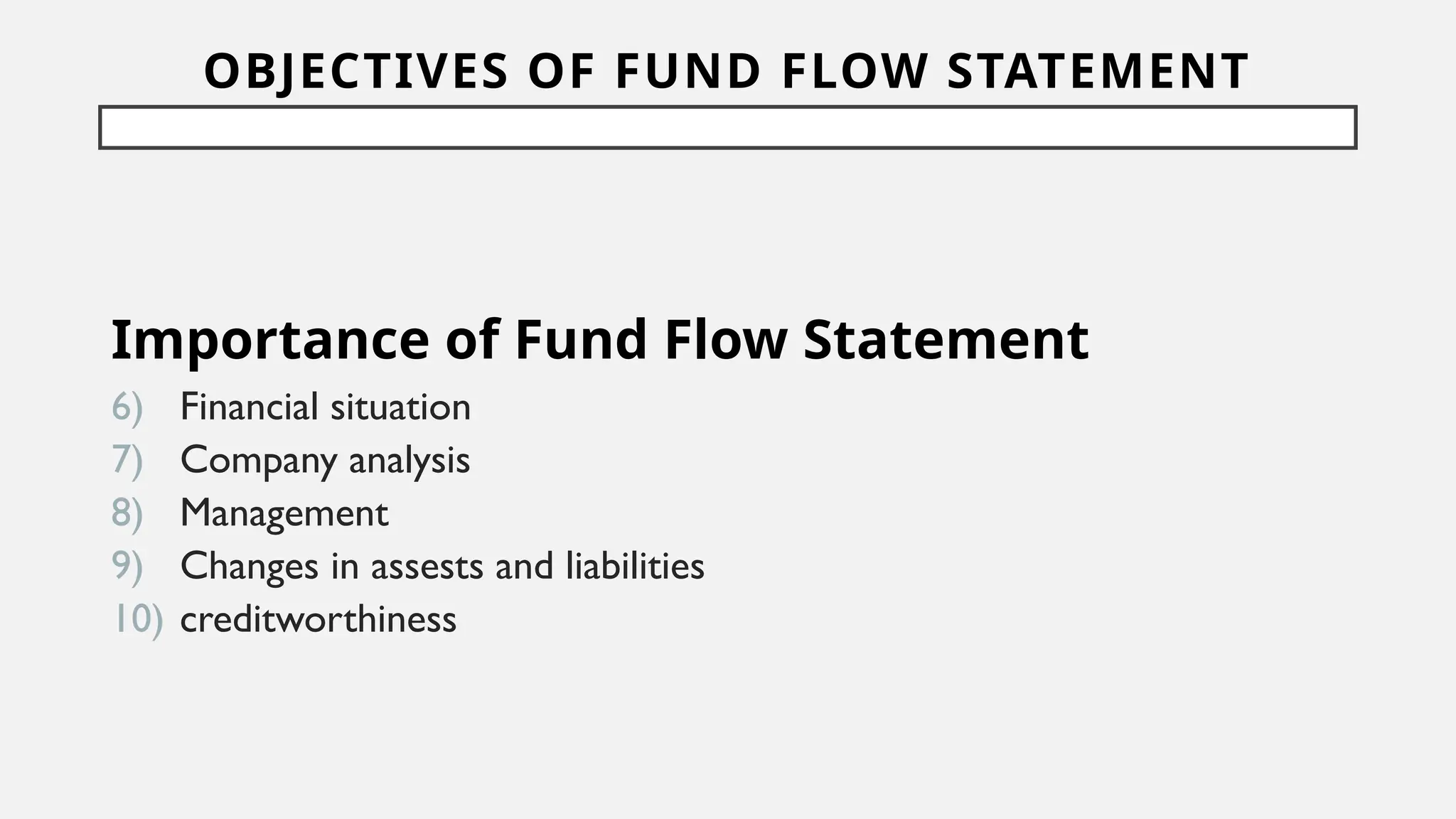
OBJECTIVES OF FUND FLOW STATEMENT
Importance of Fund Flow Statement
6) Financial situation
7) Company analysis
8) Management
9) Changes in assests and liabilities
10) creditworthiness
W H A T A R E T H E C O M P O N E N T S O F A F U N D F L O W S T A T E M E N T ?
Sources of Funds:
1. Funds from operations: Cash generated from business operations.
2. Sale of assets: Cash generated from the sale of property, equipment, or other assets.
3. Issue of shares: Cash generated from the sale of company shares or equity.
4. Borrowings: Cash generated from loans or other forms of debt financing.
Applications of Funds:
5. Purchase of assets: Cash used to purchase property, equipment, or other assets.
6. Repayment of loans: Cash used to repay loans or other debt obligations.
7. Dividend payments: Cash used to pay dividends to shareholders.
8. Other applications: Cash used for other business purposes, such as investing in new projects or expanding operations.
Working capital changes:
Tracks the changes in a company’s working capital over the period i.e increase and decrease in current assests and current
liabilities.
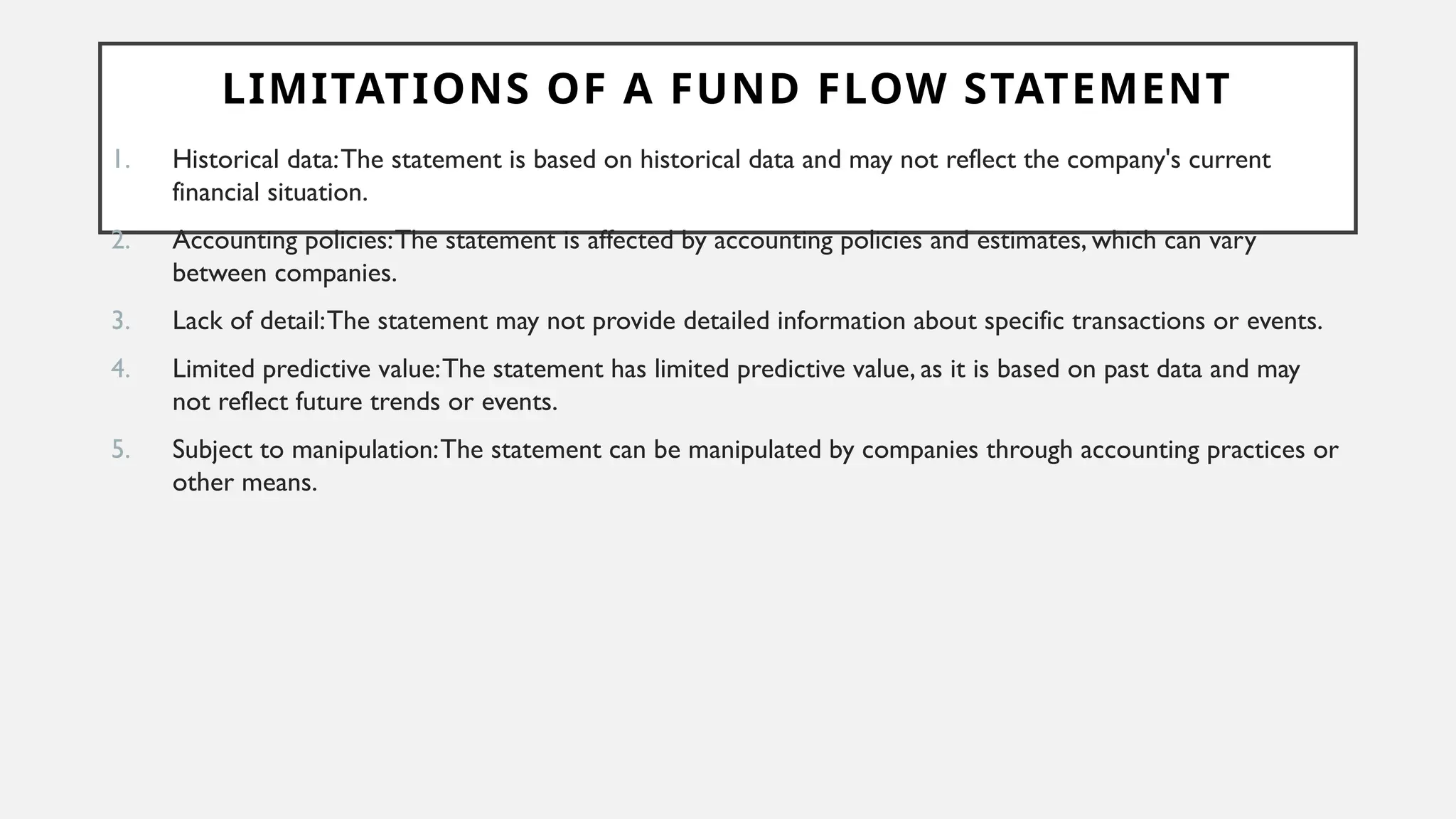
LIMITATIONS OF A FUND FLOW STATEMENT
1. Historical data:The statement is based on historical data and may not reflect the company's current
financial situation.
2. Accounting policies:The statement is affected by accounting policies and estimates, which can vary
between companies.
3. Lack of detail:The statement may not provide detailed information about specific transactions or events.
4. Limited predictive value:The statement has limited predictive value, as it is based on past data and may
not reflect future trends or events.
5. Subject to manipulation:The statement can be manipulated by companies through accounting practices or
other means.

FUND FLOW STATEMENT ppt for details about funf

  • 1.
    FINANCIAL MANAGEMNT FUND FLOWSTATEMENT PRESENTED BY- MUSKAN GARG ERP- 0241MBA196
  • 2.
    FUND FLOW STATEMENT AFund Flow Statement is a financial statement that shows the movement of funds (cash and cash equivalents) into and out of a business over a specific period of time. It highlights the sources and uses of funds, providing insights into a company's financial activities, liquidity, and financial health. Fund flow statement helps in analysing the reasons behind the change in a company’s finances. WHAT IS FUNDS? Funds refer to financial resources that are available for use, including cash, investments, bank deposit and other assets that can be easily converted into cash.
  • 3.
    WHAT IS FUNDFLOW STATEMENT ANALYSIS? • Fund flow statement analysis is used to understand changes in company’s financial situation. • Like cash flow statement analysis, fund flow statement examins the financial including  BALANCE SHEET- all the assets, liabilities and capital accounts are summarised with their current balances reflecting a specific period  PROFIT And LOSS OR INCOME STATEMENT – the profit and loss statement or income statement summarises the revenue, cost and profit or loss for a giver period  CASH FLOW STATEMENT- here, for a specific time period cash inflow and outflow for operating activities, investment activities and financial investment will be examined.
  • 4.
    OBJECTIVES OF FUNDFLOW STATEMENT Importance of Fund Flow Statement 6) Financial situation 7) Company analysis 8) Management 9) Changes in assests and liabilities 10) creditworthiness
  • 5.
    W H AT A R E T H E C O M P O N E N T S O F A F U N D F L O W S T A T E M E N T ? Sources of Funds: 1. Funds from operations: Cash generated from business operations. 2. Sale of assets: Cash generated from the sale of property, equipment, or other assets. 3. Issue of shares: Cash generated from the sale of company shares or equity. 4. Borrowings: Cash generated from loans or other forms of debt financing. Applications of Funds: 5. Purchase of assets: Cash used to purchase property, equipment, or other assets. 6. Repayment of loans: Cash used to repay loans or other debt obligations. 7. Dividend payments: Cash used to pay dividends to shareholders. 8. Other applications: Cash used for other business purposes, such as investing in new projects or expanding operations. Working capital changes: Tracks the changes in a company’s working capital over the period i.e increase and decrease in current assests and current liabilities.
  • 6.
    LIMITATIONS OF AFUND FLOW STATEMENT 1. Historical data:The statement is based on historical data and may not reflect the company's current financial situation. 2. Accounting policies:The statement is affected by accounting policies and estimates, which can vary between companies. 3. Lack of detail:The statement may not provide detailed information about specific transactions or events. 4. Limited predictive value:The statement has limited predictive value, as it is based on past data and may not reflect future trends or events. 5. Subject to manipulation:The statement can be manipulated by companies through accounting practices or other means.