From pipelines to refineries:
scaling big data applications
Tim Hunter
About Me
• Tim Hunter
• Software engineer @ Databricks
• Ph.D. from UC Berkeley in Machine Learning
• Very early Spark user
• Contributor to MLlib
• Author of TensorFrames and GraphFrames
Introduction
• Spark 2.2 in the release process
• Spark 2.3 being thought about
• This is the time to discuss Spark 3
• This presentation is a personal perspective on a future Spark
Introduction
As Spark applications grow in
complexity, what challenges lie
ahead.
Can we find some good
foundations for building big data
frameworks?
There is nothing more practical than a good theory.
James Maxwell
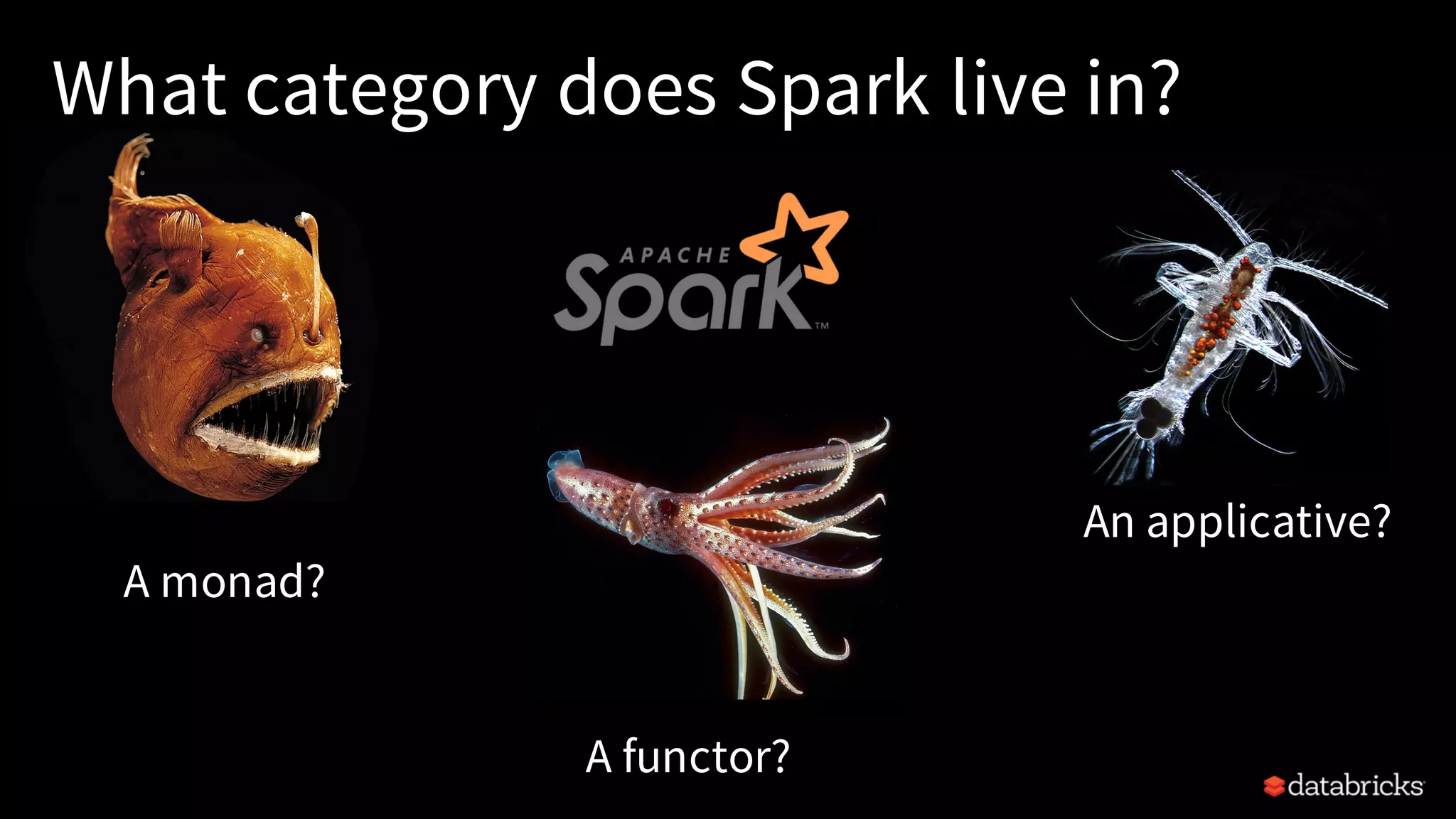
What category does Spark live in?
An applicative?
A monad?
A functor?
Introduction
• Anything presented here can be implementedin a modern
programming language
• No need to know Haskell or category theory
Outline
• State of the union
• What is goodaboutSpark?
• What are the trends?
• Classics to the rescue
• Fightingthe fourhorsemen of the datapocalypse
• Laziness to the rescue
• From theory to practice
• Makingdata processing great again
State of the union
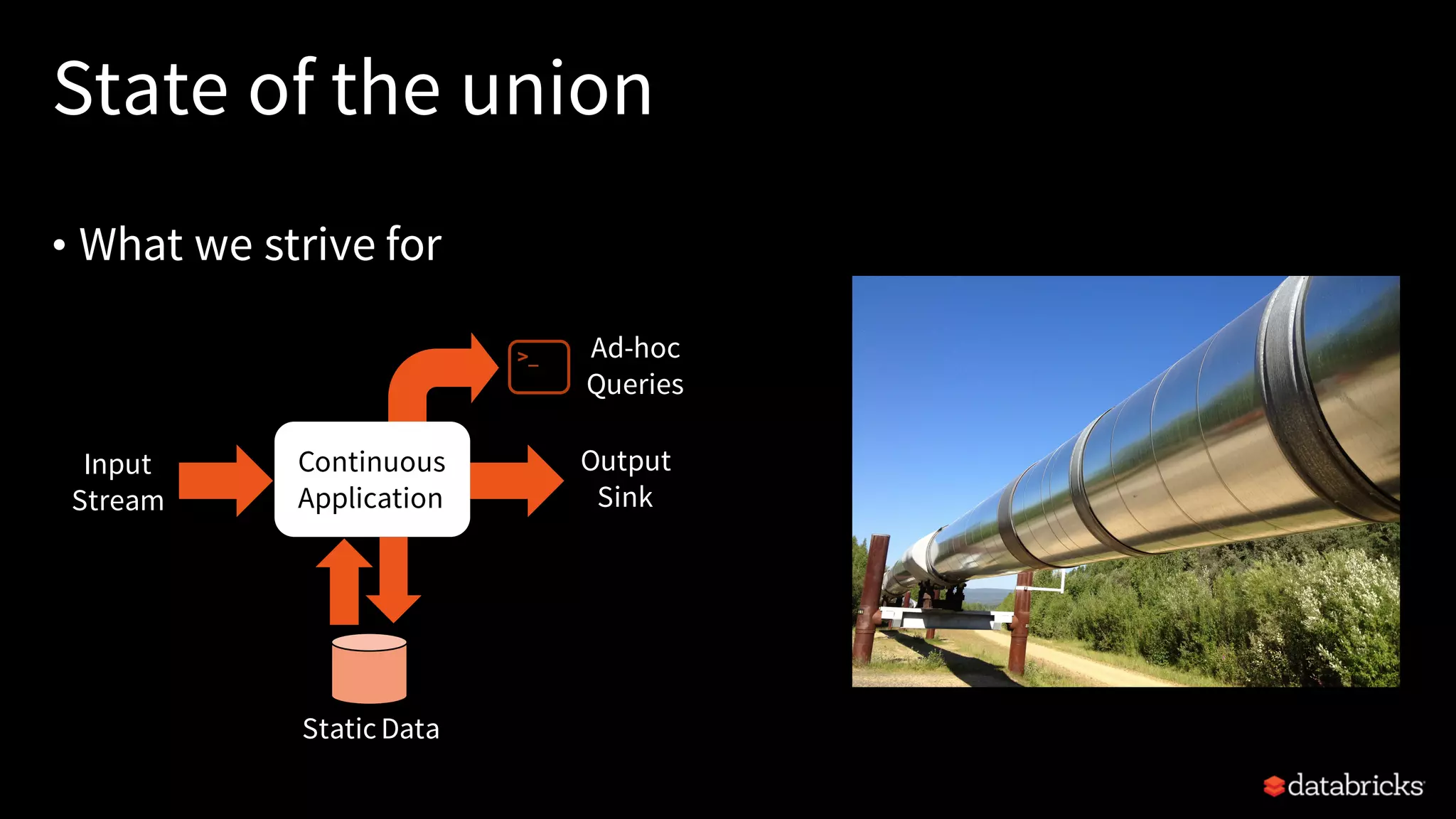
• What we strive for
Ad-hoc
Queries
Input
Stream
Output
Sink
Continuous
Application
StaticData
>_
State of the union
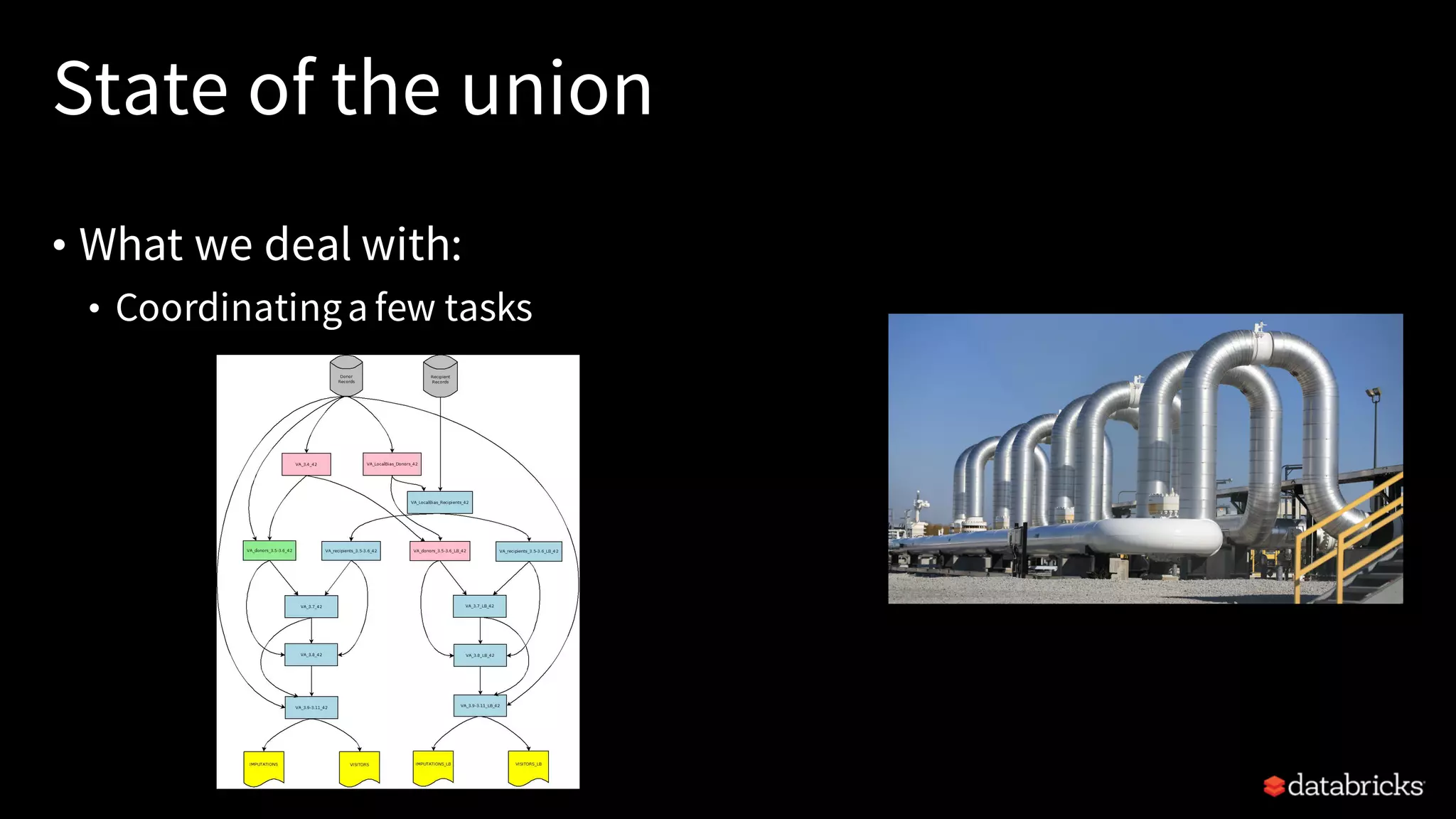
• What we deal with:
• Coordinatinga few tasks
State of the union
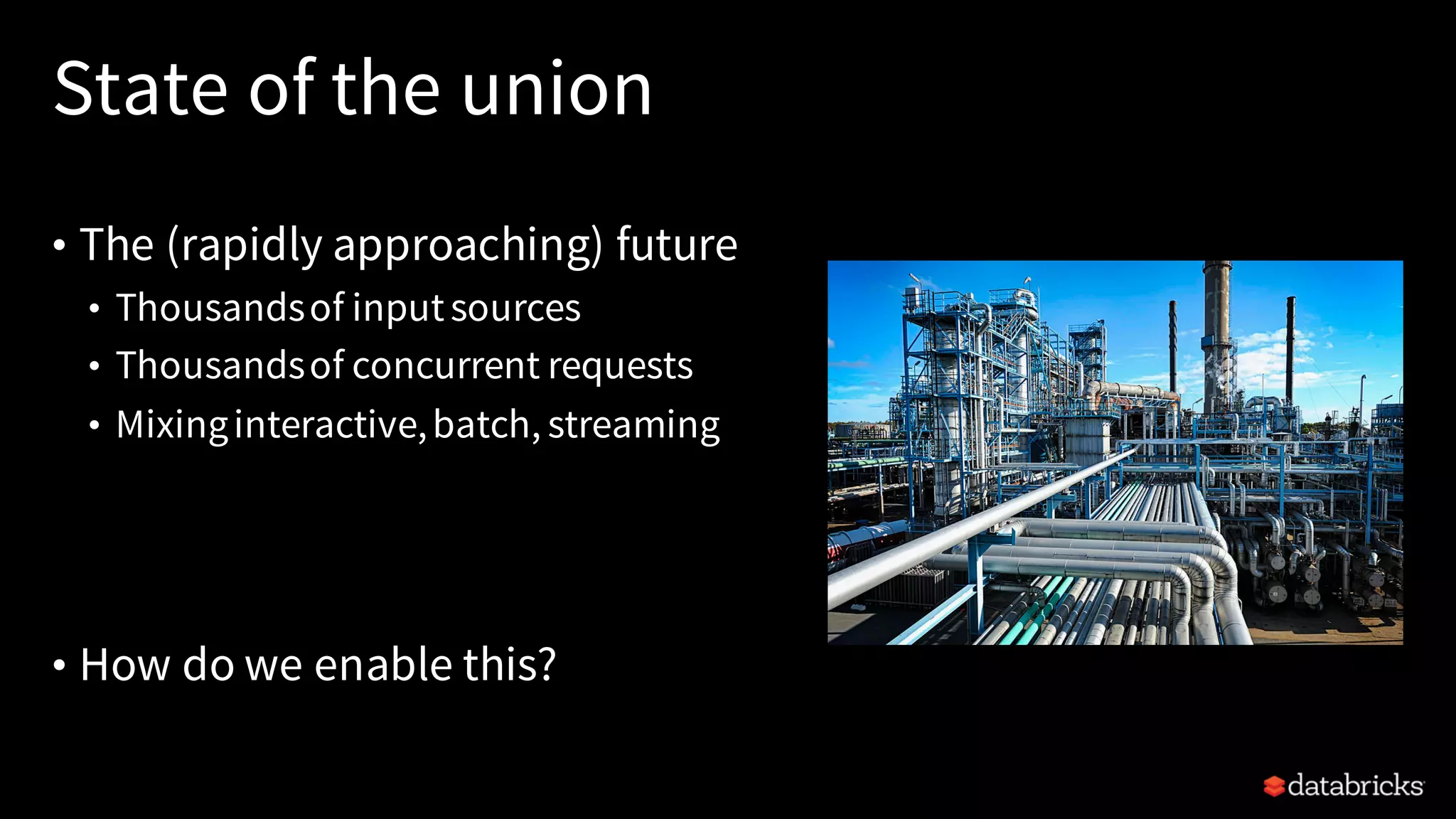
• The (rapidly approaching) future
• Thousandsof inputsources
• Thousandsof concurrent requests
• Mixinginteractive,batch, streaming
• How do we enable this?
The state of the union
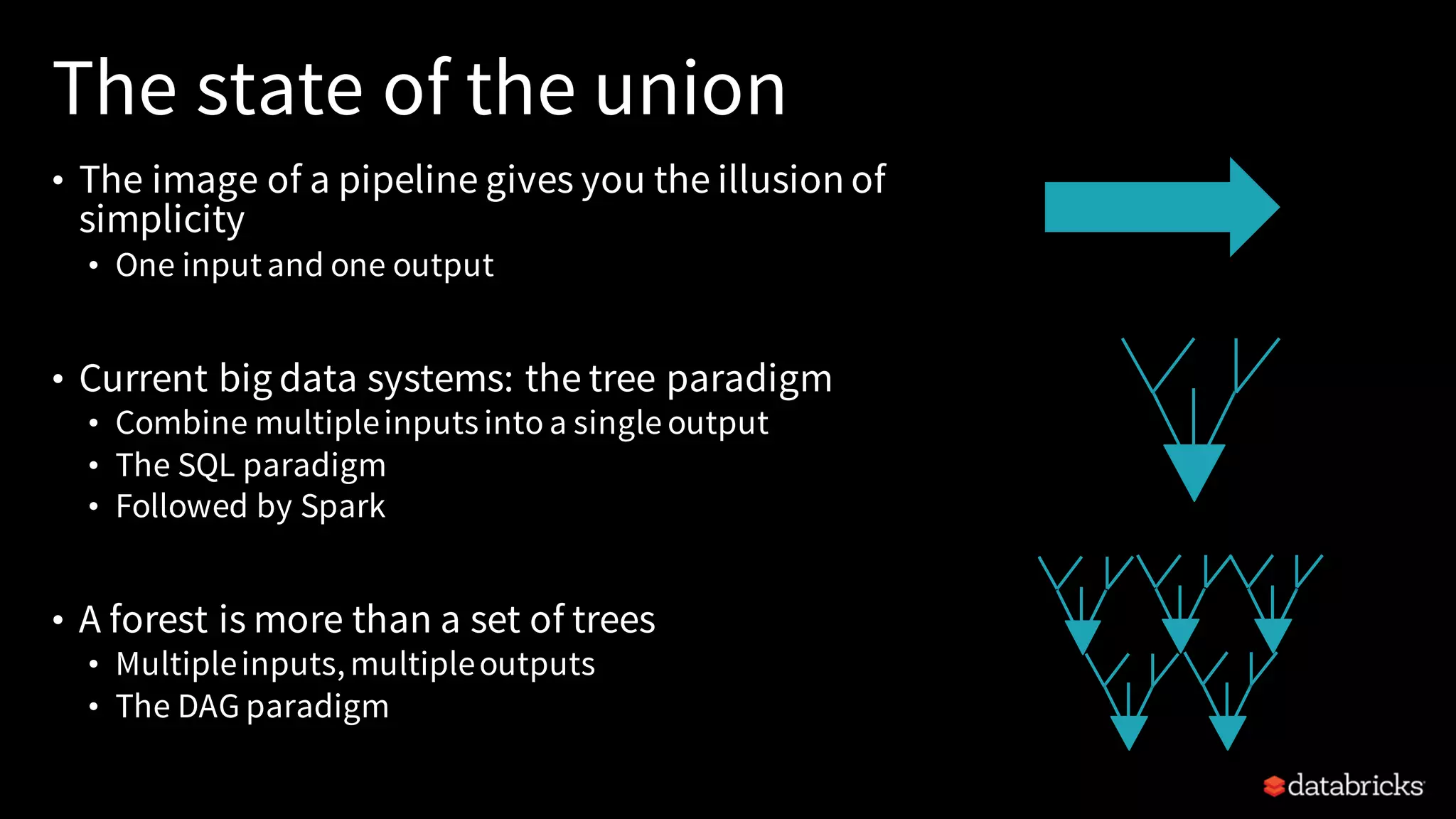
• The image of a pipeline gives you the illusion of
simplicity
• One inputand one output
• Current big data systems: the tree paradigm
• Combine multipleinputsinto a single output
• The SQL paradigm
• Followed by Spark
• A forest is more than a set of trees
• Multipleinputs,multipleoutputs
• The DAG paradigm
Data processing as a complex system
• Orchestrating complex flows is nothing new:
• Tracking andscheduling:Gantt,JIRA, etc.
• Buildtools:Bazel (Blaze), Pants, Buck
• General schedulers: AirFlow, FBLearner, Luigi
• Successfully used for orchestrating complex data processing
• But they are general tools:
• They miss the fact that we are dealingwith data pipelines
• Separate system for schedulingandfor expressing transforms
• No notionof schema, no control of the side effects
Data processing as a complex system
• Any software becomes an exercise in managing complexity.
• Complexity comes from interactions
• Howto reduce interactions?
• How to build more complex logic based on simpler elements?
• Howto compose data pipelines?
• Continuous evolution
• Let’s changethe enginesin mid-flight,because it soundsgreat
The ideal big processing system:
• Scalability
• in quantity (big data) and diversity (lots of sources)
• Chaining
• express the dependencies between the datasets
• Composition
• assemble morecomplex programsout of simpler ones
• Determinism
• given a set ofinput data, the outputshould be unique*
• Coffee break threshold
• quick feedback to the user
How is Spark faring so far?
• You can do it, but it is not easy
• Spark includes multiple programming models:
• The RDD model: low-level manipulation of distributed datasets
• Mostly imperativewith some lazy aspects
• The Dataset/Dataframes model:
• Same as RDD,with some restrictions anda domain-specificlanguage
• The SQL model: only one output, only one query
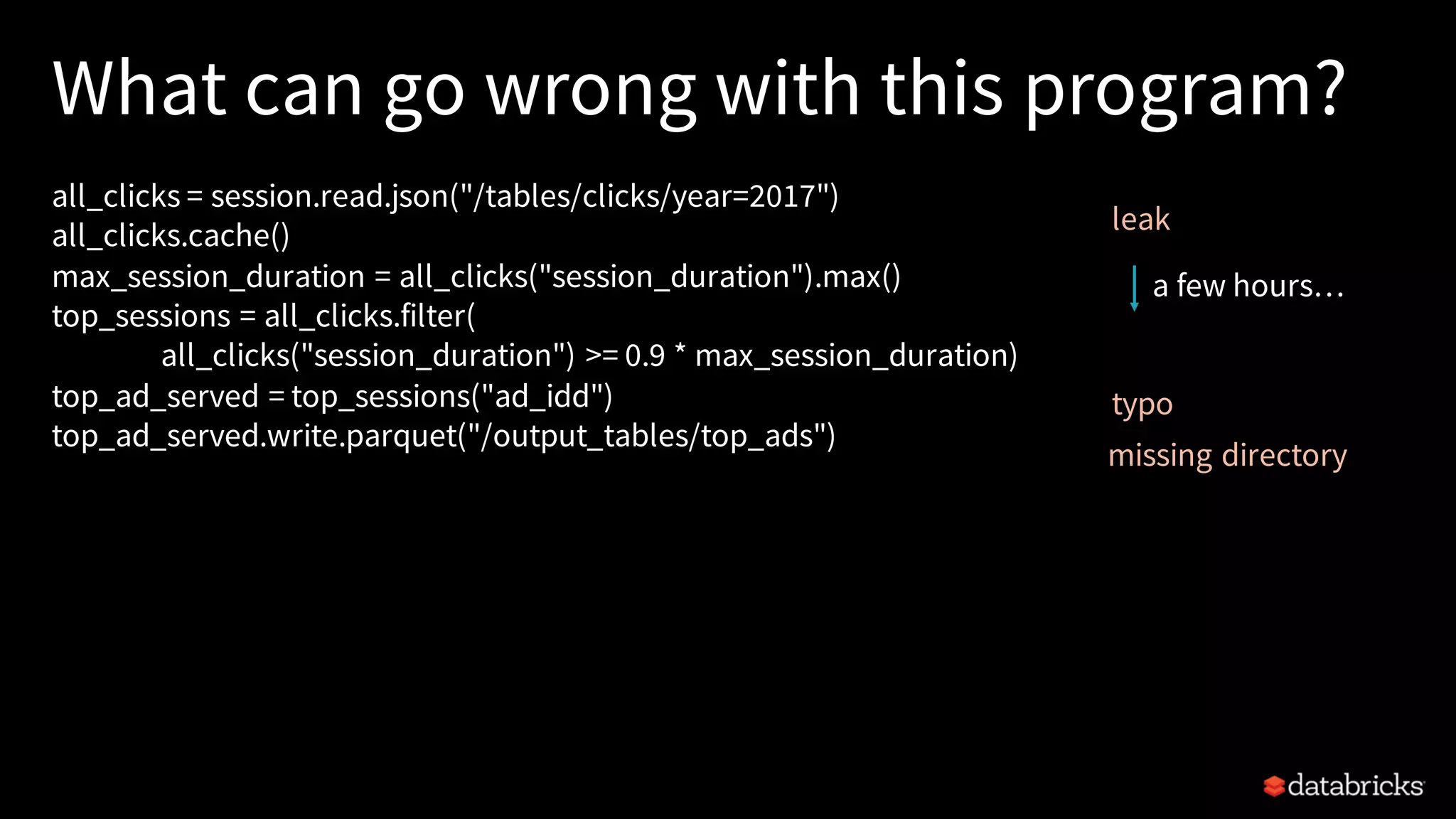
What can go wrong with this program?
all_clicks = session.read.json("/tables/clicks/year=2017")
all_clicks.cache()
max_session_duration = all_clicks("session_duration").max()
top_sessions = all_clicks.filter(
all_clicks("session_duration") >= 0.9 * max_session_duration)
top_ad_served = top_sessions("ad_idd")
top_ad_served.write.parquet("/output_tables/top_ads")
leak
typo
missing directory
a few hours…
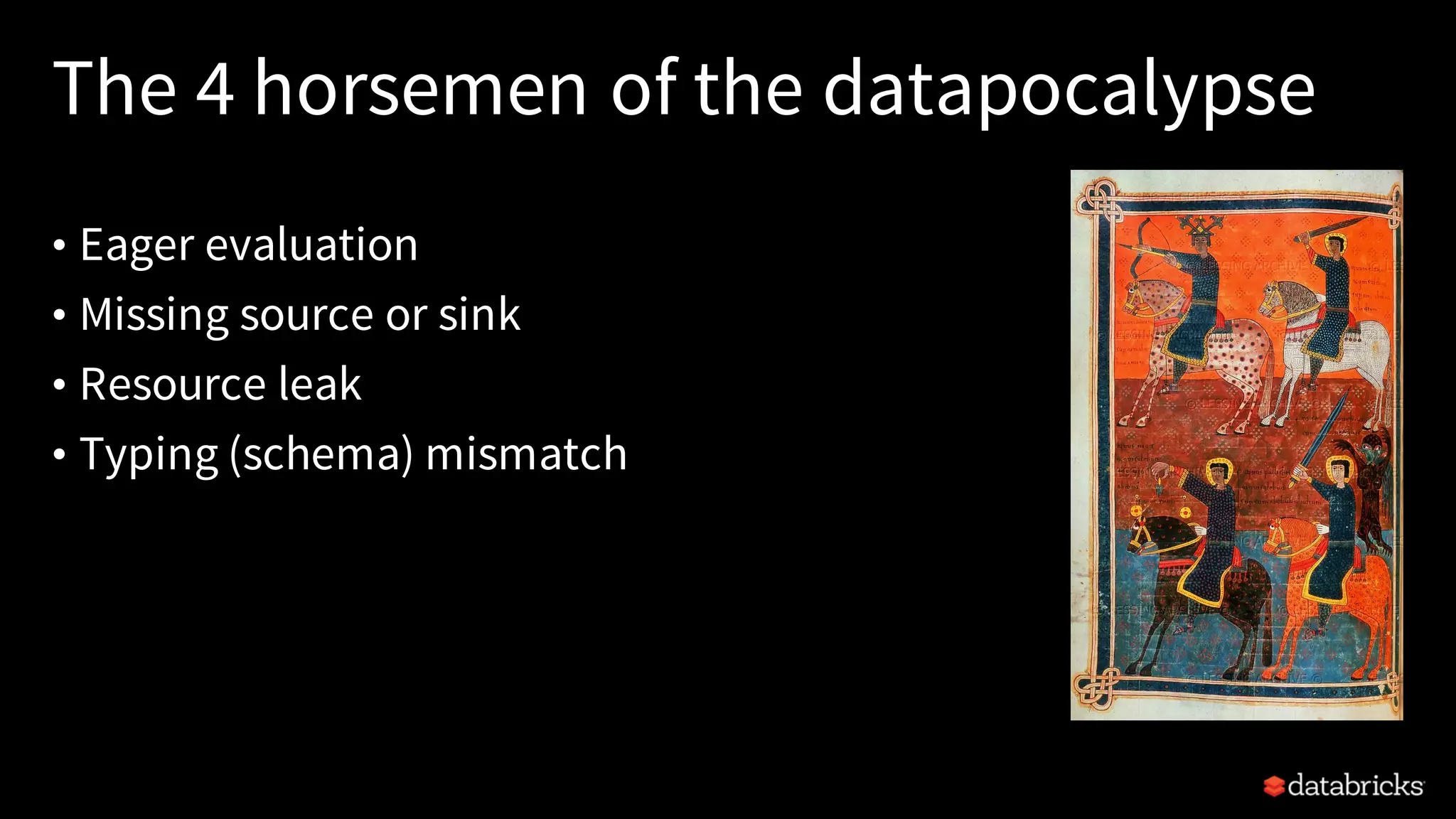
The 4 horsemen of the datapocalypse
• Eager evaluation
• Missing source or sink
• Resource leak
• Typing (schema) mismatch
Classics to the rescue
Theoretical foundations for a data system
• A dataset is a collection of elements, all of the same type
• Scala: Dataset[T]
• Principle: the content of a dataset cannot be accessed directly
• A dataset can be queried
• An observable is a single element, with a type
• intuition: datasetwith a singlerow
• Scala: Observable[T]
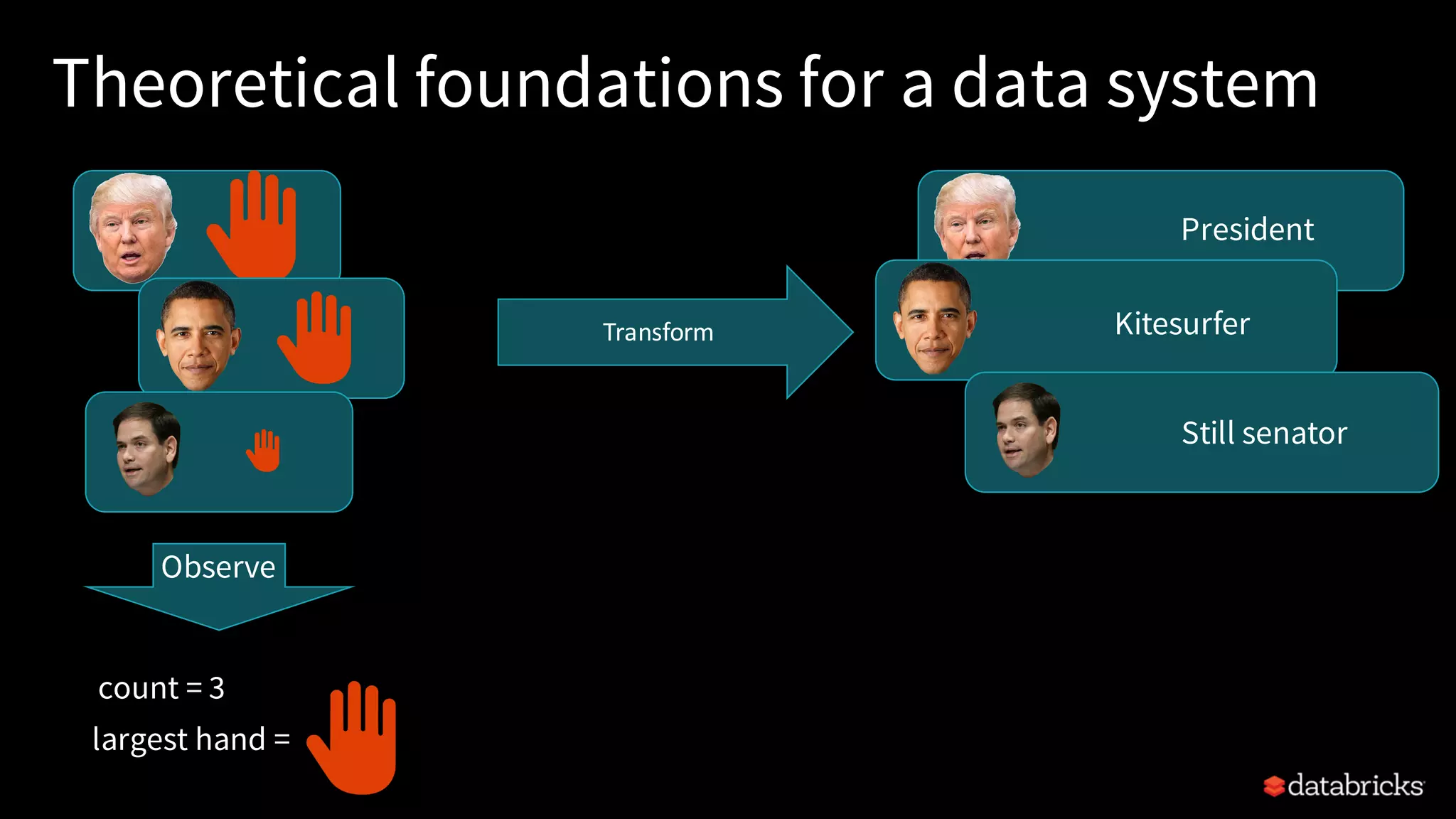
Theoretical foundations for a data system
Transform
President
Kitesurfer
Still senator
Observe
count = 3
largest hand =
Theoretical foundations for a data system
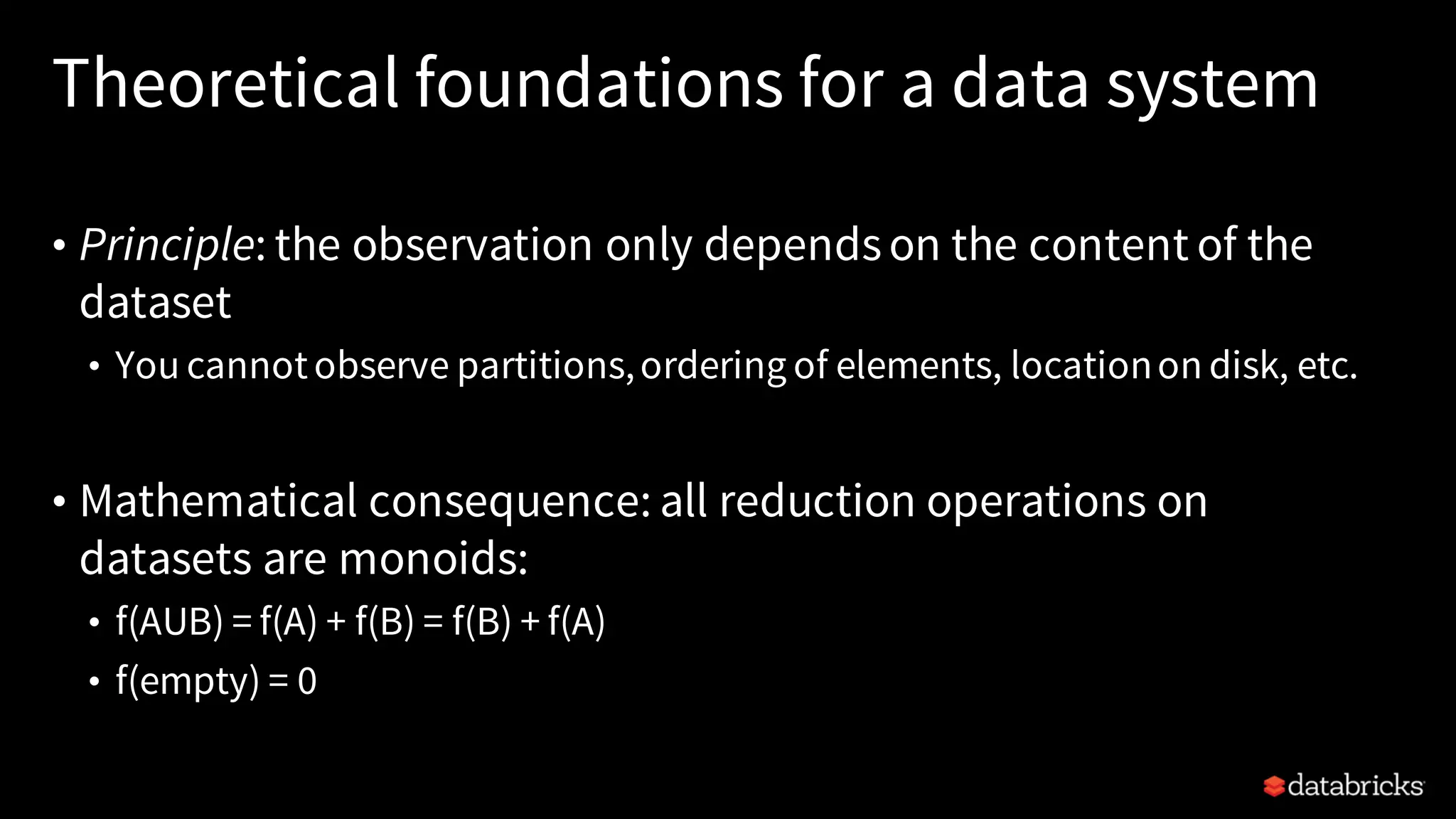
• Principle: the observation only dependson the content of the
dataset
• You cannotobserve partitions,ordering of elements, locationon disk, etc.
• Mathematical consequence: all reduction operations on
datasets are monoids:
• f(AUB) = f(A) + f(B) = f(B) + f(A)
• f(empty) = 0
Theoretical foundations for a data system
• Principle: closed world assumption
• All the effects are modeledwithin the framework
• The inputsand the transforms are sufficientto generate the outputs
• Practical consequence: strong checks and sci-fi optimizations
Examples of operations
• They are what you expect:
• Dataset[Int] : a datasetof integers
• Observable[Int]: an observationon a dataset
• max: Dataset[Int] => Observable[Int]
• union: (Dataset[Int], Dataset[Int]) => Dataset[Int]
• collect: Dataset[Int] => Observable[List[Int]]
Karps
• An implementation of these principles on top of Spark (Haskell + Scala)
• It outputs a graph of logical plans for Spark (or other systems)
• Follows the compiler principle:
• I willtry to prove you wronguntilyou have a good chance of being right
• Karps makes a number of correctness checks for your program
• It acts as a global optimizer for your pipeline
Demo 1
This is useless!
• Lazy construction of very complex programs
• Most operations in Spark can be translated to a small set of primitive
actions with well-defined composition rules.
• The optimizer can then rewrite the program without changing the
outcome
• Optimizations can leverage further SQL optimizations
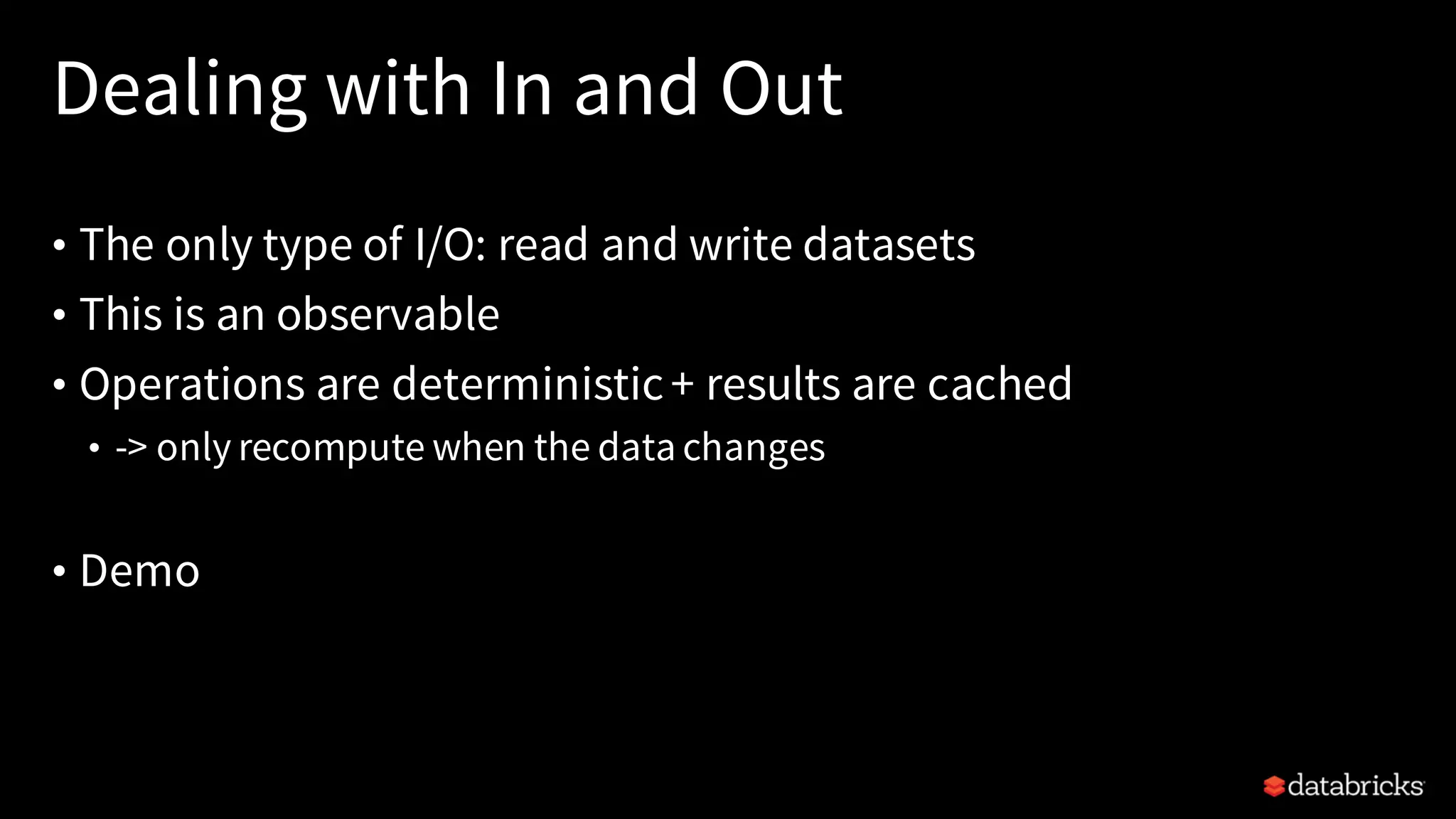
Dealing with In and Out
• The only type of I/O: read and write datasets
• This is an observable
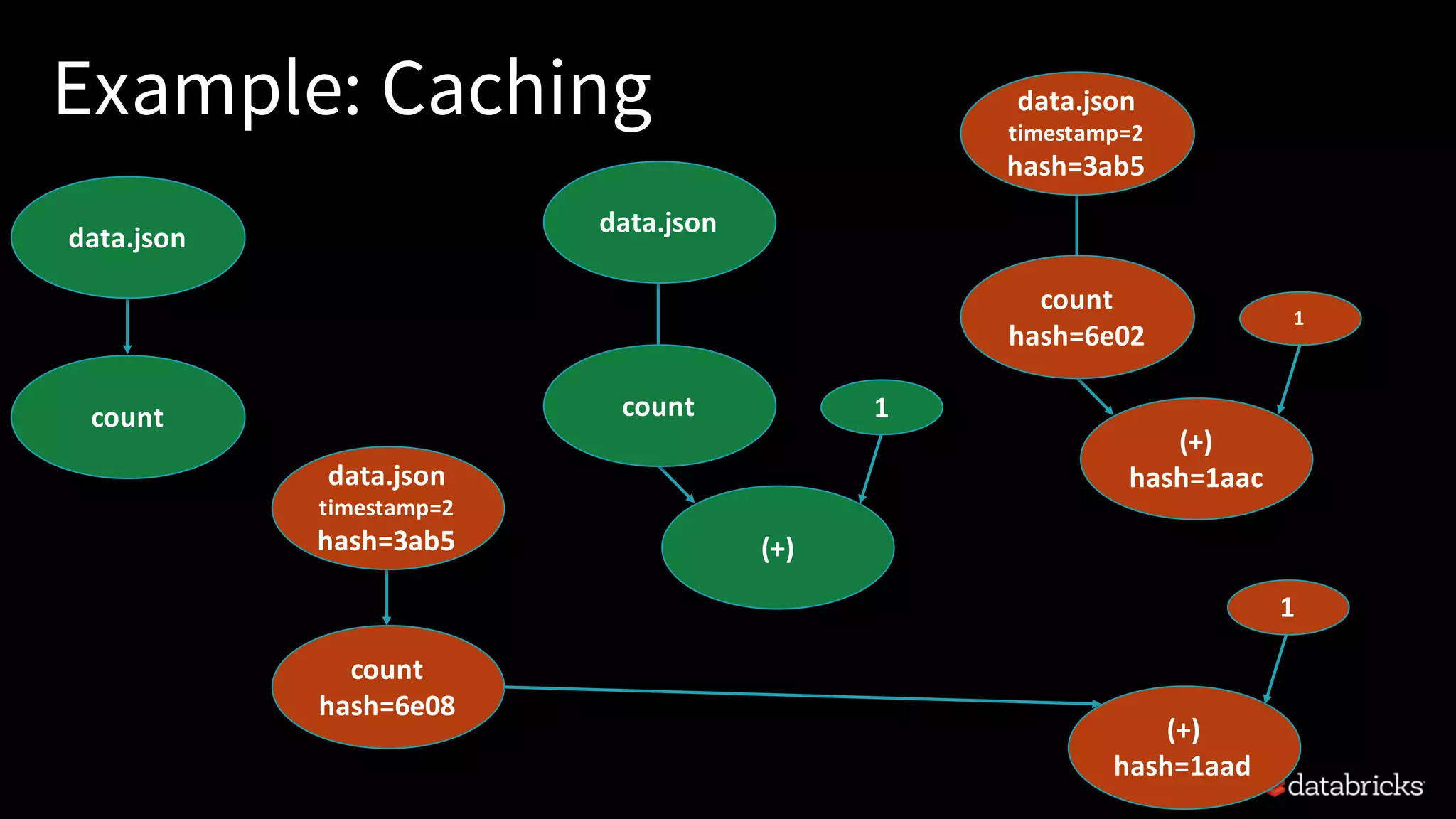
• Operations are deterministic+ results are cached
• -> only recompute when the data changes
• Demo
Example: Caching
1
data.json
count
(+)
data.json
timestamp=2
hash=3ab5
count
hash=6e08
data.json
count
1
(+)
hash=1aac
data.json
timestamp=2
hash=3ab5
count
hash=6e02
1
(+)
hash=1aad
Example: graph introspection
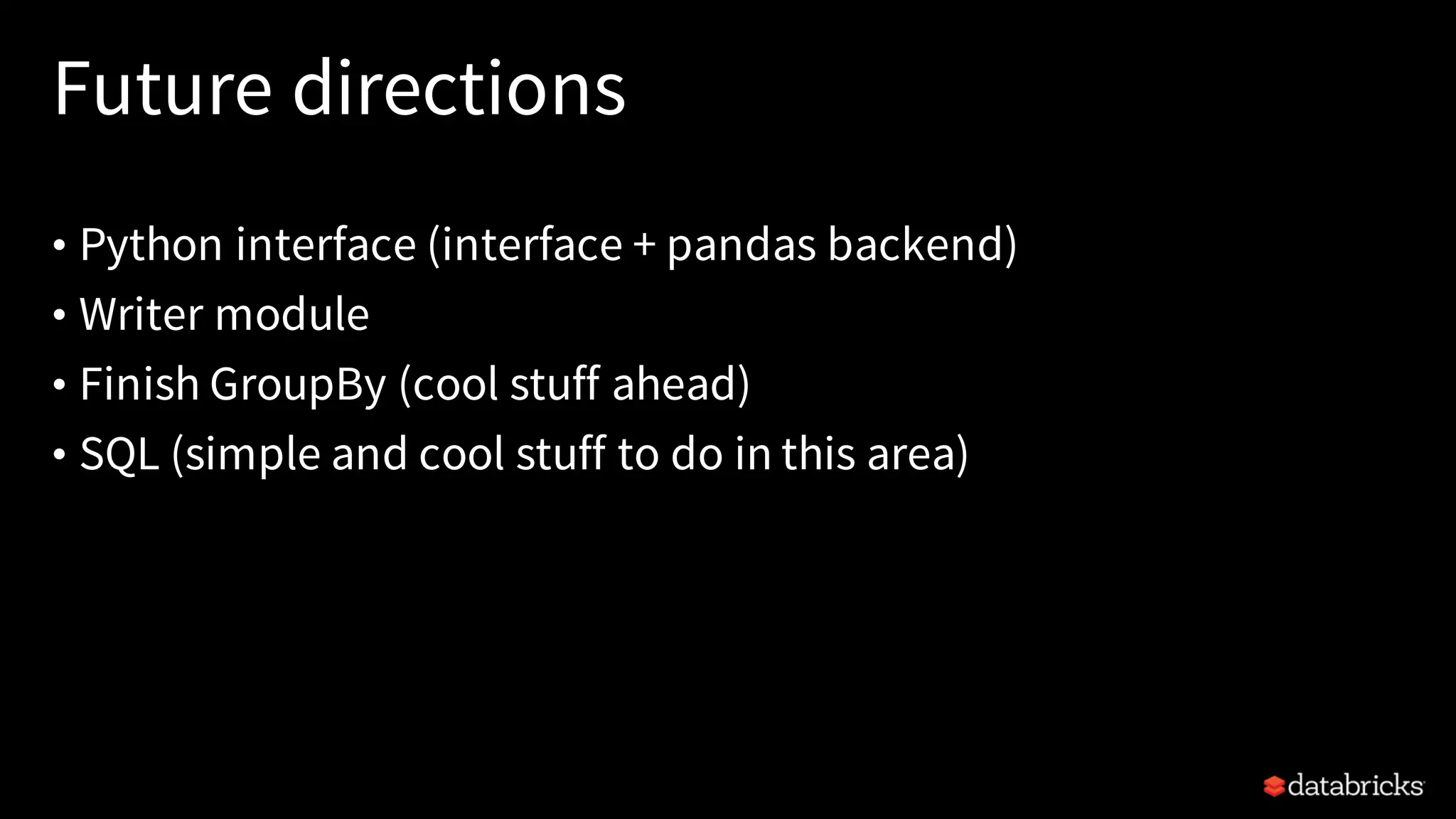
Future directions
• Python interface (interface + pandas backend)
• Writer module
• Finish GroupBy (cool stuff ahead)
• SQL (simple and cool stuff to do in this area)
Conclusion: trends in data processing
• How to manage the complexity of data flows?
• Taking inspiration from the functional world
• Spark provides solid foundation
• Laziness, declarative APIs alleviate complexity
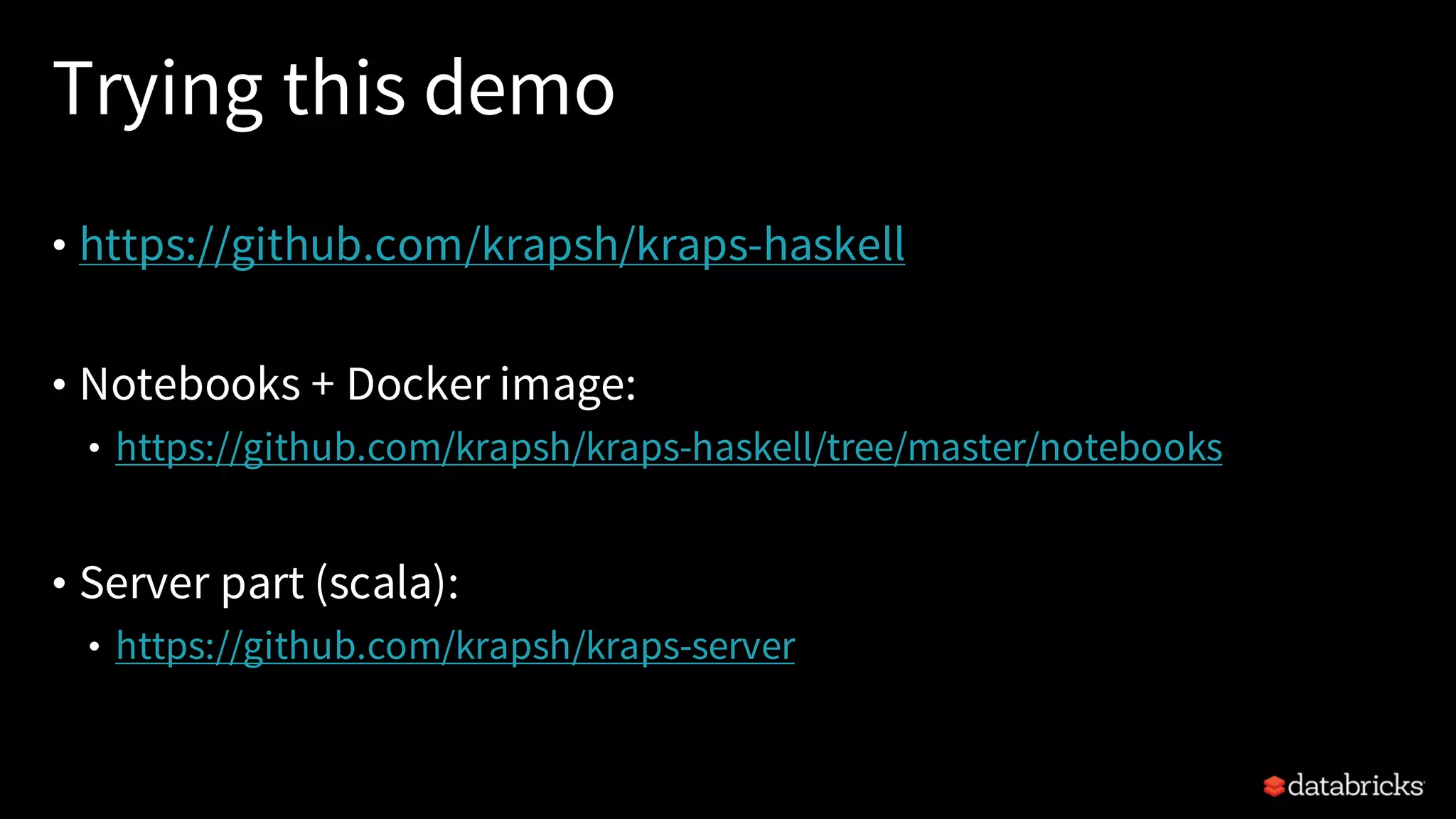
Trying this demo
• https://github.com/krapsh/kraps-haskell
• Notebooks + Docker image:
• https://github.com/krapsh/kraps-haskell/tree/master/notebooks
• Server part (scala):
• https://github.com/krapsh/kraps-server
SPARK SUMMIT 2017
DATA SCIENCE AND ENGINEERING AT SCALE
JUNE 5 – 7 | MOSCONE CENTER | SAN FRANCISCO
ORGANIZED BY spark-summit.org/2017
Thank You

From Pipelines to Refineries: Scaling Big Data Applications

  • 1.
    From pipelines torefineries: scaling big data applications Tim Hunter
  • 2.
    About Me • TimHunter • Software engineer @ Databricks • Ph.D. from UC Berkeley in Machine Learning • Very early Spark user • Contributor to MLlib • Author of TensorFrames and GraphFrames
  • 3.
    Introduction • Spark 2.2in the release process • Spark 2.3 being thought about • This is the time to discuss Spark 3 • This presentation is a personal perspective on a future Spark
  • 4.
    Introduction As Spark applicationsgrow in complexity, what challenges lie ahead. Can we find some good foundations for building big data frameworks? There is nothing more practical than a good theory. James Maxwell
  • 5.
    What category doesSpark live in? An applicative? A monad? A functor?
  • 6.
    Introduction • Anything presentedhere can be implementedin a modern programming language • No need to know Haskell or category theory
  • 7.
    Outline • State ofthe union • What is goodaboutSpark? • What are the trends? • Classics to the rescue • Fightingthe fourhorsemen of the datapocalypse • Laziness to the rescue • From theory to practice • Makingdata processing great again
  • 8.
    State of theunion • What we strive for Ad-hoc Queries Input Stream Output Sink Continuous Application StaticData >_
  • 9.
    State of theunion • What we deal with: • Coordinatinga few tasks
  • 10.
    State of theunion • The (rapidly approaching) future • Thousandsof inputsources • Thousandsof concurrent requests • Mixinginteractive,batch, streaming • How do we enable this?
  • 11.
    The state ofthe union • The image of a pipeline gives you the illusion of simplicity • One inputand one output • Current big data systems: the tree paradigm • Combine multipleinputsinto a single output • The SQL paradigm • Followed by Spark • A forest is more than a set of trees • Multipleinputs,multipleoutputs • The DAG paradigm
  • 12.
    Data processing asa complex system • Orchestrating complex flows is nothing new: • Tracking andscheduling:Gantt,JIRA, etc. • Buildtools:Bazel (Blaze), Pants, Buck • General schedulers: AirFlow, FBLearner, Luigi • Successfully used for orchestrating complex data processing • But they are general tools: • They miss the fact that we are dealingwith data pipelines • Separate system for schedulingandfor expressing transforms • No notionof schema, no control of the side effects
  • 13.
    Data processing asa complex system • Any software becomes an exercise in managing complexity. • Complexity comes from interactions • Howto reduce interactions? • How to build more complex logic based on simpler elements? • Howto compose data pipelines? • Continuous evolution • Let’s changethe enginesin mid-flight,because it soundsgreat
  • 14.
    The ideal bigprocessing system: • Scalability • in quantity (big data) and diversity (lots of sources) • Chaining • express the dependencies between the datasets • Composition • assemble morecomplex programsout of simpler ones • Determinism • given a set ofinput data, the outputshould be unique* • Coffee break threshold • quick feedback to the user
  • 15.
    How is Sparkfaring so far? • You can do it, but it is not easy • Spark includes multiple programming models: • The RDD model: low-level manipulation of distributed datasets • Mostly imperativewith some lazy aspects • The Dataset/Dataframes model: • Same as RDD,with some restrictions anda domain-specificlanguage • The SQL model: only one output, only one query
  • 16.
    What can gowrong with this program? all_clicks = session.read.json("/tables/clicks/year=2017") all_clicks.cache() max_session_duration = all_clicks("session_duration").max() top_sessions = all_clicks.filter( all_clicks("session_duration") >= 0.9 * max_session_duration) top_ad_served = top_sessions("ad_idd") top_ad_served.write.parquet("/output_tables/top_ads") leak typo missing directory a few hours…
  • 17.
    The 4 horsemenof the datapocalypse • Eager evaluation • Missing source or sink • Resource leak • Typing (schema) mismatch
  • 18.
  • 19.
    Theoretical foundations fora data system • A dataset is a collection of elements, all of the same type • Scala: Dataset[T] • Principle: the content of a dataset cannot be accessed directly • A dataset can be queried • An observable is a single element, with a type • intuition: datasetwith a singlerow • Scala: Observable[T]
  • 20.
    Theoretical foundations fora data system Transform President Kitesurfer Still senator Observe count = 3 largest hand =
  • 21.
    Theoretical foundations fora data system • Principle: the observation only dependson the content of the dataset • You cannotobserve partitions,ordering of elements, locationon disk, etc. • Mathematical consequence: all reduction operations on datasets are monoids: • f(AUB) = f(A) + f(B) = f(B) + f(A) • f(empty) = 0
  • 22.
    Theoretical foundations fora data system • Principle: closed world assumption • All the effects are modeledwithin the framework • The inputsand the transforms are sufficientto generate the outputs • Practical consequence: strong checks and sci-fi optimizations
  • 23.
    Examples of operations •They are what you expect: • Dataset[Int] : a datasetof integers • Observable[Int]: an observationon a dataset • max: Dataset[Int] => Observable[Int] • union: (Dataset[Int], Dataset[Int]) => Dataset[Int] • collect: Dataset[Int] => Observable[List[Int]]
  • 24.
    Karps • An implementationof these principles on top of Spark (Haskell + Scala) • It outputs a graph of logical plans for Spark (or other systems) • Follows the compiler principle: • I willtry to prove you wronguntilyou have a good chance of being right • Karps makes a number of correctness checks for your program • It acts as a global optimizer for your pipeline
  • 25.
  • 26.
    This is useless! •Lazy construction of very complex programs • Most operations in Spark can be translated to a small set of primitive actions with well-defined composition rules. • The optimizer can then rewrite the program without changing the outcome • Optimizations can leverage further SQL optimizations
  • 27.
    Dealing with Inand Out • The only type of I/O: read and write datasets • This is an observable • Operations are deterministic+ results are cached • -> only recompute when the data changes • Demo
  • 28.
  • 29.
  • 30.
    Future directions • Pythoninterface (interface + pandas backend) • Writer module • Finish GroupBy (cool stuff ahead) • SQL (simple and cool stuff to do in this area)
  • 31.
    Conclusion: trends indata processing • How to manage the complexity of data flows? • Taking inspiration from the functional world • Spark provides solid foundation • Laziness, declarative APIs alleviate complexity
  • 32.
    Trying this demo •https://github.com/krapsh/kraps-haskell • Notebooks + Docker image: • https://github.com/krapsh/kraps-haskell/tree/master/notebooks • Server part (scala): • https://github.com/krapsh/kraps-server
  • 33.
    SPARK SUMMIT 2017 DATASCIENCE AND ENGINEERING AT SCALE JUNE 5 – 7 | MOSCONE CENTER | SAN FRANCISCO ORGANIZED BY spark-summit.org/2017
  • 34.