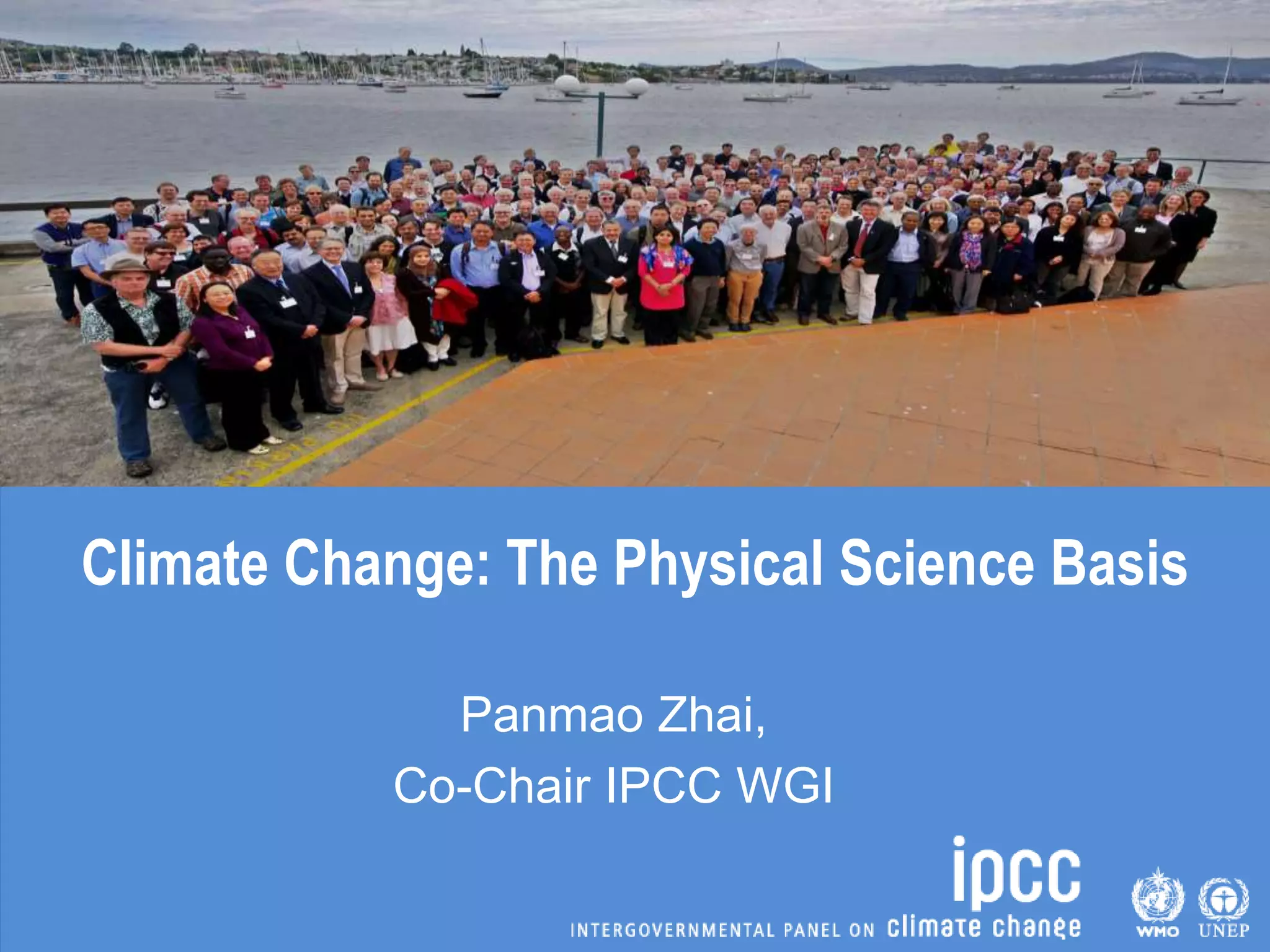
Climate Change: The Physical Science Basis
Panmao Zhai,
Co-Chair IPCC WGI
What has Changed?
Why has it changed ?
How will it change?
What has changed?
Fig.SPM.1b
Temperature Difference 1901 to 2012 based on trend (°C)
Warming of the climate system is unequivocal, [...]
© IPCC 2013
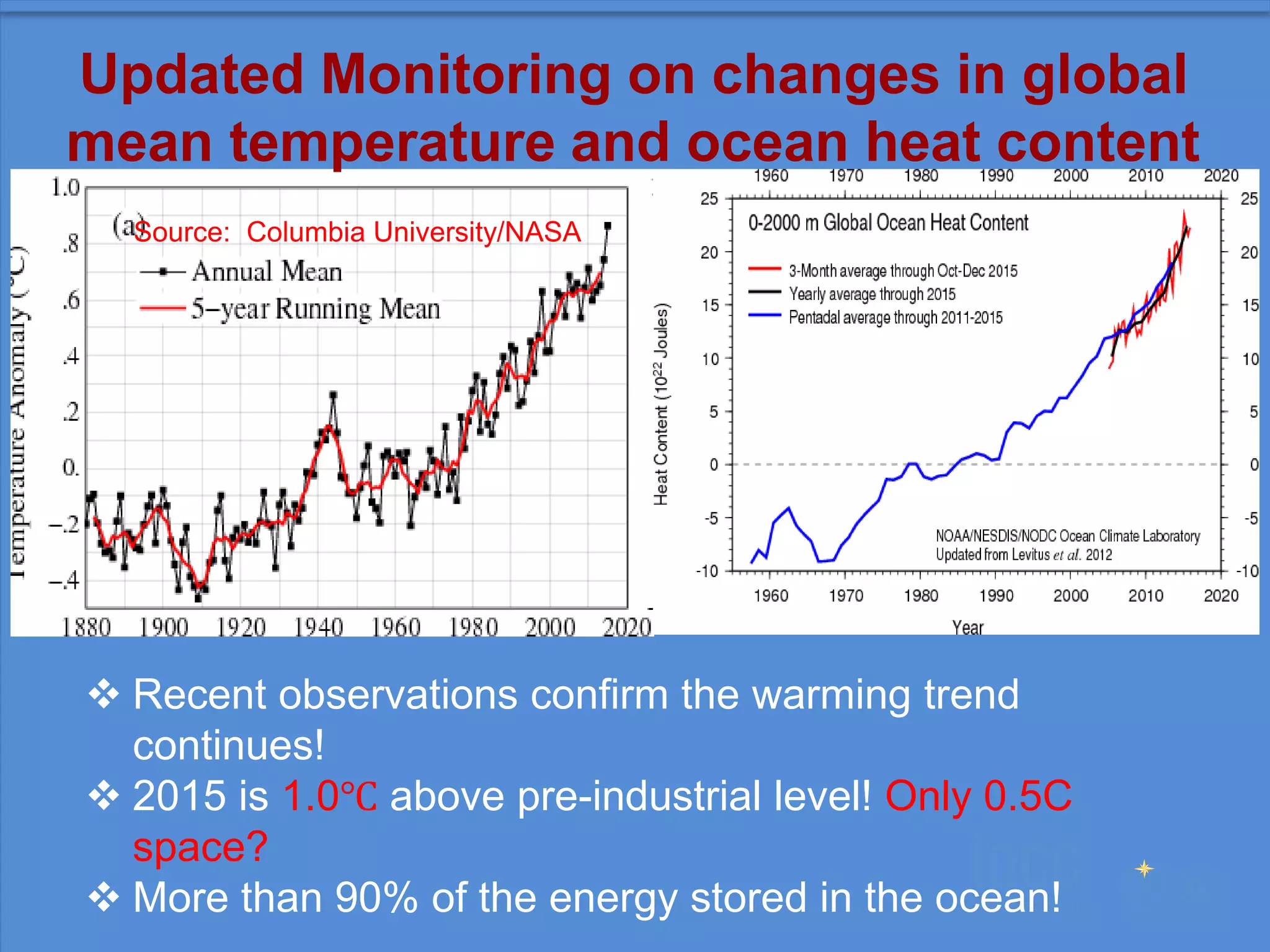
Updated Monitoring on changes in global
mean temperature and ocean heat content
 Recent observations confirm the warming trend
continues!
 2015 is 1.0℃ above pre-industrial level! Only 0.5C
space?
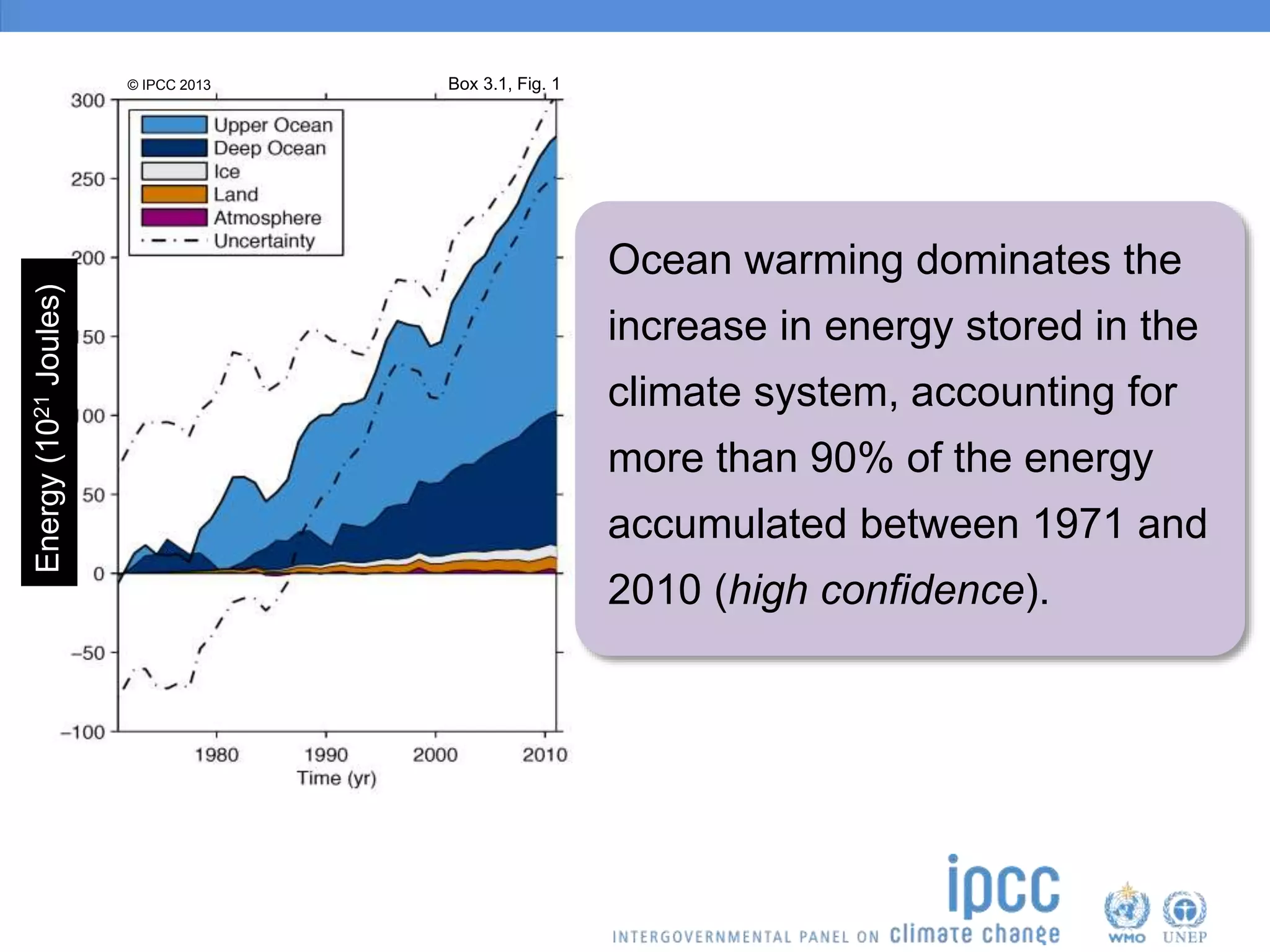
 More than 90% of the energy stored in the ocean!
Source: Columbia University/NASA
China Coastal Averaged Sea-Level Change
Mean sea level rise
rate in China coastal
is 3.0mm yr-1 between
1981 and 2014, higher
than the global
average (1.7mm/y).
Contribution of Climate Change to Sea Level Rise in China
The rate of sea level rise since the mid-19th century has been larger than
the mean rate during the previous two millennia (high confidence).
Over the period
1901 to 2010, global
mean sea level rose
by 0.19 m.
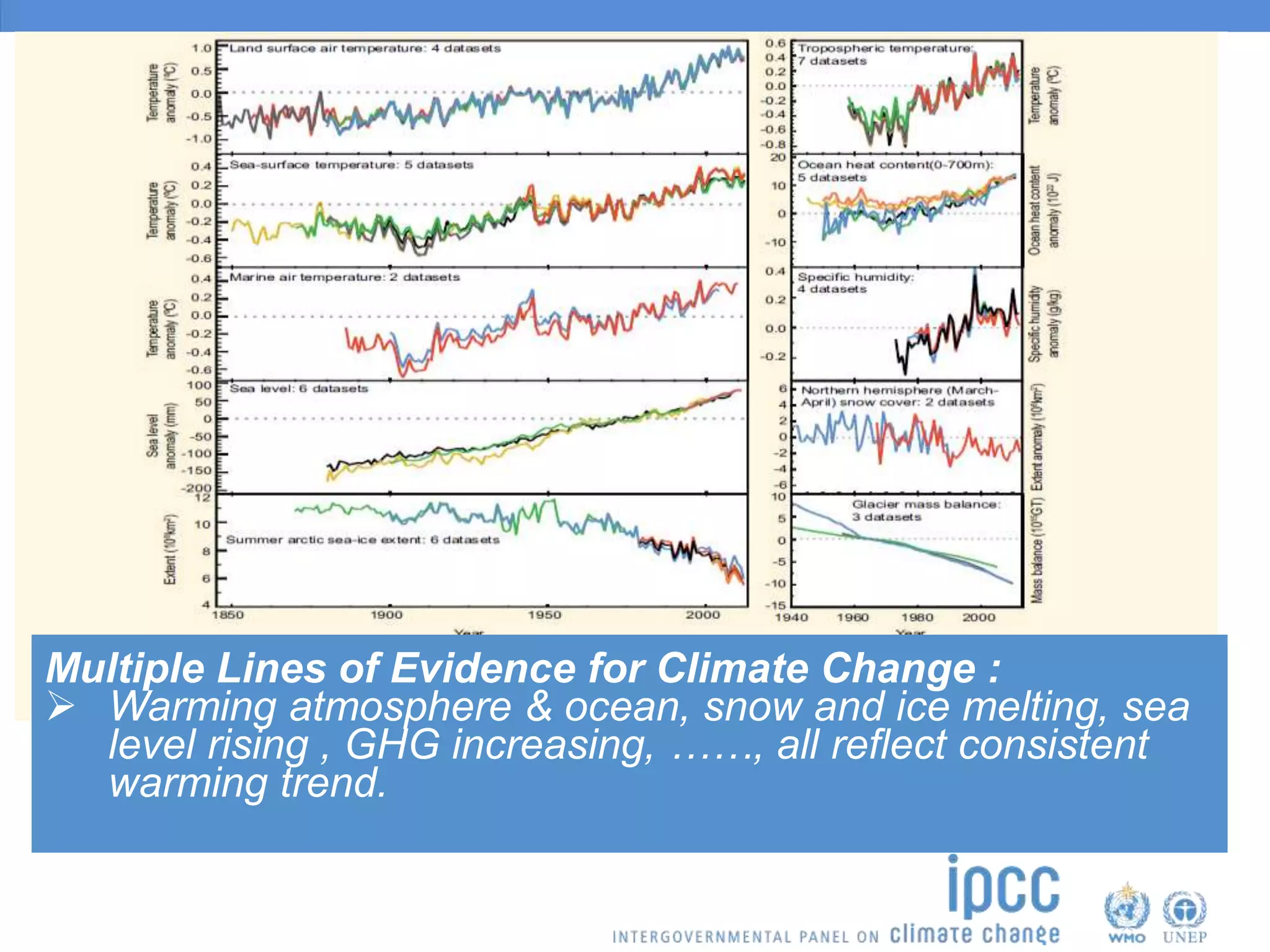
Multiple Lines of Evidence for Climate Change :
 Warming atmosphere & ocean, snow and ice melting, and
sea level rising , ……, all reflect consistent warming trend.
• Regional differences are obvious in precipitation changes, but long
term observations are incomplete in many regions, especially at
centeninal time scale!
Why has it changed?
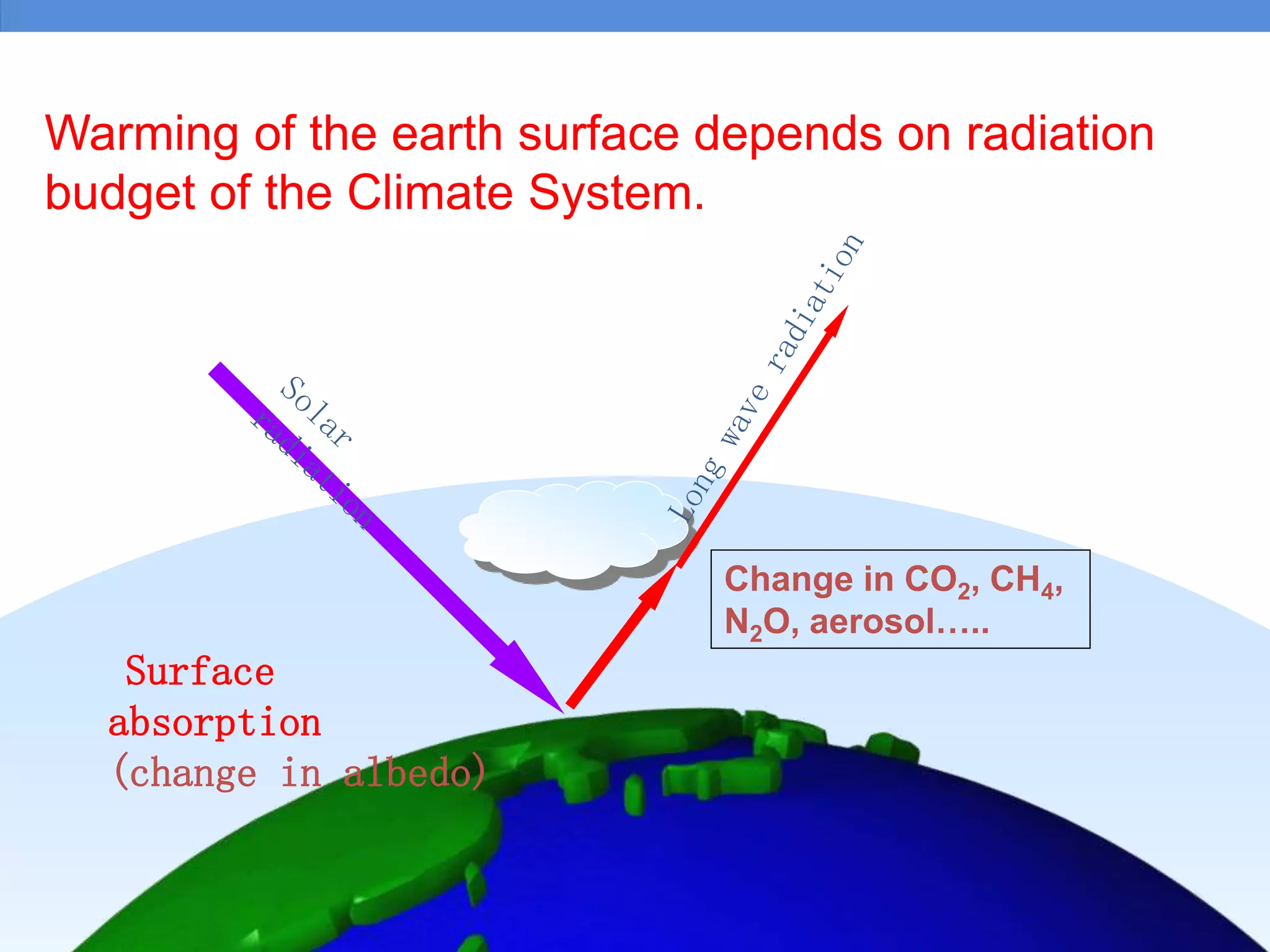
Change in CO2, CH4,…..
Surface
absorption
(change in albedo)
Warming of the earth surface depends on radiation
budget of the Climate System.
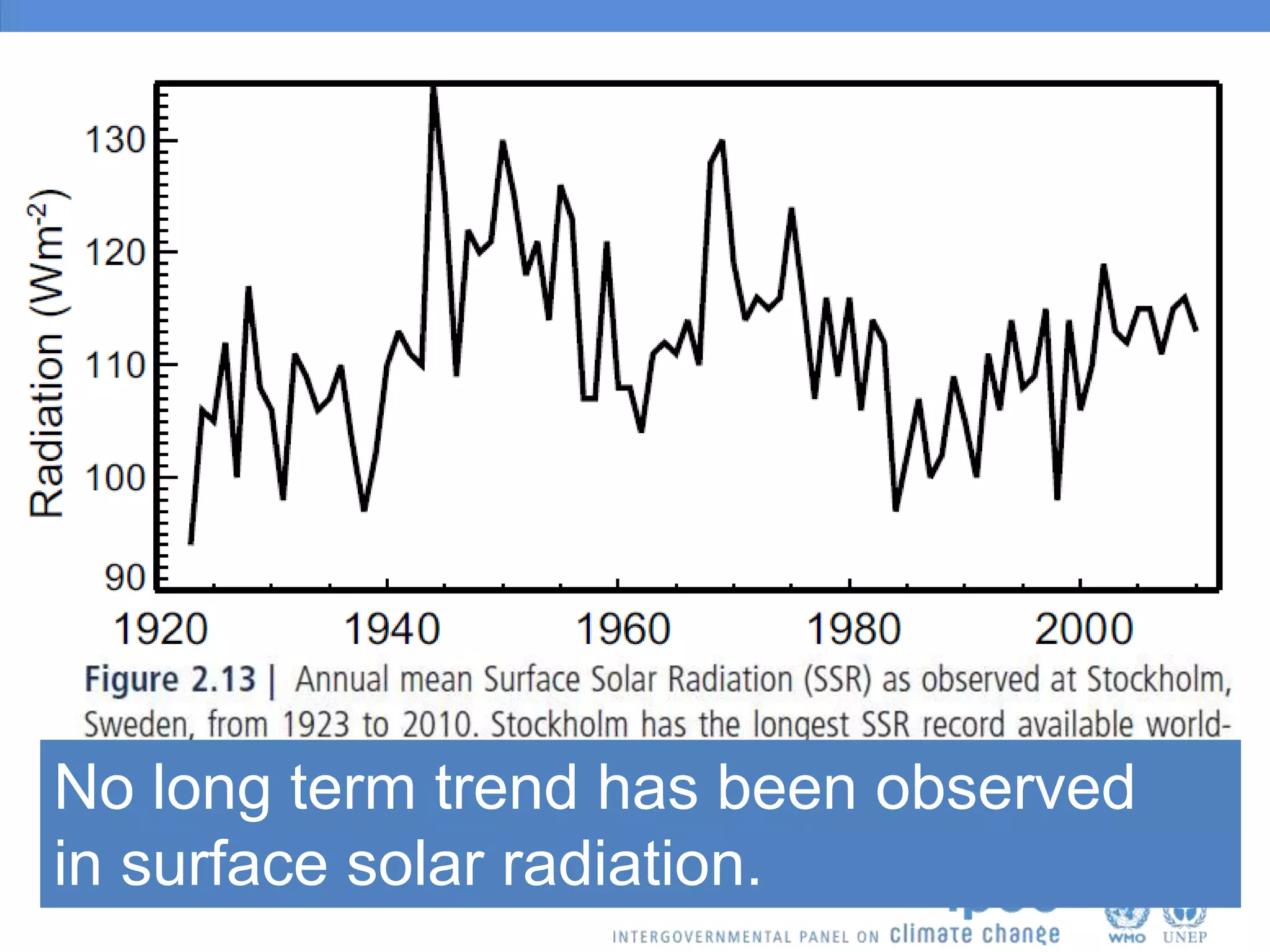
No long term trend has been observed
in surface solar radiation.
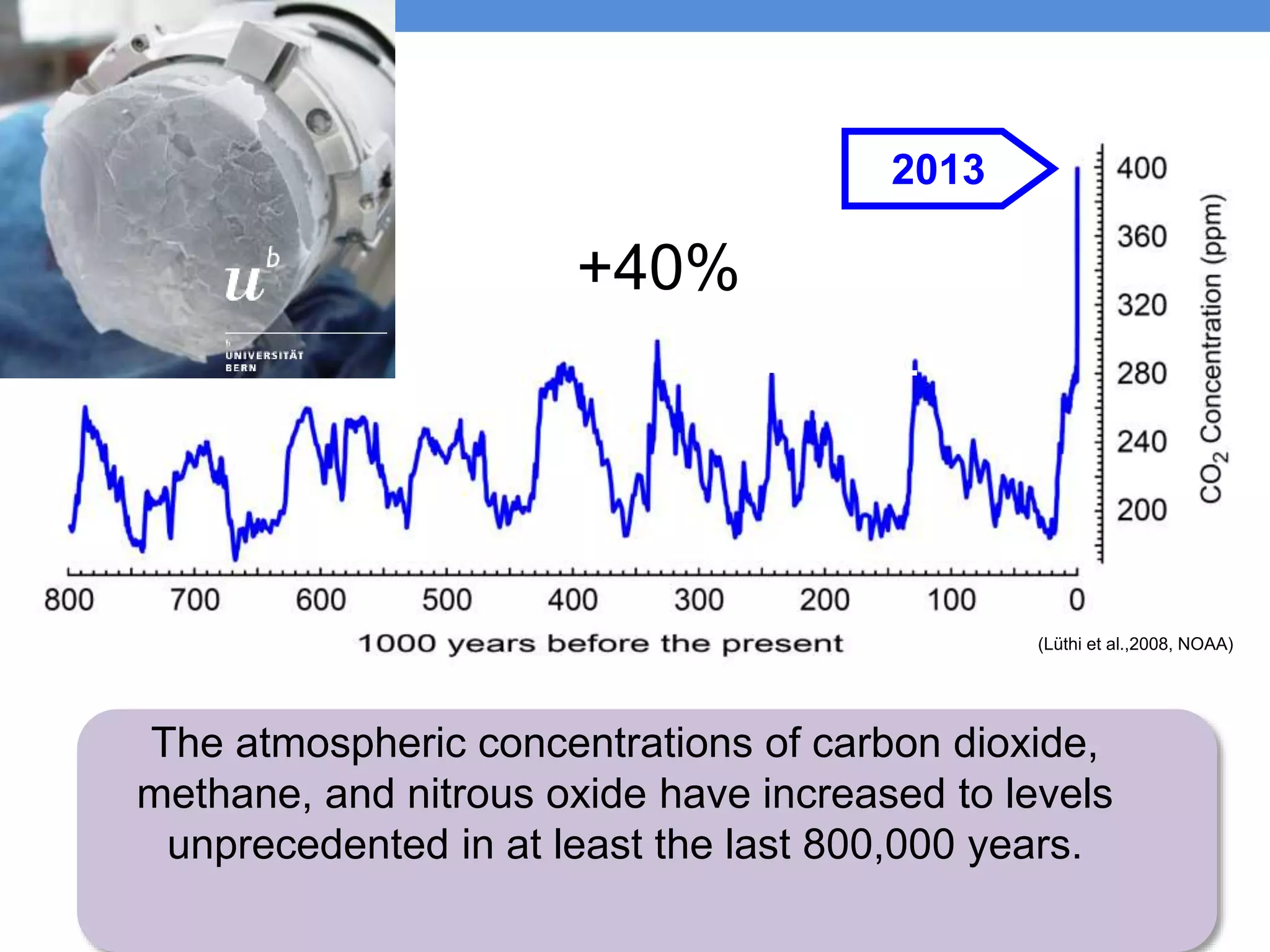
(Lüthi et al.,2008, NOAA)
+40%
2013
The atmospheric concentrations of carbon dioxide,
methane, and nitrous oxide have increased to levels
unprecedented in at least the last 800,000 years.
Human influence on the climate system is clear.
It is extremely likely that human influence has been the dominant cause of
the observed warming since the mid-20th century.
How will it Change?
Fig. SPM.7a
Global mean surface temperature change from 1986-2005
©IPCC2013
GMST change for the end of the 21st century is likely to exceed 1.5°C
relative to 1850-1900 for all RCPs except under mitigation scenario with
very low forcing level (RCP2.6).
Warming will not be regionally
uniform!
RCP2.6 RCP8.5
Fig.SPM.8
TSTFE.1,Fig.2
The contrast in precipitation between wet and dry regions
and between wet and dry seasons will increase, [...]
©IPCC2013
Change in water cycle properties from 1986-2005 to 2081-2100 in RCP8.5
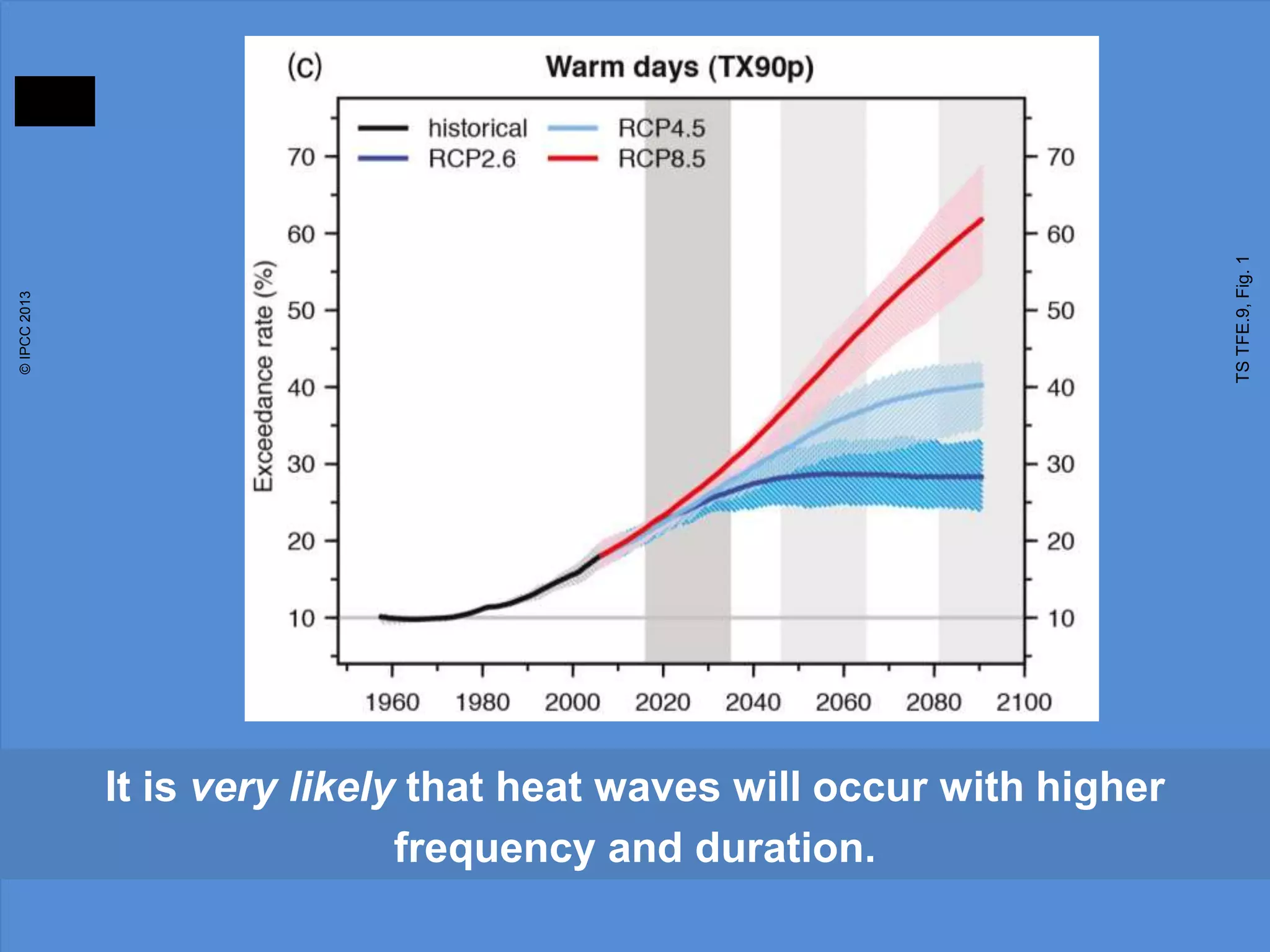
TSTFE.9,Fig.1
It is very likely that heat waves will occur with higher
frequency and duration.
©IPCC2013
RCP2.6 (2081-2100), likely range: 26 to 55 cm
RCP8.5 (in 2100), likely range: 52 to 98 cm
Fig. SPM.9
©IPCC2013
Global mean sea level will continue to rise during the 21st, due to
increased ocean warming and increased loss of mass from glaciers
and ice sheets.
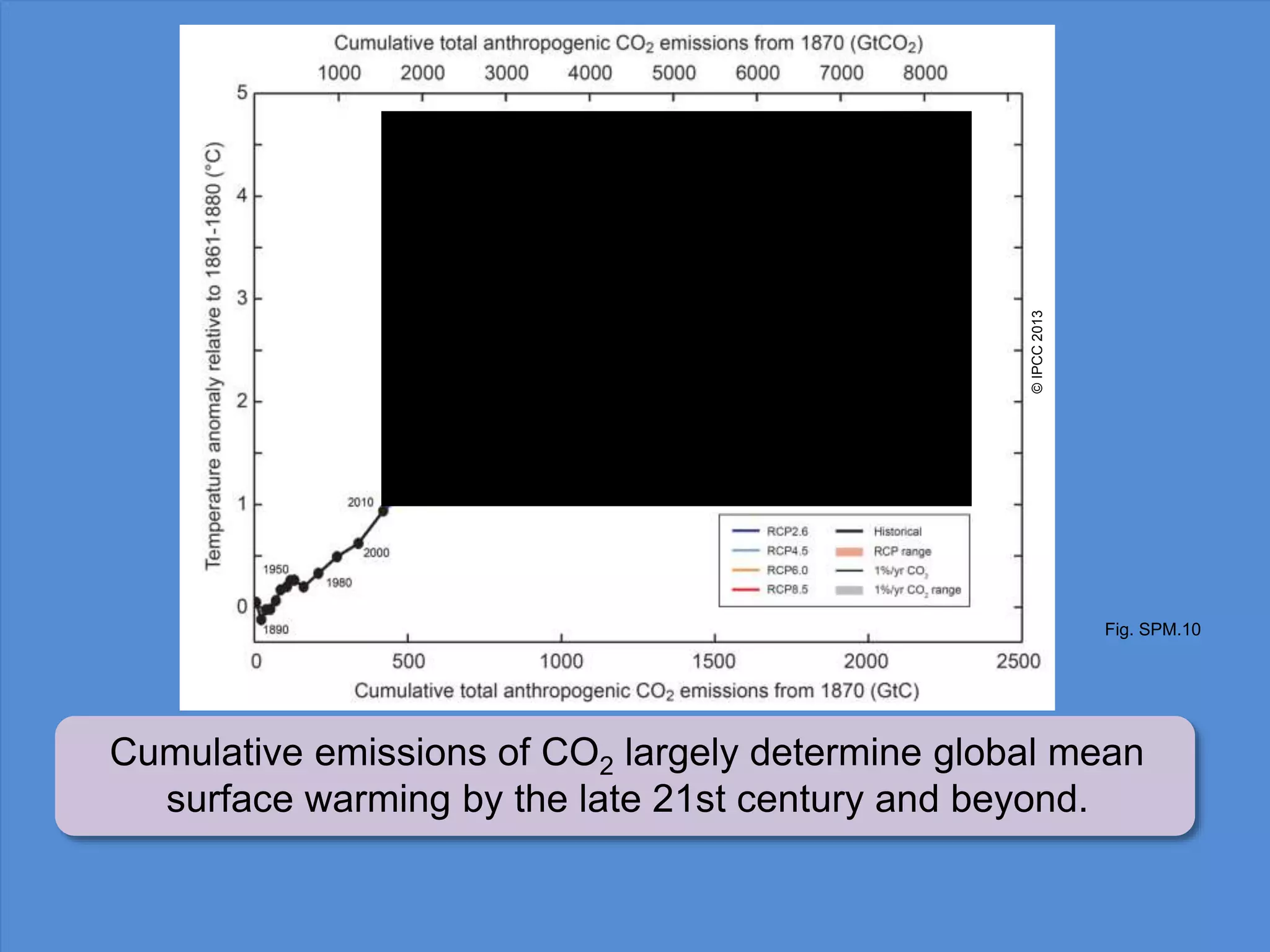
Cumulative emissions of CO2 largely determine global mean
surface warming by the late 21st century and beyond.
Fig. SPM.10
©IPCC2013
Fig. SPM.10
Limiting climate change will require substantial and
sustained reductions of greenhouse gas emissions.
©IPCC2013
1. Uncertainties in changes in circulation, cloudiness and
water cycle etc. will be reduced;
2. Confidences in large scale change in drought, cyclones,
and small scale extremes are expected to increase;
3. Understanding about process, feedback and sensitivity
and science will be improved.
4. Regionality will be further stressed!
5. Linkage to impacts, adaptation and mitigation will be
strengthened!
…………
Topics of likely interest for AR6
@IPCCNews
IPCC_Climate_Change
http://www.slideshare.net/ipcc-
media/presentations
https://www.youtube.com/c/ipccgeneva
Find us on:
Website: http://ipcc.ch/
IPCC Secretariat: ipcc-sec@wmo.int
IPCC Press Office: ipcc-media@wmo.int
@IPCC_CH
https://www.linkedin.com/company/ipcc
https://www.flickr.com/photos/ipccphoto/sets/
https://vimeo.com/ipcc
THANK YOU FOR YOUR ATTENTION!
For more information:
Data: Scripps/NOAA-ESRL
Observation of atmospheric component is a key
evidence of global warming, which can directly reflect
radiative forcing (RF), caused by human emission.
大气成分的观测能直接反应人类活动引起的
辐射强迫,是认识气候变暖成因的关键证据

Climate Change: The Physical Science Basis

  • 1.
    Climate Change: ThePhysical Science Basis Panmao Zhai, Co-Chair IPCC WGI
  • 2.
    What has Changed? Whyhas it changed ? How will it change?
  • 3.
  • 4.
    Fig.SPM.1b Temperature Difference 1901to 2012 based on trend (°C) Warming of the climate system is unequivocal, [...] © IPCC 2013
  • 5.
    Updated Monitoring onchanges in global mean temperature and ocean heat content  Recent observations confirm the warming trend continues!  2015 is 1.0℃ above pre-industrial level! Only 0.5C space?  More than 90% of the energy stored in the ocean! Source: Columbia University/NASA
  • 6.
    China Coastal AveragedSea-Level Change Mean sea level rise rate in China coastal is 3.0mm yr-1 between 1981 and 2014, higher than the global average (1.7mm/y). Contribution of Climate Change to Sea Level Rise in China The rate of sea level rise since the mid-19th century has been larger than the mean rate during the previous two millennia (high confidence). Over the period 1901 to 2010, global mean sea level rose by 0.19 m.
  • 7.
    Multiple Lines ofEvidence for Climate Change :  Warming atmosphere & ocean, snow and ice melting, and sea level rising , ……, all reflect consistent warming trend.
  • 8.
    • Regional differencesare obvious in precipitation changes, but long term observations are incomplete in many regions, especially at centeninal time scale!
  • 9.
    Why has itchanged?
  • 10.
    Change in CO2,CH4,….. Surface absorption (change in albedo) Warming of the earth surface depends on radiation budget of the Climate System.
  • 11.
    No long termtrend has been observed in surface solar radiation.
  • 12.
    (Lüthi et al.,2008,NOAA) +40% 2013 The atmospheric concentrations of carbon dioxide, methane, and nitrous oxide have increased to levels unprecedented in at least the last 800,000 years.
  • 13.
    Human influence onthe climate system is clear. It is extremely likely that human influence has been the dominant cause of the observed warming since the mid-20th century.
  • 14.
    How will itChange?
  • 15.
    Fig. SPM.7a Global meansurface temperature change from 1986-2005 ©IPCC2013 GMST change for the end of the 21st century is likely to exceed 1.5°C relative to 1850-1900 for all RCPs except under mitigation scenario with very low forcing level (RCP2.6).
  • 16.
    Warming will notbe regionally uniform! RCP2.6 RCP8.5 Fig.SPM.8
  • 17.
    TSTFE.1,Fig.2 The contrast inprecipitation between wet and dry regions and between wet and dry seasons will increase, [...] ©IPCC2013 Change in water cycle properties from 1986-2005 to 2081-2100 in RCP8.5
  • 18.
    TSTFE.9,Fig.1 It is verylikely that heat waves will occur with higher frequency and duration. ©IPCC2013
  • 19.
    RCP2.6 (2081-2100), likelyrange: 26 to 55 cm RCP8.5 (in 2100), likely range: 52 to 98 cm Fig. SPM.9 ©IPCC2013 Global mean sea level will continue to rise during the 21st, due to increased ocean warming and increased loss of mass from glaciers and ice sheets.
  • 20.
    Cumulative emissions ofCO2 largely determine global mean surface warming by the late 21st century and beyond. Fig. SPM.10 ©IPCC2013
  • 21.
    Fig. SPM.10 Limiting climatechange will require substantial and sustained reductions of greenhouse gas emissions. ©IPCC2013
  • 22.
    1. Uncertainties inchanges in circulation, cloudiness and water cycle etc. will be reduced; 2. Confidences in large scale change in drought, cyclones, and small scale extremes are expected to increase; 3. Understanding about process, feedback and sensitivity and science will be improved. 4. Regionality will be further stressed! 5. Linkage to impacts, adaptation and mitigation will be strengthened! ………… Topics of likely interest for AR6
  • 23.
    @IPCCNews IPCC_Climate_Change http://www.slideshare.net/ipcc- media/presentations https://www.youtube.com/c/ipccgeneva Find us on: Website:http://ipcc.ch/ IPCC Secretariat: ipcc-sec@wmo.int IPCC Press Office: ipcc-media@wmo.int @IPCC_CH https://www.linkedin.com/company/ipcc https://www.flickr.com/photos/ipccphoto/sets/ https://vimeo.com/ipcc THANK YOU FOR YOUR ATTENTION! For more information: Data: Scripps/NOAA-ESRL
  • 24.
    Observation of atmosphericcomponent is a key evidence of global warming, which can directly reflect radiative forcing (RF), caused by human emission. 大气成分的观测能直接反应人类活动引起的 辐射强迫,是认识气候变暖成因的关键证据