Silberschatz, Galvin and Gagne 2002
A.1
Operating System Concepts
Module A: The FreeBSD System
 History
 Design Principles
 Programmer Interface
 User Interface
 Process Management
 Memory Management
 File System
 I/O System
 Interprocess Communication
Silberschatz, Galvin and Gagne 2002
A.2
Operating System Concepts
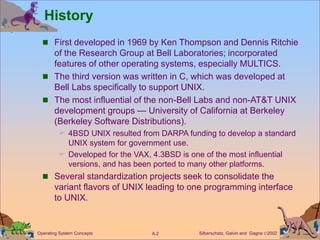
History
 First developed in 1969 by Ken Thompson and Dennis Ritchie
of the Research Group at Bell Laboratories; incorporated
features of other operating systems, especially MULTICS.
 The third version was written in C, which was developed at
Bell Labs specifically to support UNIX.
 The most influential of the non-Bell Labs and non-AT&T UNIX
development groups — University of California at Berkeley
(Berkeley Software Distributions).
 4BSD UNIX resulted from DARPA funding to develop a standard
UNIX system for government use.
 Developed for the VAX, 4.3BSD is one of the most influential
versions, and has been ported to many other platforms.
 Several standardization projects seek to consolidate the
variant flavors of UNIX leading to one programming interface
to UNIX.
Silberschatz, Galvin and Gagne 2002
A.3
Operating System Concepts
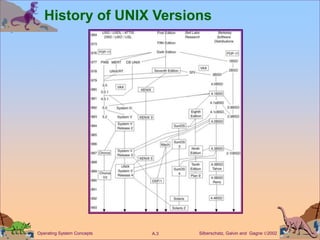
History of UNIX Versions
Silberschatz, Galvin and Gagne 2002
A.4
Operating System Concepts
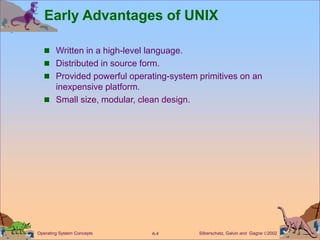
Early Advantages of UNIX
 Written in a high-level language.
 Distributed in source form.
 Provided powerful operating-system primitives on an
inexpensive platform.
 Small size, modular, clean design.
Silberschatz, Galvin and Gagne 2002
A.5
Operating System Concepts
UNIX Design Principles
 Designed to be a time-sharing system.
 Has a simple standard user interface (shell) that can be
replaced.
 File system with multilevel tree-structured directories.
 Files are supported by the kernel as unstructured
sequences of bytes.
 Supports multiple processes; a process can easily create
new processes.
 High priority given to making system interactive, and
providing facilities for program development.
Silberschatz, Galvin and Gagne 2002
A.6
Operating System Concepts
Programmer Interface
 Kernel: everything below the system-call interface and
above the physical hardware.
 Provides file system, CPU scheduling, memory
management, and other OS functions through system calls.
 Systems programs: use the kernel-supported system
calls to provide useful functions, such as compilation and
file manipulation.
Like most computer systems, UNIX consists of two separable parts:
Silberschatz, Galvin and Gagne 2002
A.7
Operating System Concepts
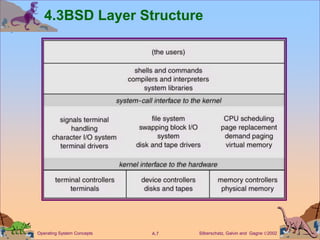
4.3BSD Layer Structure
Silberschatz, Galvin and Gagne 2002
A.8
Operating System Concepts
System Calls
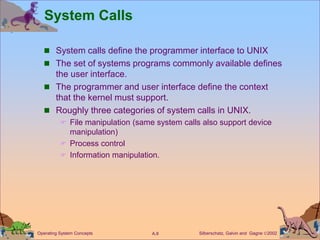
 System calls define the programmer interface to UNIX
 The set of systems programs commonly available defines
the user interface.
 The programmer and user interface define the context
that the kernel must support.
 Roughly three categories of system calls in UNIX.
 File manipulation (same system calls also support device
manipulation)
 Process control
 Information manipulation.
Silberschatz, Galvin and Gagne 2002
A.9
Operating System Concepts
File Manipulation
 A file is a sequence of bytes; the kernel does not impose
a structure on files.
 Files are organized in tree-structured directories.
 Directories are files that contain information on how to
find other files.
 Path name: identifies a file by specifying a path through
the directory structure to the file.
 Absolute path names start at root of file system
 Relative path names start at the current directory
 System calls for basic file manipulation: create, open,
read, write, close, unlink, trunc.
Silberschatz, Galvin and Gagne 2002
A.10
Operating System Concepts
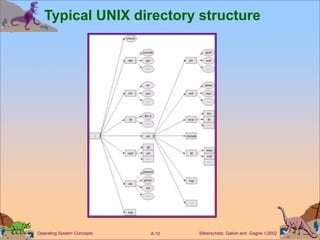
Typical UNIX directory structure
Silberschatz, Galvin and Gagne 2002
A.11
Operating System Concepts
Process Control
 A process is a program in execution.
 Processes are identified by their process identifier, an
integer.
 Process control system calls
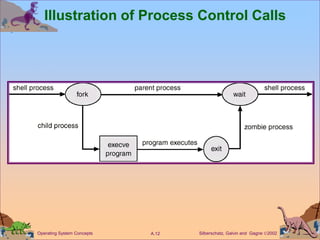
 fork creates a new process
 execve is used after a fork to replace on of the two
processes’s virtual memory space with a new program
 exit terminates a process
 A parent may wait for a child process to terminate; wait
provides the process id of a terminated child so that the
parent can tell which child terminated.
 wait3 allows the parent to collect performance statistics
about the child
 A zombie process results when the parent of a defunct
child process exits before the terminated child.
Silberschatz, Galvin and Gagne 2002
A.12
Operating System Concepts
Illustration of Process Control Calls
Silberschatz, Galvin and Gagne 2002
A.13
Operating System Concepts
Process Control (Cont.)
 Processes communicate via pipes; queues of bytes
between two processes that are accessed by a file
descriptor.
 All user processes are descendants of one original
process, init.
 init forks a getty process: initializes terminal line
parameters and passes the user’s login name to login.
 login sets the numeric user identifier of the process to that
of the user
 executes a shell which forks subprocesses for user
commands.
Silberschatz, Galvin and Gagne 2002
A.14
Operating System Concepts
Process Control (Cont.)
 setuid bit sets the effective user identifier of the process
to the user identifier of the owner of the file, and leaves
the real user identifier as it was.
 setuid scheme allows certain processes to have more
than ordinary privileges while still being executable by
ordinary users.
Silberschatz, Galvin and Gagne 2002
A.15
Operating System Concepts
Signals
 Facility for handling exceptional conditions similar to
software interrupts.
 The interrupt signal, SIGINT, is used to stop a command
before that command completes (usually produced by ^C).
 Signal use has expanded beyond dealing with exceptional
events.
 Start and stop subprocesses on demand
 SIGWINCH informs a process that the window in which output
is being displayed has changed size.
 Deliver urgent data from network connections.
Silberschatz, Galvin and Gagne 2002
A.16
Operating System Concepts
Process Groups
 Set of related processes that cooperate to accomplish a
common task.
 Only one process group may use a terminal device for I/O
at any time.
 The foreground job has the attention of the user on the
terminal.
 Background jobs – nonattached jobs that perform their
function without user interaction.
 Access to the terminal is controlled by process group
signals.
Silberschatz, Galvin and Gagne 2002
A.17
Operating System Concepts
Process Groups (Cont.)
 Each job inherits a controlling terminal from its parent.
 If the process group of the controlling terminal matches the
group of a process, that process is in the foreground.
 SIGTTIN or SIGTTOU freezes a background process that
attempts to perform I/O; if the user foregrounds that
process, SIGCONT indicates that the process can now
perform I/O.
 SIGSTOP freezes a foreground process.
Silberschatz, Galvin and Gagne 2002
A.18
Operating System Concepts
Information Manipulation
 System calls to set and return an interval timer:
getitmer/setitmer.
 Calls to set and return the current time:
gettimeofday/settimeofday.
 Processes can ask for
 their process identifier: getpid
 their group identifier: getgid
 the name of the machine on which they are executing:
gethostname
Silberschatz, Galvin and Gagne 2002
A.19
Operating System Concepts
Library Routines
 The system-call interface to UNIX is supported and
augmented by a large collection of library routines
 Header files provide the definition of complex data
structures used in system calls.
 Additional library support is provided for mathematical
functions, network access, data conversion, etc.
Silberschatz, Galvin and Gagne 2002
A.20
Operating System Concepts
User Interface
 Programmers and users mainly deal with already existing
systems programs: the needed system calls are
embedded within the program and do not need to be
obvious to the user.
 The most common systems programs are file or directory
oriented.
 Directory: mkdir, rmdir, cd, pwd
 File: ls, cp, mv, rm
 Other programs relate to editors (e.g., emacs, vi) text
formatters (e.g., troff, TEX), and other activities.
Silberschatz, Galvin and Gagne 2002
A.21
Operating System Concepts
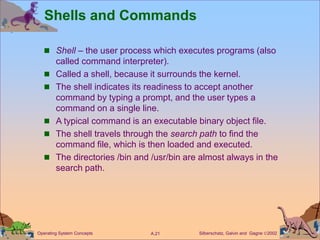
Shells and Commands
 Shell – the user process which executes programs (also
called command interpreter).
 Called a shell, because it surrounds the kernel.
 The shell indicates its readiness to accept another
command by typing a prompt, and the user types a
command on a single line.
 A typical command is an executable binary object file.
 The shell travels through the search path to find the
command file, which is then loaded and executed.
 The directories /bin and /usr/bin are almost always in the
search path.
Silberschatz, Galvin and Gagne 2002
A.22
Operating System Concepts
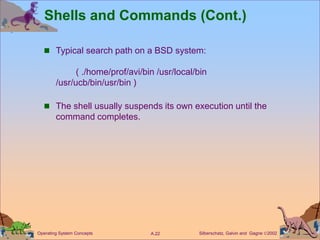
Shells and Commands (Cont.)
 Typical search path on a BSD system:
( ./home/prof/avi/bin /usr/local/bin
/usr/ucb/bin/usr/bin )
 The shell usually suspends its own execution until the
command completes.
Silberschatz, Galvin and Gagne 2002
A.23
Operating System Concepts
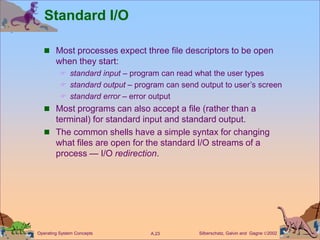
Standard I/O
 Most processes expect three file descriptors to be open
when they start:
 standard input – program can read what the user types
 standard output – program can send output to user’s screen
 standard error – error output
 Most programs can also accept a file (rather than a
terminal) for standard input and standard output.
 The common shells have a simple syntax for changing
what files are open for the standard I/O streams of a
process — I/O redirection.
Silberschatz, Galvin and Gagne 2002
A.24
Operating System Concepts
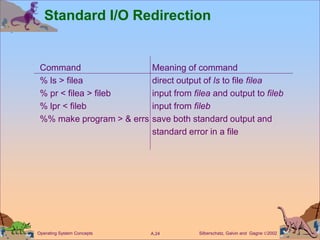
Standard I/O Redirection
Command Meaning of command
% ls > filea direct output of ls to file filea
% pr < filea > fileb input from filea and output to fileb
% lpr < fileb input from fileb
%% make program > & errs save both standard output and
standard error in a file
Silberschatz, Galvin and Gagne 2002
A.25
Operating System Concepts
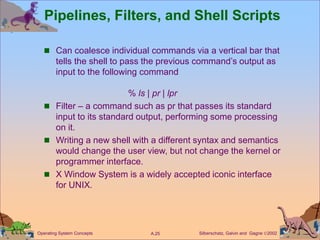
Pipelines, Filters, and Shell Scripts
 Can coalesce individual commands via a vertical bar that
tells the shell to pass the previous command’s output as
input to the following command
% ls | pr | lpr
 Filter – a command such as pr that passes its standard
input to its standard output, performing some processing
on it.
 Writing a new shell with a different syntax and semantics
would change the user view, but not change the kernel or
programmer interface.
 X Window System is a widely accepted iconic interface
for UNIX.
Silberschatz, Galvin and Gagne 2002
A.26
Operating System Concepts
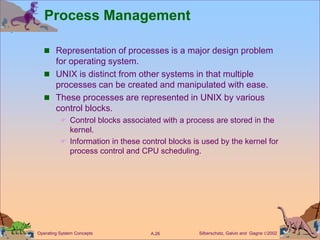
Process Management
 Representation of processes is a major design problem
for operating system.
 UNIX is distinct from other systems in that multiple
processes can be created and manipulated with ease.
 These processes are represented in UNIX by various
control blocks.
 Control blocks associated with a process are stored in the
kernel.
 Information in these control blocks is used by the kernel for
process control and CPU scheduling.
Silberschatz, Galvin and Gagne 2002
A.27
Operating System Concepts
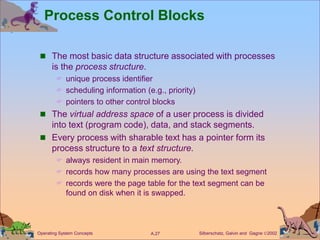
Process Control Blocks
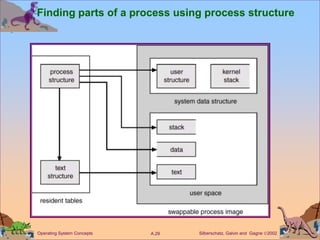
 The most basic data structure associated with processes
is the process structure.
 unique process identifier
 scheduling information (e.g., priority)
 pointers to other control blocks
 The virtual address space of a user process is divided
into text (program code), data, and stack segments.
 Every process with sharable text has a pointer form its
process structure to a text structure.
 always resident in main memory.
 records how many processes are using the text segment
 records were the page table for the text segment can be
found on disk when it is swapped.
Silberschatz, Galvin and Gagne 2002
A.28
Operating System Concepts
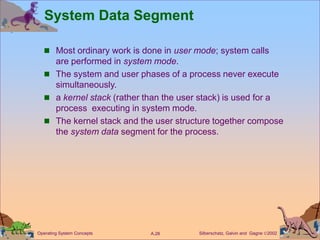
System Data Segment
 Most ordinary work is done in user mode; system calls
are performed in system mode.
 The system and user phases of a process never execute
simultaneously.
 a kernel stack (rather than the user stack) is used for a
process executing in system mode.
 The kernel stack and the user structure together compose
the system data segment for the process.
Silberschatz, Galvin and Gagne 2002
A.29
Operating System Concepts
Finding parts of a process using process structure
Silberschatz, Galvin and Gagne 2002
A.30
Operating System Concepts
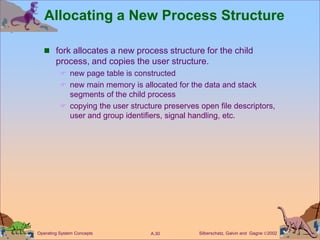
Allocating a New Process Structure
 fork allocates a new process structure for the child
process, and copies the user structure.
 new page table is constructed
 new main memory is allocated for the data and stack
segments of the child process
 copying the user structure preserves open file descriptors,
user and group identifiers, signal handling, etc.
Silberschatz, Galvin and Gagne 2002
A.31
Operating System Concepts
Allocating a New Process Structure (Cont.)
 vfork does not copy the data and stack to t he new
process; the new process simply shares the page table of
the old one.
 new user structure and a new process structure are still
created
 commonly used by a shell to execute a command and to
wait for its completion
 A parent process uses vfork to produce a child process;
the child uses execve to change its virtual address
space, so there is no need for a copy of the parent.
 Using vfork with a large parent process saves CPU time,
but can be dangerous since any memory change occurs
in both processes until execve occurs.
 execve creates no new process or user structure; rather
the text and data of the process are replaced.
Silberschatz, Galvin and Gagne 2002
A.32
Operating System Concepts
CPU Scheduling
 Every process has a scheduling priority associated with it;
larger numbers indicate lower priority.
 Negative feedback in CPU scheduling makes it difficult for
a single process to take all the CPU time.
 Process aging is employed to prevent starvation.
 When a process chooses to relinquish the CPU, it goes to
sleep on an event.
 When that event occurs, the system process that knows
about it calls wakeup with the address corresponding to
the event, and all processes that had done a sleep on the
same address are put in the ready queue to be run.
Silberschatz, Galvin and Gagne 2002
A.33
Operating System Concepts
Memory Management
 The initial memory management schemes were
constrained in size by the relatively small memory
resources of the PDP machines on which UNIX was
developed.
 Pre 3BSD system use swapping exclusively to handle
memory contention among processes: If there is too
much contention, processes are swapped out until
enough memory is available.
 Allocation of both main memory and swap space is done
first-fit.
Silberschatz, Galvin and Gagne 2002
A.34
Operating System Concepts
Memory Management (Cont.)
 Sharable text segments do not need to be swapped;
results in less swap traffic and reduces the amount of
main memory required for multiple processes using the
same text segment.
 The scheduler process (or swapper) decides which
processes to swap in or out, considering such factors as
time idle, time in or out of main memory, size, etc.
 In f.3BSD, swap space is allocated in pieces that are
multiples of power of 2 and minimum size, up to a
maximum size determined by the size or the swap-space
partition on the disk.
Silberschatz, Galvin and Gagne 2002
A.35
Operating System Concepts
Paging
 Berkeley UNIX systems depend primarily on paging for
memory-contention management, and depend only
secondarily on swapping.
 Demand paging – When a process needs a page and the
page is not there, a page fault tot he kernel occurs, a
frame of main memory is allocated, and the proper disk
page is read into the frame.
 A pagedaemon process uses a modified second-chance
page-replacement algorithm to keep enough free frames
to support the executing processes.
 If the scheduler decides that the paging system is
overloaded, processes will be swapped out whole until
the overload is relieved.
Silberschatz, Galvin and Gagne 2002
A.36
Operating System Concepts
File System
 The UNIX file system supports two main objects: files and
directories.
 Directories are just files with a special format, so the
representation of a file is the basic UNIX concept.
Silberschatz, Galvin and Gagne 2002
A.37
Operating System Concepts
Blocks and Fragments
 Most of the file system is taken up by data blocks.
 4.2BSD uses two block sized for files which have no
indirect blocks:
 All the blocks of a file are of a large block size (such as 8K),
except the last.
 The last block is an appropriate multiple of a smaller
fragment size (i.e., 1024) to fill out the file.
 Thus, a file of size 18,000 bytes would have two 8K blocks
and one 2K fragment (which would not be filled completely).
Silberschatz, Galvin and Gagne 2002
A.38
Operating System Concepts
Blocks and Fragments (Cont.)
 The block and fragment sizes are set during file-system
creation according to the intended use of the file system:
 If many small files are expected, the fragment size should
be small.
 If repeated transfers of large files are expected, the basic
block size should be large.
 The maximum block-to-fragment ratio is 8 : 1; the
minimum block size is 4K (typical choices are 4096 : 512
and 8192 : 1024).
Silberschatz, Galvin and Gagne 2002
A.39
Operating System Concepts
Inodes
 A file is represented by an inode — a record that stores
information about a specific file on the disk.
 The inode also contains 15 pointer to the disk blocks
containing the file’s data contents.
 First 12 point to direct blocks.
 Next three point to indirect blocks
 First indirect block pointer is the address of a single
indirect block — an index block containing the
addresses of blocks that do contain data.
 Second is a double-indirect-block pointer, the address of
a block that contains the addresses of blocks that
contain pointer to the actual data blocks.
 A triple indirect pointer is not needed; files with as many
as 232 bytes will use only double indirection.
Silberschatz, Galvin and Gagne 2002
A.40
Operating System Concepts
Directories
 The inode type field distinguishes between plain files and
directories.
 Directory entries are of variable length; each entry
contains first the length of the entry, then the file name
and the inode number.
 The user refers to a file by a path name,whereas the file
system uses the inode as its definition of a file.
 The kernel has to map the supplied user path name to an
inode
 Directories are used for this mapping.
Silberschatz, Galvin and Gagne 2002
A.41
Operating System Concepts
Directories (Cont.)
 First determine the starting directory:
 If the first character is “/”, the starting directory is the root
directory.
 For any other starting character, the starting directory is the
current directory.
 The search process continues until the end of the path
name is reached and the desired inode is returned.
 Once the inode is found, a file structure is allocated to
point to the inode.
 4.3BSD improved file system performance by adding a
directory name cache to hold recent directory-to-inode
translations.
Silberschatz, Galvin and Gagne 2002
A.42
Operating System Concepts
Mapping of a File Descriptor to an Inode
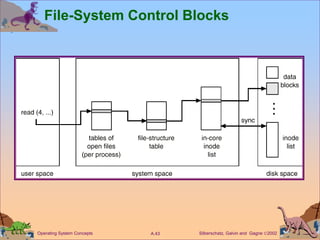
 System calls that refer to open files indicate the file is
passing a file descriptor as an argument.
 The file descriptor is used by the kernel to index a table of
open files for the current process.
 Each entry of the table contains a pointer to a file
structure.
 This file structure in turn points to the inode.
 Since the open file table has a fixed length which is only
setable at boot time, there is a fixed limit on the number
of concurrently open files in a system.
Silberschatz, Galvin and Gagne 2002
A.43
Operating System Concepts
File-System Control Blocks
Silberschatz, Galvin and Gagne 2002
A.44
Operating System Concepts
Disk Structures
 The one file system that a user ordinarily sees may
actually consist of several physical file systems, each on
a different device.
 Partitioning a physical device into multiple file systems
has several benefits.
 Different file systems can support different uses.
 Reliability is improved
 Can improve efficiency by varying file-system parameters.
 Prevents one program form using all available space for a
large file.
 Speeds up searches on backup tapes and restoring
partitions from tape.
Silberschatz, Galvin and Gagne 2002
A.45
Operating System Concepts
Disk Structures (Cont.)
 The root file system is always available on a drive.
 Other file systems may be mounted — i.e., integrated into
the directory hierarchy of the root file system.
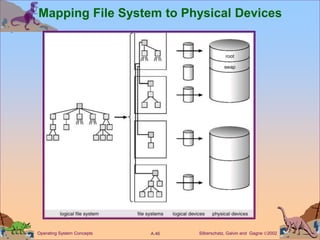
 The following figure illustrates how a directory structure is
partitioned into file systems, which are mapped onto
logical devices, which are partitions of physical devices.
Silberschatz, Galvin and Gagne 2002
A.46
Operating System Concepts
Mapping File System to Physical Devices
Silberschatz, Galvin and Gagne 2002
A.47
Operating System Concepts
Implementations
 The user interface to the file system is simple and well
defined, allowing the implementation of the file system itself
to be changed without significant effect on the user.
 For Version 7, the size of inodes doubled, the maximum file
and file system sized increased, and the details of free-list
handling and superblock information changed.
 In 4.0BSD, the size of blocks used in the file system was
increased form 512 bytes to 1024 bytes — increased
internal fragmentation, but doubled throughput.
 4.2BSD added the Berkeley Fast File System, which
increased speed, and included new features.
 New directory system calls
 truncate calls
 Fast File System found in most implementations of UNIX.
Silberschatz, Galvin and Gagne 2002
A.48
Operating System Concepts
Layout and Allocation Policy
 The kernel uses a <logical device number, inode
number> pair to identify a file.
 The logical device number defines the file system involved.
 The inodes in the file system are numbered in sequence.
 4.3BSD introduced the cylinder group — allows
localization of the blocks in a file.
 Each cylinder group occupies one or more consecutive
cylinders of the disk, so that disk accesses within the
cylinder group require minimal disk head movement.
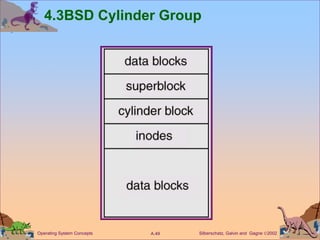
 Every cylinder group has a superblock, a cylinder block, an
array of inodes, and some data blocks.
Silberschatz, Galvin and Gagne 2002
A.49
Operating System Concepts
4.3BSD Cylinder Group
Silberschatz, Galvin and Gagne 2002
A.50
Operating System Concepts
I/O System
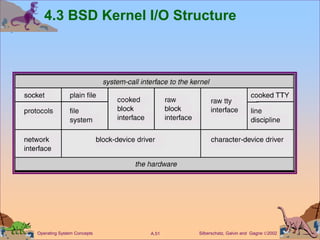
 The I/O system hides the peculiarities of I/O devices from
the bulk of the kernel.
 Consists of a buffer caching system, general device driver
code, and drivers for specific hardware devices.
 Only the device driver knows the peculiarities of a specific
device.
Silberschatz, Galvin and Gagne 2002
A.51
Operating System Concepts
4.3 BSD Kernel I/O Structure
Silberschatz, Galvin and Gagne 2002
A.52
Operating System Concepts
Block Buffer Cache
 Consist of buffer headers, each of which can point to a
piece of physical memory, as well as to a device number
and a block number on the device.
 The buffer headers for blocks not currently in use are kept
in several linked lists:
 Buffers recently used, linked in LRU order (LRU list).
 Buffers not recently used, or without valid contents (AGE
list).
 EMPTY buffers with no associated physical memory.
 When a block is wanted from a device, the cache is
searched.
 If the block is found it is used, and no I/O transfer is
necessary.
 If it is not found, a buffer is chosen from the AGE list, or
the LRU list if AGE is empty.
Silberschatz, Galvin and Gagne 2002
A.53
Operating System Concepts
Block Buffer Cache (Cont.)
 Buffer cache size effects system performance; if it is large
enough, the percentage of cache hits can be high and
the number of actual I/O transfers low.
 Data written to a disk file are buffered in the cache, and
the disk driver sorts its output queue according to disk
address — these actions allow the disk driver to minimize
disk head seeks and to write data at times optimized for
disk rotation.
Silberschatz, Galvin and Gagne 2002
A.54
Operating System Concepts
Raw Device Interfaces
 Almost every block device has a character interface, or
raw device interface — unlike the block interface, it
bypasses the block buffer cache.
 Each disk driver maintains a queue of pending transfers.
 Each record in the queue specifies:
 whether it is a read or a write
 a main memory address for the transfer
 a device address for the transfer
 a transfer size
 It is simple to map the information from a block buffer to
what is required for this queue.
Silberschatz, Galvin and Gagne 2002
A.55
Operating System Concepts
C-Lists
 Terminal drivers use a character buffering system which
involves keeping small blocks of characters in linked lists.
 A write system call to a terminal enqueues characters on
a list for the device. An initial transfer is started, and
interrupts cause dequeueing of characters and further
transfers.
 Input is similarly interrupt driven.
 It is also possible to have the device driver bypass the
canonical queue and return characters directly form the
raw queue — raw mode (used by full-screen editors and
other programs that need to react to every keystroke).
Silberschatz, Galvin and Gagne 2002
A.56
Operating System Concepts
Interprocess Communication
 Most UNIX systems have not permitted shared memory
because the PDP-11 hardware did not encourage it.
 The pipe is the IPC mechanism most characteristic of
UNIX.
 Permits a reliable unidirectional byte stream between two
processes.
 A benefit of pipes small size is that pipe data are seldom
written to disk; they usually are kept in memory by the
normal block buffer cache.
 In 4.3BSD, pipes are implemented as a special case of
the socket mechanism which provides a general interface
not only to facilities such as pipes, which are local to one
machine, but also to networking facilities.
 The socket mechanism can be used by unrelated
processes.
Silberschatz, Galvin and Gagne 2002
A.57
Operating System Concepts
Sockets
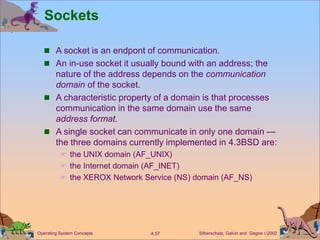
 A socket is an endpont of communication.
 An in-use socket it usually bound with an address; the
nature of the address depends on the communication
domain of the socket.
 A characteristic property of a domain is that processes
communication in the same domain use the same
address format.
 A single socket can communicate in only one domain —
the three domains currently implemented in 4.3BSD are:
 the UNIX domain (AF_UNIX)
 the Internet domain (AF_INET)
 the XEROX Network Service (NS) domain (AF_NS)
Silberschatz, Galvin and Gagne 2002
A.58
Operating System Concepts
Socket Types
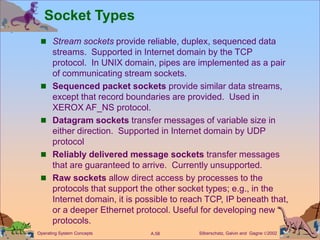
 Stream sockets provide reliable, duplex, sequenced data
streams. Supported in Internet domain by the TCP
protocol. In UNIX domain, pipes are implemented as a pair
of communicating stream sockets.
 Sequenced packet sockets provide similar data streams,
except that record boundaries are provided. Used in
XEROX AF_NS protocol.
 Datagram sockets transfer messages of variable size in
either direction. Supported in Internet domain by UDP
protocol
 Reliably delivered message sockets transfer messages
that are guaranteed to arrive. Currently unsupported.
 Raw sockets allow direct access by processes to the
protocols that support the other socket types; e.g., in the
Internet domain, it is possible to reach TCP, IP beneath that,
or a deeper Ethernet protocol. Useful for developing new
protocols.
Silberschatz, Galvin and Gagne 2002
A.59
Operating System Concepts
Socket System Calls
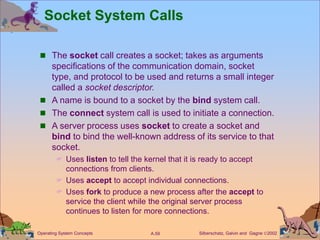
 The socket call creates a socket; takes as arguments
specifications of the communication domain, socket
type, and protocol to be used and returns a small integer
called a socket descriptor.
 A name is bound to a socket by the bind system call.
 The connect system call is used to initiate a connection.
 A server process uses socket to create a socket and
bind to bind the well-known address of its service to that
socket.
 Uses listen to tell the kernel that it is ready to accept
connections from clients.
 Uses accept to accept individual connections.
 Uses fork to produce a new process after the accept to
service the client while the original server process
continues to listen for more connections.
Silberschatz, Galvin and Gagne 2002
A.60
Operating System Concepts
Socket System Calls (Cont.)
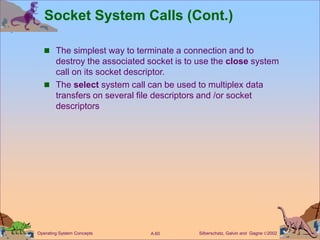
 The simplest way to terminate a connection and to
destroy the associated socket is to use the close system
call on its socket descriptor.
 The select system call can be used to multiplex data
transfers on several file descriptors and /or socket
descriptors
Silberschatz, Galvin and Gagne 2002
A.61
Operating System Concepts
Network Support
 Networking support is one of the most important features
in 4.3BSD.
 The socket concept provides the programming
mechanism to access other processes, even across a
network.
 Sockets provide an interface to several sets of protocols.
 Almost all current UNIX systems support UUCP.
 4.3BSD supports the DARPA Internet protocols UDP,
TCP, IP, and ICMP on a wide range of Ethernet, token-
ring, and ARPANET interfaces.
 The 4.3BSD networking implementation, and to a certain
extent the socket facility, is more oriented toward the
ARPANET Reference Model (ARM).
Silberschatz, Galvin and Gagne 2002
A.62
Operating System Concepts
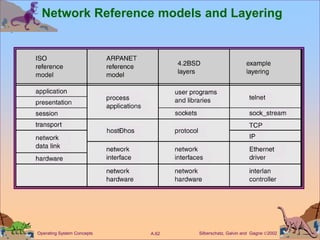
Network Reference models and Layering

FreeBSD operating system Concept for BCA

  • 1.
    Silberschatz, Galvin andGagne 2002 A.1 Operating System Concepts Module A: The FreeBSD System  History  Design Principles  Programmer Interface  User Interface  Process Management  Memory Management  File System  I/O System  Interprocess Communication
  • 2.
    Silberschatz, Galvin andGagne 2002 A.2 Operating System Concepts History  First developed in 1969 by Ken Thompson and Dennis Ritchie of the Research Group at Bell Laboratories; incorporated features of other operating systems, especially MULTICS.  The third version was written in C, which was developed at Bell Labs specifically to support UNIX.  The most influential of the non-Bell Labs and non-AT&T UNIX development groups — University of California at Berkeley (Berkeley Software Distributions).  4BSD UNIX resulted from DARPA funding to develop a standard UNIX system for government use.  Developed for the VAX, 4.3BSD is one of the most influential versions, and has been ported to many other platforms.  Several standardization projects seek to consolidate the variant flavors of UNIX leading to one programming interface to UNIX.
  • 3.
    Silberschatz, Galvin andGagne 2002 A.3 Operating System Concepts History of UNIX Versions
  • 4.
    Silberschatz, Galvin andGagne 2002 A.4 Operating System Concepts Early Advantages of UNIX  Written in a high-level language.  Distributed in source form.  Provided powerful operating-system primitives on an inexpensive platform.  Small size, modular, clean design.
  • 5.
    Silberschatz, Galvin andGagne 2002 A.5 Operating System Concepts UNIX Design Principles  Designed to be a time-sharing system.  Has a simple standard user interface (shell) that can be replaced.  File system with multilevel tree-structured directories.  Files are supported by the kernel as unstructured sequences of bytes.  Supports multiple processes; a process can easily create new processes.  High priority given to making system interactive, and providing facilities for program development.
  • 6.
    Silberschatz, Galvin andGagne 2002 A.6 Operating System Concepts Programmer Interface  Kernel: everything below the system-call interface and above the physical hardware.  Provides file system, CPU scheduling, memory management, and other OS functions through system calls.  Systems programs: use the kernel-supported system calls to provide useful functions, such as compilation and file manipulation. Like most computer systems, UNIX consists of two separable parts:
  • 7.
    Silberschatz, Galvin andGagne 2002 A.7 Operating System Concepts 4.3BSD Layer Structure
  • 8.
    Silberschatz, Galvin andGagne 2002 A.8 Operating System Concepts System Calls  System calls define the programmer interface to UNIX  The set of systems programs commonly available defines the user interface.  The programmer and user interface define the context that the kernel must support.  Roughly three categories of system calls in UNIX.  File manipulation (same system calls also support device manipulation)  Process control  Information manipulation.
  • 9.
    Silberschatz, Galvin andGagne 2002 A.9 Operating System Concepts File Manipulation  A file is a sequence of bytes; the kernel does not impose a structure on files.  Files are organized in tree-structured directories.  Directories are files that contain information on how to find other files.  Path name: identifies a file by specifying a path through the directory structure to the file.  Absolute path names start at root of file system  Relative path names start at the current directory  System calls for basic file manipulation: create, open, read, write, close, unlink, trunc.
  • 10.
    Silberschatz, Galvin andGagne 2002 A.10 Operating System Concepts Typical UNIX directory structure
  • 11.
    Silberschatz, Galvin andGagne 2002 A.11 Operating System Concepts Process Control  A process is a program in execution.  Processes are identified by their process identifier, an integer.  Process control system calls  fork creates a new process  execve is used after a fork to replace on of the two processes’s virtual memory space with a new program  exit terminates a process  A parent may wait for a child process to terminate; wait provides the process id of a terminated child so that the parent can tell which child terminated.  wait3 allows the parent to collect performance statistics about the child  A zombie process results when the parent of a defunct child process exits before the terminated child.
  • 12.
    Silberschatz, Galvin andGagne 2002 A.12 Operating System Concepts Illustration of Process Control Calls
  • 13.
    Silberschatz, Galvin andGagne 2002 A.13 Operating System Concepts Process Control (Cont.)  Processes communicate via pipes; queues of bytes between two processes that are accessed by a file descriptor.  All user processes are descendants of one original process, init.  init forks a getty process: initializes terminal line parameters and passes the user’s login name to login.  login sets the numeric user identifier of the process to that of the user  executes a shell which forks subprocesses for user commands.
  • 14.
    Silberschatz, Galvin andGagne 2002 A.14 Operating System Concepts Process Control (Cont.)  setuid bit sets the effective user identifier of the process to the user identifier of the owner of the file, and leaves the real user identifier as it was.  setuid scheme allows certain processes to have more than ordinary privileges while still being executable by ordinary users.
  • 15.
    Silberschatz, Galvin andGagne 2002 A.15 Operating System Concepts Signals  Facility for handling exceptional conditions similar to software interrupts.  The interrupt signal, SIGINT, is used to stop a command before that command completes (usually produced by ^C).  Signal use has expanded beyond dealing with exceptional events.  Start and stop subprocesses on demand  SIGWINCH informs a process that the window in which output is being displayed has changed size.  Deliver urgent data from network connections.
  • 16.
    Silberschatz, Galvin andGagne 2002 A.16 Operating System Concepts Process Groups  Set of related processes that cooperate to accomplish a common task.  Only one process group may use a terminal device for I/O at any time.  The foreground job has the attention of the user on the terminal.  Background jobs – nonattached jobs that perform their function without user interaction.  Access to the terminal is controlled by process group signals.
  • 17.
    Silberschatz, Galvin andGagne 2002 A.17 Operating System Concepts Process Groups (Cont.)  Each job inherits a controlling terminal from its parent.  If the process group of the controlling terminal matches the group of a process, that process is in the foreground.  SIGTTIN or SIGTTOU freezes a background process that attempts to perform I/O; if the user foregrounds that process, SIGCONT indicates that the process can now perform I/O.  SIGSTOP freezes a foreground process.
  • 18.
    Silberschatz, Galvin andGagne 2002 A.18 Operating System Concepts Information Manipulation  System calls to set and return an interval timer: getitmer/setitmer.  Calls to set and return the current time: gettimeofday/settimeofday.  Processes can ask for  their process identifier: getpid  their group identifier: getgid  the name of the machine on which they are executing: gethostname
  • 19.
    Silberschatz, Galvin andGagne 2002 A.19 Operating System Concepts Library Routines  The system-call interface to UNIX is supported and augmented by a large collection of library routines  Header files provide the definition of complex data structures used in system calls.  Additional library support is provided for mathematical functions, network access, data conversion, etc.
  • 20.
    Silberschatz, Galvin andGagne 2002 A.20 Operating System Concepts User Interface  Programmers and users mainly deal with already existing systems programs: the needed system calls are embedded within the program and do not need to be obvious to the user.  The most common systems programs are file or directory oriented.  Directory: mkdir, rmdir, cd, pwd  File: ls, cp, mv, rm  Other programs relate to editors (e.g., emacs, vi) text formatters (e.g., troff, TEX), and other activities.
  • 21.
    Silberschatz, Galvin andGagne 2002 A.21 Operating System Concepts Shells and Commands  Shell – the user process which executes programs (also called command interpreter).  Called a shell, because it surrounds the kernel.  The shell indicates its readiness to accept another command by typing a prompt, and the user types a command on a single line.  A typical command is an executable binary object file.  The shell travels through the search path to find the command file, which is then loaded and executed.  The directories /bin and /usr/bin are almost always in the search path.
  • 22.
    Silberschatz, Galvin andGagne 2002 A.22 Operating System Concepts Shells and Commands (Cont.)  Typical search path on a BSD system: ( ./home/prof/avi/bin /usr/local/bin /usr/ucb/bin/usr/bin )  The shell usually suspends its own execution until the command completes.
  • 23.
    Silberschatz, Galvin andGagne 2002 A.23 Operating System Concepts Standard I/O  Most processes expect three file descriptors to be open when they start:  standard input – program can read what the user types  standard output – program can send output to user’s screen  standard error – error output  Most programs can also accept a file (rather than a terminal) for standard input and standard output.  The common shells have a simple syntax for changing what files are open for the standard I/O streams of a process — I/O redirection.
  • 24.
    Silberschatz, Galvin andGagne 2002 A.24 Operating System Concepts Standard I/O Redirection Command Meaning of command % ls > filea direct output of ls to file filea % pr < filea > fileb input from filea and output to fileb % lpr < fileb input from fileb %% make program > & errs save both standard output and standard error in a file
  • 25.
    Silberschatz, Galvin andGagne 2002 A.25 Operating System Concepts Pipelines, Filters, and Shell Scripts  Can coalesce individual commands via a vertical bar that tells the shell to pass the previous command’s output as input to the following command % ls | pr | lpr  Filter – a command such as pr that passes its standard input to its standard output, performing some processing on it.  Writing a new shell with a different syntax and semantics would change the user view, but not change the kernel or programmer interface.  X Window System is a widely accepted iconic interface for UNIX.
  • 26.
    Silberschatz, Galvin andGagne 2002 A.26 Operating System Concepts Process Management  Representation of processes is a major design problem for operating system.  UNIX is distinct from other systems in that multiple processes can be created and manipulated with ease.  These processes are represented in UNIX by various control blocks.  Control blocks associated with a process are stored in the kernel.  Information in these control blocks is used by the kernel for process control and CPU scheduling.
  • 27.
    Silberschatz, Galvin andGagne 2002 A.27 Operating System Concepts Process Control Blocks  The most basic data structure associated with processes is the process structure.  unique process identifier  scheduling information (e.g., priority)  pointers to other control blocks  The virtual address space of a user process is divided into text (program code), data, and stack segments.  Every process with sharable text has a pointer form its process structure to a text structure.  always resident in main memory.  records how many processes are using the text segment  records were the page table for the text segment can be found on disk when it is swapped.
  • 28.
    Silberschatz, Galvin andGagne 2002 A.28 Operating System Concepts System Data Segment  Most ordinary work is done in user mode; system calls are performed in system mode.  The system and user phases of a process never execute simultaneously.  a kernel stack (rather than the user stack) is used for a process executing in system mode.  The kernel stack and the user structure together compose the system data segment for the process.
  • 29.
    Silberschatz, Galvin andGagne 2002 A.29 Operating System Concepts Finding parts of a process using process structure
  • 30.
    Silberschatz, Galvin andGagne 2002 A.30 Operating System Concepts Allocating a New Process Structure  fork allocates a new process structure for the child process, and copies the user structure.  new page table is constructed  new main memory is allocated for the data and stack segments of the child process  copying the user structure preserves open file descriptors, user and group identifiers, signal handling, etc.
  • 31.
    Silberschatz, Galvin andGagne 2002 A.31 Operating System Concepts Allocating a New Process Structure (Cont.)  vfork does not copy the data and stack to t he new process; the new process simply shares the page table of the old one.  new user structure and a new process structure are still created  commonly used by a shell to execute a command and to wait for its completion  A parent process uses vfork to produce a child process; the child uses execve to change its virtual address space, so there is no need for a copy of the parent.  Using vfork with a large parent process saves CPU time, but can be dangerous since any memory change occurs in both processes until execve occurs.  execve creates no new process or user structure; rather the text and data of the process are replaced.
  • 32.
    Silberschatz, Galvin andGagne 2002 A.32 Operating System Concepts CPU Scheduling  Every process has a scheduling priority associated with it; larger numbers indicate lower priority.  Negative feedback in CPU scheduling makes it difficult for a single process to take all the CPU time.  Process aging is employed to prevent starvation.  When a process chooses to relinquish the CPU, it goes to sleep on an event.  When that event occurs, the system process that knows about it calls wakeup with the address corresponding to the event, and all processes that had done a sleep on the same address are put in the ready queue to be run.
  • 33.
    Silberschatz, Galvin andGagne 2002 A.33 Operating System Concepts Memory Management  The initial memory management schemes were constrained in size by the relatively small memory resources of the PDP machines on which UNIX was developed.  Pre 3BSD system use swapping exclusively to handle memory contention among processes: If there is too much contention, processes are swapped out until enough memory is available.  Allocation of both main memory and swap space is done first-fit.
  • 34.
    Silberschatz, Galvin andGagne 2002 A.34 Operating System Concepts Memory Management (Cont.)  Sharable text segments do not need to be swapped; results in less swap traffic and reduces the amount of main memory required for multiple processes using the same text segment.  The scheduler process (or swapper) decides which processes to swap in or out, considering such factors as time idle, time in or out of main memory, size, etc.  In f.3BSD, swap space is allocated in pieces that are multiples of power of 2 and minimum size, up to a maximum size determined by the size or the swap-space partition on the disk.
  • 35.
    Silberschatz, Galvin andGagne 2002 A.35 Operating System Concepts Paging  Berkeley UNIX systems depend primarily on paging for memory-contention management, and depend only secondarily on swapping.  Demand paging – When a process needs a page and the page is not there, a page fault tot he kernel occurs, a frame of main memory is allocated, and the proper disk page is read into the frame.  A pagedaemon process uses a modified second-chance page-replacement algorithm to keep enough free frames to support the executing processes.  If the scheduler decides that the paging system is overloaded, processes will be swapped out whole until the overload is relieved.
  • 36.
    Silberschatz, Galvin andGagne 2002 A.36 Operating System Concepts File System  The UNIX file system supports two main objects: files and directories.  Directories are just files with a special format, so the representation of a file is the basic UNIX concept.
  • 37.
    Silberschatz, Galvin andGagne 2002 A.37 Operating System Concepts Blocks and Fragments  Most of the file system is taken up by data blocks.  4.2BSD uses two block sized for files which have no indirect blocks:  All the blocks of a file are of a large block size (such as 8K), except the last.  The last block is an appropriate multiple of a smaller fragment size (i.e., 1024) to fill out the file.  Thus, a file of size 18,000 bytes would have two 8K blocks and one 2K fragment (which would not be filled completely).
  • 38.
    Silberschatz, Galvin andGagne 2002 A.38 Operating System Concepts Blocks and Fragments (Cont.)  The block and fragment sizes are set during file-system creation according to the intended use of the file system:  If many small files are expected, the fragment size should be small.  If repeated transfers of large files are expected, the basic block size should be large.  The maximum block-to-fragment ratio is 8 : 1; the minimum block size is 4K (typical choices are 4096 : 512 and 8192 : 1024).
  • 39.
    Silberschatz, Galvin andGagne 2002 A.39 Operating System Concepts Inodes  A file is represented by an inode — a record that stores information about a specific file on the disk.  The inode also contains 15 pointer to the disk blocks containing the file’s data contents.  First 12 point to direct blocks.  Next three point to indirect blocks  First indirect block pointer is the address of a single indirect block — an index block containing the addresses of blocks that do contain data.  Second is a double-indirect-block pointer, the address of a block that contains the addresses of blocks that contain pointer to the actual data blocks.  A triple indirect pointer is not needed; files with as many as 232 bytes will use only double indirection.
  • 40.
    Silberschatz, Galvin andGagne 2002 A.40 Operating System Concepts Directories  The inode type field distinguishes between plain files and directories.  Directory entries are of variable length; each entry contains first the length of the entry, then the file name and the inode number.  The user refers to a file by a path name,whereas the file system uses the inode as its definition of a file.  The kernel has to map the supplied user path name to an inode  Directories are used for this mapping.
  • 41.
    Silberschatz, Galvin andGagne 2002 A.41 Operating System Concepts Directories (Cont.)  First determine the starting directory:  If the first character is “/”, the starting directory is the root directory.  For any other starting character, the starting directory is the current directory.  The search process continues until the end of the path name is reached and the desired inode is returned.  Once the inode is found, a file structure is allocated to point to the inode.  4.3BSD improved file system performance by adding a directory name cache to hold recent directory-to-inode translations.
  • 42.
    Silberschatz, Galvin andGagne 2002 A.42 Operating System Concepts Mapping of a File Descriptor to an Inode  System calls that refer to open files indicate the file is passing a file descriptor as an argument.  The file descriptor is used by the kernel to index a table of open files for the current process.  Each entry of the table contains a pointer to a file structure.  This file structure in turn points to the inode.  Since the open file table has a fixed length which is only setable at boot time, there is a fixed limit on the number of concurrently open files in a system.
  • 43.
    Silberschatz, Galvin andGagne 2002 A.43 Operating System Concepts File-System Control Blocks
  • 44.
    Silberschatz, Galvin andGagne 2002 A.44 Operating System Concepts Disk Structures  The one file system that a user ordinarily sees may actually consist of several physical file systems, each on a different device.  Partitioning a physical device into multiple file systems has several benefits.  Different file systems can support different uses.  Reliability is improved  Can improve efficiency by varying file-system parameters.  Prevents one program form using all available space for a large file.  Speeds up searches on backup tapes and restoring partitions from tape.
  • 45.
    Silberschatz, Galvin andGagne 2002 A.45 Operating System Concepts Disk Structures (Cont.)  The root file system is always available on a drive.  Other file systems may be mounted — i.e., integrated into the directory hierarchy of the root file system.  The following figure illustrates how a directory structure is partitioned into file systems, which are mapped onto logical devices, which are partitions of physical devices.
  • 46.
    Silberschatz, Galvin andGagne 2002 A.46 Operating System Concepts Mapping File System to Physical Devices
  • 47.
    Silberschatz, Galvin andGagne 2002 A.47 Operating System Concepts Implementations  The user interface to the file system is simple and well defined, allowing the implementation of the file system itself to be changed without significant effect on the user.  For Version 7, the size of inodes doubled, the maximum file and file system sized increased, and the details of free-list handling and superblock information changed.  In 4.0BSD, the size of blocks used in the file system was increased form 512 bytes to 1024 bytes — increased internal fragmentation, but doubled throughput.  4.2BSD added the Berkeley Fast File System, which increased speed, and included new features.  New directory system calls  truncate calls  Fast File System found in most implementations of UNIX.
  • 48.
    Silberschatz, Galvin andGagne 2002 A.48 Operating System Concepts Layout and Allocation Policy  The kernel uses a <logical device number, inode number> pair to identify a file.  The logical device number defines the file system involved.  The inodes in the file system are numbered in sequence.  4.3BSD introduced the cylinder group — allows localization of the blocks in a file.  Each cylinder group occupies one or more consecutive cylinders of the disk, so that disk accesses within the cylinder group require minimal disk head movement.  Every cylinder group has a superblock, a cylinder block, an array of inodes, and some data blocks.
  • 49.
    Silberschatz, Galvin andGagne 2002 A.49 Operating System Concepts 4.3BSD Cylinder Group
  • 50.
    Silberschatz, Galvin andGagne 2002 A.50 Operating System Concepts I/O System  The I/O system hides the peculiarities of I/O devices from the bulk of the kernel.  Consists of a buffer caching system, general device driver code, and drivers for specific hardware devices.  Only the device driver knows the peculiarities of a specific device.
  • 51.
    Silberschatz, Galvin andGagne 2002 A.51 Operating System Concepts 4.3 BSD Kernel I/O Structure
  • 52.
    Silberschatz, Galvin andGagne 2002 A.52 Operating System Concepts Block Buffer Cache  Consist of buffer headers, each of which can point to a piece of physical memory, as well as to a device number and a block number on the device.  The buffer headers for blocks not currently in use are kept in several linked lists:  Buffers recently used, linked in LRU order (LRU list).  Buffers not recently used, or without valid contents (AGE list).  EMPTY buffers with no associated physical memory.  When a block is wanted from a device, the cache is searched.  If the block is found it is used, and no I/O transfer is necessary.  If it is not found, a buffer is chosen from the AGE list, or the LRU list if AGE is empty.
  • 53.
    Silberschatz, Galvin andGagne 2002 A.53 Operating System Concepts Block Buffer Cache (Cont.)  Buffer cache size effects system performance; if it is large enough, the percentage of cache hits can be high and the number of actual I/O transfers low.  Data written to a disk file are buffered in the cache, and the disk driver sorts its output queue according to disk address — these actions allow the disk driver to minimize disk head seeks and to write data at times optimized for disk rotation.
  • 54.
    Silberschatz, Galvin andGagne 2002 A.54 Operating System Concepts Raw Device Interfaces  Almost every block device has a character interface, or raw device interface — unlike the block interface, it bypasses the block buffer cache.  Each disk driver maintains a queue of pending transfers.  Each record in the queue specifies:  whether it is a read or a write  a main memory address for the transfer  a device address for the transfer  a transfer size  It is simple to map the information from a block buffer to what is required for this queue.
  • 55.
    Silberschatz, Galvin andGagne 2002 A.55 Operating System Concepts C-Lists  Terminal drivers use a character buffering system which involves keeping small blocks of characters in linked lists.  A write system call to a terminal enqueues characters on a list for the device. An initial transfer is started, and interrupts cause dequeueing of characters and further transfers.  Input is similarly interrupt driven.  It is also possible to have the device driver bypass the canonical queue and return characters directly form the raw queue — raw mode (used by full-screen editors and other programs that need to react to every keystroke).
  • 56.
    Silberschatz, Galvin andGagne 2002 A.56 Operating System Concepts Interprocess Communication  Most UNIX systems have not permitted shared memory because the PDP-11 hardware did not encourage it.  The pipe is the IPC mechanism most characteristic of UNIX.  Permits a reliable unidirectional byte stream between two processes.  A benefit of pipes small size is that pipe data are seldom written to disk; they usually are kept in memory by the normal block buffer cache.  In 4.3BSD, pipes are implemented as a special case of the socket mechanism which provides a general interface not only to facilities such as pipes, which are local to one machine, but also to networking facilities.  The socket mechanism can be used by unrelated processes.
  • 57.
    Silberschatz, Galvin andGagne 2002 A.57 Operating System Concepts Sockets  A socket is an endpont of communication.  An in-use socket it usually bound with an address; the nature of the address depends on the communication domain of the socket.  A characteristic property of a domain is that processes communication in the same domain use the same address format.  A single socket can communicate in only one domain — the three domains currently implemented in 4.3BSD are:  the UNIX domain (AF_UNIX)  the Internet domain (AF_INET)  the XEROX Network Service (NS) domain (AF_NS)
  • 58.
    Silberschatz, Galvin andGagne 2002 A.58 Operating System Concepts Socket Types  Stream sockets provide reliable, duplex, sequenced data streams. Supported in Internet domain by the TCP protocol. In UNIX domain, pipes are implemented as a pair of communicating stream sockets.  Sequenced packet sockets provide similar data streams, except that record boundaries are provided. Used in XEROX AF_NS protocol.  Datagram sockets transfer messages of variable size in either direction. Supported in Internet domain by UDP protocol  Reliably delivered message sockets transfer messages that are guaranteed to arrive. Currently unsupported.  Raw sockets allow direct access by processes to the protocols that support the other socket types; e.g., in the Internet domain, it is possible to reach TCP, IP beneath that, or a deeper Ethernet protocol. Useful for developing new protocols.
  • 59.
    Silberschatz, Galvin andGagne 2002 A.59 Operating System Concepts Socket System Calls  The socket call creates a socket; takes as arguments specifications of the communication domain, socket type, and protocol to be used and returns a small integer called a socket descriptor.  A name is bound to a socket by the bind system call.  The connect system call is used to initiate a connection.  A server process uses socket to create a socket and bind to bind the well-known address of its service to that socket.  Uses listen to tell the kernel that it is ready to accept connections from clients.  Uses accept to accept individual connections.  Uses fork to produce a new process after the accept to service the client while the original server process continues to listen for more connections.
  • 60.
    Silberschatz, Galvin andGagne 2002 A.60 Operating System Concepts Socket System Calls (Cont.)  The simplest way to terminate a connection and to destroy the associated socket is to use the close system call on its socket descriptor.  The select system call can be used to multiplex data transfers on several file descriptors and /or socket descriptors
  • 61.
    Silberschatz, Galvin andGagne 2002 A.61 Operating System Concepts Network Support  Networking support is one of the most important features in 4.3BSD.  The socket concept provides the programming mechanism to access other processes, even across a network.  Sockets provide an interface to several sets of protocols.  Almost all current UNIX systems support UUCP.  4.3BSD supports the DARPA Internet protocols UDP, TCP, IP, and ICMP on a wide range of Ethernet, token- ring, and ARPANET interfaces.  The 4.3BSD networking implementation, and to a certain extent the socket facility, is more oriented toward the ARPANET Reference Model (ARM).
  • 62.
    Silberschatz, Galvin andGagne 2002 A.62 Operating System Concepts Network Reference models and Layering