PREMIER MINISTRE

Action Plan
for France
G8 OPEN DATA CHARTER

01

Context of the Open Government Data
policy in France

02
03

SGMAP / Mission Etalab
20 avenue de Segur
75007 Paris
01 42 75 80 00

Priorities for further development

04
Contact

Challenges to be overcome

Appendix
Action Plan for France
G8 OPEN DATA CHARTER

TITRE FICHE 01

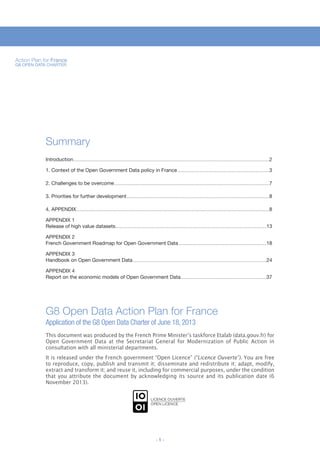
Summary
Introduction ............................................................................................................................................................................................2
1. Context of the Open Government Data policy in France ........................................................................................3
2. Challenges to be overcome.....................................................................................................................................................7
3. Priorities for further development .........................................................................................................................................8
4. APPENDIX .........................................................................................................................................................................................8
APPENDIX 1
Release of high value datasets.................................................................................................................................................13
APPENDIX 2
French Government Roadmap for Open Government Data ....................................................................................18
APPENDIX 3
Handbook on Open Government Data ................................................................................................................................24
APPENDIX 4
Report on the economic models of Open Government Data ..................................................................................37

G8 Open Data Action Plan for France
Application of the G8 Open Data Charter of June 18, 2013
This document was produced by the French Prime Minister’s taskforce Etalab (data.gouv.fr) for
Open Government Data at the Secretariat General for Modernization of Public Action in
consultation with all ministerial departments.

It is released under the French government “Open Licence” (“Licence Ouverte”). You are free
to reproduce, copy, publish and transmit it; disseminate and redistribute it; adapt, modify,
extract and transform it; and reuse it, including for commercial purposes, under the condition
that you attribute the document by acknowledging its source and its publication date (6
November 2013).

-1-
Action Plan for France
G8 OPEN DATA CHARTER

TITRE FICHE 01

Introduction
France, its government and its local authorities are strongly committed to Open Government Data.
This essential public policy is altogether:
1. A driver of democratic vitality,
2. A strategy to support economic and social innovation,
3. A catalyst for the modernization of public action.
Opening and sharing public data is a significant political commitment and stems from a long republican
and democratic tradition in France. Article 15 of the Declaration of the Rights of Man and of the Citizen,
adopted on 26 August 1789, states that "Society has the right to require of every public agent an
account of its administration."
Pursuant to this principle, France has gradually constructed a public right of access to
information and government documents, from the creation of the public archives service and the
public statistical service, the adoption of the Access to Administrative Documents Act in 1978 or the
creation of a major public service for the dissemination of law, to the transposition of the European
directive on Public Sector Information in 2005.
With the opening of open data portals for several local authorities in 2010, and the creation in 2011 of
the Prime Minister’s taskforce Etalab for Open Government Data, France has added to this democratic
imperative a resolute commitment to foster innovation, economic growth and the modernization
of public action.
The President of the Republic naturally supported the G8 Charter for Open Data adopted at the G8
Summit on 17 and 18 June 2013, where leaders called, in their final communiqué, for "open economies,
open societies and open governments".
In accordance with the terms of this charter, the present document reviews the context of the Open
Government Data policy in France, explains the main difficulties and challenges that it is facing at
the moment, and presents the main priorities for further development on which the government

intends to work in the future.

-2-
Context of the Open Government Data policy in France

01
Action Plan for France
G8 OPEN DATA CHARTER

Context of the Open Government
Data policy in France

France has recognized, since the Declaration of the Rights of Man and of the Citizen, that "Society has
the right to require of every public agent an account of its administration".
This expectation of public transparency was a common thread throughout our history. It was
expressed, for instance, with the recognition of a right to access the national archives (1794), the
creation of a major public service for statistical information (INSEE, 1946) or the establishment of a
public service for online access to the law.

Two essential laws laid the foundations of our republican model in the information society in
1978: the right to personal information protection, based on Act no. 78-17 of 6 January 1978 on dataprocessing, data files and individual liberties; and the right to access government data, stemming from
Act no. 78-753 of 17 July 1978 on the right to access administrative documents. These are defined as
follows: "(…) whatever their date, their place of retention, their form and their media, the documents
produced or received as part of their public-service duties by the State, local governments and other
persons coming under public or private law responsible for such duties. Such documents include
dossiers, records, studies, reports, minutes, statistics, directives, instructions, circulars, notes and
ministerial replies, correspondence, opinions, forecasts and decisions. (…)" (Article 1).
The right to access administrative documents has been recognized as a public freedom by the
Council of State (EC, 29 April 2002, U., no. 228830). In 1997, the Government extended the principle
by deciding to make "essential public data" available online free of charge. In 2003, Directive
2003/98/EC of the European Parliament and of the Council dated 17 November 2003 on the reuse of
public sector information, transposed by the order dated 6 June 2005 and the decree dated 30
December 2005, aimed to facilitate the reuse of existing documents held by public-sector
organizations. Decree no. 2011-577 dated 26 May 2011, on the reuse of public information held by
Government and the public sector, established the principle of free and open reuse of public data.
French Open Data policy was enhanced with the creation of taskforce Etalab (data.gouv.fr) by
Prime Ministerial decree of 21 February 2011. Attached to the Secretariat General for the Modernization
of Public Action, under the authority of the Prime Minister, taskforce Etalab is responsible for
coordinating public administrations — and supporting other entities with a public service mission —
in order to release their public data; developing the national Open Data platform data.gouv.fr to that
effect; and encouraging the reuse of public data by government itself as well as the private sector.
On 18 October 2011, the government announced the creation of the Open Licence (“Licence
Ouverte”) for open government data, which aims at enabling free reuse of public data, at no charge and
as broadly as possible. It was designed through an extensive consultation process with all relevant
stakeholders within government and amongst civil society.
On 17 May 2012, the ministers of the new government adopted a Charter of Ethics in which they
committed to promoting the release of open government data and its free reuse.
On 28 February 2013, at the government seminar on digital policy, the government presented its
roadmap for opening and sharing public data (see Appendix 2).

-3-
01

Context of the Open Government Data policy in France

On 17 September 2013, to clarify this policy and widen its understanding by public sector agents, the
Prime Minister also release a circular and a handbook on open government data (see Appendix 3).
Lastly, on 18 June 2013, President François Hollande adopted, along with the Heads of State and
governments of the G8, the G8 Open Data Charter, widely supported by France.

Main elements of context
The specific context of French Open Data policy is summarized below.

Governance and Leadership Structure:
1. Political Leadership: the Prime Minister determines and conducts Open Data policy in France. It
was specifically outlined in the Open Data roadmap dated 28 February 2013, and is regularly
updated during the meetings of the Inter-ministerial Committee on the Modernization of Public
Action (CIMAP) where all ministers with jurisdiction over the modernization of public action regularly
convene.
2. Inter-ministerial supervision: taskforce Etalab at the Secretariat General for the Modernization of
Public Action (SGMAP) — placed under the authority of the Prime Minister and available to the
Ministry for the Reform of the State, the Civil Service and Decentralization — is responsible for
coordinating and supporting the release of data by national administrations and agencies, to
encourage the broadest-possible reuse of their public sector information.
3. Network of coordinators and correspondents: An Open Data Steering Committee brings
together the Open Data coordinators who were appointed in each ministerial Secretary General. It
meets regularly to coordinate the action of the departments, and organizes a network of
correspondents within the civil service tasked with identifying and releasing public data.
4. Modernization of public action: the Prime Minister has also requested all ministries to specify
their strategies for opening public data in their "ministerial programs for modernization and
simplification" (PMMS).
5. Assessment, expert-appraisal and advice: the "Guidance Council for public publishing and
administrative information" (COEPIA) provides assessment, expert-appraisal and advice to the Prime
Minister in the fields of public publishing, administrative information and the provision of public data.
It oversees the allocation of resources and the quality of information services provided to users.

Supporting Public Administrations and Agencies:
On 17 September 2013, the Prime Minister issued a circular to Cabinet members stressing the
importance of Open Government Data policy. It requested the wide dissemination to public sector
agents of a handbook of Open Government Data intended to broaden their understanding of this
policy, the challenges they may face and the operational solutions to apply it in their department. This
practical guide aims at providing concrete answers to questions that public agents may currently have
(see Appendix 3).
The ministerial coordinators on the Open Data Steering Committee have also developed a network
of about 250 correspondents within their respective departments and agencies. Based on their
unique domain expertise, these correspondents work in a horizontal and decentralized fashion to
identify the public datasets each or their institutions produce as part of the public service they supply,
and release them as open data.

-4-
Context of the Open Government Data policy in France

01

Engagement with Stakeholders:
As much as possible, the French government intends to make Open Data a part of its broader effort
to modernize policy-making in consultation with civil society — notably engaging with the following
stakeholders:
1. Local authorities: Data.gouv.fr is open to all local authorities that wish to use it to release open data
to the public. Taskforce Etalab also regularly consults with the local authorities that have
spearheaded local open data policies in their constituencies. Etalab is also a founding member of
“Open Data France”, a non-profit established on 9 October 2013 to bring together French local
authorities committed to opening their data.
2. The innovation ecosystem: Taskforce Etalab established the “Dataconnexions” initiative to
encourage data-driven innovation. This series of contests aims at fostering innovation around public
data reuse, by engaging with the key stakeholders of the French innovation ecosystem to help
support the development of data-driven startups and projects.
3. Civil Society: On 14 may 2013, Etalab set up a network of experts, bringing together citizens, civil
society and researchers to help define the future orientations of the French government’s Open Data
policy.
4. Research: By supporting the Datalift research project, through its network of experts and through
the open public debate on research data (announced in the government's Open Data Roadmap),
Etalab seeks to encourage the use of public data for research as well as the development of data
sciences.
As an example of this commitment to openness and inclusiveness, the new Open Data platform
data.gouv.fr that will be launched in December 2013 was designed following an open, collaborative
design consultation. This “co-design” process resulted in more than 60 substantial written
contributions, and civil society organized more than 9 consultation events throughout France.

Platform:
Datasets released by public administrations, national agencies as well as some local authorities are
made available to the public on the national Open Data platform data.gouv.fr. This platform:
1. Explains the key features of the government’s Open Data policy to public data users;
2. Supplies access to raw data and a useful description of all datasets, in order to make them
understandable and easily re-usable.
3. Provides data in open formats to ensure anyone can access it easily and free of charge.
4. Provides data under an Open Licence so that anyone has the right to reuse it as broadly as is made
possible by law.
5. Seeks to highlight innovative applications of open data.

-5-
Context of the Open Government Data policy in France

01

International activities:
France — represented in particular by taskforce Etalab — cooperates with its international partners and
multilateral institutions to encourage openness and reuse of data in France, Europe and throughout the
world:
1. European "PSI" Directive: France played an important role in revising the European Directive on
Public Sector Information ("PSI"), particularly through our permanent representation to the European
Union.
2. Bilateral discussions with our diplomatic partners: France has encouraged the development of
Open Data policies amongst its international partners, through discussions on best practices and
participation in conferences or technical-assistance taskforces. In particular, it has established a
dialogue with the governments of Algeria, Morocco and Tunisia.
3. Work with the OECD on Open Government: France takes part in the effort to encourage the
development of transparent and open governments amongst the countries of the Deauville
Partnership, in connection with the Organization for Economic Cooperation and Development.
4. Discussions with the W3C on meta-data formats: taskforce Etalab has participated in the work
carried out by the W3C aiming to define the open DCAT standard, which seeks to facilitate the
exchange of meta-data between catalogues of open data.

-6-
2.

Challenges to be overcome

02
Action Plan for France
G8 OPEN DATA CHARTER

Challenges to be overcome

Encouraging the publication of comprehensive, high-quality and sustainable data: encouraging
the publication of comprehensive and high-quality data — particularly data with a strong societal
impact or high potential for economic and social innovation — by simplifying the use of data.gouv.fr;
by improving the understanding of Open Data by public agents who release it; and by stressing the
rules for the protection of privacy and the legal and regulatory context of public sector information.
Updating the economic model of public data provision: updating the economic model for the
provision of public data, particularly for high value data produced by large public sector operators;
ensuring the quality of the data being released, and that its production and continuous collection are
sustainable; while fostering open access and free reuse.

Developing a data-driven culture to modernize public action: encouraging the development of
innovative applications of data reuse; making openness a key aspect of the governance of large public
sector information systems; defining the data quality improvement effort expected of the civil service;
and, lastly, developing the application of data sciences by the public sector itself, based on Open Data
as an instrument of the modernization of public action, in order to develop a real culture of
experimentation and data-driven policy-making.

-7-
3.

Priorities for further development

03
Action Plan for France
G8 OPEN DATA CHARTER

Priorities for further development

This section explains the main priorities for further development of Open Government Data policy
that the government has assigned to itself in order to implement the G8 Open Data Charter.

Commitment 1:
Progress towards publishing data openly
by default

Public declaration of intent
France made an official announcement of its Open Data policy when it was introduced in 2011 (see
Context). Prime Minister Jean-Marc Ayrault stated the main principles of France's Open Data policy
on the occasion of the first Inter-ministerial Committee on the Modernization of Public Action (CIMAP)
on 18 December 2012; and on 28 February 2013, at the government seminar on digital policy, the
government presented its roadmap for Open Government Data (see Appendix 2).

High value data
The French government’s Open Data policy supports the release of high value datasets in order to
improve the functioning of our democracies and encourage innovative applications of public

data reuse.
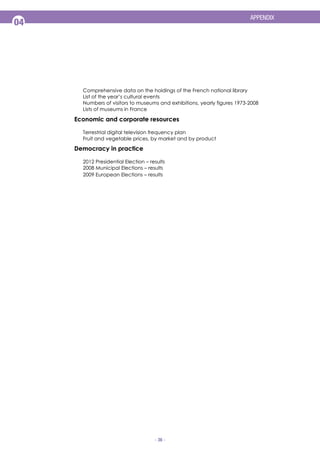
Amongst these, the following core datasets are already available on data.gouv.fr:
1. National statistics (macro-economic database, population census)
2. National maps (selection of IGN maps and databases)
3. Election results
4. National budgets (Finance Acts and associated budgetary appendices).
The government is committed to working with the various departments and agencies that produce
these datasets, and to continuously improve their accessibility, granularity and accuracy.
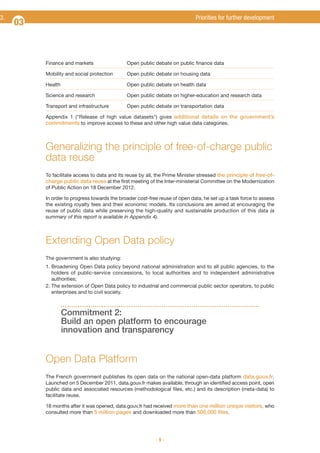
In order to progress towards publishing open data by default in the various categories recognized
as being of high value to the public by the G8 Charter, the government has adopted the following main
directions for further development:
Category of high-value data

Commitment

Worldwide development

IATI format publication as announced at the July 2013 meeting
of the Inter-ministerial Committee for International Cooperation
and Development

Environment

Open public debate on environmental risks data
-8-
3.

Priorities for further development

03

Finance and markets

Open public debate on public finance data

Mobility and social protection

Open public debate on housing data

Health

Open public debate on health data

Science and research

Open public debate on higher-education and research data

Transport and infrastructure

Open public debate on transportation data

Appendix 1 ("Release of high value datasets") gives additional details on the government’s
commitments to improve access to these and other high value data categories.

Generalizing the principle of free-of-charge public
data reuse
To facilitate access to data and its reuse by all, the Prime Minister stressed the principle of free-ofcharge public data reuse at the first meeting of the Inter-ministerial Committee on the Modernization
of Public Action on 18 December 2012.
In order to progress towards the broader cost-free reuse of open data, he set up a task force to assess
the existing royalty fees and their economic models. Its conclusions are aimed at encouraging the
reuse of public data while preserving the high-quality and sustainable production of this data (a
summary of this report is available in Appendix 4).

Extending Open Data policy
The government is also studying:
1. Broadening Open Data policy beyond national administration and to all public agencies, to the
holders of public-service concessions, to local authorities and to independent administrative
authorities;
2. The extension of Open Data policy to industrial and commercial public sector operators, to public
enterprises and to civil society.

Commitment 2:
Build an open platform to encourage
innovation and transparency

Open Data Platform
The French government publishes its open data on the national open-data platform data.gouv.fr.
Launched on 5 December 2011, data.gouv.fr makes available, through an identified access point, open
public data and associated resources (methodological files, etc.) and its description (meta-data) to
facilitate reuse.
18 months after it was opened, data.gouv.fr had received more than one million unique visitors, who
consulted more than 5 million pages and downloaded more than 500,000 files.

-9-
3.

Priorities for further development

03

Co-Design: 2nd generation of data.gouv.fr
After two years of work on data.gouv.fr, which saw the emergence and maturity of a French Open Data
community, on 10 April 2012, Etalab began a "Co-Design" operation, a collaborative co-design
process that broadly brought together the open-data ecosystem and the conclusions of which fuelled
the development of a new version of the data.gouv.fr platform. It will be opened to the public by
the end of 2013.
This next generation of the platform is a complete overhaul based on Open Source tools. It will take
into account usage feedback, user suggestions, requirements related to the increase in resources
made available online, the increase in the number of Open Data portals and new audiences interested
by the opening of public data.

Encouraging data reuse for innovation
and transparency
Following the Co-Design process, the next version of the "data.gouv.fr" platform was designed as a
platform open to all contributions and improvements shared by citizens.
This open design will improve the quality of data, encourage its use in the public debate for improving
transparency and promote innovation based on open data.

Commitment 3:
Develop Open Data policy in consultation
with citizens and civil society

Open public debates
To promote the opening of strategic and high-quality data which can be used to create services that
are useful on a daily basis, whether they are desired by citizens because of their democratic or practical
character, or because they meet a legal or regulatory requirement, taskforce Etalab will organize six
open public debates on specific themes to identify and publish new sets of data, covering the
following topics:
Q Health
Q Housing
Q Higher

education and research

Q Transport
Q Environmental

risks
Q Public expenditure
These debates will lead to a report that will be presented to the relevant ministries and that will make
recommendations on coherent datasets that should be made open and available, specifying the
benefits expected from these new releases. Through consultation mechanisms, these debates will
associate civil society and the various stakeholders to the development of the recommendations.

- 10 -
3.

Priorities for further development

03

Network of experts
On 14 May 2013, Etalab set up its network of experts to bring together citizens, civil society and
researchers to help define the future orientations of the French government’s Open Data policy.
Comprising of qualified individuals and thought leaders, its purpose is to provide taskforce Etalab
with its feedback and advice on France Open Data and Open Government strategy, specifically
taking into account its knowledge of best practices concerning access to and reuse of data, data
sciences and current trends in technology and computer science.
The network of experts provides feedback on policies and procedures it is presented with by
taskforce Etalab, may issue recommendations on the public data to be opened on data.gouv.fr, and
may also propose measures to accelerate the deployment of Open Data and Open Government in
France.

Commitment 4:
Support open innovation in France
and throughout the world

Catalyze the emergence of an ecosystem
of innovators
Taskforce Etalab will continue to support open data reuse projects by startups, innovative companies,
non-profits and large industrial groups. It will develop the DataConnexions program further in order to
foster and promote the most promising and exemplary cases of data-driven innovation based on Open
Data.

Encourage open standards and formats
The government has emphasized its commitment to open formats and will continue the provision of
data that, to the greatest extent possible, can be machine-readable in bulk. It will also progress towards
the automated provision of data through Application Programming Interfaces (API), to encourage
the creation of innovative applications of data reuse by the community of developers and hackers.
To ensure fair access to information and allow access to innovation for all, France is encouraging the
release of data under free and open formats, as well as the development of open applications. Insofar
as possible, the government will favor the development of web and mobile sites in open formats for
its online public services, rather than mobile applications on proprietary platforms.

- 11 -
3.

Priorities for further development

03

Encourage the opening of data throughout
the world
France reinstates its strong commitment to international and multilateral cooperation around
transparency and open government, through the continuation of its technical-assistance missions that
it has already carried out with its partners, by opening the Dataconnexions competitions to an
international audience and by widely supporting the best practices that it implements domestically, with
the translation and international dissemination of the French government’s “Handbook on Open
Government Data”.
The government believes that international cooperation is particularly important in the field of
transparency, Open Data and Open Government, which it strongly encourages as an avenue towards
a more open and a more transparent world.

- 12 -
APPENDIX

04
Action Plan for France
G8 OPEN DATA CHARTER

APPENDIX 1
Release of high value datasets
France is committed to an ambitious Open Data policy. A significant amount of public data has
already been made accessible to all, particularly through the data.gouv.fr platform and the local
platforms of local authorities.
In its roadmap dated 28 February 2013, the French Government expressed the wish to promote the
opening of strategic and high-quality data, whether it is used to create services that are useful on
a day-to-day basis, whether it is desired by citizens due to its democratic or practical character, or
whether its publication meets a legal or regulatory requirement.
The procedures for identifying data to be opened, in connection with the members of the network of
Open Data correspondents within departments and agencies, allow us to move towards a principle

of open data by default.
To put this principle in practice, the government has set itself specific objectives over the next two
years, aimed at releasing high value datasets among essential data categories to improve the
functioning of our democracies and encourage innovation.

Criminality and justice
The government currently makes the list of all criminal activity recorded by the Police and the
Gendarmerie, each month, in each department and in more than a hundred categories of crimes and
offences, available on data.gouv.fr. To improve the precision and granularity of this data, the
Government will begin work to publish, by 2015, more precise data on the location of events

recorded.
The Ministry of Justice, through the Statistics and Studies Sub-directorate (SDSE) will work to make
aggregate statistical data on convictions assigned to criminal records available in a reusable format
by 2015.

Culture
Public data from the cultural sector contributes to educating citizens and children, favoring the spread
of culture and the transmission of knowledge, while renewing the link between citizens and their culture.
The Ministry of Culture and Communication intends to deliver its full support to the Government’s
Open Data policy, and to encourage the further development of the data economy that is arising.
It commits to publishing a strategic roadmap on cultural Open Data which will inform its digital
economy policy, and to open sets of public data from the cultural sector more broadly, following on
the recommendations of its recent "Data Culture" report.

- 13 -
APPENDIX

04

International development
In accordance with the decision of the Inter-Ministerial Committee for International Cooperation and
Development dated 31 July 2013, France will aim to publish its data on development aid in the
format of the International Aid Transparency Initiative (IATI), starting as soon as 2014 for priority
partner countries.

Education
The Ministry of National Education and the National Office for Education and Career Information
(ONISEP) will work on the online availability of data on education to provide better information to
parents on available school services, the number of teachers, the number of pupils in establishments
and the localization of educational establishments.

Environment
To promote the release of strategic and high-quality data on environmental risks, taskforce Etalab will
organize an open public debate in connection with the Ministry of Environment, Sustainable
Development and Energy, to identify and publish new datasets in this field.
To improve the provision of information to citizens on water quality, the National Agency for Water and
Aquatic Environments (ONEMA) will work on releasing data from the information system used by the
public services covering water and sewerage.

Finance and public contracts
To promote the release of high-quality strategic data on public finances, taskforce Etalab will organize
an open public debate in connection with the financial ministries to identify and publish new sets of
data in this field.

Public contracts (awarded or future):
the Ministry for the Economy and Finance will work to publish, by 2015, all of the data relative to the
assignees of public contracts awarded by the State. It will also undertake to improve the provision
of data on the assignees of other public contracts, particularly those awarded by local authorities.

Local or national budget (planned or implemented):
the Ministry for the Economy and Finance will work to scale, generalize and accelerate the provision
of data on the initial and revised Finance Acts, and on the data contained in the Finance Acts’
"yellow" budgetary appendices.

Details of public expenditure:
The Budget Ministry and the Ministry for the Economy and Finance will work to provide, by 2015,
detailed data on Government expenditure beyond an amount to be determined.

- 14 -
APPENDIX

04

Mobility, social protection and employment
Housing:
In accordance with the decision of the Inter-ministerial Committee on the modernization of public
action (CIMAP) dated 18 December 2012, the Ministry of Territorial Equality and Housing will open, with
the support of the SGMAP, a themed public debate on housing data. This debate aims to widely
consult civil society and regional authorities to improve openness and the reuse of public data in the
field of housing.
The Government will work on the provision, by the end of 2015, of public data on rent levels resulting
from the work of the national network of rental observatories to be constituted.

Social Security:
the government will continue the provision of data on social security so as to promote the
assessment of the results and social and economic impact of public policies.

Employment market:
the government will work on still greater improvement of access for all to data on employment and

unemployment.

Earth observation
Meteorological conditions:
The French public weather forecasting service, Météo France, will undertake a study of possible future
changes to its economic model. It will continue its work on easier access to and reuse of historical data,
observations taken from the meteorological network and forecast data from digital models.

Fishing and hunting:
the Ministry of Ecology, Sustainable Development and Energy will work to provide detailed data on fish
resources by 2014.

Agriculture:
the Ministry of Agriculture, Food and Forestry will work to make even more detailed data available on
pesticides and will work to facilitate the use of data from the directory of veterinary surgeons and
approved laboratories.
France also takes part in the “Open Agriculture Data” initiative undertook at the 2012 G8 Summit. This
initiative aims to share pertinent agricultural data (for instance: economic data, genetic resources,
climate, environment, nutrition, plant protection, etc.) of G8 countries and beyond, to improve food
security worldwide, specifically in Africa. France will release data from existing French initiatives in
that field and will take necessary steps to ensure that intellectual property protection, privacy concerns
and stakeholder platforms interoperability issues are taken into account.

- 15 -
APPENDIX

04

Accountability, transparency and democracy
Election results:
The Ministry of the Interior will continue its policy of providing electoral results in a reusable format, and
will work on publishing the list of persons elected at each election. The Ministry of Foreign Affairs
will also provide the results of elections from polling stations located outside France.

Salaries:
the Ministry for the Reform of the State, the Civil Service and Decentralization will work to make data
available on salary scales and pay grades, particularly for senior positions in the national, local or
social civil service.

Front offices and points of contact for administrations / laws and regulations:
The Directorate of Legal and Administrative Information (DILA) at the service of the Prime Minister will
continue its effort to open public data contained in databases and information systems, particularly
concerning access to law and legal information.

Government activity:
The Government Information Service (SIG) is studying means of making available the public data
contained in the database of archived sites of previous governments.

Health
In accordance with the decision of the first Inter-ministerial Committee on the modernization of public
action (CIMAP) of 18 December 2012, the Ministry of Social Affairs and Health will launch an open
public debate on health data. A diverse commission bringing together all relevant stakeholders will
present recommendations to the government on improving the openness and ease of re-use of public
health data. It will be fueled by the conclusions of the review of the governance of health data from Mr
Pierre-Louis Bras, and based on a wide call for contributions from citizens.
The government will also study the provision of data relative to hygiene inspections in catering

establishments.

Science and research
The Ministry for Higher Education and Research will undertake an open public debate on research
data, with the support of SGMAP. This debate will aim to widely consult civil society and researchers
to improve openness and the reuse of public data in the field of higher education and research, and
to issue recommendations to encourage the development and applications of data sciences in France.
Recognizing the diverse relationships between research activity and public data (data on research,
data produced by research, data useful to research, research on data sciences), the Ministry will launch
the following two initiatives within this framework:
1. An audit of publicly available information on higher education, specifically on student
graduation rates training course by training course, conducted by a multi-party commission bringing
together all relevant stakeholders in accordance with Articles 6, 16 and 16a of the framework law
for higher education and research.
2. An international scientific conference planned for the beginning of 2014, covering research data
and its accessibility, in connection with the Open Data topic of the European framework program
"Horizon 2020".

- 16 -
APPENDIX

04

Transport and infrastructure
To allow fair and equal access to mobility for all, the Ministry of the Interior will work on providing data
on the results from driving schools.
In accordance with the decision of the first Inter-ministerial Committee on the modernization of public
action (CIMAP) of 18 December 2012, the Ministry of Ecology, Sustainable Development and Energy
will launch an open public debate on transport and mobility data, with the support of the SGMAP.
This debate will aim to widely consult civil society, re-users, professionals in the sector and users of
public-transport systems in order to issue recommendations to the government aiming to improve
openness and re-use of public data related to transport and mobility.

- 17 -
APPENDIX

04
Action Plan for France
G8 OPEN DATA CHARTER

APPENDIX 2
French Government Roadmap
for Open Government Data

On 28 February 2013, at the government seminar on digital policy, the Prime Minister
Jean-Marc Ayrault announced the French government’s "Roadmap for Open Government Data".

- 18 -
APPENDIX

04

Feuille de route du Gouvernement

French Government Roadmap
for Open Government Data
Opening Government Data: a public freedom and
a lever for innovation
The French government’s Open Data Strategy is based on Act no. 78-753 of 17 July 1978 on Access
to Administrative Documents, defined as follows: “irrespective of their date, place of storage, form or
format, documents drawn up or received, as part of their public service mission, by the State, local and
regional authorities as well as by other persons and bodies entrusted with such a mission. These
documents include files, reports, studies, records, minutes, statistics, orders, instructions, ministerial
circulars, memoranda or replies containing an interpretation of positive law or a description of
administrative procedures, recommendations, forecasts and decisions…” (Article 1).
The right to access administrative documents has been recognized as a public freedom by the Council
of State (EC, 29 April 2002, U., no. 228830). In 1997, the Government extended the principle by
deciding to make "essential public data" available online free of charge. In 2003, Directive 2003/98/EC
of the European Parliament and of the Council dated 17 November 2003 on the reuse of public sector
information, transposed by the order dated 6 June 2005 and the decree dated 30 December 2005,
aimed to facilitate the reuse of existing documents held by public-sector organizations. Decree no.
2011-577 dated 26 May 2011 on the reuse of public information held by Government and the public
sector established the principle of open and free reuse of public data.
On 21 February 2011, decree no. 2011-194 created the Prime Minister’s taskforce Etalab (data.gouv.fr)
for Open Government Data, the mission responsible for creating a single interdepartmental portal for
open government data, and for coordinating, managing and hosting the distribution of this public data.
With the digital revolution – which facilitates the production, distribution and processing of mass data
– sharing and opening public data has become a powerful lever for:
Q increasing

citizens' trust via greater transparency of public action (e.g. by putting online information
on public accounts, pollution or recorded offences);
Q allowing new forms of co-production with society and supporting social innovation (such as the
Handimap project which, as a result of data from the cities of Rennes and Montpellier, enabled the
development of an application for people with motor disabilities to plan their itineraries);
Q improving administrative operations (as seen by the heavy use of public data by the public sector
itself);
Q improving the effectiveness of public action by developing new organizational methods and new work
processes (such as road accident monitoring by the road safety authorities enabling improved road
layout);
Q supporting economic vitality by creating new resources for innovation and growth (as seen by the new,
innovative companies which received the DataConnexions awards);
Q contributing to France’s international influence and outreach (Open Government Partnership (OGP),
International Aid Transparency Initiative (IATI) and Extractive Industries Transparency Initiative (EITI)).

- 19 -
APPENDIX

04

The Government’s commitment to transparency
and open government data
As of the first Council of Ministers of this mandate, on 17 May 2012, the President of the French
Republic asked all members of the Government to sign a code of ethics, in particular recalling their
"duty of transparency", their "strict observance of the provisions guaranteeing citizens' access to
administrative documents” and their commitment to "work with determination for the free and easy
online access to a large amount of public data".
As he launched the Government’s Strategy for the Modernization of Public Action on 31 October 2012,
the Prime Minister reiterated the principles of the open government data policy set out by the Prime
Minister's circular of 26 May 2011, in particular each citizen's right to free and open access to public
data, or the strict supervision of charges for reusing public data.
By integrating task force Etalab into the General Secretariat for the Modernization of Public Action
(SGMAP), the Prime Minister built a global innovation force, bringing together design and overhaul of
government IT systems, open government data policy, evaluation of public policies and public policy
innovation.
Since the first ministerial committee for the modernization of public action (CIMAP) on 18 December
2012, the Government has taken three major decisions shaping its Open Data policy:
Q “Reiterate

the principle of free and open access to the re-use of public data, and extend it to local
governments, public service contractors, social security administrations and independent
administrative authorities";
Q “Launch, as of 2013, work on the transparency of public action and institutions, in particular by
opening up the debate on making data available in the areas of education, environmental risks,
transparency in the health system, transport availability, housing, the clarity of social security benefits
and public expenditure.”;
Q “Entrust to the SGMAP, in coordination with the Budget Ministry, the mission of assessing the
economic models of existing data provision charging scheme, in particular by auditing the associated
costs and income. The SGMAP must submit its proposals to the Prime Minister in spring 2013.”
Open government data is now well underway in France. In addition to the information shared (but not
always reusable) by the public service as regards access to law (Légifrance), the land register or
Géoportail (web mapping service), free access has been granted to numerous databases by the
administrations, public establishments and local authorities.
The Etalab mission developed a national platform for hosting and sharing open, free and reusable
public data (data.gouv.fr). It coordinates a network of open data users and data suppliers enabling
over 350,000 datasets to be published. Taskforce Etalab also worked on structuring the ecosystem of
data re-users (start-ups, associations, etc.), in particular by organizing the ‘DataConnexions’
competition, which allowed it to reward 12 particularly promising projects over two events.

- 20 -
APPENDIX

04

The Government’s ambition for open government
data
The Government wants to get the most out of this policy and make it a lever for modernizing public
action and supporting economic vitality.

1. Opening strategic public datasets
The government wants to encourage the release of high-quality strategic datasets, and wants them to
enable the creation of useful everyday services (such as for transport, environment, health, energy
consumption, tourism, etc.), to be in demand from citizens due to their democratic or practical nature
(budgets and expenditure set out by the administration) or that they meet a legal or regulatory demand
(publication of procurement assignees in line with Article 138 of the Public Procurement Code).
To do this, as of 2013 the SGMAP’s Etalab mission will organize six thematic and open public debates
in order to identify and publish new datasets. These debates will be entrusted to a committee
comprising the SGMAP and the relevant ministry, with a rapporteur or secretariat provided by Etalab;
a report will be drawn up, submitted to the Prime Minister and the relevant minister, who will make
recommendations as regards the coherent release of data and will set out the benefits that can be
expected.
In this framework, the Government will examine the possibilities:
Q of

expanding the strategy to open up public data to all public administrative establishments, to public
service contractors, to local and regional authorities and independent administrative authorities;
Q of extending the policy to open up public data to industrial and commercial public service missions,
public companies and associations.
Furthermore, the Prime Minister has asked all ministers to set out their strategy for opening up public
data in ministerial modernization and simplification programs, to be sent by mid-March.

2. Facilitate and improve the process of opening up public data in ministerial
departments, public sector bodies and local government
In 2013, Etalab will open a new version of the data.gouv.fr platform. While maintaining its task of widely
distributing raw data, it will eventually become a public showcase for opening up and sharing public
data. In particular, it will offer useful technical tools for taking ownership of said data (data visualization
tools, statistical processing, etc.).
Special attention must be paid to data indexation, its semantic treatment and links between this data.
Etalab, in collaboration with local and regional authorities and other public data producers, will work
on listing and presenting all freely-accessible and reusable public data, regardless of its source.
Similarly, Etalab will continue discussions with data suppliers on the importance of open formats and
the potential for technical convergence, and will set out to bring about greater interoperability between
the data.gouv.fr platform and the information systems of state, local and regional authorities and
European institutions.
Furthermore, as of 2013 Etalab will also launch on a roadmap for the distribution of public data via
application programming interfaces (APIs).

- 21 -
APPENDIX

04

3. Support innovative uses of data and an ecosystem of developers
The State promotes the maximum re-use of public data so that this policy of opening up supports a
strategy of innovation, including social innovation, and economic growth.

Government is the main user of high-quality public data
Public data is produced as part of a public service mission and the public service is often the first
beneficiary of their opening up. The production, collection and publication of data by the administration
must meet the needs of a high-quality public service. Etalab must therefore be available to
administrations to allow them to take these opportunities. In particular, it will organize training sessions,
could arrange ad-hoc workshops to analyze the potential of certain applications in the opening up of
public data (e.g. fight against unemployment) and will publish analysis notes of successful cases.

Government promotes the reuse of public data by companies to create innovative services
Etalab will continue to support innovative companies, the social and cooperative economy as well as
the major industrial groups in their public data re-use projects. In 2013, it will organize three
DataConnexions competitions, which will help identify and make known exemplary re-uses and will
support the organization of the French national open data conference, in collaboration with the Ministry
for Industrial Renewal, the Ministry for Small and Medium-sized Enterprises and the Ministry for the
Social and Cooperative Economy.

Government supports the commitment of citizens and associations to public data innovation
for the greater good and improved public services
Supporting the commitment of citizens and civic entrepreneurs to co-produce certain information, to
design new services or to help public actors to meet certain challenges is an integral part of Etalab’s
missions. In particular, it will organize competitions mobilizing citizens around data and objectives
shared by the State.

Support and promote data science research
‘Big Data’, the transformation of value chains, strategies and organizations based on the "data culture"
characterize the current forms of the digital revolution. To monitor this rapid revolution, Etalab, using
the same resources, will increase its cooperation with the sphere of higher learning and research and
by the end of 2013 will establish a panel of experts, bringing together technological experts, data
science specialists, jurists, economists and re-users (entrepreneurs or association leaders).

4. Transparency and a culture of data for the modernization of public action
The opening of public data is a major tool for the transformation of public services, in order to improve
its quality and enable it to be assessed by all users. Whenever relevant, the SGMAP will make sure to
build quantitative benchmarks, if possible in real time, to evaluate public policies, so that they can
create useful tools for driving these public policies. As set out by the CIMAP on 18 December 2012,
the SGMAP will work on designing innovations in the public services, using public data.

5. Exhaustive evaluation of existing data charging schemes
At the CIMAP on 18 December 2012, the Prime Minister, in collaboration with the Budget Ministry,
gave the SGMAP the task of assessing the economic models of existing charging schemes for data
provision, notably by auditing the associated costs and income. These recommendations will be
submitted in the first half of 2013.
Etalab and the SGMAP will help administrations which market public information support the
development of their economic models. Observance of the principle of citizens’ free and open access
to reusable public data should not preclude developing monetization strategies for high value-added
services or creating platforms.
- 22 -
APPENDIX

04

6. The evolving legal and administrative framework of open government data
A vade mecum recalling the legal framework for making public data available will be sent to the
Ministries to facilitate their commitment to opening up their data.
In particular, on the occasion of the revision of Directive 2003/98/EC of the European Parliament and
the Council of 17 November 2003 on the re-use of public sector information, the Government will hold
consultations aimed at updating, where necessary, the legal definitions governing the right to access
and re-use public data.

7. France’s international action
Finally, the Government places particular importance on France's influence in the world on the topics
of transparency, Open Data and Open Government. Task force Etalab will help support European Union
open data platform projects (in particular the site launched in early 2013 by the European Commission
(http://open-data.europa.eu/open-data/).
Furthermore, France is considering the opportunity of joining the Open Government Partnership (OGP)
to enter into successful cooperation with other governments working in that area. It will come in closer
contact with the Partnership in order to examine the terms of membership. Furthermore, France intends
to make a significant commitment to multilateral cooperation based around an approach of
transparency and Open Government.

- 23 -
APPENDIX

04
Action Plan for France
G8 OPEN DATA CHARTER

APPENDIX 3
Handbook on Open Government Data

On 13 September 2013, the Prime Minister Jean-Marc Ayrault sent members of the government a
circular announcing the publication of a "Handbook on Open Government Data".
This guide to France's policy on opening public data aims to facilitate the commitment of ministries
to this process, stressing the issues involved in sharing public data. It supplies a guide to its
implementation, providing practical questions and answers related to Open Data.
The distribution of this handbook to all ministries and all regional authorities will allow all agents
concerned to become involved in an ambitious policy of opening public data at the service of
modernizing public actions, democracy and economic dynamism.

- 24 -
APPENDIX

04

Handbook
on Open Government Data
September 2013

”

# 4
5 !  67  4
!
#
!
7  4
!
# 
!
7  4
#  7  #
17 8
!
! 
4
7 / )
4
#  7 8  
   4 !
) 7

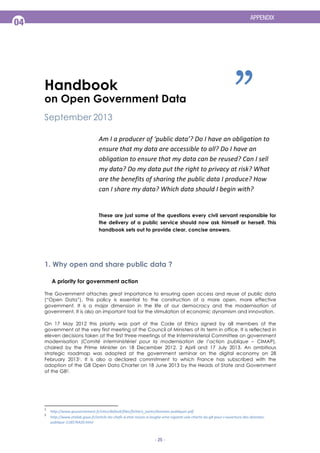
These are just some of the questions every civil servant responsible for
the delivery of a public service should now ask himself or herself. This
handbook sets out to provide clear, concise answers.

1. Why open and share public data ?
A priority for government action
The Government attaches great importance to ensuring open access and reuse of public data
(“Open Data”). This policy is essential to the construction of a more open, more effective
government. It is a major dimension in the life of our democracy and the modernisation of
government. It is also an important tool for the stimulation of economic dynamism and innovation.
On 17 May 2012 this priority was part of the Code of Ethics signed by all members of the
government at the very first meeting of the Council of Ministers of its term in office. It is reflected in
eleven decisions taken at the first three meetings of the Interministerial Committee on government
modernisation (Comité interministériel pour la modernisation de l’action publique – CIMAP),
chaired by the Prime Minister on 18 December 2012, 2 April and 17 July 2013. An ambitious
strategic roadmap was adopted at the government seminar on the digital economy on 28
February 20131. It is also a declared commitment to which France has subscribed with the
adoption of the G8 Open Data Charter on 18 June 2013 by the Heads of State and Government
of the G82.
.33)))$
#

France Open Data Action Plan - G8

  • 1.
    PREMIER MINISTRE Action Plan forFrance G8 OPEN DATA CHARTER 01 Context of the Open Government Data policy in France 02 03 SGMAP / Mission Etalab 20 avenue de Segur 75007 Paris 01 42 75 80 00 Priorities for further development 04 Contact Challenges to be overcome Appendix
  • 2.
    Action Plan forFrance G8 OPEN DATA CHARTER TITRE FICHE 01 Summary Introduction ............................................................................................................................................................................................2 1. Context of the Open Government Data policy in France ........................................................................................3 2. Challenges to be overcome.....................................................................................................................................................7 3. Priorities for further development .........................................................................................................................................8 4. APPENDIX .........................................................................................................................................................................................8 APPENDIX 1 Release of high value datasets.................................................................................................................................................13 APPENDIX 2 French Government Roadmap for Open Government Data ....................................................................................18 APPENDIX 3 Handbook on Open Government Data ................................................................................................................................24 APPENDIX 4 Report on the economic models of Open Government Data ..................................................................................37 G8 Open Data Action Plan for France Application of the G8 Open Data Charter of June 18, 2013 This document was produced by the French Prime Minister’s taskforce Etalab (data.gouv.fr) for Open Government Data at the Secretariat General for Modernization of Public Action in consultation with all ministerial departments. It is released under the French government “Open Licence” (“Licence Ouverte”). You are free to reproduce, copy, publish and transmit it; disseminate and redistribute it; adapt, modify, extract and transform it; and reuse it, including for commercial purposes, under the condition that you attribute the document by acknowledging its source and its publication date (6 November 2013). -1-
  • 3.
    Action Plan forFrance G8 OPEN DATA CHARTER TITRE FICHE 01 Introduction France, its government and its local authorities are strongly committed to Open Government Data. This essential public policy is altogether: 1. A driver of democratic vitality, 2. A strategy to support economic and social innovation, 3. A catalyst for the modernization of public action. Opening and sharing public data is a significant political commitment and stems from a long republican and democratic tradition in France. Article 15 of the Declaration of the Rights of Man and of the Citizen, adopted on 26 August 1789, states that "Society has the right to require of every public agent an account of its administration." Pursuant to this principle, France has gradually constructed a public right of access to information and government documents, from the creation of the public archives service and the public statistical service, the adoption of the Access to Administrative Documents Act in 1978 or the creation of a major public service for the dissemination of law, to the transposition of the European directive on Public Sector Information in 2005. With the opening of open data portals for several local authorities in 2010, and the creation in 2011 of the Prime Minister’s taskforce Etalab for Open Government Data, France has added to this democratic imperative a resolute commitment to foster innovation, economic growth and the modernization of public action. The President of the Republic naturally supported the G8 Charter for Open Data adopted at the G8 Summit on 17 and 18 June 2013, where leaders called, in their final communiqué, for "open economies, open societies and open governments". In accordance with the terms of this charter, the present document reviews the context of the Open Government Data policy in France, explains the main difficulties and challenges that it is facing at the moment, and presents the main priorities for further development on which the government intends to work in the future. -2-
  • 4.
    Context of theOpen Government Data policy in France 01 Action Plan for France G8 OPEN DATA CHARTER Context of the Open Government Data policy in France France has recognized, since the Declaration of the Rights of Man and of the Citizen, that "Society has the right to require of every public agent an account of its administration". This expectation of public transparency was a common thread throughout our history. It was expressed, for instance, with the recognition of a right to access the national archives (1794), the creation of a major public service for statistical information (INSEE, 1946) or the establishment of a public service for online access to the law. Two essential laws laid the foundations of our republican model in the information society in 1978: the right to personal information protection, based on Act no. 78-17 of 6 January 1978 on dataprocessing, data files and individual liberties; and the right to access government data, stemming from Act no. 78-753 of 17 July 1978 on the right to access administrative documents. These are defined as follows: "(…) whatever their date, their place of retention, their form and their media, the documents produced or received as part of their public-service duties by the State, local governments and other persons coming under public or private law responsible for such duties. Such documents include dossiers, records, studies, reports, minutes, statistics, directives, instructions, circulars, notes and ministerial replies, correspondence, opinions, forecasts and decisions. (…)" (Article 1). The right to access administrative documents has been recognized as a public freedom by the Council of State (EC, 29 April 2002, U., no. 228830). In 1997, the Government extended the principle by deciding to make "essential public data" available online free of charge. In 2003, Directive 2003/98/EC of the European Parliament and of the Council dated 17 November 2003 on the reuse of public sector information, transposed by the order dated 6 June 2005 and the decree dated 30 December 2005, aimed to facilitate the reuse of existing documents held by public-sector organizations. Decree no. 2011-577 dated 26 May 2011, on the reuse of public information held by Government and the public sector, established the principle of free and open reuse of public data. French Open Data policy was enhanced with the creation of taskforce Etalab (data.gouv.fr) by Prime Ministerial decree of 21 February 2011. Attached to the Secretariat General for the Modernization of Public Action, under the authority of the Prime Minister, taskforce Etalab is responsible for coordinating public administrations — and supporting other entities with a public service mission — in order to release their public data; developing the national Open Data platform data.gouv.fr to that effect; and encouraging the reuse of public data by government itself as well as the private sector. On 18 October 2011, the government announced the creation of the Open Licence (“Licence Ouverte”) for open government data, which aims at enabling free reuse of public data, at no charge and as broadly as possible. It was designed through an extensive consultation process with all relevant stakeholders within government and amongst civil society. On 17 May 2012, the ministers of the new government adopted a Charter of Ethics in which they committed to promoting the release of open government data and its free reuse. On 28 February 2013, at the government seminar on digital policy, the government presented its roadmap for opening and sharing public data (see Appendix 2). -3-
  • 5.
    01 Context of theOpen Government Data policy in France On 17 September 2013, to clarify this policy and widen its understanding by public sector agents, the Prime Minister also release a circular and a handbook on open government data (see Appendix 3). Lastly, on 18 June 2013, President François Hollande adopted, along with the Heads of State and governments of the G8, the G8 Open Data Charter, widely supported by France. Main elements of context The specific context of French Open Data policy is summarized below. Governance and Leadership Structure: 1. Political Leadership: the Prime Minister determines and conducts Open Data policy in France. It was specifically outlined in the Open Data roadmap dated 28 February 2013, and is regularly updated during the meetings of the Inter-ministerial Committee on the Modernization of Public Action (CIMAP) where all ministers with jurisdiction over the modernization of public action regularly convene. 2. Inter-ministerial supervision: taskforce Etalab at the Secretariat General for the Modernization of Public Action (SGMAP) — placed under the authority of the Prime Minister and available to the Ministry for the Reform of the State, the Civil Service and Decentralization — is responsible for coordinating and supporting the release of data by national administrations and agencies, to encourage the broadest-possible reuse of their public sector information. 3. Network of coordinators and correspondents: An Open Data Steering Committee brings together the Open Data coordinators who were appointed in each ministerial Secretary General. It meets regularly to coordinate the action of the departments, and organizes a network of correspondents within the civil service tasked with identifying and releasing public data. 4. Modernization of public action: the Prime Minister has also requested all ministries to specify their strategies for opening public data in their "ministerial programs for modernization and simplification" (PMMS). 5. Assessment, expert-appraisal and advice: the "Guidance Council for public publishing and administrative information" (COEPIA) provides assessment, expert-appraisal and advice to the Prime Minister in the fields of public publishing, administrative information and the provision of public data. It oversees the allocation of resources and the quality of information services provided to users. Supporting Public Administrations and Agencies: On 17 September 2013, the Prime Minister issued a circular to Cabinet members stressing the importance of Open Government Data policy. It requested the wide dissemination to public sector agents of a handbook of Open Government Data intended to broaden their understanding of this policy, the challenges they may face and the operational solutions to apply it in their department. This practical guide aims at providing concrete answers to questions that public agents may currently have (see Appendix 3). The ministerial coordinators on the Open Data Steering Committee have also developed a network of about 250 correspondents within their respective departments and agencies. Based on their unique domain expertise, these correspondents work in a horizontal and decentralized fashion to identify the public datasets each or their institutions produce as part of the public service they supply, and release them as open data. -4-
  • 6.
    Context of theOpen Government Data policy in France 01 Engagement with Stakeholders: As much as possible, the French government intends to make Open Data a part of its broader effort to modernize policy-making in consultation with civil society — notably engaging with the following stakeholders: 1. Local authorities: Data.gouv.fr is open to all local authorities that wish to use it to release open data to the public. Taskforce Etalab also regularly consults with the local authorities that have spearheaded local open data policies in their constituencies. Etalab is also a founding member of “Open Data France”, a non-profit established on 9 October 2013 to bring together French local authorities committed to opening their data. 2. The innovation ecosystem: Taskforce Etalab established the “Dataconnexions” initiative to encourage data-driven innovation. This series of contests aims at fostering innovation around public data reuse, by engaging with the key stakeholders of the French innovation ecosystem to help support the development of data-driven startups and projects. 3. Civil Society: On 14 may 2013, Etalab set up a network of experts, bringing together citizens, civil society and researchers to help define the future orientations of the French government’s Open Data policy. 4. Research: By supporting the Datalift research project, through its network of experts and through the open public debate on research data (announced in the government's Open Data Roadmap), Etalab seeks to encourage the use of public data for research as well as the development of data sciences. As an example of this commitment to openness and inclusiveness, the new Open Data platform data.gouv.fr that will be launched in December 2013 was designed following an open, collaborative design consultation. This “co-design” process resulted in more than 60 substantial written contributions, and civil society organized more than 9 consultation events throughout France. Platform: Datasets released by public administrations, national agencies as well as some local authorities are made available to the public on the national Open Data platform data.gouv.fr. This platform: 1. Explains the key features of the government’s Open Data policy to public data users; 2. Supplies access to raw data and a useful description of all datasets, in order to make them understandable and easily re-usable. 3. Provides data in open formats to ensure anyone can access it easily and free of charge. 4. Provides data under an Open Licence so that anyone has the right to reuse it as broadly as is made possible by law. 5. Seeks to highlight innovative applications of open data. -5-
  • 7.
    Context of theOpen Government Data policy in France 01 International activities: France — represented in particular by taskforce Etalab — cooperates with its international partners and multilateral institutions to encourage openness and reuse of data in France, Europe and throughout the world: 1. European "PSI" Directive: France played an important role in revising the European Directive on Public Sector Information ("PSI"), particularly through our permanent representation to the European Union. 2. Bilateral discussions with our diplomatic partners: France has encouraged the development of Open Data policies amongst its international partners, through discussions on best practices and participation in conferences or technical-assistance taskforces. In particular, it has established a dialogue with the governments of Algeria, Morocco and Tunisia. 3. Work with the OECD on Open Government: France takes part in the effort to encourage the development of transparent and open governments amongst the countries of the Deauville Partnership, in connection with the Organization for Economic Cooperation and Development. 4. Discussions with the W3C on meta-data formats: taskforce Etalab has participated in the work carried out by the W3C aiming to define the open DCAT standard, which seeks to facilitate the exchange of meta-data between catalogues of open data. -6-
  • 8.
    2. Challenges to beovercome 02 Action Plan for France G8 OPEN DATA CHARTER Challenges to be overcome Encouraging the publication of comprehensive, high-quality and sustainable data: encouraging the publication of comprehensive and high-quality data — particularly data with a strong societal impact or high potential for economic and social innovation — by simplifying the use of data.gouv.fr; by improving the understanding of Open Data by public agents who release it; and by stressing the rules for the protection of privacy and the legal and regulatory context of public sector information. Updating the economic model of public data provision: updating the economic model for the provision of public data, particularly for high value data produced by large public sector operators; ensuring the quality of the data being released, and that its production and continuous collection are sustainable; while fostering open access and free reuse. Developing a data-driven culture to modernize public action: encouraging the development of innovative applications of data reuse; making openness a key aspect of the governance of large public sector information systems; defining the data quality improvement effort expected of the civil service; and, lastly, developing the application of data sciences by the public sector itself, based on Open Data as an instrument of the modernization of public action, in order to develop a real culture of experimentation and data-driven policy-making. -7-
  • 9.
    3. Priorities for furtherdevelopment 03 Action Plan for France G8 OPEN DATA CHARTER Priorities for further development This section explains the main priorities for further development of Open Government Data policy that the government has assigned to itself in order to implement the G8 Open Data Charter. Commitment 1: Progress towards publishing data openly by default Public declaration of intent France made an official announcement of its Open Data policy when it was introduced in 2011 (see Context). Prime Minister Jean-Marc Ayrault stated the main principles of France's Open Data policy on the occasion of the first Inter-ministerial Committee on the Modernization of Public Action (CIMAP) on 18 December 2012; and on 28 February 2013, at the government seminar on digital policy, the government presented its roadmap for Open Government Data (see Appendix 2). High value data The French government’s Open Data policy supports the release of high value datasets in order to improve the functioning of our democracies and encourage innovative applications of public data reuse. Amongst these, the following core datasets are already available on data.gouv.fr: 1. National statistics (macro-economic database, population census) 2. National maps (selection of IGN maps and databases) 3. Election results 4. National budgets (Finance Acts and associated budgetary appendices). The government is committed to working with the various departments and agencies that produce these datasets, and to continuously improve their accessibility, granularity and accuracy. In order to progress towards publishing open data by default in the various categories recognized as being of high value to the public by the G8 Charter, the government has adopted the following main directions for further development: Category of high-value data Commitment Worldwide development IATI format publication as announced at the July 2013 meeting of the Inter-ministerial Committee for International Cooperation and Development Environment Open public debate on environmental risks data -8-
  • 10.
    3. Priorities for furtherdevelopment 03 Finance and markets Open public debate on public finance data Mobility and social protection Open public debate on housing data Health Open public debate on health data Science and research Open public debate on higher-education and research data Transport and infrastructure Open public debate on transportation data Appendix 1 ("Release of high value datasets") gives additional details on the government’s commitments to improve access to these and other high value data categories. Generalizing the principle of free-of-charge public data reuse To facilitate access to data and its reuse by all, the Prime Minister stressed the principle of free-ofcharge public data reuse at the first meeting of the Inter-ministerial Committee on the Modernization of Public Action on 18 December 2012. In order to progress towards the broader cost-free reuse of open data, he set up a task force to assess the existing royalty fees and their economic models. Its conclusions are aimed at encouraging the reuse of public data while preserving the high-quality and sustainable production of this data (a summary of this report is available in Appendix 4). Extending Open Data policy The government is also studying: 1. Broadening Open Data policy beyond national administration and to all public agencies, to the holders of public-service concessions, to local authorities and to independent administrative authorities; 2. The extension of Open Data policy to industrial and commercial public sector operators, to public enterprises and to civil society. Commitment 2: Build an open platform to encourage innovation and transparency Open Data Platform The French government publishes its open data on the national open-data platform data.gouv.fr. Launched on 5 December 2011, data.gouv.fr makes available, through an identified access point, open public data and associated resources (methodological files, etc.) and its description (meta-data) to facilitate reuse. 18 months after it was opened, data.gouv.fr had received more than one million unique visitors, who consulted more than 5 million pages and downloaded more than 500,000 files. -9-
  • 11.
    3. Priorities for furtherdevelopment 03 Co-Design: 2nd generation of data.gouv.fr After two years of work on data.gouv.fr, which saw the emergence and maturity of a French Open Data community, on 10 April 2012, Etalab began a "Co-Design" operation, a collaborative co-design process that broadly brought together the open-data ecosystem and the conclusions of which fuelled the development of a new version of the data.gouv.fr platform. It will be opened to the public by the end of 2013. This next generation of the platform is a complete overhaul based on Open Source tools. It will take into account usage feedback, user suggestions, requirements related to the increase in resources made available online, the increase in the number of Open Data portals and new audiences interested by the opening of public data. Encouraging data reuse for innovation and transparency Following the Co-Design process, the next version of the "data.gouv.fr" platform was designed as a platform open to all contributions and improvements shared by citizens. This open design will improve the quality of data, encourage its use in the public debate for improving transparency and promote innovation based on open data. Commitment 3: Develop Open Data policy in consultation with citizens and civil society Open public debates To promote the opening of strategic and high-quality data which can be used to create services that are useful on a daily basis, whether they are desired by citizens because of their democratic or practical character, or because they meet a legal or regulatory requirement, taskforce Etalab will organize six open public debates on specific themes to identify and publish new sets of data, covering the following topics: Q Health Q Housing Q Higher education and research Q Transport Q Environmental risks Q Public expenditure These debates will lead to a report that will be presented to the relevant ministries and that will make recommendations on coherent datasets that should be made open and available, specifying the benefits expected from these new releases. Through consultation mechanisms, these debates will associate civil society and the various stakeholders to the development of the recommendations. - 10 -
  • 12.
    3. Priorities for furtherdevelopment 03 Network of experts On 14 May 2013, Etalab set up its network of experts to bring together citizens, civil society and researchers to help define the future orientations of the French government’s Open Data policy. Comprising of qualified individuals and thought leaders, its purpose is to provide taskforce Etalab with its feedback and advice on France Open Data and Open Government strategy, specifically taking into account its knowledge of best practices concerning access to and reuse of data, data sciences and current trends in technology and computer science. The network of experts provides feedback on policies and procedures it is presented with by taskforce Etalab, may issue recommendations on the public data to be opened on data.gouv.fr, and may also propose measures to accelerate the deployment of Open Data and Open Government in France. Commitment 4: Support open innovation in France and throughout the world Catalyze the emergence of an ecosystem of innovators Taskforce Etalab will continue to support open data reuse projects by startups, innovative companies, non-profits and large industrial groups. It will develop the DataConnexions program further in order to foster and promote the most promising and exemplary cases of data-driven innovation based on Open Data. Encourage open standards and formats The government has emphasized its commitment to open formats and will continue the provision of data that, to the greatest extent possible, can be machine-readable in bulk. It will also progress towards the automated provision of data through Application Programming Interfaces (API), to encourage the creation of innovative applications of data reuse by the community of developers and hackers. To ensure fair access to information and allow access to innovation for all, France is encouraging the release of data under free and open formats, as well as the development of open applications. Insofar as possible, the government will favor the development of web and mobile sites in open formats for its online public services, rather than mobile applications on proprietary platforms. - 11 -
  • 13.
    3. Priorities for furtherdevelopment 03 Encourage the opening of data throughout the world France reinstates its strong commitment to international and multilateral cooperation around transparency and open government, through the continuation of its technical-assistance missions that it has already carried out with its partners, by opening the Dataconnexions competitions to an international audience and by widely supporting the best practices that it implements domestically, with the translation and international dissemination of the French government’s “Handbook on Open Government Data”. The government believes that international cooperation is particularly important in the field of transparency, Open Data and Open Government, which it strongly encourages as an avenue towards a more open and a more transparent world. - 12 -
  • 14.
    APPENDIX 04 Action Plan forFrance G8 OPEN DATA CHARTER APPENDIX 1 Release of high value datasets France is committed to an ambitious Open Data policy. A significant amount of public data has already been made accessible to all, particularly through the data.gouv.fr platform and the local platforms of local authorities. In its roadmap dated 28 February 2013, the French Government expressed the wish to promote the opening of strategic and high-quality data, whether it is used to create services that are useful on a day-to-day basis, whether it is desired by citizens due to its democratic or practical character, or whether its publication meets a legal or regulatory requirement. The procedures for identifying data to be opened, in connection with the members of the network of Open Data correspondents within departments and agencies, allow us to move towards a principle of open data by default. To put this principle in practice, the government has set itself specific objectives over the next two years, aimed at releasing high value datasets among essential data categories to improve the functioning of our democracies and encourage innovation. Criminality and justice The government currently makes the list of all criminal activity recorded by the Police and the Gendarmerie, each month, in each department and in more than a hundred categories of crimes and offences, available on data.gouv.fr. To improve the precision and granularity of this data, the Government will begin work to publish, by 2015, more precise data on the location of events recorded. The Ministry of Justice, through the Statistics and Studies Sub-directorate (SDSE) will work to make aggregate statistical data on convictions assigned to criminal records available in a reusable format by 2015. Culture Public data from the cultural sector contributes to educating citizens and children, favoring the spread of culture and the transmission of knowledge, while renewing the link between citizens and their culture. The Ministry of Culture and Communication intends to deliver its full support to the Government’s Open Data policy, and to encourage the further development of the data economy that is arising. It commits to publishing a strategic roadmap on cultural Open Data which will inform its digital economy policy, and to open sets of public data from the cultural sector more broadly, following on the recommendations of its recent "Data Culture" report. - 13 -
  • 15.
    APPENDIX 04 International development In accordancewith the decision of the Inter-Ministerial Committee for International Cooperation and Development dated 31 July 2013, France will aim to publish its data on development aid in the format of the International Aid Transparency Initiative (IATI), starting as soon as 2014 for priority partner countries. Education The Ministry of National Education and the National Office for Education and Career Information (ONISEP) will work on the online availability of data on education to provide better information to parents on available school services, the number of teachers, the number of pupils in establishments and the localization of educational establishments. Environment To promote the release of strategic and high-quality data on environmental risks, taskforce Etalab will organize an open public debate in connection with the Ministry of Environment, Sustainable Development and Energy, to identify and publish new datasets in this field. To improve the provision of information to citizens on water quality, the National Agency for Water and Aquatic Environments (ONEMA) will work on releasing data from the information system used by the public services covering water and sewerage. Finance and public contracts To promote the release of high-quality strategic data on public finances, taskforce Etalab will organize an open public debate in connection with the financial ministries to identify and publish new sets of data in this field. Public contracts (awarded or future): the Ministry for the Economy and Finance will work to publish, by 2015, all of the data relative to the assignees of public contracts awarded by the State. It will also undertake to improve the provision of data on the assignees of other public contracts, particularly those awarded by local authorities. Local or national budget (planned or implemented): the Ministry for the Economy and Finance will work to scale, generalize and accelerate the provision of data on the initial and revised Finance Acts, and on the data contained in the Finance Acts’ "yellow" budgetary appendices. Details of public expenditure: The Budget Ministry and the Ministry for the Economy and Finance will work to provide, by 2015, detailed data on Government expenditure beyond an amount to be determined. - 14 -
  • 16.
    APPENDIX 04 Mobility, social protectionand employment Housing: In accordance with the decision of the Inter-ministerial Committee on the modernization of public action (CIMAP) dated 18 December 2012, the Ministry of Territorial Equality and Housing will open, with the support of the SGMAP, a themed public debate on housing data. This debate aims to widely consult civil society and regional authorities to improve openness and the reuse of public data in the field of housing. The Government will work on the provision, by the end of 2015, of public data on rent levels resulting from the work of the national network of rental observatories to be constituted. Social Security: the government will continue the provision of data on social security so as to promote the assessment of the results and social and economic impact of public policies. Employment market: the government will work on still greater improvement of access for all to data on employment and unemployment. Earth observation Meteorological conditions: The French public weather forecasting service, Météo France, will undertake a study of possible future changes to its economic model. It will continue its work on easier access to and reuse of historical data, observations taken from the meteorological network and forecast data from digital models. Fishing and hunting: the Ministry of Ecology, Sustainable Development and Energy will work to provide detailed data on fish resources by 2014. Agriculture: the Ministry of Agriculture, Food and Forestry will work to make even more detailed data available on pesticides and will work to facilitate the use of data from the directory of veterinary surgeons and approved laboratories. France also takes part in the “Open Agriculture Data” initiative undertook at the 2012 G8 Summit. This initiative aims to share pertinent agricultural data (for instance: economic data, genetic resources, climate, environment, nutrition, plant protection, etc.) of G8 countries and beyond, to improve food security worldwide, specifically in Africa. France will release data from existing French initiatives in that field and will take necessary steps to ensure that intellectual property protection, privacy concerns and stakeholder platforms interoperability issues are taken into account. - 15 -
  • 17.
    APPENDIX 04 Accountability, transparency anddemocracy Election results: The Ministry of the Interior will continue its policy of providing electoral results in a reusable format, and will work on publishing the list of persons elected at each election. The Ministry of Foreign Affairs will also provide the results of elections from polling stations located outside France. Salaries: the Ministry for the Reform of the State, the Civil Service and Decentralization will work to make data available on salary scales and pay grades, particularly for senior positions in the national, local or social civil service. Front offices and points of contact for administrations / laws and regulations: The Directorate of Legal and Administrative Information (DILA) at the service of the Prime Minister will continue its effort to open public data contained in databases and information systems, particularly concerning access to law and legal information. Government activity: The Government Information Service (SIG) is studying means of making available the public data contained in the database of archived sites of previous governments. Health In accordance with the decision of the first Inter-ministerial Committee on the modernization of public action (CIMAP) of 18 December 2012, the Ministry of Social Affairs and Health will launch an open public debate on health data. A diverse commission bringing together all relevant stakeholders will present recommendations to the government on improving the openness and ease of re-use of public health data. It will be fueled by the conclusions of the review of the governance of health data from Mr Pierre-Louis Bras, and based on a wide call for contributions from citizens. The government will also study the provision of data relative to hygiene inspections in catering establishments. Science and research The Ministry for Higher Education and Research will undertake an open public debate on research data, with the support of SGMAP. This debate will aim to widely consult civil society and researchers to improve openness and the reuse of public data in the field of higher education and research, and to issue recommendations to encourage the development and applications of data sciences in France. Recognizing the diverse relationships between research activity and public data (data on research, data produced by research, data useful to research, research on data sciences), the Ministry will launch the following two initiatives within this framework: 1. An audit of publicly available information on higher education, specifically on student graduation rates training course by training course, conducted by a multi-party commission bringing together all relevant stakeholders in accordance with Articles 6, 16 and 16a of the framework law for higher education and research. 2. An international scientific conference planned for the beginning of 2014, covering research data and its accessibility, in connection with the Open Data topic of the European framework program "Horizon 2020". - 16 -
  • 18.
    APPENDIX 04 Transport and infrastructure Toallow fair and equal access to mobility for all, the Ministry of the Interior will work on providing data on the results from driving schools. In accordance with the decision of the first Inter-ministerial Committee on the modernization of public action (CIMAP) of 18 December 2012, the Ministry of Ecology, Sustainable Development and Energy will launch an open public debate on transport and mobility data, with the support of the SGMAP. This debate will aim to widely consult civil society, re-users, professionals in the sector and users of public-transport systems in order to issue recommendations to the government aiming to improve openness and re-use of public data related to transport and mobility. - 17 -
  • 19.
    APPENDIX 04 Action Plan forFrance G8 OPEN DATA CHARTER APPENDIX 2 French Government Roadmap for Open Government Data On 28 February 2013, at the government seminar on digital policy, the Prime Minister Jean-Marc Ayrault announced the French government’s "Roadmap for Open Government Data". - 18 -
  • 20.
    APPENDIX 04 Feuille de routedu Gouvernement French Government Roadmap for Open Government Data Opening Government Data: a public freedom and a lever for innovation The French government’s Open Data Strategy is based on Act no. 78-753 of 17 July 1978 on Access to Administrative Documents, defined as follows: “irrespective of their date, place of storage, form or format, documents drawn up or received, as part of their public service mission, by the State, local and regional authorities as well as by other persons and bodies entrusted with such a mission. These documents include files, reports, studies, records, minutes, statistics, orders, instructions, ministerial circulars, memoranda or replies containing an interpretation of positive law or a description of administrative procedures, recommendations, forecasts and decisions…” (Article 1). The right to access administrative documents has been recognized as a public freedom by the Council of State (EC, 29 April 2002, U., no. 228830). In 1997, the Government extended the principle by deciding to make "essential public data" available online free of charge. In 2003, Directive 2003/98/EC of the European Parliament and of the Council dated 17 November 2003 on the reuse of public sector information, transposed by the order dated 6 June 2005 and the decree dated 30 December 2005, aimed to facilitate the reuse of existing documents held by public-sector organizations. Decree no. 2011-577 dated 26 May 2011 on the reuse of public information held by Government and the public sector established the principle of open and free reuse of public data. On 21 February 2011, decree no. 2011-194 created the Prime Minister’s taskforce Etalab (data.gouv.fr) for Open Government Data, the mission responsible for creating a single interdepartmental portal for open government data, and for coordinating, managing and hosting the distribution of this public data. With the digital revolution – which facilitates the production, distribution and processing of mass data – sharing and opening public data has become a powerful lever for: Q increasing citizens' trust via greater transparency of public action (e.g. by putting online information on public accounts, pollution or recorded offences); Q allowing new forms of co-production with society and supporting social innovation (such as the Handimap project which, as a result of data from the cities of Rennes and Montpellier, enabled the development of an application for people with motor disabilities to plan their itineraries); Q improving administrative operations (as seen by the heavy use of public data by the public sector itself); Q improving the effectiveness of public action by developing new organizational methods and new work processes (such as road accident monitoring by the road safety authorities enabling improved road layout); Q supporting economic vitality by creating new resources for innovation and growth (as seen by the new, innovative companies which received the DataConnexions awards); Q contributing to France’s international influence and outreach (Open Government Partnership (OGP), International Aid Transparency Initiative (IATI) and Extractive Industries Transparency Initiative (EITI)). - 19 -
  • 21.
    APPENDIX 04 The Government’s commitmentto transparency and open government data As of the first Council of Ministers of this mandate, on 17 May 2012, the President of the French Republic asked all members of the Government to sign a code of ethics, in particular recalling their "duty of transparency", their "strict observance of the provisions guaranteeing citizens' access to administrative documents” and their commitment to "work with determination for the free and easy online access to a large amount of public data". As he launched the Government’s Strategy for the Modernization of Public Action on 31 October 2012, the Prime Minister reiterated the principles of the open government data policy set out by the Prime Minister's circular of 26 May 2011, in particular each citizen's right to free and open access to public data, or the strict supervision of charges for reusing public data. By integrating task force Etalab into the General Secretariat for the Modernization of Public Action (SGMAP), the Prime Minister built a global innovation force, bringing together design and overhaul of government IT systems, open government data policy, evaluation of public policies and public policy innovation. Since the first ministerial committee for the modernization of public action (CIMAP) on 18 December 2012, the Government has taken three major decisions shaping its Open Data policy: Q “Reiterate the principle of free and open access to the re-use of public data, and extend it to local governments, public service contractors, social security administrations and independent administrative authorities"; Q “Launch, as of 2013, work on the transparency of public action and institutions, in particular by opening up the debate on making data available in the areas of education, environmental risks, transparency in the health system, transport availability, housing, the clarity of social security benefits and public expenditure.”; Q “Entrust to the SGMAP, in coordination with the Budget Ministry, the mission of assessing the economic models of existing data provision charging scheme, in particular by auditing the associated costs and income. The SGMAP must submit its proposals to the Prime Minister in spring 2013.” Open government data is now well underway in France. In addition to the information shared (but not always reusable) by the public service as regards access to law (Légifrance), the land register or Géoportail (web mapping service), free access has been granted to numerous databases by the administrations, public establishments and local authorities. The Etalab mission developed a national platform for hosting and sharing open, free and reusable public data (data.gouv.fr). It coordinates a network of open data users and data suppliers enabling over 350,000 datasets to be published. Taskforce Etalab also worked on structuring the ecosystem of data re-users (start-ups, associations, etc.), in particular by organizing the ‘DataConnexions’ competition, which allowed it to reward 12 particularly promising projects over two events. - 20 -
  • 22.
    APPENDIX 04 The Government’s ambitionfor open government data The Government wants to get the most out of this policy and make it a lever for modernizing public action and supporting economic vitality. 1. Opening strategic public datasets The government wants to encourage the release of high-quality strategic datasets, and wants them to enable the creation of useful everyday services (such as for transport, environment, health, energy consumption, tourism, etc.), to be in demand from citizens due to their democratic or practical nature (budgets and expenditure set out by the administration) or that they meet a legal or regulatory demand (publication of procurement assignees in line with Article 138 of the Public Procurement Code). To do this, as of 2013 the SGMAP’s Etalab mission will organize six thematic and open public debates in order to identify and publish new datasets. These debates will be entrusted to a committee comprising the SGMAP and the relevant ministry, with a rapporteur or secretariat provided by Etalab; a report will be drawn up, submitted to the Prime Minister and the relevant minister, who will make recommendations as regards the coherent release of data and will set out the benefits that can be expected. In this framework, the Government will examine the possibilities: Q of expanding the strategy to open up public data to all public administrative establishments, to public service contractors, to local and regional authorities and independent administrative authorities; Q of extending the policy to open up public data to industrial and commercial public service missions, public companies and associations. Furthermore, the Prime Minister has asked all ministers to set out their strategy for opening up public data in ministerial modernization and simplification programs, to be sent by mid-March. 2. Facilitate and improve the process of opening up public data in ministerial departments, public sector bodies and local government In 2013, Etalab will open a new version of the data.gouv.fr platform. While maintaining its task of widely distributing raw data, it will eventually become a public showcase for opening up and sharing public data. In particular, it will offer useful technical tools for taking ownership of said data (data visualization tools, statistical processing, etc.). Special attention must be paid to data indexation, its semantic treatment and links between this data. Etalab, in collaboration with local and regional authorities and other public data producers, will work on listing and presenting all freely-accessible and reusable public data, regardless of its source. Similarly, Etalab will continue discussions with data suppliers on the importance of open formats and the potential for technical convergence, and will set out to bring about greater interoperability between the data.gouv.fr platform and the information systems of state, local and regional authorities and European institutions. Furthermore, as of 2013 Etalab will also launch on a roadmap for the distribution of public data via application programming interfaces (APIs). - 21 -
  • 23.
    APPENDIX 04 3. Support innovativeuses of data and an ecosystem of developers The State promotes the maximum re-use of public data so that this policy of opening up supports a strategy of innovation, including social innovation, and economic growth. Government is the main user of high-quality public data Public data is produced as part of a public service mission and the public service is often the first beneficiary of their opening up. The production, collection and publication of data by the administration must meet the needs of a high-quality public service. Etalab must therefore be available to administrations to allow them to take these opportunities. In particular, it will organize training sessions, could arrange ad-hoc workshops to analyze the potential of certain applications in the opening up of public data (e.g. fight against unemployment) and will publish analysis notes of successful cases. Government promotes the reuse of public data by companies to create innovative services Etalab will continue to support innovative companies, the social and cooperative economy as well as the major industrial groups in their public data re-use projects. In 2013, it will organize three DataConnexions competitions, which will help identify and make known exemplary re-uses and will support the organization of the French national open data conference, in collaboration with the Ministry for Industrial Renewal, the Ministry for Small and Medium-sized Enterprises and the Ministry for the Social and Cooperative Economy. Government supports the commitment of citizens and associations to public data innovation for the greater good and improved public services Supporting the commitment of citizens and civic entrepreneurs to co-produce certain information, to design new services or to help public actors to meet certain challenges is an integral part of Etalab’s missions. In particular, it will organize competitions mobilizing citizens around data and objectives shared by the State. Support and promote data science research ‘Big Data’, the transformation of value chains, strategies and organizations based on the "data culture" characterize the current forms of the digital revolution. To monitor this rapid revolution, Etalab, using the same resources, will increase its cooperation with the sphere of higher learning and research and by the end of 2013 will establish a panel of experts, bringing together technological experts, data science specialists, jurists, economists and re-users (entrepreneurs or association leaders). 4. Transparency and a culture of data for the modernization of public action The opening of public data is a major tool for the transformation of public services, in order to improve its quality and enable it to be assessed by all users. Whenever relevant, the SGMAP will make sure to build quantitative benchmarks, if possible in real time, to evaluate public policies, so that they can create useful tools for driving these public policies. As set out by the CIMAP on 18 December 2012, the SGMAP will work on designing innovations in the public services, using public data. 5. Exhaustive evaluation of existing data charging schemes At the CIMAP on 18 December 2012, the Prime Minister, in collaboration with the Budget Ministry, gave the SGMAP the task of assessing the economic models of existing charging schemes for data provision, notably by auditing the associated costs and income. These recommendations will be submitted in the first half of 2013. Etalab and the SGMAP will help administrations which market public information support the development of their economic models. Observance of the principle of citizens’ free and open access to reusable public data should not preclude developing monetization strategies for high value-added services or creating platforms. - 22 -
  • 24.
    APPENDIX 04 6. The evolvinglegal and administrative framework of open government data A vade mecum recalling the legal framework for making public data available will be sent to the Ministries to facilitate their commitment to opening up their data. In particular, on the occasion of the revision of Directive 2003/98/EC of the European Parliament and the Council of 17 November 2003 on the re-use of public sector information, the Government will hold consultations aimed at updating, where necessary, the legal definitions governing the right to access and re-use public data. 7. France’s international action Finally, the Government places particular importance on France's influence in the world on the topics of transparency, Open Data and Open Government. Task force Etalab will help support European Union open data platform projects (in particular the site launched in early 2013 by the European Commission (http://open-data.europa.eu/open-data/). Furthermore, France is considering the opportunity of joining the Open Government Partnership (OGP) to enter into successful cooperation with other governments working in that area. It will come in closer contact with the Partnership in order to examine the terms of membership. Furthermore, France intends to make a significant commitment to multilateral cooperation based around an approach of transparency and Open Government. - 23 -
  • 25.
    APPENDIX 04 Action Plan forFrance G8 OPEN DATA CHARTER APPENDIX 3 Handbook on Open Government Data On 13 September 2013, the Prime Minister Jean-Marc Ayrault sent members of the government a circular announcing the publication of a "Handbook on Open Government Data". This guide to France's policy on opening public data aims to facilitate the commitment of ministries to this process, stressing the issues involved in sharing public data. It supplies a guide to its implementation, providing practical questions and answers related to Open Data. The distribution of this handbook to all ministries and all regional authorities will allow all agents concerned to become involved in an ambitious policy of opening public data at the service of modernizing public actions, democracy and economic dynamism. - 24 -
  • 26.
    APPENDIX 04 Handbook on Open GovernmentData September 2013 ” # 4
  • 27.
    5 ! 67 4
  • 28.
  • 29.
  • 31.
  • 32.
  • 33.
  • 34.
  • 35.
  • 36.
    # 7 #
  • 37.
  • 39.
  • 41.
  • 42.
  • 43.
    # 78 4 !
  • 44.
    ) 7 These arejust some of the questions every civil servant responsible for the delivery of a public service should now ask himself or herself. This handbook sets out to provide clear, concise answers. 1. Why open and share public data ? A priority for government action The Government attaches great importance to ensuring open access and reuse of public data (“Open Data”). This policy is essential to the construction of a more open, more effective government. It is a major dimension in the life of our democracy and the modernisation of government. It is also an important tool for the stimulation of economic dynamism and innovation. On 17 May 2012 this priority was part of the Code of Ethics signed by all members of the government at the very first meeting of the Council of Ministers of its term in office. It is reflected in eleven decisions taken at the first three meetings of the Interministerial Committee on government modernisation (Comité interministériel pour la modernisation de l’action publique – CIMAP), chaired by the Prime Minister on 18 December 2012, 2 April and 17 July 2013. An ambitious strategic roadmap was adopted at the government seminar on the digital economy on 28 February 20131. It is also a declared commitment to which France has subscribed with the adoption of the G8 Open Data Charter on 18 June 2013 by the Heads of State and Government of the G82.
  • 45.
  • 46.