© Prentice Hall, 2000 1
Foundations of Electronic
Commerce
© Prentice Hall, 2000 2
Definitions and Content of Field
Electronic Commerce (EC) is where business
transactions take place via telecommunications
networks, especially the Internet.
Electronic commerce describes the buying and selling
of products, services, and information via computer
networks including the Internet.
The infrastructure for EC is a networked computing
environment in business, home, and government.
E-Business describes the broadest definition of EC. It
includes customer service and intrabusiness tasks. It
is frequently used interchangeably with EC.
© Prentice Hall, 2000 3
A global networked environment is known
as the Internet
A counterpart within organizations, is
called an intranet
An extranet extends intranets so that they
can be accessed by business partners.
Definitions and Content of Field (cont.)
© Prentice Hall, 2000 4
Pure Vs. Partial Electronic
Commerce
Three dimensions
the product (service) sold [physical / digital];
the process [physical / digital]
the delivery agent (or intermediary) [physical / digital]
Traditional commerce
all dimensions are physical
Pure EC
all dimensions are digital
Partial EC
all other possibilities include a mix of digital and
physical dimensions
© Prentice Hall, 2000 5
Implementation is dependent on four major areas
people, public policy, technical standards and
protocols, and other organizations.
The EC management coordinates the
applications, infrastructures, and pillars. It also
includes Internet marketing and advertisement.
The Electronic Commerce Field
© Prentice Hall, 2000 6
A market is a network of interactions and
relationships where information, products,
services, and payments are exchanged.
The market handles all the necessary
transactions.
An electronic market is a place where shoppers
and sellers meet electronically.
In electronic markets, sellers and buyers
negotiate, submit bids, agree on an order, and
finish the execution on- or off-line.
Electronic Markets
© Prentice Hall, 2000 7
An interorganizational information system (IOS)
involves information flow among two or more
organizations.
Its major objective is efficient routine transaction
processing, such as transmitting orders, bills, and
payments using EDI or extranets.
Scope: An IOS is a unified system
encompassing two or several business partners.
A typical IOS includes a company and its
suppliers and and/or customers.
Interorganization Information Systems
© Prentice Hall, 2000 8
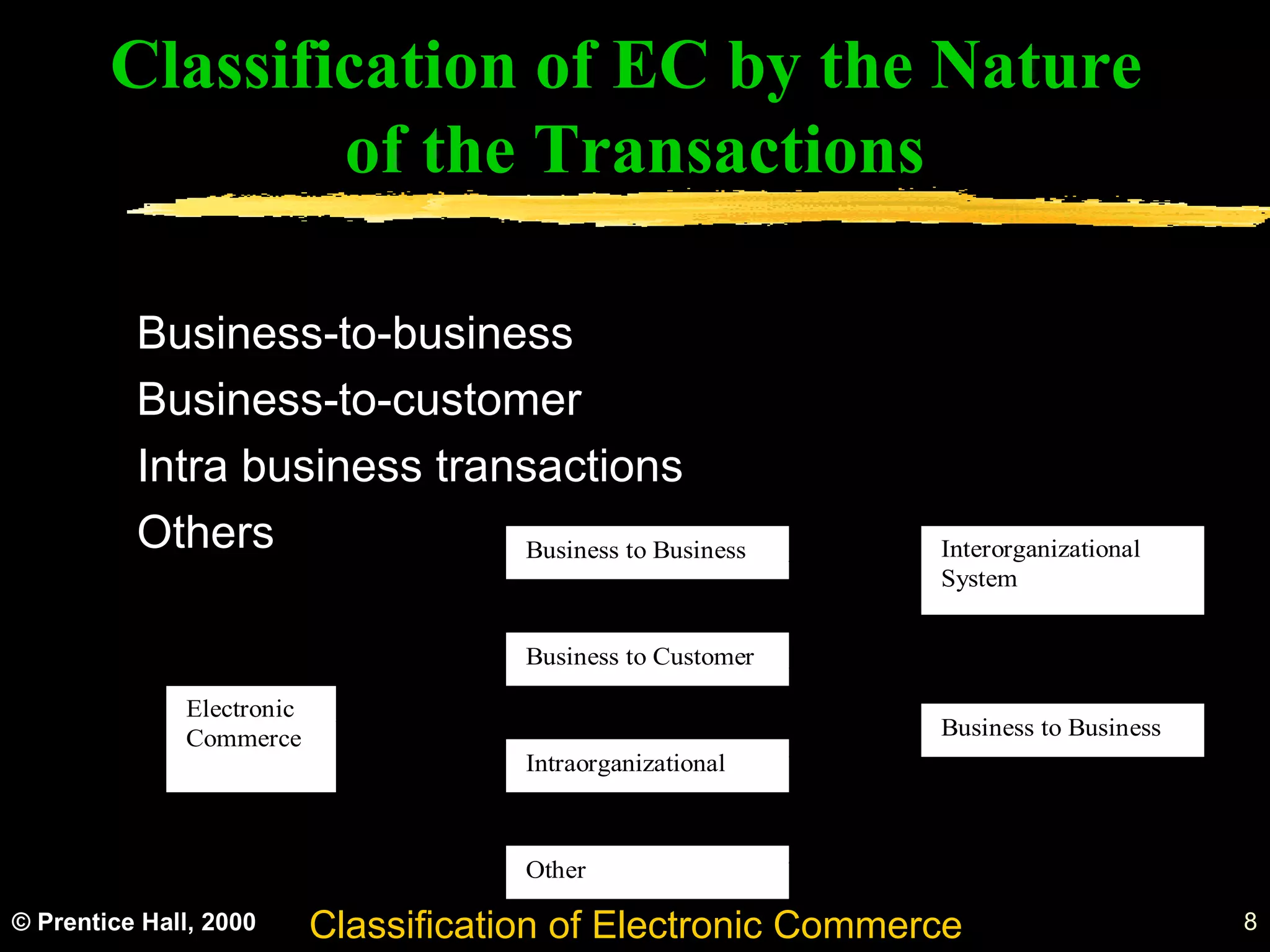
Business-to-business
Business-to-customer
Intra business transactions
Others
Electronic
Commerce
Business to Business
Business to Customer
Intraorganizational
Other
Interorganizational
System
Business to Business
Classification of Electronic Commerce
Classification of EC by the Nature
of the Transactions
© Prentice Hall, 2000
© Prentice Hall, 2000 9
Marketing
Computer sciences
Consumer behavior
and psychology
Finance
Economic
Production/Logistic
Management
information systems
Accounting and
auditing
Management
Business law and
ethics
Electronic Commerce is
Interdisciplinary
© Prentice Hall, 2000 10
The Benefits of
Electronic Commerce
Expands the marketplace to national and
international markets
Decreases the cost of creating, processing,
distributing, storing and retrieving paper-based
information
Allows reduced inventories and overhead by
facilitating “pull” type supply chain management
The pull type processing allows for customization
of products and services which provides
competitive advantage to its implementers
Benefits to Organizations
© Prentice Hall, 2000 11
Benefits to Customers
Enables customers to shop or do other
transactions 24 hours a day, all year round from
almost any location
Provides customers with more choices
Provides customers with less expensive products
and services by allowing them to shop in many
places and conduct quick comparisons
Allows quick delivery of products and services in
some cases, especially with digitized products
© Prentice Hall, 2000 12
Benefits to Customers (cont.)
Customers can receive relevant and detailed
information in seconds, rather than in days or
weeks
Makes it possible to participate in virtual auctions
Allows customers to interact with other
customers in electronic communities and
exchange ideas as well as compare experiences
Electronic commerce facilitates competition,
which results in substantial discounts.
© Prentice Hall, 2000 13
Benefits to Society
Enables more individuals to work at home, and to
do less traveling for shopping, resulting in less
traffic on the roads, and lower air pollution
Allows some merchandise to be sold at lower
prices benefiting the poor ones
Enables people in Third World countries and
rural areas to enjoy products and services which
otherwise are not available to them
Facilitates delivery of public services at a
reduced cost,increases effectiveness, and/or
improves quality
© Prentice Hall, 2000 14
The Limitations of
Electronic Commerce
Lack of sufficient system’s security, reliability,
standards, and communication protocols
Insufficient telecommunication bandwidth
The software development tools are still evolving
and changing rapidly
Difficulties in integrating the Internet and electronic
commerce software with some existing
applications and databases
Technical Limitations of Electronic Commerce
© Prentice Hall, 2000 15
Technical Limitations of
Electronic Commerce (cont.)
The need for special Web servers and other
infrastructures, in addition to the network servers
(additional cost)
Possible problems of interoperability, meaning
that some EC software does not fit with some
hardware, or is incompatible with some operating
systems or other components
© Prentice Hall, 2000 16
Other limiting factors are:
Lack of touch and feel online
Many unresolved legal issues
Rapidly evolving and changing EC
Lack of support services
Insufficiently large enough number of sellers
and buyers
Breakdown of human relationships
Expensive and/or inconvenient accessibility to
the Internet
Non-Technical Limitations (cont.)
© Prentice Hall, 2000 17
Everything Will Be Changed
Product promotion
New sales channels
Direct savings
Time-to-market (reduced cycle time)
Customer service
Brand or corporate image
Improving Direct Marketing
© Prentice Hall, 2000 18
Transforming Organizations
Work will change
Technology learning
Organizational learning
Redefining Organization
New product capabilities
New business models
Other Changes in the Workplace

Foundations of Electronic Commerce

  • 1.
    © Prentice Hall,2000 1 Foundations of Electronic Commerce
  • 2.
    © Prentice Hall,2000 2 Definitions and Content of Field Electronic Commerce (EC) is where business transactions take place via telecommunications networks, especially the Internet. Electronic commerce describes the buying and selling of products, services, and information via computer networks including the Internet. The infrastructure for EC is a networked computing environment in business, home, and government. E-Business describes the broadest definition of EC. It includes customer service and intrabusiness tasks. It is frequently used interchangeably with EC.
  • 3.
    © Prentice Hall,2000 3 A global networked environment is known as the Internet A counterpart within organizations, is called an intranet An extranet extends intranets so that they can be accessed by business partners. Definitions and Content of Field (cont.)
  • 4.
    © Prentice Hall,2000 4 Pure Vs. Partial Electronic Commerce Three dimensions the product (service) sold [physical / digital]; the process [physical / digital] the delivery agent (or intermediary) [physical / digital] Traditional commerce all dimensions are physical Pure EC all dimensions are digital Partial EC all other possibilities include a mix of digital and physical dimensions
  • 5.
    © Prentice Hall,2000 5 Implementation is dependent on four major areas people, public policy, technical standards and protocols, and other organizations. The EC management coordinates the applications, infrastructures, and pillars. It also includes Internet marketing and advertisement. The Electronic Commerce Field
  • 6.
    © Prentice Hall,2000 6 A market is a network of interactions and relationships where information, products, services, and payments are exchanged. The market handles all the necessary transactions. An electronic market is a place where shoppers and sellers meet electronically. In electronic markets, sellers and buyers negotiate, submit bids, agree on an order, and finish the execution on- or off-line. Electronic Markets
  • 7.
    © Prentice Hall,2000 7 An interorganizational information system (IOS) involves information flow among two or more organizations. Its major objective is efficient routine transaction processing, such as transmitting orders, bills, and payments using EDI or extranets. Scope: An IOS is a unified system encompassing two or several business partners. A typical IOS includes a company and its suppliers and and/or customers. Interorganization Information Systems
  • 8.
    © Prentice Hall,2000 8 Business-to-business Business-to-customer Intra business transactions Others Electronic Commerce Business to Business Business to Customer Intraorganizational Other Interorganizational System Business to Business Classification of Electronic Commerce Classification of EC by the Nature of the Transactions © Prentice Hall, 2000
  • 9.
    © Prentice Hall,2000 9 Marketing Computer sciences Consumer behavior and psychology Finance Economic Production/Logistic Management information systems Accounting and auditing Management Business law and ethics Electronic Commerce is Interdisciplinary
  • 10.
    © Prentice Hall,2000 10 The Benefits of Electronic Commerce Expands the marketplace to national and international markets Decreases the cost of creating, processing, distributing, storing and retrieving paper-based information Allows reduced inventories and overhead by facilitating “pull” type supply chain management The pull type processing allows for customization of products and services which provides competitive advantage to its implementers Benefits to Organizations
  • 11.
    © Prentice Hall,2000 11 Benefits to Customers Enables customers to shop or do other transactions 24 hours a day, all year round from almost any location Provides customers with more choices Provides customers with less expensive products and services by allowing them to shop in many places and conduct quick comparisons Allows quick delivery of products and services in some cases, especially with digitized products
  • 12.
    © Prentice Hall,2000 12 Benefits to Customers (cont.) Customers can receive relevant and detailed information in seconds, rather than in days or weeks Makes it possible to participate in virtual auctions Allows customers to interact with other customers in electronic communities and exchange ideas as well as compare experiences Electronic commerce facilitates competition, which results in substantial discounts.
  • 13.
    © Prentice Hall,2000 13 Benefits to Society Enables more individuals to work at home, and to do less traveling for shopping, resulting in less traffic on the roads, and lower air pollution Allows some merchandise to be sold at lower prices benefiting the poor ones Enables people in Third World countries and rural areas to enjoy products and services which otherwise are not available to them Facilitates delivery of public services at a reduced cost,increases effectiveness, and/or improves quality
  • 14.
    © Prentice Hall,2000 14 The Limitations of Electronic Commerce Lack of sufficient system’s security, reliability, standards, and communication protocols Insufficient telecommunication bandwidth The software development tools are still evolving and changing rapidly Difficulties in integrating the Internet and electronic commerce software with some existing applications and databases Technical Limitations of Electronic Commerce
  • 15.
    © Prentice Hall,2000 15 Technical Limitations of Electronic Commerce (cont.) The need for special Web servers and other infrastructures, in addition to the network servers (additional cost) Possible problems of interoperability, meaning that some EC software does not fit with some hardware, or is incompatible with some operating systems or other components
  • 16.
    © Prentice Hall,2000 16 Other limiting factors are: Lack of touch and feel online Many unresolved legal issues Rapidly evolving and changing EC Lack of support services Insufficiently large enough number of sellers and buyers Breakdown of human relationships Expensive and/or inconvenient accessibility to the Internet Non-Technical Limitations (cont.)
  • 17.
    © Prentice Hall,2000 17 Everything Will Be Changed Product promotion New sales channels Direct savings Time-to-market (reduced cycle time) Customer service Brand or corporate image Improving Direct Marketing
  • 18.
    © Prentice Hall,2000 18 Transforming Organizations Work will change Technology learning Organizational learning Redefining Organization New product capabilities New business models Other Changes in the Workplace